USER MANUAL 36VBC233.1 STERWINS
natural_image
Metal tool with adjustable arm and handle, no visible text or symbols
EAN:3276007807837

natural_image
Top-down view of a mechanical component with labeled parts (8b and 21), no readable text or symbols beyond labels
natural_image
Top-down view of a mechanical component with four arms and a central hub, labeled '22' (no text or symbols beyond label)
natural_image
Close-up of a black mechanical impeller with four blades and central hub (no text or symbols visible)


natural_image
Person wearing a dark jacket with a black safety belt and numbered label '18' (no text or symbols on the subject)
natural_image
Close-up of a person's seatbelt being adjusted, showing straps and buttons (no text or symbols visible)
natural_image
Illustration of two workers spraying water in a field (no text or symbols)
natural_image
Close-up of a mechanical connector with labeled component 'K' and directional arrow (no text or symbols beyond labels)
natural_image
Close-up of a handheld device with a black arrow pointing to its side panel, no visible text or symbols on the device itself.
natural_image
Technical line drawing showing two mechanical components with intersecting lines, no text or symbols present
natural_image
Simple line drawing of a hand pressing down on a mechanical component (no text or symbols)
natural_image
Illustration of a person using a manual tool to clean grass, with arrows indicating direction (no text or symbols)
natural_image
Technical line drawing of a mechanical device with rotating blades and textured surface (no text or symbols)
natural_image
Technical line drawing of a mechanical device with a circular component and directional arrow (no text or symbols)
natural_image
Close-up of a mechanical device with a labeled component 'M' and part number '21' (no readable text or symbols beyond labels)

natural_image
Mechanical component with labeled part 'P' and part number 22 (no readable text or symbols beyond label)
23
5
-7-
F
Danger!
Acendem 2 ou 1 LED(s):
When using the equipment, a few safety precautions must be observed to avoid injuries and damage. Please read the complete operating instructions and safety regulations with due care. Keep this manual in a safe place, so that the information is available at all times. If you give the equipment to any other person, hand over these operating instructions and safety regulations as well. We cannot accept any liability for damage or accidents which arise due to a failure to follow these instructions and the safety instructions.
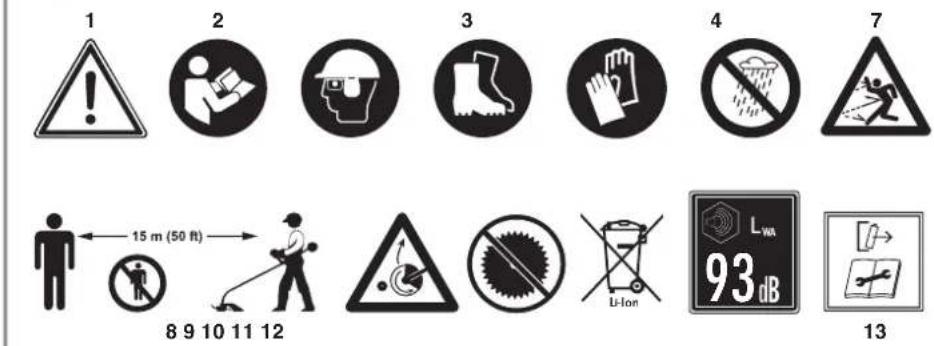
Explanation of the warning signs on the equipment (Fig. 23):
- Warning!
- Read the operating instructions before you use the tool for the first time!
- Wear safety goggles and head and ear protection.
- Wear sturdy, non-slip footwear!
- Wear safety gloves!
- Protect the tool from rain and damp!
- Watch out for thrown objects.
- All bystanders must be kept at least 15 m from the machine.
- Beware of recoil!
- Do not use any saw blades.
- The batteries must be removed from the tool before it is disposed of. How to dispose of batteries: Batteries are not allowed in household waste.
- Guaranteed sound power level
- Always remove the battery pack before making adjustments to the equipment.
1. Safety regulations
General safety information for power tools
WARNING
Read all the safety information, instructions, illustrations and technical data provided on or with this power tool. Failure to adhere to the following instructions may result in electric shock, fi re and/or serious injury.
Keep all the safety information and instructions in a safe place for future use.
The term „power tool“ used in the safety information and instructions refers to power tools operated from the mains power supply (with a power cable) and to battery operated power tools (without a power cable).
- Workplace safety
a) Keep your work area clean and well illuminated. Untidy or unlit work areas can result in accidents.
b) Do not operate the electric tool in an environment where there is a risk of explosions and where there are infl ammable liquids, gases or dust. Electric tools produce sparks which could set the dust or vapours alight.
c) Keep children and other people away from the power tool while you are using it. If you are distracted you may lose control of the power tool.
- Electrical safety
a) The connector plug from this electric tool must fit into the socket. The plug should never be altered in any way. Never use adapter plugs together with earthed electric tools. Unaltered plugs and correct sockets reduce the risk of an electric shock.
b) Avoid bodily contact with earthed surfaces such as pipes, heating, ovens and fridges. The risk of electric shock is increased if your body is earthed.
c) Keep the tool out of the rain and away from moisture. The ingress of water into an electric tool increases the risk of an electric shock.
d) Do not use the power cable for a purpose for which it is not designed, for example to carry the power tool, hang it up or to pull the plug out of the socket. Keep the power cable away from heat, oil, sharp edges and moving parts. Power cables that are damaged or tangled increase the risk of an electric shock.
e) If you use an electric power tool outdoors, use only extension cables that are suitable for outdoor use. The use of an extension cable which is suitable for outdoor use reduces the risk of an electric shock.
f) If operation of the electric tool in a damp environment can not be avoided, use a earth-leakage circuit-breaker. The earth-leakage circuit-breaker reduces the risk of an electric shock.
- Safety of persons
a) Be careful, watch what you are doing and use an electric tool sensibly. Do not use the tool if you are tired or under the influence of drugs, alcohol or medication. A moment of inattention when using the electric
GB
tool can result in serious injuries.
b) Wear personal protection equipment and always wear safety goggles. Wearing personal protection (such as dust masks, non-slip safety shoes, safety helmet or ear protection, depending upon the type and use of the electric tool) reduces the risk of injury.
c) Make sure that the appliance cannot start up accidentally. Ensure that the electric tool is switched off before you connect it to the power supply and/or insert the battery, or pick up or carry the tool. If your finger is on the switch whilst carrying the electric tool or if you connect the appliance to the mains when it is switched on, this can lead to accidents.
d) Remove all adjusting tools or wrenches before you switch on the power tool. Any tool or wrench in a rotating part of the power tool could cause injuries.
e) Avoid abnormal working postures. Make sure you stand squarely and keep your balance at all times. This will enable you to control the power tool better in unexpected situations.
f) Wear suitable clothes. Never wear loose fi tting clothes or jewelry. Keep hair, clothing and gloves away from moving parts. Loose clothing, jewelry or long hair can be caught by moving parts.
g) If dust extraction devices and dust collection devices can be fitted, they must be connected and must be used correctly. The use of a dust extractor can reduce the dangers posed by dust.
h) Do not allow yourself to be lulled into a false sense of security and do not ignore the safety regulations covering electric power tools, even if you are familiar with the power tool after having used it many times. Carelessness can lead to serious injuries in just a fraction of a second.
- Using and handling the power tool
a) Do not overload your power tool. Use the correct electric tool for the job in hand. The correct tool will enable you to work better and more safely within the specific performance range.
b) Do not use an electric power tool if the switch is defective. An electric power tool that cannot be switched on or off is dangerous and must be repaired.
c) Pull the plug out of the socket and/or remove the battery pack before making
any adjustments to the tool, changing accessories or putting the power tool down. These precautions will prevent the power tool starting accidentally.
d) Keep unused electric tools out of the reach of children. Do not allow people who are not familiar with the power tool or who have not read these instructions to use the tool. Electric tools are dangerous if they are used by inexperienced people.
e) Look after power tools plug-in tools with care. Check that moving parts function correctly and do not jam, and whether any parts are broken or damaged such that they adversely affect the function of the power tool. Have damaged parts repaired before you use the power tool. Many accidents are caused by poorly maintained electric tools.
f) Keep cutting tools sharp and clean. Carefully maintained cutting tools with sharp cutting edges will jam less and are easier to control.
g) Use the power tool, accessories, plug-in tools, etc. as set out in these instructions. Take account of the conditions in your work area and the job in hand. Using electric tools for purposes other than the one for which they are designed can result in dangerous situations.
h) Keep the handles and grip surfaces dry, clean and free from oil and grease. If the handles and grip surfaces are slippery, it will not be possible to operate and control the power tool safely in unforeseen situations.
- Using and handling the cordless tool
a) Only charge the batteries in chargers that are recommended by the manufacturer. A charger that is designed for a certain type of battery may pose a fi re risk if it is used with other types of battery.
b) Use only the correct batteries in the electric tools. The use of other batteries may result in injuries and a fi re risk.
c) Keep unused batteries away from paper clips, coins, keys, nails, screws and other metallic objects that could cause a short circuit between the contacts. A short circuit between the battery contacts may cause burns or a fire.
d) In case of incorrect use, fl uid may escape from the battery. Avoid contact with it. If you touch it by accident, rinse the aff ected area with water. If you get the fl uid
GB
in your eyes, also seek medical advice. Leaking battery fluid can cause skin irritation or burns.
e) Never use damaged or altered rechargeable batteries. Damaged or altered rechargeable batteries can behave unpredictably and lead to a risk of fire, explosion or injury.
f) Never expose a rechargeable battery to fire or high temperatures. Fire or temperatures over 130°C pose a risk of explosion.
g) Follow all the instructions on charging and never charge the rechargeable battery or cordless tool outside the specified allowable charging temperature range. Incorrect charging or charging outside the allowable charging temperature range could cause irreparable damage to the battery and increase the risk of fire.
6. Service
a) Have your electric tool repaired only by trained personnel using only genuine spare parts. This will ensure that your electric tool remains safe to use.
b) Never perform maintenance work on damaged rechargeable batteries. All maintenance work on rechargeable batteries should only be performed by the manufacturer or authorized after sales service outlets.
Additional safety instructions
We pay a great deal of attention to the design of every battery pack to ensure that we supply you with batteries which feature maximum power density, durability and safety. The battery cells have a wide range of safety devices. Each individual cell is initially formatted and its electrical characteristic curves are recorded. These data are then used exclusively to be able to assemble the best possible battery packs. Despite all the safety precautions, caution must always be exercised when handling batteries. The following points must be obeyed at all times to ensure safe use.
Safe use can only be guaranteed if undamaged cells are used. Incorrect handling can cause cell damage.
Important: Analyses confirm that incorrect use and poor care are the main causes of the damage caused by high performance batteries.
- The battery pack supplied with your cordless tool is not charged. The battery pack has to
be charged before you use the tool for the first time.
-
For optimum battery performance avoid low discharge cycles. Charge the battery pack frequently.
-
Store the battery pack in a cool place, ideally at 15°C and charged to at least 40%.
-
Lithium-ion batteries are subject to a natural ageing process. The battery pack must be replaced at the latest when its capacity falls to just 80% of its capacity when new. Weakened cells in an aged battery pack are no longer capable of meeting the high power requirements and therefore pose a safety risk.
-
Do not throw battery packs into an open fire. There is a risk of explosion!
-
Do not ignite the battery pack or expose it to fire.
-
Do not exhaustively discharge batteries. Exhaustive discharge will damage the battery cells. The most common cause of exhaustive discharge is lengthy storage or non-use of partly discharged batteries. Stop working as soon as the performance of the battery falls noticeably or the electronic protection system triggers. Place the battery pack in storage only after it has been fully charged.
-
Protect batteries and the tool from over-loads. Overloads will quickly result in overheating and cell damage inside the battery housing without this overheating actually being apparent externally.
-
Avoid damage and shocks. Replace batteries which have been dropped from a height of more than one meter or which have been exposed to violent shocks without delay, even if the housing of the battery pack appears to be undamaged. The battery cells inside the battery may have suff ered serious damage. In this respect, please also read the waste disposal information.
-
If the battery pack suffers overloading and overheating, the integrated protective cut-off will switch off the equipment for safety reasons. Important. Do not press the ON/OFF switch any more if the protective cut-off has actuated. This may damage the battery pack.
-
Use only original battery packs. The use of other batteries may result in injuries, explosion and a fire risk.
-
Protect your rechargeable battery against moisture, rain and high humidity. Moisture, rain and high humidity can cause dangerous cell damage. Never charge or work with batteries which have been exposed to moisture,
GB
rain or high humidity – replace them immediately.
- If your equipment is fi tted with a detachable battery, remove the battery for safety reasons after you have fi nished your work
-
Please check the data marked on the rating plate of the battery charger. Be sure to connect the battery charger to a power supply with the voltage marked on the rating plate. Never connect it to a different mains voltage.
-
Protect the battery charger and its cable from damage and sharp edges. If the power cable has to be replaced, this must be done by the manufacturer or one of its agents, to prevent safety risks.
-
Keep the battery charger, batteries and the cordless tool out of children's reach.
-
Do not use damaged battery chargers.
-
Do not use the supplied battery charger to charge other cordless tools.
-
In heavy use the battery pack will become warm. Allow the battery pack to cool to room temperature before commencing with the charging.
-
Do not over-charge batteries. Do not exceed the maximum charging times. These charging times only apply to discharged batteries. Frequent insertion of a charged or partly charged battery pack will result in over-charging and cell damage. Do not leave batteries in the charger for days on end.
-
Never use or charge batteries if you suspect that the last time they were charged was more than 12 months previously. There is a high probability that the battery pack has already suff ered dangerous damage (exhaustive discharge).
-
Charging batteries at a temperature below 10^ C will cause chemical damage to the cell and may cause a fire.
-
Do not use batteries which have heated during the charging process, as the battery cells may have suffered dangerous damage.
-
Do not use batteries which have suff ered curvature or deformation during the charging process or which show other non-typical symptoms (gassing, hissing, cracking,...)
-
Never fully discharge the battery pack (recommended depth of discharge max. 80%) A complete discharge of the battery pack will lead to premature ageing of the battery cells.
-
Never charge the batteries unsupervised.
Protection from environmental influences
-
Wear suitable work clothes. Wear safety goggles.
-
Protect your cordless tool and the battery charger from moisture and rain. Moisture and rain can cause dangerous cell damage.
-
Do not use the cordless tool or the battery charger near vapors and infl ammable liquids.
-
Use the battery charger and cordless tools only in dry conditions and an ambient temperature of 10-40°C.
-
Do not keep the battery charger in places where the temperature is liable to reach over 40^ C. In particular, do not leave the battery charger in a car that is parked in the sunshine.
-
Protect batteries from overheating. Overloads, over-charging and exposure to direct sunlight will result in overheating and cell damage. Never charge or work with batteries which have been overheated – replace them immediately if possible.
-
Storage of batteries, battery chargers and cordless tools. Store the charger and your cordless tool only in dry places with an ambient temperature of 10-40°C. Store your lithium-ion battery pack in a cool, dry place at a temperature of 10-20°C. Protect them from humidity and direct sunlight. Only place fully charged batteries in storage (charged at least 40%).
-
Prevent the lithium-ion battery pack from freezing. Battery packs which were stored below 0^ C for more than 60 minutes must be disposed of.
-
When handling batteries beware of electrostatic charge: Electrostatic discharges cause damage of the electronic protection system and the battery cells. Avoid electrostatic charging and never touch the battery poles.
Batteries and cordless electric equipment contain materials that are potentially harmful to the environment. Never place any rechargeable batteries or cordless electric machines or tools in your household refuse.
The rechargeable battery should be taken to a suitable collection center for proper disposal. If you do not know the whereabouts of such a collection center, you should ask in your local council offices.
To ensure that any defective/damaged lithium-ion batteries are properly packaged and delivered when you send them to us, please
GB
contact our customer service or the point of sale at which the equipment was purchased.
When shipping or disposing of batteries and cordless tools, always ensure that they are packed individually in plastic bags to prevent short circuits and fi res.
Children are not allowed to use this equipment. Children should be supervised so that they do not play with the equipment. Children are not allowed to carry out cleaning or maintenance. This equipment is not allowed to be used by people with limited physical, sensory or mental capacities or by those with insufficient knowledge or experience unless they are supervised or instructed by a person who is responsible for them.
Grass trimmer and brush cutter safety warnings
a) Do not use the machine in bad weather conditions, especially when there is a risk of lightning. This decreases the risk of being struck by lightning.
b) Thoroughly inspect the area for wildlife where the machine is to be used. Wildlife may be injured by the machine during operation.
c) Thoroughly inspect the area where the machine is to be used and remove all stones, sticks, wires, bones, and other foreign objects. Thrown objects can cause personal injury.
d) Before using the machine, always visually inspect to see that the cutter or blade and the cutter or blade assembly are not damaged. Damaged parts increase the risk of injury.
f) Follow instructions for changing accessories. Improperly tightened blade securing nuts or bolts may either damage the blade or result in it becoming detached.
g) The rated rotational speed of the blade must be at least equal to the maximum rotational speed marked on the machine. Blades running faster than their rated rotational speed can break and fly apart.
h) Wear eye, ear, head and hand protection. Adequate protective equipment will reduce personal injury by flying debris or accidental contact with the cutting line or blade.
j) While operating the machine, always wear safety footwear. Do not operate the machine when barefoot or wearing open sandals. This reduces the chance of injury to the
feet from contact with a moving cutter, line or blade.
k) While operating the machine, always wear long trousers. Exposed skin increases the likelihood of injury from thrown objects.
I) Keep bystanders away while operating the machine. Thrown debris can result in serious personal injury.
m) Always use two hands when operating the machine. Holding the machine with both hands will avoid loss of control.
n) Hold the machine by insulated gripping surfaces only, because the cutting line or blade may contact hidden wiring or its own cord. Cutting line or blades contacting a „live“ wire may make exposed metal parts of the machine „live“ and could give the operator an electric shock.
o) Always keep proper footing and operate the machine only when standing on the ground. Slippery or unstable surfaces may cause a loss of balance or control of the machine.
p) Do not operate the machine on excessively steep slopes. This reduces the risk of loss of control, slipping and falling which may result in personal injury.
q) When working on slopes, always be sure of your footing, always work across the face of slopes, never up or down and exercise extreme caution when changing direction. This reduces the risk of loss of control, slipping and falling which may result in personal injury.
s) Keep all parts of the body away from the cutter, line or blade when the machine is operating. Before you start the machine, make sure the cutter, line or blade is not contacting anything. A moment of inattention while operating the machine may result in injury to yourself or others.
t) Do not operate the machine above waist height. This helps prevent unintended cutter or blade contact and enables better control of the machine in unexpected situations.
u) When cutting brush or saplings that are under tension, be alert for spring back. When the tension in the wood fi bres is released, the brush or sapling may strike the operator and/or throw the machine out of control.
v) Use extreme caution when cutting brush and saplings. The slender material may catch the blade and be whipped toward you or pull you off balance.
GB
w) Maintain control of the machine and do not touch cutters, lines or blades and other hazardous moving parts while they are still in motion. This reduces the risk of injury from moving parts.
x) When clearing jammed material or servicing the machine, make sure all power switches are off and the battery is disconnected. Unexpected starting of the machine while clearing jammed material or servicing may result in serious personal injury.
y) Carry the machine with the machine switched off and away from your body. Proper handling of the machine will reduce the likelihood of accidental contact with a moving cutter, line or blade.
z) When transporting or storing the machine, always fi t the cover on metal blades. Proper handling of the machine will reduce the likelihood of accidental contact with the blade.
aa) Only use replacement cutters, lines, cutting heads and blades specified by the manufacturer. Incorrect replacement parts may increase the risk of breakage and injury.
bb) When removing jammed materials or performing maintenance work on the machine, check to make sure that the switch is turned off and the battery has been removed. Serious injuries could occur if the machine starts running unexpectedly when you are removing jammed materials or performing maintenance work.
Blade thrust causes and related warnings Blade thrust is a sudden sideways, forward or backward motion of the machine, which may occur when the blade jams or catches on an object such as a sapling or a tree stump. It can be violent enough to cause the machine and/or operator to be propelled in any direction, and possibly lose control of the machine.
Blade thrust and its related hazards can be avoided by taking proper precautions as given below.
a) Maintain a fi rm grip with both hands on the machine and position your arms to resist blade thrust. Position your body to the left side of the machine. Blade thrust can increase the risk of injury due to the machine moving unexpectedly. Blade thrust can be controlled by the operator if proper precautions are taken.
b) If the blade binds, or when interrupting
a cut for any reason, switch the machine off and hold the machine motionless in the material until the blade comes to a complete stop. While the blade is binding, never attempt to remove the machine from the material or pull the machine backward while the blade is in motion, otherwise blade thrust may occur. Investigate and take corrective actions to eliminate the cause of blade binding.
c) Do not use blunt or damaged blades.
Blunt or damaged blades increase the risk of jamming or catching on an object, resulting in blade thrust.
d) Always maintain good visibility of the material being cut. Blade thrust is more likely to occur in areas where it is difficult to see the material being cut.
e) If you are approached by another person while operating the machine, switch the machine off. There is an increased risk of injury to other persons being struck by the moving blade in the event of blade thrust.
Do not lose these safety instructions.
2. Layout and items supplied
2.1 Layout (Fig. 1/2)
- Battery mount
- On/Off switch
- Safety lock-off
- Strap attachment
- Additional handle
5a. Fastening clip
- Top part of long handle
- Handle connecting piece
- Union nut
- Bottom part of long handle
- Motor housing
- Spool housing
- Guard hood
- String blade
- String blade guard
- Handle
- String spool
- String
- Harness
- Undergrowth blade
19a. Safety guard
- Multifunctional tool
- Pressure plate
- 25 hex nut M10, self-locking
GB
23. Hex key
2.2 Items supplied
Please check that the article is complete as specified in the scope of delivery. If parts are missing, please contact our service center or the sales outlet where you made your purchase at the latest within 5 working days after purchasing the product and upon presentation of a valid bill of purchase. Also, refer to the warranty table in the service information at the end of the operating instructions.
- Open the packaging and take out the equipment with care.
- Remove the packaging material and any packaging and/or transportation braces (if available).
- Check to see if all items are supplied.
- Inspect the equipment and accessories for transport damage.
- If possible, please keep the packaging until the end of the guarantee period.
Danger!
The equipment and packaging material are not toys. Do not let children play with plastic bags, foils or small parts. There is a danger of swallowing or suffocating!
• Top section of the trimmer
- Bottom section of the trimmer with string spool
- Guard hood
- Harness
• Undergrowth blade
• Assembly material
• Original Operating Instructions
3. Proper use
Used as a cordless scythe (using the cutting blade) the equipment is designed for cutting young trees, strong weeds and light undergrowth.
Used as a cordless grass trimmer (using the line spool with cutting line) the equipment is designed for cutting lawns, grassed areas and small weeds.
Important! Due to the high risk of bodily injury to the user, the equipment is not allowed to be used to clean paths or to chop up tree and hedge clippings. Similarly, the equipment must not be used to level out high areas such as molehills. For safety reasons, the equipment must not be used
as a drive unit for other work tools or toolkits of any kind.
Danger! Do not use any kind of metal wire or metal wire encased in plastic in the string spool. This may cause serious injuries to the user.
Danger! Do not use any saw blades.
The equipment is to be used only for its prescribed purpose. Any other use is deemed to be a case of misuse. The user / operator and not the manufacturer will be liable for any damage or injuries of any kind caused as a result of this.
Please note that our equipment has not been designed for use in commercial, trade or industrial applications. Our warranty will be voided if the equipment is used in commercial, trade or industrial businesses or for equivalent purposes.
Caution!
Residual risks
Even if you use this electric power tool in accordance with the instructions, certain residual risks cannot be eliminated. The following hazards may arise in connection with the equipment's construction and layout:
- Lung damage if no suitable protective dust mask is used.
- Damage to hearing if no suitable ear protection is applied.
- Health damage caused by hand-arm vibrations if the equipment is used over a longer period or is not properly guided and maintained.
- Injury and damage to property caused by flying parts.
- Cut injuries if no suitable safety clothing is used.
4. Technical data
Voltage 36 V d.c.
Speed n_0 6000 min ^-1
Cutting circle diameter of line ....∅ 33 cm
Line length 6 m
Line diameter 2.0 mm
Cutting circle diameter of blade .....∅ 23 cm
Weight 3.4 kg
GB
Important!
The equipment is supplied without batteries and without a charger and is allowed to be used only with the lithium-ion batteries (two batteries) of the Power X-Change series!
The lithium-ion batteries of the Power X-Change series are allowed to be charged only with the Power-X charger.
Danger!
Sound and vibration
Sound and vibration values were measured in accordance with EN 62841.
Using with cutting string
Sound pressure level L_nA : 82.4 dB(A)
Uncertainty K_nA : 3 dB
Sound power level L_NA : 90.2 dB(A)
Uncertainty K_w : 2.54 dB
Guaranteed sound power level L_WA : ..... 93 dB(A)
Using with an undergrowth blade
Sound pressure level L_pA : 75.2 dB(A)
Uncertainty K_nA : 3 dB
Sound power level L_WA : 84.5 dB(A)
Uncertainty K_w : 3 dB
Wear ear-muff s.
The impact of noise can cause damage to hearing.
Total vibration values (vector sum of three directions) determined in accordance with EN 62841.
Handle with cutting line
Vibration emission value a_h = 4.357 m/s^2
K uncertainty = 1.5 m/s²
Handle with an undergrowth blade
Vibration emission value a_h = 10.002 m/s^2
K uncertainty = 1.5 m/s²
The stated vibration emission levels and stated noise emission values were measured in accordance with a set of standardized criteria and can be used to compare one power tool with another.
The stated vibration emission levels and stated noise emission values can also be used to make an initial assessment of exposure.
Warning:
The vibration and noise emission levels may vary from the level specified during actual use, depending on the way in which the power tool is used, especially the type of workpiece it is used for.
WARNING: It is essential to specify safety measures for the protection of the operator which are based on an estimate of exposure during actual conditions of use (all stages of the operating cycle must be considered, e.g. times in which the electric tools are switched off and times in which the tool is switched on but operates without load).
Keep the noise emissions and vibrations to a minimum.
- Only use appliances which are in perfect working order.
• Service and clean the appliance regularly.
• Adapt your working style to suit the appliance.
• Do not overload the appliance.
- Have the appliance serviced whenever necessary.
- Switch the appliance off when it is not in use.
• Wear protective gloves.
• Wear eye and hearing protection
5. Before starting the equipment
The machine is supplied without batteries and without a charger!
Caution! Carry out all the following assembly and adjustment work without rechargeable batteries – risk of injury. Wear protective gloves.
5.1 Fitting the guard hood (Fig. 3a-3c)
Place the guard hood (12) onto the mount on the motor housing as shown in Fig. 3a and fasten it with the supplied multifunctional tool (19) (Fig. 3b). On the bottom side of the guard hood (12) is a blade (13) for automatically adapting the length of the cutting string (14). This blade is fitted with a string blade guard (14) which must be removed before beginning to work.
5.2 Fitting the additional handle (Fig. 4a, 4b)
Use the supplied hex key (Fig. 2 / Item 23) to fi t/ remove or slacken/tighten the additional handle. Fit the additional handle (5) onto the top part of the long handle (6) as shown in Fig. 4a and 4b using the fastening clip (5a). If necessary, you can move the additional handle by loosening the fas-
GB
tening screws (Fig. 4b/ Item A) to adjust it to your requirements.
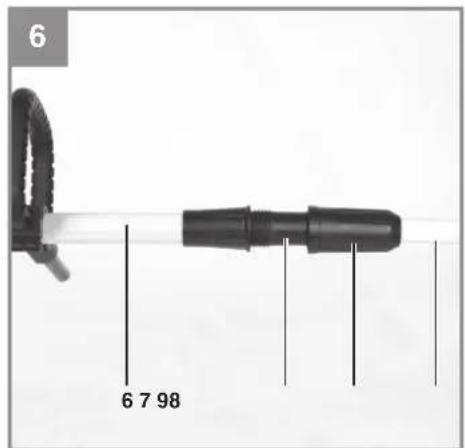
5.3 Fitting the long handle (Fig. 6)
Insert the bottom part of the long handle (9) into the upper part of the long handle (6). Screw the handle connecting piece (7) to the top part of the long handle with the union nut (8) on the bottom part of the long handle.
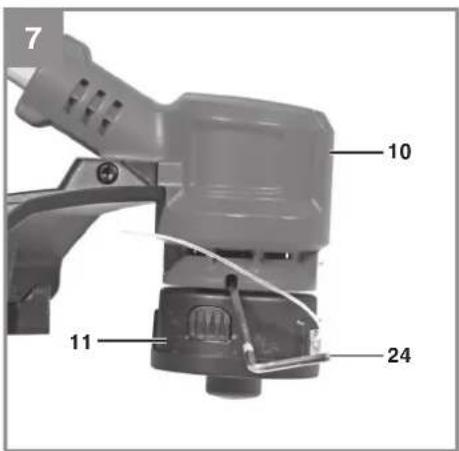
5.4 Removing/fi tting the string unit (Fig. 7)
Note: The tool is supplied from the factory ready for operation with the string.
Warning! Take care not to injure yourself on the string blade.
a) Removing the string unit
For later use as a brushcutter you must remove the string unit. Turn the spool housing (11) until you can see the recess of the fl ange on the housing recess. Insert the hex key (24) into the recesses and turn the spool housing clockwise off the gear axle.
b) Fitting the string unit
For later use as a grass trimmer you must mount the string unit. Turn the spool housing (12) counter-clockwise onto the gear axle until you can see the recess of the fl ange on the housing recess. Insert the hex key (23) into the recesses and turn the spool housing (12) counter-clockwise. Remove the hex key. Check whether the string unit can rotate freely. If this is not the case, have the mechanism checked by an expert.
5.5 Fitting/removing the undergrowth blade
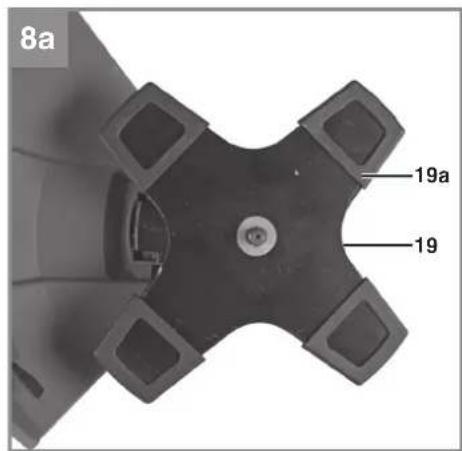
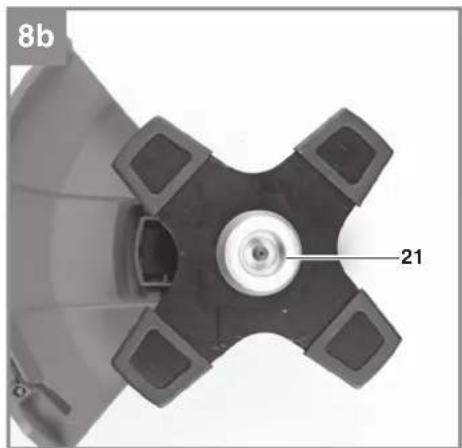
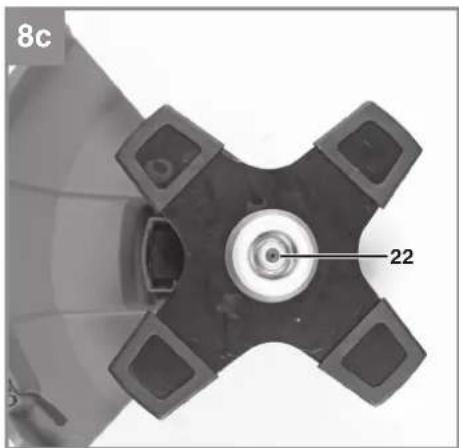
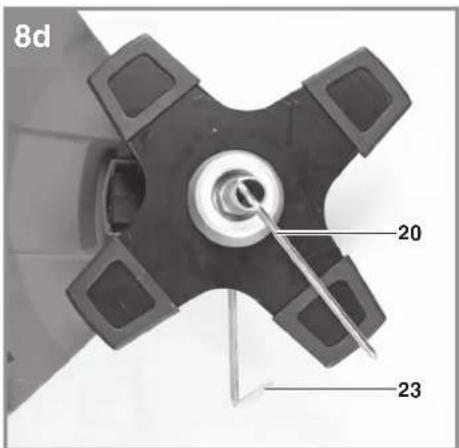
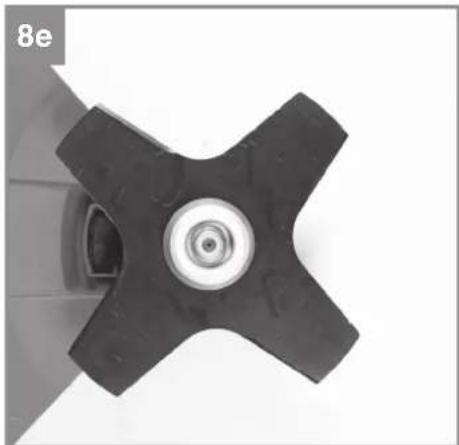
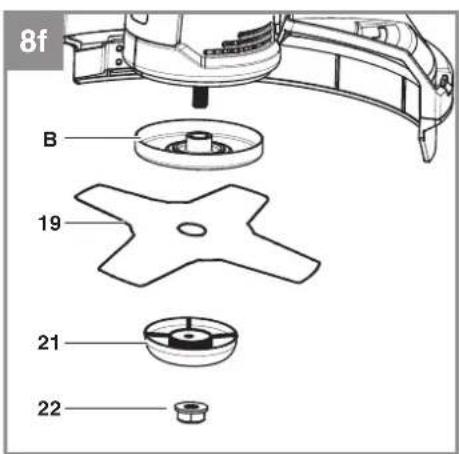
- The procedure for fitting the undergrowth blade is shown in Figs. 8a-8e. Note the detailed drawing 8f.
- The undergrowth blade (19) can be used on both sides (reversible blade). If the undergrowth blade becomes damaged, deformed, blunt or otherwise worn you must replace it with a new one.
- On the ends of the undergrowth blade there are safety guards (19a) which must be removed prior to use. These guards must be put back in place after use, during storage and during transport.
- Use only the Einhell undergrowth blade specified in the section "Ordering spare parts". Danger! Accessories from other suppliers can be dangerous and might result in serious injuries and damage to the tool.
Warning! Take care not to injure yourself on the undergrowth blade.
a) Fitting the undergrowth blade
Important! If the spacer between the under-growth blade and the motor housing (detailed drawing 8g/Item B) slips off the motor shaft (M) during dismantling, push it back onto the motor shaft as shown in the drawing.
- Fit the undergrowth blade (19) in place.
- The pressure plate (21) must be fitted with the higher edge facing the undergrowth blade (detailed drawing 8f).
- Screw the size M10 hex nut (22) in place. Warning! For safety reasons, self-locking nuts are allowed to be used only once without exception.
- Insert the hex key (23) into the recess of the gear housing and flange. Tighten the hex nut with the multifunctional tool (20).
- Check whether the blade (19) can rotate freely after you let go of the locking lever. If this is not the case, have the mechanism checked by an expert.
b) Removing the undergrowth blade
Remove the undergrowth blade in reverse order to that described in section 5.5.a.
- That the tool is in perfect condition and that the safety devices and cutting devices are complete.
• That all the screws are securely fastened.
• That all moving parts move smoothly.
Important! Vibrations when using the under-growth blade
If far stronger vibrations arise after you have fitted the undergrowth blade than compared to when using the string, this is because the undergrowth blade is not fitted in central position. Switch off the tool immediately. Remove the battery/batteries and refi t the undergrowth blade as previously described.
Caution! An undergrowth blade that is not fitted in central position will damage the tool!
A worn undergrowth blade must be replaced with a new one (see Section 7.5).
5.6 Using the harness
Caution! Always use the supplied harness when working with the tool (Fig. 2/Item 18). Do not use an additional harness. Always switch off the tool
GB
before you release the harness – risk of injury!
- (Fig. 9a) Hook the carabiner (Item 18a) into the strap holder (Item 4).
- (Fig. 9b) Slip the harness (Item 20) over your shoulder.
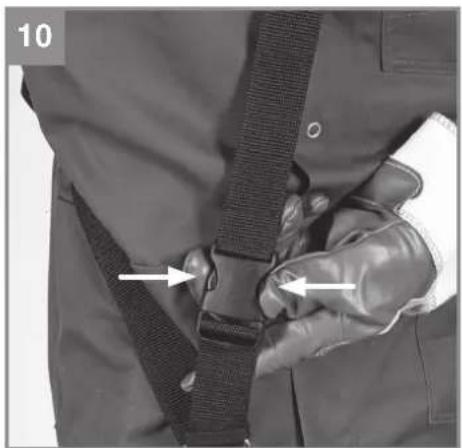
- (Fig. 10) The harness is equipped with a buckle. Press the hooks together if you need to put down the tool quickly.
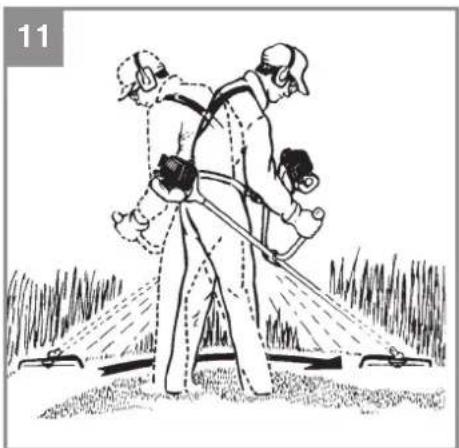
- (Fig. 11) Set the length of the harness in such a way that the cutting head runs parallel to the ground. To establish the optimum length of the harness, you should then make a few swinging movements without starting the equipment.
5.7 Fitting the battery (Fig. 13)
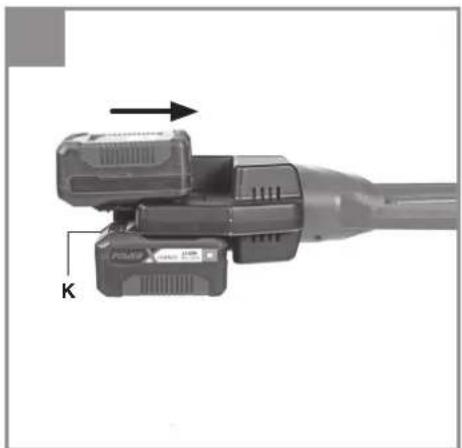
Push the rechargeable batteries into the battery mounts provided on the left and right of the tool (Fig. 2/Item 1). When the battery is pushed in fully it will engage audibly. To remove the battery, press the pushlock button (Item K) and pull out the battery.
Important!
Use only batteries which are charged to the same level. Never combine full and half-full batteries. Always charge the two batteries simultaneously. The machine's operating time depends on the battery with the lower charge level. The two batteries must always be fully charged before use.
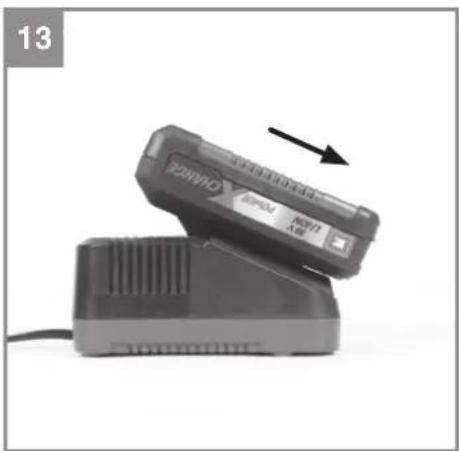
5.8 Charging the battery (Fig. 13)
- Take the battery pack out of the equipment. Do this by pressing the pushlock button.
- Check that your mains voltage is the same as that marked on the rating plate of the battery charger. Insert the power plug of the charger into the socket outlet. The green LED will then begin to flash.
- Insert the battery pack into the charger.
- In the section entitled „Charger indicator“ you will find a table with an explanation of the LED indicator on the charger.
The battery pack can become a little warm during the charging. This is normal.
If the battery pack fails to charge, check:
• whether there is voltage at the socket outlet
- whether there is good contact at the charging contacts
If the battery pack still fails to charge, send
• the charging unit
• and the battery pack
to our customer service center.
To ensure that the battery pack provides long service, you should take care to recharge it promptly. You must recharge the battery pack when you notice that the power of the cordless grass trimmer drops. Never allow the battery pack to become fully discharged. This will cause it to develop a defect.
To ensure that items are properly packaged and delivered when you send them to us, please contact our customer service or the point of sale at which the equipment was purchased.
When shipping or disposing of batteries and cordless tools, always ensure that they are packed individually in plastic bags to prevent short circuits and fi res.
5.9 Battery capacity indicator (Fig. 14)
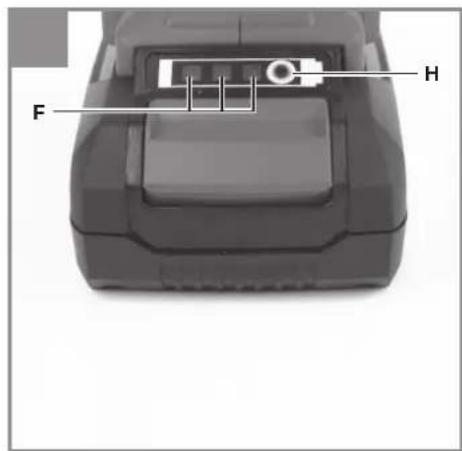
Press the button for the battery capacity indicator (Item H). The battery capacity indicator (Item F) shows the charge status of the battery using 3 LEDs.
All 3 LEDs are lit:
The battery is fully charged.
2 or 1 LED(s) are lit:
The battery has an adequate remaining charge.
1 LED blinks:
The battery is empty, recharge the battery.
All LEDs blink:
The battery temperature is too low. Remove the battery from the equipment, keep it at room temperature for one day. If the fault reoccurs, this means that the rechargeable battery has undergone exhaustive discharge and is defective. Remove the battery from the equipment. Never use or charge a defective battery.
GB
6. Operation
Please note that the statutory regulations governing noise abatement may differ from one location to another.
Danger! The guard hood must be fitted when carrying out work.
Switching on
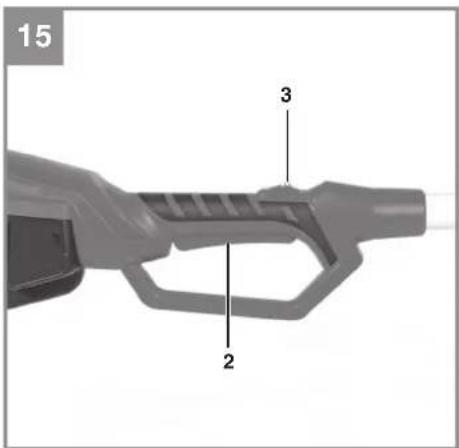
Push forward the safety lock-off (Item 3) and press the On/Off switch (Item 2). Once the tool is running, you can release the safety lock-off.
Switching off
Let go of the On/Off switch.
6.2 Practical tips
- Switch off the tool, remove the battery and check the tool for wear or damage:
- after the tool strikes a foreign body.
- whenever the tool begins to make unusual vibrations (examine immediately).
The tool is not allowed to be put into operation again until the cause is eliminated. If you fail to find the cause of the vibrations, contact a service center and arrange for essential repairs.
- If there is string on the tool, you can use the blade on the string guard hood to shorten the string. Take care not to cut your fingers on the blade.
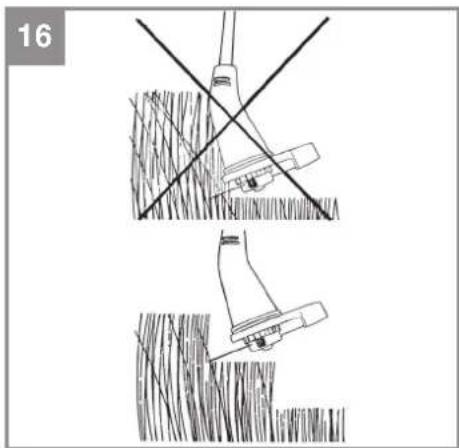
Practice all the work steps with the motor switched off and without the rechargeable battery before you start to use the equipment. Only use the cutting line to mow grass that is dry. If the grass is long, the grass must be cut shorter in stages (Fig. 16).
Extending the cutting line (Fig. 17)
Danger! Do not use any kind of metal wire or metal wire encased in plastic in the line spool. This may cause serious injuries to the user.
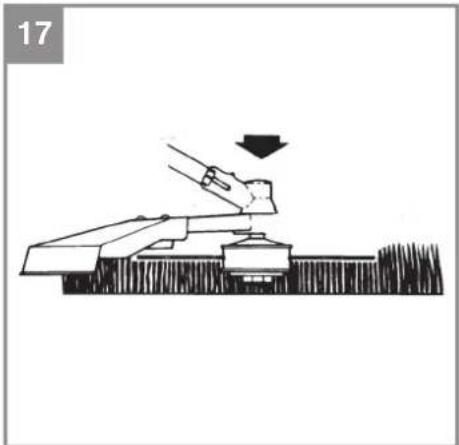
The grass trimmer has a semi-automatic line extension system (automatic jog line feed). Each time you activate the semi-automatic line extension system, the line is automatically extended to ensure that you can cut your lawn with the perfect cutting width at all times. To extend the cutting line, run the motor and tap the line spool on the
ground. This will automatically extend the line. The blade on the guard hood will cut the line to the permissible length. Please note that the more often you activate the semi-automatic line extension system, the more the line will wear.
Note: If the line is too long when you use the equipment for the fi rst time, the surplus end of it will be cut by the blade on the guard hood. If the line is too short when you start the equipment for the fi rst time, press the knob on the line spool and pull the line hard. When you then start the machine for the fi rst time the line will be cut to the perfect length automatically.
Using a brush or similar, carefully remove all residual grass from the underside of the guard hood at regular intervals.
Different cutting methods
When the equipment is correctly assembled it will cut weeds and long grass in places which are difficult to access, e.g. along fences, walls and foundations and also around trees. It can also be used for „mowing“ down vegetation so that a garden can be better prepared or a certain area cleared down to the soil.
Please note: Even if it is used carefully, cutting around foundations, stone or concrete walls, etc. will result in the line suffering above normal wear.
Trimming/mowing
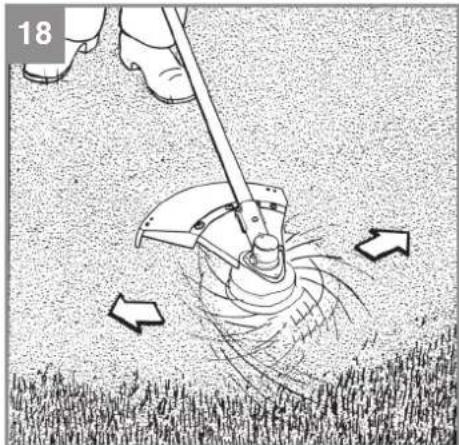
Swing the trimmer from side to side in a scything motion. Always keep the line spool parallel to the ground. Check the site and decide which cutting height you require. Guide and hold the line spool at the required height to obtain an even cut (Fig. 18).
Low trimming
Hold the trimmer right in front of you at a slight angle so that the underside of the line spool is above the ground and the line strikes the correct target. Always cut away from yourself. Never draw the trimmer towards yourself.
Cutting along fences/foundations
Approach wire mesh fences, lath fences, natural stone walls and foundations slowly so that you can cut close to them without striking the obstacle with the line. If, for example, the line strikes stones, stone walls or foundations, it will wear or fray. If the line strikes wire fencing, it will break.
GB
Trimming around trees
When trimming around tree trunks, approach slowly so that the line does not strike the bark. Walk around the tree, cutting from left to right. Approach grass or weeds with the tip of the line and tilt the line spool forwards slightly.
Warning: Take extreme care during mowing work. When doing such work keep a distance of 30 meters between yourself and other people or animals.
Mowing
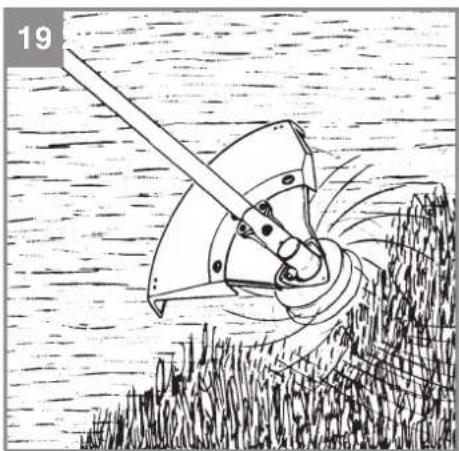
When mowing down to the ground you will cut all the vegetation. To do this, set the line spool at an angle of 30^ to the right. Place the handle in the required position. Remember the increased risk of injury to the user, watchers and animals, and the danger of damaging property due to objects (for example stones) being thrown up (Fig. 19).
Warning: Do not use the equipment to remove objects from footpaths, etc!
The equipment is a powerful tool and can throw small stones and other objects a distance of 15 meters or more, causing injuries and damage to cars, houses and windows.
Sawing
The equipment is not suitable for sawing.
Jamming
If the cutting blade jams as a result of attempting to cut vegetation that is too dense, switch off the motor immediately. Remove the grass and scrub from the equipment before you restart it.
Preventing recoil
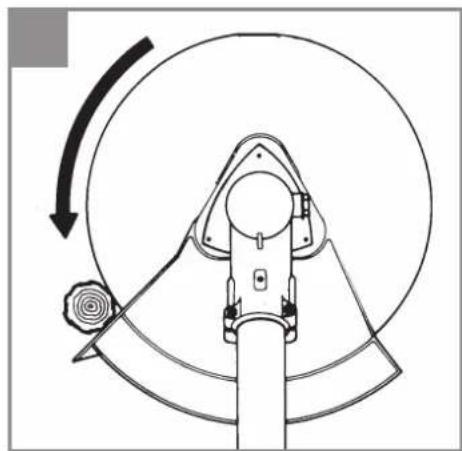
When you work with the blade, there is a risk of recoil if it strikes solid objects (tree trunks, branches, tree stumps, stones or the like). This will throw the equipment backwards in the direction opposite to the rotation of the tool. This can cause you to lose control of the equipment. Do not use the blade near fences, metal posts, boundary stones or foundations.
For cutting dense stalks, position the blade as shown in Fig. 20 to prevent recoil.
7. Cleaning, maintenance and ordering of spare parts
Danger!
Before putting away or cleaning the grass trim-mer, switch off and remove the battery pack.
7.1 Cleaning
- Keep all safety devices, air vents and the motor housing free of dirt and dust as far as possible. Wipe the equipment with a clean cloth or blow it with compressed air at low pressure.
• We recommend that you clean the device immediately each time you have finished using it.
- Clean the equipment regularly with a moist cloth and some soft soap. Do not use cleaning agents or solvents; these could attack the plastic parts of the equipment. Ensure that no water can seep into the device. The ingress of water into an electric tool increases the risk of an electric shock.
- Use a brush to remove deposits from the safety guard
7.2 Replacing the string spool
Danger! Remove the batteries!
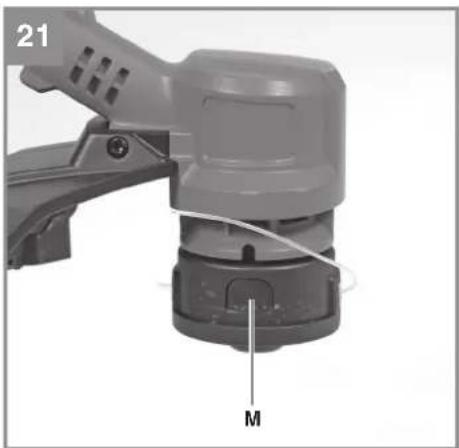
- Fig. 21: Press together the string spool housing at the point marked with "M" and the opposite point, and remove the spool cover.
- Remove the empty string spool.
- Fig. 22: Thread each of the string ends of the new string spool through each of the two eyelets (P) in the spool cover and let the string project by approx. 22 cm.
- Press the spool cover back into the string spool housing.
When you start the equipment again the line will be cut to the perfect length automatically.
Caution! Bits of the nylon line could cause injury when fl ung out!
7.3 Sharpening the guard hood blade
The guard hood blade (Fig. 2/Item 13) can become blunt over time. When you notice this, undo the screw holding the guard hood blade on the guard hood. Clamp the blade in a vise. Sharpen the blade with a flat file and make sure that the angle of the cutting edge is not altered in the process. File in one direction only.
GB
7.4 Maintenance
There are no parts inside the equipment which require additional maintenance.
7.5 Ordering replacement parts:
Please quote the following data when ordering replacement parts:
• Type of machine
• Article number of the machine
• Identification number of the machine
- Replacement part number of the part required For our latest prices and information please go to www.Einhell-Service.com
Spare line spool Art. No.: 34.051.03
Spare cutting blade Art. No.: 34.050.04
8. Disposal and recycling
The equipment is supplied in packaging to prevent it from being damaged in transit. The raw materials in this packaging can be reused or recycled. The equipment and its accessories are made of various types of material, such as metal and plastic. Never place defective equipment in your household refuse. The equipment should be taken to a suitable collection center for proper disposal. If you do not know the whereabouts of such a collection point, you should ask in your local council offices.
9. Storage and transport
Remove the batteries. Store the equipment and its accessories in a dark and dry place at above freezing temperature. The ideal storage temperature is between 5 and 30 °C. Store the electric equipment in its original packaging.
- Always hold the equipment with one hand on the handle and the other hand on the additional handle. Do not carry the equipment by its motor housing.
- Secure the equipment against slipping if you transport it in a vehicle.
- As far as possible, use the original packaging for transporting the equipment.
- Use a transport guard for metal blades during transport and storage.
10. Faults
The equipment does not work:
Check that the battery is charged and whether the charging unit is working. If the equipment will not work in spite of the voltage supply being OK, please send it to the customer service address below.
The string is pushed into the spool housing
If the string is pushed into the spool housing when it impacts on an object (e.g. a bed surround), this is because the string is wound in the wrong direction.
Disposal

Power tools, rechargeable batteries, accessories and packaging should be sorted for environmental-friendly recycling.
Do not dispose of power tools and batteries/re-chargeable batteries into household waste!
Only for EU countries:
According to the Directive 2012/19/EU on waste electrical and electronic equipment and its transposition into national law, power tools that are no longer usable, and, according to the Directive 2006/66/EC, defective or drained batteries must be collected separately and disposed of in an environmentally correct manner.
If disposed incorrectly, waste electrical and electronic equipment may have harmful effects on the environment and human health, due to the potential presence of hazardous substances.
Only for United Kingdom:
According to The Waste Electrical and Electronic Equipment Regulations 2013 (SI 2013/3113) (as amended) and the Waste Batteries and Accumulators Regulations 2009 (SI 2009/890) (as amended), products that are no longer usable must be collected separately and disposed of in an environmentally friendly manner.
The reprinting or reproduction by any other means, in whole or in part, of documentation and papers accompanying products is permitted only with the express consent of the Einhell Germany AG.
Subject to technical changes.
11. Charger indicator
| Indicator status Expl | Planations and actions |
| Red LED Green LED | |
| Off | Flashing | Ready for useThe charger is connected to the mains and is ready for use; there is no battery pack in the charger |
| On Off Charging | The charger is charging the battery pack in quick charge mode. The charging times are shown directly on the charger.Important! The actual charging times may vary slightly from the stated charging times depending on the existing battery charge. |
| Off | On | The battery is charged and ready for use. (READY TO GO)The unit then changes over to gentle charging mode until the battery is fully charged.To do this, leave the rechargeable battery on the charger for approx. 15 minutes longer.Action:Take the battery pack out of the charger. Disconnect the charger from the mains supply. |
| Flashing Off | Adapted charging | The charger is in gentle charging mode.For safety reasons the charging is performed less quickly and takes more time. The reasons can be:- The rechargeable battery has not been used for a very long time.- The battery temperature is outside the ideal range.Action:Wait for the charging to be completed; you can still continue to charge the battery pack. |
| Flashing Flashing Fault | Charging is no longer possible. The battery pack is defective.Action:Never charge a defective battery pack.Take the battery pack out of the charger. |
| On On Temperature fault | The battery pack is too hot (e.g. due to direct sunshine) or too cold (below 0^ ).Action:Remove the battery pack and keep it at room temperature (approx. 20^ ) for one day . |
GB
We have competent service partners in all countries named on the guarantee certificate whose contact details can also be found on the guarantee certificate. These partners will help you with all service requests such as repairs, spare and wearing part orders or the purchase of consumables.
Please note that the following parts of this product are subject to normal or natural wear and that the following parts are therefore also required for use as consumables.
| Category Example | |
| Wear parts* Rechargeable battery, line spool holder | |
| Consumables* Line spool, cutting blade, String | |
| Missing parts | |
* Not necessarily included in the scope of delivery!
In the effect of defects or faults, please register the problem on the internet at www.Einhell-Service.com. Please ensure that you provide a precise description of the problem and answer the following questions in all cases:
• Did the equipment work at all or was it defective from the beginning?
• Did you notice anything (symptom or defect) prior to the failure?
• What malfunction does the equipment have in your opinion (main symptom)?
Describe this malfunction.
GB
Warranty certifi cate
Dear Customer,
All of our products undergo strict quality checks to ensure that they reach you in perfect condition. In the unlikely event that this equipment develops a fault, please contact our service department at the address shown on this guarantee card. You can also contact us by telephone using the service number shown. Please note the following terms under which guarantee claims can be made:
-
These guarantee terms apply solely to consumers, i.e. natural persons, who do not want to use this product in connection with either their commercial or other self-employed activities. These guarantee terms regulate additional guarantee services which the undermentioned manufacturer promises to buyers of its new products in addition to their statutory rights of guarantee. Your statutory rights of guarantee are not affected by this guarantee. Our guarantee is free of charge to you.
-
The guarantee services cover only defects due to material or manufacturing faults on the new product which you have bought in the European Union from the undermentioned manufacturer and are limited to either the rectification of said defects or the replacement of the product, whichever we prefer. Please note that only equipment under the brand name "Professional" has been designed for use in commercial, trade or professional applications. For all other products the guarantee is invalidated if the equipment is used within the guarantee period in commercial, trade or industrial applications or for other equivalent activities.
-
Our guarantee does not cover:
-
Damage to the equipment caused by failure to comply with the installation/assembly instructions or by unprofessional installation; damage caused by failure to comply with the operating instructions (e.g. connection to the wrong mains voltage or current type); damage caused by failure to comply with the maintenance and safety regulations; damage caused by exposing the equipment to abnormal environmental conditions; damage resulting from poor care and maintenance.
- Damage to the equipment caused by misuse or incorrect applications (e.g. overloading the equipment or using non-approved attachments or accessories); damage caused by foreign bodies (e.g. sand, stones, dust, ....) getting inside the equipment. Damage in transit; damage caused by force or external influences (e.g. by dropping the equipment).
-
Damage to the equipment or parts of the equipment which is owed to use-related, normal or otherwise natural wear. For example, batteries and battery packs are manufactured with a cycle limit for design-related reasons. Wear is negatively influenced in particular by load demands and charging speeds as well as exposure to heat, cold, vibration and impact.
-
The guarantee is valid for a period of 5 years starting from the purchase date of the equipment (Warranty of battery is 2 years, unless the battery is registered on Einhell website, then also 3 years). Guarantee claims must be submitted before the end of the guarantee period and within two weeks of the defect being noticed. No guarantee claims will be accepted after the end of the guarantee period. The original guarantee period remains applicable to the equipment even if repairs are carried out or parts are replaced. In such cases, the work performed or parts fitted will not result in an extension of the guarantee period, and no new guarantee will become active for the work performed or for any replacement parts fitted. This also applies if on-site service is used.
-
To assert your guarantee claim, register the defective equipment at: www.Einhell-Service.com. You will need to provide proof of purchase of the new item of equipment. Equipment returned without such proof or without a rating plate are excluded from the guarantee services because of the lack of traceability. If the defect is covered by our guarantee, then either the item in question will be repaired immediately and returned to you or we will send you a new replacement.
-
If you have taken the equipment with you to a different EU country than where you bought it, we will arrange for a local service partner to provide the guarantee services. If you take the equipment outside the EU, the guarantee will not apply.
Of course, we are also happy to offer a chargeable repair service for any defects which are not covered or no longer covered by the scope of this guarantee. To take advantage of this service, please send the equipment to our service address. We draw attention to the restrictions of this guarantee concerning wear parts, consumables and missing parts as presented in the service information included in this operating manual.
Warrantor/ Service:
Einhell UK Ltd, Unit 10, 1st Floor, Champion's Business Park, Arrowe Brook Road, Upton, Wirral, CH49 0UQ
CE
D Konformitätserklärung: Wir erklären Konformität gemäß EU-Richtlinie und Nomen für Artikel
GB Declaration of conformity: We declare conformity in accordance with the EU directive and standards for article
F Déclaration de conformité : Nous déclarons la conformité conformément aux directives et normes UE pour l'article
I Dichiarazione di conformità: dichiariamo la conformità secondo la direttiva UE e le norme per l'articolo
DK Overensstemmelseserklæring: Vi attesterer overensstemmelse iht. EU-direktiv samt standarder for artikel
S Försäkran om överensstämmelse: Vi förklarar följande överensstämmelse enl. EU-direktiv och standarder för artikeln
CZ Prohlašeni o shodě: Prohlašujeme shodu podle směrnice EU a norem pro výrobek
SK Vyhlásenie o zhode: Vyhlasujeme zhodu podľa smernice EÚ a noriem pre výrobok
NL Conformiteitsverklaring: wij verklaren conformiteit conform EU- richtlijn en normen voor artikel
E Declaración de conformidad: declaramos la conformidad a tenor de la directiva y normas de la UE para el artículo
FIN Standardinmukaisuustodistus: Me vakuutamme, että EU-direktiivin ja standardien vaatimukset täyttyvät tuotteelle
SLO IZJAVA O SKLADNOSTI potruje sledečo skladnost s smemico EU in standardi za izdelek
H Konformitási nyilatkozat: Az EU-irányvonal és normák szerinti konformitást jelentjük ki a cikkekhez
RO Declaratie de conformitate: Declaram conformitate conform directivei si normelor UE pentru articolul
GR Δήλωση σύμμόρφωσης: Δηλώνουμε συμμόρφωση σύμφωνα με Οδηνία Εξ και πρότυπα για τα προϊόντα
P Declaração de conformidade: Declaramos a conformidade de acordo com a diretiva CE e normas para o artigo
EU
HR IZJAVA O SUKLADNOSTI potvrduje sljedeću uskladenost prema smjernicama EU i nomama za artikl
BIH IZJÁVA O SUKLADNOSTI potvrđuje sljedeć u usklađenost prema smiernicama EU i normamaza artikl
RS DEKLARACIJA O USUGLAŠENOST potvrđuje sledeću usklađenost prema smemicama EZ i normama za artikel
TR Uygunluk Deklarasyonu: AB direktifi ve ürün standartları uyanınca uygunluğunu beyan ederiz
RUS Заявление о соответствии товара: Настоящим удостоверяется, что следующие продукты соответствуют директивам и нормам EC
EE Vastavusdeklaratsioon: Tõendame toote vastavust EL direktiivile ja standarditele
LV Atbilsības deklarācija: Mēs apliecinām atbilstību ES direktīvai un standartiem tālāk minētajām precēm
LT Atitikties deklaracija: deklaruojame, kad gaminys atitinka ES direktyva ir standartus
PL Deklaracja Zgodności - deklarujemy zgodność wymienionego poniżej artykułu z następującymi normami na podstawie dyrektywy EU
BG Декларация за съответствие: Ние декларираме съответствие на Директивите и нормите (EC) за изделия
UKR Декларація відповідності: ми заявляемо про відповідність згідно з Директивою ЄС та стандартами стосовно артикула
МК Изјава за сообразност: Изјавуваме сообразност со регулативата и со нормите на ЕУ за артикли
N Samsvarserklæring: Vi erklærer samsvar i henhold til EU-direktiv og standarder for artikkel
IS Samræmisyfirlýsing: Við útskurðum samræmi við EU-reglugerð og stöðlum fyrir vörutegund
Cordless Scythe\* 36VBC2-33.1 (Sterwins)
2014/29/EU
2005/32/EC_2009/125/EC
□(EU)2015/1188
2014/35/EU
2006/28/EC
X 2014/30/EU
2014/32/EU
2014/53/EU
2014/68/EU
□(EU)2016/426
Notified Body:
□(EU)2016/425
2011/65/EU_(EU)2015/863
X 2006/42/EC
Annex IV
Notified Body:
Reg. No.:
X 2000/14/EC_2005/88/EC
Annex V
X Annex VI
Noise: measured L_w0 = 90,2 dB (A); guaranteed L_w0 = 93 dB (A)
P = kW; L/∅ = cm
Notified Body: TÜV SÜD Industrie Service GmbH (NB 0036)
□2012/46/EU_(EU)2016/1628
Emission No.
X (EU) 2023/1542
☒ (EC) No 1907/2006
Standard references: EN IEC 62841-1:2015+A11:2022; IEC 62841-4-4:2020; EN ISO 12100:2010; EN IEC 55014-1:2021; EN IEC 55014-2:2021
Subject to change without notice
Archive-File/Record: NAPR032674
Documents registrar: Daniel Laubmeler
Wiesenweg 22, D-94405 Landau/Isar
* GB Cordless soyine F-Debroussailleuse sans fili / Depospugiateore a battenia: DKN Akku-le / St Battendriven rpság - CZ Akumulatororosa kosa SK Akumulatororosa kosa NL Accu-zes E Desrozadora imalimbrica: FIN Akkuvikale - SLO Akumulatororosa kosa - N Akkus-lászasa - RO Cosistoue cu acumulator - GB Črāmēni patratorāj - P Faice eletrica semi-ro - HR/BIH Akumulatororiskas treve - RS Akumulatororisk trimer za tevu - PL Kosa akumulatorora - TT Akkū trupar - R/S Akumylatororak osokinske - EE Akulirminer - LV Akumulatororinners - LT Akumulatororinis degis - SG Akumulatoror trimer - UKH Akumulatoror kosa - MK Kosa na daterien

natural_image
Illustration of a globe with multiple flags flying around it, no text or symbols present.
D-94405 Landau/Isar - Germany