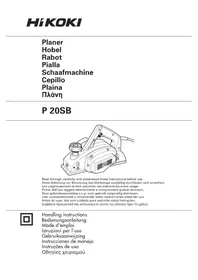
P20SF - Plane HiKOKI - Free user manual and instructions
Find the device manual for free P20SF HiKOKI in PDF.


User questions about P20SF HiKOKI
0 question about this device. Answer the ones you know or ask your own.
Ask a new question about this device
Download the instructions for your Plane in PDF format for free! Find your manual P20SF - HiKOKI and take your electronic device back in hand. On this page are published all the documents necessary for the use of your device. P20SF by HiKOKI.
USER MANUAL P20SF HiKOKI
(Original instructions)
GENERAL POWER TOOL SAFETY WARNINGS

WARNING
Read all safety warnings, instructions, illustrations and specifi cations provided with this power tool.
Failure to follow all instructions listed below may result in electric shock, fire and/or serious injury.
Save all warnings and instructions for future reference.
The term "power tool" in the warnings refers to your mains-operated (corded) power tool or battery-operated (cordless) power tool.
1) Work area safety
a) Keep work area clean and well lit.
Cluttered or dark areas invite accidents.
b) Do not operate power tools in explosive atmospheres, such as in the presence of flammable liquids, gases or dust. Power tools create sparks which may ignite the dust or fumes.
c) Keep children and bystanders away while operating a power tool.
Distractions can cause you to lose control.
2) Electrical safety
a) Power tool plugs must match the outlet. Never modify the plug in any way. Do not use any adapter plugs with earthed (grounded) power tools.
Unmodified plugs and matching outlets will reduce risk of electric shock.
b) Avoid body contact with earthed or grounded surfaces, such as pipes, radiators, ranges and refrigerators.
There is an increased risk of electric shock if your body is earthed or grounded.
c) Do not expose power tools to rain or wet conditions.
Water entering a power tool will increase the risk of electric shock.
d) Do not abuse the cord. Never use the cord for carrying, pulling or unplugging the power tool.
Keep cord away from heat, oil, sharp edges or moving parts.
Damaged or entangled cords increase the risk of electric shock.
e) When operating a power tool outdoors, use an extension cord suitable for outdoor use.
Use of a cord suitable for outdoor use reduces the risk of electric shock.
f) If operating a power tool in a damp location is unavoidable, use a residual current device (RCD) protected supply.
Use of an RCD reduces the risk of electric shock.
3) Personal safety
a) Stay alert, watch what you are doing and use common sense when operating a power tool.
Do not use a power tool while you are tired or under the influence of drugs, alcohol or medication.
A moment of inattention while operating power tools may result in serious personal injury.
b) Use personal protective equipment. Always wear eye protection.
Protective equipment such as a dust mask, non-skid safety shoes, hard hat or hearing protection used for appropriate conditions will reduce personal injuries.
c) Prevent unintentional starting. Ensure the switch is in the off -position before connecting to power source and/or battery pack, picking up or carrying the tool.
Carrying power tools with your finger on the switch or energising power tools that have the switch on invites accidents.
d) Remove any adjusting key or wrench before turning the power tool on.
A wrench or a key left attached to a rotating part of the power tool may result in personal injury.
e) Do not overreach. Keep proper footing and balance at all times.
This enables better control of the power tool in unexpected situations.
f) Dress properly. Do not wear loose clothing or jewellery. Keep your hair and clothing away from moving parts.
Loose clothes, jewellery or long hair can be caught in moving parts.
g) If devices are provided for the connection of dust extraction and collection facilities, ensure these are connected and properly used.
Use of dust collection can reduce dust-related hazards.
h) Do not let familiarity gained from frequent use of tools allow you to become complacent and ignore tool safety principles.
A careless action can cause severe injury within a fraction of a second.
4) Power tool use and care
a) Do not force the power tool. Use the correct power tool for your application.
The correct power tool will do the job better and safer at the rate for which it was designed.
b) Do not use the power tool if the switch does not turn it on and off.
Any power tool that cannot be controlled with the switch is dangerous and must be repaired.
c) Disconnect the plug from the power source and/ or remove the battery pack, if detachable, from the power tool before making any adjustments, changing accessories, or storing power tools.
Such preventive safety measures reduce the risk of starting the power tool accidentally.
d) Store idle power tools out of the reach of children and do not allow persons unfamiliar with the power tool or these instructions to operate the power tool.
Power tools are dangerous in the hands of untrained users.
e) Maintain power tools and accessories. Check for misalignment or binding of moving parts, breakage of parts and any other condition that may affect the power tool's operation. If damaged, have the power tool repaired before use.
Many accidents are caused by poorly maintained power tools.
f) Keep cutting tools sharp and clean.
Properly maintained cutting tools with sharp cutting edges are less likely to bind and are easier to control.
g) Use the power tool, accessories and tool bits etc. in accordance with these instructions, taking into account the working conditions and the work to be performed.
Use of the power tool for operations diff erent from those intended could result in a hazardous situation.
h) Keep handles and grasping surfaces dry, clean and free from oil and grease.
Slippery handles and grasping surfaces do not allow for safe handling and control of the tool in unexpected situations.
5) Service
a) Have your power tool serviced by a qualified repair person using only identical replacement parts.
This will ensure that the safety of the power tool is maintained.
PRECAUTION
Keep children and infirm persons away.
When not in use, tools should be stored out of reach of children and infirm persons.
PLANER SAFETY WARNINGS
- Wait for the cutter to stop before settling the tool down.
An exposed rotating cutter may engage the surface leading to possible loss of control and serious injury.
2. Hold the power tool by insulated gripping surfaces, because the cutter may contact its own cord. Cutting a "live" wire may make exposed metal parts of the power tool "live" and could give the operator an electric shock.
3. Use clamps or another practical way to secure and support the workpiece to a stable platform. Holding the workpiece by your hand or against the body leaves it unstable and may lead to loss of control.
ADDITIONAL SAFETY WARNINGS
- Ensure that the power source to be utilized conforms to the power requirements specified on the product nameplate.
- Ensure that the power switch is in the OFF position.
If the plug is connected to a receptacle while the power switch is in the ON position, the power tool will start operating immediately, which could cause a serious accident.
3. When the work area is removed from the power source, use an extension cord of sufficient thickness and rated capacity. The extension cord should be kept as short as practicable.
4. Prepare a stable wooden workbench suitable for planing operation. As a poorly balanced workbench creates a hazard, ensure it is securely positioned on firm, level ground.
5. Do not use the Planer with the blades facing upward (as stationary type planer).
6. Precaution after finishing the planing operation When the planer is suspended with one hand after finishing the planing operation, ensure that the cutting blades (base) of the planer do not contact or come too near your body. Failure to do so could result in serious injury.
7. Be careful not to injure your hand when attaching or detaching blades.
8. Before attaching blades, wipe off any chips or other debris adhering to the blades.
9. If the carbide blade's heights are inaccurate after above procedures have been completed, carry out the procedures described below.
10. Always make sure the power switch is OFF and that the power plug is disconnected before attaching or detaching the dust adapter.
11. Make sure the dust collector is completely attached. Failure to do so may result in injury.
12. Take care not to break the catch when attaching or detaching the dust adapter and chip cover.
13. RCD The use of a residual current device with a rated residual current of 30mA or less at all times is recommended.
NAMES OF PARTS (Fig. 17)
| a | Housing vent |
| b | Chip ejection hole |
| c | Air gun |
SYMBOLS
WARNING
The following show symbols used for the machine. Be sure that you understand their meaning before use.
| P20SF / P20ST : Planer | |
| To reduce the risk of injury, user must read instruction manual. | |
| Only for EU countries Do not dispose of electric tools together with household waste material! In observance of European Directive 2012/19/EU on waste electrical and electronic equipment and its implementation in accordance with national law, electric tools that have reached the end of their life must be collected separately and returned to an environmentally compatible recycling facility. | |
| V | Rated voltage |
| A | Amperes |
| Hz | Hertz |
| W | Watts |
| n0 | No-load speed |
| /min or min-1 | Revolution or reciprocations per minute |
| ~ | Alternating current |
| kg | Kilograms |
| I | Switching ON |
| O | Switching OFF |
| ! | Caution |
| Disconnect mains plug from electrical outlet | |
| Class II tool | |
STANDARD ACCESSORIES
In addition to the main unit (1 unit), the package contains the accessories listed in the below.
Box Wrench (for securing cutter blade) 1
Set Gauge (for adjusting cutter height) 1
Guide (with set screw) 1
O Blade Sharpening Ass'y (for Resharpenable Blade Type) 1
Case (P20SF) (not supplied in all areas) 1
O Dust adapter 1
Standard accessories are subject to change without notice.
APPLICATIONS
Planing various wooden planks and panels. (See Fig. 1)
SPECIFICATIONS
| Model | P20SF | P20ST | |
| Voltage* | (110 V, 230 V, 240 V)~ | 110 V~ | (230 V, 240 V)~ |
| Power Input* | 620 W | 550 W | 580 W |
| No-Load Speed | 17000 min-1 | ||
| Cutting Width | 82 mm | ||
| Max. Cutting Depth | 2.6 mm | 1.5 mm | |
| Weight (without cord and guide) | 2.7 kg | 2.6 kg | |
- Be sure to check the nameplate on product as it is subject to change by areas.
NOTE
Due to HiKOKI's continuing program of research and development, the specifications herein are subject to change without prior notice.
MOUNTING AND OPERATION
| Action Figure Page | ||
| Adjusting the cutter depth | 2 | 96 |
| Beginning and ending the cutting operation | 3 | 96 |
| How to use the cord holder (P20SF) | 4 | 96 |
| How to use the stand (P20SF) | 5 | 96 |
| Carbide blade disassembly (for Double edged blade type) | 6 | 96 |
| Carbide blade assembly (for Double edged blade type) | 7 | 97 |
| Adjustment of carbide blade height (for Double edged blade type) | 8 | 97 |
| Resharpenable blade disassembly | 9 | 97 |
| Resharpenable blade assembly | 10 | 97 |
| Adjustment of resharpenable blade height | 11 | 98 |
| Sharpening the resharpenable blade | 12 | 98 |
| Attaching and removing the dust adapter | 13 | 98 |
| Elbow operation (Optional accessory) | 14 | 99 |
| Switch operation | 15 | 99 |
| Replacing carbon brushes | 16 | 99 |
| Proper cleaning the chip ejection opening | 17 | 99 |
| Selecting accessories | — | 100 |
1. Surface cutting
Rough cutting should be accomplished at large cutting depths and at a suitable speed so that shavings are smoothly ejected from the machine. To ensure a smoothly finished surface, finish cutting should be accomplished at small cutting depths and at low feeding speed.
2. Blade sharpening intervals
Blade sharpening intervals depend on the type of wood being cut and the cutting depth. However, sharpening should generally be effected after each 500 meters of cutting operation.
3. Dressing Stone
When a water dressing stone is available, use it after dipping it suffi cientsly in water since such a dressing stone may be worn during grinding works, fl attenu the upper surface of the dressing stone as often as necessary.
MAINTENANCE AND INSPECTION
1. Inspecting the blades
Continued use of dull or damaged blades will result in reduced cutting efficiency and may cause overloading of the motor. Sharpen or replace the blades as often as necessary.
2. Handling
CAUTION
The front base, rear base, and cutting depth control knob are precisely machined to obtain specific cally high precision. If these parts are roughly handled or subjected to heavy mechanical impact, it may cause deteriorated precision and reduced cutting performance. These parts must be handled with particular care.
3. Inspecting the mounting screws
Regularly inspect all mounting screws and ensure that they are properly tightened. Should any of the screws be loose, retighten them immediately. Failure to do so could result in serious hazard.
4. Motor unit maintenance
The motor winding is an important part of this tool. Avoid damaging and be careful to avoid contact with cleaning oil or water. After 50 hours of use, clean the motor by blowing into the ventilation holes of the motor housing with dry air from an air gun or other tool (Fig. 17). Dust or particle accumulation in the motor can result in damage.
5. Inspecting the carbon brushes (Fig. 16)
The motor employs carbon brushes which are consumable parts. Since an excessively worn carbon brush can result in motor trouble, replace the carbon brushes with new ones having the same carbon brush No. ③ shown in the figure when it becomes worn to or near the "wear limit" ⑥. In addition, always keep carbon brushes clean and ensue that they slide freely within the brush holders.
6. Replacing carbon brushes (Fig. 16)
After removing the chip cover, use a slotted screwdriver to disassemble the brush caps. The carbon brushes can then be easily removed with the spring.
7. Replacing supply cord
If the replacement of the supply cord is necessary, it has to be done by HiKOKI Authorized Service Center to avoid a safety hazard.
8. Replacing belt
If the replacement of the belt is necessary, it has to be done by HiKOKI Authorized Service Center to avoid a safety hazard.
CAUTION
In the operation and maintenance of power tools, the safety regulations and standards prescribed in each country must be observed.
GUARANTEE
We guarantee HiKOKI Power Tools in accordance with statutory/country specific regulation. This guarantee does not cover defects or damage due to misuse, abuse, or normal wear and tear. In case of complaint, please send the Power Tool, undismantled, with the GUARANTEE CERTIFICATE found at the end of this Handling instruction, to a HiKOKI Authorized Service Center.
IMPORTANT
Correct connection of the plug
The wires of the main lead are coloured in accordance with the following code:
Blue: — Neutral
Brown: — Live
As the colours of the wires in the main lead of this tool may not correspond with the coloured markings identifying the terminals in your plug proceed as follows:
The wire coloured blue must be connected to the terminal marked with the letter N or coloured black. The wire coloured brown must be connected to the terminal marked with the letter L or coloured red. Neither core must be connected to the each terminal.
NOTE:
This requirement is provided according to BRITISH STANDARD 2769:1984.
Therefore, the letter code and colour code may not be applicable to other markets except The United Kingdom.
Information concerning airborne noise and vibration
The measured values were determined according to EN62841 and declared in accordance with ISO 4871.
Measured A-weighted sound power level:
97 dB (A) (P20SF)
95 dB (A) (P20ST)
Measured A-weighted sound pressure level:
86 dB (A) (P20SF)
84 dB (A) (P20ST)
Uncertainty K: 3 dB (A)
Wear hearing protection.
Vibration total values (triax vector sum) determined according to EN62841.
Planing softwood:
Vibration emission value a_h = 2.3m / s^2 (P20SF)
4.5 m/s² (P20ST)
Uncertainty K = 1.5m / s^2
The declared vibration total value has been measured in accordance with a standard test method and may be used for comparing one tool with another.
It may also be used in a preliminary assessment of exposure.
WARNING
The vibration emission during actual use of the power tool can differ from the declared total value depending in the ways in which the tool is used.
- Identify safety measures to protect the operator that are based on an estimation of exposure in the actual conditions of use (taking account of all parts of the operating cycle such as the times when the tool is switched off and when it is running idle in addition to the trigger time).
NOTE
Due to HiKOKI's continuing program of research and development, the specifi cations herein are subject to change without prior notice.
VOORZORGSGMAATREGELEN
VEILIGHEIDSWAARSCHUWINGEN VOOR DE SCHAAFMACHINE
VEILIGHEIDSWAARSCHUWINGEN
VEDLIKEHOLD OG INSPEKSJON
LcENCEH, NO KONTO He ca npaBeHN MoHnKauCN H CbOTBETCTBaT Ha KOHTAHTte HAmaJIraBt PnCKa OT eJeKTPnueeKn ydap.
b) Pn pa6oTa c eIeHTpHuecH uHCTpyMeHTn H36rBaHTe KOHTaKT Ha TAnOTO Cbc 3a3eMeHN NOBbpxHOCTn KATO Tpb6n, paHaTOpH n XlaanlHHu.
CbueCTByBa NOBnWeH pNCH OT eNeKTPnueckn ydap, aKO TAnOTO Bu cTaHe YAcT OT 3a3eMTeJIHHa KOHTyp.
c) He n3laarTe eIeHTpHueChnTe HNCTpyMeHTn Ha BJIHHNETo Ha BJara NIN DbHd.
IOnaJaHeTo Ha BlaRa B eJEnKTpNueCHTe INHCTpyMeHTn NOBnShaBa pNcKa OT eJEnKTpNueCHTuYdap.
d) He HapyuBaHte 9eIOCTTa Ha Ka6eJIHTe. HnKora He n3HnIOUBAHTe eIeHTpHuYeCKHrTe ypeN, Kato N3DbPnBATE OT Ka6eJa.
Ia3ete Ka6eJIte OT n3TOUHNu Ha TOnnHa, OT Cm3OCHN MaTePnaJn, OcTpN Pb6Obe N NOBUNHH KOMNOHEHTN.
HapaHeHn nn npenIeTeHn Ka6eHn nobuBaBAT pncKa oT eJeKtpnueckn ydap.
e) Horato n3noJ3BaTe eJenTpueechn ypeJ Ha OTHpnto, n3noJ3BaIte YdbJIHHTeJ, NOxOJaJ 3a BbHUnn ycIOBna Ha pa6ota.
H3noJ3BaIte Ka6eI, NOxOJaI 3a BbHJH yCIOBn, KOITo HAMJIba pNcKa OT eJIeKTpUyeCKn yIap.
f) Ako e HaIOHHTeJIHO H3NOJ3BaHeTo Ha eIeHTpueeCNn HNCTpyMeHT BBB BlaJHH YcIobn, H3NoJ3BaIte ypeDn C dIepeHuaHa 3aunTa (RCD) cpeuyyTeuHa. H3noJ3BaHeTO Ha nnFepeHuaHa 3aunTa HaMaJIbRa pUcKa OT eJeHTpueeCNuYdap.
3)Лична6e3oNaCHOCT
a)БbTe 6dTeJIHH, BHMMaBaIte B deIcTBnIa cn n H3NoJ3BaIte pa3ymHO eIeHTpNueChIte HHCTpyMeHTn.
He n3noI3BaIte eIeKtpnueeCKn HNCTpyMeHT, KOrato cTe n3MopeHn, IIN NOB BnIaHHeTo Ha JeHaPcTBeHH CpeDCTBa, anHOxOJ IIN ONHaTn.
BcraKo HeBHMaHne np np paOta c eIeKtpnueckn INHCTpyMeHTN MOHe da DOBepe Do CepNo3HN HapaHbAHn.
b) H3noJ3BaIte JnUHn PpeJna3HN CpeJcTBA. BnHaHn Hocete 3aunTHN OuHa Nm Macka.
3aunTHnTe cpeCTBa, kaTO npaxo3aunTHa MaCKa, 3aunTHN OByBn C yCTOuYBa Ha NtB3raHe NOmETKa, KACKa, Hn aHTnFOH, n3NoI3BaHn CnopeJ yCNOBnTa Ha pa60ta , Ue HAMaJIr ONaCHOCTTA OT HapaHBAHe.
c) PpeDToBpaTBAHe Ha CnyaHNO BkJIIOUbaHe. YBepete Ce, Ye 6yTOHbT 3a CTapT Ha ypeDa e B H3KIIIOUeHO NIOJOKeHne, PpeDu Da CBbpKeTe EJekTpNueeCNn HHCTpymEt H KbM N3TOuHNK Ha 3axpaHbAhe n/nn 6aTePn, KaHTo N ppeDu da ro B3emTe nn npeHaacrTe.
IpehaHTo Ha HnctpyMeHTn C npbCT Ha CTapT 6yToHa, Hn Ha npEbnIOuBaTeJI Ha 3axpaHbaHeTO, HOCn ONaCHOCT OT INUdENTn.
d) OtcpaHete BCnHn pa6oTHn npcTaBn, npedn da BHLIOHTe ypea KbM 3axpaHbaHeTo.
Taeuen KIOU HIN INHCTpymeHT, 3a6paBEN B potaunOHn KOMNOHeHTn Ha eJekTpueckn INHCTpymeHT, MoKe Da DOBeDe Do HapaHBAHe.
e) He ce npecaraTe. Ppe3 cJIto BpeMe Tp6Ba Da HMaTe Cta6HnHa onopa Ha da NODbPkaTe BaIaHC Ha TJIOTO.
Toba OCHyprBa NO-IO6bP KOHTpOIN Bbpxy eNEKtpnuecknte INHCTpyMeHTN npn HeoayKaBHu CNTuayuH.
f) Hocete noxdxoadno 06leHNo. He hocete npekaheHO shpoHN dpexn nn 6nkyTa. DpbHTe Kocata n dpexnte cn daJeu OT dBHHneTte ce qactn.
Unpoknte npexn, bnyta n Iblra Koca Morat da 6bdaT3axbaHATN OT NOBNNHHTe KOMNOHEHTN.
g) Ako ca ochrypeHH yctpoHCTBa 3a npncbdeHHBaHe KbM npaxoyIOBHTeHH HHcTaHaun, yBepTe ce, ye ca npabHnHO npncbdeHHeHH.
H3noJ3BaHTo Ha npaxoyIOBHTeN u cHIOHN MOHe Da HamaNn Cbbp3aHHTe Cbc 3AmbpCRABaHTo pNCKOBe.
h) He no3BOLIBAHte ONHTHOCTTa BN, npnIO6bTa OT YecTOTo H3NOJ3BaHe Ha NHCtpymeHTn, da BN Cb3daTe cAmOyBcTBHe, 3apaN KoETO da HrHopnPate npnHcHnnte Ha 6e3oNaCHOCT npn pa6ota c NHCtpymeHTn.
HeBHMaTeHNO DeIcTBnE MoKe Da DoBePe Do TeKHN HapaHbAHn B paMHTe Ha Yactn OT CekyHdata.
4) EHCnloataaHn npdpbHHHa Ha eJeHTpHuecHn HhCTpyMeHTn
a) He hacnBaIte eIeHTpueeCKHTE HcHTpyMeHTN. 3noJ3BaIte NOxOJaEeHTpueeCHN HHCTpymENT 3a CbOTBETHTE cJIH.
NoxOJnT eektpueckn HcPymENT Ocnpyra 6e3oNaCHO TO nno-dobpo N3BbPwBaHe Ha pa60THNE DeHOCn npn npedBnDeHnte HOMHaHnnpaMeTpN.
b) He n3noJ3BaIte eJeKtpnueechn HNCTpyMeHT, aHO He MoJHe da6bde BKNIOUeH NIN N3HIOUeHOT cbOTBeTHnA CTApT 6yToH NIN PpeBHLIOUBATeI.
BceKn eIeKtpnueckn HNCTpyMeHT, KOITo He MoKe Da ce KOHtPOIInpa OT npeBkIOUvBaTeJI, e ONaceH N NOJNeKN Ha peMOHT.
c) N3KIOUeTe ⅢeNCEHa HnHCTpyMeHTa OT n3TOuHNka Ha 3axpaHbAHe n/INn IN3BaTe6BATEpHnHnaKet OT nHCTpyMeHTa, aHO ToI NO3BOJRA BaJIaHE, ppeDn Da IN3BbPbBaTe HAcTPOHKn, npn CmHa Ha npNCTabHn INn npn CbXpaHeHne.
Te3n npedna3Hm Mepn HamaJraBaT pNcHa OT CnyaHNO HeKeHaHO BKNIOUbaHe Ha eJeKtpuuecknH INCTpyMeHT.
d) CbxpahraBaIte HeH3noJ3BaHHTe eJeHTpuYeCHn HNCTpyMeHTn DaJIeOT DOCTbn Ha Deua N He No3BOJRABaTe Ha IInca, He3aNo3HaTHn C HauHnHa Ha pa6Ota C NHCTpyMeHTne n Te3n HNCTpyKcHn, da pa6OTrT c Tax.
EneKtpnuecknte HNCTpyMeHTn npedctablaBaT onaCHOCT B pBcTe Ha HeONTHN Iuua.
e) NpOdIbPkaHte eJeHTpOHcTpymeHTnTe n aHcecoapHe. PpOBepBaHte ueHTPOBkata H 3aKpenBaHeto Ha NOdBHNHe TcACh, npOBepBaHte 3a NOBpeHn YAcTH, HOnTO Morat Da ce OTPa3rT Ha pa6oTaHa eJeETpuYeCHHeMHCTpyMeHTn.AKO yCTaHOBHTe NobpeHn,OTcPaHete rnpedn da N3noJ3BaTe eJeETpuYeCHHe HHCTpyMeHTn.
MHoro 3IIOJONYKc Ce IbIaHa Na IOWa NODpBHKHa HaeNekTpnueCKnTe INHCTpyMeHTN.
f) PoiDbPkaHapeKHeuHTe HcTpymEnTH 3aTOUeHN uHCTN.
PpaBnHNO nOaIbPkaHnTe peKeu nHCTpyMeHTn, C HatoyeHn peKeu enEmeHTn, ce ynpablaBaT N KOHTPOHnat NO-JeCHO.
g) H3noI3BaIe eIeHTpUyeCn HNCTpyMeHTn, npHcTaBHN n aHceCoapn, n T.H., cbrIaCHO Te3n HNCTpyKUnn, Hato B3eMeTe NpeBnD pa60THte ycIOBnH n BnDa pa6OTn, KOnTO ue ce H3BbPWBat.
H3noI3BaHe Ha eIeKtpnuecknTe HNCTpyMeHTn 3a pa60TN, pa3IuHN OT Te3N, 3a KOHTo Ca npEiBnDEH, MOKe Da IOBeDe Do NOBnWeH pNCK n ONaCHN CNTyaCnn.
h) Pa3eTe pBHOXBaTHNte H NOBbpxHocHTe 3a 3axBaUaHe cyxN, YnCTn, 6e3 MaCNo n rpec.
Xlb3raBnte pbKoXBaTHN n NOBbpxHOCTn 3a 3axBaAaHe He No3BOJIaBt 6e3OnaChata paBoTa n ynpabIeHne Ha NHCTpyMeHTa B HeOuaKaBaHN CNTyaun.
5) 06cIyHbAhe
a) 06cIyKBaHeTo Ha eIeHTpNueCKeHte HhCTpyMeHTn Tpa6Ba Da ce N3BbPwBa cMo OT KBaJIHΦHnPaHN cepBN3HN pa6OTHnCi, pN H3NoJ3BaHe HaOpHnHaJIH pe3epBHN qAcTn.
ToBa ige rapaHTnpa 6e3oNaChocTt npn paBoTa c eIeKtpuYeCKnte HNcTpymEnTu.
BHIMAHNE
He donychaite B 30Hata Ha pa6ota dea N Bb3pacTHN Xopa. Horato He n3non3Bate eJenKtpnueChnte HnCTpyMeHTN, cbxpaHBAITE rnaJeu OT DOCTbn Ha deua N Bb3pacTHN Xopa.
MEPHN 3A BE3OINACHOCT INPNA BOTA C EJI. PEHDE
1.ИЗчане HOHOBNТ BaI Da cnpe,прдЯ octabHTe HhCTpyMeHTa.
OTKpTnT BbptTc Ce HOKOB BaJI MoKe Da 3aKaUH NOBbpxHOCTTa, KOEtO MOHe Da DOBeDe Do 3aRy6a Ha KOHTPOI N cepNO3HO HapaHRAhe.
2.Пидьрнaite eIeHTpHueChnI HNCTpyMeNT cMo 3a N3OJIHpAHnte pBKOXBaTHN, TbI KaTO HOHOBNr BAJ MOKe Da 3aHaUcH Ka6eJa.Cpr3BaHETo Ha npOBODNHIOH AnpeJxHeHne MoKe Da DOBeDe Do npOTTuHa He ToK Ipe3 MeTaJIHnTe YactH Na HHCTpyMeHTa N TOKOB yIap.
3. H3noJ3BaIte cTern nH npaHTnueH MeTOd 3a 3actonopraBaHe Ha o6pa6oTBaHHa DetaiN KbM Cta6nHa pa6oTHa Maca.AKo npuNbprKeTaO 6pa6oTBaHHa DeTaN C pBka Hn C TAnTo CN, Toi CTABA HeCTa6nJIeH nCe Cb3daBA onaCHOCT OT 3ary6a Ha KOHTpOJ.
ДОПьЛНITEЛНМЕРКИЗАБЕЗПАСHOCT
- YBepeTe ce, Ye N3TOUHnKbT Ha 3axpaHbaHe, KOTo H3NOJ3BaTe, OTROBapr Ha N3NCKBaHnTa, NOCOeHN Bbpxy INHBENTapHaTa Ta6JIka.
- Ybepete ce, ye cTap 6yToHbTe bNo3nua N3HJI. Ako 6bJe BnIOUeH uenceLa KbM KOHTaKTa, ypeBt ige 3anOue He da paBoTH BeHara, npN 6yToH bNo3nua BHL., KoETO MoKe Da DOBeDe Do cepno3Hn HnDentn.
- Korato pa60thata nlo7aKa e daJeue OT n3ToyHK Ha 3axpaHbAe, n3NoJ3BaIte yIbJIKHTeI C DOCTaTbYHa De6eInHa n HOMHaIeH KanauTe.T. YIbJIKHTeINHnrt Ka6eT Tp6Ba Da 6bDe Bb3MOxHO Ha-NKc.
- NodrotBete CtaBnHa DbPBeHa pa6oTHa Maca, NoDxOJa 3a peHDoCbaHe. looH HnBeInpaHaTa pa6oTHa Maca Cb3daBa OnaCHOCT, 3aTOBa Tg Tp6Ba Da ce No3nIOHnpa Ha TBbpda, paBH NaOBbpXHOCT.
- He n3noI3BaIte peHJeTo c HOKOBeTe O6bphATn Harope (KaKTO npu CtaaioHapeH TIN abpHXT).
- IpeIina3Hm MepKn CneI 3aBbPwBaHe Ha peHIOcBAHeTo Horato peHJeTO ocTaHe B pKaTb CNeI N3JIn3aHe OT O6pa6oTBaHnI DeTaN, BHIMaBaIte HOKOBete (OCHOBATA) Da He BJIra3AT B DoINp HIN Da He Ca 6NIOCT Do TNIoto BN. B IpOTNBEN CnyuAyn Ima OnaCHOCT OT cepNo3HO HapaHBAHe.
- Korato noctabrte HIN CBAJTe OCTpneTa, BHIMaBaITe Da He HapaHnte pbKaTa CN.
- Ipei Da nocTaBATE ocTpneTa, H36bpuTe BCnHcN CTpyKnn nn Dpyr N acTnU, noJenHaJI N O octPneTata.
- Ako cIeJ n3nJIHeHne Ha roPHTe npOeDpyn Kap6nHTe HOKOBe He ca noPaBHeHn, n3BbPWeTe ONICAHTE NO-DOJy DeJeCTBn.
- Binhari ce yBepaBaiTe, ye npeBnIOyBaTeJIaT Ha 3axpaHbaHeTo e N3KIIIOUeH uye 3axpaHbAunr Ka6e en3BaDeH OT KOHTaHa, npedn da NoCTaBAre nn CBaIaTe aanTepa 3a npax.
11.YBepete ce, ye ycTpoNCTBOTo 3a npaxocbupaHe e noctabeHo n3zINo. HecnTa3BaHeto Ha ToBa MoKe da DOBeDe Do HapaHBAHe. - BHIMaBaTe Da He ChyInTe 3axBaTa, KOraTo CBbP3BaTe H OTCpaHraBe Ta aDAnTepa 3a npaxOyIaBHe N KaNaKa 3a CTbProTInHte.
13.Диференцалha 3aunTa (YD3)прөрөчba ce n3noJ3BaHeto Ha yctpoiCtba 3aдиференцалha 3aunTa (YD3) ot 30 mA nIn no-HnCKa,прзцлOTOВрeme.
HMEHA HA YACTNTE (Фиг. 17)
1. PeHdoBaHe Ha NOBbpxHOCTN
IpybopeHIOcBAHece npaBn npn rOJMa dbIbOCHHa Ha peHIOcBAHe n npn NOxOJa cKOpoc Ha NODaBaHe, Taka ye CTbprotInHte Da n3JIN3aT paBHOMepHO OT MaunHata. 3a da ce NoCTnHre rJaKa NOBbPxHOCr, fHnAJIHOTo peHIOcBAHe ce npaBn C MaJHa dbIbOCHHa Ha peHIOcBAHe n sbABHa cKOpoc Ha NODaBaHe.
2. BpemeBn HHTepBaJIH 3a ToyeHe Ha HOXOBeTe
HHTepBaJIte 3a ToyeHe Ha HOXOBeTe 3aBnCt OT BnDa Ha O6pa6oTBAHOT ObPBO N Dbl6OuHHata Ha peHDCBaHe. No npHcun, 3aTOUbaHETo Tp6Ba Da ce npaBn Ha BCEKn 500 IInHeHH MeTp a O6pa6oTeH MaTePnA.I
3. 3aToUBaU KaMbK
Horato pa3noIarate cbc 3aTOUbau KaMbK, nbpBO r0 NOTOnTe BbB BOda, TbN KaTO ToJ MOKe Da e 3axa6eH BCJeCDTBNE OT TOyeHETo; 3aJIaNJaTe TropHaTa NOBbPxHOCT Ha 3aTOUbaun KaMbK TOJKOBA YecTo, KOJIKOto e Heo6XoDMO.
IODAPbJKA INHcNEKU
1.ПоберкHa HOHOBeTe
PpOdbJIHnTeJIHaTa yNtpe6a Ha 3aTbIeHn IIN NOBpeDeHHoHOBe Ⅲe DOBeDe 10 No-HNCHa eΦeKTHBHOCT Ha peHDCBaHe N MoKe Da nPeTOBapu DBnIgATEJ. 3aToUBaHTe NIN CMeHnTE HOHOBeTe TOJIHOBA YecTO, KOJIHOTo E HeO6XoDIMO.
2. Pa60Ta
BHIMAHNE
IpeHnata OCHOBA, 3aHnata OCHOBn HONHTO 3a KOHTpOHa NbJb6OuHHaTn Ha peHNOOCBaHe ca IpeuN3HO n3pa6oTeHN 3a OCNpyraBe Ha BnCOKo KaueCTBO Ha o6pa6OTkata. Ako C Te3n Yactn Ce 6opabn rpy6o nn Ako 6bDat NOIOKeHN Ha CNHm MexaHn ydApn, IpeuN3HocTTa n KaueCTBTO Ha pa6oTaTn MoKe Da CE BLOwAt. C Te3n Yactn Tpr6Ba Da ce 6opabn c ocObeHo BHMaHne.
3.ИнспкциянафнсupaиBNHTOBe
PeDobHO INHCNEKTHIpaTBe BCNCHK HKNCHPaUN BINTOBe n ce yBpeTe, ye ca Do6pe 3aterHaTn. Ako yCTaHOBNTe pa3Xla6eH BnHT, He3a6abHO ro 3aterHete. Hecna3BaHeTo Ha rOpHOTo Kpne pNCKOBe OT 3IIOJOLyKn HapaHBAHe.
4.ПоддрьхнаHaMOTopa
Hamotkata Ha MOTopa e BaxHa Yact OT To3n HHCTpymeHT. 1368BaIte NOBpeXdahe H BHIMaBaIte, 3a Da 136BerHeTe KOHTaHcT C NoHcTBAUcTO MacLO ININ BOda.Cled 50 Yaca yNoTppe6a, NoOncTeTe MOTOPa 4pe3 npOdyXbaHe BB BEHTInlauOHHIne OTBOpH Na Kopnyca Ha MOTopa c NtCToJET 3a Cyx Bb3dYx ININ dpyr INHCTpymeHT (Φnr.17).Ppax INn HAtpynBaHe Ha ActtuB MOTopa MORaT Da DOBeDaT Do NOBpeDa.
I3MepeHO A-IPeTeRHeHa CToHOCT Ha cHla Ha 3ByKa:
86 dB (A) (P20SF)
84 dB (A) (P20ST)
Hecnryphnoct K:3 dB (A)
HocTe aHTnfoHN.
O6u n cToHocTn Ha Bn6paunn (BeKTopHa cyMa) onpeJeHeN cbrIacHo EN62841.
PeHIOcBaHe Ha MeKO IbPo:
CTOINOCHT Ha rheHepnpaHNTe Bn6paun a=2,3M/ceK² (P20SF) 4,5 M/ceK² (P20ST)
HeToHooT K =1,5 M/ceK
IeKnapnpaHnTe 06u n CToHocTn Ha Bn6paunn ca H3MepeHN CbflaCHO CTaHapTHnTe MeTOUHa H3NITBaHe N MOrat Da 6bDat N3NOJ3BaHn 3a CpabHeHne MeKdy pa3InuHnTe IHCTpyMeHTn.
OcbEN TOBa CTOnHOCTHTe MORaT Da ce N3NoI3BaT 3a npedBapNTeJIHa OueHka.
IPEyIpyEHEHNE
O Bn6paunnte no BpeMe Ha DeIcTBnteHa ynoTppeBa HA IHCTpyMeHTa MoT Da ce pa3JIuHabAT OT DeKJIapnpaHrte 06UH CTOHOCTH, B 3aBNCIMoCT OT HaUNHa Ha N3No13BaHe Ha INCTpyMeHTa.
O NdENTnHnIupaHe Ha MEPKIne 3a 6e3OnacHOCT 3a onepaTopa, Bb3 OCHOBa OueHHa Hb3dEnCTBnETo npn DeNCTBnTEHN YCIOBnHa N3NOJ3BaHe (KaTO CE B3EmAT PpeDnBCNUH ELEMEHTN OT pa6OTnur Kkbl, KaTO NEPNoHn HA BKNIOUBAH nN3KIIIOUBAHe, KaKTo n pa6Ota Ha Ipa3Hn O6OpOTn HENOCpeDCTBeHO npedn CneM MOMeHTa Ha N3NOJ3BaHe).
3ABEJIEXHA
Iopadn HnpeKbChaTTo pa3BNTHe Ha HayHo-pa3BoHata nporpama Ha HiKOKI, daJeHnte Tk CneuΦkaunn ca npedmet Ha npomHa 6e3 yBeDOMLeHne.
(Prevod originalog uputstva)
OPŠTA BEZBEDNOSNA UPOZORENJA ZA ELEKTRICNI ALAT
UPOZORENJE
Siemensring 34, 47877 willich, Germany
Tel: +49 2154 49930
Fax: +49 2154 499350
URL: http://www.hikoki-powertools.de
Hikoki Power Tools Norway AS
Kjeller Vest 7, N-2007 Kjeller, Norway
Tel: (+47) 6692 6600
Fax: (+47) 6692 6650
URL: http://www.hikoki-powertools.no
Hikoki Power Tools Netherlands B.V.
Brabanthaven 11, 3433 PJ Nieuwegein, The Netherlands
Tel: +31 30 6084040
Fax: +31 30 6067266
URL: http://www.hikoki-powertools.nl
Hikoki Power Tools Sweden AB
Rotebergsvagen 2B SE-192 78 Sollentuna, Sweden
Tel: (+46) 859899900
Fax: (+46) 859899940
URL: http://www.hikoki-powertools.se
Hikoki Power Tools (U.K.) Ltd.
Precedent Drive, Rooksley, Milton Keynes, MK 13, 8PJ,
United Kingdom
Tel: +44 1908 660663
Fax: +44 1908 606642
URL: http://www.hikoki-powertools.uk
Hikoki Power Tools Denmark A/S
Lillebaeltsvej 90, 6715 Esbjerg N, Denmark
Tel: (+45) 75 14 32 00
Fax: (+45) 75 14 36 66
URL: http://www.hikoki-powertools.dk
Hikoki Power Tools France S.A.S.
Parc de I'Eglantier 22, rue des Cerisiers, Lisses-C.E. 1541,
91015 EVRY CEDEX, France
Tel: +33 169474949
Fax: +33 1 60861416
URL: http://www.hikoki-powertools.fr
Hikoki Power Tools Belgium N.V./S.A.
Koningin Astridlaan 51, B-1780 Wemmel, Belgium
Tel: +32 2 460 1720
Fax: +32 2 460 2542
URL http://www.hikoki-powertools.be
Hikoki Power Tools Italia S.p.A
Via Piave 35, 36077, Altavilla Vicentina (VI), Italy
Tel: +39 0444 548111
Fax: +39 0444 548110
URL: http://www.hikoki-powertools.it
Hikoki Power Tools Ibérica, S.A.
C/ Puigbarral, 26-28, Pol. Ind. Can Petit, 08227 Terrassa
(Barcelona), Spain
Tel: +34 93 735 6722
Fax: +34 93 735 7442
URL: http://www.hikoki-powertools.es
Hikoki Power Tools Romania S.R.L.
Ring Road, No. 66, Mustang Traco Warehouses, Warehouse
No.1, Pantelimon City, 077145, Ilfov County, Romania