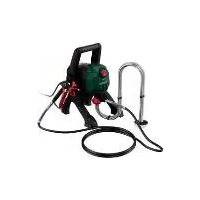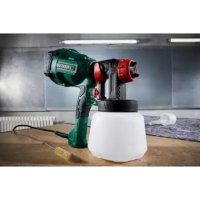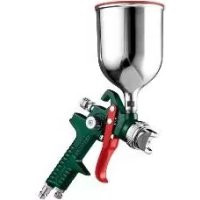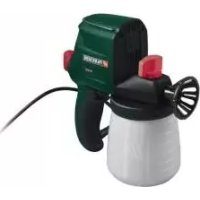
PFS 100 C2 - Paint gun PARKSIDE - Free user manual and instructions
Find the device manual for free PFS 100 C2 PARKSIDE in PDF.



| Product type | Electric paint spray gun |
| Brand | Parkside |
| Model | PFS 100 C2 |
| Intended use | Application of paint and varnish (viscosity max 80 DIN-s) |
| Max flow rate (water) | 320 g/min |
| Cup capacity | 700 ml |
| Protection class | II (double insulation) |
| Sound pressure level | 88.57 dB(A) |
| Sound power level | 99.57 dB(A) |
| Total vibrations | 13.24 m/s² (K = 1.5 m/s²) |
| Included nozzles | 0.6 mm and 0.8 mm |
| Included accessories | Suction valve, cleaning nozzle, nozzle extension, measuring cup, metal stand |
| Power supply | Mains (power cord) |
| Estimated weight | Approximately 1 kg |
| Warranty | 3 years |
| After-sales service France | 0800 919270, kompernass@lidl.fr |
| After-sales service Belgium | 070 270 171, kompernass@lidl.be |
| Maintenance and cleaning | Disassemble parts, clean with solvent, never immerse |
| Safety instructions | Wear respiratory protection and goggles, avoid flammable substances |
| Spare parts | Available through after-sales service |
| Repairability | Repair by qualified personnel only |
Frequently Asked Questions - PFS 100 C2 PARKSIDE
User questions about PFS 100 C2 PARKSIDE
0 question about this device. Answer the ones you know or ask your own.
Ask a new question about this device
Download the instructions for your Paint gun in PDF format for free! Find your manual PFS 100 C2 - PARKSIDE and take your electronic device back in hand. On this page are published all the documents necessary for the use of your device. PFS 100 C2 by PARKSIDE.
USER MANUAL PFS 100 C2 PARKSIDE
PAINT SPRAY GUN PFS 100 C2
GB 1E
PAINT SPRAY GUN
Operation and Safety Notes
Translation of the original instructions
SE
FARGSPRUTPISTOL
Before reading, unfold both pages containing illustrations and familiarise yourself with all functions of the device.
F
GB/IEOperation and Safety NotesPage 5
Features and equipment.. 6
Included items . 6
Technical data.. 6
General safety advice for electrical power tools
1.Workplace safety. 7
2. Electrical safety.. 7
3. Personal safety.. 7
4. Careful handling and use of electrical power tools.. Page 8
5. Service.. 8
Additional safety advice for paint spray guns.. 8
Advice on use
Viscosity. 9
Preparing the sprayed medium.. 9
Preparing the surface to be sprayed.. Page 10
Bringing into use
Selecting the nozzle.. Page 10
Switching On/Off. Page 10
Spraying process Page 10
Maintenance and cleaning
Service centre
Warranty
Disposal
Translation of the original declaration of conformity / Manufacturer
Paint spray gun PFS 100 C2
Introduction
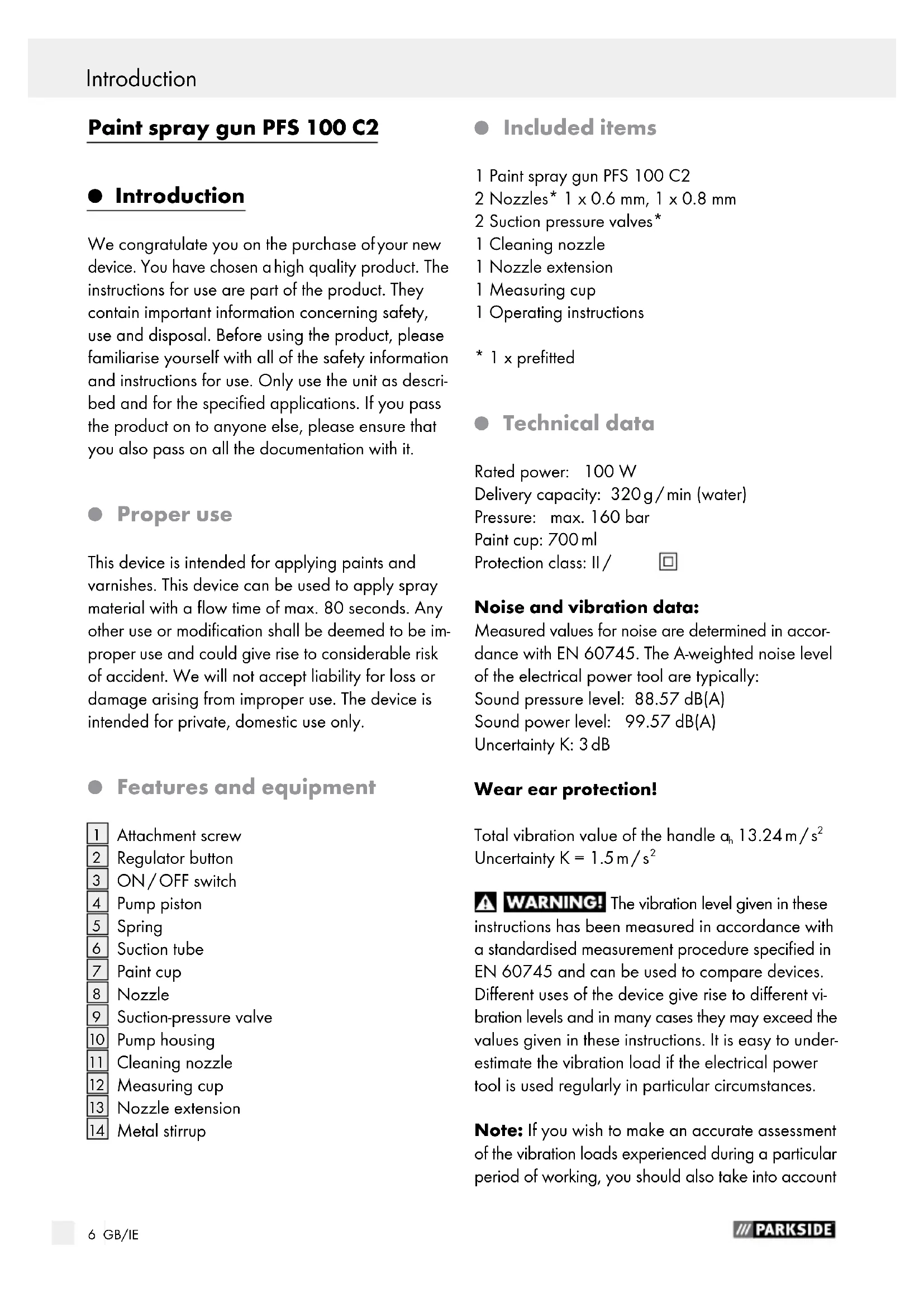
We congratulate you on the purchase of your new device. You have chosen a high quality product. The instructions for use are part of the product. They contain important information concerning safety, use and disposal. Before using the product, please familiarise yourself with all of the safety information and instructions for use. Only use the unit as described and for the specified applications. If you pass the product on to anyone else, please ensure that you also pass on all the documentation with it.
- Proper use
This device is intended for applying paints and varnishes. This device can be used to apply spray material with a flow time of max. 80 seconds. Any other use or modification shall be deemed to be improper use and could give rise to considerable risk of accident. We will not accept liability for loss or damage arising from improper use. The device is intended for private, domestic use only.
- Features and equipment
1 Attachment screw
2 Regulator button
3 ON/OFF switch
4 Pump piston
5 Spring
6 Suction tube
7 Paint cup
8 Nozzle
9 Suction-pressure valve
10 Pump housing
11 Cleaning nozzle
12 Measuring cup
13 Nozzle extension
14 Metal stirrup
- Included items
1 Paint spray gun PFS 100 C2
2 Nozzles* 1× 0.6 mm, 1× 0.8 mm
2 Suction pressure valves*
1 Cleaning nozzle
1 Nozzle extension
1 Measuring cup
1 Operating instructions
- 1 x prefitted
- Technical data
Rated power: 100 W
Delivery capacity: 320g / min (water)
Pressure: max. 160 bar
Paint cup: 700 ml
Protection class: II /

Noise and vibration data:
Measured values for noise are determined in accordance with EN 60745. The A-weighted noise level of the electrical power tool are typically:
Sound pressure level: 88.57 dB(A)
Sound power level: 99.57 dB(A)
Uncertainty K: 3 dB
Wear ear protection!
Total vibration value of the handle a_h13.24m / s^2 Uncertainty K = 1.5m / s^2
WARNING! The vibration level given in these instructions has been measured in accordance with a standardised measurement procedure specified in EN 60745 and can be used to compare devices. Different uses of the device give rise to different vibration levels and in many cases they may exceed the values given in these instructions. It is easy to underestimate the vibration load if the electrical power tool is used regularly in particular circumstances.
Note: If you wish to make an accurate assessment of the vibration loads experienced during a particular period of working, you should also take into account
the intervening periods of time when the device is switched off or is running but is not actually in use. This can result in a much lower vibration load over the whole of the period of working.
- General safety advice for electrical power tools

WARNING! Read all the safety
advice and instructions! Failure to
observe the safety advice and instructions
may result in electric shock, fire and / or serious injury.
Keep all the safety advice and instructions in a safe place for future reference!
The term "electrical tool" used in the safety advice refers to electrical tools powered by mains electricity (by means of a mains lead) and electrical tools powered by rechargeable batteries (without a mains lead).
1. Workplace safety
a) Keep your working area clean and well lit. Untidy or poorly lit working areas can lead to accidents.
b) Do not work with the device in potentially explosive environments in which there are inflammable liquids, gases or dusts. Electrical power tools create sparks, which can ignite dusts or fumes.
c) Keep children and other people away while you are operating the electrical tool. Distractions can cause you to lose control of the device.
2. Electrical safety
a) The mains plug on the device must match the mains socket. The plug must not be modified in any way. Do not use an adapter plug with devices fitted with a protective earth. Unmodified plugs and matching sockets reduce the risk of electric shock.
b) Avoid touching earthed surfaces such as pipes, radiators, ovens and refrigerators with any part of your body. There is an increased risk of electric shock if your body is earthed.
c) Keep the device away from rain or moisture. Water entering an electrical device increases the risk of electric shock.
d) Do not use the mains lead for any purpose for which it was not intended, e.g. to carry the device, to hang up the device or to pull the mains plug out of the mains socket. Keep the mains lead away from heat, oil, sharp edges or moving parts of the device. Damaged or tangled mains leads increase the risk of electric shock.
e) When working outdoors with an electrical power tool always use extension cables that are also approved for use outdoors. The use of an extension cable suitable for outdoor use reduces the risk of electric shock.
f) Use a residual current device (RCD) for protection if operating the electrical power tool in a moist environment is unavoidable. The use of an RCD reduces the risk of electric shock.
3. Personal safety
a) Remain alert at all times, watch what you are doing and always proceed with caution. Do not use the device if you are tired or under the influence of drugs, alcohol or medication. One moment of carelessness when using the device can lead to serious injury.
b) Wear personal protective equipment and always wear safety glasses. The wearing of personal protective equipment such as dust masks, non-slip safety shoes, safety helmets or ear protectors, appropriate to the type of electrical power tool used and work undertaken, reduces the risk of injury.
c} Avoid unintentional operation of the device. Check that the electrical power
tool is switched off before you connect it to the mains, pick it up or carry it.
Accidents can happen if you carry the device with your finger on the ON/OFF switch or with the device switched on.
d) Remove any setting tools or spanners before you switch the device on. A tool or spanner left attached to a rotating part of a device can lead to injury.
e) Avoid placing your body in an unnatural position. Keep proper footing and balance at all times. By doing this you will be in a better position to control the device in unforeseen circumstances.
f) Wear suitable clothing. Do not wear loose clothing or jewellery. Keep your hair, clothing and gloves clear of moving parts. Loose clothing, jewellery or long hair can become trapped in moving parts.
g) If vacuum dust extraction and collection devices are fitted do not forget to check that they are properly connected and correctly used. The use of these devices reduces the hazard presented by dust.
4. Careful handling and use of electrical power tools
a) Do not overload the device. Always use an electrical power tool that is intended for the task you are undertaking. By using the right electrical power tool for the job you will work more safely and achieve a better result.
b) Do not use an electrical power tool if its switch is defective. An electrical power tool that can no longer be switched on and off is dangerous and must be repaired.
c) Pull the mains plug from the socket before you make any adjustments to the device, change accessories or when the device is put away. This precaution is intended to prevent you from unintentionally starting the device.
d) When not in use always ensure that electrical power tools are kept out of reach of children. Do not let anyone use
the device if he or she is not familiar with it or has not read the instructions and advice. Electrical power tools are dangerous when they are used by inexperienced people.
e) Look after the device carefully. Check that moving parts are working properly and move freely. Check for any parts that are broken or damaged enough to detrimentally affect the functioning of the device. Have damaged parts repaired before you use the device. Many accidents have their origins in poorly maintained electrical power tools.
f) Keep cutting tools clean and sharp. Carefully maintained cutting tools with sharp cutting edges are less likely to jam and are easier to control.
g) Use the electrical power tool, accessories, inserted tools etc. in accordance with these instructions and advice, and the stipulations drawn up for this particular type of device. In doing this, take into account the working conditions and the task in hand. The use of electrical power tools for purposes other than those intended can lead to dangerous situations.
5. Service
a) Have your device repaired at the service centre or by qualified specialist personnel using original manufacturer parts only. This will ensure that your device remains safe to use.
Additional safety advice for paint spray guns
The spray gun must never be used for spraying inflammable substances. Spray guns must never be cleaned using inflammable solvents.
If you do not know the level of danger a substance presents, do not spray it.
WARNING! Precise observation of the hazard warnings, information and data sheets available from the sprayed medium manufacturer is essential.
Wear a breathing/dust mask! The inhalation of paint mist and solvent vapour is hazardous to health.
Work in adequately ventilated spaces only.
Wear protective glasses!
Never aim the spray at living creatures.
DANGER OF EXPLOSION! Do not use the device in environments containing gases, open flames, fires or gas-operated water heaters.
NO SMOKING!
Paint and solvents (thinners) must have a flashpoint above 21^ .
- Advice on use
Viscosity
The Parkside paint spray gun PFS 100 C2 can be used to apply sprayed media with a viscosity up to 80 DIN-sec. Viscosity is determined in a simplified measuring procedure using the supplied measuring cup (see Fig. C).
- Immerse and fill the supplied measuring cup 12 to the top with the medium to be sprayed.
- Lift the measuring cup 12 out of the medium to be sprayed and let the liquid flow out (see Figure C).
- Measure the time in seconds it takes for the flow of liquid out of the measuring cup to cease. This time is the "DIN-seconds (DIN-s)" value of viscosity.
-
If the value is too high, incrementally add and mix in small quantities of a thinner compatible with the medium to be sprayed. Proceed in accordance with the section about "Preparing the sprayed medium".
-
Remeasure the DIN-seconds value. Repeat this procedure until a value is obtained that complies with the values in the table.
Preparing the sprayed medium
NOTE: Most paints, varnishes etc. in the shops are intended to be applied by brush not spray. To achieve the best spraying result, you should prepare your paint or varnish etc. in accordance with DIN guidelines to achieve a suitable viscosity (see table). Use a suitable thinner to achieve the required thinning of the medium.
Never exceed the maximum viscosity for the device. The sprayed medium must not be too thick for the spraying process, otherwise it could clog up the device.
Ensure that the sprayed medium and the thinner are compatible with one another. If the wrong thinner is used, it can lead to lumps forming which may clog up the device. Never mix nitro-thinners with synthetic resin paint.
Consult the sprayed medium manufacturer's documentation for information about suitable thinners (water, solvents).
- Thoroughly mix the unthinned sprayed medium and bring it to average room temperature (20 - 22^) Do not increase the temperature to change the viscosity.
- Add a suitable thinner.
- Test the viscosity as described above (see Fig. C).
NOTE: Never use nitro-thinners to thin synthetic resin paint!
| Material Flow rate in | seconds |
| Latex paint 24 - 28 | |
| Water-based paint 20 - 25 | |
| Primer 24 - 28 | |
| Lacquer 20 - 25 | |
| Oil-based paint 18 - 22 | |
| Glaze 18 - 22 | |
| Aluminium paint 22 - 25 | |
| Wood sealer 28 - 35 | |
| Wood preserver No diluting | required |
| Wood stain No diluting | required |
- This device cannot be used to spray media containing discrete particles/solids. The abrasive effect of these media shortens pump and valve life.
Preparing the surface to be sprayed
The surface to be sprayed must be clean, dry and free of grease.
- Roughen smooth surfaces and remove any abraded dust.
Always cover the surrounding area around the surface to be sprayed. The spray cloud may contaminate the surrounding area.
- Bringing into use
- Selecting the nozzle
| Nozzle | Use |
| Nozzle, 0.6mm (R6)8 | all paints, varnishes |
| Nozzle, 0.8mm (R8)8 | thick-flowing sprayed media |
| Cleaning nozzle11 | a thinner, harder spray for spot-cleaning of surfaces |
| Nozzle | Use |
| Nozzle extension 13 | for spraying into corners which are difficult to reach |
- Switching ON/OFF
Switching on:
To start the electrical power tool, press the ON/OFF switch 3 and keep it pressed.
Switching off:
To switch off the electrical power tool, release the ON/OFF switch 3.
Spraying process
- You can vary the spray by adjusting the regulator button 2 (see Fig. D). The spray is correctly set when no drops are formed and the gun produces a fine, consistent spray pattern.
- Do not switch the device on or off while it is over the surface to be sprayed. Instead, start and stop the spraying process approximately 10cm outside the surface to be sprayed.
NOTE: The distance between the nozzle and the workpiece depends on the material being sprayed (approx. 20 to 35cm spraying distance, depending on the spray cone and the desired amount of material to be applied).
Use the device in a horizontal orientation only (as shown in Fig. D).
- Carry out a trial in each case to determine the most effective spraying distance.
Start with a longer distance.
- Spray corners or small decorative details first using short bursts of spray.
Then go on to the actual spraying process.
-
The spray process should follow the sequence shown in Fig. E
-
keep the spray gun moving parallel to the surface
- Do not incline the spray gun
- Move the spray gun at a constant speed
- Apply the sprayed medium as thinly as possible
- The layer(s) of sprayed medium need(s) to be allowed to dry for some time before you
apply the next coat (Fig. F) at right angles to the previous coat.
- Do not allow the paint cup 7 to empty completely while spraying - drops may form!
- Maintenance and cleaning
General advice:
- A WARNING! Pull out the mains plug before you carry out any tasks on the spray gun. Do the same when you take a break from spraying.
- After each use, spray thinners (in the open air only - danger of explosion!) or water through the device.
- To protect from rust after cleaning, you can spray sewing machine oil through the device.
- A WARNING! DANGER TO LIFE THROUGH ELECTRIC SHOCK! Never immerse the device in the cleaning medium.
- Never use inflammable solvents to clean the device.
- Use a dry cloth to clean the housing. Never use petrol, solvents or cleaning agents that might attack plastic.
Cleaning instructions:
- Unscrew the attachment screw 1, see Fig. A.
- Take off the pump housing 10 downwards.
3.Unscrewnozzle 8 and remove the suction-pressure valve 9. - Take the pump piston 4 and spring 5 out of the pump housing 10.
- Clean parts 4, 5, 8, 9 with thinners.
- Fit the components back in reverse order.
TIP: After use or cleaning, hang up the electrical power tool from the metal stirrup [14]
Service centre
- Atypical Electrical power tool repaired only by qualified specialist personnel using original manufacturer parts only. This will ensure that your electrical power tool remains safe to use.
A
lead needs to be replaced, always have the replacement carried out by the manufacturer or its service centre.
This will ensure that your electrical power tool remains safe to use.
Note: Spare parts not listed (e.g. carbon brushes, switches) can be ordered through our call centre.
Warranty
The warranty for this appliance is for 3 years from the date of purchase. The appliance has been manufactured with care and meticulously examined before delivery. Please retain your receipt as proof of purchase. In the event of a warranty claim, please make contact by telephone with our Service Department. Only in this way can a post-free despatch for your goods be assured.
The warranty covers only claims for material and manufacturing defects, but not for transport damage, for wearing parts or for damage to fragile components, e.g. buttons or batteries. This product is for private use only and is not intended for commercial use.
The warranty is void in the case of abusive and improper handling, use of force and internal tampering not carried out by our authorized service branch.
Your statutory rights are not restricted in any way by this warranty.
The warranty period will not be extended by repairs made unter warranty. This applies also to replaced and repaired parts. Any damage and defects extant on purchase must be reported immediately after unpacking the appliance, at the latest, two days after the purchase date. Repairs made after the expiration of the warranty period are subject to payment.
GB
Service Great Britain
Tel.: 08715000720 (0.10 GBP/Min.)
e-mail: kompernass@lidl.co.uk
IAN 109571
IE
Service Ireland
Tel: 1890 930 034
(0.08 EUR/Min. (peak)
0.06 EUR/Min. (off peak))
e-mail: kompernass@lidl.ie
IAN 109571

Disposal

The packaging is wholly composed of environmentally-friendly materials that can be disposed of at a local recycling centre.

Do not dispose of electrical power tools with the household rubbish!
In accordance with European Directive 2012 / 19 / EU (covering waste electrical and electronic equipment) and its transposition into national legislation, worn out electrical power tools must be collected separately and taken for environmentally compatible recycling.
Contact your local refuse disposal authority for more details of how to dispose of your worn out electrical devices.
Environmental compatibility and disposal of materials:
Paint, varnishes etc. are special wastes which must be disposed of in the appropriate manner.
Observe the regulations applicable in your area.
Observe the manufacturer's instructions.
Environmentally damaging chemicals must not be allowed to enter the soil, groundwater or watercourses.
- Carrying out spraying at the edge of watercourses or adjoining areas (catchments) is therefore prohibited.
Consider their environmental compatibility when buying paints, varnishes etc.
Translation of the original declaration of conformity / Manufacturer (C)
We, KOMPERNASS HANDELS GMBH, the person responsible for documents: Mr Semi Uguzlu, BURG-STRASSE 21, 44867 BOCHUM, GERMANY, hereby declare that this product complies with the following standards, normative documents and EU directives:
Machinery Directive (2006/42/EC)
EU Low Voltage Directive (2006/95/EC)
Electromagnetic Compatibility (2004/108/EC)
RoHS Directive (2011/65/EU)
Applicable harmonized standards
EN 60745-1:2009+A11, EN 50580:2012
EN 55014-1:2006+A1+A2
EN 55014-2:1997+A1+A2
EN 61000-3-2:2006+A1+A2
EN 61000-3-3:2008
Type/Device description:
Paint spray gun PFS 100 C2
Date of manufacture (DOM): 02-2015 Serial number: IAN 109571
Bochum, 28.02.2015
Semi Uguzlu
- Quality Manager -
We reserve the right to make technical modifications in the course of product development.
Aluksi
Date of manufacture (DOM): 02-2015
Pression: max. 160 bars
Directive Machines (2006/42/EC)
Directive CE Basse tension (2006/95/EC)
RoHS Directive (2011/65/EU)
KOMPERNASS HANDELS GMBH
BURGSTRASSE21
44867BOCHUM
GERMANY
Last Information Update · Tietojen tila · Informationsstatus
Tilstand af information · Version des informations
Stand van de informatie · Stand der Informationen:
02/2015·Ident.-No.:PFS100C2022015-3
IAN 109571