EasyManual
BF 18 LTX 90 - Sander METABO - Free user manual and instructions
Find the device manual for free BF 18 LTX 90 METABO in PDF.



User questions about BF 18 LTX 90 METABO
0 question about this device. Answer the ones you know or ask your own.
Ask a new question about this device
Download the instructions for your Sander in PDF format for free! Find your manual BF 18 LTX 90 - METABO and take your electronic device back in hand. On this page are published all the documents necessary for the use of your device. BF 18 LTX 90 by METABO.
USER MANUAL BF 18 LTX 90 METABO
m/s 8,0 m kg (lbs) 2,6 (5.7)
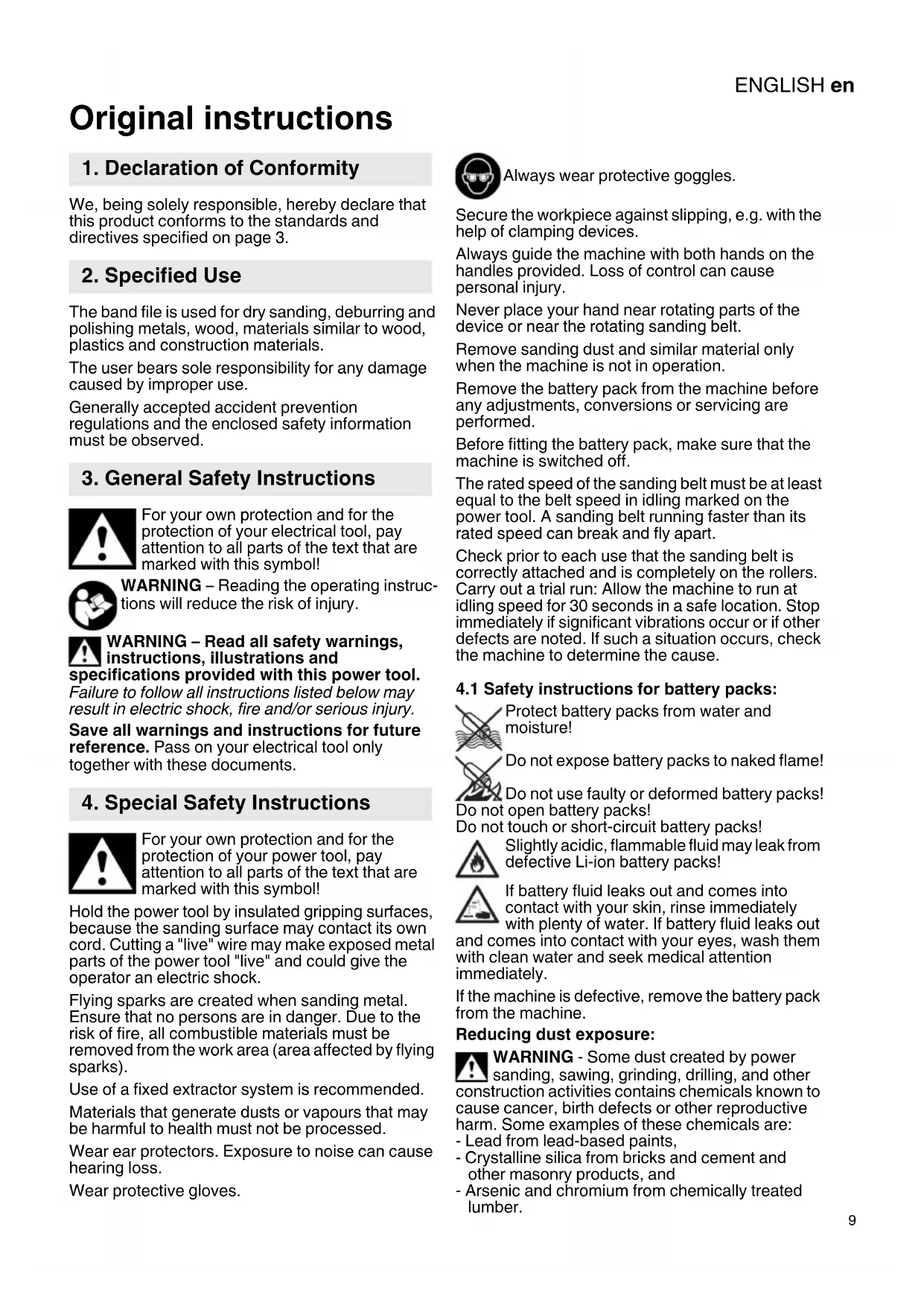
Original instructions We, being solely responsible, hereby declare that this product conforms to the standards and directives specified on page 3. The band file is used for dry sanding, deburring and polishing metals, wood, materials similar to wood, plastics and construction materials. The user bears sole responsibility for any damage caused by improper use. Generally accepted accident prevention regulations and the enclosed safety information must be observed. For your own protection and for the protection of your electrical tool, pay attention to all parts of the text that are marked with this symbol! WARNING – Reading the operating instruc- tions will reduce the risk of injury. WARNING – Read all safety warnings, instructions, illustrations and specifications provided with this power tool. Failure to follow all instructions listed below may result in electric shock, fire and/or serious injury. Save all warnings and instructions for future reference. Pass on your electrical tool only together with these documents. For your own protection and for the protection of your power tool, pay attention to all parts of the text that are marked with this symbol! Hold the power tool by insulated gripping surfaces, because the sanding surface may contact its own cord. Cutting a "live" wire may make exposed metal parts of the power tool "live" and could give the operator an electric shock. Flying sparks are created when sanding metal. Ensure that no persons are in danger. Due to the risk of fire, all combustible materials must be removed from the work area (area affected by flying sparks). Use of a fixed extractor system is recommended. Materials that generate dusts or vapours that may be harmful to health must not be processed. Wear ear protectors. Exposure to noise can cause hearing loss. Wear protective gloves. Always wear protective goggles. Secure the workpiece against slipping, e.g. with the help of clamping devices. Always guide the machine with both hands on the handles provided. Loss of control can cause personal injury. Never place your hand near rotating parts of the device or near the rotating sanding belt. Remove sanding dust and similar material only when the machine is not in operation. Remove the battery pack from the machine before any adjustments, conversions or servicing are performed. Before fitting the battery pack, make sure that the machine is switched off. The rated speed of the sanding belt must be at least equal to the belt speed in idling marked on the power tool. A sanding belt running faster than its rated speed can break and fly apart. Check prior to each use that the sanding belt is correctly attached and is completely on the rollers. Carry out a trial run: Allow the machine to run at idling speed for 30 seconds in a safe location. Stop immediately if significant vibrations occur or if other defects are noted. If such a situation occurs, check the machine to determine the cause.
4.1 Safety instructions for battery packs:
Protect battery packs from water and moisture! Do not expose battery packs to naked flame! Do not use faulty or deformed battery packs! Do not open battery packs! Do not touch or short-circuit battery packs! Slightly acidic, flammable fluid may leak from defective Li-ion battery packs! If battery fluid leaks out and comes into contact with your skin, rinse immediately with plenty of water. If battery fluid leaks out and comes into contact with your eyes, wash them with clean water and seek medical attention immediately. If the machine is defective, remove the battery pack from the machine. Reducing dust exposure: WARNING - Some dust created by power sanding, sawing, grinding, drilling, and other construction activities contains chemicals known to cause cancer, birth defects or other reproductive harm. Some examples of these chemicals are: - Lead from lead-based paints, - Crystalline silica from bricks and cement and other masonry products, and - Arsenic and chromium from chemically treated lumber.
1. Declaration of Conformity
3. General Safety Instructions
Your risk from these exposures varies, depending on how often you do this type of work. To reduce your exposure to these chemicals: work in a well ventilated area, and work with approved safety equipment, such as those dust masks that are specially designed to filter out microscopic particles. This also applies to dust from other materials such as some timber types (like oak or beech dust), metals, asbestos. Other known diseases are e.g. allergic reactions, respiratory diseases. Do not let dust enter the body. Observe the relevant guidelines and national regulations for your material, staff, application and place of application (e.g. occupational health and safety regulations, disposal). Collect the particles generated at the source, avoid deposits in the surrounding area. Use suitable accessories for special work. In this way, fewer particles enter the environment in an uncontrolled manner. Use a suitable extraction unit. Reduce dust exposure with the following measures: - do not direct the escaping particles and the exhaust air stream at yourself or nearby persons or on dust deposits, - use an extraction unit and/or air purifiers, - ensure good ventilation of the workplace and keep clean using a vacuum cleaner. Sweeping or blowing stirs up dust. - Vacuum or wash the protective clothing. Do not blow, beat or brush. Transport of li-ion battery packs: The shipping of li-ion battery pack is subject to laws related to the carriage of hazardous goods (UN 3480 and UN 3481). Inform yourself of the currently valid specifications when shipping li-ion battery packs. If necessary, consult your freight forwarder. Certified packaging is available from Metabo. Only send the battery pack if the housing is intact and no fluid is leaking. Remove the battery pack from the machine for sending. Prevent the contacts from short-circuiting (e.g. by protecting them with adhesive tape). See page 2. 1 Sanding attachment 2 Rotary knob for securing the sanding attachment and adjusting the belt run 3Cover 4 Arrow (direction of rotation of drive shaft
5Screw for securing the cover 6Sanding belt 7 Tensioner arm for replacing the sanding belt 8 Sanding head
Locking screw for adjusting sanding head 10 Additional handle 11 Sliding on/off switch
Handle 13 Electronic signal indicator 14 B attery pack release button 15 Capacity indicator button 16 Capacity and signal indicator 17 Battery pack 18 Dust filter
6.1 Attaching the additional handle
Always work with the additional handle attached (10)! Attach the additional handle on the left or right of the machine and secure. Attach the additional handle to the side facing away from the sanding belt (6).
6.2 Turning the sanding head (8) to
operating position Loosen the locking screw (9) using the hexagon spanner and, if necessary and depending on the task at hand, turn the sanding head (8). The sanding head must be positioned in the permitted working area as shown (see illustration A, page 2). Firmly tighten the locking screw (9). Each time before you start work, verify that the locking screw (9) is sufficiently tightened to ensure that the sanding head (8) does not move. Otherwise, the sanding belt (6) may come in contact with the user. Loss of control can cause personal injury.
See illustration C on page 2. Always fit the dust filter if the surroundings are heavily polluted (18). The machine heats up faster when the dust filter is fitted (18). It is protected by the electronics system from overheating (see chapter9.). To fit: See fig. page 2. Attach the dust filter (18) as shown. To remove: Holding the dust filter at the edges, raise it slightly (18) and then pull it downwards and remove.
6.4 Rotating battery pack
See illustration C on page 2. The rear section of the machine can be rotated 270° in three stages, thus allowing the machine's shape to be adapted to the working conditions. Only operate the machine when it is in an engaged position.
Charge the battery pack before use (17). If performance diminishes, recharge the battery pack. Instructions on charging the battery pack can be found in the operating instructions of the Metabo charger. "Li-Power" li-ion battery packs have a capacity and signal indicator: (16)
- Press the button (15), the LEDs indicate the charge level. - If one LED is flashing, the battery pack is almost flat and must be recharged.
6.6 Removing and inserting the battery pack
Removal: Press the battery pack release (14) button and pull the battery pack (17) forwards
Inserting: Slide in the battery pack (17) until it engages.
7.1 On/Off switch, continuous activation
Always guide the machine with both hands. Switch the machine on first before mounting it on the workpiece. The machine must not be allowed to draw in additional dust and shavings. When switching the machine on and off, keep it away from dust deposits. After switching off the machine, only place it down when the motor has come to a standstill. Avoid switching on the machine accidentally: always switch it off when the battery pack is removed from the machine. In continuous operation, the machine continues running if it is forced out of your hands. Therefore, always hold the machine using the handles provided, stand in a safe position and concentrate. Switching on/ Continuous activation : Push sliding switch (11) forward. For continuous activation, now tilt downwards until it engages. Switching off: Press the rear end of the slide switch (11) and release.
7.2 Sanding belt replacement
See illustration B, page 2. - Manually loosen screw (5) and remove cover (3). - Pull tensioner arm (7) backwards and remove sanding belt (6). - Place the new sanding belt on the rollers such that its direction of circulation (arrows on the inside of the sanding belt) matches the arrows (4) on the cover. Place the sanding belt first on the drive shaft and then on the roller on the sanding attachment (1). - Replace the cover (3) and tighten the screw (5) by hand. - Check the belt run and adjust if necessary (see
7.3 Adjusting belt run
Using the screw (2), adjust the sanding belt (while the machine is not in operation and the battery pack is removed) so that it runs in the centre of the sanding belt roller.
7.4 Sanding procedure
Switch the machine on first before mounting it on the workpiece. Place the machine on the material such that the sanding belt is parallel to the surface of the workpiece. Keep the machine in constant motion because otherwise recesses could be produced in the material.
7.5 Replacing the sanding attachment
See illustration C, page 2. - Removing the sanding belt (see Section 7.2). - Remove screw (2), and remove sanding attachment (1). - Attach the other sanding attachment as shown (ensure that the nose at the end of the sanding attachment is pointing in the direction of the tensioning arm, see illustration C). - Secure with screw (2). - Attaching the sanding belt (see Section 7.2). - Adjusting the belt run (see Section 7.3). Motor cleaning: blow compressed air through the rear ventilation slots of the machine regularly, frequently and thoroughly. Here, the machine must be held firmly. The electronic signal display (13) lights up and the load speed decreases. The temperature is too high! Run the machine in idling until the electronics signal indicator switches off. The electronic signal display (13) flashes and the machine does not start. The restart protection is active. The machine will not start if the battery pack is inserted while the machine is on. Switch the machine off and on again. Do not press the device too firmly against the surface being sanded. This does not improve, but rather impairs, the sanding performance.
8. Cleaning, Maintenance
- For optimum operation: Sand on the side on which the sanding belt moves towards the machine. Use only original Metabo or CAS (Cordless Alliance System) battery packs and accessories. Use only accessories which fulfil the requirements and specifications listed in these operating instruc- tions. Battery packs with different capacities: 18 V Li-Power 4,0 Ah p. 6
- .25591 18 V Li-Power 5,2 Ah p. 6
- .25592 18 V LiHD 5,5 Ah p. 6
- .25342 18 V LiHD 8,0 Ah .25369 Chargers: AS 55 ASC 145 etc. For a complete range of accessories, see www.metabo.com or the main catalogue Repairs to electrical tools must be carried out by qualified electricians ONLY! Contact your local Metabo representative if you have Metabo power tools requiring repairs. For addresses see www.metabo.com. You can download a list of spare parts from www.metabo.com. Observe national regulations on environmentally compatible disposal and on the recycling of disused machines, packaging and accessories. Battery packs must not be disposed of with regular waste. Please return faulty or used battery packs to your Metabo dealer. Do not throw battery packs into water. Only for EU countries: Never dispose of power tools in your household waste! In accordance with European Guideline 2012/ 19/EU on used electronic and electric equipment and its implementation in national legal systems, used power tools must be collected separately and handed in for environmentally compatible recycling. Before disposal, discharge the battery pack in the power tool. Prevent the contacts from short- circuiting (e. g. by protecting them with adhesive tape). Explanatory notes on the specifications on page 3. Changes due to technological progress reserved. U =Voltage of battery pack p. 6
=Sanding belt length
=Belt speed in idling m =Weight with smallest battery pack Measured values determined in conformity with EN
Permitted ambient temperature during operation: -20 °C (-4°F) to 50 °C (120°F) (limited performance with temperatures below 0 °C (32°F)). Permitted ambient temperature for storage: 0 °C (32°F) to 30 °C (86°F). Direct current The technical specifications quoted are subject to tolerances (in compliance with the relevant valid standards). Vibration total value (vector sum of three directions) determined in accordance with EN 62841:
= Uncertainty (vibration) The vibration emission level given in this information sheet has been measured in accordance with a standardised test given in EN 62841 and may be used to compare one tool with another. It is also suitable for a provisional estimate of the vibratory load. The specified vibration level applies to the main applications of the power tool. However, if the tool is used for other applications, with different accessories or is poorly maintained, the vibration level may vary. This can considerably increase the vibratory load over the entire working period. An estimation of the level of exposure to vibration should also take into account the times when the tool is switched off or when it is running but not actually doing the job. This can considerably reduce the vibratory load over the entire working period. Identify additional safety measures to protect the operator from the effects of vibration such as: maintain the tool and the accessories, keep the hands warm, organisation of work patterns. A-effective perceived sound levels:
=Sound pressure level
=Acoustic power level
= Uncertainty (noise level) During operation the noise level can exceed 80 dB(A). Wear ear protectors!