HDM9000LX - Range hood HOOVER - Free user manual and instructions
Find the device manual for free HDM9000LX HOOVER in PDF.



| Product type | Extractor or recirculation hood |
| Brand | Hoover |
| Model | HDM9000LX |
| Width | 90 cm |
| Estimated weight | 15 kg |
| Power supply | 220-240 V, 50 Hz, fuse 3 A |
| Insulation class | Class I or II depending on model (see rating plate) |
| Number of motor speeds | 3 speeds + intensive (10 min) |
| Lighting type | Halogen or LED (depending on version) |
| Grease filters | Dishwasher safe, clean every 2 months |
| Activated carbon filters | Non-regenerable (replace every 4 months) or regenerable (washable, replace every 3 years) |
| Minimum distance from hob | 45 cm (electric, gas or induction cooking) |
| Air outlet diameter | 150 mm (recommended) |
| Special functions | Automatic shut-off timer 15 min, Clean Air function, filter saturation detection |
| Controls | Electronic or mechanical depending on version (see manual) |
| Installation type | Wall-mounted with or without decorative chimney |
| Maintenance | Clean the exterior with a damp cloth and denatured alcohol |
| Repairability | Halogen lamps replaceable by user; LED by technician; motor and electronics by approved service |
Frequently Asked Questions - HDM9000LX HOOVER
User questions about HDM9000LX HOOVER
0 question about this device. Answer the ones you know or ask your own.
Ask a new question about this device
Download the instructions for your Range hood in PDF format for free! Find your manual HDM9000LX - HOOVER and take your electronic device back in hand. On this page are published all the documents necessary for the use of your device. HDM9000LX by HOOVER.
USER MANUAL HDM9000LX HOOVER
indicata in Fig.8.1.
E = touche TROSIEME VITESSE.
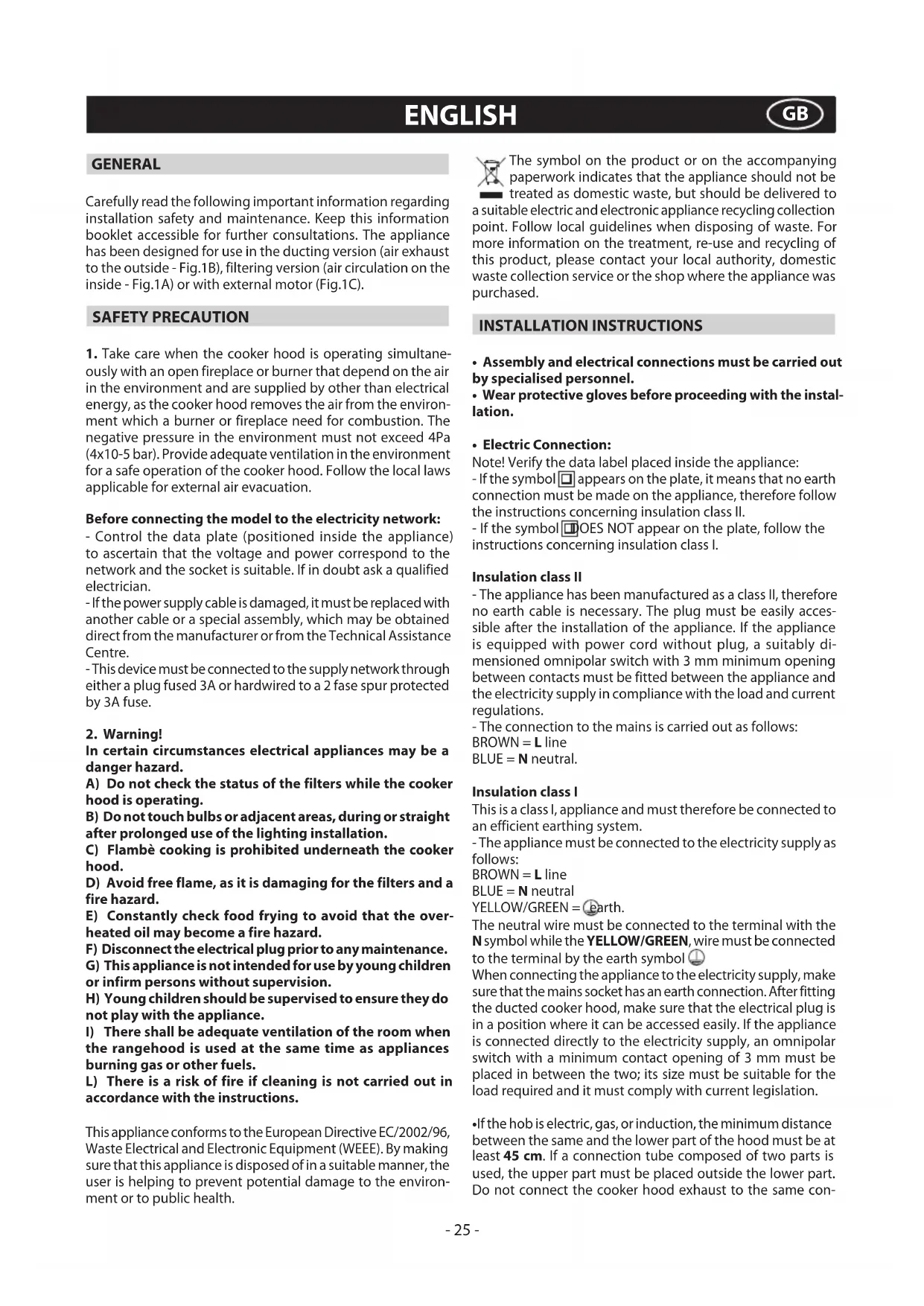
Carefully read the following important information regarding installation safety and maintenance. Keep this information booklet accessible for further consultations. The appliance has been designed for use in the ducting version (air exhaust to the outside - Fig.1B), filtering version (air circulation on the inside - Fig.1A) or with external motor (Fig.1C).
SAFETY PRECAUTION
- Take care when the cooker hood is operating simultaneously with an open fireplace or burner that depend on the air in the environment and are supplied by other than electrical energy, as the cooker hood removes the air from the environment which a burner or fireplace need for combustion. The negative pressure in the environment must not exceed 4Pa (4x10⁻⁵ bar). Provide adequate ventilation in the environment for a safe operation of the cooker hood. Follow the local laws applicable for external air evacuation.
Before connecting the model to the electricity network:
- Control the data plate (positioned inside the appliance) to ascertain that the voltage and power correspond to the network and the socket is suitable. If in doubt ask a qualified electrician.
-
If the power supply cable is damaged, it must be replaced with another cable or a special assembly, which may be obtained direct from the manufacturer or from the Technical Assistance Centre.
-
This device must be connected to the supply network through either a plug fused 3A or hardwired to a 2 fase spur protected by 3A fuse.
2. Warning!
In certain circumstances electrical appliances may be a danger hazard.
A) Do not check the status of the filters while the cooker hood is operating.
B) Do not touch bulbs or adjacent areas, during or straight after prolonged use of the lighting installation.
C) Flambé cooking is prohibited underneath the cooker hood.
D) Avoid free flame, as it is damaging for the filters and a fire hazard.
E) Constantly check food frying to avoid that the overheated oil may become a fire hazard.
F) Disconnect the electrical plug prior to any maintenance.
G) This appliance is not intended for use by young children or infirm persons without supervision.
H) Young children should be supervised to ensure they do not play with the appliance.
I) There shall be adequate ventilation of the room when the rangehood is used at the same time as appliances burning gas or other fuels.
L) There is a risk of fire if cleaning is not carried out in accordance with the instructions.
This appliance conforms to the European Directive EC/2002/96, Waste Electrical and Electronic Equipment (WEEE). By making sure that this appliance is disposed of in a suitable manner, the user is helping to prevent potential damage to the environment or to public health.

The symbol on the product or on the accompanying paperwork indicates that the appliance should not be treated as domestic waste, but should be delivered to
a suitable electric and electronic appliance recycling collection point. Follow local guidelines when disposing of waste. For more information on the treatment, re-use and recycling of this product, please contact your local authority, domestic waste collection service or the shop where the appliance was purchased.
INSTALLATION INSTRUCTIONS
Assembly and electrical connections must be carried out by specialised personnel.
- Wear protective gloves before proceeding with the installation.
Electric Connection:
Note! Verify the data label placed inside the appliance:
- If the symbol appears on the plate, it means that no earth connection must be made on the appliance, therefore follow the instructions concerning insulation class II.
- If the symbol OES NOT appear on the plate, follow the instructions concerning insulation class I.
Insulation class II
- The appliance has been manufactured as a class II, therefore no earth cable is necessary. The plug must be easily accessible after the installation of the appliance. If the appliance is equipped with power cord without plug, a suitably dimensioned omnipolar switch with 3mm minimum opening between contacts must be fitted between the appliance and the electricity supply in compliance with the load and current regulations.
- The connection to the mains is carried out as follows:
BROWN = L line
BLUE = N neutral.
Insulation class I
This is a class I, appliance and must therefore be connected to an efficient earthing system.
- The appliance must be connected to the electricity supply as follows:
BROWN = L line
BLUE = N neutral
YELLOW/GREEN = earth.
The neutral wire must be connected to the terminal with the N symbol while the YELLOW/GREEN, wire must be connected to the terminal by the earth symbol
When connecting the appliance to the electricity supply, make sure that the mains socket has an earth connection. After fitting the ducted cooker hood, make sure that the electrical plug is in a position where it can be accessed easily. If the appliance is connected directly to the electricity supply, an omnipolar switch with a minimum contact opening of 3mm must be placed in between the two; its size must be suitable for the load required and it must comply with current legislation.
- If the hob is electric, gas, or induction, the minimum distance between the same and the lower part of the hood must be at least 45cm . If a connection tube composed of two parts is used, the upper part must be placed outside the lower part. Do not connect the cooker hood exhaust to the same con
ducer used to circulate hot air or for evacuating fumes from other appliances generated by other than an electrical source. Before proceeding with the assembly operations, remove the anti-grease filter(s) (Fig.2.2 - Fig.3.2) so that the unit is easier to handle.
- In the case of assembly of the appliance in the suction version prepare the hole for evacuation of the air.
- If the appliance is supplied with the small cupola M remove it by releasing it as indicated in Fig.2.3 - Fig.3.3.
Before proceeding with the assembly operations, for easier manoeuvrability of the appliance disengage the anti-grease filter by pulling handle B as indicated in Fig.2.2 - Fig.3.2.
If one owns a model with perimeter suction panel, before carrying out this operation, perform the following phases:
- Open panel C as indicated in Fig.2.1 - Fig.3.1.
- If one owns the version with three A panels release them from the fixing pins by pulling outwards (Fig.3.4) and then remove them from safety pins N (Fig.3.4) placed inside the hood. To put them back perform the operation in reverse order.
ATTENTION! During this disassembly and assembly operation ensure to hold the panel securely to prevent accidental falls.
- Wall mounting:
Trace the bottom side of the hood on the wall. Consider the measurements shown in Fig.4A and minimum distance from the cooking surface (Fig.4B).
- Position the fixing template on the wall, making sure that the line coincides with the line previously made on the wall.
- Mark the fixing holes and cut them into the material (Fig.5).
- Fix the 2 top screws K and screw anchors (Fig.5), without tightening them completely.
- Place the appliance against the wall, align it in horizontal position and tighten screws K (Fig.6A).
- Once the adjustment has been completed, fix the hood using the 2 screws C (Fig.6B).
- When carrying out the fixing operations, use only screws and screw anchors suited to the type of wall (e.g. reinforced concrete, plasterboard etc.).
- If the screws and screw anchors are supplied with the appliance, make sure that they are suited to the type of wall to which the hood must be fixed.
- Installation of models without decorative ducts: Extractor hood
- Unclip the canopy M and remove the grille E (Fig.7).
- Pass the power supply cable through the slot in the canopy M , as indicated in Fig.9A.1.
- Taking the grommet H , position it between the power cable and the slot (Fig.9A.2).
- Connect the flexible hose L (not supplied) to the hood (Fig.9B).
- Re-position the small cupola M paying attention that it is hitched perfectly to the fixing pins G (Fig.9B).
-Filtering version:
- Unclip the canopy M and remove the grille E (Fig.7).
Pass the power supply cable through the slot in the canopy M_i as indicated in Fig.8.1. - Taking the grommet H , position it between the power cable and the slot (Fig.8.2).
-Fix the small cupola M and the grille E making sure that is it perfectly hooked on to the fastening pins G (Fig.8).
-Optional accessories:
This model may have decorative ducts as optional accessories
- ask your retailer for information.
Before installing decorative flues it is necessary to remove the small cupola M and loosen the 4 screws Q that lock the fastening pins G as shown in Fig.11.
- Installation of models with decorative ducts: Extractor hood
Make sure the electrical power supply is within the measurements of the decorative connector. Adjust the width of the support bracket of the top connector (Fig.10.2). Then fix it to the ceiling so that it is on the same axis as the hood using screws A and observing the distance from the ceiling shown in Fig.10.1. Connect flange F to the air exhaust hole using flexible hose L (Fig.12A). Slide the top connector inside the lower duct and place this on the body (Fig.12B). Pull out the top duct as far as the bracket and secure it using screws B (Fig.10.2). To transform the hood from a ducting version into a filtering version, ask your dealer for the charcoal filters and follow the installation instructions.
Filter hood:
Please note:
The filters must be ordered from your dealer as an accessory.
-
To transform the hood from the SUCTION version to the FILTERING version, charcoal filters must be ordered from your dealer as an accessory. Two types of kit are available, one with non-renewable filters (Fig.13) and the other with renewable filters (washable) (Fig.14). Unlike traditional carbon filters, this carbon filter can be washed and reactivated for approximately 12-15 times. With normal hood use, this filter should be cleaned once every 2-3 months. The filter can be washed into a dishwasher at the highest temperature using a standard dishwasher detergent. After washing, dry the filter in the oven at 100^ for 10-15 minutes to reactivate it. The filter will retain its odour-absorbing capacity for three years, after which it will have to be replaced.
-
If a bracket is found in the packaging like that indicated in Fig.14 loosen the screws already installed inside the hood and install the bracket using the previously-removed screws.
-
To replace re-usable carbon filters Y , remove the brackets from their seat, pulling them outwards (Fig.14).
-
If your product is not supplied with the bracket, it means that the active charcoal filter cannot be renewed (Fig.13). These must be applied to the suction unit inside the hood, centring them in it and turning them 90^ until they snap into place (Fig.13).
USE AND MAINTENANCE
- We recommend that the cooker hood is switched on before any food is cooked. We also recommend that the appliance is left running for 15 minutes after the food is cooked, in order to thoroughly eliminate all contaminated air.
The effective performance of the cooker hood depends on constant maintenance; the anti-grease filter and the active carbon filter both require special attention.
- The anti-grease filter is responsible retaining the grease particles suspended in the air, therefore it is subject to clogging with variable frequency according to the use of the appliance.
- To prevent the danger of possible fires, at least every 2 months one must wash the anti-grease filters by hand using non-abrasive neutral liquid detergents or in the dishwasher at low temperatures and on short cycles.
- After a few washes, colour alterations may occur. This does not give the right to claim their replacement.
- The active carbon filters are used to purify the air that is
sent back into the room and its function is to mitigate the unpleasant odours produced by cooking.
- The non-regenerable active carbon filters must be replaced at least every 4 months. The saturation of the active charcoal depends on the more or less prolonged use of the appliance, on the type of kitchen and on the frequency with which anti-grease filter is cleaned.
- Regenerable active charcoal filters must be washed by hand, with non-abrasive neutral detergents, or in the dishwasher at a maximum temperature of 65^ (the washing cycle must be complete without dishware). Remove excess water without damaging the filter, remove the plastic parts, and let the mat dry in the oven for at least 15 minutes approximately at a maximum temperature of 100^ . To keep the regenerable charcoal filter functioning efficient this operation must be repeated every 2 months. These must be replaced at least every 3 years or when the mat is damaged.
- Before remounting the anti-grease filters and the regenerable active charcoal filters it is important that they are completely dry.
- Clean the hood frequently, both internally and externally, using a cloth dampened with denatured alcohol or neutral liquid detergents that are non abrasive.
The lighting system is designed for use during cooking and not for the prolonged general lighting of the room. The prolonged use of the lighting system significantly decreases the average duration of the bulbs. -
If the appliance is equipped with courtesy lights it is possible to use them for general room lighting for a prolonged amount of time.
-
Attention: the non compliance with the hood cleaning warnings and with the replacement and cleaning of the filters entails risk of fires. One therefore recommends keeping to the suggested instructions.
-
Replacing halogen light bulbs (Fig.15.1):
To replace the halogen light bulbs B remove the glass panel C using a lever action on the relevant cracks.
Replace the bulbs with new ones of the same type.
Caution: do not touch the light bulb with bare hands.
- Replacing LED lamps (Fig.15.2):
If the appliance version is with LED lamps, the intervention of a specialised technician is necessary to replace them.
- Commands luminous (Fig.16) the key symbols are explained below:
A = LIGHT
B = OFF
C=SPPEEDI
D=SPEEDII
E=SPPEED III
F = AUTOMATIC STOP TIMER - 15 minutes (*)
If your appliance has the INTENSIVE speed function, from speed THREE, press key E for 2 seconds and it will be activated for 10 minutes after which it will return to the previously set speed. When the function is active the LED flashes.
To interrupt it before the 10 minutes have elapsed, press key E again.
Some models allow activating this function even with speed one and two.
By pressing key F for two seconds (with the hood switched off) the "clean air" function is activated. This function switches the appliance on for ten minutes every hour at the first speed. As soon as this function is activated the motor starts up at the first speed for ten minutes. During this time key F and key
C must flash at the same time. After ten minutes the motor switches off and the LED of key F remains switched on with a fixed light until the motor starts up again at the first speed after fifty minutes and keys F and C start to flash again for ten minutes and so on. By pressing any key for the exclusion of the hood light the hood will return immediately to its normal functioning (e.g. if key D is pressed the "clean air" function is deactivated and the motor moves to the 2nd speed straight away. By pressing key B the function is deactivated).
(*) The "AUTOMATIC STOP TIMER" delays stopping of the hood, which will continue functioning for 15 minutes at the operating speed set at the time this function is activated.
-
Anti-grease/active charcoal filters saturation:
-
When the A key flashes with a 2 second frequency the anti-grease filters must be washed.
-
When the A key flashes with a 0.5 second frequency the active carbon filters must be replaced or washed depending on the type of filter.
Once the clean filter has been put back one must reset the electronic memory by pressing the A key for approximately 5 seconds until it stops flashing.
- Commands (Fig.17):
Push-button A = on/off lights switch.
Push-button B = on/off cooker hood switch. The appliance switches on at speed level 1, If the cooker hood is on depress the push-button for 2 sec. to switch off the cooker hood. If the cooker hood is at speed level 1 it will not be necessary to depress the push-button to switch the cooker hood off. Decreases the motor speed.
Display C = indicates the motor speed level selected and activates the timer.
Push-button D = switches on the cooker hood. Increases the motor speed. Touching the key at 3rd speed, the intensive function runs for 10' , then the appliance goes back to work at the original speed. During this function the display blinks.
Key E = The Timer times the functions on activation for 15 minutes, after which they are switched off. The Timer is deactivated by re-pressing Key E.
When the Timer is activated the decimal point must flash on the display. The Timer cannot be activated if the intensive speed is functioning.
The "clean air" function is activated by pressing key E for 2 seconds when the appliance is switched off. This switches the motor on for 10 minutes every hour at the first speed.
During functioning a rotary movement of the peripheral segments must be visualised on the display. When this time has passed the motor switches off and the fixed letter "C" must be visualised on the display until the motor re-starts after 50 minutes for another 10 minutes and so on.
Press any key apart from the light keys to return to normal functioning. Press key E to deactivate the function.
-
Anti-grease/active charcoal filters saturation:
-
When display item C flashes, at a speed where it alternates with the letter F (e.g. 1 and F), the anti-grease filters must be washed.
-
When display item C flashes, at a speed where it alternates with the letter A (e.g. 1 and A), the active carbon filters must be replaced or washed depending on the type of filter.
After the clean filter has been positioned correctly, the electronic memory must be reset by pressing button A for approximately 5 seconds, until the indication F or A shown on the display C stops flashing.
- Commands mechanical (Fig.18) the key symbols are explained below:
A = LIGHT
B=OFF
C=SPPEEDI
D=SPEDII
E = SPEED III.
- Mechanical controls (Fig.19) the symbols are as follows:
A = LIGHT/ON-OFF key
B = OFF/FIRST SPEED key
C = SECOND SPEED key
D = THIRD SPEED key.
If the hood is shut off at first, second or third speed, when it is turned back on, it will start at the same speed it was in when switched off.
CUSTOMER ASSISTANCE SERVICE
Before contacting the Technical Assistance Service.
If the product does not operate at all, we advise you to:
- Check that the plug has been inserted into the power socket correctly.
If you cannot identify the cause of the operating anomaly: switch off the appliance (do not subject it to rough treatment) and contact the Assistance Service.
PRODUCT SERIAL NUMBER. Where can I find it?
It is important that you inform the Assistance Service of your product code and its serial number (a 16-character code which begins with the number 3); this can be found on the guarantee certificate or on the data plate located inside the appliance.
This will help to avoid wasted journeys being made by technicians, thereby (and most significantly) saving the corresponding callout charges.
THE MANUFACTURER DECLINES ALL RESPONSIBILITY FOR EVENTUAL DAMAGES CAUSED BY BREACHING THE ABOVE WARNINGS.
ALGEMEEN
INSTALLATIE INSTRUCTIES
C = knop EERSTE SNELHEID
D=knopTWEEDWERDESNELHEID
E = knop DERDE SNELHEID.
MARROM Linha
AZUL = N neutrto
AMARELO/VERDE = terra.
Tecla A = acende/apaga as luzes.
A = tast for BELYSNING
B = tast for OFF
C = tast for FØRSTE HASTIGHED
D = tast for ANDEN HASTIGHED
E = tast for TREDJE HASTIGHED
F = tast for TIMER AUTOMATISK STOP 15 minutter (*)
A = tast for BELYSNING
B = tast for OFF
C = tast for FØRSTE HASTIGHED
D = tast for ANDEN HASTIGHED
E = tast for TREDJE HASTIGHED.
- Manuelle betjeningstaster (Fig.19) herunder gengives symbolerne:
A = LYS-tast/ON-OFF
B = OFF-tast/FØRSTE HASTIGHED
C = tast for ANDEN HASTIGHED
D = tast for TREDJE HASTIGHED.
B = ENSIMMAINEN NOPEUS ON/OFF
C=TOINEN NOPEUS
D=KOLMAS NOPEUS.
YINHPEEA YNOSTHPHIEH NELAION
Piv kaloeote tv unnpoeia Teviknc uootpiEnc.
BARNA L fazis
KÉK = N nulla
SÁRGA/ZÖLD = föld.
E = HARMADIK SEBESSEG.
GUL/GRONN = Jording.
Den noytrale traden ma kopies til pluggen med symbolet N mens den GRONN/GULE, traden makioples til pluggen naer jordingssymbolet
A = tast for BELYSNING
B = tast for OFF (AV)
C = tasting for FØRSTE HASTIGHET
D = tast for ANNEN HASTIGHET
E = tast for TREDJE HASTIGHET
F = tast TIDSURE AUTOMATISK STOPP 15 minuutter (*)
A = tast for LYS/ON-OFF
B = tast for OFF/FØRSTE HASTIGHET
C = tast for ANDRE HASTIGHET
D = tast for TREDJE HASTIGHET.
Hvis hetten slukkes nár den er plassert på forste, andre aller tredje hastighet, vil den starte ved samme hastighet nár den slås på igjen.
KUNDESERVICE
NIEBIESKI = N neutrally
MInHImaJIbHaI DaICTaHcIa MExNy OOnOpHoI HaPeBaIOUeICn PINOCKOCTbIO HIXKHeY CaTbIO KxOHHO DbIMOCoA DOJXHa 6bITb He MeHee 45 cm.
Ecnn npimehareTc coeHHntbHn Tpy6a n3 DByx n 60onee qacte,TO Bepnna TcBdoJXn paCnoIarTbcn ChapyKn HnKHe yactn. He coeHHnTb Bbl6poc n3 BblTAKKn C KaHAnOM cnpKyIaunrTopayero BO3Dyxa nn C KaHAnOM,NCNoJIb3yeMmIgN OTBOda DbIMoT UCTPOINCTB,3aNbITbIBaEMbIX INHOJ 3Heprnue Kpome 3NeKTPNueckoi.
Ipeed Tem Ka npctyntb K c6opke yctpoicTBa, nla 6-nerueHn ero MoTataKa OTcoeHNHTe hnBtp/KnpoynaBnBaIoUnn hnBtp (Pnc.2.2 - Pnc.3.2.).
B TOM Cnyuae, ecn npnbop MOHTnpyetcR C BbITJHKbIM yCTpOINCTBOM, peKOMeHnyETcR oecneuHTb NOMEUHe BblBOIDhIM OTBepCTnEM.
-PeKoMeHdyETcNcNoIb3OBAbT py6y DbIMOXoJa c TaKIM JxE dIaMeTpOM, UTO N OTBepCTne NOdau BO3dyxa. IcNoIb3OBAHHe cyXeHHo Tpy6bl MoKeT COKpaTntb KII BbITRAKKn I yBeIuHTb ee WymOBOy yPOBeHb.
- Ecn np6op ochaen KOJNAKOM M, cHrB erO, nIa 3TOO orcoeHHb, KaK noka3aHO Ha Puc.2.3 - Puc.3.3.
IpeaTeM, KaK npCTyNTb KMOTaXHbIM Opeaunr, YTO6bl yBeuHTb MaHeBpeHHocTb Pn60pa, CneDyET OTOeUNHTb XInpoUaNBAIOuN FUnbTp, DnA 3TOrO NToAHyTb pyKoRTKY B, KaK noka3aHO Ha Puc.2.2 - Puc.3.2.
Ha moJenIcx c nepImeTpalbHoi BbITaXHo nAHeJIbIO,pepeBblONHeHnem 3ToI onepaun, BblOnHHTb CneDyUoNIE DeiCTBnI:
-OTKpbITb NaHeNb C, KaYka3aHo Ha Pnc.2.1 - Pnc.3.1.
-Ha Bercn C TpeMnaHeMa A OTOcoeHNHTb nx OT KpenEckHbIX WtBipei, nIy cero CneJeYET NotHyTB nx HApyy (Pnc.3.4)N 3aTeM, CHTb nx C npedoxpaHnteJbHbx WtBipei N (Pnc.3.4)KOTOpbie HaxoJrTcB HByTpN KOJINaKa. Iy YCTaHOBKn, BblONHtB onepaunn B o6paTHOM nopRKe.
BHIMAHHE!PnBbINONHeHHN3ToMOnTaXHNoI MeMOHTaXHoIonepaun,npOBepuTb,4TO NaHeNbHaIeXHOyctaHOBeHa,BO n36ExKaHHe cnUaHOrO naDeHHra.
BHMaHHe: He npKaacaiTebc K IaMnam roIbIM pyKaMn.
- 3aMeHa CBTeOAnoHbIX lamn (Pnc.15.2):
Ha nCnoJIHeHn co CBETOIOIOnHbIMN lamnamn, 3aMeHy lamn doJnxKe H npOu3BoUITb CneuaJn3npoBaHHbI TexHnueckn nepcoHn.
- OpraHbI ynpaBJIeHnCBeTaeUneCe (Pnc.16):
A=KHONKaOCBeueHnRA
B=KHOIIKa HUJIeBOI
C=KHOIIKa NEpBOI CKOpOCTN
D=KHONKa BTOPOK CKOPOCTN
E = KHOIIKA TpeTei CKOPOCTN
F=KHOIIKa TaIMepa ABTomaTnueckoOCTaHOBKn Yepe3 15 MNH (*)
EcINB Baaem yctpoCTBe NOdkJIOueHa FyHKUH INHTHCNB-HOCKOPoCTN,JIe ee AKTBAuHN Heo6xoJIMOBKIIouHTb TPETbIO CKOpocTB N depKaTb HkaToB TeueHne npImepHO 2 cekHyd KhoNky E.3Ta FyHKcuaA kTtBNpyetc Ha 10 MNHyT, nocJe Hero npom3oJET BO3BpaKytAHOBJeHHo paHee ckopocTu.Bo BPem AKTBAuHN FyHKUH MmraE CTBeTOJNOHbI INDnKATOp.ДЯ OCTaHOBKn FyHKUH Do nCTeueHn 10 MNHyT Heo6xOJMo CHOBa HkaTb KhoNky E.
BHeKOTopbIX MoeIax BO3MOXHO aKTUBPObaTb 3Ty yHKUHO Ha nepBOH n BTOPOI CKOPoCTn.
HaKaTOM noIoxKeHn B TeueHne 2-x cekyHd KJIaBnUy F.ДЯ BKJIIOUeHnФyHKcUN "clean air" HaKaTb N DEpKcTaB B TaKOM noIoxKeHn KJIaBnUy F.3aФyHKcUN exEeacHO BKJIIOuAet DBIrataNb Ha nepBoi ckopocTu Ha 10 MInHT, B TeueHne KOTOpbIX DoJXHbMIraTb OINHOpeMeHHO yKa3aTeJIu KJIaBnU F nC. PocNe Yero DBrarTeNb BBIKIOUaETcR, a Yka3aTeJIb Ha KJIaBnUe F ocTaETcRAxKHeHHbIM.
Pn6n3ntbHO uepe 50 MNHT ONTb BKHouaetc DnIraTeNb Ha nepBOckopocu, u KakaTeN F u C hauHaOT MIRatb B TeueHne 10 MNHT u T.D. Haxmam Ha IIO6yK HONKY, 3a NCKIOUeHNEM CBeta, BbITXk BAoBpaAaeTc K HopMaHbHomy pexmy pa6Otbl (HaNPmep, npn HaxaTN HA KHONky D, OTKnIOUaETc cyHKzna "clean air" n DBnraTeNb yCTaHaBnBaEaTc Ha BTopyk CKOpocTb; Haxmam Ha KHONKy B, fYHKUaNT OKKnIOUaETc).
(*)Функцу"TAIMEP ABTOMATUeCKO OCTAHOBKN 3aepKnBaET OKIIOueHne BbITAKN, KOToPAIPOJONKaET pa6Oty Ha ckopocTN, Bb6paHHoI npBKnOueHn EToI ΦyHKuIN Upe3 15 MInHT.
- 3acopenhne funbtpoB-KnnpoyNoBtene/foNbTpacakTNBnpoBAHHbIM yrlem:
-Korda Muraet KHonka A c qactoto2 cek, Heo6xOJIMMO BblMbItb 0nBtpbl-xypooyOBNTEN.
-Korda Mnraet KhoNka A c qactoTo0 0,5 cek. Heo6xOJIMO npomblb nn 3aMeHnTb fNilbTp cAKTNBnPOBaHHbIM yrIeM, B 3aBNCMOCTN OT erO Tnna.
Iocne yctaHOBN Ha MeTO YnCTOPO HnBtpa Heo6xOdmo 06HyNTb 3NeKTPoHHy OamTb, HaxkAB KHOKNy A npImepHO Ha 5 cek. Bnnot Do npekpaueHn MuraHn.
- OpraHbI ynpaBHeHnA (Pnc.17):
KnaBnuaA=BkIIOaET/BbIKIOaET NOCBETKY.
Knabuha B = BkIIOueHHe/BbIKIOueHHe BbITJXKN. BbITJXKa BkIIIOUaTeCn Ha 1-0i ckOpocTn. EcNn BbITJXKa BkIIIOUeHa, HaxMMTE KONKy Ha 2 cKeYHdbi, YTO6bl BbIKIOuHTb ee. EcNn BbITJXKa pa6Otaet Ha 1-0i ckOpocTn, He HxKHO depXaTb KONKY HxKATOIN eE BbIKIOueHn. CkOpocTb DnIRatEna COKpauaaeTc.
Ducnne C = NOKa3bIBaET CKOPoCTb MOTOpA, KOtOpa 6bla Ha6paHa, IN BKJIIOUeHHe TaIMepa.
KnaBuaD = BKIOUOaET BbITAAKKy. YBeINuINBaET CKOpOCTb MoTopa.HaKaTne KlaBnUs 3-1 CKOpOCTu Bbl3bIaET aKTINBaUNo fYHKUIN INTeHCNBHOrO pexkma Ha 10 MmH, NO nCTeueHN KOtOpbIX BOCCTaHaBnIBaETcA CKOpOCTb pa60TbI, aKTINbHO B MOMENT BKIOUeEHNAHHo fYHKUIN. Ha nepNOd DeiCTBnIN INTEHCNBHOrO pexkma IMeET MeCTO MIRAHNE INHINKAToPA.
Knabuha E = TaMep Ha 15 MNHyT 3aNOMnHaet yHKUIN B MoMeHT BKIOUeHnI NOcJIe OTKIOUeHn I Tnx fYHKUIN. TaMepOTKIOUaeTc NOBTOPbIM HaxaTNEM KHOIN E. Korda fYHKUIN TaMep BKIOUeHa, Ha dCnJIee DOJXHO MmraTb DecrTNUHoe 3NaueHne. Ecn pa6OtaET INTeHCnBHa CkOpocTb, BKIOUHTb fYHKUIN TaMep HeNb3R.
HaKaB KHOKky E Ha 2 cekyHdbI npn BbIKIOueHHoB BbITJXKe, BKIOUaETcA yHKcNIA "clean air", 3Ta yHKcNIA BKIOUaET dBIRATEb Ha 1-0iCKOPOCTn Ha 10 MHyT KaKDbI qac. B npouecce yHKcNIOHnpOBAHn HA DnCnIee NOKa3bBAOTc BpaauOUIeCE6OKOBIE cerMeHTbl.
IIO nCTeueHn 3TORO BpeMeHn DVBraTeNb BbIKIOuaeTcN, Hn HaDnCJIeE NOBBAETc6yKBa"C"do CNEdyIOUero 3Anycka DVBraTeJHa 10 MNHT IO npOWeCTBn50 MNHT. YTo6bl BEpyTbcK HOpMaJIbHOI pa6Ote, HaxaTb Ha IHO6yIO KONKy KpOME OCBeueHn. YTo6bl OTKJIIOHTb FyHKUNHOxKaTb HA KONKY E.
- 3acopenhne fHbTpOB-KnpooyNoBtene/foNbTpacakTNBpuOBAHHbIM yIem:
-KordaHaDncnnee CnonepemehNO MmraHOT 3haueHne pa6oeyckopocTN 6yKBA F (HaPm.,1 n F) Heo6xOJMO BbIMbITb fNtbpI-IXPOYIOBNTeIN.
-Korda Ha DnCnlee C no nepemehno MraIOT pa6oay cKoPocbI 6ykbA A (Haipmep, 1 n A) Heo6xOJNMO 3aMeHntB nnnpomblb HnbltpblcakTNBupOBaHHbIM yrlem, B 3aBncMOCtN OT BnDa Hnbltppa. NocJe yCTaHOBKn Hnbltpa Ha MeTO nocLe YnCTKN Heo6xOJNMO O6HynlTb 3NeKTPOHHyIO NaMBy, HaxAB KhONky A npimepHO Ha 5 cek. BnIoTb Do npEkpaaeHnna MIRAHIN 6ykbBi F nnA Ha DnCnlee C.
- Oprahby ynpablenm mexaunueckne (Pnc.18):
A=KHONKaOCBeUeHnA
B=KHONka HynelBOI
C=KNHONKa nepBOK cKOpOCTN
D=KHONKa BTOPOcKOpocTN
E = KHOIIKa TpeTei CKOPoCTN.
- Mexanhueckoe ynpablenhe (Pnc.19) 06o3haeHnna CneDyUOu:
A=KhONKaCBET/BKJI-BblKJI
B=KhONKa Bblk/IIPEPBAR CKOPOCTb
C=KhONKa BTOPACKOPOCTb
D=KHonKa TPETbR CKOPOCTb.
EcIn BbITJkKa 6yDet BbIKJIOHeHa Ha nepBOi, BTOPOI INn TpeTbei CKOPoCTN, TO B MOMENT NocJeDyJOUeRO BKJIOUeHn OHa 6yDet pa6OtaTb Ha Toi Je COKpOCTN, Ha KOtOpoi npOn30Wllo BbIKJIOUeHne.
CEPBNUCHOE OBCJUYKUBAHNE IOKYNIATEJEI
IpeTeM KaK o6paTntbCnB LcHtp CepBnchoro O6cnyXnBaHn.
Bcnyae HecnpapBHO TaWero n3dennpeKoMeHnyem:
-Поверпь,пpoчно Ли BOTКHyТа WTeNceЛьня BUNka N3-ДELINВ cTeByIO po3eTKy.
EcIn BbI He MoXeTe 06HApYKnTb npuHny HEnCnPaBHOCTN: BblKIOUHTe N3dJIeNe, He nbTaIaTeCb paKpbIb erO n o6paTne TcB b LcHTp CepBucHoro O6cJyKnbAHna.
IACIOPTHAR TABJIINUKA Ie oHa haoaHTc?
PnO6paueHnB LcHtpCepBnCHoro O6cnyKnBaHnBaxHo coo6uTb apTuKyn Homep erO tex. NaCnpTa (16-3HaUhBi KOD, HaUNHaUoNcra C uΦpbI 3), KOtOpBle Bbl HaJTe B rapaHTnHOM TaIIOHe nHa naCnpTHo T6nUne, pa-nOLOKeHHo BHyTp n3dEIny.
Takm 6pa3OM MOxHO N36eKaTb HApapCHO BblOBA TexHnKa, C3KOHOMNB Ha CTOnMOCTN OcCnyKuBaHH.
ΦHMPA HE HECET HUKAKOJ OTBETCTBEHHOCTN 3A UyEP6, Bbl3BAHHbI HECOBJIIODEHNEM BblJEINPUBE- DEHHbIX PPEyIPKJEHNI.
OBSERVERA
C = knapp FÖRSTA HASTIGHET
D = knapp ANDRA HASTIGHT
E = knapp TREDJE HASTIGHT
F = TIMER FÖR AUTOMATISK AVSTÄNGNING EFTER 15 minuter (*)
C = knapp FÖRSTA HASTIGHET
D = knapp ANDRA HASTIGHET
E = knapp TREDJE HASTIGHET.
- Mekaniska kommando (Fig.19) symbologin ar foljande:
A = knapp LJUS/ON-OFF
B = knapp OFF/FÖRSTA HASTIGHETEN
C = knapp ANDRA HASTIGHETEN
D = knapp TREDJE HASTIGHETEN.



- SAFETY PRECAUTION
- Before connecting the model to the electricity network:
- Warning!
- INSTALLATION INSTRUCTIONS
- Electric Connection:
- Insulation class II
- Insulation class I
- ATTENTION! During this disassembly and assembly operation ensure to hold the panel securely to prevent accidental falls.
- - Wall mounting:
- - Installation of models without decorative ducts: Extractor hood
- -Filtering version:
- -Optional accessories:
- - Installation of models with decorative ducts: Extractor hood
- Filter hood:
- Please note:
- USE AND MAINTENANCE
- CUSTOMER ASSISTANCE SERVICE
- PRODUCT SERIAL NUMBER. Where can I find it?
- ALGEMEEN
- INSTALLATIE INSTRUCTIES
- YINHPEEA YNOSTHPHIEH NELAION
- KUNDESERVICE
- - OpraHbI ynpaBHeHnA (Pnc.17):
- - 3acopenhne fHbTpOB-KnpooyNoBtene/foNbTpacakTNBpuOBAHHbIM yIem:
- - Oprahby ynpablenm mexaunueckne (Pnc.18):
- CEPBNUCHOE OBCJUYKUBAHNE IOKYNIATEJEI
- IACIOPTHAR TABJIINUKA Ie oHa haoaHTc?
- ΦHMPA HE HECET HUKAKOJ OTBETCTBEHHOCTN 3A UyEP6, Bbl3BAHHbI HECOBJIIODEHNEM BblJEINPUBE- DEHHbIX PPEyIPKJEHNI.
- OBSERVERA
Brand : HOOVER
Model : HDM9000LX
Category : Range hood