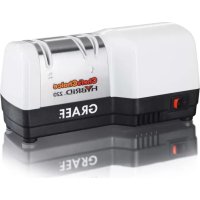
CC 80 - Sharpener GRAEF - Free user manual and instructions
Find the device manual for free CC 80 GRAEF in PDF.



| Brand | Graef |
| Model | CC 80 |
| Product Type | Electric Sharpener |
| Technology | Hybrid® diamond HONE® (motorized sharpening + manual honing) |
| Power Supply | Electric, power cord with polarized plug |
| Number of Stages | 2 (Stage 1 motorized dual slot, Stage 2 manual single slot) |
| Compatible Blade Types | American, European, Asian (double bevel) knives, serrated blades |
| Sharpening Angles | Module 1: nominal angle on each side, Module 2: slightly wider angle (double bevel) |
| Not Recommended Blades | Ceramic knives, scissors, single-bevel Asian knives (kataba, sashimi) |
| Use | Domestic use only |
| Maintenance | Soft damp cloth, periodic expulsion of metal dust |
| Lubricant | None (do not use oil, water or other lubricant) |
| Safety | Do not immerse, unplug before cleaning, do not use with damaged cord |
| Manufacturer Warranty | 2 years (24 months) from date of purchase |
| Customer Service | Phone: 02932-9703677, Email: service@graef.de |
| Recycling | Recyclable packaging (Green Dot), appliance must not be disposed of with household waste |
Frequently Asked Questions - CC 80 GRAEF
User questions about CC 80 GRAEF
0 question about this device. Answer the ones you know or ask your own.
Ask a new question about this device
Download the instructions for your Sharpener in PDF format for free! Find your manual CC 80 - GRAEF and take your electronic device back in hand. On this page are published all the documents necessary for the use of your device. CC 80 by GRAEF.
USER MANUAL CC 80 GRAEF
EN Operating Instructions
When using electrical appliances, basic safety precautions should always be followed including the following:
-
- Read all instructions. For your safety, every user should read this manual.
- To protect against electrical hazards, do not immerse the Graef Hybrid® sharpener in water or other liquid.
- Make sure that only clean knife blades are inserted in Model CC80.
- Disconnect the appliance from its power source when not in use, before cleaning, during service and when replacing parts.
- Avoid contacting moving parts.
- Do not operate any appliance with a damaged cord or plug or after the appliance malfunctions, or is dropped or damaged in any manner.
- Please return your sharpener to your local distributor where the cost of repair or electrical or mechanical adjustment can be estimated. If the supply cord of this appliance is damaged, it must be replaced by a repair facility appointed by the manufacturer because special tools are required. Please consult your Graef distributor.
- CAUTION! This appliance may be fitted with a polarized power plug (one blade is wider than the other). To reduce the risk of electric shock, this plug will fit in a polarized outlet only one way. If the plug does not fit fully in the outlet, reverse the plug. If it still does not fit, contact a qualified electrician. Do not modify the plug in anyway.
- The use of attachments not recommended or sold by Graef may cause fire, electric shock or injury.
- The Graef Hybrid® sharpener is designed to sharpen American, European, and Asian style knives as described in following sections. Do not attempt to sharpen scissors, ax blades or any blade that does not fit freely in the slots.
- Do not let the cord hang over edge of table or counter or touch hot surfaces.
- When in the "ON" position (Red flash on switch is exposed when "ON"), the Graef sharpener should always be on a stable countertop or table.
- WARNING: KNIVES PROPERLY SHARPENED ON YOUR Graef Hybrid® SHARPENER WILL BE SHARPER THAN YOU EXPECT. TO AVOID INJURY, USE AND HANDLE THEM WITH EXTREME CARE. DO NOT CUT TOWARD ANY PART OF YOUR FINGERS, HAND OR BODY. DO NOT RUN FINGER ALONG EDGE. STORE IN A SAFE MANNER.
- Do not use outdoors.
- Appliance is not intended to be used or cleaned by children or persons with reduced physical, sensory or mental capabilities or lack of experience and knowledge of the hazards involved.
- Do not use honing oils, water or any other lubricant with the Graef Hybrid® sharp-
ener Model CC80.
- For household use only.
SAVE THESE INSTRUCTIONS.
DESCRIPTION OF THE GRAEF HYBRID® DIAMOND HONE® KNIFE SHARPENER CC80
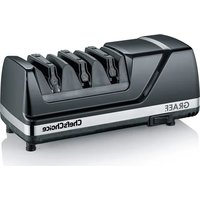
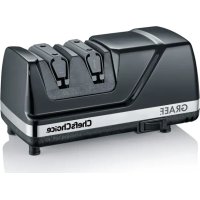
The Hybrid® has two sharpening Stages, a first sharpening Stage that is motor driven, followed by a honing Stage that is entirely manual in operation. The sharpening Stage 1 is motor driven, has two slots (the two slots on the left) to sharpen alternately the left and right side of the blade's edge. Always follow an alternating pattern of sharpening in right and left slots when using Stage 1. This dual-slot stage quickly establishes a sharp edge that is then honed and finished in the manual second stage which uses only a single slot (far right slot) that hones both sides of the edge simultaneously.
USING THE HYBRID® SHARPENER
Note: Always clean your knife before sharpening in the Hybrid®! For your safety, keep your fingers clear of the blade edge at all times. You will find that the Hybrid® can create and maintain an exceedingly sharp and effective edge on all your conventional fine edge and serrated cutlery. The primary edge facets are each formed in Stage 1 at a nominal 20 degrees on each side of the edge, which results in a total primary edge of 40 degrees. Stage 2 creates a second bevel at a slightly larger angle leaving a strong double beveled edge structure that will stay sharp longer. Always use the sharpener with the stage numbers 1 and 2, facing you.
STAGE 1
To sharpen, place the sharpener on the table gripping it securely with your left hand. Push on the power switch. Insert the knife blade, Figure 1, near its handle, into the far left slot of Stage #1 and allow the left face of the blade to rest on the left face of the slot as you pull the knife toward you. The knife edge should be in sustained moving contact with the internal diamond coated disk. Only light downward force will be necessary as you pull the blade toward you. Listen carefully to insure your knife maintains good contact with the diamond disk. Take about 5 seconds to make each pull if you have a six inch (6") long blade. Increase the time of each pull for longer blades or decrease the time for shorter blades. Make one pull of the blade in the left slot as described above and then repeat the same procedure in the adjacent (right) slot of Stage 1. As you pull the knife thru the right slot, (see Figure 3), allow the right side of the knife to rest on the right face of the slot. If your knife, before sharpening, is not very dull you will find that only about 5 pairs of pulls, alternating in the left and right slots of Stage 1, will be sufficient to put a keen edge on the blade. However, if the knife is initially very dull
you may find that 10 or more alternating pairs of pulls in the left and right slots of Stage 1 will be needed the first time as you reshape and sharpen the old edge. In Stage 1 always pull the blade toward you. Never push the blade away from you when using Stage 1. Before leaving Stage 1 it is important to examine the knife edge to insure there is a small burr along one side of the edge.
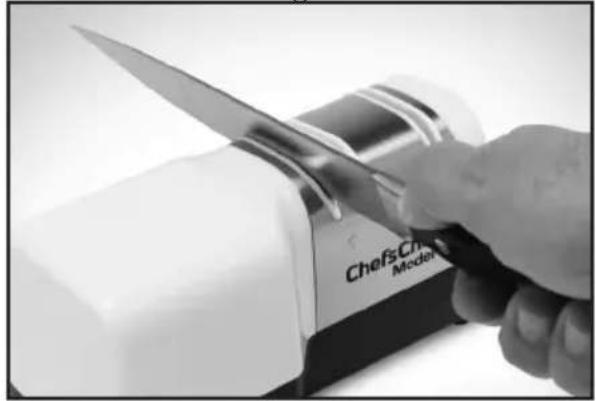
Figure 1. Inserting the blade in the left slot of the Stage 1. Alternate individual pulls in left and right slots.
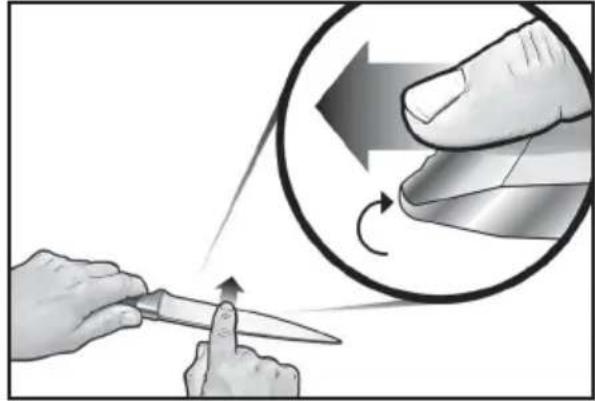
Figure 2. Develop a distinct burr along knife edge before honing in Stage 2. Burr can be detected by sliding finger across and away from the edge.
Figure 2 illustrates how to check for the burr. Proceed as follows: If your last sharpening pull was in the right slot there should be a small burr on the right side of the blade edge. If the last pull was in the left slot there should be a small burr along the left side of the edge. If there is no burr make another pair of pulls and again check for a burr. Repeat making pairs of alternating right and left pulls until you create a small burr along the edge. (Sometimes it is easier to create the burr if you pull the blade slower.) Make another single pull and confirm there is a burr along the edge after each pull. Only then are you are ready to hone in Stage 2.
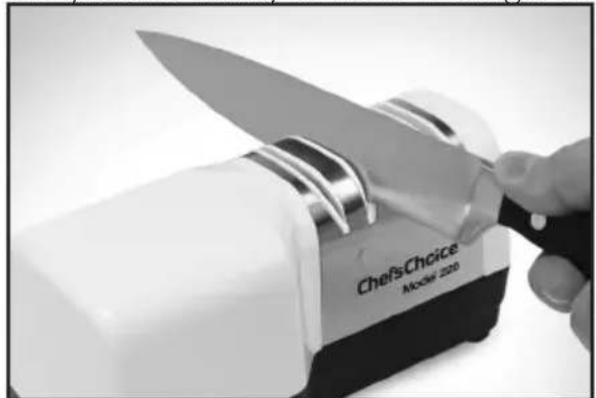
Figure 3. Inserting the blade in the right slot of Stage 1. Alternate pulls in left and right slots.
STAGE 2
Since Stage 2 is a manual honing stage you can turn off the power switch. If the knife is fully sharpened in Stage 1 only 4-5 back and forth strokes will be needed in the single slot of Stage 2 (the far right slot, see Figure 4) to hone a small second bevel along the
edge which will be exceedingly sharp and effective. It should cut paper smoothly allowing you to make straight or curved cuts easily. For optimum results in Stage 2 center the blade within the slot width and keep the length of the blade aligned with the center line of the slot as you move the blade back and forth in the slot without lifting. Apply only a light downward pressure, about 3-4 pounds, on the blade as you sharpen in Stage 2. For optimum results make smooth consistent strokes while maintaining the light downward pressure to insure that the two disks rotate as you move the blade back and forth. The finished edge will be very sharp and burr free.
RESHARPENING THE KNIFE EDGE
To reshapepen follow the procedure for Stage 2 described above, making two to three (2-3) complete back and forth stroke pairs while maintaining recommended downward pressure. Listen to confirm the sharpening disks are turning. Then test the edge for sharpness. If necessary reshapepen again but first use Stage 1 followed by two to three (2-3) back and forth pairs of strokes in Stage 2. Generally you should be able to reshapepen several times using only Stage 2 before having to reshapepen in Stage 1.
SERRATED BLADES
Serrated blades can be sharpened in Stage 2 (see Figure 5). Center the blade in the slot of Stage 2 and make five (5) back and forth pairs of strokes. Examine the edge and if necessary make another 5 full stroke pairs. Test the blade for sharpness. If the blade to be sharpened is very dull, first make two fast but full pairs of pulls — alternating right and left slots in Stage 1 and then make five (5) paired strokes (back and forth) in Stage 2. Because of its nature, a serrated knife will not ever appear as sharp or cut as smoothly as a straight edged blade. Caution: Do not make many strokes in Stage 1, or you will remove too much metal from the teeth of the serrated edge.
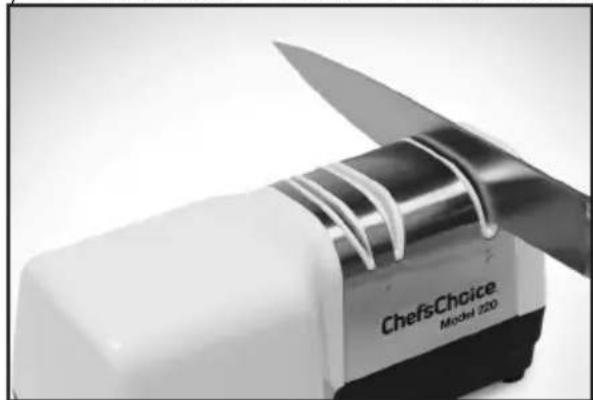
Figure 4. Knife in Stage 2. Use back and forth sharpening strokes with modest downward pressure.
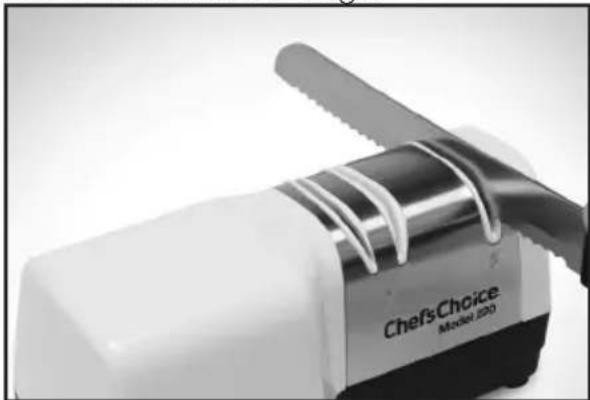
Figure 5. Serrated knife in Stage 2.
ASIAN BLADES
The Hybrid® which sharpens at a primary angle of 20 degrees, can sharpen double faceted Asian blades such as the Santoku which is traditionally sharpened at 15^ . However, for optimum results with all Asian blades we recommend a 15^ sharpener such as the Graef Electric Models CX110, CX125 or CC150 as the preferred choice for all Asian style blades. Do not sharpen in the Hybrid® any single sided, single faceted Asian Kataba knives, such as the traditional sashimi styled blade that is commonly used to prepare ultra thin sashimi. Stage 2 sharpens simultaneously both sides of the cutting edge while the sashimi knives are designed to be sharpened only on one side of the blade. The Graef electric sharpeners listed in the previous paragraph will correctly sharpen these single sided knives.
CERAMIC KNIVES
The Hybrid® is not recommended for ceramic knives.
SCISSORS
Do not attempt to use the Hybrid® to sharpen scissors.
TEST FOR SHARPNESS
To test for sharpness and cutting ability of your fine edge knives, hold a sheet of paper vertically by its upper edge and carefully cut down through the sheet a small (but safe) distance from your fingers. A sharp edge (on a straight edge blade) will cut smoothly without tearing the paper.
Alternatively try cutting a tomato. The knife should penetrate the skin of the tomato and cut through it on the first pull without applying significant force to the knife.
MAINTENANCE
- The exterior of the Hybrid® can be cleaned with a damp soft cloth.
- Periodically shake out and dispose of the metal sharpening dust by inverting
- the sharpener and lightly tapping it onto a newspaper, paper towel, or other paper sheet.
- No oils or other lubricating liquids are necessary with this sharpener.
AFTER-SALES SERVICE
If your Graef device is damaged, please contact your dealer or the Graef Customer Service at +49 (2932) 9703677 or write an e-mail to service@graef.de.
IMPORTANT!
If possible, keep the original packaging during the guarantee period of the unit in order to be able to pack the unit correctly in case of guarantee.

DISPOSAL OF THE PACKAGING
The packaging protects the unit against transport damage. The packaging materials are selected according to the environmental compatibility and disposal-related aspects and can therefore be recycled.
The return of packaging into the material cycle saves raw material and reduces the waste volume. Dispose of the packaging material no longer needed at collection points for the "Green Dot" recycling system (in Germany).

DISPOSAL OF THE UNIT
At the end of its service life, this product cannot be disposed of in normal domestic waste. The symbol on the product and in the operating instructions point out to this fact. Reuse the materials according to their marking. With the reuse, recycling or other forms of recycling of old equipment, you make an important contribution to the protection of our environment. Please ask your municipal administration for the disposal point.
TWO-YEAR WARRANTY
For this product, we assume 24 months manufacturer warranty for defects, which are due to production or material defects. Your legal warranty claim in conformity with Section 437 et seq. of the German Civil Code (BGB) shall remain unaffected by this regulation. The warranty does not cover damage caused by improper handling or use as well as defects which only slightly influence the function or the value of the appliance. In this case, the warranty will also become null and void. Transport damages, as far as we are not responsible for it, are excluded from the warranty claims. A warranty claim is excluded for damage caused by a repair which has not been carried out by us or one of our agents. In case of justified complaints, we shall repair the defective product or replace it by a product without defects at our discretion.
CONSIGNES DE SECURITE IMPORTANTES
He hamaaratec3actocobybntounilky Hybrid@nra3atoybaHHHOxNt.
TECT HA FOCTPOTY
Lio6 nepeBipnpiKyu KpOMky Baunx HoxiBa roctpoTy, Bi3bmitb apkuy nanepy, Tpmaoun Ioro BepTKaIbHo 3a BepxHn Kpa, oBepeXho po3piXte nanip Ha HebeNikB iDCTahi BID Baunx nalbciv. Tocpe ne3o (y HOXIB 3 npAmm ne3om) pIBHO po3piKe nanip, He po3pNBauOn Ioro.
K aIbTePHaTnBy, cnpo6yIte po3pi3aTH nomiOp. HIX MaE npOnHKHTn chepe3 shkipky do M'akoti nomiOppy i po3pi3aTH noRo 6e3 3aBnx 3ycnIb.
OBCJYTOBYBAHH
CJYKBAIITPIMKKNKJIIEHTIB
Якwo Baw npicpi Graef nowkoJxHo, 3BepHitbca Do BaWoro toproBebHoro nocpeHNka a6o cny6n niTpMkn KnieHTIB fipMN rpaeΦ (Graef) 3a Homepom 02932-9703677 a6o hdiuNt bHam eNeKtpOHoro Jncta Ha service@graef.de
BAXJIINBOI
36epiTe opriHaIbHy ynaKOBky npotrrom rapaHInHO TepmiHy npicToIO, 06 npicTpim MoJHa 6yNo HaleXnM YHHOM ynaKyBatn Ta TpaHCnOpTyBatn y pa3i nped'YBHeHn npTeH3ii 0do rapaHTII.

YTNJI3AUZI YNAKOBKN
Ynakobka 3axuae npicptiB iD nokoJxHnR nIac TpaHcnpTyBaHHa. MaTepi aIy naKOBKn BnupaTbC BIDNOBIOHO do ekolorHQcMICHocTi Ta acneKTIB ytni3aui, TOMy BOH NiJaRaOTb BTOpHHi nepepo6ci.
- SAVE THESE INSTRUCTIONS.
- DESCRIPTION OF THE GRAEF HYBRID® DIAMOND HONE® KNIFE SHARPENER CC80
- USING THE HYBRID® SHARPENER
- STAGE 1
- STAGE 2
- RESHARPENING THE KNIFE EDGE
- SERRATED BLADES
- ASIAN BLADES
- CERAMIC KNIVES
- SCISSORS
- TEST FOR SHARPNESS
- MAINTENANCE
- AFTER-SALES SERVICE
- IMPORTANT!
- DISPOSAL OF THE PACKAGING
- DISPOSAL OF THE UNIT
- TWO-YEAR WARRANTY
- CONSIGNES DE SECURITE IMPORTANTES
- TECT HA FOCTPOTY
- OBCJYTOBYBAHH
- CJYKBAIITPIMKKNKJIIEHTIB
- BAXJIINBOI
- YTNJI3AUZI YNAKOBKN
Brand : GRAEF
Model : CC 80
Category : Sharpener