IR 100 - Thermometer MICROLIFE - Free user manual and instructions
Find the device manual for free IR 100 MICROLIFE in PDF.



User questions about IR 100 MICROLIFE
0 question about this device. Answer the ones you know or ask your own.
Ask a new question about this device
Download the instructions for your Thermometer in PDF format for free! Find your manual IR 100 - MICROLIFE and take your electronic device back in hand. On this page are published all the documents necessary for the use of your device. IR 100 by MICROLIFE.
USER MANUAL IR 100 MICROLIFE
Guarantee Card IR 100

text_image
Hyperintensile hematite Fever RCTM Flexible HeatingEurope (Middle East Africa
d. 2017年
(1) 2013-04
In 4/10 (2018)
[Unreadable]
[Unreadable]
59%在第1页已用
Rada
North Evergreen
4、21.10/19:23;4
- 2023年1月28日
“
请详细阅读《中国证券报》
西方集团(注)
North/Central/South America
The following table is a simple diagram and cannot be extracted.
| 1. | Country name | 3 | ● | One thing is a child, a child who is doing it to the child. |
| 2. | Age (years) | 4 | Two children are older than 50 years. | |
| 3. | Age (years) | 5 | One child is aged 50-60 years. | |
| 4. | Age (years) | 6 | One child is aged 60-70 years. | |
| 5. | Age (years) | 7 | One child is aged 70-80 years. | |
| 6. | Age (years) | 8 | One child is aged 80-90 years. | |
| 7. | Age (years) | 9 | One child is aged 90-100 years. | |
| 8. | Age (years) | 10 | One child is aged 100-110 years. | |
| 9. | Age (years) | 11 | One child is aged 110-120 years. | |
| 10. | Age (years) | 12 | One child is aged 120-130 years. | |
| 11. | Age (years) | 13 | One child is aged 130-140 years. | |
| 12. | Age (years) | 14 | One child is aged 140-150 years. | |
| 13. | Age (years) | 15 | One child is aged 150-160 years. | |
| 14. | Age (years) | 16 | One child is aged 160-170 years. | |
| 15. | Age (years) | 17 | One child is aged 170-180 years. | |
| 16. | Age (years) | 18 | One child is aged 180-190 years. | |
| 17. | Age (years) | 19 | One child is aged 190-200 years. | |
| 18. | Age (years) | 20 | One child is aged 200-210 years. | |
| 19. | Age (years) | 21 | One child is aged 210-220 years. | |
| 20. | Age (years) | 22 | One child is aged 220-230 years. | |
| 21. | Age (years) | 23 | One child is aged 230-240 years. | |
| 22. | Age (years) | 24 | One child is aged 240-250 years. | |
| 23. | Age (years) | 25 | One child is aged 250-260 years. | |
| 24. | Age (years) | 26 | One child is aged 260-270 years. | |
| 25. | Age (years) | 27 | One child is aged 270-280 years. | |
| 26. | Age (years) | 28 | One child is aged 280-290 years. | |
| 27. | Age (years) | 29 | One child is aged 290-300 years. | |
| 28. | Age (years) | 30 | One child is aged 300-310 years. | |
| 29. | Age (years) | 31 | One child is aged 310-320 years. | |
| 30. | Age (years) | 32 | One child is aged 320-330 years. | |
| 31. | Age (years) | 33 | One child is aged 330-340 years. | |
| 32. | Age (years) | 34 | One child is aged 340-350 years. | |
| 33. | Age (years) | 35 | One child is aged 350-360 years. | |
| 34. | Age (years) | 36 | One child is aged 360-370 years. | |
| 35. | Age (years) | 37 | One child is aged 370-380 years. | |
| 36. | Age (years) | 38 | One child is aged 380-390 years. | |
| 37. | Age (years) | 39 | One child is aged 390-400 years. | |
| 38. | Age (years) | 40 | One child is aged 400-410 years. | |
| 39. | Age (years) | 41 | One child is aged 410-420 years. | |
| 40. | Age (years) | 42 | One child is aged 420-430 years. | |
| 41. | Age (years) | 43 | One child is aged 430-440 years. | |
| 42. | Age (years) | 44 | One child is aged 440-450 years. | |
| 43. | Age (years) | 45 | One child is aged 450-460 years. | |
| 44. | Age (years) | 46 | One child is aged 460-470 years. | |
| 45. | Age (years) | 47 | One child is aged 470-480 years. | |
| 46. | Age (years) | 48 | One child is aged 480-490 years. | |
| 47. | Age (years) | 49 | One child is aged 490-500 years. | |
| 48. | Age (years) | 50 | One child is aged 500-510 years. | |
| 49. | Age (years) | 51 | One child is aged 510-520 years. | |
| 50. | Age (years) | 52 | One child is aged 520-530 years. | |
| 51. | Age (years) | 53 | One child is aged 530-540 years. | |
| 52. | Age (years) | 54 | One child is aged 540-550 years. | |
| 53. | Age (years) | 55 | One child is aged 550-560 years. | |
| 54. | Age (years) | 56 | One child is aged 560-570 years. | |
| 55. | Age (years) | 57 | One child is aged 570-580 years. | |
| 56. | Age (years) | 58 | One child is aged 580-590 years. | |
| 57. | Age (years) | 59 | One child is aged 590-600 years. | |
| 58. | Age (years) | 60 | One child is aged 600-610 years. | |
| 59. | Age (years) | 61 | One child is aged 610-620 years. | |
| 60. | Age (years) | 62 | One child is aged 620-630 years. | |
| 61. | Age (years) | 63 | One child is aged 630-640 years. | |
| 62. | Age (years) | 64 | One child is aged 640-650 years. | |
| 63. | Age (years) | 65 | One child is aged 650-660 years. | |
| 64. | Age (years) | 66 | One child is aged 660-670 years. | |
| 65. | Age (years) | 67 | One child is aged 670-680 years. | |
| 66. | Age (years) | 68 | One child is aged 680-690 years. | |
| 67. | Age (years) | 69 | One child is aged 690-700 years. | |
| 68. | Age (years) | 70 | One child is aged 700-710 years. | |
| 69. | Age (years) | 71 | One child is aged 710-720 years. | |
| 70. | Age (years) | 72 | One child is aged 720-730 years. | |
| 71. | Age (years) | 73 | One child is aged 730-740 years. | |
| 72. | Age (years) | 74 | One child is aged 740-750 years. | |
| 73. | Age (years) | 75 | One child is aged 750-760 years. | |
| 74. | Age (years) | 76 | One child is aged 760-770 years. | |
| 75. | Age (years) | 77 | One child is aged 770-780 years. | |
| 76. | Age (years) | 78 | One child is aged 780-790 years. | |
| 77. | Age (years) | 79 | One child is aged 790-800 years. | |
| 78. | Age (years) | 80 | One child is aged 800-810 years. | |
| 79. | Age (years) | 81 | One child is aged 810-820 years. | |
| 80. | Age (years) | 82 | One child is aged 820-830 years. | |
| 81. | Age (years) | 83 | One child is aged 830-840 years. | |
| 82. | Age (years) | 84 | One child is aged 840-850 years. | |
| 83. | Age (years) | 85 | One child is aged 850-860 years. | |
| 84. | Age (years) | 86 | One child is aged 860-870 years. | |
| 85. | Age (years) | 87 | One child is aged 870-880 years. | |
| 86. | Age (years) | 88 | One child is aged 880-890 years. | |
| 87. | Age (years) | 89 | One child is aged 890-900 years. | |
| 88. | Age (years) | 90 | One child is aged 900-910 years. | |
| 89. | Age (years) | 91 | One child is aged 910-920 years. | |
| 90. | Age (years) | 92 | One child is aged 920-930 years. | |
| 91. | Age (years) | 93 | One child is aged 930-940 years. | |
| 92. | Age (years) | 94 | One child is aged 940-950 years. | |
| 93. | Age (years) | 95 | One child is aged 950-960 years. | |
| 94. | Age (years) | 96 | One child is aged 960-970 years. | |
| 95. | Age (years) | 97 | One child is aged 970-980 years. | |
| 96. | Age (years) | 98 | One child is aged 980-990 years. | |
| 97. | Age (years) | 99 | One child is aged 990-1000 years. | |
| 98. | Age (years) | 100 | One child is aged 1000-1010 years. | |
| 99. | Age (years) | 101 | One child is aged 1010-1020 years. | |
| 100. | Age (years) | 102 | One child is aged 1020-1030 years. |
FM
stock's
Guarantee Card IR 100
| Name of the name of the Company's Name or Category of the Company's Name, and the full name of the Company's Name is 100% owned by the Company's Company. The company is a subsidiary of the Company's Company. |
| Company's name is 100% owned by the Company's Company. |
| Company's name is 100% owned by the Company's Company. |
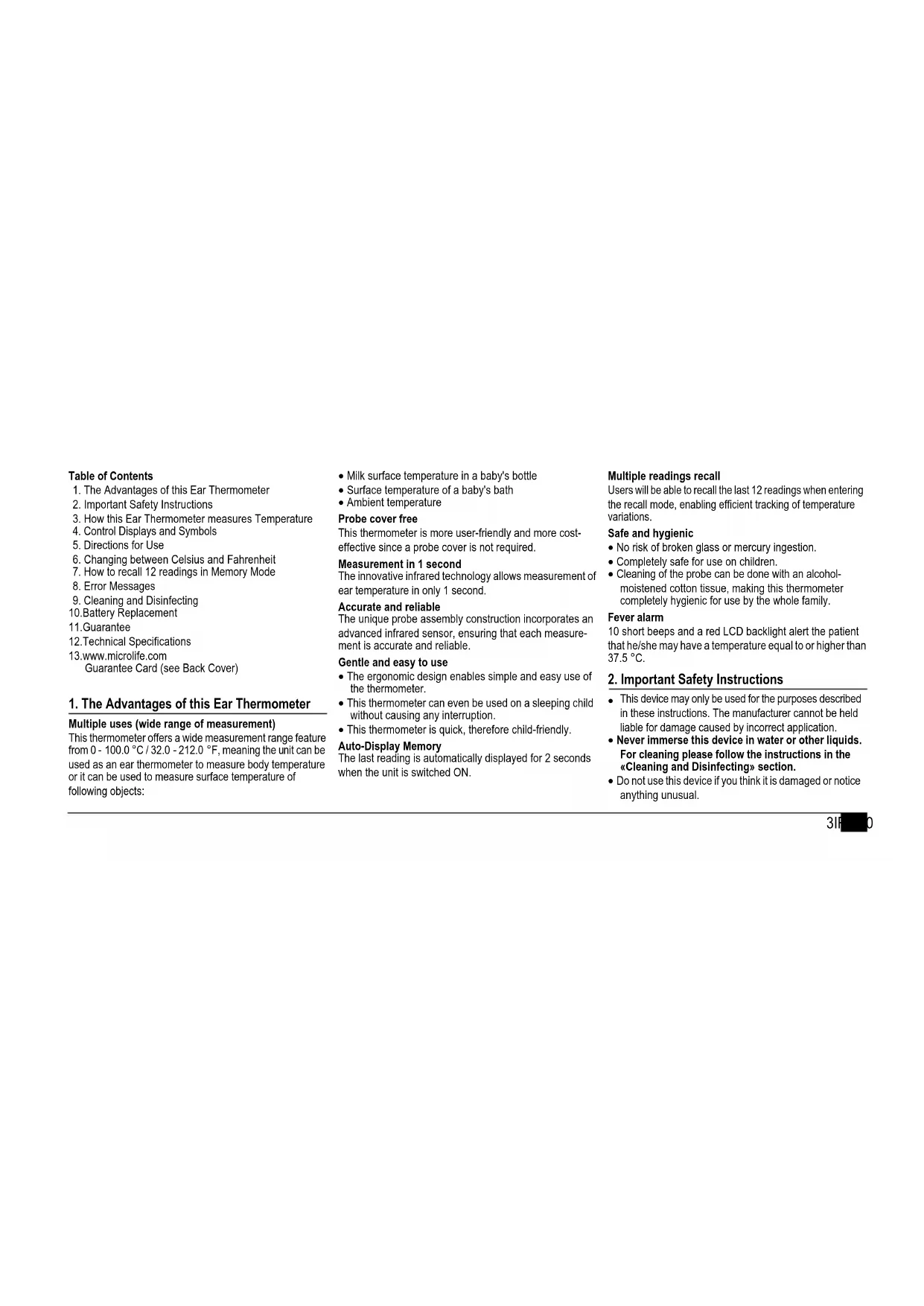
Table of Contents
- The Advantages of this Ear Thermometer
- Important Safety Instructions
- How this Ear Thermometer measures Temperature
- Control Displays and Symbols
- Directions for Use
- Changing between Celsius and Fahrenheit
- How to recall 12 readings in Memory Mode
- Error Messages
- Cleaning and Disinfecting
10.Battery Replacement
11.Guarantee - Technical Specifications
13.www.microlife.com
Guarantee Card (see Back Cover)
1. The Advantages of this Ear Thermometer
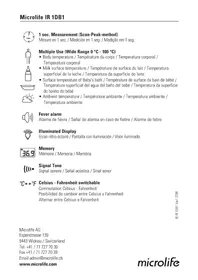
Multiple uses (wide range of measurement)
This thermometer offers a wide measurement range feature from 0 - 100.0 °C / 32.0 - 212.0 °F, meaning the unit can be used as an ear thermometer to measure body temperature or it can be used to measure surface temperature of following objects:
- Milk surface temperature in a baby's bottle
• Surface temperature of a baby's bath - Ambient temperature
This thermometer is more user-friendly and more cost-effective since a probe cover is not required.
The innovative infrared technology allows measurement of ear temperature in only 1 second.
Probe cover free
Measurement in 1 second
Accurate and reliable
The unique probe assembly construction incorporates an advanced infrared sensor, ensuring that each measurement is accurate and reliable.
Gentle and easy to use
- The ergonomic design enables simple and easy use of the thermometer.
- This thermometer can even be used on a sleeping child without causing any interruption.
- This thermometer is quick, therefore child-friendly.
Auto-Display Memory
The last reading is automatically displayed for 2 seconds when the unit is switched ON.
Multiple readings recall
Users will be able to recall the last 12 readings when entering the recall mode, enabling efficient tracking of temperature variations.
Safe and hygienic
- No risk of broken glass or mercury ingestion.
- Completely safe for use on children.
- Cleaning of the probe can be done with an alcohol-moistened cotton tissue, making this thermometer completely hygienic for use by the whole family.
Fever alarm
10 short beeps and a red LCD backlight alert the patient that he/she may have a temperature equal to or higher than 37.5 °C.
2. Important Safety Instructions
- This device may only be used for the purposes described in these instructions. The manufacturer cannot be held liable for damage caused by incorrect application.
- Never immerse this device in water or other liquids. For cleaning please follow the instructions in the «Cleaning and Disinfecting» section.
-
Do not use this device if you think it is damaged or notice anything unusual.
-
Never open this device.
- Earwax in the ear canal may cause a lower temperature reading. Therefore it is important to ensure the subject's ear canal is clean.
- This device comprises sensitive components and must be treated with caution. Observe the storage and operating conditions described in the «Technical Specifications» section.
-
Protect it from:
-
extreme temperatures
- impact and dropping
- contamination and dust
- direct sunlight
-
heat and cold
-
If the device is not going to be used for a prolonged period the battery should be removed.
- Ensure that children do not use this device unsupervised; some parts are small enough to be swallowed.
WARNING: Use of this device is not intended as a substitute for consultation with your physician. This device is NOT waterproof so do not immerse in liquids.
3. How this Ear Thermometer measures Temperature
This thermometer measures infrared energy radiated from the eardrum and the surrounding tissue. This energy is collected through the lens and converted to a temperature value. The measured reading obtained directly from the eardrum (Tympanic Membrane) ensures the most accurate ear temperature.
Measurements taken from the surrounding tissue of the ear canal generate lower readings and may result in misdiagnosis of fever.
To avoid an inaccurate measurement
- Switch on the thermometer by pressing the ON/OFF button ④.
- After one beep is heard (and the temperature scale icon is flashing), straighten the ear canal by gently pulling the middle of the ear back and up.
- Place the probe ① firmly into the ear canal, press the START button ② and keep the probe in the ear until the thermometer beeps to signal the completion of the measurement.
4. Control Displays and Symbols
- All segments displayed ⑥: Press the ON/OFF button ④ to turn on the unit; all segments will be shown for 2 seconds.
- Memory ⑦: The last reading will automatically be shown on the display for 2 seconds.
- Ready for measurement ⑧: When the unit is ready for measurement, the «°C» or «°F» icon will keep flashing.
- Measurement complete ⑨: The reading will be shown on the display ③ with the «°C» or «°F» icon; the unit is ready for the next measurement, when the «°C» or «°F» icon is flashing again.
- Out-of-ear temperature indication ⑩: A crossed-ear-icon will appear on the display ③ if the reading falls outside the range 32.0 \~ 42.2 °C / 89.6 \~ 108.0 °F.
- Low battery indicator ⑪: When the unit is turned on, the battery icon will keep flashing to remind the user to replace the battery.
5. Directions for Use
- Press the ON/OFF button ④. The display ③ is activated to show all segments for 2 seconds.
-
The last measurement reading will automatically be shown on the display for 2 seconds with the «M» icon ⑦.
-
When the «°C» or «°F» icon is flashing, a beep sound is heard and the thermometer is ready for measuring ⑧.
- Straighten the ear canal by pulling the ear up and back to give a clear view of the eardrum.
- For children under 1 year; pull the ear straight back.
- For children of 1 year to adult; pull the ear up and back. Also refer to the short instructions at the front.
- While gently pulling the ear, insert the probe snugly into the ear canal (about 1 sec.) and immediately press the START button ②. Release the button and wait for the beep sound. This indicates the end of the measurement.
- Remove the thermometer from the ear canal. The display shows the measured temperature ⑨.

NOTE:
- To ensure accurate readings, wait at least 30 sec. after 3-5 continuous measurements.
- Accumulation of earwax on the probe can result in less accurate temperature readings or cross infection between users. Therefore, it is essential that the probe is clean before each measurement. For cleaning, follow the instructions in the «Cleaning and Disinfecting» section.
- After cleaning the measuring sensor ① with alcohol, wait 5 minutes before taking the next measurement, in
order to allow the thermometer to reach its operating reference temperature.
- 10 short beeps and a red LCD backlight alert the patient that he/she may have a temperature equal to or higher than 37.5 °C.
- For an infant, it is best to have the child lying flat with his/her head sideways so the ear is facing upwards. For an older child or adult, it is best to stand behind and slightly to the side of the patient.
- Always take the temperature in the same ear, since the temperature readings may be different from ear to ear.
- In the following situations it is recommended that three temperatures in the same ear be taken and the highest one taken as the reading:
- New born infants in the first 100 days.
- Children under three years of age with a compromised immune system and for whom the presence or absence of fever is critical.
- When the user is learning how to use the thermometer for the first time until he/she has familiarized himself/herself with the device and obtains consistent readings.
- If the measurement is surprisingly low.
6. Changing between Celsius and Fahrenheit
This thermometer can display temperature readings in either Fahrenheit or Celsius. To switch the display between °C and °F, simply turn OFF the unit, press and hold the START button ② for 5 seconds; after 5 seconds, the current measurement scale («°C» or «°F» icon) will flash on the display ⑫. Change the measurement scale between °C and °F by pressing the START button ②. When the measurement scale has been chosen, wait for 5 seconds and the unit will automatically enter the «ready for measuring» mode.
7. How to recall 12 readings in Memory Mode
This thermometer can recall the last 12 readings.
- Recall mode ⑬: Press the START button ② to enter Recall mode when power is off. The memory icon «M» will flash.
- Reading 1 - the last reading ⑭: Press and release the START button ② to recall the last reading. Display 1 alone with memory icon.
- Reading 12 - readings in succession: Press and release the START button ② consecutively to recall the last 12 readings in succession.
Pressing and releasing the START button ② after the last 12 readings have been recalled will resume the above sequence from reading 1.
8. Error Messages
- Measured temperature too high ⑮: Displays «H» when measured temperature is higher than 100.0 °C / 212.0 °F.
- Measured temperature too low ⑯: Displays «L» when measured temperature is lower than 0 °C / 32.0 °F.
- Ambient temperature too high ⑰: Displays «H» in conjunction with the «▲» when ambient temperature is higher than 40.0 °C / 104.0 °F.
- Ambient temperature too low ⑱: Display «L» in conjunction with the «▼» when ambient temperature is lower than 10.0 °C / 50.0 °F.
- Error function display ^19 : The system has a malfunction.
- Blank display 20: Check if the battery has been loaded correctly. Also check polarity ( <+≥slant and <-≥slant ) of the battery.
- Flat battery indication ②1: If the steady battery icon is the only symbol shown on the display, the battery should be replaced immediately.
9. Cleaning and Disinfecting
Use an alcohol swab or cotton tissue moistened with alcohol (70% Isopropyl) to clean the thermometer casing and the measuring sensor. Ensure that no liquid enters the interior of the device. Never use abrasive cleaning agents, thinners or benzene for cleaning and never immerse the device in water or other cleaning liquids. Take care not to scratch the surface of the sensor lens and the display.
10. Battery Replacement
This device is supplied with one lithium battery, type CR2032. Replace with a new CR2032 battery when the flashing battery symbol appears on the display 21 . Remove the battery cover 22 by sliding it in the direction shown. Insert the new battery with the + at the top.

Batteries and electronic devices must be disposed of in accordance with the locally applicable regulations, not with domestic waste.
11. Guarantee
This device is covered by a 2 year guarantee from the date of purchase. The guarantee is valid only on presentation of
the guarantee card completed by the dealer (see back) confirming date of purchase or the receipt.
- The guarantee covers the device. The battery and packaging are not included.
- Opening or altering the device invalidates the guarantee.
- The guarantee does not cover damage caused by improper handling, a discharged battery, accidents or non-compliance with the operating instructions.
Please contact Microlife-service.
12. Technical Specifications
Type: Ear Thermometer IR 100
Measurement
range: 0-100.0 °C / 32-212.0 °F
Resolution: 0.1 °C / °F
Measurement Laboratory:
accuracy: ±0.2 ^ , 32.0 - 42.2 ^ ±0.4 ^ , 89.6 108.0 ^
Display: Liquid Crystal Display, 4 digits plus special icons
Acoustic: The unit is turned ON and ready for the measurement: 1 short beep. Complete the measurement: 1 long beep. System error or malfunction: 3 short beeps. Fever alarm: 10 short beeps.
Memory: Auto-Display the last measured temperature 12 readings recall in the Memory Mode
Backlight: The display light will be GREEN for 4 seconds, when the unit is turned ON. The display light will be GREEN for 5 seconds, when a measurement is completed with a reading less than 37.5 °C / 99.5 °F. The display light will be RED for 5 seconds, when a measurement is completed with a reading equal to or higher than 37.5 °C / 99.5 °F.
Operating 10 - 40 °C / 50.0 - 104 °F temperature: 15-95 % relative maximum humidity Storage -25 - +55 °C / -13 - +131 °F temperature: 15-95 % relative maximum humidity
Automatic Approx. 1 minute after last measurement Switch-off: has been taken. Battery: 1 x CR2032 battery 3V - at least 1000 measurements
Dimensions: 120 x 35 x 60 mm
Weight: 53 g (with battery), 50 g (w/o battery)
Reference to EN 12470-5; ASTM E1965; standards: IEC 60601-1; IEC 60601-1-2 (EMC)
This device complies with the requirements of the Medical Device Directive 93/42/EEC. Technical alterations reserved. According to the Medical Product User Act a biennial technical inspection is recommended for professional users. Please observe the applicable disposal regulations.
13.www.microlife.com
Detailed user information about our thermometers and blood pressure monitors as well as services can be found at www.microlife.com.
Read the instructions carefully before using this device.

Normy: EN 12470-5; ASTM E1965; IEC 60601-1; IEC 60601-1-2 (EMC)
standard: IEC 60601-1; IEC 60601-1-2 (EMC)
Szabvány: EN 12470-5; ASTM E1965; IEC 60601-1; IEC 60601-1-2 (EMC)
merania: 0-100,0 °C / 32-212,0 °F
Rozlíšenie: 0,1 °C / °F