
POWXG1022 - Saw PowerPlus - Free user manual and instructions
Find the device manual for free POWXG1022 PowerPlus in PDF.



| Product Type | Petrol Chainsaw |
| Brand | PowerPlus |
| Model | POWXG1022 |
| Displacement | 45 cm³ |
| Engine Power | 1.8 kW |
| Engine Type | 2-stroke |
| Rotational Speed | 10 000 min⁻¹ |
| Chain Speed | 22 m/s |
| Cutting Length | 450 mm |
| Ignition | CDI |
| Chain Type | Oregon |
| Guide Bar Type | Oregon |
| Spark Plug | Champion |
| Carburettor | Walbro |
| Fuel/Oil Mixture | 40:1 |
| Fuel Tank Capacity | 590 ml |
| Oil Tank Capacity | 250 ml |
| Sound Pressure Level LpA | 96 dB(A) |
| Sound Power Level LwA | 114 dB(A) |
| Vibrations (aw) | 8.5 m/s² |
| Chain Brake | Yes |
| Automatic Lubrication | Yes |
| Anti-Kickback System | Yes (low-kickback chain) |
Frequently Asked Questions - POWXG1022 PowerPlus
User questions about POWXG1022 PowerPlus
0 question about this device. Answer the ones you know or ask your own.
Ask a new question about this device
Download the instructions for your Saw in PDF format for free! Find your manual POWXG1022 - PowerPlus and take your electronic device back in hand. On this page are published all the documents necessary for the use of your device. POWXG1022 by PowerPlus.
USER MANUAL POWXG1022 PowerPlus
GARDENPRO POWERPLUS HIGH QUALITY TOOLS

POWXG1022

NL NEDERLANDS VERTAALDE VERSIE VAN DE ORIGINELE HANDLEIDING
FR FRANÇAIS TRADUCTION DU MODE D'EMPLOI D'ORIGINE
EN ENGLISH ORIGINAL INSTRUCTION MANUAL
9.2.2 Mengtabel benzine
| Benzine liters | 1 | 2 | 3 | 4 | 5 |
| 2-takt olie ml | 25 | 50 | 75 | 100 | 125 |
9.2.3 Aanbevolen benzine
16 PROBLEEMOPLOSSING
9.2.4 Appoint de carburant
1 APPLIANCE 4
2 DESCRIPTION 4
3 PACKAGE CONTENT LIST 5
4 SYMBOLS 5
5 SAFETY 5
6 KICKBACK SAFETY PRECAUTIONS 7
7 SAFETYWARNINGS GASOLINE 8
8 ASSEMBLY 8
8.1 Tools for assembly 8
8.2 Assembly requirements.. 8
8.3 Guide bar / saw chain / clutch cover installation 8
8.3.1 Mounting the bucking spike (13) 8
8.3.2 Installation of the guide bar: 9
8.3.3 To install saw chain: 9
8.3.4 Saw chain tension adjustment.. 9
8.3.5 To adjust saw chain: 10
8.3.6 Chain brake mechanical test 10
8.3.7 To test chain brake: 10
9 FUEL AND LUBRICATION 11
9.1 Fuel 11
9.2 Mixing fuel 11
9.2.1 Fuel and lubrication symbols 11
9.2.2 Fuel mixing table 11
9.2.3 Recommended fuels 11
9.2.4 Filling with fuel 11
9.3 Chain oil 12
9.3.1 Chain and bar lubrication 12
9.3.2 Filling with chain oil 12
10 OPERATION 12
10.1 Engine pre start checks (Fig. 8) 12
POWXG1022 EN
10.2 To start engine 12
10.3 Re-starting a warm engine 13
10.4 To stop engine (Fig. 9f) 13
10.5 Chain brake operational test 13
10.6 Saw chain / bar lubrication 13
10.7 Automatic oiler 14
10.8 General cutting instructions 14
10.8.1 Felling 14
10.8.2 Limbing 15
10.8.3Bucking 15
10.8.4Bucking using a sawhorse 16
11 MAINTENANCE INSTRUCTIONS 16
11.1 Preventive maintenance 16
11.2 Winter maintenance 17
11.3 Air filter 17
11.4 Fuel filter 17
11.5 Spark arrester screen 18
11.6 Spark plug 18
11.7 Carburetor adjustment 18
12 MAINTENANCE 18
12.1 Guide bar maintenance.. 18
12.2 Sprocket tip lubrication 19
12.3 Guide bar maintenance.. 19
12.4 Chain sharpening 19
12.5 Guide bar 20
12.6 Chain maintenance 21
13 TECHNICAL DATA 22
14 NOISE 22
15 STORING A CHAIN SAW 23
16 TROUBLESHOOTING 23
17 WARRANTY 24
18 ENVIRONMENT 25
19 DECLARATION OF CONFORMITY 25
CHAINSAW 45 CC - 450 MM POWXG1022
1 APPLIANCE
These models are intended for infrequent use by homeowners, cottagers, and campers, and for such general applications as clearing, pruning, cutting firewood, etc. They are not intended for prolonged use. If the intended use involves prolonged periods of operation, this may cause circulatory problems in the user's hands due to vibration. It is not designed for commercial use.

Read this manual carefully before using the machine, for your own safety. Your power tool should only be passed on with these instructions.
Only use Bio degradable oil (environment-friendly) to lubricate the chain.
2 DESCRIPTION
- Saw chain
- Guide bar
- Spark arrester screen
- Chain brake lever / hand guard
- Front handle
- Starter handle
- Engine switch
- Safety trigger
- Rear handle / boot loop
-
Oil tank cap
-
Fuel tank cap
- Starter cover
- Bucking spike
- Bar retaining nuts
- Muffler shield
- Air cleaner cover
- Choke lever
- Saw chain adjustment screw
- Chain catcher
- Throttle/ trigger
LOW KICKBACK SAW CHAIN helps significantly reduce kickback, or the intensity of kickback, due to specially designed depth gauges and guard links.
CHAIN BRAKE is a safety feature designed to reduce the possibility of injury due to kickback by stopping a moving saw chain in milliseconds. It is activated by the Chain Brake lever.
SPARK ARRESTER SCREEN retains carbon and other flammable particles over 0.023 inches (0.6mm) in size from engine exhaust flow. Compliance with local, state and federal laws and/or regulations governing the use of a spark arrester screen is the user's responsibility. See Safety Precautions for additional information.
ENGINE SWITCH immediately stops the engine when tripped. Engine switch must be pushed to ON position to start or restart engine.
SAFETY TRIGGER prevents accidental acceleration of the engine. Throttle trigger cannot be squeezed unless the safety latch is depressed.
CHAIN BRAKE LEVER / HAND GUARD protects the operator's left hand in the event it slips off the front handle while saw is running.
CHAIN CATCHER reduces the danger of injury in the event saw chain breaks or derails during operation. The chain catcher is designed to intercept a whipping chain.

NOTE: Study your saw and be familiar with its parts.

WARNING! Beware of kickback. Hold chain saw firmly with both hands when using. For your own safety, please read and follow the safety precautions in this manual before attempting to operate your chain saw. Improper use can cause serious injury.
POWXG1022 EN

WARNING! When using gas tools, basic safety precautions, including the following, should always be followed to reduce the risk of serious personal injury and/or damage to the unit.
3 PACKAGE CONTENT LIST
- Remove all packaging materials.
- Remove remaining packing and package inserts (if included).
- Check that the package contents are complete.
- Check the appliance, the power cord, the power plug and all accessories for transportation damage.
- Keep the packing materials as far as possible till the end of the warranty period. Dispos it into your local waste disposal system afterwards.

WARNING: Packaging materials are not toys! Children must not play with plastic bags! Danger of suffocation!
1x CHAINSAW 45 cc - 450 mm
1xmanual
2xchain
1 x guide bar
1 x bar cover
1 x spark plug wrench
1 x empty bottle

If any parts are missing or damaged, please contact your dealer.
4 SYMBOLS
In this manual and/or on the machine the following symbols are used:
| Read manual before use. | Wear gloves. | ||
| Whenever the machine is in use, safety goggles must be worn to safeguard against flying objects, as must ear protectors, such as a soundproof helmet, in order to protect the operator's hearing. If the operator is working in an area where there is a risk of falling objects, a safety helmet must also be worn. | Wearing of protective shoes advised. | ||
| Make Sure the Chain Brake is disengaged! Pull Hand Guard/Chain Brake back to run. | |||
| Denotes risk of personal injury or damage to the tool. |
5 SAFETY
- DO NOT operate a chain saw with one hand! Serious injury to the operator, helpers, bystanders, or any combination of these persons may result from one-handed operation. A chain saw is intended for two-handed use.
- DO NOT operate a chain saw when you are fatigued, under the influence of drugs, alcohol or medication.
POWXG1022 EN
-
Use safety footwear, snug-fitting clothing, protective gloves, and eye, hearing and head protection devices.
-
Use caution when handling fuel. To avoid fire, move the chain saw at least 10 feet (3m) from the fuelling point before starting the engine.
-
DO NOT allow other persons to be near when starting or cutting with the chain saw. Keep bystanders and animals out of the work area.
-
DO NOT start cutting until you have a clear work area, secure footing, and a planned retreat path from the falling tree.
-
Keep all parts of your body away from the saw chain when the engine is running.
-
Before you start the engine, make sure that the saw chain is not contacting anything.
-
Carry the chain saw with the engine stopped, the guide bar and saw chain to the rear, and the muffler away from your body.
-
DO NOT operate a chain saw that is damaged, improperly adjusted, or not completely and securely assembled. Be sure that the saw chain stops moving when the throttle control trigger is released.
-
Shut off the engine before setting the chain saw down.
-
Use extreme caution when cutting small size brush and saplings because slender material may catch the saw chain and be whipped toward you or pull you off balance.
-
When cutting a limb that is under tension, be alert for spring back so that you will not be struck when the tension in the wood fibres is released.
-
Keep the handles dry, clean, and free of oil or fuel mixture.
-
Operate the chain saw only in well-ventilated areas.
-
DO NOT operate a chain saw in a tree unless you have been specifically trained to do so.
-
All chain saw service, other than the items listed in the user manual safety and maintenance instructions, should be performed by competent chain saw service personnel.
-
When transporting your chain saw, use the appropriate guide bar scabbard.
-
DO NOT operate your chain saw near or around flammable liquids or gases whether in or out of doors. An explosion and/or fire may result.
-
Do not fill fuel tank, oil tank or lubricate when the engine is running.
-
USE THE RIGHT TOOL: Cut wood only. Do not use the chain saw for purposes for which it was not intended. For example, do not use the chain saw for cutting plastic, masonry, or non-building materials.
-
The first time user should have practical instruction in the use of chainsaw and the protective equipment from an experienced operator.
-
Do not attempt to hold the saw with one hand only. You cannot control reactive forces and you may lose control of the saw, which can result in the skating or bouncing of the bar and chain along the limb or log.
-
Never run the chainsaw indoors. Your chainsaw produces poisonous exhaust as soon as the combustible engine is started, which may be colourless and odourless. To use this product can generate dust, mists and fumes containing chemicals known to cause reproductive harm. Be aware of harmful dust, mist (such as saw dust or oil mist from chain lubrication) and protect yourself properly.
-
Wear gloves and keep your hand warm. Prolonged use of chainsaws exposing the operator to vibrations may produce whitefinger disease. In order to reduce the risk of whitefinger disease, please wear gloves and keep your hand warm. If any of the whitefinger symptoms appear, seek medical advice immediately.
-
Drive in the spiked bumper of the chainsaw directly behind the intended hinge and pivot the saw around this point. The spiked bumper rolls against the trunk.
-
Only chain, guide bar and spark plug can be replaced by the user himself. Always make sure you replace with correct material as stated in the specifications of the manual.
6 KICKBACK SAFETY PRECAUTIONS
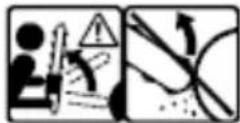
KICKBACK may occur when the NOSE or TIP of the guide bar touches an object, or when wood closes in and pinches the saw chain in the cut.
Tip contact in some cases may cause a lightning-fast reverse reaction, kicking the guide bar up and back toward the operator.
PINCHING the saw chain along the BOTTOM of the guide bar may PULL the saw forward away from the operator.
PINCHING the saw chain along the TOP of the guide bar may PUSH the guide bar rapidly back toward the operator.
Any of these reactions may cause you to lose control of the saw, which could result in serious personal injury.
- With a basic understanding of kickback, you can reduce or eliminate the element of surprise. Sudden surprise contributes to accidents.
- Keep a good firm grip on the saw with both hands, the right hand on the rear handle, and the left hand on the front handle, when the engine is running. Use a firm grip with thumbs and fingers encircling the chain saw handles. A firm grip will help you reduce kickback and maintain control of the saw. Don't let go.
- Make sure that the area in which you are cutting is free from obstructions. Do not let the nose of the guide bar contact a log, branch, or any other obstruction which could be hit while you are operating the saw.
Cut at high engine speeds. - Do not overreach or cut above shoulder height.
- Follow manufacturer's sharpening and maintenance instructions for the saw chain.
- Only use replacement bars and chains specified by the manufacturer or the equivalent.

NOTE: Low-kickback saw chain is chain that has met the kickback performance.

WARNING: Kickback can lead to dangerous loss of control of the chain saw and result in serious or fatal injury to the saw operator or to anyone standing close by. Always be alert. Rotational kickback and pinch-kickback are major chain saw operational dangers and the leading cause of most accidents.
Beware of:
- Rotational kickback (Fig. 2a)
A = kickback path
B = kickback reaction zone
The push (pinch kickback) and pull reactions a = pull (Fig. 2b)
B = solid objects
C = push
7 SAFETY WARNINGSGASOLINE

WARNING: Use extra care in handling fuels. They are flammable and the vapours are explosive.
The following points must be observed:
- Use only an approved container.
- Never remove the fuel cap or add fuel with the power source running. Allow engine exhaust components to cool before refuelling.
- Do not smoke.
- Never refuel the machine indoors.
- Never store the machine or fuel containers inside, where is an open flame, such as a water heater.
- If fuel is spilled, do not attempt to start the power source, but move the machine away from the area of spillage before starting.
- Always replace and securely tighten the fuel cap after refuelling.
If the tank is drained, this should be done outdoors.
8 ASSEMBLY

Note: described actions below may vary slightly depending on model you purchased.
8.1 Tools for assembly
You will need these tools to assemble your chain saw:
- Combination wrench-screwdriver (contained in your user's kit).
- Heavy duty work gloves (user supplied).
8.2 Assembly requirements

Warning: do not start the saw engine until unit is properly prepared.
Your new chain saw will require adjustment of chain, filling the fuel tank with correct fuel mixture and filling the oil tank with lubricating oil before the unit is ready for operation.
Read the entire user manual before attempting to operate your unit. Pay particular attention to all safety precautions.
Your user manual is both a reference guide and handbook provided to furnish you with general information to assemble, operate and maintain your saw.
8.3 Guide bar / saw chain / clutch cover installation

Warning: always wear protective gloves when handling chain.
8.3.1 Mounting the bucking spike (13)
First, mount the bucking spike (13) at the front of the cylinder block, using two mounting screws (included in this package) (spikes must face upwards).
POWXG1022 EN
8.3.2 Installation of the guide bar:
To ensure the bar and chain receive oil, only use the original style bar with the oil passage hole (A) as illustrated above (Fig. 3a).
- Make sure the chain brake lever is pulled back into the disengaged position (Fig. 3b).
- Remove the bar retaining nut(s) (B). Remove the chain brake cover (C) by pulling straight out, some force may be required (Fig. 3c).

Note: discard the two plastic washers, they are only used for shipping the chain saw.
- Place the slotted end of the guide bar over the bar bolt (F). Slide guide bar behind clutch drum (G) until the guide bar stops (Fig. 3d).
8.3.3 To install saw chain:

WARNING! Always wear heavy duty gloves when handling saw chain or making saw chain adjustments.
- Spread chain out in a loop with cutting edges (A) pointing clockwise around loop (Fig. 4a).
- Slip the chain around the sprocket (B) behind the clutch (C). Make sure the links fit between the sprocket teeth (Fig. 4b).
- Guide the drive links into the groove (D) and around the end of the bar (Fig. 4b).

Note: the saw chain may droop slightly on the lower part of bar. This is normal.
- Pull guide bar forward until chain is snug. Ensure all drive links are in the bar groove.
- Install the clutch cover making sure the tang is positioned in the lower hole in the guide bar. Make sure the chain does not slip off of the bar. Install the bar retaining nut hand tight and follow tension adjustment instructions in section saw chain tension adjustment.

Note: the guide bar retaining nuts are installed only hand tight at this point because saw chain adjustment is required. Follow instructions in section saw chain tension adjustment.
8.3.4 Saw chain tension adjustment
Proper tension of saw chain is extremely important and must be checked before starting, as well as during any cutting operation.
Taking the time to make needed adjustments to the saw chain will result in improved cutting performance and prolonged chain life.

Warning: always wear heavy duty gloves when handling saw chain or making saw chain adjustments.
8.3.5 To adjust saw chain:
- Loosen the bar retaining nuts so they are finger tight.
- Hold nose of guide bar up and turn adjustment screw (A) clockwise to increase chain tension. Turning screw counterclockwise will decrease amount of tension on chain. Ensure the chain fits snugly all the way around the guide bar (Fig. 5).
- After making adjustment, and while still holding nose of bar in the uppermost position, tighten the bar retaining nuts securely. Chain has proper tension when it has a snug fit all around and can be pulled around by gloved hand.

Note: if chain is difficult to rotate on guide bar or if it binds, too much tension has been applied. This requires minor adjustment as follows:
- Loosen the bar retaining nuts so they are finger tight. Decrease tension by turning the bar adjustment screw counterclockwise slowly. Move chain back and forth on bar. Continue to adjust until chain rotates freely, but fits snugly. Increase tension by turning bar adjustment screw clockwise.
- When saw chain has proper tension, hold nose of bar in the uppermost position and tighten the 2 bar retaining nuts securely.

Caution: a new saw chain stretches, requiring adjustment after as few as 5 cuts. This is normal with a new chain, and the interval between future adjustments will lengthen quickly.

Caution: if saw chain is too loose or too tight, the sprocket, bar, chain, and crankshaft bearings will wear more rapidly. Study Fig. 6 for information concerning correct cold tension (A), correct warm tension (B), and as a guide for when saw chain needs adjustment (C).
8.3.6 Chain brake mechanical test
Your chain saw is equipped with a chain brake that reduces possibility of injury due to kickback. The brake is activated if pressure is applied against brake lever when, as in the event of kickback, operator's hand strikes the lever. When the brake is actuated, chain movement stops abruptly.

Warning: the purpose of the chain brake is to reduce the possibility of injury due to kickback; however, it cannot provide the intended measure of protection if the saw is operated carelessly. Always test the chain brake before using your saw and periodically while on the job.
8.3.7 To test chain brake:
- The chain brake is disengaged (chain can move) when brake lever is pulled back and locked. Be sure the chain brake latch is in the off position (Fig. 7a).
- The chain brake is engaged (chain is stopped) when brake lever is in forward position and the chain brake latch is in the on position. You should not be able to move chain (Fig. 7b).

Note: the brake lever should snap into both positions. If strong resistance is felt, or lever does not move into either position, do not use your saw. Take it immediately to a professional service centre for repair.
9 FUEL AND LUBRICATION
9.1 Fuel
Use regular grade unleaded gasoline mixed with 40:1 custom 2-cycle engine oil for best results. Use mixing ratios in section fuel mixing table below.

Warning: never use straight gasoline in your unit. This will cause permanent engine damage and void the manufacturer's warranty for that product. Never use a fuel mixture that has been stored for over 90 days.

Warning: 2-cycle lubricant must be a premium grade oil for 2-cycle air cooled engines mixed at a 40:1 ratio. Do not use any 2-cycle oil product with a recommended mixing ratio of 100:1. If insufficient lubrication is the cause of engine damage, it voids the manufacturer's engine warranty.
9.2 Mixing fuel
Add oil to an approved fuel container followed by the gasoline to allow incoming gasoline to mix with oil. Shake container to ensure thorough mix.

Warning: Lack of lubrication voids engine warranty. Gasoline and oil must be mixed at 40:1
9.2.1 Fuel and lubrication symbols
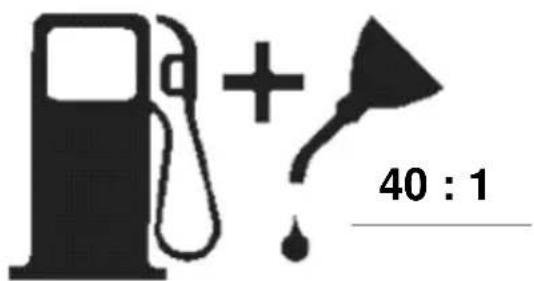
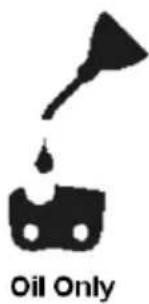
9.2.2 Fuel mixing table
| Gasoline litters | 1 | 2 | 3 | 4 | 5 |
| 2-cycle oil ml | 25 | 50 | 75 | 100 | 125 |
9.2.3 Recommended fuels
Some standard petrols are enriched with oxygen-containing compounds such as alcohol or ether to comply with regulations on clean air. The motor is designed to work well on any car petrol, including these enriched petrol, on the condition that the above mixing ratios are observed!
9.2.4 Filling with fuel
Clean the area around the cap of the fuel tank, and remove all wood dust and dirt.
- Open the fuel tank by turning the cap anticlockwise.
- Fill with fresh 2-stroke mix, DO NOT overfill.
POWXG1022 EN
- When finished refuelling, immediately refit the cap to the fuel tank, and close by turning it clockwise until hand tight and sealed.

Warning: Move at least 3m from the fuelling spot, away from potential spillage and escaped fumes, before attempting to start the engine.
9.3 Chain oil
9.3.1 Chain and bar lubrication
Always refill the chain oil tank each time the fuel tank is refilled. We recommend using our chain & bar oil (check our oil assortment). To ensure the bar and chain receive oil, only use the original style bar with the oil passage hole (A) as illustrated above (Fig. 3a). Always use good quality sprocket oil, which contains additives to reduce friction and wear and to assist in the prevention of pitch formation on the bar and chain.
9.3.2 Filling with chain oil

Warning: be careful not to spill any oil. Thoroughly clean away any spilled chain oil, even if bio-degradable chain oil is used. Be aware of slipping hazards!
- Clean the area around the chain oil reservoir, and remove all wood dust and dirt.
- Open the chain oil reservoir cap by turning it anticlockwise.
- Fill with special chain oil. Do not overfill.
- Immediately refit the chain oil reservoir cap, and close by turning it clockwise until hand tight and sealed.
10 OPERATION
10.1 Engine pre start checks (Fig. 8)

WARNING: Never start or operate the saw unless the bar and chain are properly installed.
- Fill the fuel tank (A) with correct fuel mixture.
- Fill the oil tank (B) with correct chain and bar oil.
- Be certain the chain brake (C) is disengaged before starting unit.
10.2 To start engine
- Activate the chain brake (move the hand guard forward and engage it) (Fig. 3b)
- To start the saw, push the engine switch (ON/OFF switch) to the ON (I) position (Fig. 9a).
- Pull out the choke (A) to the point where it latches in place (Fig. 9b).
- Press primer bulb 3 to 5 times.
- Place the saw on a firm and level surface. Hold the saw securely with your foot as illustrated. Tug sharply on the starter 2 times. Watch the chain in case it runs (Fig. 9c).
- When engine turns, choke will automatically switch off (Fig. 9d).
POWXG1022 EN
- Let the engine run for 10 seconds to warm up. Press the trigger (H) and put it into idle (Fig. 9e).

If the engine does not start up, repeat the above steps.
10.3 Re-starting a warm engine
Make sure the on/off switch is in the "l" position.
- Pull the starter rope rapidly 2 times. The engine should start.
10.4 To stop engine (Fig. 9f)
- Release trigger and allow engine to return to idle speed.
- Push the I/O (on/off) switch to o (off) to stop engine.

Note: for emergency stopping, simply activate chain brake and switch the I/O (on/off) switch to O (off).
10.5 Chain brake operational test
Test the chain brake periodically to ensure proper function.
Perform a chain brake test prior to initial cutting, following extensive cutting, and definitely following any chain brake service.
Test chain brake as follows:
- Place saw on a clear, firm, flat surface.
Start engine. - Grasp the rear handle (A) with your right hand (Fig. 10).
- With your left hand, hold the front handle (B) [not chain brake lever (C)] firmly (Fig. 10).
- Squeeze the throttle trigger to 1/3 throttle, then immediately activate the chain brake lever (C) (Fig. 10).

Warning: activate the chain brake slowly and deliberately. Keep the chain from touching anything; don't let the saw tip forward.
- Chain should stop abruptly. When it does, immediately release the throttle trigger.

Warning: if chain does not stop, turn engine off and take your unit to the nearest authorized service centre for service.
- If chain brake functions properly, turn the engine off and return the chain brake to the disengaged position.

Warning: if chain does not stop, turn engine off and take your unit to the nearest authorized service centre for service.
10.6 Saw chain / bar lubrication
Adequate lubrication of the saw chain is essential at all times to minimize friction with the guide bar. Never starve the bar and chain of oil. Running the saw with too little oil will decrease cutting efficiency, shorten saw chain life, cause rapid dulling of chain, and cause excessive wear of bar from overheating. Too little oil is evidenced by smoke, bar discoloration or pitch build-up. To ensure the bar and chain receive oil, only use the original style bar with the oil passage hole (A) as illustrated above (Fig. 3a).
POWXG1022 EN

Note: saw chain stretches during use, particularly when it is new, and it will occasionally be necessary to adjust and tighten it. New chain will require adjustment after about 5 minutes of operation.
10.7 Automatic oiler
Your chain saw is equipped with an automatic clutch driven oiler system. The oiler automatically delivers the proper amount of oil to the bar and chain. As the engine speed increases, so does the oil flow to the bar pad.

Warning: don't put pressure on the saw when reaching the end of the cut. The pressure may cause the bar and chain to rotate. If the rotating chain strikes some other object, a reactive force may cause moving chain to strike the operator.
10.8 General cutting instructions
10.8.1 Felling
Felling is the term for cutting down a tree. Small trees up to 6-7 inches (15-18 cm) in diameter are usually cut in a single cut. Larger trees require notch cuts. Notch cuts determine the direction the tree will fall.
Felling a tree:

Warning: a retreat path (A) should be planned and cleared as necessary before cuts are started. The retreat path should extend back and diagonally to the rear of the expected line of fall, as illustrated in Fig. 11a

Caution: if felling a tree on sloping ground, the chain saw operator should keep on the uphill side of the terrain, as the tree is likely to roll or slide downhill after it is felled.

Note: direction of fall (B) is controlled by the notching cut. Before any cuts are made, consider the location of larger branches and natural lean of the tree to determine the way the tree will fall.

Warning: do not cut down a tree during high or changing winds or if there is a danger to property. Consult a tree professional. Do not cut down a tree if there is a danger of striking utility wires; notify the utility company before making any cuts.
General guidelines for felling trees: (Fig 11B)
Normally felling consists of 2 main cutting operations, notching (C) and making the felling cut (D). Start making the upper notch cut (C) on the side of the tree facing the felling direction (E). Be sure you don't make the lower cut too deep into the trunk.
The notch (C) should be deep enough to create a hinge (F) of sufficient width and strength. The notch should be wide enough to direct the fall of the tree for as long as possible.
POWXG1022 EN

WARNING: Never walk in front of a tree that has been notched. Make the felling cut (D) from the other side of the tree and 1.5 - 2.0 inches (3-5 cm) above the edge of the notch (C) (Fig. 11b)
Never saw completely through the trunk. Always leave a hinge. The hinge guides the tree. If the trunk is completely cut through, control over the felling direction is lost. Insert a wedge or felling lever in the cut well before the tree becomes unstable and starts to move. This will prevent the guide bar from binding in the felling cut if you have misjudged the falling direction. Make sure no bystanders have entered the range of the falling tree before you push it over.

Warning: before making the final cut, always recheck the area for bystanders, animals or obstacles.
Felling cut:
-
Use wooden or plastic wedges (A) to prevent binding the bar or chain (B) in the cut. Wedges also control felling (Fig. 11c).
-
When diameter of wood being cut is greater than the bar length, make 2 cuts as shown (Fig. 11d).

WARNING: As the felling cut gets close to the hinge, the tree should begin to fall. When tree begins to fall, remove saw from cut, stop engine, put chain saw down, and leave area along retreat path (Fig. 11a).
10.8.2 Limbing
- Limbing a tree is the process of removing the branches from a fallen tree. Do not remove supporting limbs until after the log is bucked (cut) into lengths (Fig. 12).
- Branches under tension should be cut from the bottom up to avoid binding the chain saw

WARNING: Never cut tree limbs while standing on tree trunk.
10.8.3 Bucking
Bucking is cutting a fallen log into lengths. Make sure you have a good footing and stand uphill of the log when cutting on sloping ground. If possible, the log should be supported so that the end to be cut off is not resting on the ground. If the log is supported at both ends and you must cut in the middle, make a downward cut halfway through the log and then make the undercut. This will prevent the log from pinching the bar and chain. Be careful that the chain does not cut into the ground when bucking as this causes rapid dulling of the chain. When bucking on a slope, always stand on the uphill side.
- Log supported along entire length: Cut from top (overbuck), being careful to avoid cutting into the ground (Fig. 13a).
- Log supported on 1 end: First, cut from bottom (underbuck) 1/3 diameter of log to avoid splintering. Second, cut from above (overbuck) to meet first cut and avoid pinching (Fig. 13b).
POWXG1022 EN
- Log supported on both ends: First, overbuck 1/3 diameter of log to avoid splintering. Second, underbuck to meet first cut and avoid pinching (Fig. 13c).

NOTE: The best way to hold a log while bucking is to use a sawhorse. When this is not possible, the log should be raised and supported by the limb stumps or by using supporting logs. Be sure the log being cut is securely supported.
10.8.4 Bucking using a sawhorse
For personal safety and ease of cutting, the correct position for vertical bucking is essential (Fig. 14).
Vertical cutting:
- Hold the saw firmly with both hands and keep the saw to the right of your body while cutting.
- Keep the left arm as straight as possible.
- Keep weight on both feet.

Caution: while the saw is cutting, be sure the chain and bar are being properly lubricated.
11 MAINTENANCE INSTRUCTIONS
All chain saw service, other than items listed here in your user manual maintenance instructions, should be performed by a professional.
11.1 Preventive maintenance
A good preventive maintenance program of regular inspection and care will increase life and improve performance of your chain saw. This maintenance checklist is a guide for such a program. Cleaning, adjustment, and parts replacement may be required, under certain conditions, at more frequent intervals than those indicated.
| Maintenance checklist | Each use | Hours of Operation | ||
| Item | Action | 10 | 20 | |
| Screws/nuts/bolts | Inspect/tighten | V | ||
| Air filter | Clean or replace | V | ||
| Fuel filter/oil filter | Replace | V | ||
| Spark plug | Clean/adjust/replace | V | ||
| Fuel hoses | Inspect | V | ||
| Replace as required | ||||
| Chain brake components | Inspect | V | ||
| Replace as required | ||||
Air filter: Regularly check and clean the filter element. Replace if necessary.
POWXG1022 EN
11.2 Winter maintenance
Your chain saw requires a winter maintenance. Please contact your local dealer for this. It includes the following:
Replacing spark plug
Sharpening the chain
Cleaning of air filter (Replacement if necessary)
Cleaning of guide bar
Oil pump check up
Thorough cleanup
Fine tuning and testing
11.3 Air filter

Caution: never operate saw without the air filter. Dust and dirt will be drawn into engine and damage it. Keep the air filter clean!
To clean air filter:
- Remove knob (A) holding air filter cover in place, remove the top cover (B) by loosening the cover retaining screw. Cover will lift off (Fig. 15a).
- Lift the air filter (C) out of air-box (D) (Fig. 15b).
- Clean air filter. Wash filter in clean, warm, soapy water. Rinse in clear, cool water. Air dry completely.

Note: it is advisable to have a supply of spare filters.
- Install air filter. Install engine / air filter cover. Make sure latch (E) latch (F) and cover fit properly. Tighten the cover retaining knob securely (Fig. 15c & Fig. 15d).

Warning: never perform maintenance when the engine is hot, to avoid any chance of burning hands or fingers.
11.4 Fuel filter
- Remove the fuel tank cap.
- Bend a piece of soft wire to from a hook at the end.
- Reach into fuel tank opening and hook fuel line. Carefully pull the fuel line toward the opening until you can reach it with your fingers.

Note: do not pull hose completely out of tank.
- Lift filter (A) out of tank (Fig. 16).
Pull filter off with a twisting motion. Discard filter. - Install new filter. Insert end of filter into tank opening. Make sure filter sits in bottom corner of tank. Use a long screwdriver to aid in filter placement if necessary.
- Fill tank with fresh fuel / oil mixture. See section fuel and lubrication. Install fuel cap.
11.5 Spark arrester screen

Note: a clogged spark arrester screen will dramatically reduce engine performance.
- Remove the 2 bolts (A) and pull muffler out (Fig. 17a).
- Remove the 2 screws that hold the cover (B) (Fig. 17b).
Discard the used spark arrester screen (D) and replace it with a new one. - Reassemble the muffler components and install the muffler to the cylinder. Tighten securely.
11.6 Spark plug

Note: for efficient operation of saw engine, spark plug must be kept clean and properly gapped.
- Push stop switch down.
- Remove knob (A) holding air filter cover in place, remove the top cover (B) by loosening the cover retaining screw. Cover will lift off (Fig. 18a).
- Disconnect the wire connector (C) from the spark plug (D) by pulling and twisting at the same time (Fig. 18b).
- Remove spark plug with spark plug socket wrench.
DO NOT USE ANY OTHER TOOL - Check electrode gaps with wire feeler gauge and set gaps to .025" (.635mm) if necessary.
- Reinstall a new spark plug.

Note: a resistor spark plug must be used for replacement.
Note: this spark ignition system meets all requirements of the interference-causing equipment regulations.
11.7 Carburetor adjustment
The carburetor was pre-set at the factory for optimum performance.
If further adjustments are necessary, please take your unit to the nearest qualified service technician.
12 MAINTENANCE
12.1 Guide bar maintenance
Frequent lubrication of the guide bar (railed bar which supports and carries the saw chain) sprocket tip is required. Proper maintenance of the guide bar, as explained in this section, is essential to keep your saw in good working condition.
- Dismount the Saw Chain (1) and Guide Bar (2) by following the instructions in 'Assembling the chainsaw' in reverse
- Remove saw dust from the bar groove and oiling port using a small screwdriver, probe (not included) (see Fig. 19), or compressed air
- Inspect the Guide Bar and the sprocket on its tip. Lubricate the sprocket with a suitable maintenance spray
- Deburr, turn over or replace the Guide Bar as required
12.2 Sprocket tip lubrication

Caution: the sprocket tip on your new saw has been pre-lubricated at the factory. Failure to lubricate the guide bar sprocket tip as explained below will result in poor performance and seizure, voiding the manufacturer's warranty.
Lubrication of the sprocket tip is recommended after 10 hours of use or once a week, which ever occurs first. Always thoroughly clean guide bar sprocket tip before lubrication.
Tools for lubrication:
The lube gun (optional) is recommended for applying grease to the guide bar sprocket tip. The lube gun is equipped with a needle nose tip which is necessary for the efficient application of grease to the sprocket tip.
To lubricate sprocket tip:

Warning: wear heavy duty work gloves when handling the bar and chain.
- Press the stop switch down.

Note: it is not necessary to remove the saw chain to lubricate the guide bar sprocket tip. Lubrication can be done on the job.
Clean the guide bar sprocket tip.
- Using the lube gun (optional), insert needle nose into the lubrication hole and inject grease until it appears at outside edge of sprocket tip (Fig. 20).
- Rotate saw chain by hand. Repeat lubrication procedure until the entire sprocket tip has been greased.
12.3 Guide bar maintenance
Most guide bar problems can be prevented merely by keeping the chain saw well maintained. Insufficient guide bar lubrication and operating the saw with chain that is too tight will contribute to rapid bar wear. To help minimize bar wear, the following guide bar maintenance procedures are recommended.

Warning: always wear protective gloves during maintenance operations. Do not carry out maintenance when the engine is hot.
12.4 Chain sharpening
Chain sharpening requires special tools to ensure that cutters are sharpened at the correct angle and depth. For the inexperienced chain saw user, we recommend that the saw chain be professionally sharpened by the nearest professional service center. For non-experienced users of the chain saw, we recommend to have the chain sharpened by a specialist in any authorized service.

Warning: when having wrong sharpened chain, there may occur a higher danger of kickback.
POWXG1022 EN
- To sharpen the saw chain, use the suitable sharpening tools:
round chain file
file leading
chain measuring calibre.
These tools can be bought in any specialized stores.
- To gain well shaped sawdust particles, use sharp chain. If there appears wooden powder, you must sharpen the saw chain.

Warning: all cutting teeth must be similarly long. Different length of the teeth can cause rough run of the chain or its rupture, as well.
- Minimum length of the teeth must be 4mm . If they are shorter, remove the saw chain.
- Angles, which the teeth are under, must be followed.
- To sharpen the chain basically, make 2 to 3 pulls of the file from the inside out.

Warning: after 3 to 4 of your sharpening of the cutting teeth, haveve the saw chain sharpened in any authorised service. They will sharpen the depth limiter as well, which provides the distance.
Chain sharpening
The pitch of the chain (Fig. 21) depends on the model.
| POWXG1022 | |
| Pitch | 3/8" |
| Gauge | 0.050" |
Sharpen the chain using protective gloves and a round file of 5 / 32" (4 mm).
Always sharpen the cutters only with outward strokes (Fig. 22) observing the values given in Fig. 21. After sharpening, the cutting links must all have the same width and length.

Warning: a sharp chain produces well-defined chips. When your chain starts to produce sawdust, it is time to sharpen.
- After every 3-4 times the cutters have been sharpened you need to check the height of the depth gauges and, if necessary, lower them using the flat file and template supplied optional, then round off the front corner (Fig. 23).

WARNING: Proper adjustment of the depth gauge is as important as proper sharpening of the chain.
12.5 Guide bar
The bar should be reversed every 8 working hours to ensure uniform wear. Keep the bar groove and lubrication hole clean using a bar groove cleaner (optional) (Fig. 24)

Warning: never mount a new chain on a worn sprocket or self-aligning ring.
Bar wear - turn guide bar frequently at regular intervals (for example, after 8 hours of use), to ensure even wear on top and bottom of bar.
Oil passages - oil passages on the bar should be cleaned to ensure proper lubrication of the bar and chain during operation.

Note: the condition of the oil passages can be easily checked. If the passages are clear, the chain will automatically give off a spray of oil within seconds of starting the saw.your saw is equipped with an automatic oiler system.
12.6 Chain maintenance
Chain tension:
Check the chain tension frequently and adjust as often as necessary to keep the chain snug on the bar, but loose enough to be pulled around by hand.
Breaking in a new saw chain:
A new chain and bar will need chain readjustment after as few as 5 cuts. This is normal during the break-in period, and the interval between future adjustments will begin to lengthen quickly.

Warning: never have more than 3 links removed from a loop of chain. This could cause damage to the sprocket.
Chain lubrication:
Always make sure the automatic oiler system is working properly. Keep the oil tank filled with good quality chain, bar and sprocket oil.
Adequate lubrication of the bar and chain during cutting operations is essential to minimize friction with the guide bar.
Never starve the bar and chain of lubricating oil. Running the saw dry or with too little oil will decrease cutting efficiency, shorten saw chain life, cause rapid dulling of chain, and lead to excessive wear of bar from overheating. Too little oil is evidenced by smoke or bar discoloration.
Chain sharpening:
For the inexperienced chain saw user, we recommend that the saw chain be professionally sharpened by the nearest professional service centre. If you feel comfortable sharpening your own saw chain, special tools are available from the professional service centre.
POWXG1022 EN
13 TECHNICAL DATA
| Cylinder capacity | 45 cc |
| Rotation speed | 10.000 min-1 |
| Chain speed | 22 m/s |
| Carburettor type | Walbro |
| Spark plug type | Champion |
| Chain type | Oregon |
| Cutting length | 450 mm |
| Engine power | 1.8 kW |
| Guide bar type | Oregon |
| CDI ignition | Yes |
| Controlled oil delivery | Yes |
| Crank engine | Full |
| E10 fuel proof | Yes |
| Easy start system | Yes |
| Engine type | 2-stroke |
| Fuel mixing ratio | 1:40 |
| Fuel tank capacity | 580 ml |
| Oil tank capacity | 250 ml |
| High power engine | Yes |
| Long life air filter system | yes |
| Low kickback | Yes |
| Low vibration system | Yes |
| Primer bulb | Yes |
| Quick stop | Yes |
| Safety trigger throttle latch | Yes |
| Shock absorber | Yes |
| Auto-brake hand guard | Yes |
| Automatic chain oiler | Yes |
| Automatic choke switch off | Yes |
| Automatic lubrication | Yes |
14 NOISE
Noise emission values measured according to relevant standard. (K = 3)
| Acoustic pressure level LpA | 96dB(A) |
| Acoustic power level LwA | 114 dB(A) |

ATTENTION! Wear hearing protection when sound pressure is over 85 dB(A).
aw (Vibration):
8.5 m/s²
K = 1.5 m/s²
15 STORING A CHAIN SAW

Caution: never store a chain saw for longer than 30 days without performing the following procedures. Storing a chain saw for longer than 30 days requires storage maintenance. Unless the storage instructions are followed, fuel remaining in the carburettor will evaporate, leaving gum-like deposits. This could lead to difficult starting and result in costly repairs.
- Remove the fuel tank cap slowly to release any pressure in tank. Carefully drain the fuel tank.
- Start the engine and let it run until the unit stops to remove fuel from carburettor.
- Allow the engine to cool (approx. 5 minutes).
- Using a spark plug wrench, remove the spark plug.
- Pour 1 teaspoon of clean 2-cycle oil into the combustion chamber. Pull starter rope slowly several times to coat internal components. Replace spark plug.

Note: store the unit in a dry place and away from possible sources of ignition such as a furnace, gas hot water heater, gas dryer, etc.
Removing a unit from storage
- Remove spark plug.
Pull starter rope briskly to clear excess oil from combustion chamber. - Clean and gap spark plug or install a new spark plug with proper gap.
Prepare unit for operation. - Fill fuel tank with proper fuel / oil mixture. See fuel and lubrication section
16 TROUBLE SHOOTING
| PROBLEM | PROBABLE CAUSE | CORRECTIVE ACTION |
| Unit won't start or starts but will not run. | Incorrect starting procedures.Incorrect carburettor mixture adjustment setting.Fouled spark plugEmpty fuel tank.Primer bulb was not pressed enough. | Follow instructions in the user manual.Have carburettor adjusted by an authorized service centreCLEAN/gap or replace plug.Fill fuel tank with properly mixed fuel. |
| Unit starts, but engine has low power. | Fuel filter is plugged.Incorrect lever position.Dirty spark arrestor screen.Dirty air filter.Incorrect carburettor mixture adjustment setting service dealer. | Replace the fuel filter.Move to run position.Replace spark arrestor screen.Remove, clean and reinstall. Have carburettor adjusted by an authorized service centre. |
| Engine hesitates. | Incorrect carburettor mixture adjustment setting.Air filter is plugged.Old or improperly mixed fuel. | Have carburettor adjusted by an authorized service centre.Replace or clean the air filter.Drain gas tank/add fresh fuel mixture. |
POWXG1022 EN
| PROBLEM | PROBABLE CAUSE | CORRECTIVE ACTION |
| No power under load. | Incorrect carburettor mixture adjustment setting. Old or improperly mixed fuel. Air filter is plugged. Fouled spark plug. | Have carburettor adjusted by an authorized service centre. Drain gas tank (see storage)/add fresh fuel mixture. Replace or clean the air filter. Replace or clean the spark plug. |
| Runs erratically. | Incorrectly gapped spark plug. Plugged spark arrestor. Dirty air filter. | Clean/gap or replace plug. Clean or replace spark arrestor. Clean or replace air filter. |
| Smokes excessively. | Incorrect carburettor mixture adjustment setting. Incorrect fuel mixture. | Have carburettor adjusted by an authorized service centre. Use properly mixed fuel (40:1). |
17 WARRANTY
This product is warranted for a 36-month period effective from the date of purchase by the first user.
- This warranty covers all material or production flaws excluding : batteries, chargers, defective parts subject to normal wear & tear such as bearings, brushes, cables, and plugs, or accessories such as drills, drill bits, saw blades, etc. ; damage or defects resulting from maltreatment, accidents or alterations; nor the cost of transportation.
- Damage and/or defects resulting from inappropriate use also do not fall under the warranty provisions.
We also disclaim all liability for any bodily injury resulting from inappropriate use of the tool.
- Repairs may only be carried out by an authorised customer service centre for Powerplus tools.
- You can always obtain more information at the number 00 32 3 292 92 90.
- Any transportation costs shall always be borne by the customer, unless agreed otherwise in writing.
- At the same time, no claim can be made on the warranty if the damage of the device is the result of negligent maintenance or overload.
- Definitely excluded from the warranty is damage resulting from fluid permeation, excessive dust penetration, intentional damage (on purpose or by gross carelessness), inappropriate usage (use for purposes for which the device is not suitable), incompetent usage (e.g. not following the instructions given in the manual), inexpert assembly, lightning strike, erroneous net voltage. This list is not exhaustive.
- Acceptance of claims under warranty can never lead to the prolongation of the warranty period nor commencement of a new warranty period in case of a device replacement.
Devices or parts which are replaced under the warranty therefore remain the property of Varo NV.
- We reserve the right to reject a claim whenever the purchase cannot be verified or when it is clear that the product has not been properly maintained. (Clean ventilation slots, carbon brushes serviced regularly, etc.).
- Your purchase receipt must be kept as proof of date of purchase.
- Your appliance must be returned undismantled to your dealer in an acceptably clean state, (in its original blow-moulded case if applicable to the unit), accompanied by proof of purchase.
18 ENVIRONMENT
Should your machine need replacement after extended use, do not put it in the domestic waste but dispose of it in an environmentally safe way.
19 DECLARATION OF CONFORMITY

VARO N.V. - Joseph Van Instraat 9 - BE2500 Lier - BELGIUM, declares that,
Product: CHAINSAW 45 cc - 450 mm
Trade mark: POWERplus
Model:POWXG1022
is in conformity with the essential requirements and other relevant provisions of the applicable European Directives, based on the application of European harmonized standards. Any unauthorized modification of the apparatus voids this declaration.
European Directives (including, if applicable, their amendments up to the date of signature):
2006/42/EC
2014/30/EU
2000/14/EC Annex V LwA 109dB(A) / 114dB(A)
European harmonized standards (including, if applicable, their amendments up to the date of signature):
EN11681-1:2011
EN ISO 14982:2009
Keeper of the Technical Documentation: Philippe Vankerkhove, VARO - Vic. Van Rompuy N.V.
The undersigned acts on behalf of the company CEO,
Philippe Vankerkhove
Regulatory Affairs - Compliance Manager
01/07/16
POWXG1022 DE
Regulatory Affairs - Compliance Manager
01/07/16
POWXG1022 PT
11 INSTRUÇÉS DE MANUTENÇÂO 18
9.2.4 Abastecer com combustivel
Saging i oppreist stilling:
- Hold sagen godt fast med begge hender og hold sagen til hoyre for kroppen under saging
- Hold venstre arm sa rett som mulig.
- Hold jevn vekt på begge føtter.

Verktoy for smoring:
Rengoring at luftfilter
Oil only = Doar ulei
9.2.2 Tabel cu amestecurile de carburanti
IpeynpeKdene: He cTaptnpaTe DnraTeHa TpnoHa, OkaTo He 6bJe npabuHNO noDroTBeH.
Baunr HOB BepnKeH TpnoH n3ncBa peylnpaHe Ha BepraTa, HnblBaHe Ha pe3epBOapa 3a RopBO C NOxOJaA rOpNBHa Cmec N HnblBaHe Ha pe3epBOapa 3a MacNo CbC Cma3OuHO MacNo. IpeN Da e rTOB 3a pa6ota.
PpOeTeTe cJIoTO PbKOoDcTBO Ha nOTpe6HTeJI, npeIa 3aDeIcTBaTe yCTPOIcTBOTo. O6bpHeTe CNEuaJIHO BHMaHne Ha BCNU pPeDn3Hm MepKn.
BaWeTo PbKOBOCTBO Ha noTpe6nteJra e EHNOBpeMeHHO cnpaBOUHK n HapbYHK, npEHa3HaueH Da BN ppeOCTaBn 067a INΦopMauJra 3a MOHTax, ekCnIooTaunr N NOdpbXka Ha Baunr TpnoH.
8.3 Nocmaahe Ha HapraeBaa uHa / eepuza Ha mpuoHa / Kanak Ha cbebuhumela

IpeynpejxdeHne: BnHaH HocTe 3aunTHn pbkauu, KoraTo 6opabnte C Bepurata.
8.3.1 MoHTaX Ha 3aKoHTpIuIa IuI (13)
Пьрв моHTираite 3akOHtpraшп (13) кьm пpeДнаТаЧСТ HaцИнДрВЯ 6лOK kaTo H3NoJI3BaTe ДБа MOHTaЖн BnHTa (BkJIQUeH N T aЗ n OпakOBka) (WInNOBete Tpr6Ba Da ca HacoуeHn HappeI).
8.3.2 NocTabaHe Ha HnpaBnaBaUaTa UHa:
3a da cte cnrypHn, ye uHaTaN Bepurata noJyabat Macno, n3no3BaTe caMo opuHaJIHHa BnD uHa C OTBop 3a KaHaI 3a Cma3BaHe (A), KaKTo e nnHoctpnpaHO no-rope (fNr. 3a).
YBepTe ce,Ye cnpaunrT noCT Ha BepnraTa e N3dbpnaH Ha3aD B N3KIOueHa No3n (fur. 3b).
POWXG1022BG
OTctpaHETe KOHTparaiKaTa(-Te) Ha uHaTa (B). Na. OTcTpaHete KaNaKa Ha BepnXHaTa cnnpaKa (C), kato n3dbpnaTe Happao, moxe da e Heo6xOdima n3BeCTHa cnla (fnr. 3c).

3a6eJekka: n3xbpIe Te DBeTe pIacTMacoBn 7aIb6n, 3aIoTO Te ce H3noJI3BaT cAmO 3a TpaHCnpTupaHe Ha BepNXHn TpNOH.
IocTabete npop3aHna Kpa HnHa HnpabBaata WnHa Bbpxy 6oTa Ha WnHaTa (F). Ipb3He TnPaBnBaata WnHa 3ad 6loka Ha 6apa6aHa Ha cbeDnHnteTg (G),doKaTo WnHaTcnpe (Фиг.3d).
8.3.3 3a da MOHTupaTe BepnKHHa TpnoH:

BHHarn HocTe pKabu3a TeKko HaTOBapBaHe, KOrato 6opabnte c BepnraTa Ha TpnoHa nIypeRynipate.
Pa3npedeeneBepnraTno KOHTyp cpexeuNTe p6oBe (A),coueu no nocoka Ha yacOBHKOBATA CTpeNkO OKONO KOHTypa (Dur. 4a).
- PnB3HETe BepnraTa OKOIO BepnxKHO 3b6HO KOJIeIO (B) 3aI cBeiHNHeTJIa (C). YBepeTe ce, Ye BOB3KNTe Ce HaRaJdAT MeKdy 3b6NTE Ha BepnxKHO 3b6HO KOJIeIO (ΦmR. 4b).
- PpokapaiTe Bpb3Knte Ha 3aDbNkBaHeTo B KaHaja (D) n OKoNo Kpaar Ha shHaTa (fnr. 4b).

3a6eIeKka: BepnraTa Ha TpnoHa MoKe Da npOBncHe IeKO Bbpxy NoHnCKaTa YacT Ha uHaTa. ToBa e HopMaIIHo.
- DpbHHe HnpaBnaBaAata uHa Hnpei,doKATO Beprata 3actane NtBTHO.YBepeTe Ce,Ye BCNUKBOB3KN Ha 3aDbNkBAHETo Ca B KaHaHa Ha UHHATA.
IocTabeTe Kanaka Ha cBeHNHTeJ, KaTO ce yBepNTe, ye BODEUANT Kpa e No3nIOHnpaH B NO-DoHNHa OTbOp Ha HAnpabNJaBaUaTa 7uHa. YBepTe ce, ye BepnArTa He ce n3Pb3Ba OT uHa. IocTabeTe o6paTHo OrpaHnHTeJHnHa 3b6 Ha BepnKHaT a Nna. IocTabeTe KOHTparaiKaTa Ha uHa TcERHaTo Ha pKa i CneDbaiTe INCTpyKUnTe 3a peryInpAHe Ha onbHa B pa3deJa PeryInpAHe Ha onbHa Ha BepnArTa Ha TPNoHa.

3a6eJexka: KOHTparaiKITE Ha HAnpaBIAaTa 5uHa ca NoCTaBeHn B MOMeHTa CTeHato cAmo Ha pbKa, 3aIoTO e Heo6xOdmo peryInpaHe Ha Bepurata Ha TpNoHa. CJeDbaTe IHcTpyKcUnte B pa3deHa PeryInpaHe Ha OlbHa Ha Bepurata Ha TpNoHa.
8.3.4 PerynnpaHe Ha onbHa Ha Bepurata Ha TpnoHa
IpaBnHnT onbH Ha Bepnata Ha TpnoHa e N3KJIuOHTeJHO BaxeH n Tp8Ba da ce npOBepn npEi CTapTnpaHe, KaKTo I NO BpeMe Ha IpOceca Ha p3aHe.
KATO OTDeIte BpeMe Da HAppaBITE Heo6xOdUMITE KOpeKuIN BBB BepnraTa Ha TpnoHa, B pe3yIITat ige nMaTe IIOobpeHa pa60Ta npn pR3aHe u yDbJnxEh cPOK Ha ekCnIooatauHa H BepnraTa.

IpeynpexdeHne: BnHaH N OceTe 3aunTHN pBkaBnC 3a TeKKn ycNoBna Ha pa6ota, KOraTo 6opabnte C Bepurata Ha TpnoHa IInn Y KopurnpaTe .
8.3.5 3a da perynnpaTe BepuraTa Ha TpnoHa:
Pa3xna6eTe KOHTparaKNTe Ha uHaTa, Taka Ye Te Da ce 3aTgat Ha DbKa.
-Дрьжte Hoca Ha HanpaBnaBaUaTa 乌Ha Harope n 3aBbptTe perynnpaun BnHT (A) no Yacobata CtpeIka, 3a Da nobuWite OtbHa Ha Bepurata. 3abpTaHe Ha BnHTa CpeUy Yacobata CtpeIka ige Hamann OtbHa Ha Bepurata. YBepete ce, Ye Bepurata npnra TINbTHO INpe3 UJNTO BpeMe OKoNo HanpaBnaBaUaTa 乌Ha (ФИR.5).
CneI KaTo N3BbPunTe KopeKunrN I DOKaTO BCE OSe HocbT Ha WnHaTa E B RopHa No3nUra, 3aterHete NaedexJHO KOHTparauKnte Ha WnHaTa. Bepurata mMa TOuHna ONbH, Korato N3UraIO PpNJRAI PJIbTHO IMoKe Da Ce DbpNa OT PbKa B PbKaBuua.

3a6eJekka: Ako BepuraTa ce Bbptn Tpydno Bbpxy HnpaBnaaata uHa, nHa aKO 3aHpa, e npIooKe h TBbpde rOjam Oth. ToBa n3nckBa peylnpahene KbM NO-MaTbK ONbH KaKTo CJIeDba:
Pa3xna6eTe KOHTparaikte Ha uHa, Taka Ye Te da ce 3aTgat Ha pka. HamaTe ONbHa KaTO 3aBbPTnte 6abHO BnHTa 3a perynpaHe Ha uHa t Cpeu y acOBaTa cTpeNka. DnHexe T BePrtata Ha3ad n HanpeD Bbpxy uHaT. PpOdbJXbaIe Ta peynpate, DOkato Bepurata Ce BbPTn CBO6oH0, Ho npnra nnTHO. NobuWeTe ONbHa, KATO 3aBbPTnte BnHTa 3a DEVnpaHe Ha uHaT NO YacOBaTa CTpeNka.
Korato Bepnata Ha TpnoHa mHa NOxOJaOnb, 3aApbXte HocHa Ha IHHaB RopHa N03uH N3aterHeTe HAdExJHO DBete KOHTparayKn Ha IHHaT.

BHMMaHHe: HOBa Bepnra Ha TpnoHa ce pa3TgRa, KaTo e Heo6xOdIma KopeKunr cne5 p3aHn. ToBa e HopMaIHO npn HOBa Bepnra n HHTepBaJIbT Mekdy 6bDeu KopeKUnn ue ce yDbJnx 6bp30.

BHMMaHHe: aKO Bepurata Ha TpNoHa e TBbpDe Xla6aBa NJI TbbpDe HaTe rHaTa, BepnXhOTo 3b6Ho KOJeNo, uHnHaTa, Bepurata N IarepuTe Ha KOJHOBnBaI Ue Ce n3HocT No-6bp3o. Pa3rJeDaIte BHMaTeJHo nr.6 3a HOpMaunBvB Bp3Ka C KopeKTHO cTydeHO ontBAHe (A), KopeKTHO Tonno OntBaHe (B), n KaTo HapbUHnK Kora Bepurata Ha TpNoHa ce HyxJae ot perylnpahe (C).
8.3.6 MexaHnHOno n3nTahHe Ha BepnxHaTa cnnpaKa
Baunr Bepnke Htpnoe oobpydban C Bepnka, KOTo peDynpa Bb3MOxHocTTa OT hapaHraBaHe npaOn OTkaT. CnpaKaTa ce aKTHBpa, Ako Ce npINOxHaJIraHe cnpMo CnpaHnaIOCT, KORAto, KaTO B CnyaC OTkata, PbKaTa Ha ONepaTopa ydapn loCTa. Korato CnpaKaTa e 3aJeCTBaHa, DvnKeHneTo Ha BepnTa Cnpa pR3KO.

IpeDynpexDeHne: ceTtHa BepnxHaTa CnnpaQka e da ce peDyUnpa Bb3MOxHocTTa 3a HapaHyaBe NopadN OTKaT; obae THe MoKe Da OcnHypr npoeKtnpaHTo HnBO Ha 3aunTa, aKO c TpnoHa ce pa60Tu HeBHMATEJHo. BuHaT NectBaTe BepnxHaTa CnnpaQka, npeDn Da n3No13BaTe Baunr TpnoH n nepnoDnUHO no BpeMe Ha pa60Ta.
8.3.7 3a da ce TcTeBa BepnKHaTa CnpaYuKa:
BepnKaTa cnpaHa e n3KIOueHa (BepraTa MoKe Da ce DnK), KOraTo IocTbT Ha cnpaKaTa e n3DbpNaH Ha3aN 6IokpaH. YBepTe Ce, ye e3NuHTo Ha BepnKaTa cnpaKa e B noLoXeHne OFF (U3Kn.) (Our. 7a).
POWXG1022BG
BepnKaTa CnpaKa e BkIoueHa (BepraTa e cnpaHa), KOrato JocTbT Ha cnpaKaTa e B npEdHa No3uNn i e3NuTe Ho BepnKaTa CnpaKa e B noLoKeHne ON (Bkn.) Tp6Ba Da He MoKeTe Da DnKnte Beprata (fir. 7b).

3a6eJekka: JocTbT Ha cnpaKaTa CneJa da ce fHKnpa B DBeTe N03uH. Ako ce yceua cnHOb cbnpotNBHeHne, Hn JocTbT He Ce DnKnB HNKo N03uH, He n3noJ3BaIe TpNoHa. 3aHeCete rO He3a6abHO do npocecnoHaJIeH cepBn3eH ueHTbp 3a peMOHT.
9 TOPNBO N CMA3BAHE
9.1 Topueo
I3noJI3BaIte peOBeH KlaC 6e3oIOBHe 6eH3nH CMeCEH c 40:1 O6NKHOBEHO MacNo 3a DByTaKTOB DBrIATEJ 3a Hau-Do6pN pe3yIITaTn. I3noJI3BaIte CbOTHOWeHnra THa CMEcBaHe B Ta6nIzata ot pa3dena CmecBaHe Ha rOpIBO no-dony.

IpeynpexdeHne: Hkora He n3non3BaTe cAmo 6eH3nB bB BaWeTo yctpoiCTBO. ToBa ue DoBeDe do NoctOHa NobPeDa Ha DnRaTeJN u ce aHyInpa rapaHunra Na Hpon3BoDnteJra 3a To3n npOdyKT. Hnkora He n3non3BaTe rOpNBHa cMec, KOrTo e 6nla Ha cKnad nobuee ot 90 deHa.

IpeDynpexDeHne: DByTaKToBaTa CMa3Ka Tp86Ba Da 6bJe OT MacNo OT npemnym KnaC 3a DByTaKToBn DBrrAteN C Bb3dUwHO OxJaXdaHe, cMeceHa B cBoTHoWeHne 40:1. He n3noJ3BaTe DByTaKTOBO MacNo C npenOpbYHTeNHO cBoTHoWeHne Ha CmecBaHe 100:1. Ako npuHa 3a NOBpeDa Ha DBrrAteT e HeOCTaTBuHO CMa3BaHe, TOBa aHyInpa rapaHcIra Ta Ha npOn3BODnteHa DBrrAteTn.
Oil only= Camo macno
9.2.2 Ta6nua 3a cmeBaHe Ha rOpnbTo
10.7 AemomamuHa MacJboHka
Baunr TpnoH e obopydban c aBtOMaTHuHa CnCTema 3a CMa3BaHe, 3aDbNxBaHa OT CbeHNHTeJ. MacIbOHHkata aBtOMaTHUHO DoCTABn IOxOJaIO KOJIueCTBO MaCNo Bbpxy ShnHaTn Bepurata. Korato CKOpocCTTa Ha DnIRatJe Ce NOBnN, 3aOnuBa Da Teue NOBueMacNo KbM Ha6NBkata Ha shnHaT.

PpeDynpexKdHHe: He ynpaxHbAte HaTnck Bbpxy TpnoHa npN DoCTnraHe Ha KpaHa p3aHTo. HATnckbT MoKe Da npuHH 3aBbptaHe Ha uHata N Bepurata.AKO BbptaTa ce Bepura ydapn HkoN ppeMeT, peakTBHata cnla MoKe Da npuHHN OTcKaUaHe Ha Hepurata N ydap Ha onepaTopa.
10.8 06u uHcmpkyu 3a p3aHe
10.8.1 Nobajne





- GARDENPRO POWERPLUS HIGH QUALITY TOOLS
- 9.2.2 MENGTABEL BENZINE
- 9.2.3 AANBEVOLEN BENZINE
- 16 PROBLEEMOPLOSSING
- 9.2.4 APPOINT DE CARBURANT
- POWXG1022 EN
- CHAINSAW 45 CC - 450 MM POWXG1022
- 1 APPLIANCE
- 2 DESCRIPTION
- 3 PACKAGE CONTENT LIST
- 4 SYMBOLS
- 5 SAFETY
- 6 KICKBACK SAFETY PRECAUTIONS
- NOTE: LOW-KICKBACK SAW CHAIN IS CHAIN THAT HAS MET THE KICKBACK PERFORMANCE
- BEWARE OF
- 7 SAFETY WARNINGSGASOLINE
- 8 ASSEMBLY
- 8.1 TOOLS FOR ASSEMBLY
- 8.2 ASSEMBLY REQUIREMENTS
- 8.3 GUIDE BAR / SAW CHAIN / CLUTCH COVER INSTALLATION
- 8.3.1 MOUNTING THE BUCKING SPIKE (13)
- 8.3.2 INSTALLATION OF THE GUIDE BAR
- 8.3.3 TO INSTALL SAW CHAIN
- 8.3.4 SAW CHAIN TENSION ADJUSTMENT
- 8.3.5 TO ADJUST SAW CHAIN
- 8.3.6 CHAIN BRAKE MECHANICAL TEST
- 8.3.7 TO TEST CHAIN BRAKE
- 9 FUEL AND LUBRICATION
- 9.1 FUEL
- 9.2 MIXING FUEL
- 9.2.1 FUEL AND LUBRICATION SYMBOLS
- 9.2.2 FUEL MIXING TABLE
- 9.2.3 RECOMMENDED FUELS
- 9.2.4 FILLING WITH FUEL
- 9.3 CHAIN OIL
- 9.3.1 CHAIN AND BAR LUBRICATION
- 9.3.2 FILLING WITH CHAIN OIL
- 10 OPERATION
- 10.1 ENGINE PRE START CHECKS (FIG. 8)
- 10.2 TO START ENGINE
- 10.3 RE-STARTING A WARM ENGINE
- 10.4 TO STOP ENGINE (FIG. 9F)
- 10.5 CHAIN BRAKE OPERATIONAL TEST
- TEST CHAIN BRAKE AS FOLLOWS
- 10.6 SAW CHAIN / BAR LUBRICATION
- 10.7 AUTOMATIC OILER
- 10.8 GENERAL CUTTING INSTRUCTIONS
- 10.8.1 FELLING
- FELLING A TREE
- GENERAL GUIDELINES FOR FELLING TREES: (FIG 11B)
- FELLING CUT
- 10.8.2 LIMBING
- 10.8.3 BUCKING
- 10.8.4 BUCKING USING A SAWHORSE
- 11 MAINTENANCE INSTRUCTIONS
- 11.1 PREVENTIVE MAINTENANCE
- 11.2 WINTER MAINTENANCE
- 11.3 AIR FILTER
- CAUTION: NEVER OPERATE SAW WITHOUT THE AIR FILTER. DUST AND DIRT WILL BE DRAWN INTO ENGINE AND DAMAGE IT. KEEP THE AIR FILTER CLEAN
- TO CLEAN AIR FILTER
- NOTE: IT IS ADVISABLE TO HAVE A SUPPLY OF SPARE FILTERS
- WARNING: NEVER PERFORM MAINTENANCE WHEN THE ENGINE IS HOT, TO AVOID ANY CHANCE OF BURNING HANDS OR FINGERS
- 11.4 FUEL FILTER
- NOTE: DO NOT PULL HOSE COMPLETELY OUT OF TANK
- 11.5 SPARK ARRESTER SCREEN
- 11.6 SPARK PLUG
- 11.7 CARBURETOR ADJUSTMENT
- 12 MAINTENANCE
- 12.1 GUIDE BAR MAINTENANCE
- 12.2 SPROCKET TIP LUBRICATION
- TOOLS FOR LUBRICATION
- TO LUBRICATE SPROCKET TIP
- 12.3 GUIDE BAR MAINTENANCE
- 12.4 CHAIN SHARPENING
- CHAIN SHARPENING
- 12.5 GUIDE BAR
- 12.6 CHAIN MAINTENANCE
- CHAIN TENSION
- BREAKING IN A NEW SAW CHAIN
- CHAIN LUBRICATION
- 14 NOISE
- 15 STORING A CHAIN SAW
- REMOVING A UNIT FROM STORAGE
- 16 TROUBLE SHOOTING
- 17 WARRANTY
- 18 ENVIRONMENT
- 19 DECLARATION OF CONFORMITY
- POWXG1022 DE
- POWXG1022 PT
- 9.2.4 ABASTECER COM COMBUSTIVEL
- RENGORING AT LUFTFILTER
- 9.2.2 TABEL CU AMESTECURILE DE CARBURANTI
- 8.3 NOCMAAHE HA HAPRAEBAA UHA / EEPUZA HA MPUOHA / KANAK HA CBEBUHUMELA
- 8.3.1 MOHTAX HA 3AKOHTPIUIA IUI (13)
- 8.3.2 NOCTABAHE HA HNPABNABAUATA UHA
- POWXG1022BG
- 8.3.3 3A DA MOHTUPATE BEPNKHHA TPNOH
- 8.3.4 PERYNNPAHE HA ONBHA HA BEPURATA HA TPNOHA
- 8.3.5 3A DA PERYNNPATE BEPURATA HA TPNOHA
- 8.3.6 MEXAHNHONO N3NTAHHE HA BEPNXHATA CNNPAKA
- 8.3.7 3A DA CE TCTEBA BEPNKHATA CNPAYUKA
- 9 TOPNBO N CMA3BAHE
- 9.1 TOPUEO
- 10.7 AEMOMAMUHA MACJBOHKA
- 10.8 06U UHCMPKYU 3A P3AHE
- 10.8.1 NOBAJNE
Brand : PowerPlus
Model : POWXG1022
Category : Saw