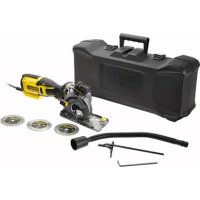
FME380 - Saw STANLEY - Free user manual and instructions
Find the device manual for free FME380 STANLEY in PDF.



| Brand | Stanley |
| Model | FME380 |
| Product type | Universal compact saw |
| Intended use | Rip and cross cutting of wood, particle board, plywood, aluminum, tiles, stone, plastic and lightweight building materials |
| Supply voltage | 230 V AC |
| No-load speed | 4500 min⁻¹ |
| Blade size | 89 mm |
| Max cutting depth (softwood) | 28.5 mm |
| Max cutting depth (tile) | 8 mm |
| Max cutting depth (aluminum) | 3 mm |
| Sound pressure level | 90 dB(A) (circular saw function), 97 dB(A) (cutting off) |
| Sound power level | 101 dB(A) (circular saw), 108 dB(A) (cutting off) |
| Vibration (wood) | 2.4 m/s² (uncertainty 1.5 m/s²) |
| Vibration (metal) | 5.5 m/s² (uncertainty 1.5 m/s²) |
| Vibration (concrete) | 5.5 m/s² (uncertainty 1.5 m/s²) |
| Double insulation | Yes |
| Lower blade guard | Yes, automatic operation and manual retraction for plunge cuts |
| Laser guide | Yes, class II |
| Dust extraction connection | Yes |
| Parallel guide | Yes, adjustable |
| Maintenance | Clean ventilation slots regularly with a soft brush or dry cloth; clean motor housing with a damp cloth; do not use abrasive or solvent-based detergents |
| Available spare parts | Saw blades (hardened steel, diamond, TCT), flange, blade bolt, hex key, extraction hose |
| Warranty | 12 months |
| Weight | Approx. 1.5 kg (estimate) |
Frequently Asked Questions - FME380 STANLEY
User questions about FME380 STANLEY
0 question about this device. Answer the ones you know or ask your own.
Ask a new question about this device
Download the instructions for your Saw in PDF format for free! Find your manual FME380 - STANLEY and take your electronic device back in hand. On this page are published all the documents necessary for the use of your device. FME380 by STANLEY.
USER MANUAL FME380 STANLEY
Your Stanley Fat Max FME380 Compact multi-material saw has been designed for lengthways and crossways sawing of wood, chipboard, plywood, aluminium, tiles, stone, plastic and lightweight construction materials held in a fixed position. It is intended for making short cuts only. This tool is intended for professional and private, non professional users.
Safety instructions
General power tool safety warnings

Warning! Read all safety warnings and all instructions. Failure to follow the warnings and instructions listed below may result in electric shock, fire and/or serious injury.
Save all warnings and instructions for future reference. The term "power tool" in the warnings refers to your mains operated (corded) power tool or battery operated (cordless) power tool.
1. Work area safety
a. Keep work area clean and well lit. Cluttered or dark areas invite accidents.
b. Do not operate power tools in explosive atmospheres, such as in the presence of flammable liquids, gases or dust. Power tools create sparks which may ignite the dust or fumes.
c. Keep children and bystanders away while operating a power tool. Distractions can cause you to lose control.
2. Electrical safety
a. Power tool plugs must match the outlet. Never modify the plug in any way. Do not use any adapter plugs with earthed (grounded) power tools. Unmodified plugs and matching outlets will reduce risk of electric shock.
b. Avoid body contact with earthed or grounded surfaces such as pipes, radiators, ranges and refrigerators. There is an increased risk of electric shock if your body is earthed or grounded.
c. Do not expose power tools to rain or wet conditions. Water entering a power tool will increase the risk of electric shock.
d. Do not abuse the cord. Never use the cord for carrying, pulling or unplugging the power tool. Keep cord away from heat, oil, sharp edges or moving parts. Damaged or entangled cords increase the risk of electric shock.
e. When operating a power tool outdoors, use an extension cord suitable for outdoor use. Use of a cord suitable for outdoor use reduces the risk of electric shock.
f. If operating a power tool in a damp location is unavoidable, use a residual current device (RCD) protected supply. Use of an RCD reduces the risk of electric shock.
3. Personal safety
a. Stay alert, watch what you are doing and use common sense when operating a power tool. Do not use a power tool while you are tired or under the influence of drugs, alcohol or medication. A moment of inattention while operating power tools may result in serious personal injury.
b. Use personal protective equipment. Always wear eye protection. Protective equipment such as dust mask, non-skid safety shoes, hard hat, or hearing protection used for appropriate conditions will reduce personal injuries.
c. Prevent unintentional starting. Ensure the switch is in the off-position before connecting to power source and/or battery pack, picking up or carrying the tool. Carrying power tools with your finger on the switch or energising power tools that have the switch on invites accidents.
d. Remove any adjusting key or wrench before turning the power tool on. A wrench or a key left attached to a rotating part of the power tool may result in personal injury.
e. Do not overreach. Keep proper footing and balance at all times. This enables better control of the power tool in unexpected situations.
f. Dress properly. Do not wear loose clothing or jewellery. Keep your hair, clothing and gloves away from moving parts. Loose clothes, jewellery or long hair can be caught in moving parts.
g. If devices are provided for the connection of dust extraction and collection facilities, ensure these are connected and properly used. Use of dust collection can reduce dust-related hazards.
4. Power tool use and care
a. Do not force the power tool. Use the correct power tool for your application. The correct power tool will do the job better and safer at the rate for which it was designed.
b. Do not use the power tool if the switch does not turn it on and off. Any power tool that cannot be controlled with the switch is dangerous and must be repaired.
c. Disconnect the plug from the power source and/or the battery pack from the power tool before making any adjustments, changing accessories, or storing power tools. Such preventive safety measures reduce the risk of starting the power tool accidentally.
ENGLISH
(Original instructions)
d. Store idle power tools out of the reach of children and do not allow persons unfamiliar with the power tool or these instructions to operate the power tool. Power tools are dangerous in the hands of untrained users.
e. Maintain power tools. Check for misalignment or binding of moving parts, breakage of parts and any other condition that may affect the power tools operation. If damaged, have the power tool repaired before use. Many accidents are caused by poorly maintained power tools.
f. Keep cutting tools sharp and clean. Properly maintained cutting tools with sharp cutting edges are less likely to bind and are easier to control.
g. Use the power tool, accessories and tool bits etc. in accordance with these instructions, taking into account the working conditions and the work to be performed. Use of the power tool for operations different from those intended could result in a hazardous situation.
5. Service
a. Have your power tool serviced by a qualified repair person using only identical replacement parts. This will ensure that the safety of the power tool is maintained.
Safety instructions for all saws
Cutting procedures

Danger: Keep hands away from cutting area and the blade. Keep your second hand on auxiliary handle, or motor housing. If both hands are holding the saw, they cannot be cut by the blade
Do not reach underneath the workpiece. The guard cannot protect you from the blade below the workpiece.
Adjust the cutting depth to the thickness of the workpiece. Less than a full tooth of the blade teeth should be visible below the workpiece.
- Never hold piece being cut in your hands or across your leg. Secure the workpiece to a stable platform. It is important to support the work properly to minimize body exposure, blade binding, or loss of control.
Hold power tool by insulated gripping surfaces when performing an operation where the cutting accessory may contact hidden wiring or its own cord. Cutting accessory contacting a "live" wire may make exposed metal parts of the power tool "live" and could give the operator an electric shock
When ripping, always use a rip fence or straight edge guide. This improves the accuracy of cut and reduces the chance of blade binding.
Always use blades with correct size and shape (diamond versus round) of arbour holes.
Blades that do not match the mounting hardware of the saw will run eccentrically, causing loss of control.
Never use damaged or incorrect blade washers or bolt. The blade washers and bolt were specially designed for your saw, for optimum performance and safety of operation.

Warning! Contact with or inhalation of dusts arising from sawing applications may endanger the health of the operator and possible bystanders. Wear a dust mask specifically designed for protection against dust and fumes and ensure that persons within or entering the work area are also protected.
Thoroughly remove all dust after sawing.
Do not let children or pregnant women enter the work area.
Do not eat, drink or smoke in the work area.
Dispose of dust particles and any other debris safely.
The intended use is described in this instruction manual. The use of any accessory or attachment or performance of any operation with this tool other than those recommended in this instruction manual may present a risk of personal injury and/or damage to property.
- The accessory will continue to move after releasing the switch. Always switch the tool off and wait for the accessory to come to a complete standstill before putting the tool down.
Keep blades sharp. Dull or damaged blades may cause the saw to swerve or stall under pressure. Always use the appropriate type of saw blade for the workpiece material and type of cut.
When cutting pipe or conduit, make sure that they are free from water, electrical wiring, etc.
Do not touch the workpiece or the blade immediately after operating the tool. They can become very hot.
Be aware of hidden hazards, before cutting into walls, floors or ceilings, check for the location of wiring and pipes.
Avoid cutting nails, inspect the material that is being cut to see if there are nails in it and remove before cutting.
Do not run the saw while carrying it at your side.
Make sure the depth locking lever is tight and secure before making a cut.
When cutting is interrupted or the blade bound, please release the trigger immediately and hold the saw firmly in the material until the blade comes to a complete stop. Never attempt to remove the saw from the work or pull the saw backward while the blade is in motion, otherwise, kickback might happen.
Further safety instructions for all saws
Kickback causes and related warnings
kickback is a sudden reaction to a pinched, bound or misaligned saw blade, causing an uncontrolled saw to lift up and out of the workpiece toward the operator;
when the blade is pinched or bound tightly by the kerf closing down, the blade stalls and the motor reaction drives the unit rapidly back toward the operator;
if the blade becomes twisted or misaligned in the cut, the teeth at the back edge of the blade can dig into the top surface of the wood causing the blade to climb out of the kerf and jump back toward the operator.
Kickback is the result of tool misuse and/or incorrect operating procedures or conditions and can be avoided by taking proper precautions as given below.
Maintain a firm grip with both hands on the saw and position your arms to resist kickback forces. Position your body to either side of the blade, but not in line with the blade. Kickback could cause the saw to jump backwards, but kickback forces can be controlled by the operator, if proper precautions are taken.
When blade is binding, or when interrupting a cut for any reason, release the trigger and hold the saw motionless in the material until the blade comes to a complete stop. Never attempt to remove the saw from the work or pull the saw backward while the blade is in motion or kickback may occur. Investigate and take corrective actions to eliminate the cause of blade binding.
When restarting a saw in the workpiece, centre the saw blade in the kerf and check that saw teeth are not engaged into the material. If saw blade is binding, it may walk up or kickback from the workpiece as the saw is restarted.
Support large panels to minimise the risk of blade pinching and kickback. Large panels tend to sag under their own weight. Supports must be placed under the panel on both sides, near the line of cut and near the edge of the panel.
Do not use dull or damaged blades. Unsharpened or improperly set blades produce narrow kerf causing excessive friction, blade binding and kickback.
Blade depth and bevel adjusting locking levers must be tight and secure before making cut. If blade adjustment shifts while cutting, it may cause binding and kickback.
Use extra caution when sawing into existing walls or other blind areas. The protruding blade may cut objects that can cause kickback.
Lower guard function
Check guard for proper closing before each use. Do not operate the saw if guard does not move freely and enclose the blade instantly. Never clamp or tie the guard so that the blade is exposed. If saw is accidentally dropped, guard may be bent. Check to make sure that guard moves freely and does not touch the blade or any other part, in all angles and depths of cut.
Check the operation of the lower guard spring. If the guard and the spring are not operating properly, they must be serviced before use. Lower guard may operate sluggishly due to damaged parts, gummy deposits, or a build-up of debris.
The lower guard may be retracted manually only for special cuts such as "plunge cuts" and "compound cuts". Raise the lower guard by the retracting handle and as soon as the blade enters the material, the lower guard must be released. For all other sawing, the lower guard should operate automatically.
Always observe that the lower guard is covering the blade before placing the saw down on bench or floor. An unprotected, coasting blade will cause the saw to walk backwards, cutting whatever is in its path. Be aware of the time it takes for the blade to stop after the switch is released.
Saw blades
Do not use blades of larger or smaller diameter than recommended. For the proper blade rating refer to the technical data. Use only the blades specified in this manual, complying with EN 847-1.
Warning! Never use abrasive wheels.
Safety of others
This tool can be used by children aged from 8 years and above and persons with reduced physical, sensory or mental capabilities or lack of experience and knowledge if they have been given supervision or instruction concerning use of the appliance in a safe way and understand the hazards involved.
Children shall not play with the tool. Cleaning and user maintenance shall not be made by children without supervision.
Residual risks
Additional residual risks may arise when using the tool which may not be included in the enclosed safety warnings. These risks can arise from misuse, prolonged use etc.
Even with the application of the relevant safety regulations and the implementation of safety devices, certain residual risks can not be avoided. These include:
Injuries caused by touching any rotating/moving parts.
ENGLISH
(Original instructions)
Injuries caused when changing any parts, blades or accessories.
Injuries caused by prolonged use of a tool. When using any tool for prolonged periods ensure you take regular breaks.
Impairment of hearing.
Health hazards caused by breathing dust developed when using your tool (example:- working with wood, especially oak, beech and MDF.)
Vibration
The declared vibration emission values stated in the technical data and the declaration of conformity have been measured in accordance with a standard test method provided by EN 60745 and may be used for comparing one tool with another. The declared vibration emission value may also be used in a preliminary assessment of exposure.
Warning! The vibration emission value during actual use of the power tool can differ from the declared value depending on the ways in which the tool is used. The vibration level may increase above the level stated.
When assessing vibration exposure to determine safety measures required by 2002/44/EC to protect persons regularly using power tools in employment, an estimation of vibration exposure should consider, the actual conditions of use and the way the tool is used, including taking account of all parts of the operating cycle such as the times when the tool is switched off and when it is running idle in addition to the trigger time.
Labels on tool
The following pictograms. along with the date code, are shown on the tool:

Warning! To reduce the risk of injury, the user must read the instruction manual.

Wear safety glasses or goggles.

Wear ear protection.

Wear a dust mask.

This product is not to be used by children under 16.

No Hands Zone - Keep fingers and arms away from rotational saw blades.
Wear gloves when handling saw blades.


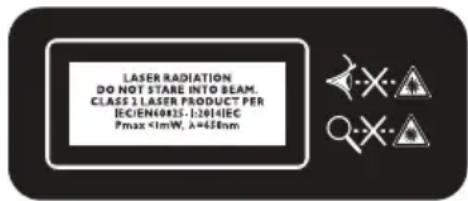
Warning! Laser radiation.


Do not view the laser beam directly with optical instruments.
Electrical safety

This tool is double insulated; therefore no earth wire is required. Always check that the power supply corresponds to the voltage on the rating plate.
- If the supply cord is damaged, it must be replaced by the manufacturer or an authorised Stanley Fat Max Service Centre in order to avoid a hazard.
Features
This tool includes some or all of the following features.
- Trigger On/Off switch
- Cutting depth scale
- Clamp for setting cutting depth
- Lower guard
- Parallel guide adjustment knob
- Parallel guide
- Footplate
- Clamping flange
-
Blade bolt
-
Trigger lock and shoe release button
- Ventilation slots
- Laser sight
- Connection for dust extraction
- Spindle-lock button
- Hex key
- Diamond saw blade
- Hardened steel saw blade
- TCT saw blade
- Dust extraction hose
- Line-of-cut indicator
Assembly
Check for damage to the tool, parts and accessories which may have occurred during transportation. Take some time to read this manual carefully and understand all the content prior to assembly and operation
Use
Warning! Let the tool work at its own pace. Do not overload.
Switching on and off (fig. A)
Note:Before engaging the on/off switch, check the saw blade to see if it is fitted properly and runs smoothly, and the blade clamp screw is well tightened.
Push the trigger lock and shoe release button button (10) to release the trigger.
Switch on tool by pulling trigger switch (1).
Switch off tool by releasing trigger switch (1).
Adjusting cutting depth (0-28,5 mm) (fig.B)
Loosen clamp (3).
Set desired cutting depth using scale (2).
Tighten clamp (3)
For an optimal quality cut, the saw blade should not extend more than 3mm below the workpiece
Be aware that the actual depth of cut of the diamond disc differs approx. 2mm from the depth of cut indicated on scale (2).
Note: Always make trial cuts first to verify actual line of cut.
Dust suction (fig.C)
connect vacuum cleaner hose (19) to connection (13) and vacuum cleaner as illustrated.
Warning! Never let the vacuum cleaner hose interfere with the lower guard or the cutting operation.
Warning! Do not use vacuum cleaner when cutting metal.
Changing saw blade (fig. D - G)
Warning! Before changing blades or performing any maintenance, ensure the tool is off and disconnected from the power source.
Set cutting depth to the maximum (fig. D).
Use hex key (15) provided.
Push spindle-lock button (14) and hold (Fig. E). Remove blade bolt (9) by turning hex key (15)
CLOCKWISE (= in same direction as arrow imprinted on the guard) (Fig. F).
Release spindle-lock button (14).
Remove flange (8).
Press button (10) with your thumb
Lift up foot (7) and remove saw blade.
Install new blade making sure that rotation of blade is in same direction as arrow imprinted on the guard.
Mount flange (8).
Firmly tighten blade bolt (9) by turning hex key (15) COUNTER-CLOCKWISE while pushing spindle-lock button (14).
Release spindle-lock button (14).
Operating the tool (fig. H-M)
Set desired cutting depth.
Connect plug to power source.
Press button (10) with your thumb.
Place tool with front end of foot flat on workpiece.
Tilt tool forward with line-of-cut indicator (20) lined up with desired line of cut marked on the workpiece (fig. H).
Ensure that the saw teeth are not engaged into the workpiece.
Switch on the tool.
The tool should run at full speed before the blade enters into the workpiece.
- Do not force the tool (apply light and continuous pressure in order to avoid overheating the blade tips and, in case of cutting plastics, melting the plastic material).
While working, always hold the tool at the insulated grip area(s).
After completing the cut switch off tool by releasing trigger (1).
Ensure that the blade has come to a complete standstill, before you lift the tool from the workpiece.
Electronic Function. Laser beam action (Fig.I)
Caution! When not in use, be sure to turn off the laser.
Never look into the laser beam directly; laser beam may injure your eyes.
LASER RADIATION: DO NOT STARE INTO THE BEAM or any CLASS II LASER PRODUCTS.
Before shifting the laser line or performing maintenance adjustment, be sure to unplug the tool.
To turn the laser on/off, toggle the switch (12a) on the back of the laser housing.
Cleaning of the lens for the laser light
If the lens for the laser light becomes dirty, or sawdust adheres to it in such a way that the laser line is no longer easily visible, unplug the saw and clean the lens carefully with a damp, soft cloth. Do not use solvents or any petroleum based cleaners on the lens.
Note: When laser line is dim and almost or entirely invisible because of the direct sunlight in the indoor or outdoor window near your work area, relocate the work area to a place not exposed to direct sunlight.
Note: All of the adjustments for the operation of this machine have been carried out at the factory.
Caution: Use of controls or adjustments or performance of procedures other than those specified herein may result in hazardous radiation exposure. The use of optical instruments with this product will increase eye hazard. Do not attempt to repair or disassemble the laser. If unqualified persons attempt to repair this laser product, serious injury may result.
ENGLISH
(Original instructions)
Any repair required on this laser product should be performed by authorised service centre personnel.
Plunge cutting (fig.J)
Press button(10).
Switch on the tool.
Warning! The tool should run at full speed before the blade enters into the workpiece.
- Tilt tool forward with line-of-cut indicator (20) lined up with desired line of cut marked on the workpiece. Gradually move tool forward.
Warning! Never pull tool backwards.
Using the parallel guide (fig.K)
For making exact cuts along a workpiece edge.
Can be inserted in either side of foot.
Adjusting parallel guide
Loosen knob (5)
Adjust to desired cutting width by using parallel guide scale (use line-of-cut indicator (20) as 0-reference).
Tighten knob (5).
Tips for optimum use
Only use sharp saw blades of the correct type and size (fig. L).
Use hardened steel saw blade (17) for cutting wood, aluminium, plastic and all sorts of laminated wood
Use diamond saw for (16) cutting ceramics and tiles
Use carbide-tipped blade (18) for wood and plastic only
Cutting large panels (fig. M)
Support panel close to the cut either on floor, table or workbench.
Warning! Set cutting depth so that you cut through panel and not through support.
In case parallel guide does not allow desired width of cut, clamp or nail straight piece of wood to workpiece as a guide, and use the right side of the foot against this guide.
Splinter-free cutting
Always face the good side of the workpiece down - fasten a straight piece of wood on the workpiece by means of 2 clamps.
Cutting particularly tough or abrasive materials
Soft sheet metal
Always set the depth adjustment to at least 1 mm deeper than the material thickness to avoid the blade riding up over the surface. Scrap material is required underneath the work surface.
Remove burrs and rust as these impede the feed across the material.
Thick beeswax (furniture polish) applied to the base plate of the tool makes metal cutting easier.
Only suitable for cutting brass, copper, lead or aluminium.
Every 2 minutes of metal cutting should be followed by a rest of at least 3 minutes.
Ceramic tiles, slates etc
Only use a blade specifically designed for this purpose.
Always use with a suitable vacuum cleaner or dust extractor connected as the dust can be hazardous to the operator and prevent the guard operating correctly.
Plasterboard:
- The plunge saw is only recommended for making occasional cut outs in plasterboard and always use it with a suitable vacuum cleaner or dust extractor connected. The dust can prevent the guard operating correctly.
- Conventional tools such as keyhole saws or knives generally give excellent results, though the plunge saw can be used if a particularly neat, dust free cut is required or if there is a danger of cutting pipes or cables.
Maintenance
Your Stanley Fat Max corded/cordless appliance/tool has been designed to operate over a long period of time with a minimum of maintenance. Continuous satisfactory operation depends upon proper tool care and regular cleaning.
Warning! Before performing any maintenance on corded/ cordless power tools:
Switch off and unplug the appliance/tool.
Or switch off and remove the battery from the appliance/ tool if the appliance/tool has a separate battery pack.
Or run the battery down completely if it is integral and then switch off.
- Regularly clean the ventilation slots in your appliance/tool/ charger using a soft brush or dry cloth.
Regularly clean the motor housing using a damp cloth. Do not use any abrasive or solvent-based cleaner.
Warning! If any of the following events occur during normal operation, the power supply should be shut off at once and tool thoroughly inspected by a qualified person and repaired if necessary:
The rotating parts get stuck or speed drops abnormally low.
The tool shakes abnormally accompanied by some unusual noise.
The motor housing gets abnormally hot.
Heavy sparks occur around the motor area
Mains plug replacement (U.K. & Ireland only)
If a new mains plug needs to be fitted:
Safely dispose of the old plug.
Connect the brown lead to the live terminal in the new plug.
Connect the blue lead to the neutral terminal.
Warning! No connection is to be made to the earth terminal. Follow the fitting instructions supplied with good quality plugs. Recommended fuse: 5 A.
Protecting the environment

Separate collection. Products and batteries marked with this symbol must not be disposed of with normal household waste.
Products and batteries contain materials that can be recovered or recycled reducing the demand for raw materials. Please recycle electrical products and batteries according to local provisions. Further information is available at www.2helpU.com
Technical data
| FME380 | ||
| Voltage V | AC | 230 |
| No-load speed min | -1 | 4500 |
| Blade size mm | 89 | |
| Max cutting depth (soft wood) | mm | 28.5 |
| Max cutting depth (tile) | mm | 8 |
| Max cutting depth (aluminium) | mm | 3 |
| Level of sound pressure according to EN 60745: |
| Circular saw function: Sound pressure (Lp) 90 dB(A), uncertainty (K) 3 dB(A) |
| Sound power (LW) 101 dB(A), uncertainty (K) 3 dB(A) |
| Cutting off machine function: (Lp) 97 dB(A), uncertainty (K) 3 m/s2Sound power (Lw) 108 dB(A), uncertainty (K) 3 dB(A) |
| Vibration total values (triax vector sum) according to EN 60745: |
| Cutting wood (ah) 2.4 m/s2, uncertainty (K) 1,5 m/s2Cutting metal (ah,M) 5.5 m/s2uncertainty (K) 1,5 m/s2 |
| Cutting concrete slab (ah) 5,5 m/s2, uncertainty (K) 1,5 m/s2 |
EC declaration of conformity
MACHINERY DIRECTIVE

FME380 Compact multi-material saw
Stanley Europe declares that these products described under "technical data" are in compliance with: 2006/42/EC, EN62841-1:2015, EN 62841-2-5:2014
These products also comply with Directive 2014/30/EU and 2011/65/EU. For more information, please contact Stanley Europe at the following address or refer to the back of the manual.
The undersigned is responsible for compilation of the technical file and makes this declaration on behalf of Stanley Europe.
R. Laverick
Engineering Manager
Stanley Europe, Egide Walschaertsstraat14-18,
2800 Mechelen, Belgium
23/08/2016
Guarantee
Stanley Europe is confident of the quality of its products and offers consumers a 12 month guarantee from the date of purchase. This guarantee is in addition to and in no way prejudices your statutory rights. The guarantee is valid within the territories of the Member States of the European Union and the European Free Trade Area.
To claim on the guarantee, the claim must be in accordance with Stanley Europe Terms and Conditions and you will need to submit proof of purchase to the seller or an authorised repair agent. Terms and conditions of the Stanley Europe 1 year guarantee and the location of your nearest authorised repair agent can be obtained on the Internet at www.2helpU.com, or by contacting your local Stanley FatMax office at the address indicated in this manual.
Please visit our website www.stanley.eu/3 to register your new Stanley Fat Max product and receive updates on new products and special offers.
Verwendungszweck
Responsible technique
Stanley Europe, Egide Walschaertsstraat14-18,
Director de Engenharia
Stanley Europe, Egide Walschaertsstraat14-18, 2800 Mechelen, Bélgica 23/08/2016
Garantia
LASERSTRALNING: TITTA INTE IN I STRALEN aller nagra KCLASS II PRODUKTER.
Keramikplattor, skiffer etc
Tip for optimal drug


- Safety instructions
- General power tool safety warnings
- Work area safety
- Electrical safety
- Personal safety
- Power tool use and care
- ENGLISH
- (Original instructions)
- Service
- Safety instructions for all saws
- Cutting procedures
- Further safety instructions for all saws
- Kickback causes and related warnings
- Lower guard function
- Saw blades
- Safety of others
- Residual risks
- Vibration
- Labels on tool
- Electrical safety
- Features
- Assembly
- Use
- Switching on and off (fig. A)
- Adjusting cutting depth (0-28,5 mm) (fig.B)
- Dust suction (fig.C)
- Changing saw blade (fig. D - G)
- Operating the tool (fig. H-M)
- Electronic Function. Laser beam action (Fig.I)
- Cleaning of the lens for the laser light
- Plunge cutting (fig.J)
- Using the parallel guide (fig.K)
- Adjusting parallel guide
- Tips for optimum use
- Cutting large panels (fig. M)
- Splinter-free cutting
- Cutting particularly tough or abrasive materials
- Soft sheet metal
- Ceramic tiles, slates etc
- Plasterboard:
- Maintenance
- Mains plug replacement (U.K. & Ireland only)
- Protecting the environment
- EC declaration of conformity
- Guarantee
- Verwendungszweck
- Garantia
- Keramikplattor, skiffer etc
- Tip for optimal drug
Brand : STANLEY
Model : FME380
Category : Saw