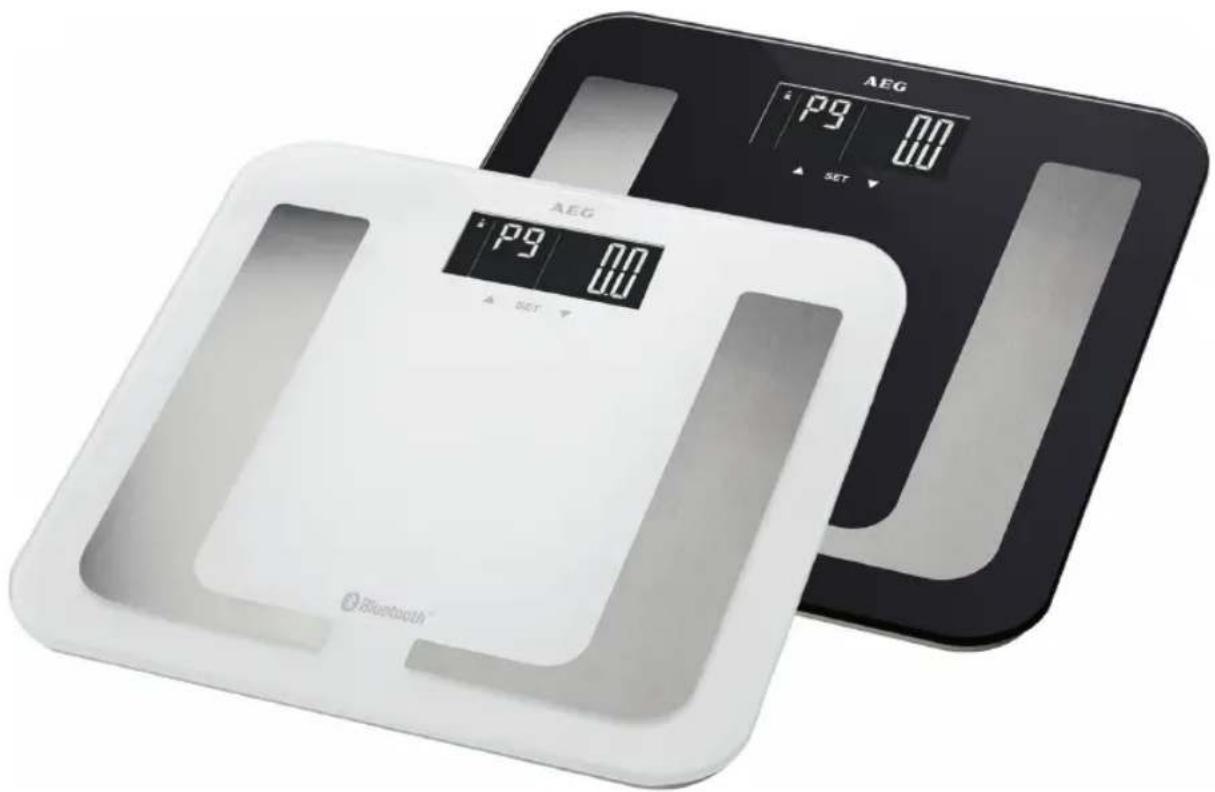
USER MANUAL PW 5653 BT AEG
GB 8 in 1 Diagnostic Scales With Bluetooth
PL 8 in 1 Diagnostic Scale with Bluetooth
8 IN 1 DIAGNOSTIC SCALE WITH BLUETOOTH
PW 5653 BT
AEG
Overview of the Components.. Page 3
Instruction manual.. Page 40
Technical Data.. Page 42
Disposal. Page 45
Polish
Table of contents
BMI = weight in kg: (height in m x height in m)
Example:
Information concerning Bluetooth. 21
Information concerning the "Smart Scale" application.....21
Power supply: 4 x 1.5 V batteries, type "AAA" / "R03"
| Età(Anni) | Donne Uomini | |
| Basso Normale Alto Basso | Normale Alto | | | |
| 10-17 | < 54,0 | 54,0-60,0 | >60,0 | < 57,0 | 57,0-62,0 | >62,0 |
| 18-30 | < 53,5 | 53,5-59,5 | >59,5 | < 56,5 | 56,5-61,5 | >61,5 |
| 31-40 | < 53,0 | 53,0-59,0 | >59,0 | < 56,0 | 56,0-61,0 | >61,0 |
| 41-60 | < 52,5 | 52,5-58,5 | >58,5 | < 55,5 | 55,5-60,5 | >60,5 |
| 61-99 | < 52,0 | 52,0-58,0 | >58,0 | < 55,0 | 55,0-60,0 | >60,0 |
Thank you for choosing our product. We hope you enjoy using the appliance.
Contents
General Notes 40
Symbols in these Instructions for Use 40
Children 40
Special Safety Instructions for This Machine 40
Handling Batteries 41
Inserting the Batteries 41
Overview of the Components 41
Technical Data 42
Information about the Analysis Scale 42
Information on Bluetooth 42
Information on the App "Smart Scale" 42
System requirement for use of the app. 42
Initial use with the app 42
Use 42
Weighing Function 43
Saving Personal Data 43
Measurement and Analysis. 43
Assessment of the Results 43
Body Fat. 44
The Importance of Water for our Health. 44
Body fat percentage guidelines. 44
Body water percentage guidelines 44
Visceral fat percentage guidelines 44
BMR (Basal Metabolic Rate / Energy expenditure). 45
Reference values of the daily intake of kilocalories
without physical activities 45
BMI (Body Mass Index) 45
Reference values for the BMI. 45
Display Error Messages 45
Cleaning. 45
Disposal 45
Disposal of Batteries. 45
Meaning of the "Dustbin" Symbol 46
General Notes
Read the operating instructions carefully before putting the appliance into operation and keep the instructions including the warranty, the receipt and, if possible, the box with the internal packing. If you give this device to other people, please also pass on the operating instructions.
- The device is designed exclusively for private and not for commercial use.
- Only use the device for the intended purpose.
- Do not use a damaged device.
- Keep away from heat, direct sunlight, damp (never immerse in liquids) and sharp edges.
- Do not try to repair the appliance on your own. Always contact an authorized technician.
- Pay careful attention to the following "Special Safety Instructions".
Symbols in these Instructions for Use
Important information for your safety is specially marked. It is essential to comply with these instructions in order to avoid accidents and prevent damage to the machine:
WARNING:
This warns you of dangers to your health and indicates possible injury risks.
CAUTION:
This refers to possible hazards to the machine or other objects.
iNOTE:
This highlights tips and information.
Children
- In order to ensure your children's safety, please keep all packaging (plastic bags, boxes, polystyrene etc.) out of their reach.
WARNING!
Do not allow small children to play with the foil. There is a danger of suffocation!
Children should be supervised at all times in order to ensure that they do not play with the device.
Special Safety Instructions For This Machine
WARNING:
If the weighing surface is damp or if there are drops of water on it, first wipe it dry or them off. Slip hazard exists.
CAUTION:
- Handle the balance with care, as it is a precise measuring instrument. Do not drop it or jump on it.
- Do not load the appliance with more than 150 kg (330.69 lb, 23:62 st/lb) to avoid damaging the device. If the scales are carried or not going to be used, please store them only in a horizontal position. The body fat analysis scale is not suitable for the following persons:
- Children under 10 years and adults over 99 years
- Persons with symptoms of fever, oedema, or osteoporosis
- Persons undergoing treatment for dialysis
- Persons who use a pacemaker
- Persons who take cardiovascular medication Pregnant women
- Sportspersons who perform over 5 hours of intensive sporting activities each day
- Persons with a heartbeat lower than 60 beats/minute
- Persons with considerable anatomic deviations of the legs in relation to total body size (length of the legs considerably shortened or lengthened).
Handling batteries

WARNING:
- Do not expose the batteries to high temperatures or direct sunlight.
- Never throw batteries into the fire. There is a danger of explosion!
- Keep batteries away from children. They are not a toy.
- Batteries may be swallowed, which can be life-threatening. If a battery has been swallowed, seek medical help immediately.
- Do not open the batteries by force.
- Avoid contact with metallic objects. (Rings, nails, screws et cetera.) There is a danger of short-circuiting!
- As a result of a short-circuit batteries may heat up considerably or even catch fire. This may result in burns.
- For your own safety the battery poles should be covered with adhesive strips during transport.
- If a battery leaks do not rub the liquid into your eyes or mucous membranes. If hands come into contact with the liquid they should be washed thoroughly and eyes rinsed out with clear water; if symptoms persist please consult a doctor.
Inserting the Batteries

NOTE:
Where required, the supplied batteries have been protected for transport with plastic foil.
- Remove this foil before inserting the batteries into the appliance.
- Open the battery compartment on the underside.
- Insert 4 batteries of type AAA/R03. Please ensure that the polarity is correct (see the inside of the battery compartment)!
- Close the battery compartment again.
- If the message "Lo" appears on the display, replace the batteries.

CAUTION:
- Batteries may leak and lose battery acid. If the appliance is not in use for long periods of time, remove the batteries.
- Different battery types or new and used batteries must not be used together.
- Batteries are not to be disposed of together with domestic wastes. Dispose of the used batteries at the relevant collection bin or at your dealer's.
Overview of the Components
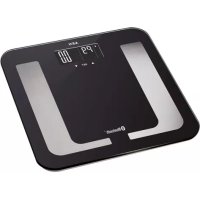
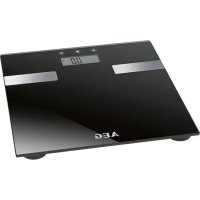
1 button 2 SET button 3 button 4 Display 5 Contact Surfaces
Underside (not shown)
Battery compartment
Button "kg/lb/st" (select the unit of weight)
| Display Indications | Meaning |
| kg (lb / st:lb) Body weight |
| P1 - P9 User memory space |
| Male |
| Female |
| cm (ft) Body height |
| age | Age |
| ((●)) | This symbol flashes while transferring data to the app |
| - | No connection to the app
- The symbol on the display goes out as soon as a connection has been established via the app. |
| Body fat display |
| Body water display |
| Muscle mass display |
| Bone weight display |
| Visceral fat display (organ fat) |
| % | Percentage - body fat / body water / muscle mass |
| - | Rating:
underweight - normal weight-
overweight - obese |
| (KCAL) | Basal metabolic rate of the daily energy requirement in kilocalories (BMR) |
| Body Mass Index |
42 English
Technical Data
Model: PW 5653 BT
Power supply: 4 Batteries 1.5 V Type "AAA" / "R03"
Net weight of device approx. 1.80 kg
Memory capacity: 9
Mass alignment: from 60 to 240 cm (2'00" - 7'10" ft.in)
Age: from 10 to 99 years
Minimum weight: from 5.0 kg (11.0 lb / 0:11 st/lb)
Maximum weight: 150 kg (330.69 lb / 23:62 st/lb)
Weight measurement unit: 100 g (0.2 lb / 1/4 st/lb) increments
Body fat measurement unit: 0.1%
Body fluid graduation: 0.1%
Recommended operating environment:
Temperature: 0°C - 40°C / 32°F - 104°F
Relative air humidity: < 85%
The right to make technical and design modifications in the course of continuous product development remains reserved.
This device has been tested according to all relevant current CE guidelines, such as electromagnetic compatibility and low voltage directives, and has been constructed in accordance with the latest safety regulations.
WARNING:
Do not use the scales if you use a pacemaker or another medical implant with electronic components. The function of the implant may be impaired by the measurement.
The main principle of this device is based on the measurement of the electric impedance within the human body. In order to determine the actual body data, the device leads a weak, unnoticeable electric signal through your body.
The signal is generally safe! However, please read our special safety instructions!
The method of measurement is referred to as "bioelectric impedance analysis" (BIA), a factor which is based on the relationship between body weight and associated body water percentages as well as on other biological data (age, gender, body weight).
Bluetooth is a technology for remote wireless connection of devices over a short distance. Devices with Bluetooth Standard transmit in the ISM-Band (Industrial, Scientific and
Medical) between 2.402 and 2.480 GHz. Interference may be caused e.g. by WLAN networks, DAB radios, cordless phones, or microwave ovens that operate in the same frequency range.
These scales offer you the possibility of sending the calculated data via Bluetooth to your smartphone or tablet PC. More information can be found in the next section (Information on the App "Smart Scale").
Due to the many different device manufacturers, models, and software versions, full functionality cannot be guaranteed.
You can download the free app via the Apple Store or the Google Play Store.
NOTE:
Depending on the provider, there may be costs involved in downloading the app.
The link to download the app can be found on our internet page:
System requirement for use of the app
- iOS 6.0 or higher + Bluetooth 4.0 or higher Android 4.3 or higher + Bluetooth 4.0 or higher
Initial use with the app
Before you use the scales with the app, you must pair the devices. To do so, refer to the user manual for your smartphone or tablet PC (hereinafter known as "device").
- Activate Bluetooth in the settings of your device.
- Install the app "Smart Scale" from the corresponding App Store.
- Switch on the scales by gently exerting pressure on the weighing surface with your foot.
- Start the app. Establish a connection to the scales in the app menu "Settings".
- Enter your user details in the app in "User".
- Perform the measurement as described in the section, "Use / Measurement and Analysis".
Use
NOTE:
- The buttons are touch buttons. Gently touch the buttons with a finger to execute the function. The scales are factory set with the units "kg" and "cm".
To change the settings to "lb" or "st:lb" as well as ", proceed as follows:
- Switch on the scales by gently exerting pressure on the weighing surface with your foot.
- Press the "kg / lb / st" button on the underside of the scales repeatedly, until the required weight unit is displayed. The unit for the height also automatically changes.
Weighing Function
- Place the scale on a hard, flat surface (avoid carpets). An uneven floor contributes to inaccurate measurements.
- Stand on the scales with both feet. The device switches on automatically.
- Distribute your weight equally and wait for the scale to determine your weight.
- The digits on the display will flash before your exact weight will be shown.
- In order to extend the battery life, the device will automatically turn off 10 seconds after you have stepped off the scale. If there is no weight determination while "0.0" is shown, the scale will shut off automatically after 10 seconds.
Saving Personal Data
i NOTE:
The scale has default values that you can change, as described below. Carry out the following steps in sequence and within a few seconds. Otherwise, the device will automatically cancel input mode. Keeping one of the buttons (▲) pressed during the setting for approx. 2 seconds sets fast mode.
- Press the button SET. The last selected preset in the memory (e.g. P1) flashes on the display. Confirm the setting by pressing SET or select another memory space by pressing the ◀ button. Then press SET to go to the next setting.
- The symbol for "male" or "female" will flash. Confirm the setting by pressing SET or use the button to choose the symbol for your gender. Then press SET to go to the next setting.
- The setting AGE will flash. Select your age by pressing the ◀ button. Confirm your entry by pressing SET.
- The height setting will flash. Select your height by pressing the ▲ or ▼ button. Confirm your entry by pressing SET.
- Then you will see the memory location, the symbol of the gender and the weight "0.0 kg" (0.0 lb / 0:0 st/lb) in the display.
You now have the following options:
- Repeatedly press the SET button to display or change the settings again.
- You can store more presets in the memory. Proceed as described above.
- You can immediately start measuring.
Measurement and Analysis
Record your personal data in the memory.
NOTE:
- The analysis scale will only work correctly when you are standing on the contact surfaces barefoot and with slightly moistened foot soles, if possible. Completely dry foot soles can lead to unsatisfactory results as they have a conductivity that is too low. If necessary wipe the contact surfaces to improve results.
- Due to the significant fluctuation of body fat, it is difficult to attain a standard value. Therefore, to obtain consistent data, always measure at the same time of day.
- Press the SET button. Use the triangle/square button to select the stored position at which your data is saved.
- Wait until the display comes to a standstill: memory location, the symbol of the gender and the weight "0.0 kg" (0.0 lb / 0:0 st:lb).
- Stand on the contact surfaces (5) of the scales with both feet.
- Firstly your weight is displayed briefly. Then the analysis starts.
You'll see a treadmill "000" in the display during the analysis. After a few seconds, the following results are displayed in sequence. Each time, the value is also displayed in the form of a bar.
- The weight in the previously selected unit (kg / lb / st:lb).
- The body fat proportion in % (symbol).
- The proportion of body fluid % (symbol).
- The bone weight in kg (lb / st:lb) (symbol).
- The visceral fat (symbol).
- The proportion of muscle mass in % (symbol).
- The basal metabolic rate of the daily energy requirement in KCAL (symbol).
- The Body Mass Index (symbol).
Afterwards the determined data will be shown repeatedly. Then the scale will automatically turn off.
Assessment of the Results
There are heavy persons with a well-balanced percentage between fat and muscle mass, and there are seemingly slim persons with significantly high body fat values. Fat is a factor that puts serious strain on the body, in particular the cardiovascular system. Therefore, controlling both values (fat and weight) is a prerequisite for health and fitness.
Body Fat
Body fat is an important component of the body. From protecting the joints as a vitamin repository to regulating the body temperature, fat plays a vital role in the body. Thus the goal is not to radically reduce the proportion of body fat, but rather to achieve and maintain a healthy balance between muscle and fat.
The Importance of Water for our Health
Approximately fifty-five to sixty percent of the human body consist of water, depending on age and gender in varying amounts.
Water has to fulfill several tasks within the body:
- It is the building block of our cells. That means that all the cells in our body, whether skin cells, gland cells, muscle cells, brain cells or others, are functional only if they contain enough water.
It is a solvent for important substances in our body. It is a means of conveyance for nutrients, the body's own substances and metabolic products.
Reference values for your fitness profile can be seen in the benchmark table. It shows the dependency of body fat data on age and gender. Always pay attention to your body's water balance, which, as well as the fat level, undergoes strong fluctuations throughout the day. Therefore, to obtain consistent data, always measure at the same time of day.
The calculated results of the body fat and water level should only be considered as reference values. They are not recommended to be used for medical purposes. Please always consult a doctor if you have questions about a medical treatment or a diet in order to achieve a normal body weight.
Body fat percentage guidelines (approx. figures)
| Age(Years) | Women |
| Underweight Normal Overweight Obese | | |
| 10-17 3.0-15.0 | 15.1-22.0 22.1-26.4 26 | 5-50.0 | | |
| 18-30 3.0-15.4 | 15.5-23.0 23.1-27.0 27 | 1-50.0 | | |
| 31-40 3.0-16.0 | 16.1-23.4 23.5-27.4 27 | 5-50.0 | | |
| 41-60 3.0-16.4 | 16.5-24.0 24.1-28.0 28 | 1-50.0 | | |
| 61-99 3.0-17.0 | 17.1-24.4 24.5-28.4 28 | 5-50.0 | | |
| Age (Years) | Men |
| Underweight Normal Overweight Obese | | |
| 10-17 3.0-12.0 | 12.1-17.0 17.1-22.0 22 | 1-50.0 | | |
| 18-30 3.0-12.4 | 12.5-18.0 18.1-23.0 23 | 1-50.0 | | |
| 31-40 3.0-13.0 | 13.1-18.4 18.5-23.0 23 | 1-50.0 | | |
| 41-60 3.0-13.4 | 13.5-19.0 19.1-23.4 23 | 5-50.0 | | |
| 61-99 3.0-14.0 | 14.1-19.4 19.5-24.0 24 | 1-50.0 | | |
Body water percentage guidelines (approx. figures)
| Age(Years) | Women Men | |
| Low Normal High Low Normal High | | | |
| 10-17<54.0 | 54.0-60.0 | >60.0 | <57.0 | 57.0-62.0 | >62.0 |
| 18-30<53.5 | 53.5-59.5 | >59.5 | <56.5 | 56.5-61.5 | >61.5 |
| 31-40<53.0 | 53.0-59.0 | >59.0 | <56.0 | 56.0-61.0 | >61.0 |
| 41-60<52.5 | 52.5-58.5 | >58.5 | <55.5 | 55.5-60.5 | >60.5 |
| 61-99<52.0 | 52.0-58.0 | >58.0 | <55.0 | 55.0-60.0 | >60.0 |
Visceral fat percentage guidelines (approximate values)
| Visceral fat | Normal | Somewhat too high | Too high |
| 0-9 10- | 14 > 15 | |
Visceral fat is fat located in the abdominal cavity, surrounding the internal organs. To a certain degree, it can be attributed to abdominal fat. It is not directly visible, but comprises a part of the abdominal volume. This fat acts as a reserve during food shortages.
The Basal Metabolic Rate (BMR) characterizes the energy expenditure. Energy expenditure is used to describe the amount of energy in KCAL that the body requires per day during complete rest, at an indifference temperature (28-30°C) and on an empty stomach for the maintenance of its functions (e.g., while sleeping).
Reference values for daily kilocalorie intake without physical activity
| Age
(Years) | Women Men | |
| Weight
(kg) | KCAL | Weight
(kg) | KCAL |
| 10-17 50 | 1265 60 1620 | | | |
| 18-30 55 | 1298 65 1560 | | | |
| 31-40 60 | 1302 70 1561 | | | |
| 41-60 60 | 1242 70 1505 | | | |
| 61-99 50 | 1035 65 1398 | | | |
BMI (Body Mass Index)
The Body Mass Index (BMI) relates body weight to the square of body height.
BMI = Weight in kg / (body height in m x body height in m)
Example:
A woman weighs 55 kg and is 1.68 m tall. Her BMI is calculated as follows:
55 kg / (1.68 m x 1.68 m) ≈ 19.5 kg/m² ⇌ Normal weight
The value "square of the body height" is in no relation to the body surface. The BMI is merely a rough reference value, as it neither considers build and gender, nor the individual composition of the body mass from fat and muscle tissue of a human.
Reference values for BMI
| BMI | Under-weight | Normal | Over-weight | Obese |
| <18.5 18 | 5 - 25 25 - 30 > 30 | |
Please note that the interpretation of the BMI indicates excess weight for very muscular bodies (bodybuilders). The reason for this is that the far above-average muscle mass is not considered in the BMI formula.
Display Error Messages
NOTE:
If an error message appears on the display, wait until the device is turned off. Turn it on again to restart the operation. If the error display has not disappeared, take the batteries out of the battery compartment for 10 seconds.
| Display Indications | Meaning |
| P80000 | Self test (after inserting the batteries) for perfect functioning of the display |
| Lo | Battery is low. The scales then switch off. |
| Err | The weight lies above the allowed maximum weight. |
| Err2/FALL | The percentage of body fat content lies above or below the limits of the measuring scale. |
| E | The entered user details do not match the measurement. Enter the correct user details. |
Cleaning
CAUTION:
- Do not immerse the balance in water, the electronic components can be damaged.
- Do not use a wire brush or any abrasive items.
- Do not use any acidic or abrasive detergents.
- Clean the device with a slightly moist cloth. Make sure that no humidity or water seeps into the device!
- Use a commercially sold detergent or soap for cleaning.
- Dry the device well after cleaning with a dry and soft cloth.
Disposal
Disposal of Batteries
Your appliance contains batteries. If these batteries are spent, follow the instructions below:
CAUTION:
Batteries/rechargeable batteries must not be disposed of with household waste!
- The batteries must be removed from the appliance.
- Take spent batteries to the appropriate collection point or to a dealer.
- Your town or local authority can provide information about public collection points.
This symbol can be found on batteries/rechargeable batteries which contain hazardous substances:
46 English
- Pb = contains lead
- Cd = contains cadmium
- Hg = contains mercury
- Li = contains lithium
Meaning of the "Dustbin" Symbol
Protect our environment: do not dispose of electrical equipment in the domestic waste.
Please return any electrical equipment that you will no longer use to the collection points provided for their disposal.
This helps avoid the potential effects of incorrect disposal on the environment and human health.
This will contribute to the recycling and other forms of reutilisation of electrical and electronic equipment.
Information concerning where the equipment can be disposed of can be obtained from your local authority.
Instruction manual
Minimum weight: from 5.0 kg (11.0 lb / 0:11 st/lb)
Maximum weight: 150 kg (330.69 lb / 23:62 st/lb)
CTC Clatronic Sp. z o.o
BMI (Body Mass Index) - IMT (indice de masa corporal) 66
Calculation of BMI (Body Mass Index) 66
Display of the measurement result 66
Cleaning 67
General instructions
Before using this device, please read the instruction manual carefully and keep it together with the warranty card, cash receipt and, if possible, with the cardboard box with the inner packaging. If you pass the device on to third parties, please also pass on this instruction manual.
- The device is intended for private and domestic use, not for commercial use. Use the device only as intended. Do not use a damaged device. Keep the device away from heat sources, direct sunlight (unless it is intended for that), and sharp objects.
Do not repair the device yourself; contact an authorized specialist. Please pay attention to the following "Special safety instructions".
CIMBOJIN Buii hctpykuii 3 ekcnnyatauui
BaxnBi Bka3iBKn Ila BaWoI 6e3neK nceJIaJIbHO BiIMcHcI IIa 3anobirahn HnssacnX BNapKIB Ta NsKOJKeH npuJNy oOo'R3KOBO pntpumyITecb nx Bka3iBOK:

NONEPEDKEHHRA
PonepeJxye npo 3arp0nI nIa Bauoro 3npob'ra Bka3ye Ha MoKJIINBI pU3NkI TpaBM.

YBAGA:
Bka3ye Ha moxJIiBi 3arpo3n dIy npilady a6o iHux nped-MetIB.

PMIMITKA:
Buiinie nidaKa3Kn Ta iHopmauio INa BAc.
Дити
-Дябзпсвсдгн He 3aJiuaJte DoCTyHIMn naky-BaJIbHi MaTePiaIaN (InaCTuKOBi NaKeTu, KapTOHHI Kopo6Kn, NeHONlact ToUO).

TONEPEDEXEHH
He do3B0aIte MaIM dIaM rpaTncb i3 pNIBKOIO. IcHye 3arpo3a 3aayx!
IITRM HeIO3BOJHeO rpaTncb 3 cIM npuJaOM. Notpi-6eH,doTnla3a HMM.
CneiaIbHa iHcTpyKzIa 3 TexhIKn 6e3neKn dJa cboI npnaIy

NONEPEDXEHHA:
The surface of the bath and the taps may be slippery. You can slip.

WARNING:
- Please be careful with the baths, as they are a tool for bathing. Do not stand on them, do not climb on their surface.
Do not overload the bath with more than 150 kg (330.69 lb, 23.62 stone) to avoid damage to the device.
If you are carrying it to another place or the bath is not used for a long time, it should be kept in a horizontal position. - The analysis function is not suitable for:
-Children, people over 10 years old, adults, elderly over 99 years old
- People with symptoms of fever, pressure or osteoporosis
62 Ukrainian
- People who have a pacemaker
- People who use a cardioverter - people who take medication for the cardiovascular system
- Pregnant women - athletes who train intensively every day - people who have a stent or artificial joint with significant anatomical differences from the general size of the foot (the foot length is significantly increased or decreased).
Using the battery
WARNINGS:
Do not immerse the battery in high temperature or direct sunlight. Never throw the battery into fire. There is a risk of explosion! Do not give the battery to children. Batteries are not toys. If the battery is punctured, there is a risk of injury. In case of puncture, seek medical help immediately. Do not open the battery with force. Do not place the battery near metal objects (rings, chains, screws, etc.) as a short circuit may occur! Due to a short circuit, the battery may heat up strongly or catch fire. As a result, burns and injuries may occur. For safety, follow the battery polarity during transport. - If the battery leaks, the liquid is very dangerous for the eyes and skin - avoid contact with it. If contact cannot be avoided, rinse hands thoroughly with plenty of clean water, and if symptoms persist for a long time, consult a doctor.
Inserting the batteries
NOTE:
It is not necessary to remove the batteries that are installed for transportation with plastic film.
- First insert the batteries, then remove the film.
- Open the battery compartment cover.
- Insert 4 batteries of type AAA/R03. Pay attention to the correct polarity of the batteries (see markings on the device)!
- Close the battery compartment cover.
- When the low battery indicator appears, replace the batteries.

WARNING:
The battery may leak. If you do not intend to use the device for a long time, remove the batteries. Batteries of different types or new and used batteries must not be used together. Batteries must not be disposed of in household waste. Dispose of used batteries at special collection points for hazardous waste or return them to the store where you purchased the device.
Control elements
1 Button 2 Button 3 Button 4 Display 5 Contact surface
Press the buttons briefly to activate the functions. Factory setting: "kgi" cm
Indicates a possible danger to the device or from sharp objects.
NOTE:
Provides advice or information.
Do not leave packaging (plastic bags, cardboard, polystyrene, etc.) without supervision. Do not let children play with the packaging film. Danger of suffocation! Keep packaging out of reach of children to ensure they do not play with the device.
Special safety instructions for this device
IMPORTANT SAFETY INSTRUCTIONS:
If the surface is wet, dry it thoroughly before placing the scale on it. There is a risk of slipping.
CAUTION:
- Handle the scale carefully, as it is a precise measuring instrument. Do not drop the scale or jump on it. Do not overload the scale beyond 150 kg (330.69 lb) to avoid damage to the device.
- Transport and storage of the scale should only be in a horizontal position. The scale's contents are not intended for the following people:
- Children under 10 and adults over 99 years old - People with pacemakers, edema, or osteoporosis - People undergoing treatment with radiation - People using immunosuppressants - People taking cardiovascular medications - Pregnant women - Athletes training intensively more than 5 hours a day - People with a pulse below 60 beats per minute - People with noticeable anatomical deviations of the legs or feet (e.g., noticeably shorter or longer than normal).
- Open the battery compartment on the back of the scale.
- Insert 4 AAA/R03 batteries. Make sure the polarity is correct (see markings inside the battery compartment)!
- Close the battery compartment again.
- Replace the batteries as described in the instructions.
WARNING:
Batteries may leak and cause loss of readings. If the device is not used for a long time, remove the batteries. Batteries of different types, as well as old and new batteries, should not be used together. Do not dispose of batteries with household waste. Take batteries to the appropriate recycling point or to your dealer.
Batteries
CAUTION:
Do not expose batteries to high temperatures or direct sunlight. Never throw batteries into fire. Risk of explosion! Store batteries in a place inaccessible to children. This is not a toy! There is a risk of swallowing batteries, which can be life-threatening. If batteries are swallowed, seek medical help immediately. Do not open batteries. Avoid contact with metal objects (rings, nails, screws, etc.). Risk of short circuit! As a result of a short circuit, batteries may heat up or even ignite. This can lead to burns. For your own safety, battery contacts must be covered with insulating tape during transport. If a battery starts to leak, do not get the liquid in your eyes or on mucous membranes. If skin comes into contact with the liquid, wash thoroughly, and rinse eyes with clean water. If painful symptoms persist, consult a doctor.
Inserting batteries
NOTE:
The batteries were turned over with a plastic tab for transport.
- Remove this plastic tab before inserting batteries into the device.
Overview of device parts
1 Button 2 SET button 3 Button 4 Display 5 Contact surfaces
Back side (not shown)
Battery compartment
Button "kg / lb / st" (selection of weight units)
Never immerse the device in water: this could damage the electronic components. Do not use a wire brush or abrasive cleaners. Do not use acidic or abrasive cleaning agents.
Wipe the device with a slightly damp cloth. Make sure that no moisture or water penetrates the device! Use commercially available mild cleaning agents if necessary. After cleaning, dry the device with a soft, dry cloth.
(BMI)
60-55

1521, 1531, 1541, 1551, 1561, 1571, 1581, 1591, 1601, 1611, 1621, 1631, 1641, 1651, 1661, 1671, 1681, 1691, 1701, 171
1 2
J 150
I SET
. (st:lb0:0 / lb0.0) kg0.0
Jai (5) Jai jai jai 3
A
JdIaLae. Jdi aaiiie 1000" aaiy jajj
Jg, gill 100
y
Bluetooth
ISM 2.402-2.480 GHz, WLAN
"Smart Scale"
GoogleAppleStore 1
Aahy
cuiyjIgle liiaigle gailll jii jolllbljil
CiyjBll 10
a# 330.69)150 LjLjLjLjLjLjLjLjLjLjLjLjLjLjLjLjLjLjLjLjLjLjLjLjLjLjLjLjLjLjLjLjLjLjLjLjLjLjLjLjLjLjLjLjLjLjLjLjLjLjLj
Baaaiy 1 y j aalssuiuie g j jao
99 10 10 10 11 11 11 11 11 11 11 11 11 11 11 11
5 60 60 60 60 60 60 60 60 60 60 60 60 60 60 60 60 60 60 60 60 60 60 60 60 60 60 60 60 60 60 60 60 60 60
L
jll plisily giui j loli lii i jilie
#
80 100
80 1
80
80
79
79
79.
79
78.
- Bluetooth
78..."Smart Scale"
78.
78
78
78
77
77
77
77
77 1
76
76.
76
76..(Basal Metabolic Rate) BMR
76
76 Body Mass Index
- (BMI)
75.
75
Lale C. Li, D. Xu