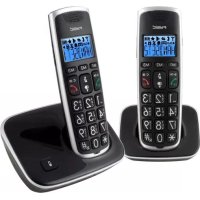
USER MANUAL FX6020 Fysic
Big button cordless telephone
INHOUDSOPGAVE
1 OVERZICHTEN
1.1 HANDSET 5
1.2 DISPLAY 7
1.3 BASIS 8
2 INSTALLATIE
2.1 BASIS 9
2.2 HANDSET 10
2.3 EXTRA HANDSETS EN OPLADERS 10
3 TELEFONEREN
3.1 TELEFONEREN MET DE HOORN OF HANDENVRIJ 11
3.2 OPGEBELD WORDEN 11
3.3 VERBINDING VERBREKEN 11
3.4 NUMMERS KIEZEN 12
3.5 RUGGESPRAAK 14
3.6 ONTVANGSTVOLUME 14
3.7 GESPREKSDUUR 15
3.8 R/FLASH FUNCTIE 15
3.9 HANDSET ZOEKFUNCTIE 15
3.10 UITSCHAKELEN HANDSET 16
4 NUMMERHERHALING
4.1 INTRODUCTION 17
4.2 OPNIEUW KIEZEN 17
4.3 BEWAREN OF WISSEN 17
5 NUMMERWEERGAVE
5.1 INTRODUCTION 19
5.2 INDICATIE NIEUWE OPROEP 19
5.3 GEHEUGEN INZIEN EN TERUGBELLEN 19
5.4DETAILS,BEWARENOF WISSEN 20
5.5 EXTRA INFORMATIE 21
6 VOICE MAIL INDICATIE
6.1 INTRODUCTION 22
6.2 INDICATIE NIEUWE VOICEMAIL 22
7 TELEFOONBOEKGEHEUGEN
7.1 INTRODUCTION 23
7.2 CONTACT OPZOEKEN EN BELLEN 23
7.3 CONTACTEN TOEVOEGEN, WIJZIGEN OF WISSEN 24
7.4 DIRECTGEHEUGENS 27
7.5 CONTACTEN BEKIJKEN 29
7.6 GEHEUGEN STATUS 30
7.7 BESCHIKBARE KARAKTERS 30
9 KLOK & ALARM (WEK) FUNCTIE
9.1 INTRODUCTION 34
9.2 INSTellen Tijd EN DATUM 34
9.3 ALARM IN/UITSCHAKELEN EN INSTELLEN ALARMTIJD 35
9.4WERKINGALARM 36
10 HANDSET VOORKEUREN
10.1 INTRODUCTION 37
10.2 MENU VOOR DE HANDSET VOORKEUREN 37
11 BASIS VOORKEUREN
11.1 INTRODUCTION 39
11.2 MENU VOOR DE BASIS VOORKEUREN 39
12 RESET VOORKEUREN
12.1 INTRODUCTION 41
12.2 MENU VOOR RESET VOORKEUREN 41
12.3 FABRIEKSINSTELLINGEN 42
13 EXTRA HANDSETS
13.1 INTRODUCTION 43
13.2 AANMELDEN HANDSETS 43
13.3 TIPS BETREFFENDE MULTIHANDSET 44
13.4 AFMELDEN HANDSETS 44
14 TIPS EN WAARSCHUWINGEN
14.1 ALGEMEEN 45
14.2 INSTALLATIE 45
14.3 PLAATSING 45
14.4 BEREIK 46
14.5 VOEDINGHANDSET 46
14.6 HOORTOESTELLEN 47
14.7 MEDISCHE APPARATUUR 47
14.8 LICHTNETUITVAL 47
14.9 AFLUISTEREN 47
14.10 ONDERHOUD 48
14.11 MILIEU 48
15 MOGELIJKE PROBLEMEN EN OPLOSSINGEN
15.1 PROBLEMEN MET UITGAANDE OPROEPEN 48
15.2 PROBLEMEN MET INKOMENDE OPROEPEN 49
15.3 PROBLEMEN TIJDENS TELEFONEREN 49
15.4 PROBLEMEN MET NUMMERWEERGAVE 50
15.5 OVERIG 50
16 VERKLARING VAN CONFORMITEIT 51
17 SPECIFICATIONS 51
18 GARANTIEVOORWAARDEN 53
1 OVERZICHTEN
1.1 HANDSET:
9 KLOK & ALARM (WEK) FUNCTIE
9.1 INTRODUCTION:
External beltoon Melodie 6
Belvolume Niveau 4
Hornvolume Niveau 3
Manufacturers name and address : Vtech Telecommunications LTD, 23/F., Tai Ping Industrial Centre, Block 1, 57 Ting Kok Road, Tai Po, Hong Kong.
Model Identifier: VT05EEU06045
Average active efficiency : 74.2 %
Efficiency at low 10% load: -
No load Power consumption: 0.07 W
18 GARANTIEVOORWAARDEN
Alecto is a brand of Commaxx B.V. Wiebachstraat 37, 6466 NG Kerkrade, The Netherlands

Service/Help?www.alecto.nl Support.alecto.nl

V2.1
TABLE OF CONTENTS
1 OVERVIEWS
1.1 HANDSET 6
1.2 DISPLAY 8
1.3 BASE 9
2 INSTALLATION
2.1 BASE STATION 10
2.2 HANDSET 10
2.3 EXTRA HANDSETS AND CHARGERS 10
3 CALLING
3.1 CALLING WITH THE PHONE OR USING THE HANDS-FREE FUNCTION 12
3.2 RECEIVING CALLS 12
3.3 ENDING CALLS 12
3.4 DIALLING NUMBERS 13
3.5 TO MUTE THE MICROPHONE 15
3.6 RECEPTION VOLUME 15
3.7CALL DURATION 16
3.8 R/FLASH FUNCTION 16
3.9 HANDSET SEARCH FUNCTION 16
3.10 TO SWITCH OFF THE HANDSET 17
4 RE-DIALLING
4.1 INTRODUCTION 18
4.2 TO REDIAL 18
4.3 TO SAVE OR DELETE 18
5 CALLER IDENTIFICATION
5.1 INTRODUCTION 20
5.2 INDICATION NEW CALLS 20
5.3 VIEW MEMORY AND callback 20
5.4 DETAILS,SAVE OR DELETE 21
5.5 ADDITIONAL INFORMATION 22
6 VOICEMAIL INDICATION
6.1 INTRODUCTION 23
6.2 NEW VOICEMAIL INDICATION 23
7 PHONE BOOK MEMORY
7.1 INTRODUCTION 24
7.2 SEARCHING FOR AND CALLING CONTACTS 24
7.3 TO ADD, EDIT OR DELETE CONTACTS 25
7.4 DIRECT MEMORIES 28
7.5 TO VIEW CONTACTS 30
7.6 MEMORY STATUS 31
7.7 AVAILABLE CHARACTERS 31
8.1 INTRODUCTION 32
8.2 INTERCOM 32
8.3 TRANSFER / CONFERENCE CALL 33
9 CLOCK & ALARM (WAKE-UP) FUNCTION
9.1 INTRODUCTION 35
9.2 TIME AND DATE SETUP 35
9.3 TO ENABLE/DISABLE THE ALARM AND TO SET THE ALARM TIME 36
9.4 ALARM OPERATION 37
10 HANDSET PREFERENCES
10.1 INTRODUCTION 38
10.2 MENU FOR HANDSET PREFERENCES 38
11 BASE PREFERENCES
11.1 INTRODUCTION 40
11.2 MENU FOR BASIS PREFERENCES 40
12 RESETTING PREFERENCES
12.1 INTRODUCTION 42
12.2 MENU FOR RESETTING PREFERENCES 42
12.3 FACTORY SETTINGS 43
13 ADDITIONAL HANDSETS
13.1 INTRODUCTION 44
13.2 TO REGISTER HANDSETS 44
13.3 TIPS FOR MULTIPLE HANDSETS 45
13.4 DE-REGISTERING HANDSETS 45
14 TIPS AND WARNINGS
14.1 PLACEMENT 46
14.2 RANGE 46
14.3 POWER SUPPLY HANDSET 46
14.4 HEARING AIDS 47
14.5 MEDICAL EQUIPMENT 47
14.6 POWER FAILURE 47
14.7 EAVESDROPPING 47
15 POSSIBLE PROBLEMS AND SOLUTIONS
15.1 PROBLEMS DURING CALLING 48
15.2 PROBLEMS WITH INCOMING CALLS 48
15.3 PROBLEMS DURING CALLING 49
15.4 PROBLEMS WITH CALLER IDENTIFICATION 49
15.5 OTHER 49
16 SPECIFICATIONS 50
17 DECLARATION OF CONFORMITY 51
1 OVERVIEWS
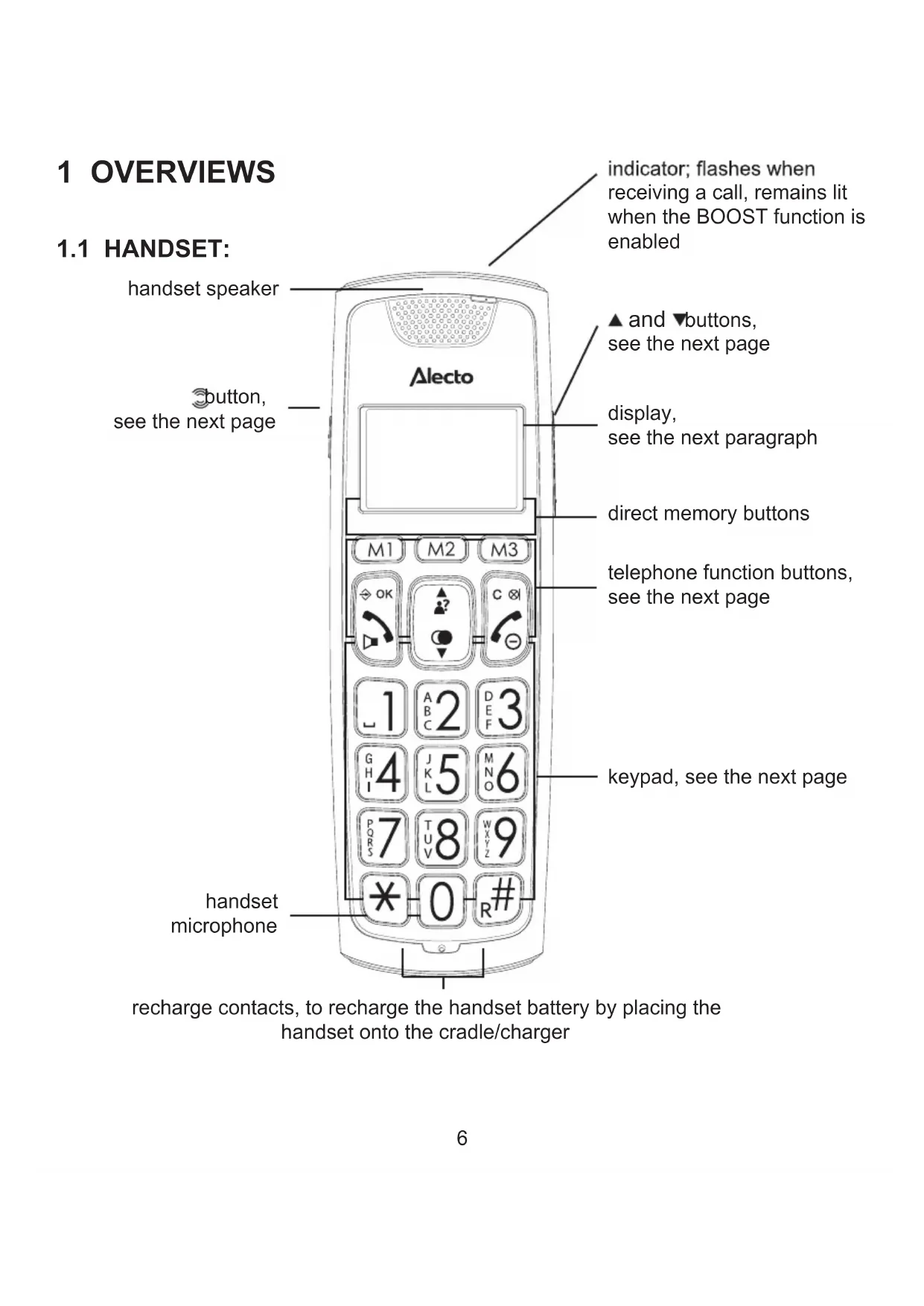
1.1 HANDSET:
indicator; flashes when receiving a call, remains lit when the BOOST function is enabled
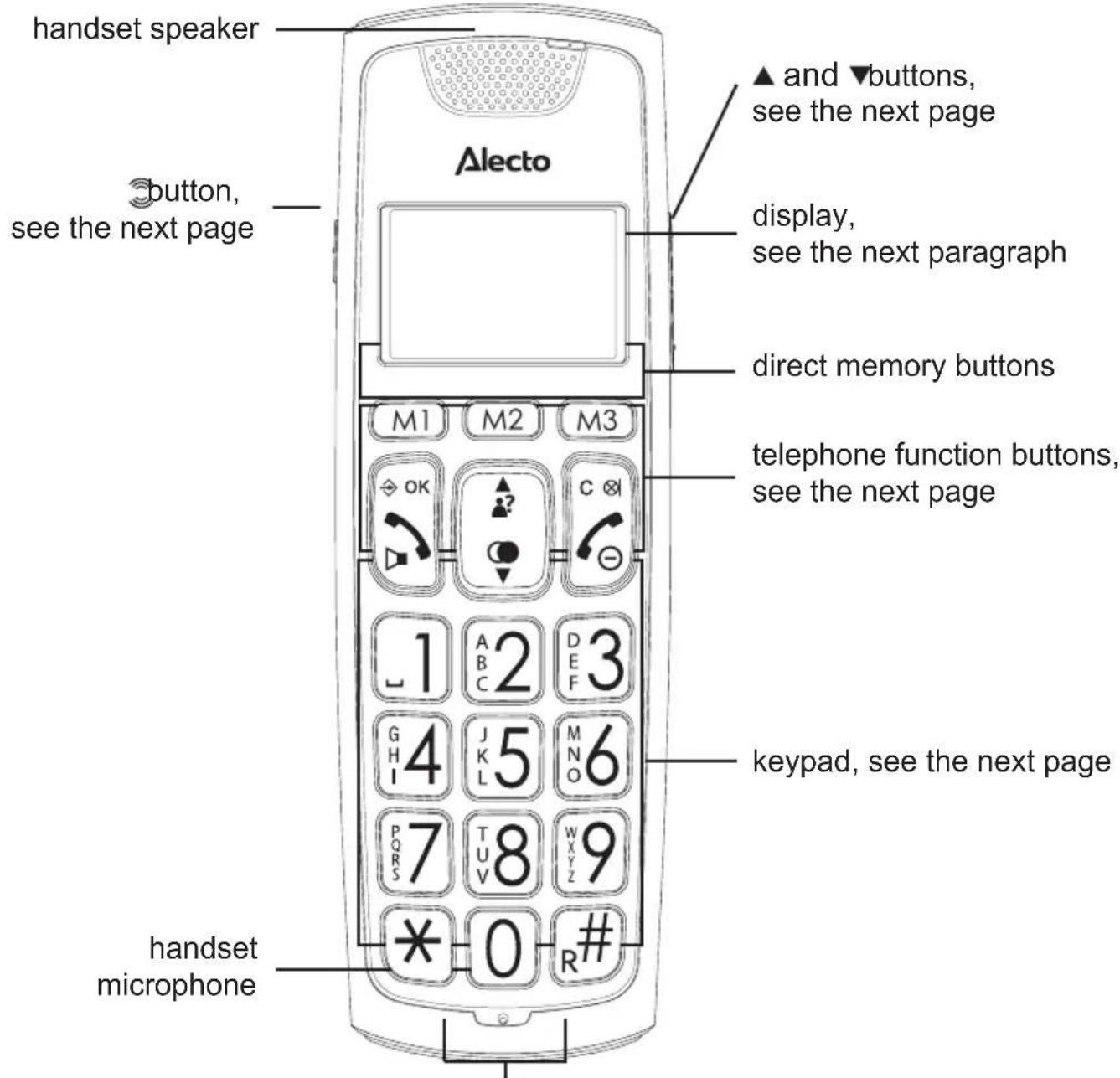
recharge contacts, to recharge the handset battery by placing the handset onto the cradle/charger

BOOST button: during a call, press to enable the extra amplifier

and buttons: during a call, press to increase or decrease the volume

in standby mode, press to open the menu during setup, press to confirm your settings

press to answer an incoming call or to start a phone conversation during a call, press again to enable or disable the speaker function

in standby mode, press to open the Caller-ID memory press to scroll memories or settings during a call, press to increase the volume

in standby mode, press to open the last dialled number memory. press to scroll memories or settings during a call, press to decrease the volume

correction button when entering phone numbers or names during a call, press to switch off the microphone in stand-by mode, press to start an intercom call during setup, press to go back one step

press to end a call press and hold (>5 sec.) to switch off the handset
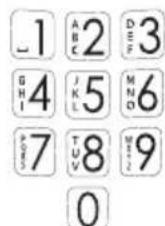
0-9 buttons: to dial phone numbers and to enter memories
0 button: press and hold to insert a dialling space

'asterisk' and 'pound' buttons: used for e.g. telecom banking
R button: function button for certain telecom services
1.2 DISPLAY:
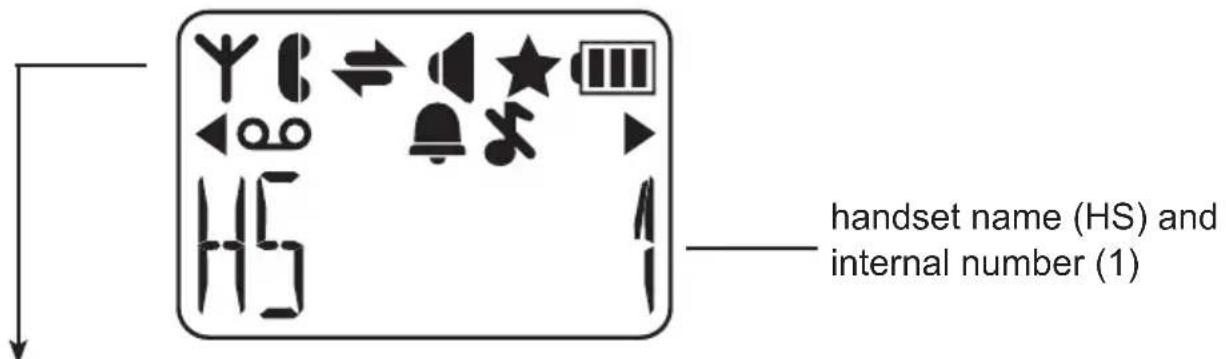
Y flashes when the connection between the handset and base is lost remains lit when the handset is within range of the base
C flashes when receiving an external call remains lit during a call
flashes when receiving an internal call remains lit during an intercom call
illuminates when the speaker function is enabled
Illuminates when checking the Caller-ID memory and having new calls
shows the status of the rechargeable batteries:
= batteries are full
= batteries are 2/3 full
= batteries are 1/3 full, recharge as soon as possible
□ = batteries are empty, the handset will switch off and you can no longer make calls
the battery symbol will scroll while charging until the batteries are fully charged

illuminates when the number is too long to be shown in the display (press the # button to see the rest of the number)

illuminates when you've receiver a voicemail message (only FSK systems)

illuminates when the alarm (wake-up) function is enabled

illuminates when the ring volume is set to 0 (switched off)
1.3 BASE:
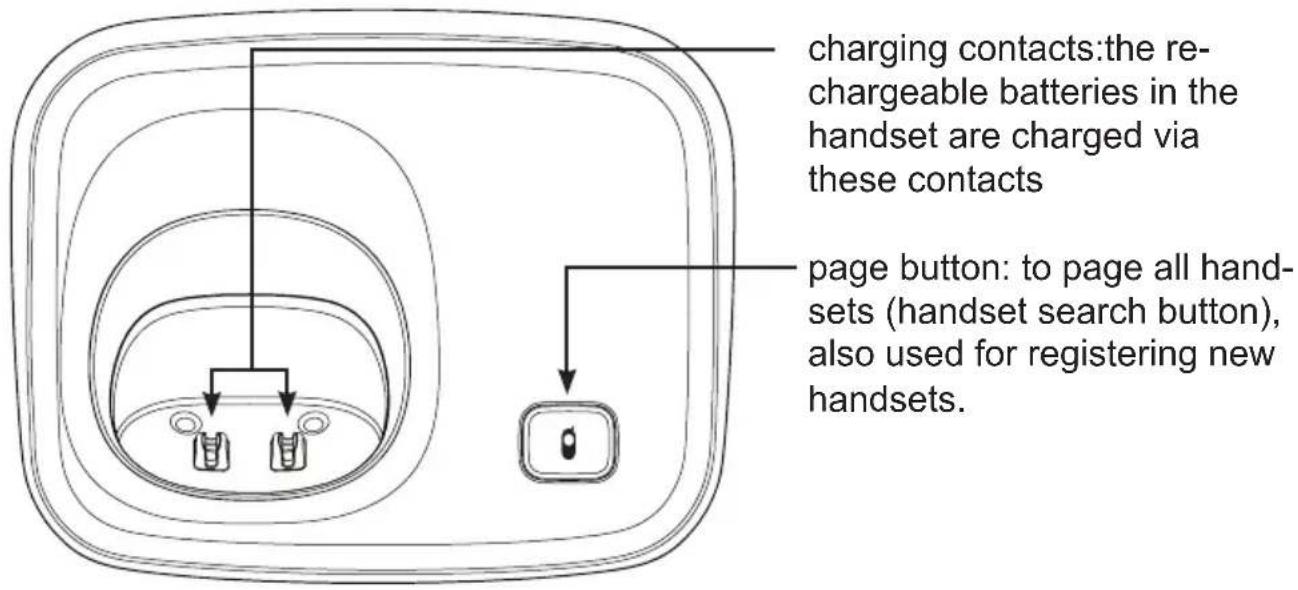
2 INSTALLATION
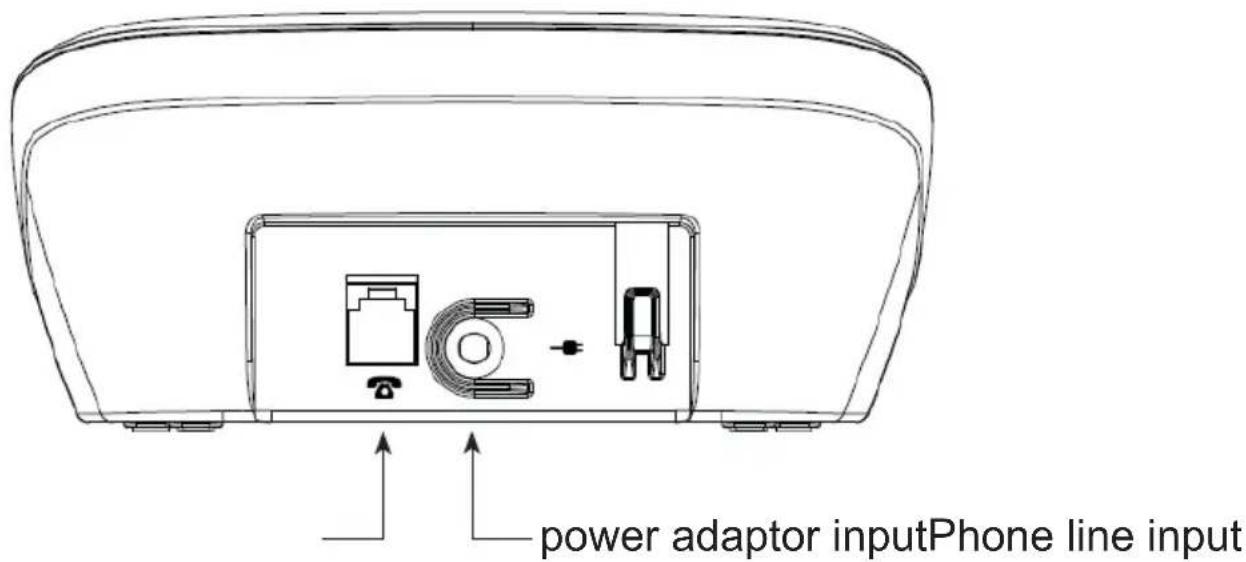
2.1 BASE STATION:
Telephone connection:
Plug the small connector at the phone cable into the back of the base station (press the connector until you hear a click). Plug the phone connector into the phone socket.
Power supply:
Connect the supplied power adaptor to the -put at the rear of the base and insert the adaptor into a 230V wall socket.

ONLY CONNECT THE INCLUDED ADAPTER. CONNECTING OTHER ADAPTERS MAY RESULT IN DANGEROUS SITUA
TIONS OR MAY CAUSE DAMAGE TO THE ELECTRONICS OF THE PHONE.
2.2 HANDSET:
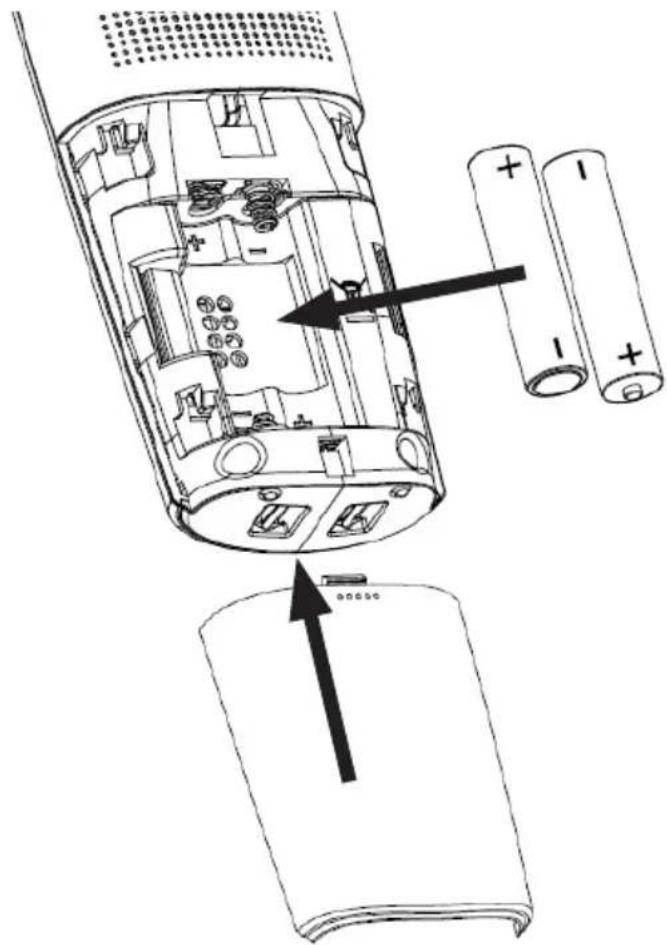
- Open the battery compartment of the handset, by sliding the battery cover down.
- Insert the batteries into the battery compartment; at this, pay attention to the polarity (+ and -).
- Slide the battery cover back onto the handset and place the handset on the base station.
- Leave the handset continuously during 15 hours on the base station, to charge the batteries properly.

INSERT ONLY RE-
CHARGEABLE NiMH
(NICKEL METAL HYDRIDE)
BATTERIES. THE USE OF NOT RECHARGEABLE BATTERIES MAY CAUSE DANGEROUS SITUATIONS OR EXPLOSION HAZARD.
2.3 EXTRA HANDSETS AND CHARGERS:
2 batteries and a charger with adapter will be included for every handset. Plug the adapter of these chargers in a 230 Volt mains socket, insert the batteries into the handset(s) and place the handset(s) on the charger(s) for 15 hours to charge the batteries.
3 CALLING
3.1 CALLING WITH THE PHONE OR USING THE HANDS-FREE FUNCTION:
You can make calls holding the handset against your ear or you can use the speaker function allowing other household members to listen in or to keep your hands free for e.g. making notes
during a call, press the Call button again to switch on the speaker function
press the Call button again to switch the speaker function back off
3.2 RECEIVING CALLS:
when you receive a call, the display lighting of the handset will switch on and the indicator at the top of the handset starts flashing

press the Call button to answer this call
- see paragraph 10.2, item [Auto antw] answering calls by only from the base station
3.3 ENDING CALLS:

press the End button to disconnect your call
- you can also place the handset back onto the base or cradle/charger to disconnect a call
3.4 DIALLING NUMBERS:
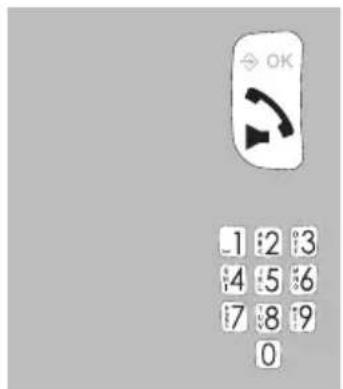
Direct dialing:
Press the phone-on key and wait for the dial tone.
Enter the phone number through the keyboard; this number will be dialed directly.
predialling:
Enter the phone number through the keyboard.
- press and hold the 0 button for at least once second to insert a dialling pause (the display will show -P-)
- press the C button to delete any incorrect input
press the Call button to dial the number
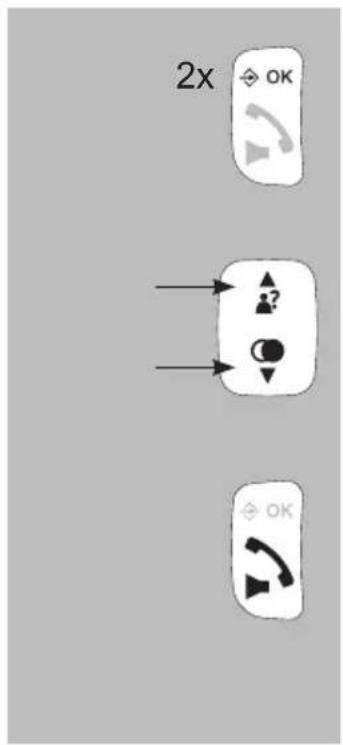
dialling from the phonebook memory: press 2x the button
use the and buttons to search for the desired memory
press the Call button to dial the number see paragraph 7.3 for programming phonebook memories

dialling from the Caller-ID memory:
press the? button and use the and buttons to select the desired call

press the Call button to dial the selected number

dialling from the last dialled number memory:
press the button and use the and buttons to select the desired call

press the Call button to dial the selected number
2 sec.
M1
M2
M3

dialling speed-dial contacts
press and hold the M1, M2 or M3 button for 2 seconds
the handset will switch on and the number is dialled
- see paragraph 10.2, item [Snelkeuz] for programming these speed-dial memories
dialling direct memories
press and hold one of the 0-9 buttons on the keypad for at least 2 seconds
the handset will switch on and the number is dialled
- see paragraph 7.4 for programming the direct memories
3.5 TO MUTE THE MICROPHONE:
During a call, you can switch off the microphone allowing you to consult with other household members without having your call partner listening.
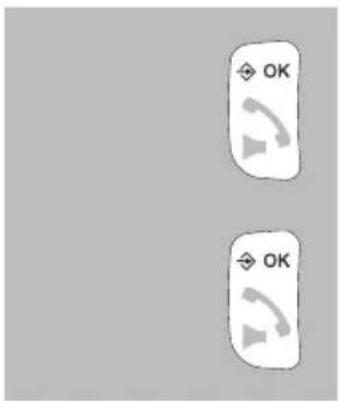
during a call, press the button to switch off the microphone;
press the c again to switch the microphone back on
3.6 RECEPTION VOLUME:
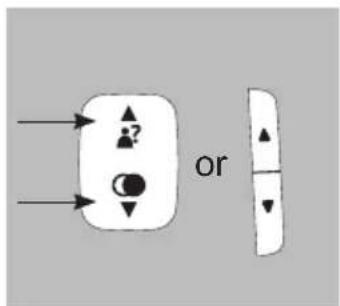
normal amplification:
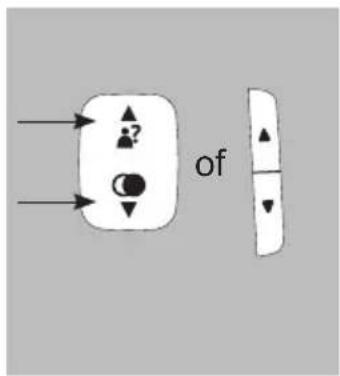
during a call, use the and buttons to adjust the reception volume; for this you may also use the and buttons at the right side of the handset or the and buttons underneath the M2 button
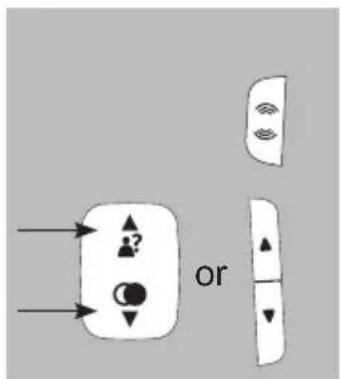
boost amplification:
first press the ≈ button at the left side of the handset; the indicator above the display will switch on
now use the and buttons to set the desired volume level
- the volume level for calling via the handset or hands-free can be set separately
- the selected setting will be kept in the memory
- after disconnecting a call, the boost amplifier will be switched off automatically
- the boost amplifier level is +9dB
3.7 CALL DURATION:
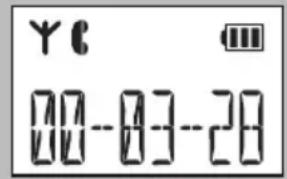
during a call, the call duration will be shown in the display; the call duration will disappear from the display as soon as you disconnect
3.8 R/FLASH FUNCTION:
R/FLASH means you briefly interrupt the telephone connection. This function allows you to forward calls with certain home or office switchboards or activate telephone services such as 'Call waiting'.

during a call, press and hold the # / R button for at least 2 seconds to emit a FLASH pulse
- Some telephone service providers require you to press a numeric button after giving the FLASH pulse to use e.g. 'Call Waiting'; contact your provider for more information.
- The interruption duration of the FLASH pulse can be adjusted; for this, see paragraph 11.2 [Flash].
3.9 HANDSET SEARCH FUNCTION:

in case you've misplaced the handset, briefly press the button on the base
the handset will then sound a signal for 60 seconds while [ PAGING ] appears in the display. This signal will stop after 60 seconds or you can press a random button to stop it beforehand.
3.10 TO SWITCH OFF THE HANDSET:
You can fully switch off the handset to save battery power or when you don't want to be disturbed:
5 sec.

press and hold the End button for 5 seconds; the handset will now switch itself off completely
5 sec.

press and hold again for 5 seconds to switch the handset back on
(or place the handset onto the cradle/charger)
- keep in mind that you cannot call or be called while the handset is switched off
4 RE-DIALLING
4.1 INTRODUCTION:
The handset memorizes the 5 last dialled numbers. You can redial these numbers, save them in the phonebook memories or delete them.
4.2 TO REDIAL:
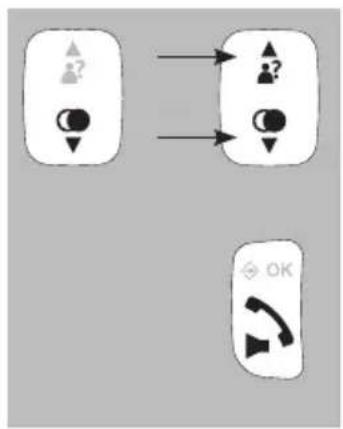
press the button and use the and buttons to select the desired last dialled number
press the Call button to dial the selected number
4.3 TO SAVE OR DELETE:
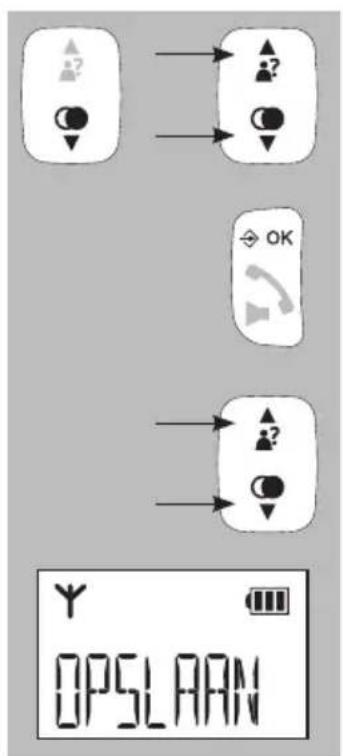
press the button and use the and buttons to select the desired number
press the ⇔ OK button
use the and Buttons to choose one of the following options:
save:
select this option to add the number to the phonebook memory of the telephone (*)
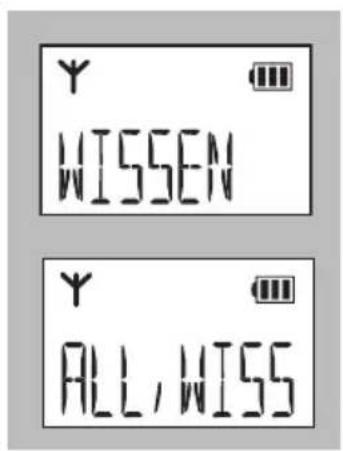
delete: use this option to only delete the selected call from the memory
delete all: use this option to delete the entire last dialled number memory
*: when saving a number, you may set a ringtone that'll sound when that subscriber calls you; for this function you must be subscribed to the Caller-ID service
5 CALLER IDENTIFICATION
5.1 INTRODUCTION:
If you have the service Caller Identification at your disposal, the number of the calling party is displayed on the display of your handset(s).
You have programmed this number including name and the phone book memory of the handset, the name is also displayed on the display and you can set an individual ringtone for each memory. Each handset has a memory for 10 calls.
5.2 INDICATION NEW CALLS:
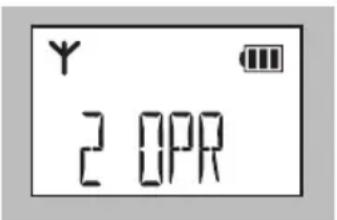
The display of the handset shows how many new calls you've received since the last time you checked the memory.
5.3 VIEW MEMORY AND callback:
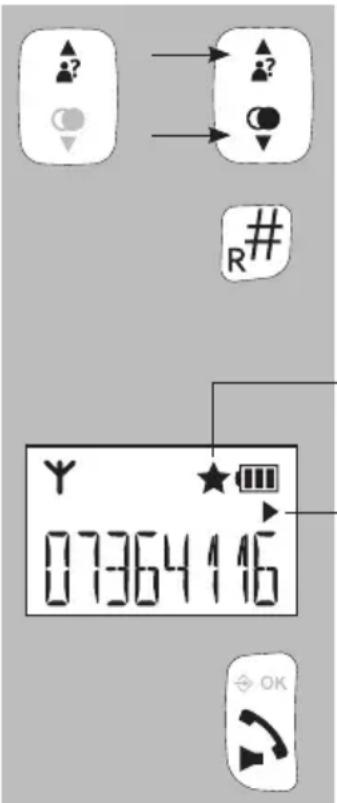
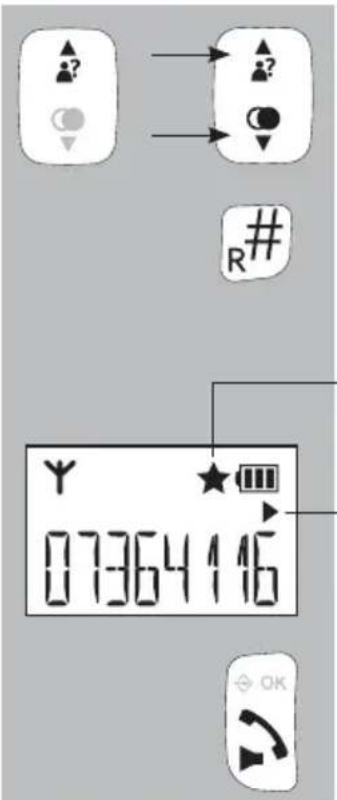
press the button and use the and buttons to scroll the memory
if a name is shown, you can press the # button to display the number
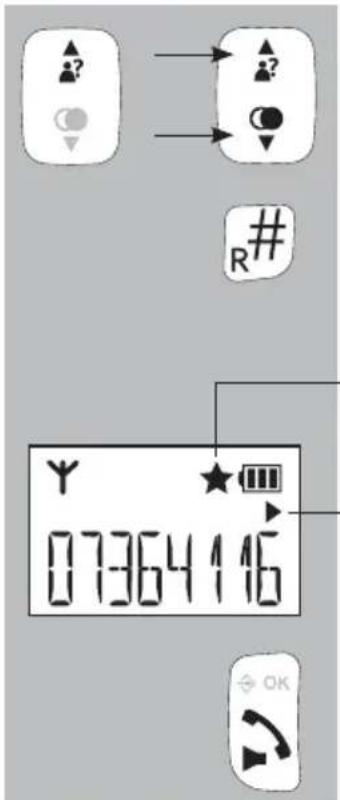
new calls are indicated by a star in the display
the triangular arrow pointing to the right indicates that there are additional digits at the right side of the displayed number; press the # button to show these digits
press the Call button to dial the selected number
5.4 DETAILS, SAVE OR DELETE:
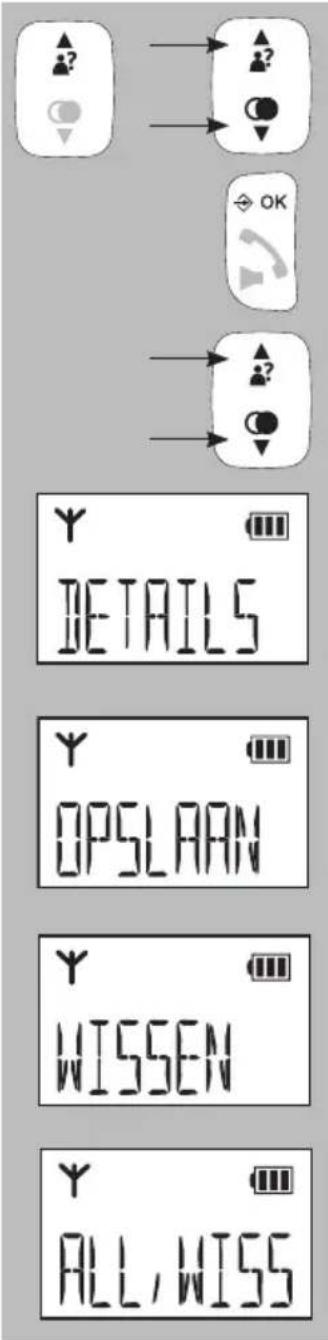
press the button and use the and buttons to select the desired number
press the ⇒ OK button
use the and Buttons to choose one of the following options:
details:
choose this option to show the date of the call, now press the # button to display the time of this call (*)
save:
select this option to add the number to the phonebook memory of the telephone
delete:
use this option to only delete the selected call from the memory
delete all:
use this option to delete the entire last dialled number memory
- The FX-6000 / FX-6020 is suitable for both the DTMF system, offered by the Dutch PTT and for the FSK system, offered by the Belgian PTT and by cable companies in the Netherlands and Belgium for as far as this service is offered.
- The Caller-ID service often requires an additional subscription; please contact your telephone service provider for more information.
- Name display:
- the DTMF system doesn't send any names; the name will only appear in the display when you've programmed it in the phonebook memory of the handset
- the FSK system does send names (ask your telephone service provider for more information)
- If the display shows [ONBEKEND], [PRIVE], [ONDERDRUKT] or [0000000000], the calling subscriber has blocked sending his or her name and number.
- The names/numbers of the calls you've answered are also saved.
- When using multiple handsets: memories must be deleted separately in each handset.
6 VOICEMAIL INDICATION
6.1 INTRODUCTION:
Voicemail is a service offered by the telephone service provider, allowing callers to leave a message. You can listen to this message at a later time. (*)
6.2 NEW VOICEMAIL INDICATION:
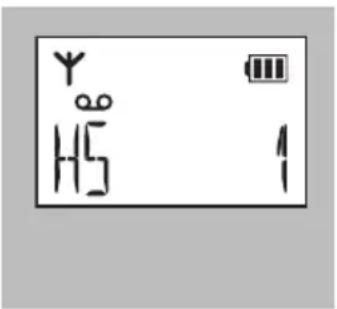
If your service provider supports voicemail, based on the FSK system, you may receive a notification when a new message has been left for you. This is indicated by the voicemail symbol (oio the display of your handset
this voicemail notification will disappear after you've listened to your message
- You can remove this notification also by resetting the settings, please see paragraph 12.2.
- Underneath button 1 you can save the number of your voicemail, please see paragraph 10.2, item [MAILBOX]
- For any questions about the voicemail function, please contact your telephone service provider.
7 PHONE BOOK MEMORY
7.1 INTRODUCTION:
Every FX-6000 / FX-6020 handset has a phone book memory with a capacity of 50 phone numbers of at most 20 digits. You can program a name of at most 8 characters with each number. The phone book memory in the handset is connected to the function Caller Identification. When you are called by somebody, whose name and number you have programmed in the memory, the name of this person is also displayed beside the number on the display of your handset. (However, for this you need to subscribe to the service Caller Identification.)
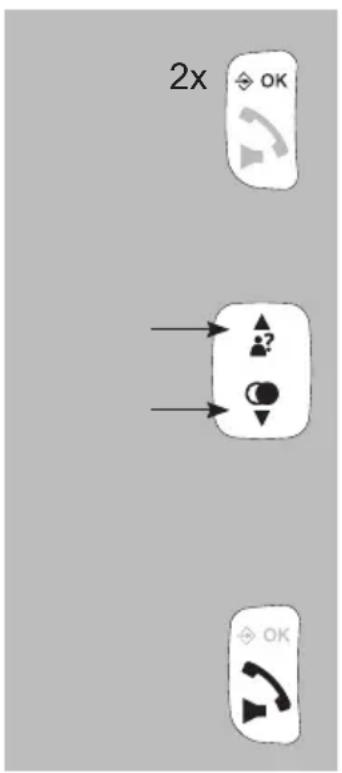
press 2x the button to open the phonebook memory, the display will then show the name of the first contact or [LEEG] appears when no contacts are saved
use the and buttons to scroll the memory you can also search using the keypad, for example press 2x the 5 button to search for the first contact starting with the letter K, now continue searching with the and buttons
press the Call button to dial the selected number
4x






to add:
press 4x the OK button
use the keypad to enter the name
press the OK button
use the keypad to enter the phone number
- use the C button to correct any incorrect input
- briefly press and hold the 0 button to insert a dialling pause
press the OK button
use the and buttons to select the desired melody that must sound when this subscriber calls you, to use this function you must be subscribed to the Caller-ID service
press the OK button to save this contact
press the End button to stop programming and return the handset to standby mode

to edit: press 2x the button
use the and buttons to select the contact you want to edit
press the button
use the and buttons to select the option [BEWERKEN]
press the button
use the C button to delete the old name and use the keypad to enter the new name
press the button
use the C button to delete the old number and use the keypad to enter the new name
press the button
use the and buttons to select a different ringtone that must sound when this subscriber calls you


2x



press the button to save this memory
press the End button to stop editing and return the handset to standby mode
to delete:
press 2x the button
use the and buttons to select the contact you want to delete
press the OK button
use the and buttons to select the option [WISSEN] to only delete the selected contact or select [ALL. WISS] to delete all contacts
press the OK button
when using [ALL. WISS] you must press ⇔ 2 × k
press the End button to stop deleting and return the handset to standby mode
7.4 DIRECT MEMORIES:
A contact from the memory can be assigned to each of the 2-9 buttons. Whit the handset in standby mode, you can then press and hold that button for at least 2 seconds to automatically dial the assigned number.
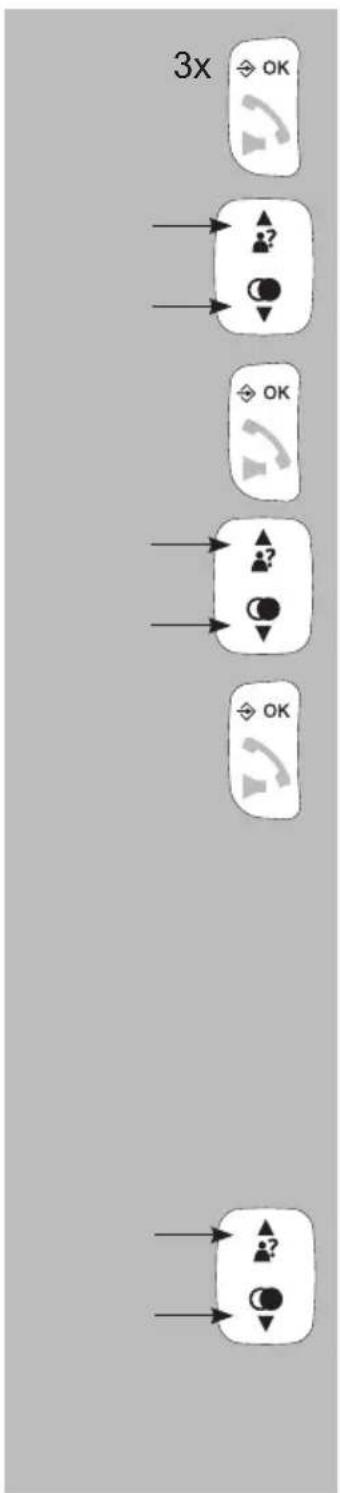
to assign a contact: press 3x the button
use the and buttons to select the option [SNELKEUZ]
press the OK button
use the and buttons to select the desired button (2~9)
press the OK button
[ LEEG ] will appear when no contact is yet assigned to this button, otherwise the name of the assigned contact will be shown
when [LEEG] after a second or more the first contact in the memory of your handset will appear, now use the and buttons to select the desired contact
contact already assigned See the next paragraph: 'to assign,edit or delete
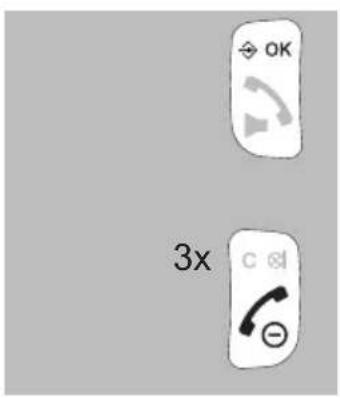
press the OK button
press 3x the End button to stop assigning and return the handset to standby mode
See paragraph 10.2, item [MAILBOX] for programming a number underneath button 1
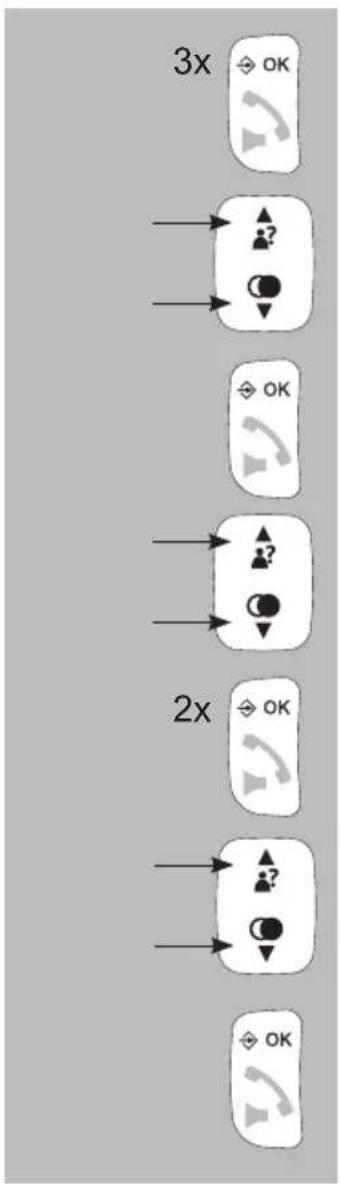
to assign,edit or delete:
press 3x the button
use the and buttons to select the option [SNELKEUZ]
press the button
use the and buttons to select the desired button (2~9)
press 2x the button
use the and buttons to select the option [WISSEN] to remove the assigned contact or select [BEWERKEN] to assign a different contact to the selected button
press the button to confirm deleting the contact or assigning another contact
You can check the number and the set ringtone for each contact as follows:

press 2x the button
use the and buttons to select the desired contact
press the ⇔ OK button
use the and buttons to select the option [BEKIJKEN]
press the button
now use the and buttons to view the name, number and set ringtone for the selected contact
press the button
press the End button to stop viewing and return the handset to standby mode
7.6 MEMORY STATUS:
You can check the memory status of your handset as follows:
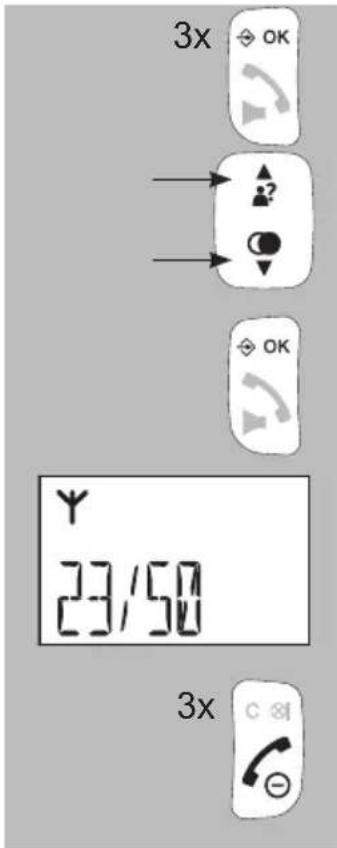
press 3x the button
use the and buttons to select the option [GEHEUGEN]
press the OK button
the display will now show how many of the available 50 memories you're currently using (the example below shows that 23 of the 50 are being used)
press 3x the End button to stop viewing and return the handset to standby mode
7.7 AVAILABLE CHARACTERS:
While programming the names of your contact, you can use the following available characters:
| toets: | .. x indrukken: |
| 1x | 2x | 3x | 4x | 5x | 6x |
| 1 | sp | - | 1 | (sp = spatie) |
| 2 | A | B | C | 2 | | |
| 3 | D | E | F | 3 | | |
| 4 | G | H | I | 4 | | |
| 5 | J | K | L | 5 | | |
| 6 | M | N | O | 6 | | |
| 7 | P | Q | R | S | 7 | |
| 8 | T | U | V | 8 | | |
| 9 | W | X | Y | Z | 9 | |
| 0 | 0 | | | | | |
| * | * | ? | / | \ | ( ) | |
| # | # | ' | , | - | . | & |
8.1 INTRODUCTION:
You can register up to 5 handsets on the FX-6000 / FX-6020 base station. When registering multiple handsets, you can make internal calls free of charge and you may transfer calls. If your telephone was supplied with multiple handsets, you can immediately start using these functions. If your telephone was supplied with only one handset, you can purchase additional handsets that must be registered on the base first. See paragraph 13.2 for instructions.
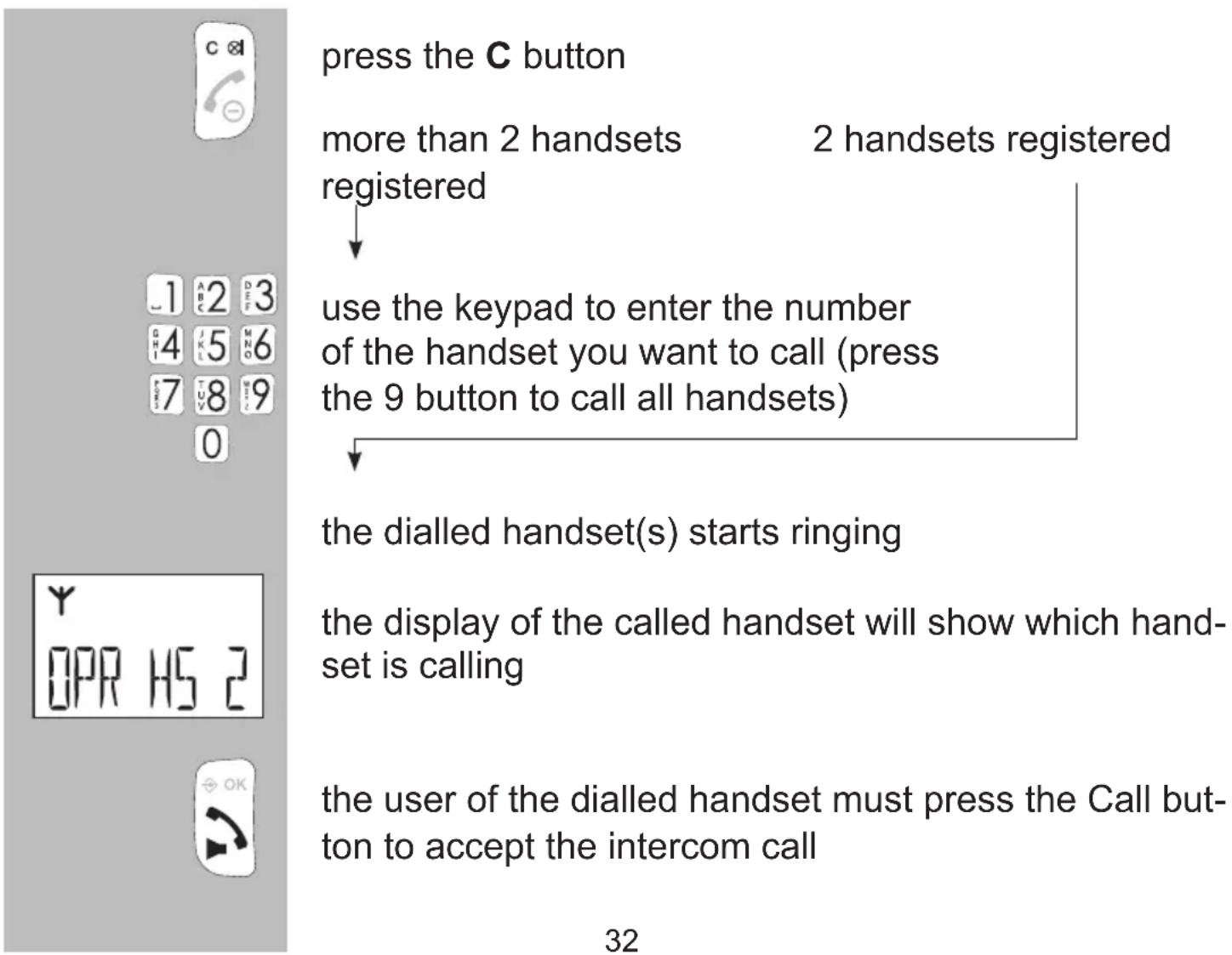

- When receiving an external call during an intercom call, the handset will emit notification tones. Disconnect your intercom call, wait until the usual ringtone sounds and answer the outside call (when using more than 2 handsets, you can also accept the outside line using any free handset).
8.3 TRANSFER / CONFERENCE CALL:
2x

during a call with the outside line, press 2x the OK button
more than 2 handsets registered
2 handsets registered
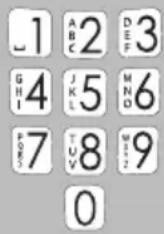
use the keypad to enter the number of the handset you want to transfer the call to or you want to add to the conversation (press the 9 button to dial all handsets)
wait for the dialled handset to pick up. If the dialled handset doesn't answer, briefly press the End button to retrieve the outside line
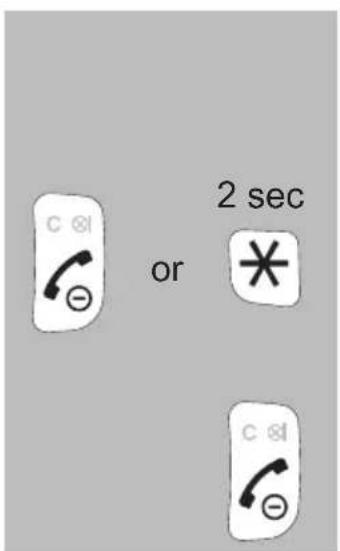
transfer conference call
press the End button to transfer the call to the other handset
press and hold the * (asterisk) button for at least 2 seconds to start the 3-way call
press the End button to disconnect the call.
9 CLOCK & ALARM (WAKE-UP) FUNCTION
9.1 INTRODUCTION:
In standby mode, the display of the handset(s) shows the time. Moreover, you can program an alarm or wake-up time (for each handset).
9.2 TIME AND DATE SETUP:
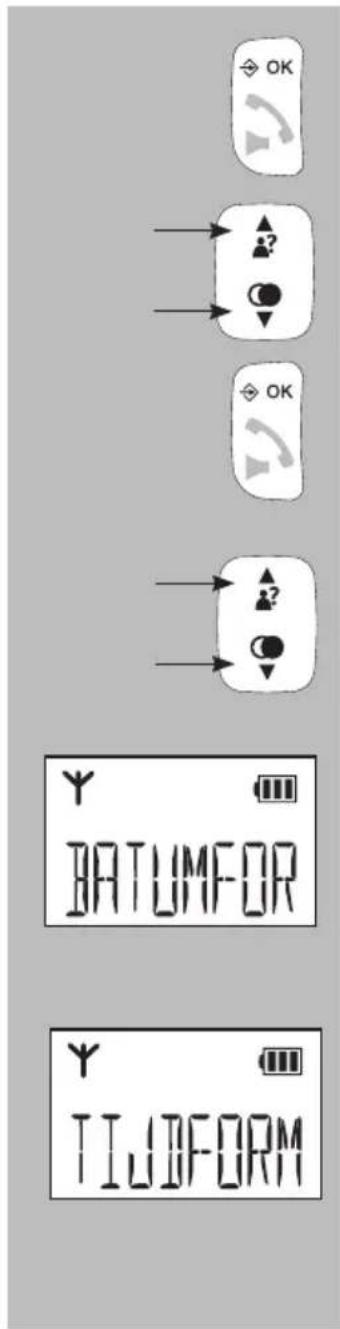
press the button
use the and buttons to select the option [ DAT/TIJD]
press the button
use the and buttons to choose one of the following options:
[ DATUMFOR ]
select this option to set the time display format: day-month-year or month-day-year
use this option to switch between the 12-hour or 24-hour clock. For example at quarter past nine in the evening:
12-hour clock: 9:15 PM / 24-hour clock: 21:15
![Fysic FX6020 - [TIJFORM] - 1](/content/2026/02/356451/images/2573c1ec093d03750e7a14be2cd25742da24a19ad5193b8e435e0be511598acf.jpg)
[TIJD INST]
here you can set the time
[ DAT INST ]
here you can set the date
9.3 TO ENABLE/DISABLE THE ALARM AND TO SET THE ALARM TIME:
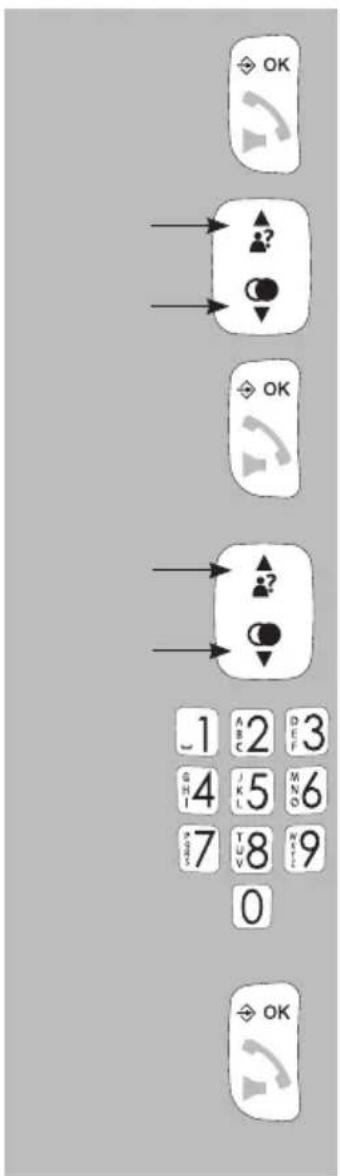
press the button
use the and buttons to select the option [ALARM]
press the OK button
use the and buttons to switch the alarm ON or OFF
use the keypad to enter the desired alarm time
press the button
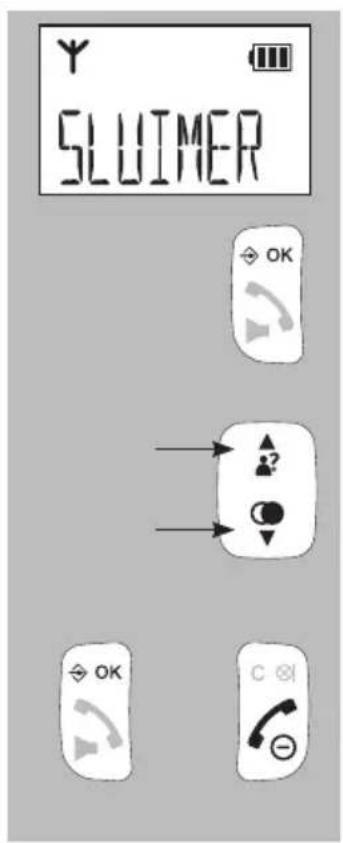
the display will show the word [ SLUIMER ]
press the button
now use the and buttons to enable or disable the snooze function (see below an explanation of the snooze function)
press the button to save your settings and press the End button to return the handset to standby mode
9.4 ALARM OPERATION:
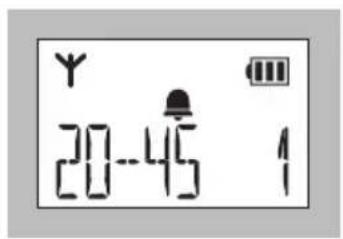
-
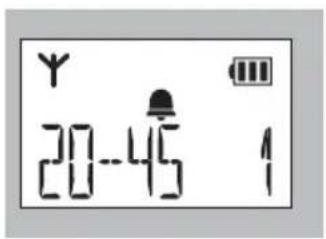
the symbol appears in the display when the wake-up signal is enabled
-
at the set time, the alarm will sound for 45 seconds or until you press a random button to stop the alarm signal beforehand
-
when the [ sluimer ] function is enabled and you press a random button to stop the alarm signal, the alarm will sound again after 7 minutes; you can disable an enabled snooze function by pressing and holding the End button for at least 5 seconds while the alarm sounds (or by disabling the alarm function according to the instructions in the previous paragraph)
the alarm is not repeated daily
- the alarm volume is the same as the set ring volume; if the ring volume is set to 0 (off), the alarm signal is set to volume level 1
10 HANDSET PREFERENCES
10.1 INTRODUCTION:
You can use the menu [HS INST] to adjust various handset settings to your personal preferences.
10.2 MENU FOR HANDSET PREFERENCES:
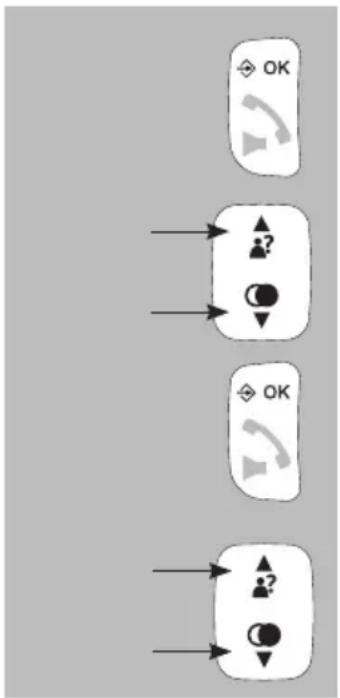
press the button
use the and buttons to select the option [HS INST]
press the button
now use the and buttons to choose from the following options:
[BEL INST]
Here you can set the ringtone signals. Keep in mind that you can set different signals for internal calls and for outside calls. You can also choose to turn the ring volume off, in this case the × symbol will appear in the display
[TOON INS]
Here you can enable or disable the following tones:
- Key tone: the tones that are emitted when pressing buttons
- Batt weak: the tones that are emitted when the batteries are nearly empty
- Range: the tones that are emitted when the handset is nearly out of range from the base station
[EQUALIZER]
You can use the equalizer to (extra) amplify the treble or bass levels. This tone control is disabled when set to 'natural'
[TAAL]
Here you can set the language in which the various messages are displayed on the display.
You can restore a known language as follows in case you've set an unknown language accidentally:
- press: OK▼▼▼ OK▼▼OK
- now use and to select the desired language
- press to confirm
[HS NAAM]
Use this option to assign a personal name to the handset of up to 6 characters. Use the C button to delete the old name.
See paragraph 7.7 for all available characters.
[DISPLAY]
Here you can determine whether the handset name or actual time must be shown with the handset in standby mode.
[ AUT.ANTW ]
Here you can determine whether an incoming call can be answered directly by picking up the receiver from the base or charger. With this function disabled, you must always press the Call button to accept incoming calls.
[SNELKEUZ]
Here you can enter numbers for the direct memory buttons M1, M2 and M3. By pressing and holding these buttons in standby mode, the assigned number will be dialled directly.
[MAILBOX]
The number you can enter here will be saved underneath button 1. By pressing and holding the 1 button for at least 2 seconds in standby mode, this number will be dialled. Usually the phone number for your voicemail is stored underneath the 1 button, but you may store any frequently used number.
11 BASE PREFERENCES
11.1 INTRODUCTION:
Via the menu [BS voorkeuren] you can, amongst others, deregister other handsets, adjust the FLASH interruption time and change your PIN code.
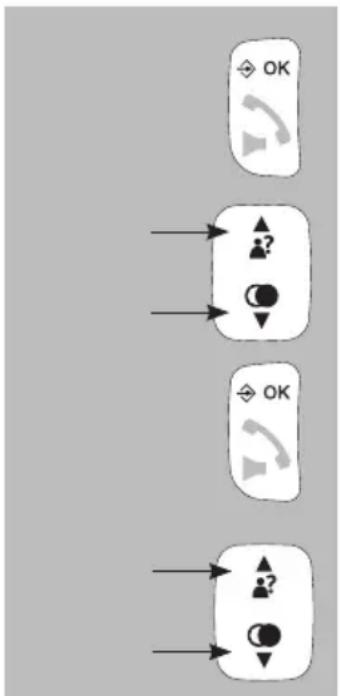
press the button
use the and buttons to select the option [BAS INST]
press the ⇔ OK button
use the and buttons to choose from the following options:
[HS AFMEL]
Here you may deregister faulty or lost handset. Keep in mind that you can only deregister other handsets, you cannot deregister your own handset. See also paragraph 13.4.
[FLASH]
Here you can set the interruption duration of the flash pulse (see also paragraph 3.8):
- short setting: 100mS
- average setting: 300mS
- long setting: 600mS
Ask your telephone service provider or the supplier of your home or office switchboard for the most suitable interruption time. The default flash time of 100mS is used in the Benelux, which is already set upon leaving the factory.
[ PIN WIJZ ]
A PIN code is required for various settings and for registering and deregistering handsets. The stand factory PIN code is 0000, but you can use this menu to change this PIN code into your personal 4-digit PIN code.
- make sure the display shows [ PIN WIJZ ]
- press 2x the OK button
- now first enter the old PIN code
- press 2x the OK button
- enter the new PIN code
- press 2x the OK button
- enter the new PIN code again
- you'll hear a confirmation tone; the new PIN code is now stored
Instructions to restore the default factory PIN code 0000 in case you've forgotten or lost your personal PIN code:
- remove the power adaptor of the base from the wall socket
- on the base, press the button AND KEEP THIS BUTTON DEPRESSED
- now insert the adaptor back into the wall socket (keep the button depressed)
- after 5 seconds, release the button
- the PIN-code is now changed back into 0000
12 RESETTING PREFERENCES
12.1 INTRODUCTION:
Via the menu [STANDARD], you can reset your settings to the standard factory settings.
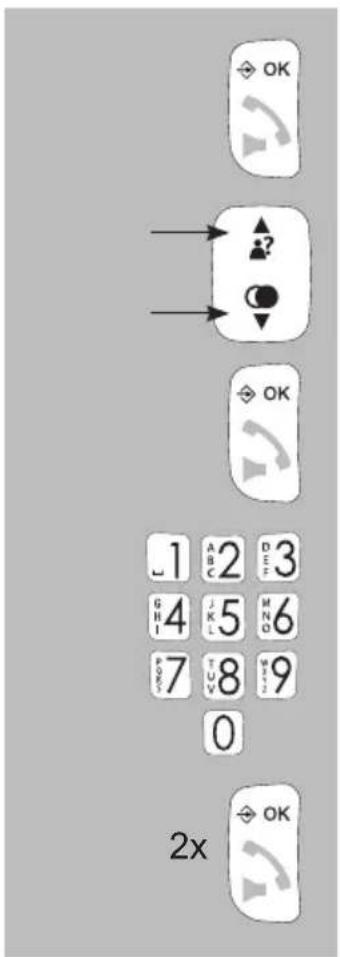
press the button
use the and buttons to select the option [STANDARD]
press the button
use the keypad to enter the PIN code
press 2x the button
12.3 FACTORY SETTINGS:
Name handset handset
Display language Dutch
Internal ringtone Melody 2
External ringtone Melody 6
Ring volume Level 4
Receiver volume Level 3
Hands-free volume Level 3
Battery tone Enabled
Out-of-range tone Enabled
Key tones Enabled
Auto answer Disabled
Clock format 24 HR
Date/time 01-01-11 / 00:00
Flash: 100mS ('short' setting)
Voicemail indication: off
PIN code: 0000
Last dialled memory: empty
Caller-ID memory: empty
Phonebook memory: unchanged
13 ADDITIONAL HANDSETS
13.1 INTRODUCTION:
You can connect 5 handsets with each base station from the FX-6000 / FX-6020 series. This way you can make internal calls free of charge and you can also transfer calls.
13.2 TO REGISTER HANDSETS:
Attention, the handset(s) supplied with the basis is (are) already registered to that base. The following instructions are only valid for registering new handsets or for re-registering handsets in case of a power outage.
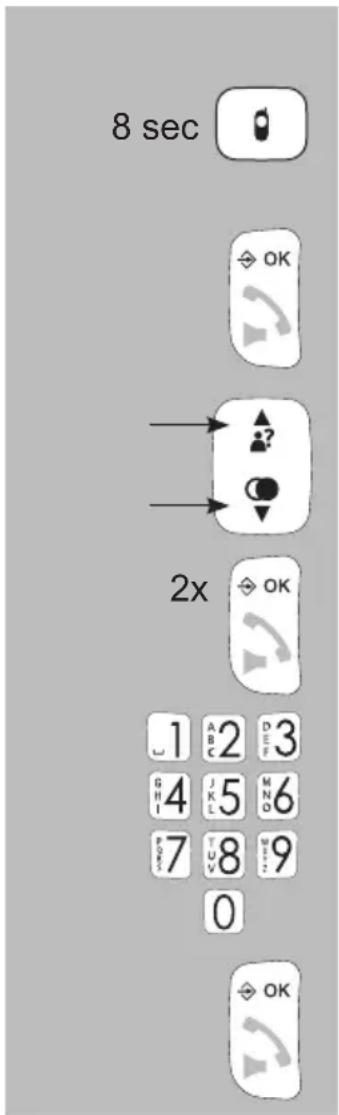
base: press and hold the base button for at least 8 seconds
handset: press 2x the button
use the and buttons to select the option [REGISTR]
press 2x the button
use the keypad to enter the PIN code
press the button, the handset will now start searching for the base station
After several seconds the base and handset will have 'found' each other and the display of the handset will show the internal number of that handset (1-5); the handset is now registered
13.3 TIPS FOR MULTIPLE HANDSETS:
- Instructions for dialling and incoming calls are identical for all handsets of the FX-6000 / FX-6020 series.
- Intercom calls are free of charge.
- When receiving an external call during an intercom call, the handsets will emit a notification tone. Disconnect the internal call, wait for the regular ringtone to sound and answer the external call. In case you've registered more than 2 handsets on the base, you can also answer the outside call using any free handset.
- When an outside call is being received, all handsets will start ringing. The handset that's the first to answer the call will be connected with the outside line.
13.4 DE-REGISTERING HANDSETS:
Defect or lost handsets must be de-registered:
- press the button
- use the and buttons to select the [BAS INST] option
- press the button
- use the and buttons to select the [HS AFMEL] option
- press the button
- use the keypad to enter the PIN code
- press the button
- use the and buttons to select the handset you want to deregister
- press the button
Keep in mind that you can only deregister other handsets; you cannot deregister your own handset.
14 TIPS AND WARNINGS
14.1 PLACEMENT:
-
Preferably, do not place the device on surfaces that have been treated with cellulose; the rubber feet can leave traces on these.
-
Do not place the phone in the direct vicinity of other phones or other electronic (medical) devices, TL tubes and other gas discharge lamps; the emitted radio waves of these (and other) wireless phone(s) may disrupt the functioning of the equipment, or the emitted signals of the equipment disrupt the functioning of the phone.
14.2 RANGE:
- The range of the phone is up to 300 meters in the open field and up to 50 meters inside; the range depends on local circumstances. When you get out of reach of the base station, the symbol will start flashing and the text [ZOEKEN] appears on the display. In this state, you cannot receive or make any calls. In case the power supply adapter of the base station is unplugged from the mains socket, the handset will lose contact with the base station, the display will display [ZOEKEN], and the antenna symbol will start flashing. The handset will restore contact with the base station within several minutes after the power supply adapter has been plugged in again.
14.3 POWER SUPPLY HANDSET:
-
The display of the handset is provided with a built-in battery capacity meter (When the battery symbol is full, the batteries are charged; when the battery symbol is empty or only half full, the batteries should be recharged.
-
For optimal use, we recommend you to place the handset onto the charger every evening. This does not have an adverse effect on the rechargeable batteries.
ATTENTION:
The handset measures how long the battery is charged and calculates how much current is in the battery and how long the handset can work on it. If you now remove a full battery from the handset and replace it, the handset will think that another battery has been inserted and will therefore show an incorrect and lower battery indication in the display. In that case, simply charge the handset again continuously for 24 hours for a correct battery indication.
14.4 HEARING AIDS:
- Users of older generation hearing aids always shall keep into account a possible uncomfortable buzzing tone when using DECT phones.
14.5 MEDICAL EQUIPMENT:
- It is possible that enabled DECT phones interfere with sensitive medical equipment. When the phone is kept in the vicinity of the medical device, interference can occur. Do not place a DECT phone on or near a medical device, not even when it is in standby mode.
14.6 POWER FAILURE:
- This phone obtains its power supply from the mains power. In case of failure of the mains power, this phone cannot be used.
14.7 EAVESDROPPING:
- Eavesdropping on a DECT phone is virtually impossible. Not only shall one be within reach of the DECT phone, one also needs expensive equipment.
15 POSSIBLE PROBLEMS AND SOLUTIONS
15.1 POSSIBLE PROBLEMS AND SOLUTIONS
No dialling tone.
- The outside line is being used by another unit. Wait until that call has ended and try again.
-
Check the connection between the base and you telephone socket (when in doubt, connect a different phone to your telephone socket).
-
The power supply is interrupted.
-
Check whether the adaptor below at the rear of the base is plugged in and that the power adaptor is connected with a wall socket.
15.2 PROBLEMS WITH INCOMING CALLS:
-
No notification of incoming calls:
-
The bell is disabled; enable it.
-
Check the connection between the phone and your telephone socket (when in doubt, connect a different phone to your telephone socket)
-
You are continuously busy:
-
Check whether you have a 2nd telephone with the receiver next to it.
- Check whether another handset registered on your telephone is keeping the line busy.
-
Connect another phone to your phone connection, and use this to check whether the malfunction originates from your connection or your carrier.
-
Handset switches itself off when it starts ringing:
-
The batteries cannot supply power for the ringtone. Clean the battery contacts or replace the batteries.
15.3 PROBLEMS DURING CALLING:
-
Beep tones during an intercom call:
-
You are called from outside during an intercom call; end this call, wait until the phone rings normally and answer the call.
-
Beep tones during a call:
-
The batteries are nearly empty; disconnect the call and replace the handset onto the base or charger to recharge the batteries
-
Noise and other distortions:
-
You are getting out of reach of the base station; reduce the distance.
-
There are other electrical devices in the vicinity that interfere with the radio waves of your phone; try another location.
15.4 PROBLEMS WITH CALLER IDENTIFICATION:
-
You do not receive Name or Caller Identification information on the display:
-
Check whether your carrier transmits these signals (you shall subscribe to this service with some telephone companies).
-
You do receive the numbers on the display of your phone, but not the name.
-
The carrier does not forward names; consult your carrier for this.
-
The name has not been programmed in the memory of your phone; program it. (see paragraph 7.3)
15.5 OTHER:
The display stays blank:
-
The batteries are empty , please recharge them
-
The handset does not have contact with the base station:
-
You are too far from the base station; reduce the distance.
-
The base station has been switched off. Check and repair it.
-
The handset is not registered with the base station (anymore); register it (again). (see paragraph 13.2)
In case the failure has not been solved with aforementioned solutions:
- Remove the batteries from the handset, and unplug the power supply adapter and the phone connector from their sockets; connect everything again after several minutes.
You can also contact the Alecto service center; support.alecto.nl
16 SPECIFICATIONS
Protocol: DECT / GAP, 5 handsets
Phone book: 50 names and number
Call history:DTMF&FSK,10memories
Last number memory: 5 numbers
Dialling: TONE (DTMF)
FLASH: 100, 300 & 600 ms, adjustable.
Boost amplification: +9dB
Power supply charger: 2x 1.2V NiMH batteries, 500mAh, format AAA
Power supply base station: 6 VDC, 450mA , - - +
adapter model nr.: VT05EEU06045
Range: 50m indoors, 300m outdoors
Operational life (with full batteries):
standby: >100 hours
use: >10 hours
Connection factor: 12.5 (according to the old method, this
corresponds with a connection factor of 0.5)
Operational temperature: 15°C to 40°C
Storage temperature: -20°C to 60°C
Frequency Range : 1880-1900 Mhz
Maximum Power : < 24 dBm
Information Power Adapter:
Manufacturers name and address : Vtech Telecommunications LTD, 23/F., Tai Ping Industrial Centre, Block 1, 57 Ting Kok Road, Tai Po, Hong Kong.
Model Identifier: VT05EEU06045
Average active efficiency : 74.2 %
Efficiency at low 10% load: -
No load Power consumption: 0.07 W
Hereby, Commaxx declares that the radio equipment type Alecto FX-6000/6020 is in compliance with directive 2014/53/EU.
The full text of the EU declaration of conformity is available at the following internet address:
https://commaxx-certificates.com/doc/fx-6000_doc.pdf
Alecto
Alecto is a brand of Commaxx B.V. Wiebachstraat 37, 6466 NG Kerkrade, The Netherlands

Service / Help? www.alecto.nl Support.alecto.nl
TABLE DES MATIERES
1 SOMMAIRES
1.1 COMBINE 5
1.2 DISPLAY 7
1.3BASE 8
2 INSTALLATION
2.1 BASE 9
2.2 COMBINE 10
2.3 COMBINES ET CHARGEURS SUPPLEMENTaires 10
3 TELEPHONER
3.1 TELEPHONER AVEC LE CORNET OU MAINS LIBRES. 11
3.2ETREAPPELE 11
3.3 INTERROMPRE LA LIAISON 11
3.4 CHOISIR DES NUMEROS 12
3.5 CONVERSATION PARALELLE 14
3.6 VOLUME DE RECEPTION 14
3.7 DUREE DE L'APPEL 15
3.8 FONCTION R/FLASH 15
3.9 FONCTION RECHERCHE DU COMBINE 15
3.10 DESACTIVER LE COMBINE 16
4 RAPPELDU NUMERO
4.1 INTRODUCTION 17
4.2 CHOISIR ANOUVEAU 17
4.3 SAUVEGARDER OU EFFACER 17
5 AFFICHAGE DU NUMERO
5.1 INTRODUCTION 19
5.2 INDICATION NOUVEL APPEL 19
5.3 VOIR LA MÉMOIRE ET RAPPELER 19
5.4 SAUVEGARDER OU EFFACER LES DETAILS 20
5.5 INFORMATION SUPPLEMENTAIRE 21
6 INDICATION VOICE MAIL
6.1 INTRODUCTION 22
6.2 INDICATION NOUVEAU VOICEMAIL 22
7 MÉMOIRE DE L'ANNUAIRE TELEPHONIQUE
7.1 INTRODUCTION 23
7.2 CHERCHER ET APPELER UN CONTACT 23
7.3 AJOUTER, MODIFIER OU EFFACER DES CONTACTS 24
7.4 MEMOIRESDIRECTES 27
7.5 REGARDER LES CONTACTS 29
7.6 STATUS DE LA MEMOIRE 30
7.7 CARACTERES DISPONIBLES 30
8.1 INTRODUCTION 31
8.2 INTERCOM 31
8.3 TRANSFERER / CONVERSATION CONFERENCE 32
9 REVEIL & ALARME FONCTION (REVEIL)
9.1 INTRODUCTION 34
9.2 PROGRAMMER L'HEURE ET LA DATE 34
9.3 ACTIVER/DEACTIVER L'ALARME 35
9.4 FONCTIONNEMENT DE L'ALARME 35
10 PREFERENCES DES COMBINES
10.1 INTRODUCTION 37
10.2 MENU POUR LES PREFERENCES DU COMBINE 37
11 PREFERENCES DE LA BASE
11.1 INTRODUCTION 39
11.2 MENU POUR LES PREFERENCES DE LA BASE 39
12 REMETTRE LES PREFERENCES A ZERO
12.1 INTRODUCTION 41
12.2 MENU POUR REMETTRE LES PREFERENCES A ZERO 41
12.3 PROGRAMMATION D'USINE 42
13 COMBINES SUPPLEMENTaires
13.1 INTRODUCTION 43
13.2 ANNONCER DES COMBINES 43
13.3 CONSEILS CONCERNANT LE MULTICOMBINE 44
13.4 DESANNONCER LES COMBINES 44
14 CONSEILS ET AVERTISSEMENTS
14.1 GENERAL 45
14.2 INSTALLATION 45
14.3 PLACEMENT 45
14.4 LA PORTEE 46
14.5 ALIMENTATION DU COMBINE 46
14.6 APAREILS AUDITIFS 47
14.7 APPAREILLAGE MEDICALE 47
14.8 COUPURE DE COURANT 47
14.9 ECOUTER 47
14.10 ENTRETIEN 47
14.11 ENVIRONNEMENT 47
15 PROBLEMS ET SOLUTIONS POSSIBLES
15.1 PROBLEMS AVEC DES APPELS SORTANTS 48
15.2 PROBLEMES AVEC LES APPELS ENTRANTS 48
15.3 PROBLEMES PENDANT QUE VOUS TELEPHONEZ 49
15.4 PROBLEMES AVEC L'AFFICHAGE DU NUMERO 49
15.5 AUTRES 50
16DECLARATION DE COMFORMITE 50
17 SPECIFICATIONS 51
18 CONDITION DE GARANTIE 52
1 SOMMAIRES
1.1 COMBINE:
3.6 VOLUME DE RECEPTION:
7.7 CARACTERES DISPONIBLES:
8.1 INTRODUCTION:
8.3 TRANSFERER / CONVERSATION CONFERENCE:
2x

Indication voicemail Eteint
Code PIN 0000
15 PROBLEMS ET SOLUTIONS POSSIBLES
15.1 PROBLEMS AVEC DES APPELS SORTANTS:
Loading factor: 12.5
Manufacturers name and address: Vtech Telecommunications LTD, 23/F., Tai
Ping Industrial Centre, Block 1, 57 Ting Kok Road, Tai Po, Hong Kong.
Model Identifier: VT05EEU06045
Input voltage: 100-240VAC
Input AC frequency: 50 / 60Hz
Output voltage: 6.0V DC
Output current: 0.45 A
Output Power: 2.7 W
Average active efficiency: 74.2%
Efficiency at low 10% load: -
No load Power consumption: 0.07 W
18 CONDITION DE GARANTIE
Alecto is a brand of Commaxx B.V. Wiebachstraat 37, 6466 NG Kerkrade, The Netherlands

Service/Help?www.alecto.nl Support.alecto.nl

V2.1
INHALTSANGABE
1 ÜBERSICHT
1.1 HANDSET 5
1.2 DISPLAY 7
1.3 BASIS 8
2 INSTALLATION
2.1 BASIS 9
2.2 HANDSET 10
2.3 EXTRA HANDSETS UND LADESTATIONEN 10
3 TELEFONIEREN
3.1 TELEFONIEREN MIT DEM HÖRER ODER FREISPRECHEND......11
3.2 ANGERUFEN WERDEN 11
3.3 VERBINDUNG UNDERBRECHEN 11
3.4 NUMMERN WÄHLEN 12
3.5 RUCKSPRACHE 14
3.6 EMPFANGSLAUTSTÄRKE 14
3.7 GESPRACHSDAuer 15
3.8 R/FLASH FUNCTION 15
3.9 HANDSET SUCHFUNCTION 15
3.10 AUSSCHALTEN DES HANDSET 16
4 NUMMERWIEDERHOLUNG
9 UHR & ALARM (WECK) FUNKTION
9 UHR & ALARM (WECK) FUNKTION
9.1 BESCHREIBUNG:
Manufacturers name and address : Vtech Telecommunications LTD, 23/F., Tai
Ping Industrial Centre, Block 1, 57 Ting Kok Road, Tai Po, Hong Kong.
Model Identifier: VT05EEU06045
Output current: 0.45 A
Output Power : 2.7 W
Average active efficiency : 74.2 %
Efficiency at low 10% load: -
No load Power consumption: 0.07 W
18 GARANTIEBESTIMMUNGEN
Alecto is a brand of Commaxx B.V. Wiebachstraat 37, 6466 NG Kerkrade, The Netherlands

Service/Help?www.alecto.nl Support.alecto.nl

V2.1
INDICE
1 VISTA GENERAL
1.1 TELÉFONO 5
1.2 PANTALLA 7
1.3 BASICO 8
2 INSTALLACION
2.1 BAsico 9
2.2 TELÉFONO 10
2.3 TELFONOS ADICIONALES Y CARGADORES 10
3 LLAMAR
3.1 LLAMAR CON EL AURICULAR O CON EL MANOS LIBRES 11
3.2 RECEPCION DE LLAMADAS 11
3.3 COLGAR 11
3.4 MARCAR NUMEROS 12
3.5 LLAMADA DE CONSULTA 14
3.6 VOLUMEN RECIBIDO 14
3.7 DURACION DE LA CONVERSACION 15
3.8 FUNCION R/FLASH 15
3.9 FUNCION DE BUSQUEDA DEL AURICULAR 15
3.10 APAGAR EL AURICULAR 15
4 RELLAMAR
4.1 INTRODUCCION 17
4.2 RELLAMAR 17
4.3 GUARDAR O BORRAR 17
5.3 RECONOCER LA MEMORIA Y LLAMAR:
5.4 DETALLES, ALMACENAR O ELIMINAR:
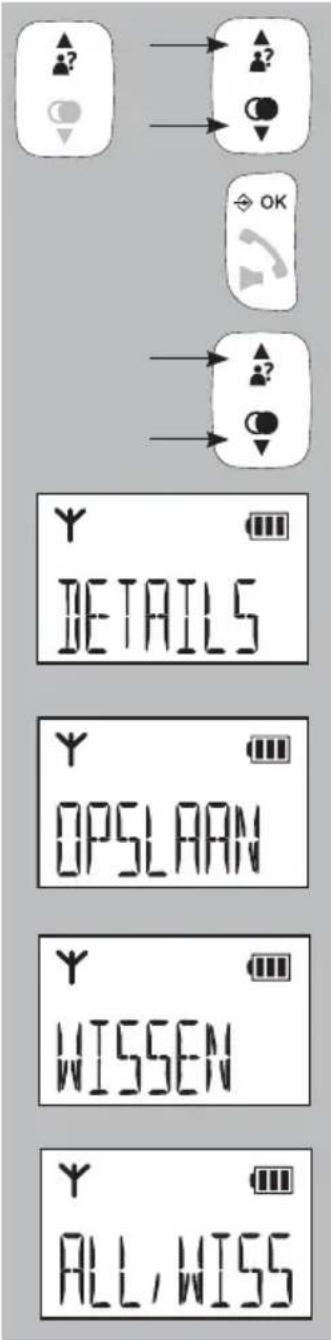
7.7 CARACTERES DISPONIBLES:
Ping Industrial Centre, Block 1, 57 Ting Kok Road, Tai Po, Hong Kong.
Alecto is a brand of Commaxx B.V. Wiebachstraat 37,6466 NG Kerkrade, The Netherlands

Service/Help?www.alecto.nl Support.alecto.nl

V2.1
INDHOLDSFORTEGNEALSE
1 OVERSIGT
1.1 HANDSET 5
1.2 DISPLAY 7
1.3 GRUNDLAEGGENDE 8
2 INSTALLATION
2.1 BASIS 9
2.2 HANDSAET 10
2.3 EKSTRA HANSDAET OG OPLADERE 10
3 TELEFONER
3.1 TELEFONERING MED HANDSAET ELLER HANDFRI 11
3.2 BLIVE RINGET OP 11
3.3 AFBRYD FORBINDELSEN 11
3.4 RING NUMRE 12
3.5 RING 14
3.6 MODTAGELSESVOLUME
3.7 OPKALDSVARIGHED 15
3.8 R/FLASH-FUNKTION 15
3.9 HANSDAET-SOGEFUNKTION 15
3.10 SLUK HANDSAET 16
4 NUMBER REDIAL
4.1 INTRODUKTION 1
4.2 REDIAL 17
4.3 GEMELLERSLET 17
5 CALLER ID
5.1 INTRODUKTION 19
5.2 INDIKATION AF NYT OPKALD 19
5.3 HUKOMMELSESVISNING OG TILBAGEKALDELSE 19
5.4 DETALJER, GEM ELLER SLET 20
5.5 YDERLIGERE OPLYSNINGER 21
6 INDIKATION AF VOICE MAIL
6.1 INTRODUKTION 22
6.2 INDIKATION AF NY VOICE MAIL 22
7 TELEFONBOGSHUKOMMALSE
7.1 INTRODUKTION 23
7.2 SLAKONTAKT OP OG RING 23
7.3 TILFØJ, AENDR ELLER SLET KONTAKTER 24
7.4 DIREKTE HUKOMMELSER 27
7.5 SE KONTAKTER 29
7.6 HUKOMMELSESSTATUS 30
7.7 TILGAENGELIGETEGN 30
8 SAMTALEANLæG, OVERFØRSEL OG KONFERENCE
8.1 INTRODUKTION 31
8.2 INTERCOM 31
8.3 OMSTILLING/KONFERENCEOPKALD 32
9 UR & ALARM (VAEKNING) FUNKTION
9.1 INTRODUKTION 34
9.2 INDSTILLING AF TID OG DATO 34
9.3 AKTIVERING/DEAKTIVERING AF ALARM OG INDSTILLING AF ALARMTID.... 35
9.4 BETJENING AF ALARM 36
10 HANSDAETTETS PRAEFERENCER
10.1 INTRODUKTION 37
10.2 HANSDAETTETSINDSTILLINGSMENU 37
11 GRUNDLAGGENDE PRÄFERENCER
11.1 INTRODUKTION 39
11.2 MENU FOR GRUNDLAEGGENDE INDSTALLINGER 39
12 NULSTIL PRAEFERENCER
12.1 INTRODUKTION 41
12.2 MENU TIL NULSTILLING AF PRAREFERENCES 41
12.3 FABRIKSINDSTILLINGER 42
13 EKSTRA HANDSAET
13.1 INTRODUKTION 43
13.2 REGISTRERING AF HANDSæT 43
13.3 TIPS OM MULTIHANDSAET 44
13.4 AFMELDING AF HANSDAET 44
14 TIPS OG ADVARSLER
14.1 GENERELT 45
14.2 INSTALLATION 45
14.3 INSTALLATION 45
14.4 RANGE 46
14.5 STRØMFORSYNING Händsæt 46
14.6 HOREAPPARAT 47
14.7 MEDICINSKUDSTYR 47
14.8 NETSVIGT 47
14.9 REMOTE 47
14.10 VEDLIGEHOLDELSE 48
14.11 MILJ0 48
15 MULIGE PROBLEMER OG LØSNINGER
15.1 PROBLEMER MED UDGÄENDE OPKALD 48
15.2 PROBLEMER MED INDGAENDE OPKALD 49
15.3 PROBLEMER UNDER OPKALD 49
15.4 PROBLEMER MED OPKALDS-ID 50
15.5 ANDET 50
16 OVERENSSTEMMELSESERKLÄERING 51
17 SPECIFICATIONER 51
18 GARANTIBETINGELSER 53
1 OVERBLIK
lampe; blinker, nár du bliver ringet op, lyser konstant, nár BOOST-funktionen er taendt
1.1 HANDSET:
2.3 EKSTRA HANDSAET OG OPLADERE:
3.9 HANSDAETTETS SOGEFUNKTION:

5.4 DETALJER, GEMME ELLER SLETTE:
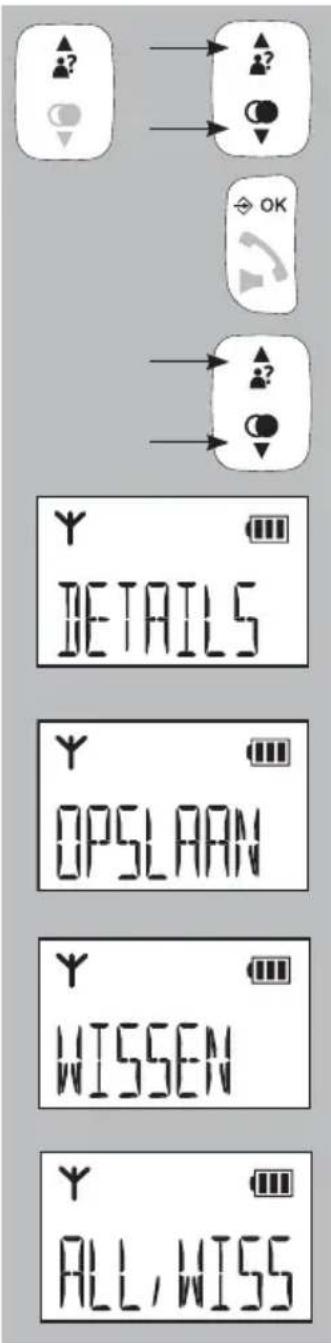
8.3 OVERFØRSEL/KONFERENCEOPKALD:
2x

under det eksterne opkald, tryk 2x på tasten OK
Ping Industrial Centre, Block 1, 57 Ting Kok Road, Tai Po, Hong Kong.
Model identifier: VT05EEU06045
Alecto is a brand of Commaxx B.V. Wiebachstraat 37,6466 NG Kerkrade, The Netherlands

Service/Help?www.alecto.nl Support.alecto.nl

V2.1
INNEHÄLLSFORTECKNING
1 OVERSIKT
1.1 HANDSET 5
1.2 DISPLAY 7
1.3 GRUNDLAGGANDE 8
2 INSTALLATION
2.1 BASIS 9
2.2 HANDLUR 10
2.3 EXTRA HANDENHETER OCH LADDARE 10
3 TELEFONER
3.1 TELEFONERING MED LUREN ELLER HANDSFREE 11
3.2 BLI RINGD 11
3.3 KOPPLA FRAN 11
3.4 RINGA NUMMER 12
3.5 RING 14
3.6 MOTTAGNINGSVOLYM 14
3.7 SAMTALETS VARAKTIGHET 15
3.8 R/FLASH-FUNKTION 15
3.9 SOKFUNTION FOr HANDENHET 15
3.10 STANGA AV LUREN 16
4 NUMMER REDIAL
4.1 INTRODUKTION 17
4.2 REDIAL 17
4.3 SPARA ELLER RADERA 17
5 UPPRINGAR-ID
5.1 INTRODUKTION 19
5.2 INDIKATION FÖR NYTT SAMTAL 19
5.3 MINNESVY OCH ATERUPPRINGNING 19
5.4 DETALJER, SPARA ELLER RADERA 20
5.5 YTTERLIGARE INFORMATION 21
6 INDIKERING AV RÖSTBREVLÄDA
6.1 INTRODUKTION 22
6.2 INDIKATION PÄ NYTT RÖSTMEDDELANDE 22
7 MINNE FÖR TELEFONBOK
7.1 INTRODUKTION 23
7.2 SOKA UPP KONTAKT OCH RINGA 23
7.3 LAGG TILL, ANDRA ELLER TA BORT KONTAKTER 24
7.4 DIREKTMINNEN 27
7.5 VISA KONTAKTER 29
7.6 MINNESSTATUS 30
7.7 TILLGANGLIGA TECKEN 30
8.1 INTRODUKTION 31
8.2 INTERCOM 31
8.3 OVERFORING/KONFERENSSAMTAL 32
9 KLOCKA & ALARM (VÄCKNING) FUNKTION
9.1 INTRODUKTION 34
9.2 STALLA IN TID OCH DATUM 34
9.3 AKTIVERA/AVAKTIVERA LARM OCH STÄLLA IN LARMTID 35
9.4 ANVANDALARM 36
10 INSTALLNINGAR FOR HANDENHET
10.1 INTRODUKTION 37
10.2 MENY FOR HANDSETINSTÄLLNINGAR 37
11 GRUNDLAGGANDE PREFERENSER
11.1 INTRODUKTION 39
11.2 MENY FOR GRUNDLAGGANDE INSTÄLLNINGAR 39
12 ATERSTÄLL INSTALLNINGAR
12.1 INTRODUKTION 41
12.2 MENY FOR ATERSTÄLLNING AV INSTALLINGAR 41
12.3 FABRIKSINSTÄLLNINGAR 42
13 EXTRA HANDSÄTT
13.1 INTRODUKTION 43
13.2 REGISTRERING AV HANDENHETER 43
13.3 TIPS OM MULTIHANDSET 44
13.4 AVREGISTRINGAVHANDENHETER 44
14 TIPS OCH VARNINGAR
14.1 ALLMÄNT 45
14.2 INSTALLATION 45
14.3 INSTALLATION 45
14.4 RANGE 46
14.5 STRÖMFÖRSSÖRJNING HANDENHET 46
14.6 HORSELHJALP 47
14.7 MEDICINTEKNISKA PRODUKTER 47
14.8 FEL PÄ ELNÄTET 47
14.9 FJARRKONTROLL 47
14.10 UNDERHALL 48
14.11 MILJÖ 48
15 EVENTUELLA PROBLEM OCH LÖSNINGAR
15.1 PROBLEM MED UTGAENDE SAMTAL 48
15.2 PROBLEM MED INKOMMANDE SAMTAL 49
15.3 PROBLEM NÄR DU RINGER 49
15.4 PROBLEM MED NUMMERPRESENTATION 50
15.5 OVRIGT 50
16 FORSAKRAN OM OVERENSSTAMMELSE 51
17 SPECIFICATIONER 51
18 GARANTIVILLKOR 53
1 ÖVERSIKT
1.1 HANDSET:
5.2 INDIKATION NYTT SAMTAL:
I Telefonlurens display visas hur mga ngaSampler du har tagit emot sedan du senast öppnade minnet.
5.3 MINNE OCH RING TILLBAKA:
7 MINNE FÖR TELEFONBOK
7.1 INLEDNING:
Uppringning: TON (DTMF)
FLASH: 100,300&600mS,justerbar
Boost-forstärkning: +9dB
Ping Industrial Centre, Block 1, 57 Ting Kok Road, Tai Po, Hong Kong.
Utgangsspanning: 6,0 V DC
Utgangsström: 0,45 A
Utgangseffekt:2,7W
Alecto is a brand of Commaxx B.V. Wiebachstraat 37,6466 NG Kerkrade, The Netherlands

Service/Help?www.alecto.nl Support.alecto.nl

V2.1
SISÄLLYSLUETTELO
1 KATSAUS
1.1 HANDSET 5
1.2 NAYTTÖ 7
1.3 PERUSOHJELMAT 8
2 ASENNUS
2.1 PERUSTIEDOT 9
2.2 KAsIPUHELIN 10
2.3 LISALUURIT JA -LATURIT 10
3 PUHELIMET
3.1 PUHELU LUURILLA TAI HANDSFREE-JARJESTELMALLA 11
3.2 SITOUTUMINEN 11
3.3 PURKAA YHTEYTTA 11
3.4 NUMEROIDEN VALINTA 12
3.5 SOITA 14
3.6 VASTAANOTON AENENOIMAKKUUS 14
3.7 PUHELUN KESTO 15
3.8 R/FLASH-TOIMINTO 15
3.9 LUURIN HAKUTOIMINTO 15
3.10 LUURIN SAMMUTTAMINEN 16
4 NUMERO REDIAL
4.1 INTRODUCTION 17
4.2 REDIAL 17
4.3 TALLENNA TAI POISTA 17
5 SOITTAJAN TUNNUS
5.1 TUTUSTUMINEN 19
5.2 UUDEN PUHELUN ILMOITUS 19
5.3 MUISTINAKYMA JA TAKAISINSOITTO 19
5.4 TIEDOT, TALLENNA TAI POISTA 20
5.5 LISÄTIEDOT 21
6 PUHEPOSTIN NÄYTTÖ
6.1 JOHDANTO 22
6.2 UUDEN VASTAAJAN ILMOITTAMINEN 22
7 PUHELINLUETTELEN MUISTI
7.1 KAYTTÖONOTTO 23
7.2 YHTEYSTIEDON ETSIMINEN JA SOITTAMINEN 23
7.3 YHTEYSTIETOJEN LISAAMINEN, MUUTTAMINEN TAI POISTAMINEN 24
7.4 SUORAMUIISTIT 27
7.5 YHTEYSTIETOJEN TARKASTELU 29
7.6 MUISTIN TILA 30
7.7 KAYTETTAVISSAOLEVATMERKIT 30
8 SISAPUHELIN, SIIRTO JA KONFERENSSI
8.1 JOHDANTO 31
8.2 INTERCOM 31
8.3 SIIRTO/NEUVOTTELUPUHELU 32
9 KELLO- JA HERATYSTOIMINTO (HERATYS)
9.1 JOHDANTO 34
9.2 KELLONAJAN JA PÄIVÄMÄÄRÄN ASETTAMINEN 34
HÁLYTYKSEN OTTAMINEN KAYTTOÖN/POIS KAYTÖSTÀ JA HÁLYTYSAJAN
9.3 ASETTAMINEN 35
9.4 HALYTYKSEN KAYTTÖ 36
10 LUURIN ASETUKSET
10.1 JOHDANTO 37
10.2 LUURIN ASETUKSET -VALIKKO 37
11 PERUSMIELTYMYKSET
11.1 JOHDANTO 39
11.2 PERUSASETUSTENVALIKKO 39
12 ASETUSTEN PALAUTTAMINEN
12.1 JOHDANTO 41
12.2 VALIKKO ASETUSTEN PALAUTTAMISTA VARTEN 41
12.3 TEHDASASETUKSET 42
13 LISAKASITTEET
13.1 JOHDANTO 43
13.2 LUURIEN REKISTERÖINTI 43
13.3 VINKKEJAMONIPUHELIMIIN 44
13.4 LUURIEN POISTAMINEN REKISTERISTA 44
paina nappainta 4x令 OK
Vtech Telecommunications LTD, 23/F., Tai
Ping Industrial Centre, Block 1, 57 Ting Kok Road, Tai Po, Hong-kong.
Mallin tunniste: VT05EEU06045.
Alecto is a brand of Commaxx B.V. Wiebachstraat 37,6466 NG Kerkrade, The Netherlands

Service/Help?www.alecto.nl Support.alecto.nl

V2.1
SPIS TRESCI
1 PRZEGLAD
1.1 ZESTAWRECZNY 5
1.2 WYSWIETLACZ 7
1.3 PODSTAWY 8
2 INSTALACJA
2.1 PODSTAWA 9
2.2 ZESTAW SUSHAWKOWY 10
2.3 DODATKOWE SUSHAWKI I LADOWARKI 10
3 TELEFONY
3.1 TELEFONOWANIE ZA POMOCA SLUCHAWKI LUB ZESTAWU GLOSNOMOWIACEGO..11
3.2 BYCPOLACZONYM 11
3.3 ROZLACZ 11
3.4 WYBIERANIE NUMEROW 12
3.5 POlACz 14
3.6 GLOsNOscODBIORU 14
3.7 CZAS TRWANIA POŁACZENIA 15
3.8 FUNKCJA R/FLASH 15
3.9 FUNKCJA WYSZUKIWANIA SLUCHAWKI 15
3.10 WYLACZANIE SUSHAWKI 16
4 WYBIERANIE NUMERU
4.1 WPROWADZENIE 17
4.2 REDIAL 17
4.3 ZAPISZ LUB USUN 17
5 IDENTYFIKATOR DZWONIACEGO
5.1 WPROWADZENIE 19
5.2 WSKAZANIE NOWEGO POŁACZENIA 19
5.3 WIDOK PAMIECI I ODDZWANIANIE 19
5.4 SZCZEGOly, ZAPISYWANIE LUB USUWANIE 20
5.5 DODATKOWE INFORMACJE 21
6 WSKAZANIEPOCZTYGLOSOWEJ
6.1 WPROWADZENIE 22
6.2 WSKAZANIE NOWEJ POCZTY GLOSOWEJ 22
7 PAMIEC KSIAZKI TELEFONICZNEJ
7.1 WPROWADZENIE 23
7.2 WYSZUKIWANIE KONTAKTOWI POŁACZEN 23
7.3 DODAWANIE, MODYFIKOWANIE LUB USUWANIE KONTAKTOW 24
7.4 PAMIECI BEZPOSREDNIE 27
7.5 PRZEGLADANIE KONTAKTOW 29
7.6 STATUS PAMIECI 30
7.7 DOSTEPNE ZNAKI 30
8 INTERKOM, TRANSFERIKONFERENCJA
8.1 WPROWADZENIE 31
8.2 INTERCOM 31
8.3 TRANSFER/POLACZENIE KONFERENCYJNE 32
9 FUNKCJA ZEGARA I ALARMU (BUDZENIA)
9.1 WPROWADZENIE 34
9.2 USTAWIANIE GODZINYI DATY 34
9.3 WlACZANIE/WYLACZANIE ALARMU I USTAWIANE CZASU ALARMU 35
9.4 OBSLUGA ALARMU 36
10 PREFERENCJE SŁUCHAWKI
10.1 WPROWADZENIE 37
10.2 MENU PREFERENCJI SLUCHAWKJ 37
11 PODSTAWOWE PREFERENCJE
11.1 WPROWADZENIE 39
11.2 MENU PREFERENCJI PODSTAWOWYCH 39
12 RESETOWANIE PREFERENCJI
12.1 WPROWADZENIE 41
12.2 MENU RESETOWANIA PREFERENCJI 41
12.3 USTAWIENIA FABRYCZNE 42
13 DODATKOWE ZESTAWY SŁUCHAWKOWE
13.1 WPROWADZENIE 43
13.2 REJESTRACJA SLUCHAWEK 43
13.3 WSKAZOwKI DOTYCZACE WIELU ZESTAWOW SLUCHAWKOWYCH 44
13.4 WYREJESTROWANIE SLUCHAWEK 44
9.4 ALARM OPERACYJNY:
Ping Industrial Centre, Block 1, 57 Ting Kok Road, Tai Po, Hong Kong.
Identityfikator modelu : VT05EEU06045
Alecto is a brand of Commaxx B.V. Wiebachstraat 37,6466 NG Kerkrade, The Netherlands

Service/Help?www.alecto.nl Support.alecto.nl

V2.1