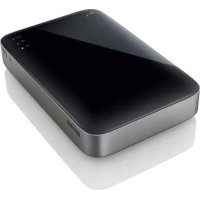
MiniStation Air - External hard drive BUFFALO - Free user manual and instructions
Find the device manual for free MiniStation Air BUFFALO in PDF.



| Product type | External wireless hard drive |
| Brand | Buffalo |
| Model | MiniStation Air (HDW-PU3) |
| Dimensions | 130 x 84 x 23 mm |
| Weight | Approximately 285 g |
| Power supply | 5 V DC, ~7 W |
| Battery | Internal lithium-ion 2860 mAh |
| Charging time | Approximately 4.5 hours |
| Wired connection | USB 3.0 Micro-B (compatible with USB 2.0/1.1) |
| Wireless connection | Wi-Fi 802.11b/g/n (2.4 GHz) |
| Default format | FAT32 |
| Wireless security | WPA2-PSK, WPA-PSK, WEP (128/64-bit) |
| Maximum number of wireless clients | 3 |
| Compatible operating systems | Windows 8/7/Vista/XP, Mac OS X 10.5+, iOS 4.3+, Android 2.3+ |
| Operating temperature | 5 to 35 °C |
| Operating humidity | 0 to 80 % (without condensation) |
| Maintenance and cleaning | Wipe with a soft, dry cloth. Do not use chemical products. |
| Safety | Do not expose to water, do not disassemble the battery, keep away from children. |
| Spare parts and reparability | Battery not replaceable by user. Contact Buffalo technical support. |
Frequently Asked Questions - MiniStation Air BUFFALO
User questions about MiniStation Air BUFFALO
0 question about this device. Answer the ones you know or ask your own.
Ask a new question about this device
Download the instructions for your External hard drive in PDF format for free! Find your manual MiniStation Air - BUFFALO and take your electronic device back in hand. On this page are published all the documents necessary for the use of your device. MiniStation Air by BUFFALO.
USER MANUAL MiniStation Air BUFFALO
LEDs and Connections 4
2. Recommended Usage 6
Battery Handling Guidelines and Safety Precautions 6
Computer Connection (USB Connection) Guidelines 7
Notes 8
3. Formatting 10
What is Formatting? 10
For Windows users 10
For Mac users 10
Formatting Notes 10
Formatting with NTFS (Windows) 10
Formatting with FAT32 (Mac) 12
4. Specifications 15
Specifications 15
USB Interface Specifications 16
Wireless Interface Specifications 16
5. Regulatory Compliance Information 17
1. Layout
LEDs and Connections
Top
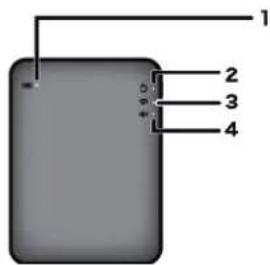
1 Battery LED
Turns on while the unit is charging.
Glowing red : charging
Glowing green : fully charged
2 Power LED
This LED shows the status of the unit.
Glowing green : power on (If not accessed for 5 minutes, the drive goes into sleep mode and the LED turns off .)
Flashing green : The drive is being accessed.
Glowing red : Indicates that the remaining battery power level has dropped below 25%. Charging is recommended.
3 Wireless LED
Indicates the status of the unit's wireless.
Glowing blue : power on
Flashing blue : wireless communication in progress
4 AOSS LED
Indicates the AOSS status.
Glowing red : Connection by AOSS is complete. (After glowing for 1 minute, the LED turns off .)
Double-fl ashes (red) : The unit is looking for another AOSS device to connect to.
Flashing red : AOSS connection error. The LED will turn off after 60 seconds.
Bottom
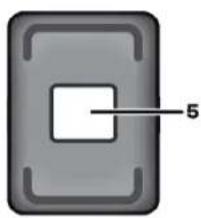
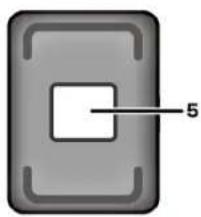
5 Wireless Security Label
This label shows the default settings for connecting to the device wirelessly.
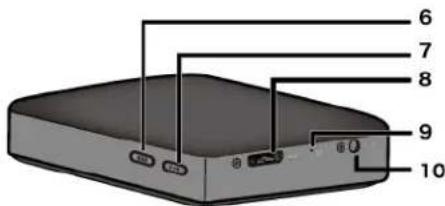
Side
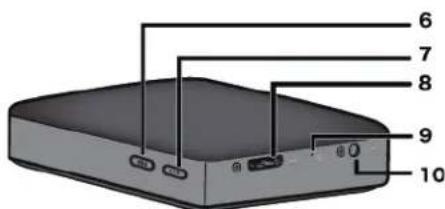
6 AOSS Button
With the power on, hold down this button until the AOSS LED starts flashing (about 2 seconds) to start AOSS.
7 Power Button
Press to turn the unit on. To turn it off, hold it down until the power LED turns red.
8 USB Connector
To connect to a computer, connect the supplied USB data cable to this port.
9 Reset Button
To reset the unit to its factory default settings, use a straightened paperclip to hold down this recessed button until the power LED turns red. The MiniStation Air should be connected to power while you do this.
10 Power Connector
To charge the unit, connect the supplied USB power cable to this port.
2. Recommended Usage
Battery Handling Guidelines and Safety Precautions
This product includes an internal lithium-ion battery. Please follow the safety precautions below.
If the battery pack is leaking fluid, do not come into contact with the fluid.
Battery fluid can cause burns. Also, if the fluid gets on your skin or clothes, immediately rinse the fluid off with water, and seek medical attention. If the fluid gets in your eyes, it can lead to permanent loss of eyesight, and so immediately flush your eyes thoroughly with clean water and seek medical treatment.
Never get the battery pack wet, or put it inside water or other liquids.
This can cause overheating, rupture, ignition, or a failure of the battery pack. If the battery pack gets wet, immediately stop usage, and contact the Buffalo Technology Support Center or your local dealer.
Never disassemble or modify the battery pack.
This could cause the fluid in the battery pack to splash out, which can lead to permanent loss of eyesight if it gets into your eyes, or can lead to overheating, rupture, or ignition of the battery.
Charge the unit periodically.
Charging the unit can prevent loss of performance over time.
When charging is complete, remove the USB power cable from this unit.
Do not expose the battery to heat or fire, or store in a hot place. Avoid exposure to direct sunlight.
Do not drop the battery on hard surfaces or expose it to mechanical shock.
Keep the battery out of the reach of children.
If the battery is swallowed, seek medical advice immediately.
Even when the MiniStation Air is turned off, standby mode consumes a small amount of power.
A fully charged battery will last about a week.
The battery should be charged before use.
Always use the correct charger and refer to this manual for the proper charging procedure.
Do not leave the battery connected to the charger when not in use.
After extended periods of storage, it may be necessary to charge and discharge the battery several times to obtain maximum performance.
The battery gives its best performance at normal room temperature (65irc - 80ircF)
Retain the original product literature for future reference.
Computer Connection (USB Connection) Guidelines
To avoid damage to data, follow these precautions:
Never configure this unit as a destination for virtual memory.
Never do any of the following while the power LED is blinking:
- unplug the USB data cable
- turn off your computer
- put your computer into standby, hibernate, or sleep mode
The MiniStation Air supports hot-plugging.
You can plug or unplug the USB data cable even if it and your PC are on. However, never unplug the USB data cable while the power LED is blinking, or your data may be lost or damaged.
To charge the MiniStation Air, connect the USB power cable to a port on your computer.
The USB data cable may also charge the unit, but at reduced power because its power is also being used to run the hard drive.
If the MiniStation Air does not operate normally, the problem might be that your computer doesn't provide enough power through the data cable.
Try attaching the USB power cable to an AC adapter with a USB port.
Booting Windows from this drive is not supported.
The MiniStation Air supports USB 3.0.
If it is connected to a USB 2.0 or USB 1.1 port, Windows may display a message that a high speed USB device is connected to a non high-speed USB device. To continue, click "X".
You may hear some noise while the MiniStation Air is working, especially when it is booting or being accessed. This is normal.
Notes
The following restrictions apply to this product. Please check these points before use.
While the MiniStation Air is connected to a computer with the USB data cable, Wi-Fi is disabled.
Unplug the USB data cable before connecting wirelessly.
To charge this unit, it is recommended that you use the supplied USB power cable together with an AC adapter with USB port provided with a smartphone or other device to connect this unit to an outlet.
If the USB power cable is used to connect to a computer, the supplied power varies depending on the computer. This means that the charging time will also vary depending on your computer. Although the battery LED turns on when the unit is connected to a computer by the USB data cable, the power is also being used to run the unit, and so the charging time will be longer than when the unit is idle (in certain cases, the unit may hardly be charged at all).
If this unit is charged while connected wirelessly, the battery LED may turn off and charging may not be performed in certain cases.
If this unit is charged while connected wirelessly, the internal temperature of the unit can be come hot. If this happens, to prevent unit damage due to overheating, the battery LED turns off, and charging is stopped. Once the internal temperature of the unit drops, charging is restarted automatically.
The battery in this unit cannot be removed.
After the power is turned on, it takes about 1 minute for the unit to boot. During startup, the power can't be turned off.
After the unit is booted normally, hold down the power button for 3 seconds to turn off the power.
Do not shake or drop the MiniStation Air during boot. This could damage the hard drive.
Do not lean any object against MiniStation Air. It may cause the unit to malfunction.
To use files that are 4 GB or larger, reformat with NTFS.
To use the MiniStation Air with Mac OS, leave it in FAT32. The MiniStation Air does not support HFS+.
A maximum of three devices can be connected wirelessly at the same time.
The MiniStation Air selects wireless channels automatically. There is no provision for locking communication to a single fixed channel.
When the MiniStation Air is connected to the Internet through a wireless router, the wireless throughput to and from your portable device drops to half.
With this configuration, only a single connected wireless device is recommended.
Press the AOSS button on the MiniStation Air to connect to your smartphone or other wireless client.
WPS is not supported.
The wireless channel cannot be changed manually.
The auto channel only is supported.
The client-side IP address of the MiniStation Air is fixed at "10.10.10.254".
3. Formatting
What is Formatting?
Formatting is an operation that enables a hard drive to be used on your computer.
This unit is formatted with FAT32 by default, and so it can be used without any additional formatting procedure.
However, due to the restrictions of the FAT32 format, this unit cannot save files that are 4 GB or larger in size.
For Windows users
Reformatting with NTFS is recommended for most Windows users. This will let you save files that are 4 GB or larger. However, Macs will not be able to write to the dive if it is formatted with NTFS.
For Mac users
Keeping the default FAT32 format partition is recommended for Mac users. If the MiniStation Air is reformatted with HFS+, files on it will no longer be accessible from your iPhone, iPad, iPod touch, Android phones, or other portable device. If you have already reformatted the MiniStation Air with a different partition, use the procedure in this manual to reformat it with FAT32.
Formatting Notes
Never unplug, reset, or turn off the computer during the formatting process. This could result in damage to the drive or other problems. Proper operation cannot be guaranteed if the format process is interrupted.
Formatting will erase all data on the hard drive. Before formatting, back up any data.
The user is responsible for any data lost due to formatting of the hard drive.
Don't format the wrong drive! Check the drive letter and partition name carefully. If you format the wrong drive, all data on it will be lost.
Formatting with NTFS (Windows)
If you use a Windows computer primarily, you may reformat the MiniStation Air with NTFS. This will allow files larger than 4 GB to be saved.
Note:
Most Mac computers cannot save data to an NTFS drive.
1 Use the supplied USB data cable to connect this unit to your computer.
2 Select Start - Computer (My Computer).
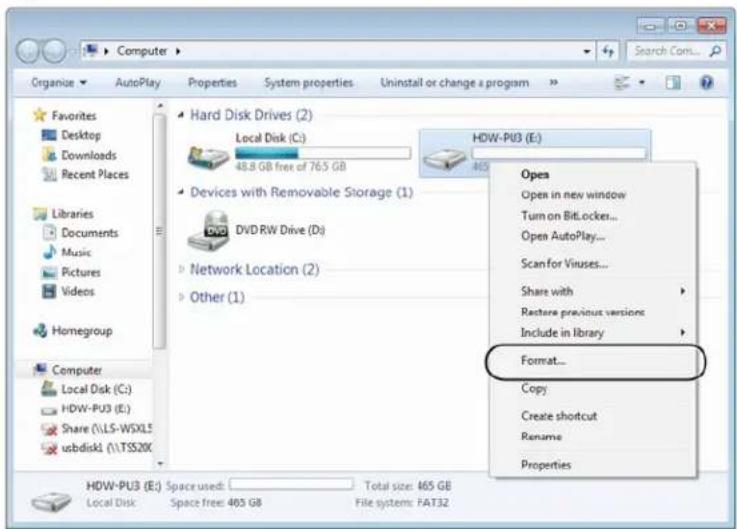
3 Right-click the icon for this MiniStation Air and select Format from the right-click menu.
4
- Select NTFS for the file system.
- Insert a checkmark for Quick Format.
- Click Start.
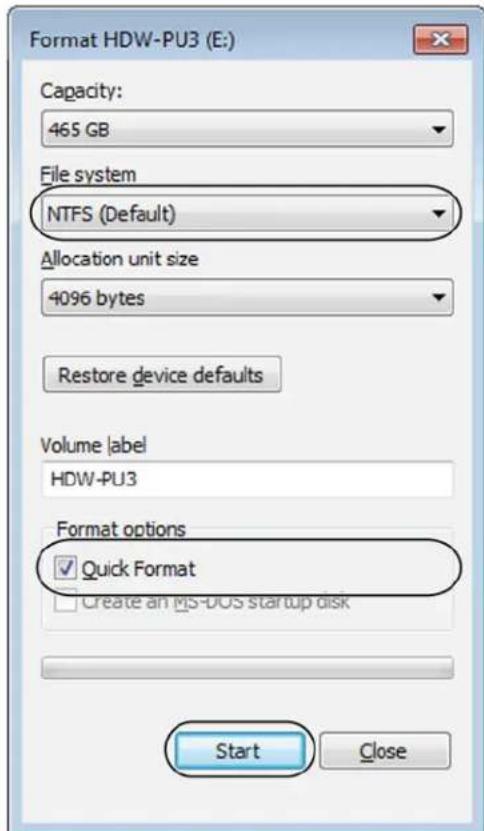
5 Click OK.
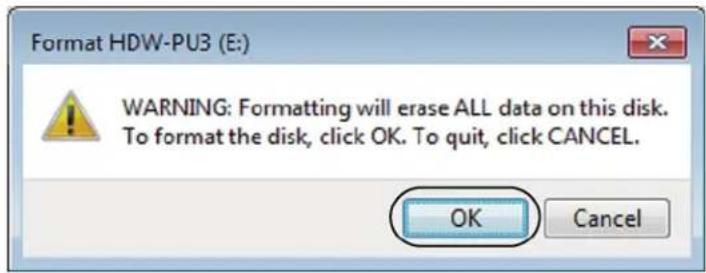
6 Click OK.
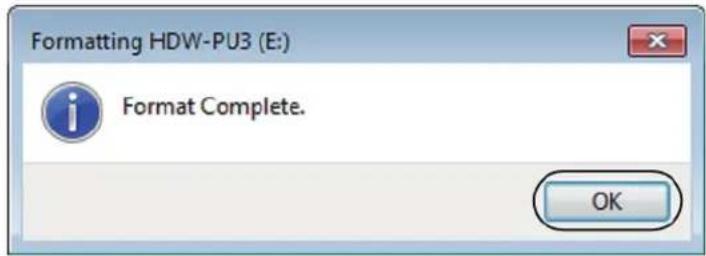
This completes the formatting process.
Formatting with FAT32 (Mac)
FAT32 formatting is recommended if the MiniStation Air will be used with non-Windows computers such as Macs. After formatting with FAT32, only files of 4 GB or smaller can be saved to the drive. This is the default format on the drive. If the drive has been reformatted with NTFS and you want to use it with a Mac, follow the procedure below to reformat it with FAT32 from your Mac.
Note:
HFS+ is not recommended for this drive because it is not compatible with iOS and Android devices. If you accidentally reformatted the drive with HFS+, use the procedure below to restore it to FAT32 from your Mac.
1 Use the supplied USB data cable to connect this unit to your Mac.
2 Click to select the Finder.
3 Select Go - Utilities.

Finder

Edit

Go
Window
Help
4 Double-click Disk Utility.
5
- Click the disk to be formatted.
- Confirm that you are about to format the right drive!
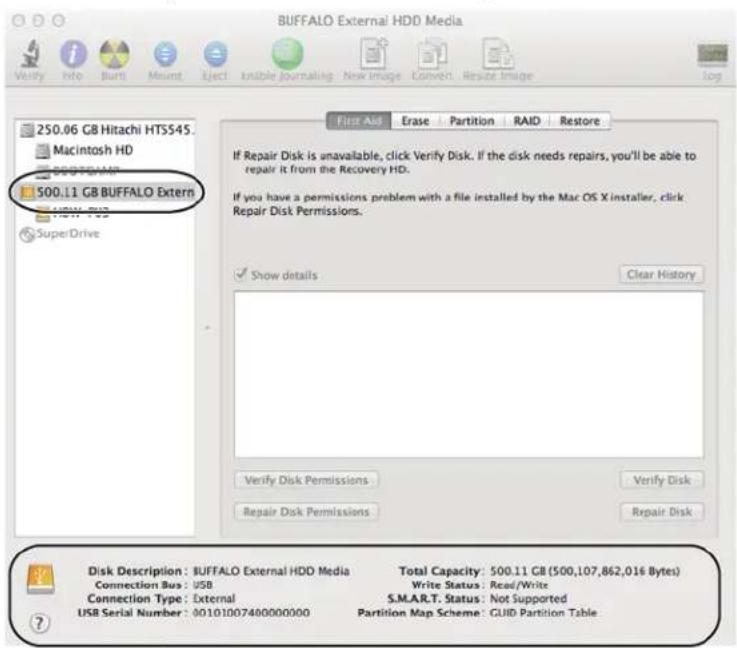
6
- Click Partition.
- Select 1 Partition.
- Select MS-DOS (FAT) for the formatting type.
- Click Apply.
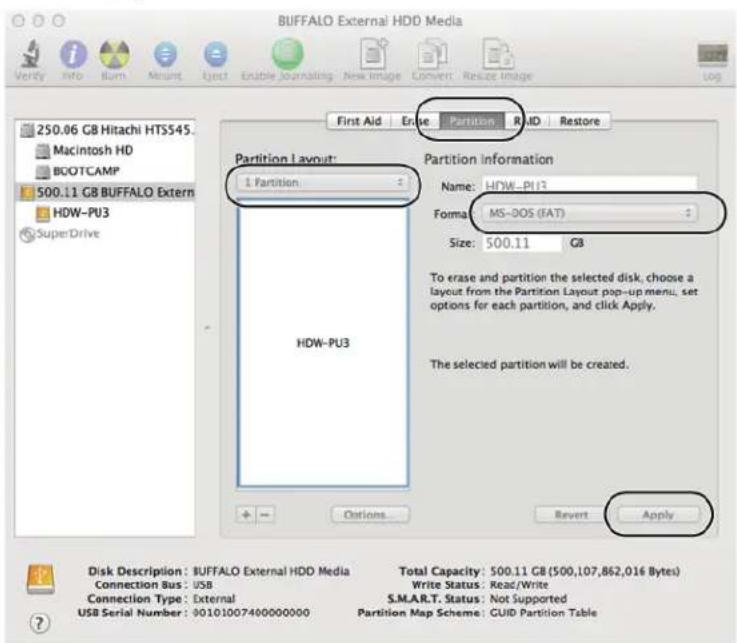
7 Click Partition.
Are you sure you want to partition the disk "BUFFALO External HDD Media"?
Partitioning this disk will delete all the data on this disk.
This partition will be erased: "HDW-PU3"
This partition will be added: "HDW-PU3"
Cancel
Partition
This completes the formatting process.
4. Specifications
For the most up-to-date information and products, go to www.buffalotech.com.
Specifications
| Factory defaults FAT32 | ||
| External dimensions | 130×84×23 mm; 5.12"×3.31"×0.91" (excluding protruding parts) | |
| Internal battery Internal lithium-ion battery (2860 mAh) | ||
| Input voltage DC 5 V ± 5 % (when charged from a computer) | ||
| Power consumption ~ 7 W | ||
| Full-charge time approx. 4.5 hours * | ||
| Weight approx. 285 g | ||
| Operating environment | 5 - 35°C | |
| 0 - 80% | ||
| Compatible PCs (USB connection) | Windows with USB 3.0/2.0 ports Mac (models with Intel Processor) with USB 3.0/2.0 ports | |
| Compatible smartphones and tablet devices (Wireless connection) | iPhone, iPad, iPod touch (4th generation), Android smartphones and tablet devices | |
| Compatible OS | PCs | Windows 8 (32-bit or 64-bit) Windows 7 (32-bit or 64-bit) Windows Vista (32-bit or 64-bit) Windows XP (32-bit) OS X 10.5 or later (OS X 10.7 or later required for USB 3.0 connection.) |
| iPhone/iPad/iPod touch | iOS 6.0 or later iOS 5.0 or later iOS 4.3 or later | |
| Android devices | Android 4.0 or later Android 3.0 or later Android 2.3 or later | |
- Some computers (especially older models) may not be able to provide the USB power cable with the constant 5 V it needs to charge the MiniStation Air. Charging may take much longer, or not occur at all. If you experience this problem, connect the MiniStation Air to an AC adapter with USB port for charging. The adapters provided with smartphones and tablets often work well.
USB Interface Specifications
| Interface USB 3.0 (USB 2.0) | |
| Connector USB 3.0 micro-B | |
| Transfer speed | USB 3.0: ~ 5 Gbps* USB 2.0: ~480 Mbps* |
- Connect the unit to a USB 3.0 port for the best transfer speeds. The unit will function when connected to a USB 2.0/1.1 port, but data transfer will be much slower.
Wireless Interface Specifications
| Standard compliance | IEEE802.11n IEEE802.11g IEEE802.11b |
| Transmission method | Direct Sequence Spread Spectrum (DSSS) OFDM |
| Frequency range 2.4 GHz (1 ~ 11ch) | |
| Security | WPA2-PSK (AES/TKIP) WPA-PSK (AES/TKIP) WEP (128-bit or 64-bit) |
| Access mode | Infrastructure mode AP/SAT |
5. Regulatory Compliance Information
Federal Communication Commission Interference Statement
This equipment has been tested and found to comply with the limits for a Class B digital device, pursuant to Part 15 of the FCC Rules. These limits are designed to provide reasonable protection against harmful interference in a residential installation. This equipment generates, uses and can radiate radio frequency energy and, if not installed and used in accordance with the instructions, may cause harmful interference to radio communications. However, there is no guarantee that interference will not occur in a particular installation. If this equipment does cause harmful interference to radio or television reception, which can be determined by turning the equipment off and on, the user is encouraged to try to correct the interference by one of the following measures:
- Reorient or relocate the receiving antenna.
- Increase the separation between the equipment and receiver.
- Connect the equipment into an outlet on a circuit different from that to which the receiver is connected.
- Consult the dealer or an experienced radio/TV technician for help.
FCC Caution:
Any changes or modifications not expressly approved by the party responsible for compliance could void the user's authority to operate this equipment.
This device complies with Part 15 of the FCC Rules. Operation is subject to the following two conditions: (1) This device may not cause harmful interference, and (2) this device must accept any interference received, including interference that may cause undesired operation.
SAR information: 0.263 W/kg (1g)
CAUTION
RISK OF EXPLOSION IF BATTERY IS REPLACED BY AN INCORRECT TYPE.
DISPOSE OF USED BATTERIES ACCORDING TO THE INSTRUCTIONS.
Important Note - FCC Radiation Exposure Statement:
This equipment complies with FCC radiation exposure limits set forth for an uncontrolled environment. This equipment should be installed and operated with minimum distance 0.5cm between the radiator & your body.
This transmitter must not be co-located or operating in conjunction with any other antenna or transmitter.
The availability of some specific channels and/or operational frequency bands are country dependent and are firmware programmed at the factory to match the intended destination. The firmware setting is not accessible by the end user.
Industry Canada statement:
This Class B digital apparatus complies with Canadian ICES-003.
This device complies with RSS-210 of the Industry Canada Rules. Operation is subject to the following two conditions:
(1) This device may not cause harmful interference, and
(2) this device must accept any interference received, including interference that may cause undesired operation.
Important Note - Radiation Exposure Statement:
Note Importante - Declaration d'exposition aux radiations:
This equipment complies with IC radiation exposure limits set forth for an uncontrolled environment. This equipment should be installed and operated with minimum distance 0.5cm between the radiator and your body.
This device has been designed to operate with an antenna having a maximum gain of [5] dB. Antenna having a higher gain is strictly prohibited per regulations of Industry Canada. The required antenna impedance is 50 ohms.
Under Industry Canada regulations, this radio transmitter may only operate using an antenna of a type and maximum (or lesser) gain approved for the transmitter by Industry Canada. To reduce potential radio interference to other users, the antenna type and its gain should be so chosen that the equivalent isotropically radiated power (e.i.r.p.) is not more than that necessary for successful communication.
Europe - EU Declaration of Conformity
This device complies with the essential requirements of the R&TTE Directive 1999/5/EC. The following test methods have been applied in order to prove presumption of conformity with the essential requirements of the R&TTE Directive 1999/5/EC:
EN60950-1:2006+A11:2009
Safety of Information Technology Equipment
EN50385:(2002-08)
Product standard to demonstrate the compliance of radio base stations and fixed terminal stations for wireless telecommunication systems with the basic restrictions or the reference levels related to human exposure to radio frequency electromagnetic fields (110MHz - 40 GHz) - General public
EN 300 328 V1.7.1: (2006-10)
Electromagnetic compatibility and Radio spectrum Matters (ERM); Wideband Transmission systems; Data transmission equipment operating in the 2,4 GHz ISM band and using wide band modulation techniques; Harmonized EN covering the essential requirements of article 3.2 of the R&TTE Directive
EN 301 489-1 V1.9.2: (2011-09)
Electromagnetic compatibility and Radio Spectrum Matters (ERM); ElectroMagnetic Compatibility (EMC) standard for radio equipment and services; Part 1: Common technical requirements
EN 301 489-17 V2.1.1 (2009-05)
Electromagnetic compatibility and Radio spectrum Matters (ERM); ElectroMagnetic Compatibility (EMC) standard for radio equipment; Part 17: Specific conditions for Broadband Data Transmission Systems
EN 62209-2:2010: Part 2:
Procedure to determine the specific absorption rate (SAR) for mobile wireless communication devices used in close proximity to the human body (frequency range of 30 MHz to 6 GHz)
This device is a 2.4 GHz wideband transmission system (transceiver), intended for use in all EU member states and EFTA countries, except in France and Italy where restrictive use applies.
In Italy the end-user should apply for a license at the national spectrum authorities in order to obtain authorization to use the device for setting up outdoor radio links and/or for supplying public access to telecommunications and/or network services.
This device may not be used for setting up outdoor radio links in France and in some areas the RF output power may be limited to 10 mW EIRP in the frequency range of 2454 - 2483.5 MHz. For detailed information the end-user should contact the national spectrum authority in France.
Cesy [Czech]
Buffalo Technology Inc. timto prohlauje, ze tento HDW-PU3 je ve shodse zakladnimi pozadavky a dalsimi prislu-snymiustanovenimi smernice 1999/5/ES.
Dansk [Danish]
Hereby, Buffalo Technology Inc. declares that this HDW-PU3 is in compliance with the essential requirements and other relevant provisions of Directive 1999/5/EC.
Espanol [Spanish]
Lietuviu [Lithuanian]
Portugues [Portuguese]
Slovensko [Slovenian]
Buffalo Technology Inc. izjavlja, da je ta HDW-PU3 v skladu z bistvenimi zahtevami in ostalimi relevantnimi dolocili direktive 1999/5/ES.
Slovensky [Slovak]
Buffalo Technology Inc. tymto vyhlasuj, ze HDW-PU3 spina zakladne poziadavya a vsetky prisluanse ustanovenia Smernice 1999/5/ES.
Suomi [Finnish]
SAR information: 0.095 W/kg (10g)
Safety
This equipment is designed with the utmost care for the safety of those who install and use it. However, special attention must be paid to the dangers of electric shock and static electricity when working with electrical equipment. All guidelines of this manual and of the computer manufacturer must therefore be allowed at all times to ensure the safe use of the equipment.
Total Capacity:500.13 Gb (500.107,82.24) bytes
Write Status: Read Write
MAE7. Status: Not Supported
Farties Vap Schm : Oie Patten Tae

Are you sure you want to partition the disk "BUFFALO External HDD Media"?
Partitioning this disk will delete all the data on this disk.
This partition will be erased:
"HDW-PU3"
This partition will be added:
HDW-PU3
Cancel
Partition
Federal Communication Commission Interference Statement
This equipment has been tested and found to comply with the limits for a Class B digital device, pursuant to Part 15 of the FCC Rules. These limits are designed to provide reasonable protection against harmful interference in a residential installation. This equipment generates, uses and can radiate radio frequency energy and, if not installed and used in accordance with the instructions, may cause harmful interference to radio communications. However, there is no guarantee that interference will not occur in a particular installation. If this equipment does cause harmful interference to radio or television reception, which can be determined by turning the equipment off and on, the user is encouraged to try to correct the interference by one of the following measures:
- Reorient or relocate the receiving antenna.
- Increase the separation between the equipment and receiver.
- Connect the equipment into an outlet on a circuit different from that to which the receiver is connected.
- Consult the dealer or an experienced radio/TV technician for help.
FCC Caution:
Any changes or modifications not expressly approved by the party responsible for compliance could void the user's authority to operate this equipment.
This device complies with Part 15 of the FCC Rules. Operation is subject to the following two conditions: (1) This device may not cause harmful interference, and (2) this device must accept any interference received, including interference that may cause undesired operation.
SAR information: 0.263 W/kg (1g)
CAUTION
RISK OF EXPLOSION IF BATTERY IS REPLACED BY AN INCORRECT TYPE. DISPOSE OF USED BATTERIES ACCORDING TO THE INSTRUCTIONS.
Important Note - FCC Radiation Exposure Statement:
This equipment complies with FCC radiation exposure limits set forth for an uncontrolled environment. This equipment should be installed and operated with minimum distance 0.5cm between the radiator & your body.
This transmitter must not be co-located or operating in conjunction with any other antenna or transmitter.
The availability of some specific channels and/or operational frequency bands are country dependent and are firmware programmed at the factory to match the intended destination. The firmware setting is not accessible by the end user.
Industry Canada statement: Industrie Canada déclaration:
This Class B digital apparatus complies with Canadian ICES-003.
This device complies with RSS-210 of the Industry Canada Rules. Operation is subject to the following two conditions:
(1) This device may not cause harmful interference, and
(2) this device must accept any interference received, including interference that may cause undesired operation.
Important Note - Radiation Exposure Statement:
This equipment complies with IC radiation exposure limits set forth for an uncontrolled environment. This equipment should be installed and operated with minimum distance 0.5cm between the radiator and your body.
This device has been designed to operate with an antenna having a maximum gain of [5] dB. Antenna having a higher gain is strictly prohibited per regulations of Industry Canada. The required antenna impedance is 50 ohms.
Under Industry Canada regulations, this radio transmitter may only operate using an antenna of a type and maximum (or lesser) gain approved for the transmitter by Industry Canada.
To reduce potential radio interference to other users, the antenna type and its gain should be so chosen that the equivalent isotropically radiated power (e.i.r.p.) is not more than that necessary for successful communication.
Europe - EU Declaration of Conformity
This device complies with the essential requirements of the R&TTE Directive 1999/5/EC. The following test methods have been applied in order to prove presumption of conformity with the essential requirements of the R&TTE Directive 1999/5/EC:
EN60950-1:2006+A11:2009
Safety of Information Technology Equipment
EN50385:(2002-08)
Product standard to demonstrate the compliance of radio base stations and fixed terminal stations for wireless telecommunication systems with the basic restrictions or the reference levels related to human exposure to radio frequency electromagnetic fields (110MHz - 40 GHz) - General public
EN 300 328 V1.7.1: (2006-10)
Electromagnetic compatibility and Radio spectrum Matters (ERM); Wideband Transmission systems; Data transmission equipment operating in the 2,4 GHz ISM band and using wide band modulation techniques; Harmonized EN covering the essential requirements of article 3.2 of the R&TTE Directive
EN 301 489-1 V1.9.2: (2011-09)
Electromagnetic compatibility and Radio Spectrum Matters (ERM); ElectroMagnetic Compatibility (EMC) standard for radio equipment and services; Part 1: Common technical requirements
EN 301 489-17 V2.1.1 (2009-05)
Electromagnetic compatibility and Radio spectrum Matters (ERM); ElectroMagnetic Compatibility (EMC) standard for radio equipment; Part 17: Specific conditions for Broadband Data Transmission Systems
EN 62209-2:2010: Part 2:
Procedure to determine the specific absorption rate (SAR) for mobile wireless communication devices used in close proximity to the human body (frequency range of 30 MHz to 6 GHz)
This device is a 2.4 GHz wideband transmission system (transceiver), intended for use in
all EU member states and EFTA countries, except in France and Italy where restrictive use applies.
In Italy the end-user should apply for a license at the national spectrum authorities in order to obtain authorization to use the device for setting up outdoor radio links and/or for supplying public access to telecommunications and/or network services.
This device may not be used for setting up outdoor radio links in France and in some areas the RF output power may be limited to 10mW EIRP in the frequency range of 2454 - 2483.5 MHz. For detailed information the end-user should contact the national spectrum authority in France.
C∈0560①
Cesky [Czech]
Hereby, Buffalo Technology Inc. declares that this HDW-PU3 is in compliance with the essential requirements and other relevant provisions of Directive 1999/5/EC.
Espanol [Spanish]
Portugues [Portuguese]
Slovensko [Slovenian]
Buffalo Technology Inc. izjavlja, da je ta HDW-PU3 v skladu z bistvenimi zahtevami in ostalimi relevantnimi dolocili directives 1999/5/ES.
Slovensky [Slovak]
SAR information: 0.095 W/kg (10g)
Safety
This equipment is designed with the utmost care for the safety of those who install and use it. However, special attention must be paid to the dangers of electric shock and static electricity when working with electrical equipment. All guidelines of this manual and of the computer manufacturer must therefore be allowed at all times to ensure the safe use of the equipment.
Are you sure you want to partition the disk "BUFFALO External HDD Media"?
Partitioning this disk will delete all the data on this disk.
This partition will be erased: "HOW-PU3"
This partition will be added: "HDW-PU3"
Cancel
Partition
Federal Communication Commission Interference Statement
This equipment has been tested and found to comply with the limits for a Class B digital device, pursuant to Part 15 of the FCC Rules. These limits are designed to provide reasonable protection against harmful interference in a residential installation. This equipment generates, uses and can radiate radio frequency energy and, if not installed and used in accordance with the instructions, may cause harmful interference to radio communications. However, there is no guarantee that interference will not occur in a particular installation. If this equipment does cause harmful interference to radio or television reception, which can be determined by turning the equipment off and on, the user is encouraged to try to correct the interference by one of the following measures:
- Reorient or relocate the receiving antenna.
- Increase the separation between the equipment and receiver.
- Connect the equipment into an outlet on a circuit different from that to which the receiver is connected.
- Consult the dealer or an experienced radio/TV technician for help.
FCC Caution:
Any changes or modifications not expressly approved by the party responsible for compliance could void the user's authority to operate this equipment.
This device complies with Part 15 of the FCC Rules. Operation is subject to the following two conditions: (1) This device may not cause harmful interference, and (2) this device must accept any interference received, including interference that may cause undesired operation.
SAR information: 0.263 W/kg (1g)
CAUTION
RISK OF EXPLOSION IF BATTERY IS REPLACED BY AN INCORRECT TYPE. DISPOSE OF USED BATTERIES ACCORDING TO THE INSTRUCTIONS.
Important Note - FCC Radiation Exposure Statement:
This equipment complies with FCC radiation exposure limits set forth for an uncontrolled environment. This equipment should be installed and operated with minimum distance 0.5cm between the radiator & your body.
This transmitter must not be co-located or operating in conjunction with any other antenna or transmitter.
The availability of some specific channels and/or operational frequency bands are country dependent and are firmware programmed at the factory to match the intended destination.
The firmware setting is not accessible by the end user.
Industry Canada statement: Industrie Canada déclaration:
This Class B digital apparatus complies with Canadian ICES-003.
This device complies with RSS-210 of the Industry Canada Rules. Operation is subject to the following two conditions:
(1) This device may not cause harmful interference, and
(2) this device must accept any interference received, including interference that may cause undesired operation.
Important Note - Radiation Exposure Statement:
This equipment complies with IC radiation exposure limits set forth for an uncontrolled environment. This equipment should be installed and operated with minimum distance 0.5cm between the radiator and your body.
This device has been designed to operate with an antenna having a maximum gain of [5] dB. Antenna having a higher gain is strictly prohibited per regulations of Industry Canada. The required antenna impedance is 50 ohms.
Under Industry Canada regulations, this radio transmitter may only operate using an antenna of a type and maximum (or lesser) gain approved for the transmitter by Industry Canada.
To reduce potential radio interference to other users, the antenna type and its gain should be so chosen that the equivalent isotropically radiated power (e.i.r.p.) is not more than that necessary for successful communication.
Europe - EU Declaration of Conformity
This device complies with the essential requirements of the R&TTE Directive 1999/5/EC. The following test methods have been applied in order to prove presumption of conformity with the essential requirements of the R&TTE Directive 1999/5/EC:
EN60950-1:2006+A11:2009
Safety of Information Technology Equipment
EN50385:(2002-08)
Product standard to demonstrate the compliance of radio base stations and fixed terminal stations for wireless telecommunication systems with the basic restrictions or the reference levels related to human exposure to radio frequency electromagnetic fields (110MHz - 40 GHz) - General public
EN 300 328 V1.7.1: (2006-10)
Electromagnetic compatibility and Radio spectrum Matters (ERM); Wideband Transmission systems; Data transmission equipment operating in the 2,4 GHz ISM band and using wide band modulation techniques; Harmonized EN covering the essential requirements of article 3.2 of the R&TTE Directive
EN 301 489-1 V1.9.2: (2011-09)
Electromagnetic compatibility and Radio Spectrum Matters (ERM); ElectroMagnetic Compatibility (EMC) standard for radio equipment and services; Part 1: Common technical requirements
EN 301 489-17 V2.1.1 (2009-05)
Electromagnetic compatibility and Radio spectrum Matters (ERM); ElectroMagnetic Compatibility (EMC) standard for radio equipment; Part 17: Specific conditions for Broadband Data Transmission Systems
EN 62209-2:2010: Part 2:
Procedure to determine the specific absorption rate (SAR) for mobile wireless communication devices used in close proximity to the human body (frequency range of 30 MHz to 6 GHz)
This device is a 2.4 GHz wideband transmission system (transceiver), intended for use in all EU member states and EFTA countries, except in France and Italy where restrictive use applies.
In Italy the end-user should apply for a license at the national spectrum authorities in order to obtain authorization to use the device for setting up outdoor radio links and/or for supplying public access to telecommunications and/or network services.
This device may not be used for setting up outdoor radio links in France and in some areas the RF output power may be limited to 10mW EIRP in the frequency range of 2454 - 2483.5 MHz. For detailed information the end-user should contact the national spectrum authority in France.
C∈0560
Cesky [Czech]
Hereby, Buffalo Technology Inc. declares that this HDW-PU3 is in compliance with the essential requirements and other relevant provisions of Directive 1999/5/EC.
Espanol [Spanish]
Lietuviu [Lithuanian]
Portugues [Portuguese]
Slovensko [Slovenian]
Buffalo Technology Inc. izjavlja, da je ta HDW-PU3 v skladu z bistvenimi zahevami in ostalimi relevantnimi dolocili directives 1999/5/ES.
Slovensky [Slovak]
This equipment is designed with the utmost care for the safety of those who install and use it. However, special attention must be paid to the dangers of electric shock and static electricity when working with electrical equipment. All guidelines of this manual and of the computer manufacturer must therefore be allowed at all times to ensure the safe use of the equipment.
Are you sure you want to partition the disk "BUFFALO External HDD Media"?
Partitioning this disk will delete all the data on this disk.
This partition will be erased: "HOW-PU3"
This partition will be added: "HDW-PU3"
Cancel
Partition
Federal Communication Commission Interference Statement
This equipment has been tested and found to comply with the limits for a Class B digital device, pursuant to Part 15 of the FCC Rules. These limits are designed to provide reasonable protection against harmful interference in a residential installation. This equipment generates, uses and can radiate radio frequency energy and, if not installed and used in accordance with the instructions, may cause harmful interference to radio communications. However, there is no guarantee that interference will not occur in a particular installation. If this equipment does cause harmful interference to radio or television reception, which can be determined by turning the equipment off and on, the user is encouraged to try to correct the interference by one of the following measures:
- Reorient or relocate the receiving antenna.
- Increase the separation between the equipment and receiver.
- Connect the equipment into an outlet on a circuit different from that to which the receiver is connected.
- Consult the dealer or an experienced radio/TV technician for help.
FCC Caution:
Any changes or modifications not expressly approved by the party responsible for compliance could void the user's authority to operate this equipment.
This device complies with Part 15 of the FCC Rules. Operation is subject to the following two conditions: (1) This device may not cause harmful interference, and (2) this device must accept any interference received, including interference that may cause undesired operation.
SAR information: 0.263 W/kg (1g)
CAUTION
RISK OF EXPLOSION IF BATTERY IS REPLACED BY AN INCORRECT TYPE. DISPOSE OF USED BATTERIES ACCORDING TO THE INSTRUCTIONS.
Important Note - FCC Radiation Exposure Statement:
This equipment complies with FCC radiation exposure limits set forth for an uncontrolled environment. This equipment should be installed and operated with minimum distance 0.5cm between the radiator & your body.
This transmitter must not be co-located or operating in conjunction with any other antenna or transmitter.
The availability of some specific channels and/or operational frequency bands are country dependent and are firmware programmed at the factory to match the intended destination.
The firmware setting is not accessible by the end user.
Industry Canada statement: Industrie Canada déclaration:
This Class B digital apparatus complies with Canadian ICES-003.
This device complies with RSS-210 of the Industry Canada Rules. Operation is subject to the following two conditions:
(1) This device may not cause harmful interference, and
(2) this device must accept any interference received, including interference that may cause undesired operation.
Important Note - Radiation Exposure Statement:
This equipment complies with IC radiation exposure limits set forth for an uncontrolled environment. This equipment should be installed and operated with minimum distance 0.5cm between the radiator and your body.
This device has been designed to operate with an antenna having a maximum gain of [5] dB. Antenna having a higher gain is strictly prohibited per regulations of Industry Canada. The required antenna impedance is 50 ohms.
Under Industry Canada regulations, this radio transmitter may only operate using an antenna of a type and maximum (or lesser) gain approved for the transmitter by Industry Canada.
To reduce potential radio interference to other users, the antenna type and its gain should be so chosen that the equivalent isotropically radiated power (e.i.r.p.) is not more than that necessary for successful communication.
Europe - EU Declaration of Conformity
This device complies with the essential requirements of the R&TTE Directive 1999/5/EC. The following test methods have been applied in order to prove presumption of conformity with the essential requirements of the R&TTE Directive 1999/5/EC:
EN60950-1:2006+A11:2009
Safety of Information Technology Equipment
EN50385:(2002-08)
Product standard to demonstrate the compliance of radio base stations and fixed terminal stations for wireless telecommunication systems with the basic restrictions or the reference levels related to human exposure to radio frequency electromagnetic fields (110MHz - 40 GHz) - General public
EN 300 328 V1.7.1: (2006-10)
Electromagnetic compatibility and Radio spectrum Matters (ERM); Wideband Transmission systems; Data transmission equipment operating in the 2,4 GHz ISM band and using wide band modulation techniques; Harmonized EN covering the essential requirements of article 3.2 of the R&TTE Directive
EN 301 489-1 V1.9.2: (2011-09)
Electromagnetic compatibility and Radio Spectrum Matters (ERM); ElectroMagnetic Compatibility (EMC) standard for radio equipment and services; Part 1: Common technical requirements
EN 301 489-17 V2.1.1 (2009-05)
Electromagnetic compatibility and Radio spectrum Matters (ERM); ElectroMagnetic Compatibility (EMC) standard for radio equipment; Part 17: Specific conditions for Broadband Data Transmission Systems
EN 62209-2:2010: Part 2:
Procedure to determine the specific absorption rate (SAR) for mobile wireless communication devices used in close proximity to the human body (frequency range of 30 MHz to 6 GHz)
This device is a 2.4 GHz wideband transmission system (transceiver), intended for use in all EU member states and EFTA countries, except in France and Italy where restrictive use applies.
In Italy the end-user should apply for a license at the national spectrum authorities in order to obtain authorization to use the device for setting up outdoor radio links and/or for supplying public access to telecommunications and/or network services.
This device may not be used for setting up outdoor radio links in France and in some areas the RF output power may be limited to 10mW EIRP in the frequency range of 2454 - 2483.5 MHz. For detailed information the end-user should contact the national spectrum authority in France.
C∈0560
Cesky [Czech]
Hereby, Buffalo Technology Inc. declares that this HDW-PU3 is in compliance with the essential requirements and other relevant provisions of Directive 1999/5/EC.
Espanol [Spanish]
Lietuviu [Lithuanian]
Portugues [Portuguese]
Slovensko [Slovenian]
Buffalo Technology Inc. izjavlja, da je ta HDW-PU3 v skladu z bistvenimi zahevami in ostalimi relevantnimi dolocili directives 1999/5/ES.
Slovensky [Slovak]
This equipment is designed with the utmost care for the safety of those who install and use it. However, special attention must be paid to the dangers of electric shock and static electricity when working with electrical equipment. All guidelines of this manual and of the computer manufacturer must therefore be allowed at all times to ensure the safe use of the equipment.
MiniStation Air supporta USB 3.0.
Are you sure you want to partition the disk "BUFFALO External HDD Media"?
Partitioning this disk will delete all the data on this disk.
This partition will be erased: "HOW-PU3"
This partition will be added: "HDW-PU3"
![BUFFALO MiniStation Air - Espanol [Spanish] - 1](/content/2026/02/355353/images/b55d8ad0aa65c548dd61d6e4b1f5024d3c8ed7acf24557fec8b5ad7ea6a3c90e.jpg)
Federal Communication Commission Interference Statement
This equipment has been tested and found to comply with the limits for a Class B digital device, pursuant to Part 15 of the FCC Rules. These limits are designed to provide reasonable protection against harmful interference in a residential installation. This equipment generates, uses and can radiate radio frequency energy and, if not installed and used in accordance with the instructions, may cause harmful interference to radio communications. However, there is no guarantee that interference will not occur in a particular installation. If this equipment does cause harmful interference to radio or television reception, which can be determined by turning the equipment off and on, the user is encouraged to try to correct the interference by one of the following measures:
- Reorient or relocate the receiving antenna.
- Increase the separation between the equipment and receiver.
- Connect the equipment into an outlet on a circuit different from that to which the receiver is connected.
- Consult the dealer or an experienced radio/TV technician for help.
FCC Caution:
Any changes or modifications not expressly approved by the party responsible for compliance could void the user's authority to operate this equipment.
This device complies with Part 15 of the FCC Rules. Operation is subject to the following two conditions: (1) This device may not cause harmful interference, and (2) this device must accept any interference received, including interference that may cause undesired operation.
SAR information: 0.263 W/kg (1g)
CAUTION
RISK OF EXPLOSION IF BATTERY IS REPLACED BY AN INCORRECT TYPE. DISPOSE OF USED BATTERIES ACCORDING TO THE INSTRUCTIONS.
Important Note - FCC Radiation Exposure Statement:
This equipment complies with FCC radiation exposure limits set forth for an uncontrolled environment. This equipment should be installed and operated with minimum distance 0.5cm between the radiator & your body.
This transmitter must not be co-located or operating in conjunction with any other antenna or transmitter.
The availability of some specific channels and/or operational frequency bands are country dependent and are firmware programmed at the factory to match the intended destination. The firmware setting is not accessible by the end user.
Industry Canada statement: Industrie Canada déclaration:
This Class B digital apparatus complies with Canadian ICES-003.
This device complies with RSS-210 of the Industry Canada Rules. Operation is subject to the following two conditions:
(1) This device may not cause harmful interference, and
(2) this device must accept any interference received, including interference that may cause undesired operation.
Important Note - Radiation Exposure Statement:
This equipment complies with IC radiation exposure limits set forth for an uncontrolled environment. This equipment should be installed and operated with minimum distance 0.5cm between the radiator and your body.
This device has been designed to operate with an antenna having a maximum gain of [5] dB. Antenna having a higher gain is strictly prohibited per regulations of Industry Canada. The required antenna impedance is 50 ohms.
Under Industry Canada regulations, this radio transmitter may only operate using an antenna of a type and maximum (or lesser) gain approved for the transmitter by Industry Canada.
To reduce potential radio interference to other users, the antenna type and its gain should be so chosen that the equivalent isotropically radiated power (e.i.r.p.) is not more than that necessary for successful communication.
Europe - EU Declaration of Conformity
This device complies with the essential requirements of the R&TTE Directive 1999/5/EC. The following test methods have been applied in order to prove presumption of conformity with the essential requirements of the R&TTE Directive 1999/5/EC:
EN60950-1:2006+A11:2009
Safety of Information Technology Equipment
EN50385:(2002-08)
Product standard to demonstrate the compliance of radio base stations and fixed terminal stations for wireless telecommunication systems with the basic restrictions or the reference levels related to human exposure to radio frequency electromagnetic fields (110MHz - 40 GHz) - General public
EN 300 328 V1.7.1: (2006-10)
Electromagnetic compatibility and Radio spectrum Matters (ERM); Wideband Transmission systems; Data transmission equipment operating in the 2,4 GHz ISM band and using wide band modulation techniques; Harmonized EN covering the essential requirements of article 3.2 of the R&TTE Directive
EN 301 489-1 V1.9.2: (2011-09)
Electromagnetic compatibility and Radio Spectrum Matters (ERM); ElectroMagnetic Compatibility (EMC) standard for radio equipment and services; Part 1: Common technical requirements
EN 301 489-17 V2.1.1 (2009-05)
Electromagnetic compatibility and Radio spectrum Matters (ERM); ElectroMagnetic Compatibility (EMC) standard for radio equipment; Part 17: Specific conditions for Broadband Data Transmission Systems
EN 62209-2:2010: Part 2:
Procedure to determine the specific absorption rate (SAR) for mobile wireless communication devices used in close proximity to the human body (frequency range of 30 MHz to 6 GHz)
This device is a 2.4 GHz wideband transmission system (transceiver), intended for use in
all EU member states and EFTA countries, except in France and Italy where restrictive use applies.
In Italy the end-user should apply for a license at the national spectrum authorities in order to obtain authorization to use the device for setting up outdoor radio links and/or for supplying public access to telecommunications and/or network services.
This device may not be used for setting up outdoor radio links in France and in some areas the RF output power may be limited to 10mW EIRP in the frequency range of 2454 - 2483.5 MHz. For detailed information the end-user should contact the national spectrum authority in France.
C∈0560①
Cesky [Czech]
Hereby, Buffalo Technology Inc. declares that this HDW-PU3 is in compliance with the essential requirements and other relevant provisions of Directive 1999/5/EC.
Espanol [Spanish]
Portugues [Portuguese]
Slovensko [Slovenian]
Buffalo Technology Inc. izjavlja, da je ta HDW-PU3 v skladu z bistvenimi zahtevami in ostalimi relevantnimi dolocili directives 1999/5/ES.
Slovensky [Slovak]
SAR information: 0.095 W/kg (10g)
Safety
This equipment is designed with the utmost care for the safety of those who install and use it. However, special attention must be paid to the dangers of electric shock and static electricity when working with electrical equipment. All guidelines of this manual and of the computer manufacturer must therefore be allowed at all times to ensure the safe use of the equipment.
Are you sure you want to partition the disk "BUFFALO External HDD Media"?
Partitioning this disk will delete all the data on this disk.
This partition will be erased: "HOW-PU3"
This partition will be added: "HDW-PU3"
Cancel
Partition
Federal Communication Commission Interference Statement
This equipment has been tested and found to comply with the limits for a Class B digital device, pursuant to Part 15 of the FCC Rules. These limits are designed to provide reasonable protection against harmful interference in a residential installation. This equipment generates, uses and can radiate radio frequency energy and, if not installed and used in accordance with the instructions, may cause harmful interference to radio communications. However, there is no guarantee that interference will not occur in a particular installation. If this equipment does cause harmful interference to radio or television reception, which can be determined by turning the equipment off and on, the user is encouraged to try to correct the interference by one of the following measures:
- Reorient or relocate the receiving antenna.
- Increase the separation between the equipment and receiver.
- Connect the equipment into an outlet on a circuit different from that to which the receiver is connected.
- Consult the dealer or an experienced radio/TV technician for help.
FCC Caution:
Any changes or modifications not expressly approved by the party responsible for compliance could void the user's authority to operate this equipment.
This device complies with Part 15 of the FCC Rules. Operation is subject to the following two conditions: (1) This device may not cause harmful interference, and (2) this device must accept any interference received, including interference that may cause undesired operation.
SAR information: 0.263 W/kg (1g)
CAUTION
RISK OF EXPLOSION IF BATTERY IS REPLACED BY AN INCORRECT TYPE.
DISPOSE OF USED BATTERIES ACCORDING TO THE INSTRUCTIONS.
Important Note - FCC Radiation Exposure Statement:
This equipment complies with FCC radiation exposure limits set forth for an uncontrolled environment. This equipment should be installed and operated with minimum distance 0.5cm between the radiator & your body.
This transmitter must not be co-located or operating in conjunction with any other antenna or transmitter.
The availability of some specific channels and/or operational frequency bands are country dependent and are firmware programmed at the factory to match the intended destination.
The firmware setting is not accessible by the end user.
Industry Canada statement: Industrie Canada déclaration:
This Class B digital apparatus complies with Canadian ICES-003.
This device complies with RSS-210 of the Industry Canada Rules. Operation is subject to the following two conditions:
(1) This device may not cause harmful interference, and
(2) this device must accept any interference received, including interference that may cause undesired operation.
Important Note - Radiation Exposure Statement:
This equipment complies with IC radiation exposure limits set forth for an uncontrolled environment. This equipment should be installed and operated with minimum distance 0.5cm between the radiator and your body.
This device has been designed to operate with an antenna having a maximum gain of [5] dB. Antenna having a higher gain is strictly prohibited per regulations of Industry Canada. The required antenna impedance is 50 ohms.
Under Industry Canada regulations, this radio transmitter may only operate using an antenna of a type and maximum (or lesser) gain approved for the transmitter by Industry Canada.
To reduce potential radio interference to other users, the antenna type and its gain should be so chosen that the equivalent isotropically radiated power (e.i.r.p.) is not more than that necessary for successful communication.
Europe - EU Declaration of Conformity
This device complies with the essential requirements of the R&TTE Directive 1999/5/EC. The following test methods have been applied in order to prove presumption of conformity with the essential requirements of the R&TTE Directive 1999/5/EC:
EN60950-1:2006+A11:2009
Safety of Information Technology Equipment
EN50385:(2002-08)
Product standard to demonstrate the compliance of radio base stations and fixed terminal stations for wireless telecommunication systems with the basic restrictions or the reference levels related to human exposure to radio frequency electromagnetic fields (110MHz - 40 GHz) - General public
EN 300 328 V1.7.1: (2006-10)
Electromagnetic compatibility and Radio spectrum Matters (ERM); Wideband Transmission systems; Data transmission equipment operating in the 2,4 GHz ISM band and using wide band modulation techniques; Harmonized EN covering the essential requirements of article 3.2 of the R&TTE Directive
EN 301 489-1 V1.9.2: (2011-09)
Electromagnetic compatibility and Radio Spectrum Matters (ERM); ElectroMagnetic Compatibility (EMC) standard for radio equipment and services; Part 1: Common technical requirements
EN 301 489-17 V2.1.1 (2009-05)
Electromagnetic compatibility and Radio spectrum Matters (ERM); ElectroMagnetic Compatibility (EMC) standard for radio equipment; Part 17: Specific conditions for Broadband Data Transmission Systems
EN 62209-2:2010: Part 2:
Procedure to determine the specific absorption rate (SAR) for mobile wireless communication devices used in close proximity to the human body (frequency range of 30 MHz to 6 GHz)
This device is a 2.4 GHz wideband transmission system (transceiver), intended for use in all EU member states and EFTA countries, except in France and Italy where restrictive use applies.
In Italy the end-user should apply for a license at the national spectrum authorities in order to obtain authorization to use the device for setting up outdoor radio links and/or for supplying public access to telecommunications and/or network services.
This device may not be used for setting up outdoor radio links in France and in some areas the RF output power may be limited to 10mW EIRP in the frequency range of 2454 - 2483.5 MHz. For detailed information the end-user should contact the national spectrum authority in France.
C∈0560
Cesky [Czech]
Hereby, Buffalo Technology Inc. declares that this HDW-PU3 is in compliance with the essential requirements and other relevant provisions of Directive 1999/5/EC.
Espanol [Spanish]
Lietuviu [Lithuanian]
Portugues [Portuguese]
Slovensko [Slovenian]
Buffalo Technology Inc. izjavlja, da je ta HDW-PU3 v skladu z bistvenimi zahevami in ostalimi relevantnimi dolocili directives 1999/5/ES.
Slovensky [Slovak]
SAR information: 0.095 W/kg (10g)
Safety
This equipment is designed with the utmost care for the safety of those who install and use it. However, special attention must be paid to the dangers of electric shock and static electricity when working with electrical equipment. All guidelines of this manual and of the computer manufacturer must therefore be allowed at all times to ensure the safe use of the equipment.
CBeTITc3eHeHbIM:INHOCTbIO 3apJxKeH
2 INDnKaTOp NITaHnA
DaHHbI INHdNKaTOP yKa3bIBaET Ha COcToHHe yCTpoiCTBa.
CBeNTcra 3eIeHbIM: NITaHHe BkJIouYeHO (ecn nck He nCNOJb3yETcB TeueHne 5 MmHyT, OH nepexoJIT B CnI pEXHM, INdIKaTOP BbIKIOuHaTeC.)
Mnraet3eIeHbIM:INCKNcNOlb3yETcA.
CBeNTcKpaChbIM:OCTaBUnsC3apRd aKKymyTOpa coCTabnEeMeHee 25%.PeKOMeHnyeTc3aprntb aKKymyTOp.
3 HndkaTop 6ecnpoBodHcB3N
Yka3bIbaeHT Ha COCTOAHHe 6ecnpoBOHOH CBA3n yCTpOHTBa.
CBETTCAHNM:NITAHNE BKNIOUOeHO
MnraetCnHm:OCyueCTBnaeTc6ecnpoBDAHcBA3b
4 TexHonorra AOSS LED
Yka3bIbAeT Ha COCTOHNAE AOSS.
CBeNTcKpaChbIM:coeHHeHne c nmoosAoSS 3aBepseHo.(NoCne CbeHnB TeueHne 1MHHyTb INHnKaTop BbIKIouaETc.)
Mnraet Dba pa3a (KpaChbIM): yCTpoiCTBO OcyuieCTBnaeT NOnCK dpyrOro yCTpoiCTBa IJa CoeINHeHnC nOMoou AOSS.
Mnraet KpaChbIM: Ow6ka npi nOdkHoueHH C nOMoUbAOSS. HdkKaTOp BbIKIOHTcyepe3 60 cekyHd.
HnKnaHJIb
5 Hakleika c hactpoikam6e3oNaCTHO6ecnpoBDHOro NOKIOUeHn
Ha daHHoH haKneIke yKa3aHbI 3NaueHnno yMOJuaHnIO dno NOkNIOeHnry UcTPOCTBa No 6ecnpoBOHOH CBa3n.
Bokobbie naHenn
6 KHONka AOSS
YTo6bBkIouHb AOSS, npn BkIIOueHHOM nITaHm HaxMnte u yepxmbTe 3Ty KhoNky, noka NHdkaTOp AOSS He HaHTet MngTaB (okoJ0 2 cekyHd).
7 Khonka nHTaHn
HaMMTe ee, yTo6b BkHouHTb NtAHne. YTo6b BbIKHouHTb NtAHne, HaxMMTe ee u ydepxNBAITE, noka HnDnKaTOP NtAHn He 3aTOpNTc KpaChbIM.
8 Pa3bem USB
YTo6bI CoeINHnTbcra C KOMNbIOTePOM, NOdkJIouHTe USB-Ka6eNb IJRA pepeaun daHHbIX IN3 KOMNIIeKta nocTaBKN K TOMy npTy.
9 Khonka nepe3arpy3kn
TTO6bI BOCCTAHOBNTb HAcTPOIKu YcTPOINCTBa DO CTaHApTHeix 3aOBDCKNX 3NaueHIn, INCnOL3y paacpmaeHHyckpenKy, HaxMMTe N ydePknBaIte KONKUpe3aRpy3KN, NOKa INDnKaTOP nITaHnHE 3aROpNTcKpaCHbIM. B 3TOBpMaYcTPOINCTBO MiniStation Air DoJXHO 6bITb NDKnIOUeHO K NcToHnky nITaHn.
10 Pa3bEm NHTAHm
YTo6b3aPAnITb yCTpoIcTBO, NOkKnOChTe USB-Ka6eNb n3 KOMnKeTa nocTabKn K 3ToMny npOpTy.
HnKOrda He MounTe ynaKOBky aKKymyIaTopa, He onyckaIte ero B Bodv nn npyrne Knkocctn.
3TO MoKET BbI3BaTb NpeRpeB, TpeuHny, BocnnaMeHeHne uNIO NobpeXeHne aKKymyIaTopa. Ecnu aKKymyIaTOp HAMOK, HeMeDJIeHHo PpeKpaTte erO NCNoJIb3OBaHne I o6paTtTeCb B cHTp TexHnueckoro 06cnyxIBaHnBuFFaloo Technology uN K MeCTHOMy nocTaBunKy.
HnKoIaHa He pa36upaTe n He n3MeHnTe aKKymyIaTOp.
3TO MOKET BbI3BaTb BbIIneCK 3JIeKTpOInTu, 4TO MOKET pINBecTn K 6e3BO3BpaTHoN IOTepe 3peHn Ipn IOnaDaHn B rla3a, nepERpeBaHnIO, TpeuHne Nn BOCpIaMeHeHIO aKKyMylAToPA.
PepnoDnueckn 3apjkaTe yctpoNCTBO.
3apka yctpoiCTbMoKTe IpeDToBpaTnTb yxUdHeHne TexHnuecknx XapaKTepncTKn C TeueHnem BpeMeHn.
Korda 3apdka 3akohyeHa, n3BneKeIte n3 3TOrO yctpoIcTbA USB-ka6eIb nHTaHn.
He noDBepraIte akKymyIaTOp BO3dEiCTBnIO TeNla IINn ORHn H He xpaHInTe erO B MeCtAX C NOBbIeHHoI TEMpepatypoi. 136eraIte nonadHna Ha Hero npAmbix coJneHbIX lyuei.
He 6pocai Te aKKyMylTOp Ha TBepdyo NOBepxHocTb I He noDBepraTe MexaHueckomy Bo3deiCTBIO.
XpaHHTe aKKyMnyTOp B HeNoctynHom dIa DeTe MeCTe.
PpI npOrNaTbIbAHm aKKymyIaTopa HeMeIeHNo o6paTntecb K BpaU.
YcTpoIcTBo MiniStation Air daxe B BBIKIOueHHom COCTOAHN 6ydt nOTpe6nTb HeKOTOpoe KOnuYeCTBO 3NeKTPo3Heprnn.
EMKOCnI NOJIHOCbIO 3apJKeHHOro aKKyMylrToPA XBaTIT npImepHO Ha HeJeIO NcNoB3ObaHnA.
Ipeep nCnoB3OBAHnEm aKKymyTOp cneyeT 3apAaNTb.
Bcerda nCnoIb3yIte TOnIbKO noDxOJaIe 3apAHOe yCTPOcTBO u CM. pyKOBODCTBO IaI NOnyuHn IuOpMaun IIO BbINOJIHeHIO 3apAKn DoJKNbIM O6pa3OM.
He ocTabnai Te akymyIaTOp noKnIOeHHbIM K 3apAHOmy yCTpoIcTBY,ecn OH He nCnOJIb3yeTcA.
Pn dntenbHom cpoke xpaehn moKeT noTp6oBaTcH eckoBko pa3 3apndt b nn pa3pndt b aKKymyIaTOp Dn daocnkeHMAKcmaJIbHO npOn3BOuNTeHbHOCTn.
OnTmAbHna npoun3BODnTeNbHocb aKKymyIaTopa doCTnraeTc npn HopMaIbHOKOMHaTHOH TemnepaType 18-27°C (65-80°F).
CoxpaHnte opuunhaIbHyIO dokymentauNIO no TObApy IINocJeUoJero nCNoIb3ObaHn.
PykoBODCTBO NO NOkIoueHIO K KombIoTepy (yepe3 USB-NOkIoueHne)
Bo n36eXaHne NOBpeKdEHH daHbIX co6JIIOaIte cneDyUOJe MEpbI npedocToPOxHOCTn.
3anpeaetcnaHactpaNaBt daHnHOe yCTPOINCTBO KaueCTBe MeCTa Ha3HaueHnI dIra BnPTyAIBHOI nAMrTn.
3anpeaetcBbINOJIHrTbIIO6yIOuN3 yka3aHHbIX HNXe Oepaunipn MmraHnn HndkATopa nTaHna.
-OTKIIoueHne USB-ka6eIy IaIpepaUdAHHbIX
- BbIKIIOueHne KOMIIbIOTepa
- IpebeoKOMnbIOTepaB pexIM OxndaHnI, rI6epHaunnNnB cnaepnI pexIM
YcptpoIcTBo MiniStation Air noDdepKnBaet «ropuee» nokkluoyene.
Moxho npocenHb n OcoeHnHb USB-ka6ebI pynepaun daHHbx daxe npBkIOueHHbx yCTpoiCTBe
KOMNbItepe. Ondako 3aIpeuaetc OTOeHNHb USB-ka6ebI pynepaun daHHbx BO Bpem MmraHn
HdNKATopa nHTAHn, Hnue daHHblc MOyT 6bItb yTeprHb nn NobpeJdeHbl.
YTo6bI 3apAInb MiniStation Air, noKnHouTe USB-ka6eB nHTaHn Ka nopTy Ha KOMnbIOTpe.
USB-ka6ebnI pynepaun daHHbIX TAKKe MoKeT 3apXKaTb yCTpoiCTBO, HO C NOHKeHHoM OuHocTbIO, TaK KaK MOuHocTb NcNoJIb3yeTcN I DnI pa6Otbl JecTKOrO DNCKa.
Ecn yctpoictbo MiniStation Air pa6oTaet HnpabunbHno, np6nema MoKeT 3aknouaTbcra B Tom, TTO uepe3 ka6enb dnenpepaan daHHbx OT KOMnbOTepa noCTynaet HeocTaTOH MOUHOCTn.
IopkIIOUHTe USB-ka6ebn bntaHnK aadantepy nepemehoro ToKa c nmoouo USB-nopta.
3arpy3ka OC Windows c 3TOro dncKa He noDepxNbAeTc.
YcTpoIcTBo MiniStation Air noIDepKnBaET INHTepfec USB 3.0.
Ipn ero noKluoyenn K npTy USB 2.0 nnn USB 1.1 OC Windows MoKeT BbIBeCTn Ha ekpaH coO6uHne O TOM, YTO BlicOKocOpocTHoe ycToIcTBo USB noKluoyeHo K Hn3KocKopocTHOMy ycToIcTBY USB. YTo6bl npOdoJXHTb, UeKNHe [X].
Bo Bpempa60b MiniStation Air moKet n3daBaTb wym, oO6eHNO BO Bpem 3aRpy3Kn nn doctyna K daHHbIM. To HopMaNbHo.
Приимechия
Ha npimene He daHHoro npoDKTa yCTaHabnBaIOc TcneDyUOHe oRpaHnue Hn. O3hakombTecb C 3TNMI nyHKTaMn nepeed nCnoJIb3OBaHnEM.
Korda yctpoictbo MiniStation Air nodknoeHo K Komnbtepy c nomoubIO USB-ka6eIra npepaHn daHHbx, Wi-Fi otknioaetc.
OTKJIouTe USB-ka6eIb Iy nepeaun daHbIX nepei noKJIouHeHnem C nOMOuBIO 6ecnpoBOHO CB3N.
YTo6bI 3apAunTb yctpoiCTBO, peKOMeHdyEaTc NcNoJIb3ObaTb USB-Ka6eBnITAHN, KOtOpB bBXoNT B KOMnneKT NoCTABKN, COBMeCTHO c aadantepom nepemehHoro ToKa, mHeIOUm USB-NOPT, ppeoctabIaEMbIM co CmapTfoHOM IIN dpyrMM yctpoiCTBOM, IIN NOkIIoueHnaDHHORO yCTPOIcTBa K po3eTke.
Ecn nI npKIOHcHn K KombIoTepy nCnoB3yeTc USB-Ka6eJIb NITAHn, NOaHa MoUHocTN 3aBNCIT OT KOMNbIbTepa. 3TO O3Haayet, YTO BpeM 3apJkN TaKke 6yDet 3abNCeTB OT KOMNbIbTepa. HecmOTpHa To, YTO TOpNT INdIKaTOP aKKMyTAToPA npN pOKnIOHcHn yCTpoiCTBa K KomMbItepy c NMOuB IO USB-Ka6eJIa Ira nepedau NaHHbIX, MOnHCObT TaKke NcNoB3yeTc DnA pa6oTbY uCTpoiCTBa, NOtOMy 3apJkKa 6yDet OcyueCTBnTbCS MedneHHee, Yem npN Hepa6oTaIOSeM yCTpoiCTBe (B HeKOTopbIX CnyaX yCTpoiCTBO MOKeT NOUTn He 3apJdNtbcR).
Ecni 3apjkaetc yctpOCTBO, nOdknUeHHe uepe3 6ecnpoBOnHy cBa3b, INdNkAToP aKKymIaTopa MoKET BblKnOHTbcra, n 3apJka MoKTe He BblONHHTbcra B HeKOtOpbIX cnuyax.
Ecnn 3apkaetc yctpoiCTBO, noknueehnoe uepe3 6ecnpoBDHyu CBA3b, TeMepaTypa ycTpoiCTBa MoKeT yBeHnTbcra. B 3tOM cnuyae dna npedotBpaueHn NOBpeKdEHHy uCtpoiCTBa n3-3a neperpeBaHn, INdkaTop aKKymIaTopa BkIOUaETc, n 3apJa knpekpaaetc. KaT ToIbKO TempepaTypa ycTpoiCTBa ChIXKaETc, 3apJaKa ABTomatueckn BO306HOBJIaTeC.
Hebo3MOxHO uBLeuB aKymyTOp u3 3TOr oYcToPcTBA.
Pocne BkIoueHn nTuHn Tpe6yetc OkoNo MmHytbl Ia3arpy3Kn yctpoiCTBa.Bo Bpem 3anycka BbIKIOuHTb nTuHn HeBO3MOxHO.
Iocne HopmaIbHOJ 3aRpy3Kn yCTpoiCTBa HaxMnte n ydepxkBaIte KhoNky NITAHn B TeueHne 3 cekyH, TTo6blBbIKIOHTb PNTaHne.
He TpncTe u He poHnTe ycTpoiCtBo MiniStaion Air Bo BpeMa 3arpy3Kn. To MoKeT nobPeDuTb JecTkui Dnck.
He npncnoHnTe K MiniStation Air pyrue npedMeTbI.3To moKet npuBecTu K c6oU B pa6oTe yctpoCTBa.
WPS He nopeKnBaTcra.
BecnpoBoDHOK KaHAN HeIb3a IN3MeHNITb BpyHyIO.
IopndepxmbaetcTbko aBtOMatueckn Bbl6p 6ecnpoBOHOrKaHaHa.
IP-adpec KIneHtckOro yctpoiCTBa MiniStation Air fukcnpyeTcKaK «10.10.10.254»
3.Форматурованne
Are you sure you want to partition the disk "BUFFALO External HDD Media"?
Partitioning this disk will delete all the data on this disk.
This partition will be erased: "HDW-PU3"
This partition will be added: "HDW-PU3"
Cancel
Partition
3To 3aBepuNTIpoueccΦopMaTIpObaHnA.
4. Texhnueckne xapakTepnCTnKn
Camyu CBexkyu INΦopMaunu N daHbIe O HOBeuXn PpOdykTx cm. Ha Be6-caiTe www.buffalotech.com.
TexHnueckmeXapaKTepeNCTnKN
| ЗавODSCке параMeтусы по умочаю | FAT32 | |
| Габары | 130×84×23mm;5,12"×3,31"×0,91"(зашк. Вьостулочи чASTe) | |
| Встwoенны akкументор Встwoенны | Плты-ионны akкументор (2860 Mau) | |
| Вхонhoe наразожения DC 5 B ± 5% (во | Вөрөдөдөдөдөдөдөдөдөдөдөдөдөдөдөдөдөдөдөдөдөдөдөдөдөдөдөдөдөдөдөдөдөдөдөдөдөдөдөдөдөдөдөдөдөдөдөдөдөдөдөс) | |
| ЗнegrопотреileнUE ~ 7ВТ | ||
| Вөрмя полно зарадки akкументopa | приблиstельно 4,5 ча* | |
| Вес пriблиstельно 285 r | ||
| Условая Exkspлуатаци | 5-35°C | |
| 0-80% | ||
| Совмостимость с ПК (с пomoшю USB-поклочец) | набаз Windows c USB-nортум 3.0/2.0 набаз Mac (modem c поочерам Intel) c USB-nортум 3.0/2.0 | |
| Совмостимostь с смартфогами и палшетныпК (поклочец по бес四项ю сва) | iPhone, iPad, iPod touch (4-oe nokoileнe), Смартфоги и палшетные ПК на сьаз Android | |
| Совмостимье OC | ПК | Windows 8 (32-paizdнay有很大 64-paizdнay) Windows 7 (32-paizdнay有很大 64-paizdнay) Windows Vista (32-paizdнay有很大 64-paizdнay) Windows XP (32-paizdнay) OS X 10.5有很大 boлгем поиздем ворси (дя OS X 10.7有很大 boлгем поиздем ворси ТрбуETсу поиздем ворси Android 3.0) |
| iPhone/iPad/iPod touch | iOS 6.0有很大 boлгем поиздем ворси iOS 5.0有很大 boлгем поиздем ворси iOS 4.3有很大 boлгем поиздем ворси | |
| Устюства Android | Android 4.0有很大 boлгем поиздем ворси Android 3.0有很大 boлгем поиздем ворси Android 2.3有很大 boлгем поиздем ворси | |
* HeKOTOpBle KOMbIbTePbI (B OcO6eHHocTn 6OJIee C7apBle MoJEn) MOrTy HnepeJaBaTb No Ka6eNIO nITaHnI USB NOCTOBHbIe 5 B, Heo6xOdImbIe IaI3apJKn yctpoiCTBa MiniStation Air. 3apJka MoKeT BblONHbTcR ropa3do DOJIbSe IIN He BblONHbTcR cOBcEM. EcIn Bbl CTOLKHynicb CToTn PpO6JeMoI, NpOKJIouHtYe yctpoiCTBO MiniStation Air K aAdanTpE npemEHoro ToKa c USB-nOpTm IaI BblONHeHnI 3apJKn. AaAnTpEby, HaxOJaUneC8 B KomnNeKeTe NOCTABKc cMaprfoHOH bIpaHsTeHbIX PK, 3auaCTyIO pa6OtaIOT DoJIXhBIM o6pa30M.
TexHHueckme xapaKTepeNCTnKN USB-nHTeppeiCa
Federal Communication Commission Interference Statement
This equipment has been tested and found to comply with the limits for a Class B digital device, pursuant to Part 15 of the FCC Rules. These limits are designed to provide reasonable protection against harmful interference in a residential installation. This equipment generates, uses and can radiate radio frequency energy and, if not installed and used in accordance with the instructions, may cause harmful interference to radio communications. However, there is no guarantee that interference will not occur in a particular installation. If this equipment does cause harmful interference to radio or television reception, which can be determined by turning the equipment off and on, the user is encouraged to try to correct the interference by one of the following measures:
- Reorient or relocate the receiving antenna.
- Increase the separation between the equipment and receiver.
- Connect the equipment into an outlet on a circuit different from that to which the receiver is connected.
- Consult the dealer or an experienced radio/TV technician for help.
FCC Caution:
Any changes or modifications not expressly approved by the party responsible for compliance could void the user's authority to operate this equipment.
This device complies with Part 15 of the FCC Rules. Operation is subject to the following two conditions: (1) This device may not cause harmful interference, and (2) this device must accept any interference received, including interference that may cause undesired operation.
SAR information: 0.263 W/kg (1g)
CAUTION
RISK OF EXPLOSION IF BATTERY IS REPLACED BY AN INCORRECT TYPE.
DISPOSE OF USED BATTERIES ACCORDING TO THE INSTRUCTIONS.
Important Note - FCC Radiation Exposure Statement:
This equipment complies with FCC radiation exposure limits set forth for an uncontrolled environment. This equipment should be installed and operated with minimum distance 0.5cm between the radiator & your body.
This transmitter must not be co-located or operating in conjunction with any other antenna or transmitter.
The availability of some specific channels and/or operational frequency bands are country dependent and are firmware programmed at the factory to match the intended destination. The firmware setting is not accessible by the end user.
Industry Canada statement:
This Class B digital apparatus complies with Canadian ICES-003.
This device complies with RSS-210 of the Industry Canada Rules. Operation is subject to the following two conditions:
(1) This device may not cause harmful interference, and
(2) this device must accept any interference received, including interference that may cause undesired operation.
Important Note - Radiation Exposure Statement:
Note Importante - Declaration d'exposition aux radiations:
This equipment complies with IC radiation exposure limits set forth for an uncontrolled environment. This equipment should be installed and operated with minimum distance 0.5cm between the radiator and your body.
This device has been designed to operate with an antenna having a maximum gain of [5] dB. Antenna having a higher gain is strictly prohibited per regulations of Industry Canada. The required antenna impedance is 50 ohms.
Under Industry Canada regulations, this radio transmitter may only operate using an antenna of a type and maximum (or lesser) gain approved for the transmitter by Industry Canada. To reduce potential radio interference to other users, the antenna type and its gain should be so chosen that the equivalent isotropically radiated power (e.i.r.p.) is not more than that necessary for successful communication.
Europe - EU Declaration of Conformity
This device complies with the essential requirements of the R&TTE Directive 1999/5/EC. The following test methods have been applied in order to prove presumption of conformity with the essential requirements of the R&TTE Directive 1999/5/EC:
EN60950-1:2006+A11:2009
Safety of Information Technology Equipment
EN50385:(2002-08)
Product standard to demonstrate the compliance of radio base stations and fixed terminal stations for wireless telecommunication systems with the basic restrictions or the reference levels related to human exposure to radio frequency electromagnetic fields (110MHz - 40 GHz) - General public
EN 300 328 V1.7.1: (2006-10)
Electromagnetic compatibility and Radio spectrum Matters (ERM); Wideband Transmission systems; Data transmission equipment operating in the 2,4 GHz ISM band and using wide band modulation techniques; Harmonized EN covering the essential requirements of article 3.2 of the R&TTE Directive
EN 301 489-1 V1.9.2: (2011-09)
Electromagnetic compatibility and Radio Spectrum Matters (ERM); ElectroMagnetic Compatibility (EMC) standard for radio equipment and services; Part 1: Common technical requirements
EN 301 489-17 V2.1.1 (2009-05)
Electromagnetic compatibility and Radio spectrum Matters (ERM); ElectroMagnetic Compatibility (EMC) standard for radio equipment; Part 17: Specific conditions for Broadband Data Transmission Systems
EN 62209-2:2010: Part 2:
Procedure to determine the specific absorption rate (SAR) for mobile wireless communication devices used in close proximity to the human body (frequency range of 30 MHz to 6 GHz)
This device is a 2.4 GHz wideband transmission system (transceiver), intended for use in all EU member states and EFTA countries, except in France and Italy where restrictive use applies.
In Italy the end-user should apply for a license at the national spectrum authorities in order to obtain authorization to use the device for setting up outdoor radio links and/or for supplying public access to telecommunications and/or network services.
This device may not be used for setting up outdoor radio links in France and in some areas the RF output power may be limited to 10 mW EIRP in the frequency range of 2454 - 2483.5 MHz. For detailed information the end-user should contact the national spectrum authority in France.
Cesy [Czech]
Buffalo Technology Inc. timto prohlauje, ze tento HDW-PU3 je ve shodse zakladnimi pozadavky a dalsimi prisluynmiustanovenimi smernice 1999/5/ES.
Dansk [Danish]
Hereby, Buffalo Technology Inc. declares that this HDW-PU3 is in compliance with the essential requirements and other relevant provisions of Directive 1999/5/EC.
Espanol [Spanish]
Lietuviu [Lithuanian]
Portugues [Portuguese]
Slovensko [Slovenian]
Buffalo Technology Inc. izjavlja, da je ta HDW-PU3 v skladu z bistvenimi zahtevami in ostalimi relevantnimi dolocili direktive 1999/5/ES.
Slovensky [Slovak]
Buffalo Technology Inc. tymto vyhlasuje, ze HDW-PU3 splina zakladné poziadavya a vsetky prislušné ustanovian Smernice 1999/5/ES.
Suomi [Finnish]
This equipment is designed with the utmost care for the safety of those who install and use it. However, special attention must be paid to the dangers of electric shock and static electricity when working with electrical equipment. All guidelines of this manual and of the computer manufacturer must therefore be allowed at all times to ensure the safe use of the equipment.
Federal Communication Commission Interference Statement
This equipment has been tested and found to comply with the limits for a Class B digital device, pursuant to Part 15 of the FCC Rules. These limits are designed to provide reasonable protection against harmful interference in a residential installation. This equipment generates, uses and can radiate radio frequency energy and, if not installed and used in accordance with the instructions, may cause harmful interference to radio communications. However, there is no guarantee that interference will not occur in a particular installation. If this equipment does cause harmful interference to radio or television reception, which can be determined by turning the equipment off and on, the user is encouraged to try to correct the interference by one of the following measures:
- Reorient or relocate the receiving antenna.
- Increase the separation between the equipment and receiver.
- Connect the equipment into an outlet on a circuit different from that to which the receiver is connected.
- Consult the dealer or an experienced radio/TV technician for help.
FCC Caution:
Any changes or modifications not expressly approved by the party responsible for compliance could void the user's authority to operate this equipment.
This device complies with Part 15 of the FCC Rules. Operation is subject to the following two conditions: (1) This device may not cause harmful interference, and (2) this device must accept any interference received, including interference that may cause undesired operation.
SAR information: 0.263 W/kg (1g)
CAUTION
RISK OF EXPLOSION IF BATTERY IS REPLACED BY AN INCORRECT TYPE. DISPOSE OF USED BATTERIES ACCORDING TO THE INSTRUCTIONS.
Important Note - FCC Radiation Exposure Statement:
This equipment complies with FCC radiation exposure limits set forth for an uncontrolled environment. This equipment should be installed and operated with minimum distance 0.5cm between the radiator & your body.
This transmitter must not be co-located or operating in conjunction with any other antenna or transmitter.
The availability of some specific channels and/or operational frequency bands are country dependent and are firmware programmed at the factory to match the intended destination. The firmware setting is not accessible by the end user.
Industry Canada statement: Industrie Canada déclaration:
This Class B digital apparatus complies with Canadian ICES-003.
This device complies with RSS-210 of the Industry Canada Rules. Operation is subject to the following two conditions:
(1) This device may not cause harmful interference, and
(2) this device must accept any interference received, including interference that may cause undesired operation.
Important Note - Radiation Exposure Statement:
This equipment complies with IC radiation exposure limits set forth for an uncontrolled environment. This equipment should be installed and operated with minimum distance 0.5cm between the radiator and your body.
This device has been designed to operate with an antenna having a maximum gain of [5] dB. Antenna having a higher gain is strictly prohibited per regulations of Industry Canada. The required antenna impedance is 50 ohms.
Under Industry Canada regulations, this radio transmitter may only operate using an antenna of a type and maximum (or lesser) gain approved for the transmitter by Industry Canada.
To reduce potential radio interference to other users, the antenna type and its gain should be so chosen that the equivalent isotropically radiated power (e.i.r.p.) is not more than that necessary for successful communication.
Europe - EU Declaration of Conformity
This device complies with the essential requirements of the R&TTE Directive 1999/5/EC. The following test methods have been applied in order to prove presumption of conformity with the essential requirements of the R&TTE Directive 1999/5/EC:
EN60950-1:2006+A11:2009
Safety of Information Technology Equipment
EN50385:(2002-08)
Product standard to demonstrate the compliance of radio base stations and fixed terminal stations for wireless telecommunication systems with the basic restrictions or the reference levels related to human exposure to radio frequency electromagnetic fields (110MHz - 40 GHz) - General public
EN 300 328 V1.7.1: (2006-10)
Electromagnetic compatibility and Radio spectrum Matters (ERM); Wideband Transmission systems; Data transmission equipment operating in the 2,4 GHz ISM band and using wide band modulation techniques; Harmonized EN covering the essential requirements of article 3.2 of the R&TTE Directive
EN 301 489-1 V1.9.2: (2011-09)
Electromagnetic compatibility and Radio Spectrum Matters (ERM); ElectroMagnetic Compatibility (EMC) standard for radio equipment and services; Part 1: Common technical requirements
EN 301 489-17 V2.1.1 (2009-05)
Electromagnetic compatibility and Radio spectrum Matters (ERM); ElectroMagnetic Compatibility (EMC) standard for radio equipment; Part 17: Specific conditions for Broadband Data Transmission Systems
EN 62209-2:2010: Part 2:
Procedure to determine the specific absorption rate (SAR) for mobile wireless communication devices used in close proximity to the human body (frequency range of 30 MHz to 6 GHz)
This device is a 2.4 GHz wideband transmission system (transceiver), intended for use in
all EU member states and EFTA countries, except in France and Italy where restrictive use applies.
In Italy the end-user should apply for a license at the national spectrum authorities in order to obtain authorization to use the device for setting up outdoor radio links and/or for supplying public access to telecommunications and/or network services.
This device may not be used for setting up outdoor radio links in France and in some areas the RF output power may be limited to 10mW EIRP in the frequency range of 2454 - 2483.5 MHz. For detailed information the end-user should contact the national spectrum authority in France.
C∈0560①
Cesky [Czech]
Hereby, Buffalo Technology Inc. declares that this HDW-PU3 is in compliance with the essential requirements and other relevant provisions of Directive 1999/5/EC.
Espanol [Spanish]
Portugues [Portuguese]
Slovensko [Slovenian]
Buffalo Technology Inc. izjavlja, da je ta HDW-PU3 v skladu z bistvenimi zahtevami in ostalimi relevantnimi dolocili directives 1999/5/ES.
Slovensky [Slovak]
SAR information: 0.095 W/kg (10g)
Safety
This equipment is designed with the utmost care for the safety of those who install and use it. However, special attention must be paid to the dangers of electric shock and static electricity when working with electrical equipment. All guidelines of this manual and of the computer manufacturer must therefore be allowed at all times to ensure the safe use of the equipment.
Ook Description: BUTFALD External HDD Media
Connection Status: L58
Contraction Type: External
JNR Social Analysis 05/01/08
Total Capacity: 500.11 Gt (500.107,882.94 ft3)
Write Status: Read/Write
A.M.T. Stahl - No Support
Max Schaefer - COI Partitions

7
Are you sure you want to partition the disk "BUFFALO External HDD Media"?
Partitioning this disk will delete all the data on this disk.
This partition will be erased:
"HDW-PU3"
This partition will be added.
"HDW-PU3"
Cancel
Partition
按一下[Partition(磁碟分割)]。
如此即完成格式化程序。
Federal Communication Commission Interference Statement
This equipment has been tested and found to comply with the limits for a Class B digital device, pursuant to Part 15 of the FCC Rules. These limits are designed to provide reasonable protection against harmful interference in a residential installation. This equipment generates, uses and can radiate radio frequency energy and, if not installed and used in accordance with the instructions, may cause harmful interference to radio communications. However, there is no guarantee that interference will not occur in a particular installation. If this equipment does cause harmful interference to radio or television reception, which can be determined by turning the equipment off and on, the user is encouraged to try to correct the interference by one of the following measures:
- Reorient or relocate the receiving antenna.
- Increase the separation between the equipment and receiver.
- Connect the equipment into an outlet on a circuit different from that to which the receiver is connected.
- Consult the dealer or an experienced radio/TV technician for help.
FCC Caution:
Any changes or modifications not expressly approved by the party responsible for compliance could void the user's authority to operate this equipment.
This device complies with Part 15 of the FCC Rules. Operation is subject to the following two conditions: (1) This device may not cause harmful interference, and (2) this device must accept any interference received, including interference that may cause undesired operation.
SAR information: 0.263 W/kg (1g)
CAUTION
RISK OF EXPLOSION IF BATTERY IS REPLACED BY AN INCORRECT TYPE. DISPOSE OF USED BATTERIES ACCORDING TO THE INSTRUCTIONS.
Important Note - FCC Radiation Exposure Statement:
This equipment complies with FCC radiation exposure limits set forth for an uncontrolled environment. This equipment should be installed and operated with minimum distance 0.5cm between the radiator & your body.
This transmitter must not be co-located or operating in conjunction with any other antenna or transmitter.
The availability of some specific channels and/or operational frequency bands are country dependent and are firmware programmed at the factory to match the intended destination. The firmware setting is not accessible by the end user.
Industry Canada statement: Industrie Canada déclaration:
This Class B digital apparatus complies with Canadian ICES-003.
This device complies with RSS-210 of the Industry Canada Rules. Operation is subject to the following two conditions:
(1) This device may not cause harmful interference, and
(2) this device must accept any interference received, including interference that may cause undesired operation.
Important Note - Radiation Exposure Statement:
This equipment complies with IC radiation exposure limits set forth for an uncontrolled environment. This equipment should be installed and operated with minimum distance 0.5cm between the radiator and your body.
This device has been designed to operate with an antenna having a maximum gain of [5] dB. Antenna having a higher gain is strictly prohibited per regulations of Industry Canada. The required antenna impedance is 50 ohms.
Under Industry Canada regulations, this radio transmitter may only operate using an antenna of a type and maximum (or lesser) gain approved for the transmitter by Industry Canada.
To reduce potential radio interference to other users, the antenna type and its gain should be so chosen that the equivalent isotropically radiated power (e.i.r.p.) is not more than that necessary for successful communication.
Europe - EU Declaration of Conformity
This device complies with the essential requirements of the R&TTE Directive 1999/5/EC. The following test methods have been applied in order to prove presumption of conformity with the essential requirements of the R&TTE Directive 1999/5/EC:
EN60950-1:2006+A11:2009
Safety of Information Technology Equipment
EN50385:(2002-08)
Product standard to demonstrate the compliance of radio base stations and fixed terminal stations for wireless telecommunication systems with the basic restrictions or the reference levels related to human exposure to radio frequency electromagnetic fields (110MHz - 40 GHz) - General public
EN 300 328 V1.7.1: (2006-10)
Electromagnetic compatibility and Radio spectrum Matters (ERM); Wideband Transmission systems; Data transmission equipment operating in the 2,4 GHz ISM band and using wide band modulation techniques; Harmonized EN covering the essential requirements of article 3.2 of the R&TTE Directive
EN 301 489-1 V1.9.2: (2011-09)
Electromagnetic compatibility and Radio Spectrum Matters (ERM); ElectroMagnetic Compatibility (EMC) standard for radio equipment and services; Part 1: Common technical requirements
EN 301 489-17 V2.1.1 (2009-05)
Electromagnetic compatibility and Radio spectrum Matters (ERM); ElectroMagnetic Compatibility (EMC) standard for radio equipment; Part 17: Specific conditions for Broadband Data Transmission Systems
EN 62209-2:2010: Part 2:
Procedure to determine the specific absorption rate (SAR) for mobile wireless communication devices used in close proximity to the human body (frequency range of 30 MHz to 6 GHz)
This device is a 2.4 GHz wideband transmission system (transceiver), intended for use in
all EU member states and EFTA countries, except in France and Italy where restrictive use applies.
In Italy the end-user should apply for a license at the national spectrum authorities in order to obtain authorization to use the device for setting up outdoor radio links and/or for supplying public access to telecommunications and/or network services.
This device may not be used for setting up outdoor radio links in France and in some areas the RF output power may be limited to 10mW EIRP in the frequency range of 2454 - 2483.5 MHz. For detailed information the end-user should contact the national spectrum authority in France.
C∈0560①
Cesky [Czech]
Hereby, Buffalo Technology Inc. declares that this HDW-PU3 is in compliance with the essential requirements and other relevant provisions of Directive 1999/5/EC.
Espanol [Spanish]
Portugues [Portuguese]
Slovensko [Slovenian]
Buffalo Technology Inc. izjavlja, da je ta HDW-PU3 v skladu z bistvenimi zahtevami in ostalimi relevantnimi dolocili directives 1999/5/ES.
Slovensky [Slovak]
SAR information: 0.095 W/kg (10g)
Safety
This equipment is designed with the utmost care for the safety of those who install and use it. However, special attention must be paid to the dangers of electric shock and static electricity when working with electrical equipment. All guidelines of this manual and of the computer manufacturer must therefore be allowed at all times to ensure the safe use of the equipment.
Regulatory Compliance Information..14 5
目次
1各部の名称 2
各部の名称 2
2使用上的注意 4
4
PON接续时(USB接续时)の注意 5
制限事項 6
3F0一Mト(初期化) 7
7
Windowsを使の方へ
Macをお使の方へ 7
7
5 Regulatory Compliance Information 14
13の名称
各部の名称
上面
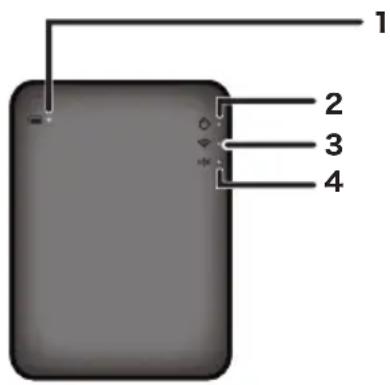
1. ローテーマフ
本製品の充電に点灯いたします。
点灯(赤):充電中
点灯(綠):充電完了
2.ハフ・アクせス蘭
Federal Communication Commission Interference Statement
This equipment has been tested and found to comply with the limits for a Class B digital device, pursuant to Part 15 of the FCC Rules. These limits are designed to provide reasonable protection against harmful interference in a residential installation. This equipment generates, uses and can radiate radio frequency energy and, if not installed and used in accordance with the instructions, may cause harmful interference to radio communications. However, there is no guarantee that interference will not occur in a particular installation. If this equipment does cause harmful interference to radio or television reception, which can be determined by turning the equipment off and on, the user is encouraged to try to correct the interference by one of the following measures:
- Reorient or relocate the receiving antenna.
- Increase the separation between the equipment and receiver.
- Connect the equipment into an outlet on a circuit different from that to which the receiver is connected.
- Consult the dealer or an experienced radio/TV technician for help.
FCC Caution:
Any changes or modifications not expressly approved by the party responsible for compliance could void the user's authority to operate this equipment.
This device complies with Part 15 of the FCC Rules. Operation is subject to the following two conditions: (1) This device may not cause harmful interference, and (2) this device must accept any interference received, including interference that may cause undesired operation.
SAR information: 0.263 W/kg (1g)
CAUTION
RISK OF EXPLOSION IF BATTERY IS REPLACED BY AN INCORRECT TYPE.
DISPOSE OF USED BATTERIES ACCORDING TO THE INSTRUCTIONS.
Important Note - FCC Radiation Exposure Statement:
This equipment complies with FCC radiation exposure limits set forth for an uncontrolled environment. This equipment should be installed and operated with minimum distance 0.5cm between the radiator & your body.
This transmitter must not be co-located or operating in conjunction with any other antenna or transmitter.
The availability of some specific channels and/or operational frequency bands are country dependent and are firmware programmed at the factory to match the intended destination.
The firmware setting is not accessible by the end user.
Industry Canada statement: Industrie Canada déclaration:
This Class B digital apparatus complies with Canadian ICES-003.
This device complies with RSS-210 of the Industry Canada Rules. Operation is subject to the following two conditions:
(1) This device may not cause harmful interference, and
(2) this device must accept any interference received, including interference that may cause undesired operation.
This equipment complies with IC radiation exposure limits set forth for an uncontrolled environment. This equipment should be installed and operated with minimum distance 0.5cm between the radiator and your body.
This device has been designed to operate with an antenna having a maximum gain of [5] dB. Antenna having a higher gain is strictly prohibited per regulations of Industry Canada. The required antenna impedance is 50 ohms.
Under Industry Canada regulations, this radio transmitter may only operate using an antenna of a type and maximum (or lesser) gain approved for the transmitter by Industry Canada. To reduce potential radio interference to other users, the antenna type and its gain should be so chosen that the equivalent isotropically radiated power (e.i.r.p.) is not more than that necessary for successful communication.
Europe - EU Declaration of Conformity
This device complies with the essential requirements of the R&TTE Directive 1999/5/EC. The following test methods have been applied in order to prove presumption of conformity with the essential requirements of the R&TTE Directive 1999/5/EC:
EN60950-1:2006+A11:2009
Safety of Information Technology Equipment
EN50385:(2002-08)
Product standard to demonstrate the compliance of radio base stations and fixed terminal stations for wireless telecommunication systems with the basic restrictions or the reference levels related to human exposure to radio frequency electromagnetic fields (110MHz - 40 GHz) - General public
EN 300 328 V1.7.1: (2006-10)
Electromagnetic compatibility and Radio spectrum Matters (ERM); Wideband Transmission systems; Data transmission equipment operating in the 2,4 GHz ISM band and using wide band modulation techniques; Harmonized EN covering the essential requirements of article 3.2 of the R&TTE Directive
EN 301 489-1 V1.9.2: (2011-09)
Electromagnetic compatibility and Radio Spectrum Matters (ERM); ElectroMagnetic Compatibility (EMC) standard for radio equipment and services; Part 1: Common technical requirements
EN 301 489-17 V2.1.1 (2009-05)
Electromagnetic compatibility and Radio spectrum Matters (ERM); ElectroMagnetic Compatibility (EMC) standard for radio equipment; Part 17: Specific conditions for Broadband Data Transmission Systems
EN 62209-2:2010: Part 2:
Procedure to determine the specific absorption rate (SAR) for mobile wireless communication devices used in close proximity to the human body (frequency range of 30 MHz to 6 GHz)
This device is a 2.4 GHz wideband transmission system (transceiver), intended for use in all EU member states and EFTA countries, except in France and Italy where restrictive use applies.
In Italy the end-user should apply for a license at the national spectrum authorities in order to obtain authorization to use the device for setting up outdoor radio links and/or for supplying public access to telecommunications and/or network services.
This device may not be used for setting up outdoor radio links in France and in some areas the RF output power may be limited to 10mW EIRP in the frequency range of 2454 - 2483.5 MHz. For detailed information the end-user should contact the national spectrum authority in France.
C∈0560
Cesky [Czech]
Hereby, Buffalo Technology Inc. declares that this HDW-PU3 is in compliance with the essential requirements and other relevant provisions of Directive 1999/5/EC.
Espanol [Spanish]
Lietuviú [Lithuanian]
Portugues [Portuguese]
Slovensko [Slovenian]
Buffalo Technology Inc. izjavlja, da je ta HDW-PU3 v skladu z bistvenimi zahevami in ostalimi relevantnimi dolocili directives 1999/5/ES.
Slovensky [Slovak]
SAR information: 0.095 W/kg (10g)
Safety
This equipment is designed with the utmost care for the safety of those who install and use it. However, special attention must be paid to the dangers of electric shock and static electricity when working with electrical equipment. All guidelines of this manual and of the computer manufacturer must therefore be allowed at all times to ensure the safe use of the equipment.
[BaT]RlIe 3KJ KJg WkU kNsi Jn's aJiOJIe 100000000000000000000000000000000000000000000000000000
MiniStation Air has USB 4.0/USB 4.0/USB 4.0/USB 4.0/USB 4.0/USB 4.0/USB 4.0/USB 4.0/USB 4.0/USB 4.0/USB 4.0/USB 4.0/USB 4.0/USB 4.0/USB 4.0/USB 4.0/USB 4.0/USB 4.
IiJHJiJiJiJiJiJiJiJiJiJiJiJiJiJiJiJiJiJiJiJiJiJiJiJiJiJiJiJiJiJiJiJiJiJiJiJiJiJiJiJiJiJiJiJiJiJiJiJiJiJiJ1
iJ.
i
前日川,
当机告请性以或服的,用前,即。
3 Finder File Edit View Go [Go(0|同)]-[Utilities(用T]1]
4 [Disk Utility(Disksuhyuillri)]]
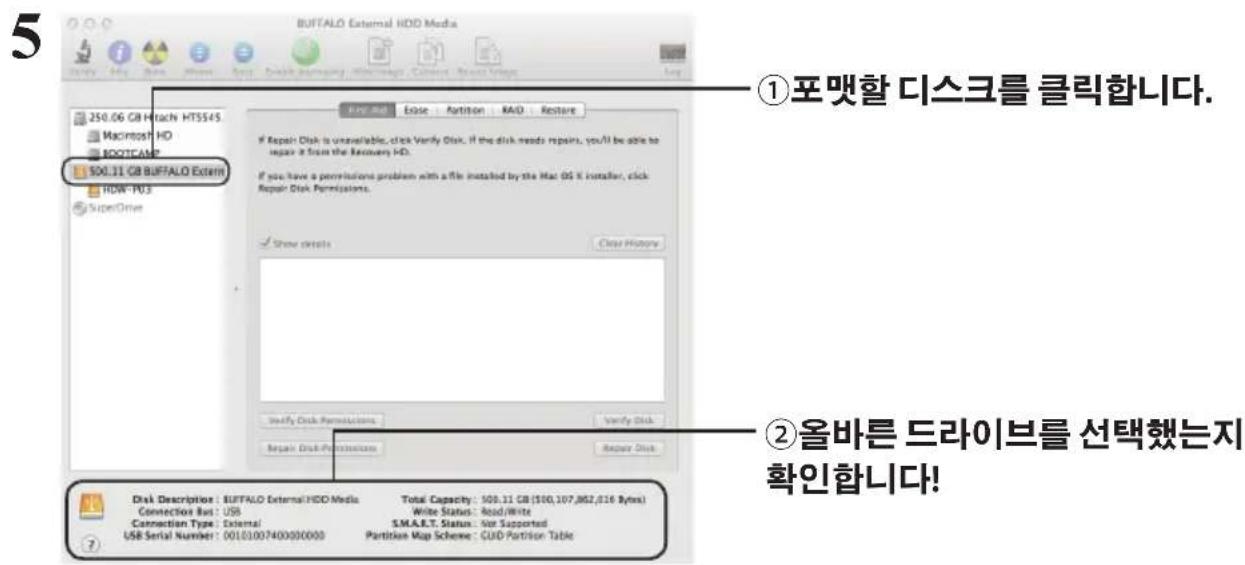

6
Total Capacity:500.11 Gt (500.107,882.96 ft3)
Write Status: Read/Write
MA.RT. Status: Not Supported

7
Are you sure you want to partition the disk "BUFFALO External HDD Media"?
Partitioning this disk will delete all the data on this disk.
This partition will be erased: "HOW-PU3"
This partition will be added: "HDW-PU3"
Cancel
Partition
[Partition(和T]l]
IeJr foAeFbFOReSsHaLoReDfouEeHsu.
俱信在格保及音音上海士网www.buffalotech.com的
人
Federal Communication Commission Interference Statement
This equipment has been tested and found to comply with the limits for a Class B digital device, pursuant to Part 15 of the FCC Rules. These limits are designed to provide reasonable protection against harmful interference in a residential installation. This equipment generates, uses and can radiate radio frequency energy and, if not installed and used in accordance with the instructions, may cause harmful interference to radio communications. However, there is no guarantee that interference will not occur in a particular installation. If this equipment does cause harmful interference to radio or television reception, which can be determined by turning the equipment off and on, the user is encouraged to try to correct the interference by one of the following measures:
- Reorient or relocate the receiving antenna.
- Increase the separation between the equipment and receiver.
- Connect the equipment into an outlet on a circuit different from that to which the receiver is connected.
- Consult the dealer or an experienced radio/TV technician for help.
FCC Caution:
Any changes or modifications not expressly approved by the party responsible for compliance could void the user's authority to operate this equipment.
This device complies with Part 15 of the FCC Rules. Operation is subject to the following two conditions: (1) This device may not cause harmful interference, and (2) this device must accept any interference received, including interference that may cause undesired operation.
SAR information: 0.263 W/kg (1g)
CAUTION
RISK OF EXPLOSION IF BATTERY IS REPLACED BY AN INCORRECT TYPE. DISPOSE OF USED BATTERIES ACCORDING TO THE INSTRUCTIONS.
Important Note - FCC Radiation Exposure Statement:
This equipment complies with FCC radiation exposure limits set forth for an uncontrolled environment. This equipment should be installed and operated with minimum distance 0.5cm between the radiator & your body.
This transmitter must not be co-located or operating in conjunction with any other antenna or transmitter.
The availability of some specific channels and/or operational frequency bands are country dependent and are firmware programmed at the factory to match the intended destination. The firmware setting is not accessible by the end user.
Industry Canada statement: Industrie Canada déclaration:
This Class B digital apparatus complies with Canadian ICES-003.
This device complies with RSS-210 of the Industry Canada Rules. Operation is subject to the following two conditions:
(1) This device may not cause harmful interference, and
(2) this device must accept any interference received, including interference that may cause undesired operation.
Important Note - Radiation Exposure Statement:
This equipment complies with IC radiation exposure limits set forth for an uncontrolled environment. This equipment should be installed and operated with minimum distance 0.5cm between the radiator and your body.
This device has been designed to operate with an antenna having a maximum gain of [5] dB. Antenna having a higher gain is strictly prohibited per regulations of Industry Canada. The required antenna impedance is 50 ohms.
Under Industry Canada regulations, this radio transmitter may only operate using an antenna of a type and maximum (or lesser) gain approved for the transmitter by Industry Canada.
To reduce potential radio interference to other users, the antenna type and its gain should be so chosen that the equivalent isotropically radiated power (e.i.r.p.) is not more than that necessary for successful communication.
Europe - EU Declaration of Conformity
This device complies with the essential requirements of the R&TTE Directive 1999/5/EC. The following test methods have been applied in order to prove presumption of conformity with the essential requirements of the R&TTE Directive 1999/5/EC:
EN60950-1:2006+A11:2009
Safety of Information Technology Equipment
EN50385:(2002-08)
Product standard to demonstrate the compliance of radio base stations and fixed terminal stations for wireless telecommunication systems with the basic restrictions or the reference levels related to human exposure to radio frequency electromagnetic fields (110MHz - 40 GHz) - General public
EN 300 328 V1.7.1: (2006-10)
Electromagnetic compatibility and Radio spectrum Matters (ERM); Wideband Transmission systems; Data transmission equipment operating in the 2,4 GHz ISM band and using wide band modulation techniques; Harmonized EN covering the essential requirements of article 3.2 of the R&TTE Directive
EN 301 489-1 V1.9.2: (2011-09)
Electromagnetic compatibility and Radio Spectrum Matters (ERM); ElectroMagnetic Compatibility (EMC) standard for radio equipment and services; Part 1: Common technical requirements
EN 301 489-17 V2.1.1 (2009-05)
Electromagnetic compatibility and Radio spectrum Matters (ERM); ElectroMagnetic Compatibility (EMC) standard for radio equipment; Part 17: Specific conditions for Broadband Data Transmission Systems
EN 62209-2:2010: Part 2:
Procedure to determine the specific absorption rate (SAR) for mobile wireless communication devices used in close proximity to the human body (frequency range of 30 MHz to 6 GHz)
This device is a 2.4 GHz wideband transmission system (transceiver), intended for use in
all EU member states and EFTA countries, except in France and Italy where restrictive use applies.
In Italy the end-user should apply for a license at the national spectrum authorities in order to obtain authorization to use the device for setting up outdoor radio links and/or for supplying public access to telecommunications and/or network services.
This device may not be used for setting up outdoor radio links in France and in some areas the RF output power may be limited to 10mW EIRP in the frequency range of 2454 - 2483.5 MHz. For detailed information the end-user should contact the national spectrum authority in France.
C∈0560①
Cesky [Czech]
Hereby, Buffalo Technology Inc. declares that this HDW-PU3 is in compliance with the essential requirements and other relevant provisions of Directive 1999/5/EC.
Espanol [Spanish]
Portugues [Portuguese]
Slovensko [Slovenian]
Buffalo Technology Inc. izjavlja, da je ta HDW-PU3 v skladu z bistvenimi zahtevami in ostalimi relevantnimi dolocili directives 1999/5/ES.
Slovensky [Slovak]
SAR information: 0.095 W/kg (10g)
Safety
This equipment is designed with the utmost care for the safety of those who install and use it. However, special attention must be paid to the dangers of electric shock and static electricity when working with electrical equipment. All guidelines of this manual and of the computer manufacturer must therefore be allowed at all times to ensure the safe use of the equipment.


- Recommended Usage 6
- Formatting 10
- Specifications 15
- Regulatory Compliance Information 17
- Layout
- LEDs and Connections
- Top
- Battery LED
- Power LED
- Wireless LED
- AOSS LED
- Bottom
- Wireless Security Label
- Side
- AOSS Button
- Power Button
- USB Connector
- Reset Button
- Power Connector
- Recommended Usage
- Battery Handling Guidelines and Safety Precautions
- Computer Connection (USB Connection) Guidelines
- Notes
- Formatting
- What is Formatting?
- For Windows users
- For Mac users
- Formatting Notes
- Formatting with NTFS (Windows)
- 4
- Formatting with FAT32 (Mac)
- Note:
- 6
- Click Partition.
- Are you sure you want to partition the disk "BUFFALO External HDD Media"?
- Specifications
- Regulatory Compliance Information
- Federal Communication Commission Interference Statement
- FCC Caution:
- CAUTION
- Important Note - FCC Radiation Exposure Statement:
- Industry Canada statement:
- Important Note - Radiation Exposure Statement:
- Note Importante - Declaration d'exposition aux radiations:
- Europe - EU Declaration of Conformity
- Portugues [Portuguese]
- Slovensko [Slovenian]
- Slovensky [Slovak]
- Suomi [Finnish]
- Safety
- Industry Canada statement: Industrie Canada déclaration:
- C∈0560①
- Cesky [Czech]
- Espanol [Spanish]
- C∈0560
- HnKnaHJIb
- Bokobbie naHenn
- PykoBODCTBO NO NOkIoueHIO K KombIoTepy (yepe3 USB-NOkIoueHne)
- Приимechия
- 3.Форматурованne
- Texhnueckne xapakTepnCTnKn
- TexHHueckme xapaKTepeNCTnKN USB-nHTeppeiCa
- 目次
- 1各部の名称 2
- 2使用上的注意 4
- 3F0一Mト(初期化) 7
- Regulatory Compliance Information 14
- 13の名称
- 各部の名称
- 上面
- ローテーマフ
- 2.ハフ・アクせス蘭
- Lietuviú [Lithuanian]
- 人
Brand : BUFFALO
Model : MiniStation Air
Category : External hard drive