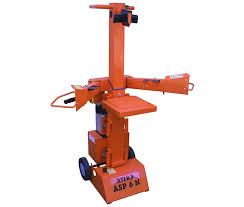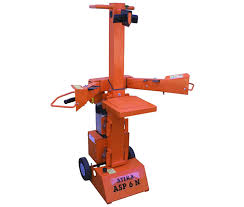
ASP 5,5 - Log splitter ATIKA - Free user manual and instructions
Find the device manual for free ASP 5,5 ATIKA in PDF.



User questions about ASP 5,5 ATIKA
0 question about this device. Answer the ones you know or ask your own.
Ask a new question about this device
Download the instructions for your Log splitter in PDF format for free! Find your manual ASP 5,5 - ATIKA and take your electronic device back in hand. On this page are published all the documents necessary for the use of your device. ASP 5,5 by ATIKA.
USER MANUAL ASP 5,5 ATIKA
Operating Manual – Safety instructions – Spare parts

Page 15
GB Extend of delivery
After unpacking, check the contents of the box
That it is complete
Check for possible transport damage
Report any damage or missing items to your dealer, supplier or the manufacturer immediately. Complaints made at a later date will not be acknowledged.
| ■ 1 ready mounted machine unit | ■ 2 wheels |
| ■ 1 control arm, right | ■ 1 bag of accessories |
| ■ 1 control arm, left | ■ 1 operating manual |
F Furniture
Tip: grease the metal plates at top and bottom first!
Insert control arms and insert pipe in recess of cross connection.
Push the holding bolt through before the cross connection.
Lock the holding bolt at the bottom.
Do not operate machine before having read the operating instructions, understood all the notes and assembly the machine as described here.
Keep the instructions in a safe place for future use.
Contents
| Declaration of Conformity | 1 |
| Spare parts / Description of device | 2 |
| Extent of delivery | 4 |
| Assembly | 5 |
| Symbols | 15 |
| Proper use | 15 |
| Residual risks | 15 |
| Safe working | 16 |
| Transport instructions | 17 |
| Positioning | 17 |
| Start-up | 17 |
| Working with the log splitter | 18 |
| Care and maintenance | 20 |
| Guarantee | 21 |
| Technical data | 22 |
| Possible problems | 22 |
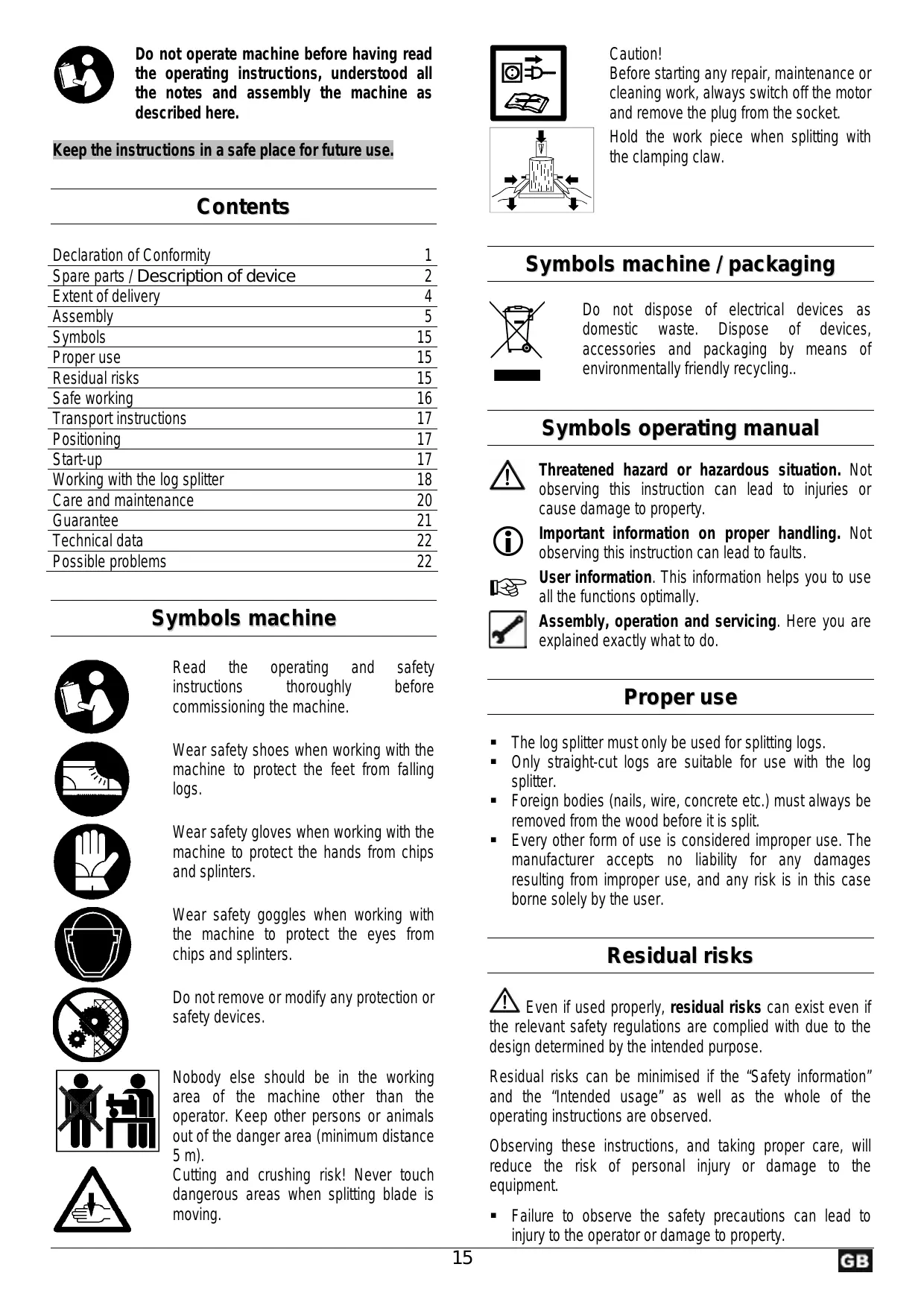
Symbols machine

Read the operating and safety instructions thoroughly before commissioning the machine.
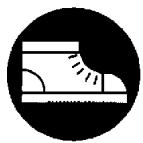
Wear safety shoes when working with the machine to protect the feet from falling logs.

Wear safety gloves when working with the machine to protect the hands from chips and splinters.

Wear safety goggles when working with the machine to protect the eyes from chips and splinters.
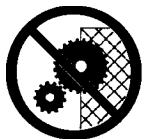
Do not remove or modify any protection or safety devices.
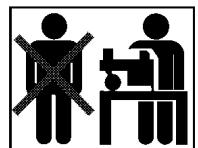
Nobody else should be in the working area of the machine other than the operator. Keep other persons or animals out of the danger area (minimum distance 5 m).

Cutting and crushing risk! Never touch dangerous areas when splitting blade is moving.
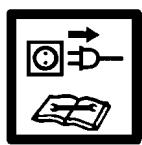
Caution!
Before starting any repair, maintenance or cleaning work, always switch off the motor and remove the plug from the socket.
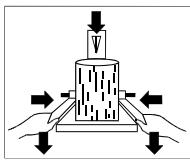
Hold the work piece when splitting with the clamping claw.
Symbols machine / packaging
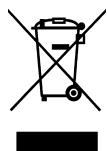
Do not dispose of electrical devices as domestic waste. Dispose of devices, accessories and packaging by means of environmentally friendly recycling..
Symbols operating manual

Threatened hazard or hazardous situation. Not observing this instruction can lead to injuries or cause damage to property.

Important information on proper handling. Not observing this instruction can lead to faults.

User information. This information helps you to use all the functions optimally.

Assembly, operation and servicing. Here you are explained exactly what to do.
Proper use
- The log splitter must only be used for splitting logs.
- Only straight-cut logs are suitable for use with the log splitter.
- Foreign bodies (nails, wire, concrete etc.) must always be removed from the wood before it is split.
- Every other form of use is considered improper use. The manufacturer accepts no liability for any damages resulting from improper use, and any risk is in this case borne solely by the user.
Residual risks
Even if used properly, residual risks can exist even if the relevant safety regulations are complied with due to the design determined by the intended purpose.
Residual risks can be minimised if the "Safety information" and the "Intended usage" as well as the whole of the operating instructions are observed.
Observing these instructions, and taking proper care, will reduce the risk of personal injury or damage to the equipment.
-
Failure to observe the safety precautions can lead to injury to the operator or damage to property.
-
Carelessness, failure to comply with the safety regulations and incorrect use can result in injuries to your hands and fingers when the splitting blade is moving.
- Risk from electricity, by using non-standard electrical connections.
- Touching live parts of opened electrical components.
In addition, in spite of all the precautionary measures taken, non-obvious residual risks can still exist.
Safe working
Before commissioning this product, read and keep to the following advice. Also observe the preventive regulations of your professional association and the safety provisions applicable in the respective country, in order to protect yourself and others from possible injury.
Pass the safety instructions on to all persons who work with the machine.
i Keep these safety instructions in a safe place.
- Make yourself familiar with the equipment before using it, by reading and understanding the operating instructions.
- Do not use the machine for unsuitable purposes (see "Normal intended use" and "Working with the log splitter").
- Ensure that you have stand in a secure standing position and maintain your balance at all times.
Take up a working position which is close to the controls. Fig. 9 - Never stand on top of the machine.
-
Pay attention at all times. Take care with what you are doing, and approach the work sensibly. Do not use the machine:
-
when you are tired.
under the influence of drugs, alcohol or medications that may impair your powers of judgement. -
When working with the machine, always wear
-
protective goggles or face mask
- safety gloves
hearing protection - safety shoes with steel toe-caps
Wear suitable work clothing:
- do not wear any loose-fitting clothing or jewellery, since these may be caught or trapped by moving parts
- Within his area of work the operator is responsible for third parties.
- The machine may not be operated by children or young people under the age of 18.
- Keep children away from machine.
- Never operate the machine if other persons are in the immediate vicinity.
- Never leave the saw unattended.
- Keep your workplace in an orderly condition! Untidiness can result in accidents.
- Do not overload the machine! You work better and safer in the given performance range.
- Only operate the machine with complete and correctly attached safety equipment and do not alter anything on the machine that could impair the safety.
- Faulty or damaged parts in the device must be replaced immediately.
- Do not spray machine with water (this is hazardous due to live components).
- Do not leave the machine standing in the rain or use when raining.
- Store the unused machine in a dry locked place away from the reach of children.
- Switch the machine off and remove the mains plug from the socket when
carrying out repair works
- carrying out servicing and repair works, removal of faults
- Transporting
- leaving unattended (even during short interruptions)

-
Check the machine for possible damage
-
Before continuing to use the machine, the protective devices must be inspected to ensure that they work perfectly and with their intended function
- Check whether the movable parts function perfectly and do not stick or whether the parts are damaged. All parts must be correctly installed and fulfil all conditions to ensure perfect operation of the machine.
- Damaged guards and parts must be properly repaired or exchanged by a recognized, specialist workshop; insofar as nothing else is stated in the instructions for use.
- Damaged or illegible safety warning labels should be replaced immediately.
Electrical safety
- Electrical connections must conform to IEC 60245 (H 07 RN-F) with a cable cross-section of at least
230V
3 × 1.5 ~mm^2 for a maximum cable length of up to 10 ~m 400 ~V 3-
5 × 1.5 ~mm^2 for a maximum cable length of up to 10 ~m
-
Never use the machine with a power supply cable of over 10m in length. Longer power supply cables will cause a drop in voltage. The motor will not be able to provide its maximum performance and the operation of the machine will be impaired.
-
When laying the connecting attachments, be sure that they do get crushed or bent, and that the plug-and-socket connection does not get wet.
- Do not use the cable for purposes for which it is not meant. Protect the cable against heat, oil and sharp edges. Do not use the cable to pull the plug from the socket.
- Regularly check the extension cables and replace them if they are damaged.
- Do not use any defective connection cables.
- When working outdoors, only use extension cables especially approved and appropriately labelled for outdoor use.
- Do not set up any provisional electrical connections.
- Never bypass protective devices or deactivate them.

The electrical connection or repairs to electrical parts of the machine must be carried out by a certified electrician or one of our customer service points. Local regulations - especially regarding protective measures - must be observed.

Repairs to other parts of the machine must be carried out by the manufacturer or one of his customer service points.

Use only original spare parts. Accidents can arise for the user through the use of other spare parts. The manufacturer is not liable for any damage or injury resulting from such action.
Transport Instructions

Move the splitting blade right down every time before
the machine is transported.
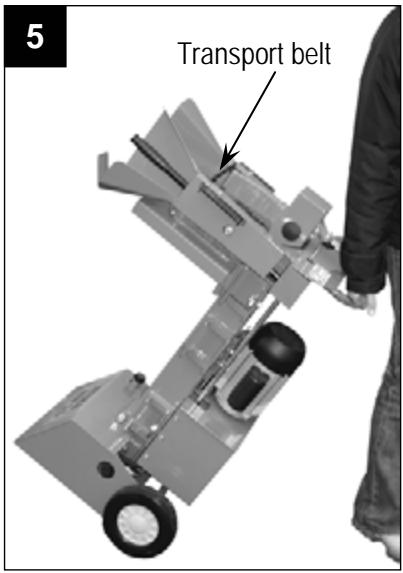
To transport the machine, grasp the strap one hand and tilt the log splitter slightly towards you. The log splitter can be easily transported in this position.
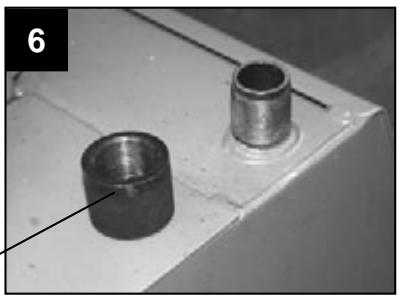
To avoid the escape of oil during the transport the oil dipstick must be replaced by the transport closure.
Positioning
Place chocks under the wheels to prevent the machine rolling during operation.
Ensure that the working area meets the following conditions:
- no danger of slipping
level - free of obstacles
- sufficiently well lit
Do not operate the machine in the direct vicinity of gas or petrol pipes or containers, or any other easily inflammable materials.
Start-up
-
Check that the machine is completely and correctly assembled.
Before using the log splitter, make sure each time that -
there are no faulty connections (tears, cuts, etc.)
there are no damage at the machine
all screws are tight
- check the hydraulic system for any possible leaks
the oil level
The transport closure with gasket must be replaced before the initiation by the oil dipstick.
transport closure

Mains connection
- Compare the voltage given on the machine model plate e.g. 230 ~V with the mains voltage and connect the machine to the relevant and properly earthed plug.
- Only use connection cables with sufficient diameters.
- Connect the machine via a 30mA fault current safety switch.

Fuse protection
230 V\~ 16 A inert

400V3\~ 16 A

Switching on / off

Prior to every use, check the function of the nuction mechanism (by switching on and off).
Do not use any device where the switch can not be switched on and off. Damaged switches must be repaired or replaced immediately by the customer service.

Switching on
Press the green button.

Switching off
Press the red button.
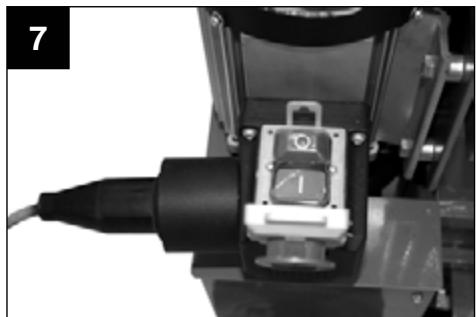
① Lock in case of power (zero-voltage initiator)
The equipment will switch off automatically if there is a power cut. Repress the green button to switch it on again.
Log splitter with 400 V 3~
Make sure that the motor turns in the correct direction (see motor arrow), because operation in the wrong direction damages the oil pump.
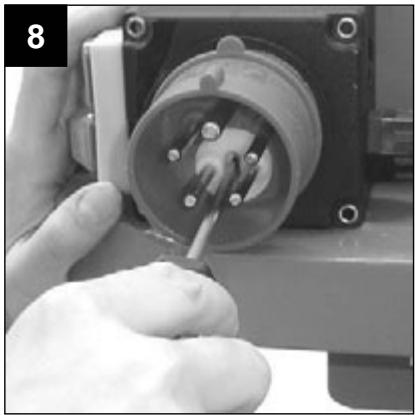
You can change the direction by placing a screwdriver in the slot provided in the plug collar, and adjust the correct direction by moving to the left or right applying slight pressure.
(i) Hydraulics
- Never operate the machine in the event of any possible danger from hydraulic fluid.
- Ensure that the machine and working area are clean and free of oil. Danger of slippage or fire!
- Check the hydraulic reservoir regularly to ensure that it contains enough hydraulic oil (see "Care and maintenance")
Capacity: 4.0 litres
Working with the log splitter
additional SAFETY INSTRUCTIONS
The log splitter may only be operated by a single person.
- The machine may only be operated by persons over the age of 18 years, and who have read and understood these operating instructions.
- Wear protective equipment (safety goggles/mask, gloves, safety shoes) to protect yourself from possible injury.
- Never try to split logs containing nails, wire or other similar objects.
- Already split wood and wood chips create a dangerous working area. The operator may stumble, slip or fall. Always keep the working area neat and tidy.
- Never place the hands on or near any moving parts of the machine when it is switched on. Maintain a safe distance from the log, the ram and the wedge in order to protect your hands from injury.
- The machine should only be used for splitting logs with a maximum length of 1050 ~mm .
- Check before splitting if the splitting column has been sufficiently lubricated to allow its trouble-free retraction and extension.
What type of logs can I split?
Size of logs
Length: max. 1050 ~mm
Diameter: min. 100 - max. 300 mm
The log diameter is a recommended guideline figure, because:
thin logs can be difficult to split if they contain knots or if the fibres are too strong.
- logs with a diameter of over 300 ~mm can be split if the fibres are smooth and open.
Do not try to split green logs. Dry logs are much easier to split, and do not cause jams as often as green (damp) wood.
Operation
Two-hand operation
Never operate the log splitter with two people.
Never block the control handles (clamping claws).
- Press the green switch on the electric motor. Wait a few moments until the motor has reached its operating revolutions and the required pressure has been built up in the hydraulic pump.
① Check the direction of the motor in the log splitter with threephase motor (400 V 3~), because operation in the wrong direction damages the oil pump.
(1) At temperatures below -5^ C , let the log splitter run for at least 15 ~min . In neutral to heat up the oil.
- Place the log on the log splitter table.
1 Only split the logs in the direction of the wood fibres.
-
Hold the log tight with the clamping claws.
-
Press both operating hand
The splitting blade falls down and splits the log.
- Release the two control handles, the splitting blade returns to its initial position.
If you only release one control handle, then the splitting blade remains where it is.
Special instructions for splitting logs:
Preparations:
The logs to be split should be cut to the maximum dimensions. Ensure also that the logs are cut straight and square.
Place the log properly on the log splitter, so as not to cause any risk of stumbling or falling to the operator.
- Adjusting the stroke height
In case of shorter wood pieces the efficiency can be increased by shortening the return of the splitting cutter.
- Place the log on the splitting table and press the two control handles to bring the splitting blade down to approx. 2 cm above the log.
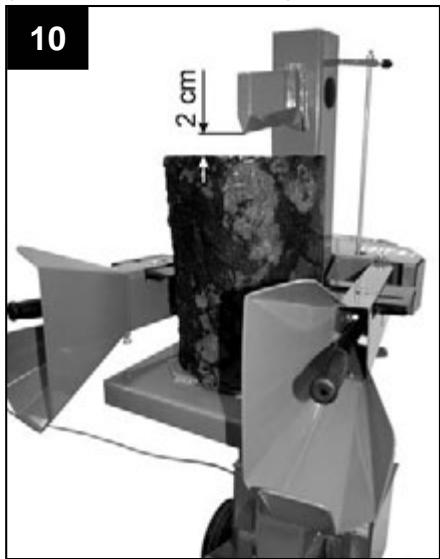
- Release one control handle so that the blade stays in this position.
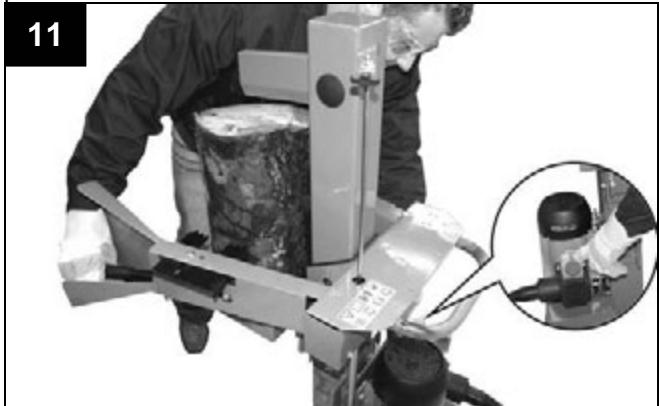
- Switch the machine off and disconnect the power.
- Release the second control handle.
- Shorten the return path at the rod fitted to the side by fixing the holding screw at the necessary height.
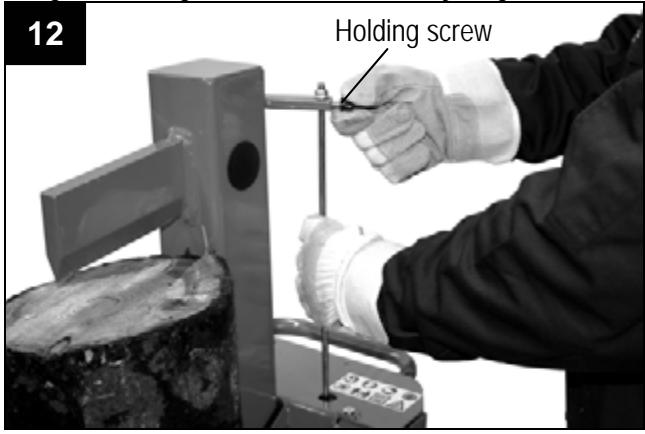
- Adjusting the height of the table
upper position of table for logs up to 560 mm lower position of table for logs up to 1050 mm
- Release the locking hooks.
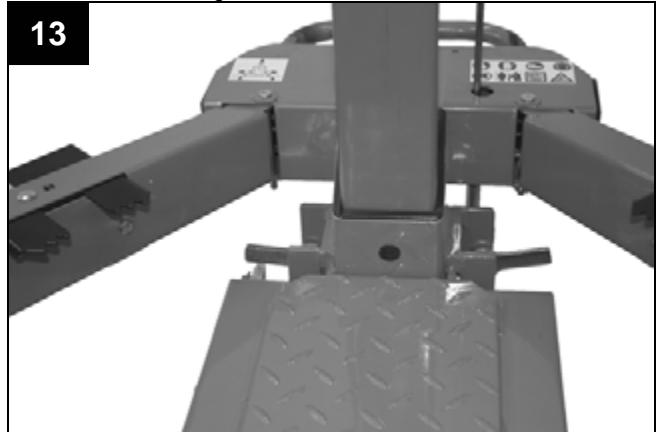
- Pull the table out.
- Use the table in a position that comes close to the log length and secure it with the locking hooks.
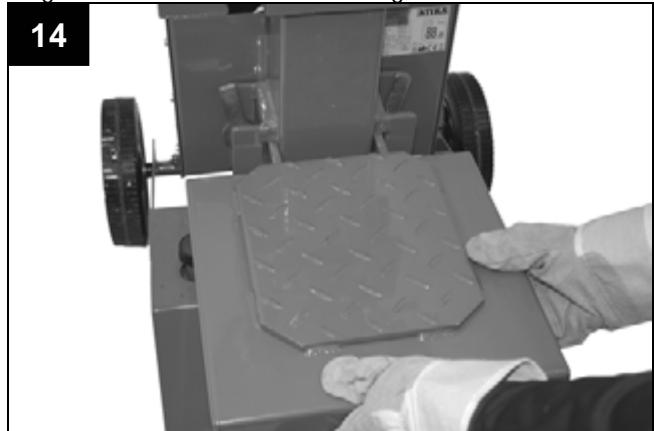
- Splitting short wood:
- upper position of table
- Place the log on the splitting table.
① Only split the logs in the direction of the wood fibres.
- Hold the log tight with the clamping claws.
- Splitting long wood:
- lower position of table
- Remove the splitting cross.
- Place the log on the splitting table.
Possible malfunction when cleaving logs: The log to be cleaved is not cleaved right through, jams on the cleaving blade and is pulled up during the blade's return movement. It is no longer possible to release the log manually.
In this case, proceed as follows:
- Switch off the device.
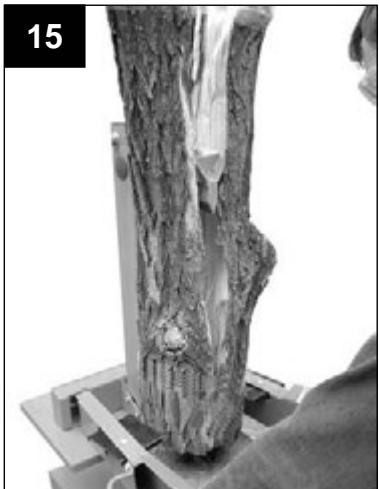
- Fasten the table in the top position.
- Switch on the device and continue the splitting operation.
Never try to split two logs at once.
Never try to remove or replace the log during the splitting process.
① Never try to force the splitting of the log by maintaining the pressure for several seconds. This can lead to damage to the machine.
Position the log on the table again and repeat the splitting phase, or put the log on one side.
How to release a jammed log?
There is a risk of knotted logs getting stuck during the splitting process.
- Switch machine off and disconnect the power.
- Carefully move the stuck log backwards and forwards to loosen it.
Never hammer on the stuck log.
Never use a saw to cut the stuck log out of the machine. Do not enlist the aid of a second person - this is a one-man job.
Finishing work:
Bring the splitting blade to the lower position (run-in state).
Release one of the control handles.
Switch the machine off and disconnect the power.
Follow the care and maintenance instructions.
Care and maintenance

Remove the plug from the power socket before starting any maintenance or cleaning work.
Wear protective gloves in order to avoid injury to the hands.
① Observe the following in order to keep the log splitter in good working order:
- Clean the machine thoroughly after you have finished using it.
- Remove any resin remains on the machine.
- Lubricate the splitting column regularly or oil it using environmentally friendly spray oil.
- Check the oil level and change the oil as necessary.
- Check hydraulic hoses and hose connections regularly for any leaks and firm fitting.
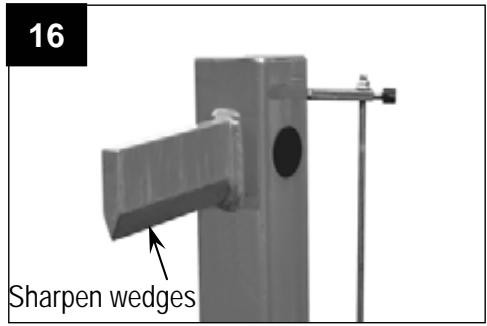
Sharpening the splitting blade
After longer operating periods, for reduced splitting performance or slight deformation of the cutting edge, grind the splitting blade or sharpen it with a fine file (remove burrs).
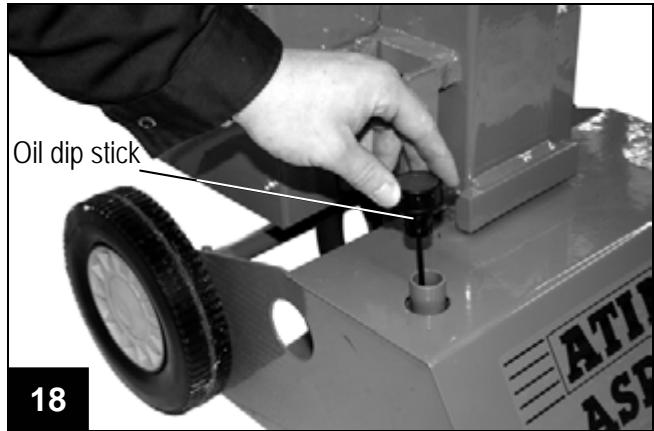
How do I check the oil level?
- The splitting column must be in run-in state.
- Now remove the dipstick.
- Clean the dipstick and the oil seal.
- Replace the dipstick fully into the oil reservoir.
- Now remove the dipstick again, and read off the oil level.
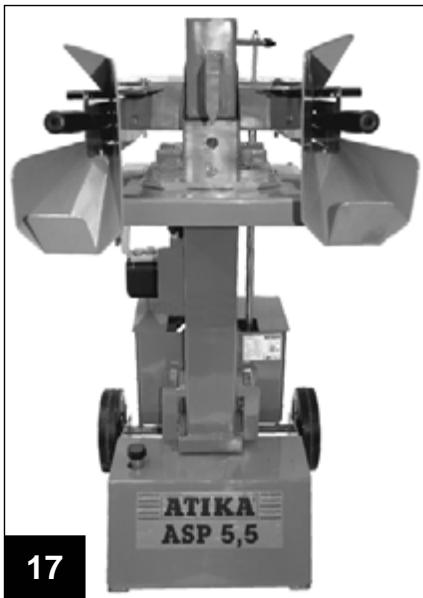
17
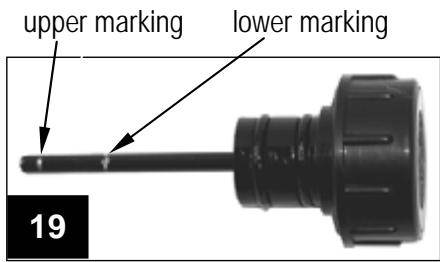
If the oil level is between the two marking on the dipstick, there is sufficient oil in the reservoir.
If the oil level is below the lower marking, more oil should be added with the aid of a clean funnel.
- Check the oil seal and replace it if it is damaged in any way.
- Replace the dipstick into the oil reservoir.
When should I change the oil?
The first oil change should be carried out after 50 operating hours, and then every 500 operating hours.

Requires two persons.
Changing the oil:
- The splitting column must be in run-in state.
- Now remove the dipstick.
- Place a container under the log splitter to catch the old oil. The container should have a capacity of at least 5 litres.
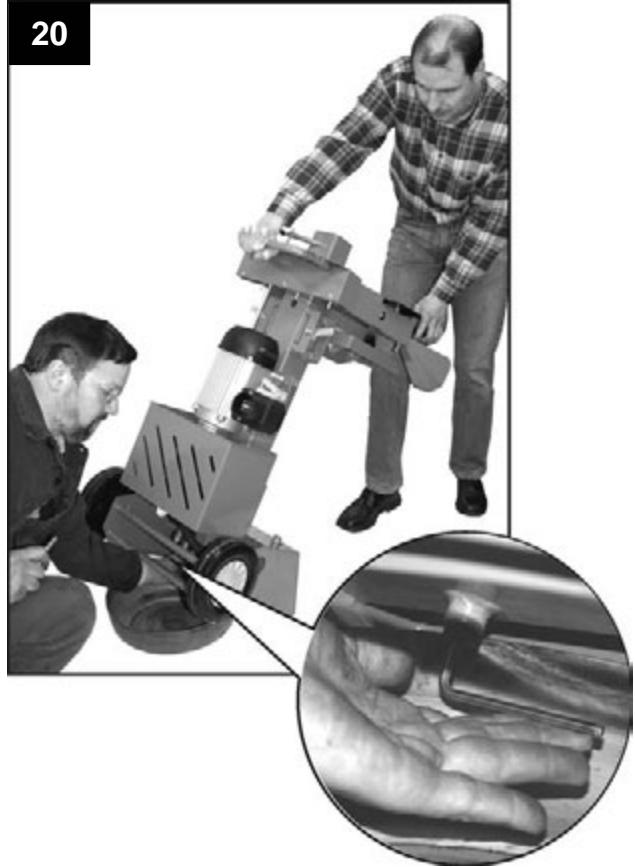
- Remove the drain plug to drain the oil.
- Insert the seal and drain plug again.
- Pour in the new hydraulic oil (4.0 litres) using a clean funnel.
- Clean the dipstick and the oil seal.
- Check the oil seal and replace it if it is damaged in any way.
- Replace the dipstick.
Dispose of the old oil properly (local oil disposal point). The old oil must not be poured into the ground or drainage system, or mixed with other waste.
i Hydraulic oil
We recommend the following hydraulic oils for the hydraulic cylinder:
Shell Tellus T 22
Aral Vitam Gf 22
BP Energol HLP 22
Mobil DTE 11
or equivalent
Do not use any other types of oil. The use of any other type of oil will adversely affect the operation of the hydraulic cylinder.
Guarantee
- The machine is guaranteed for a period of 2 years from the date of purchase/delivery against faults due to material or manufacturing errors.
- The guarantee is rendered invalid in the event of any damage caused due to improper use or handling, improper packaging when returning the machine or failure to observe the operating instructions.
- Faulty parts must be returned to our works carriage-paid. The decision on free replacement of faulty parts will be made at our discretion.
- The guarantee does not cover normal wear and tear to the splitting wedge, hydraulic oil, guide plates, seals or wheels.
- Any guarantee work will be carried out by the manufacturer. Our express approval must be obtained before having any such work carried out by another company.
- The guarantee only remains valid provided that original replacement parts are used.
- We reserve the right to make technical changes in the course of technical progress.
Technical data
| Model | ASP 5,5 |
| Type | ASP 5,5 |
| Splitting force | 55 kN (5.5 t) ± 10 % |
| Log length | max. 1050 mm |
| Log diameter | min. 100 – max. 300 mm |
| Stroke | ≈ 500 mm |
| Feed speed | ca. 0,06 m/sec. |
| Return speed | ca. 0,13 m/sec. |
| Hydraulic oil (max.) | 4,0 litres |
| Hydraulic pressure | 20 MPa (200 bar) |
| Electric motor performance (power consumption) | AC P1 = 3500 W (S6-40%) Threephase P1 = 3000 W (S6-40%) |
| Power supply | AC 230 V ~ 50 Hz, 16 A inert Threephase 400 V 3~ 50 Hz, 16 A |
| Dimensions | Length 740 x Width 500 x Height 1520 mm |
| Weight | ca. 96 kg |
Possible problems
| Problem | possible cause | remedy |
| Logs are not being split properly (insufficient splitting performance) | ⇒ The log is not positioned correctly ⇒ The log exceeds the maximum dimensions or the wood is too hard for the performance of the machine ⇒ Splitting blade does not split log ⇒ Hydraulic pressure too low ⇒ Release rods bent (hydraulic tappet not quite pressed in) ⇒ Incorrect connecting lead (longer than 10 m or too small cable cross-section) | ⇒ Reposition the log correctly ⇒ Cut the log to the required dimensions ⇒ Sharpen splitting blade, check for burrs or notches ⇒ Check the oil level and add more oil if necessary. If the problem cannot be rectified, refer to the manufacturer or other approved service centre. ⇒ Arrange for manufacturer or authorised company to adjust the rods ⇒ Use the correct connecting lead |
| Splitting column moves unsteadily or with strong vibrations | ⇒ Air in the circuit ⇒ Splitting column not sufficiently lubricated or oiled. | ⇒ Check the oil level and add more oil if necessary. ⇒ Lubricate splitting column or oil with environmentally friendly spray oil. If the problem cannot be rectified, refer to the manufacturer or other approved service centre. |
| Splitting column does not move | ⇒ Hydraulic pump defective | ⇒ To correct the problem, refer to the manufacturer or other approved service centre. |
| Motor starts up but splitting column does not move | ⇒ Motor turns in wrong direction | ⇒ Check the motor direction Threephase: adjust the motor direction (s. page 18) AC: To correct the problem, refer to the manufacturer or other approved service centre. |
| Motor will not start | ⇒ No electrical power ⇒ 2-phase mode in threephase motor ⇒ Connection cable defective ⇒ Electric motor defective | ⇒ Check the fuse. ⇒ Have fuse and lead checked by qualified electrician. ⇒ Replace the connection cable or have it checked by an electrician. ⇒ To correct the problem, refer to the manufacturer or other approved service centre. |

Contenance: 4,0 litres
Symbol apparatus / emballage
Indkobling / Frakobling