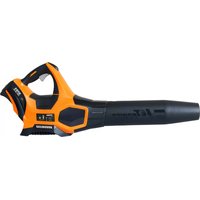
LSHC 40-70 - Blower ATIKA - Free user manual and instructions
Find the device manual for free LSHC 40-70 ATIKA in PDF.


| Product type | Cordless leaf blower/vacuum/shredder |
| Brand | ATIKA |
| Model | LSHC 40-70 |
| Weight | 2.9 kg |
| Power supply | Li-ion battery 36 V (2000 mAh or 4000 mAh), dedicated charger (not included) |
| Rotation speed (adjustable) | 7500 – 12500 min⁻¹ |
| Air speed (max blowing) | 257 km/h |
| Air volume (max suction) | 840 m³/h |
| Air speed with vacuum booster | 31.6 m/s |
| Shredding ratio | ~10:1 |
| Collection bag capacity | 45 L |
| Guaranteed sound power level | 106 dB(A) |
| Sound pressure level | 93.2 dB(A) |
| Hand-arm vibration | 3.40 m/s² (K=1.5 m/s²) |
| Protection class | II (double insulation) |
| Functions | Blowing, suction, shredding |
| Safety | Automatic stop, collection bag lock, battery protection |
| Maintenance | Clean with cloth; bag hand washable with soapy water |
| Spare parts | Order numbers available for tubes, wheels, bag, etc. |
| Warranty | According to the enclosed warranty statement |
Frequently Asked Questions - LSHC 40-70 ATIKA
User questions about LSHC 40-70 ATIKA
0 question about this device. Answer the ones you know or ask your own.
Ask a new question about this device
Download the instructions for your Blower in PDF format for free! Find your manual LSHC 40-70 - ATIKA and take your electronic device back in hand. On this page are published all the documents necessary for the use of your device. LSHC 40-70 by ATIKA.
USER MANUAL LSHC 40-70 ATIKA
Original instructions
Notice originale
flowchart
graph TD
    A["Person with glasses"] --> B["Hand gesture"]
    B --> C["Cube with arrows indicating direction"]
    C --> D["Move blocks"]
    D --> E["Arrow to block"]
1
6
① Keep the operating instructions in a safe place for future use.
① Pass the operating instructions on to all persons who work with the machine.

You may not start to operate the machine until you have read these operating instructions, observed all the instructions given and installed the machine as described!

This machine must not be operated / used by children, persons with restricted physical, sensory or mental abilities or a lack of experience and/or know-how or by persons who are not familiar with the instructions.

The machine must not be operated by children or young people under 16 years of age.
Extent of delivery
After unpacking, check the contents of the box
▶ that it is complete
▶ check for possible transport damage
Report any damage or missing items to your dealer, supplier or the manufacturer immediately. Complaints made at a later date will not be acknowledged.


1x device unit 1
1x front handle 4
1x star grip screw 5
1x back suction tube 7
1x back vacuum tube 8
1x dual pipe
1x wheel set (2-pieces) 10
1x vacuum Booster 11
1x collecting bag 13
1x shoulder strap 14
1x fastener bag 16
1x assembling instruction
1x original instructions
1x terms of guarantee
The following parts are not included in the scope of delivery. These accessories are available from your dealer or manufacturer.

• Charger ALG 40-1800 (article-no. 365500)
- Accu AP 40-2000 (article-no. 365501) or AP 40-4000 (article-no. 365503)

Contents
| Extent of delivery 11 | |
| EC Declaration of Conformity 11 | |
| Symbols original instructions / machine 12 | |
| Description of the device 12 | |
| Operating Times 12 | |
| Proper use 12 | |
| Residual risks 13 | |
| Vibrations | 13 |
| Safe working 13 | |
| Spare parts 14 | |
| Assembly | 14 |
| Start-up | 15 |
| Working with the garden vac 15 | |
| Care and maintenance 17 | |
| Storage | 17 |
| Possible faults | 17 |
| Technical data 18 | |
| Guarantee | 18 |
EC Declaration of Conformity
No. (S-No.): 26252
according to EC directive: 2006/42/EC
We,
Altrad Lescha Atika GmbH
Josef-Drexler-Str. 8, 89331 Burgau - Germany
herewith declare under our sole responsibility that the product
conforms with the above mentioned EC directives as well as the provisions of the guidelines below:
2014/30/EU, 2000/14/EC and 2011/65/EU.
Following standards have been applied:
EN 60335-1/A11:2014, EN 50636-2-100:2014
EN 62233:2008, EN 55014-1:2017 EN 55014-2:2015.
EN 61000-3-2:2014 EN 61000-3-3:2013
Conformity assessment procedure:
2000/14/EC-Appendix V
Measured level of the acoustic output L_WA 98.7 dB (A).
Guaranteed level of the acoustic output L_WA 106 dB (A).
Duly authorised person for the compilation of technical documents:
Altrad Lescha Atika GmbH – Technical department
Josef-Drexler-Str. 8 -89331 Burgau - Germany
Burgau, 15.07.2019
Symbols machine
Memorise the meaning to be able to operate the device more safely and to protect yourself and other from possible injuries.

Carefully read operator's manual before handling the machine. Observe instructions and safety rules when operating.
Danger - objects may be thrown out at high speed when motor is running.
Keep people, pets and domestic animals out of the danger area.
Beware of the rotating tool.
Keep hands and feet out of openings while machine is running.
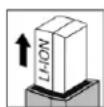
Pulling out the battery
⇒ before starting any work (cleaning, maintenance, repair, etc.) on the device.
⇒ when interrupting work, during transport and storage.
Protect against moisture.
Wear eye and ear protection.

"Blowing speed"
Air volume
Position "Suction and Shredding".
The material is sucked in and shred.
Position "Blowing"
The material is blown away.
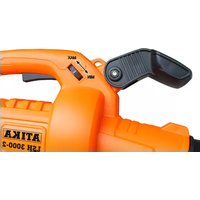
Speed regulation (infinitely variable)
MIN = 7500 rpm
1
MAX = 12500 rpm
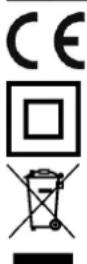
This product complies with European regulations specifically applicable to it.
Machine of the protection class II (double insulated)
Electrical devices do not go into the domestic rubbish. Give devices, accessories and packaging to an ecofriendly recycling.
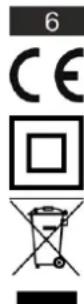
According to the European Directive 2012/19/EU on electrical and electronic scrap, electrical devices that are no longer serviceable must be separately collected and brought to a facility for an environmentally compatible recycling.
Symbols original instructions

Threatened hazard or hazardous situation. Not observing this instruction can lead to injuries or cause damage to property.

Important information on proper handling. Not observing this instruction can lead to faults in the machine.

User information. This information helps you to use all the functions optimally.

Assembly, operation and servicing. Here you are explained exactly what to do.
1
Please refer to the attached assembly and operating instruction sheet for references to figure numbers in the text.
2
and operating instruction sheet for references to figure numbers in the text.
3
Operating Times
Please consider the individual country specifications.
Information on how to avoid noise:
Some noise exposure from this machine is unavoidable. Schedule noisy work to times during which it is allowed. Respect all rest times and restrict the work duration to the minimum. You as the operator and bystanders should wear a suited hearing protection.
Proper use
- The garden vac/blower/shredder is only suitable for light, dry materials, such as leaves and garden waste such as grass, small twigs and pieces of paper.
■ The vacuuming, blowing and shredding of
▶ heavy materials, such as metal, stones, branches, fir cones or broken glass
▶ combustible materials such as cigarette butts, barbecue coal
▶ flammable, toxic or explosive materials is explicitly forbidden. - Never use the machine in areas with harmful dust and liquids or as a wet vacuuming machine, because of the risk of physical injury.
- Any other use than for vacuuming, blowing and shredding is not allowed.
- The garden vac/blower/shredder is only designed for private use in accordance with its proper purpose.
- Regarded as machine for private gardens and allotments are those units which are not employed in public grounds, parks, sports grounds, and in agriculture and forestry.
- Every other form of use is considered improper use. The manufacturer accepts no liability for any damages resulting from improper use, and any risk is in this case borne solely by the user.
-
The intended usage also includes compliance with the operating, servicing and repair conditions prescribed by the manufacturer and following the safety instructions included in the instructions.
-
The relevant accident prevention regulations for the operation as well as the other generally acknowledged occupational medicine and safety rules must be complied with.
- Unauthorised modifications at the garden vac will exempt the manufacturer from any liability for damages of any kind arising from this.
- Only persons who are familiarised with the device and informed about possible risks are allowed to prepare, operate and service this device. Repair works may only be carried out by us or by a customer service agent nominated by us.
- The machine may not be used in a potentially explosive environment or be exposed to the rain.
Residual risks
Even if used properly, residual risks can exist even if the relevant safety regulations are complied with due to the design determined by the intended purpose.
Residual risks can be minimised if the "Safety information" and the "Intended usage" as well as the whole of the operating instructions are observed.
Observing these instructions, and taking proper care, will reduce the risk of personal injury or damage to the equipment.
- Failure to observe the safety precautions can lead to injury to the operator or damage to property.
■ Stones and soil may be thrown off. - Risk from electricity, by using non-standard electrical connections.
■ Touching live parts of opened electrical components. - Impairment of hearing when working on the machine for longer periods of time without ear protection.
In addition, in spite of all the precautionary measures taken, non-obvious residual risks can still exist.
Vibrations
Hand arm vibration a_vhw = 3.40 m/s^2
Measuring uncertainty K = 1.5 m/s^2
The indicated vibration emission level has been measured according to a standardised test method and can be used to compare power tools.
It can also be used for an initial estimate of the vibration exposure.
⚠ The actual vibration emission level during the use of the machine may differ from that indicated in the operating instructions or indicated by the manufacturer.
This may be caused by the following factors to be minded before and during the use:
– Proper use of the machine
– Proper condition of the machine for use
- Handles and optional anti-vibration handles properly mounted on the machine body
When you feel uncomfortable or notice discoloration of skin on your hands during the use of the machine, stop working immediately. Observe sufficient break times to rest. Failure to have sufficient break times may result in a hand-arm vibration syndrome.
The extent of exposure depending on the type of work or machine use should be estimated and appropriate breaks taken. In this way, the extent of exposure can be considerably reduced over the entire work time. Minimise the risk caused by vibrations. Maintain this machine according to the instructions in the manual. If you intend to use this machine frequently, contact your local authorised dealer and purchase anti-vibration accessories if required. Avoid the use of this machine at temperatures under 10°C. Create a work schedule in order to minimise vibration exposure.
Safe working
When improperly handled a garden vac may be dangerous. If electrical tools are used, the fundamental safety precautions must be met to preclude the risks of fire, electric shock and injuries to persons.
Before commissioning this product, read and keep to the following advice. Also observe the preventive regulations of your professional association and the safety provisions applicable in the respective country, in order to protect yourself and others from possible injury.
i Pass the safety instructions on to all persons who work with the machine.
i Keep these safety instructions in a safe place.
Children and youngsters less than 16 years of age and people who have not read the original instructions must not operate the machine.
■ Make yourself familiar with the equipment before using it, by reading and understanding the operating instructions.
- Do not use the machine for unsuitable purposes (see "Normal intended use" and "Working with the vacuum cleaner").
- Be observant. Attend to what you do. Start working with rationality. Do not use the device when you are tired or under the influence of drugs, alcohol or medicaments. One moment of carelessness when using the device can result in serious injuries.
■ Wear suitable work clothes:
- no loosely fitting clothing or jewellery; it may be sucked into the suction opening
- no loose clothing or such with hanging bands or drawstrings
- gloves and nonskid footwear. Do not work with the device barfooted or only with thongs on your feet.
– trousers to protect the legs - keep long hair away from the intake opening. Otherwise, it could be drawn into the intake opening. Wear a hairnet if required.
■ Wear protective clothing:
- safety goggles
- ear protection (Sound intensity level at workplace can exceed 85 dB (A))
- it is recommended to wear a face guard to prevent irritation due to dust.
- Ensure that you have stand in a secure standing position and maintain your balance at all times. Do not bend forwards.
- When working on slopes always make sure to have a safe standing position.
- Keep your workplace in an orderly condition! Untidiness can result in accidents.
■ Be careful when stepping back! Risk of stumbling! -
If you come across to foreign objects, please power off the device and remove those foreign objects. However before you restart the device, check it for possible damages and have it repaired if necessary.
■ Take into consideration environmental influences: -
Do not use the device in moist or wet ambience.
- Do not expose the device to rain.
- Do not work in bad weather conditions (e.g. rain, risk of lightning).
- Do only work with sufficient visibility conditions. Provide for good illumination.
- Keep bystanders and animals away from your working area.
Do not allow other persons, especially children, to touch the tool or cable.
- Switch off the machine if persons, in particular children or pets, are close to you or if you change your working area.
■ Within his area of work the operator is responsible for third parties. - Keep children away from machine.
- Never operate the machine if other persons are in the immediate vicinity.
- The user is responsible for accidents with other people or their property.
■ Never leave the device unattended. - Do not overload the machine! You work better and safer in the given performance range.
■ Never operate the unit
– with damaged protective devices or covers
– without protective devices, e.g. collecting bag
– with damaged or worn cable.
- Do not modify anything on the machine that could impair its safety.
- Faulty or damaged parts in the device must be replaced immediately.
- Never leave the machine powered when tipping it over on its side. The machine is designed for operating in upright posture.
- Do not spray machine with water (this is hazardous due to live components).
-
Switch the machine off and remove the remove the battery before
-
carrying out repair works
– carrying out servicing and repair works - removal of faults
- eliminating blockages
– checking the connection cable for damage and entanglement during operation - transporting
– leaving unattended (even during short interruptions)
– unusual noises and vibrations
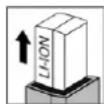
-
Do not touch dangerous moving parts before the machine has been isolated from the electric supply and such moving parts have come to a dead stop.
■ Thoroughly maintain your garden vac: -
Make sure that the ventilation apertures are free.
- Keep handles dry and free of oils and grease.
– Follow the maintenance instructions.
- Check the machine for possible damage
- Before continuing to use the machine, the protective devices must be inspected to ensure that they work perfectly and with their intended function
- Check whether the parts are damaged. All parts must be correctly installed and fulfil all conditions to ensure perfect operation of the saw.
- Damaged guards and parts must be properly repaired or exchanged by a recognized, specialist workshop; insofar as nothing else is stated in the instructions for use.
- Damaged or illegible safety warning labels should be replaced immediately.
- Store the unused machine in a dry locked place away from the reach of children.
Refer to the enclosed brochure “General safety instructions” for additional safety notices.
Behaviour in an emergency situation
- Initiate all required first aid measures suited for the injury and seek qualified medical advice as quickly as possible.
- Protect the injured person against further injuries and immobilise the injured person.
Description of the device / Spare parts
⚠️ Please observe the enclosed assembling instructions!
| Pos | Designation Order.-No. | ||
| 1 | device unit | ||
| 2 | ON-/OFF switch | ||
| 3 | speed control | ||
| 4 | front handle | set | 381329 |
| 5 | star grip screw | ||
| 6 | changeover switch | ||
| 7 | back suction tube | 381324 | |
| 8 | back vacuum tube | 381325 | |
| 9 | dual pipe | 381326 | |
| 10 | wheel (with axle) | set | 381328 |
| 10a | wheel (with nut) | ||
| 11 | vacuum Booster | 381327 | |
| 12 | collecting bag | 381330 | |
| 13 | shoulder strap | 381338 | |
| 14 | safety label | 381323 | |
| 15 | fastener bag | 381337 | |
| 16 | Charger 1,8 A 2 | 365500 | |
| 17 | Accu 2,0,Ah 2 | 365501 | |
| 18 | Accu 4,0 Ah 2 | 365503 | |
Assembly
⚠️ Please observe the enclosed assembling instructions! Start the leaf sucker only after it has been completely assembled.
Assembling the suction tube
3 Insert the rear suction pipe (7) and the rear blowing
4 pipe (8) into the unit, and screw both to the unit.
5 Insert the axle of the wheel (10) through the holder and turn the wheel (10a) on the axle.
6 Insert the double pipe (9) into the rear pipes and screw everything together
Fixing the handle
7 Plug the front handle (4) on the handle holder and fasten it with the star grip screw (5).
Fixing the collecting bag
8 First hook the collecting bag (12) into the front lug of the frame (A).
9 Fold the collecting bag (12) back until it audibly engages in the frame holder
10 Hook the eyelet (C) into the retainer of the rear suction pipe.
The device is not equipped with a safety lock. The device cannot be started without attaching or correctly attaching the collection bag.
Fixing the carrying strap
10 Hook the carrying strap (13) into the eyelet (D) provided on the unit.
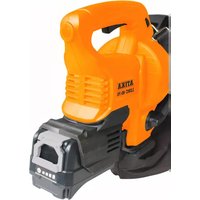
Battery
2 The lithium ion batteries AP 40-4000 (Article No. 365503) or AP 40-2000 (Article No. 365501) as well
as the charger ALG 40-1800 (Article No. 365500) are not included in the scope of delivery and must be purchased separately.
⚠️ Use only an original battery and the original charger.
Refer to the respective "Operating instructions" for further information on the batteries and the charger.
Inserting the battery
12 Insert the battery (17/18) in the device. Make sure to slide the battery fully in until it engages with a click.
Switching on/off
13 The On/Off switch is integrated in the handle.
Hold the switch pressed to start the leaf sucker


The leaf sucker stops automatically when you release the switch.
The stronger the On/Off switch is pressed the more powerful the leaf blower blows.
To protect the battery the device automatically switches off at a low battery charge.
Be sure not to continue operating the On/Off switch; this may damage the battery.
① Charge the lithium-ion battery (●“Battery” operating instructions).
Do not use any device where the switch cannot be switched on and off. Damaged switches must be repaired or replaced immediately by the customer service.
Working instructions

Before starting any work read and understand
▶ the safety notes,
▶ following additional instructions on how to work with this machine.
Carry out the following checks before startup and regularly during work: Observe the relevant sections in the operating instructions:
Before start of work
- Check the device before each use: for possible damages
- Wear your safety gear Make sure to have a safe and tidied up work area. Remove from the working area objects which might be thrown off (e.g. stones).
- Do not work in bad weather conditions (e.g. rain, risk of lightning).
■ Make sure that: - no other persons or animals stay within the working area,
- you can always step back without any barriers,
-
you have always a secure standing position.
— handles and mountings are dry and clean. -
The following is recommended before starting the blowing/suction:
– use a rake and broom to loosen dirt
– slightly wet dusty areas - Never point the suction/blow tube to yourself or other person or animals. Never blow objects in the direction of people of animals.
While working:
- Spectators must observe safety clearance of min. 5 m.
- Use the complete blow nozzle extension to ensure that the air flow can take full effect close to the ground.
- Switch-off the device if you cross gravel- and ballast chipping walks.
- Only operate the machine in walking speed, do not run with it.
- Beware of swirling and flying objects. Be particularly aware of recoiling effects from brickwork or house walls (e.g. stones).
GB
- Switch off the machine before crossing gravel or grit paths.
- Do not fill anything by hand into the suction hole.
- Do not operate the machine with wet hands or during damp weather.
- Never put objects manually into the suction opening.
- Always ensure that the connection lead runs back away from the machine. Otherwise there is a risk of stumbling, slipping or falling.
■ Never use the machine
- without the bag,
– without closing the zip fastener of the bag
- Immediately switch off the unit and allow it to come to a stop if foreign objects enter the unit or if the unit starts to make unusual noises or vibrates. Remove the mains plug and carry out the following checks:
– inspect for damage,
– have damaged parts replaced or repaired,
– check the equipment and tighten loose parts.
Before using the machine, ensure that the bag has been fitted, is not damaged or worn and the zip fastener has been closed.
⚠️ Power off the machine before attaching or removing the collecting bag.
Instructions for using as vac/shredder
15 Move the changeover switch to the vac/shredding setting.
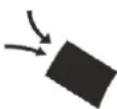
→ Hold the machine firmly at the handle and place the belt over your shoulder. Adjust the belt so that the machine can be carried comfortably and safely.
13 Switch the machine on.
18 Move the machine slowly and evenly over the material. Do not press it into the leaves.
The suction power decreases when the bag is full. Switch the machine off and disconnect from the mains. Open the zip fastener and empty the bag.
16 After finishing work, move the changeover switch to the blowing setting to remove any remains from the suction/blowing pipe.
Take up leaves in good time! – It is advisable to take up fallen leaves when the weather is dry and as soon as they have fallen. Wet leaves are a problem, together with leaves that have already begun to rot or are on big piles.
15 Move the changeover switch to the vac/shredding setting. → Hold the machine firmly at the handle and place the belt over your shoulder. Adjust the belt so that the machine can be carried comfortably and safely. 13 Switch the machine on. 18 Move the machine slowly and evenly over the material. Do not press it into the leaves. i The suction power decreases when the bag is full. Switch the machine off and disconnect from the mains. Open the zip fastener and empty the bag. 16 After finishing work, move the changeover switch to the blowing setting to remove any remains from the suction/blowing pipe. i Take up leaves in good time! – It is advisable to take up fallen leaves when the weather is dry and as soon as they have fallen. Wet leaves are a problem, together with leaves that have already begun to rot or are on big piles.
Using the Vacuum Booster
The Vacuum Booster (11) can be used for vacuuming most foliage and increases the suction power.
17 Insert it into the recesses in the front of the suction pipe (9).
The Vacuum Booster (11) can be used for vacuuming most foliage and increases the suction power. Insert it into the recesses in the front of the suction pipe (9).
Move the suction pipe over the material to be sucked up. Small stones, which are sucked in as well, do not get into the chipping turbine for the most part.
After switching off the leaf sucker, the small stones fall out again.
If you want to vacuum heavy and large leaves, remove the insert.
Instructions for use as blower
16 Move the changeover switch to the blowing setting.
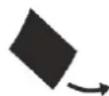
→ Hold the machine firmly at the handle and place the belt over your shoulder. Adjust the belt so that the machine can be carried comfortably and safely.
13 Switch the machine on.
19 Move the suction/blowing pipe in generous swaying movements uniformly a few centimetres over the ground, moving from one side to the other. Blow in the direction of the wind
13 Switch the machine on. 19 Move the suction/blowing pipe in generous swaying movements uniformly a few centimetres over the ground, moving from one side to the other. Blow in the direction of the wind
Garden vac with speed control
14 This version has adjustable motor speed and therefore adjustable vacuuming and blowing.
The speed is fully variable from 7500 rpm to 12500 rpm.
What can I vacuum and blow?
√ light, dry materials, e.g. dry leaves and garden waste such as grass, small twigs and pieces of paper
X heavy materials such as metal, stones, branches, fir cones or broken glass
Do not use the machine to vacuum or blow any burning, explosive or smoking items such as cigarettes, matches or hot ash.
Do not vacuum or blow any liquids, in particular flammable liquids such as fuel. Do not use the machine in the vicinity of such substances.
√ light, dry materials, e.g. dry leaves and garden waste such as grass, small twigs and pieces of paper ✗ heavy materials such as metal, stones, branches, fir cones or broken glass ⚠️ Do not use the machine to vacuum or blow any burning, explosive or smoking items such as cigarettes, matches or hot ash. ⚠️ Do not vacuum or blow any liquids, in particular flammable liquids such as fuel. Do not use the machine in the vicinity of such substances.
Care and maintenance

Before each maintenance and cleaning work :
- switch off device
- wait for standstill of the device
- allow the machine to cool down
- remove the battery
- switch off device - wait for standstill of the device - allow the machine to cool down - remove the battery
Replace any worn or damaged parts for safety reasons.
For maintaining and cleaning, removed security devices must unconditionally be mounted properly and proved again.
Use only original parts. Other parts can result in unexpected damages and injuries.
Maintenance and repair work beyond this is only allowed to be carried out by the manufacturer or authorized service staff.
i Please proceed as follows to preserve the functioning ability of your garden vac.
■ Remove dust and dirt with a cloth or a brush.
- Do not clean the machine with running water or high-pressure cleaners.
- Do not use solvents for the synthetic parts (petrol, alcohol, etc.) as these can damage the synthetic parts.
Cleaning the bag
Empty the bag every time after it has been used.
9 To remove the collection bag, pull the locking lever (B) to the rear.
→ Shake the bag thoroughly.
→ Turn it inside out and brush the bag out thoroughly.
→ Wash the bag when extremely soiled or at least once a year, by hand in mild soap suds.
i If the zip fastener is stiff, rub dry soap into the zip.
⚠ For your own safety, regularly check the bag for any signs of damage. Always replace a damaged bag immediately.
Storage
■ Store devices that are not in use in a dry locked place protected against frost and outside the reach of children and unauthorized persons
■ Before a longer storage observe the following in order to prolongate the service life of the machine and to guarantee a smooth running operation:
→ Remove the battery
→ thoroughly clean the machine
→ Check the machine for perfect condition to ensure a safe use of it after a longer period of storage
i Refer to the respective "Operating instructions" for further information on the batteries and the charger.
Possible faults
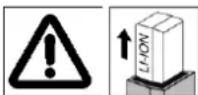
Before each fault elimination:
- Switch off device.
- Wait for standstill of the device.
– Pull out mains plug.
| Problem Possible cause Remedy | |
| Motor won't start | ➤ Li-lon battery run down➤ Lithium-ion battery not inserted correctly➤ Li-lon battery too cold/ too warm➤ Li-lon battery, Motor or switch defect |
| Material is not sucked in properly (reduced vacuuming power) | ➤ Machine is clogged or blocked➤ Bag too full➤ Speed setting too low (only for garden vacs with fully variable speed control)➤ The Li-lon battery charge is low➤ The Li-lon battery is defect |
| Machine works with interruptions | ➤ Internal fault➤ ON-Off-switch defect |
| Output per battery charge too short | ➤ Rechargeable battery is low➤ Battery service life exhausted |
① In case of further faults or inquiries please contact your local dealer.
Technical data
| Model LSHC 40-70 | |
| Year of construction see last page | |
| Suitable for battery type Li-lon 36 V | |
| Suitable for battery capacity 2000 mAh or 4000 mAh | |
| Speed n (with speed control) | 7500 - 12500 min^-1 |
| Chipping ratio ~ 10:1 | |
| Blowing air flow (max. air velocity) 257 km/h | |
| Suction power (max. air flow) 840 m^3/h | |
| Suction power (max. with vacuum booster) 31.6 m/s | |
| Hand arm vibration (as per EN 1033/DIN 45675) | a_vhw = < 3.40 m/s^2 |
| Measuring uncertainty | K = 1.5 m/s^2 |
| Bag (volume) 45 l | |
| Protection class | II – double insulated ☐ |
| Weight approx. 2.9 kg | |
| Sound power level L_WA (as per 2000/14/EC) | measured sound power level 98.7 dB (A) |
| guaranteed sound power level 106 dB (A) | |
| Measuring uncertainty | K = 3.0 dB (A) |
| Sound pressure level L_PA (as per 2000/14/EC) | 93.2 dB (A) |
| Measuring uncertainty | K_PA = 3.0 dB (A) |
Refer to the respective “Operating instructions” for “Technical specifications” of the batteries and the charger.
Guarantee
Please observe the enclosed terms of guarantee.
Technical modifications reserved!
Rychlost vyfukování
Objem vzduchu
Oog- en geluidsbescherming dragen.
Blaas-snelheid
Luchtvolume
Conformity assessment procedure
2000/14/UE - Appendix V
Noste ochranu očí a sluchu!
GB Year of construction