BA123 - Bread maker ELTA - Free user manual and instructions
Find the device manual for free BA123 ELTA in PDF.



User questions about BA123 ELTA
0 question about this device. Answer the ones you know or ask your own.
Ask a new question about this device
Download the instructions for your Bread maker in PDF format for free! Find your manual BA123 - ELTA and take your electronic device back in hand. On this page are published all the documents necessary for the use of your device. BA123 by ELTA.
USER MANUAL BA123 ELTA
Trockenhefe 3/4 Päckchen 1 Päckchen
Programm: SCHNELL
Kartoffelbrot
LaibgroBe 1000 g (2 lb) 1250 g (2,5 lb)
Trockenhefe 3/4 Päckchen 1 Päckchen
Programm:STANDARD
Roggenbrot
LaibgroBe 1000 g (2 lb) 1250 g (2,5 lb)
Wasser 350 ml 450 ml
Gretrocketer Sauerteig 1/2 Päckchen 3/4 Päckchen
Trockenhefe 3/4 Päckchen 1 Päckchen
Programm: VOLLKORN
Trockenhefe 3/4 Päckchen 1 Päckchen
Programm: VOLLKORN
D
Ahorn Vollkornbrot
LaibgroBe 1000 g (2 lb) 1250 g (2,5 lb)
Trockenhefe 3/4 Päckchen 1 Päckchen
Programm:STANDARD
Joghurt Vollkornbrot
LaibgroBe 1000 g (2 lb) 1250 g (2,5 lb)
Trockenhefe 3/4 Päckchen 1 Päckchen
Programm:STANDARD
Pollerbrot
LaibgroBe 1000 g (2 lb) 1250 g (2,5 lb)
Wasser 350 ml 500 ml
Trockenhefe 3/4 Päckchen 1 Päckchen
Programm: VOLLKORN
Getreidebrot
LaibgroBe 1000 g (2 lb) 1250 g (2,5 lb)
Wasser 450 ml 650 ml
Trockenhefe 3/4 Päckchen 1 Päckchen
Programm:STANDARD
Trockenhefe 3/4 Päckchen 1 Päckchen
Program: SCHHELL
Frischkasebrot
LaibgroBe 1000 g (2 lb) 1250 g (2,5 lb)
Trockenhefe 3/4 Päckchen 1 Päckchen
Programm:STANDARD
Amarettobrot
Trockenhefe 3/4 Päckchen 1 Päckchen
Programm SCHNELL
D
Krauterbrot
LaibgroBe 1000 g (2 lb) 1250 g (2,5 lb)
Buttermilch 375 ml 550 ml
Trockenhefe 3/4 Päckchen 1 Päckchen
Programm:STANDARD
Reisbrot
Trockenhefe 3/4 Päckchen 1 Päckchen
Programm: SCHNELL
Möhrenbrot
LaibgroBe 1000 g (2 lb) 1250 g (2,5 lb)
Wasser 275 ml 350 ml
Butter 25g 30g
Brotmehl 500 g 650 g
Trockenhefe 3/4 Päckchen 1 Päckchen
Trockenhefe 3/4 Päckchen 1 Päckchen
Programm:STANDARD
D
Sonnenblumkern Brot
Trockenhefe 3/4 Päckchen 1 Päckchen
Programm:STANDARD
Feigen-Walnuss Brot
Trockenhefe 3/4 Päckchen 1 Päckchen
Programm: VOLLKORN
Pizzabrot
LaibgroBe 1000 g (2 lb) 1250 g (2,5 lb)
Wasser 375 ml 570 ml
Trockenhefe 3/4 Päckchen 1 Päckchen
Programm: SCHNELL
D
Zucchini Brot
Trockenhefe 3/4 Päckchen 1 Päckchen
Programm:STANDARD
Trockenhefe 3/4 Päckchen 1 Päckchen
Trockenhefe 3/4 Päckchen 1 Päckchen
Programm: SCHNELL
Beeren-Walnuss Brot
LaibgroBe 1000 g (2 lb) 1250 g (2,5 lb)
Milch 190ml 220 ml
Eier3 4
Trockenhefe 3/4 Päckchen 3/4 Päckchen
Trockenhefe 3/4 Päckchen 3/4 Päckchen
Programm: KURZ
Sehr süβes Brot
LaibgroBe 1000 g (2 lb) 1250 g (2,5 lb)
Wasser 210 ml 270 ml
Eier 3 4
Trockenhefe 3/4 Päckchen 3/4 Päckchen
Programm: KURZ
1,5 Teelöffel
D
Urlaubsbrot
LaibgroBe 1000 g (2 lb) 1250 g (2,5 lb)
Wasser 150 ml 180 ml
Milch 230 ml 300 ml
Trockenhefe 3/4 Päckchen 3/4 Päckchen
Programm: KURZ
Sandwich Brot
LaibgroBe 1000 g (2 lb) 1250 g (2,5 lb)
Wasser 340 ml 460 ml
Trockenhefe 3/4 Päckchen 3/4 Päckchen
Trockenhefe 3/4 Päckchen 3/4 Päckchen
Trockenhefe 3/4 Päckchen 1 Päckchen
Programm: TEIG
Please read these Operating Instructions through carefully before connecting your device to the mains, in order to avoid damage due to incorrect use. Please pay particular attention to the safety information. If you pass the device on to a third party, these Operating Instructions must also be handed over.
DESIGN
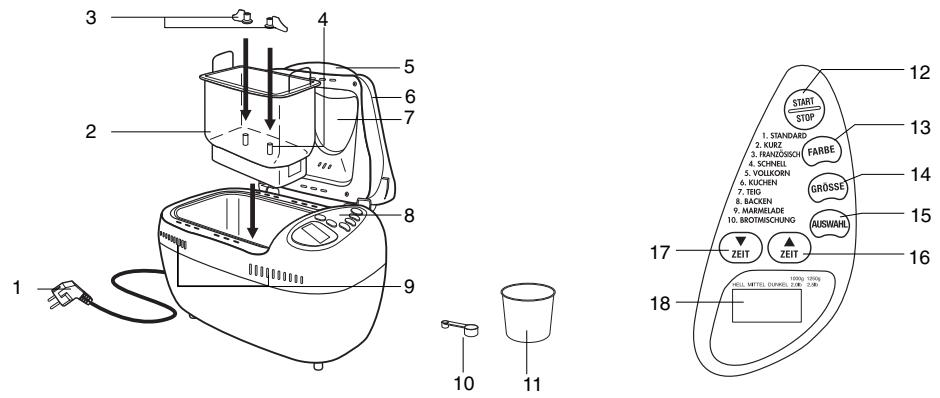
- Power cord with power plug
- Baking mould
- Kneading hook
- Drive shafts
- Handle
- Lid
- View window
- Operating panel
- Venting slots
- Measuring spoon
- Measuring beaker
Operating panel:
12. Button START/STOP
13. Button FARBE (Colour)
14. Button GROBE (Size)
15. Button AUSWAHL (Selection)
16. Button ZEIT▲ (Time)
17. Button ZEIT▼ (Time)
18.LCD-Display
SAFETY INSTRUCTIONS
- Incorrect operation and improper use can damage the appliance and cause injury to the user.
- The appliance may be used only for it's intended purpose. No responsibility can be taken for any possible damage caused through incorrect use or improper handling.
- Before connecting the appliance to the power source, check that the current and power match those given on the rating plate.
- Do not put the appliance or the plug in water or any other liquid. However should the appliance accidentally fall into water, unplug the appliance immediately and have it checked by a qualified person before using it again. Non-observance could cause a fatal electric shock!
- Never attempt to open the housing yourself.
- Do not place any kind of object into the inside of the housing.
- Do not use the appliance with wet hands, on a damp floor or when the appliance itself is wet.
- Do not touch the plug with wet or damp hands.
- Check the cord and the plug regularly for any possible damage. If the cord or plug is damaged, it must be replaced by the manufacturer or a qualified person in order to avoid a hazard.
- Do not use the appliance if it is dropped or otherwise damaged or if the cord or plug are damaged. In the case of damage, take the appliance to an electrical repair shop for examination and repair if
GB
necessary.
- Never attempt to repair the appliance yourself. This could cause an electric shock.
- Do not allow the cord to hang over sharp edges and keep it well away from hot objects and naked flames. Remove the plug from the socket only by holding the plug.
- For extra protection it is possible to fit the electric household installation with a fault current breaker with a rated breaking current of not more than 30mA . Ask your electrician for advice.
- Make sure that there is no danger that the cord or extension cord may inadvertently be pulled or cause anyone to trip when in use.
- If an extension cord is used it must be suited to the power consumption of the appliance, otherwise overheating of the extension cord and/or plug may occur.
- Stand the appliance on a firm, level and heatproof surface away from naked flame (eg. a gas oven) and out of reach of children.
- This appliance is not suitable for commercial use nor for use in the open air.
- Never leave the appliance unattended while it is in use.
- Children cannot recognise the dangers involved in the incorrect use of electrical appliances. Therefore never allow children to use household appliances without supervision.
- Always remove the plug from the socket when the appliance is not in use and each time before it is cleaned.
- Danger! Nominal voltage is still present in the appliance as long as the appliance is connected to the mains socket.
- Switch off the unit before pulling out the mains plug.
- Never use the cord to carry the appliance.
SPECIAL SAFETY INSTRUCTIONS
- Please operate the automatic baking unit only after placing the baking mould filled with the ingredients in the unit. Operating without ingredients will cause the unit to overheat.
- Release the power plug from the socket before removing the mould from the unit.
- Use Caution! The baking mould becomes extremely hot. Always use oven mittens or pot holders while removing the mould from the unit. Let all metallic parts cool before touching them.
- Do not touch any moving parts!
- Do not move the unit, if it is filled with liquids.
- Clear a distance of 5cm around the automatic baking unit while the it is in operation and until it has cooled. The outside of the unit becomes hot while in operation. The air emitting from the steam exhausts is very hot.
- The parts of the automatic baking unit must not be washed in the dishwasher and can only be washed by hand (refer to CLEANING AND CARE).
- Never leave the unit unattended during operation, even when set for Timer operation.
- Do not cover the unit while in operation.
- Never use the unit in the vicinity of easily inflammable materials. Combustion hazard!
- Do not remove foodstuff from the automatic baking unit, if it is still connected or if the power plug is still in the wall socket.
- Do not put bulky foodstuff, metal foils, packings or similar materials in the unit.
UNIT PERFORMANCE ABILITIES
- You can use this automatic baking machine to:
Process ready-mix bread dough. The recipes are usually printed on or in the packing.
Bake bread by using the recipes offered with this unit. Bookshops stock special books on this topic. This automatic bread baking unit has facilities for the processing stages of kneading, processing and baking.
Knead dough (e.g. pasta, pastry or buns).
Cook jams and marmalades.
This automatic baking unit is suitable for making bread with a maximum weight of 1,250 g. Do not put in more than this quantity of material, including fluids, into the mould (2).
GB
ABOUT BREAD MAKERS
- The principal benefit of this bread maker is that all the kneading, rising and baking is performed within a space saving, self-contained unit. This bread maker will easily produce superb loaves time and time again provided the user follows the instructions and understands these few basic principles.
ACCESSIONS
- 2 kneading blades (3)
1 measuring cup (11)
1 measuring spoon (10) - The quantities of sugar, oil & other ingredients in these recipes are based upon this metric measuring spoon: large end 15ml = tablespoon small end 5ml = teaspoon
- The pan (2) must be properly inserted into the machine before the drive cogs can make contact with the kneading shafts. Next, insert the kneading blades (3), regardless of their direction. As you place the blades on to the kneading shaft, rotate them until they lock into place.
CONTROLS
- START/STOP (12): Starts unit operation. To stop the unit part way through press and hold this button for 3 seconds. After which, the machine will reset to programme 1.
FARBE (Colour) (13): Press to select crust colour: light, medium or dark. The arrow on the LCDdisplay (16) will point to the colour you have selected. NOTE: Crust colour is not available with the BREADMIX program (for readymade bread mixtures) - GROBE (Size) (14): Select between 2 lb (approx. 1000 g) and 2.5 lb (approx. 1250 g) loaf size. The small arrow will move to indicate your current selection.
AUSWAHL (Select) (15): Main selector control. Press to cycle through each programme. - ZEIT (Time) (16): Time selection (increase)
- ZEIT (Time) (17): Time selection (decrease)
THE PROGRAMMES
- STANDARD (Basic): This is the first programme displayed when the machine is switched on. This is a good, general-purpose programme for white or brown bread. Most recipes use this programme.
- KURZ (Short): Uses shorter steps to make bread in less time. NOTE: Loaf size is not available in this mode.
- FRANZÖSISCH (French): This setting is slightly longer than the STANDARD programme, due to the extra kneading and rising time required to give the loaf a 'airy' texture characteristic of French bread.
NOTE: Loaf size cannot be altered in this mode. - SCHNELL (Quick): This mode is similar to the KURZ programme (Short) in that the steps are shorter for a faster process time.
NOTE: Loaf size cannot be altered in this mode.
SCHNELL mode (Quick) is best for gluten-free recipes.
VOLLKORN (Whole wheat): WHOLE WHEAT: This mode allows more time for the kneading and rising steps in order to obtain better results with the low gluten whole wheat/whole meal flour. - KUCHEN (Cake): Programme for making cakes.
Note: The crust colour control is available in this mode. - TEIG (Dough): Performs all the steps of kneading and rising but omits the bake cycle. NOTE: Crust colour control and loaf size selection are not available.
- BACKEN (Bake): Stand-alone bake cycle. Good for sweet bread, baking pre-made dough etc.
- MARMELADE (Jam): Mixing and heating programme ideal for jam making.
GB
- BROTMISCHUNG (Bread mixture): Programme specially designed for pre-packaged bread mixes.
INGREDIENTS
- The most important part of the bread making process is the selection of quality ingredients. Just apply this simple rule: Best ingredients - best results, poor ingredients - poor results. For example: If quality yeast, flour and cold water were thrown together and mixed in an old bucket the mixture would still rise! Nothing the bread maker does will prevent the dough from rising. If your loaf does not rise it is unlikely that the bread maker is to blame. It is probably due to the ingredients. In order to save you time we have included information on each major element used in the making of bread.
- FLOUR: In bread making, the most important element in the flour is the protein gluten, which is the natural agent that gives the dough the ability to hold its shape and retain the carbon dioxide produced by the yeast. The term 'strong flour' means that it has a high gluten content. It has probably been milled from hard wheat and is lends well to bread making.
- BROWN FLOUR (or FARMHOUSE FLOUR): Brown flour contains about 85% of the wheat kernel. Much of the bran part of the wheat kernel has been removed. Loaves made with all brown flour tend to be smaller than white loaves due to the lower gluten content however there tends to be more flavour and texture to brown loaves. When buying this type of flour the strong, finely ground type will obtain better results from the bread maker.
- WHOLEMEAL or WHOLE-WHEAT FLOUR: This type of flour contains all of the original wheat kernel including the bran; the tough outer skin of the wheat which is an excellent source of fibre. As with the brown flour, you should specify a strong fine ground variety when using your bread maker. The bran in the wholemeal flour inhibits the release of gluten so wholemeal loaves tend to be smaller and more dense than white loaves.
- YEAST is the living organism that multiplies in the dough. It produces the carbon dioxide bubbles that make the dough rise. For bread making machines it is best to use the 'Easy Blend' dried yeast that comes in sachets. This yeast does not rely on sugar in order to ferment so it is easier to reduce the sugar content of your loaf without any adverse effects. Avoid yeast in tubs or tins as these tend to perform less well once opened. Sachet yeast is very sensitive to moisture so do not store partly used sachets for more than a day.
- SALT not only adds to the flavour of the bread, but it can also be used to slow down a particularly lively yeast.
- BUTTER (or fat) enhances the flavour and makes the loaf softer. Alternatives to butter are margarine or olive oil. Avoid low fat spreads as these may be as little as 40% fat and will not have the same effect.
SUGAR adds to the flavour of the bread and helps to make the crust turn a darker shade of brown. Note: Most sachet yeasts do not rely on sugar to become active. - WATER: Use soft water if possible but the bread maker will still produce quality bread with hard water. There is much debate on what temperature the water should be. The answer is simple. If the water feels cool to the touch then it's fine. There is no need to warm the water first. If you're worried the water may be too cold from the tap just leave it to sit for an hour in order to reach room temperature. Making the water warm could prematurely kill the yeast.
- OPTIONAL INGREDIENTS could mean anything from dried fruit, cheese, eggs, nuts or yoghurt to other cereals like rye flour, corn meal or any number of herbs and spices. There are a couple of things to consider for best results. Always be aware of the moisture content and adjust accordingly. Things like cheese, milk and fresh fruit contain quite a bit of water, which will determine the look of the finished loaf. In the beginning you might want to stick to dry substitutes like Parmesan cheese, dried milk or dried fruit. As you become more proficient with the machine you will instinctively know whether the dough looks too wet or too dry and can add flour or water accordingly during the process. Remember to consider the salt content of the ingredients you add. Salt can slow down the yeast.
GB
Finally, if the added ingredients are wet like yoghurt or powdered like dried herbs they can go into the mixture at the start of the process. For things like nuts or dried fruit there is a time during the process where the machine will beep to let you know it's time to add these to the dough mixture. Refer to the TABLE so you know when to expect the beep.
- ENVIRONMENT: Last but not least is the environment in which the bread is made. The bread maker will work well in a wide range of temperatures but there could be a difference of 15% in loaf size between a very warm room and a very cold room. Do not place your bread maker in a draughty part of the house. The machine will offer some protection to the dough against draughts but it does have limitations. If the humidity in the room is high this too could affect the loaf. As a general rule, if the room is comfortable for you it will be comfortable for your bread maker.
STORING YOUR BREAD
- Homemade bread contains no artificial preservatives. However, if you store the bread in a clean, air-tight container placed in the refrigerator it should keep for 5-7 days. Bread is also good to freeze, but allow finished loaves to cool before placing into a polythene bag and storing in the freezer.
YOUR FIRST LOAF
- The following recipe is for a simple white loaf. Even if you do not usually eat white bread we strongly recommend you make this your first loaf because it is relatively easy to make.
- Follow the steps in the exact order shown on the next page. For a 1000g / 2 lb loaf you will need the following ingredients:
Water
310 ml
Strong white bread flour
560 g
Sugar
2 tablespoons
Butter or margarine
2 tablespoons
Salt
2 tablespoons
Yeast (sachet type)
2 1/2 tablespoons (usually 1 1/2 7 g sachet)
- Use quality kitchen scales to measure the flour. Use the measuring cup (10) provided for the liquid or, if you prefer, any measuring beaker that's calibrated in ml.
BEFORE STARTING FOR THE FIRST TIME
- Remove all packing material.
- Clean the unit before using it for the first time (see CLEANING AND CARE).
- There can be some slight smoke and/or smell when using it for the first time. Residues left over from the manufacturing process are being burned on the surface of the unit.
OPERATION
- Remove the baking mould (2) from the unit with both hands. Attach the two kneading hooks (large and small) (3) to the drive shafts (4) on bottom of the baking mould (2). Please ensure that the kneading hooks (3) are latched in securely.
- Pour the condiments into the baking mould (2) (refer to the chapters INGREDIENTS and RECIPES). It is absolutely essential that the condiments are in the baking mould (2) before placing the baking mould (2) into the automatic baking unit. Otherwise, it will dirty the unit or damage the heating rods.
- Empty the condiments, in the sequence indicated above, into the baking mould (2). First fill in the fluid, then the flour. It is best to spread the sugar and salt around the edge of the flour. Make a small basin in the flour for yeast. Please see to it that the yeast does not come in contact with the salt or the fluid.
- Insert the baking mould (2) into the unit. Please ensure that it latches with a distinct clicking sound. Close the lid (6).
- Insert the power plug (1) into a suitable socket.
GB
The program STANDARD is displayed:
Baking time: 3:30 hrs.
FARBE (Colour): Medium
GRÖSSE (Size): 2 lb (1000 g)
-
Select another program: Keep the AUSWAHL (Select) button (15) pressed, until the programme number of the desired operation lights up in the LCD display (18).
-
Select the desired settings using the buttons GROSSE (Size) (14) and FARBE (Colour) (13) (refer to the section TABLES).
-
You can now set the ZEIT (Time) function (see Using the Timer).
-
Press the button START/STOP (12). The unit now begins to warm the dough to room temperature. Thereafter, the kneading hooks (3) begin to knead the dough.
-
At this point, the selected programme engages. The time remaining for the selected programme is shown in the LCD display (18). The automatic bread baking unit now executes the various operations. Kneading, processing and baking, depending upon the selected programme.
-
In the kneading process, the unit mixes the condiments for several minutes. It is quite normal for the unit to vibrate, and make a little noise, during the kneading process.
-
Then the unit begins to process the dough. In this period, the yeast begins processing and the viewing window (7) may become lightly clouded during this time.
-
If the unit emits some smoke, keep the cover (6) closed. Pull the power plug (1) from the socket. Under no circumstances should you wipe the rising dough in the unit with water. Smoke can be generated if dough rises over the edge of the mould (2) and touches the heating coil.
-
To achieve the best baking results, do not, if possible, open the unit during operation. You can observe the baking progress through the viewing window (7).
-
A signal is sounded after 1/3 of the time has passed, if you use one of these programs: STANDARD, KURZ (Short), FRANZÖSISCH (FRENCH), VOLLKORN (Whole Wheat), KUCHEN (Cake), TEIG (Dough) and BROTMISCHUNG (Bread mixture) (see the section TABLES). At this time add the optional ingredients to the bread, such as nuts etc. Open the lid (6) carefully, add the optional ingredients and close the lid (6). Please be careful of the rising steam!
After the set program is over, the LCD display (18) shows 0:00. The bread is now fully baked.
-
Pull the power plug (1) from the socket.
-
Open the lid (6). Remove the baking mould (2) from the unit, using oven mittens.
Caution: The baking mould (2) is very hot!
Again, please mind the rising steam!
- Place the baking mould (2) on a heat-proof surface, never on a table top or plastic surface.
- Let the baking mould (2) cool for about 5 minutes in the unit, before removing the bread from the mould (2). After these 5 minutes remove the baking mould (2) from the unit. Shake lightly to release the bread.
- The unit will keep the baked bread hot for one hour, if it is not removed after 5 minutes.
- If the kneading hooks (3) are still stuck in the bread, you can remove them using a blunt object. Please always use a wooden object, so as not to damage the non-stick coating on the kneading hooks (3).
After about 30 minutes of cooling, the bread may become distorted.
HOW TO USE THE TIMER
- The most common use for the timer is to make a loaf overnight in order for it to be ready in the morning. Once you have selected your desired programme, simply press the button ZEIT (Time increase) (16) or the button ZEIT (Time decrease) (17) on the control panel and the figure on the display will increase or decrease by 10 minutes. This way you can set programme to suit your needs. The important thing to keep in mind is that the amount of time the display reads is the time from pressing START/STOP (12) to when the loaf will be ready. For example: After selecting the required programme, keep pressing the ZEIT button (Time increase) (16) ZEIT button (Time decrease) (17) until the display reads 5:00. Then press START/STOP (12). It will now be 5 hours before the loaf is ready.
GB
If you press the ZEIT ▲ (Time increase) (16) - until the display reads 8:10 then the loaf will be ready in 8 hours and 10 minutes. You can press and hold the ZEIT (Time) (left/right) buttons to scroll quickly to your desired setting. You can set a maximum of 13 hours.
- NOTES: Once you have pressed START/STOP (12) you cannot alter the timer. If you need to reset the timer press START/STOP (12) button for 3 seconds and the machine will reset, after which you can re-select your programme and timer accordingly.
Note: Do not do this if the process is past the first kneading. Do not use perishable ingredients like milk or eggs when using the delay timer as these will spoil whilst sitting in the bread pan (2). You cannot reduce the delayed time to less than the process time.
CLEANING AND CARE
- In addition to this, you must observe the safety instructions.
- Let the unit cool down completely before starting to clean it.
- If necessary, remove the baking mould (2) from the unit and remove the kneading hooks (3) from the drive shafts (4). The baking mould (2) and the kneading hooks (3) have a non-stick coating. This facilitates cleaning. The baking mould (2) and the kneading hooks (3) should be cleaned with a mild cleaning solution and warm water.
- Never use any abrasive cleaning agents, scouring aids or scratching sponges. If the kneading hooks (3) become encrusted or difficult to remove from the drive shafts (4), fill the baking mould (3) with hot water. After about 30 minutes, try again. Dry the parts well before putting them back into the unit.
- The baking mould (2) and the kneading hooks (3) should not be washed in the dishwasher.
- Do not place the baking mould into water. This might cause damage to the protection on the bottom of the mould.
- Wipe the baking compartment and container using a moist cloth and let dry completely.
FREQUENTLY ASKED QUESTIONS
Q: The motor did not run when I pressed START/STOP (12).
A: It's not supposed to. All the programmes start with a pre-heat step that ensures all the ingredients are at the right temperature before the process starts.
Q: The machine beeped part way through the process.
A: This is the signal to add optional ingredients like fruit or nuts. Some of the recipes call for extra ingredients. Refer to the appropriate recipe for more information.
Q: I tried to make another loaf right after the first but the process wouldn't start.
A: The machine must be allowed to cool thoroughly before another loaf can be made.
GB
PROBLEMS
- Sunken loaves: Typically, what happens is the dough will rise very well then sinks just as the baking process starts. Most of the time, this is because the dough was not strong enough. Whilst the yeast is still producing gas a weak dough will maintain a good shape but once the yeast is killed by the baking process, the loaf can sink under it's own weight. The mixture is too wet causing weak dough.
Too much water/not enough flour. This will make the dough watery. The dough should be soft but firm.
Some brands may need some adjustment to the ingredients. Some types of flour absorb less water than others. In this case, add an extra 50g of flour to make the dough thicker.
- The gas bubbles produced by the yeast are escaping! Dough without gluten is like water without soap; you cannot make bubbles.
The white flour brand you are using probably does not have sufficient gluten to make a decent dough.
- The yeast is dead or has gone off.
If you use warm water, the yeast may be exhausted before the rising process is complete.
Tap water is usually fine. Be extra careful that the yeast does not come into contact with the water before the mixing process starts. This is particularly important when using the timer.
Check the "best before" date on the yeast sachet. If it is close to expiry it would be best to buy another.
Avoid using yeast from sachets that are already opened. Use a new sachet every time.
- The loaf did not rise! Many of the reasons why bread doesn't rise are outlined above. But first, let us eliminate the obvious:
Whole meal & brown loaves seldom rise as well as white.
You did put the yeast in didn't you? It's easy to forget.
A common error is mistaking teaspoons of salt for tablespoons. The yeast will not work well if you add too much salt.
Both the flour and the yeast must be in good condition.
The mixture may have been too dry. Add 1 tablespoon of water to the mixture if necessary. If you feel that the yeast should be increased then only add an extra 1 tsp - but not more.
- The loaf rose too high and stuck to the lid!
Usually caused by too much yeast, too much water or flour, or forgetting to add the salt. Salt keeps the yeast in check - without it the yeast can cause the loaf to over-rise.
TECHNICAL DATA
Power input: 230V 50Hz
Power consumption: 1000 Watt
GUARANTEE AND CUSTOMER SERVICE
Before delivery our devices are subjected to rigorous quality control. If, despite all care, damage has occurred during production or transportation, please return the device to your dealer. In addition to statutory legal rights, the purchaser has an option to claim under the terms of the following guarantee:
For the purchased device we provide 2 years guarantee, commencing from the day of sale. During this period we will remedy all defects free of charge, which can be demonstrably attributed to material or manufacturing defects, by repair or exchange.
Defects which arise due to improper handling of the device and malfunctions due to interventions and repairs by third parties or the fitting of non-original parts, are not covered by this guarantee.
APPENDIX: TABLE ON BAKING PHASE TIMINGS
| Program number | 1 | 2 | 3 | 4 |
| Program name | STANDARD | KURZ | FRANZÖSISCH | SCHNELL |
| 2.0 lb / 2.5 lb / 1,000 g 1,250g | 1:58 | |||
| 3:30 3:40 | 3:50 | 1:52 | ||
| Pre-heat: | 20 min 17 min | 5 min | 22 min | 3 min |
| Stirring: | 3 min | 3 min | 3 min | 3 min |
| Knead 1 | 2 min | 2 min | 2 min | 2 min |
| Knead 2: Heat at 25°C | 13 min Signal at 2:57 (2lb) 3:04 (2,5lb) | 20 min Signal at 1:33 | 21 min Signal at 3:12 | 5 min |
| Open 1 Heat to/at 25°C | 45 min | - | 45 min | - |
| Open 2 | 19 min | 7 min | 26 min | 7 min |
| Open 3 | 46 min | 26 min | 51 min | 27 min |
| Bake | 62 min 55 min | 55 min | 65 min | 65 min |
| Keep warm | 60 min | 60 min | 60 min | - |
| Timer- programming | 13 h | - | 13 h |
| 5 | 6 | 7 | 8 | 9 | 10 |
| VOLLKORN | KUCHEN | TEIG | BACKEN | MARME- LADE | BROTMISCHUNG |
| 2.0 lb / 2.5 lb / 1,000 g 1,250g | 2.0 lb / 1,000 g | 1:50 | 1:00 | 1:20 | 2.0 lb / 2.5 lb / 1,000 g 1,250 g |
| 3:40 3:30 | 2:00 | 3:20 3:09 | |||
| 40 min 37 min | - | 22 min | - | 15 min | 22 min 11 min |
| 3 min | 3,5 min | 3 min | - | 45 min heating | 3 min |
| 2 min | 20 min Fruit signal 1:49 | 2 min | - | Pause: 20 min | 2 min |
| 13 min | - | 16 min Fruit signal 1:12 | - | End | 13 min Fruit signal 2:45 |
| 45 min | - | - | - | 45 min | |
| 19 min | - | 45 min | - | 19 min | |
| 36 min | - | 22 min | - | 40 min | |
| 62 min 55 min | 80 min plus 60 min pause | - | 60 min | 56 min | |
| 60 min | - | - | 60 min | 60 min | |
| 13 h | - | 13 h | 13 h | 13 h |
RECIPES
| White bread | ||
| Loaf size | 1000 g (2 lb) | 1250 g (2.5 lb) |
| Water | 350 ml | 500 ml |
| Salt | 1 teaspoon | 1.5 teaspoons |
| Sugar | 1 teaspoon | 1.5 teaspoons |
| Hard wheat semolina | 150 g | 200 g |
| Bread flour | 350 g | 500 g |
| Yeast | 3/4 packet | 1 packet |
Program: STANDARD or KURZ (Quick) (for quick baking)
French white bread
| Loaf size | 1000 g (2 lb) | 1250 g (2.5 lb) |
| Water | 375 ml | 550 ml |
| Salt | 1 teaspoon | 1.5 teaspoons |
| Bread flour | 525 g | 700 g |
| Hard wheat semolina | 75 g | 100 g |
| Sugar | 1 teaspoon | 1.5 teaspoons |
| Dry yeast | 3/4 packet | 1 packet |
Program: FRANZÖSISCH (French) or KURZ (Quick) (for quick baking)
Nut and raisin bread
| Tip: Add the raisins and nuts after you hear the sound signal | ||
| Loaf size | 1000 g (2 lb) | 1250 g (2.5 lb) |
| Water or milk | 275 ml | 50 ml |
| Margarine or butter | 30 g | 40 g |
| Salt | 1/4 teaspoon | 3/4 teaspoon |
| Sugar | 1 tablespoon | 2 tablespoons |
| Bread flour | 500 g | 650 g |
| Dry yeast | 3/4 packet | 1 packet |
| Raisins | 50 g | 50 g |
| Grated walnuts | 40 g | 60 g |
Program: STANDARD
Italian white bread
| Loaf size | 1000 g (2 lb) | 1250 g (2.5 lb) |
| Water | 375 ml | 570 ml |
| Salt | 1 teaspoon | 1.5 teaspoons |
| Vegetable oil | 1 tablespoon | 1.5 tablespoon |
| Sugar | 1 teaspoon | 1.5 teaspoons |
| Bread flour | 475 g | 650 g |
| Corn semolina | 100 g | 150 g |
| Dry yeast | 3/4 packet | 1 packet |
Program: STANDARD
Poppy bread
Tip: Before the last fermentation, open the lid briefly, apply water on the dough and then distribute the poppy. Press the poppy lightly with the hands.
| Loaf size | 1000 g (2 lb) | 1250 g (2.5 lb) |
| Water | 375 ml | 570 ml |
| Bread flour | 500 g | 670 g |
| Corn semolina | 75 g | 130 g |
| Sugar | 1 teaspoon | 1.5 teaspoons |
| Salt | 1 teaspoon | 1.5 teaspoons |
| Whole milled poppy | 75 g | |
| Grated nutmeg | 1 pinch | 2 pinches |
| Butter | 15 g | 20 g |
| Grated Parmesan | 1 tablespoon | 1.5 tablespoons |
| Dry yeast | 3/4 packet | 1 packet |
Program: KURZ (Short)
Oat bread
| Loaf size | 1000 g (2 lb) | 1250 g (2.5 lb) |
| Water | 350 ml | 500 ml |
| Margarine or butter | 25 g | 30 g |
| Salt | 1 teaspoon | 1.5 teaspoons |
| Brown sugar | 1 teaspoon | 1.5 teaspoons |
| Oat flakes | 150 g | 200 g |
| Bread flour | 375 g | 550 g |
| Dry yeast | 3/4 packet | 1 packet |
Program: KURZ (Short)
Buttermilk bread
| Loaf size | 1000 g (2 lb) | 1250 g (2.5 lb) |
| Buttermilk | 375 ml | 550 ml |
| Salt | 1 teaspoon | 1.5 teaspoons |
| Sugar | 1 teaspoon | 1.5 teaspoons |
| Bread flour | 500 g | 760 g |
| Dry yeast | 3/4 packet | 1 packet |
Program: FRANZÖSISCH (French)
Coarse white bread
| Loaf size | 1000 g (2 lb) | 1250 g (2.5 lb) |
| Milk | 275 ml | 350 ml |
| Margarine or butter | 25 g | 30 g |
| Salt | 1 teaspoon | 1.5 teaspoons |
| Sugar | 1 teaspoon | 1.5 teaspoons |
| Bread flour | 500 g | 650 g |
| Dry yeast | 3/4 packet | 1 packet |
Program: STANDARD
Wholemeal bread
| Loaf size | 1000 g (2 lb) | 1250 g (2.5 lb) |
| Water | 350 ml | 500 ml |
| Margarine or butter | 25 g | 35 g |
| Salt | 1 teaspoon | 1.5 teaspoons |
| Sugar | 1 teaspoon | 1.5 teaspoons |
| Bread flour | 270 g | 380 g |
| Wholemeal flour | 270 g | 380 g |
| Dry yeast | 3/4 packet | 1 packet |
Program:STANDARD
Raisin bread
| Tip: Add the raisins or other dry fruits after you hear the sound signal during the 2ndkneading phase. | ||
| Loaf size | 1000 g (2 lb) | 1250 g (2.5 lb) |
| Water | 275 ml | 350 ml |
| Margarine or butter | 30 g | 40 g |
| Salt | 1/4 teaspoon | 3/4 teaspoon |
| Honey | 1 teaspoon | 2 teaspoons |
| Bread flour | 500 g | 650 g |
| Cinnamon | 3/4 teaspoons | 1 teaspoon |
| Dry yeast | 3/4 packet | 1 packet |
| Raisins/ dry fruits | 75 g | 100 g |
Program: KURZ (Short)
Coarse grained bread
| Loaf size | 1000 g (2 lb) | 1250 g (2.5 lb) |
| Water | 300 ml | 450 ml |
| Salt | 1 teaspoon | 1.5 teaspoons |
| Dry wheat sourdough | 25 g | 40 g |
| Bread flour | 500 g | 670 g |
| Sugar | 1 teaspoon | 1.5 teaspoons |
| Dry yeast | 3/4 packet | 1 packet |
Program: FRANZÖSISCH (French)
Tip: The sourdough improves the finish, freshness and taste of the dough. It is milder than rye sourdough.
Onion bread
| Loaf size | 1000 g (2 lb) | 1250 g (2.5 lb) |
| Water | 350 ml | 500 ml |
| Salt | 1 teaspoon | 1.5 teaspoons |
| Sugar | 1 teaspoon | 1 teaspoon |
| Roasted onions | 50 g | 75 g |
| Bread flour | 540 g | 760 g |
| Dry yeast | 3/4 packet | 1 packet |
Loaf size 1000 g (2 lb) 1250 g (2.5 lb)
Fresh milk 275 ml 400 ml
Margarine or butter 25g 35g
Eggs 2 4
Salt 1 teaspoon 1.5 teaspoons
Honey 2 tablespoons 3 tablespoons
Bread flour 500 g 700 g
Dry yeast 3/4 packet 1 packet
Sugar 1 teaspoon 1.5 teaspoons
Bread flour 630g 780g
Dry yeast 1 packet 1.5 packets
1000 g (2 lb) 1250 g (2.5 lb)
Dried sourdough 1/4 packet 3/4 packet
Water 350 ml 450 ml
Bread spices 1/4 teaspoon 1 teaspoon
Salt 1 teaspoon 1.5 teaspoons
Rye flour 250g 340g
Bread flour 250g 340g
Dry yeast 1 packet 1.5 packets
Program: STANDARD
Dried sourdough is concentrated and is available in 15g packing.
White Graham bread
1000 g (2 lb) 1250 g (2.5 lb)
Water 350 ml 550 ml
Salt 1 teaspoon 1 teaspoon
Butter or Margarine 25 g 30 g
Honey 1 teaspoon 1.5 teaspoons
Vinegar 3/4 teaspoon 1 teaspoon
Wheat wholemeal 500g 700g
Dry yeast 1 packet 1,5 packet
Program: VOLLKORN (Whole wheat)
GB
Coarse grained brown bread
Tip: The spices can be added either full or stomped. Before the last fermentation, open the lid briefly. Moisten the dough with water and add oats or millet. Compress lightly with the hands.
Loaf size 1000 g (2 lb) 1250 g (2.5 lb)
Water 350 ml 450 ml
Rye flour 170 g 220 g
Wheat wholemeal 170g 220g
Spelt flour 170 g 220 g
Beet treacle 1 teaspoon 1.5 teaspoons
Pimento grain 1/4 teaspoon 1.5 teaspoons
Coriander 1/4 teaspoon 1.5 teaspoons
Grated nutmeg 1 pinch 2 pinches
Dried sourdough 1/4 packet 3/4 packet
Dry yeast 3/4 packet 1 packet
Program:STANDARD
Rye bread
1000 g (2 lb) 1250 g (2.5 lb)
Water 350 ml 450 ml
Dried sourdough 1/4 packet 3/4 packet
Salt 1 teaspoon 1.5 teaspoons
Rye malt 10 g 15 g
Rye flour 300 g 400 g
Bread flour 200g 260g
Yeast 1 packet 1.5 packets
Program: VOLLKORN (Whole wheat)
Apple walnut bread
Eggs 2
Milk 40 ml
Oil 4 tablespoons
Sugar 1 cup
Granny Smith apples peeled and chafed 2 cups
Hacked walnuts 1 cup
Flour 380g
Sodium bicarbonate 1 teaspoon
Baking powder 1 teaspoon
Salt 1/4 teaspoon
Nutmeg 1/4 teaspoon
Cinnamon 1/4 teaspoon
Program: KURZ (Short)
GB
Banana nut bread
| Milk | 250 ml |
| Oil | 4 teaspoons |
| Bananas peeled and mashed | 2 cups |
| Eggs | 4 |
| Sugar | 1/4 cup |
| Dark brown sugar | 1/4 cup |
| Hacked walnuts | 1 cup |
| Flour | 380 g |
| Sodium bicarbonate | 2 teaspoons |
| Salt | 2 teaspoons |
Program: KURZ (Short)
Corn bread
| Milk | 250 ml |
| Eggs | 4 |
| Oil | 1/3 teaspoon |
| Sugar | 1/4 cup |
| Salt | 1 teaspoon |
| Flour | 300 g |
| Corn flour | 120 g |
| Baking powder | 5 teaspoons |
Program: KURZ (Short)
WHOLEMEAL BREADS
| Seven grain bread | ||
| Loaf size | 1000 g (2 lb) | 1250 g (2.5 lb) |
| Water | 500 ml | 700 ml |
| Margarine or butter | 30 g | 50 g |
| Salt | 1.5 teaspoons | 2 teaspoons |
| Sugar | 1.5 teaspoons | 2 teaspoons |
| Vinegar | 1.5 teaspoons | 2 teaspoons |
| Wholemeal flour | 550 g | 750 g |
| 7-grain flakes | 200 g | 300 g |
| Dry yeast | 3/4 packet | 1 packet |
Program: VOLLKORN (Whole wheat)
Tip: Instead of cumin, you can also use 1/4 teaspoonfuls (5 g) of coriander, fennel or anise.
Bavarian wholemeal bread
| Loaf size | 1000 g (2 lb) | 1250 g (2.5 lb) |
| Water | 300 ml | 360 ml |
| Wheat wholemeal | 400 g | 570 g |
| Rye wholemeal flour | 125 g | 150 g |
| Salt | 1 teaspoon | 1.5 teaspoons |
| Sugar | 1 teaspoon | 2 teaspoons |
| Medium size potatoes cooked and mashed | 100 g | 150 g |
| Dried sourdough | 1/4 packet | 3/4 packet |
| Dry yeast | 3/4 packet | 1 packet |
Program: VOLLKORN (Whole wheat)
GB
Maple wholemeal bread
| Loaf size | 1000 g (2 lb) | 1250 g (2.5 lb) |
| Margarine or butter | 1 teaspoon | 1.5 teaspoons |
| Maple syrup | 1.5 teaspoons | 2 teaspoons |
| Bread flour | 540 g | 260 g |
| Dry yeast | 3/4 packet | 1 packet |
Program:STANDARD
Yoghurt wholemeal bread
| Loaf size | 1000 g (2 lb) | 1250 g (2.5 lb) |
| Water or milk | 250 ml | 300 ml |
| Yogurt | 150 g | 200 g |
| Salt | 1 teaspoon | 1.5 teaspoons |
| Sugar | 1 teaspoon | 1.5 teaspoons |
| Vinegar | 3/4 tablespoon | 1 tablespoon |
| Wheat wholemeal | 500 g | 700 g |
| Dry yeast | 3/4 packet | 1 packet |
Program:STANDARD
Pollard bread
| Loaf size | 1000 g (2 lb) | 1250 g (2.5 lb) |
| Water | 350 ml | 500 ml |
| Margarine or butter | 30 g | 40 g |
| Salz | 1 teaspoon | 1,5 teaspoons |
| Salt | 1 teaspoon | 1.5 teaspoons |
| Sugar | 1 teaspoon | 1.5 teaspoons |
| Wheat pollard | 75 g | 100 g |
| Wheat germinal | 50 g | 70 g |
| Wheat germinal | 1 tablespoon | 1.5 tablespoons |
| Wheat wholemeal | 400 g | 650 g |
| Dry yeast | 3/4 packet | 1 packet |
Program: VOLLKORN (Whole wheat)
Cereal bread
| Loaf size | 1000 g (2 lb) | 1250 g (2.5 lb) |
| Water | 450 ml | 650 ml |
| Wheat wholemeal | 175 g | 250 g |
| Rye wholemeal flour | 175 g | 250 g |
| Coarse ground rye | 50 g | 70 g |
| Unripe ground spelt | 50 g | 70 g |
| Ground buckwheat | 50 g | 70 g |
| Sunflower seeds | 35 g | 50 g |
| Pumpkin seeds | 35 g | 50 g |
| Linseed | 1 tablespoon | 1.5 tablespoons |
| Sesame | 1 tablespoon | 1.5 tablespoons |
| Salt | 1 teaspoon | 1.5 teaspoons |
| Honey | 1 teaspoon | 1.5 teaspoons |
| Dried sourdough | 1/4 packet | 3/4 packet |
| Dry yeast | 1 packet | 1.5 packets |
Program: VOLLKORN (Whole wheat)
Spelt (German wheat) bread
Tip: Open the lid of the appliance briefly before the last fermentation. Moisten the salt bread with hot water, spread the spelt or oat flakes and press the cumin lightly with the hand.
| Loaf size | 1000 g (2 lb) | 1250 g (2.5 lb) |
| Buttermilk | 400 ml | 500 ml |
| Spelt wholemeal flour | 230 g | 280 g |
| Rye wholemeal flour | 180 g | 230 g |
| Coarse ground spelt | 180 g | 180 g |
| Sunflower seeds | 75 g | 100 g |
| Salt | 1 teaspoon | 1.5 teaspoons |
| Sugar | 1 teaspoon | 1.5 teaspoons |
| Dried sourdough | 1 packet | |
| Dry yeast | 3/4 packet | 1 packet |
Program: STANDARD
100% wheat bread
| Loaf size | 1000 g (2 lb) | 1250 g (2.5 lb) |
| Water | 350 ml | 500 ml |
| Salt | 1 teaspoon | 1.5 teaspoons |
| Honey | 1 teaspoon | 2 teaspoons |
| Wheat wholemeal | 540 g | 760 g |
| Dry yeast | 3/4 packet | 1 packet |
Program: VOLLKORN (Whole wheat)
Brown bread
| Loaf size | 1000 g (2 lb) | 1250 g (2.5 lb) |
| Water | 400 ml | 450 ml |
| Rye wholemeal flour | 180 g | 180 g |
| Wheat wholemeal | 230 g | 280 g |
| Black malt | ||
| (Barley malt)* | 10 g | 15 g |
| Salt | 1 teaspoon | 1.5 teaspoons |
| Sunflower seeds | 75 g | 100 g |
| Dark beet treacle | 3/4 packet | 1 packet |
| Dry yeast | 3/4 packet | 1 packet |
Program: VOLLKORN (Whole wheat)
- Gives a dark colour to the inside of the bread.
Pure wheat wholemeal bread
| Loaf size | 1000 g (2 lb) | 1250 g (2.5 lb) |
| Water | 350 ml | 550 ml |
| Salt | 1 teaspoons | 1.5 teaspoons |
| Vegetable oil | 1 tablespoon | 1 tablespoon |
| Honey | 3/4 teaspoon | 1 teaspoon |
| Beet treacle | 3/4 teaspoon | 1 teaspoon |
| Wheat wholemeal | 500 g | 760 g |
| Real wheat gluten | 3/4 tablespoon | 1 tablespoon |
| Dry yeast | 3/4 packet | 1 packet |
Program: VOLLKORN (Whole wheat)
Beer bread
| Loaf size | 1000 g (2 lb) | 1250 g (2.5 lb) |
| Water | 200 ml | 225 ml |
| Beer | 200 ml | 225 ml |
| Wheat wholemeal | 230 g | 280 g |
| Buckwheat flour | 180 g | 180 g |
| Spelt wholemeal flour | 180 g | 180 g |
| Salt | 1 teaspoon | 1.5 teaspoons |
| Sesame | 50 g | 75 g |
| Black malt | 5 g | 10 g |
| (Barley malt) | ||
| Dry yeast | 3/4 packet | 1 packet |
| Dried sourdough | 3/4 packet | 1 packet |
Program:STANDARD
DIFFERENT BAKERY DELIGHTS
Colourful breakfast bread
| Tip: The crisp Muesli can be replaced by chocolate Muesli or any other Muesli. | ||
| Loaf size | 1000 g (2 lb) | 1250 g (2.5 lb) |
| Milk | 250 ml | 330 ml |
| Bread flour | 425 g | 570 g |
| Sugar | 1.5 tablespoon | 2 tablespoon |
| Salt | 1 teaspoon | 1.5 teaspoons |
| Dried and rough cut plums | 15 g | 20 g |
| Crisp Muesli | 50 g | 75 g |
| Cocoa flakes | < 3/4 tablespoon | < 1 tablespoon |
| Butter | 25 g | 35 g |
| Dry yeast | 3/4 packet | 1 packet |
Rum, raisin and nut bread
| Loaf size | 1000 g (2 lb) | 1250 g (2.5 lb) |
| Milk or water | 280 ml | 350 ml |
| Rum 40% | 1 tablespoon | 1 tablespoon |
| Butter | 30 g | 40 g |
| Wheat wholemeal | 500 g | 650 g |
| Fig honey | 2 tablespoons | 3 tablespoons |
| Salt | 1 teaspoons | 1.5 teaspoons |
| Whole walnut seeds* | 40 g | 60 g |
| Schwartau rum raisins* | 50 g | 75 g |
| Dry yeast | 3/4 packet | 1 packet |
- Add these condiments after the first audible signal.
GB
Yoghurt bread
| Loaf size | 1000 g (2 lb) | 1250 g (2.5 lb) |
| Water or milk | 250 ml | 300 ml |
| Yogurt | 150 g | 200 g |
| Salt | 1 teaspoon | 1.5 teaspoons |
| Sugar | 1 teaspoon | 1.5 teaspoons |
| Bread flour | 500 g | 700 g |
| Dry yeast | 3/4 packet | 1 packet |
Program: STANDARD
French honey bread
| Loaf size | 1000 g (2 lb) | 1250 g (2.5 lb) |
| Water | 325 ml | 450 ml |
| Salt | 1 teaspoons | 1.5 teaspoons |
| Olive oil | 2 tablespoon | 1.5 tablespoon |
| Honey | 1.5 tablespoon | 3/4 tablespoon |
| Bread flour | 450 g | 600 g |
| Hard wheat flour | 75 g | 100 g |
| Dry yeast | 3/4 packet | 1 packet |
| Loaf size | 1000 g (2 lb) | 1250 g (2.5 lb) |
| Water or milk | 200 ml | 300 ml |
| Margarine or butter | 30 g | 40 g |
| Whole eggs | 1 | 1 |
| Salt | 1 teaspoons | 1.5 teaspoons |
| Sugar | 1 teaspoons | 1.5 teaspoons |
| Grainy fresh cheese | 125 g | 200 g |
| Bread flour | 500 g | 700 g |
| Dry yeast | 3/4 packet | 1 packet |
Program: STANDARD
Amaretto bread
Tip: Instead of almond leaves, you can also use grated almonds. The amaretto can be replaced by milk or water.
| Loaf size | 1000 g (2 lb) | 1250 g (2.5 lb) |
| Milk or water | 200 ml | 250 ml |
| Amaretto | 75 ml | 100 ml |
| Bread flour | 500 g | 650 g |
| Sugar | 1 tablespoon | 2 tablespoon |
| Salt | 1/4 teaspoon | 3/4 teaspoon |
| Butter | 30 g | 40 g |
| Almond leaves | 75 g | 100 g |
| Dry yeast | 3/4 packet | 1 packet |
| Loaf size | 1000 g (2 lb) | 1250 g (2.5 lb) |
| Buttermilk | 375 ml | 550 ml |
| Salt | 1 teaspoon | 1.5 teaspoons |
| Butter | 10 g | 20 g |
| Sugar | 1 teaspoons | 1.5 teaspoons |
| Bread flour | 500 g | 760 g |
| Fresh, small cut parsley or other mixed herbs | 1.5 tablespoons | 2 tablespoons |
| Dry yeast | 3/4 packet | 1 packet |
Program:STANDARD
Rice bread
| Cook the rice in heavily salted water and let it cool in the water. Preserve the cooking water and use as described below. Tip: You can also use milk instead of the rice water. You can add 2-3 tablespoons of raisins and 1 teaspoon of cinnamon. You cannot bake a large bread loaf, as the bread then becomes sticky. | ||
| Loaf size | 1000 g (2 lb) | 1250 g (2.5 lb) |
| Rice water | 300 ml | 350 ml |
| Bread flour | 540 g | 650 g |
| Round rice grains | ||
| Raw weight | 50 g | 75 g |
| Sugar | 2 teaspoons | 3 teaspoons |
| Dry yeast | 3/4 packet | 1 packet |
| Loaf size | 1000 g (2 lb) | 1250 g (2.5 lb) |
| Water | 275 ml | 350 ml |
| Butter | 25 g | 30 g |
| Bread flour | 500 g | 650 g |
| Thinly sliced carrots* | 60 g | 90 g |
| Salt | 1 teaspoon | 1.5 teaspoons |
| Sugar | 1 teaspoon | 1.5 teaspoons |
| Dry yeast | 3/4 packet | 1 packet |
- You can also make carrot juice and add the above-mentioned quantity of the marrow. Program: STANDARD
Egg bread
| Tip: Beat the eggs in a measuring beaker, till you get the desired quantity. Bake the bread immediately and consume fresh. | ||
| Loaf size | 1000 g (2 lb) | 1250 g (2.5 lb) |
| Water | 375 ml | 550 ml |
| Bread flour | 525 g | 700 g |
| Salt | 1 teaspoon | 1.5 teaspoons |
| Sugar | 1 teaspoon | 1.5 teaspoons |
| Sunflower seeds | 35 g | 50 g |
| Dry yeast | 3/4 packet | 1 packet |
Program:STANDARD
Sunflower seed bread
Tip: Add the sunflower seeds after the first audible signal. You can also use pumpkin seeds. If the seeds are roasted briefly, the taste is sharper.
| Loaf size | 1000 g (2 lb) | 1250 g (2.5 lb) |
| Water | 375 ml | 550 ml |
| Butter | 30 g | 40 g |
| Bread flour | 525 g | 700 g |
| Salt | 1 teaspoon | 1.5 teaspoons |
| Sugar | 1 teaspoon | 1.5 teaspoons |
| Sunflower seeds | 35 g | 50 g |
| Dry yeast | 3/4 packet | 1 packet |
Program: STANDARD
Fig walnut bread
Tip: If fresh walnuts are used with their seed skin still soft, the bread tastes slightly bitter, but very tasty and goes beautifully with new wine.
| Loaf size | 1000 g (2 lb) | 1250 g (2.5 lb) |
| Water | 350 ml | 550 ml |
| Bread flour | 260 g | 320 g |
| Rye flour | 400 g | 450 g |
| Salt | 1 teaspoon | 1.5 teaspoons |
| Fine cut | ||
| dried figs | 50 g | 60 g |
| Hacked walnuts | 50 g | 60 g |
| Honey | 1.5 teaspoons | 2 teaspoons |
| Dry yeast | 3/4 packet | 1 packet |
Program: STANDARD
Wedding bread
Tip: If the timer indicator shows 1:30, take a small earthen pot of about 5cm diameter and make a small hole in the centre of the bread. Then bake the bread. The small hole can be filled with salt after baking. This is an original present for a wedding, on moving in or other occasions.
| Loaf size | 1000 g (2 lb) | 1250 g (2.5 lb) |
| Buttermilk | 250 ml | 330 ml |
| Water | 150 ml | 200 ml |
| Rye flour | 175 g | 240 g |
| Rye wholemeal flour | 175 g | 240 g |
| Bread flour | 225 g | 300 g |
| Sugar | 1 teaspoon | 1.5 teaspoons |
| Dried sourdough | 3/4 packet | 1 packet |
| Dry yeast | 1 packet | 1.5 packets |
Program: STANDARD
Herb bread
| Loaf size | 1000 g (2 lb) | 1250 g (2.5 lb) |
| Water | 350 ml | 450 ml |
| Dried sourdough | 1/2 packet | 3/4 packet |
| Bread flour | 500 g | 660 g |
| Salt | 1 teaspoon | 1.5 teaspoons |
| Sugar | 1 teaspoon | 1.5 teaspoons |
| Coriander | 1/2 teaspoon | 3/4 teaspoon |
| Fennel | 1/2 teaspoon | 3/4 teaspoon |
| Anise | 1/2 teaspoon | 3/4 teaspoon |
| Dry yeast | 1 packet | 1.5 packet |
Program:STANDARD
French herb bread
Tip: The quantity of the cloves of garlic can be increased four times, if it is cut in strips and then fried in butter till slightly brown. When cooled, you can them to other condiments. The taste is then better. You can also use herbal salt instead of salt.
| Loaf size | 1000 g (2 lb) | 1250 g (2.5 lb) |
| Water | 350 ml | 480 ml |
| Bread flour | 525 g | 700 g |
| Hard wheat flour | 75 g | 100 g |
| Sugar | 1 teaspoon | 1.5 teaspoons |
| Salt | 1 teaspoon | 1.5 teaspoons |
| Cut parsley, | ||
| dill and cress | 1.5 tablespoons | 2 tablespoons |
| Pressed cloves of garlic | 2 units | 3 units |
| Butter | 15 g | 20 g |
| Dry yeast | 1 packet | 1.5 packets |
| Tip: this party bread tasted better with fresh cheese. It is much lighter. If you want it to be more firm, use only half the amount of yeast. | ||
| Loaf size | 1000 g (2 lb) | 1250 g (2.5 lb) |
| Water | 325 ml | 450 ml |
| Bread flour | 500 g | 700 g |
| Salt | 1 teaspoon | 1.5 teaspoons |
| Sugar | 1 teaspoon | 1.5 teaspoons |
| Butter | 15 g | 20 g |
| Roasted almond leaves | 75 g | 100 g |
| Green pepper grains | 1 tablespoon | 1 tablespoon |
| Dry yeast | 1 packet | 1.5 packets |
Program:STANDARD
Corn bread
| Tip: This dough is eminently suited for buns. Use the SCHHELL (Quick) or TEIG (Dough) program to make buns. Bake in oven. | ||
| Loaf size | 1000 g (2 lb) | 1250 g (2.5 lb) |
| Water | 300 ml | 400 ml |
| Butter | 25 g | 30 g |
| Bread flour | 540 g | 700 g |
| Grain semolina | 60 g | 80 g |
| Cut sour apples | ||
| with peel | 1 | 1 |
| Dry yeast | 3/4 packet | 1 packet |
Program:STANDARD
GB
Pumpkin bread
| Loaf size | 1000 g (2 lb) | 1250 g (2.5 lb) |
| Pumpkin purée* | 300 ml | 400 ml |
| Bread flour | 500 g | 650 g |
| Salt | 1 teaspoon | 1.5 teaspoons |
| Sugar | 1 teaspoon | 1.5 teaspoons |
| Butter | 25 g | 30 g |
| Pumpkin seeds | 50 g | 100 g |
| Dry yeast | 3/4 packet | 1 packet |
Program: STANDARD
- Make the pumpkin purée from sweet and sour marinated pumpkins. Use the indicated quantity.
Anchovy bread
Tip: Instead of the apple, you can also use an equal amount of fine cut gherkins. The bread is particularly tasty, when served with herb butter. It is a special surprise at every bread buffet.
| Loaf size | 1000 g (2 lb) | 1250 g (2.5 lb) |
| Water | 325 ml | 440 ml |
| Wheat wholemeal | 500 g | 700 g |
| Wheat wholemeal | 75 g | 100 g |
| Fine cut anchovy files | 8 | 11 |
| Red apple with peel, cored | ||
| and cut in slices | 1 | 1,5 |
| Olive oil | 1.5 tablespoons | 2 tablespoons |
| Dry yeast | 1 packet | 1.5 packets |
Program: EXPRESS
Vine dresser bread
| Loaf size | 1000 g (2 lb) | 1250 g (2.5 lb) |
| Water | 150 ml | 150 ml |
| Dry white wine | 150 ml | 180 ml |
| Wheat wholemeal | 400 g | 570 g |
| Rye wholemeal flour | 125 g | 150 g |
| Salt | 1 teaspoon | 1.5 teaspoons |
| Brown sugar | 1 teaspoon | 1.5 teaspoons |
| Lard | 20 g | 30 g |
| Soft and small cut vine leaves | 1 tablespoon | 2 tablespoons |
| Fine cut leek | 1 tablespoon | 2 tablespoons |
| Rough cut walnuts | 2 tablespoons | 3 tablespoons |
| Dried sourdough | 1/4 packet | 3/4 packet |
| Dry yeast | 3/4 packet | 1 packet |
Program: VOLLKORN (Whole wheat)
Pizza bread
| Loaf size | 1000 g (2 lb) | 1250 g (2.5 lb) |
| Water | 375 ml | 570 ml |
| Olive oil | 1 tablespoon | 1 tablespoon |
| Salt | 1 teaspoon | 1.5 teaspoons |
| Sugar | 1 teaspoon | 1.5 teaspoons |
| Oregano | 3/4 teaspoon | 1 teaspoon |
| Parmesan | 2.5 tablespoons | 3.5 tablespoons |
| Grain semolina | 100 g | 150 g |
| Bread flour | 475 g | 650 g |
| Dry yeast | 3/4 packet | 1 packet |
Tip: This bread is particularly tasty, when eaten hot with a little olive oil.
| Loaf size | 1000 g (2 lb) | 1250 g (2.5 lb) |
| Water | 50 g | 75 g |
| Bread flour | 500 g | 750 g |
| Fine cut raw zucchini | 300 g | 450 g |
| Salt | 1 teaspoon | 1.5 teaspoons |
| Sugar | 1 teaspoons | 1.5 teaspoons |
| Dry yeast | 3/4 packet | 1 packet |
Program:STANDARD
Franconia ham bread
| Tip: You can select in the TEIG (DOUGH) program if you want to make a bread dough or bun. Anoint with flour and bake in baking oven at 200°C. | ||
| Loaf size | 1000 g (2 lb) | 1250 g (2.5 lb) |
| Buttermilk | 350 ml | 450 ml |
| Rye flour | 300 g | 400 g |
| Bread flour | 200 g | 260 g |
| Salt | 1 teaspoon | 1.5 teaspoons |
| Fine cut streaky ham | 75 g | 100 g |
| Dried sourdough | 1/4 packet | 3/4 packet |
| Dry yeast | 1 packet | 1,5 packet |
Program: STANDARD
BREAD RECIPES WITH BAKING MIXES
Unless otherwise indicated by the bake mix maker, use the EXPRESS program when you bake mixes.
Ciabatta
Tip: You can make the dough using the TEIG (DOUGH) program. Make buns and then bake them.
| Loaf size | 1000 g (2 lb) | 1250 g (2.5 lb) |
| Lukewarm water | 310 ml | 375 ml |
| Ciabatta bake mix | 625 g | 750 g |
| Dry yeast | 3/4 packet | 1 packet |
Program:BROTMISCHUNG (BREADMIX)
Sour bread
| Loaf size | 1000 g (2 lb) | 1250 g (2.5 lb) |
| Lukewarm water | 375 ml | 450 ml |
| Dried bake mix | 600 g | 750 g |
| Dry yeast | 1 packet | 1.5 packets |
Program:BROTMISCHUNG (BREADMIX)
Rye wholemeal bread
| Loaf size | 1000 g (2 lb) | 1250 g (2.5 lb) |
| Lukewarm water | 425 ml | 550 ml |
| Rye wholemeal | ||
| Bake mix | 600 g | 750 g |
| Dry yeast | 1 packet | 1.5 packets |
Program:BROTMISCHUNG (BREADMIX)
GB
Coarse brown bread
1000 g (2 lb) 1250 g (2.5 lb)
Lukewarm water 375 ml 450 ml
Coarse brown bread
Bake mix 600g 750g
Dry yeast 1 packet 1.5 packets
Program:BROTMISCHUNG (BREADMIX)
Fine plaited pigtail
Loaf size 1000 g (2 lb) 1250 g (2.5 lb)
Lukewarm water or milk 310 ml 375 ml
Ciabatta bake mix 625g 750g
Dry yeast 3/4 packet 1 packet
Butter oil 5 tablespoons 6 tablespoons
Sugar 5 tablespoons 6 tablespoons
Salt 2 teaspoons 2.5 teaspoons
Citrus peel 1 teaspoons 1.5 teaspoons
Bread flour 500 g 620 g
Dry yeast 3/4 packet 3/4 packet
Dried berries or
cherries 60g 75g
Hacked walnuts 60 g 75 g
Program: KURZ (SHORT)
Cinnamon raisin nut bread
1000 g (2 lb) 1250 g (2.5 lb)
Water 330 ml 450 ml
Oil 3 tablespoons 4 tablespoons
1 teaspoon 1.5 teaspoons
Dark brown sugar 1 1/3 tablespoon 1.5 tablespoons
Raisins 80g 110g
Nuts 80g 110g
Salt 2 teaspoons 2.5 teaspoons
Bread flour 460 g 580 g
Dry yeast 3/4 packet 3/4 packet
Program: KURZ (SHORT)
Very sweet bread
Loaf size 1000 g (2 lb) 1250 g (2.5 lb)
Water 210 ml 270 ml
3 4
Oil 3 tablespoons 4 tablespoons
Sugar 3 tablespoons 4 tablespoons
Salt 2 teaspoons 2.5 teaspoons
Bread flour 460 g 580 g
Raisins 75g 100g
Dry yeast 3/4 packet 3/4 packet
Program: KURZ (SHORT)
GB
Holiday bread
1000 g (2 lb) 1250 g (2.5 lb)
Water 150 ml 180 ml
Milk 230 ml 300 ml
Oil 3 tablespoons 4 tablespoons
Salt 2.5 teaspoons 3 teaspoons
Sugar 5 tablespoons 6 tablespoons
Bread flour 460 g 580 g
Hacked walnuts 80 g 110 g
Candied fruits 80g 110g
Dry yeast 3/4 packet 3/4 packet
Program: KURZ (SHORT)
Sandwich bread
1000 g (2 lb) 1250 g (2.5 lb)
Water 340 ml 460 ml
Margarine or butter 2 tablespoons 2.5 tablespoons
Salt 2 teaspoons 2.5 teaspoons
Milk powder 2 teaspoons 2.5 teaspoons
Sugar 4 tablespoons 5 tablespoons
Bread flour 500 g 620 g
Dry yeast 3/4 packet 3/4 packet
Program:BROTMISCHUNG (BREADMIX)
Wholemeal Sandwich bread
1000 g (2 lb) 1250 g (2.5 lb)
Water 450 ml 570 ml
Wheal wholemeal bread 500 g 620 g
Milk powder 2 tablespoons 2.5 tablespoons
Salt 2 teaspoons 2.5 teaspoons
Margarine or butter 2 tablespoons 2.5 tablespoons
Honey 3 tablespoons 4 tablespoons
Dry yeast 3/4 packet 3/4 packet
Program:BROTMISCHUNG (BREADMIX)
PREPARATION OF THE DOUGH
Dough can be prepared by using the TEIG (DOUGH) program in the bread baking machine. You can then continue to work with the dough and bake it in the oven.
Add the condiments during the 2^nd kneading phase, when the sound signal goes off. There is no difference in the baking stages in the dough program. We indicate the quantities that can be prepared.
French baguette
Dough size NORMAL LARGE
Water 375 ml 550 ml
Dried sourdough 25 g 50 g
Salt 1 teaspoon 1/4 teaspoon
Sugar 1 teaspoon 1/4 teaspoon
Bread flour 552 g 700 g
Hard wheat flour 75 g 100 g
Dry yeast 3/4 packet 1 packet
Program: TEIG (DOUGH)
When the dough is ready, split it into 2-4 parts and form long bars. Let them rest for 30-40 minutes. Make a series of slanting cuts on the surface and bake the bread in the oven.
GB
Wholemeal pizza
| Dough size | NORMAL | LARGE |
| Water | 150 ml | 225 ml |
| Salt | 1/4 teaspoon | 1 teaspoon |
| Olive oil | 2 tablespoons | 3 tablespoons |
| Wheat wholemeal | 300 g | 450 g |
| Wheat grains | 1 tablespoon | 1.5 tablespoons |
| Dry yeast | 1/4 packet | 3/4 packet |
Program: TEIG (DOUGH)
Spread the dough and form rounds. Let them rest for 10 minutes.
Spread pizza sauce and the condiments on the dough.
Bake for 20 minutes.
Coffee cakes
| Dough size | NORMAL | LARGE |
| Milk | 170 ml | 225 ml |
| Salt | 1/4 teaspoon | 1/4 teaspoon |
| Egg yellow | 1 | 1 |
| Butter or Margarine | 10 | 20 g |
| Bread flour | 350 g | 450 g |
| Sugar | 35 g | 50 g |
| Dry yeast | 1/4 packet | 3/4 packet |
Program: TEIG (DOUGH)
Take the dough out from the container and knead it.
Make a round or angular shape and add the fillings given below:
| Melted butter | 2 tablespoons | 3 tablespoons |
| Sugar | 75 g | 100 g |
| Ground cinnamon | 1 teaspoon | 1.5 teaspoons |
| Grated nuts | 60 g | 90 g |
Overglaze as much as desired
Spread the butter on the dough.
Mix sugar, cinnamon and nuts in a bowl and spread on the butter.
Let the dough rest in a warm place for 30 minutes and then bake.
Pretzel
| Dough size | NORMAL | LARGE |
| Water | 200 ml | 300 ml |
| Salt | 1/4 teaspoon | 1/4 teaspoon |
| Bread flour | 360 g | 540 g |
| Sugar | 1/4 teaspoon | 3/4 teaspoon |
| Dry yeast | 1/4 packet | 3/4 packet |
1 egg beaten lightly
Coarse grained salt for spreading.
Put all condiments except the egg and coarse grained salt in the container.
Program: TEIG (DOUGH)
When you hear the audible signal and the indicator shows 0:00, press the START/STOP button.
Preheat the oven to 230^ .
Divide the dough in parts and form a long thin roll with each part.
Form the pretzels and place on a greased backing paper. Then paint with the beaten egg and then spread salt.
Bake the pretzel at 200^ for 12-15 minutes in preheated oven.
GB
Condiments for a Christmas fruit cake
Christmas fruit cakes
| Weight | 100 g |
| Milk | 125 m |
| Butter cream | 125 g |
| Eggs | 1 |
| Rum | 3 table |
| Bread flour | 500 g |
| Sugar | 100 g |
| Candied citrus peel | 50 g |
| Candied orange peel | 25 g |
| Raisins | 100 g |
| Salt | 1 pinch |
| Cinnamon | 2 pinch |
| Dry yeast | 2 pack |
Program: TEIG (DOUGH)
Take the dough out of the container and put it in a fruit cake mould. Bake at 180^ (160°C in a circulation oven) for 1 hour -1 hour 15 minutes.
Brioche
| Condiments for | 9 units | 12 units |
| Eggs | 1 | 2 |
| Fill with water or milk, up to | 225 ml | 300 ml |
| Butter or Margarine | 55 g | 75 g |
| Salt | 1/4 teaspoon | 3/4 teaspoon |
| Sugar | 40 g | 50 g |
| Bread flour | 400 g | 540 g |
| Dry yeast | 3/4 packet | 1 packet |
Program: TEIG (DOUGH)
Take the dough out from the container, knead and divide it.
Make a small and a large ball out of each part.
Put the large balls in a greased brioche mould. Place the small balls on them. Let it ferment till the volume has doubled.
Mix an egg with a little sugar and paint the brioches and then bake.
Croissants
| Dough size | 14 units |
| Eggs | 1 |
| Fill with milk or water up to | 225 ml |
| Butter | 60 g |
| Salt | 1 teaspoon |
| Sugar | 2 tables |
| Bread flour | 400 g |
| Dry yeast | 3/4 pack |
Program: TEIG (DOUGH)
Take the dough out of the container, knead it, then let it rest and knead once more.
Cover the dough and place it in the refrigerator for 30 minutes.
Form a rectangle with the dough and spread melted butter on it (not on the edges). Fold the dough three times (like a letter). Repeat this process three times.
Place the dough in a plastic bag and place it in the refrigerator for at least 1 hour or overnight.
Roll the dough into a rectangle and cut it into 9 (18) squares. Cut each square diagonally.
GB
Yeast rolls
| Rolls | 9 pieces | 12 pieces |
| Milk | 100 ml | 200 ml |
| Salt | 3/4 teaspoon | 1 teaspoon |
| Water | 30 ml | 45 ml |
| Butter | 30 g | 45 g |
| Whole egg | 1 | 1+1 yellow of the egg |
| Bread flour | 350 g | 450 g |
| Sugar | 1.5 tablespoons | 2 tablespoons |
| Dry yeast | 1/4 packet | 3/4 packet |
Program: TEIG/PIZZA (DOUGH / PIZZA)
Work the dough into any shape you like or as given below for cinnamon rolls:
Filling
| Melted butter/ | ||
| Margarine | 50 g | 100 g |
| Sugar | 50 g | 100 g |
| Ground cinnamon | 1/4 teaspoon | 3/4 teaspoon |
| Glazing as desired | ||
Take the dough out from the container and knead it thoroughly and well.
Roll out into a rectangle on a working surface coated with flour and spread the butter cream on the dough. Mix sugar and cinnamon and spread on the butter.
Roll up, starting with the broader side. Fold in the edges well.
Cut the roll into individual pieces and place on a baking plate so that they do not touch each other.
Let them rest for 40 minutes.
Bake for 20-25 minutes at 190^ in pre-heated oven.
Glaze them while they are still hot.
Fluff rolls
| Condiments for | 9 pieces | 12 pieces |
| Water | 325 ml | 430 ml |
| Salt | 1 teaspoon | 1.5 teaspoons |
| Butter or Margarine | 30 g | 40 g |
| Pure Lecithin powder* | 5 g | 8 g |
| Bread flour | 400 g | 600 g |
| Oat flakes | 75 g | 100 g |
| Sugar | 1 teaspoon | 1.5 teaspoons |
| Dry yeast | 3/4 packet | 1 packet |
Program: TEIG (DOUGH)
Remove the dough when the program has ended.
Knead the dough and form into rolls which need to be kneaded again.
Bake in pre-heated oven at 200^
- Pure Lecithin is a natural emulsifier, which increases the volume of the bread, making the soft part softer and lighter and keeps it fresh for a longer time.
GB
MARMALADE
It is easy to make marmalades with the bread baking machine.
Wash fresh, ripe fruits. Peel apples, pears, peaches and other fruits with hard peels.
Always use the exact amounts mentioned, as these are matched specially for the marmalade program. Otherwise the marmalade can boil too early or overcook.
Weigh the fruits and cut into small pieces (max. 1 cm).
Add 2:1 gelatinized sugar into the indicated quantity. Never add normal sugar or 1:1 gelatinised sugar, as then the marmalade is not thick enough.
Mix the fruits with the sugar and start the program. The program runs fully automatically.
The audible signal goes off after 1 hour 20 minutes and the marmalade can be filled in glasses. Close the glasses tightly.
Strawberry jam
| Washed and cleaned fresh strawberries, either cut into small pieces or pureed | 900 g |
| 2:1 gelatinised sugar | 500 g |
| Lemon juice | 1 tablespoon |
Mix all condiments in the container using a plastic scraper.
Select and start the MARMELADE (Marmalade) program.
Remove the residual sugar on the container using a scraper.
When the audible signal goes off, take the container out from the machine, using hand gloves.
Fill the marmalade into glass jars and close them tightly.
Berry marmalade
| Thawed deep-freeze berries | 950 g |
| 2:1 gelatinised sugar | 500 g |
| Lemon juice |
Mix all condiments in the container using a plastic scraper.
Select and start the MARMELADE (Marmalade) program.
Remove the residual sugar on the container using a scraper.
When the audible signal goes off, take the container out from the machine, using hand gloves.
Fill the marmalade into glass jars and close them tightly.
Orange marmalade
| Peeled and thinly cut oranges | 900 g |
| Peeled and thinly cut lemons | 100 g |
| 2:1 gelatinised sugar | 500 g |
Peel the oranges and lemons and cut into pieces.
Add sugar and mix all condiments in the container using a plastic scraper.
Select and start the MARMELADE (Marmalade) program.
Remove the residual sugar on the container using a scraper.
When the audible signal goes off, take the container out from the machine, using hand gloves.
Fill the marmalade into glass jars and close them tightly.
MODE D'EMPLOI BA123 MACHINE A PAIN PROFESSIONNELLE
Chere Cilente, cher Client,
QUESTIONS FREQUEMENT POSEES
Pain aux raisins secs
Ezzel a kenyersutovel:
Program: STANDARD (Alap):
Francia fehérkenyér
LIMPEZA E MANUTENCAO
GWARANCJA I ZAKLADY USUGOWE
Pszenny chleb Graham
Wielkosc bochenka 1000 g (2 lb) 1250 g (2,5 lb)
Woda 350 ml 550 ml
Só1 lyzeczka 1 lyzeczka
Boter of margarine 2 TL
Zout 2TL
Gist (droge gist in zakjes) 2 1/2 TL (normaal gesproken 1 1/2 7g-zakje)
Water of milk 250 ml 300 ml
Yoghurt 150g 200g
Zout 1 theelepel 1,5 theelepel
Suiker 1 theelepel 1,5 theelepel
Margarine of boter 30g 40g
Zout 1 theelepel 1,5 theelepel
Suiker 1 theelepel 1,5 theelepel
Tarwepollen 75g 100g
Tarwekiemen 50g 70g
Tarwekiemen 1 eetlepel 1,5 eetlepel
Tarwevolkorenmeel 400g 650g
Droge gist 3/4 pakje 1 pakje
Programma: VOLLKORN
Granenbrood
Broodgewicht 1000 g (2 lb) 1250 g (2,5 lb)
Water 450 ml 650 ml
Tarwevolkorenmeel 175g 250g
Roggevolkorenmeel 175g 250g
Grof gemalen rogge 50 g 70 g
Water of Melk 250 ml 300 ml
Yoghurt 150g 200g
Zout 1 theelepel 1,5 theelepel
Suiker 1 theelepel 1,5 theelepel
Broodmeel 500 g 700 g
Droge gist 3/4 pakje 1 pakje
Programma:STANDARD
Frans honingbrood
Broodgewicht 1000 g (2 lb) 1250 g (2,5 lb)
Water 325 ml 450 ml
Zout 1 theelepel 1,5 theelepel
Water of milk 200 ml 300 ml
Margarine of boter 30 g 40 g
Volle eieren 1 1
Zout 1 theelepel 1,5 theelepel
Suiker 1 theelepel 1,5 theelepel
Korrelige kwalk 125g 200g
Broodmeel 500 g 700 g
Droge gist 3/4 pakje 1 pakje
Programma:STANDARD
Amarettobrood
Milk of water 200 ml 250 ml
Amaretto 75 ml 100 ml
Broodmeel 500 g 650 g
Suiker 1 eetlepel 2 eetlepels
Zout 1/1 theelepels 3/4 theelepel
Boter 30g 40g
Amandelblaadjes 75g 100g
Droge gist 3/4 pakje 1 pakje
Programma SCHNELL
NL
Kruidenbrood
Broodgewicht 1000 g (2 lb) 1250 g (2,5 lb)
Karnemelk 375 ml 550 ml
Zout 1 theelepel 1,5 theelepel
Boter 10g 20g
Suiker 1 theelepel 1,5 theelepel
Broodmeel 500g 760g
Verse, fijn gehakte
peterselie of andere
gemengde kruiden 1,5 eetlepel 2 eetlepels
Droge gist 3/4 pakje 1 pakje
Gedurende 40 minutes later rusten.
Mlete orechy 60g 90g
Soyulmş veince kesilmş Portakal 900g
Soyulmş veince kesilmş Limon 100g
2:1 Regelsekeri 500g