
VT-12 BIZONE - Fridge FAGOR - Free user manual and instructions
Find the device manual for free VT-12 BIZONE FAGOR in PDF.



| Brand | FAGOR |
| Model | VT-12 BIZONE |
| Category | Refrigerator / Bi-zone wine cellar |
| Product type | Wine cellar with two temperature zones |
| Capacity | Approximately 12 bottles |
| Number of zones | 2 (upper and lower) |
| Upper zone temperature range | 12 °C to 18 °C |
| Lower zone temperature range | 8 °C to 18 °C |
| Display | Digital screen with temperature control |
| Temperature adjustment | Via selection button and ▲/▼ keys |
| Interior lighting | Yes, with dedicated lighting key |
| Door type | Full glass door |
| Shelves | Removable shelves |
| Power supply | 220-240 V ~ 50 Hz |
| Energy consumption | Approximately 0.5 kWh/24h |
| Climate class | N/ST (ambient temperature up to 32 °C) |
| Dimensions (H x W x D) | Approximately 85 x 60 x 60 cm |
| Net weight | Approximately 30 kg |
| Noise level | Approximately 40 dB |
| Refrigerant | R600a |
| Defrost | Manual |
| Installation | Flat, stable surface, away from heat sources, minimum 5 cm side clearance, 10 cm rear clearance |
| Maintenance | Clean with a soft cloth, do not use abrasive products |
| Safety | Grounding mandatory, do not touch with wet hands, unplug before cleaning |
| Standards | Compliant with European EMC and low voltage directives |
Frequently Asked Questions - VT-12 BIZONE FAGOR
User questions about VT-12 BIZONE FAGOR
0 question about this device. Answer the ones you know or ask your own.
Ask a new question about this device
Download the instructions for your Fridge in PDF format for free! Find your manual VT-12 BIZONE - FAGOR and take your electronic device back in hand. On this page are published all the documents necessary for the use of your device. VT-12 BIZONE by FAGOR.
USER MANUAL VT-12 BIZONE FAGOR
The manufacturer reserves the right to modify the models described in this User's Manual
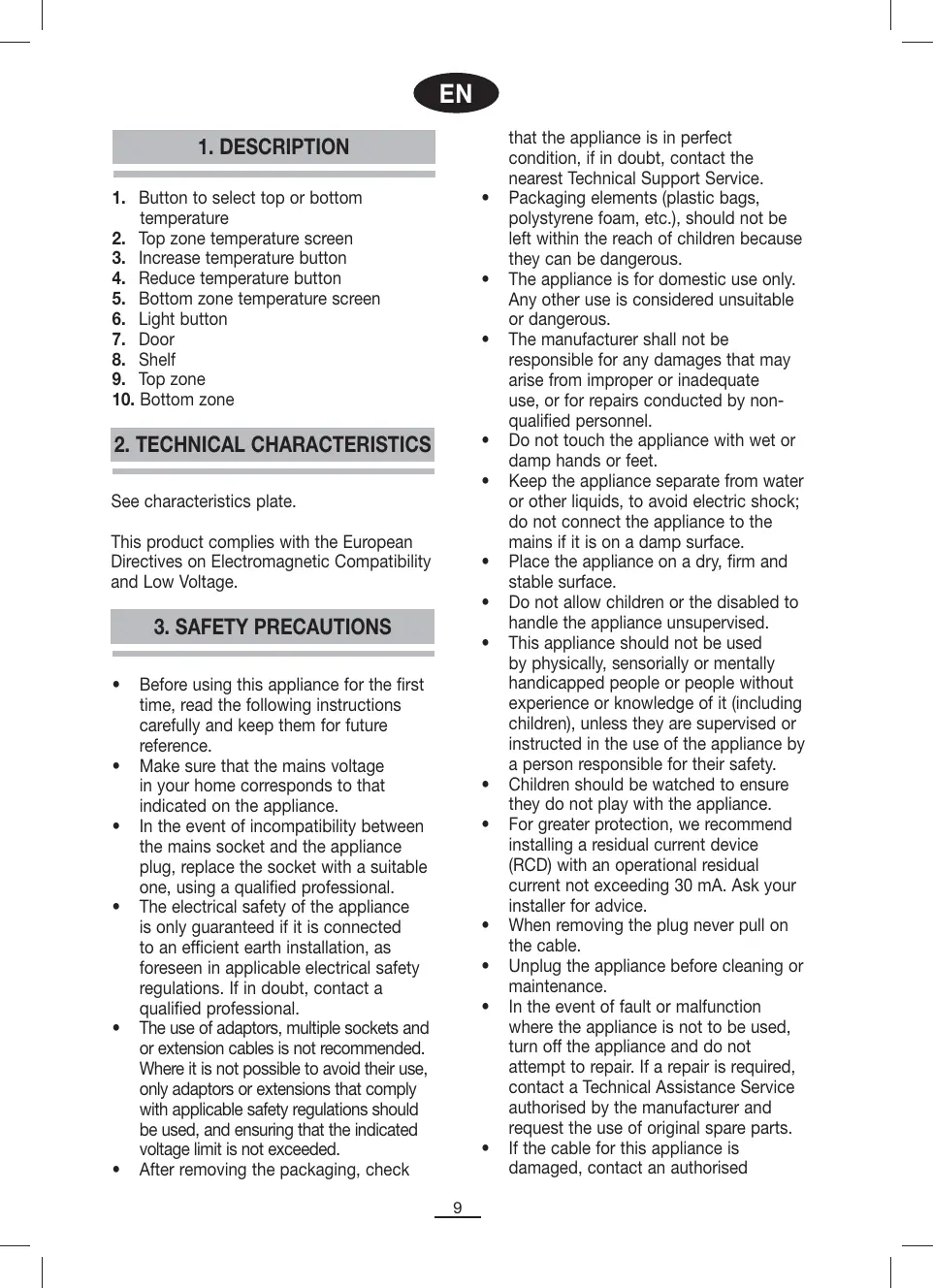
- Button to select top or bottom temperature
- Top zone temperature screen
- Increase temperature button
- Reduce temperature button
- Bottom zone temperature screen
- Light button
- Door
- Shelf
- Top zone
- Bottom zone
2. TECHNICAL CHARACTERISTICS
See characteristics plate.
This product complies with the European Directives on Electromagnetic Compatibility and Low Voltage.
3. SAFETY PRECAUTIONS
- Before using this appliance for the first time, read the following instructions carefully and keep them for future reference.
Make sure that the mains voltage in your home corresponds to that indicated on the appliance. - In the event of incompatibility between the mains socket and the appliance plug, replace the socket with a suitable one, using a qualified professional.
- The electrical safety of the appliance is only guaranteed if it is connected to an efficient earth installation, as foreseen in applicable electrical safety regulations. If in doubt, contact a qualified professional.
- The use of adaptors, multiple sockets and or extension cables is not recommended. Where it is not possible to avoid their use, only adaptors or extensions that comply with applicable safety regulations should be used, and ensuring that the indicated voltage limit is not exceeded.
After removing the packaging, check
that the appliance is in perfect condition, if in doubt, contact the nearest Technical Support Service.
- Packaging elements (plastic bags, polystyrene foam, etc.), should not be left within the reach of children because they can be dangerous.
- The appliance is for domestic use only. Any other use is considered unsuitable or dangerous.
- The manufacturer shall not be responsible for any damages that may arise from improper or inadequate use, or for repairs conducted by nonqualified personnel.
- Do not touch the appliance with wet or damp hands or feet.
- Keep the appliance separate from water or other liquids, to avoid electric shock; do not connect the appliance to the mains if it is on a damp surface.
- Place the appliance on a dry, firm and stable surface.
- Do not allow children or the disabled to handle the appliance unsupervised.
- This appliance should not be used by physically, sensorially or mentally handicapped people or people without experience or knowledge of it (including children), unless they are supervised or instructed in the use of the appliance by a person responsible for their safety.
Children should be watched to ensure they do not play with the appliance.
- For greater protection, we recommend installing a residual current device (RCD) with an operational residual current not exceeding 30mA . Ask your installer for advice.
- When removing the plug never pull on the cable.
- Unplug the appliance before cleaning or maintenance.
- In the event of fault or malfunction where the appliance is not to be used, turn off the appliance and do not attempt to repair. If a repair is required, contact a Technical Assistance Service authorised by the manufacturer and request the use of original spare parts.
- If the cable for this appliance is damaged, contact an authorised
Technical Assistance Service for it to be replaced.
- Do not leave the appliance exposed to the elements (rain, sun, ice, etc.).
- Do not use or let any part of the appliance come into contact or near hot surfaces (kitchen gas or electric hobs or ovens).
- Do not use detergents or abrasive sponges to clean the appliance.
- Do not let the cable come into contact with the hot parts of the appliance.
- When installing the appliance, make sure that there is at least 5cm of free space at the sides and 10cm at the rear of the appliance. This will allow for the appropriate amount of ventilation.
- Do not place hot food or drinks in the wine cooler until they have cooled down to room temperature.
- Close the door properly and do not open it too often or for a long period of time, as the wine will not reach the selected temperature.
- Keep the appliance well away from any heat source or direct sunlight.
- Do not place anything on top of the appliance.
- Do not use the appliance outside or in humid conditions.
- Keep the cable well away from hot surfaces.
4. OPERATING INSTRUCTIONS
- Place the wine cooler on an even, horizontal and stable surface, well away from hot surfaces and humidity.
- Open the door (7) and place the shelves (8) onto the guides inside the wine cooler. Close the door (7).
- Plug the wine cooler into a power socket and select the desired temperature (see "Adjusting the temperature" section).
- Leave the wine cooler empty and in operation for approximately two hours for it to reach the temperature selected.
- Once the wine cooler has reached the selected temperature, open the door (7) and place the bottles of wine at room temperature on to the shelves (8).
The bottles will reach the temperature selected in approximately 6 hours. This time may vary depending on the number of bottles put in and their temperature.
The wine cooler will automatically set an on-and-off cycle in order to constantly maintain the selected temperature.
Press the light button (6) to turn on the light inside and see what there is in the top zone of the wine cooler. Press the same button again to switch off the light.
Important: Close the door (7) properly and do not open it too often or for a long period of time, as the wine will not reach the selected temperature.
5. ADJUSTING THE TEMPERATURE
Select the top/bottom temperature for the wine cooler by pressing button 1. The temperature will flash, you can now change it. Press the “▲” button (3) to increase the temperature and press the “▼” button (4) to reduce it. To change the temperature in the other top/bottom zone press button 1 again. Finally, the temperature will be confirmed when you stop pressing the buttons (the temperature will stop flashing).
NOTE: The screen will always show the temperature inside the wine cooler, so immediately after increasing/reducing the temperature, the screen will show the temperature inside the wine cooler; two hours later the wine cooler will reach the temperature selected earlier and this will be shown on the screen.
The temperature in the top zone has a range of 12 - 18^ .
The temperature in the bottom zone has a range of 8 - 18^
The unit's cooling system works efficiently with an ambient temperature of 25^ or less.
Advice and recommendations:
The recommended temperature for red wine is 14 - 16^
- The recommended temperature for white wine is 10 - 12^ .
IMPORTANT: The temperature that can be achieved inside the wine cooler is approximately 15^ lower than the ambient temperature. The unit will find it difficult to cool if the ambient temperature is below 10^ or above 32^ . The temperature
obtained inside the wine cabinet may vary by approximately 1^ depending on the ambient temperature, the humidity, the number of bottles in the cabinet and the temperature of the bottles.
6. TROUBLESHOOTING
| Problem | Possible causes | Solution |
| The wine cooler is not working | 1. Fault in the power supply. 2. A fuse has blown. | 1. Make sure that the wine cooler is plugged in and that the power socket is switched on. 2. Change the blown fuse. |
| The wine cooler is not reaching the selected temperature | 1. The wine cooler has been placed too near a heat source. 2. Lack of ventilation. 3. The door is being opened too often or for a long period of time. 4. The outside temperature is too high. | 1. Keep the wine cooler well away from sunlight and other heat sources. 2. Place the wine cooler in a well-ventilated position and keep all objects away from the ventilation grilles. 3. Close the door properly and do not open it too often or for a long period of time. 4. Position the wine cooler in a place where the outside temperature is no more than 15°C higher than the temperature selected inside the wine cooler. |
7. INFORMATION FOR THE CORRECT DISPOSAL OF ELECTRICAL AND ELECTRONIC APPLIANCES
m = 311 ;
At the end of its working life, the product must not be disposed of as urban waste. It must be taken to a special local authority differentiated waste collection centre or to a dealer providing this
service. Disposing of a household appliance separately avoids possible negative consequences for the environment and health deriving from inappropriate disposal and enables the constituent materials to be
recovered to obtain significant savings in energy and resources.
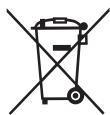
To remind you that you must collaborate with a selective collection scheme, the symbol shown appears on the product warning you not to dispose of it in traditional refuse containers.
For further information, contact your local authority or the shop where you bought the product.
FR
1.DESCRIPTION
5. NASTAVENI TEPLOTY
5. NASTAVENIE TEPLOTY
Zvolte vyšsiu/nizšiu teplotu vo vinotéke stisnutim tlacidla 1, teplota bude blikat, v tej chvili ju budete moc't zmenit. Stisnite tlacidlo "▲" (3), aby ste zvyšili teplota a stisnite tlacidlo "▼" (4) pre jez zniženie. Aby ste mohli zmenit' teplotu v druhej spodnej/hornej Časti, stisnite opat tlacidlo 1. Nakoniec potvrdite teplotu, ked prestanete tisn'tlacidla (teplata prestane blikat).
Brand : FAGOR
Model : VT-12 BIZONE
Category : Fridge