
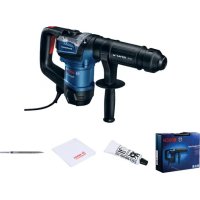
GSH 16-28 Professional - Breaker BOSCH - Free user manual and instructions
Find the device manual for free GSH 16-28 Professional BOSCH in PDF.


| Product type | Professional demolition hammer |
| Brand | Bosch |
| Model | GSH 16-28 Professional |
| Power supply | Electric, 230 V, 50 Hz |
| Power input | 1500 W |
| Impact energy | 40 J |
| Impact rate at full load | 1400 bpm |
| Tool holder | Hexagonal 28 mm |
| Weight | 31.5 kg |
| Dimensions (L x W x H) | 790 x 250 x 280 mm |
| Protection class | Class II (double insulation) |
| Sound pressure level (LpA) | 96 dB(A) |
| Sound power level (LWA) | 107 dB(A) |
| Vibrations (ah) | 18 m/s² |
| Main functions | Chiseling, demolition, chipping concrete and masonry |
| Included chisel type | Pointed chisel, flat chisel |
| Maintenance and cleaning | Regularly clean ventilation slots, grease the tool holder |
| Safety | Anti-vibration switch, depth stop, rotation lock |
| Spare parts and repairability | Available via Bosch after-sales service, repairable at authorized center |
| Certification | CE, compliance with European standards |
Frequently Asked Questions - GSH 16-28 Professional BOSCH
User questions about GSH 16-28 Professional BOSCH
0 question about this device. Answer the ones you know or ask your own.
Ask a new question about this device
Download the instructions for your Breaker in PDF format for free! Find your manual GSH 16-28 Professional - BOSCH and take your electronic device back in hand. On this page are published all the documents necessary for the use of your device. GSH 16-28 Professional by BOSCH.
USER MANUAL GSH 16-28 Professional BOSCH

Robert Bosch Power Tools GmbH
70538 Stuttgart
GERMANY
www.bosch-pt.com
1 609 92A 2BF (2019.01) DOC/143

1 609 92A 2BF
GSH Professional
16-28|16-30

BOSCH
General Power Tool Safety Warnings
WARNING
Read all safety warnings and all instructions. Failure to follow the
warnings and instructions may result in electric shock, fire and/or serious injury.
Save all warnings and instructions for future reference.
The term "power tool" in the warnings refers to your mains-operated (corded) power tool or battery-operated (cordless) power tool.
Work area safety
▶ Keep work area clean and well lit. Cluttered or dark areas invite accidents.
▶ Do not operate power tools in explosive atmospheres, such as in the presence of flammable liquids, gases or dust. Power tools create sparks which may ignite the dust or fumes.
▶ Keep children and bystanders away while operating a power tool. Distractions can cause you to lose control.
Electrical safety
▶ Power tool plugs must match the outlet. Never modify the plug in any way. Do not use any adapter plugs with
earthed (grounded) power tools. Unmodified plugs and matching outlets will reduce risk of electric shock.
▶ Avoid body contact with earthed or grounded surfaces, such as pipes, radiators, ranges and refrigerators. There is an increased risk of electric shock if your body is earthed or grounded.
▶ Do not expose power tools to rain or wet conditions. Water entering a power tool will increase the risk of electric shock.
▶ Do not abuse the cord. Never use the cord for carrying, pulling or unplugging the power tool. Keep cord away from heat, oil, sharp edges or moving parts.
Damaged or entangled cords increase the risk of electric shock.
▶ When operating a power tool outdoors, use an extension cord suitable for outdoor use. Use of a cord suitable for outdoor use reduces the risk of electric shock..
▶ If operating a power tool in a damp location is unavoidable, use a residual current device (RCD) protected supply. Use of an RCD reduces the risk of electric shock.
Personal safety
▶ Stay alert, watch what you are doing and use common sense when operating a power tool. Do not use a power tool while you are tired or under the influence of drugs, alcohol or medication. A moment of inattention while operating power tools may result in serious personal injury.
▶ Use personal protective equipment. Always wear eye protection. Protective equipment such as dust mask, non-skid safety shoes, hard hat, or hearing protection used for appropriate conditions will reduce personal injuries.
▶ Prevent unintentional starting. Ensure the switch is in the off-position before connecting to power source and/or battery pack, picking up or carrying the tool. Carrying power tools with your finger on the switch or energising power tools that have the switch on invites accidents.
Remove any adjusting key or wrench before turning the power tool on. A wrench or a key left attached to a rotating part of the power tool may result in personal injury.
▶ Do not overreach. Keep proper footing and balance at all times. This enables better control of the power tool in unexpected situations.
▶ Dress properly. Do not wear loose clothing or jewellery. Keep your hair, clothing and gloves away from moving parts. Loose clothes, jewellery or long hair can be caught in moving parts.
If devices are provided for the connection of dust extraction and collection facilities, ensure these are connected and properly used. Use of dust collection can reduce dust-related hazards.
Power tool use and care
▶ Do not force the power tool. Use the correct power tool for your application. The correct power tool will do the job better and safer at the rate for which it was designed.
▶ Do not use the power tool if the switch does not turn it on and off. Any power tool that cannot be controlled with the switch is dangerous and must be repaired.
▶ Disconnect the plug from the power source and/or the battery pack from the power tool before making any adjustments, changing accessories, or storing power tools. Such preventive safety measures reduce the risk of starting the power tool accidentally.
▶ Store idle power tools out of the reach of children and do not allow persons unfamiliar with the power tool or these instructions to operate the power tool. Power tools are dangerous in the hands of untrained users.
- Maintain power tools. Check for misalignment or binding of moving parts, breakage of parts and any other condition that may affect the power tool's operation. If damaged, have the power tool repaired before use. Many accidents are caused by poorly maintained power tools.
▶ Keep cutting tools sharp and clean. Properly maintained cutting tools with sharp cutting edges are less likely to bind and are easier to control.
▶ Use the power tool, accessories and tool bits etc. in accordance with these instructions, taking into account the working conditions and the work to be performed. Use of the power tool for operations different from those intended could result in a hazardous situation.
Service
▶ Have your power tool serviced by a qualified repair person using only identical replacement parts. This will ensure that the safety of the power tool is maintained.
Hammer Safety Warnings
▶ Wear ear protectors. Exposure to noise can cause hearing loss.
▶ Use auxiliary handle(s), if supplied with the tool. Loss of control can cause personal injury.
▶ Hold power tool by insulated gripping surfaces, when performing an operation where the cutting accessory may contact hidden wiring or its own cord. Cutting accessory contacting a "live" wire may make exposed metal parts of the power tool "live" and could give the operator an electric shock.
▶ Use suitable detectors to determine if utility lines are hidden in the work area or call the local utility company for assistance. Contact with electric lines can lead to fire and electric shock. Damaging a gas line can lead to explosion. Penetrating a water line causes property damage or may cause an electric shock.
Products sold in GB only:
Your product is fitted with an BS 1363/A approved electric plug with internal fuse (ASTA approved to BS 1362).
If the plug is not suitable for your socket outlets, it should be cut off and an appropriate plug fitted in its place by an authorised customer service agent. The replacement plug should have the same fuse rating as the original plug.
The severed plug must be disposed of to avoid a possible shock hazard and should never be inserted into a mains socket elsewhere.
▶ Hold the power tool firmly with both hands and make sure you have a stable footing. The power tool can be more securely guided with both hands.
Product Description and Specifications

Read all the safety and general instructions. Failure to observe the safety and general instructions may result in electric shock, fire and/or serious injury.
Please observe the illustrations at the beginning of this operating manual.
Intended use
The power tool is intended for heavy chiselling and demolition work as well as for driving in and compacting with the appropriate accessories.
Product features
The numbering of the product features refers to the diagram of the power tool on the graphics page.
(1) Handle (insulated gripping surface)
(2) On/off switch
(3) Carrying handle
(4) Knurled nut with carrying handle
(5) Lock bolt (GSH 16-30)
(6) Tool retainer (GSH 16-28)
(7) Tool shank
(8) Tool holder
(9) Shoulder
Technical data
| Demolition Hammer | GSH 16-28 GSH 16-30 | |
| Article number | 3 611 C35 0.. 3 611 C35 1.. | |
| Rated power input W 1750 1750 | ||
| Impact rate min | 1 | 1 300 1 300 |
| Impact energy per stroke according to EPTA-Procedure 05/2009 | J 41 41 | |
| Tool holder mm 28 30 | ||
| Weight according to | kg 18.3 16.9 | |
12 | English
| Demolition Hammer | GSH 16-28 GSH 16-30 | |
| EPTA-Procedure01:2014 | ||
| Protection class | ☐/II/II | ☐ |
The specifications apply to a rated voltage [U] of 230 V. These specifications may vary at different voltages and in country-specific models.
Noise/Vibration Information
Noise emission values determined according to EN 60745-2-6.
Typically, the A-weighted noise level of the power tool is: 93 dB(A); sound power level 104 dB(A). Uncertainty K = 3 dB.
Wear hearing protection
Total vibration values ah (triax vector sum) and uncertainty K determined according to
EN 60745-2-6:
Chiselling: ah = 13 m/s2 , K = 1,5 m/ s2
The vibration level given in these instructions has been measured in accordance with a standardised measuring procedure and may be used to compare power tools. It can also be used for a preliminary estimation of exposure to vibration.
The stated vibration level applies to the main applications of the power tool. However, if the power tool is used for different applications, with different application tools or poorly maintained, the vibration level may differ. This can significantly increase the exposure to vibration over the total working period.
To estimate the exposure to vibration accurately, the times when the tool is switched off or when it is running but not actually being used should also be taken into account. This can significantly reduce the exposure to vibration over the total working period.
Implement additional safety measures to protect the operator from the effects of vibration, such as servicing the power tool and application tools, keeping the hands warm, and organising workflows correctly.
Assembly
Carrying handle
The carrying handle (3) can be turned to any position. Loosen the knurled nut(4), rotate the carrying handle (3) around the axis of the tool to the required position and retighten the knurled nut (4).
The carrying handle (3) can be refitted in a different position. Completely unscrew the knurled nut (4) and then pull the hexagon bolt upwards and out. Pull off the carrying handle (3) to the side and rotate the remaining clamping element by 180°. Fit the carrying handle (3) by following the steps in reverse order.
Changing the tool (GSH 16-28)
▶ Pull the plug out of the socket before carrying out any work on the power tool.
Clean the tool shank (7) and apply a light coating of grease.
Application tools without collar (see figures A - B)
- Pivot the tool retainer (6) upwards by approx. 150° and insert the application tool into the tool holder (8).
- Pivot the tool retainer (6) back down to lock the application tool in place.
- Check that it is locked by pulling on the tool.
Application tools with collar (see figures C - D)
Application tools with an insertion length of 152 mm (6") to the collar can be used.
- Pivot the tool retainer (6) upwards by approx. 180° and insert the application tool into the tool holder (8).
- Pivot the tool retainer (6) back as far as the application tool to lock it in place. The collar (9) must be held by the tool retainer (6).
- Check that it is locked by pulling on the tool.
Changing the tool (GSH 16-30)
▶ Pull the plug out of the socket before carrying out any work on the power tool.
- Clean the tool shank (7) and apply a light coating of grease.
- Pull out the lock bolt (5) and turn it anticlockwise by 180° . Allow the lock bolt 5 to engage again.
- Push the application tool all the way into the tool holder (8). The groove of the tool shank (7) must face upwards as shown in the figure.
- Pull out the lock bolt (5) and turn it clockwise by 180° . Allow the lock bolt (5) to engage again.
- Check that it is locked by pulling on the tool.
Dust/Chip Extraction
Dust from materials such as lead-containing coatings, some wood types, minerals and metal can be harmful to one's health. Touching or breathing-in the dust can cause allergic reactions and/or lead to respiratory infections of the user or bystanders.
Certain dust, such as oak or beech dust, is considered carcinogenic, especially in connection with wood-treatment additives (chromate, wood preservative). Materials containing asbestos may only be worked by specialists.
- Provide for good ventilation of the working place.
- It is recommended to wear a P2 filter-class respirator.
Observe the relevant regulations in your country for the materials to be worked.
- Avoid dust accumulation at the workplace. Dust can easily ignite.
Operation
Starting operation
▶ Pay attention to the mains voltage. The voltage of the power source must match the voltage specified on the rating plate of the power tool. Power tools marked with 230 V can also be operated with 220 V.
Switching on/off
- To start the power tool, tilt the on/off switch (2) to the "I" position.
- To switch off the power tool, tilt the on/off switch (2) to the "0" position.
At low temperatures, the power tool will take a certain amount of time to reach its full impact performance. You can shorten this warm-up time by tapping the power tool's inserted application tool on the ground once.
Working advice
▶ Pull the plug out of the socket before carrying out any work on the power tool.
While working, hold the power tool with both hands by the handle (1). The handle (1) can move up and down around its axis by approx. 30 mm. This has a damping effect against vibrations.
For the highest possible impact damping, work only with moderate pressure.
Sharpening Chisels
Only sharp chiselling tools will produce good results, therefore sharpen your chiselling tools in good time before use. This will ensure a long service life for the tools and good work results.
Resharpening
Grind chiselling tools against sanding discs, e.g. aluminium oxide, under a steady stream of water. Take care that no annealing colouration appears on the cutting edges; this impairs the hardness of the chiselling tools.

To forge a chisel, heat it to between 850 and 1050 °C (pale red to yellow).
To harden a chisel, heat it to approx. 900 °C and quench in oil. Then, leave it in an oven for approx. one hour at 320 °C (annealing colour: pale blue).
Maintenance and Service
Maintenance and Cleaning
▶ Pull the plug out of the socket before carrying out any work on the power tool.
▶ To ensure safe and efficient operation, always keep the power tool and the ventilation slots clean.
In order to avoid safety hazards, if the power supply cord needs to be replaced, this must be done by Bosch or by an after-sales service centre that is authorised to repair Bosch power tools.
When the carbon brushes are worn out, the power tool switches itself off. The power tool must be sent to the after-sales service for maintenance; see the "After-sales service and application service" section for addresses.
After-Sales Service and Application Service
Our after-sales service responds to your questions concerning maintenance and repair of your product as well as spare parts. You can find explosion drawings and information on spare parts at: www.bosch-pt.com
The Bosch product use advice team will be happy to help you with any questions about our products and their accessories.
In all correspondence and spare parts orders, please always include the 10-digit article number given on the nameplate of the product.
Great Britain
Robert Bosch Ltd. (B.S.C.)
P.O. Box 98
Broadwater Park
North Orbital Road
Denham Uxbridge
UB 9 5HJ
At www.bosch-pt.co.uk you can order spare parts or arrange the collection of a product in need of servicing or repair.
Tel. Service: (0344) 7360109
E-Mail: boschservicecentre@bosch.com
Ireland
Origo Ltd.
Unit 23 Magna Drive
Magna Business Park
City West
Dublin 24
Tel. Service: (01) 4666700
Fax: (01) 4666888
Australia, New Zealand and Pacific Islands
Robert Bosch Australia Pty. Ltd.
Power Tools
Locked Bag 66
Clayton South VIC 3169
Customer Contact Center
Inside Australia:
Phone: (01300) 307044
Fax: (01300) 307045
14 | Français
Inside New Zealand:
Phone: (0800) 543353
Fax: (0800) 428570
Outside AU and NZ:
Phone: +61 3 95415555
www.bosch-pt.com.au
www.bosch-pt.co.nz
Republic of South Africa
Customer service
Hotline: (011) 6519600
Gauteng - BSC Service Centre
35 Roper Street, New Centre
Johannesburg
Tel.: (011) 4939375
Fax: (011) 4930126
E-mail: bsctools@icon.co.za
KZN - BSC Service Centre
Unit E, Almar Centre
143 Crompton Street
Pinetown
Tel.: (031) 7012120
Fax: (031) 7012446
E-mail: bsc.dur@za.bosch.com
Western Cape - BSC Service Centre
Democracy Way, Prosperity Park
Milnerton
Tel.: (021) 5512577
Fax: (021) 5513223
E-mail: bsc@zsd.co.za
Bosch Headquarters
Midrand, Gauteng
Tel.: (011) 6519600
Fax: (011) 6519880
E-mail: rbsa-hq.pts@za.bosch.com
Disposal
The power tool, accessories and packaging should be recycled in an environmentally friendly manner.

Do not dispose of power tools along with household waste.
Only for EU countries:
According to the European Directive 2012/19/EU on Waste Electrical and Electronic Equipment and its implementation into national law, power tools that are no longer usable must be collected separately and disposed of in an environmentally friendly manner.
Français
Robert Bosch (France) S.A.S.
Calle Robert Bosch No. 405
Bosch Service Center
Telegrafvej 3
2750 Ballerup
På www.bosch-pt.dk kan der online bestilles reservedele eller oprettes en reparations ordre.
Tlf. Service Center: 44898855
Fax: 44898755
E-Mail: vaerktoej@dk.bosch.com
Bortskaffelse
Bosch Service Center
Telegrafvej 3
2750 Ballerup
Danmark
Tel.: (08) 7501820 (inom Sverige)
Fax: (011) 187691
Avfallshantering
Robert Bosch Sp. z o.o.
Bosch Service Center PT
K Vápence 1621/16
692 01 Mikulov
Service scule electrice
Strada Horia Măcelariu Nr. 30-34, sector 1
013937 Bucureşti
Service scule electrice
Strada Horia Măcelariu Nr. 30–34, sector 1
013937 Bucureşti, România
www.bosch-pt.com/bg/bg/
Бракуване
Robert Bosch Morocco SARL
- شارع الملازم محمد م representatives
20300 الدار البيضاء
Henk Becker Chairman of Executive Management
Helmut Heinzelmann Head of Product Certification

i.v. h=w
Robert Bosch Power Tools GmbH, 70538 Stuttgart, GERMANY Stuttgart, 01.01.2019
- GSH PROFESSIONAL
- BOSCH
- GENERAL POWER TOOL SAFETY WARNINGS
- WARNING
- SAVE ALL WARNINGS AND INSTRUCTIONS FOR FUTURE REFERENCE
- WORK AREA SAFETY
- ELECTRICAL SAFETY
- PERSONAL SAFETY
- POWER TOOL USE AND CARE
- SERVICE
- HAMMER SAFETY WARNINGS
- PRODUCTS SOLD IN GB ONLY
- PRODUCT DESCRIPTION AND SPECIFICATIONS
- INTENDED USE
- PRODUCT FEATURES
- 12 | ENGLISH
- NOISE/VIBRATION INFORMATION
- WEAR HEARING PROTECTION
- EN 60745-2-6
- ASSEMBLY
- CARRYING HANDLE
- CHANGING THE TOOL (GSH 16-28)
- APPLICATION TOOLS WITHOUT COLLAR (SEE FIGURES A - B)
- APPLICATION TOOLS WITH COLLAR (SEE FIGURES C - D)
- CHANGING THE TOOL (GSH 16-30)
- DUST/CHIP EXTRACTION
- OPERATION
- STARTING OPERATION
- SWITCHING ON/OFF
- WORKING ADVICE
- SHARPENING CHISELS
- RESHARPENING
- MAINTENANCE AND SERVICE
- MAINTENANCE AND CLEANING
- AFTER-SALES SERVICE AND APPLICATION SERVICE
- GREAT BRITAIN
- IRELAND
- AUSTRALIA, NEW ZEALAND AND PACIFIC ISLANDS
- 14 | FRANÇAIS
- REPUBLIC OF SOUTH AFRICA
- CUSTOMER SERVICE
- GAUTENG - BSC SERVICE CENTRE
- KZN - BSC SERVICE CENTRE
- WESTERN CAPE - BSC SERVICE CENTRE
- BOSCH HEADQUARTERS
- DISPOSAL
- ONLY FOR EU COUNTRIES
- FRANÇAIS
- BORTSKAFFELSE
- AVFALLSHANTERING
- БРАКУВАНЕ
Brand : BOSCH
Model : GSH 16-28 Professional
Category : Breaker