
TE 6-A36-AVR - Drill HILTI - Free user manual and instructions
Find the device manual for free TE 6-A36-AVR HILTI in PDF.


| Product Type | Cordless Rotary Hammer |
| Brand | Hilti |
| Model | TE 6-A36-AVR |
| Dimensions (L x W x H) | 344 mm x 94 mm x 215 mm |
| Weight (according to EPTA 01/2003) | 4.0 kg |
| Rated Voltage | 36 V (DC) |
| No-load speed (without hammering) | 1,010 /min |
| No-load speed (with hammering) | 940 /min |
| No-load speed (hammer drilling) | 1,040 /min |
| Impact energy (according to EPTA 05/2009) | Data not available |
| Tool holder | TE-C CLICK |
| Chuck | TE-C CLICK (self-tightening) |
| Side handle | Adjustable anti-vibration with depth stop |
| Electronic protection | Against overload and temperature monitoring |
| Safety clutch | Mechanical slip clutch |
| Battery charge indicator | 4 LEDs (charge status) |
| Compatible battery packs | B 36/2.4, B 36/2.6, B 36/3.0, B 36/3.3, B 36/3.9 Li-Ion |
| Compatible chargers | C 4/36, C 4/36-90, C 4/36-350, C 4/36-ACS, C 4/36-ACS TPS |
| Housing material | Resilient plastic with elastomer grip area |
| Routine maintenance | Regular cleaning, periodic lubrication, replacement of dust protection |
| Manufacturer's warranty | For the entire service life of the tool (defective parts) |
| Recycling | Do not dispose of with household waste; take back by Hilti |
Frequently Asked Questions - TE 6-A36-AVR HILTI
User questions about TE 6-A36-AVR HILTI
0 question about this device. Answer the ones you know or ask your own.
Ask a new question about this device
Download the instructions for your Drill in PDF format for free! Find your manual TE 6-A36-AVR - HILTI and take your electronic device back in hand. On this page are published all the documents necessary for the use of your device. TE 6-A36-AVR by HILTI.
USER MANUAL TE 6-A36-AVR HILTI
1

| 2 | 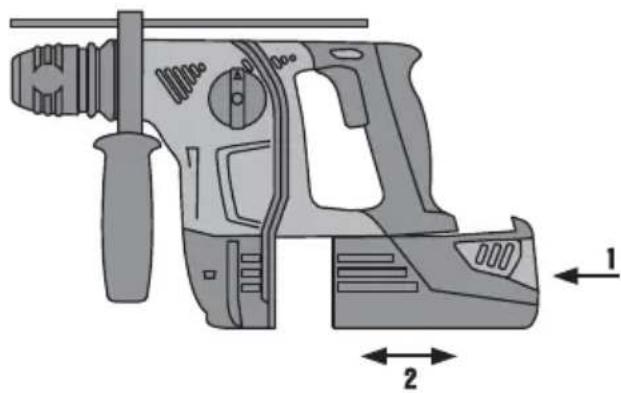 | 3 |  |
| 4 |  | ||
| 5 |  |  |  |
| 6 |  | ||
7


8

9


10


12


TE 6-A36 Akku-Bohrhammer
Head of BA Quality and Process Mana-
gement 1210
Business Area Electric Tools & Acces-
sories
01/2012
Jan Doongaji
Executive Vice President
Business Unit Power
Tools & Accessories
01/2012
TE 6-A36 cordless rotary hammer
It is essential that the operating instruct are read before the power tool is open the first time.
Always keep these operating instructions get her with the power tool.
Ensure that the operating instructions are with the power tool when it is given persons.
Contents Page
| 1 | General information 15 |
| 2 | Description 16 |
| 3 | Insert tools, accessories 18 |
| 4 | Technical data 18 |
| 5 | Safety instructions 19 |
| 6 | Before use |
| 7 | Operation 23 |
| 8 | Care and maintenance |
| 9 | Troubleshooting 25 |
| 10 | Disposal 26 |
| 11 | Manufacturer's warranty - tools |
| 12 | EC declaration of conformity (original) |
These numbers refer to the corresponding illustrations. The illustrations can be found on the fold-out cover pages. Keep these pages open while studying ating instructions.
In these operating instructions, the designation "the power tool" always refers to the TE 6-A36 cordless rotary hammer.
reComponents, operating controls and indicators 1 to other
① Chuck
② Function selector switch
③ Forward / reverse switch
④ Control switch
⑤ Battery release button (2 buttons)
⑥ Battery
⑦ Interface for TE DRS-6-A dust removal module
⑧ Grip
9 Side handle with depth gauge
24
27
27
1 General information
1.1 Safety notices and their meaning
DANGER
Draws attention to imminent danger that will lead to serious bodily injury or fatality.
WARNING
Draws attention to a potentially dangerous situat could lead to serious personal injury or fatality.
CAUTION
Draws attention to a potentially dangerous situat could lead to slight personal injury or damage to the equipment or other property.
NOTE
Draws attention to an instruction or other useful information.
1.2 Explanation of the pictograms and other information
Warning signs
General warning

Warning: electricity

Warning: caustic substances
Obligation signs

Wear eye protection

Wear a hard hat

Wear ear protection

Wear
protective
gloves

Wear
breathing
protection
Symbols

Read the operating instructions before use

Return waste material for recycling.

Drilling
without
hammering

Hammer drilling

Volts
Direct

current

Rated speed under no load

Revolutions
per minute

Diameter
Forward / reverse

2 Description
2.1 Use of the product as directed
The TE 6-A36 is a hand-held, cordless rotary hammer for hammer drilling in concrete and masonry, drilling in steel and wood and driving or removing screws.
Use only the batteries and chargers recommended by Hilti.
The powertool maybe used only in adry environment.
Do not use the power tool where there is a risk of fire or explosion.
Working on materials hazardous to the health (e.g. asbestos) is not permissible.
The power tool is designed for professional use and may be operated, serviced and maintained only by trained, authorized personnel. This personnel must be informed of any special hazards that may be encountered. The power tool and its ancillary equipment may present hazards when used incorrectly by untrained personnel or when used not as directed.
The working environment may be as follows: construction site, workshop, renovation, conversion or new construction. Modification of the power tool or tampering with its parts is not permissible.
Do not use the battery as a power source for other unspecified appliances.
To avoid the risk of injury, use only genuine Hilti accessories and insert tools.
Observe the information printed in the operating instructions concerning operation, care and maintenance.
Nationally applicable industrial safety regulations must be observed.
2.2 Chuck
TE-C CLICK chuck
2.3 Switches
Speed control switch for smooth starting
Function selector switch
Forward / reverse switch
2.4 Grips
Vibration-absorbing, pivotable side handle with depth gauge
Vibration-absorbing grip
2.5 Protective features
Mechanical slip clutch
Electronic overload protection
2.6 Additional electronic features of the power tool
The power tool is equipped with electronic overload protection. The power tool switches off automatically in the event of overloading. When the control switch is released and then pressed again, the power tool immediately regains full power.
In addition, the temperature of the power tool's electronics is monitored to ensure extra-long life. In the event of the electronics overheating, the drive spindle will not rotate even when the control switch is pressed fully. The power tool can be used again as soon as the temperature is within the permissible range.
2.7 Lubrication
Permanent lubrication (grease)
2.8 Items supplied as standard
1 Power tool
1 TE-C CLICK chuck
1 Side handle with depth gauge
1 Operating instructions
1 Hilti toolbox (optional)
1 Cleaning cloth (optional)
1 Grease (optional)
2.9 Additional items required for operating the tool
B 36/3.0 Li-Ion battery or, alternatively, B 36/2.4 Li-Ion, B 36/2.6 Li-Ion, B 36/3.3 Li-Ion or B 36/3.9 Li-Ion battery. C 4/36-90, C 4/36-350, C 4/36-ACS, C 4/36-ACS TPS charger or, alternatively, C 4/36 charger.
2.10 Li-ion battery charge status
| LEDs light constantly LEDs blnk | Charge status C | ||||||
| LED | 1,2,3,4 | - | C ≧ 75 % | ||||
| LED | 1,2,3 | - | 50 % | ≤ C | < 75 % | ||
| LED | 1,2 | - | 25 % | ≤ C | < 50 % | ||
| LED | 1 | - | 10 % | ≤ C | < 25 % | ||
| - | LED 1 | C < 10 % | |||||
NOTE
Indication of the charge status is not possible while the power tool is in operation or immediately after operation. If the battery charge status LEDs blink, please refer to the information given in section 9, "Troubleshooting".
3 Insert tools, accessories
| Designation Description |
| Hammer drill bits φ 5...16 mm |
| Anchor-setting tools C-type connection end |
| Quick-release chuck for wood and metal drill bits With smooth shank, hexagonal shank |
| Keyed chuck With smooth shank, hexagonal shank |
| Wood drill bits φ 3...20 mm |
| Wood drill bits (auger bits) φ Max. 14 mm |
| Metal drill bits (for steel) φ 3...10 mm |
| Designation | Short designation | Description | ||||
| TE-C | CLICK | chuck | ||||
| Charger | for | Li-ion | batteries | C | 4/36 | |
| Charger | for | Li-ion | batteries | C | 4/36-ACS | |
| Charger | for | Li-ion | batteries | C | 4/36-ACS TPS | |
| Charger | for | Li-ion | batteries | C | 4/36-90 | |
| Charger | for | Li-ion | batteries | C | 4/36-350 | |
| Battery | B36/2.4 | Li-ion | ||||
| Battery | B36/2.6 | Li-ion | ||||
| Battery | B36/3.0 | Li-ion | ||||
| Battery | B36/3.3 | Li-ion | ||||
| Battery | B36/3.9 | Li-ion | ||||
| Angular | chuck | C-type connection end | ||||
| TE | DRS-6-A | dust removal module | ||||
4 Technical data
Right of technical changes reserved.
| Power tool | TE 6-A36 |
| Rated voltage (DC voltage) | 36 V |
| Weight in accordance with EPTA procedure 01/2003 | 4.0 kg |
| Dimensions (L x W x H) | 344 mm x 94 mm x 215 mm |
| Drilling speed without hammering | 1,010/min |
| Hammer drilling speed | 940/min |
| Speed under no load in hammer drilling mode | 1,040/min |
| Single impact energy in accordance with EPTA procedure 05/2009 | proced- |
NOTE
The vibration emission level given in this information sheet has been measured in accordance with a standardised test given in EN 60745 and may be used to compare one tool with another. It may be used for a preliminary assessment
of exposure. The declared vibration emission level represents the main applications of the tool. However if the tool is used for different applications, with different accessories or poorly maintained, the vibration emission may differ. This may significantly increase the exposure level over the total working period. An estimation of the level vibration should also take into account the times when the tool is switched off or when it is running but not actually doing the job. This may significantly reduce the exposure level over the total working period. Identify additional safety measures to protect the operator from the effects of vibration such as: maintain the tool and the accessories, keep the hands warm, organisation of work patterns.
Noise and vibration information (measured in accordance with EN 60745-2-6):
| Typical A-weighted sound power level 99 dB (A) | |
| Typical A-weighted emission sound pressure level. 88 dB (A) | |
| Uncertainty for the given sound level 3 dB (A) | |
| Triaxial vibration values (vibration vector sum) Measured in accordance with EN 60745-2-6 | |
| Hammer drilling in concrete HD a | 9 m/s 2 |
| Drilling in metal H,D a | <2.5 m/s 2 |
| Uncertainty (K) for triaxial vibration value 1.5 m/s 2 | |
Other information about the power tool
Chuck TE-C Click
| Battery B 36/2 | 4 Li-Ion B 36 | 2.6 Li-Ion B 36 | 36/3.0 Li-Ion B | 36/3.3 Li-Ion B | 36/3.9 Li-Ion |
| Rated voltage | 36 V | 36 V | 36 V | 36 V | 36 V |
| Capacity | 2.4 Ah | 2.6 Ah | 3.0 Ah | 3.3 Ah | 3.9 Ah |
| Energy capacity | 86.4 Wh | 93.6 Wh | 108.0 Wh | 118.8 Wh | 140.4 Wh |
| Weight | 1.17 kg | 1.17 kg | 1.17 kg | 1.6 kg | 1.65 kg |
| Type of cell | Li-ion | Li-ion | Li-ion | Li-ion | Li-ion |
| Temperature monitoring | NTC | NTC | NTC | NTC | NTC |
| Deep discharge protection | Yes | Yes | Yes | Yes | Yes |
5 Safety instructions
NOTE
The safety rules in section 5.1 contain all ger rules for electric tools which, in accordance with the applicable standards, must be listed in the operating instructions. Accordingly, some of the rules listed may not be relevant to this tool.
5.1 General power tool safety warnings
a)

WARNING
Read all safety warnings and all instructio
ure to follow the warnings and instructions may result in electric shock, fire and/or serious injury. warnings and instructions for future reference.
The term “power tool” in the warnings refers to your mains-operated (corded) power tool or operated (cordless) power tool.
5.1.1 Work area safety
al safety
a) Keep work area clean and well lit. Cluttered or dark areas invite accidents.
b) Do not operate power tools in explosive atmospheres, such as in the presence of flammable liquids, gases or dust. Power tools create sparks which may ignite the dust or fumes.
c) Keep children and bystanders away while operating a power tool. Distractions can cause you to control.
s. Fail-
5.1.2 Electrical safety
Say Paler tool plugs must match the outlet. Never modify the plug in any way. Do not use any a apter plugs with earthed (grounded) power tools battery unmodified plugs and matching outlets will reduce risk of electric shock.
b) Avoid body contact with earthed or ground surfaces, such as pipes, radiators, ranges refrigerators. There is an increased risk of shock if your body is earthed or grounded.
c) Do not expose power tools to rain or water. Water entering a power tool will increase risk of electric shock.
d) Do not abuse the cord. Never use the c carrying, pulling or unplugging the power Keep cord away from heat, oil, sharp ed moving parts. Damaged or entangled cords theriskofelectricshock.
e) When operating a power tool outdoors, use extension cord suitable for outdoor use. Use a cord suitable for outdoor use reduces the electric shock.
f) If operating a power tool in a damp local unavoidable, use a residual current device protected supply. Use of an RCD reduces of electric shock.
5.1.3 Personal safety
a) Stay alert, watch what you are doing and common sense when operating a power to not use a power tool while you are tired the influence of drugs, alcohol or medicat moment of inattention while operating power may result in serious personal injury.
b) Use personal protective equipment. Always eye protection. Protective equipment such as mask, non-skid safety shoes, hard hat, or protection used for appropriate conditions will personal injuries.
c) Prevent unintentional starting. Ensure the s is in the off-position before connecting to source and/or battery pack, picking up or the tool. Carrying power tools with your fin switch or energising power tools that have on invites accidents.
d) Remove any adjusting key or wrench befo ing the power tool on. A wrench or a key left at- tached to a rotating part of the power too in personal injury.
e) Do not overreach. Keep proper footing an ance at all times. This enables better cont power tool in unexpected situations.
f) Dress properly. Do not wear loose clothing jewellery. Keep your hair, clothing and glo away from moving parts. Loose clothes, jev or long hair can be caught in moving part
g) If devices are provided for the connection extraction and collection facilities, ensure that are connected and properly used. Use of collection can reduce dust-related hazards.
5.1.4 Power tool use and care
a) Do not force the power tool. Use the c-power tool for your application. The correct tool will do the job better and safer at the which it was designed.
b) Do not use the power tool if the switch turn it on and off. Any power tool that
ded controlled with the switch is dangerous and must and repaired.
electric Disconnect the plug from the power source and/or the battery pack from the power tool et before making any adjustments, changing case accessories, or storing power tools. Such preventive safety measures reduce the risk of cord starting the power tool accidentally.
tool. Store idle power tools out of the reach of changes dren and do not allow persons unfamiliar with increase power tool or these instructions to operate the power tool. Power tools are dangerous in the base and untrained users.
(see) Maintain power tools. Check for misalignment of the risk binding of moving parts, breakage of parts and any other condition that may affect the power ation tool's operation. If damaged, have the power to (RCD)epaired before use. Many accidents are caused the priorly maintained power tools.
f) Keep cutting tools sharp and clean. Properly maintained cutting tools with sharp cutting edges are likely to bind and are easier to control.
Use the power tool, accessories and tool bits tool. Do accordance with these instructions, taking int or account the working conditions and the work t on. Be performed. Use of the power tool for opera- tools different from those intended could result in hazardous situation.
wear
5.1.5 Battery tool use and care
hearing Recharge only with the charger specified by the reduce manufacturer. A charger that is suitable for one type of battery pack may create a risk of fire v witchused with another battery pack.
powdse power tools only with specifically designate carry battery packs. Use of any other battery packs n ger create a risk of injury and fire.
(he) When battery pack is not in use, keep it away from other metal objects, like paper clips, coins are tays, nails, screws or other small metal objects that can make a connection from one terminal I may not reach Shorting the battery terminals together may cause burns or a fire.
d)Under abusive conditions, liquid may be ejected rol of the battery; avoid contact. If contact acci- dentally occurs, flush with water. If liquid conta g or eyes, additionally seek medical help. Liquid ejec- ves ted from the battery may cause irritation or burns vellery
s. 5.1.6 Service
of Hast your power tool serviced by a qualified these person using only identical replacement parts. dust This will ensure that the safety of the power too maintained.
5.2 Hammer safety warnings
prect a) Wear ear protectors. Exposure to noise can cause it power hearing loss.
b) Use auxiliary handles, if supplied with the tool. Loss of control can cause personal injury. does not
c) Hold power tool by insulated gripping sur when performing an operation where the accessory may contact hidden wiring. Cutti cessory contacting a "live" wire may make metal parts of the power tool "live" and co the operator an electric shock.
5.3 Additional safety instructions
5.3.1 Personal safety
a) Always hold the power tool securely with hands on the grips provided. Keep the g clean and free from oil and grease.
b) Breathing protection must be worn if the tool is used without a dust removal system that creates dust.
c) Improve the blood circulation in your finger relaxing your hands and exercising your fi during breaks between working.
d) Avoid touching rotating parts. Switch the tool on only after bringing it into position workpiece. Touching rotating parts, especially ing insert tools, may lead to injury.
e) Activate the safety lock (forward / reverse in the middle position) before storing or porting the power tool.
f) When restarting after the electronic overload section system has switched the tool off, must be taken to ensure that the power securely with both hands on the grips pr
g) Children must be instructed not to play power tool.
h) The power tool is not intended for use by debilitated persons or those who have no instruction or training.
i) Dust from material such as paint containing some wood species, minerals and metal may harmful. Contact with or inhalation of the cause allergic reactions and/or respiratory dist to the operator or bystanders. Certain kinds are classified as carcinogenic such as oak a dust especially in conjunction with additives conditioning (chromate, wood preservative). Ma containing asbestos must only be treated by ists. Where the use of a dust extraction possible it shall be used. To achieve a of dust collection, use a suitable vacuum of the type recommended by Hilti for wo and/or mineral dust together with this too that the workplace is well ventilated. The dust mask of filter class P2 is recommen low national requirements for the materials want to work with.
5.3.2 Electric tool use and care
a) Secure the workpiece. Use clamps or a secure the workpiece. The workpiece is the more securely than by hand and both hand free to operate the power tool.
b) Check that the insert tools used are con with the chuck system and that they are in the chuck correctly.
faces 5.3 Battery tool use and care cutting a) Ensure the switch is in the off position before ng ac- inserting battery pack. Inserting the battery pack exposed into power tools that have the switch on invites could give accidents.
b) Observe the special instructions applicable to the transport, storage and use of Li-ion batteries.
c) Do not expose batteries to high temperature fire. This presents a risk of explosion. en
d) Do not disassemble, squash or incinerate batter both les and do not subject them to temperatures dry 80°C. A risk of fire, explosion or injury through tact with caustic substances may otherwise result.
Do not use batteries other than those approved for use with the applicable power tool or appliance. Use of other batteries or use of the batteries by purposes for which it is not intended presents a purpose of fire and explosion.
Do not charge or continue to use damaged batteries (e.g. batteries with cracks, broken parts, bent or pushed-in and/or pulled-out contacts).
g) Avoid short-circuiting the battery. Check that the terminals on the battery and in the power tool switch are free from foreign objects before inserting the trans-battery in the power tool. Short circuiting the battery terminals presents a risk of fire, explosion and chemical burns.
Care) Avoid ingress of dampness. Dampness may cause tool is held a short circuit resulting in a risk of burning injury.
1) If the battery gets too hot to touch, this may in that it is faulty. Place the tool in a location v by children, it can be kept under observation, well away fr received flammable materials, and allow it to cool down. Contact Hilti Service after the battery has been lead, allowed to cool.
ust may 5.3.4 Electrical safety eases

special- device is beginning work, check the working area (e.g. using a metal detector) to ensure that no conceal electric cables or gas and water pipes are present External metal parts of the power tool may become live for example, when an electric cable is damaged accidentally. This presents a serious risk of electric shock
ded. Fol- 5.3.5 Work area you
a) Ensure that the workplace is well lit.
b) Ensure that the workplace is well ventilated. Exposure to dust at a poorly ventilated workplace n result in damage to the health.
usc) held the work involves breaking right through, takes to remain appropriate safety measures at the opposite side. Parts breaking away could fall out and / o down and injure other persons.
secured
5.3.6 Personal protective equipment





The user and any other persons in the vicinity must wear suitable eye protection, a hard hat, ear protec-
tion, protective gloves and breathing protection while the tool is in use.
6 Beforeuse

6.1 Battery use and care
NOTE
Battery performance drops at low temperatures. use the battery until the cells become fully dis Change to the second battery as soon as a formance is noticed. Recharge the battery imme so that it is ready for reuse.
Store the battery in a cool, dry place. Never battery where it is exposed to direct sunlight of heat, e.g. on heaters / radiators or behind vehicle windscreen. Batteries that have reached of their life must be disposed of safely and avoid environmental pollution.
6.2 Charging the battery



DANGER
Use only the Hilti batteries and Hilti chargers under "Accessories".
6.2.1 Charging a new battery for the first t
Charge the battery fully before using it for the
6.2.2 Charging a previously used battery
Ensure that the outer surfaces of the battery and dry before inserting it in the corresponding For information about charging, read the operations for the battery charger and section 2 battery charge status" of these operating instruction. Li-ion batteries are ready for use at any time, only partly charged. Charging progress is indicated the LED display (see charger operating instruction).
6.3 Fitting the battery 2
CAUTION
Before fitting the battery, check that the power to is switched off and that the transport lock is eng (forward/reverse switch in the middle position). Use only the Hilti batteries intended for use with this tool, i.e. B 36/3.0 Li-ion, B 36/2.4 Li-ion, B 36/2.6
Never36/3.3 Li-ion or B 36/3.9 Li-ion.
charged.
drop Push the battery into the power tool from the r diately until it is heard to engage with a double click.
- CAUTION A falling battery may present a risk injury to yourself or others.
store Check that the battery is seated securely in the or source power tool.
a motor
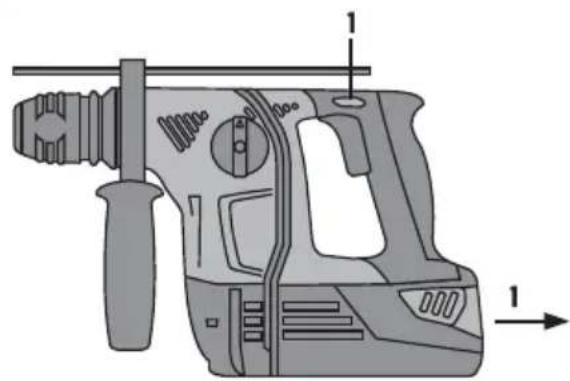
the end 6.4 Removing the battery 3
-
Press both battery release buttons.
-
Pull the battery out of the power tool toward the rear.
6.5 Transport and storage of battery packs
Pull the battery pack out of the locked position (wor position) and move it into the first click-stop position (transport position).
If you disconnect a battery pack from the power too for transport or storage, make sure that the contacts the battery pack are not short-circuited. Remove loose metal parts such as screws, nails, clamps, loose screw bits, wires or metal swarf from the case, toolbox or transport container, or prevent these parts from coming first contact with the battery packs.
Observe national and international transport regulations when shipping battery packs (transportation by road, re-seaclean air).
charger.
ng 6.6- Fitting the side handle 4
-
"L-ion" sets the forward / reverse switch to the middle 1 ions. tion or remove the battery from the power tool. even when 2. Release the side handle clamping band by turning ed by the handle counterclockwise.
-
Remove the depth gauge from the side handle. Slide the side handle clamping band over the ch order to avoid injury. and onto the cylindrical section at the front end
- Pivot the side handle into the desired position.
- Fit the depth gauge and secure the side handle the desired position by turning the grip firmly upright.
en
7 Operation

CAUTION
In the event of the drill bit sticking, the power pivot about its own axis. Always use the power the side handle fitted and hold it securely with so that the resulting opposing force causes the to release in the event of the drill bit sticking or a vicetohold the work pieces securely.
7.1 Preparing for use
7.1.1 Fitting the insert tool 5
CAUTION
Wear protective gloves when changing the insert
- Set the forward / reverse switch to the motion or remove the battery from the power
- Check that the connection end of the insert clean and lightly greased. Clean it and gre necessary.
- Check that the sealing lip of the dust shie and in good condition. Clean the dust shie cessary or replace it if the sealing lip is damaged (please refer to the "Care and maance" section).
- Push the insert tool into the chuck and ro applying slight pressure until it engages in grooves.
- Push the insert tool further into the chuck heard to engage.
- Check that the insert tool has engaged or pulling it.
7.1.2 Adjusting the depth gauge / side hand
- Release the side handle clamping band by the handle counterclockwise.
- Pivot the side handle into the desired position
- Adjust the depth gauge to the desired drill
- Tighten the side handle securely by turning grip section. This also clamps the depth g position.
7.1.3 Removing the insert tool 7
CAUTION
Wear protective gloves when changing insert tools as the insert tool will get hot during use.
- Set the forward / reverse switch to the middle tion or remove the battery from the power tool.
- Open the chuck by pulling back the chuck release sleeve.
- Pull the insert tool out of the chuck.
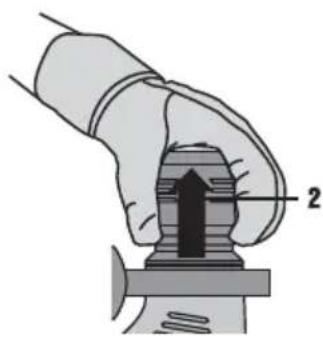
7to4 Removing the chuck 8
CAUTIONth
both hands the depth gauge from the side handle and spin clutch from the chuck in order to avoid injury. Use clamps
- Set the forward / reverse switch to the middle tion or remove the battery from the power tool.
- Pull the chuck sleeve forward and hold it securely
- Remove the chuck by pulling it away from the tool.
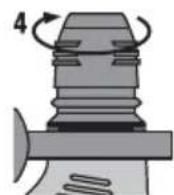
tool 7.1:5 Fitting the chuck 9
dQAUTION
Remove the depth gauge from the side handle and insert tool from the chuck in order to avoid injury.
ase it if
1. Set the forward / reverse switch to the middle tion or remove the battery from the power tool.
2. if Grip the chuck sleeve, pull it forward and hold it securely in this position.
3 Slide the chuck onto the guide tube from the first
ainten- and then release the sleeve.
- Rotate the chuck until it is heard to engage. ate it while the guide
7.2 Operation
until it is

le6CAUTION
Working on the material may cause it to splinter. Eye protection and protective gloves. Wear breathing or protection if no dust removal system is used. Spli-ntering depth material presents a risk of injury to the eyes body.
CAUTION
The work generates noise. Wear ear protectors. Exposure to noise can cause hearing loss.
7.2.1 Working at low temperatures
NOTE
The hammering mechanism works only when the tool has reached a minimum operating temperature
Bring the drill bit briefly into contact with the while allowing the power tool to run under no minimum operating temperature is reached. If ne repeat this procedure until the hammering mecha begins to operate.
7.2.2 Forward / reverse
NOTE
The forward / reverse switch is used to select of rotation of the drive spindle. An interlock p switching while the motor is running. The contr is locked when the forward / reverse switch is middle position.
For forward rotation, push the forward / revers on the side of the power tool toward the chu direction of the arrow.
For reverse rotation, push the forward / reverse the side of the power tool toward the grip of the arrow.
Bring the forward / reverse switch into the de tion.
7.2.3 Drilling without hammering 10
- Set the forward / reverse switch to the "f position before beginning drilling.
- Turn the function selector switch until it eng the "Drilling without hammering" position. Do operate the function selector switch while th is running.
- Bring the side handle into the desired posi check that it is fitted correctly and secured
- Fit the battery.
- Position the power tool and drill bit at the where the hole is to be drilled.
-
Press the control switch slowly (drill at a until the drill bit centers itself in the hole)
-
Press the control switch fully to continue drilling full power.
- Adjust the pressure applied to the power tool ac- power cording to the material you are working on. This ensure the optimum rate of drilling progress.
base material
7.2.4 Hammer drilling 11 load until the
cessa Set the forward / reverse switch to the "forward"anism position before beginning drilling.
-
Turn the function selector switch until it engages the "Hammer drilling" position. Do not operate the function selector switch while the motor is running
-
Bring the side handle into the desired position at the direction, check that it is fitted correctly and secured.
-
Fit the battery.
-
Position the power tool and drill bit at the point in the where the hole is to be drilled.
-
Press the control switch slowly (drill at a low sp until the drill bit centers itself in the hole).
-
Switch the control switch fully to continue drilling in full power.
-
Adjust the pressure applied to the power tool according to the material you are working on. This is the desired for the optimum rate of drilling progress.
-
Reduce drilling speed shortly before breaking
ired to siough in order to avoid spalling.
7.2.5 Reading the charge status LED display on Li-ion batteries 12
brNOTE
The charge status cannot be indicated while the power is in operation. LED 1 blinks when the battery fully discharged or when it is too hot (temperature is 80°C) for The battery must then be inserted in the charge. If all 4 LEDs blink, this indicates that the power to be been overloaded or has overheated.
The Li-ion battery features a charge status LED displ: The charge status is indicated by the LEDs on the point during charging (please refer to the operating instructio for the charger). When the battery is not in use, pr one of the battery release buttons or inserting the b into the power tool causes the battery charge status be displayed by the four LEDs for three seconds.
See section: 2.10 Li-ion battery charge status
8 Care and maintenance
CAUTION
Before beginning cleaning, remove the battery the power tool in order to prevent unintention ing.
8.1 Care of insert tools
Clean off dirt and dust deposits adhering to tools and protect them from corrosion by wiping insert tools from time to time with an oil-soak
Check that the connection end of the insert t and lightly greased. Clean it and grease it if
8.2 Care of the power tool
from CAUTION
Keep the power tool, especially its grip surfaces, clean and free from oil and grease. Do not use ing agents which contain silicone.
e Thiseder casing of the power tool is made from ir grestant plastic. Sections of the grip are made from eysthetic rubber material.
Never clearrate the power tool when the ventilation sl necesss blocked. Clean the ventilation slots carefully using
a dry brush. Do not permit foreign objects to interior of the power tool. Clean the outside of tool at regular intervals with a slightly damp cl not use a spray, steam pressure cleaning equip running water for cleaning. This may negatively electrical safety of the power tool.
8.3 Cleaning or replacing the dust shield
Clean the dust shield on the chuck with a cloth at regular intervals. Clean the sealing lip carefully and then grease it again lightly with it is essential that the dust shield is replaced by lip is found to be damaged. Push the tip of under the edge of the dust shield and prise in the front. Clean the area of the chuck in con shield and then fit a new dust shield. Press until it engages.
8.4 Care of the Li-ion battery
Avoid entrance of moisture.
Charge the battery fully before using it for the In order to achieve maximum battery life, stop the battery as soon as a significant drop in p is noticed.
NOTE
If use of the power tool continues, further bat charge will be stopped automatically before the cells suffer damage.
Charge the battery with the Hilti charger approved for use with Li-ion batteries. 8.6 Check
NOTE the
the A poweritioning charge (as is required with NiCd oth. NiMH batteries) is not necessary.
opment of interruption of the charging procedure has no nega affect the effect on battery life.
- Charging can be started at any time with no negative effect on battery life. There is no memory effect (a with NiCd or NiMH batteries).
For best results, batteries should be stored by charging it in places subject to high ambient temperatures (e.g. if the window) as this has an adverse effect on battery and increases the rate of self-discharge.
It - out toward the battery no longer reaches full charge, it may tact have lost capacity due to aging or overstressing. It is possible to continue working with a battery in the condition but it should be replaced in good time.
8.5 Maintenance
WARNING
Repairs to the electrical section of the power tool he carried out only by trained electrical specialists.
performance
Check all external parts of the power tool for damage at regular intervals and check that all controls operate faultlessly. Do not operate the power tool if parts are damaged or when the controls do not function faultless if necessary, the power tool should be repaired by Service.
8.6 Checking the power tool after care and maintenance
After carrying out care and maintenance work on the power tool, check that all protective and safety device are fitted and that they function faultlessly.
9 Troubleshooting
| Fault Possible cause Remedy | ||
| The power tool doesn't run. The battery is discharged or fitted incorrectly. The battery must be heard to engage with a double click or, respectively, needs to be charged. | ||
| Electrical fault. Remove the battery from the power tool and contact Hilti Service. | ||
| The battery is too hot or too cold. Bring the battery to the recommended working temperature. | ||
| The power tool doesn't run 1 LED blinks. | Timel battery is discharged. Change the battery and recharge the discharged battery. | |
| The battery is too hot or too cold. Bring the battery to the recommended working temperature. | ||
| The tool doesn't work and LEDs blink. | The 4 power tool has been overloaded. Release the control switch and put it again. | |
| The overheating prevention cut-out Allow the power tool to cool down. has been activated. Clean the ventilation slots. | ||
| No hammering action. The power tool is too cold. Allow the power tool to warm up to the minimum operating temperature.See section: 7.2.1 Working at low temperatures | ||
| The function selector switch is set to the function selector switch to “Drilling without hammering”. “Hammer drilling”. | ||
| The forward/reverse switch is set to the forward/reverse switch to forward rotation. | ||
| The control switch can’t be pressed, i.e. the switch is locked. | The forward / reverse switch is put the forward / reverse switch to middle position (transport lock en-the left or right. gaged). | |
| The drive spindle doesn’t rotate. The permissible operating temperature of the power tool’s electronics has been exceeded. | The permissible battery operation with the power tool to cool down. | |
| The permissible battery operation in the battery to the recommended working temperature has been exceeded. | ||
| The battery is discharged. Change the battery and recharge the discharged battery. | ||
| The power tool switches itself off automatically. | The overload cut-out has been a release the control switch, reduce the load on the power tool and then acted. | |
| The battery runs down more quickly than usual. | Battery condition is not optimal. Have battery condition diagnosed by Hilti Service or replace with a new battery. | |
| The battery doesn’t engage an audible double click. | The retaining lugs on the battery clean the retaining lugs and check dirty. that the battery engages securely. Contact Hilti Service if the problem persists. | |
| The power tool or the battery gets very warm. | Electrical fault. Switch the power tool off immediately, remove the battery and contact Hilti Service. | |
| The power tool has been overloaded the right power tool for the job (application limits exceeded). (don’t use a low-powered tool for heavy work). | ||
| The insert tool can’t be released. | The chuck is not pulled back fully. Pull the chuck back as far as it and remove the insert tool. | |
| The tool makes no progress. | The forward/reverse switch is set the forward/reverse switch to reverse rotation. | |
10 Disposal
CAUTION
Improper disposal of the equipment may have serious consequences: the burning of plastic components generates toxic fumes which may present a health hazard. Batteries may explode if damaged or exposed to very high temperatures, causing poisoning, burns, acid burns or environmental pollution. Careless disposal may permit unauthorized and improper use of the equipment. This may result in serious personal injury, injury to third parties and pollution of the environment.
CAUTION
Dispose of defective batteries without delay. Keep them out of reach of children. Do not attempt to open or dismantle batteries and do not dispose of them by incineration.
CAUTION
Dispose of the batteries in accordance with national regulations or return them to Hilti.
Most of the materials from which Hilti power tools or appliances are manufactured can be recycled. The materials must be correctly separated before they can be recycled. In many countries, Hilti has already made arrangements for taking back your old power tools or appliances for recycling. Please ask your Hilti customer service department or Hilti representative for further information.
en
For EC countries only
Disposal of electric tools together with household waste is not permissible.
In observance of the European Directive on waste electrical and electronic equipment and its implementation in accordance with national law, electrical appliances that have reached the end of their life must be collected separately and returned to an environmentally compatible recycling facility.
11 Manufacturer's warranty - tools
Hilti warrants that the tool supplied is free of material and workmanship. This warrant as the tool is operated and handled correctly, and serviced properly and in accordance with t Operating Instructions, and the technical system tained. This means that only original Hilti consu components and spare parts may be used in
This warranty provides the free-of-charge repair or placement of defective parts only over the entire of the tool. Parts requiring repair or replacement result of normal wear and tear are not covered warranty.
Additional claims are excluded, unless stringent national rules I prohibit such exclusion. In particular, H cleaned is not obligated for direct, indirect, incidental or consequential damages, losses or expenses in connection with, or by reason of, the use of, or inability uses the tool for any purpose. Implied warranties of merchantability or fitness for a particular purpose is specifically excluded.
Fifesrepair or replacement, send the tool or related p immediately upon discovery of the defect to the addr by this local Hilti marketing organization provided.
This constitutes Hilti's entire obligation with regard to warranty and supersedes all prior or contemporaneous comments and oral or written agreements concerning warranties.
12 EC declaration of conformity (original)
Designation: Cordless rotary hammer
Type: TE 6-A36
Generation: 03
Year of design: 2009
We declare, on our sole responsibility, that this complies with the following directives and stands 2006/42/EC, 2006/66/EC, 2004/108/EC, 2011/65/EU, EN 60745-1, EN 60745-2-6, EN ISO 12100.
Hilti Corporation, Feldkircherstrasse 100, FL-9494 Schaan


Paolo Luccini
Head of BA Quality and Process Man-
agement
Business Area Electric Tools & Ac-
cessories
01/2012
Jan Doongaji
Executive Vice President
Business Unit Power
Tools & Accessories
01/2012
Technical documentation filed at:

Perçage
sans
percussion
Poignée anti-vibration
7.2.3 Perçage sans percussion 10
normies of BA Quality and Process Mana-
gement
Business Area Electric Tools & Acces-
12100.
01/2012 01/2012
Executive Vice President
Business Unit Power
Tools & Accessories
guenti di Head of BA Quality and Process Mana- gement
Business Area Electric Tools & Accessories 01/2012
Jan Doongaji
Executive Vice President
Business Unit Power
Tools & Accessories
01/2012
Business of BA Quality and Process Management Business Area Electric Tools & Accessories 01/2012 01/2012 Executive Vice President Business Unit Power Tools & Accessories
Head of BA Quality and Process Mana-
gement
Business Area Electric Tools & Acces-
12100.
01/2012
Jan Doongaji
Executive Vice President
Business Unit Power
Tools & Accessories
01/2012
Head of BA Quality and Process Mana- Executive Vice President
3/EG. gemet
Business-Area Electric Tools & Acces-
sories
01/2012 01/2012
Head of BA Quality and Process Management Business Area Electric Tools & Accessories 1200. Business Unit Power Tools & Accessories 01/2012 01/2012
FARA
42/EG, of BA Quality and Process Management Executive Vice President Business Area Electric Tools & Accessories Business Unit Power Tools & Accessories 01/2012 01/2012
Teknisk dokumentation vid:
∴ m = 3/11
∴ m = 3/11
∴ m = 3/11
∴ m = 3/11
∴ m = 3/11
n a b erk til t
n a b erk til t
n a b erk til t
n a b erk til t
n a b erk til t
n a b erk til t
n a b erk til t
n a b erk til t
n a b erk til t
∴ m = 3/11
∴ m = 3/11
∴ m = 3/11
∴ m = 3/11
∴ m = 3/11
∴ m = 3/11
∴ m = 3/11
∴ m = 3/11
∴ m = 3/11
∴ m = 3/11
∴ m = 3/11
∴ m = 3/11
∴ m = 3/11
-
∴ m = 3/11
∴ m = 3/11
∴ m = 3/11
-
∴ m = 3/11
∴ m = 3/11
∴ m = 3/11
∴ m = 3/11
h a b erk til t
h a b erk til t
h a b erk til t
h a b erk til t
h a b erk til t
h a b erk til t
h a b erk til t
h a b erk til t
n a b erk til t
n a b erk til t
n a b erk til t
n a b erk til t
n a b erk til t
5.3.6 Personlig verneutstyr




Head of BA Quality and Process
Management
Business Area Electric Tools & Access-
ories
01/2012
Jan Doongaji
Executive Vice President
Business Unit Power
Tools & Accessories
01/2012
Head of BA Quality and Process Management Business Area Electric Tools & Accessories 01/2012 01/2012 Executive Vice President Business Unit Power Tools & Accessories
Head of BA Quality and Process
Management
Business Area Electric Tools &
Accessories
01/2012
Jan Doongaji
Executive Vice President
Business Unit Power
Tools & Accessories
01/2012
head of BA Quality and Process Management
Business Area Electric Tools & Accessories 12100.
01/2012
Jan Doongaji
Executive Vice President
Business Unit Power
Tools & Accessories
01/2012
TE 6-A36 Perforators ar akumulatoru
66/EK, of BA Quality and Process Ma-
nagement
Business Area Electric Tools &
Accessories
01/2012 01/2012
Executive Vice President
Business Unit Power
Tools & Accessories
Head of BA Quality and Process Management Executive Vice President Business Area Electric Tools & Accessories Business Unit Power 01/2012 Tools & Accessories 01/2012
ALGUPÄRANE KASUTUSJUHEND
Akupuurvasar TE 6-A36
Head of BA Quality and Process Management Business Area Electric Tools & Accessories 01/2012
Jan Doongaji
Executive Vice President
Business Unit Power
Tools & Accessories
01/2012
Tehnilised dokumendid saadaval:
Hilti = registered trademark of Hilti Corp., Schaan
W 3709 | 0613 | 00-Pos. 1 | 1
Printed in China © 2013
Right of technical and programme changes reserved S. E. & O.
409092 / A3

- TE 6-A36 AKKU-BOHRHAMMER
- TE 6-A36 CORDLESS ROTARY HAMMER
- 1 GENERAL INFORMATION
- DANGER
- WARNING
- CAUTION
- NOTE
- 2 DESCRIPTION
- 2.1 USE OF THE PRODUCT AS DIRECTED
- 2.2 CHUCK
- 2.3 SWITCHES
- 2.4 GRIPS
- 2.5 PROTECTIVE FEATURES
- 2.6 ADDITIONAL ELECTRONIC FEATURES OF THE POWER TOOL
- 2.7 LUBRICATION
- 2.8 ITEMS SUPPLIED AS STANDARD
- 2.9 ADDITIONAL ITEMS REQUIRED FOR OPERATING THE TOOL
- 2.10 LI-ION BATTERY CHARGE STATUS
- 5 SAFETY INSTRUCTIONS
- 5.1 GENERAL POWER TOOL SAFETY WARNINGS
- 5.1.1 WORK AREA SAFETY
- 5.1.2 ELECTRICAL SAFETY
- 5.1.3 PERSONAL SAFETY
- 5.1.4 POWER TOOL USE AND CARE
- WEAR
- 5.1.6 SERVICE
- 5.2 HAMMER SAFETY WARNINGS
- 5.3 ADDITIONAL SAFETY INSTRUCTIONS
- 5.3.1 PERSONAL SAFETY
- 5.3.2 ELECTRIC TOOL USE AND CARE
- UST MAY 5.3.4 ELECTRICAL SAFETY EASES
- DED. FOL- 5.3.5 WORK AREA YOU
- 5.3.6 PERSONAL PROTECTIVE EQUIPMENT
- 6 BEFOREUSE
- 6.1 BATTERY USE AND CARE
- 6.2 CHARGING THE BATTERY
- 6.2.1 CHARGING A NEW BATTERY FOR THE FIRST T
- 6.2.2 CHARGING A PREVIOUSLY USED BATTERY
- 6.3 FITTING THE BATTERY 2
- THE END 6.4 REMOVING THE BATTERY 3
- 6.5 TRANSPORT AND STORAGE OF BATTERY PACKS
- NG 6.6- FITTING THE SIDE HANDLE 4
- 7 OPERATION
- 7.1 PREPARING FOR USE
- 7.1.1 FITTING THE INSERT TOOL 5
- 7.1.2 ADJUSTING THE DEPTH GAUGE / SIDE HAND
- 7.1.3 REMOVING THE INSERT TOOL 7
- 7TO4 REMOVING THE CHUCK 8
- CAUTIONTH
- TOOL 7.1:5 FITTING THE CHUCK 9
- DQAUTION
- 7.2 OPERATION
- LE6CAUTION
- 7.2.1 WORKING AT LOW TEMPERATURES
- 7.2.2 FORWARD / REVERSE
- 7.2.3 DRILLING WITHOUT HAMMERING 10
- 7.2.5 READING THE CHARGE STATUS LED DISPLAY ON LI-ION BATTERIES 12
- BRNOTE
- 8 CARE AND MAINTENANCE
- 8.1 CARE OF INSERT TOOLS
- 8.2 CARE OF THE POWER TOOL
- FROM CAUTION
- 8.3 CLEANING OR REPLACING THE DUST SHIELD
- 8.4 CARE OF THE LI-ION BATTERY
- NOTE THE
- 8.5 MAINTENANCE
- 8.6 CHECKING THE POWER TOOL AFTER CARE AND MAINTENANCE
- 9 TROUBLESHOOTING
- 10 DISPOSAL
- 11 MANUFACTURER'S WARRANTY - TOOLS
- 12 EC DECLARATION OF CONFORMITY (ORIGINAL)
- 7.2.3 PERÇAGE SANS PERCUSSION 10
- FARA
- 5.3.6 PERSONLIG VERNEUTSTYR
- JAN DOONGAJI
- TE 6-A36 PERFORATORS AR AKUMULATORU
- ALGUPÄRANE KASUTUSJUHEND
- AKUPUURVASAR TE 6-A36
Brand : HILTI
Model : TE 6-A36-AVR
Category : Drill