
HSC 560/18 - Hedge Trimmers ATIKA - Free user manual and instructions
Find the device manual for free HSC 560/18 ATIKA in PDF.


| Brand | ATIKA |
| Model | HSC 560/18 |
| Product type | Cordless lithium-ion hedge trimmer |
| Rated voltage | 18 V DC |
| Battery capacity | 1.3 Ah |
| Charging time | Approximately 3 hours |
| Runtime | Approximately 25 minutes |
| Cutting length | 510 mm |
| Max. cutting diameter | 11 mm |
| No-load speed | 1400 min⁻¹ |
| Weight (with battery) | Approximately 2.70 kg |
| Sound pressure level LPA | 90 dB (A) |
| Guaranteed sound power level | 100 dB (A) |
| Hand-arm vibration | < 4.26 m/s² |
| Battery type | Lithium-ion (model AB 18/02) |
| Charger | ALG 18/300, 230V / 50 Hz |
| Safety | Two-hand operation, hand guard, protective cover |
| Maintenance and cleaning | Oil blades regularly, clean with a brush, no water |
| Spare parts available | Blade, hand guard, battery, charger, blade protector, safety label |
| Warranty | Warranty declaration included |
Frequently Asked Questions - HSC 560/18 ATIKA
User questions about HSC 560/18 ATIKA
0 question about this device. Answer the ones you know or ask your own.
Ask a new question about this device
Download the instructions for your Hedge Trimmers in PDF format for free! Find your manual HSC 560/18 - ATIKA and take your electronic device back in hand. On this page are published all the documents necessary for the use of your device. HSC 560/18 by ATIKA.
USER MANUAL HSC 560/18 ATIKA
Heckenschere
Original instructions – Safety instructions – Spare parts
Taille-haie

GB Do not operate machine before having read the operating instructions, understood all the notes and assembly the machine as described here.
Keep the instructions in a safe place for future use.

Inhalt
Lieferumfang 4
2004/108/EG, 2000/14/EG, 2006/95/EG
Ahlen, 01.03.2010
Extent of delivery 13
Operating times 13
EC Declaration of Conformity 13
Symbols operating manual 13
Symbols on machine / charger / battery 14
Normal intended use 14
Residual risks 14
Safety Notes 15
– General Power Tool Safety Warnings 15
– Safety instructions for hedge trimmers 16
– Safety notes for chargers 16
– Safety instructions for the battery 16
- Safe working 16
Description of device / spare parts 17
Before the first start-up 17
- Charging the rechargeable battery 17
Start-up 17
- Switching on / off 17
Work instructions 18
- Working with the hedge trimmer 18
– Vibrations 18
Maintenance and cleaning 18
Maintenance 18
Cleaning 18
Transport 19
Storage 19
Disposal 19
- Transport 19
Guarantee 19
Possible faults 19
Technical data 20
Extent of delivery
After unpacking, check the contents of the box
▶ That it is complete
▶ Check for possible transport damage
Report any damage or missing items to your dealer or the manufacturer immediately. Complaints made at a later date will not be acknowledged.
• 1 Hedge trimmer cpl., assembled
- 1 Knife protection
- 1 Battery
- 1 Charger
• 1 Operating manual
Operating times
Before initiating the device please observe the provisions pertaining to corresponding laws (regional provisions) for the noise control.
EC Declaration of Conformity
according to EC directive 2006/42/EG
We,
ATIKA GmbH & Co. KG
Schinkelstraße 97
59227 Ahlen – Germany
herewith declare under our sole responsibility that the product
Hedge trimmer HSC 560/18
is conform with the above mentioned EC directives as well as with the provisions of the guidelines below:
2004/108/EG, 2000/14/EG, 2006/95/EG
Following harmonized standards have been applied:
EN 60745-1:2009; EN 60745-2-15:2009;
EN 55014-1:2006; EN 55014-2:1997+A1:2001
Conformity assessment procedure: 2000/14/EC - Appendix V.
Measured sound power level LWA 95.4 dB (A).
Guaranteed sound power level LWA 100 dB (A).
Measuring uncertainty KWA :3.0 dB (A)
Keeping of technical documents at:
ATIKA GmbH & Co. KG – Technical department –
Schinkelstr. 97 – 59227 Ahlen – Germany

Ahlen, 18.12.2009
A. Pollmeier, management
Symbols operating manual

Threatened hazard or hazardous situation. Not observing this instruction can lead to injuries or cause damage to property.

Important information on proper handling. Not observing this instruction can lead to faults.

User information. This information helps you to use all the functions optimally.

Assembly, operation and servicing. Here you are explained exactly what to do.

Before working on the charger: Pull out mains plug.

The numbers refer to the figures on the pages 2 and 3.
...
Symbols machine

Carefully read operator's manual before handling the machine. Observe instructions and safety rules when operating.

Do not expose to rain. Protect against humidity.
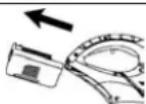
Remove the battery before any repair, maintenance and cleaning work.

Wear protective gloves.

Wear eye and ear protection.

Keep other persons away from the work area. Safety distance at least 6 m.

Danger! Risk of burning. Do not touch these surfaces.

Electrical devices do not go into the domestic rubbish.
Symbols on charger

Protection class II

Always use the charger in dry rooms only.

Carefully read operator's manual and the safety instructions before starting the machine and observe the instructions when operating.

Electrical devices do not go into the domestic rubbish.
Symbols on the battery

Li - ion

Lithium ion batteries do not fall under domestic rubbish.
Protect the battery against direct sunlight and keep it away from sources of heat.
Normal intended use
- This hedge trimmer is designed for cutting young shoots and soft branches on hedges and shrubs in house and hobby gardens.
- As hedge shears for the private house and hobby garden are considered such devices that are not applied in public facilities, parks, and sports facilities as well as in the agriculture and silviculture.
- The device shall not be used for cutting grass, grass borders or in order to chop for composting. Risk of injuries existing!
- The intended usage also includes compliance with the operating, servicing and repair conditions prescribed by the manufacturer and following the safety instructions included in the instructions.
- Any other use is deemed not to be intended use. The manufacturer is not liable for any type of damage resulting from this: the user bears the sole risk.
- Arbitrary modifications on the hedge shears exclude a liability of the manufacturer for damages of all kinds resulting from it.
- The hedge shears shall only be assembled, used and maintained by persons who are familiar with it and instructed about the risks. Repair works may only be carried out by us or by a customer service agent nominated by us.
Residual risks
Even if used properly, residual risks can exist even if the relevant safety regulations are complied with due to the design determined by the intended purpose.
Residual risks can be minimised if the “Safety instructions” and the “Normal intended use” as well as the whole of the operating instructions are observed.
Observing these instructions, and taking proper care, will reduce the risk of personal injury or damage to the equipment.
■ Risk of injuries of fingers and hands by the tool
■ Injury by catapulted workpiece parts.
■ Breaking or catapulting of knife pieces.
- Risk from electricity, by using non-standard electrical connections.
Electric shock.
- Touching live parts of opened electrical components.
- Impairment of hearing when working on the machine for longer periods of time without ear protection.
- Eye injury when failing to wear safety goggles or visor. In addition, in spite of all the precautionary measures taken, non-obvious residual risks can still exist.
Safety Notes
General Power Tool Safety Warnings
WARNING
Read all safety warnings and all instructions. Failure to follow the warnings and instructions may result in electric shock, fire and/or serious injury.
Save all warnings and instructions for future reference.
The term “power tool/garden product” in the warnings refers to your mains-operated (corded) garden product or battery-operated (cordless) garden product.
1. Work area safety
a) Keep work area clean and well lit. Cluttered or dark areas invite accidents.
b) Do not operate power tools in explosive atmospheres, such as in the presence of flammable liquids, gases or dust. Power tools create sparks which may ignite the dust or fumes.
c) Keep children and bystanders away while operating a power tool. Distractions can cause you to lose control.
2. Electrical safety
a) Power tool plugs must match the outlet. Never modify the plug in any way. Do not use any adapter plugs with earthed (grounded) power tools. Unmodified plugs and matching outlets will reduce risk of electric shock.
b) Avoid body contact with earthed or grounded surfaces, such as pipes, radiators, ranges and refrigerators. There is an increased risk of electric shock if your body is earthed or grounded.
c) Do not expose power tools to rain or wet conditions. Water entering a power tool will increase the risk of electric shock.
d) Do not abuse the cord. Never use the cord for carrying, pulling or unplugging the power tool. Keep cord away from heat, oil, sharp edges and moving parts. Damaged or entangled cords increase the risk of electric shock.
e) When operating a power tool outdoors, use an extension cord suitable for out-door use. Use of a cord suitable for out-door use reduces the risk of electric shock..
f) If operating a power tool in a damp location is unavoidable, use a residual current device (RCD) protected supply. Use of an RCD reduces the risk of electric shock.
3. Personal safety
a) Stay alert, watch what you are doing and use common sense when operating a power tool. Do not use a power tool while you are tired or under the influence of drugs, alcohol or medication. A moment of inattention while operating power tools may result in serious personal injury.
b) Use personal protective equipment. Always wear eye protection. Protective equipment such as dust mask, non-
skid safety shoes, hard hat, or hearing protection used for appropriate conditions will reduce personal injuries.
c) Prevent unintentional starting. Ensure the switch is in the off-position before connecting to power source and/or battery pack, picking up or carrying the tool. Carrying power tools with your finger on the switch or energising power tools that have the switch on invites accidents.
d) Remove any adjusting key or wrench be-fore turning the power tool on. A wrench or a key left attached to a rotating part of the power tool may result in personal injury.
e) Do not overreach. Keep proper footing and balance at all times. This enables better control of the power tool in unexpected situations.
f) Dress properly. Do not wear loose clothing or jewellery. Keep your hair, clothing and gloves away from moving parts. Loose clothes, jewellery or long hair can be caught in moving parts.
g) If devices are provided for the connection of dust extraction and collection facilities, ensure these are connected and properly used. Use of dust collection can reduce dust-related hazards.
4. Power tool use and care
a) Do not force the power tool. Use the correct power tool for your application. The correct power tool will do the job better and safer at the rate for which it was designed.
b) Do not use the power tool if the switch does not turn it on and off. Any power tool that cannot be controlled with the switch is dangerous and must be repaired.
c) Disconnect the plug from the power source and/or the battery pack from the power tool before making any adjustments, changing accessories, or storing power tools. Such preventive safety measures reduce the risk of starting the power tool accidentally.
d) Store idle power tools out of the reach of children and do not allow persons unfamiliar with the power tool or these instructions to operate the power tool. Power tools are dangerous in the hands of untrained users.
e) Maintain power tools. Check for misalignment or binding of moving parts, breakage of parts and any other condition that may affect the power tool's operation. If damaged, have the power tool repaired before use. Many accidents are caused by poorly maintained power tools.
f) Keep cutting tools sharp and clean. Properly maintained cutting tools with sharp cutting edges are less likely to bind and are easier to control.
g) Use the power tool, accessories and tool bits etc. in accordance with these instructions, taking into account the working conditions and the work to be performed. Use of the power tool for operations different from those intended could result in a hazardous situation.
5. Battery tool use and care
a) Recharge only with the charger specified by the manufacturer. A charger that is suitable for one type of battery pack may create a risk of fire when used with another battery pack.
b) Use power tools only with specifically designated battery packs. Use of any other battery packs may create a risk of injury and fire.
c) When battery pack is not in use, keep it away from other metal objects, like paper clips, coins, keys, nails, screws or other small metal objects, that can make a connection from one terminal to another. Shorting the battery terminals together may cause burns or a fire.
d) Under abusive conditions, liquid may be ejected from the battery; avoid contact. If contact accidentally occurs, flush with water. If liquid contacts eyes, additionally seek medical help. Liquid ejected from the battery may cause irritation or burns.
6. Service
a) Have your power tool serviced by a qualified repair person using only identical replacement parts. This will ensure that the safety of the power tool is maintained.
Safety instructions for hedge trimmers
- Keep away all body parts from the cutting blades. Do not attempt to remove cut material or to hold material to be cut while the cutting tool is in operation. Only remove jammed material after the unit was switched off. A single moment of inadvertence when using the hedge shear may result in severe injury.
- Make sure that all protective devices and handles are attached before using the unit. Never attempt to put into service an incomplete unit or a unit that was improperly modified.
- Carry the hedge shear on its handle with the cutting tool stopped. Always install the guard when transporting or storing the hedge shear. A careful handling of the unit minimises the risk of injury by the cutting tool.
- Keep the cable away from the cutting area. During the work, the cable may be hidden by shrubbery and accidentally cut.
- This device is not intended to be used by persons (including children) with restricted physical, sensory or mental abilities or a lack of experience and/or know-how unless they are supervised by a person responsible for their safety or they have been instructed by such a person on the use of the device. Supervise children to make sure they do not play with the device.
Safety notes for chargers
- Do not use the charger in moist or wet ambience. There is an increased risk of an electric shock when water penetrates into the charger.
- Only use the charger for the dedicated power tool. Its use for other power tools may result in injuries and fire.
-
Keep the charger clean. Contamination may result in electric shock.
-
Do not operate the charger on combustible surfaces (such as paper, textiles). There is a risk of fire as the charger heats up during the charging process.
- Before each use, check the charger, charger cable and cable connector for damages. Do not use damaged chargers. Have your charger only be repaired by qualified specialized personnel with genuine spare parts. This will ensure that the device is kept in a safe condition.
- Do not continue the charging process when the battery is not fully charged after the indicated charging time has lapsed. Otherwise, there is a risk of fire or explosion.
- Only charge the battery at temperatures between 10° C and 40° C. Otherwise, the battery may be damaged or its service life may be reduced.
- Never try to charge a damaged battery or a non-rechargeable battery.
- When the charger is not used disconnect it from the mains supply and store it in a dry area.
- Remove the battery and store it in a dry place when the power tool is not used.
Safety instructions for the battery
- Do not open the battery. Otherwise, there is the risk of a short-circuit.
- Protect the battery against heat, including permanent exposure to sunlight, and fire. Otherwise, there is a risk of explosion.
- Do not short-circuit the battery. Otherwise, there is a risk of explosion.
- Fumes may escape when the battery is damaged or improperly used. Admit fresh air and see a doctor in case of discomforts. Such fumes may irritate the respiratory tract.
- Only charge the battery with the specified charger and only use it in the machine for which it is provided.
- Protect the battery against moisture and water and any damage.
- Only store the battery within a temperature range between 0° C and 45° C. Do not leave the battery in your car in summer, for example.
- Immediately stop working or charging the battery when you perceive unnormal odors, overheating, changes in color or shape or other abnormalities.
- Do not place the battery in a microwave oven, high-pressure vessel or on an induction cooker.
Safeworking
- Do not modify the device or parts of the device respectively.
- The operator is responsible to third persons within the area of operations.
- Adhere to national regulations that might specify an age limit for the user of the unit.
- Stop the hedge trimmer when moving to another work place.
-
Always hold the hedge trimmer with both hands - one hand on the front handle and the other on the rear handle.
-
Make sure that you can step back safely without hindrances.
- Before trimming, remove all foreign objects (e.g. stones, branches, wires, etc.). While working watch out for further foreign objects.
- Be sure that the cutting tool already moves before you start cutting.
- Caution! The cutting tool stops delayed after the machine is switched off. Do not try to slow down the cutting tool by the hand.
- After a longer period of use, accessible metallic parts and accessories may be hot.
- Turn off the machine, remove the battery and wait until the cutting tool is stationary when
- the cutting tool comes into contact with soil, stones, nails or other foreign objects ( ⇒ check whether the cutting tool/machine is damaged)
- removal of faults (including blocking of knives)Leaving the machine (also during temporary interruption)
- Maintain your hedge trimmer with care:
- Before each starting of the machine the safety devices must be checked carefully for their proper and intended function. Do not modify things on the machine that could impair its safety.
- Damaged or illegible safety warning labels should be replaced immediately.

Repairs to other parts of the machine must be carried out by the manufacturer or one of his customer service points.

Use only original spare parts, accessories and special accessory parts. Accidents can arise for the user through the use of other spare parts. The manufacturer is not liable for any damage or injury resulting from such action.


Description of device / spare parts
| Pos. | Denomination Order-No. | |
| 1 | Knife | - |
| 2 | Hand guard | 364156 |
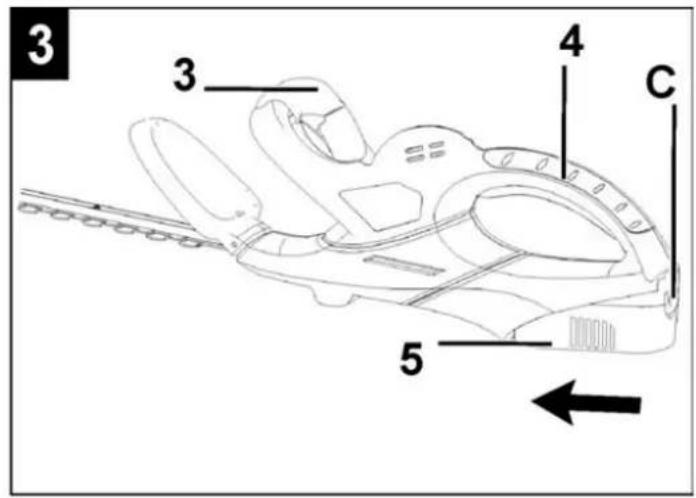
| 3 | Front handhold with switch button | - |
| 4 | Rear handhold with ON-OFF switch | - |
| 5 | Battery | 364150 |
| 6 | Ventilation slots | - |
| 7 | Charging unit | } 364152 |
| 8 | Transformer unit | |
| 9 | Knife protection | 364157 |
| 10 | Safety label 1 | 364155 |
Before the first start-up
Charging the rechargeable battery

Always use the supplied charger to charge the lithium ion battery supplied with the machine.
Mains connection
Compare the voltage given on the machine model plate e.g. 230 V with the mains voltage and connect the hedge trimmer to the relevant and properly earthed plug.
Fully charge the lithium ion batteries before first use or after a longer storage period of the machine.
The rechargeable battery will reach its full capacity only after several charge-discharge cycles.
Connect the transformer unit (8) to the charging unit (7).
2 Plug the transformer unit (8) in the mains socket. The LED (A) lights → ready for operation.
2 Slide the battery (5) in the charging unit.
2 The charging indicator LED (A) will light up red. → Charging is in progress.
During the charging process, the charger is heated and a low humming noise can be heard. This is normal.
The charging process is completed after approx. 3 hours. The LED (A) lights green.
After completed charging, remove the battery (5) and disconnect the charger from the mains.
Start-up
Switching on / off

Switch on
The hedge shears has a two-hand protective shut-down which prevents an unintended switching on.
3 Insert the battery (5) in the machine.
3 Make sure to slide the battery fully in until it engages with a click.
→ 1 Remove the knife guard (9).
3 Push the circuit closer/breaker on the rear handhold (4) and operate at the same time with the other hand the switch button on the front handhold (3)
| [5XXY] | To protect the battery the machine automatically switches off at a low battery.Do not continue to operate the ON/OFF switch. Otherwise the battery may be damaged. |
 | Charge the lithium ion battery (⇒ „Charging the battery“). |

Switching off
For switching off the device release the circuit closer/breaker or the switch button.

The cutting tool stops delayed after the machine is turned off. Therefore wait until the cutting tool is stationary before you restart the product.

Removing the battery
3 To remove the battery press the battery release button (C).
Working instructions

You may not start to operate the machine until you have read these operating instructions, observed all the instructions given and installed the machine as described! Observe all safety instructions in any case.
Working with the hedge trimmer

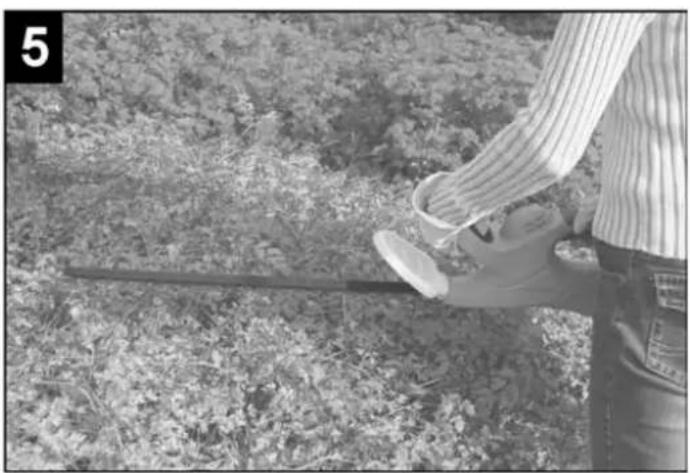
Hold the hedge trimmer with both hands on a safe distance from the body.
Scare animals off the hedge before starting to cut in order to prevent them from being injured.
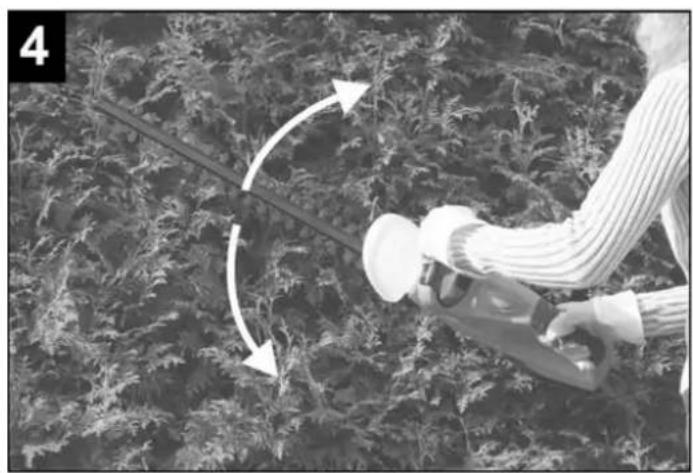
4 Due to its double sided knives the hedge trimmer can be guided forward and backward or by oscillating movements from one to another side.
The maximal diameter to cut depends on the wood's type, age, moisture and hardness.
Best time for hedge trimming:
⇒ Leaved hedge: June and October
⇒ Conifer hedge: April and August
⇒ Quickly growing hedge: from May and then every 6
w e e
- At first cut the sides of the hedge and then the upper edge.
Cut the hedge from the bottom up.
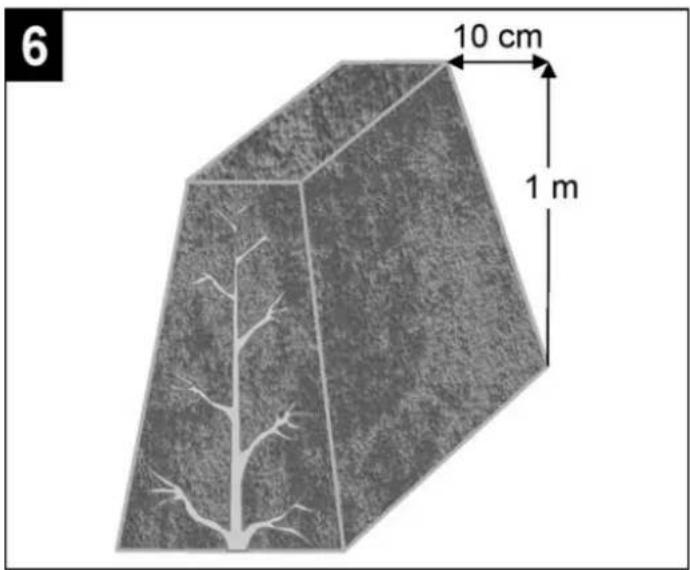
6 Cut the hedge in trapezium shape.
i As a rule of thumb: 10 cm inclination per metre hedge height.
For a 2 m high hedge having a width of 80 cm at its base this means that its crown has a width of 40 cm, for example.
→ Stretch a guide over the complete length of the hedge when you want to shorten the upper edge of the hedge evenly.
Vibrations
⚠️ If persons who have blood circulation problems are too often exposed to vibrations damages to the nervous system or to blood vessels may occur.
You can reduce vibrations:
- by thick and warm working gloves,
- shorter working time (have longer breaks).
See a doctor if your fingers swell, you don't feel well or your fingers become numb.
Maintenance and cleaning

Before each maintenance and cleaning work
- switch off device
- wait until the cutting device does not longer move.
— remove the battery - wear protective gloves.
Maintenance and repair work other than those described in this chapter is only allowed to be carried out by service staff.
For maintaining and cleaning, removed security devices must unconditionally be mounted properly and proved again.
Use only original parts. Other parts can result in unexpected damages and injuries.
Maintenance
The cutting tool will not come to a standstill immediately after cut-off. Before starting any service work wait until all parts are stationary.
To guarantee a long and reliable usage of the product carry out the following maintenance works regularly.
Check the machine for obvious defects such as
- loose, hung out or damaged cutting tools
k worn of damaged components - correct assembly and faultless covers and protective devices.
Necessary repair works or maintenance have to be carried out before using the power tool.
Cleaning

Before cleaning work on the charger: Pull out mains plug.
i Clean the machine and its accessories thoroughly after each application so that the faultless function is kept.
→ Clean the case with a soft brush or a dry cloth.
⚠️ Water, solvents and polishing agents shall not be applied.
- Clean the cutting device on a regular basis using a brush or a cloth.
i Never clean the knives with water → Risk of corrosion!
Oil the cutting tools regularly. Never use any grease Use environmentally friendly oil.
Keep handles dry and free of oils and grease.
Transport
Power off the machine and remove the battery before each transport.
⚠️ Transport the product on the handle and with the guard installed.
Storage
- Remove the battery and store it in a dry place when the power tool is not used.
■ Before a longer storage observe the following in order to prolongate the service life of the machine and to guarantee a smooth running operation: - thoroughly clean the device
- treat all movable parts with an environmentally friendly oil

Never use any grease!
- Store the battery at room temperature (19°C to 25°C) and recharge it approximately once in a year.
- Protect the battery against short-circuit, e.g. by covering the contacts with scotch tape.
Push the knife protection on the knife.
The knife guard has two hanging eyelets that can be used to hang up the hedge trimmer space-saving.
Disposal
Give devices, accessories and packaging to an ecofriendly recycling.
For EU countries only.

Electrical devices do not go into the domestic rubbish.
According to the European Directive 2002/96/EC on electrical and electronic scrap, electrical devices that are no longer serviceable must be separately collected and brought to a facility for an environmentally compatible recycling.

Lithium ion batteries do not fall under domestic rubbish.
According to the European Directive 2006/66/EC on batteries and rechargeable accumulators, defective batteries/accumulators must be recycled. Bring batteries/accumulators, which are no longer usable, to local collecting points or dealers.
⚠️ Fully run down the lithium ion battery
Transport
The lithium ion battery has passed the test procedures according to the guideline "Transport of dangerous goods" ST/SG/AC.10/11/Rev.3 Part III, 38.3
The battery is safe against internal excess pressure, extreme temperatures and short circuits or external forces.
The lithium ion content of the rechargeable battery (either as separate part or integrated in the device) is below the required limit and thus does not fall under national or international dangerous goods regulations. However, when transporting multiple batteries, dangerous goods regulations may be relevant and special safety requirements must be met, e.g. identification of the packaging.
Guarantee
Please observe the enclosed terms of guarantee.
Possible faults

Before each fault elimination:
- switch off device
— wait until the cutting tool comes to a stop - remove the battery
- wear protective gloves
After each fault clearance, put into operation and recheck all security installations.
| Fault Possible cause Remedy | ||
| Machine does not start after switching on | Lithium ion battery run downLithium ion battery defectiveON/OFF-switch defectiveInternal fault | Charge the lithium ion batteryContact the customer service |
| Machine does not work with full performance | Lithium ion battery run downLithium ion battery defective | Charge the lithium ion batteryContact the customer service |
| Machine does not cut properly | Cutting tool blunt/worn | Have the cutting tool reground or replace it |
| Machine cuts with interruptions | ON/OFF switch defectiveInternal fault | Contact the customer service |
| Knives get hot | Missing lubrication => frictionKnives are edgelessCutting tool has nicks | Lubricating of knivesArrange sharpening of knivesCheck the cutting tool |
| Motor is running, knives do not move | Knives are blockingInternal fault | Remove objectManufacturer or responsible customer service respectively must be called |
| Cutting time with fully charged battery too short | Missing lubrication => frictionKnife has to be cleanedRechargeable battery is lowBattery service life exhausted | Lubricating of knivesClean the knifeCharging the rechargeable batteryReplace the rechargeable battery |
Technical Data
HSC
| Type 560/18 | |
| No-load speed n0 1400 min | -1 |
| Cutting length 510 mm | |
| Cutting distance 11 mm | |
| Weight with rechargeable battery approx. 2.70 kg | |
| Hand-arm vibration to EN 1033/DIN 45675 a | vhw = < 4.26 m/s2 |
| Measuring uncertainty K 1.5 m/s2 | |
| Sound power level Lwa (according to regulation 2000/14/EG) | measured sound power level 95.4 dB (A)guaranteed sound power level 100 dB (A) |
| Sound pressure level LPA (according to regulation 2000/14/EG) 90 dB (A) | |
| Measuring uncertainty KPA / KWA 3.0 dB (A) | |
| Rechargeable battery | AB 18/02 |
| Rated voltage | 18 V DC === |
| Capacity | 1.3 Ah |
| Charging time | approx. 3 h |
| Operating time | approx. 25 min |
| Charger | ALG 18/300 |
| Mains voltage / Mains frequency | 230V 50 Hz |
| Charging current | 300 mA |
| Permissible charging temperature range | 10 – 40 °C |
| Weight | 0.15 kg |
Table des matières
2000/14/EG, 2004/108/EG, 2006/95/EG.
Ahlen, 2009.12.18.
2004/108/EG, 2000/14/EG, 2006/95/EG
Ahlen, 14.12.2009
2004/108/EG, 2000/14/EG, 2006/95/EG
Ahlen, 14.12.2009
A. Pollmeier, management
Symbolen in de bedieningshandleiding

2004/108/EG, 2000/14/EG, 2006/95/EG
Ahlen, 18.12.2009
2004/108/EG, 2000/14/EG, 2006/95/EG
Conformity assessment procedure 2000/14/UE – Appendix V
Incertitudine de măsurare KWA :3,0 dB (A).
Depozitarea documentelor tehnice:
Ahlen, 18.12.2009
A. Pollmeier, directiunea
2004/108/EG, 2000/14/EG, 2006/95/EG
Ahlen, 18.12.2009
2004/108/EG, 2000/14/EG, 2006/95/EG
Uporabljeni so bili naslednjih harmonizirani standardi:
EN 55014-1:2006; EN 55014-2:1997+A1:2001;
EN 60745-1:2009; EN 60745-2-15:2009;
Ahlen, 18.12.2009
A. Pollmeier, poslovodstvo


- HECKENSCHERE
- TAILLE-HAIE
- INHALT
- EXTENT OF DELIVERY
- OPERATING TIMES
- EC DECLARATION OF CONFORMITY
- SYMBOLS OPERATING MANUAL
- SYMBOLS MACHINE
- SYMBOLS ON CHARGER
- SYMBOLS ON THE BATTERY
- NORMAL INTENDED USE
- RESIDUAL RISKS
- SAFETY NOTES
- GENERAL POWER TOOL SAFETY WARNINGS
- WARNING
- WORK AREA SAFETY
- ELECTRICAL SAFETY
- PERSONAL SAFETY
- POWER TOOL USE AND CARE
- BATTERY TOOL USE AND CARE
- SERVICE
- SAFETY INSTRUCTIONS FOR HEDGE TRIMMERS
- SAFETY NOTES FOR CHARGERS
- SAFETY INSTRUCTIONS FOR THE BATTERY
- SAFEWORKING
- DESCRIPTION OF DEVICE / SPARE PARTS
- BEFORE THE FIRST START-UP
- CHARGING THE RECHARGEABLE BATTERY
- MAINS CONNECTION
- FULLY CHARGE THE LITHIUM ION BATTERIES BEFORE FIRST USE OR AFTER A LONGER STORAGE PERIOD OF THE MACHINE
- START-UP
- SWITCHING ON / OFF
- SWITCH ON
- SWITCHING OFF
- REMOVING THE BATTERY
- WORKING INSTRUCTIONS
- WORKING WITH THE HEDGE TRIMMER
- VIBRATIONS
- MAINTENANCE AND CLEANING
- MAINTENANCE
- CLEANING
- TRANSPORT
- POWER OFF THE MACHINE AND REMOVE THE BATTERY BEFORE EACH TRANSPORT
- STORAGE
- NEVER USE ANY GREASE
- DISPOSAL
- ELECTRICAL DEVICES DO NOT GO INTO THE DOMESTIC RUBBISH
- LITHIUM ION BATTERIES DO NOT FALL UNDER DOMESTIC RUBBISH
- GUARANTEE
- POSSIBLE FAULTS
- BEFORE EACH FAULT ELIMINATION
- TECHNICAL DATA
- SYMBOLEN IN DE BEDIENINGSHANDLEIDING
Brand : ATIKA
Model : HSC 560/18
Category : Hedge Trimmers