
HA 500/51 - Hedge Trimmers ATIKA - Free user manual and instructions
Find the device manual for free HA 500/51 ATIKA in PDF.


| Product type | Electric hedge trimmer |
| Brand | ATIKA |
| Model | HA 500/51 |
| Power | 500 W |
| Supply voltage | 230 V~ / 50 Hz |
| Blade length | 510 mm |
| Cutting length | 460 mm |
| Max. branch diameter | 16 mm |
| Weight | 2.2 kg |
| Protection class | II (double insulation) |
| Guaranteed sound level | 99 dB(A) |
| Sound pressure level | 77.3 dB(A) |
| Hand-arm vibration (front handle) | 3.384 m/s² |
| Hand-arm vibration (rear handle) | 3.428 m/s² |
| Safety device | Two-handed safety switch, hand guard |
| Blade maintenance | Oil regularly with biodegradable oil; never use grease |
| Cleaning | Brush or dry cloth; do not use water, solvent, or polish |
| Main replacement parts | Blade guard (ref. 364196), Hand guard (ref. 364194) |
| Delivery contents | Hedge trimmer, blade guard, hand guard, instruction manual, warranty statement |
| Intended use | Trimming hedges for non-professional use at home and in the garden |
Frequently Asked Questions - HA 500/51 ATIKA
User questions about HA 500/51 ATIKA
0 question about this device. Answer the ones you know or ask your own.
Ask a new question about this device
Download the instructions for your Hedge Trimmers in PDF format for free! Find your manual HA 500/51 - ATIKA and take your electronic device back in hand. On this page are published all the documents necessary for the use of your device. HA 500/51 by ATIKA.
USER MANUAL HA 500/51 ATIKA
Original instructions – Safety instructions – Spare parts
Taille-haie

Inhalt
Lieferumfang 7
Betriebszeiten 7
HA 500/51 vorderer Handgriff: ahv,eq = 3,384 m/s²; K = 1,5 m/s² hinterer Handgriff: ahv,eq = 3,428 m/s²; K = 1,5 m/s²
HA 620/55 vorderer Handgriff: ahv,eq = 4,183 m/s²; K = 1,5 m/s² hinterer Handgriff: ahv,eq = 3,872 m/s²; K = 1,5 m/s²
HA 710/61 vorderer Handgriff: ahv,eq = 4,062 m/s²; K = 1,5 m/s² hinterer Handgriff: ahv,eq = 4,027 m/s²; K = 1,5 m/s²
Extent of delivery 15
Operating times 15
Symbols machine 15
Symbols used in the operating instructions 15
Normal intended use 16
Residual risks 16
Vibrations 16
Safety Notes 16
Device description / Spare parts 19
Assembly 19
Commissioning 19
Adjustments on the hedge trimmer 19
Working instructions 19
Maintenance and care 20
Storage 20
Guarantee 20
Possible faults 21
Technical data 21
Declaration of conformity 112
Extent of delivery
- Hedge trimmer
- Knife protection
-
Hand guard
-
Original instructions
- Warranty declaration
After unpacking, check the contents of the box
▶ That it is complete
▶ Check for possible transport damage
Report any damage or missing items to your dealer, supplier or the manufacturer immediately. Complaints made at a later date will not be acknowledged.
Operating times
Before initiating the device please observe the provisions pertaining to corresponding laws (regional provisions) for the noise control.
Symbols machine

Carefully read operating instructions before handling the machine. Observe in
structions and safety rules when operating.

Do not expose to rain or moistness.

Shut off engine and remove power cord before performing cleaning, maintenance or repair work.

When connecting cable is damaged or cut through immediately pull out the power plug.

Wear eye and ear protection.
Wear protection gloves.

This product complies with European regulations specifically applicable to it.

Machine of the protection class II (double insulated)
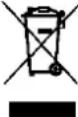
Electrical devices do not go into the domestic rubbish. Give devices, accessories and packaging to an eco-friendly recycling.
According to the European Directive 2012/19/EC on electrical and electronic scrap, electrical devices that are no longer serviceable must be separately collected and brought to a facility for an environmentally compatible recycling.
Symbols used in the operating instructions

Threatened hazard or hazardous situation. Not observing this instruction can lead to injuries or cause damage to property.

Important information on proper handling. Not observing this instruction can lead to faults in the machine.

User information. This information helps you to use all the functions optimally.

Assembly, operation and servicing. Here you are explained exactly what to do.
Normal intended use
- The hedge shears is only intended for the private use in the house and hobby garden.
- As hedge shears for the private house and hobby garden are considered such devices that are not applied in public facilities, parks, and sports facilities as well as in the agriculture and silviculture.
- The device shall not be used for cutting grass, grass borders or in order to chop for composting. Risk of injuries existing!
- The intended usage also includes compliance with the operating, servicing and repair conditions prescribed by the manufacturer and following the safety instructions included in the instructions.
- The relevant accident prevention regulations for the operation as well as the other generally acknowledged occupational medicine and safety rules must be complied with.
- Any other use is deemed not to be use as prescribed. The manufacturer is not liable for any type of damage resulting from this: the user bears the sole risk.
- Arbitrary modifications on the hedge shears exclude a liability of the manufacturer for damages of all kinds resulting from it.
- The hedge shears shall only be assembled, used and maintained by persons who are familiar with it and instructed about the risks. Repair works may only be carried out by us or by a customer service agent nominated by us.
- The machine may not be used in a potentially explosive environment or be exposed to the rain.
- Metallic parts (wires etc.) have unconditionally to be removed from the material to be cut.
Residual risks
Even if used properly, residual risks can exist even if the relevant safety regulations are complied with due to the design determined by the intended purpose.
Residual risks can be minimised if the “Safety information” and the “Intended usage” as well as the whole of the operating instructions are observed.
Observing these instructions, and taking proper care, will reduce the risk of personal injury or damage to the equipment.
- Warning! This device generates an electromagnetic field during operation. Such a field may affect active or passive medical implants under certain circumstances. To reduce the risk of serious injuries we recommend persons who carry medical implants to consult their doctor and the manufacturer of the medical implant before operating this device.
- Health impairment resulting from exposure to hand arm vibration if the machine is used too long or is not properly guided and maintained.
- isk of injuries of fingers and hands by the tool.
- Injury by catapulted workpiece parts.
-
Breaking or catapulting of knife pieces.
-
Risk from electricity, by using non-standard electrical connections.
- Electric shock.
- Touching live parts of opened electrical components.
- Impairment of hearing when working on the machine for longer periods of time without ear protection.
- Eye injury when failing to wear safety goggles or visor.
In addition, in spite of all the precautionary measures taken, non-obvious residual risks can still exist.
Vibrations
| HA 500/51 |
| Front handle: ahv,eq = 3,384 m/s2; K = 1,5 m/s2 |
| Rear handle: ahv,eq = 3,428 m/s2; K = 1,5 m/s2 |
| HA 620/55 |
| Front handle: ahv,eq = 4,183 m/s2; K = 1,5 m/s2 |
| Rear handle: ahv,eq = 3,872 m/s2; K = 1,5 m/s2 |
| HA 710/61 |
| Front handle: ahv,eq = 4,062 m/s2; K = 1,5 m/s2 |
| Rear handle: ahv,eq = 4,027 m/s2; K = 1,5 m/s2 |
The indicated vibration emission level has been measured according to a standardised test method and can be used to compare power tools.
It can also be used for an initial estimate of exposure.
Warning!
The vibration emission level can differ from the indicated value during actual use of the power tool depending on the manner of usage.
It is necessary to define safety measures to protect the operator that are based on an estimate of exposure at the actual conditions of usage (for this, all parts of the operation cycle have to be considered, e.g. times during which the power tool is cut off and times during which it is switched on but runs in no-load mode).
Safety Notes
General Power Tool Safety Warnings
WARNING
Read all safety warnings and all instructions. Failure to follow the warnings and instructions may result in electric shock, fire and/or serious injury.
Save all warnings and instructions for future reference.
The term "power tool/garden product" in the warnings refers to your mains-operated (corded) garden product or battery-operated (cordless) garden product.
1. Work area safety
a) Keep work area clean and well lit. Cluttered or dark areas invite accidents.
b) Do not operate power tools in explosive atmospheres, such as in the presence of flammable liquids, gases or dust. Power tools create sparks which may ignite the dust or fumes.
c) Keep children and bystanders away while operating a power tool. Distractions can cause you to lose control.
2. Electrical safety
a) Power tool plugs must match the outlet. Never modify the plug in any way. Do not use any adapter plugs with earthed (grounded) power tools. Unmodified plugs and matching outlets will reduce risk of electric shock.
b) Avoid body contact with earthed or grounded surfaces, such as pipes, radiators, ranges and refrigerators. There is an increased risk of electric shock if your body is earthed or grounded.
c) Do not expose power tools to rain or wet conditions. Water entering a power tool will increase the risk of electric shock.
d) Do not abuse the cord. Never use the cord for carrying, pulling or unplugging the power tool. Keep cord away from heat, oil, sharp edges and moving parts. Damaged or entangled cords increase the risk of electric shock.
e) When operating a power tool outdoors, use an extension cord suitable for out-door use. Use of a cord suitable for out-door use reduces the risk of electric shock..
f) If operating a power tool in a damp location is unavoidable, use a residual current device (RCD) protected supply. Use of an RCD reduces the risk of electric shock.
3. Personal safety
a) Stay alert, watch what you are doing and use common sense when operating a power tool. Do not use a power tool while you are tired or under the influence of drugs, alcohol or medication. A moment of inattention while operating power tools may result in serious personal injury.
b) Use personal protective equipment. Always wear eye protection. Protective equipment such as dust mask, non-skid safety shoes, hard hat, or hearing protection used for appropriate conditions will reduce personal injuries.
c) Prevent unintentional starting. Ensure the switch is in the off-position before connecting to power source and/or battery pack, picking up or carrying the tool. Carrying power tools with your finger on the switch or energising power tools that have the switch on invites accidents.
d) Remove any adjusting key or wrench be-fore turning the power tool on. A wrench or a key left attached to a rotating part of the power tool may result in personal injury.
e) Do not overreach. Keep proper footing and balance at all times. This enables better control of the power tool in unexpected situations.
f) Dress properly. Do not wear loose clothing or jewellery. Keep your hair, clothing and gloves away from moving parts. Loose clothes, jewellery or long hair can be caught in moving parts.
g) If devices are provided for the connection of dust extraction and collection facilities, ensure these are
connected and properly used. Use of dust collection can reduce dust-related hazards.
4. Power tool use and care
a) Do not force the power tool. Use the correct power tool for your application. The correct power tool will do the job better and safer at the rate for which it was designed.
b) Do not use the power tool if the switch does not turn it on and off. Any power tool that cannot be controlled with the switch is dangerous and must be repaired.
c) Disconnect the plug from the power source and/or the battery pack from the power tool before making any adjustments, changing accessories, or storing power tools. Such preventive safety measures reduce the risk of starting the power tool accidentally.
d) Store idle power tools out of the reach of children and do not allow persons unfamiliar with the power tool or these instructions to operate the power tool. Power tools are dangerous in the hands of untrained users.
e) Maintain power tools. Check for misalignment or binding of moving parts, breakage of parts and any other condition that may affect the power tool's operation. If damaged, have the power tool repaired before use. Many accidents are caused by poorly maintained power tools.
f) Keep cutting tools sharp and clean. Properly maintained cutting tools with sharp cutting edges are less likely to bind and are easier to control.
g) Use the power tool, accessories and tool bits etc. in accordance with these instructions, taking into account the working conditions and the work to be performed. Use of the power tool for operations different from those intended could result in a hazardous situation.
5. Service
a) Have your power tool serviced by a qualified repair person using only identical replacement parts. This will ensure that the safety of the power tool is maintained.
Safety instructions for hedge trimmers
- Keep away all body parts from the cutting blades. Do not attempt to remove cut material or to hold material to be cut while the cutting tool is in operation. Only remove jammed material after the unit was switched off. A single moment of inadvertence when using the hedge shear may result in severe injury.
- Make sure that all protective devices and handles are attached before using the unit. Never attempt to put into service an incomplete unit or a unit that was improperly modified.
- Carry the hedge shear on its handle with the cutting tool stopped. Always install the guard when transporting or storing the hedge shear. A careful handling of the unit minimises the risk of injury by the cutting tool.
- Keep the cable away from the cutting area. During the work, the cable may be hidden by shrubbery and accidentally cut.
- This device is not intended to be used by persons (including children) with restricted physical, sensory or mental abilities or a lack of experience and/or know-how unless they are supervised by a person responsible for their safety or they have been instructed by such a person on the use of the device.
Supervise children to make sure they do not play with the device.
more safety warnings
„Electrical safety“
- Design of the connection cable according to IEC 60245 (H 07 RN-F) with a core cross-section of at least
- 1.5 mm2 for cable lengths up to 25 m
-
2.5 mm2 for cable lengths over 25 m
-
Long and thin connection lines result in a voltage drop. The motor does not reach any longer its maximal power; the function of the device is reduced.
- Plugs and coupler outlets on connection cables must be made of rubber, non-rigid PVC or other thermoplastic material of same mechanical stability or be covered with this material.
- The connector of the connection cable must be splash-proof.
- When running the connection line observe that it does not interfere, is not squeezed, bended and the plug connection does not get wet.
- During the cutting operation, the supply cord must be securely positioned to prevent the cord from snagged on branches and the like.
- Do not use the cable for purposes for which it is not meant. Protect the cable against heat, oil and sharp edges.
- Wind off completely the cable when using a cable drum.
- Regularly check the cables and replace them if they are damaged.
- Do not use any defective connection cables.
- Do not set up any provisional electrical connections.
- Do not hose down the device with water. (origin of danger electric current).
- Never bypass protective devices or deactivate them.
- Only hook up the machine by means of a fault-current circuit breaker (30 mA).
- The electrical connection or repairs to electrical parts of the machine must be carried out by a certified electrician or one of our customer service points. Local regulations – especially regarding protective measures – must be observed.
more safety warnings
„Personal safety“
- The operator is responsible to third persons within the area of operations.
- Adhere to national regulations that might specify an age limit for the user of the unit.
- Wear suitable protective equipment when working:
— hairnet in case of long hair
— protection gloves
— eye and ear protection
more safety warnings
„Power tool use and care“
- Do not modify the device or parts of the device respectively.
- After a longer period of use, accessible metallic parts and accessories may be hot.
- Switch off machine and pull out power plug out of the power outlet in case of:
the cutting tool comes into contact with soil, stones, nails or other foreign objects ( ⇒ check whether the cutting tool/machine is damaged)
- Carrying out repair work.
- Performing maintenance and cleaning work.
– Removal of faults (including blocking of knives). - Transport.
- Leaving the machine (also during temporary interruption).
- Check the machine for possible damage:
- Before further use of the machine the safety devices must be checked carefully for their proper and intended function. Only operate the machine with complete and correctly attached safety equipment and do not alter anything on the machine that could impair the safety.
- Check whether movable parts function perfectly and do not stick or whether parts are damaged. All parts must be correctly installed and fill all conditions to ensure perfect operation of the machine.
- Damaged safety devices and parts must be properly repaired or exchanged by a recognized, specialist workshop; insofar as nothing else is stated in the instructions for use.
– Damaged or illegible safety labels have to be replaced.
- Store unused devices in a dry, locked place.
more safety warnings
„Service“

Repairs to other parts of the machine must be carried out by the manufacturer or one of his customer service points.

Use only original spare parts, accessories and special accessory parts. Accidents can arise for the user through the use of other spare parts. The manufacturer is not liable for any damage or injury resulting from such action.
more safety warnings
„Hedge trimmer safety warnings“
- Stop the hedge trimmer when moving to another work place.
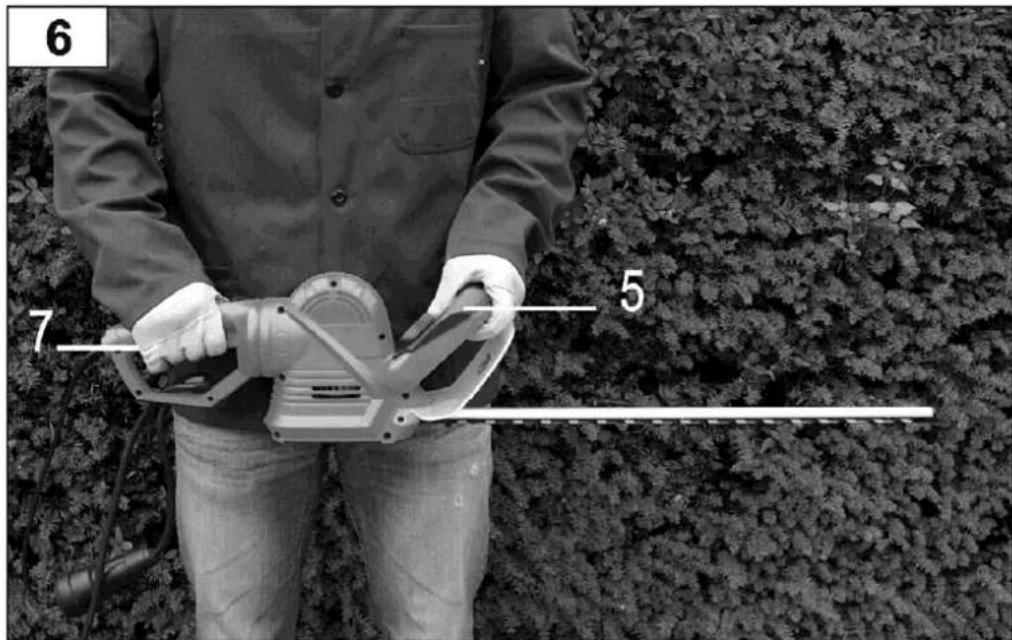
- Always hold the hedge trimmer with both hands - one hand on the front handle and the other on the rear handle.
- Make sure that you can step back safely without hindrances.
- Before trimming, remove all foreign objects (e.g. stones, branches, wires, etc.). While working watch out for further foreign objects.
- Be sure that the cutting tool already moves before you start cutting.
- Caution! The cutting tool stops delayed after the machine is switched off. Do not try to slow down the cutting tool by the hand.
Description / Spare parts
| Pos. | Denomination Order-No. | |
| 1/ | Knife | |
| 2 | Knife protection HA 500/51 | 364196 |
| Knife protection HA 620/55 | 364197 | |
| Knife protection HA 710/61 | 364198 | |
| 3 | Hand guard (HA 500/51) | 364194 |
| Hand guard (HA 620/55, HA 710/61) | 364195 | |
| 4 | Safety label | 364190 |
| 5 | Front handhold with switch button | 364199 |
| 6 | Ventilation slots | |
| 7 | Rear handhold with ON-OFF switch | |
| 8 | Cable with power plug | |
| 9 | Cover strip | |
| 10 | Impact protection | |
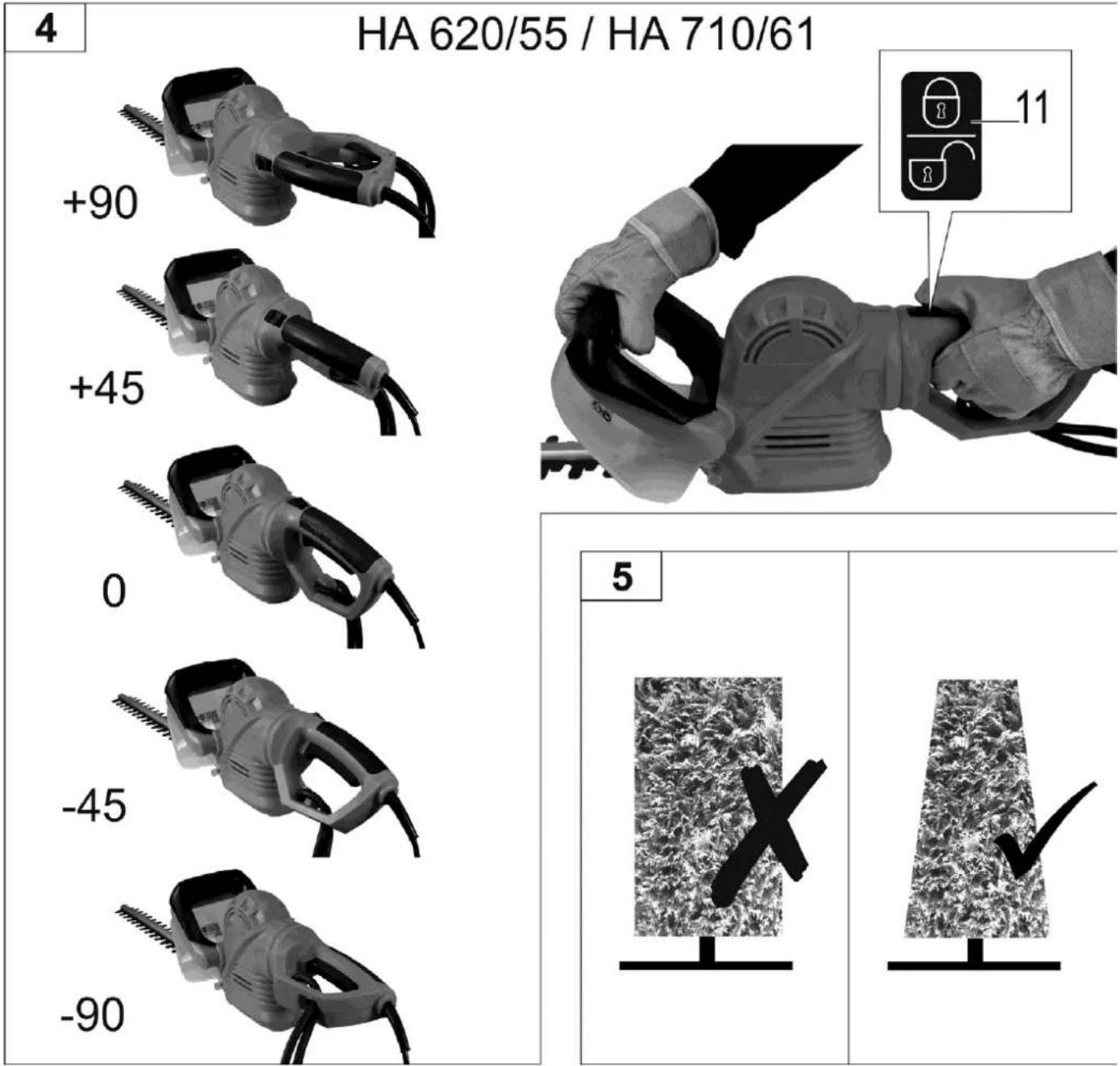
| 11 | Switch for the angular motion of the rear handhold |

Assembly
1 Attach the hand guard (3) with screws to the device prior to startup.

Commissioning
Mains connection
Compare the voltage given on the machine model plate e.g. 230 V with the mains voltage and connect the hedge trimmer to the relevant and properly earthed plug.

Alternating current motor:
Use a shockproof plug, mains voltage 230 V with residual current circuit breaker 30 mA and 10 A fuses.
- Use connection cable or extension cable respectively with a cross section of at least 1.5 mm 2 .
Mounting of the extension cable
→ 2 In order to prevent an unintended loosening of the connection assembly put the extension cable as noose through the opening on the rear handhold (7) and put it over the cable mounting.
Switch on
Do not use any device where the switch can not be switched on and off. Damaged switches must be repaired or replaced immediately by the customer service.
The hedge shears has a two-hand protective shut-down which prevents an unintended switching on.
1 Push the circuit closer/breaker on the rear handhold (7) and operate at the same time with the other hand the switch button on the front handhold (5).
Switching off
For switching off the device release the circuit closer/breaker or the switch button.

Adjustments on the hedge trimmer
Turn handhold (Type HA 620/55; HA 710/61)
The handhold can be set to 5 working positions (45° raster)
During the setting the circuit closer/breaker on the rear handhold (7) can not be operated.
3 Hold the hedge shear on the front handhold (5).
→ Push the switch (11) backwards.
The rear handhold (7) can be turned into the desired position.
Release the switch (11) and make sure that it engages. The handhold is fixed.
Working instructions

You may not start to operate the machine until you have read these operating instructions, observed all the instructions given and installed the machine as described!
Observe all safety instructions in any case.

Before commencing work, ensure the following:
■ Workplace tidied?
- You may not start to operate the machine until you have read these operating instructions, observed all the instructions given and installed the machine as described!
■ Always keep the ventilation apertures free.
- Scare animals off the hedge before starting to cut in order to prevent them from being injured.
Best time for hedge trimming:
⇒ Leaved hedge: June and October
⇒ Conifer hedge: April and August
⇒ Quickly growing hedge: from May and then every 6
w e e
Working with the hedge trimmer

Hold the hedge trimmer with both hands on a safe distance from the body.
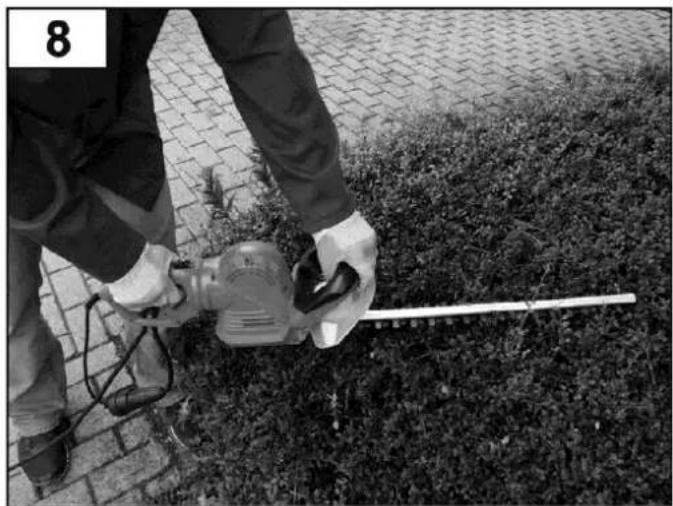
2 The extension cable must be kept behind the hedge trimmer when cutting so that it cannot be caught by the knives.
5 Due to its double sided knives the hedge trimmer can be guided forward and backward or by oscillating movements from one to another side?
6 At first cut the sides of the hedge and then the upper edge.
→ 4 Cut the hedge from the bottom up.
→ Cut the hedge in trapezium shape.
Stretch a guide over the complete length of the hedge when you want to shorten the upper edge of the hedge evenly.
Remove unconditionally any foreign objects out of the hedge (e.g. wires) as these can damage the knives of the hedge trimmer.
Maintenance and Care
Remove the plug from the power socket before starting any maintenance or cleaning work.
Maintenance and repair work other than those described in this chapter is only allowed to be carried out by service staff.
For maintaining and cleaning, removed security devices must unconditionally be mounted properly and proved again.
Use only original parts. Other parts can result in unexpected damages and injuries.
Maintenance
The cutting tool will not come to a standstill immediately after cut-off. Before starting any service work wait until all parts are stationary.
To guarantee a long and reliable usage of the product carry out the following maintenance works regularly.
Check the machine for obvious defects such as
- loose, hung out or damaged cutting tools
- worn or damaged components
- correct assembly and faultless covers and protective devices.
Necessary repair works or maintenance have to be carried out before using the power tool.
Cleaning
i Clean the machine and its accessories thoroughly after
each application so that the faultless function is kept.
- Clean the case with a soft brush or a dry cloth.
⚠️ Water, solvents and polishing agents shall not be applied.
→ Clean the cutting device on a regular basis using a brush or a cloth.
i Never clean the knives with water
→ Risk of corrosion!
Oil the cutting tools regularly. Never use any grease
Use environmentally friendly oil.
Keep handles dry and free of oils and grease.
Storage

Remove the mains plug from the socket.
■ Store unused equipment in a dry, locked place out of the reach of children.
■ To extend the service life of the hedge trimmer and guarantee smooth operation, before storing for a longer period
— thoroughly clean the hedge trimmer
- treat all movable parts with an environmentally friendly oil
i Never use any grease!
Push the knife protection on the knife.
Guarantee
Please observe the enclosed terms of guarantee.
Possible faults
| Fault Possible cause Removal | (disconnect power plug) | |
| Hedge trimmer does not work. | No powerPower failureExtension cable defectSafety fuse defectMotor or switch defect | Check cable, no longer use defect cable protectionCheck cable, no longer use defect cable protectionCheck power supply, power outlet, fuseReplace fuseHave motor or switch checked by an approved electrician or replaced by original spare parts |
| Hedge trimmer cuts with interruptions | Cable defectInternal failureCircuit closer/breaker defect | Check cable, no longer use defect cable protectionManufacturer or responsible customer service respectively must be calledManufacturer or responsible customer service respectively must be called |
| Motor is running, knives do not move | Internal failure | Manufacturer or responsible customer service respectively must be called |
| Knives get hot | Knives are edgelessKnives are defectMissing lubrication => friction | Arrange sharpening of knivesExchange knivesLubricating of knives |
| Motor is humming, knives do not move | Knives are blocking | Remove object |
Technical Data
| Typ / Modell | HA 500/51 | HA 620/55 | HA 710/61 |
| Year of construction see last page | |||
| Motor output P1 500 W 620 W | 710 W | ||
| Mains voltage / Mains frequency | 230 V~ / 50 Hz | ||
| No-load speed n0 | 1750 min-1 | 1700 min-1 | 1700 min-1 |
| Length of knives | 510 mm | 550 mm | 610 mm |
| Cutting length | 460 mm | 500 mm | 560 mm |
| Cutting distance | 16 mm | 20 mm | 24 mm |
| Hand-arm vibration according to EN 60745 | avhw=<3.428 m/s2;K=1.5 m/s2 | avhw=<4.183 m/s2;K=1.5 m/s2 | avhw=<4.062 m/s2;K=1.5 m/s2 |
| Sound power level Lwa(according to regulation 2000/14/EC)measured sound power levelguaranteed sound power level | 97,3 dB (A)99 dB (A)K=3dB | 100,7 dB (A)102 dB (A)K=3dB | 100,4 dB (A)102 dB (A)K=3dB |
| Sound pressure level LPA(according to regulation 2000/14/EG) | 77,3 dB (A);K=3,0 dB (A) | 80,7 dB (A);K=3,0 dB (A) | 80,4 dB (A);K=3,0 dB (A) |
| Weight ca. | 2.2 kg | 3.1 kg | 3.4 kg |
| Protection class | II | ||
Sommaire
Fourniture 22


- TAILLE-HAIE
- INHALT
- EXTENT OF DELIVERY
- OPERATING TIMES
- SYMBOLS MACHINE
- SYMBOLS USED IN THE OPERATING INSTRUCTIONS
- NORMAL INTENDED USE
- RESIDUAL RISKS
- VIBRATIONS
- WARNING
- SAFETY NOTES
- GENERAL POWER TOOL SAFETY WARNINGS
- SAVE ALL WARNINGS AND INSTRUCTIONS FOR FUTURE REFERENCE
- WORK AREA SAFETY
- ELECTRICAL SAFETY
- PERSONAL SAFETY
- POWER TOOL USE AND CARE
- SERVICE
- SAFETY INSTRUCTIONS FOR HEDGE TRIMMERS
- MORE SAFETY WARNINGS
- „ELECTRICAL SAFETY
- „PERSONAL SAFETY
- „POWER TOOL USE AND CARE
- „SERVICE
- „HEDGE TRIMMER SAFETY WARNINGS
- DESCRIPTION / SPARE PARTS
- ASSEMBLY
- COMMISSIONING
- MAINS CONNECTION
- MOUNTING OF THE EXTENSION CABLE
- SWITCH ON
- SWITCHING OFF
- ADJUSTMENTS ON THE HEDGE TRIMMER
- TURN HANDHOLD (TYPE HA 620/55; HA 710/61)
- WORKING INSTRUCTIONS
- WORKING WITH THE HEDGE TRIMMER
- MAINTENANCE AND CARE
- MAINTENANCE
- CLEANING
- STORAGE
- REMOVE THE MAINS PLUG FROM THE SOCKET
- GUARANTEE
- SOMMAIRE
Brand : ATIKA
Model : HA 500/51
Category : Hedge Trimmers