
S-31-LR-QL - Loudspeaker PIONEER - Free user manual and instructions
Find the device manual for free S-31-LR-QL PIONEER in PDF.



| Product Type | Floorstanding speaker, 2-way, bass-reflex |
| Brand | PIONEER |
| Model | S-31-LR-QL |
| Woofer | 2 x 10 cm cone |
| Tweeter | 2.5 cm dome |
| Nominal Impedance | 6 Ω |
| Frequency Response | 38 Hz – 40 kHz |
| Sensitivity | 84 dB (2.83 V) |
| Maximum Input Power | 120 W |
| Crossover Frequency | 3 kHz |
| Dimensions (W x H x D) | 202 x 1006 x 230 mm |
| Weight | 8.8 kg |
| Enclosure Type | Bookshelf / floorstanding, bass-reflex |
| Included Accessories | Speaker cords (3 m) x 2, anti-tip straps x 2, screws x 2, non-slip pads x 2 sets, warranty card, user manual |
| Maintenance | Clean with a dry cloth; diluted neutral detergent if necessary; avoid solvents and chemicals |
| Installation Safety | Place on a stable surface, use the provided anti-tip straps to prevent tipping |
| Amplifier Connection | Lower terminals (red +, black -); recommended amplifier impedance: 4 to 16 Ω |
| Power | Passive (requires external amplifier) |
| Repairability | Removable grille; speakers not specified as user-replaceable |
| Warranty | Warranty card included; refer to terms |
Frequently Asked Questions - S-31-LR-QL PIONEER
User questions about S-31-LR-QL PIONEER
0 question about this device. Answer the ones you know or ask your own.
Ask a new question about this device
Download the instructions for your Loudspeaker in PDF format for free! Find your manual S-31-LR-QL - PIONEER and take your electronic device back in hand. On this page are published all the documents necessary for the use of your device. S-31-LR-QL by PIONEER.
USER MANUAL S-31-LR-QL PIONEER
S-31-LR-K S-31-LR-QL
Speaker System / Enceintes acoustiques / Lautsprechersystem / Sistema di diffusori / Luidsprekersystem / Sistema de altavoces / Sistema de Colunas / Hogtalarsystem / Hogitalersystem / Høytalersystem / Kaiutinjärestelmä / Akvctnuecka cnCTema / 揭聲器系統 / 扬声器
Discover the benefits of registering your product online at http://www.pioneer.co.uk (or http://www.pioneer.eu)
Décovrez les nombreux avantages offerts en enregistrant votre produit en ligne maintainant sur http://www.pioneer.fr (ou http://www.pioneer.eu).
Bitte nutzen Sie die Möglichkeit zur Registierung Ihres Produkttes unter http://www.pioneer.de (oder http://www.pioneer.eu)
Registra il suo prodotto su http://www.pioneer.it (o http://www.pioneer.eu) e scopri subito qualivantaggi puoit ottenere!
Ontdek nu de Voorden van online registatie! Registreeuw Pioneer product via http://www.pioneer.nl - http://www.pioneer.be (of http://www.pioneer.eu)
Registre su producto en http://www.pioneer.es (o en http://www.pioneer.eu) Descubra los beneficios de registrarse on-line:
Registe o seu produits em http://www.pioneer.pt (ou em http://www.pioneer.eu). Descubra asvantagens de o fazer ahora on-line.
Registrera din produit pada http://www.pioneer.se (eller pa http://www.pioneer.eu). Upptack fordelarna med att gora det on-line nu.
Registrar dit produit pada http://www.pioneer.dk (eller http://www.pioneer.eu). Olev fordelene ved at gà online nu.
Registrar produit ditt pada http://www.pioneer.no (http://www.pioneer.eu). Oppdag fordelene med dette p a nettet i dag.
Rekisteröi tuote sivustossa http://www.pioneer.fi (http://www.pioneer.eu). Tutustu nyt online-rekisteröitymisen etuihin.
Заразсtripупту Ваши Идени на http://www.pioneer-rus.ru (ил http://www.pioneer.eu).
Ознakомьтесь с пелмуцентов ретистах в Intерnet
Register your product on: http://www.pioneerelectronics.com (US) http://www.pioneerelectronics.ca (Canada)
Enregistrez votre produit sur:
http://www.pioneerelectronics.com (US)
http://www.pioneerelectronics.ca (Canada)
Operating Instructions / Mode d'emploi / Bedienungsanleitung / Istruzioni per l'uso / Handleiding / Manual de instrucciones / Manual de instruções / Bruksanvisning / Brugsanvisning / Bruksanvisning / Käyttoohjeet / Иструкши по зксануташи / 操作手册 / 使用说明书
Thank you for buying this Pioneer product.
Please read through these operating instructions so you will know how to operate your model properly. After you have finished reading the instructions, put them away in a safe place for future reference.
Before you start
- The nominal impedance of this speaker system is 6 . Connect the speaker system to an amplifier with a load impedance ranging from 4 to 16 (a model with "4 to 16 displayed on the speaker output terminals).
In order to prevent damage to the speaker system resulting from input overload, please observe the following precautions:
- Do not supply power to the speaker system in excess of the maximum permissible input.
- When using a graphic equalizer to emphasize loud sounds in the high-frequency range, do not use excessive amplifier volume.
- Do not try to force a low-powered amplifier to produce loud volumes of sound (the amplifier's harmonic distortion will be increased, and you may damage the speaker).
Caution: installation
- When placing this unit, ensure that it is firmly secured and avoid areas where it may be likely to fall and cause injury in the event of a natural disaster (such as an earthquake).
- Do not attach these speakers to the wall or ceiling. They may fall off and cause injury.
- Do not install your speakers overhead on the ceiling or wall. If improperly attached, the speaker grille can fall and cause damage or personal injury.
- Switch off and unplug your AV equipment and consult the instructions when connecting up components. Make sure you use the correct connecting cables.
Caution: in use
- Do not place the speaker on an unstable surface. It could present a hazard if it falls, as well as damaging the equipment.
For U.S. model
WARNING: Handling the cord on this product or cords associated with accessories sold with the product will expose you to chemicals listed on proposition 65 known to the State of California and other governmental entities to cause cancer and birth defect or other reproductive harm.
Wash hands after handling
D36-P4_A_En
For European model
If you want to dispose this product, do not mix it with general household waste. There is a separate collection system for used electronic products in accordance with legislation that requires proper treatment, recovery and recycling.
Private households in the member states of the EU, in Switzerland and Norway may return their used electronic products free of charge to designated collection facilities or to a retailer (if you purchase a similar new one).
For countries not mentioned above, please contact your local authorities for the correct method of disposal.
By doing so you will ensure that your disposed product undergoes the necessary treatment, recovery and recycling and thus prevent potential negative effects on the environment and human health.
K058_A_En
How to install
Choosing where to place the speaker systems
- Sounds played through speaker systems are easily affected in subtle ways by the conditions in the listening space.
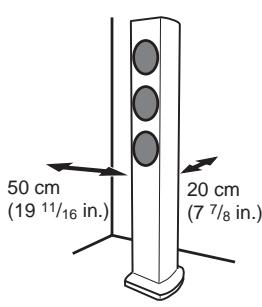
- For best sound, choose a solid floor upon which to place the speakers, and position the speakers as shown below. The level of low sounds can be adjusted by moving the speakers closer to or further from the wall. Adjust the speakers so that they are equidistant from their respective side walls to assure balanced sound.
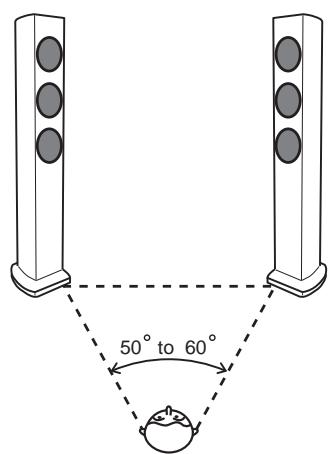
- Place the left and right speakers equal distances from your listening position for good stereo sound. Use speaker cords of the same length for each speaker.
- So far as possible, place the front left and front right speakers on the same plane as the TV screen.
- To achieve optimum surround sound, you should place the TV between the left and right speakers, with the speakers pointing at a 50 to 60 degree angle toward the listening position.
- If the room has a lot of reverberation, we recommend hanging heavy fabric on the walls, and/or putting a carpet on the floor to damp the sound. For best results, cover walls completely.

Important
- Pioneer assumes no liability whatsoever for damages resulting from assembly, improper mounting, insufficient reinforcement, misuse of the product, acts of nature, etc.
- Since these speaker systems are quite heavy, do not install them in unstable locations; a falling speaker could result in damage or dangerous personal injury.
- When installing these speaker systems, be sure to provide positive measures against tipping or falling, since accidental falls due to earthquakes or other causes could result in injury.
Applying non skid pads
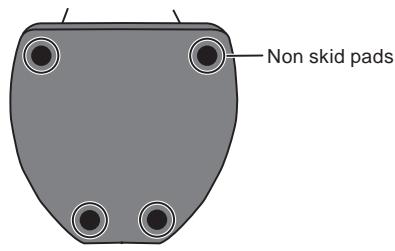
The use of non skid pads is recommended depending on the installation location. Apply the pads to the four corners of the side of the speaker which will be on the bottom. Note that depending on the location, the pads may not provide fully sufficient traction to prevent slipping, so care should be taken not to install the speakers in conditions where they may be prone to slide.
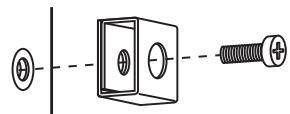
Mounting the Fall-Prevention Fastener
- Using the included screw, tightly secure the metal catch to the backside of the speaker.
- Pass a commercially-available reinforced string through the metal catch to securely support the speaker to the wall. Be sure that the wall to which you fasten the speaker is strong enough to support the weight of the speaker. After fastening the speaker, make sure that it does not fall over.
- The speaker can incur damage in the event of a fall.
- Do not attach the metal catch directly to the wall. It should only be used in conjunction with reinforced string to prevent the speaker from falling.
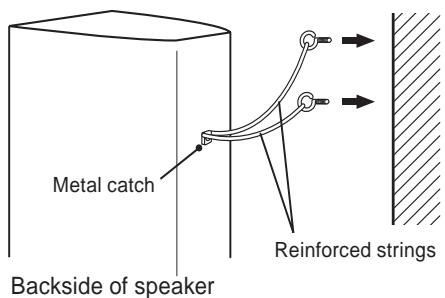
- Pass two reinforced strings through the metal catch, and fasten the speaker to the wall as shown above.
Attaching and Removing the Grille
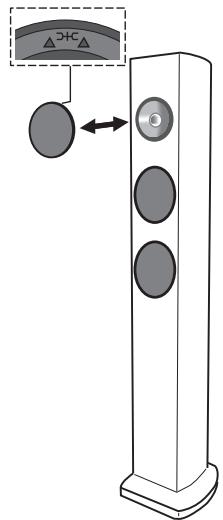
It is recommended that this speaker system be used with the grille net attached, but it can be removed if desired. To remove, follow these instructions:
1 To remove the grille, place your fingers at the outside of the grille toward the bottom and pull gently outward. Then do the same at the top to detach.
2 To reattach the grille, hold the speaker grille with the triangular symbol pointing upward, then align the four pins on the back side of the grille with the holes in the speaker and press in firmly.
Connections
This speaker does not include speaker cables used for connecting to an amplifier.
Connecting the cables
1 Switch off the power to your amplifier.
2 Connect the speaker cables to the input terminals (lower) on the back of the speaker. For input terminal polarity, red is positive (+) and black is negative (-).
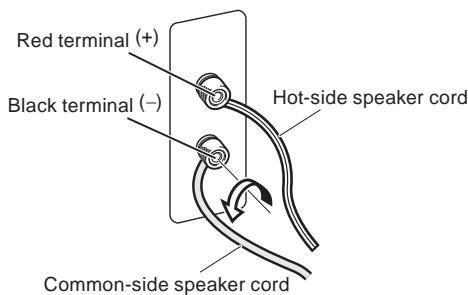
3 Connect the other ends of the cables to the amp's speaker output terminals (for more details, refer to your amp instruction manual).
- Grasp the cap knobs on the lower input terminals and rotate them to the left (counter-clockwise), insert the speaker cable wires into the holes in the terminal posts, then tighten the knobs to secure the short bar as well as the wires.
- You can also connect the speaker's terminals with a banana plug.
- When using a banana plug, first remove the caps covering the speaker terminal.
-
After connecting the plugs, pull lightly on the cables to make sure that the ends of the cables are securely connected to the terminals. Poor connections can create noise and interruptions in the sound.
-
If the cables' wires happen to be pushed out of the terminals, allowing the wires to come into contact with each other, it places an excessive additional load on the amp. This may cause the amp to stop functioning, and may even damage the amp.
- When using a set of speakers connected to an amplifier, you won't be able to obtain the normal stereo effect if the polarity (+, -) of one of the speakers (left or right) is reversed.
CAUTION
These speaker terminals carry HAZARDOUS LIVE voltage. To prevent the risk of electric shock when connecting or disconnecting the speaker cables, disconnect the power cord before touching any uninsulated parts. D3-4-2-2
D3-4-2-2-3_A_En
Specifications
Enclosure. Bass-reflex floorstanding type
Configuration 2-way
Woofer 10 cm (4 in.) cone x 2
Tweeter. 2.5 cm (1 in.) dome
Impedance 6Ω
Frequency response 38 Hz to 40 kHz
Sensitivity. 84 dB (2.83 V)
Maximum input power 120 W
Crossover frequency. 3 kHz
Exterior dimensions . . . . . . . . . . . . . . . . . . . . . . . . . . . . . . . . . . . . . . . . . . . . . . . . . . . . . . . . . . . . . . . . . . . . . . . . . . . . . . . . . . . . . . 202 (W) mm x 1006 (H) mm x 230 (D) mm
7^15 / 16(W) in. × 39^5 / 8(H) in. × 9^1 / _16(D) in.
Weight 8.8 kg (19 lbs 6 oz.)
Supplied accessories
Speaker cable (3 m) 2
Metal catch 2
Screw (for metal catch) 2
Non skid pads 2 set
Warranty card
Operating instructions (this document)

Note
Specifications and design subject to possible modification without notice, due to improvements.

is a trademark placed on a product with Pioneer's Phase
Control technology. This technology enables high-grade sound reproduction through each component by improving overall phase matching.
Published by Pioneer Corporation.
Copyright © 2009 Pioneer Corporation.
All rights reserved.
For U.S. model


Dear Customer:
Selecting fine audio equipment such as the unit you've just purchased is only the start of your musical enjoyment. Now it's time to consider how you can maximize the fun and excitement your equipment offers. This manufacturer and the Electronic Industries Association's Consumer Electronics Group want you to get the most out of your equipment by playing it at a safe level. One that lets the sound come through loud and clear without annoying blaring or distortion-and, most importantly, without affecting your sensitive hearing.
Sound can be deceiving. Over time your hearing "comfort level" adapts to higher volumes of sound. So what sounds "normal" can actually be loud and harmful to your hearing. Guard against this by setting your equipment at a safe level BEFORE your hearing adapts.
To establish a safe level:
- Start your volume control at a low setting.
- Slowly increase the sound until you can hear it comfortably and clearly, and without distortion.
Once you have established a comfortable sound level:
- Set the dial and leave it there.
Taking a minute to do this now will help to prevent hearing damage or loss in the future. After all, we want you listening for a lifetime.
We Want You Listening For A Lifetime
Used wisely, your new sound equipment will provide a lifetime of fun and enjoyment. Since hearing damage from loud noise is often undetectable until it is too late, this manufacturer and the Electronic Industries Association's Consumer Electronics Group recommend you avoid prolonged exposure to excessive noise. This list of sound levels is included for your protection.
Decibel
Level Example
30 Quiet library,soft whispers
40 Living room, refrigerator, bedroom away from traffic
50 Light traffic, normal conversation, quiet office
60 Air conditioner at 20 feet, sewing machine
70 Vacuum cleaner, hair dryer, noisy restaurant
80 Average city traffic, garbage disposals, alarm clock at two feet.
THE FOLLOWING NOISES CAN BE DANGEROUS UNDER CONSTANT EXPOSURE
90 Subway, motorcycle, truck traffic, lawn mower
100 Garbage truck, chain saw, pneumatic drill
120 Rock band concert in front of speakers, underclap
140 Gunshot blast, jet plane
180 Rocket launching pad
Information courtesy of the Deafness Research Foundation.


S001_En
Publication de Pioneer Corporation.
© 2009 Pioneer Corporation.
Copyright © 2009 Pioneer Corporation.
Copyright © 2009 Pioneer Corporation.
Copyright © 2009 Pioneer Corporation.
"Copyright" © 2009 Pioneer Corporation.
Skruv (for metallhake) x 2

Glidskyddsdynor ^ 一 satser
Garantibevis
Bruksanvisning (detta Dokument)
Skruv (for metallhake) 2
Copyright © 2009 Pioneer Corporation.
Kopiering forbjuden.
Published by Pioneer Corporation.
Copyright © 2009 Pioneer Corporation.
Anti-gilfelt × 2 sett
Garantikort
Bruksanvisning (dette dokumentet)
Hvis du onsker á kaste dette produitet, mä du ikke blande det med vanlig husholdningsavfall. Det finnes et separat innsamlingssystem for brukte elektronikkprodukter, som i henhold til lovgivningen krever korrekt spelzialbehandling, gjenbru k og gjenvinning.
Private husholdninger i EU-landene, pluss Sveits og Norge kan levere brukte elektronikkprodukter gratis til bestemte anlege for spezialavfall, ell er til forhandleren (ved kjop av et nytt, tilsvarende produit).
Opphavsrett © 2009 Pioneer Corporation.
Alle rettigheter reservert.
Copyright-oikeudet © 2009 : Pioneer Corporation.
H3daHo Pioneer Corporation.
Pioneer Corporation, 2009.
Bce npaba 3aunneHbI.
Приимechanical:
B COOTBETCTBnO CStaBei 53aKaHOa PocCncko Φeepaun "O 3aunTe npab notpeTne" U Yka3aHHeM PpaBnteBCTBa PocCncko Φeepaun N720 ot 16 noHa 1997 rda kopnpaun Pioneer Europe NV yctahBaNbaeY cOpBne Ha cNeyUuO npdoJnKtneBHoCTb cPoka cnKykbI ophiuaNBHO noCTabJIeMbIX Ha PocCnckn pbIHOK TObApOB.
Aydno n BndeooobopyoBaHne: 7 let
Ipehenochoe aydnoobopyoBaHne: 6 neT
Dpyroe obopydobAHne (HayuHnKmKpOfoH n.T.D.): 5 neT
ABTOMO6nIbHaJ 3JeKToHnKa: 6 JeT
D3-7-10-6_A_Ru
PIONEER ELECTRONICS (USA) INC.
P.O. BOX 1540, Long Beach, California 90801-1540, U.S.A. TEL: (800) 421-1404
PIONEER ELECTRONICS OF CANADA, INC.
300 Allstate Parkway, Markham, Ontario L3R 0P2, Canada TEL: 1-877-283-5901, 905-479-4411
PIONEER EUROPE NV
Haven 1087, Keetberglaan 1, B-9120 Melsele, Belgium TEL: 03/570.05.11
PIONEER ELECTRONICS ASIACENTRE PTE. LTD.
253 Alexandra Road, #04-01, Singapore 159936 TEL: 65-6472-7555
PIONEER ELECTRONICS AUSTRALIA PTY. LTD.
178-184 Boundary Road, Braeside, Victoria 3195, Australia, TEL: (03) 9586-6300
PIONEER ELECTRONICS DE MEXICO S.A. DE C.V.
Blvd. Manuel Avila Camacho 138 10 piso Col.Lomas de Chapultepec, Mexico,D.F. 11000 TEL: 55-9178-4270
K002_Ru
日本先锋公司
日本国东京都目黑区目黑1-4-1
销售商:先锋电子(中国)投资有限公司
- Before you start
- Caution: installation
- Caution: in use
- For U.S. model
- For European model
- How to install
- Choosing where to place the speaker systems
- Important
- Applying non skid pads
- Mounting the Fall-Prevention Fastener
- Attaching and Removing the Grille
- Connections
- Connecting the cables
- CAUTION
- Specifications
- Supplied accessories
- Note
- Dear Customer:
- To establish a safe level:
- Once you have established a comfortable sound level:
- We Want You Listening For A Lifetime
- Decibel
- Level Example
- THE FOLLOWING NOISES CAN BE DANGEROUS UNDER CONSTANT EXPOSURE
- Приимechanical:
- PIONEER ELECTRONICS (USA) INC.
- PIONEER ELECTRONICS OF CANADA, INC.
- PIONEER EUROPE NV
- PIONEER ELECTRONICS ASIACENTRE PTE. LTD.
- PIONEER ELECTRONICS AUSTRALIA PTY. LTD.
- PIONEER ELECTRONICS DE MEXICO S.A. DE C.V.
- 日本先锋公司
- 销售商:先锋电子(中国)投资有限公司
Brand : PIONEER
Model : S-31-LR-QL
Category : Loudspeaker