
MES4000 VITAJUICE - Juicer BOSCH - Free user manual and instructions
Find the device manual for free MES4000 VITAJUICE BOSCH in PDF.
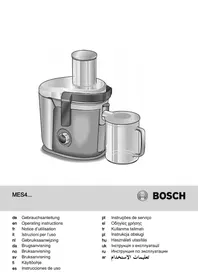



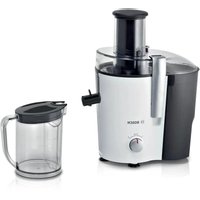
| Brand | BOSCH |
| Model | MES4000 VITAJUICE |
| Category | Juice extractor |
| Product type | Vertical feed juicer |
| Power supply | 220-240 V ~ 50/60 Hz |
| Rated power | 800 W (estimated) |
| Speeds | 2 or 3 levels depending on model (MES4000: 2 speeds; MES4010: 3 speeds) |
| Dimensions (W x D x H) | Approximately 30 x 30 x 40 cm (estimated) |
| Weight | Approximately 5 kg (estimated) |
| Pulp container capacity | Approximately 1.5 L (estimated) |
| Juice jug capacity | Approximately 1 L with splash-proof lid |
| Filter material | Stainless steel with ceramic rasp blades |
| Bowl and lid material | BPA-free plastic (estimated) |
| Power cord length | Approximately 1.2 m (estimated) |
| Safety interlock | Yes – the appliance only starts when the filter, lid, and clamp are properly locked. |
| Overheating protection | Automatic shut-off after 40 seconds of continuous use (for large quantities) |
| Cleaning | Filter dishwasher-safe (brush first); motor unit wipe with damp cloth |
| Spare parts | Replacement filter available (ref. 00754210) through after-sales service |
| Recommended use | Ripe non-frozen fruits (apples, pears, carrots, etc.); not suitable for sugar cane, bananas, avocados, mangoes |
| Warranty | According to the distributor's terms in the country of purchase |
Frequently Asked Questions - MES4000 VITAJUICE BOSCH
User questions about MES4000 VITAJUICE BOSCH
0 question about this device. Answer the ones you know or ask your own.
Ask a new question about this device
Download the instructions for your Juicer in PDF format for free! Find your manual MES4000 VITAJUICE - BOSCH and take your electronic device back in hand. On this page are published all the documents necessary for the use of your device. MES4000 VITAJUICE by BOSCH.
USER MANUAL MES4000 VITAJUICE BOSCH

BOSCH
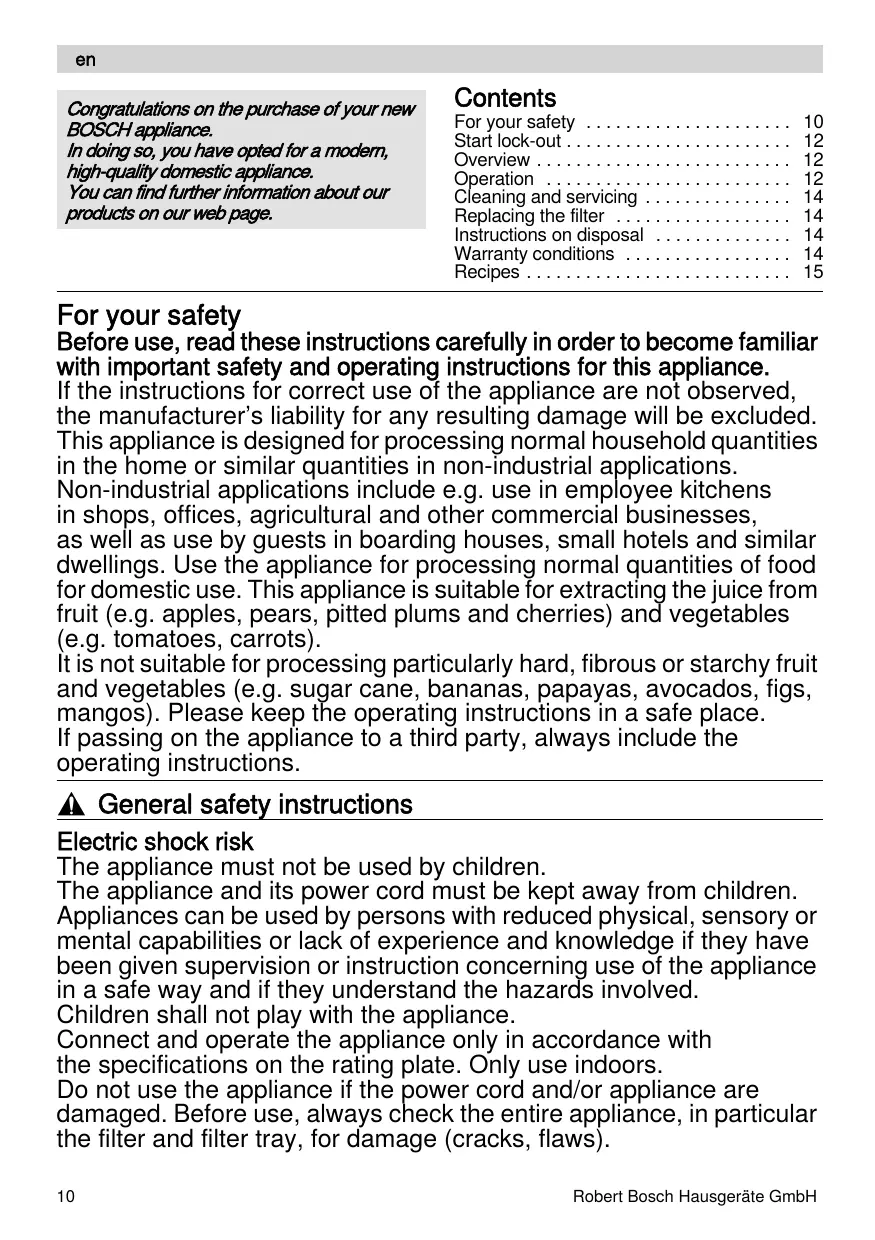
Congratulations on the purchase of your new BOSCH appliance. In doing so, you have opted for a modern, high-quality domestic appliance. You can find further information about our products on our web page.
Contents
For your safety ..... 10 Start lock-out ..... 12 Overview ..... 12 Operation ..... 12 Cleaning and servicing ..... 14 Replacing the filter ..... 14 Instructions on disposal ..... 14 Warranty conditions ..... 14 Recipes ..... 15
For your safety
Before use, read these instructions carefully in order to become familiar with important safety and operating instructions for this appliance.
If the instructions for correct use of the appliance are not observed, the manufacturer's liability for any resulting damage will be excluded. This appliance is designed for processing normal household quantities in the home or similar quantities in non-industrial applications.
Non-industrial applications include e.g. use in employee kitchens in shops, offices, agricultural and other commercial businesses, as well as use by guests in boarding houses, small hotels and similar dwellings. Use the appliance for processing normal quantities of food for domestic use. This appliance is suitable for extracting the juice from fruit (e.g. apples, pears, pitted plums and cherries) and vegetables (e.g. tomatoes, carrots).
It is not suitable for processing particularly hard, fibrous or starchy fruit and vegetables (e.g. sugar cane, bananas, papayas, avocados, figs, mangos). Please keep the operating instructions in a safe place. If passing on the appliance to a third party, always include the operating instructions.
▲ General safety instructions
Electric shock risk
The appliance must not be used by children.
The appliance and its power cord must be kept away from children. Appliances can be used by persons with reduced physical, sensory or mental capabilities or lack of experience and knowledge if they have been given supervision or instruction concerning use of the appliance in a safe way and if they understand the hazards involved.
Children shall not play with the appliance.
Connect and operate the appliance only in accordance with the specifications on the rating plate. Only use indoors.
Do not use the appliance if the power cord and/or appliance are damaged. Before use, always check the entire appliance, in particular the filter and filter tray, for damage (cracks, flaws).
Do not use the appliance if the filter or the lid is damaged or if there are visible cracks. Always disconnect the appliance from the supply if it is left unattended and before assembling, disassembling or cleaning. Do not place the power cord over sharp edges or hot surfaces.
To prevent injury, a damaged power cord must be replaced by the manufacturer or his customer service or a similarly qualified person. Only our customer service may repair the appliance.
⚠️ Safety instructions for this appliance
Risk of electric shock!
Risk of injury!
Never immerse the base unit in liquids and do not clean in the dishwasher. Use only the rotary switch to switch the appliance on or off. Before replacing accessories or additional parts, which move during operation, switch off the appliance and disconnect from the power supply. Do not dismantle the appliance until the motor has stopped. The appliance is intended to be used by one person.
Risk of injury!
Caution when closing the catch, otherwise you may trap your fingers. Do not place fingers in the filling shaft.
Use the supplied pusher only!
Do not touch shredding blades/blades on the base of the filter.
First clean the filter with the brush, then rinse under running water or wash in the dishwasher.
Important!
Process ripe and unfrozen fruit and vegetables only.
Fruit and vegetables which are not ripe will block the filter very quickly. Empty the pulp container before the pulp reaches the edge of the filter tray. If the appliance vibrates during the juicing process, the filter is blocked or damaged. Switch off the appliance immediately.
Check the filter. Do not use a damaged filter!
Explanation of the symbols on the appliance or accessory

The lock is open!
The lock is closed!
Start lock-out
The appliance cannot be switched on unless
- Filter tray and lid have been attached correctly and the catches have been engaged correctly. Before using the appliance, always check that the lid is locked! Before switching on the appliance for the first time, remove all the packaging material!
Overview
Please fold out the illustrated page.
Fig. A
1 Motor unit 2 Switch with 2 or 3 settings (depending on model) a) MES400.: 0/off Switch off the appliance 1 Switch on the appliance/lowest speed 2 maximum speed b) MES401.: 0/off Switch off the appliance 1 Switch on the appliance/lowest speed 2 medium speed 3 maximum speed
3 Catch
4 Pulp container
5 Juice jug with lid
6 Filter tray
a) Outlet
b) Lock

Important information
When switching on the appliance, ensure that the lock is open (lock at top/☐). When the lock is open, the juice flows into the juice jug.

Important information
Before emptying the juice jug, switch off the appliance (0/off) and close the lock (press downwards/☒). This will stop more juice from running out and prevent soiling of the work surface.
7 Filter with ceramic shredding blades 8 Lid 9 Filling shaft 10 Pusher 11 Cord store
Operation
Fig. B
Assemble

Risk of injury
Do not use the appliance if the power cord and/or appliance are damaged. Before use, always check the entire appliance, in particular the filter and filter tray, for damage (cracks, flaws). Do not touch shredding blades/blades on the base of the filter. Caution when closing the catch, otherwise you may trap your fingers.
- Pull cord out of the cord store to the required length.
- Insert filter tray into the motor unit.
- Insert filter and press down until it clicks into position. The filter must be situated firmly on the drive. Check for damage beforehand!
- Insert the pulp container into the motor unit.
- Attach the cover.
- Swivel catch over the lid until it clicks into position.
- Place juice jug with the spout under the outlet. Place lid on the juice jug to prevent splashes.
- Open lock on the outlet.
- Insert pusher into the filling shaft. Pusher has a guide groove!
Preparing fruit and vegetables
Warning!
Process ripe and unfrozen fruit and vegetables only. Fruit and vegetables which are not ripe will block the filter very quickly.
- First, wash the fruit and vegetables.
- Remove stones from fruit. Remove large stalks.
- Chop up large fruit and vegetables so that they fit the filling shaft.
- Process only fresh fruit and vegetables because they are juicier.
- Peel fruit beforehand if it has thick and hard peel, e.g. pineapples, melons, oranges, grapefruits and raw beetroot. Remove the white skin from citrus fruits as it has a bitter aftertaste.
- The consistency of apple juice depends on the kind of apple used.
The juicier the apples, the thinner the juice. Add a few drops of lemon juice to the apple juice to delay the juice from turning brown.
- Leaves and stems (e.g. stalks from leaf salad) can also be processed in this juicer.
- If possible, drink juice immediately after preparation, as it loses its flavour and nutritional value quickly.
- Starchy fruits (e.g. bananas, papayas, avocados, figs and mangos) are not suitable for juicing in this appliance.
Extracting juice

Risk of injury
Do not place fingers in the filling shaft.
Use the supplied pusher only!
- Place the assembled appliance on a smooth, clean worktop.
- Insert the mains plug.
- Switch on the appliance.
Appliance with 2-setting switch:
- Setting 1 is particularly suitable for fruit/vegetables which contain a lot of juice, e.g. water melons, grapes, tomatoes, cucumbers and raspberries.
- Setting 2 is suitable for hard, firm fruit and vegetables, e.g. carrots.
Appliance with 3-setting switch:
- Setting 1 is particularly suitable for soft fruit/vegetables which contain a lot of juice, e.g. water melons, grapes, tomatoes, cucumbers and raspberries.
- Setting 2 is suitable for slightly harder fruit/vegetables which contain less juice, e.g. soft pears, apricots.
- Setting 3 is suitable for hard and firm fruit and vegetables, e.g. carrots, apples.
Do not use the appliance for more than 10 minutes for all kinds of fruit and vegetables e.g. carrots, cucumbers, apples and pears.
If processing fairly large quantities, never use the appliance for longer than 40 seconds. Then switch off appliance and leave to cool down.
- When the motor is running, put fruit/vegetables in the filling shaft.
- Only use the pusher when adding more ingredients. Never insert fingers into the filling shaft!
Apply only light pressure to the pusher. This increases juice yield and protects the appliance.
- Switch off the appliance.
Move the switch to 0/off.
Do not switch off the appliance until all the juice has run out.
Warning!
Before opening the appliance, wait until the motor has stopped.

Important information
- Empty the pulp container before the pulp reaches the edge of the filter tray.
- If the appliance vibrates during the juicing process, the filter is blocked or damaged. Switch off the appliance immediately.
Check the filter. Do not use a damaged filter!
Emptying the pulp container and filter
Fig. C
Empty the pulp container before the pulp reaches the edge of the filter tray.
Switch off the appliance:
- Move the switch to 0/off.
- To remove the pulp container, take hold of it with the recessed grip and swivel it out.
Before continuing to operate the appliance:
● Re-insert the pulp container.
Empty the filter if
– the motor speed drops significantly, – the juice becomes thick, – the appliance begins to vibrate noticeably.
Recommendation: Empty the pulp container and filter at the same time.
Important!
If juice has run under the filter tray, immediately remove it with a damp cloth.
Dismantling the appliance

Electric shock risk
Before working on the appliance, pull out the mains plug.

Risk of injury
Do not dismantle the appliance until the motor has stopped. Do not touch shredding blades/blades on the base of the filter.
Fig. D
- Switch off the appliance and pull out the mains plug.
- Wait until the motor stops (approx. 10–12 sec.).
- Remove the pusher and pulp container.
- Swivel catch forwards.
- Remove lid.
- Lift the filter tray with both hands and take it out of the motor unit. ● Take the filter out of the filter tray.
Cleaning and servicing

Important information
The appliance requires no maintenance. Thorough cleaning protects the appliance from damage and keeps it functional.

Electric shock risk
Before working on the appliance, pull out the mains plug. Never immerse the base unit in liquids and do not clean in the dishwasher.

Risk of injury
Do not touch shredding blades/blades on the base of the filter. Clean them with a brush!
Warning!
Do not use abrasive cleaning agents. Surfaces may be damaged.
- First clean the filter with the brush, then rinse under running water or wash in the dishwasher. Discolouration of the filter and the ceramic shredding blades (e.g. from carrots, beetroot) can be easily removed with a little vegetable oil.
Wipe the motor unit with a damp cloth, if required use a little washing-up liquid. Dry the motor unit immediately.
All other parts are dishwasher-proof.
Discoloured plastic parts (e.g. caused by carrots, beetroot) can easily be removed with a few drops of vegetable oil.
Put parts in the dishwasher (provided they are dishwasher-safe).
Replacing the filter
Replace the filter at the first signs of wear or damage in order to prevent any risk of breakage. If the appliance is used daily, the filter should be replaced after approx. 5 years.

Important information
A filter can be ordered from customer service (order no. 00754210).
Instructions on disposal

This appliance is identified according to the European guideline 2012/19/EU on waste electrical and electronic equipment – WEEE.
The guideline specifies the framework for an EU-wide valid return and re-use of old appliances.
Please ask your dealer or inquire at your local authority about current means of disposal.
Warranty conditions
The guarantee conditions for this appliance are as defined by our representative in the country in which it is sold.
Details regarding these conditions can be obtained from the dealer from whom the appliance was purchased.
The bill of sale or receipt must be produced when making any claim under the terms of this guarantee.
Recipes
Melon yoghurt smoothie
(For 4 drinks)
200 g natural yoghurt
2 tsp. vanilla pulp
2 tbs. honey, to taste
400 g water melon fruit pulp, without skin and pips
- Mix the yoghurt with the vanilla pulp and honey until smooth and pour into a tall glass.
- Cut the melon into suitable pieces and juice.
- Pour onto the yoghurt and garnish with a piece of melon if required.
Cucumber kefir drink
(For 4 drinks)
2 cucumbers
800 g kefir
200 g yoghurt
2 tsp. olive oil
2 tbs. lemon juice
4 tbs. freshly chopped dill
Sea salt
Freshly ground pepper
- Wash the cucumber, clean it, and cut it into four strips with a peeler.
- Juice the rest of the cucumber.
- Then mix the juice with the kefir, yogurt, oil, and lemon juice.
- Then stir in the dill and season the drink with salt and pepper to taste.
- Thread the cucumber strips in a concertina shape onto wooden skewers. Pour the drink into glasses and place the cucumber skewers over the glasses.
Pepper vegetable smoothie
(For 4 drinks)
2 red peppers
8 fully ripe tomatoes
1 tsp. paprika powder, sweet
1/2 tsp. olive oil, salt
Cayenne pepper
2 tsp. lemon juice
Szechuan pepper, to garnish
Wash and halve the pepper, remove the seeds and white inner peel, and cut into large pieces.
- Wash the tomatoes, cut out the core, and cut into pieces.
- Juice the tomato and pepper.
- Mix with the paprika powder and olive oil, and season with salt, cayenne pepper, and lemon juice to taste.
- Pour into a cold glass and serve with a garnish of grated Szechuan pepper.
Juice "Tropical"
1 orange
1/2 mango
1 slice of pineapple
1 slice of watermelon
5 berries (e.g., strawberries)
- Peel the orange, pineapple, and watermelon, and remove the stone from the mango.
- Juice everything on setting 1.
- Serve the drink in a glass.
Carrot cake
4 eggs
4 tbs. warm water
200 g sugar
100 g flour
500 g carrots (use the leftover juiced carrots (200–300 g) only – they can be found in the pulp container.)
200 g ground hazelnuts
1 tsp. baking powder
- Juice the carrots at setting 2 for approx. 5 seconds. (When processing larger quantities, leave the appliance to cool down to room temperature each time after emptying the pulp container.)
- Mix eggs, water and sugar for approx. 5 minutes. The mixture must have a frothy appearance.
- Slowly add flour, baking powder, hazel nuts and carrots. The pieces of carrot must not be too large.
- Put the dough in a baking tin (e.g. spring-form tin, diameter 260 mm) and bake for 30–35 minutes at 180 degrees.
4 tablespoons warm water
200 g sugar
100 g flour
4 Container for pulp
5 Juice container with lid
6 Sieve bowl
a) Outlet
b) Closure

Important note

(waste electrical and electronic equipment – WEEE)
Jebel Ali Free Zone – Dubai
Tel.: 04 881 4401
mailto:service.uae@bshg.com
www.bosch-home.com/ae
Republic of Albania
AERTECH SH.P.K.
Rruga Qemal Stafa
New building opposite the General Prosecutor's Office
General
Entrance C, Floor 10
Tirana
Tel.: 066 206 47 94
mailto:g.volina@aertech.al
HEATHERTON, Victoria 3202
Tel.: 1300 368 339
mailto:bshau-as@bshg.com
www.bosch-home.com.au
BA Bosnia and Herzegovina, Bosnia-Herzegovina
"HIGH" d.o.o.
Gradačačka 29b
71000 Sarajevo
Info-Line: 061 100 905
Fax: 033 213 513
mailto:delicnanda@hotmail.com
European Trade Center Building, 5th floor
1784 Sofia
Tel.: 02 892 90 47
Fax: 02 878 79 72
mailto:informacia.servis-bg@
bshg.com
www.bosch.home.bg
+ 7 snt/min (alv 23%)
+ 17 snt/min (alv 23%)
FR France
BSH Electroménager S.A.S.
50 rue Ardoin – BP 47
93401 SAINT-OUEN cedex
To arrange an engineer visit, to
order spare parts and accessories
or for product advice please visit
www.bosch-home.co.uk
or call
*Calls from a BT landline will be charged at up to 3 pence per minute. A call set-up fee of up to 6 pence may apply.
GR Greece, Ελλάς
BSH Ikiakes Siskeves A.B.E.
Central Branch Service
17 km E.O. Athinon-Lamias &
Potamou 20
14564 Kifisia
Unit 1 & 2, 3rd Floor
North Block, Skyway House
3 Sham Mong Road
Tai Kok Tsui, Kowloon
Hong Kong
Tel.: 2565 6151
Fax: 2565 6681
mailto:bosch.hk.service@bshg.com
www.bosch-home.cn
HR Hrvatska, Croatia
BSH kućni uređaji d.o.o.
Kneza Branimira 22
10000 Zagreb
Tel.: 01 640 36 09
Fax: 01 640 36 03
mailto:informacije.servis-hr@bshg.com
bshg.com
www.bosch-home.com/hr
www.bosch-home.com/hu
IE Republic of Ireland
BSH Home Appliances Ltd.
Unit F4, Ballymount Drive
Ballymount Industrial Estate
Walkinstown
Dublin 12
Service Requests,
Spares and Accessories
Tel.: 01450 2655
Fax: 01450 2520
www.bosch-home.co.uk
IL Israel, בַרָבִי
C/S/B Home Appliance Ltd.
Uliel Building
2, Hamelacha St.
Industrial Park North
71293 Lod
Tel.: 08 9777 222
Fax: 08 9777 245
mailto:csb-serv@zahav.net.il
www.bosch-home.co.il
IN India, Bhārat, भारत
BSH Customer Service Front Office
Shop No.4, Everest Grande,
Opp. Shanti Nagar Bus Stop,
Mahakali Caves Road, Andheri East
Mumbai 400093
IS Iceland
Smith & Norland hf.
Noatuni 4
105 Reykjavik
Tel.: 0520 3000
Fax: 0520 3011
www.sminor.is
IT Italia, Italy
www.bosch-home.com/it
IP Turebekov Yerzhan
Nurmanovich
Jangeldina str. 15
Shimkent 160018
Tel.: 0252 31 00 06
mailto:evrika_kz@mail.ru
LB Lebanon, Lebanon
Teheni, Hana & Co.
Boulevard Dora 4043 Beyrouth
P.O. Box 90449
Jdeideh 1202 2040
Tel.: 01 255 211
mailto:Info@Teheni-Hana.com
LT Lietuva, Lithuania
Senuku prekybos centras UAB
Jonavos g. 62
44192 Kaunas
Tel.: 0372 12146
Fax: 0372 12165
www.senukai.lt
LU Luxembourg
General Serviss Limited
Bullu street 70c
1067 Riga
Tel.: 07 42 41 37
mailto:bt@olimpeks.lv
Elkor Serviss
Brivibas gatve 201
1039 Riga
Tel.: 067 0705 20; -36
Fax: 067 0705 24
mailto:domoservice@elkor.lv
www.servisacentrs.lv
MD Moldova
S.R.L. "Rialto-Studio"
Shchuseva St. 98
2012 Chisinau
tel./fax: 022 23 81 80
mailto:bosch-md@mail.ru
ME Montenegro
Elektronika komerc
UI. Slobode 17
84000 Bijelo Polje
Tel./Fax: 050 432 575
Mobil: 069 324 812
mailto:ekobosch.servis@
t-com.me
Unit F 2, 4 Orbit Drive
Mairangi Bay
Auckland 0632
Tel.: 09 477 0492
Fax: 09 477 2647
mailto:bshnz-cs@bshg.com
www.bosch-home.co.nz
PL Polska, Poland
Bin Hamran Commercial Centr.
6th Floor 603B
Jeddah 21481
Tel.: 800 124 1247
mailto:service.ksa@bshg.com
www.bosch-home.com/sa
SE Sverige, Sweden
www.bosch-home.com/tr
4th floor, No. 112 Sec 1
Chung Hsiao E Road
Taipei ROC 100
Tel.: 02 2321 6222
mailto:Bosch@achelis.com.tw
UA Ukraine, Ukraine
gama-electronics.com
XS Srbija, Serbia
BSH Kućni aparati d.o.o.
Milutina Milankovića 11
11070 Novi Beograd
Tel.: 011 205 23 97
Fax: 011 205 23 89
mailto:informacije.servis-sr@bshg.com
bshg.com
www.bosch-home.rs
ZA South Africa
BSH Home Appliances (Pty) Ltd.
15th Road Randjespark
Private Bag X36, Randjespark
1685 Midrand – Johannesburg
Tel.: 086 002 6724
Fax: 086 617 1780
mailto:applianceserviceza@
bshg.com
www.bosch-home.com/za


- BOSCH
- CONTENTS
- FOR YOUR SAFETY
- ▲ GENERAL SAFETY INSTRUCTIONS
- ELECTRIC SHOCK RISK
- ⚠️ SAFETY INSTRUCTIONS FOR THIS APPLIANCE
- RISK OF ELECTRIC SHOCK
- RISK OF INJURY
- IMPORTANT
- EXPLANATION OF THE SYMBOLS ON THE APPLIANCE OR ACCESSORY
- START LOCK-OUT
- OVERVIEW
- PLEASE FOLD OUT THE ILLUSTRATED PAGE
- FIG. A
- IMPORTANT INFORMATION
- OPERATION
- FIG. B
- ASSEMBLE
- PREPARING FRUIT AND VEGETABLES
- WARNING
- EXTRACTING JUICE
- EMPTYING THE PULP CONTAINER AND FILTER
- FIG. C
- DISMANTLING THE APPLIANCE
- FIG. D
- CLEANING AND SERVICING
- REPLACING THE FILTER
- INSTRUCTIONS ON DISPOSAL
- WARRANTY CONDITIONS
- RECIPES
- MELON YOGHURT SMOOTHIE
- CUCUMBER KEFIR DRINK
- PEPPER VEGETABLE SMOOTHIE
- JUICE "TROPICAL
- CARROT CAKE
- IMPORTANT NOTE
- REPUBLIC OF ALBANIA
- BA BOSNIA AND HERZEGOVINA, BOSNIA-HERZEGOVINA
- FR FRANCE
- GR GREECE, ΕΛΛΆΣ
- HR HRVATSKA, CROATIA
- IE REPUBLIC OF IRELAND
- IL ISRAEL, בַרָבִי
- IN INDIA, BHĀRAT, भारत
- IS ICELAND
- IT ITALIA, ITALY
- LB LEBANON, LEBANON
- LT LIETUVA, LITHUANIA
- LU LUXEMBOURG
- MD MOLDOVA
- ME MONTENEGRO
- PL POLSKA, POLAND
- SE SVERIGE, SWEDEN
- UA UKRAINE, UKRAINE
- XS SRBIJA, SERBIA
- ZA SOUTH AFRICA
Brand : BOSCH
Model : MES4000 VITAJUICE
Category : Juicer