
SY-MB1000 - Excavator SCHEPPACH - Free user manual and instructions
Find the device manual for free SY-MB1000 SCHEPPACH in PDF.


User questions about SY-MB1000 SCHEPPACH
0 question about this device. Answer the ones you know or ask your own.
Ask a new question about this device
Download the instructions for your Excavator in PDF format for free! Find your manual SY-MB1000 - SCHEPPACH and take your electronic device back in hand. On this page are published all the documents necessary for the use of your device. SY-MB1000 by SCHEPPACH.
USER MANUAL SY-MB1000 SCHEPPACH
natural_image
Technical line drawing of an excavator with tracked components and mounting bracket (no text or symbols)
EXC1400/SY-MB1000
| DE | MinibaggerOriginalbetriebsanleitung | 2 |
| GB | Mini excavatorTranslation of the original instructions | 40 |
| FR | Mini-pelleTraduction de la notice originale | 74 |
| IT | Mini escavatoreTraduzione delle istruzioni per l'uso originali | 111 |
| NL | Mini-graafmachineVertaling van de oorspronkelijkegebruiksaanwijzing | 147 |
| ES | MiniexcavadoraTraducción del manual de instrucciones original | 182 |
| PT | MiniescavadoraTradução do manual original | 218 |
Inhaltsverzeichnis
Günzburger Straße 69
D-89335 Ichenhausen
Hinweis:
- 2x Gabelschlüssel/Steckschlüssel SW 13 mm*
- Cuttermesser*
• 2x Gabelschlüssel/Steckschlüssel SW 13 mm*
- 2x Gabelschlüssel/Steckschlüssel SW 24 mm*
Günzburger Straße 69
D-89335 Ichenhausen
Division Manager Product Center

Head of Project Management
Garantiebedingungen
Revisionsdatum 26.11.2021
1 Introduction.... 46
2 Proper use.... 46
3 Product description (Fig. 1-44) 47
4 Scope of delivery (Fig. 2).... 47
5 Unpacking.... 48
6 Technical data 48
7 Safety instructions 50
8 Assembly 55
9 Before commissioning 56
10 Operation.... 58
11 Working instructions 63
12 Cleaning and maintenance.... 64
13 Storage 69
14 Transport 69
15 Repair and ordering spare parts.... 70
16 Disposal and recycling.... 70
17 Troubleshooting.... 71
18 EU Declaration of Conformity 73
Explanation of the symbols on the product
Symbols are used in this manual to draw your attention to potential hazards. The safety symbols and the accompanying explanations must be fully understood. The warnings themselves will not rectify a hazard and cannot replace proper accident prevention measures.
 | Before commissioning, read and observe the operating manual and safety instructions! |
 | Attention! Failure to observe the safety signs and warning information affixed to the product and failure to observe the safety and operating manual can result in serious injury or even death. |
 | Before commissioning, read and observe the operating manual and safety instructions! |
 | Wear safety goggles. |
 | Wear hearing protection. |
 | Always wear a safety helmet! |
 | Use your safety belt. |
 | Warning - Hot surfaces! |
 | Keep your hands away! |
 | Do not start the engine by short-circuiting the starter terminals. |
 | Naked flames or smoking near the device is strictly prohibited! |
 | Important. The exhaust gases are toxic. Do not operate the engine in areas that are not ventilated. |
 | Attention! Flying objects can cause injury. |
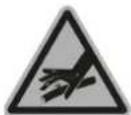




Keep your hands away from this area.
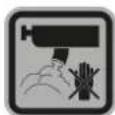
Pressurised liquids or air can penetrate the skin and cause serious injury or even death. Keep a sufficient distance.
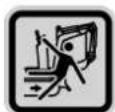
Beware of falling objects. There is a danger of crushing. Keep away from raised loads/components and their range of movement.
Danger of cutting and crushing: Before maintenance work, ensure that all moving parts have been stopped. Keep away from moving parts or tool attachments and always keep protective devices in place.
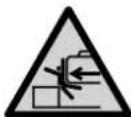
Stay away from this area. There is a risk of serious or even fatal crushing injuries.
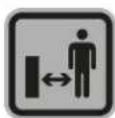
Make sure that other persons maintain a sufficient safety distance.
Attention! The exhaust pipe and other parts of the product become very hot during operation, do not touch!
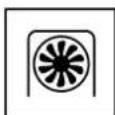
Keep your distance and do not block the fan.
Please ensure your safety. Do not reach into or remain in the working area.
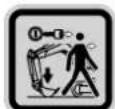
Before leaving the product, lower the tool attachment to the ground, switch off the engine and remove the ignition key.
Keep hands away from moving parts. Moving parts can crush and cut.
Cooling fan
Keep your hands away from the fan.
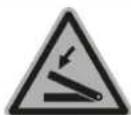
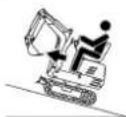
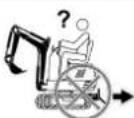
There is an increased risk of tipping when driving on slopes or inclines.
 | Sparks are produced when the engine is started. These can ignite nearby flammable gases. |
 | Fill the oil before commissioning! An oil monitor prevents the engine starting when there is insufficient oil. |
 | If the product malfunctions, switch off the engine immediately. |
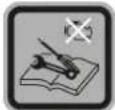 | Maintenance or repair only when the engine is switched off and after reading the instructions. |
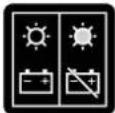 | Operating display |
 | Operating hours |
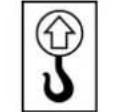 | Lifting point |
 | Transport anchoring. |
 | Lubrication points. |
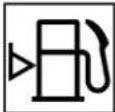 | Fuel |
 | Fuel gauge |
 | Tank contents |
 | Top up hydraulic oil. |
 | Horn. |

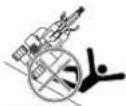



 | Throttle lever and choke. |
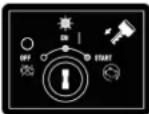 | The ignition switch has three positions: - OFF: The ignition is off. - ON: The ignition is on .START: The engine is started. |
 | Sight glass for hydraulic oil level. (Check the hydraulic oil level before each use of the product.) |
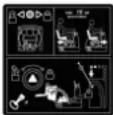 | Seat adjustment and engine cover release. |
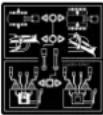 | Adjust track width and raise/lower the dozer blade. |
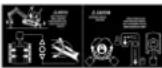 | Presets for adjusting the track width and locking/unlocking the upper carriage/operating station. |
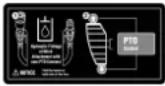 | Control tool attachments via the hydraulic system. |
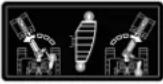 | Swing the boom to the left or right. |
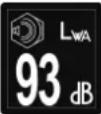 | Guaranteed sound power level of the product. |
 | The product complies with the applicable European directives. |
 | The product complies with the applicable Serbian directives. |
Explanation of the signal words in the operating manual

DANGER
Signal word to indicate an imminently hazardous situation which, if not avoided, will result in death or serious injury.

WARNING
Signal word to indicate a potentially hazardous situation which, if not avoided, could result in death or serious injury.

CAUTION
Signal word to indicate a potentially hazardous situation which, if not avoided, could result in minor or moderate injury.
ATTENTION
Signal word to indicate a potentially hazardous situation which, if not avoided, could result in product or property damage.
1 Introduction
Manufacturer:
Scheppach GmbH
Günzburger Straße 69
D-89335 Ichenhausen
Note:
In accordance with the applicable product liability laws, the manufacturer of this product assumes no liability for damage to the product or caused by the product arising from:
- Improper handling
- Failure to comply with the operating manual
• Repairs carried out by third parties, unauthorised specialists
• Installing and replacing non-original spare parts - Improper use
- Failures of the electrical system due to failure to observe the national electrical requirements and regulations.
Note:
The operating manual is part of the product and contain important information for safe, proper and economical operation. Please also observe the applicable national regulations. Read all operating and safety instructions carefully before use and only use the product as described. Keep the manual and pass it on when you give the product to someone else.
2 Proper use
The mini excavator is suitable for the following application areas:
- Earthworks and levelling of the ground after completion of construction work within the specified technical limits.
- Driving and manoeuvring within the intended area of application (e.g. construction sites, company premises, paved areas).
- Positioning or moving the product, e.g. for maintenance, cleaning or to switch tool attachments.
- Use for lifting, moving or processing material is not permitted without a suitable tool attachment.
If faults occur during operation that could compromise safety, switch off the mini excavator immediately. In this case, it may only be put back into operation once the cause has been rectified and full operational safety has been restored.
The product may only be used in the intended manner. Any use beyond this is improper. The user, not the manufacturer, is responsible for damages or injuries of any type resulting from this.
An element of the intended use is also the observance of the safety instructions, as well as the assembly instructions and operating information in the operating manual.
Persons who operate and maintain the product must be familiar with the manual and must be informed about potential dangers.
The liability of the manufacturer and resulting damages are excluded in the event of modifications of the product.
The product may only be operated with original parts and original accessories from the manufacturer.
The safety, operating and maintenance specifications of the manufacturer, as well as the dimensions specified in the technical data, must be observed.
Please note that our products were not designed with the intention of use for commercial or industrial purposes. We assume no guarantee if the product is used in commercial or industrial applications, or for equivalent work.
2.1 Improper use
Do not make any changes to the product. Safety may be compromised as a result. The user, not the manufacturer, is responsible for damages or injuries of any type resulting from this.
People who are not familiar with the operating manual, people under the influence of alcohol, drugs or medication, and people who are tired or unwell are not allowed to operate the product.
National regulations may restrict the use of the product!
The following activities are expressly prohibited:
• Lifting and transporting people.
- Use of the product as an aerial work platform.
- Lifting and transporting loads, unless the tool attachments are designed for this purpose.
- Towing trailer loads.
- Use of the product after improper troubleshooting or repair.
- Driving on public roads and traffic routes.
3 Product description (Fig. 1-44)
- Boom
1a. LED headlights
1b. Swivel mechanism
- Hoop guard
2a. Screw (M16x50 mm)
2b. Washer
2c. Spring washer
2d. Nut
2e. Roof
2f. Screw (M8x65 mm)
2g. Washer
2h. Nut (self-locking)
2i. Front screen
2j. Bar
2k. Screw (M8x25 mm)
- Washer
2m. Nut (self-locking)
- Operator's seat
3a. Seat contact switch
3b. Adjustment lever
3c. Seat belt
3d. Belt buckle
- Engine cover
4a. Key
4b. Engine cover lock
-
Upper carriage
-
Rubber crawler chassis
6a. Rubber crawler
6b. Cover
6c. Screw
6d. Lock nut
6e. Set screw
6f. Drive pinion
7f. Nut (self-locking)
7g. Exterior mirror (left/right)
7h. Screw (M8x25 mm)
7i. Washer
7j. Spring washer
7k. Nut
- Dozer blade
8a. Locking pin
8b. Dozer blade extension
-
Bucket
-
Quick coupling
10a. Lock nut
10b. Nut
10c. Screw
10d. Pin
10e. Split pin
10f. Locking screw (M6x50 mm)
10g. Retainer
- Tool receiver
11a. Cylinder
- Arm
12a. Hydraulic line
12b. Quick coupling
12c. Plug nipple
12d. Plug
12e. Cylinder
- Operating station
13a. Operating lever (left)
13a 1. Rubber sleeve
13a 2. Nut
13a 3. Clamping screw
13a 4. Lock nut
13b. Drive lever (left)
13b 1. Handle
13c. Drive lever (right)
13c 1. Handle
13d. Operating lever (right)
13d 1. Rubber sleeve
13d 2. Nut
13d 3. Clamping screw
13d 4. Lock nut
13e. Locking lever (operating station)
13f. Control lever (dozer blade/rubber track undercarriage)
13g. Throttle
13h. Choke
13i. Control pedal (left)
13j. Selection lever (dozer blade/rubber track undercarriage)
13k. Locking lever (upper carriage)
13l. Control pedal (right)
- Control panel
14a. Operating hours counter
14b. Operating display
14c. Button (horn)
14d. Button (LED headlight)
- Transport frame
15a. Screw
-
Lifting points
-
Engine oil tank
17a. Oil dipstick
- Fuel tank
18a. Fuel filler cap
18b. Fuel filter insert
18c. Fuel valve
- Hydraulic oil tank
19a. Hydraulic oil tank cap
19b. Sight glass
- Spark plug connector
20a. Spark plug
- Battery
21a. Safety key
21b. Lock
- Ignition lock
22a. Ignition key
- Air filter cover
23a. Wing nut
23b. Wing nut
23c. Air filter
-
Grease nipple
-
Carburettor screw
-
Fuse 10 A
-
Funnel
-
21 mm assembly spanner
-
Grease gun (with hose)
4 Scope of delivery (Fig. 2)
Item Qua
Designation
ntity
- 1 x Hoop guard
2e. 1 x Roof
2i. 1 x Front screen (depending on model)
- 1 x Operator's seat
4a. 1 x Key
- 1 x Front bar
7g. 2 x Exterior mirror (left/right)
- 1 x Earth bucket (22 litres) ^*
Article no.: 20000342
- 1 x Quick coupling
13a. / 2 x Operating lever (left/right)
13d.
13a 1. / 2 x Rubber sleeve
13d 1.
13b 1.2 x Handle
22a. 2 x Ignition key
-
1 x Funnel
-
1 x 21 mm assembly spanner
-
1 x Grease gun (with hose)
(grease not included)
1 x Mini excavator
1 x Operating manual
* = may not be included in the scope of delivery!
5 Unpacking

WARNING
The product and the packaging material are not children's toys!
Do not let children play with plastic bags, films or small parts! There is a danger of choking or suffocating!
- Remove the packaging material, as well as the packaging and transport safety devices (if present).
- Check whether the scope of delivery is complete.
- Check the product and accessory parts for transport damage. Immediately report any damage to the transport company that delivered the Product. Later claims will not be recognised.
- If possible, keep the packaging until the expiry of the warranty period.
- Familiarise yourself with the product by means of the operating manual before using for the first time.
- With accessories as well as wearing parts and replacement parts use only original parts. Spare parts can be obtained from your specialist dealer.
- When ordering please provide our article number as well as type and year of manufacture for the product.
Tool required:
- 2x open-ended spanner/socket spanner, size 13 mm*
- Utility knife*
- Suitable slinging gear*
- Suitable lifting device*
* = may not be included in the scope of delivery!
5.1 Removing the transport frame (15) (Fig. 3)
- Remove the packaging material. Use a utility knife. Be careful with your fingers!
- Remove the screws (15a) from the transport frame (15). Use two 13 mm open-ended spanners/socket spanners.
- Carefully remove the transport frame (15).
-
Cut and remove the straps securing the product.
-
Remove all accessories and transport locks from the pallet before moving the product.
5.2 Lifting the product (Fig. 3)
Observe the safety instructions as described under 7.6.8.

DANGER
Danger to life!
Persons must never be in the movement area of raised loads.
Lifted loads pose a risk of serious or fatal crushing injuries.

WARNING
To avoid injury, the product must only be lifted without any tool attachments fitted.

WARNING
The lifting points are marked with appropriate symbols. Lifting at other points is unsafe and may result in personal injury or damage to the product.
Notes:
Before lifting, make sure that the lifting device (crane or hoist) is capable of carrying the product weight without danger. See type plate for weight of lifting device.
Observe the instructions of the slinging gear and lifting device manufacturer.
Only use approved lifting devices (min. lifting capacity kg).
- Attach the slinging gear to the designated lifting points (16).
- Hook the slinging gear into the lifting device.
- Lift the product a small distance and make sure that all slinging gear is properly fastened.
- You can now lift the product as desired using the lifting device.
- Place the product on a level, even surface.
5.3 Removing the product from pallet
- Proceed as described in 8 und 9, to make the product ready for use.
- Familiarise yourself with the chapter 10.4.
- Start the product as described in 10.5.
- Turn the upper carriage 180°, as described in 10.4.5.2.
- Align the bucket close to the ground to lower the centre of gravity of the product and improve stability during descent.
- Drive slowly and carefully off the pallet. Keep the bucket close to the ground while doing this.
6 Technical data
| General: | |
| Operating weight approx. | 1085 kg |
| Empty weight approx. | 1010 kg |
| Digging force | 12.3 kN (1230 kg) |
| Track width (adjustable) 720 - 900 mm | ||
| Crawler width 180 mm | ||
| Max. incline 15° | ||
| Ground clearance 300 mm | ||
| Ground contact pressure 29 kPa | ||
| Boom swivelling range Left 45° | ||
| Right 85° | ||
| Travel speed (F/R) 1.8 km/h | ||
| Safety belt according to EN ISO 6683:2008 | ||
| TOPS (Tip Over Protection) according to: | ISO 12117:1997 | |
| Engine: | ||
| Type of engine 4-stroke engine, air-cooled | ||
| Rated engine power 8.5 kW (11.5 PS) | ||
| Max. engine speed 3600 rpm | ||
| Displacement 420 cm | 3 | |
| Torque 27.8 Nm | ||
| Start system Electric starter (12 V) / pull starter | ||
| Fuel | E10 and E5 | |
| CO2 output | 734.5 g/kWh | |
| Fuel tank volume | 6 litres | |
| Engine oil tank volume | 1.1 litres | |
| Hydraulic system: | ||
| Pump capacity | 2×13 l/min | |
| System pressure | 175 bar | |
| Hydraulic oil tank capacity | 13.5 litres | |
| Accessories included in scope of delivery: | ||
| Bucket (9) 0,023m | 3(23 litres) | |
*determined without driver, without dynamic effects, on level, solid ground, with earth bucket 7915400705
Subject to technical changes!
Noise and vibration

WARNING
Noise can have serious effects on your health. If the machine noise exceeds 85 dB, please wear suitable hearing protection for you and persons in the vicinity.

WARNING
Please observe the legal provisions from the noise protection ordinance.
Information on the noise emissions of the product has been determined in accordance with the requirements of EN ISO 6395:2008 and based on Directive 2000/14/EC, Annex VI:
Noise data
| Sound pressure level L_pA | 71.08 dB |
| Measurement uncertainty K_pA | 1.99 dB |
| Sound power level L_wA | 91.1 dB |
| Guaranteed sound power level L_wA | 93 dB |
| Measurement uncertainty K_wA | 1.99 dB |

WARNING
The noise emission values and vibration emission value can vary from the specified values during the actual use of the product, depending on the type and the manner in which the product is used, and in particular the type of workpiece being processed.
Try to keep the stress as low as possible. For example: Limit working time. In doing so, all parts of the operating cycle must be taken into account (such as times in which the product is switched off or times in which it is switched on, but is not running under a load).
If necessary, adhere to rest periods and limit the duration of work to the bare minimum.
Information about the vibration development measured in accordance with applicable standards
Vibration parameters (hand/arm vibration)
| Hand/arm vibration | |
| Vibration a_h | 2.17 m/s ^2 |
| Uncertainty K_h | 0.5 m/s ^2 |
| Bodywork | |
| Vibration a_h | 7.65 m/s ^2 |
| Uncertainty K_h | 0.5 m/s ^2 |
Keep the noise level and vibration to a minimum!
Observe the following information to reduce hazards:
- Only use faultless products.
- Maintain and clean the product at regular intervals.
- Adapt your working methods to the product.
- Do not overload the product.
- Have the product checked if necessary.
- Switch the product off if it is not in use.
- Wear gloves.
- Keep your body and especially your hands warm in cold weather.
• Take regular breaks and move your hands to promote circulation.
- Ensure as little vibration as possible of the product via regular maintenance and stable parts on the product.
7 Safety instructions
ATTENTION
Attention!
When using products, several safety warnings must be observed to prevent injuries and damage. For this reason, please carefully read this operating manual/safety instructions. If you hand the product over to another person, please hand over this operating manual/safety instructions as well. We accept no liability for accidents or damage that occur due to a failure to observe this manual and the safety instructions.
Follow the safety instructions
Keep all safety information and instructions for future reference!
7.1 Familiarising yourself with the product
- Read the entire operating manual before using the product.
- Observe the warning and information signs attached to the product. They provide important notes for safe operation.
- Familiarise yourself with the controls and the proper use of the product.
- It must be ensured that the product is only operated by trained persons who have read and understood the enclosed operating manual and observe all instructions and safety precautions contained therein.
7.2 Working range
- Before using the product or attaching a tool attachment, carefully check the surrounding area. The product is not suitable for use under harsh conditions, such as extreme air-conditioning packages or hazardous environments, where special safety measures are required.
- The product must not be used in contaminated environments.
- Do not work with the product in an explosive environment.
- Keep children and other people away while using the product. Distractions may cause you to lose control of the product.
7.3 Personal safety
- Do not use the product while tired or under the influence of drugs, alcohol or medication. Do not use products if you are tired.
- Wear suitable clothing! Do not wear wide clothing or jewellery, which can become entangled in moving parts or tool attachments. It is recommended to wear sturdy gloves, non-slip shoes, hearing protection and safety goggles.
- During operation, only the operator is allowed to be on the product. The presence of other persons is not permitted.
- Keep hands and feet away from the rotating parts and tool attachments.
7.4 Operation and care
- Check the product, in particular the protective devices and mechanical components, for damage such as loose, worn or damaged parts before each use. Check all nuts, pins and screws for firm seating.
- For safety reasons, replace worn or damaged parts.
- Before starting up, ensure that the product is in good condition, filled with fuel, properly lubricated and greased, and that all maintenance work has been carried out.
- The product must not be modified. Modifications can reduce the effectiveness of the safety measures and increase risks for the operator.
- Check the covers and protective devices for damage and correct seating. Replace them if necessary.
- If the protective structure is impaired by plastic deformation and/or cracks – for example, as a result of being run over, tipped over or struck by an object – it must be replaced in accordance with the manufacturer's specifications.
7.5 Safety instructions when children are present
Not paying attention to children around you can have serious and tragic consequences. Children often show great interest in products, but do not recognise the dangers associated with them and often behave unpredictably.
- Never assume that children will remain where you last saw them.
• Always keep children under the supervision of a responsible adult and away from the work area.
• Always be attentive and stop the product immediately if children enter the work area. - Never allow children to ride on the product.
There is no safe place for them. Children may fall off, be run over or obstruct the operator while the product is in use. - Never allow children to operate the product. Never allow adults who have not been trained to operate the product.
- Children must not play with the product or the tool attachment.
- Before reversing, always ensure that there are no children, people or obstacles in the danger zone by looking over your shoulder.
- Place the product on a level, even surface.
Before leaving the product, lower the tool attachment to the ground, switch off the engine, take off the ignition key and wedge the rubber track chassis.
7.6 Special safety instructions
7.6.1 Before use
Check the area thoroughly to select a suitable tool attachment and the appropriate accessories for the job at hand. So that you can carry out your work properly and safely.
Only use tool attachments and accessory parts approved by the manufacturer.
The use of other insertion tools and other accessories can entail a danger of injury.
- Prepare your workstation properly. Do not work near buildings or objects that could be damaged by the product. Remove debris or loosely attached materials that could move unexpectedly when driving over them and cause a hazard.
- Keep people away from raised lifting arms, tool attachments and unsupported loads. Use barriers or signal generators to warn vehicles and pedestrians. Honk the horn before starting the product to alert bystanders.
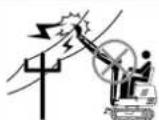
- Avoid contact between the lifting arm or tool attachment and overhead power lines and other obstacles. Watch out for hidden holes, obstacles, soft ground and overhangs to avoid hazards.
- Avoid contact with gas pipes, underground cables and water pipes when working with certain tool attachments.

DANGER
There may be underground supply lines in the work area.
Damage to these lines may result in electric shock or explosion.
Have the site checked for underground cables and only dig in marked areas.
Contact your local service provider or utility company to have the area marked!
- Keep the product clean. Heavy soiling, grease, dust and grass can ignite and cause accidents or injuries.
7.6.2 Safe operation
- Ensure that all drives are in neutral before starting the engine. Only start the engine from the operating platform.
- Never start up the product if protective devices are missing or not securely fitted. Ensure that all locking mechanisms are correctly fitted, properly set and fully functional.
- Never exceed the rated operating load. The product may become unstable and control may be lost.
- Never lift loads while driving. Always keep loads in a low position.
- Always secure tool attachments securely, even for short sections, and store accessories neatly.
7.6.2.1 Working on slopes

DANGER
Slopes increase the risk of losing control and tipping over, which can result in serious injury or fatal accidents. Take particular care when using the product on slopes and uneven terrain.
Avoid working on soft, frozen or unstable ground.
Observe the following information to reduce hazards:
• Take into account the inclination of the product in all axes.
• Maximum lateral inclination: 11°.
• Maximum inclination: 25°.
• Always drive uphill and downhill with the load lowered.
Adjust your driving accordingly to ensure the stability of the product.
Make sure to hold the heavier end of the product on the
hanging side.
The weight distribution varies depending on the tool attachment:
- When the bucket is empty, the rear end is heavier.
- When the bucket is full, the weight is at the front.
-
With tools such as the clamshell bucket or dozer blade, the centre of gravity is also at the front.
-
When driving on slopes, raised lifting arms reduce the stability of the product. Always keep loads in a low position.
- When the tool attachment is uncoupled on a slope, the weight shifts to the rear, making the rear heavier.
- Drive and move the product slowly and in a controlled manner on slopes. Avoid sudden changes in direction or speed.
- Avoid starting and stopping on slopes. If traction is lost, drive slowly and straight down the slope.
- Avoid turning on slopes. If necessary, turn slowly and keep the heavy end facing upwards.
- Do not park the product on slopes or embankments without lowering the tool attachment to the ground and wedging the rubber crawler chassis.
7.6.2.2 Safety instructions for the rubber crawler chassis
The rubber crawler chassis allows for versatile movement. To prevent premature wear of the rubber crawlers, the following points must be observed.
- Driving or turning on sharp-edged objects or steps puts a lot of strain on the rubber crawler and can cause breaks or notches in the tread.
- Make sure that there are no foreign objects in the rubber crawlers, as these are subject to heavy loads during operation and foreign objects can cause damage or tears.
- Avoid getting fuel or oil on the rubber crawlers. If this happens, clean the affected area immediately.
- Sharp turns on tracks with high friction coefficients, such as concrete or asphalt surfaces, can place heavy loads on the rubber crawlers.
- Avoid working near fall edges, trenches or embankments. The rubber crawler chassis can tip over suddenly if a rubber crawler runs over an edge or breaks through it.
- Avoid working on wet grass, as reduced traction can cause the product to slip.
- Always pay attention to the direction in which the product is moving and check the path for possible obstacles.
- Get in and out safely. Please use the handrails for this purpose. Do not jump on or off the product.
7.6.3 Work complete
- Place the product on a level, even surface.
- Lower the tool attachment completely to the ground.
- Switch off the auxiliary hydraulics.
- Switch off the engine and remove the ignition key from the ignition lock.
- Pull the safety key out.
7.6.4 Fire protection
The product has components that are exposed to high temperatures during operation, especially the engine and the exhaust system. In addition, damaged or poorly maintained electrical equipment can generate sparks or arcs, which pose a fire hazard.
Observe the following information to reduce hazards:
- When working under difficult conditions, deposits near hot engine exhaust parts should be blown out regularly. All combustible materials such as leaves, straw and wood chips must be removed from the trough, the underbody and the area around the engine to prevent fire hazards.
- Regularly check all fuel lines and hydraulic lines for wear and damage. If there are any signs of leaks, they must be replaced immediately.
- Check electrical lines and plug connectors regularly for damage. Have any damage rectified immediately and only by an electrician.
- Check the exhaust system daily for leaks, broken pipes and silencers, and for screws, nuts and clamps that are loose or missing. If leaks or damaged parts are found, repairs must be completed before use to ensure safe operation.
• Always keep a multi-purpose fire extinguisher near the product or directly on it. Operating personnel must be trained in the use of the fire extinguisher and know how to use it quickly and correctly in an emergency.
7.6.5 Hydraulic hazards
- If hydraulic oil gets into your eyes, rinse them immediately with plenty of clean water and seek medical attention immediately.
- Avoid contact of skin and clothing with hydraulic oil. If hydraulic oil comes into contact with the skin, wash the affected areas thoroughly with soap and water immediately to prevent skin irritation and dermatosis. If hydraulic oil gets on your clothing, change it immediately.
- If hydraulic oil vapours are inhaled, seek medical attention immediately. If a leak occurs in the hydraulic system, do not start the product or stop it immediately.
- Oil leaks must not be checked with bare hands. Wear personal protective equipment. Wearing personal protective equipment such as work clothes, safety goggles and gloves reduces the risk of injury.

WARNING
The hydraulic system is under pressure. Leaks can cause serious injury.

WARNING
Danger of burning!
The temperature of the hydraulic oil rises during operation, which can lead to a risk of burns.
7.6.6 Emergency measures
7.6.6.1 Electric shock
Special precautionary measures are required when working near power lines.
Observe the following information to reduce hazards:
- Current does not spread exclusively via the path of least resistance to earth.
- Current can flow back into products via pipes, hoses and cables.
- Low voltage can cause serious, sometimes fatal injuries. Numerous work-related electrical accidents result from contact with voltages below 440 volts.
Most electric shocks are not felt immediately, but there are typical signs that may indicate an electric shock:
- Power failure
- Smoke is produced
- Explosion
- Loud bangs
- Arc formation
If one or more of these symptoms occur, an electric shock is likely.
7.6.6.2 Damage to a power line
If you suspect that a power line is damaged, do not move.
Observe the following information to reduce hazards:
- Once you are on the product, stay there. Lift the tool attachment and move the product out of the immediate danger zone.
- When you are not on the product, do not touch the product or the tool attachment.
- Leave the work area with small steps and keep your feet close together. This reduces the risk of electric shock from so-called step voltage.
- Immediately inform any persons standing nearby about the electric shock and instruct them to leave the danger zone immediately.
- Contact the power supply company immediately to have the power supply disconnected.
- The work area may only be re-entered with the permission of the power supply company after it has been vacated. No unauthorised access.
7.6.6.3 Damage to a gas pipe
Observe the following information to reduce hazards:
- The engine must be switched off immediately if this can be done safely and without delay.
- Remove all sources of ignition immediately, provided this can be done safely and without delay.
- Immediately inform any bystanders that a gas pipe has been cut and instruct them to leave the danger zone immediately.
- Leave the danger zone immediately.
- Contact the utility company immediately.
- If the work area is located on a road, traffic in the affected area must be stopped immediately.
- The work area may only be re-entered with the permission of the emergency services and the utility company. No unauthorised access.
7.6.6.4 Damage to a fibre optic cable
Do not look into cut ends of fibre optic cables or unidentified cables, as this may cause damage to your eyesight.
Contact the utility company immediately.
7.6.6.5 Fire involving the product
Perform an emergency shutdown immediately.
Observe the following information to reduce hazards:
- Remove the battery safety key (if accessible).
- Attempt to extinguish the fire if it is small and a fire extinguisher is available.
- If the fire cannot be extinguished, leave the work area immediately and notify the emergency services.
7.6.7 Loading and unloading products safely

WARNING
Loading and unloading a product onto a trailer or lorry increases the risk of tipping.
This can result in serious or fatal injuries.
- Extreme caution is required when driving onto or off a ramp.
- Only drive or ride on a ramp with the tool attachment lowered.
- When loading the product via a ramp, only reverse gear may be used. The heavier side of the product must always be facing uphill to prevent tipping or slipping. When unloading the product, it is permissible to drive forwards.
-
Avoid sudden starts and stops, as this can lead to loss of control and cause the product to tip over.
-
Observe all regulations on public roads when transporting the product.
- When loading the product onto a lorry, use ramps that are sufficiently long and stable.
- Only use ramps that are suitable for the weight of the product.
- To prevent tipping, do not change the direction of travel.
- After loading, switch off the engine, remove the safety key and remove the spark plug connector from the spark plug.
- Use suitable wedges to secure the rubber crawler chassis against uncontrolled movements.
- Only use fasteners that are suitable for the weight of the product.
Observe local regulations for fastening.
7.6.8 Lifting the product safely
The product can also be lifted onto a trailer/lorry using suitable lifting devices.

WARNING
Lifting work must only be carried out by qualified personnel with appropriate training and instruction.

DANGER
Danger to life!
Persons must never be in the movement area of raised loads.
Lifted loads pose a risk of serious or fatal crushing injuries.

WARNING
Danger of crushing!
Pay attention to your fingers!
Observe the following information to reduce hazards:
- Remove the tool attachment.
- Only use the lifting points provided and marked by the manufacturer.
- Only use slinging gear and lifting devices that are suitable for the weight of the product.
- Only lift the product at the three lifting points.
- When lifting the product, ensure that the angle of inclination does not exceed 20 degrees.
7.7 Handling fuel
ATTENTION
Use only E5 or E10 unleaded petrol as fuel.

DANGER
Danger to life!
Fuel is toxic and highly flammable.
- Only store fuel in containers (canisters) designed for this purpose.
- The tank caps must always be properly screwed on and tightened.
- For safety reasons, the fuel tanks and other fuel caps must be replaced if damaged.
- Keep fuel away from sparks, open flames, permanent flames, heat sources and other sources of ignition. Do not smoke!
- Refuel outdoors only and do not smoke while refuelling.
- Before refuelling, switch off the combustion engine and let it cool down.
- Fuel must be filled before starting the engine. While the engine is running or immediately after switching off the product, do not open the fuel filler cap or add fuel.
- Open the fuel cap carefully and slowly. Wait for the pressure to equalise and only then remove the fuel filler cap completely.
- Use a suitable funnel or filler pipe for refuelling so that no fuel can spill onto the combustion engine and housing. Do not overfill the fuel tank!
- To leave room for the fuel to expand, never fill the fuel tank beyond the lower edge of the filling nozzle. Observe additional information in the combustion engine user manual.
- If fuel has overflowed, do not start the combustion engine until the area contaminated with fuel has been cleaned. Avoid starting the engine until the fuel vapours have evaporated (wipe dry).
• Always wipe up spilled fuel immediately. -
If fuel has got on clothing, it must be changed.
-
The tank cover must be properly screwed on and tightened after each refuelling operation. The product must not be put into operation without the original tank cover screwed on.
- For safety reasons, check fuel line, fuel tank, fuel cap and connections regularly for damage, ageing (brittleness), tight fit and leaks and replace if necessary.
- Only empty the tank outdoors.
- Never use beverage bottles or similar to dispose of or store operating materials, such as fuel. People, especially children, could be tempted to drink from it.
- Never store the product with fuel in the tank inside a building. Any fuel vapours produced can come into contact with naked flames or sparks and ignite.
- Do not place the product and fuel tank near heaters, radiant heaters, welding machines or other sources of heat.

DANGER
Risk of explosion!
If a defect is detected on the tank, the tank cover or on fuel-carrying parts (fuel lines) during operation, the combustion engine must be switched off immediately.
Then consult a specialist dealer.
7.8 Battery safety
- To avoid spark formation due to a short circuit, always disconnect the negative cable (-) from the battery first and reconnect it last.
- Never smoke during work on the battery. Always keep sparks, naked flames and other heat sources away from the battery.
- Special care must be taken when using jumper cables. Follow relevant instructions to avoid damage to the device (in particular, do not operate the starter for more than 10 seconds).
- Never open the battery and do not drop it.
• Always charge the battery in a closed room with good ventilation, dry and protected against the weather. - Do not short-circuit battery connections.
- Deformed or defective (leaking) batteries must not be used and must be replaced and disposed of in an environmentally friendly manner. Observe the country-specific regulations.
- If the batteries are defective, liquid may leak out. Avoid contact! In case of accidental contact, rinse with water. If the liquid gets into your eyes, seek additional medical attention. Leaking battery fluid can cause skin irritation, burns and chemical burns.
- Regularly visually inspect the connection cables on the battery for damage. Have damaged cables replaced by a specialist.
- Never bypass the fuses. Never use a fuse with a rating other than the prescribed rating (amperes).
7.8.1 Safety instructions for handling batteries
- Always make sure that the batteries are inserted with the correct polarity (+ and -), as indicated on the battery.
- Do not short-circuit batteries.
-
Do not charge non-rechargeable batteries.
-
Do not overcharge batteries!
- Do not mix old and new batteries or batteries of different types or manufacturers! Replace an entire set of batteries at the same time.
-
Immediately remove used batteries from the device and dispose of them properly! Do not throw batteries away with household waste. Defective or used batteries must be recycled in accordance with Directive 2006/66/EC. Return batteries and / or the device via the collection facilities provided. You can find out about disposal options from your local or municipal authority.
-
Do not allow batteries to heat up!
- Do not weld or solder directly on batteries!
- Do not disassemble the batteries!
- Do not allow batteries to deform!
- Do not throw batteries into fire!
- Keep batteries out of the reach of children.
- Do not allow children to replace batteries without supervision!
- Do not store batteries near fire, ovens or other sources of heat. Do not use batteries in direct sunlight or store them in vehicles in hot weather.
- Keep unused batteries in the original packaging and keep them away from metal objects. Do not mix unpacked batteries or toss them together! This can lead to a short circuit of the battery and thus damage, burns or even the risk of fire.
- Remove batteries from the product when it will not be used for an extended period of time, unless it is for emergencies!
- NEVER handle batteries that have leaked without appropriate protection. If the leaked fluid comes into contact with your skin, the skin in this area should be rinsed off under running water immediately. Always prevent the fluid from coming into contact with the eyes and mouth. In the event of contact, please seek immediate medical attention.
- Clean the battery contacts and corresponding contacts in the device prior to inserting the batteries.
Residual risks
The product has been built according to state-of-the-art and the recognised technical safety rules. However, individual residual risks can arise during operation.
• Furthermore, despite all precautions having been met, some non-obvious residual risks may still remain.
- Residual risks can be minimised if the "Safety Instructions" and the "Intended Use" together with the operating instructions as a whole are observed.
- Prevent the product being unintentionally started up.
- Keep your hands away from the working area when the product is in operation.
- Unintentional starting up of the product.
- Comply with the stipulated maintenance and safety instructions in the operating instructions.

WARNING
In case of extended working periods, the operating personnel may suffer circulatory disturbances in their hands (vibration white finger) due to vibrations.
Raynaud's syndrome is a vascular disease that causes the small blood vessels on the fingers and toes to cramp in spasms. The affected areas are no longer supplied with sufficient blood and therefore appear extremely pale. The frequent use of vibrating products can cause nerve damage in people whose circulation is impaired (e.g. smokers, diabetics).
If you notice unusual adverse effects, stop working immediately and seek medical advice.
8 Assembly
ATTENTION
Always carry out assembly and adjustments on the product with the engine switched off and disconnect the spark plug connector.
ATTENTION
Due to the heavy product weight, we recommend that at least two people assemble the product.
- Do not fit any products or accessories to the product that are not provided by or approved by the manufacturer.
Tool required:
- 2x open-ended spanner/socket spanner, size 13 mm*
- 2x 24 mm open-ended spanner/socket spanner*
- Allen key, 4mm*
* = may not be included in the scope of delivery!
Note:
Keep all dismantled fasteners for the subsequent assembly of components.
8.1 Fitting the operator's seat (3) (Fig. 4)
-
Insert the rail of the operator seat (3) into the receiver on the engine cover (4) from the front.
-
Connect the seat contact switch (3a).
-
Pull the adjustment lever (3b) outwards and hold it in this position.
-
Slide the operator's seat (3) to the desired position and release the adjustment lever (3b).
The operator's seat (3) will audibly lock into place.
8.2 Fitting the operating lever (13a/13d) (Fig. 5)
-
Remove the nuts (13a 2/13d 2) from the operating levers (13a/13d). Use a 24 mm open-ended spanner.
-
Insert the operating levers (13a/13d) from above through the rubber sleeves (13a 1/13d 1).
-
Loosen the locking screws (13a 3/13d 3) on the operating station (13). Use a 4 mm Allen key.
-
Screw the nuts (13a 2/13d 2) onto the operating levers (13a/13d).
-
Turn the operating levers (13a/13d) into the sockets and align the desired working position.
-
Tighten the locking screws (13a 3/13d 3) and secure them with the lock nuts (13a 4/13d 4).
Use a 4 mm Allen key and a 13 mm open-ended spanner.
- Tighten the nuts (13a 2/13d 2).
Use a 24 mm open-ended spanner.
- Slip the rubber sleeves (13a 1/13d 1) over the receivers.
8.3 Fitting the handle (13b 1/13c 1) (Fig. 5)
-
Screw one handle (13b 1/13c 1) onto each drive lever (13b/13c).
-
Secure the handles (13b 1/13c 1) with the nuts.
Use a 16 mm open-ended spanner.
8.4 Fitting the front bar (7) (Fig. 6)
-
Remove all M16 screws (7a), washers (7b) and spring washers (7c) from the upper carriage (5). Use a 24 mm open-ended spanner/socket spanner.
-
Align the front bracket (7) with the upper carriage (5). Ensure that the mounting holes match.
-
Fit the front bar (7) to the upper carriage (5) using the M16 screws (7a), washers (7b) and spring washers (7c). Use a 24 mm open-ended spanner/socket spanner.
8.5 Mounting the hoop guard (2) (Fig. 6, 7)
- Remove all M8/M16 screws (7d/2a), washers (7e/2b), spring washers (2c) and nuts (7f/2d) from the upper mounting holes on the front bracket (7). Use two open-ended spanners/socket spanners, 13 mm and 24 mm.
Set aside the four M8 screws (7d) and the corresponding washers (7e) and nuts (7f).
-
Align the hoop guard (2) with the front bar (7). Ensure that the mounting holes match.
-
Insert one M16 screw (2a) with washer (2b) and spring washer (2c) through each mounting hole and secure with one washer (2b) and one nut (2d).
-
Tighten all nuts (2d) and bolts M16 (2a). Use two 24 mm open-ended spanners/socket spanners.
8.6 Fitting the front screen (2i) (Fig. 7)
-
Remove all M8 bolts (2k), washers (2l) and nuts (2m) from the mounting holes on the hoop guard (2). Use two 13 mm open-ended spanners/socket spanners.
-
Remove the strips (2j).
-
Unpack the front screen (2i) and remove the protective film from both sides.
-
Place the front screen (2i) onto the hoop guard (2) from above. Ensure that the mounting holes align.
-
Place the strips (2j) on the front screen (2i). Ensure that they are correctly aligned.
-
Insert one M8 screw (2k) through each of the mounting holes in the strips (2j) and the front panel (2i) and secure them with one washer (2l) and one nut (2m) each.
Also use the four M8 screws (7d), washers (7e) and nuts (7f) set aside for the lower mounting holes.
- Carefully tighten all nuts (2m/7f) and M8 bolts (2k/7d). Use a 13 mm open-ended spanner/socket spanner.
8.7 Fitting the roof (2e) (Fig. 7, 8)
- Remove all M8 bolts (2f), washers (2g) and nuts (2h). Use two 13 mm open-ended spanners/socket spanners.
- Place the roof (2e) onto the hoop guard (2). Ensure that the recess in the roof (2e) is facing towards the windscreen (2i).
- Insert one M8 screw (2f) with washer (2g) through each of the mounting holes in the roof (2e) and secure with a washer (2g) and nut (2h).
- Tighten all nuts (2h) and M8 bolts (2f). Use two 13 mm open-ended spanners/socket spanners.
8.8 Fitting exterior mirrors (7g) (Fig. 9)
- Remove all M8 bolts (7h), washers (7i), spring washers (7j), and nuts (7k). Use two 13 mm open-ended spanners/socket spanners.
- Align the two exterior mirrors (7g) on the left and right sides of the front bar (7). Ensure that the mounting holes match. Ensure correct alignment.
- Insert one M8 screw (7h) with washer (7i) through each mounting hole and secure with one washer (7i), one spring washer (7j) and one nut (7k).
- Tighten all nuts (7k) and M8 bolts (7h). Use two 13 mm open-ended spanners/socket spanners.
- Adjust the exterior mirrors (7g) by tilting or turning them via the ball joint until the desired view is achieved.
9 Before commissioning

WARNING
For your own safety, please thoroughly read this manual and the general safety instructions before turning the product on. If you give the product to third parties, always include these operating instructions.

WARNING
Disconnect the battery and always take off the safety key before making any settings on the product.

WARNING
Do not close the battery circuit until the product is ready for use.
ATTENTION
Always make sure the product is fully assembled before commissioning!
ATTENTION
At initial start-up, engine oil and fuel must be filled.
ATTENTION
Lubricate all grease nipples before each start-up.
Note:
The product is delivered with hydraulic oil already filled.
Before starting up each time, check the product for the following:
- All screw connections are tight.
- Leaks in pipes, hoses and tanks.
- Visible defects.
- Sufficient oil, hydraulic oil and fuel levels.
ATTENTION
Product damage!
If the product is operated without oil or with too little oil or with used oil, this can lead to product damage.
- Fill with oil before starting the machine. The product is delivered without oil.
- Do not use used oil!
– Check the oil level before each operation.
ATTENTION
Environmental damage!
Spilled oil can pollute the environment permanently. The liquid is highly toxic and can quickly lead to water pollution.
– Fill/empty oil only on level, paved surfaces.
– Use a filling nozzle or funnel.
– Collect drained oil in a suitable container.
– Wipe up spilled oil carefully immediately and dispose of the cloth according to local regulations.
– Dispose of oil as per local regulations.

DANGER
Danger to life!
Fuel is toxic and highly flammable.

DANGER
Risk of fire and explosion!
Only fill the fuel when the engine is switched off and has cooled down. Do not smoke when refuelling the product.

DANGER
Risk of fire and explosion!
When filling, fuel may ignite and even explode. This can lead to severe burns or death.

WARNING
Health hazard!
Inhalation of fuel / lubricating oil vapours and exhaust gases can cause serious damage to health, unconsciousness and in extreme cases death.
- Do not breathe fuel / lubricating oil vapours and exhaust gases.
– Empty out fuel only outdoors.
Note:
Place the product on a level, even surface.
Tool required:
- Funnel (28)
- Rag/cloth*
* = may not be included in the scope of delivery!
9.1 Opening/closing the engine cover (4) (Fig. 10)
Opening:
- Unlock the engine cover (4) by turning the key (4a) anticlockwise.
- Lift the engine cover (4) and open it completely. Ensure that the engine cover lock (4b) engages.
Closing:
-
Unlock the engine cover lock (4b) by pulling it slightly towards you at the bottom end. Hold the engine cover (4) firmly with your other hand.
-
Close the engine cover (4), ensuring that it is locked in place.
Note:
It is not necessary to lock the engine cover with the key – it locks automatically after closing.
9.2 Filling up with engine oil (Fig. 11)
ATTENTION
The product is delivered without engine oil. Therefore, ensure that you add oil before starting it up. Use SAE 10W-30 oil.
- Switch the engine off and let it cool down.
- Avoid contact with skin and eyes.
- Make sure that no dirt or water gets into the engine oil tank.
Notes:
The engine oil affects the performance and service life of the product.
An oil monitor prevents the engine starting when there is insufficient oil.
Use an engine oil for 4-stroke engines.
Make sure that the oil meets the API SERVICE classification SJ or higher – you will find this information on the oil container label.
Check the oil level regularly before commissioning. An oil level that is too low can damage the motor.
-
Open the engine cover (4) as described in 9.1.
-
Unscrew the oil dipstick (17a).
- Fill the engine oil tank (17) using a funnel. Observe the max fill level (see Technical Data). Carefully fill the engine oil up to the lower edge of the filling nozzle.
- Wipe the oil dipstick (17a) with a clean, lint-free cloth.
- Reinsert the oil dipstick (17a) without screwing the oil dipstick (17a) back on.
- Pull the oil dipstick (17a) out and read the oil level in the horizontal position. The oil level must be between L (low) and H (high) on the oil dipstick (17a).
- If the oil level is too low, add the recommended amount of engine oil (see Technical Data).
- Then screw the oil dipstick (17a) in again.
- Close the engine cover (4).
9.3 Filling in fuel (Fig. 12)
- Switch off the engine and let it cool down.
- Keep heat, flames and sparks away.
- Only fill up with fuel outdoors.
- Wear protective gloves.
- Avoid contact with skin and eyes.
- Avoid using old or contaminated fuel and do not use fuel-oil mixtures.
- Make sure that no dirt or water gets into the fuel tank.
Note:
Check the fuel level every time before commissioning.
ATTENTION
The product is delivered without fuel. It is therefore essential to fill with fuel before commissioning. Use Super E5/E10 petrol for this.
- Open the engine cover (4) as described in 9.1.
- Clean the tank cover (18a) and the area around the filling nozzle to prevent dirt or foreign objects from entering the fuel tank (18).
- Carefully open the fuel filler cap (18a) to release any excess pressure. The fuel filler cap (18a) is connected to an anti-loss device in the fuel tank (18) and cannot fall off.
- Remove the fuel filter insert (18b).
- Check the fuel level by visual inspection.
- Reinsert the fuel filter insert (18b).
- Fill the fuel tank (18) with fuel using a funnel (27). Observe the maximum filling quantity of 6 litres. Carefully fill the fuel up to the lower edge of the filler neck.
- Seal the tank cover (18a) again by placing it straight on and turning it clockwise. Make sure that the tank cover (18a) is completely sealed to prevent leaks and evaporation.
- Clean the tank cover (18a) and the surroundings.
- Check the fuel tank (18) and fuel lines for leaks.
- Close the engine cover (4).
9.4 Checking the hydraulic oil level (Fig. 13)
ATTENTION
In order to read the hydraulic oil level correctly, all hydraulic cylinders must be in their rear end position. To do this, retract all hydraulic cylinders completely.
Check the oil level at an ambient temperature of approximately 10 to 30°C.
- Check the oil level at the sight glass (19b); the level must be between the markings.
9.5 Checking the spark plug (20a) (Fig. 14)
- Open the engine cover (4) as described in 9.1.
- Make sure that the spark plug connector (20) is attached to the spark plug (20a).
9.6 Connecting/disconnecting a battery (21) (Fig. 15)
The safety key (21a) can be used to close or interrupt the battery circuit (21).

WARNING
Disconnect the battery and always take off the safety key before making any settings on the product.

WARNING
The battery may only be removed by authorised specialists.
To connect the battery:
- Open the engine cover (4) as described in 9.1.
- Insert the safety key (21a) into the lock (21b).
- Turn the safety key (21a) clockwise until it audibly clicks into place.
The product is now ready for use. - Close the engine cover (4).
To disconnect the battery:
- Open the engine cover (4) as described in 9.1.
- Turn the safety key (21a) anti-clockwise; the battery (21) is now disconnected.
- Take off the safety key (21a).
10 Operation

DANGER
Danger of injury!
Always wear personal protective equipment (PPE)!
– Wear a safety helmet.
– Wear hearing protection.
- Wear close-fitting protective clothing with a cut protection insert.
– Wear non-slip safety shoes.
- Wear protective gloves.

WARNING
Risk of serious injury and personal injury!
Before starting the product, make sure that there are no other persons in the vicinity of the product. Check the direction of the rubber crawlers before working with the product. (Idle roller and dozer blade pointing to the front of the product). Avoid driving across a slope or working sideways on it.

WARNING
Danger from falling loads when the engine is stopped!
If the engine stops unexpectedly, immediately push the right operating lever forward to lower the tool attachment in a controlled manner. Otherwise, malfunctions and serious accidents may occur due to loads falling uncontrollably.

CAUTION
When the product is not in use or is left unattended, the tool attachment must be placed on the floor and the operating station must be locked in place using the locking lever.
ATTENTION
Due to the heavy weight of the product, we recommend that at least two people are involved in installing/removing the tool attachment.
Familiarise yourself with the operating manual before attempting to operate the product.
10.1 Adjusting the operator's seat (3)
(Fig. 16)

CAUTION
Before adjusting the operator seat, ensure that no hands are on the engine cover or behind the operator seat.
- Sit on the operator's seat (3).
- Pull the adjustment lever (3b) outwards and hold it in this position.
-
Adjust the operator's seat (3) to a position where you can easily reach all the controls.
-
Release the adjustment lever (3b). The operator's seat (3) will audibly lock into place.
10.2 Fastening the seat belt (3c) (Fig. 16)
- Sit on the operator's seat (3).
- Lock the seat belt (3c) in the buckle (3d).
- Adjust the safety belt (3c) so that it fits snugly against your body but does not cause discomfort.
10.3 Explanation of the control panel (14) (Fig 1, 17)
Insert the ignition key (22a) into the ignition lock (22) and turn it to the "ON" position.
Operating hours counter (14a):
The operating hours counter (14a) displays the number of hours the product has been in operation to date.
If the ignition key (22a) is in the "ON" position, the operating hours counter (14a) continues to count even when the engine is switched off.
Operating display (14b):
The LED of the operating display (14b) lights up green continuously as soon as the ignition key (22a) is turned to the "ON" position and the battery circuit (21) is closed as described under 9.6.
Button (horn) (14c):
Pressing the button (14c) causes the horn to sound.
Button (LED headlight) (14d):
Pressing the button (14d) switches the LED headlight (1a) on or off.
10.4 Explanation of the operating station (13) (Fig. 1)
Left operating lever (13a):
- Extend or retract arm (12).
- Turn the excavator to the left and right.
Left drive lever (13b):
- Forward/reverse (in combination with right operating lever).
- Drive left/right.
Right operating lever (13c):
- Forward/reverse (in combination with left operating lever).
- Drive left/right.
Right operating lever (13d):
- Raise or lower the boom (1).
• Dig or empty using the bucket (9).
Locking lever (13e):
- Lock the operating station (13) in place.
Control lever (13f) in combination with selector lever (13j):
- Extend/retract rubber track undercarriage (6).
- Raise or lower the dozer blade (8).
Left control pedal (13i):
• Control pedal for additional hydraulic circuit.
• Control the tool attachment.
Selector lever (13j):
- Switch between rubber track undercarriage (6) or dozer blade (8).
Locking lever (13k):
- Lock the upper carriage (5).
Right control pedal (13l):
- Turn the upper carriage (5).
For further information on how to use the product, please refer to the additional descriptions.
10.4.1 Locking the operating station in place (13) (Fig. 1, 18)
The operating station (13) can be locked in place using the locking lever (13e).
Locking the operating station in place:
- Push the locking lever (13e) to the front position.
- The operating station (13) is locked.
Unlocking the operating station:
- Pull the locking lever (13e) to the rear position.
- The operating station (13) is released.
10.4.2 Raising/lowering the dozer blade (8) (Fig. 19)
- Set the selector lever (13j) to the bottom position.
- Push the control lever (13f) forward to lower the dozer blade (8) or pull it back to raise it.
Note:
Lower the dozer blade completely for greater stability during all stationary work and when parking the product.
10.4.2.1 Levelling blade extension (8b) (Fig. 19)
The dozer blade (8) can be extended from 720 mm to 900 mm in width if required.
- Pull the two inner locking pins (8a) upwards to remove them.
- Swivel the two dozer blade extensions (8b) outwards until they reach the stop.
- Secure the dozer blade extensions (8b) with the locking pins (8a).
10.4.3 Drive lever (13b/13c)
10.4.3.1 Operating the travel drive (Fig. 20)
ATTENTION
When moving the product, lift the tool attachment slightly, but keep it low.
ATTENTION
Raise the dozer blade when driving the product.
WARNING
When the upper carriage is rotated 180^ , the direction of travel of the drive levers is reversed. When the operator moves the drive lever forward, the excavator moves backwards from the operator's perspective.

CAUTION
Do not change direction on steep slopes – the excavator could tip over. If a change of direction is necessary, ensure that there are no persons in the working area.
Note:
The product may run out on a slope because the fuel in the tank flows forward and the fuel supply is interrupted.
The direction of travel of the individual rubber tracks (6a) is controlled by the drive levers (13b/13c).
- Unlock the operating station (13) using the locking lever (13e).
Driving forward:
- Push both drive levers (13b/13c) forward simultaneously.
Driving in reverse:
- Pull both drive levers (13b/13c) back simultaneously.
Changing direction:
- Push the right drive lever (13c) forwards.
- The right rubber crawler moves forward, causing the product to turn to the left.
- Pull the right drive lever (13c) backwards.
- The right rubber crawler moves backwards, causing the product to turn to the right.
- Push the left drive lever (13b) forwards.
- The left rubber crawler moves forward, causing the product to turn to the right.
- Pull the left drive lever (13b) backwards.
- The left rubber crawler moves backwards, causing the product to turn to the left.
Driving uphill and downhill:
-
Keep the lower edge of the attachment tool about 20–40 cm above the ground while driving. Even though the excavator is stable on its tracks, it is safer to let the bucket glide slightly above the ground when driving downhill.
-
Always drive at low speed when going uphill and downhill.
10.4.3.1.1 Driving curves and radii:

WARNING
Warning about spot turns (turning on the spot)!
Spot turns at high speeds can lead to rocking, instability and accidents.
Only perform spot turns at low speed.
- Curves and radii can be driven by pressing and pulling the driving levers (13b/13c) with varying degrees of force.
- The greater the difference in the driving lever movement between the left and right rubber crawlers (6a), the tighter the turning radius.
Note:
Only operate one driving lever to change the direction of travel when the product is stationary or moving.
To turn the product on the spot, push one driving lever forward and the other backward at the same time.
10.4.4 Operating lever (13a/13d) (Fig. 21)
10.4.4.1 Operating the boom (1) (Fig. 22, 23)

WARNING
Always keep your feet at the edge of the footrest to avoid getting caught between the swivel frame and the boom or cylinder.
ATTENTION
Improper lowering can cause damage and lead to injury.
- When lowering the boom, ensure that it does not collide with the dozer blade.
- Ensure that the excavator teeth do not touch the dozer blade.
Note:
At low hydraulic oil temperatures (e.g. immediately after starting the engine), the boom's damping function may be delayed (approx. 3–5 seconds). This is due to the increased viscosity of the cold hydraulic oil. This is not a malfunction.
- Move the right operating lever (13d) forwards or backwards to raise or lower the boom (1).
- Step on the front or rear part of the right control pedal (13l) to swing the boom (1) to the right and left via the swivel mechanism (1b) independently of the upper carriage (5).
- The boom (1) can be swivelled a maximum of 45^ to the left and 85^ to the right.
- Fold the right-hand control pedal (13I) to the upper position when not in use to prevent accidental operation.
10.4.4.2 Operating the arm (12) (Fig. 24)
ATTENTION
When raising the arm, the movement may be briefly interrupted when the arm is in a vertical position.
In this position, the maximum load on the arm and the tool attachment is reached, and the hydraulic pressure in the cylinder is temporarily insufficient to continue the movement smoothly.
This behaviour is a normal characteristic of the hydraulic system and does not indicate a malfunction.
- Move the left operating lever (13a) backwards or forwards to extend or retract the arm (12).
10.4.4.3 Operating the tool attachment (Fig. 25)
-
Move the right operating lever (13d) to the left or right to tilt the tool attachment inwards or outwards.
-
Step on the front or rear part of the left control pedal (13i) to operate the tool attachment connected to the hydraulic connections (12b/12c).
– Fold the left control pedal (13i) to the upper position when not in use to prevent accidental operation.
10.4.5 Upper carriage (5)
10.4.5.1 Locking the upper carriage (5) in place (Fig. 1, 18)
The upper carriage (5) can be locked in place using the locking lever (13k).

CAUTION
Before locking the latch, ensure that the upper carriage and the rubber track are aligned parallel to each other.
Locking the upper carriage in place:
- Push the locking lever (13k) to the front position.
- The upper carriage (5) is locked in place.
Unlocking the upper carriage:
- Pull the locking lever (13k) to the rear position. – The upper carriage (5) is released.
10.4.5.2 Controlling the upper carriage (5) (Fig. 27)
ATTENTION
Before each turning movement, ensure that the locking lever is not locked.
ATTENTION
Do not move the left operating lever jerkily from right to left or vice versa. Abrupt changes in direction cause sudden loads on the slewing gearbox and slewing motor due to inertia. This can cause damage to components and significantly shorten the service life of the machine.
- Move the left operating lever (13a) to the left or right to turn the upper carriage (5) to the left or right.
10.4.6 Adjusting the track width (Fig. 28, 29)

DANGER
Slopes increase the risk of losing control and tipping over, which can result in serious injury or fatal accidents. Take particular care when using the product on slopes and uneven terrain. Avoid working on soft, frozen or unstable ground.
Place the product on a level, even surface.
- Swing the upper carriage (5) as described under 10.4.5.2 so that the boom (1) is on the opposite side of the dozer blade (8).
- Set the selector lever (13j) to the bottom position.
- Lower the bucket (9) and dozer blade (8) carefully and evenly until the rubber tracks (6a) are no longer in contact with the ground.
- Set the selector lever (13j) to the upper position.
- Push the control lever (13f) forward to increase the track width or pull it back to decrease it.
- Lift the bucket (9) and dozer blade (8) carefully and evenly until the rubber tracks (6a) are back in contact with the ground.
10.5 Switching the product on/off

DANGER
Danger of poisoning!
Only use the product outdoors and never in closed or poorly ventilated rooms.
NOTE
If the engine is being started for the first time, several tries are required to start until the fuel has been delivered from the tank to the engine.

WARNING
Risk of fire and explosion!
Never use pre-glow or starter fluid! This can lead to severe burns or death.

WARNING
Risk of serious injury if the start protection function is bypassed!
The product is equipped with a seat contact switch. The engine may only be started when the operator is correctly seated in the driver's seat. The pull cord starter is intended exclusively for service and repair work by authorised specialist personnel.

CAUTION
Before each start-up, check that the locks on the operating station and upper carriage are locked.
See also
Connecting/disconnecting a battery (21) (Fig. 15) [▶ 58]
Checking the hydraulic oil level (Fig. 13) [▶ 58]
Filling in fuel (Fig. 12) [▶ 57]
Filling up with engine oil (Fig. 11) [▶ 57]
Checking the spark plug (20a) (Fig. 14) [▶ 58]
Adjusting the operator's seat (3) (Fig. 16) [▶ 58]
Fastening the seat belt (3c) (Fig. 16) [▶ 59]
10.5.1 Starting the engine (Fig. 1, 30, 31)
Before starting:
- Read the entire operating manual before using the product.
- Familiarise yourself with the product by means of the operating manual before using for the first time.
- Place the product on a level, even surface.
- Check the engine oil, fuel and hydraulic fluid levels before each start-up (see 9.2, 9.3 and 9.4).
- Make sure that the spark plug connector (20) is attached to the spark plug (20a).(see 9.5).
- Open the fuel tap (18c).
- Remove the battery (21) as described in 9.6.
-
Close the engine cover (4).
-
Sit on the operator seat (3) and fasten the safety belt (3c) as described in 10.1 und 10.2.
- During operation, the operator must be seated on the operator's seat (3) and have the safety belt (3c) fastened.
- Release the locking levers (13e/13k).
- Insert the ignition key (22a) into the ignition lock (22) and set it to the "I" position.
- Honk the horn before starting the product to alert bystanders.
After starting:
- Allow the engine to warm up briefly.
- Allow the hydraulic fluid to warm up sufficiently before starting operation at cold outside temperatures, as cold fluid can significantly delay the response time of the product.
- Use the throttle to set the required speed (13g).
- MIN position, "tortoise"
- MAX position, "hare"
10.5.1.1 Starting a cold engine
Note:
With high outside temperatures, it may be necessary to start the engine without the choke even when the engine is cold!
- Position the throttle (13g) in the middle.
- Keep the choke (13h) in the "CHOKE" position.
- Turn the ignition key (22a) to the "START" position and hold it in this position until the product starts up.
- Allow the engine to warm up briefly.
- Slowly turn the choke (13h) to the "RUN" position.
- Use the throttle to set the required speed (13g).
- If the engine does not start even after several attempts, read the 17 chapter.
10.5.1.2 Starting a warm engine
- Position the throttle (13g) in the middle.
- Turn the ignition key (22a) to the "START" position and hold it in this position until the product starts up.
- Use the throttle to set the required speed (13g).
- If the engine does not start even after several attempts, start the product as described in section 10.5.1.1.
10.5.2 Switching off the engine (Fig. 16, 32)
Note:
• After switching off the product, wait two minutes before interrupting the battery circuit.
- Place the product on a level, even surface.
- Lower the tool attachment* completely to the ground.
- Stop all product movements.
- Turn the ignition key (22a) to the "OFF" position.
- Lock the operating station (13) using the locking lever (13e).
- Remove the safety belt (3c) and leave the operator's seat (3).
- Remove the ignition key (22a) when leaving the product.
- Close the fuel tap (18c).
-
Allow the engine to cool down before parking the product in enclosed spaces.
-
During maintenance or prolonged storage, take off the spark plug connector (20) from the spark plug (20a) and interrupt the battery circuit (21) as described in 9.6.
10.6 Fitting/removing the quick coupling (10) (Fig. 33)
The quick coupling (10) is pre-assembled when delivered.
Do not use a quick coupling (10) with the "Thumb and claw"* tool attachment.
* = may not be included in the scope of delivery!
Assembling:
- Remove the lock nuts (10a), nuts (10b) and bolts (10c) from the mounting holes on the bolt (10d). Use two 13 mm open-ended spanners/socket spanners.
- Remove the bolts (10d) from the quick coupling (10).
- Align the quick coupling (10) with the tool receiver (11). Ensure that the mounting holes match.
- Guide the bolts (10d) into the mounting holes.
- Secure the bolts (10d) with the screws (10c) and nuts (10b). Use two 13 mm open-ended spanners/socket spanners.
- Lock the nuts (10c) with the lock nuts (10a). Use two 13 mm open-end wrenches/socket spanners.
Removing:
- Remove the tool attachment from the quick coupling (10) as described in 10.7.2.
- Remove the lock nuts (10a), nuts (10b) and bolts (10c) from the mounting holes on the bolt (10d). Use two 13 mm open-ended spanners/socket spanners.
- Hold the quick coupling (10) firmly and remove the bolts (10d) from the mounting holes on the tool receiver (11)
- Set the quick coupling (10) aside.
- Guide the bolts (10d) into the mounting holes of the quick coupling (10).
- Fit the screws (10c), nuts (10b) and lock nuts (10a) onto the bolt (10d). Use two 13 mm open-ended spanners/socket spanners.
10.7 Attaching/removing the tool attachment
ATTENTION
The use of other insertion tools and other accessories can entail a danger of injury.

WARNING
Do not use damaged or deformed tool attachments.

WARNING
Always make sure that the tool attachment is fitted correctly!
ATTENTION
When moving the product, lift the tool attachment slightly, but keep it low.
10.7.1 Without quick coupling (10) (Fig. 34)
- Remove the quick coupling (10) as described in 10.6.
Assembling:
- Remove the split pins (10e) from the mounting holes on the bolt (10d).
- Remove the bolt (10d) from the tool attachment.
- Align the tool attachment with the tool receiver (11). Ensure that the mounting holes are aligned.
- Insert the bolts (10d) into the mounting holes.
- Secure the bolts (10d) with the split pins (10e).
Removing:
- Remove the split pins (10e) from the mounting holes on the bolt (10d).
- Hold the tool attachment firmly and remove the bolts (10d) from the mounting holes on the tool receiver (11).
- Put the tool attachment aside.
- Guide the bolts (10d) into the mounting holes of the tool attachment.
- Fit the split pins (10e).
10.7.2 With quick coupling (10) (Fig. 35)
Assembling:
- Place the tool attachment on a flat, level surface. Ensure that there is sufficient space behind the tool attachment.
- Remove the split pin (10e) on the locking screw (10f) of the quick coupling (10).
- Turn the locking screw (10f) anti-clockwise to open the lock. Use a 24 mm open-ended spanner/socket spanner.
- Start the engine as described in 10.5, to move the product, as described in 10.4.3.1, to the tool attachment.
- Align the quick coupling (10) with the tool attachment.
- Position the arm (12) and the cylinder (12e) so that you grip the bolt of the tool attachment with the receptacle (10g) of the quick coupling (10).
- Tilt the tool attachment until the lower bolt of the tool attachment engages in the lock.
- Turn the locking screw (10f) clockwise to close the lock. Use a 24 mm open-ended spanner/socket spanner.
- Secure the locking screw (10f) with the split pin (10e).
- Lower the arm (12) to place the tool attachment on the ground.
- Check that the tool attachment is correctly inserted and secured.
- Remove the tool attachment in reverse order.
Note:
Scan the QR code below to access the operating manuals for the various tool attachments.
10.7.3 Connecting hydraulic lines (Fig. 26)
Connect the hydraulic lines if the tool attachment requires hydraulic power for operation.
WARNING
Pressurised liquids or air can penetrate the skin and cause serious injury or even death.
To avoid injury:
- Keep a sufficient distance.
– Oil leaks must not be checked with bare hands. Wear personal protective equipment. - Before disconnecting the hydraulic lines, switch off the engine and take off the safety key.
Operate all operating levers to completely relieve the system pressure.
– Lower raised components, secure them or support them with suitable aids.
– Release the residual pressure in the hydraulic tank. - Before starting up, check that all connections are secure and that all lines are undamaged.
– In case of injury, seek medical attention immediately.
ATTENTION
Hot surfaces! Risk of burns on contact. Only handle when cool or wear suitable protective gloves.
- Relieve any residual pressure as described in 12.2.5.2.
- Clean all quick couplings (12b) and plug nipples (12c) of dirt, dust and deposits to prevent contamination of the hydraulic system.
- Connect the quick coupling of the tool attachment to the plug nipple (12c) of the hydraulic lines (12a).
- Connect the plug nipple of the tool attachment to the quick coupling (12b) of the hydraulic lines (12a).
- Before starting up, check that the hydraulic connections are secure.
11 Working instructions
- Avoid sudden movements when manoeuvring or turning.
- When manoeuvring, keep the tool attachment as close to the ground as possible to prevent it from rocking.
- When working on slopes, keep the boom on the uphill side and drive parallel to the slope.
- Observe the lifting capacity of the product and do not exceed it.
- It is forbidden to remain in the danger zone!
- If the rubber tracks become clogged with sand or stones when working on soft ground, lift the rubber track using the boom, arm and bucket and turn it to remove the sand and stones.
- If the product gets stuck on muddy ground, lift it onto firm ground as described under 5.2.
- Do not drive on muddy roads when the upper carriage is perpendicular to the rubber track undercarriage. Otherwise the crawlers can get stuck in the mud.
- Do not attempt to break concrete or rock by swinging the tool sideways.
Also avoid:
- Move the mound of earth by swinging the tool attachment sideways.
– Lifting by utilising the product's gravity.
– Consolidating gravel or soil by dropping the tool.
– Excavation using the product's driving energy.
Adhering soil:
- Remove any soil adhering to the bucket when emptying it by lifting it to the maximum stroke of the cylinder. If this is not sufficient, extend the arm (12) fully and move the tool attachment back and forth alternately.
Protection of the dozer blade:
- Avoid the boom cylinder (1) hitting the dozer blade (8). For deep excavation work, swing the upper carriage so that the dozer blade (8) is at the rear of the excavator. This protects the dozer blade (8) and the cylinder from damage.
Inserting the tool attachment:
- Ensure that the tool attachment does not collide with the dozer blade (8) when retracting it for driving or transport.
Avoiding collisions:
- Ensure that the dozer blade (8) does not come into contact with obstacles such as rocks when moving the product. Such collisions can significantly shorten the service life of the dozer blade (8) and the cylinder.
Stabilising the product:
- Lower the dozer blade (8) completely to the ground when supporting the product.
Protection against water and mud:
- If water or mud reaches above the top edge of the rubber tracks (6a), the swivel bearings, swivel motor gearbox and gear rim may come into contact with foreign objects.
Cleaning:
- Wash the excavator thoroughly with a high-pressure cleaner after each use.
Lubrication:
- Observe the lubrication procedures described in the operating manual.
Protective cover:
- Reattach the protective cover if it has been removed beforehand.
11.1 Running in the product
The service life of your new excavator depends largely on proper operation and regular maintenance. Before your excavator left the factory, it was carefully checked and tested. Nevertheless, all moving components must be run in during the first 50 hours of operation.
During this running-in phase, the following points should be observed:
- Do not operate at full engine speed or maximum load.
- Allow the engine to warm up sufficiently before starting work.
- Only increase the engine speed to the extent necessary to enable operation.
A correct running-in phase is crucial to ensure the full performance and maximum service life of your excavator.
11.2 LED headlights (1a) (Fig. 1)
The illuminance in the product's working environment must be at least 500 lux.
CAUTION
Do not look directly into the LED spotlight or light source.
CAUTION
Visibility is limited in the dark, so work lighting alone is not enough. Provide additional lighting and observe all applicable safety regulations and special rules for night work to prevent accidents.
11.3 Reducing rubber track wear (Fig. 40)
The rubber tracks (6a) are particularly suitable for use on soft, unpaved ground with few stones or debris.
To minimise wear on the rubber tracks (6a), always drive at reduced speed and with a large turning circle.
To avoid the following stresses:
- Spinning of the rubber crawlers under heavy loads.
- Turning on sharp surfaces (e.g. stones, broken concrete, rubble).
- Tight turning manoeuvres on solid surfaces such as asphalt or concrete.
- Driving over high kerbs, edges or protrusions.
- Driving up to or grinding the rubber crawlers on walls or kerbs.
- Working on aggressive surfaces (e.g. salt, fertiliser or other aggressive substances)
12 Cleaning and maintenance
WARNING
Have maintenance and repair tasks that are not described in this operating manual, carried out by a specialist workshop. Use only original spare parts.
WARNING
Improper maintenance or cleaning work can cause injuries!
WARNING
The product may start unexpectedly and cause injuries and burns during cleaning, repair and maintenance work.
- Switch the product off.
– Turn the ignition key to the "OFF" position. - Remove the ignition key.
- Remove the safety key.
- Remove the spark plug connector from the spark plug.
- Allow the product to cool.

WARNING
Carry out a visual and functional check/maintenance regularly/daily and before commissioning to ensure that the product is in good operating condition.
- Incorrect maintenance, use of non-conforming replacement parts, or removal or modification of safety equipment may lead to severe property or personal damages.
- If this work cannot be carried out by the user themselves, see a specialist dealer.
12.1 Cleaning
- Keep protective devices, air vents and the motor housing as free of dust and dirt as possible. Rub the product clean with a clean cloth or blow it off with compressed air at low pressure. We recommend that you clean the product directly after every use.
- To reduce the risk of fire, regularly clean the cooling fins of the engine with compressed air. Clear the silencer area of dust, leaves or other foreign objects.
- Ventilation openings must always be free.
- Clean the product at regular intervals using a damp cloth* and a little soft soap. Do not use any cleaning products or solvents; they could attack the plastic parts of the product. Make sure that no water can penetrate the product interior.
- Cleaning and user maintenance must not be carried out by children.
- Only carry out cleaning and maintenance work to the extent specified in this operating manual. Further work must be carried out by qualified specialists.
12.1.1 Cleaning the fuel filter insert (18b) (Fig. 12)
Note:
The petrol filter is a fuel filter insert cup, which is located directly under the fuel cap and filters all the fuel that is filled in.
-
Open the engine cover (4) as described in 9.1.
-
Carefully open the fuel filler cap (18a) to release any excess pressure.
The fuel filler cap (18a) is connected to an anti-loss device in the fuel tank (18) and cannot fall off. -
Remove the fuel filter insert (18b). Clean it in a non-flammable solvent or a solvent with a high flash point.
-
Reinsert the fuel filter insert (18b).
-
Seal the tank cover (18a) again by placing it straight on and turning it clockwise. Make sure that the tank cover (18a) is completely sealed to prevent leaks and evaporation.
-
Close the engine cover (4).
12.2 Maintenance
Observe the safety instructions as described under 7.
Place the product on a level, even surface.
Any work not described in this operating manual must be performed by an authorised specialist workshop only.
Maintain the product carefully. Check for misalignment or binding of moving parts, breakage of parts and any other condition that may affect the product's operation. Have damaged parts repaired before using the product.
Regular, careful servicing is required to guarantee the safety level and performance of the product.
Remove all tools used for maintenance before operating or storing the product.
All protective and safety equipment must be reassembled immediately after repair and maintenance work is completed.
Tool required:
• 21 mm assembly spanner (29)
• Copper wire brush*
- Feeler gauge*
- Rag/cloth*
- Collection bucket*
- Funnel (28)
- Oil extraction pump*
- Grease gun (30)
- 30 mm open-ended spanner/socket spanner*
* = may not be included in the scope of delivery!
12.2.1 Maintenance plan
Always comply with the following maintenance intervals in order to ensure problem-free operation.
Attention! At initial start-up, engine oil and fuel must be filled.
| Operating hours Before | commissioning | 10 hours 50 | hours 200 hours | 1000 hours | 2 years 6 years | |||
| General visual inspection | x | |||||||
| Check the fuel level | x | |||||||
| Check the fuel line | x | |||||||
| Change fuel lines | X* | |||||||
| Checking the engine oil level | x | |||||||
| Change the engine oil | x | |||||||
| Check hydraulic lines | x | |||||||
| Change hydraulic lines | X* | |||||||
| Check hydraulic oil level | x | |||||||
| Switch hydraulic oil x | ||||||||
| Switch hydraulic suction filter insert | x | |||||||
| Check lubrication points, lubricate if necessary | x | |||||||
| Clean product x | ||||||||
| Check electrical lines x | ||||||||
| Check battery status x | ||||||||
| Check the air filter x | ||||||||
| Clean the air filter x | ||||||||
| Replace air filter x | ||||||||
| Check and clean the spark plug if necessary | x | |||||||
| Replace the spark plug x | ||||||||
| Rubber track settings Initial | check | x | ||||||
| Attention: Only have points “X*” carried out by an authorised specialist company. | ||||||||
12.2.2 Maintaining the air filter (24c) (Fig. 36)
ATTENTION
Risk of damage!
Operating the engine without a filter element or with a damaged filter element can cause engine damage.
- Never run the engine without the air filter element or with a damaged filter element. This would allow dirt into the engine, which would result in severe damage to the engine.
ATTENTION
Fouled air filters diminish the engine output due to reduced air supply to the carburettor. Regular inspection is therefore essential.
ATTENTION
If the product is used in a particularly dusty environment, the air filter must be checked and cleaned more frequently than specified in the regular maintenance intervals.
ATTENTION
Do not clean the product with the engine running. Water could penetrate the air filter and damage the engine. Keep the air filter dry.
ATTENTION
Never clean the air filter with petrol or combustible solvents.
Clean the air filter (24c) every 50 operating hours; it is recommended to
replace the air filter (24c) after 200 operating hours.
- Open the engine cover (4) as described in 9.1.
- Remove the wing nut (24a) and remove the air filter cover (24).
- Check the air filter cover (24) for holes or cracks. Replace any damaged insert.
- Unscrew the inner wing nut (24a) and remove the air filter (24c).
- Wipe off dirt on the inside of the filter housing with a clean moist cloth. Make sure that no direct enters the opening. Set the air filter cover (24) on the filter housing for the duration of the filter cleaning process.
- Take the. air filter (24c), check it for damage and replace it if necessary.
- Knock the air filter (24c) against a hard surface to remove the dirt. Replace a faulty air filter (24c) with a new one.
- Replace the air filter (24c) and tighten the inner wing nut (24a).
- Put on the air filter cover (24) and secure it with the wing nut (24a).
- Close the engine cover (4).
12.2.3 Maintaining the spark plug (20a) (Fig. 37)
ATTENTION
Only replace the spark plug when the engine is cold!
ATTENTION
A loose spark plug can overheat and cause damage to the engine. Tightening the spark plug too much can damage the thread in the cylinder head.
Electrode gap = 0.6 mm (distance between the electrodes, between which the ignition spark is generated). Check the spark plug for dirt for the first time after 10 operating hours and clean it with a copper wire brush if necessary.
Then service the spark plug every 50 operating hours.
ATTENTION
Pull the spark plug connector off carefully. Do not pull on the cable, but directly on the plug.
Replace the spark plug (20a) after 500 operating hours or after one year at the latest.
- Open the engine cover (4) as described in 9.1.
- Remove the spark plug connector (20) and disassemble the spark plug (20a).
Use a 21 mm (29) assembly spanner. - Remove any dirt from the base of the spark plug (20a).
- Clean the spark plug (20a) with a copper wire brush or replace it with a new one.
- Check the spark plug gap. Use a feeler gauge to adjust the electrode gap to 0.6-0.7 mm.
- Replace the spark plug (20a) and take care not to tighten it excessively.
Use a 21 mm assembly spanner (29). - Then place the spark plug connector (20) on the spark plug (20a).
- Close the engine cover (4).
12.2.4 Maintaining fuel lines and hoses
- Before each start-up, check that all fuel lines, hoses and hose clamps are securely fastened and undamaged.
- Replace fuel lines, hoses and hose clamps when worn or damaged, or every two years.
12.2.5 Maintaining the hydraulics (Fig. 13)
ATTENTION
Product damage!
If the product is operated without oil or with too little oil or with used oil, this can lead to product damage.
- Do not use used oil!
– Check the oil level before each start-up.
ATTENTION
Environmental damage!
Spilled oil can pollute the environment permanently. The liquid is highly toxic and can quickly lead to water pollution.
– Fill/empty oil only on level, paved surfaces.
– Use a filling nozzle or funnel.
– Collect drained oil in a suitable container.
– Wipe up spilled oil carefully immediately and dispose of the cloth according to local regulations.
– Dispose of oil as per local regulations.

WARNING
The hydraulic system is under pressure. Leaks can cause serious injury.
The product is delivered already filled with ISO 22 hydraulic oil.
The following oil types are recommended:
• HLP22
• ISO 22
1. Before working on the hydraulic tank (19), release the residual pressure as described in 12.2.5.2.
12.2.5.1 Checking the hydraulic oil level
- Proceed as described in 9.4.
12.2.5.2 Relieving the hydraulic oil tank (19) (Fig. 13, 26)
- Switch the product off as described in 10.5.2.
- Press the left control pedal (13i) several times to relieve the hydraulic system.
12.2.5.3 Topping up the hydraulic oil (Fig. 13)
If, when checking the hydraulic oil level, you find that there is too little hydraulic oil in the system, top up with hydraulic oil.
All hydraulic cylinders must be in the rear end position.
To do this, retract all hydraulic cylinders completely.
- Open the engine cover (4) as described in 9.1.
- Open the hydraulic oil tank cap (19a).
- Top up with fresh hydraulic oil, checking the oil level at the sight glass (19b) repeatedly as described in 12.2.5.1. Use a funnel (28).
- Close the hydraulic oil tank cap (19a).
- Close the engine cover (4).
- Check the oil level again after a short period of operation.
12.2.5.4 Switch hydraulic oil
Contact a specialist or a specialist workshop.
12.2.5.5 Changing the suction filter
Contact a specialist or a specialist workshop.
12.2.5.6 Hydraulic lines
Check the marked areas for leaks before starting work and every 50 operating hours. Replace the hydraulic lines after six years at the latest.
Contact a specialist or a specialist workshop.
12.2.6 Servicing engine oil
ATTENTION
Product damage!
If the product is operated without oil or with too little oil or with used oil, this can lead to product damage.
- Fill with oil before starting the machine. The product is delivered without oil.
- Do not use used oil!
– Check the oil level before each operation.
ATTENTION
Environmental damage!
Spilled oil can pollute the environment permanently. The liquid is highly toxic and can quickly lead to water pollution.
– Fill/empty oil only on level, paved surfaces.
– Use a filling nozzle or funnel.
– Collect drained oil in a suitable container.
– Wipe up spilled oil carefully immediately and dispose of the cloth according to local regulations.
– Dispose of oil as per local regulations.
12.2.6.1 Checking the oil level (Fig. 38)
Check the oil level regularly before commissioning. An oil level that is too low can damage the motor.
- Start the motor as described in 10.5.
- Allow the engine to warm up briefly.
- Switch off the engine.
- Open the engine cover (4) as described in 9.1.
- Unscrew the oil dipstick (17a).
- Wipe the oil dipstick (17a) with a clean, lint-free cloth.
- Reinsert the oil dipstick (17a) without screwing the oil dipstick (17a) back on.
- Screw the oil dipstick (17a) out and read the oil level in the horizontal position. The oil level must be between L (low) and H (high) on the oil dipstick (17a).
- If the oil level is too low, add the recommended amount of engine oil as described in 9.2.
- Then screw the oil dipstick (17a) in again.
- Close the engine cover (4).
12.2.6.2 Oil change (Fig. 38)
The engine oil affects the performance and service life of the product.
Use an engine oil for 4-stroke engines.
SAE 10W-30 is recommended for general use.
Make sure that the oil meets the API SERVICE classification SJ or higher – you will find this information on the oil container label.
The engine oil change should be carried out while the engine is at operating temperature.
- Provide a collection bucket to collect the used oil.
- Reduce the track width as described under 10.4.6.
- Turn the upper carriage (5) by 90°, as described in 10.4.5.2.
- Place the collection bucket under the oil drain screw (17b).
- Remove the oil drain plug (17b).
- Unscrew the oil dipstick (17a).
- Wait until all the engine oil has drained into the collection bucket.
- Re-fit the oil drain screw (17b).
- Fill the engine oil tank (17) as described in 9.2.
- Screw the oil dipstick (17a) in again.
-
Close the engine cover (4).
-
Start the motor as described in 10.5.
- Allow the engine to warm up briefly.
- Check the oil level as described in 12.2.6.1.
- Dispose of the used oil properly.
12.2.7 Lubrication points (Fig. 39)
Regular lubrication is essential to prevent damage, premature wear and product failure.
There are 28 grease nipples (25) on the product.
Use commercially available lithium-soaped EP2 multi-purpose grease as lubricating grease.
- Shell Alvania EP2
- Mobilux EP2
- Beacon Q2
Lubricate the lubrication points every 4 operating hours.
Only add a small amount of grease. Under no circumstances overfill!
-
Apply a grease gun (30) to the grease nipple (25).
-
Press max. one lift of commercially available grease into the grease nipple (25).
12.2.8 Adjusting the rubber track undercarriage (6) (Fig. 40)

WARNING
Risk of crushing and tipping!
Only adjust the rubber track undercarriage on level, stable ground. Never place any part of your body between the rubber track and the chassis!
Check the rubber crawlers (6a) before starting work, after the first 10 operating hours and then every 50 operating hours.
- Remove the covers (6b) by loosening the screws (6c). Use a 13 mm open-ended spanner/socket spanner.
- Loosen the lock nut (6d) on each side by a few turns. Use a 30 mm open-ended spanner/socket spanner.
-
Turn the adjustment screw (6e) evenly on both sides: Use a 30 mm open-ended spanner/socket spanner.
-
Turn clockwise to tighten the rubber chain (6a).
-
Turn anti-clockwise to loosen the rubber chain (6a).
-
Check the tension of the rubber chain (6a) by pressing the rubber chain (6a) slightly with your foot between the drive sprocket (6f) and the front idle roller (6g). The rubber chain (6a) should give way by about 5 cm at this point.
Ensure that both rubber chains (6a) are evenly tensioned.
- Adjust the tension if necessary.
- Lock the adjusting screws (6e) with the lock nuts (6d), ensuring that the tightening torque does not exceed 108 Nm.
Use a torque wrench.
- Fit the covers (6b).
Use a 13 mm open-ended spanner/socket spanner.
- Drive a few metres and check the tension of the rubber crawlers again (6a).
12.2.9 Fuses 10A (26) (Fig. 42)
The excavator is protected by two 10A (26) fuses. One 10A fuse (26) is located under the engine cover (4), the second 10A fuse (26) is housed in the operating station (13).
13 Storage
Store the product and its accessories in a dark, dry and frost-free place that is inaccessible to children.
The optimum storage temperature is between 5°C and 30°C. Store the product in its original packaging.
Cover the product to protect it from dust or moisture. Store the operating manual with the product.

DANGER
Risk of fire and explosion!
Storing the product near potential sources of ignition can result in a fire or an explosion. This can lead to severe burns or death.
- Eliminate possible sources of ignition, such as furnaces, hot water boilers with gas, gas dryers, etc.
ATTENTION
Risk of damage!
If the product is not stored properly, the engine can be damaged.
- Store the product protected against dirt, dust and moisture.
Tool required:
- Fuel extraction pump*
- Oil filler bottle*
- Rag/cloth*
* = may not be included in the scope of delivery!
13.1 Drain fuel with a fuel extraction pump (Fig. 41)
-
Open the engine cover (4) as described in 9.1.
-
Hold a collection bucket under the hose on the fuel extraction pump.
-
Clean the tank cover (18a) and the area around the filling nozzle to prevent dirt or foreign objects from entering the fuel tank (18).
-
Open the fuel filler cap (18a) by turning it anti-clockwise. The fuel filler cap (18a) is connected to an anti-loss device in the fuel tank (18) and therefore cannot fall off.
-
Remove the fuel filter insert (18b).
-
Push the hose of the fuel extraction pump into the fuel tank (18) and drain out the fuel tank completely using the fuel extraction pump.
-
Reinsert the fuel filter insert (18b).
-
Seal the tank cover (18a) again by placing it straight on and turning it clockwise.
-
To ensure that no fuel remains in the carburettor, the remaining fuel must be drained out of the carburettor. To do this, place a suitable container under the carburettor and open the carburettor screw (26) with the aid of a 10 mm open-ended spanner.
-
Close the engine cover (4).
13.2 Preparation for storage

WARNING
Do not remove the fuel in enclosed spaces, near fire or when smoking. Petrol fumes can cause explosions and fire.
If the product will not be used for a period of more than 30 days, the following measures must be taken to prepare it for storage.
- Clean and check the product for damage.
- Empty the fuel tank using a petrol extraction pump.
- Start the engine and let it run until the remaining fuel is used up.
- Store fuel in tanks specifically designed for this purpose.
- Change the oil at the end of every season.
- Remove the spark plug connector from the spark plug.
- Store the product in a well-ventilated place or area.
14 Transport
Tool required:
- Suitable ramps*
- Suitable wedges*
- Suitable slinging gear*
- Suitable lifting device*
- Suitable fasteners*
* = may not be included in the scope of delivery!
14.1 Load product onto a trailer or lorry via ramps
Observe the safety instructions as described under 7.6.7.
14.1.1 Inspect trailer/lorry
- Check the trailer/lorry for wear and tears.
- Check the battery for a 12-volt load.
- Check that the rear lights and indicators are clean and working properly.
- Replace reflectors if damaged or dirty.
- Check tyre pressure and check wheel nuts are tightened to the correct torque.
- Set the brakes so that they work together with the brakes of the towing vehicle.
- Check the loading area for cracks and damage.
14.1.2 Charging the product (Fig. 1, 37)

WARNING
Risk of tipping during loading and unloading!
- When loading the product via a ramp, only reverse gear may be used.
The heavier side of the product must always be facing uphill to prevent tipping or slipping.
- When unloading the product, it is permissible to drive forwards.
Note:
The product may run out on a slope because the fuel in the tank flows forward and the fuel supply is interrupted.
-
Start the engine and set the throttle to a medium stage.
-
Lift the tool attachment slightly, but keep it low.
-
Align the product on the ramps and drive forward slowly.
-
Once you have reached the anchoring position on the trailer/lorry, lower the tool attachment and the dozer blade (8) to the ground.
Be careful not to lower the dozer blade (8) too far.
- After loading, switch off the engine, remove the safety key (21a) and remove the spark plug connector (20) from the spark plug (20a).
14.2 Lifting the product
- Lift the product off as described in 5.2.
14.3 Securing the product (Fig. 44)

DANGER
Position the product centrally on the trailer/lorry so that the weight is evenly crumbled on both axes.
Make sure that the main load is slightly shifted forward (towards the towing vehicle).
Incorrect weight distribution can lead to instability, loss of control and serious accidents.

WARNING
The transport anchors are marked with appropriate symbols.
Attaching the product to other locations is unsafe and may result in personal injury or damage to the product.
- Use suitable wedges to secure the rubber crawler chassis (6) against uncontrolled movements.
- Secure the product using a suitable fastening device.
- Before transport, check that the product is securely fastened.
14.4 Preparation for transport
- Switch the product off.
- Remove the spark plug connector from the spark plug.
- Drain the motor oil of the warm motor.
- Empty the fuel tank using a petrol extraction pump into an approved container.
- We recommend that you clean the product before each transport.
15 Repair and ordering spare parts
After repairs or maintenance, make sure that all safety-related parts are installed and are in perfect condition. All parts which may cause injury must be kept where they are inaccessible to children or others.
ATTENTION
According to the German Product Liability Act, no liability is accepted for damage caused by improper repairs or by not using original spare parts.
Such work should be performed by a customer service centre or an authorised specialists. The same applies to accessory parts.
Spare parts and accessories can be obtained from our Service Centre. To do this, scan the QR code on the front page.
ATTENTION
Important note in the case of repairs
When returning the product for repair, for safety reasons, ensure that it is free of oil and fuel when it is sent to the service centre.
16 Disposal and recycling
Notes for packaging


The packaging materials are recyclable. Please dispose of packaging in an environmentally friendly manner.
Notes on the disposal of electrical and electronic equipment

Waste electrical and electronic equipment does not belong in household waste, but must be collected and disposed of separately!
- Used batteries that are not installed permanently in the old device must be removed non-destructively before disposal! Their disposal is regulated by the battery act.
- Owners or users of electrical and electronic devices are legally obliged to return them after use.
- The end user is responsible for deleting their personal data from the old device being disposed of!
- The symbol of the crossed-out dustbin means that waste electrical and electronic equipment must not be disposed of with household waste.
- Waste electrical and electronic equipment can be handed in free of charge at the following places:
– Public disposal or collection points (e.g. municipal works yards)
- Points of sale of electrical devices (stationary and online), provided that dealers are obliged to take them back or offer to do so voluntarily.
- Up to three waste electrical devices per type of device, with an edge length of no more than 25 centimetres, can be returned free of charge to the manufacturer without prior purchase of a new device from the manufacturer or taken to another authorised collection point in your vicinity.
– Further supplementary take-back conditions of the manufacturers and distributors can be obtained from the respective customer service.
- If the manufacturer delivers a new electrical appliance to a private household, the manufacturer can arrange for the free collection of the old electrical appliance upon request from the end user. Please contact the manufacturer's customer service for this.
- These statements only apply to devices installed and sold in the countries of the European Union and which are subject to the European Directive 2012/19/EU. In countries outside the European Union, different regulations may apply to the disposal of waste electrical and electronic equipment.
Information on the disposal of used batteries

Used batteries do not belong in household waste, but should be collected and disposed of separately!
- For safe removal of used batteries from the electrical device and for information on their type or chemical system, please refer to the additional information in the operating or assembly instructions.
- Owners or users of batteries are legally obliged to return them after use. The return is limited to household quantities.
- Old batteries may contain pollutants or heavy metals that can harm the environment or human health. Recycling old batteries and using the resources they contain helps to protect these two important issues.
- The plastic and metal parts used can be separated by type and thus recycled.
- The symbol of the crossed-out dustbin means that used batteries must not be disposed of with household waste.
- If the signs Hg, Cd or Pb are also located below the dust-bin symbol, this stands for the following:
– Hg: Battery contains more than 0.0005% mercury
– Cd: Battery contains more than 0.002% cadmium
– Pb: Battery contains more than 0.004% lead
- Used batteries can be returned free of charge to the following places:
– Public disposal or collection points (e.g. municipal works yards)
- Battery retail outlets
- Take-back points of the common take-back system for old device batteries
- Take-back point of the manufacturer (if not a member of the common take-back system)
• These statements are only valid for batteries sold in the countries of the European Union and subject to the European Regulation (EU) 2023/1542. Different provisions can apply to the disposal of used batteries in countries outside the European Union.
You can find out how to dispose of the disused device from your local authority or city administration.
Fuels and oils
- Before disposing of the product, the fuel tank and the engine oil tank must be emptied!
- Fuel and engine oil do not belong in household waste or drains, but must be collected or disposed of separately!
- Empty oil and fuel tanks must be disposed of in an environmentally friendly manner.
17 Troubleshooting
The following table shows fault symptoms and describes remedial measures in the event of your product failing to work properly. If you cannot localise and rectify the problem with this, please contact your service workshop.
| Fault Possible cause Remedy | ||
| Engine | ||
| The product cannot be started. The | ignition key is in the “OFF” position. | Turn the ignition key to the “ON” position. |
| The battery circuit is not closed. | Close the circuit using the safety key. | |
| Spark plug connector not connected. | Place the spark plug connector on the spark plug. | |
| Oil viscosity too high; engine runs with difficulty in winter. | Use hydraulic oil for winter use. | |
| Overload switch has been triggered. | Reset the overload switch. | |
| The battery is empty. Pull the starter cable to recharge the battery. | ||
| Spark plug sooty. | Clean or replace the spark plug. | |
| Engine oil level low | Refill the engine oil. | |
| Fuel level low. | Check the fill level and top up with fuel if necessary. | |
| Product is on a slope. | Fuel supply has been interrupted. | |
| The fuse is blown. | Check the fuses. | |
| Insufficient engine power | Air filter dirty. | Clean the air filter. |
| Motor stops suddenly | Fuel level low. | Check the fill level and top up with fuel if necessary. |
| Product is on a slope. | Fuel supply has been interrupted. | |
| Abnormal exhaust colour | Insufficient fuel. | Use high-quality fuel. |
| Too much engine oil | Drain the engine oil to the specified oil level. | |
| Carburettor choke closed. | Open the choke | |
| Hydraulic system | ||
| Boom, tool attachment and drive power too low. | Hydraulic oil level too low. Top up oil. | |
| Leaks in lines and/or connec-tions. | Replace lines or connection. | |
| Drive system | ||
| Deviation from drive direction Blocked by foreign object. Remove foreign bodies. | ||
18 EU Declaration of Conformity
Translation of the original Declaration of Conformity
Manufacturer:
Scheppach GmbH
Günzburger Straße 69
D-89335 Ichenhausen
We declare under our sole responsibility that the product described here complies with the applicable directives and standards.
Brand: SCHEPPACH
Art. designation: Mini excavator - EXC1400/SY-MB1000
Art. no. 5915003903, 5915003915
EU directives:
2014/30/EU, 2006/42/EG, 2000/14/EG_2005/88/EG, 2016/1628/EU, 2011/65/EU*,
* The object of the declaration described above fulfils the regulations of the directive 2011/65/EU of the European Parliament and Council from 8th June 2011, on the restriction of the use of certain hazardous substances in electrical and electronic equipment.
Applied standards:
EN ISO 12100:2010; EN 474-1:2022; EN 474-5:2022; EN 474-5:2022/AC:2022
Conformity assessment procedure:
2000/14/EG_2005/88/EC – Appendix: VI
Guaranteed
sound power level (LWA): 93 dB
Measured
sound power level ( L_WA ): 91.1 dB
Notified body: TÜV Rheinland
LGA Products GmbH
Tillystr. 2
90431 Nürnberg
Germany
Number: 0197
2016/1628/EU
Emission. No:
e24*2016/1628*2021/1398SRB1/P*0556*00
Documentation authorised representative:
David Rümpelein
Günzburger Str. 69
D-89335 Ichenhausen
Division Manager Product Center

Head of Project Management
Sommaire
Günzburger Straße 69
D-89335 Ichenhausen
Remarque :
Günzburger Straße 69
D-89335 Ichenhausen
Division Manager Product Center

Head of Project Management
Indice
Günzburger Straße 69
D-89335 Ichenhausen, Germania
Indicazione:
Günzburger Straße 69
D-89335 Ichenhausen
Division Manager Product Center

Head of Project Management
Inhoudsopgave
1 Inleiding 153
Transportverankering.
Smeerpunten.
Brandstof
Brandstofmeter
Tankinhoud
Günzburger Straße 69
D-89335 Ichenhausen
Aanwijzing:
Knop (claxon) (14c):
Günzburger Straße 69
D-89335 Ichenhausen
Division Manager Product Center

Head of Project Management
Índice
Günzburger Straße 69
Günzburger Straße 69
D-89335 Ichenhausen
Division Manager Product Center

Andreas Pecher
Head of Project Management
Índice
Günzburger Straße 69
2f. Parafuso (M8x65 mm)
8.2 Montar as alavancas de operação (13a/13d) (fig. 5)
8.3 Montar as pegas (13b 1/13c 1) (fig. 5)
Günzburger Straße 69
D-89335 Ichenhausen
Division Manager Product Center

Andreas Pecher
Head of Project Management
Garantie DE
Obvious defects must be reported within 8 days after receipt of the goods, otherwise the purchaser loses all claims due to such defects. We guarantee our machines, if handled correctly, for the duration of the statutory warranty period from handover in such a way that we will replace free of charge any machine part that demonstrably becomes unusable within this period as a result of material or manufacturing defects. For parts that we do not manufacture ourselves, we only provide a warranty to the extent that we are entitled to warranty claims against the upstream suppliers. The purchaser shall bear the costs of fitting the new parts. Claims for conversion and reduction and other claims for damages are excluded.