
7X 57289 - Air suspension kit Vevor - Free user manual and instructions
Find the device manual for free 7X 57289 Vevor in PDF.
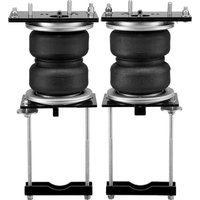


| Product Type | Air Suspension Kit |
| Brand | Vevor |
| Model | 7X 57289 |
| Compatible Vehicles | Dodge Ram 2500 2WD and 4WD (2014-2023) |
| Maximum Load Capacity | 5000 lb (2268 kg) |
| Inflation Pressure Range | 5-100 PSI (0.34-6.9 bar) |
| Minimum Operating Pressure | 5 PSI (0.34 bar) |
| Number of Air Springs | 2 |
| Air Line Type | Nylon |
| Fitting | PTC (Push-to-Connect) |
| Inflation Valve Type | Schrader Valve |
| Spring Material | Air (rubber and textile) |
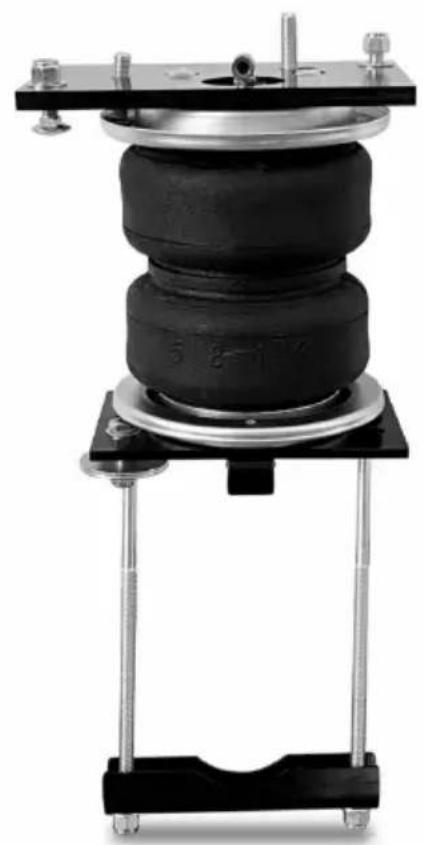
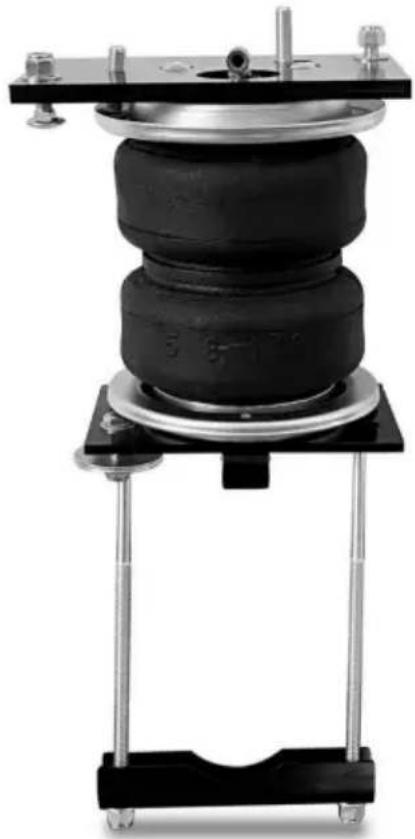
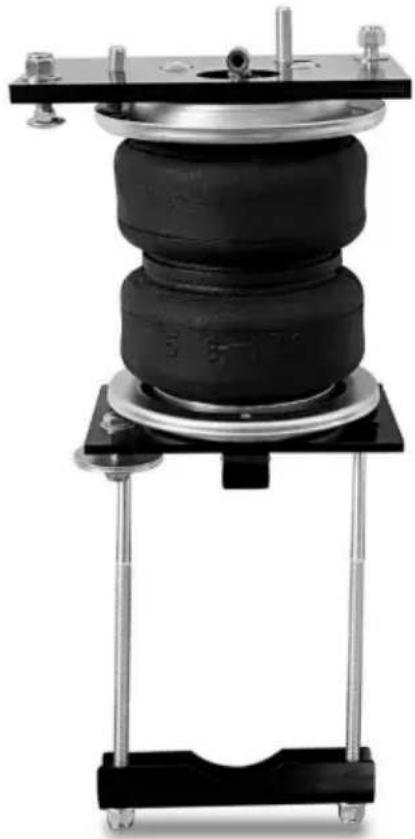
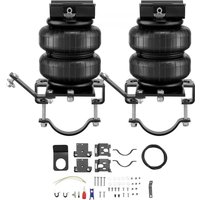
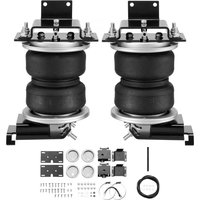
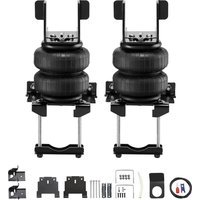
| Kit Contents | Frame brackets, spring brackets, wear pads, hardware, air line, valves, caps, manual |
| Maintenance | Check pressure weekly, clean with garden hose |
| Safety | Do not exceed 100 PSI, do not exceed GVWR, use soapy water for leaks |
| Warranty | Electronic warranty certificate at www.vevor.com/support |
| Country of Manufacture | China |
| Manual Available | Yes, in multiple languages (FR, DE, EN, IT, NL, PL, SV, etc.) |
| Mounting Type | On frame and axle |
| Recommended Leak Test | Soapy water solution |
Frequently Asked Questions - 7X 57289 Vevor
User questions about 7X 57289 Vevor
0 question about this device. Answer the ones you know or ask your own.
Ask a new question about this device
Download the instructions for your Air suspension kit in PDF format for free! Find your manual 7X 57289 - Vevor and take your electronic device back in hand. On this page are published all the documents necessary for the use of your device. 7X 57289 by Vevor.
USER MANUAL 7X 57289 Vevor
Technical Support and E-Warranty Certificate www.vevor.com/support
AIR BAG SUSPENSION KIT
MODEL: 7X 57289
We continue to be committed to providing you with tools at competitive prices. "Save Half", "Half Price", or any other similar expressions used by us only represent an estimate of savings you might benefit from buying certain tools with us compared to top brands, and does not necessarily mean to cover all categories of tools offered. We kindly remind you to verify carefully when placing an order with us whether you are actually saving half in comparison with the top major brands.
VEVOR®
TOUGH TOOLS, HALF PRICE
AIR BAG SUSPENSION KIT
MODEL: 7X 57289
NEED HELP? CONTACT US!
Have product questions? Need technical support? Please feel free to contact us:
Technical Support and E-Warranty Certificate www.vevor.com/support
This is the original instruction. Please read all manual instructions carefully before operating. VEVOR reserves the right to interpret the user manual. The appearance of the product shall be subject to the product you received. Please forgive us that we won't inform you of any technology or software updates on our product.
Thank you for purchasing the 7X 57538 Kit! Please kindly be advised to read the instructions carefully before installing the air spring kit.
Please take safety precautions accordingly during installation.
The installation instructions are based on the left side or based on the driver's side of the vehicle, and the structure on the right side can refer to the same mode as the left side.
The retrofit kit you purchased is a single valve inflation system.
Please note that the air spring will bend and expand under working conditions. Ensure there is enough space for it to work properly and avoid friction between the air spring and other chassis parts.
IMPORTANT SAFETY NOTICE
The installation of this kit does not alter the gross vehicle weight rating (GVWR) payload of the vehicle. Check the vehicle's owner's manual and do not exceed the maximum load listed for this vehicle.
Gross vehicle weight rating: The maximum allowable weight of the fully loaded vehicle (including passengers and cargo). This number — along with other weight limits, as well as tire, rim size, and inflation pressure data — is shown on the vehicle's Safety Compliance Certification Label.
Payload: The combined, maximum allowable weight of cargo and passengers the truck is designed to carry. Payload is GVWR minus the base curb weight.
Hazard notations appear in various locations in this publication. Information that is highlighted by one of these notations must be observed to help minimize personal injury or possible improper installation which may render the vehicle unsafe. Notes are used to help emphasize areas of procedural importance and
provide helpful suggestions. The following definitions explain the use of these notations as they appear throughout this guide.

INDICATES IMMEDIATE HAZARDS WHICH WILL RESULT IN SEVERE PERSONAL INJURY OR DEATH.
INDICATES HAZARDS OR UNSAFE PRACTICES WHICH COULD RESULT IN SEVERE PERSONAL INJURY OR DEATH.
INDICATES HAZARDS OR UNSAFE PRACTICES WHICH COULD RESULT IN DAMAGE TO THE MACHINE OR MINOR PERSONAL INJURY.
PARAMETER LIST
| Model | standard |
| Adapted models | 2014-2023 Dodge Ram 2500 2WD&4WD |
| rated load (lbs) | 5000 |
| Use the pressure (psi) | 5-100 |
PARTS LIST
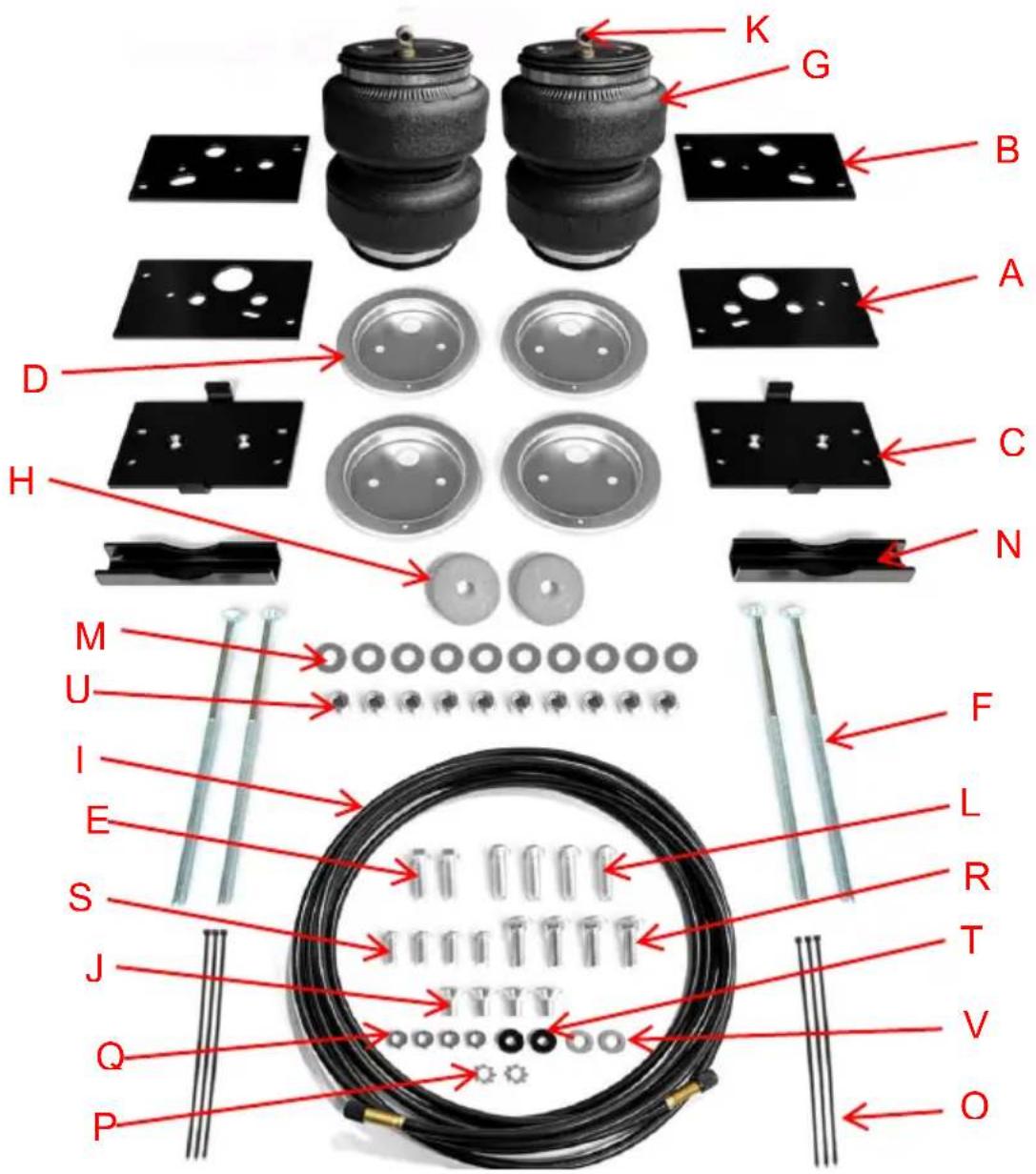
| ITEM | DESCRIPTION | QTY | ITEM | DESCRIPTION | QTY |
| A | Upper frame bracket | 2 | L | 3/8"-24 x 7/8" Button-head screw | 4 |
| B | Upper air spring bracket | 2 | M | 3/8" Flat washer | 10 |
| C | Lower bracket | 2 | N | Clamp bar | 2 |
| D | Roll plate (silver zin plated) | 4 | O | Zip tie | 6 |
| E | 3/8"-16 x 1.25" Hex-head bolt | 2 | P | Star washer | 2 |
| F | 3/8"-16 x 10" Carriage bolt | 4 | Q | 5/16" Hex nut | 4 |
| G | Air spring | 2 | R | 3/8"-16 x 1.25" Carriage bolt | 4 |
| H | Large flat washer | 2 | S | M10-1.5 Button-head screw | 4 |
| I | Nylon air line | 1 | T | Rubber washer | 2 |
| J | 3/8"-24 x 3/4" Flat-head screw | 4 | U | 3/8"-16 Nylon lock nut | 10 |
| K | Push-to-connect (PTC) fitting | 2 | V | M8 Flat washer | 2 |
* not pictured in the Installation Diagram
| DESCRIPTION | QTY |
| Valve cap | 2 |
| instruction | 1 |
GETTING STARTED
- Raise the vehicle and support the frame with jack stands, then drop the axle to make room for the air spring assemblies to be put into position between the frame and axle (Fig. 2).
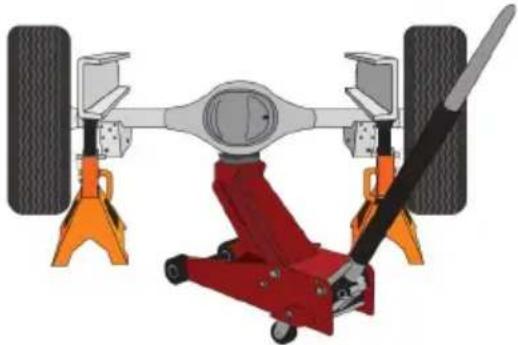
Fig. 2
- On the left (driver's) side axle there is a small vent tube (Fig. 3) that is not tied on an angle with a zip tie (BB).
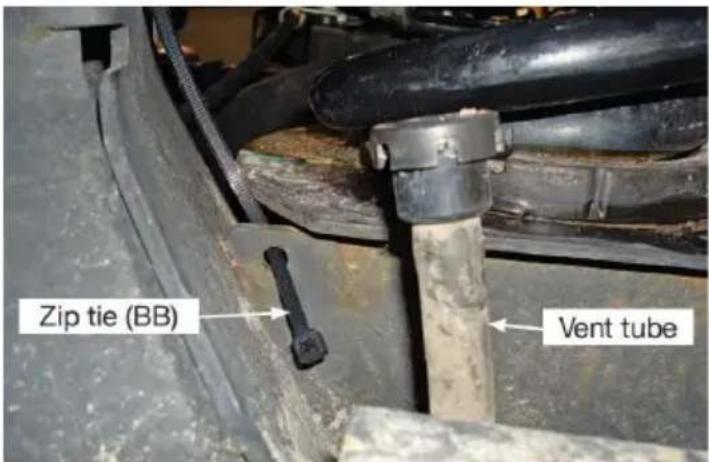
Fig. 3
- Insert the zip tie into the small hole in the lower coil spring seat, then a vent tube and just snug the zip tie enough to angle the tube out of the way.
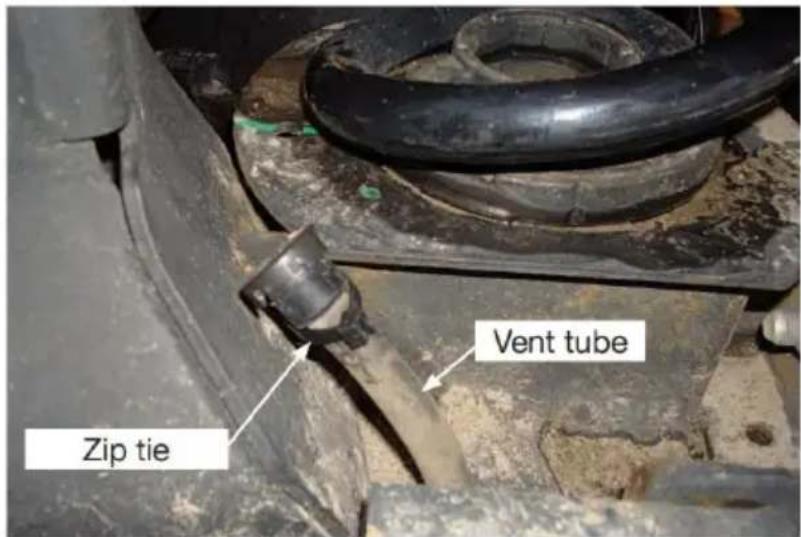
Fig. 4
- Remove the left and right side jounce bumpers (Figs. 5 & 6).
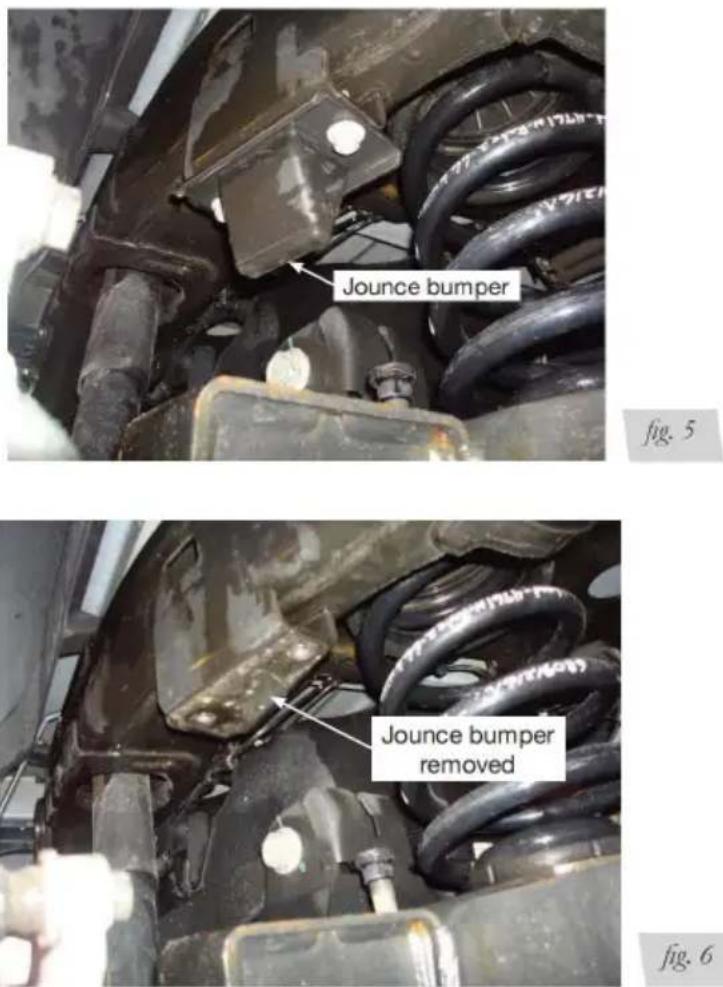
- Attach the upper frame bracket (A) to the frame (Figs. 7 & 8) using the button head screws (S).
NOTE: The large hole in the bracket goes to the outside of the frame (toward the tire).
Driver's side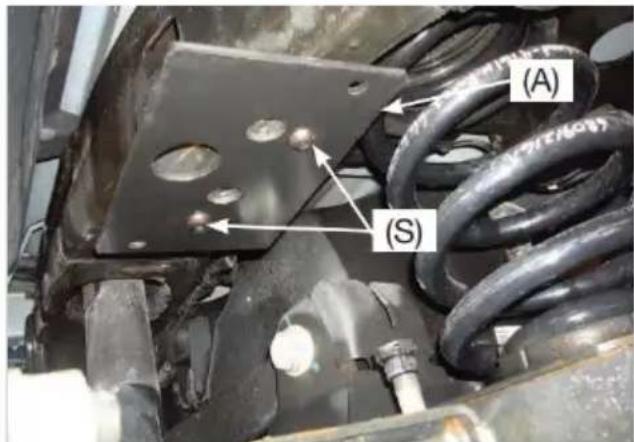
Fig. 7
Passenger's side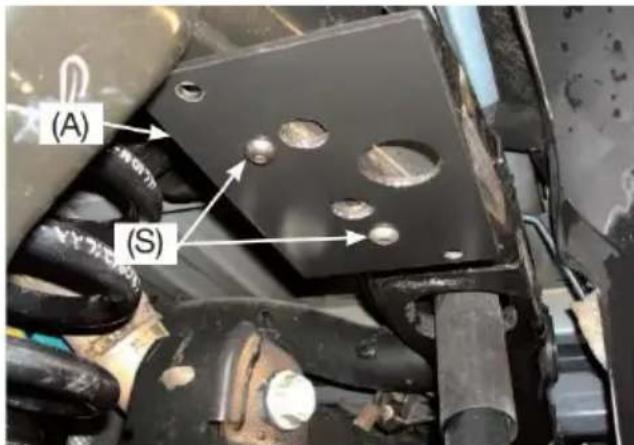
Fig. 8
6. Torque the mounting hardware to 30 lb.-ft. (41 Nm).
BUILDING THE AIR SPRING ASSEMBLIES
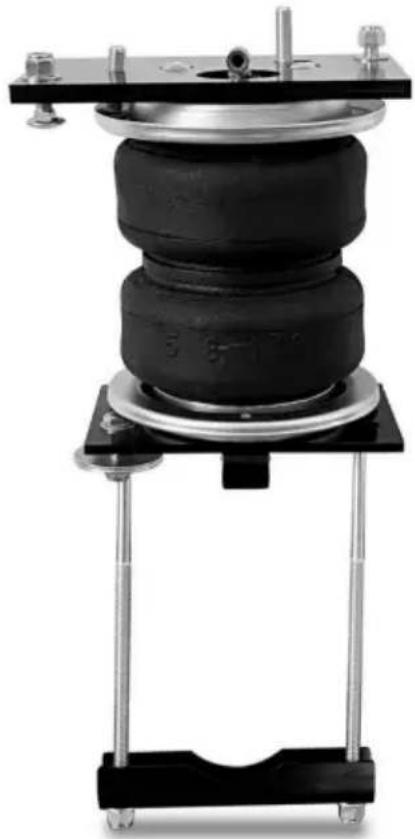
- Set a roll plate (D) over the top of each air spring (G).
NOTE: The radiused (rounded) edge of the roll plate (D) will be toward the spring so that the air spring is seated inside both roll plates.
- Install the swivel fitting (K) into the top of the air spring finger tight plus a half turn (Fig. 9). Repeat for both air springs. It is recommended that the nozzle (K) be wrapped with PTFE TAPE during assembly.
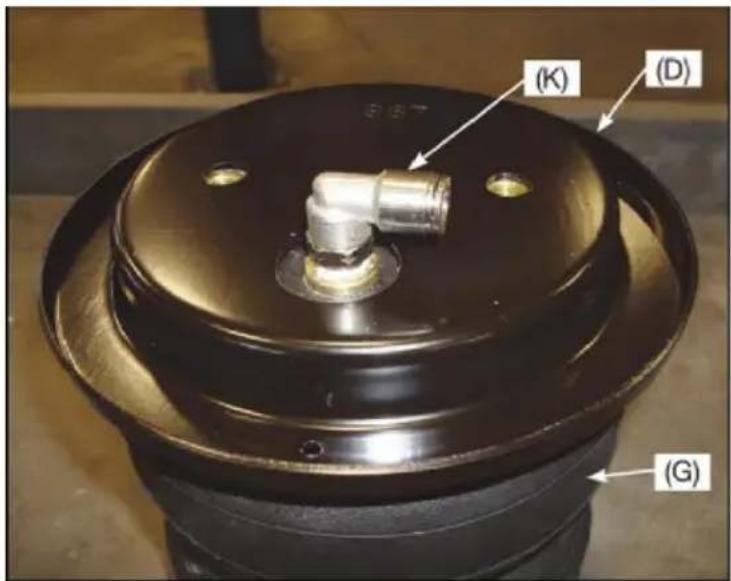
fig. 9
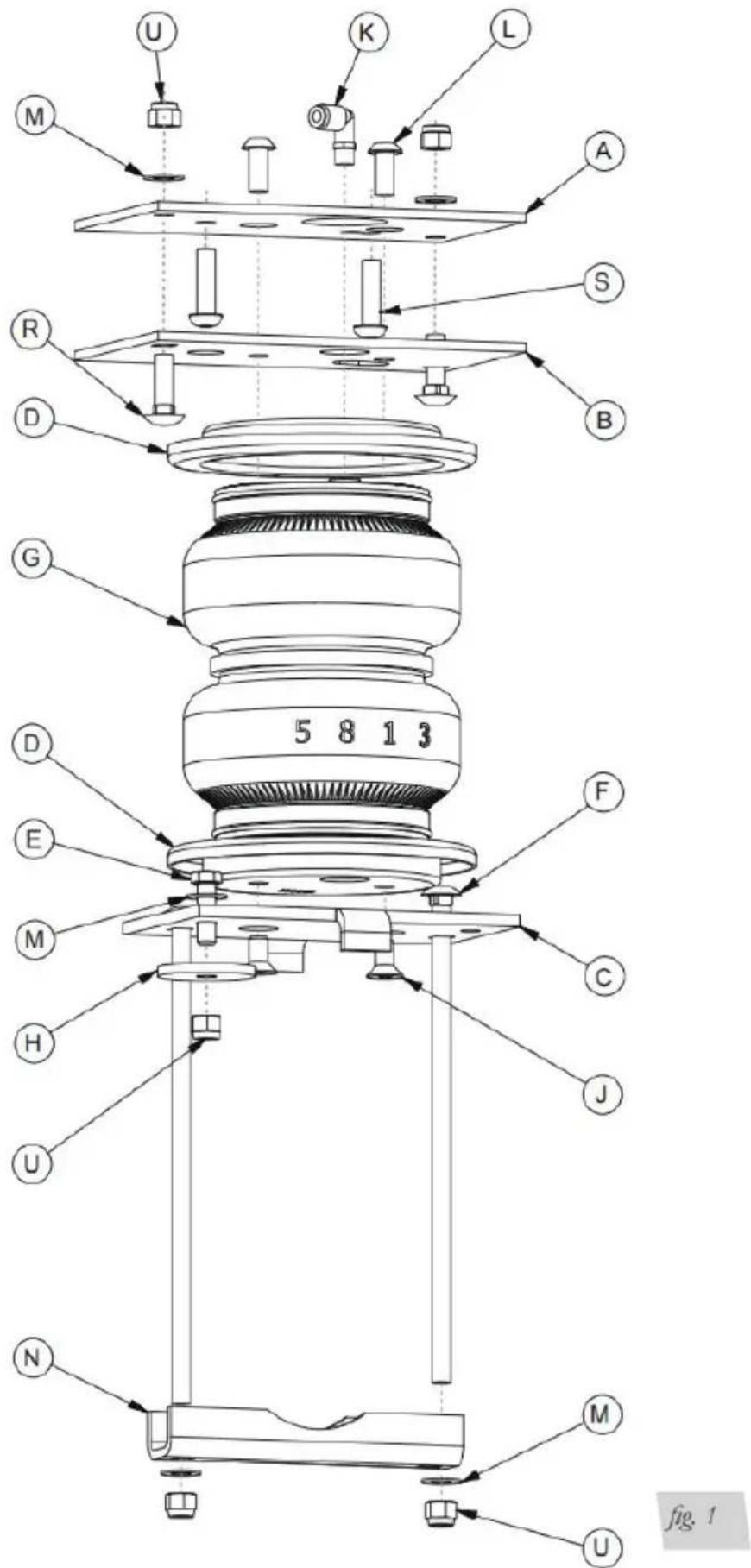
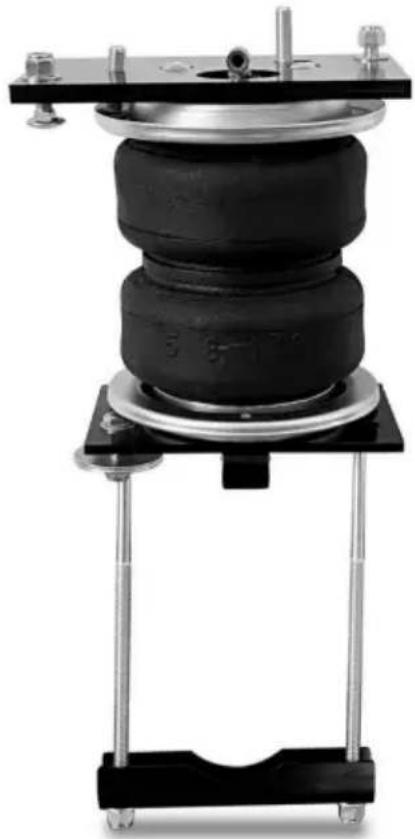
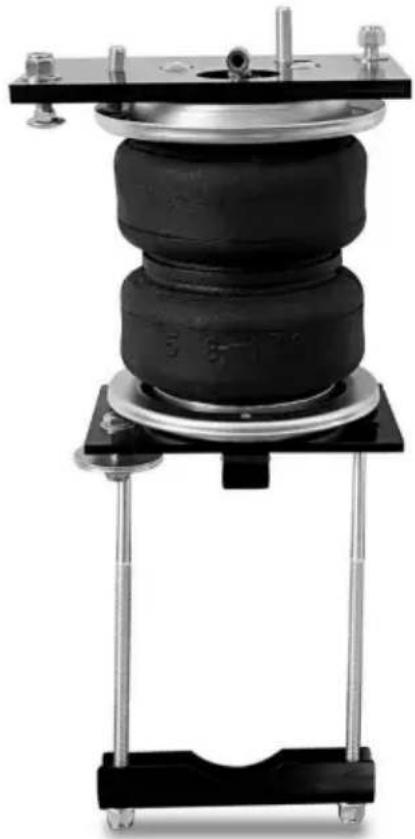
- Set both air springs in front of you with the fittings pointing at you (Fig. 4). Insert the 3/8" carriage bolt (R) through the upper air spring bracket (B) hole at the back side only (Figs. 1 & 10).
NOTE: The upper air spring brackets will be a mirror image when set onto springs (see Fig. 10).
Left (driver's) side assembly
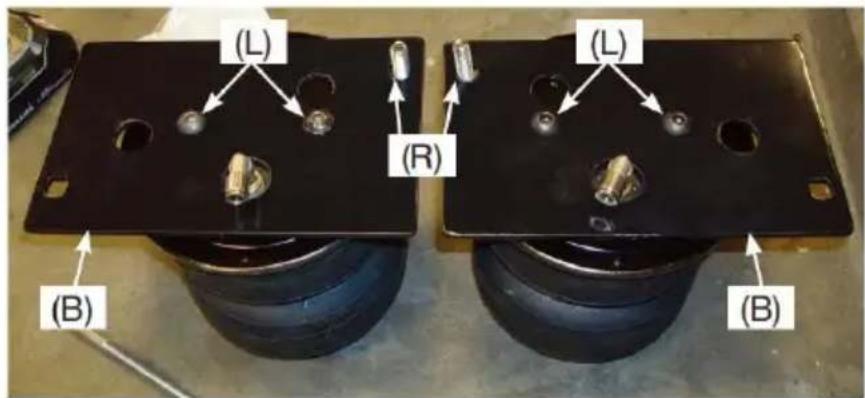
Right (passenger's) side assembly
fig. 10
- Set both brackets onto the air springs and attach using the 3/8" button head screws (L). Torque no more than 20 lb.-ft. (27Nm).
- Install the thick 3/8" flat washer (H) onto the lower bracket (C) with 3/8" hex-head bolt (E), 3/8" flat washer (M) and 3/8" nylon lock nut (U) as shown in Figs. 1 & 11. Tighten securely.
- Insert the long 3/8" carriage bolts (F) into the square holes in the lower bracket (Figs. 1 & 11).
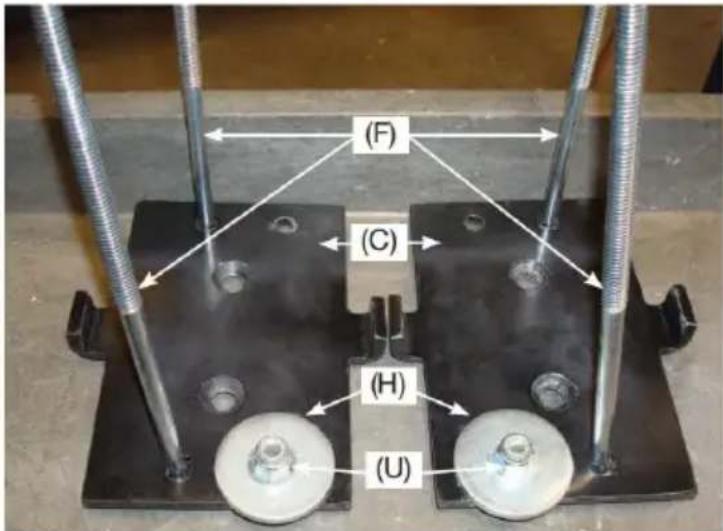
fig. 11
- Set a roll plate (D) over the bottom of the air spring and install the lower bracket onto the air spring assembly so that the large washer previously installed will be forward of the axle once installed (Figs. 12 & 13) using the 3/8" flat head screws (J). Torque to no more than 20 lb-ft. (27Nm).
Left (driver's) side assembly
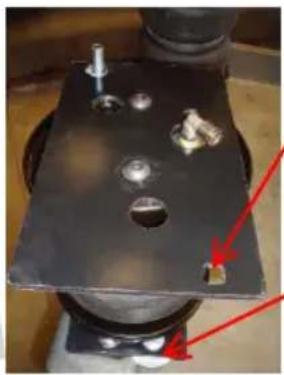
Make sure the lower bracket attached with the large washer is on the same side as the open square hole in the top bracket as shown.
The large washer installed on the lower bracket will be forward of the axle once installed.
Left (driver's) side assembly
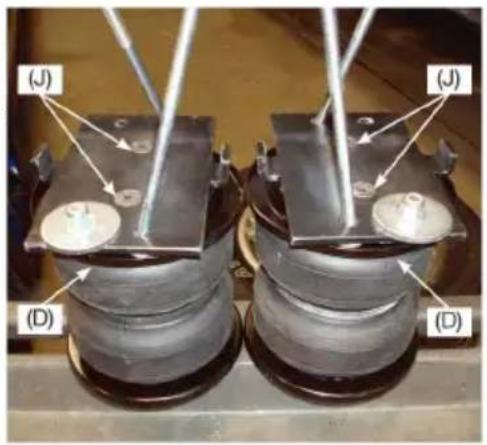
Right (passenger's) side assembly
See Figures 8 & 10 to position correctly on the Assembly.
fig. 13
FINISHED ASSEMBLIES
Left (driver's) side assembly
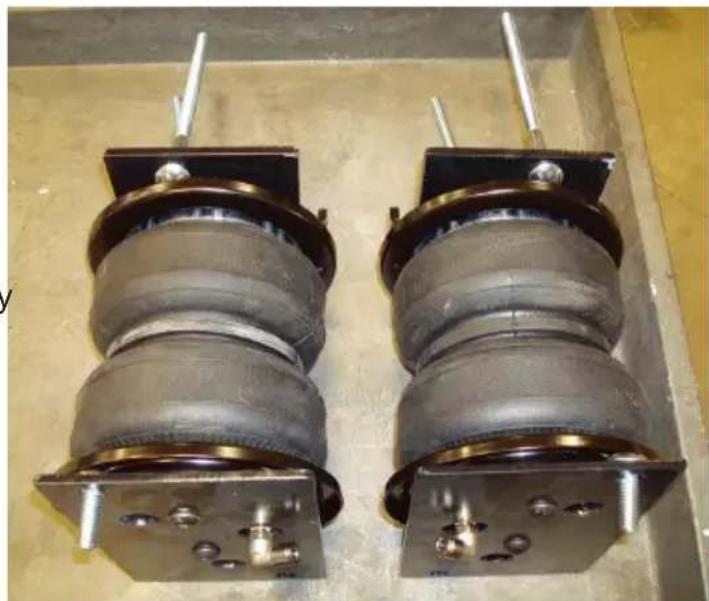
Right (passenger's) side assembly
fig. 14
ATTACHING THE ASSEMBLIES TO THE FRAME
- With the axle slightly hanging, set the left (driver's) side assembly on the frame, making sure that the carriage bolt (F) goes in between the brake line and the frame.
(Fig. 15).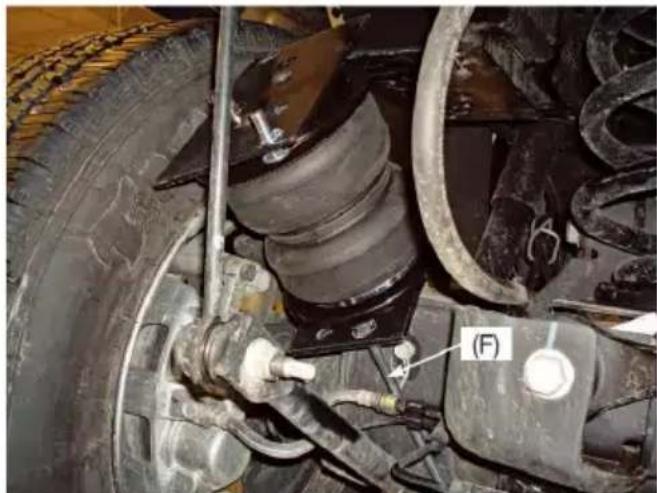
fig. 15
- Carefully set the upper air spring bracket into position, making sure that the carriage bolt and fitting line up with the holes in the frame bracket (Fig. 16). Raise the axle up so that the brackets come together, making sure the fitting and carriage bolt go through the holes and do not bind.
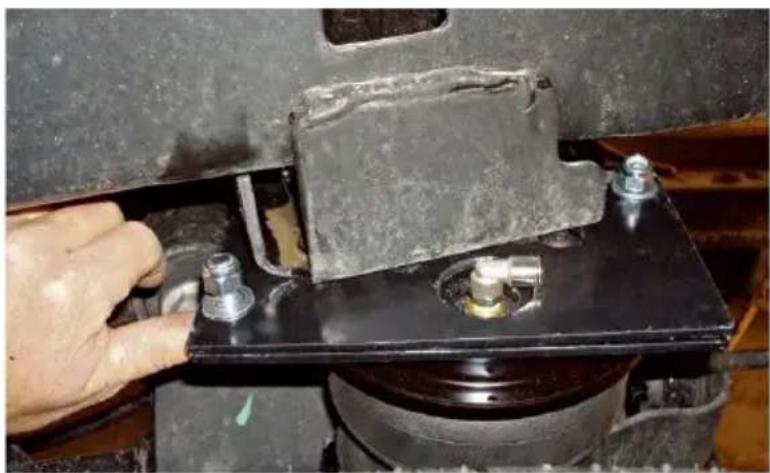
fig. 16
- Insert the remaining carriage bolt (R) through the open front holes from the bottom up and cap both upper carriage bolts with 3/8" flat washer (M) and nylon lock nut (U). Torque to 16 lb.-ft. (22Nm). Repeat for the other side.
NOTE: It may be necessary to use a 9/16" crows foot adapter to torque the underneath the frame.
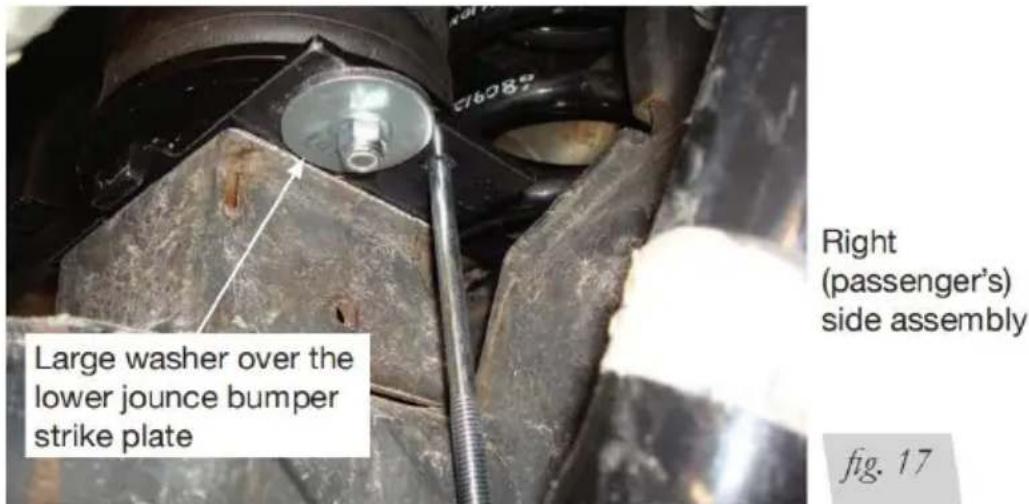
- Bring the axle all the way up and position the lower bracket over the low jounce bumper strike plate. The large washer on the bottom of the bracket is to be positioned forward and over the lower jounce bumper strike plate (Fig. 17)
- Set the clamp bar (N) over the two long carriage bolts (F) under the axle cap with two 3/8" flat washers (M) and 3/8" nylon lock nuts (U) (Fig. 18).
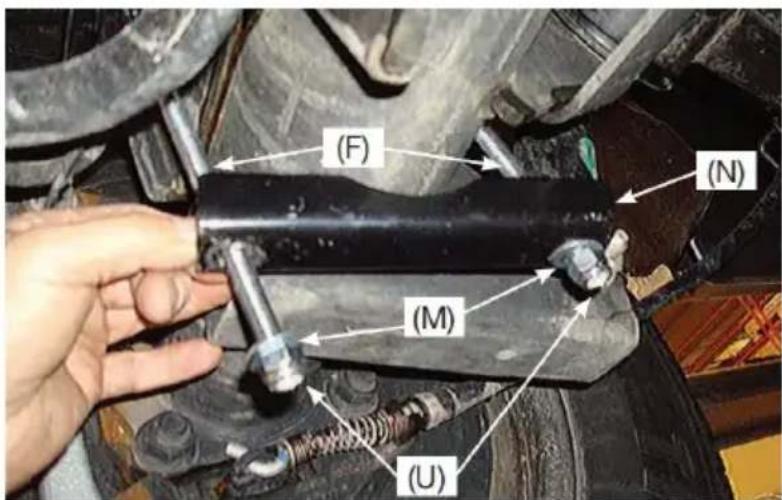
fig. 18
- Torque evenly to 10 lb.-ft. (14Nm) (Fig. 19). Repeat for the other side.
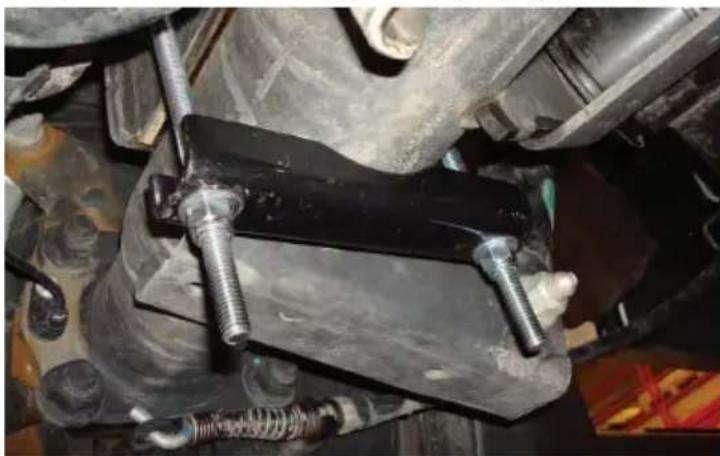
fig. 19
- Raise the axle or lower the vehicle and remove the jack stands.
INSTALLING THE AIR LINES
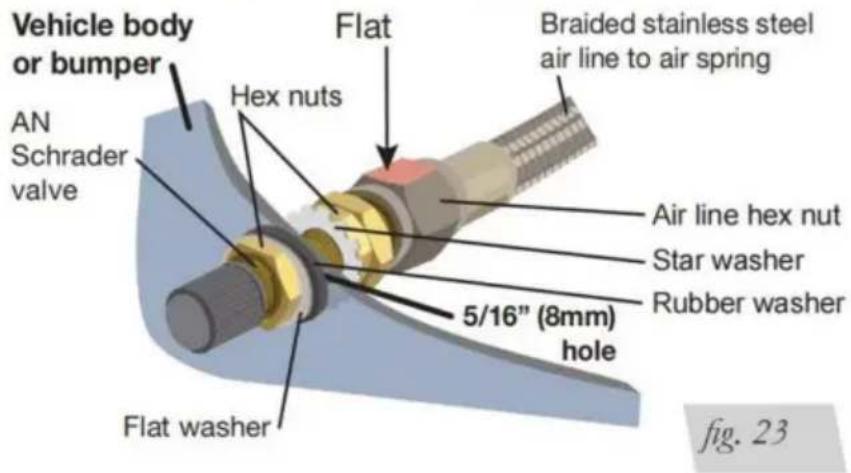
Air lines are routed from the air springs to Schrader valves. Lines come in two styles: nylon and braided stainless steel. Begin by choosing locations for the Schrader valves and drill a 5/16" hole (8mm), if necessary (Fig. 20).
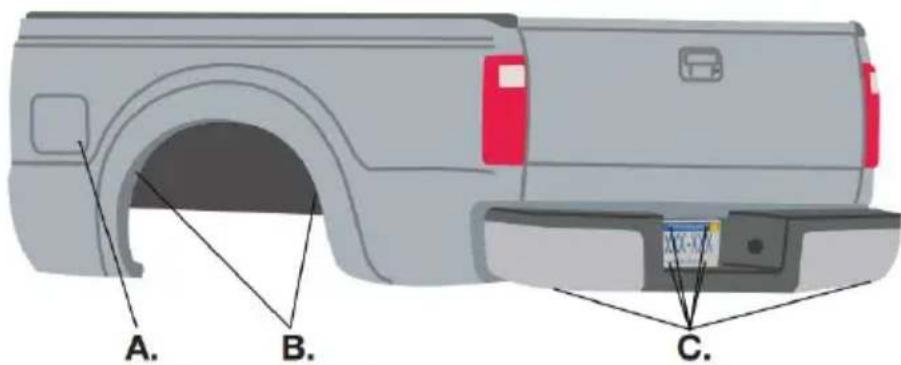
* For LoadLifter Ultimate Plus kits, the recommended location for the Schrader valves is the rear bumper area or license plate.
A. Inside fuel tank filler door
B. Inside rear wheel wells
C. License plate or rear bumper area*
fig. 20

CAUTION
KEEP AT LEAST 6" OF CLEARANCE BETWEEN ALL AIR LINES AND THE EXHAUST SYSTEM. AVOID SHARP BENDS AND EDGES.
INSTALLING NYLON AIR LINES
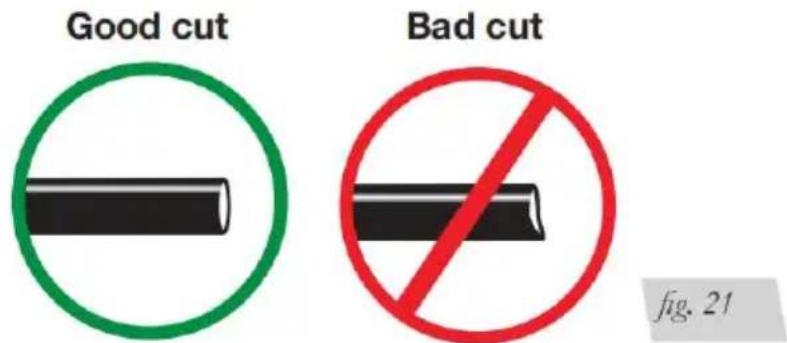
- Cut the air line in half. Make clean, square cuts with a razor blade or hacksaw (Fig. 21). Do not use scissors or wire cutters.
- Use zip ties to secure the airline to fixed points along the chassis. Do not pinch or kink the air line. The minimum bend radius for the air line is 1" (25mm). Leave at least 2" (50mm) of slack in the air line to allow for any movement that might occur.
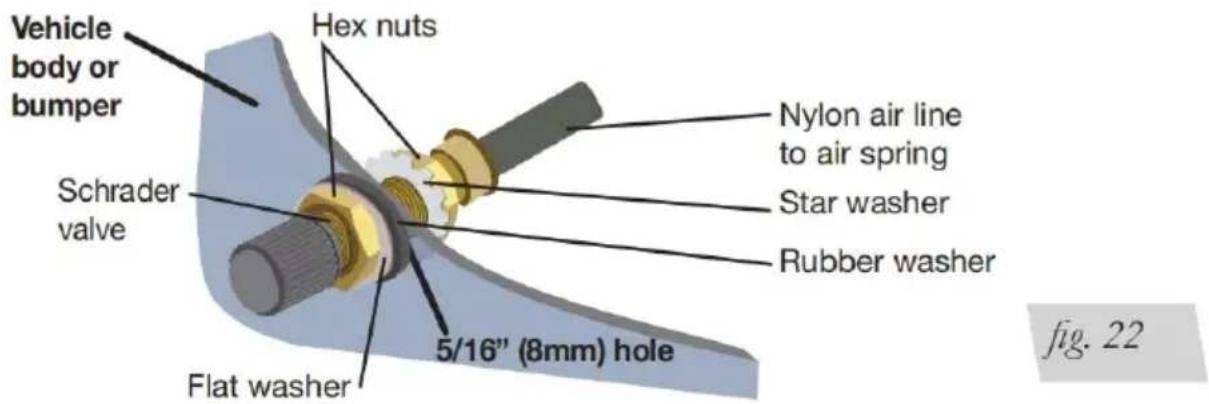
- Install the Schrader valve in the chosen location (Fig. 22).
INSTALLING BRAIDED STAINLESS STEEL AIR LINES

CAUTION
KEEP THE AIR LINE AWAY FROM THE FUEL LINE, BRAKE LINES AND ELECTRICAL WIRES.
- Use zip ties to secure the airline to fixed points along the chassis every 6" to 8" (150-300mm). Leave at least 2" (50mm) of slack to allow for any movement that might put stress on the air line.
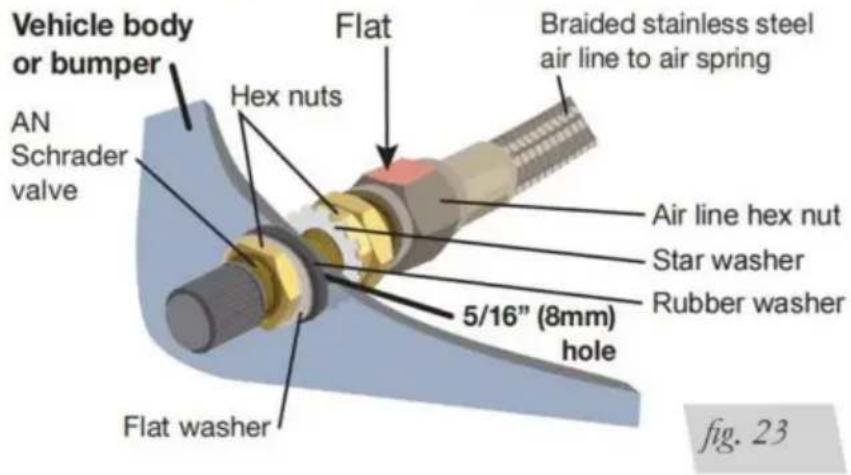
- Tighten the airline hex nut finger tight, then use 2 wrenches to turn 1 additional flat (1/6 of one full turn). Do not overtighten (Figs. 23 or 24). The easiest way to tighten the fitting is off the vehicle. Install the Schrader valve in the chosen location.
- Coil and secure any excess airline in an area where it will not be susceptible to damage.
The braided stainless steel airline cannot be trimmed.
Air Line Setup Without Compressor System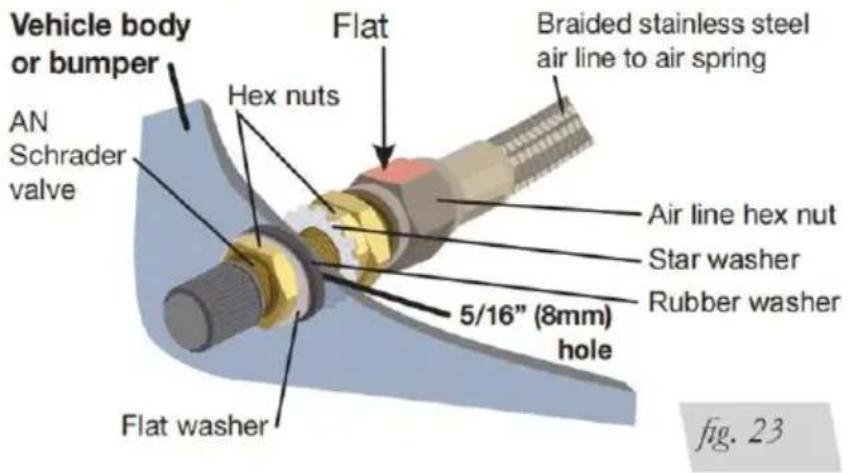
Air Line Setup for Compressor Integration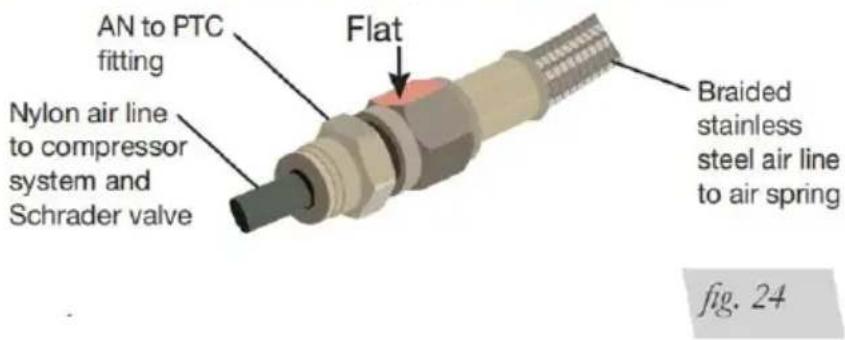
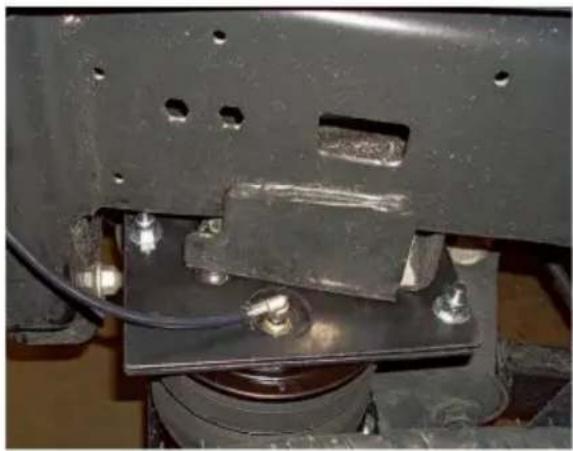
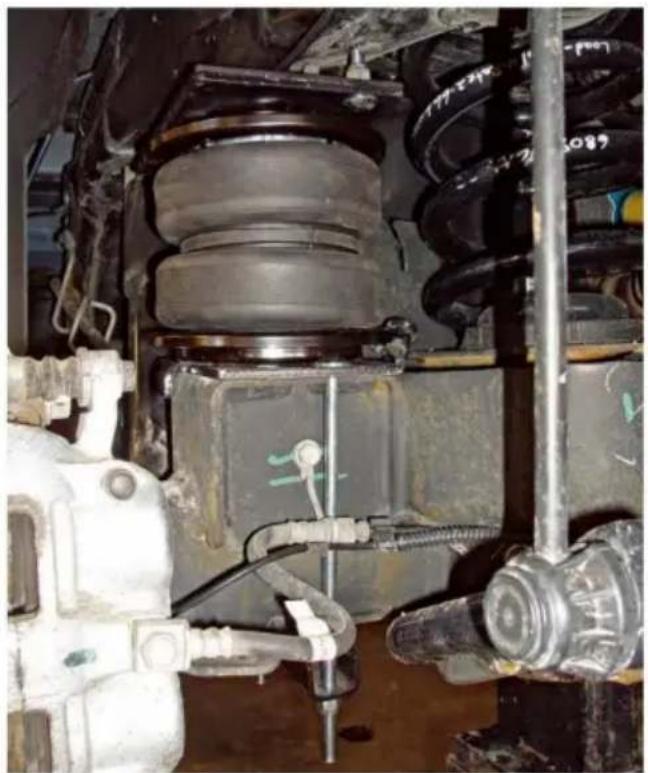
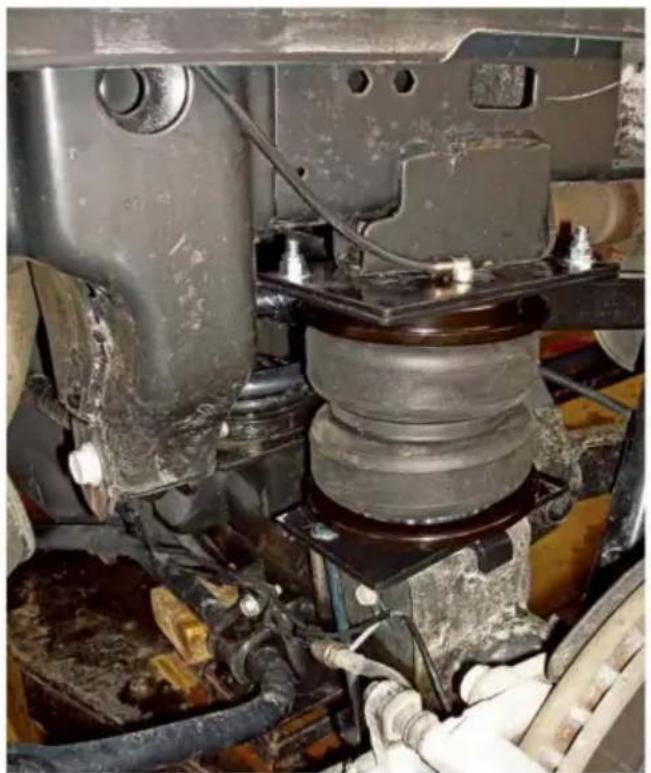
Finished Installation Photos
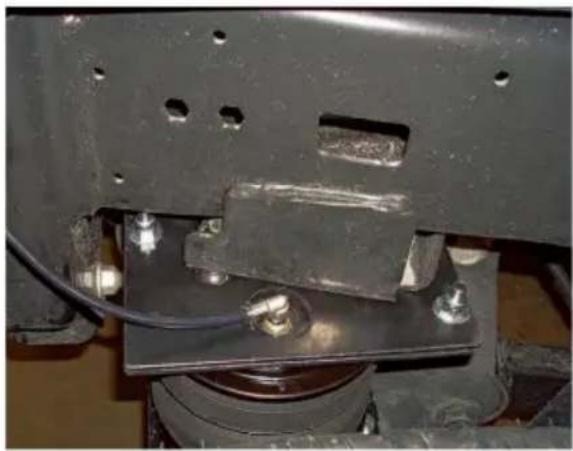
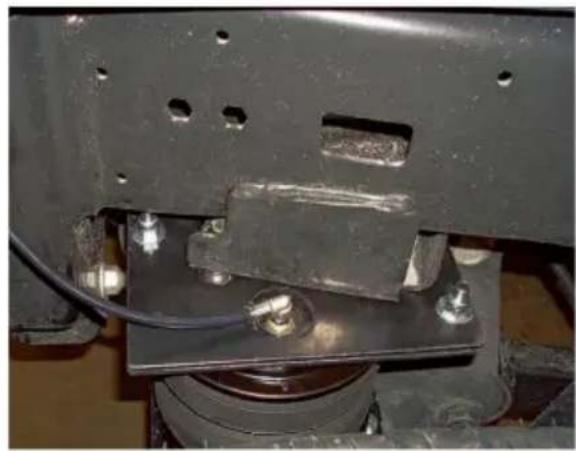
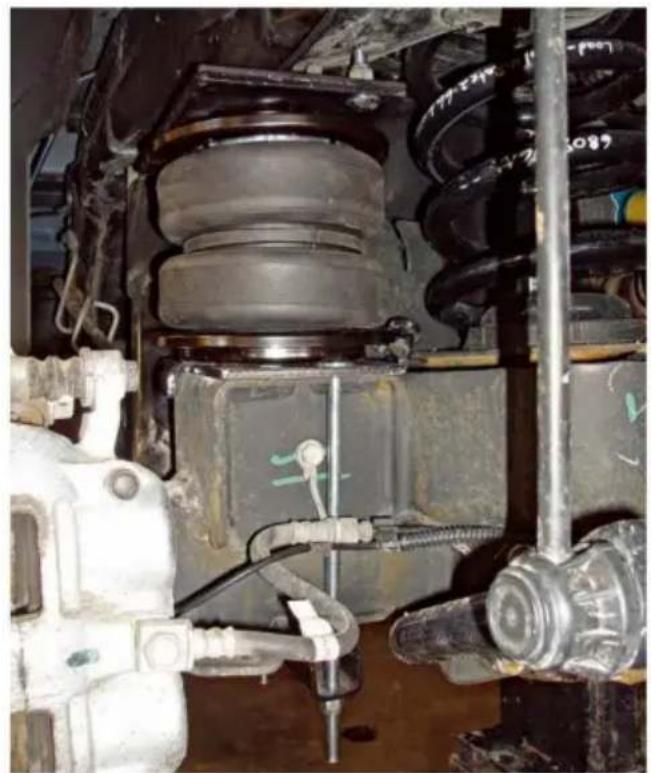
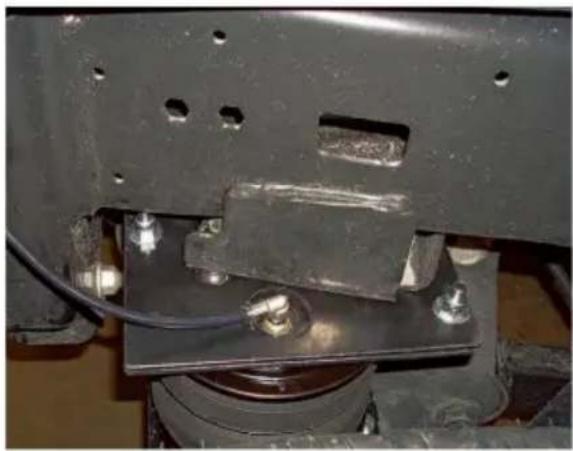
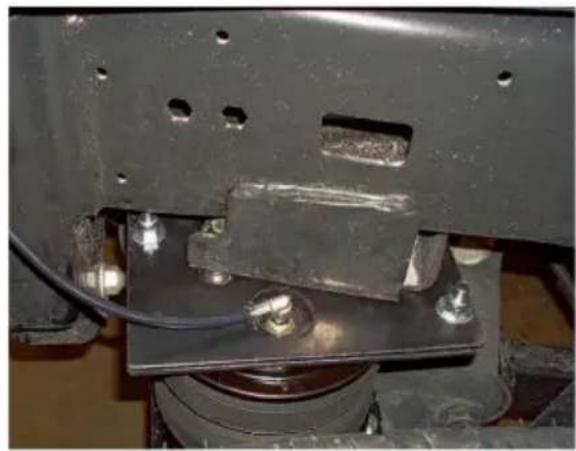
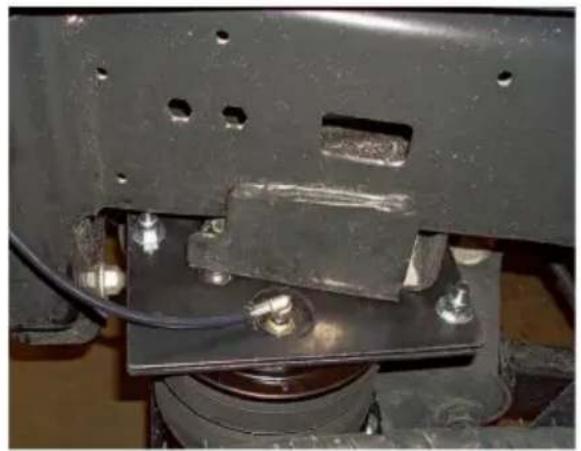
- The following images show the finished installation of both sides. (Figs. 25)
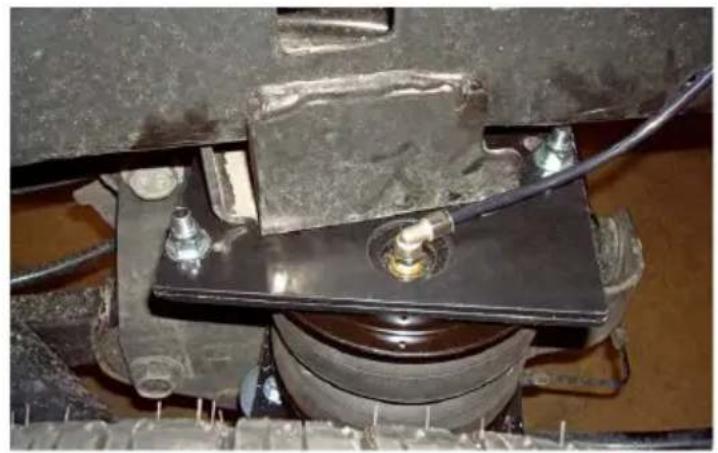
Left (driver's) side top view
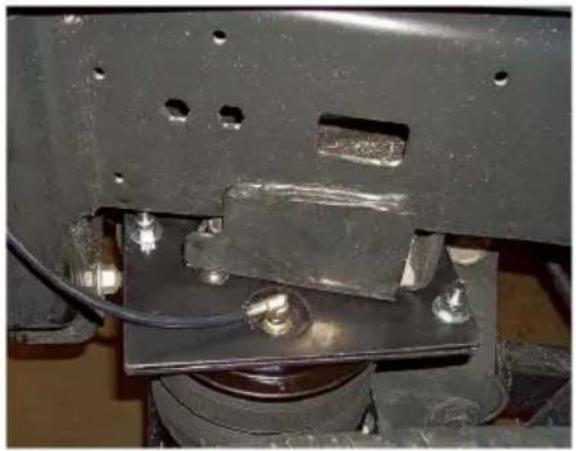
Right (passenger's) side top view
fig. 26
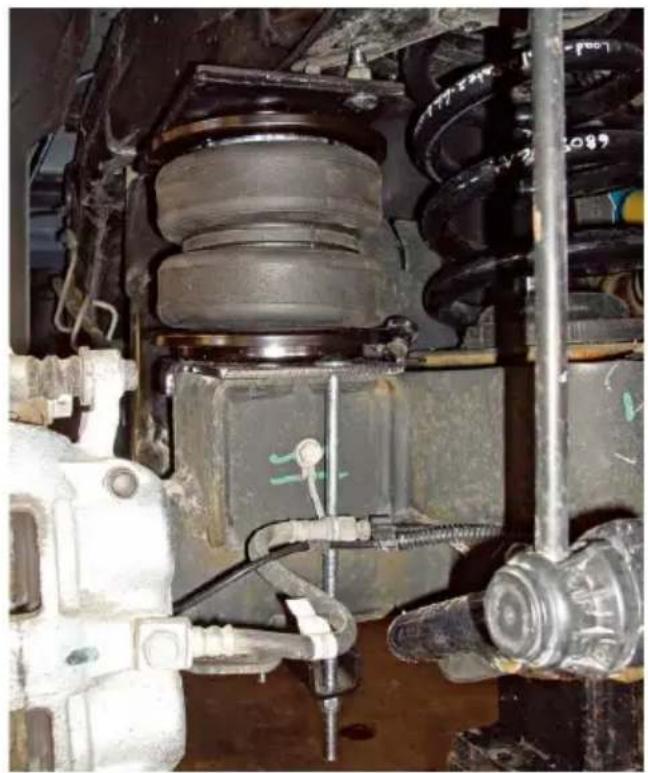
Left (driver's) side back view shown with tire removed
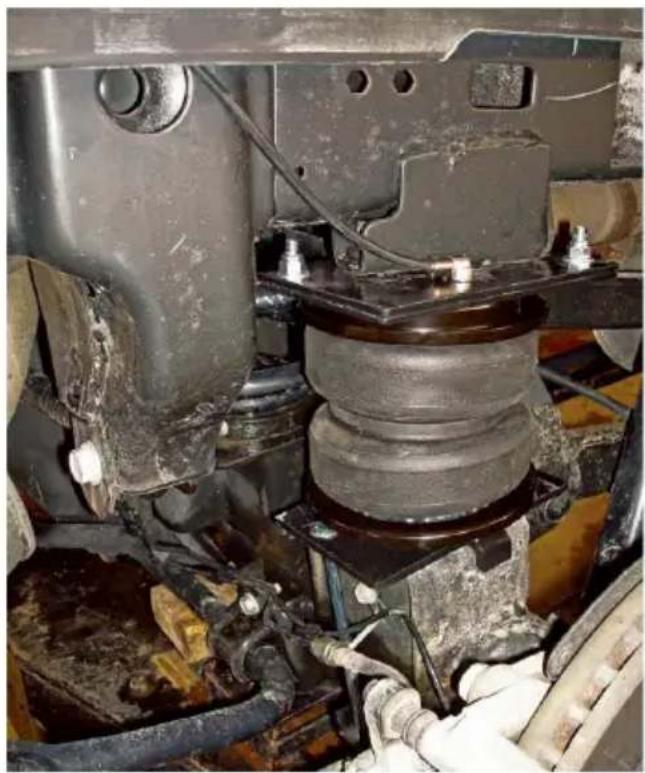
Right (passenger's) side view shown with tire removed
fig. 28
BEFORE OPERATING
CHECKING FOR LEAKS
- Inflate the air spring to 30 PSI (2BAR).
- Spray all connections and the inflation valves with a solution of liquid dish soap. Spot leaks easily by looking for bubbles in the soapy water.
- After the test, deflate the springs to the minimum pressure required to restore the vehicle to normal ride height. Do not deflate to lower than 5 PSI (.34BAR).
- Check the air pressure again after 24 hours. A 2-4 PSI (0.14-0.28 BAR) loss after installation is normal. Retest for leaks if the loss is more than 5 PSI (0.34 BAR).
FIXING LEAKS
- If there is a problem with the swivel fitting:
a. Check the airline connection by deflating the spring and removing the line by pulling the collar against the fitting and pulling firmly on the air line. Trim 1 inch (25 mm) off the end of the air line. Be sure the cut is clean and square (see Figure 21). Reinsert the air line into the push-to-connect fitting. b. Check the threaded connection by tightening the swivel fitting another half turn. If it still leaks, deflate the air spring, remove the fitting, and re-coat threads with thread sealant. Reinstall by hand tightening as much as possible and then use a wrench for an additional two turns.
- If there is a problem with the inflation valve:
a. Check the valve core by tightening it with a valve core tool. b. Check the air line by removing the air line from the barbed fitting. Cut the airline off a few inches in front of the fitting and use a pair of pliers or a screwdriver to pull/twist the airline off of the fitting.
DO NOT CUT OFF THE AIR LINE AT THE FITTING BECAUSE THIS COULD NICK
THE BARB AND RENDER THE FITTING USELESS.
INSTALLATION CHECKLIST
Clearance test — Inflate the air springs to 75-90 PSI (5.2-6.2 BAR) and make sure there is at least 1/2 inch (13 mm) clearance from anything that might rub against the sleeve. Be sure to check the tire, brakes, frame, shock absorbers, and brake cables.
Leak test before road test — Inflate the air springs to 75-90 PSI (5.2-6.2 BAR) and check all connections for leaks. All leaks must be eliminated before the vehicle is road tested.
Heat test — Be sure there is sufficient clearance from heat sources, at least 6 inches (152 mm) for air springs and air lines. If a heat shield was included in the kit, install it.
Fastener test — Recheck all bolts for proper torque.
Road test — The vehicle should be road tested after the preceding tests. Inflate the springs to recommended driving pressures. Drive the vehicle 10 miles (16 km) and recheck for clearance, loose fasteners, and air leaks.
Operating instructions — If professionally installed, the installer should review the operating instructions with the owner. Be sure to provide the owner with the paperwork that came with the kit.
POST-INSTALLATION CHECKLIST
Overnight leak down test — Recheck air pressure after the vehicle has been used for 24 hours. If the pressure has dropped more than 5 PSI (.34BAR), there is a leak that must be fixed. Either fix the leak yourself or return to installer for service.
Air pressure requirements — It is important to understand the air pressure requirements of the air spring system. Regardless of load, the air pressure shall always be adjusted to maintain adequate ride height at all times while driving. Thirty-day or 500-mile (800km) test — Recheck the air spring system after 3 days or 500 miles (800km), whichever comes first. If any part shows signs of rubbing or abrasion, the source should be identified and moved, if possible. If not possible to relocate the cause of the abrasion, the air spring may need remounted. If professionally installed, the installer should be consulted. Check fasteners for tightness.
PRODUCT USE, MAINTENANCE AND SERVICING
Minimum Recommended Pressure
5 PSI (.34BAR)
Maximum Air Pressure
100 PSI (7BAR)
MAINTENANCE GUIDELINES
NOTE: By following the steps below, vehicle owners will obtain the longest life and best results from their air springs.
- Check air pressure weekly.
- Always maintain normal ride height. Never inflate beyond 100 PSI (7BAR).
- If the system develops an air leak, use a soapy water solution to check line connections and the inflation valve core before deflating and removing the spring.

CAUTION
FOR SAFETY AND TO PREVENT POSSIBLE DAMAGE TO THE VEHICLE, DO NOT EXCEED MAXIMUM GROSS
VEHICLE WEIGHT RATING (GVWR), AS INDICATED BY THE VEHICLE MANUFACTURER. ALTHOUGH THE AIR SPRINGS ARE RATED AT A MAXIMUM INFLATION PRESSURE OF 100 PSI (7BAR), THE AIR PRESSURE ACTUALLY NEEDED IS DEPENDENT ON LOAD AND GROSS VEHICLE WEIGHT RATING.
- Loaded vehicles require at least 25 PSI (1.7BAR). A “loaded vehicle” refers to a vehicle with a heavy bed load, a trailer, or both. Never exceed GVWR, regardless of air spring, air pressure, or another load assist. The springs in this kit will approximately 40 pounds (18kg) of load (combined on both springs) for each (.07BAR) of pressure. The required air pressure will vary depending on the s the original suspension. Operating the vehicle below the minimum air spring pressure will void the warranty.
- When increasing load, always adjust air pressure to maintain normal ride I Increase or decrease pressure from the system as necessary to attain normal height for optimal ride and handling. Remember that loads carried behind the (including tongue loads) require more leveling force (pressure) than those carri directly over the axle.
- Always add air to springs in small quantities, checking the pressure frequency
- Should it be necessary to raise the vehicle by the frame, make sure the is at minimum pressure (5 PSI [.34BAR]) to reduce the tension on the sus brake components. Use of on-board leveling systems do not require deflation disconnection.
- Periodically check the air spring system fasteners for tightness. Also, check air springs for any signs of rubbing. Realign if necessary.
- On occasion, give the air springs a hard spray with a garden hose to re mud, sand, gravel or other debris.
TUNING THE AIR PRESSURE
Pressure determination comes down to three things — level vehicle, ride com and stability.
1. Level vehicle
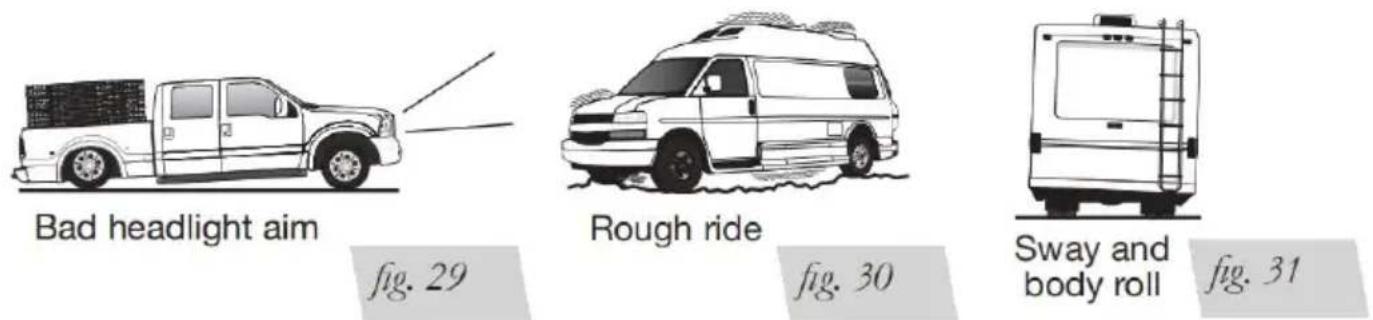
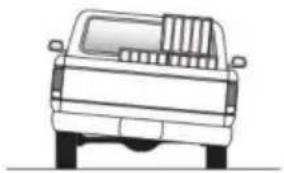
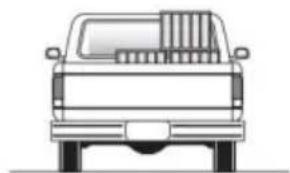
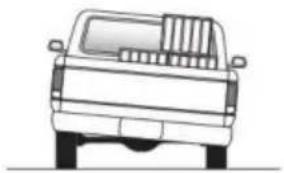
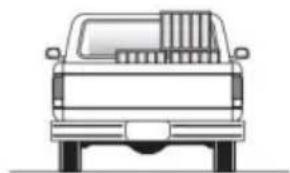
If the vehicle's headlights are shining into the trees or the vehicle is leaning side, then it is not level (Fig. 29). Raise the air pressure to correct either c problems and level the vehicle.
2. Ride comfort
If the vehicle has a rough or harsh ride, it may be due to either too much or not enough air pressure (Fig. 30). Try different pressures to determine the best ride comfort.
3. Stability
Stability translates into safety and should be the priority, meaning the driver may need to sacrifice a perfectly level and comfortable ride. Stability issues include control, bounce, dive during braking, and sponginess (Fig. 31). Tuning out these problems usually requires an increase in pressure.
GUIDELINES FOR ADDING AIR
- Start with the vehicle level or slightly above.
- When in doubt, always add air.
- If the front of the vehicle dives while braking, increase the pressure in the air bags, if equipped.
- If it is ever suspected that the air bags have bottomed out, increase the pressure (Fig. 32).
- Adjust the pressure up and down to find the best ride.
- If the vehicle rocks and rolls, adjust the air pressure to reduce movement.
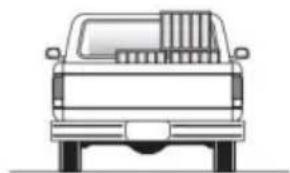
- It may be necessary to maintain different pressures on each side of the vehicle. Loads such as water, fuel, and appliances will cause the vehicle to be heavy on one side (Fig. 33). As much as a 50 PSI (3.5 BAR) difference is not uncommon.
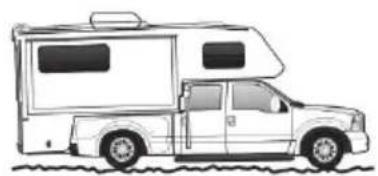
Bottoming out
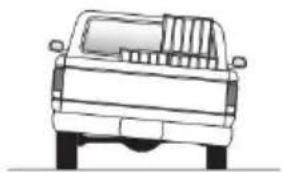
Unlevel
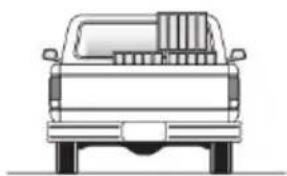
Level fig. 33
fig. 32 Troubleshooting Guide
| PROBLEM | CAUSE | SOLUTION |
| System won't maintain pressure overnight. | Improperly installed airline, air line has holes or crac | Leak test the air line connecti the threaded connection into th air spring, and all fittings in t control system. |
| Air spring or airline leak. | Fitting seal or airline is compromised. | Check to make sure air lines seated in connectors. Inspect fittings with soapy water. Trim hose or re-seal fitting. Ensure lines are cut straight. |
| Corner won't raise o air leak develops. | Look for a kink or fold air line. | Replace any airline that has b kinked. |
FREQUENTLY ASKED QUESTIONS
Q. Will installing air springs increase the weight ratings of a vehicle?
No. Adding air springs will not change the weight ratings (GAWR, GCWR and or GVWR) of a vehicle. Exceeding the GVWR is dangerous and voids the warranty.
Q. Is it necessary to keep air in the air springs at all times and how much pressure will they need?
The recommended minimum air pressure is 5 PSI (.34 BAR). Ultimate and Ulti Plus can safely be run at zero air pressure when unladen (no load).
Q. Is it necessary to add a compressor system to the air springs?
No. Air pressure can be adjusted with any type of compressor as long as it produces sufficient pressure to service the springs. Even a bicycle tire pump can be used, but it's a lot of work.
Q. How long should air springs last?
If the air springs are properly installed and maintained, they can last indefinitely.
Q. Will raising the vehicle on a hoist for service work damage the air springs?
No. The vehicle can be lifted on a hoist for short-term service work such as tire rotation or oil changes. However, if the vehicle will be on the hoist for a prolonged period of time, support the axle with jack stands in order to take the tension off the air springs.
Manufacturer: Shanghai Muxin Muye Youxian Gongsi
Address: Shuangcheng Lu 803 Nong 11 Hao 1602A-1609 Shi, Baoshan Qu, Shanghai 200000 CN.
Imported to AUS: Sihao Pty Ltd. 1 Rokeva Street, Eastwood NSW 2122 Australia
Imported to USA: Sanven Technology Ltd. Suite 250, 9166 Anaheim Place, Rancho Cucamonga, CA 91730
| UK | REP |
YH Consulting Limited.
C/O YH Consulting Limited Office 147,
Centurion House, London Road,
Staines-upon-Thames, Surrey, TW18 4AX
| EC | REP |
E-CrossStu GmbH
Mainzer Landstr. 69,
60329 Frankfurt am Main.
VEVOR®
TOUGH TOOLS, HALF PRICE
Technical Support and E-Warranty Certificate
www.vevor.com/support
VEVOR®
TOUGH TOOLS, HALF PRICE
NEED HELP? CONTACT US!
fig. 1
GETTING STARTED
fig. 2
fig. 4
fig. 11
ATTACHING ASSEMBLIES TO THE FRAME
fig. 15
fig. 16
* For LoadLifter Ultimate Plus kits, the recommended location for the Schrader valves is the rear bumper area or license plate.
A. Inside fuel tank filler door
B. Inside rear wheel wells
C. License plate or rear bumper area*
fig. 20

CAUTION
KEEP AT LEAST 6" CLEARANCE BETWEEN ANY AIR LINES AND EXHAUST SYSTEM. AVOID SHARP BENDS AND EDGES.
INSTALLATION OF NYLON AIR LINES
fig. 22
INSTALLATION OF STAINLESS STEEL BRAIDED AIR LINES

CAUTION
KEEP AIR LINE AWAY FROM FUEL LINE, BRAKE LINES, AND ELECTRICAL WIRES.
Air Line Setup Without Compressor System
Air Line Setup for Compressor Integration
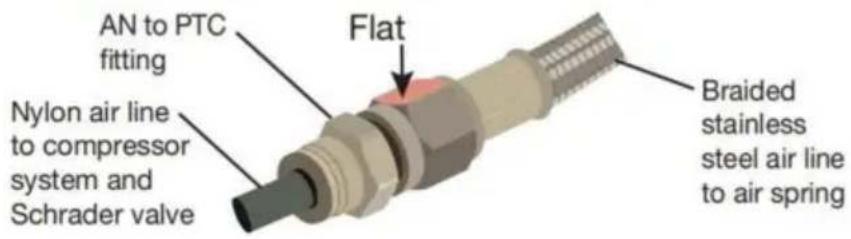
fig. 24
Left (driver's) side top view
Right (passenger's) side top view
fig. 26
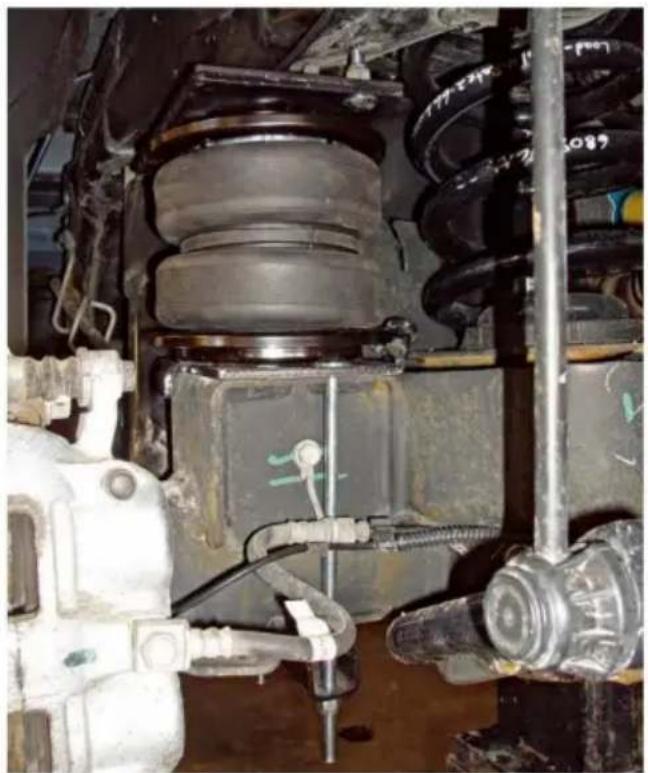
Left (driver's) side back view shown with tire removed
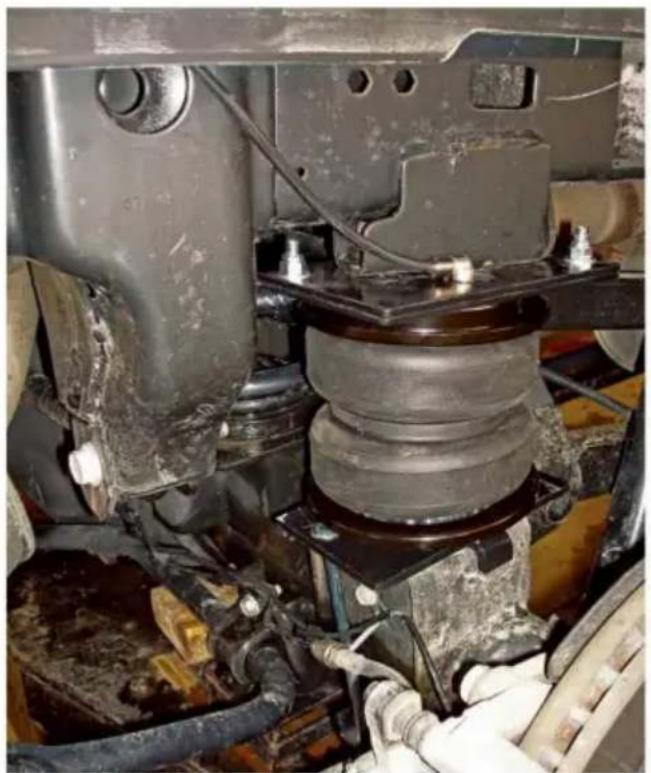
Right (passenger's) side view shown with tire removed
fig. 28
BEFORE USE
LEAK CHECK
DO NOT CUT THE AIR LINE AT THE FITTING AS THIS
COULD NICK
THE BARB AND MAKE THE FITTING USELESS.
INSTALLATION CHECKLIST
Minimum Recommended Pressure
5 PSI (.34BAR)
Maximum Air Pressure
100 PSI (7BAR)
MAINTENANCE INSTRUCTIONS
Bottoming out
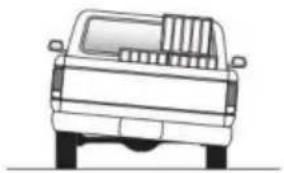
Unlevel
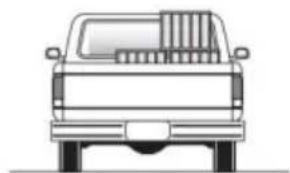
Level fig. 33
Location, Rancho Cucamonga, CA 91730
YH CONSULTING LIMITED.
C/O YH Consulting Limited Office 147,
Centurion House, London Road,
Staines-upon-Thames, Surrey, TW18 4AX
E-CrossStu GmbH
Mainzer Landstr.69,
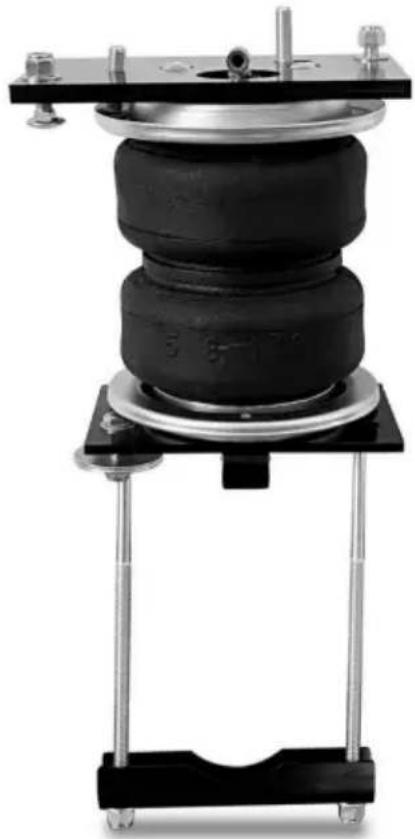
fig. 1
FIRST STEPS
fig. 2
fig. 4
Machine Translated by Google
fig. 11
fig. 15
fig. 16
* For LoadLifter Ultimate Plus kits, the recommended location for the Schrader valves is the rear bumper area or license plate.
A. Inside fuel tank filler door B. Inside rear wheel wells C. License plate or rear bumper area*
fig. 20

CAUTION
fig. 22
Air Line Setup Without Compressor System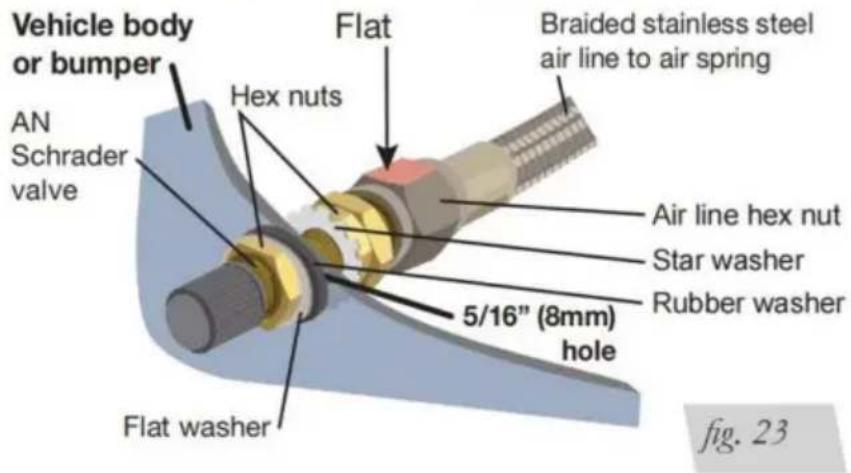
Air Line Setup for Compressor Integration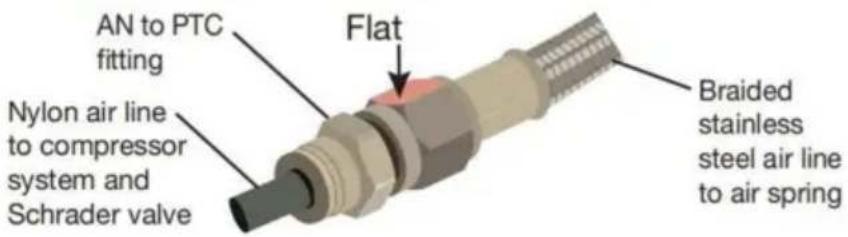
fig. 24
Left (driver's) side top view
Right (passenger's) side top view
fig. 26
Left (driver's) side back view shown with tire removed
Right (passenger's) side view shown with tire removed
fig. 28
BEFORE OPERATION
CHECK FOR LEAKS
Minimum Recommended Pressure
5 PSI (.34BAR)
Maximum Air Pressure
100 PSI (7BAR)
MAINTENANCE GUIDELINES
Bottoming out
Unlevel
Level fig. 33
C/O YH Consulting Limited Office 147,
Centurion House, London Road,
Staines-upon-Thames, Surrey, TW18 4AX
www.vevor.com/support
VEVOR®
TOUGH TOOLS, HALF PRICE
AIRBAG SUSPENSION KIT
MODEL: 7X 57289
AIRBAG SUSPENSION KIT
MODEL: 7X 57289
NEED HELP? CONTACT US!
fig. 1
START
fig. 2
fig. 4
- Remove the left and right side bump stops (Fig. 5 and 6).
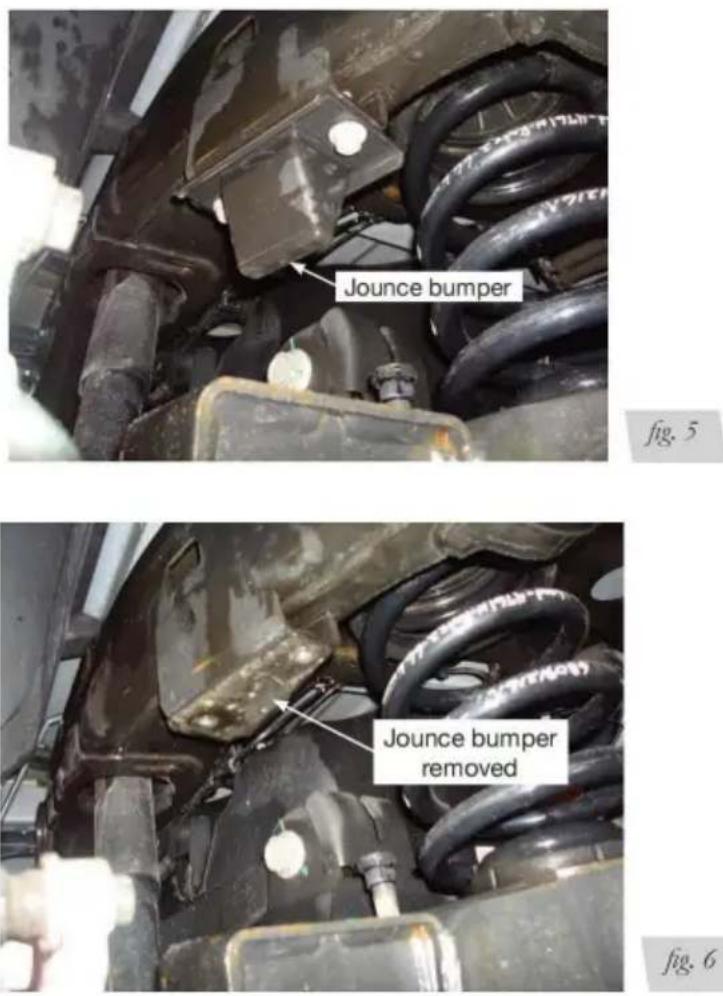
fig. 11
fig. 15
fig. 16
* For LoadLifter Ultimate Plus kits, the recommended location for the Schrader valves is the rear bumper area or license plate.
A. Inside fuel tank filler door
B. Inside rear wheel wells
C. License plate or rear bumper area*
fig. 20

CAUTION
MAINTAIN AT LEAST 6" OF CLEARANCE BETWEEN ALL AIR LINES AND THE EXHAUST SYSTEM. AVOID SHARP BENDS AND EDGES.
MAINTAIN AT LEAST 6" OF CLEARANCE BETWEEN ALL AIR LINES AND THE EXHAUST SYSTEM. AVOID SHARP BENDS AND EDGES.
MAINTAIN AT LEAST 6" OF CLEARANCE BETWEEN ALL AIR LINES AND THE EXHAUST SYSTEM. AVOID SHARP BENDS AND EDGES.
fig. 22
INSTALLATION OF STAINLESS STEEL BRAIDED AIR LINES

CAUTION
Air Line Setup Without Compressor System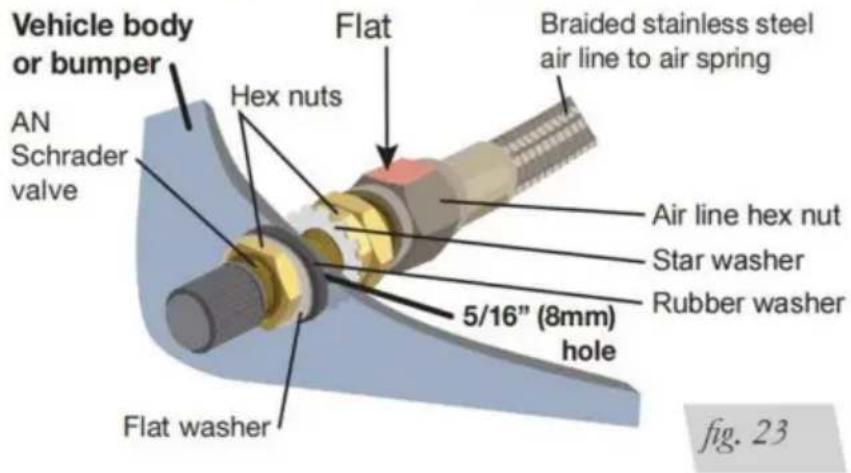
Air Line Setup for Compressor Integration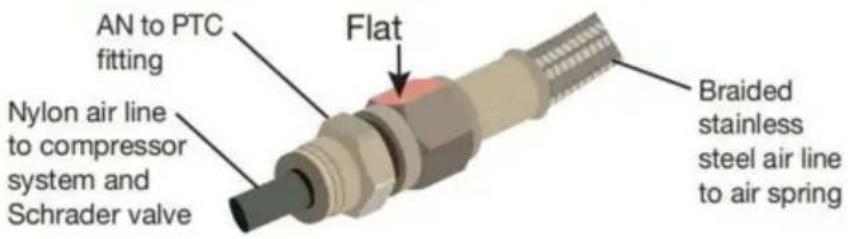
fig. 24
Left (driver's) side top view
Right (passenger's) side top view
fig. 26
Left (driver's) side back view shown with tire removed

Right (passenger's) side view shown with tire removed
fig. 28
BEFORE OPERATING
LEAK CHECK
Minimum Recommended Pressure
5 PSI (.34BAR)
Maximum Air Pressure
100 PSI (7BAR)
Bottoming out
Unlevel
Level fig. 33
Imported in AUS: SIHAO PTY LTD. 1 ROKEVA STREETEASTWOOD NSW 2122 Australia
C/O YH Consulting Limited Office 147,
Centurion House, London Road,
Staines-upon-Thames, Surrey, TW18 4AX
E-CrossStu GmbH
Mainzer Landstr.69,
electronics www.vevor.com/support
VEVOR®
TOUGH TOOLS, HALF PRICE

fig. 1
STARTING
fig. 2
fig. 4
fig. 11
fig. 15
fig. 16
* For LoadLifter Ultimate Plus kits, the recommended location for the Schrader valves is the rear bumper area or license plate.
A. Inside fuel tank filler door
B. Inside rear wheel wells
C. License plate or rear bumper area*
fig. 20

CAUTION
MAINTAIN AT LEAST 6" OF CLEARANCE BETWEEN ALL AIR LINES AND THE EXHAUST SYSTEM. AVOID SHARP CURVES AND EDGES.
Air Line Setup Without Compressor System
Air Line Setup for Compressor Integration
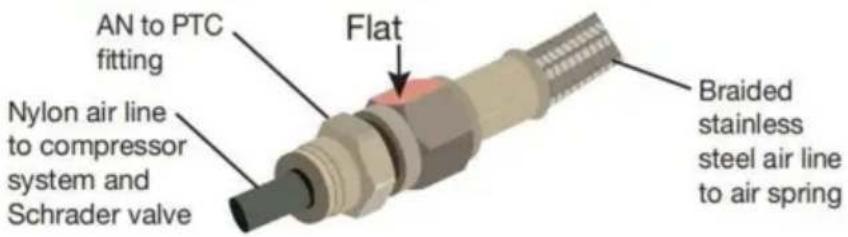
fig. 24
Left (driver's) side top view
Right (passenger's) side top view
fig. 26
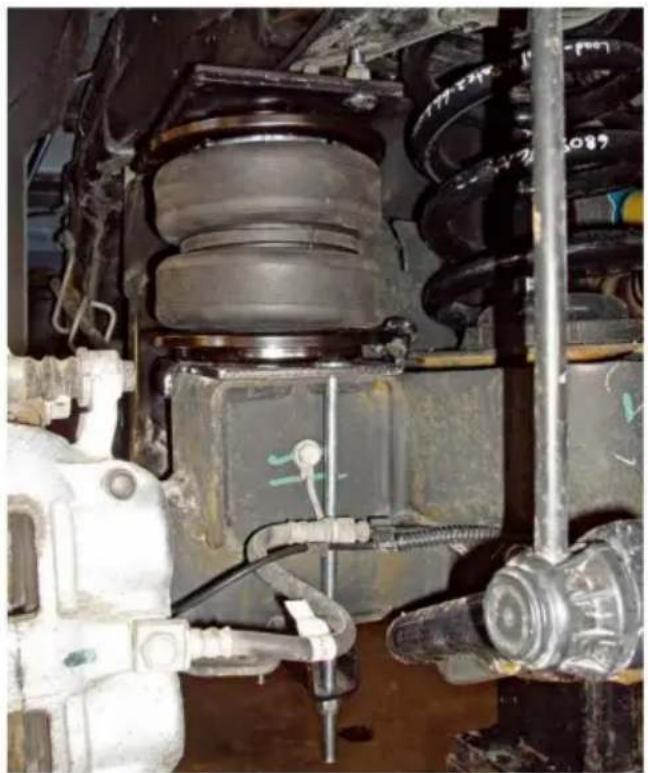
Left (driver's) side back view shown with tire removed
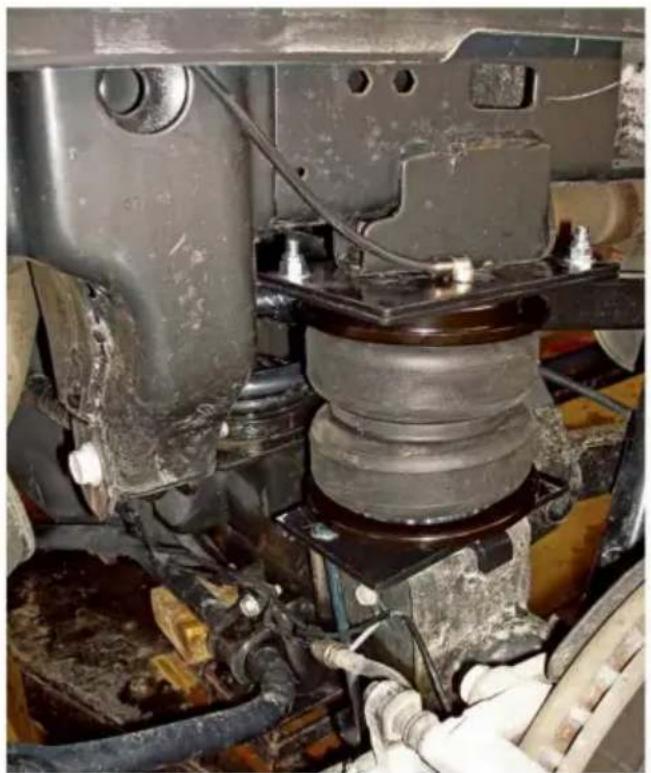
Right (passenger's) side view shown with tire removed
fig. 28
BEFORE OPERATING
CHECK FOR LEAKS
Minimum Recommended Pressure
5 PSI (.34BAR)
Maximum Air Pressure
100 PSI (7BAR)
Bottoming out
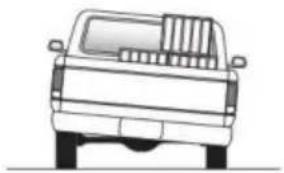
Unlevel
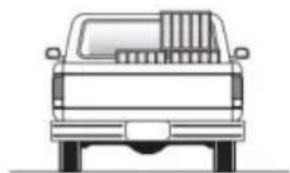
Level fig. 33
fig. 32 Troubleshooting guide
Centurion House, London Road,
Staines-upon-Thames, Surrey, TW18 4AX
E-CrossStu GmbH
Mainzer Landstr.69,
NEED HELP? CONTACT US!
fig. 1
STARTING
fig. 2
fig. 4
fig. 11
fig. 15
fig. 16
* For LoadLifter Ultimate Plus kits, the recommended location for the Schrader valves is the rear bumper area or license plate.
A. Inside fuel tank filler door
B. Inside rear wheel wells
C. License plate or rear bumper area*
fig. 20

CAUTION
KEEP AT LEAST 6" CLEARANCE BETWEEN AIR
LINES AND EXHAUST SYSTEM. AVOID SHARP
BENDS AND EDGES.
fig. 22
INSTALLATION OF AIR LINES WITH STAINLESS STEEL BRAID

CAUTION
Air Line Setup Without Compressor System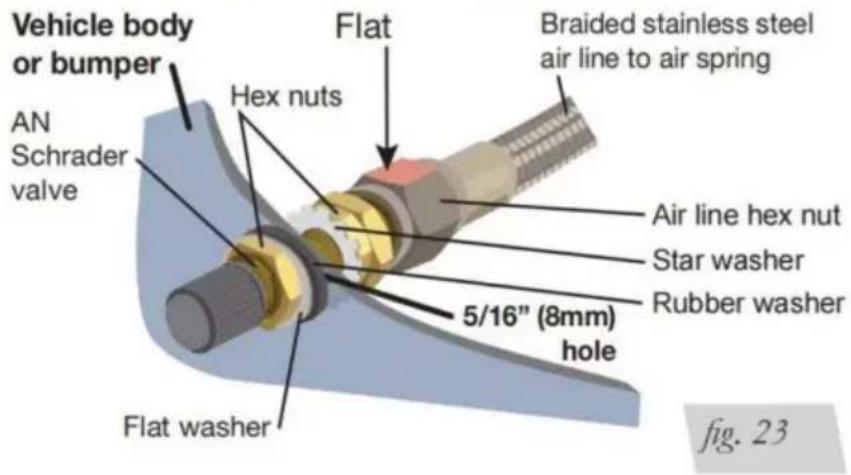
Air Line Setup for Compressor Integration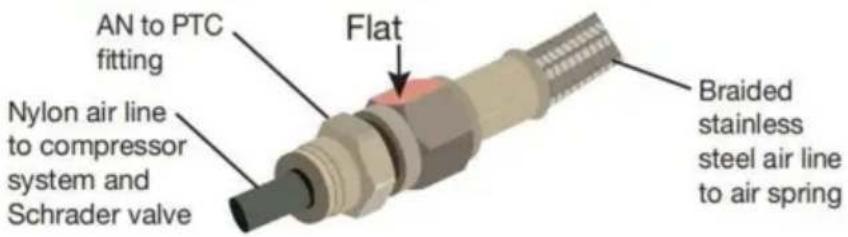
fig. 24
Left (driver's) side top view
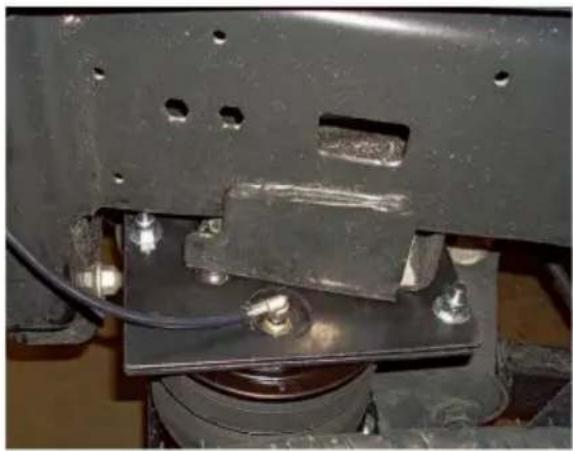
Right (passenger's) side top view
fig. 26
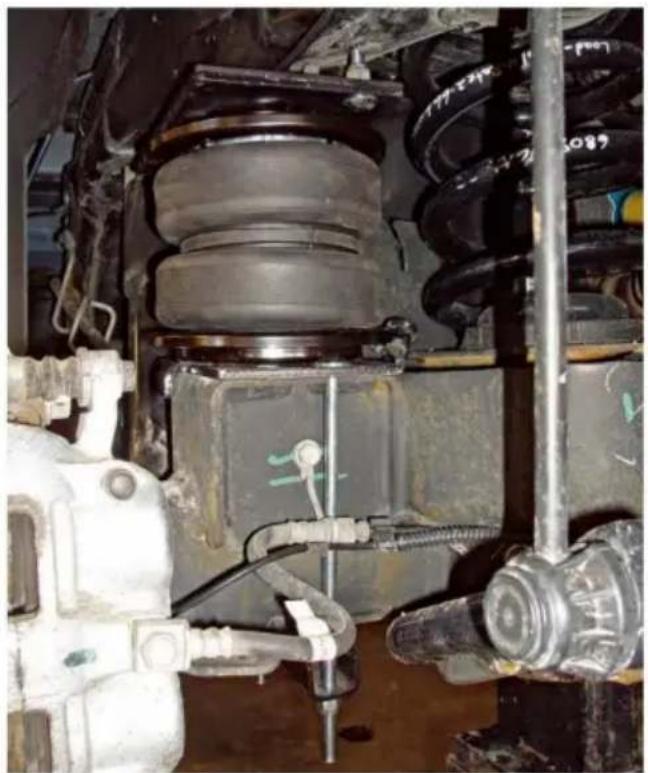
Left (driver's) side back view shown with tire removed
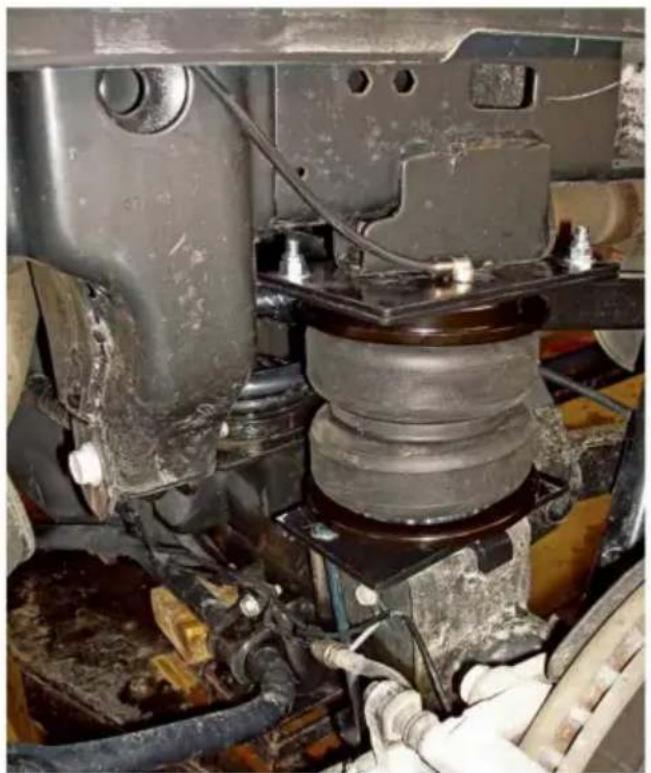
Right (passenger's) side view shown with tire removed
fig. 28
BEFORE OPERATION
CHECKING FOR LEAKS
Minimum Recommended Pressure
5 PSI (.34BAR)
Maximum Air Pressure
100 PSI (7BAR)
MAINTENANCE GUIDELINES
Bottoming out

Unlevel
Level fig. 33
C/O YH Consulting Limited Office 147,
Centurion House, London Road,
Staines-upon-Thames, Surrey, TW18 4AX
| REPREZENT KE |
E-CrossStu GmbH
Mainzer Landstr.69,
60329 Frankfurt am Main.
VEVOR®
TOUGH TOOLS, HALF PRICE
www.vevor.com/support
VEVOR®
TOUGH TOOLS, HALF PRICE
Technical support and e-warranty certificate www.vevor.com/support
AIRBAG SUSPENSION KIT
MODEL: 7X 57289
NEED HELP? CONTACT US!
| ITEM | BESCHRIJVING | AANTAL | ITEM | BESCHRIJVING | AANTAL |
| A Bovenste framebeugel | 2 | L | 3/8"-24 x 7/8"Bolkopschroef | 4 | |
| B | Bovenste luchtveer haakje | 2 | M 3/8" | platte sluitring | 10 |
| C Onderbeugel | 2 | N Klemstang | 2 | ||
| D | Rolplaat (zilver zink verguld) | 4 | O Ritssluiting | 6 | |
| EN | 3/8"-16 x 1,25"Zeskantbout | 2 | P | Sterren wasmachine | 2 |
| F | 3/8"-16 x 10"Slotbout | 4 | Q 5/16" Zeskantmoer | 4 | |
| G Luchtveer | 2 | R | 3/8"-16 x 1,25"Slotbout | 4 | |
| H | Grote platte sluitring | 2 | S | M10-1.5Bolkopschroef | 4 |
| I | Nylon luchtleiding | 1 | T Rubberen ring | 2 | |
| J IN | 3/8"-24 x 3/4"Platkopschroef | 4 | 3/8"-16 Nylon slot noot | 10 | |
| K | Push-to-connect(PTC) montage | 2 | V M8 | Platte sluitring | 2 |
fig. 1
GETTING STARTED
fig. 2
fig. 4
fig. 11
fig. 15
fig. 16
* For LoadLifter Ultimate Plus kits, the recommended location for the Schrader valves is the rear bumper area or license plate.
A. Inside fuel tank filler door
B. Inside rear wheel wells
C. License plate or rear bumper area*
fig. 20

CAUTION
KEEP AT LEAST 15 cm OF CLEARANCE BETWEEN ALL AIR LINES AND THE EXHAUST SYSTEM. AVOID SHARP BENDS AND EDGES.
INSTALLING NYLON AIR LINES
fig. 22
INSTALLING BRAIDED STAINLESS STEEL AIR LINES

CAUTION
KEEP THE AIR LINE AWAY FROM THE FUEL LINE, BRAKE LINES, AND ELECTRICAL WIRES.
Air Line Setup Without Compressor System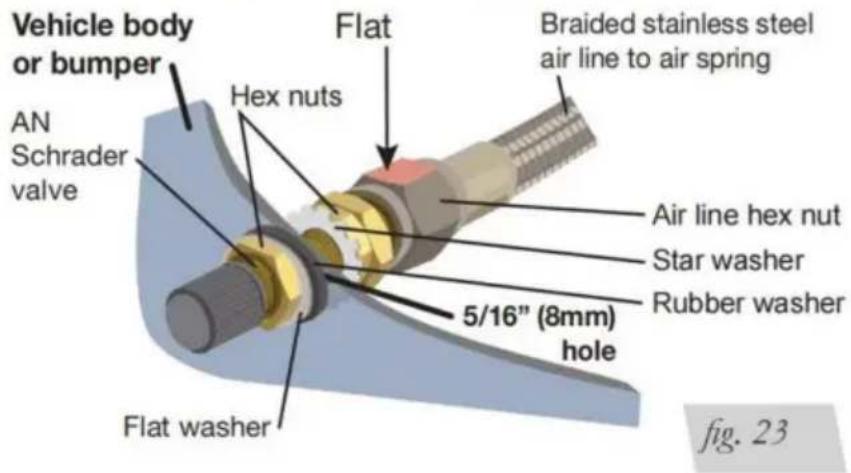
Air Line Setup for Compressor Integration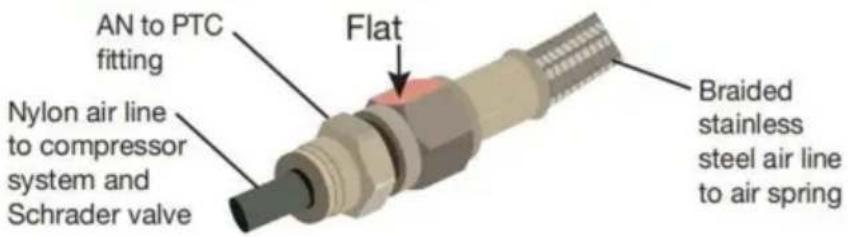
fig. 24
Left (driver's) side top view
Right (passenger's) side top view
fig. 26
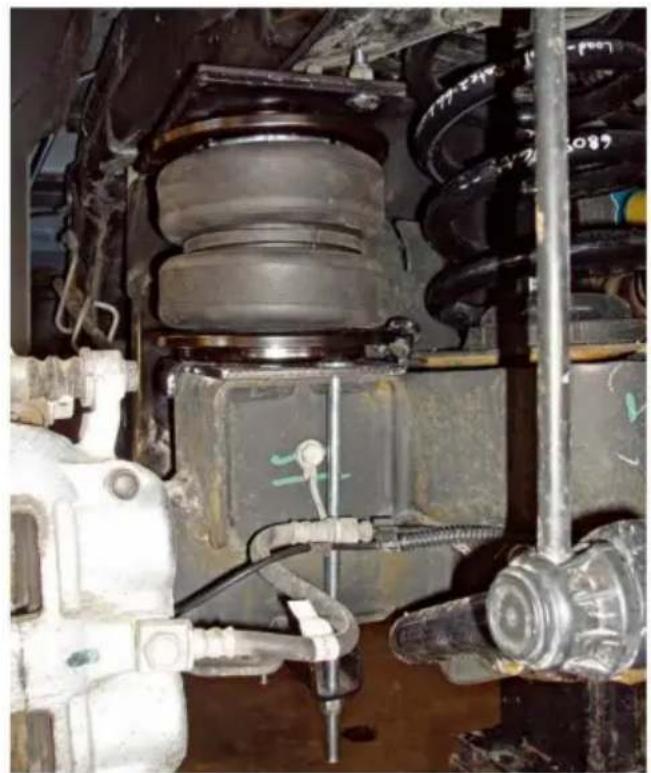
Left (driver's) side back view shown with tire removed
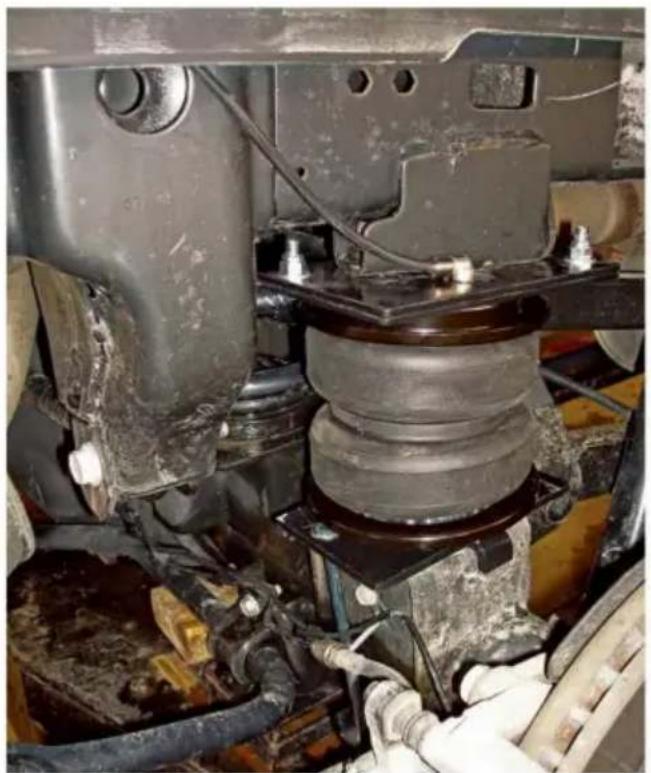
Right (passenger's) side view shown with tire removed
fig. 28
BEFORE USE
CHECK FOR LEAKS
Minimum Recommended Pressure
5 PSI (.34BAR)
Maximum Air Pressure
100 PSI (7BAR)
MAINTENANCE GUIDELINES
Bottoming out
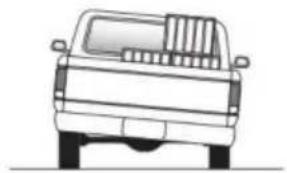
Unlevel

Level fig. 33
C/O YH Consulting Limited Office 147,
Centurion House, London Road,
Staines-upon-Thames, Surrey, TW18 4AX
E-CrossStu GmbH
Mainzer Landstr.69,
60329 Frankfurt am Main.
VEVOR®
TOUGH TOOLS, HALF PRICE
Warranty certificate www.vevor.com/support
VEVOR®
TOUGH TOOLS, HALF PRICE
NEED HELP? CONTACT US!
fig. 1
GETTING STARTED
fig. 2
fig. 4
Right (passenger) side mounting fig. 10
fig. 11
Right (passenger) side mounting
fig. 14
ATTACHING THE UNITS TO THE FRAME
fig. 15
fig. 16
* For LoadLifter Ultimate Plus kits, the recommended location for the Schrader valves is the rear bumper area or license plate.
A. Inside fuel tank filler door B. Inside rear wheel wells C. License plate or rear bumper area*
fig. 20

CAUTION
KEEP AT LEAST 6" CLEARANCE BETWEEN ALL AIR
LINES AND THE EXHAUST SYSTEM. AVOID SHARP
BENDS AND EDGES.
INSTALL NYLON AIR LINES
INSTALL STAINLESS STEEL BRAIDED AIR LINES

CAUTION
KEEP AIR LINES AWAY FROM FUEL LINES, BRAKE LINES, AND ELECTRICAL WIRING.
Air Line Setup Without Compressor System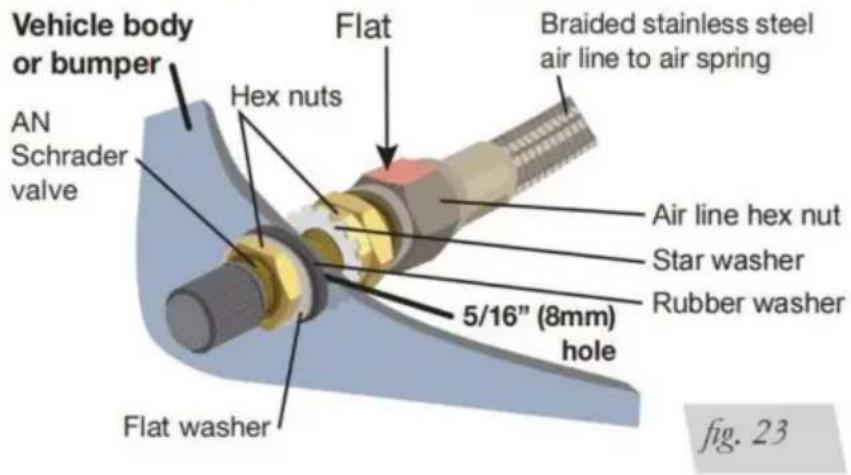
Air Line Setup for Compressor Integration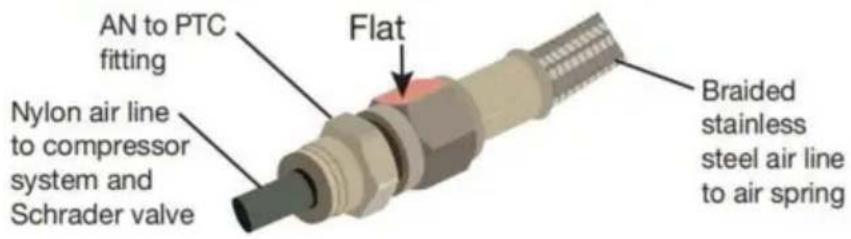
fig. 24
Completed installation photos
Left (driver's) side top view
Right (passenger's) side top view
fig. 26
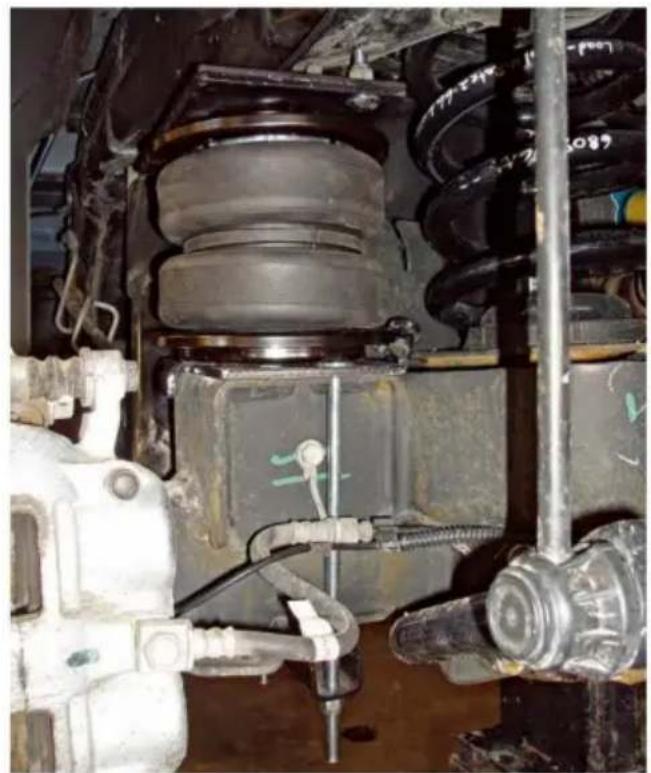
Left (driver's) side back view shown with tire removed
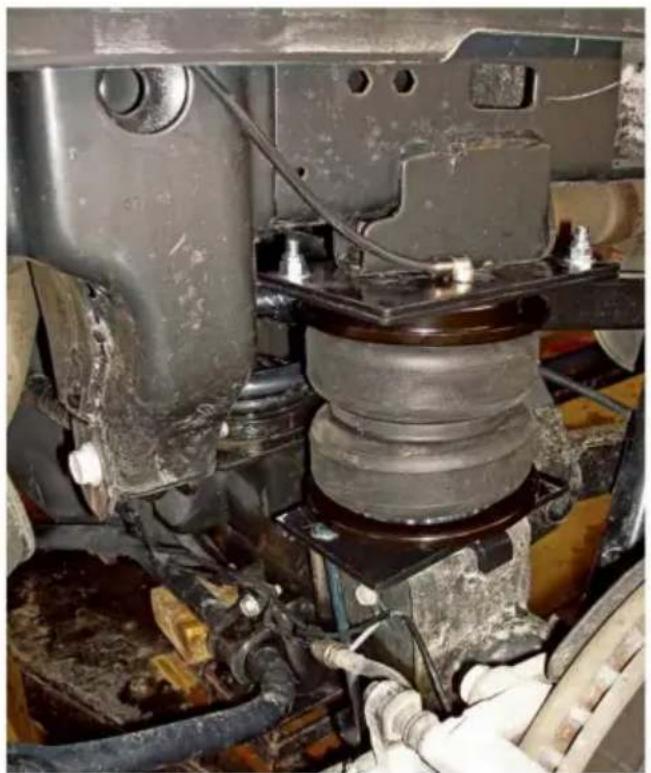
Right (passenger's) side view shown with tire removed
fig. 28
BEFORE USE
CHECK FOR LEAKS
DO NOT CUT THE AIR LINE AT THE FITTING AS THIS
COULD DAMAGE IT
AND MAKE THE CREW UNUSABLE.
INSTALLATION CHECKLIST
Minimum Recommended Pressure
5 PSI (.34 BAR)
Maximum Air Pressure
100 PSI (7 BAR)
MAINTENANCE GUIDELINES
Bottoming out
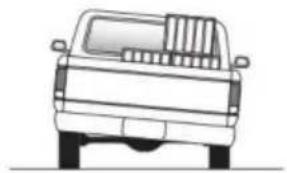
Unlevel
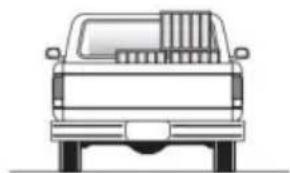
Level fig. 33
fig. 32 Troubleshooting guide
C/O YH Consulting Limited Office 147,
Centurion House, London Road,
Staines-upon-Thames, Surrey, TW18 4AX
| EC | REP |
E-CrossStu GmbH
Mainzer Landstr.69,
60329 Frankfurt am Main.
VEVOR®
TOUGH TOOLS, HALF PRICE
www.vevor.com/support
- AIR BAG SUSPENSION KIT
- VEVOR®
- NEED HELP? CONTACT US
- IMPORTANT SAFETY NOTICE
- PARTS LIST
- GETTING STARTED
- BUILDING THE AIR SPRING ASSEMBLIES
- FINISHED ASSEMBLIES
- ATTACHING THE ASSEMBLIES TO THE FRAME
- INSTALLING THE AIR LINES
- CAUTION
- INSTALLING NYLON AIR LINES
- INSTALLING BRAIDED STAINLESS STEEL AIR LINES
- FINISHED INSTALLATION PHOTOS
- BEFORE OPERATING
- CHECKING FOR LEAKS
- FIXING LEAKS
- INSTALLATION CHECKLIST
- POST-INSTALLATION CHECKLIST
- PRODUCT USE, MAINTENANCE AND SERVICING
- MAINTENANCE GUIDELINES
- TUNING THE AIR PRESSURE
- LEVEL VEHICLE
- RIDE COMFORT
- STABILITY
- GUIDELINES FOR ADDING AIR
- FREQUENTLY ASKED QUESTIONS
- TOUGH TOOLS, HALF PRICE
- ATTACHING ASSEMBLIES TO THE FRAME
- INSTALLATION OF NYLON AIR LINES
- INSTALLATION OF STAINLESS STEEL BRAIDED AIR LINES
- AIR LINE SETUP WITHOUT COMPRESSOR SYSTEM
- AIR LINE SETUP FOR COMPRESSOR INTEGRATION
- BEFORE USE
- LEAK CHECK
- MINIMUM RECOMMENDED PRESSURE
- PSI (.34BAR)
- MAXIMUM AIR PRESSURE
- PSI (7BAR)
- MAINTENANCE INSTRUCTIONS
- FIRST STEPS
- MACHINE TRANSLATED BY GOOGLE
- BEFORE OPERATION
- CHECK FOR LEAKS
- AIRBAG SUSPENSION KIT
- START
- STARTING
- INSTALLATION OF AIR LINES WITH STAINLESS STEEL BRAID
- ATTACHING THE UNITS TO THE FRAME
- INSTALL NYLON AIR LINES
- INSTALL STAINLESS STEEL BRAIDED AIR LINES
- COMPLETED INSTALLATION PHOTOS
Brand : Vevor
Model : 7X 57289
Category : Air suspension kit