SSC-15D - Toys Vevor - Free user manual and instructions
Find the device manual for free SSC-15D Vevor in PDF.


User questions about SSC-15D Vevor
0 question about this device. Answer the ones you know or ask your own.
Ask a new question about this device
Download the instructions for your Toys in PDF format for free! Find your manual SSC-15D - Vevor and take your electronic device back in hand. On this page are published all the documents necessary for the use of your device. SSC-15D by Vevor.
USER MANUAL SSC-15D Vevor
Technical Support and E-Warranty Certificate www.vevor.com/support
CHESS AND BACKGAMMON/CHECKERS TRIAD INSTRUCTIONS MODEL:SSC-15D
We continue to be committed to provide you tools with competitive price. "Save Half", "Half Price" or any other similar expressions used by us only represent estimate of savings you might benefit from buying certain tools with us compared top brands and does not necessarily mean to cover all categories of tools offered are kindly reminded to verify carefully when you are placing an order with us actually saving half in comparison with the top major brands.
MODEL:SSC-15D
natural_image
Chessboard with pieces arranged on a checkered board, no text or symbols visibleNEED HELP? CONTACT US!
Have product questions? Need technical support? Please feel fr contact us:
Technical Support and E-Warranty Certificate www.vevor.com/support
This is the original instruction, please read all manual instruction carefully before operating. VEVOR reserves a clear interpretation user manual. The appearance of the product shall be subject to product you received. Please forgive us that we won't inform you there are any technology or software updates on our product.
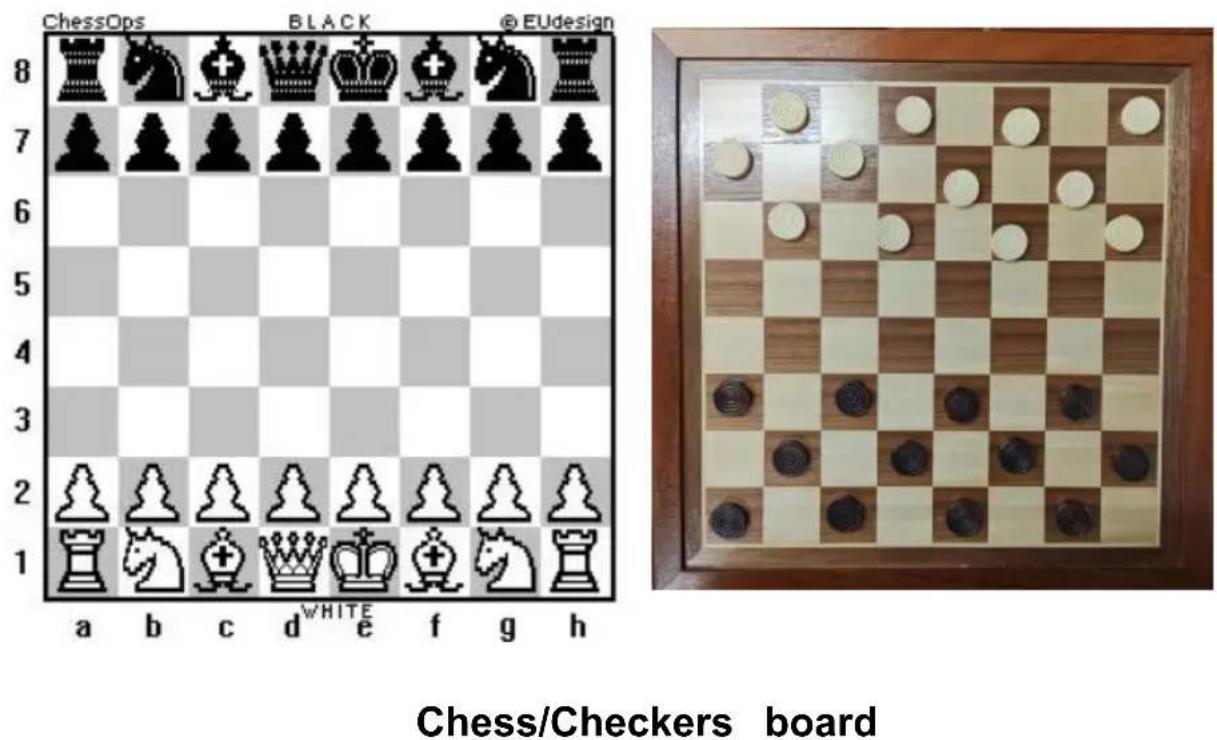
Welcome to choose this product, this product has both chess and checkers. shared chessboard; So you can choose how to play accord your needs. (See Figure 1).
text_image
ChessOps BLACK @ EUdesign 8 7 6 5 4 3 2 1 a b c d WHITE e f g h Chess/Checkers boardFigure 1
Chess gameplay instructions
Setting up the board
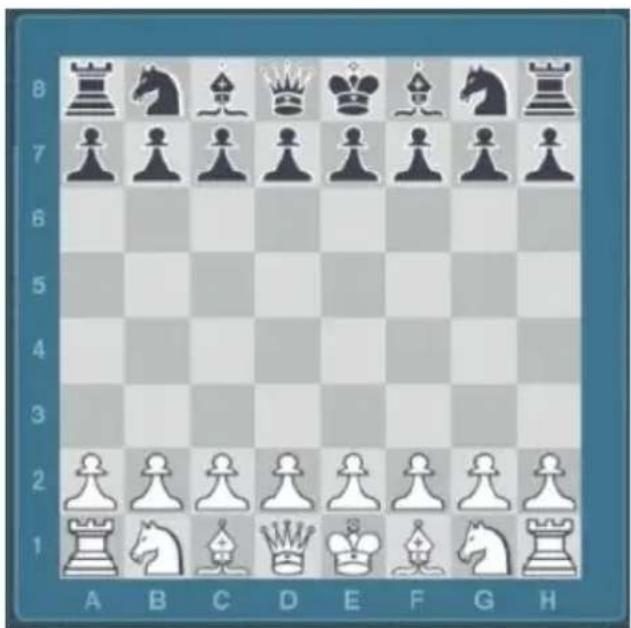
Chess is a game of strategy believed to have been invented more than 1 years ago in India It ig a game for two players, one with the light pieces a with the dark pieces. The chessboard is eight squares long by eight squares. When sitting across the board from another player the lighter color square go each player's right hand side("light on right") and the white queen is placed white square and the black queen on the black square("queen on her own c). The starting position of the pieces is shown in the following chessboard(See Figure 2).
The player with the white pieces moves first and the players then take turn moving. One piece may be moved at each turn except for castling (which is described below).
Ranks and files
Going from left to right, the vertical rows on the board, called files, are a through h. The horizontal rows, called ranks, are numbered 1 to 8. The 1 white's side of the board; 8 is black's side. This system can be used to show square a piece is on in a way like the game Battleship. When the board is the square a1 will be on the white player's left side.(See Figure 2).
text_image
8 7 6 5 4 3 2 1 A B C D E F G HFigure 2
Chess pieces and how to move them
In our club, once you move a piece and take your hand off i cannot change your move, unless your opponent lets you, which they not need to do. However, you may touch a piece, consider a move the piece back in its original position, as long as you don't take y off of the piece during the process.
King Moves
The most important piece on the board is the King. The king can one and only one space at a time, in any direction (left, right, for backward, and diagonally). The capture of the king is the object of game..(Figure3)

text_image
8 7 6 5 4 3 2 1 A B C D E F G HFigure3
●Queen Moves
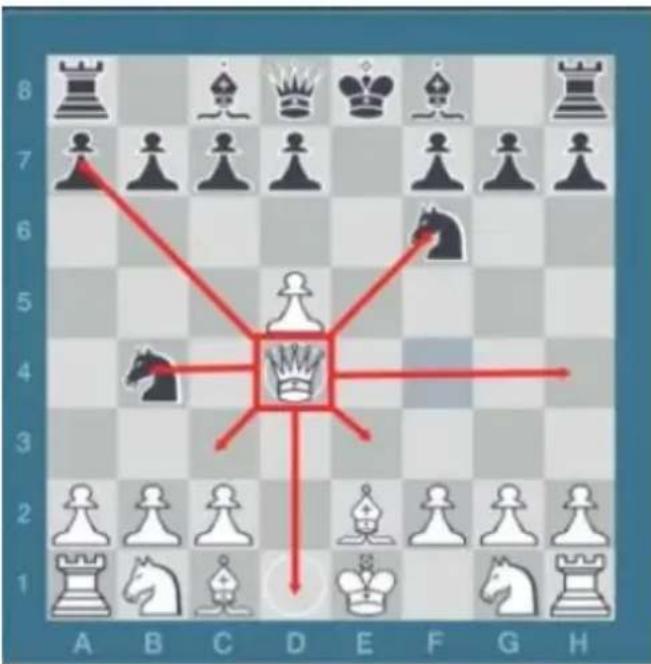
The Queen is the most powerful piece, as it can either move diagonally or in a straight line, which makes it like a bishop and together. The queen cannot move like a knight. When the board is the queen always starts on her own color, so the white queen always starts on a white square. The queen is worth 9 points because she move to so many places on the board so quickly.(Figure4)
text_image
8 7 6 5 4 3 2 1 A B C D E F G HFigure4
●Rook Moves
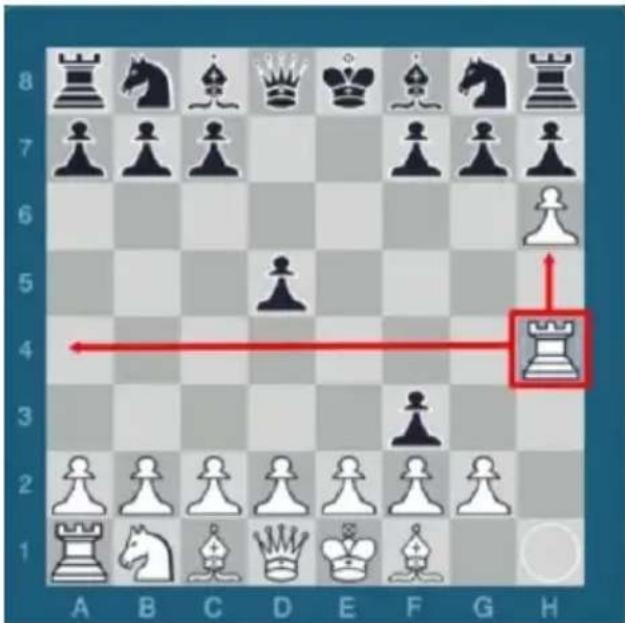
The Rook moves in a straight line in any direction, as many space it likes, without jumping. Rooks shouldn't usually be used until later game, and should almost never be brought out at the beginning, because they will be harassed by pawns and other pieces, wasting for the player who brought out the rook. This piece might also be being brought out early, which is bad because the rook is valued (Figure5).
text_image
8 7 6 5 4 3 2 1 A B C D E F G HFigure5
●Bishop Moves

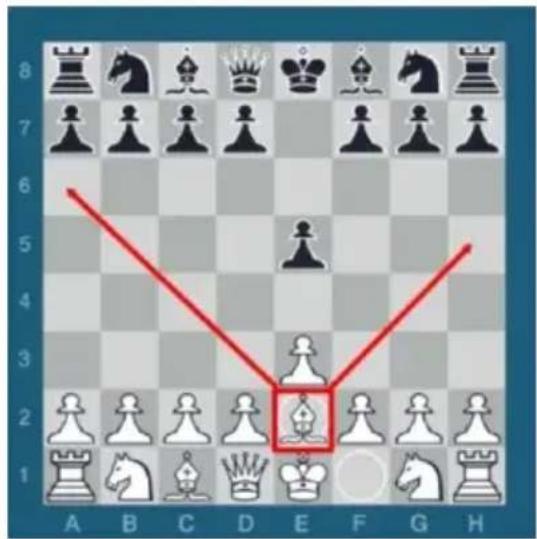
The Bishop moves diagonally, any distance along a diagonal, with jumping over any pieces. A bishop that starts on a black square w always be on a black square, so it can only get to half the square board. The bishops value is 3.(Figure6)
text_image
A B C D E F G H 1 2 3 4 5 6 7 8Figure6
●Knight Move

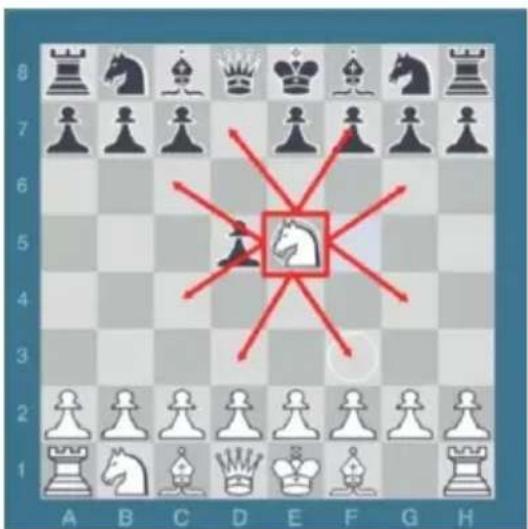
Knights move in an L-shaped pattern. A knight moves one square over two squares up, or two squares over and one square up, one square of two squares back, etc. as long as the same shape and size of the jump maintained. The knight is the only piece that can jump over other pieces jumps straight to a square without disturbing any of the pieces in between. Knights are generally brought out early, and this is good. The knight's
3.(Figure7)
text_image
8 7 6 5 4 3 2 1 A B C D E F G HFigure7
●Pawn Moves
White pawns start on rank two, black pawns on rank 7. The f a pawn is moved it can move forward either one or two ranks. jump over another piece. After it has moved once, whether it has up one or two, a pawn can only move one square forward at a it cannot move backward. If a pawn advances to the end rank (8 white, 1 for black) then it is promoted, which means it is exchanged for any other piece, with the exception of a king or another pawn. I are moved from the chessboard itself; in this way a color can ha (or more!) queens at the same time. The pawn’s “value” is 1.(Fig

text_image
8 7 6 5 4 3 2 1 A B C D E F G HFigure8
●Capturing:
A piece captures an opponent's piece by moving onto the square occupied by the opponent's piece. That piece is removed from the and replaced by the capturing piece. Knights, Bishops, Rooks, Que and Kings capture by moving in their normal way. The pawns can differently, by moving one square diagonally, either to the right or left, onto the piece to capture. They cannot capture by moving straight forward. At no time may more than one piece stay in any square pieces cannot capture a piece of the same color.
- Check and Checkmate:
When a piece would be able to capture the opposing king on the next turn, the king is said to be in check. The king in danger must get out of check on the next turn, either by moving out of the way, blocking the check with another piece, or capturing the attacking piece, whatever removes the threat. It is illegal to move your king into check, so, for instance, you can't move your king next to the opponent's king. The goal of the game is to put the opposing king in checkmate, which means he is in check and cannot be saved by any of the ways of escaping check. At this time the game is over, with the player whose king cannot escape check losing. The first player to get the opponent's king wins; if white checkmate black, black has lost, even if the black player could have checkmated white on the next move. If you see that you are going to lose, you can resign by knocking over your king, gently! After checkmate or a resignation, shake hands across the board with your opponent and congratulate him or her on a good game.
●Draws:
If a king is not in check, but no legal move can be played without putting king in check, then the game is a stalemate, which is a tie, or draw. This us happens when a player has only a king left and the other player, with many pieces left, creates a position in which the king cannot move but is not threatened. Another way to draw is if both players move 50 times in a row total of 100 moves) without capturing a piece or promoting a pawn. Players may also agree on a draw when they see it coming; to do this, extend your hand over the board, to shake hands, and say, “I offer a draw.” If the oppo
shakes your hand, it's a draw. The opponent does not need to accept! They may think they can win. The last way to draw is through three-time repetitive where the same sequence of moves is repeated three times in a row. This means not only one player's moves, but both players doing the same thing three times in a row.
Note: Special moves
- Castling:
If both the king and a rook have not been moved yet during the game, there are no pieces between them, and the king is not in check, then the king and rook can move in a special way called castling: the king moves two spaces toward the rook, and the rook moves to the other side of the king, right next to the king. Often, the puts the king in a more protected position, behind some pawns. The king cannot castle out of, though, or into check. He cannot move through a square threatened I an enemy piece.
●Capturing en passant:
en passant is a special way a pawn can capture another pawn. It is French for passing," which is helpful to know because the rule applies to a pawn which has just moved up two spaces, skipping over the square threatened by the opponent's pawn. Here is an example: a black pawn is on b4. The white pawn on c2 has no moved yet. On white's turn the pawn on c2 is moved to c4, evading capture by pawn on b4. But the pawn on b4 has the option, for one turn only, of capturing the white c-pawn. The black pawn moves to c3, and the white pawn is taken off the board. If black chooses not to capture immediately, then the chance is lost, and black may not capture en passant at a later time. En passant is always a one-turn chance for a pawn to capture a pawn which has evaded capture by moving up two spaces on its first turn. It does not apply to any other positions in only concerns pawns.
Checkers Instructions for how to play
(For 2 Players/ Ages 6 to Adult)
●GAME SETUP:
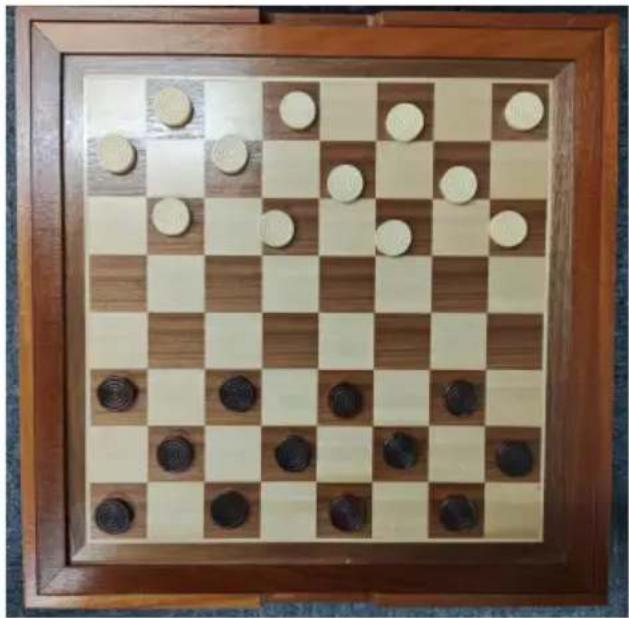
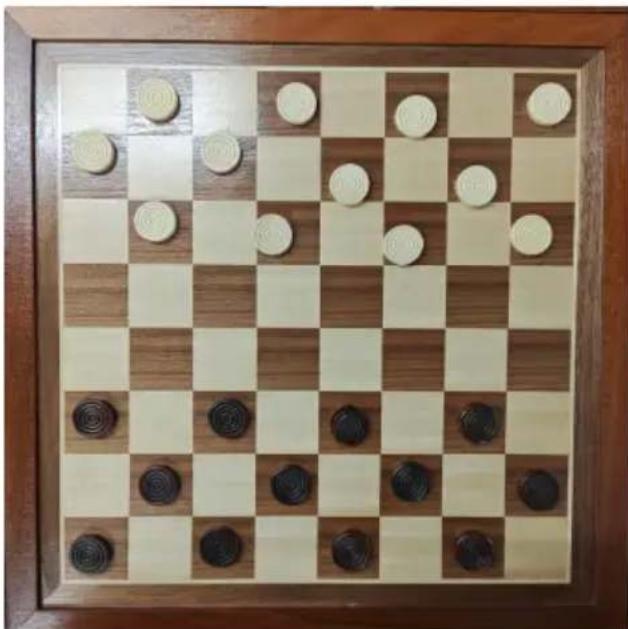
Take 12 checkers of the same color and place them on all of dark squares of the first three rows in front of you. Your opp does the same.(Figure10)
natural_image
Chessboard with pieces arranged on a checkered board, no text or symbols visibleFigure10
●HOW TO PLAY:
Choose a player to go first. On your turn, move any one of your by the movement rules described below. After you move one check your turn is over. The game continues with players alternating turns
●Movement Rules:
- Always move your checker diagonally forward, toward your opponent's side of the game board.
Note: After a checker becomes a "King" it can move diagonally
forward or backward.
-
Move your checker one space diagonally, to an open adjacent square; or jump one or more checkers diagonally to an open square adjacent to the checker you jumped. When you jump on an opponent's checker, you capture it (see Capturing an Opponent's Checker).
-
If all squares adjacent to your checker are occupied, your check is blocked and cannot move.
- OBJECT:
Remove all of your opponent's checkers from the game board capturing them.
●Capturing an Opponent's Checker:
If you jump an opponent's checker, you capture it. Remove it the game board and place it in front of you.
●Becoming a "King":
As soon as one of your checkers reaches the first row on your opponent's side of the game board, it becomes a King. Place another checker of the same color on top of it. Now this double-decker checker can move forward or backward on the game board.
●HOW TO WIN:
The first player to capture all opposing checkers from the game board wins the game!
ACCESSORIES LIST
- Chessman * 32
- Chess Instructions * 1
- Checkers * 30
- Storage bag *2
VEVOR®
TOUGH TOOLS, HALF PRICE
Technical Support and E-Warranty Certificate www.vevor.com/support
VEVOR®
TOUGH TOOLS, HALF PRICE
natural_image
Chessboard with pieces arranged in mid-game position, wooden and beige squares (no text or symbols)natural_image
Chessboard with pieces arranged for mid-game analysis (no text or symbols)Abbildung 10
ÿSPIELANLEITUNG:
natural_image
Chessboard with pieces arranged in mid-game position, wooden and beige squares (no text or symbols)POTRZEBUJESZ POMOCY? SKONTAKTUJ SIĘ Z NAMI!
natural_image
Chessboard with pieces arranged on a checkered board, no text or symbols visiblenatural_image
Chessboard with pieces arranged for mid-game analysis (no text or symbols)Rysunek 10
JAK GRAĆ:
natural_image
Chessboard with pieces arranged in mid-game position, wooden and beige squares (no text or symbols)BESOIN D'AIDE? CONTACTEZ-NOUS!
natural_image
Chessboard with pieces arranged on a checkered board, no text or symbols visibleÉchiquier/dames
Figure 1
natural_image
Chessboard with pieces arranged for mid-game analysis (no text or symbols)Figure 10
COMMENT JOUER :
natural_image
Chessboard with pieces arranged in mid-game position, wooden and beige squares (no text or symbols)HULP NODIG? NEEM CONTACT MET ONS OP!
www.vevor.com/support
natural_image
Chessboard with pieces arranged for mid-game analysis (no text or symbols)Figuur 10
ÿHOE TE SPELEN:
ÿHOE JE KUNT WINNEN:
natural_image
Chessboard with pieces arranged in mid-game position, wooden and beige squares (no text or symbols)natural_image
Chessboard with pieces arranged for mid-game analysis (no text or symbols)Figura 10
CÓMO JUGAR:
natural_image
Chessboard with pieces arranged on a checkered board, framed in wooden frame (no text or symbols)BEHÖVER HJÄLP? KONTAKTA OSS!
natural_image
Chessboard with pieces arranged for mid-game analysis (no text or symbols)Figur 10
ÿHUR MAN SPELAR:
natural_image
Chessboard with pieces arranged in mid-game position, wooden and beige squares (no text or symbols)natural_image
Chessboard with pieces arranged for mid-game analysis (no text or symbols)Figura 10