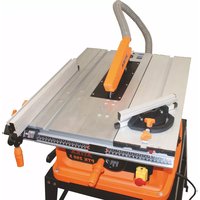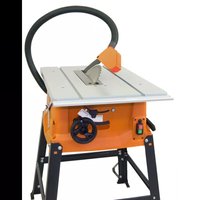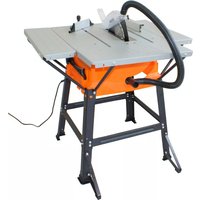
T 250 N-3 - Saw ATIKA - Free user manual and instructions
Find the device manual for free T 250 N-3 ATIKA in PDF.


| Brand | ATIKA |
| Model | T 250 N-3 |
| Type | Table circular saw |
| Motor power | 2000 W (S6 – 25%) |
| Supply voltage | 220-240 V ~ |
| Mains frequency | 50 Hz |
| Blade speed | 5000 min⁻¹ |
| Blade diameter | 250 mm |
| Blade bore | 30 mm |
| Cutting depth at 90° | 0-85 mm |
| Cutting depth at 45° | 65 mm |
| Blade tilt | 0° to 45° |
| Table dimensions (with extensions) | 804 x 893 mm |
| Table height | 820 mm |
| Weight with stand | 21.0 kg |
| Extraction connection diameter | 35 / 40 mm |
| Mains fuse | 10 A delayed |
| Main functions | Rip cuts, cross cuts, mitre cuts and bevel cuts |
| Safety devices | Safety guard, riving knife, safety switch, motor protection |
| Maintenance and cleaning | Cleaning with brush or vacuum, oiling moving parts, blade replacement |
| General information | Manual in 168 pages, available in several languages |
Frequently Asked Questions - T 250 N-3 ATIKA
User questions about T 250 N-3 ATIKA
0 question about this device. Answer the ones you know or ask your own.
Ask a new question about this device
Download the instructions for your Saw in PDF format for free! Find your manual T 250 N-3 - ATIKA and take your electronic device back in hand. On this page are published all the documents necessary for the use of your device. T 250 N-3 by ATIKA.
USER MANUAL T 250 N-3 ATIKA
Original instructions
Notice originale
natural_image
Exterior view of a modern office building (no signage)

Do not operate machine before having read the operating instructions, understood all the notes and assembly the machine as described here.
Keep the instructions in a safe place for future use.
Contents
Extent of delivery 11
Declaration of conformity 11
Characteristics data of noise 12
Symbols machine /operating instructions 12
Normal intended use 12
Residual risks 13
Safety instructions 13
Description of device / Spare parts 13
Assembly 13
Preparing for commissioning 14
Commissioning 14
Mains connection 14
On / Off Switch 15
Dust/chip exhaustion 15
Adjusting the saw 15
Adjusting the riving knife 15
Set the cutting height 15
Adjust saw blade pitch 15
Fitting and adjusting the transverse stop 15
Fitting and adjusting the longitudinal stop 16
Working with the saw 16
Cutting narrow workpieces 16
Cutting wide workpieces 16
Cross cuts / mitre cuts 16
Cutting lengthwise and tilted 16
Maintenance and care 17
Maintenance 17
Cleaning 17
Transport 18
Storage 18
Possible faults 18
Technical data 19
Guarantee 19
Extent of delivery
After unpacking, check the contents of the box
▶ That it is complete
▶ Check for possible transport damage
Report any damage or missing items to your dealer, supplier or the manufacturer immediately. Complaints made at a later date will not be acknowledged.
— Power cable and plug
- TCT saw blade ∅ 250 x 1,8/2,8 x ∅ 30 mm; 40 teeth
• Circular saw T 250 N-3 including
- 4 table legs
• 2 connecting braces short
• 2 connecting braces long
- 4 push-on bases
• 2 additional braces
• Safety guard with exhaust outlet
- Splitting wedge
- Longitudinal stop
- Table length extension
• 2 supports for bench length extension
• 2 bench width extensions
• 4 supports for table width extensions
- Pushstick
- Extraction hose
- Screw bag
• 2 spanners for replacing saw blade
• Original operating instruction manual
• Safety instructions for circular table saws
• Assembly and operating instruction sheet
- Warranty declaration
EC Declaration of Conformity
No. (S-No.): 26382
according to EC directive: 2006/42/EC
We,
Altrad Lescha Atika GmbH
herewith declare under our sole responsibility that the product
Tischkreissäge (Circular Saw Bench)
Model M1H-ZP5-250A-1, Type T 250 N-3
Serial number: 000001 - 020000
is conform with the above mentioned EC directives as well as with the provisions of the guidelines below:
2014/30/EU and 2011/65/EU
Following harmonized standards have been applied:
EN 62841-1:2015; EN 62841-3-1:2014/A11:2017
EN 55014-1:2017; EN 55014-2:2015;
EN 61000-3-2:2014; EN 61000-3-3:2013
Duly authorised person for the compilation of technical documents:
Altrad Lescha Atika GmbH – Technical department
Josef-Drexler-Str. 8 – 89331 Burgau – Germany
Burgau, 18.10.2019
Engineering design management
Characteristic data of noise
DIN EN ISO 3744
Use of the machine as a bench to circular saw with standard circular saw blade.
| Noise power level Sound pressure level at the workplace | |
| L_WA = 107 dB(A) L | _pA = 94 dB(A) |
The factor of measurement uncertainty is 3 dB.
The values given are emission values and must therefore not simultaneously represent safe workplace values too. Although there is a relationship between emission and immersion levels, it can be reliably deduced whether additional precautionary measures are necessary or not. Factors, which can influence the immersion level currently existing at the workplace include the duration of the effects, the special type of the workroom, other noise sources, etc. e.g. the number of machines and other adjacent processes. The permissible workplace values can also vary from country to country. This information should however enable an improved assessment of the danger and risk to be carried out.
Symbols machine
 | Carefully read operator's manual before handling the machine. |
 | Wear eye and ear protection |
 | Wear dust mask. |
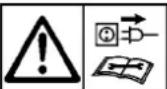 | Shut off engine and remove power cord before performing cleaning, maintenance or repair work. |
 | Do not expose to rain. Protect against humidity. |
 | Risk of injuries of fingers and hands by the saw blade |
 | This product complies with European regulations specifically applicable to it. |
 | Machine of the protection class II (double insulated) |
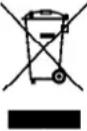 | Electrical devices do not go into the domestic rubbish. Give devices, accessories and packaging to an ecofriendly recycling.According to the European Directive 2012/19/EU on electrical and electronic scrap, electrical devices that are no longer serviceable must be separately collected and brought to a facility for an environmentally compatible recycling. |
Symbols Operating instructions
 | Threatened hazard or hazardous situation. Not observing this instruction can lead to injuries or cause damage to property. | |
 | Important information on proper handling of the saw. Not observing this instruction can lead to faults in the machine. | |
 | User information. This information helps you to use all the functions of the chain saw optimally. | |
 | Assembly, operation and servicing. Here you are explained exactly what to do. | |
   ... ... | Please refer to the attached assembly and operating instruction sheet for references to figure numbers in the text. |  |
Normal intended use
- The bench-type circular saw is intended exclusively for ripping and cross-cutting solid wood and panel materials such as chipboard, core-board and medium density fiberboard with square or rectangular cross-section using carbide tipped saw blades, whereby only saw blades in compliance with the norm EN 847-1 are allowed to be used with this machine.
■ The saw blade must have a diameter of 250 mm. - The use of saw blades made of HSS steel (high-alloy high speed steel) is not permitted since this steel is hard and brittle. Risk of injury through saw blade breakage and expulsion of saw blade pieces.
- Cutting round material (posts, firewood, etc.) is not permitted.
■ This saw may not be used for rebating or cutting grooves. - Do not use this saw for cutting inserts (grooves that end in the workpiece).
- Only workpieces which have been securely mounted and aligned can be processed.
- The intended usage also includes compliance with the operating, servicing and repair conditions prescribed by the manufacturer and following the safety instructions included in the instructions.
- The relevant accident prevention regulations for the operation as well as the other generally acknowledged occupational medicine and safety rules must be complied with.
- Any other use is deemed not to be use as prescribed. The manufacturer is not liable for any type of damage resulting from this: the user bears the sole risk.
- Independently made alterations to the circular saw preclude any liability of the manufacturer for resulting damages of any kind.
-
The circular saw may only be equipped, used and serviced by persons who are familiar with these and have been instructed in the hazards. Repair works may only be carried out by us or by a customer service agent nominated by us.
-
The machine may not be used in a potentially explosive environment or be exposed to the rain.
■ Metal parts (nails, etc.) must be removed from the timber to be sawn.
Residual risks
Even if used properly, residual risks can exist even if the relevant safety regulations are complied with due to the design determined by the intended purpose.
Residual risks can be minimised if the "Safety information" and the "Intended usage" as well as the whole of the operating instructions are observed.
Observing these instructions, and taking proper care, will reduce the risk of personal injury or damage to the equipment.
- Danger of injury of fingers and hands by the tool (saw blade) or work piece, e.g. when replacing the saw blade.
■ Injury from parts of the workpiece spinning off. - Throwback of the workpiece or workpiece parts.
■ Breakage and expulsion of saw blade. - Risk from electricity, by using non-standard electrical connections.
- Touching live parts of opened electrical components.
- Impairment of hearing when working on the machine for longer periods of time without ear protection.
- Emission of harmful timber dust when operating without exhaust suction.
In addition, in spite of all the precautionary measures taken, non-obvious residual risks can still exist.
Safety instructions
WARNING
Read all safety warnings and all instructions. Failure to follow the warnings and instructions may result in electric shock, fire and/or serious injury.

sure to observe the separately enclosed "General safety notices for circular table saws".
Save all warnings and instructions for future reference.
Description of device / spare parts
1
| Pos.-No. | Order-No. | Denomination |
| 2 | 366279 | Supporting leg |
| 3 | 366281 | Connection strut - short C |
| 4 | 366280 | Connection strut - long B |
| 5 | 366266 | Saw blade |
| 6 | × | Crank for height adjustment |
| 7 | 366504 | Safety guard |
| 8 | 366505 | Riving knife |
| 9 | 366261 | Extraction hose |
| 10 | × | Bench plate |
| 11 366254 Transverse stop cpl. | ||
| 11A | × | Stop bar |
| 12 | 366255 | Table insert |
| 13 366506 Longitudinal stop cpl. | ||
| 13A | × | Fence |
| 14 366271 Adjusting knob for incline adjustment | ||
| 15 366272 Clamping screw for incline adjustment | ||
| 16 | × | On/Off switch |
| 17 | × | Motor protection |
| 18 | 366270 | Dust extraction port |
| 19 | 366275 | Sliding stick |
| 22 366268 Saw blade flange 37 | ||
| 23 366269 Hexagonal screw for saw blade 37 | ||
| 24 366257 Guide section for longitudinal stop | ||
| 25 | × | Clamping lever for longitudinal stop |
| 26 | 366288 | Safety label |
| 27 | 366282 | Additional brace |
| 28 | × | Scale for cross-cut adjustment |
| 29 | 366283 | Slip-on foot |
| 30 | 366273 | Ring wrench size 10/21 |
| 31 Ring wrench size 10/13 | ||
| 32 | 366507 | Bench width extension |
| 33 366508 Bench length extension | ||
| 34a 366509 Support for table width extension, right | ||
| 34a 366510 Support for table width extension, left | ||
| 35 366511 Support for table length extension | ||
| 36 366513 Reinforcement brace for table width extension | ||
Assembly
Please refer to the attached assembly and operating instruction sheet.
① Tighten all screw connections only hand-tight first.
2 Place the saw with the table surface facing downwards onto a suitable work surface. Place then the table width extensions (32) and the table length extension (33) onto the table plate (10).
3 Secure the table width and table length extensions on the table plate.
4 i The supports have different lengths. Support for table width extension, right (34a) Support for table width extension, left (34b) Support for table length extensions (35)
5 Secure the table legs (2) together with their supports on the saw. First unscrew the hexagon screws M6 x 12 from the housing.
6 Secure then the supports on the table width and table length extensions.
7 Secure the braces Ⓑ (4) and Ⓓ (3) to the table legs.
ⓘ The braces have different lengths.
8 Secure the two long braces Ⓑ (4) first to the table legs.
9 Now secure the two short braces © (3).
10 Mount the push-on bases (29) to the table legs.
11 Install the additional braces (27).
① Firmly tighten all screw connections.
Turn the saw right side up so it stands on the table legs. Adjust the additional braces (27) so that they touch the ground.
12 Raise the saw blade (5) with the crank (6) to the highest position.
13 Remove the table insert (12).
14 Loosen the screw (A) and insert the blade guard (8) into the receiver.
15 Adjust the distance between saw blade and riving knife (8). The distance must be between 3 and 8 mm. Retighten the screw (A).
16 Attach the safety guard (7) to the riving knife (8).
Do not tighten the screw (B). The safety guard must lower itself again to the table top on its own after lifting it.
17 Slide the extraction hose (9) on the connection piece of the safety guard (7) and on the extractor neck (18) on the housing.
18 Fasten the stop bar (11A) on the transverse stop.
33 Place the pushstick (19) in its holder.
Preparing for commissioning
To achieve flawless functioning of the machine, please follow the instructions listed:
- Place the saw in a place that fulfils the following conditions:
– secured against slipping
– free of vibrations - even
– free of tripping hazards - adequate light
Before each use, check
→ Connection cables for defects (cracks, cuts, etc.)
Do not use any defective cables.
→ that the guard is in a proper condition
- Inspect the safety guard for visible damages. Do not use damaged safety guards.
- Lift the safety guard and then release it. It must lower down to the saw table on its own.
→ the splitting wedge setting (see splitting wedge setting)
→ that the table insert is in a proper condition
Immediately replace a worn or damaged table insert (Worn sawing gap)
→ whether the pushstick is to hand
Always use the original push stick
→ the saw blade for flawless condition
Do not use any cracked saw blades or such that have changed their shape.
Do not use any saw blades made of HSS steel.
Commissioning
Rotational direction of the saw blade
i Ensure that the rotational direction of the saw blade is the same as the rotational direction given on the guard.
Selection of saw blades
⚠️ Consider when selecting the saw blade, that no edgeless or damaged saw bands are used and that the diameter of the blade location hole is 30 mm.
- Do not use saw blades made of high speed steel (HSS) since this steel is hard and brittle; use only tools according to EN 847-1.
The use of other tools and other accessories may present a risk of injury to you. - Pay attention that the saw blade conforms with the dimensions specified under "Technical Data" and is suitable for the work piece material.
The saw blade supplied as a standard is suitable for timber and most plastics.
Suitable saw blades must be selected for other materials to be cut.
When sawing plastic, avoid overheating of the sawtooth tips to prevent the material to be cut from melting.
Mains connection
Compare the voltage given on the machine model plate e.g. 220 – 240 V with the mains voltage and connect the saw to the relevant and properly earthed plug.
Use the connection or extension cable according to IEC 60245 (H 07 RN-F) with a core cross-profile section of at least
■ 1.5 mm2 for cable lengths up to 25m
■ 2.5 mm2 for cable lengths over 25m
i Alternating current motor:
Use a shockproof plug, mains voltage 220 – 240 V with residual current circuit breaker (FI switch 30 mA).
i Main fuse: 10 A inert
i Power system impedance
In case of disadvantageous power system conditions short-term voltage reductions can occur during the event of switching on of the device which can influence other devices (e.g. jittering of a lamp).
Such influences are not expected at a system impedance of Z_max 0,346 .
On / Off Switch
⚠ Do not use any device where the switch can not be switched on and off. Damaged switches must be repaired or replaced immediately by the customer service.
19
Switch on

Press the green button ( I ) on the switch.
If there is a power cut, the machine switches off automatically. To switch on again, press the green (1) button.
Switch off

Press the red button (O) on the switch.
Motor protection

The motor is equipped with a safety switch and switches off independently when overloaded.
It can be switched back on following cooling phase (5 - 10 min.).
First press
- small button (17)
- the green button ( I ) to start
Dust/chip exhaustion
The wood dust generated during operation impedes the necessary view and is harmful to health to some degree.
Unless the machine is used outdoors, it must be connected to a chip exhaust system (e.g. portable dust remover).
Chip exhaustion
Connect a chip exhaust system or small vacuum cleaner with suitable adapter to the chip exhaust neck (18) (∅ 40 mm).
1
i Air velocity at the exhaust neck of the saw ≥ 20 m/sec.
Use a special exhaust device when exhausting dusts that are harmful to health, carcinogen or dry.
Adjusting the saw
Pull the mains plug before performing settings.
Adjusting the riving knife
⚠ The riving knife is an important safety device as it prevents the workpiece from recoiling.
Always use the supplied riving knife.
To ensure the function of the riving knife its clearance to the saw blade teeth must be correctly adjusted.

Adjusting the riving knife
For information on how to adjust the riving knife see the chapter "Maintenance → Changing the saw blade".
20 Set the cutting height

The cut height can be adjusted stepless from 0 - 85 mm using the crank (6).

Before adjusting the cutting height, tighten the locking screw for incline adjustment (15).

Set the cutting height 5 mm higher than the material thickness.
21 Adjust saw blade pitch
The saw blade must not be set to the inclined position when the blade is turning. The motor must be switched off first.
Adjusting between 0° - 45°
- Loosen the clamping screw (15).
- Turn the handwheel until the required angle is shown ( 0^ - 45^ ).
- Retighten the clamping screw (15).
Fitting and adjusting the transverse stop

The transverse stop supplied can be used as a transverse or mitre stop.

Make sure that the stop is correctly adjusted (see "Working with the saw").

Fit the transverse stop to the saw table plate
22 Push the transverse stop (11) into one of the two grooves on the saw table plate.

Setting the angle
23 Loosen the clamping screw (B) of the transverse stop (11) by turning. You can now set the stop to the required angle. Turn the clamping screw tight again.
Fitting and adjusting the longitudinal stop

Fit the longitudinal stop to the saw table plate.
The longitudinal stop (13) can be installed on the left or right of the saw blade. To attach the fence on the other side of the stop,
■ 24 loosen the two thumb nuts (D)
■ 25 remove the fence (13A)
■ remove the two thumb nuts and pull out the screws
- insert the screws from the opposite side through the stop and screw on the thumb nuts by some turns
■ reinstall the fence
■ tighten the thumb nuts
■ 25 release the clamping lever (25) and pull the length stop out of the guide groove
■ 26 slide the length stop in the guide groove from the opposite side and press the clamping lever (25) down for clamping.
Make sure that the fences are correctly adjusted. (See "Working instructions").

Setting the longitudinal stop 27
- Place the longitudinal stop (13) in the guide profile (24) on the bench.
- Set the desired dimension and turn the lever (25) down.
- To obtain a precise cut, first make a test cut and then readjust the stop as needed.
Working with the saw

Before starting to work consider the following safety advices to keep the risk of injuries as small as possible.
■ Protective guard, splitting wedge and saw blade ok?
■ Is the saw blade well-sharpened?
- Stoppers (fences) ready for use and pushstick to hand?
■ Workplace tidied?
- You may not start to operate the machine until you have read these operating instructions, observed all the instructions given and installed the machine as described!

Before making adjustments to the saw settings (e.g. replacing the saw blade etc.)
- switch off device
— Wait for standstill of the saw blade - pull out main plug

Also, note the following important points:
- Place yourself outside of the area of danger.
- Place your hands flat on the workpiece with fingers closed. With it, lead the work piece with the hand only up to the leading edge of the saw blade protection.
■ Make sure the safety guard lowers itself onto the workpiece on its own. - Never remove loose splinters, chips, or similar by hand.

Observe all safety instructions in any case.

Cutting narrow workpieces
(Width less than 150 mm)

Push the workpiece forward with both hands, in the area of the saw blade, use the pushstick (19).

When working on very flat and narrow workpieces (Width 30 mm and less) use the lower guide are of the fence (13A).

Use a push stick if the workpiece is narrower than 50 mm.
29 You can easily make your own push block / push stick. To do so, screw the handle for the pushing block (not included with the delivery, order no. 361700) onto a board of the right size. The board should be 300 to 400 mm long, 80 to 100 mm wide and 15 to 20 mm thick. The push block handle must be replaced if damaged.

Cutting wide workpieces
- With the flat of the hand and the fingers closed, push the work piece to be cut along the stop.

- Push the transverse stop (11) into one of the guide grooves on the table and set the transverse stop to the required angle.
- Place the workpiece to be cut against the stop rails.
- Hold the workpiece firmly in place and push it past the saw blade using the transverse stop (11). Use the pushing bar (19) if necessary.
32 Cutting lengthwise and tilted
Adjust the saw blade as described in "Adjusting the saw blade tilt".
When the saw blade is tilted, always attach the stop to the right side.
Maintenance and Care


Before each maintenance and cleaning work
- switch off device
- wait for stop of saw
- pull out main plug
Further maintenance and cleaning works than described in this chapter shall only be carried out by the manufacturer or companies named by the manufacturer.
For maintaining and cleaning, removed security devices must unconditionally be mounted properly and proved again.
Use only original parts. Other parts can result in unexpected damages and injuries.
Maintenance

Notes on saw blade change


Before replacing the saw blade:
- switch off device
— wait for stop of saw -
pull out main plug
-
Do not use any saw blades made of HSS steel.
- Do not use any cracked saw blades or such that have changed their shape.
■ Only use well-sharpened saw blades.
■ Use only suitable saw blades. - Always use saw blades whose max. speed (see identification on the saw blade) corresponds to the motor speed indicated on the saw (see "Technical data").
- Always use saw blades whose cutting width is greater and whose main blade thickness is smaller than the riving knife thickness.
Danger of burning! The saw blade is still hot shortly after cutting. Allow the saw blade to cool down.
Danger of cutting! Wear gloves when replacing the saw blade.
⚠️ If possible, carry saw blades in a container.

Changing the saw blade:
20 Bring the saw blade to the highest position.
34 Remove the safety guard (7).
35 Remove the table insert (12).
36 Place the ring wrench (30) on the saw blade flange (22) and the ring wrench (31) on the hexagon screw (23). For loosening, turn the ring wrench (31) in arrow direction.
37 Remove the hexagon screws (23) and the saw blade flange (22). Pull the saw blade (5) off. Clean the flange.
Fit the new saw blade in reverse order.
⚠️ Firmly tighten the saw blade.
⚠️ Note the direction in which the saw blade turns (see arrow on saw blade).
Check the distance / Adjusting the riving knife:
Raise the saw blade (5) with the crank (6) to the highest position.
38 Measure the distance between saw blade and blade guard (8). The distance must be between 3 and 8 mm.
If required:
39 Loosen the screw (A) the adjust the distance.
Retighten the screw (A).
⚠️ Finally, reinstall the table insert and the safety guard.

Replacing the table insert 35
A worn out or damaged table insert must be immediately replaced.

Tool storage
40
Cleaning
i Observe the following to maintain the functionality of the saw.
- Do not wash down device with water.
- Remove splints and sawdust only with a brush or vacuum cleaner.
■ Clean and oil all moving parts regularly.
i Never use any grease!
Use for instance sewing machine oil, liquid hydraulic fluid or environmentally acceptable spray oil.
■ Take care that the saw blade remains free of rust and resin.
- Remove all resin residues from the saw bench top
i Resin residues can be removed with a commercial maintenance and care spray.
- The saw blade is a wearing part and will become dull after prolonged or frequent use.
Renew the saw blade or have it sharpened
Transport
Remove mains plug before each transport.
The saw must only be transported with the saw blade lowered and the protective cover in position. This will avoid possible injury from the saw blade.
■ Take hold on the right and left side of the saw for transporting.
- If the saw is transported in a vehicle, it must be secured against slipping and tilting. Avoid heavy vibration during transport.
■ Never use the safety devices for handling and transport.
Storage
Remove the mains plug from the socket.
■ Store unused equipment in a dry, locked place out of the reach of children.
■ To extend the service life of the saw and guarantee smooth operation, before storing for a longer period
— thoroughly clean the saw
- treat all movable parts with an environmentally friendly oil
Never use any grease!
■ To save storage space, the saw frame can be collapsed.
Possible faults
Before each fault clearance
- switch off device
— wait for stop of chain saw - pull out main plug
After each fault clearance, put into operation and recheck all security installations.
| Fault Possible cause Removal | ||
| Machine fails to start after switching on or switches off during idle running | Power failureExtension cable defectMotor or switch defectSaw blade sticks | Replace fuseCheck cable, no longer use defect cableHave motor or switch checked by an approved electrician or replaced by original spare partsRemove the cause of the jam. |
| Machine stops while cutting | Saw blade bluntFeed is too great | Replace saw bladeAllow motor to cool and proceed working with less pressure |
| Workpiece sticks when feeding | Saw blade is dullThe longitudinal or parallel stop is not parallel to the saw blade | Hold the workpiece firmly and switch the motor off immediately. The have the saw blade sharpened or renewReadjust the scale |
| Burned spots at the cut areas | Saw blade is not suitable for the work step or is dull | Replace saw blade or have it sharpened |
| Chip outlet is clogged | No exhaust system connectedExhaust power too weak | Switch off saw, remove chips and connect exhaust systemSwitch off saw, remove chips and increase exhaust power (air velocity 20 m/sec at chip exhaust neck). |
| Motor running, saw blade will not turn. | Driving belt defective | Contact an authorised customer service workshop |
| Saw vibrates | Saw blade is warpedSaw blade not properly mounted | Replace saw bladeMount saw blade properly |
① In case of further faults or inquiries please contact your local dealer.
Technical data
| Model / Type M1H-ZP5-250A-1 / T 250 N-3 | |
| Year of constructions see last page | |
| Motor output P_1 2000 W (S6 – 25%) | |
| Mains voltage 220 – 240 V~ | |
| Mains frequency 50 Hz | |
| Saw blade speed 5000 min | -1 |
| Mains fuse 10 A inert | |
| Hard metal saw blade ∅ maximum 250 mm | |
| Hard metal saw blade ∅ minimum 250 mm | |
| Saw blade thickness 1.8 mm | |
| Cut width 2.8 mm | |
| Number of teeth 40 | |
| Thickness of splitting wedge 2 mm | |
| Saw blade location hole 30 mm | |
| Cutting speed (at maximum saw blade ∅) | 65 m/s |
| Cutting height at 90° (for maximum saw blade ∅) | ca. 0 - 85 mm |
| Cutting height at 45° (for maximum saw blade ∅) | ca. 65 mm |
| Bevel cut adjustment | 0° – 45° |
| Table size (with length and width extension) | 804 x 893 mm |
| Table height (with stand) | 820 mm |
| Table length extension | 560 x 221 mm |
| Table width extension | 583 x 165 mm |
| Weight (with stand) | ca. 21.0 kg |
| exhaust outlet saw guard ∅ | 35 mm |
| Exhaust connection ∅ | 35 / 40 mm |
Commercial small dust removers or industrial vacuum cleaners can be used for exhaustion.
Guarantee
Please observe the enclosed terms of guarantee.

Burgau, 18.10.2019
Burgau, 2019.10.18.
89331 Burgau – Germany
Burgau, 18.10.2019
model M1H-ZP5-250A-1-type T 250 N-3
Serienummer: 000001 - 020000
Stof-/spanenafzuiging
conform directive: 2006/42/UE
Prin prezenta, noi
Altrad Lescha Atika GmbH
Josef-Drexler-Str. 8, 89331 Burgau - Germany
Year of construction
F