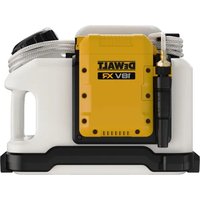
DCE6820 - Water tank DEWALT - Free user manual and instructions
Find the device manual for free DCE6820 DEWALT in PDF.


| Product Type | Water tank with electric pump |
| Brand | DeWALT |
| Model | DCE6820 |
| Dimensions (L x W x H) | 434 x 307 x 330 mm |
| Weight (without water or battery) | 5.1 kg |
| Power Supply | 18 V DC battery (Li-Ion) |
| Maximum Tank Capacity | 15 L |
| Maximum Water Pressure | 1.6 bar |
| Admissible Water Temperature | 0 °C to 40 °C |
| Hose Outer Diameter | 10 mm |
| Hose Inner Diameter | 6 mm |
| Hose Length | 3 m |
| Protection Class | IPX4 |
| Sound Pressure Level (L_PA) | 56 dB(A) |
| Sound Power Level (L_WA) | 66 dB(A) |
| Main Functions | Electric pump, pressure adjustment, Wireless Tool Control™ mode, TSTAK compatibility |
| Maintenance and Cleaning | Clean with a damp cloth and mild soap; drain and dry before storage; do not use solvents |
| Safety | Do not immerse, do not use high-pressure water, use only water, do not expose to frost |
| Spare Parts and Repairability | Repair by DeWalt approved center, use original parts |
| General Information | Intended use: dust reduction on construction site; non-potable water; WTC remote control sold separately |
Frequently Asked Questions - DCE6820 DEWALT
User questions about DCE6820 DEWALT
0 question about this device. Answer the ones you know or ask your own.
Ask a new question about this device
Download the instructions for your Water tank in PDF format for free! Find your manual DCE6820 - DEWALT and take your electronic device back in hand. On this page are published all the documents necessary for the use of your device. DCE6820 by DEWALT.
USER MANUAL DCE6820 DEWALT
English (original instructions) 29
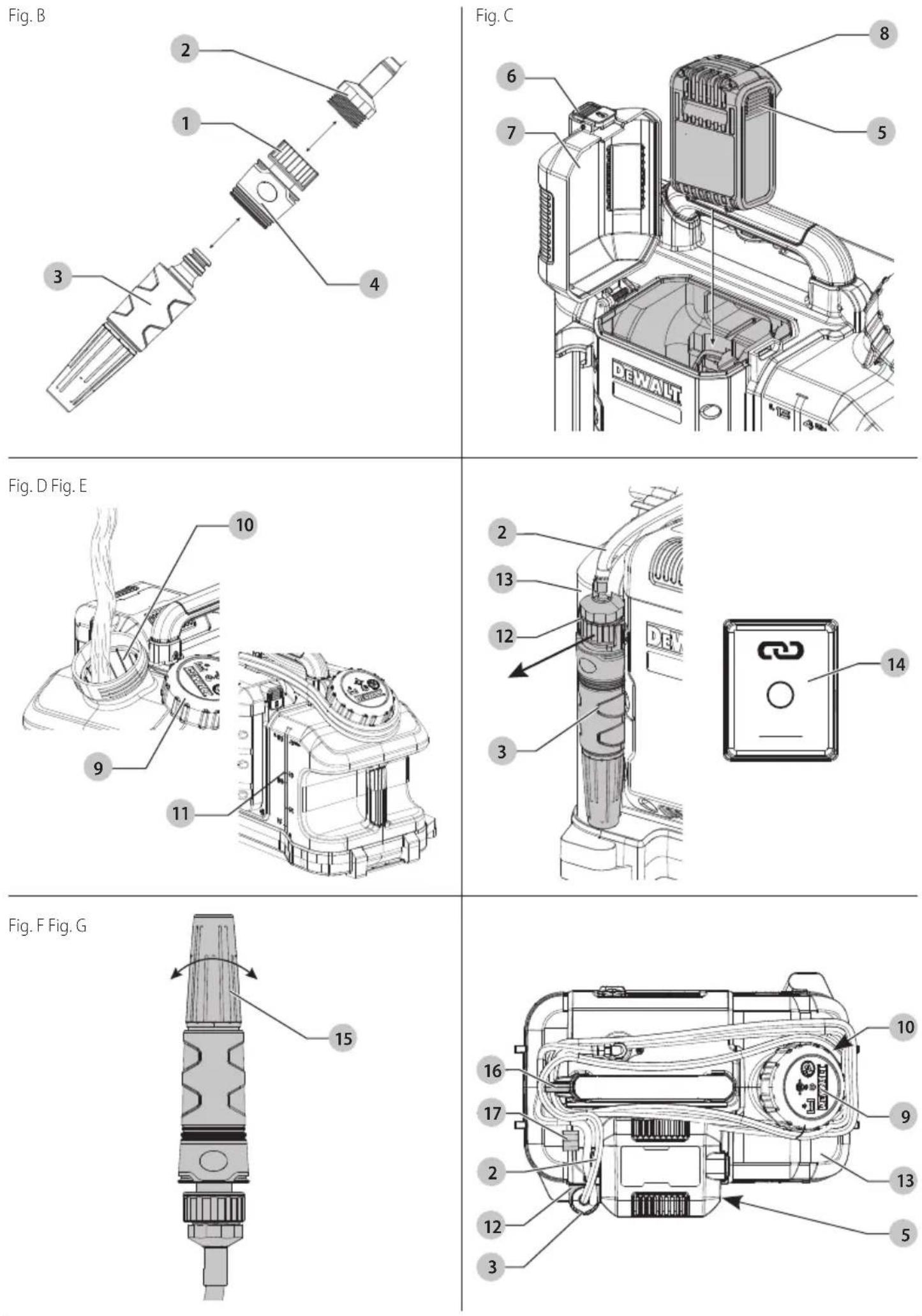
Fig. H
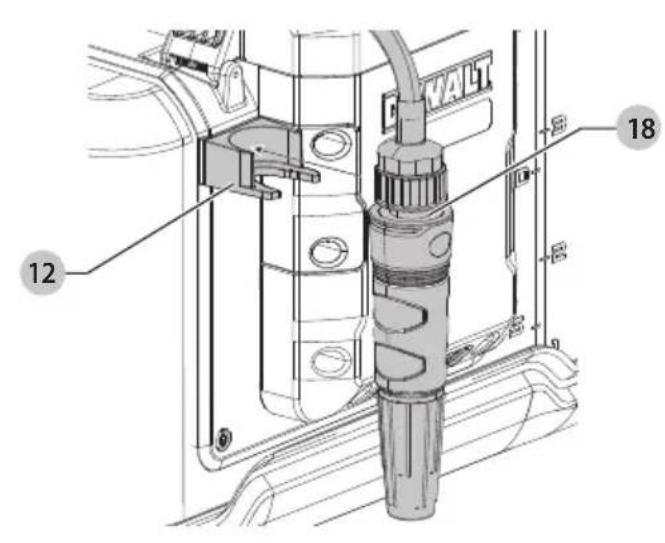
Fig.1
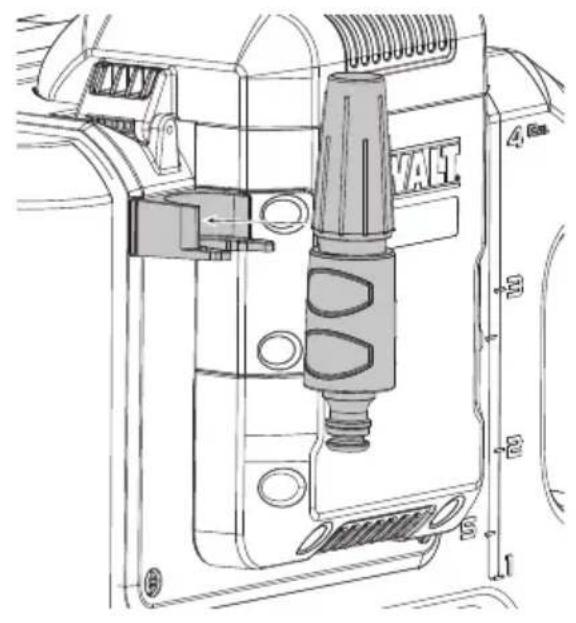
Fig. J Fig. K
18V VANDTANK MED MOTOR DCE6820
Tillykke!
Vice-President Engineering, PTE-Europe
65510, Idstein, Germany
15.01.2024
GENERELLE SIKKERHEDSADVARSLER FOR ELVÆRKT∅JER
Vice-President Engineering, PTE-Europe
65510, Idstein, Germany
15.01.2024
You have chosen a DEWALT tool. Years of experience, thorough product development and innovation make DEWALT one of the most reliable partners for professional power tool users.
Technical Data
| DCE6820 | ||
| Type 1 | ||
| Power source DC | ||
| Battery voltage V | DC | 18 |
| Weight (without water and battery) Kg 5.1 | ||
| Max water capacity | L | 15 |
| Max water temperature | °C | 40 |
| Min water temperature | °C | 0 |
| Dimensions (L*W*H) | mm | 434*307*330 |
| Max water pressure | Bar | 1.6 |
| Hose outer diameter | mm | 10 |
| Hose inner diameter | mm | 6 |
| Hose length | m | 3 |
| Protection class IPX4 | ||
| Noise values according to EN 62841-1: | ||
| L_PA (emission sound pressure level) | dB(A) 56 | |
| L_WA (sound power level) | dB(A) 66 | |
| K(uncertainty for the given sound level) | dB(A) 3 | |

ING: To reduce the risk of injury, read the tion manual.
Definitions: Safety Guidelines
The definitions below describe the level of severity for each signal word. Please read the manual and pay attention to these symbols.
DANGER: Indicates an imminently hazardous solution which, if not avoided, will result in death or serious injury.
WARNING: Indicates a potentially hazardous situation, if not avoided, could result in death or serious injury.
CAUTION: Indicates a potentially hazardous situation which, if not avoided, may result in minor or moderate injury.
NOTICE: Indicates a practice not related to personal injury which, if not avoided, may result in property damage.

tes risk of electric shock.

ates risk of fire.
EC-Declaration of Conformity
Machinery Directive and Radio Equipment Directive

Powered Water Tank DCE6820
DEWALT declares that these products described under Technical Data are in compliance with: 2006/42/EC, EN 62841-1:2015+A11:2022 EN ISO 12100:2010. These products also comply with Directive 2014/53/EU and 2011/65/EU. For more information, please contact DEWALT at the following address or refer to the back of the manual. The undersigned is responsible for compilation of the technical file and makes this declaration on behalf of DEWALT.
Markus Rompel
Vice-President Engineering, PTE-Europe DEWALT, Richard-Klinger-Straße 11, 65510, Idstein, Germany 15.01.2024
DECLARATION OF CONFORMITY MACHINERY AND RADIO EQUIPMENT REGULATIONS UK CA
Powered Water Tank DCE6820
DEWALT declares that these products described under "technical data" are in compliance with:
EN 62841-1:2015+A11:2022; EN ISO 12100:2010.
These products conform to the following UK Regulations The Supply of Machinery (Safety) Regulations, 2008, S.I. 2008/1597 (as amended).
The Radio Equipment Regulations 2017, S.I. 2017/1206 (as amended)
The Restriction of the Use of Certain Hazardous Substances in Electrical and Electronic Equipment Regulations 2012, S.I. 2012/3032 (as amended).
| Batteries Chargers/Charge Times (Minutes)*** | |||||||||||||
| Cat # V | DC | Ah Weight (kg) | DCB104 DCB107 | DCB112/DCB1102 | DCB113 | DCB115/DCB1104 | DCB116 DCB117 DCB118 DCB132 DCB119 | ||||||
| DCB546 | 18/54 | 6.0/2.0 | 1.08 | 60 | 270 | 170 | 140 | 90 | 80 | 40 | 60 | 90 | X |
| DCB547/G | 18/54 | 9.0/3.0 | 1.46 | 75* | 420 | 270 | 220 | 135* | 110* | 60 | 75* | 135* | X |
| DCB548 | 18/54 | 12.0/4.0 | 1.46 | 120 | 540 | 350 | 300 | 180 | 150 | 80 | 120 | 180 | X |
| DCB549 | 18/54 | 15.0/5.0 | 2.12 | 125 | 730 | 450 | 380 | 230 | 170 | 90 | 125 | 230 | X |
| DCB181 | 18 | 1.5 | 0.35 | 22 | 70 | 45 | 35 | 22 | 22 | 22 | 22 | 22 | 45 |
| DCB182 | 18 | 4.0 | 0.61 | 60/40** | 185 | 120 | 100 | 60 | 60/45** | 60/40** | 60/40** | 60 | 120 |
| DCB183/B | 18 | 2.0 | 0.40 | 30 | 90 | 60 | 50 | 30 | 30 | 30 | 30 | 30 | 60 |
| DCB184/B | 18 | 5.0 | 0.62 | 75/50** | 240 | 150 | 120 | 75 | 75/60** | 75/50** | 75/50** | 75 | 150 |
| DCB185 | 18 | 1.3 | 0.35 | 22 | 60 | 40 | 30 | 22 | 22 | 22 | 22 | 22 | 40 |
| DCB187 | 18 | 3.0 | 0.54 | 45 | 140 | 90 | 70 | 45 | 45 | 45 | 45 | 45 | 90 |
| DCB189 | 18 | 4.0 | 0.54 | 60 | 185 | 120 | 100 | 60 | 60 | 60 | 60 | 60 | 120 |
| DCBP034/G | 18 | 1.7 | 0.32 | 27 | 82 | 50 | 40 | 27 | 27 | 27 | 27 | 27 | 50 |
| DCBP518 | 18 | 5.0 | 0.75 | 50 | 240 | 150 | 120 | 75 | 60 | 50 | 50 | 75 | 150 |
*Date code 201811475B or later
**Date code 201536 or later
***Battery charge times matrix provided for guidance only; charge times will vary depending on temperature and condition of batteries.
For more information, please contact DEWALT at the following address or refer to the back of the manual.
The undersigned is responsible for compilation of the technical file and makes this declaration on behalf of DEWALT.
Karl Evans
Vice President Professional Power Tools EANZ GTS
DEWALT UK, Meadowfield Avenue, Spennymoor
DL16 6YJ
England
15.01.2024
GENERAL POWER TOOL SAFETY WARNINGS
WARNING: Read all safety warnings, instructions, indications and specifications provided with this
power tool. Failure to follow all instructions listed below may result in electric shock, fire and/or serious injury.
SAVE ALL WARNINGS AND INSTRUCTIONS FOR FUTURE REFERENCE
The term "power tool" in the warnings refers to your DCE6820 powered Water Tank..
1) Work Area Safety
a) Keep work area clean and well lit. Cluttered or dark areas invite accidents.
b) Do not operate power tools in explosive atmospheres, such as in the presence of flammable liquids, gases or dust. Power tools create sparks which may ignite the dust or fumes.
c) Keep children and bystanders away while operating a power tool. Distractions can cause you to lose control.
2) Electrical Safety
a) Power tool plugs must match the outlet. Never modify the plug in any way. Do not use any adapter plugs with earthed (grounded) power tools.
Unmodified plugs and matching outlets will reduce risk of electric shock.
b) Avoid body contact with earthed or grounded surfaces, such as pipes, radiators, ranges and refrigerators. There is an increased risk of electric shock if your body is earthed or grounded.
c) Do not expose power tools to rain or wet conditions. Water entering a power tool will increase the risk of electric shock.
d) Do not abuse the cord. Never use the cord for carrying, pulling or unplugging the power tool. Keep cord away from heat, oil, sharp edges or moving parts. Damaged or entangled cords increase the risk of electric shock.
e) When operating a power tool outdoors, use an extension cord suitable for outdoor use. Use of a cord suitable for outdoor use reduces the risk of electric shock.
f) If operating a power tool in a damp location is unavoidable, use a residual current device (RCD) protected supply. Use of an RCD reduces the risk of electric shock.
3) Personal Safety
a) Stay alert, watch what you are doing and use common sense when operating a power tool. Do not use a power tool while you are tired or under the influence of drugs, alcohol or medication. A moment of inattention while operating power tools may result in serious personal injury.
b) Use personal protective equipment. Always wear eye protection. Protective equipment such as a dust mask, non-skid safety shoes, hard hat or hearing protection used for appropriate conditions will reduce personal injuries.
c) Prevent unintentional starting. Ensure the switch is in the off position before connecting to power source and/or battery pack, picking up or carrying the tool. Carrying power tools with your finger on the switch or energising power tools that have the switch on invites accidents.
d) Remove any adjusting key or wrench before turning the power tool on. A wrench or a key left attached to a rotating part of the power tool may result in personal injury.
e) Do not overreach. Keep proper footing and balance at all times. This enables better control of the power tool in unexpected situations.
f) Dress properly. Do not wear loose clothing or jewellery. Keep your hair and clothing away from moving parts. Loose clothes, jewellery or long hair can be caught in moving parts.
g) If devices are provided for the connection of dust extraction and collection facilities, ensure these are connected and properly used. Use of dust collection can reduce dust-related hazards.
h) Do not let familiarity gained from frequent use of tools allow you to become complacent and ignore tool safety principles. A careless action can cause severe injury within a fraction of a second.
4) Power Tool Use and Care
a) Do not force the power tool. Use the correct power tool for your application. The correct power tool will do the job better and safer at the rate for which it was designed.
b) Do not use the power tool if the switch does not turn it on and off. Any power tool that cannot be controlled with the switch is dangerous and must be repaired.
c) Disconnect the plug from the power source and/or remove the battery pack, if detachable, from the power tool before making any adjustments, changing accessories, or storing power tools. Such preventive safety measures reduce the risk of starting the power tool accidentally.
d) Store idle power tools out of the reach of children and do not allow persons unfamiliar with the power tool or these instructions to operate the power tool. Power tools are dangerous in the hands of untrained users.
e) Maintain power tools and accessories. Check for misalignment or binding of moving parts, breakage of parts and any other condition that may affect the power tool's operation. If damaged, have the power tool repaired before use. Many accidents are caused by poorly maintained power tools.
f) Keep cutting tools sharp and clean. Properly maintained cutting tools with sharp cutting edges are less likely to bind and are easier to control.
g) Use the power tool, accessories and tool bits, etc. in accordance with these instructions, taking into account the working conditions and the work to be performed. Use of the power tool for operations different from those intended could result in a hazardous situation.
h) Keep handles and grasping surfaces dry, clean and free from oil and grease. Slippery handles and grasping surfaces do not allow for safe handling and control of the tool in unexpected situations.
5) Battery Tool Use and Care
a) Recharge only with the charger specified by the manufacturer. A charger that is suitable for one type of battery pack may create a risk of fire when used with another battery pack.
b) Use power tools only with specifically designated battery packs. Use of any other battery packs may create a risk of injury and fire.
c) When battery pack is not in use, keep it away from other metal objects, like paper clips, coins, keys, nails, screws or other small metal objects, that can make a connection from one terminal to another. Shorting the battery terminals together may cause burns or a fire.
d) Under abusive conditions, liquid may be ejected from the battery; avoid contact. If contact accidentally occurs, flush with water. If liquid contacts eyes, additionally seek medical help. Liquid ejected from the battery may cause irritation or burns.
e) Do not use a battery pack or tool that is damaged or modified. Damaged or modified batteries may exhibit unpredictable behaviour resulting in fire, explosion or risk of injury.
f) Do not expose a battery pack or tool to fire or excessive temperature. Exposure to fire or temperature above 130 °C may cause explosion.
g) Follow all charging instructions and do not charge the battery pack or tool outside the temperature range specified in the instructions. Charging improperly or at temperatures outside the specified range may damage the battery and increase the risk of fire.
6) Service
a) Have your power tool serviced by a qualified repair person using only identical replacement parts. This will ensure that the safety of the power tool is maintained.
b) Never service damaged battery packs. Service of battery packs should only be performed by the manufacturer or authorised service providers.
General Safety Rules
Safety at the workplace

VING: Do not dunk the power tool.

VING: Do not get the battery wet.

WING: Do not use a high pressure water to clean the act as water can enter the electrical system and cause ge to the product.
WARNING: Some dust created by power sanding, sawing, drilling, drilling, and other construction activities contains chemicals known to the State of California to cause cancer, birth defects or other reproductive harm. Some examples of these chemicals are:
- lead from lead-based paints,
• crystalline silica from bricks and cement and other masonry products, and
• arsenic and chromium from chemically-treated lumber.
Your risk from these exposures varies, depending on how often you do this type of work. To reduce your exposure to these chemicals: work in a well-ventilated area, and work with approved safety equipment, such as those dust masks that are specially designed to filter out microscopic particles.
- Keep your work area clean and well lit. Cluttered or dark work areas invite accidents.
- Do not operate the power tool in explosive atmospheres, such as in the presence of flammable liquids, gases or dust. Power tools create sparks which may ignite the dust or fumes.
- Keep bystanders, children and visitors away while operating a power tool. Distractions can cause you to lose control of the tool.
Personal Safety
- Stay alert, watch what you are doing and use common sense when operating a power tool. Do not use a power tool while you are tired or under the influence of drugs, alcohol or medication. A moment of inattention while operating the power tool may result in serious personal injury.
- Wear your personal protective equipment and always wear protective glasses. Depending on the purpose for which the power tool is to be used, wearing safety equipment such as a dust mask, non-skid safety shoes, hard hat, or hearing protection will reduce the risk of injury.
- Avoid accidental starting. Check that the power tool is switched off before you connect it to the power supply and/or the battery and before picking it up or carrying it. Carrying power tools with your finger on the switch or plugging in power tools that are already switched on invites accidents.
- Avoid unaccustomed body positions. Maintain proper footing and balance at all times. This will allow you to control the power tool better, even in unexpected situations.
- Wear suitable work clothes. Do not wear jewelry or loose clothing. Keep your hair, clothing and gloves away from moving parts. Loose clothes, jewelry or long hair can be snagged by moving parts.
- Do not lull yourself into a false sense of security and do not flout the safety rules for power tools, even if you are familiar with the power tool after using it many times. Careless handling could cause serious injury within fractions of a second.
- You may occasionally notice some residual water inside the tank, hose, or nozzle after the water tank is first turned on. This is the result of internal testing during the
manufacturing process and will not adversely affect the tool in any way.
Safety Warnings: Using and Handling the Power Tool
- Do not overload the tool. Use the correct power tool for your application. The correct power tool will do the job better and more safely within the performance range for which it is designed.
- Do not use a power tool if it has a faulty On/Off switch. Any power tool that cannot be controlled with the switch is dangerous and must be repaired.
- Disconnect the plug from the power outlet and/or remove a removable battery before making any adjustments, changing accessories, or storing the tool. This precaution reduces the risk of the power tool starting accidentally.
- Store power tools out of reach of children when not in use. Do not allow persons who are not familiar with the tool and these instructions to operate it. Power tools are dangerous in the hands of inexperienced persons.
- Maintain power tools and accessories carefully. Check that moving parts operate satisfactorily and do not jam, and whether any parts are broken or so damaged that the correct operation of the power tool is adversely affected. If parts are damaged, have the parts repaired before using of the tool. Many accidents are caused by poorly maintained power tools.
- Use power tools, accessories, insert tools, etc. only as described in this manual. Take the working conditions and the work to be performed into account. Use of the power tool for operations different from those intended could result in a hazardous situation.
- Keep grips and gripping surfaces dry, clean and free from oil and grease. Slippery grips and gripping surfaces do not allow the power tool to be safely operated and controlled in unforeseen situations. Using and handling the cordless power tool
- Recharge the batteries only with the chargers specified by the manufacturer. A charger that is suitable for a certain type of battery may present a risk of fire when used with other types of battery.
- Use only the specified batteries in power tools. Use of any other batteries may create a risk of injury and fire.
- When the battery is not in use, keep it away from paper clips, coins, keys, nails, screws and other small metal objects that could cause bridging between the terminals. A short circuit between the battery terminals may cause burns or a fire.
- Liquid may leak from the battery if used incorrectly. Avoid contact with the liquid. If contact accidentally occurs, flush with water. If the liquid contacts the eyes, also seek medical attention. Liquid escaping from the battery can cause skin irritation or burns.
-
Do not use damaged or modified batteries. Damaged or modified batteries may behave unpredictably and lead to fires, explosions or risk of injury.
-
Do not expose batteries to fire or excessive temperatures. Fires or temperatures over 130 °C (265 °F) may cause an explosion.
- Follow all instructions on battery charging and never charge the battery or the battery-powered tool outside the temperature range stated in the operating instructions. Incorrect charging or charging outside the approved temperature range may destroy the battery and increase the risk of fire.
- Do not operate the powered water tank in any orientation other than in an upright position. Water may enter the electrical system and cause damage.
- If the powered water tank develops a leak, stop using it immediately and contact your nearest DEWALT authorised repair agent.
- Do not touch the powered water tank when performing an operation where a connected power tools cutting accessory may contact hidden wiring. In the event of a cutting accessory contacting a "live" wire, wet or metal parts of the power tool may become "live" and could give the operator an electric shock.
- Do not leave a running powered water tank unattended.
- Be aware of stagnant water. It could contain germs and be harmful to health.
- Do not use water with a temperature higher than 40^ or lower than 0^ .
- Avoid placing the product in extreme direct sunlight. This may cause the water to heat up excessively.
Service
- Tool service must be performed only by qualified repair personnel. Service or maintenance performed by unqualified personnel could result in a risk of injury.
- When servicing a tool, use only identical replacement parts. Follow instructions in the Maintenance section of this manual. Use of unauthorized parts or failure to follow Maintenance Instructions may create a risk of electric shock or injury.
- Store in a safe location with battery removed, and out of reach of children.
Additional Safety Instructions
- Use the product and accessories only when they are in perfect working order.
- Never tamper with or modify the product or accessories in any way.
- Risk of injury by falling tools and/or accessories. Before starting work, check that the battery and installed accessories are secure.
• Make sure that the product cannot roll away or fall down. - Do not transport the product by crane or with other hoists.
- Operate the product only with the battery-compartment cover closed.
- At temperatures below the freezing point, make sure that no water remains in the product. Freezing water can cause damage when it expands inside components of the product.
- Use the product in combination with water only. Do not pour chemicals or other liquids into the tank.
CAUTION: Fill the product with clean water only. Foreign water can cause damage to the pump. Keep the tank free of sand, drilling slurry and other foreign matter.
Chargers
DEWALT chargers require no adjustment and are designed to be as easy as possible to operate.
Electrical Safety
The electric motor has been designed for one voltage only. Always check that the battery pack voltage corresponds to the voltage on the rating plate. Also make sure that the voltage of your charger corresponds to that of your mains.

Your DEWALT charger is double insulated in accordance with EN60335; therefore, no earth wire is required.
If the supply cord is damaged, it must be replaced only by DEWALT or an authorised service organisation.
Mains Plug Replacement (U.K. & Ireland Only)
If a new mains plug needs to be fitted:
• Safely dispose of the old plug.
- Connect the brown lead to the live terminal in the plug.
- Connect the blue lead to the neutral terminal.
WARNING: No connection is to be made to the terminal.
Follow the fitting instructions supplied with good quality plugs. Recommended fuse: 3 A.
Using an Extension Cable
An extension cord should not be used unless absolutely necessary. Use an approved extension cable suitable for the power input of your charger (see Technical Data). The minimum conductor size is 1 mm ^2 , the maximum length is 30 m.
When using a cable reel, always unwind the cable completely.
Important Safety Instructions for All Battery Chargers
saVE ThEsE InsTRUcTIOns: This manual contains important safety and operating instructions for compatible battery chargers (refer to Technical Data).
- Before using charger, read all instructions and cautionary markings on charger, battery pack, and product using battery pack.
NOTICE: Under certain conditions, with the charger plugged into the power supply, the exposed charging contacts inside the charger can be shorted by foreign material. Foreign materials of a conductive nature such as, but not limited to, steel wool, aluminum foil or any buildup of metallic particles should be kept away from charger cavities. Always unplug the charger from the power supply when there is no battery pack in the cavity. Unplug charger before attempting to clean.
- DO NOT attempt to charge the battery pack with any chargers other than the ones in this manual. The charger and battery pack are specifically designed to work together.
• These chargers are not intended for any uses other than charging DEWALT rechargeable batteries. Any other uses may result in risk of fire, electric shock or electrocution. - Do not expose charger to rain or snow.
- Pull by plug rather than cord when disconnecting charger. This will reduce risk of damage to electric plug and cord.
- Make sure that cord is located so that it will not be stepped on, tripped over, or otherwise subjected to damage or stress.
- Do not use an extension cord unless it is absolutely necessary. Use of improper extension cord could result in risk of fire, electric shock, or electrocution.
- Do not place any object on top of charger or place the charger on a soft surface that might block the ventilation slots and result in excessive internal heat.
Place the charger in a position away from any heat source. The charger is ventilated through slots in the top and the bottom of the housing.
- Do not operate charger with damaged cord or plug—have them replaced immediately.
- Do not operate charger if it has received a sharp blow, been dropped, or otherwise damaged in any way. Take it to an authorised service centre.
- Do not disassemble charger; take it to an authorised service centre when service or repair is required. Incorrect reassembly may result in a risk of electric shock, electrocution or fire.
- In case of damaged power supply cord, the supply cord must be replaced immediately by the manufacturer, its service agent or similar qualified person to prevent any hazard.
- Disconnect the charger from the outlet before attempting any cleaning. This will reduce the risk of electric shock. Removing the battery pack will not reduce this risk.
- NEVER attempt to connect two chargers together.
- The charger is designed to operate on standard 230V household electrical power. Do not attempt to use it on any other voltage. This does not apply to the vehicular charger.
Charging a Battery
NOTE: To ensure maximum performance and life of lithium-ion battery packs, charge the battery pack fully before first use.
- Plug the charger into an appropriate outlet before inserting battery pack.
- Insert the battery pack 5 into the charger, making sure the battery pack is fully seated in the charger. The red (charging) light will blink repeatedly indicating that the charging process has started.
- The Stage 1 charging blink indicator represents the charge process that charges the majority of the battery's capacity. Stage 2 charging blink indicator represents the remainder, or top off charge process, for the battery to reach full capacity.
- The completion of charge for Stage 1 or Stage 2 will be indicated by the stage's light remaining ON continuously. The battery pack is fully charged when both Stage 1 and Stage 2 charging lights remain ON continuously, and it may be removed and used at this time or left in the charger.
NOTE: To remove the battery pack, some chargers require the battery pack release button 8 to be pressed.
Refer to the indicators below for the charge status of the battery pack.
Indicators
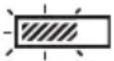 | Stage 1 Charging | — — | | |
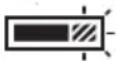 | Stage 2 Charging | — | — — | |
 | Fully Charged | — | — | |
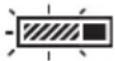 | Hot/Cold Pack Delay* | — — — | |
* The red light will continue to blink, but a yellow indicator light will be illuminated during this operation. Once the battery pack has reached an appropriate temperature, the yellow light will turn off and the charger will resume the charging procedure. The compatible charger(s) will not charge a faulty battery pack. The charger will indicate faulty battery by refusing to light.
NOTE: This could also mean a problem with a charger.
If the charger indicates a problem, take the charger and battery pack to be tested at an authorised service centre.
Hot/Cold Pack Delay
When the charger detects a battery pack that is too hot or too cold, it automatically starts a Hot/Cold Pack Delay, suspending charging until the battery pack has reached an appropriate temperature. The charger then automatically switches to the pack charging mode. This feature ensures maximum battery pack life.
A cold battery pack will charge at a slower rate than a warm battery pack. The battery pack will charge at that slower rate throughout the entire charging cycle and will not return to maximum charge rate even if the battery pack warms.
Electronic Protection System
XR Li-Ion tools are designed with an Electronic Protection System that will protect the battery pack against overloading, overheating or deep discharge.
The tool will automatically turn off if the Electronic Protection System engages. If this occurs, place the lithium-ion battery pack on the charger until it is fully charged.
Wall Mounting
These chargers are designed to be wall mountable or to sit upright on a table or work surface. If wall mounting, locate the charger within reach of an electrical outlet, and away from a corner or other obstructions which may impede air flow. Use the back of the charger as a template for the location of the mounting screws on the wall. Mount the charger securely using drywall screws (purchased separately) at least 25.4 mm long with a screw head diameter of 7–9 mm, screwed into wood to an optimal depth leaving approximately 5.5 mm of the screw exposed. Align the slots on the back of the charger with the exposed screws and fully engage them in the slots.
Charger Cleaning Instructions
WARNING: Shock hazard. Disconnect the charger from the AC outlet before cleaning. Dirt and grease may be removed from the exterior of the charger using a cloth or soft non-metallic brush. Do not use water or any cleaning solutions. Never let any liquid get inside the tool; never immerse any part of the tool into a liquid.
Battery Packs
Important Safety Instructions for All Battery Packs
When ordering replacement battery packs, be sure to include catalogue number and voltage.
The battery pack is not fully charged out of the carton. Before using the battery pack and charger, read the safety instructions below. Then follow charging procedures outlined.
READ ALL INSTRUCTIONS
- Do not charge or use battery in explosive atmospheres, such as in the presence of flammable liquids, gases or dust. Inserting or removing the battery from the charger may ignite the dust or fumes.
- Never force battery pack into charger. Do not modify battery pack in any way to fit into a non-compatible charger as battery pack may rupture, causing serious personal injury.
• Charge the battery packs only in DEWALT chargers. - DO NOT splash or immerse in water or other liquids.
- Do not store or charge the battery pack in locations where the temperature may fall below 4 °C (39.2 °F) (such as outside sheds or metal buildings in winter), or reach or exceed 40 °C (104 °F) (such as outside sheds or metal buildings in summer).
- Do not incinerate the battery pack even if it is severely damaged or is completely worn out. The battery pack can explode in a fire. Toxic fumes and materials are created when lithium-ion battery packs are burned.
- If battery contents come into contact with the skin, immediately wash area with mild soap and water. If battery liquid gets into the eye, rinse water over the open eye for 15 minutes or until irritation ceases. If medical attention
is needed, the battery electrolyte is composed of a mixture of liquid organic carbonates and lithium salts.
- Contents of opened battery cells may cause respiratory irritation. Provide fresh air. If symptoms persist, seek medical attention.
WARNING: Burn hazard. Battery liquid may be flammable if exposed to spark or flame.
WARNING: Never attempt to open the battery pack for any reason. If battery pack case is cracked or damaged, do not insert into charger. Do not crush, drop or damage battery pack. Do not use a battery pack or charger that has received a sharp blow, been dropped, run over or damaged in any way (i.e., pierced with a nail, hit with a hammer, stepped on). Electric shock or electrocution may result. Damaged battery packs should be returned to service centre for recycling.
WARNING: Fire hazard. Do not store or carry the battery pack so that metal objects can contact exposed battery terminals. For example, do not place the battery pack in aprons, pockets, tool boxes, product kit boxes, drawers, etc., with loose nails, screws, keys, etc.
CAUTION: When not in use, place tool on its side on a simple surface where it will not cause a tripping or falling hazard. Some tools with large battery packs will stand upright on the battery pack but may be easily knocked over.
Transportation
WARNING: Fire hazard. Transporting batteries can probably cause fire if the battery terminals inadvertently come into contact with conductive materials. When transporting batteries, make sure that the battery terminals are protected and well-insulated from materials that could contact them and cause a short circuit. NOTE: Lithium-ion batteries should not be put in checked baggage.
DEWALT batteries comply with all applicable shipping regulations as prescribed by industry and legal standards, which include UN Recommendations on the Transport of Dangerous Goods; International Air Transport Association (IATA) Dangerous Goods Regulations; International Maritime Dangerous Goods (IMDG) Regulations; and the European Agreement Concerning The International Carriage of Dangerous Goods by Road (ADR). Lithium-ion cells and batteries have been tested to section 38.3 of the UN Recommendations on the Transport of Dangerous Goods Manual of Tests and Criteria.
In most instances, shipping a DEWALT battery pack will be excepted from being classified as a fully regulated Class 9 Hazardous Material. In general, only shipments containing a lithium-ion battery with an energy rating greater than 100 Watt Hours (Wh) will require being shipped as fully regulated Class 9. All lithium-ion batteries have the Wh rating marked on the pack. Furthermore, due to regulation complexities, DEWALT does not recommend air shipping lithium-ion battery packs alone regardless of Wh rating. Shipments of tools with batteries (combo kits) can be air shipped as excepted if the Wh rating of the battery pack is no greater than 100 Wh.
or fully regulated, it is the shipper's responsibility to consult the latest regulations for packaging, labeling/marking and documentation requirements.
The information provided in this section of the manual is provided in good faith and believed to be accurate at the time the document was created. However, no warranty, expressed or implied, is given. It is the buyer's responsibility to ensure that its activities comply with the applicable regulations.
Storage Recommendations
- The best storage place is one that is cool and dry away from direct sunlight and excessive heat or cold. For optimum battery performance and life, store battery packs at room temperature when not in use.
- For long storage, it is recommended to store a fully charged battery pack in a cool, dry place out of the charger for optimal results.
nOTE: Battery packs should not be stored completely depleted of charge. The battery pack will need to be recharged before use.
Labels on Charger and Battery Pack
In addition to the pictographs used in this manual, the labels on the charger and the battery pack may show the following pictographs:


Technical Data for charging time.

probe with conductive objects.

charge damaged battery packs.

expose to water.

effective cords replaced immediately.

only between 4 °C and 40 °C.

indoor use.
the battery pack with due care for

battery packs only with designated DEWALT
Chargers. Charging battery packs other than the designated DEWALT batteries with a DEWALT charger may make them burst or lead to other dangerous situations.

incinerate the battery pack.Regardless of whether a sh
Battery Type
These battery packs may be used: DCB181, DCB182, DCB183, DCB183B, DCB184, DCB184B, DCB185, DCB187, DCB189, DCBP034, DCBP034G, DCBP518, DCB546, DCB547, DCB547G, DCB548, DCB549. Refer to Technical Data for more information.
Date Code Position (Fig. A)
The production date code 22 consists of a 4-digit year followed by a 2-digit week and is extended by a 2-digit factory code.
Description (Fig. A)
WARNING: Never modify the power appliance or any part of it. Damage or personal injury could result.
1 Nozzle connector
2 Hose
3 Nozzle
4 Nozzle connector release collar
5 Battery pack
6 Battery compartment release button
7 Battery compartment cover
8 Battery pack release button
9 Tank cap
10 Filter
11 Measurement line
12 Nozzle holder
13 Tank
14 Three-position switch
15 Nozzle water pressure adjustment collar
16 Hose storage hook
17 Hose clip
18 Nozzle detent
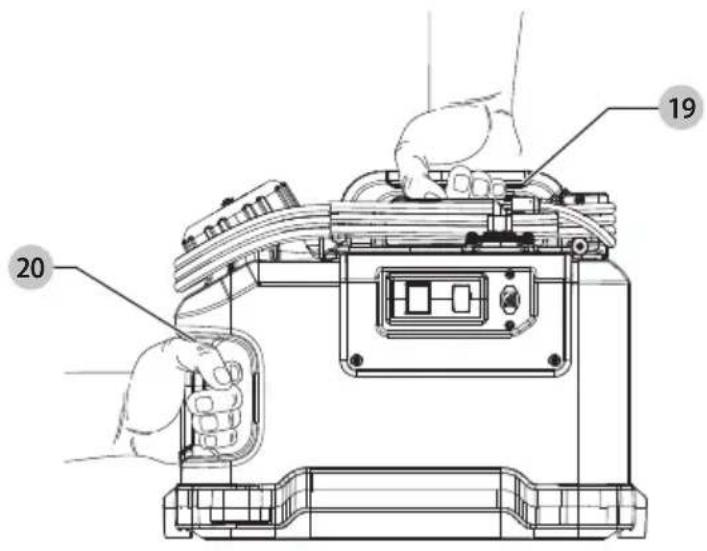
19 Top handle
20 Front handle
21 Wireless Tool Control™ pairing button
22 Date code
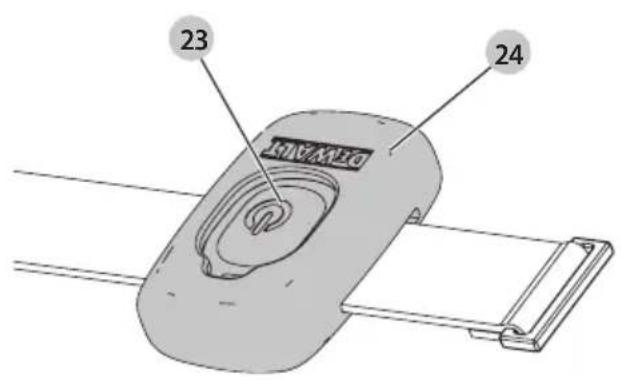
23 Wireless Tool Control™ remote button (Fig. K)
24 Wireless Tool Control™ remote (Fig. K)
25 TSTAK mounting plate
Intended Use
Your DEWALT powered water tank has been designed for everyday and jobsite use. It is intended exclusively for use with water.
This powered water tank can be used with a DEWALT TSTAK transport system or as a stand alone unit on the floor.
This powered water tank provides water to reduce dust generation during working process with certain machines (e.g., diamond core drilling machines).
This powered water tank is not intended for liquids other than water and not intended to provide potable water.
DO NOT let children come into contact with the tool.
Supervision is required when inexperienced operators use this tool.
- Young children and the infirm. This appliance is not intended for use by young children or infirm persons without supervision.
- This product is not intended for use by persons (including children) suffering from diminished physical, sensory or mental abilities; lack of experience, knowledge or skills unless they are supervised by a person responsible for their safety. Children should never be left alone with this product.
ASSEMBLY AND ADJUSTMENTS
WARNING: To reduce the risk of serious personal injury, turn tool off and disconnect battery pack before making any adjustments or removing/installing attachments or accessories. An accidental start-up can cause injury.
WARNING: Use only DEWALT batteries and chargers.
Attaching and Removing Nozzle (Fig. B)
- Screw the nozzle connector 1 to the end of the hose 2.
- Slide the nozzle 3 straight into the hose connector until it snaps into place.
- To remove the nozzle, pull back on the hose connector release collar 4 until the nozzle pops out.
OPERATION
Instructions for Use
WARNING: Always observe the safety instructions and applicable regulations.
WARNING: To reduce the risk of serious personal injury, turn tool off and disconnect battery pack before making any adjustments or removing/installing attachments or accessories. An accidental start-up can cause injury.
Check for damage to the tool, parts or accessories which may have occurred during transport.
Installing and Removing the Battery Pack (Fig. C)
WARNING: Ensure the tool/appliance is in the off position before inserting the battery pack.
NOTE: For best results, make sure your battery pack 5 is fully charged.
• To install the battery pack into the tool
1. Press the battery compartment release button 6.
2. Lift the battery compartment cover 7.
3. Align the battery pack with the rails inside the battery compartment and slide it in until the battery pack is firmly seated in the tool, and ensure it does not disengage.
4. Close the battery compartment cover. Ensure the battery compartment release button clicks into place.
• To remove the battery pack:
- Press the battery compartment release button 6.
- Lift the battery compartment cover 7.
- Press the battery pack release button 8 and firmly pull the battery pack out of the powered water tank. Insert it into the charger as described in the charger section of this manual.
- Close the battery compartment cover. Ensure the battery compartment release button clicks into place.
To Fill Tank (Fig. D)
WARNING: Use care in filling powered water tank. Do not overflow. Keep water away from battery and internal electrical components to avoid damage.
- Turn the tank cap 9 counterclockwise to remove and ensure the filter 10 is in place.
- Pour water through the filter and into the tank. Do not fill past the top of the measurement line 11.
- Replace the tank cap by turning it clockwise.
Use (Fig. E)
- Pull the nozzle 3 straight out of the nozzle holder 12 and unwrap the hose 2.
- Fill the tank 13 as described in the To Fill Tank section.
- Insert battery pack as described in the Installing and Removing the Battery Pack section.
- Turn the powered water tank on by pressing the (I) side of the three-position switch 14.
- Turn the powered water tank off by pressing the on/off button until it sits in the middle position.
- If using a Wireless Tool Control™ remote, press the top of the on/off button to select the setting.
Adjusting Water Pressure (Fig. F)
• To increase water pressure, turn the water pressure adjustment collar 15 clockwise as seen from behind.
• To decrease water pressure, turn the water pressure adjustment collar counterclockwise as seen from behind.
Stacking Using the DEWALT TSTAK Mounting Plate (Fig. A)
WARNING: When stacking, always place the powered water tank bottom down on the TSTAK.
The TSTAK mounting plate 25 allows the powered water tank to be attached to other TSTAK products to securely stack one on top of the other for convenience and portability.
- To use the TSTAK stacking, place the powered water tank on top of a TSTAK box and flip up the box's two TSTAK stacking latches, so they clip securely to the bottom of the unit.
- To remove the powered water tank from a TSTAK box, release the two TSTAK stacking latches. Remove and place the powered water tank in a safe place. If not removed the powered water tank tip and falling, causing injury.
MAINTENANCE
Your power tool has been designed to operate over a long period of time with a minimum of maintenance. Continuous
satisfactory operation depends upon proper tool care and regular cleaning.
WARNING: To reduce the risk of serious personal injury, turn tool off and disconnect battery pack before making any adjustments or removing/installing attachments or accessories. An accidental start-up can cause injury.
The charger and battery pack are not serviceable.
Storing (Fig. G–I)
CAUTION: Do not allow water to freeze in the tank. Store above freezing temperatures.
- Remove the tank cap 9 and the inlet filter 10. Pour water out of the tank 13.
- Run the powered water tank until no more water comes out of the hose 2.
- Remove the battery pack 5.
- Let the tank dry.
- Place the filter in the tank, under the tank cap.
- Screw the tank cap on tightly.
- Properly attach the hose and nozzle 3:
a. Wrap the hose around the hose storage hook 16 and powered water tank cap.
b. Halfway through, snap the hose clip 17 onto the hose in two locations to hold the hose close to the water tank.
c. Continue wrapping the hose until the nozzle meets the nozzle holder 12.
d. Line up the nozzle detent 18 with the bottom of the nozzle holder and push straight in until it snaps into place.
NOTE: When the nozzle is removed from the hose, it may be stored in the nozzle holder without the hose attached (Fig. I).
- If you suspect water has frozen inside the system, take the powered water tank to a warm place and wait until the ice has defrosted.
Transporting (Fig. J)
WARNING: always use and store in horizontal position with battery compartment cover 7 facing up.
Assemble the powered water tank as described in the Storing section.
The powered water tank may be carried by either the top handle 19, front handle 20, or both.
Wireless Tool Control™ Mode
(Remote may be sold separately)
Pairing the Powered Water Tank with a Tool using Wireless Tool Control™ Mode (Fig. K)
CAUTION: When the powered water tank is being controlled with the remote or paired power tool it may start or stop without warning.
WARNING: Do not attach the remote strap to moving parts.
To Pair with a DEWALT Remote or Wireless Tool Control™ Tool
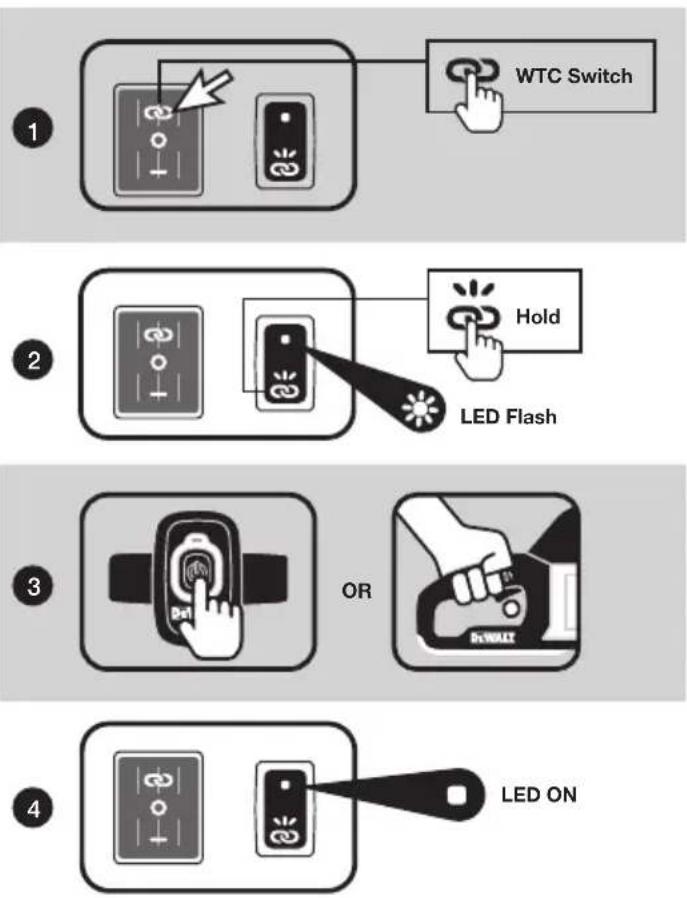
- Press the three-position switch 14 to the Wireless Tool Control™ position.
- Press and hold the Wireless Tool Control™ pairing button 21 (Fig. A) on the powered water tank, then press the button on the second tool or press the remote button 23 on the remote 24. The LED then flashes to show the water tank is ready to be paired.
- The LED above the Wireless Tool Control™ pairing button will be steadily illuminated to indicate a successful pairing.
CAUTION: Do not activate the Wireless Tool Control at the tool if the hose is not connected to the water outlet.
nOTE: Only one transmitter can be paired at a time. If the unit is already paired, the previous transmitter will be overridden.

WIRELESS TOOL CONTROL™ PAIRING INSTRUCTIONS
flowchart
graph TD
    A["1"] --> B["WTC Switch"]
    B --> C["2"]
    C --> D["LED Flash"]
    D --> E["3"]
    E --> F["OR"]
    F --> G["4"]
    G --> H["LED ON"]
To Unpair with a Wireless Tool Control™ Tool or Remote
- Press and hold the Wireless Tool Control™ pairing button 21 (Fig. A) on the DCE6820, then press the button on the second tool or press the remote button 23 on the remote 24.
- The LED above the Wireless Tool Control™ pairing button will flash slowly to indicate a successful unpairing.
CAUTION: To prevent unintentional switch-on after the end of work, switch the on/off switch to the middle position. or unpair the Wireless Tool Control of tool or remote.
LED FLASH PATTERN
| In pairing mode | ---- |
| No device is paired | ---- |
| Device is successfully paired | ---- |
Cleaning
WARNING: Never use solvents or other harsh chemicals for cleaning the non-metallic parts of the tool. These chemicals may weaken the plastic materials used in these parts. Use a cloth dampened only with water and mild soap. Never let any liquid get inside the tool; never immerse any part of the tool into a liquid.
Optional Accessories
WARNING: Since accessories, other than those offered by DEWALT, have not been tested with this product, use of such accessories with this tool could be hazardous. To reduce the risk of injury, only DEWALT-recommended accessories should be used with this product.
Consult your dealer for further information on the appropriate accessories.
Protecting the Environment
Separate collection. Products and batteries marked with this symbol must not be disposed of with normal household waste.

Products and batteries contain materials that can
be recovered or recycled, reducing the demand for raw materials. Please recycle electrical products and batteries according to local provisions. Further information is available at www.2helpU.com.
Rechargeable Battery Pack
This long-life battery pack must be recharged when it fails to produce sufficient power on jobs that were easily done before. At the end of its technical life, discard it with due care for our environment:
- Run the battery pack down completely, then remove it from the tool.
- Li-lon cells are recyclable. Take them to your dealer or a local recycling station. The collected battery packs will be recycled or disposed of properly.
Troubleshooting
| Symptom Possible Cause(s) Corrective Action | ||
| No water supply to the Wireless Tool Control (WTC)-connected product. | Product is set to WTC mode, but not paired to a WTC-enabled tool. | Follow WTC pairing instructions' or 'switch tool on manually using on/off switch. |
| The supply of water in the tank has been used up completely. | Fill the tank. | |
| The nozzle on the end of the hose is closed. | Open the nozzle. | |
| The nozzle connector release collar has no connection with nozzle or other tool connector. | Insert the nozzle or other tool hose connector into the nozzle connector release collar. | |
| No tank filter installed. | Check installation of the tank filter and, if applicable, install a tank filter. | |
| Inlet filter or tank filter clogged. | Clean or replace inlet filter and/or tank filter. | |
| Battery is discharged | Charge the battery or insert a charged battery. | |
| Water in tank or hose has frozen. | Move the product to a warm place and wait until the ice has desfrosted. | |
| Continuously running for more than 30 minutes. | Turn the three-position switch off and then back on again. | |
| There is water spilled on the product. Tool does not start after ON button is pressed. | Remove the battery and wait for water to dryIf the problem persists, consult DEWALT Service. | |
| The supply of water in the tank has been fully depleted and the tool is left to run for 1 minute or more. | Refill the tank and turn the tool off and back on. | |
65510, Idstein, Germany
15.01.2024
65510, Idstein, Germany
15.01.2024
CONSIGNES DE SÉCURITÉ GÉNÉRALES PROPRES AUX OUTILS ÉLECTRIQUES

Bloc-batterie rechargeable
65510, Idstein, Germany
15.01.2024
AVVERTENZE GENERALI DI SICUREZZA PER APPARATI ELETTRICI

Vice-President Engineering, PTE- Europe
65510, Idstein, Germany
15.01.2024
ALGEMENE VEILIGHEIDSWAARSCHUWINGEN VOOR ELEKTRISCH GEREEDSCHAP

7 Kap accucompartiment
8 Accuvrijgaveknop
9 Tankdop
10 Filter
11 Meetlijn
12 Spuitmondhouder
13 Tank
Vice-President Engineering, PTE-Europe
65510, Idstein, Germany
15.01.2024
GENERELLE SIKKERHETSADVARSLER FOR ELEKTRISKE VERKT∅Y

Vice-President Engineering, PTE-Europe
65510, Idstein, Germany
15.01.2024