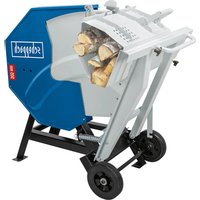
HS510 - Saw SCHEPPACH - Free user manual and instructions
Find the device manual for free HS510 SCHEPPACH in PDF.


User questions about HS510 SCHEPPACH
0 question about this device. Answer the ones you know or ask your own.
Ask a new question about this device
Download the instructions for your Saw in PDF format for free! Find your manual HS510 - SCHEPPACH and take your electronic device back in hand. On this page are published all the documents necessary for the use of your device. HS510 by SCHEPPACH.
USER MANUAL HS510 SCHEPPACH
Günzburger Straße 69
D-89335 Ichenhausen
Verehrter Kunde,
Homepage: https://www.scheppach.com/de/service
Explanation of the symbols on the equipment
The use of symbols in this manual is intended to draw your attention to possible risks. The safety symbols and the explanations that accompany them must be perfectly understood. The warnings in themselves do not remove the risks and cannot replace correct actions for preventing accidents.
| Attention! Read manual. | |
| Wear protective gloves. | |
| Wear ear protection. | |
| Wear eye protection. | |
| Wear non-slip footwear. | |
| Keep sufficient distance from the rotating saw blade during operation. | |
| Attention! Do not reach into the area of the saw blade! Risk of injury! | |
| The device must only be operated by one person. | |
| Keep children away from the working area. | |
| Disconnect the mains plug before carrying out any repair, cleaning or maintenance work! | |
| Do not operate the device in rain or in humid conditions. Danger of electric shock! | |
| Beware of electrical voltage! | |
| Attention! Before starting repair, maintenance and cleaning work, switch off the engine and unplug the mains plug. | |
| Removing or modifying protective or safety equipment is prohibited. | |
| ΔΔΔ CE | The product complies with the applicable Serbian directives. |
| The product complies with the applicable European directives. | |
| Δ Attention! | In this operating manual, we have used this sign to mark all sections that concern your safety. |
Table of contents: Page:
- Introduction 23
- Device description 23
- Scope of delivery 23
- Intended use 24
- Safety notes 24
- Additional safety instructions 26
- Technical data 27
- Unpacking 27
- Attachment / Before starting the equipment 28
- Initial operation 28
- Electrical connection 28
- Cleaning 29
- Transport 29
- Storage 29
- Maintenance 29
- Disposal and recycling 30
- Troubleshooting 31
- Declaration of conformity 93
1. Introduction
Manufacturer:
Scheppach GmbH
Günzburger Straße 69
D-89335 Ichenhausen
Dear customer,
We hope your new tool brings you much enjoyment and success.
Note:
According to the applicable product liability laws, the manufacturer of the device does not assume liability for damages to the product or damages caused by the product that occurs due to:
- Improper handling,
Non-compliance of the operating instructions, - Repairs by third parties, not by authorized service technicians.
- Installation and replacement of non-original spare parts,
Application other than specified, - A breakdown of the electrical system that occurs due to the non-compliance of the electric regulations and VDE regulations 0100, DIN 57113 / VDE0113.
We recommend:
Read through the complete text in the operating instructions before installing and commissioning the device.
The operating instructions are intended to help the user to become familiar with the machine and take advantage of its application possibilities in accordance with the recommendations.
The operating instructions contain important information on how to operate the machine safely, professionally and economically, how to avoid danger, costly repairs, reduce downtimes and how to increase reliability and service life of the machine.
In addition to the safety regulations in the operating instructions, you have to meet the applicable regulations that apply for the operation of the machine in your country.
Keep the operating instructions package with the machine at all times and store it in a plastic cover to protect it from dirt and moisture.
Read the instruction manual each time before operating the machine and carefully follow its information.
The machine can only be operated by persons who were instructed concerning the operation of the machine and who are informed about the associated dangers. The minimum age requirement must be complied with.
In addition to the safety instructions in this operating manual and the separate regulations of your country, the generally recognised technical rules for operating woodworking machines must also be observed.
We accept no liability for accidents or damage that occur due to a failure to observe this manual and the safety instructions.
2. Device description
- Rocker
- Motor
- Rocker fence
- Frame
- Mounting hole
- Locking lever
7.Wheels - On/Off switch
- Protection device
- Clamping screw for fence
- Handle bar
- Clamping screw for rocker extension
13.Wheel axle - Rocker extension
- Outer saw blade protection
- Inner saw blade protection
- Fence
- Recoil spring
- Spring split pin
3. Scope of delivery
- Operating manual
- Wheel axle
- Wheels
- Rocker extension
Fence - Accessories kit (4 hex bolts M8 x 20 mm plus 2 washers & 1 nut per bolt / 2 spring split pins / 6 large washers)
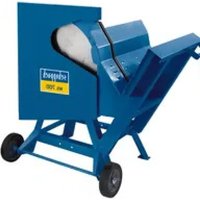
- Rocking log saw
Assembly tools
4. Intended use
The equipment is to be used only for its prescribed purpose. Any other use is deemed to be a case of misuse. The user / operator and not the manufacturer will be liable for any damage or injuries of any kind caused as a result of this.
The equipment is to be operated only with suitable saw blades. It is prohibited to use any type of cutting-off wheel.
To use the equipment properly you must also observe the safety information, the assembly instructions and the operating instructions to be found in this manual. All persons who use and service the equipment have to be acquainted with this manual and must be informed about the equipment's potential hazards.
It is also imperative to observe the accident prevention regulations in force in your area. The same applies for the general rules of health and safety at work.
The manufacturer will not be liable for any changes made to the equipment nor for any damage resulting from such changes.
The machine corresponds to the valid EC guideline.
-
The log saw is constructed as 1-man-operating stand and is only to be used in outdoor locations.
-
The log saw is a portable circular saw. It is only applicable to cross cut firewood with a feeding rocker according to the technical specifications.
-
The saw is constructed solely for cross cutting of firewood.
-
Regardless of the diameter of the wood only 1 work piece is to be put on the rocker.
-
Observe all safety and hazard notes on the machine and ensure they are kept complete and in a legible condition.
-
The machining range and surrounding areas of the machine must be clear of interfering foreign matter to prevent accidents occurring.
-
Workpieces must be completely free of foreign objects, i.e. nails or screws.
The circular sawbench is designed exclusively for the machining of wood and materials similar to wood. Only original Scheppach tools and accessories may be used. Use the required sawblade in accordance with the EN 847-1 norm depending on the type of cut and type of wood (solid wood, plywood or chipboard). Please observe the "Special Tool Accessories".
- The machine must only be used in technically perfect condition in accordance with its designated use and the instructions set out in the operating manual, and only by safety-conscious persons who are fully aware of the risks involved in operating the machine. Any functional disorders, especially those affecting the safety of the machine, should therefore be rectified immediately.
- Relevant accident prevention regulations and other, generally recognized safety-technical rules must also be adhered to.
- The Scheppach machine may only be used, maintained, and operated by persons familiar with it and instructed in its operation and procedures. Arbitrary alterations to the machine release the manufacturer from all responsibility for any resulting damages.
The machine may be operated only with original parts and original accessories of the manufacturer.
The safety, work and maintenance instructions of the manufacturer as well as the dimensions indicated in the Technical Data section must be adhered to.
Please note that our equipment has not been designed for use in commercial, trade or industrial applications.
Our warranty will be voided if the equipment is used in commercial, trade or industrial businesses or for equivalent purposes.
5. Safety notes
- Warning: When using electric tools it is imperative to take the following basic safety precautions in order to reduce the risk of electric shock, injury and fire.
Take due note of all this information before and while working with the saw. - Do not lose these safety regulations.
Guard against electric shock - Avoid body contact with earthed parts.
- When equipment is not being used it should be kept in a dry, closed place out of childrens reach.
- Keep mounted attachments sharp and clean to enable you to work well and safely.
- Check the power cable regularly and have it replaced by an authorized specialist at the first sign of any damage.
- Check your extension cables regularly and replace them if damaged.
-
When working outdoors, use only extension cables that are approved for outdoor use and which are marked accordingly.
-
Concentrate on what you are doing. Use common sense when working. Do not operate the tool if your mind is not on your work.
- Never use an electric tool with a switch that cannot be turned on and off.
- Warning! The use of other tools and accessories may put you at risk of injury.
- Always pull the plug out of the power socket before adjusting or servicing the machine.
- Give these safety regulations to all persons who work on the machine.
- Caution! Hands and fingers may be injured on the rotating saw blade.
- The machine is equipped with a safety circuit-breaker to prevent it starting up again after a voltage drop
- Before you use the machine for the first time, check that the voltage marked on the rating plate is the same as your mains voltage.
- If you need to use an extension cable, make sure its conductor cross-section is big enough for the saws power consumption. Minimum cross-section 1,5 mm² or 2,5 mm² for cable lengths of 20 m or more.
- If you use a cable reel, the complete cable must be pulled off the reel.
- Check the power cable. Never use a faulty or damaged power cable.
- Do not use the cable to pull the plug out of the socket. Protect the cable from heat, oil and sharp edges.
- Do not leave the saw in the rain and never use it in damp or wet conditions.
- Provide good lighting.
- Do not saw near flammable liquids or gases.
- Wear suitable work clothes! Loose garments or jewellery may become caught up in the rotating saw blade.
- Non-slip shoes are recommended when working outdoors.
- Wear a hair net if you have long hair.
- Avoid abnormal working postures.
- Operators must be at least 16 years of age.
- Keep children away from the machine when it is connected to the power supply.
- Keep your workplace clean of wood scrap and any unnecessary objects.
- An untidy work area invites accidents.
- Do not allow other persons, especially children, to touch the tool or cable. Keep them out of your work area.
-
Persons working on the machine should not be distracted.
-
Note the direction of rotation of the motor and saw blade. Use only blades whose permissible maximum speed is not lower than the maximum spindle speed of the circular saw and of the material to be cut.
After you have switched off the motor, never slow down the saw blade by applying pressure to its side.
Only fit blades which are well sharpened and have no cracks or deformations. - Do not use circular saw blades made of high-alloy high-speed steel (HSS).
- Only use saw blades that are recommended by the manufacturer, comply with EN 847-1 and bear a warning note.
- When replacing the saw blade ensure that the cutting width is no smaller than the blade thickness of the saw blade.
- Faulty saw blades must be replaced immediately.
- Never use saw blades which do not comply with the data specified in this manual.
- Never dismantle the machines safety devices or render them inoperative.
- If the table insert is worn, replace it.
Always stand to the side of the saw blade when working with the saw. - Never load the machine so much that it cuts out.
- Make sure that off-cuts do not catch on the saw blade crown. Risk of catapulting!
- Never remove loose splinters, chips or jammed pieces of wood when the saw blade is running, unless a push stick is used.
- To rectify faults or remove jammed pieces of wood, always switch off the machine first. Pull the power plug!
- If the sawing gap is worn, replace the table insert. Pull the power plug!
- Carry out retooling work, adjustments, measurements and cleaning jobs only when the motor is switched off. Pull the power plug!
- Before switching on, make sure that all keys and wrenches have been removed from the tool.
- Switch off the motor and pull the power plug before you leave the workplace.
- Refit all guards and safety devices immediately after you have completed any repairs or maintenance work.
-
Be sure to observe the safety information and operating and maintenance instructions issued by the manufacturer, as well as the dimensions listed in the Technical Data.
-
It is imperative to observe the accident prevention regulations in force in your area as well as all other generally recognized rules of safety.
Note the information published by your professional associations (VBG 7j). - The circular saw has to be connected to a 230 V socket with a 16 A fuse.
- Do not use any low-powered machines for heavy duty work.
- Do not use the cable for purposes for which it is not designed.
Make sure you stand squarely and keep your balance at all times. - Check the tool for damage.
Each time before re-using the tool, carefully check that the guards or any slightly damaged parts are working as intended. - Check that the moving parts are in good working order, that they do not jam, and that no parts are damaged. Make sure that all parts are fitted correctly and that all other operating conditions are properly fulfilled.
- Unless otherwise stated in the operating instructions, damaged safety devices and parts must be repaired or replaced by an authorized service centre.
- Have damaged switches replaced by a customer service workshop.
- This electric tool complies with the pertinent safety regulations. Repairs are to be carried out only by a qualified electrician using original replacement parts or the user may suffer an accident.
-
If necessary, wear suitable personal protection equipment. This could consist of:
-
Ear plugs to prevent the risk of damaging your hearing;
- A breathing mask to avoid the risk of inhaling hazardous dust.
-
Always wear gloves when handling saw blades and rough materials. Whenever practicable, saw blades must be carried in a container.
-
The operator must be informed about the conditions that influence the generation of noise (for example saw blades designed to reduce noise emissions, caring for blades and the machine).
- Faults on the machine or its guards, safety devices and blade must be reported to the person in charge as soon as they are discovered.
-
Use only the transport devices to move the machine. Never use the guards for handling and moving the machine.
-
All operators must receive proper training in the use, adjustment and operation of the machine.
- Do not saw any materials that contain foreign bodies such as wires, cables or ties.
- Only use sharp saw blades
- The machine must stand during the operation on a horizontal, flat floor and the floor around the machine must be level, well maintained and free of debris, such as Be chips and cut workpieces.
- Assign the workpiece to be machined and the stack finished workpieces close to the normal work of the operator.
- Make it adopt the safe procedures for cleaning, maintenance and the regular removal of chips and dust to avoid the risk of fire.
- Follow the instructions of the manufacturer for use, adjustment and repair of saw blades.
Note appearing on the blades maximum speed. - Make sure that the flanges used are as specified by the manufacturer, suitable for the intended use.
- Make sure you include that necessary for operating the machine guards and other safety devices are fitted, they are in good operating condition and properly maintained.
- The dust level is influenced by the type of material to be cut.
WARNING! This electric tool generates an electromagnetic field during operation. This field can impair active or passive medical implants under certain conditions. In order to prevent the risk of serious or deadly injuries, we recommend that persons with medical implants consult with their physician and the manufacturer of the medical implant prior to operating the electric tool.
6. Additional safety instructions
The machine has been built using modern technology in accordance with recognized safety rules. Some remaining hazards, however, may still exist.
- The rotating saw blade can cause injuries to fingers and hands if the work piece is incorrectly fed.
- Thrown work pieces can lead to injury if the work piece is not properly secured or fed.
- Noise can be a health hazard. The permitted noise level is exceeded when working. Be sure to wear personal protective gear such as ear protection.
Defective saw blades can cause injuries. Regularly inspect the structural integrity of saw blades.
The use of incorrect or damaged mains cables can lead to injuries caused by electricity.
- The operating instructions supplied with the special accessories must be observed and carefully read when Scheppach special accessories are used.
- Health hazard due to electrical power, with the use of improper electrical connection cables.
- Release the handle button and switch off the machine prior to any operations.
Even when all safety measures are taken, some remaining hazards which are not yet evident may still be present.
- Remaining hazards can be minimized by following the instructions in "Safety notes", "Intended use" and in the entire operating manual.
- Avoid accidental starts of the machine: Do not press the start button while inserting the plug into the socket.
- Use the tools recommended in this manual to obtain the best results from your machine.
Always keep hands away from the work area when the machine is running.
Note!
For workplace safety, protect from tipping or shifting by securing the saw with screws or bolts to the floor.
7. Technical data
Motor 230 V / 50 Hz
| Performance input P1 3 kW | |
| Output power P2 2.2 kW | |
| Operation mode S2 15 min | |
| Rated idling revolution speed | 2800 rpm |
| Engine brake | yes |
| Engine brake type | mechanical |
| Dimensions L x W x H | 1015 x 809 x 994 mm |
| Sawblade | 505/30/3.6 mm Z40 |
| Weight | 65 kg |
| Wood Ø min. / max. | 30 - 170 mm |
| Lenght if wood min. / max. | 250 - 1000 mm |
| Protection type | IP 54 |
| Protection class | I |
Subject to technical changes!
*Operating mode S2, short-term operation with constant load.
The mode comprises of a start-up period, a time with constant load and an idle time. The operating time is 10 mins, the relative duty cycle is 15% of the operating time
Noise
Warning: Noise can have serious effects on your health. If the machine noise exceeds 85 dB, please wear suitable hearing protection.
Characteristic noise emission values
Sound power level L_WA 115 dB (EN ISO 3744)
Sound pressure level L_pA 101 dB (EN ISO 11201)
Uncertainly K_PA 4 dB
8. Unpacking
ATTENTION!
The device and packaging materials are not toys! Children must not be allowed to play with plastic bags, film and small parts! There is a risk of swallowing and suffocation!
- Open the packaging and remove the device carefully.
- Remove the packaging material as well as the packaging and transport bracing (if available).
- Check that the delivery is complete.
- Check the device and accessory parts for transport damage.
- In case of complaints the dealer must be informed immediately. Subsequent complaints will not be accepted.
- If possible, store the packaging until the warranty period has expired.
- Read the operating manual to make yourself familiar with the device prior to using it.
- Only use original parts for accessories as well as for wearing and spare parts. Spare parts are available from your specialized dealer.
- Specify our part numbers as well as the type and year of construction of the device in your orders.
9. Attachment/ Before starting the equipment
IMPORTANT!
You must fully assemble the appliance before using it for the first time!
9.1 Assembly
9.1.1 Wheel axle (13) (fig. 2)
Place the wheel axle in the intended position and secure it with the four screws, washers and nuts provided in the accessories kit.
9.1.2 Wheels (7) (fig. 3)
Note: Three washers are required for each side.
Push two of the three washers onto the wheel axle you have already assembled. Then push the wheel onto the axle. Finally, place the third washer on the axle and fix it with the spring split pin provided.
9.1.3 Rocker extension (14) (fig. 4)
Slide the rocker extension (14) into the opening on the left side of the rocker and align it correctly in order for the firewood to sit firmly. Then tighten the rocker extension with the clamping screw (12).
9.2 Before starting the equipment
9.2.1 On/Off switch (8) (fig. 5)
Turning on
Press green button I.
Turning off
Press red button O.
10. Initial operation
Before commissioning observe the safety notes.
-
All safety and auxiliary installations must be fitted.
-
Check the rocker inlet for wear and replace it if necessary.
-
Check the rocker that it returns to its home position autonomously.
-
Check the saw blade for perfect fitting and correct direction of rotation.
-
Changeover, setting, measuring and cleaning operations are only to be conducted with the motor switched off. Pull the mains plug and wait for the rotating tool to come to halt.
The saw is constructed solely for the cross cutting of firewood.
- Regardless of the diameter of the wood only one work piece is to be put on the rocker.
- ATTENTION! Do not saw faggots or multiple pieces at once.
- Put curved wood on the rocker in such a way that the curved-out side is directed to the saw blade.
- Ensure the machine is securely placed on solid ground.
Sawing
- Turn on the machine.
- Wait until the saw blade has reached full speed.
- Put the wood on the rocker.
- Take hold of both handle bars of the rocker with both hands and lead it evenly to the saw blade; thus the saw blade is revealed.
- Push the rocker evenly to ensure the engine speed does not drop.
- Remove the sawn wood from the rocker before putting on the next piece.
ATTENTION!
Do not leave the machine unattended during operation.
Turn off the machine if you discontinue working, and pull the mains plug.
11. Electrical connection
The electrical motor installed is connected and ready for operation. The connection complies with the applicable VDE and DIN provisions. The customer's mains connection as well as the extension cable used must also comply with these regulations.
Damaged electrical connection cable
The insulation on electrical connection cables is often damaged.
This may have the following causes:
Passage points, where connection cables are passed through windows or doors.
- Kinks where the connection cable has been improperly fastened or routed.
- Places where the connection cables have been cut due to being driven over.
Insulation damage due to being ripped out of the wall outlet.
- Cracks due to the insulation ageing.
Such damaged electrical connection cables must not be used and are life-threatening due to the insulation damage.
Check the electrical connection cables for damage regularly. Make sure that the connection cable does not hang on the power network during the inspection. Electrical connection cables must comply with the applicable VDE and DIN provisions. Only use connection cables with the marking "H07RN-F".
The printing of the type designation on the connection cable is mandatory.
For single-phase AC motors, we recommend a fuse rating of 16A (C) or 16A (K) for machines with a high starting current (starting from 3000 watts)!
12. Cleaning
Attention!
Pull out the power plug before carrying out any cleaning work on the equipment.
We recommend that you clean the equipment immediately after you use it.
Clean the equipment regularly with a damp cloth and some soft soap.
Do not use cleaning agents or solvents; these may be aggressive to the plastic parts in the equipment. Ensure that no water can get into the interior of the equipment.
13. Transport
Place the jack in the transport position and secure it with the locking lever (6). In order to move the saw easily, tip it in the direction of the person moving it.
14. Storage
- Store the device and its accessories in a dark, dry and frost-proof place that is inaccessible to children.
- The optimum storage temperature is between 5 and 30^ .
- Cover the electrical tool in order to protect it from dust and moisture.
- Store the operating manual with the electrical tool.
15. Maintenance
Attention!
Pull out the power plug before carrying out any maintenance work on the equipment.
Connections and repairs
Connections and repairs of electrical equipment may only be carried out by an electrician.
Adjustment of the jack stop, (3) (Fig. 6)
Set the entry point of the jack with the adjustment screw (6a).
Change of saw blades (Fig. 7 - 10)
- Unplug the unit.
- Wait until the blade stops rotating and the motor has cooled down.
- Bring the jack into the transport position and lock the saw in this position with the locking lever.
- Remove the hexagon nut (7a) from the guide (7a).
- Now push the guide (7b) out of the threaded pin.
- Remove the spring split pin (19) from the recoil spring (18).
- Loosen the locking lever and grasp the jack firmly so that it does not fall down and the recoil spring cannot jump out of the unit in an uncontrolled fashion.
- Tip the jack carefully back and place it on the ground. (Fig. 9)
- Use the locking bolt (10a) to lock the saw blade. Insert it through the outer hole in the saw blade guard (15).
- Use the saw blade wrench (fig. 13) to open the hexagon nut (10b) and remove it along with the washer (10c) and the flange (10d).
- Carefully remove the saw blade. Wear protective gloves for this part of the work. (Attention: there is danger of injury, so please take caution!)
- Before replacing the saw flange, clean the flange with a cloth or soft brush.
- Replace the saw blade and flange and tighten the flange nut.
- Reassemble the device in reverse order.
- Test the functionality of the rocker.
ATTENTION! Observe the correct direction of rotation when inserting the saw blade.
Please provide the following information in the event of any enquiries:
Type of current for the motor
- Motor data - type plate
- Machine data - type plate
Service information
Please note that the following parts of this product are subject to normal or natural wear and that the following parts are therefore also required for use as consumables.
Wear parts*: sawblade, rocker inlet
- Not necessarily included in the scope of delivery!
Spare parts and accessories can be obtained from our service centre. To do this, scan the QR code on the cover page.
16. Disposal and recycling
Notes for packaging


The packaging materials are recyclable. Please dispose of packaging in an environmentally friendly manner.
Notes on the electrical and electronic equipment act [ElektroG]
![SCHEPPACH HS510 - Notes on the electrical and electronic equipment act [ElektroG] - 1](/content/2026/04/681507/images/b285fabc853f980d1da30271581dbb3f34a3a659a521af638ec46bf42d99836d.jpg)
Waste electrical and electronic equipment does not belong in household waste, but must be collected and disposed of separately!
- Used batteries or rechargeable batteries that are not installed permanently in the old appliance must be removed non-destructively before disposal. Their disposal is regulated by the battery law.
- Owners or users of electrical and electronic devices are legally obliged to return them after use.
- The end user is responsible for deleting their personal data from the old device being disposed of!
-
The symbol of the crossed-out dustbin means that waste electrical and electronic equipment must not be disposed of with household waste.
-
Waste electrical and electronic equipment can be handed in free of charge at the following places:
-
Public disposal or collection points (e.g. municipal works yards)
- Points of sale of electrical appliances (stationary and online), provided that dealers are obliged to take them back or offer to do so voluntarily.
-
Up to three waste electrical devices per type of device, with an edge length of no more than 25 centimetres, can be returned free of charge to the manufacturer without prior purchase of a new device from the manufacturer or taken to another authorised collection point in your vicinity.
Further supplementary take-back conditions of the manufacturers and distributors can be obtained from the respective customer service. -
If the manufacturer delivers a new electrical appliance to a private household, the manufacturer can arrange for the free collection of the old electrical appliance upon request from the end user. Please contact the manufacturer's customer service for this.
-
These statements only apply to devices installed and sold in the countries of the European Union and which are subject to the European Directive 2012/19/EU. In countries outside the European Union, different regulations may apply to the disposal of waste electrical and electronic equipment.
17. Troubleshooting
The table below contains a list of error symptoms and explains what you can do to solve the problem if your tool fails to work properly. If the problem persists after working through the list, please contact your nearest service workshop.
| Problem Possible cause Help | ||
| Saw blade gets loose after turning off the motor | Fastening nut tightened insufficiently | Tighten fastening nut, M20 left-handed thread |
| Motor does not start | Failure main fuse Check the mains | fuse. |
| Extension cable defect Replace the extension cable | ||
| Connections on the motor or switch defect | Have it checked by an electrician | |
| Motor or switch defect Have it checked by an electrician | ||
| Wrong rotational direction | Capacitor defect Have it checked by an electrician | |
| Changed phase | Have the polarity of the wall socket changed by an electrician | |
| No motor output, turns off automatically | Cross section of extension cable is too low | See "electric connection" |
| Overload by dull saw blade Insert a sharpened saw blade | ||
| Burns on the cutting surface | Dull saw blade Insert a sharpened saw blade | |
| Wrong saw blade Insert correct saw blade | ||
Günzburger Straße 69
D-89335 Ichenhausen
Chers clients,
Günzburger Straße 69
D-89335 Ichenhausen
Egregio cliente,
Günzburger Straße 69
D-89335 Ichenhausen
Geachte klant,
9.1.3 Wipverlenging (14) (afb. 4)
Günzburger Straße 69
D-89335 Ichenhausen
Estimado cliente,
Apparent defects must be notified within 8 days from the receipt of the goods. Otherwise, the buyer's rights of claim due to such defects are invalidated. We guarantee for our machines in case of proper treatment for the time of the statutory warranty period from delivery in such a way that we replace any machine part free of charge which provably becomes unusable due to faulty material or defects of fabrication within such period of time. With respect to parts not manufactured by us we only warrant insofar as we are entitled to warranty claims against the upstream suppliers. The costs for the installation of the new parts shall be borne by the buyer. The cancellation of sale or the reduction of purchase price as well as any other claims for damages shall be excluded.