BT-SB 200 - Saw EINHELL - Free user manual and instructions
Find the device manual for free BT-SB 200 EINHELL in PDF.


User questions about BT-SB 200 EINHELL
0 question about this device. Answer the ones you know or ask your own.
Ask a new question about this device
Download the instructions for your Saw in PDF format for free! Find your manual BT-SB 200 - EINHELL and take your electronic device back in hand. On this page are published all the documents necessary for the use of your device. BT-SB 200 by EINHELL.
USER MANUAL BT-SB 200 EINHELL
natural_image
Close-up of a mechanical component with two black bolts and a white pin, labeled with number 3 (no text or symbols on the object itself)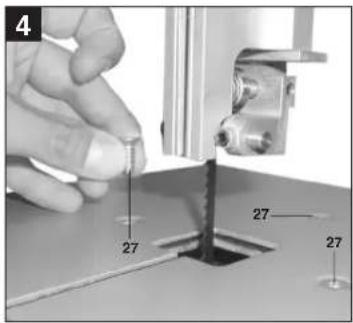
text_image
4 27 27 27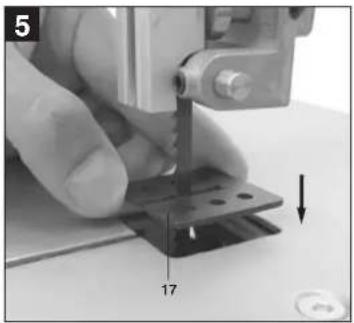
natural_image
Close-up of a hand using a sewing machine to cut metal components, with arrows indicating direction (no text or symbols visible)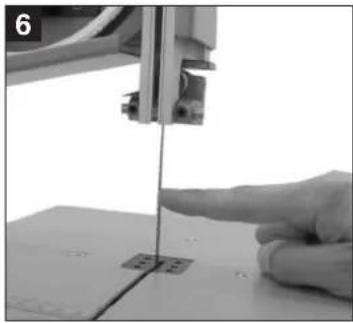
natural_image
Close-up of a hand using a sewing machine to cut a vertical line on a workbench (no text or symbols visible)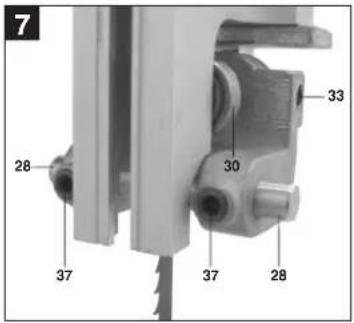
text_image
7 28 37 30 37 28 33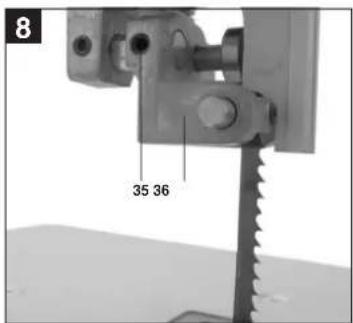
text_image
8 35 36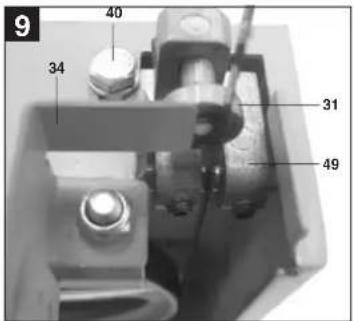
text_image
9 40 34 31 49
3
text_image
10 11 29 38 38 39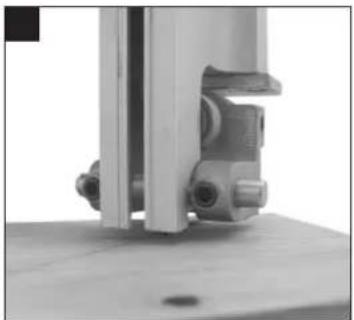
natural_image
Close-up of a mechanical assembly with metal components and bolts (no visible text or symbols)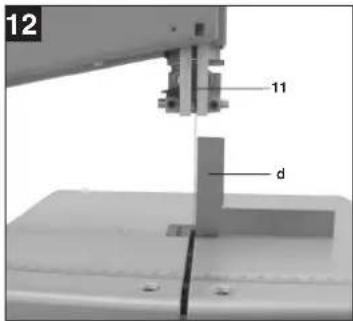
text_image
12 11 d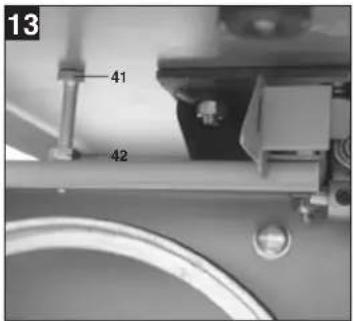
text_image
13 41 42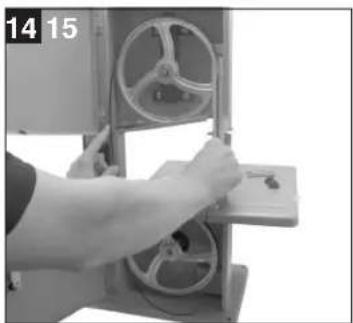
natural_image
Person operating a mechanical device with visible gears and shafts (no text or symbols)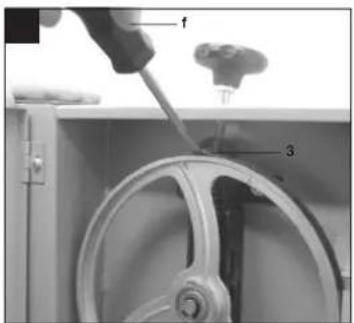
text_image
Technical diagram showing a mechanical device with labeled parts 1, 2, and 3, likely for assembly or maintenance.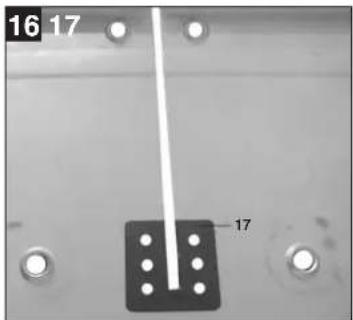
natural_image
Close-up of a mechanical component with a central rod and mounting holes, labeled '16 17' (no other text or symbols)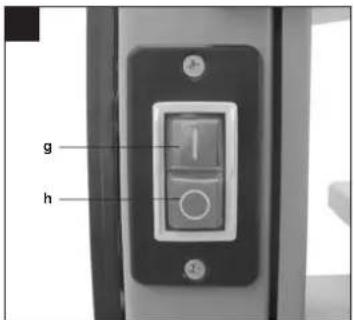
text_image
g h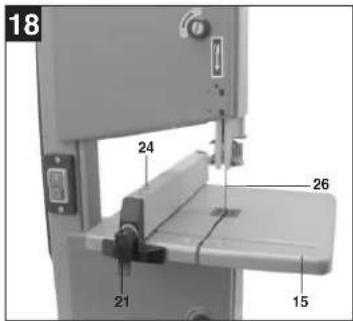
text_image
18 24 26 21 15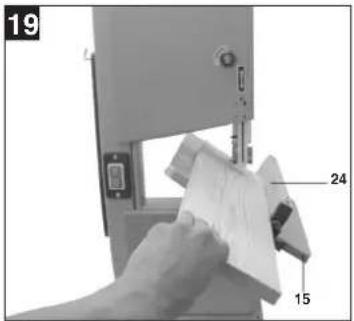
text_image
19 24 15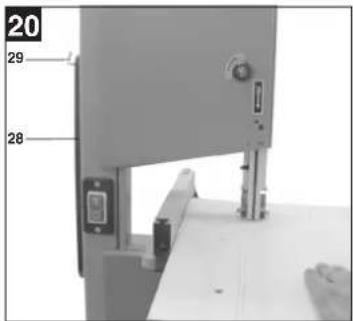
text_image
20 29 28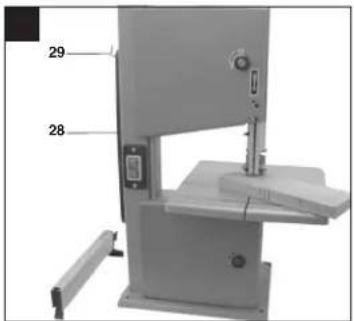
text_image
29 28
5


● Feststellgriff (20) lockern.
"Caution - Read the operating instructions to reduce the risk of inquiry"

Wear ear-muffs.
The impact of noise can cause damage to hearing.

Wear a breathing mask.
Dust which is injurious to health can be generated when working on wood and other materials.
Never use the device to work on any materials containing asbestos!

Wear safety goggles.
Sparks generated during working or splinters, chips and dust emitted by the device can cause loss of sight.

Pull the power plug before beginning any repair or maintenance work!
GB
⚠️ Important!
When using the equipment, a few safety precautions must be observed to avoid injuries and damage. Please read the complete operating instructions and safety regulations with due care. Keep this manual in a safe place, so that the information is available at all times. If you give the equipment to any other person, hand over these operating instructions and safety regulations as well. We cannot accept any liability for damage or accidents which arise due to a failure to follow these instructions and the safety instructions.
1. Machine layout (Figures 1/2)
-
ON/OFF switch
-
Power cord
-
Rubber tires
-
Web panel
-
Machine foot
-
Extractor socket
-
Lower blade pulley
-
Upper blade pulley
-
Tightening screw
-
Blade guard
-
Upper blade guide
-
Side cover
-
Hood closure
-
Retaining screw for upper blade pulley
-
Saw table
-
Dial scale for tilt angle
-
Plastic table insert
-
Fixing handles for saw table
-
Setting handle for blade guide
-
Fixing handle for blade guide
-
Clip for parallel stop
-
Setting screw for upper blade pulley
-
Motor
-
Parallel stop
-
Machine frame
-
Blade
2. Items supplied
- Bandsaw
● Saw table
- Push stick
- Parallel stop
3. Proper use
The bandsaw is designed to perform longitudinal and cross cuts on timber or wood-type materials. To cut round materials you must use suitable holding devices. The machine is to be used only for its prescribed purpose.
Any use beyond that mentioned is considered to be a case of misuse. The user/operator and not the manufacturer shall be liable for any damage or injury resulting from such cases of misuse.
The machine is to be operated only with suitable saw blades. To use the machine properly you must also observe the safety regulations, the assembly instructions and the operating instructions to be found in this manual.
All persons who use and service the machine have to be acquainted with this manual and must be informed about the machine's potential hazards.
Informed about the machine's potential hazards.
It is also imperative to observe the accident
prevention regulations in force in your area. The same applies for the general rules of occupational health and safety.
The manufacturer shall not be liable for any changes made to the machine nor for any damage resulting from such changes.
Even when the machine is used as prescribed it is still impossible to eliminate certain residual risk factors. The following hazards may arise in connection with the machine's construction and design:
● Damage to hearing if ear-muffs are not used as necessary.
● Harmful emissions of wood dust when used in closed rooms.
- Contact with the blade in the uncovered cutting zone.
● Injuries (cuts) when changing the blade.
● Injury from catapulted workpieces or parts of workpieces.
● Crushed fingers.
- Kickback.
- Tilting of the workpiece due to inadequate support.
● Touching the blade.
● Catapulting of pieces of timber and workpieces.
Please note that our equipment has not been designed for use in commercial, trade or industrial applications. Our warranty will be voided if the machine is used in commercial, trade or industrial businesses or for equivalent purposes.
GB
4. Important notes
Safety information
IMPORTANT! Whenever you use electric tools it is imperative to take basic safety precautions in order to reduce the risk of fire, electric shock and personal injury. Essential safety precautions include:
- Keep your work area tidy!
- An untidy work area invites accidents.
- Check the working conditions!
- Do not expose electric tools to rain.
- Never use electric tools in damp or wet locations.
- Make sure there is good lighting.
- Do not use electric tools near flammable liquids or gases.
- Guard against electric shock!
- Avoid body contact with earthed components.
- Keep other persons away!
- Do not allow other persons, particularly children, to touch the tool or cable. Keep all persons out of your work area.
- Store tools in a safe place!
- When tools are not in use they should be stored in a dry, locked room out of children's reach.
- Do not overload your tools!
- Tools work better and safer when used within their quoted capacity range.
- Use the right tool!
- Never use tools or attachments with insufficient power for the job in hand.
- Never use tools on jobs for which they were not intended. For example, do not use a hand-held circular saw to cut down trees or lop off branches.
- Wear suitable work clothes!
- Do not wear loose clothing or jewelry as they may get caught in moving parts.
- Non-slip shoes are recommended when working outdoors.
- Wear a hair net if you have long hair.
- Use personal safety equipment!
- Wear safety goggles
- Use a dust mask when working on dusty jobs
- Connect up a vacuum extraction system!
- If there are provisions for connecting up a vacuum extraction system, make sure that such a system is fitted and in use.
- Do not mis-use the cabl
- Do not carry the tool by its cable or pull on the cable to remove the plug from the socket-outlet. Protect the cable from heat, oil and sharp edges.
- Secure your workpiece!
- Use clamps or a vise to hold the workpiece securely. This is safer than using your hand and
will enable you to operate the machine with both hands.
- Avoid abnormal working postures!
- Make sure you stand squarely and keep your balance at all times.
- Look after your tools!
- Keep your tools sharp and clean for better and safer performance.
- Follow the instructions for maintenance work and for changing any attachments.
- Check the plug and cable regularly and, if damaged, have them replaced by an authorized specialist.
- Check the extension cable regularly and replace it if damaged.
- Keep handles dry and free from oil and grease.
- Always pull out the power plug:
- When the tool is not being used, before carrying out any maintenance work and when changing attachments such as blades, bits and cutters of any kind.
- Remove adjusting keys and wrenches!
- Make sure that all keys and adjusting wrenches are removed from the tool before switching it on.
- Avoid unintentional starting!
- Make sure that the switch is in OFF position when inserting the power plug.
- When using an extension cable outdoors:
- Check that it is approved for outdoor duty and is marked accordingly.
- Be alert at all times!
- Watch what you are doing. Use common sense. Do not operate the tool if your mind is not on your work.
- Check the tool for damage!
- Each time before re-using the tool, carefully check that the guards or any slightly damaged parts are working as intended.
- Check that the moving parts are in good working order, that they do not jam, and that no parts are damaged. Make sure that all parts are fitted correctly and that all other operating conditions are properly fulfilled.
- Unless otherwise stated in the operating instructions, damaged guards and parts have to be repaired or replaced by an authorized service center.
- Have damaged switches replaced by a customer service workshop.
- Never use any tool if its switch cannot be turned off and on.
- IMPORTANT!
- The use of any accessory or attachment other than those recommended may involve a risk of injury for you personally.
GB
- Have repairs carried out only by a qualified electrician!
- This electric tool complies with the pertinent safety regulations. Repairs are to be carried out only by a qualified electrician using original replacement parts or the user may suffer an accident.
- Wear safety gloves whenever you carry out any maintenance work on the blade!
- In the case of miter cuts when the table is tilted, the guide must be positioned on the lower part of the table.
- When cutting round wood, use a device to stop the workpiece from twisting.
- When cutting boards in upright position, use a device to prevent kick-back.
- A dust extraction system designed for an air velocity of 20 m/s should be connected in order to comply with woodworking dust emission values and to ensure reliable operation.
- Give these safety regulations to all persons who work on the machine.
- Do not use this saw to cut fire wood.
- The machine is equipped with a safety switch to prevent it being switched on again accidentally after a power failure.
- Before you use the machine for the first time, check that the voltage marked on the rating plate is the same as your mains voltage.
- If you use a cable reel, the complete cable has to be pulled off the reel.
- Persons working on the machine should not be distracted.
- Note the direction of rotation of the motor and blade.
- Never dismantle the machine's safety devices or put them out of operation.
- Never cut workpieces which are too small to hold securely in your hand.
- Never remove loose splinters, chips or jammed pieces of wood when the saw blade is running.
- It is imperative to observe the accident prevention regulations in force in your area as well as all other generally recognized rules of safety.
- Note the information published by your professional associations.
- Position the blade guard so it is approx. 3 mm above the material you want to saw.
- Important! Support long workpieces (e.g. with a roller table) to prevent them sagging at the end of a cut.
- Make sure the blade guard (10) is in its lower position when the saw is being transported.
-
Safety guards are not to be used to move or misuse the machine.
-
Blades that are misshapen or damaged in any way must not be used.
- If the table insert is worn, replace it.
- Never operate the machine if either the door protecting the blade or the detachable safety device are open.
- Ensure that the choice of blade and the selected speed are suitable for the material to be cut.
- Do not begin cleaning the blade until it has come to a complete standstill.
- In the case of straight sawing against the parallel stop, a push stick must be used.
- The bandsaw blade guard should be in its lowest position close to the bench during transport.
- For miter cuts when the table is tilted, the parallel stop must be positioned on the lower part of the table.
- When cutting round timber, use a suitable holding device to prevent the workpiece turning.
- Never use guards to lift or transport items.
- Ensure that the bandsaw blade guards are used and correctly adjusted.
- Keep your hands a safety distance away from the bandsaw blade. Use a push stick for narrow cuts.
5. Technical data
Voltage: 230V \~ 50 Hz
Power: S1 180 W S2 15 min. 250 W
Ideal speed no: 1400 min
Blade length: 1400 mm
Max. blade width: 8 mm
Blade speed: 900 m/min
Cutting height: 80 mm / 90°
45 mm / 45°
Throat: 200 mm
Table size: 300 x 300 mm
Tilting range of table: 0° to 45°
Workpiece size: 400 x 400 mm
Weight: 18.5 kg
GB
Noise emission values
Sound and vibration values were measured in accordance with EN 61029.
Cutting
| L_pA sound pressure level 82.3 dB(A) | |
| K_pA uncertainty | 3 |
| L_WA sound power level 92.8 dB(A) | |
| K_WA uncertainty | 3 |
Load factor:
A load factor of S2 15 min (intermittent periodic duty) means that you may operate the motor continuously at its nominal power level (250 W) for no longer than the time stipulated on the specifications label (15 minutes ON period). If you fail to observe this time limit the motor will overheat. During the OFF period the motor will cool again to its starting temperature.
Wear ear-muffs.
The impact of noise can cause damage to hearing.
Keep the noise emissions and vibrations to a minimum.
●Only use appliances which are in perfect working order.
●Service and clean the appliance regularly.
●Adapt your working style to suit the appliance.
●Do not overload the appliance.
●Have the appliance serviced whenever necessary.
●Switch the appliance off when it is not in use.
Residual risks
Even if you use this electric power tool in accordance with instructions, certain residual risks cannot be rules out. The following hazards may arise in connection with the equipment's construction and layout:
-
Lung damage if no suitable protective dust mask is used.
-
Damage to hearing if no suitable ear protection is used.
6. Before putting the machine into operation
● Make sure the machine stands securely, i.e. bolt it to a workbench or solid base. There are two holes for this purpose in the machine foot.
- The saw table must be mounted correctly. - All covers and safety devices have to be properly fitted before the machine is switched on.
- It must be possible for the blade to run freely.
- When working with wood that has been processed before, watch out for foreign bodies such as nails or screws etc.
- Before you actuate the On/Off switch, make sure that the saw blade is correctly fitted and that the machine's moving parts run smoothly.
● Before you connect the machine to the power supply, make sure the data on the rating plate is the same as that for your mains.
7. Assembly
CAUTION!
Pull out the power plug before carrying out any maintenance, resetting or assembly work on the bandsaw!
7.1. Mounting the saw table (Fig. 3 - 5)
- Remove the web panel (4).
- Place the saw table (15) on the machine housing (25) from the right and fasten with 3 fixing screws (27). Make sure that the blade (26) is positioned exactly in the center of the saw table.
● Re-insert the web panel (4).
- Insert the plastic table insert (17) into the table from above. Do this in such a way that a through-going slot is the result.
● To dismantle the saw table, proceed in reverse order.
7.2. Tensioning the blade (Figure 1/6)
- CAUTION! Remove the tension from the blade if the bandsaw is not going to be used for some time. Be sure to re-tension the blade before you start the machine.
● Turn the tightening screw (9) for tensioning the blade (26) in a clockwise direction.
● The correct blade tension can be checked by applying pressure to the side of the blade with your finger, somewhere in the middle between the two blade pulleys (7 + 8). You should only be able to bend the blade (26) very slightly (approx. 1-2 mm).
GB
- IMPORTANT! The blade may break if the tension is too high. BEWARE OF INJURY! If the tension is too low, the powered blade pulley (7) will spin while the blade does not move.
7.3 Adjusting the blade
- CAUTION! The blade tension has to be set correctly before you can adjust the blade.
- Undo the fasteners (13) and open the side cover (12).
- Slowly turn the upper blade pulley (8) clockwise by hand. The blade (26) should run in the middle of the pulley. If it does not, you will have to adjust the tilt of the upper blade pulley (8).
- If the blade (26) tends to run to the back of the blade pulley (8), i.e. towards the machine frame (25), turn the setting screw (22) anti-clockwise while turning the blade pulley (8) by hand until the blade (26) runs in the middle.
- If the blade (26) tends to run to the front edge of the blade pulley (8), turn the setting screw (22) in a clockwise direction.
- After setting the upper blade pulley (8) you need to check the blade (26) position on the lower blade pulley (7). The blade (26) should run in the middle of the blade pulley (7), as above. If it does not, you will have to adjust the tilt of the upper blade pulley (8) again.
● Turn the upper blade pulley several times until the adjustment to the upper blade pulley (8) has an effect on the blade position of the lower blade pulley (7).
● After any adjustments have been carried out, the side covers (12) must be closed again and re-secured with the fasteners (13).
7.4. Setting the blade guide (Fig. 7 - 10)
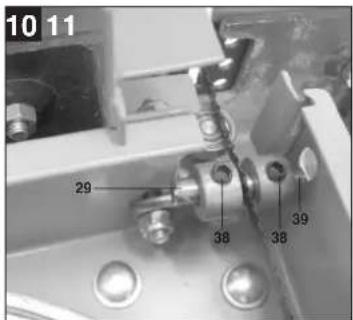
Whenever you change the blade you must re-set both the support bearings (30 + 31) and the guide pins (28 + 29).
● Undo the fasteners (13) and open the side cover (12).
7.4.1. Upper support bearing (30)
● Undo the screw (33)
- Move the support bearing (30) so that it is no longer touching the blade (26). There should be a maximum gap of 0.5 mm.
● Re-tighten the screw (33).
7.4.2. Adjusting the lower support bearing (31)
● Dismantle the saw table (15).
● Swing the blade guard (34) away.
- Adjust in the same way that the upper support bearing was adjusted.
The blade (26) is only supported by the support bearings (30 + 31) during cutting. When idle the blade should not touch the ball bearing.
7.4.3. Adjusting the upper guide pins (28)
● Undo the Allen screw (35)
- Move the mount (36) of the guide pins (28) so that there is a gap of approx. 1 mm between the front edge of the guide pins (28) and the gullet of the blade in front.
● Re-tighten the Allen screw (35).
- CAUTION! The blade will be rendered useless if the teeth touch the guide pins while the blade is running.
● Undo the Allen screws (37).
- Move the guide pins (28) towards the blade so that there is a gap of approx. 0.5 mm between the guide pins (28) and the blade (26). The blade must not jam.
● Re-tighten the Allen screws (37).
● Turn the upper blade pulley (8) several times in a clockwise direction.
- Check the setting of the guide pins (28) again and re-adjust if necessary.
7.4.4. Adjusting the lower guide pins (29)
● Dismantle the saw table (15).
● Undo the screw (40).
- Move the mount (49) of the guide pins (29) so that there is a gap of approx. 1 mm between the front edge of the guide pins (29) and the gullet of the blade in front.
● Re-tighten the screw (40).
- CAUTION! The blade will be rendered useless if the teeth touch the guide pins while the blade is running.
● Re-tighten the Allen screws (38).
- Move the guide pins (29) towards the blade so that there is a gap of approx. 0.5 mm between the guide pins (29) and the blade (26). The blade must not jam.
● Re-tighten the Allen screws (38).
● Turn the lower blade pulley (7) several times in a clockwise direction.
- Check the setting of the guide pins (29) again and re-adjust if necessary.
CAUTION! When the adjustments have been
finished, the blade guard (34) must be closed
again.
7.5. Adjusting the upper blade guide (11) (Figure 11) ● Undo the fixing handle (20).
● Turn the setting wheel (19) to lower the blade guide (11) as close as possible to the workpiece to be cut. The gap should be approx. 2-3 mm.
● Re-tighten the fixing handle (20).
- Check the setting before each cut and re-adjust if necessary.
7.6. Adjusting the machine table (15) to 90° (12/13)
● Move the upper blade guide (11) to the top.
● Undo the fixing handles (18).
- Set the angle (d) between the blade (26) and the table (15).
- Turn the setting wheel (19) to tilt the saw table (15) until it is at an angle of exactly 90^ to the blade (26).
● Re-tighten the fixing handle (18).
● Undo the nut (42).
- Adjust the Allen screw (41) until there is contact with the machine frame.
● Re-tighten the nut (42) to fasten the Allen screw (41).
7.7. Blade selection
The blade supplied with the bandsaw is designed for all-purpose use. When you select a blade you should have regard to the following criteria:
- Use a narrow blade to cut tighter radii than you can with a wider blade.
● Wide blades are used to saw straight cuts. This is particularly important in cutting wood because the blade has a tendency to follow the grain of the wood and thereby deviate easily from the cutting line.
● Finely toothed blades provide smoother cuts but are slower than coarse blades.
Important: Never use warped or lacerated blades!
7.8. Changing the blade (Fig. 14)
- Move the blade guide (11) into a position approximately half way between the saw table (15) and the machine housing (25).
● Undo the fasteners (13) and open the side cover (12).
- Remove the web panel (4).
● Turn the tightening screw (9) anti-clockwise to remove the tension from the blade (26).
- Remove the blade (26) from the blade pulleys (7, 8) and take out through the slot in the table (15)
● Fit the new blade (26), aligned centrally on the blade pulleys (7, 8).
The teeth of the blade (26) must point downwards in the direction of the table.
● Tension the blade (26) (see 7.2)
- Close the side cover (12) again.
● Mount the web panel (4) again.
7.9. Changing the rubber tires on the blade pulleys (Figure 15)
After a certain time the rubber tires (3) on the blade pulleys (7/8) will get worn by the sharp teeth of the blades and must be replaced.
● Open the side cover (12).
- Remove the blade (26) (see 7.7).
● Lift the edge of the tire (3) with a small
screwdriver (f) and remove from the blade pulley (8).
- Repeat for the lower blade pulley (7).
● Fit the new tire (3), replace the blade (26) and close the side cover (12).
7.10. Changing the table insert (Figure 16)
To prevent increased likelihood of injury the table insert (17) should be changed whenever it is worn or damaged.
- Detach the table (15) (see 7.1).
● Lift out the worn table insert (17).
● Fit the replacement table insert by following the above in reverse.
7.11. Extractor sockets
The bandsaw is equipped with extractor sockets (6) for extracting sawdust and chips.
8. Control elements
8.1. On/Off switch (Figure 17)
- To turn the machine on, press the green button "1" (g).
● To turn the machine off again, press the red button ..0" (h).
- Your bandsaw has a switch with undervoltage release. After a power failure you must reactivate the switch.
8.2. Parallel stop (Figure 18)
● Push the clip (21) on the parallel stop (24) upwards.
- Move the parallel stop (24) along the table (15), from either the right or left of the blade (26), and position as required.
- Push the clip (21) down to fix the parallel stop (24). If the clip (21) does not give enough hold, turn it clockwise several times until the parallel stop is securely fixed.
● You must always ensure that the parallel stop (24) is positioned parallel to the blade (26).
GB
8.3. Angular cuts (Abb. 19)
To enable you to perform angular cuts parallel to the blade (26), the table (15) can be tilted forwards between 0^ - 45^ .
● Undo the fixing handles (18).
● Tilt the saw table (15) forwards until the required angle value is set on the dial scale (16).
● Re-tighten the fixing handles (18).
- Important: When the table (15) is tilted, place the parallel stop (24) to the right of the blade (26) looking in the direction in which you are working, on the side pointing downwards (provided the workpiece is wide enough) in order to stop the workpiece from slipping off.
9. Operation
Caution! After every new adjustment we recommend you to make a trial cut in order to check the new settings.
- For all cutting operations it is important to position the blade guide (11) as close as possible to the workpiece (see 7.5).
● Always guide the workpiece with both hands, holding it flat on the table (15) in order to prevent the blade (26) from jamming.
● Feed the workpiece at a uniform speed that enables the blade to cut through the material without difficulty and without blocking.
● Always use the parallel stop (24) on all cuts for which they are intended.
● Always aim at making a complete cut in one pass rather than in a stop-and-go operation requiring the workpiece to be withdrawn. If you have to withdraw the workpiece, switch off the bandsaw first and wait for the blade (26) to stop before freeing the workpiece.
● The workpiece must always be guided by the longer side during cutting.
Important! When handling narrower workpieces, it is essential to use a push stick. The push stick (28) must always be kept close at hand at the hook (29) provided for that purpose on the side of the saw.
9.1. Longitudinal cuts (Figure 20)
Longitudinal cutting is when you use the saw to cut along the grain of the wood.
● Place the parallel stop (24) to the left of the blade (25), as far as possible, for the width required.
● Lower the blade guide (11) down to the workpiece (see 7.5).
- Switch on the saw.
- Press the edge of the workpiece with your right hand to hold it securely against the parallel stop (24) and flat on the table (15).
● Guide the workpiece along the parallel stop (24) and through the blade (26) at a uniform speed.
- Important: Long workpieces must be secured against falling off at the end of the cut (e.g. with a roller stand etc.)
9.2. Making angular cuts (Fig. 19)
● Set the saw table to the desired angle (see 8.3).
● Carry out the cut as described in 9.1.
9.3. Freehanded cuts (Figure 21)
One of the most outstanding features of a bandsaw is the ease with which it allows you to make curved cuts and radii.
● Lower the blade guide (11) to the workpiece (see 7.5).
- Switch on the saw.
● Hold the workpiece securely on the table (15) and guide slowly through the blade (26).
- Freehanded cuts should be made at low feed speed so that you can guide the blade (26) along the required line.
- It often pays to first cut off surplus curves and corners up to about 6 mm from the cutting line.
- In the case of curves which are too tight for the blade to cut correctly, it can help to make a series of close-lying cuts at right angles to the curved line. When you saw the radius the material will simply drop off.
10. Transport
To transport the bandsaw, hold the supporting foot (5) with one hand and the frame (25) with the other hand. Important! Never use guards to lift or transport the equipment.
11. Maintenance
- Caution! Pull out the power plug first.
- Remove dust and dirt regularly from the bandsaw. Cleaning is best carried out with a fine brush or a cloth.
- Do not use caustic cleaning agents for cleaning plastic.
12. Ordering replacement parts
Please quote the following data when ordering replacement parts:
●Type of machine
●Article number of the machine
●Identification number of the machine
●Replacement part number of the part required
For our latest prices and information please go to www.isc-gmbh.info
13. Disposal and recycling
The unit is supplied in packaging to prevent its being damaged in transit. This packaging is raw material and can therefore be reused or can be returned to the raw material system.
The unit and its accessories are made of various types of material, such as metal and plastic. Defective components must be disposed of as special waste. Ask your dealer or your local council.


Duljina trake pile: 1400 mm
Širina trake pile maks.: 8 mm
Brzina trake pile: 900 m/min
Visina rezanja: 80 mm / 90° 45 mm / 45°
Polumjer rada: 200 mm
Veličina stola: 300 x 300 mm
Nagib stola: 0° do 45°
Veličina radnog komada maks.: 400 x 400 mm
Težina: 18,5
HR/ BIH
● explains the following conformity according to EU directives and norms for the following product
90/396/EC_2009/142/EC
□ 89/686/EC_96/58/EC
2011/65/EC
x 2006/42/EC
Annex IV
Notified Body: TÜV Rheinland LGA Products GmbH
Notified Body No.: 0197 Reg. No.: BM 5018 3261 0001
□2000/14/EC_2005/88/EC
□ Annex V
□ Annex VI
Noise: measured L_ = dB(A) ; guaranteed L_ = dB(A)
P = KW; L∅ = cm Notified Body:
2004/26/EC
Emission No.:
Standard references: EN 61029-1; EN 61029-2-5; EN 55014-1; EN 55014-2; EN 61000-3-2; EN 61000-3-3
Subject to change without notice Wiesenweg 22, D-94405 Landau/Isar
Documents registrar: Siegfried Rolder
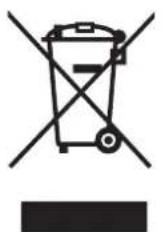
©Nur für EU-Länder
For EU countries only
Never place any electric tools in your household refuse.
To comply with European Directive 2002/96/EC concerning old electric and electronic equipment and its implementation in national laws, old electric tools have to be separated from other waste and disposed of in an environment-friendly fashion, e.g. by taking to a recycling depot.
Recycling alternative to the demand to return electrical devices:
As an alternative to returning the electrical device, the owner is obliged to cooperate in ensuring that the device is properly recycled if ownership is relinquished. This can also be done by handing over the used device to a returns center, which will dispose of it in accordance with national commercial and industrial waste management legislation. This does not apply to the accessories and auxiliary equipment without any electrical components which are included with the used device.
The reprinting or reproduction by any other means, in whole or in part, of documentation and papers accompanying products is permitted only with the express consent of ISC GmbH.
F
All of our products undergo strict quality checks to ensure that they reach you in perfect condition. In the unlikely event that your device develops a fault, please contact our service department at the address shown on this guarantee card. Of course, if you would prefer to call us then we are also happy to offer our assistance under the service number printed below. Please note the following terms under which guarantee claims can be made:
- These guarantee terms cover additional guarantee rights and do not affect your statutory warranty rights. We do not charge you for this guarantee.
- Our guarantee only covers problems caused by material or manufacturing defects, and it is restricted to the rectification of these defects or replacement of the device. Please note that our devices have not been designed for use in commercial, trade or industrial applications. Consequently, the guarantee is invalidated if the equipment is used in commercial, trade or industrial applications or for other equivalent activities. The following are also excluded from our guarantee: compensation for transport damage, damage caused by failure to comply with the installation/assembly instructions or damage caused by unprofessional installation, failure to comply with the operating instructions (e.g. connection to the wrong mains voltage or current type), misuse or inappropriate use (such as overloading of the device or use of non-approved tools or accessories), failure to comply with the maintenance and safety regulations, ingress of foreign bodies into the device (e.g. sand, stones or dust), effects of force or external influences (e.g. damage caused by the device being dropped) and normal wear resulting from proper operation of the device. This applies in particular to rechargeable batteries for which we nevertheless issue a guarantee period of 12 months.
The guarantee is rendered null and void if any attempt is made to tamper with the device.
-
The guarantee is valid for a period of 2 years starting from the purchase date of the device. Guarantee claims should be submitted before the end of the guarantee period within two weeks of the defect being noticed. No guarantee claims will be accepted after the end of the guarantee period. The original guarantee period remains applicable to the device even if repairs are carried out or parts are replaced. In such cases, the work performed or parts fitted will not result in an extension of the guarantee period, and no new guarantee will become active for the work performed or parts fitted. This also applies when an on-site service is used.
-
In order to assert your guarantee claim, please send your defective device postage-free to the address shown below. Please enclose either the original or a copy of your sales receipt or another dated proof of purchase. Please keep your sales receipt in a safe place, as it is your proof of purchase. It would help us if you could describe the nature of the problem in as much detail as possible. If the defect is covered by our guarantee then your device will either be repaired immediately and returned to you, or we will send you a new device.
Of course, we are also happy offer a chargeable repair service for any defects which are not covered by the scope of this guarantee or for units which are no longer covered. To take advantage of this service, please send the device to our service address.
F BULLETIN DE GARANTIE
Chère Cliente, Cher Client,
| Name: | |
| Surname / NR.: | Telephone: |
| PLZ OR | Mobile: |
| 1 | Service History: 01805 120 509 · w.w.i-sc-gmbh.info · Mo-Fr. 8:00-18:00 Uhr(Fresenepedia: 4 cim. mobtuniprese maxima): 42 cim. Auburnab Deutschen Islands talien statesden Gebruera lon liu reglules Gaspich ihs di Fesenetz an). |
EH 12/2011 (01)