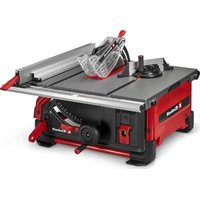
TE-TS 10 T - Saw EINHELL - Free user manual and instructions
Find the device manual for free TE-TS 10 T EINHELL in PDF.


| Product type | Table saw |
| Brand | Einhell |
| Model | TE-TS 10 T |
| Power supply | 220-240 V ~ 50 Hz |
| Rated power (S1) | 1800 W |
| Maximum power (S6 25%) | 2000 W |
| No-load speed | 4700 rpm |
| Blade diameter | 254 mm |
| Blade bore | 30 mm |
| Blade thickness | 2.8 mm |
| Number of teeth | 48 |
| Max. cutting height (90°) | 89 mm |
| Max. cutting height (45°) | 63 mm |
| Blade tilt | 0° to 45° (continuous) |
| Crosscut fence | -60° to +60° |
| Dust extraction connection | ∅ 36 mm |
| Weight | approx. 18 kg |
| Protection class | II (double insulation) |
| Riving knife thickness | 2.3 mm |
| Sound pressure level | 92.3 dB(A) (K=3 dB) |
| Sound power level | 105.3 dB(A) (K=3 dB) |
| Extractable table extension | Yes, to the right |
| Blade guard | With automatic retraction |
| Push stick included | Yes |
| Adjustable parallel fence | Yes, with guide rail |
Frequently Asked Questions - TE-TS 10 T EINHELL
User questions about TE-TS 10 T EINHELL
0 question about this device. Answer the ones you know or ask your own.
Ask a new question about this device
Download the instructions for your Saw in PDF format for free! Find your manual TE-TS 10 T - EINHELL and take your electronic device back in hand. On this page are published all the documents necessary for the use of your device. TE-TS 10 T by EINHELL.
USER MANUAL TE-TS 10 T EINHELL
GB Original operating instructions Bench-type circular saw
natural_image
Mechanical assembly diagram showing a motor with labeled parts (14 and 2b), no readable text or symbols beyond labels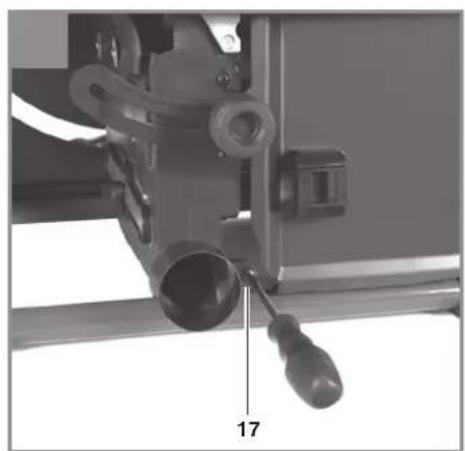
natural_image
Mechanical component with a screwdriver inserted into a pipe fitting (no visible text or symbols)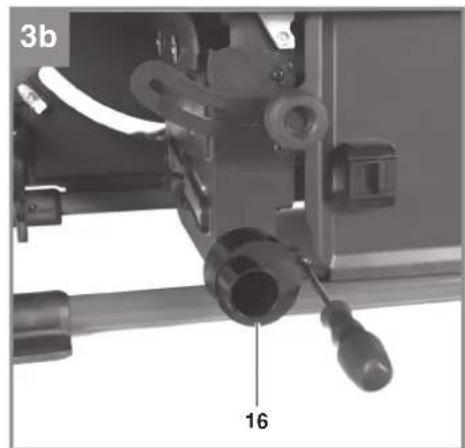
natural_image
Mechanical assembly diagram showing a lever and shaft with labeled component (16), no readable text or symbols beyond labels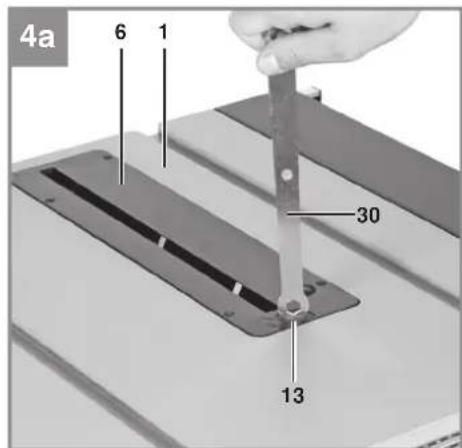
scatter
| Label | Value | |---|---| | 40 | 40 | | 6 | 6 | | 40 | 40 | | 13 | 13 | | 5 | 5 | | B | 5 | | 415 | 20 | | 4 | 4 |-4-

natural_image
Close-up of a mechanical component with a checkmark symbol in the corner (no readable text or symbols)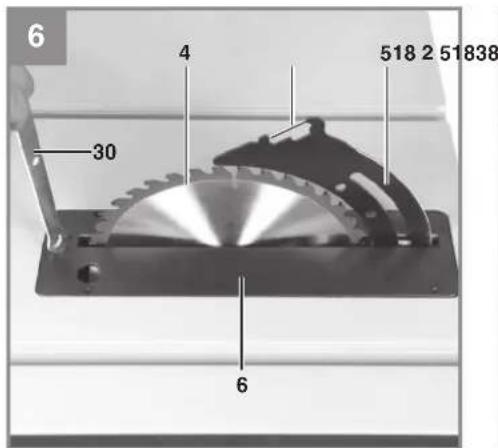
natural_image
Close-up of a hand using a cutting tool to cut a metal sheet on a workbench, with no visible text or symbols.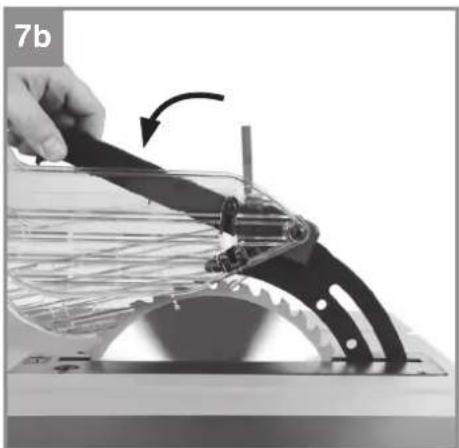
natural_image
Close-up of a hand using a tool to cut or spread a circular object on a cutting board (no text or symbols visible)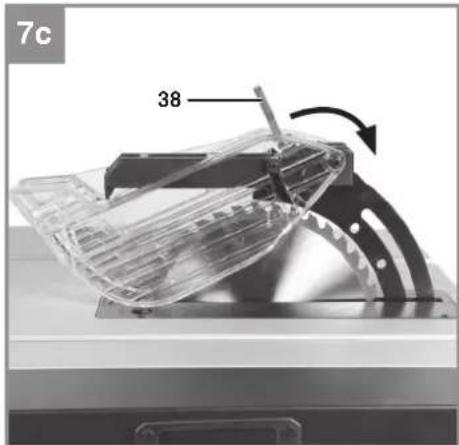
natural_image
Close-up of a hand holding a cylindrical object with labeled parts (no readable text or symbols)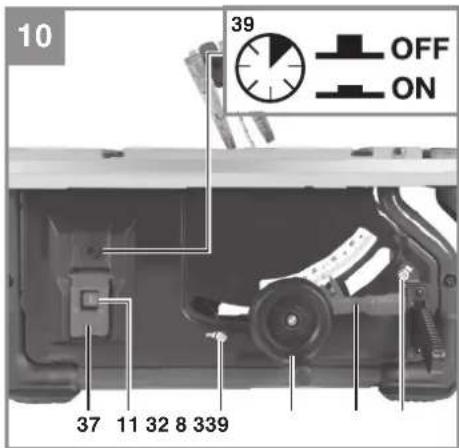
natural_image
Mechanical assembly diagram showing a component with numbered parts (8 and 9) and a curved arrow indicating motion or force direction (no text or symbols present)
-7-
natural_image
Mechanical assembly diagram showing a vehicle chassis with gears and shafts (no text or symbols visible)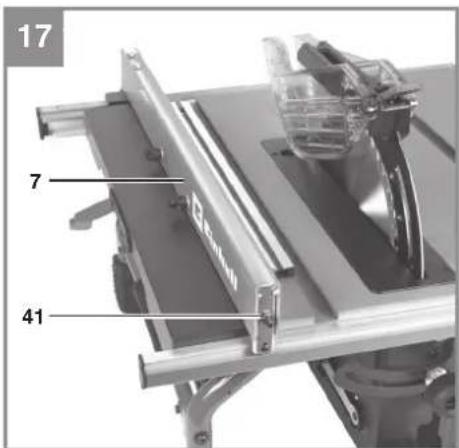
natural_image
Mechanical machine with a tool handle and workbench, no visible text or symbols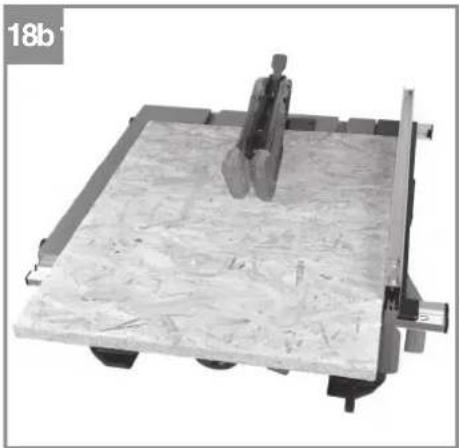
natural_image
3D rendering of a mechanical device with a central human figure and textured base (no visible text or symbols)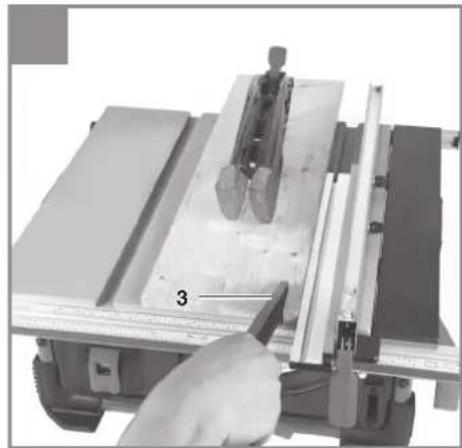
natural_image
Close-up of a mechanical cutting machine with a hand operating the work (no visible text or symbols)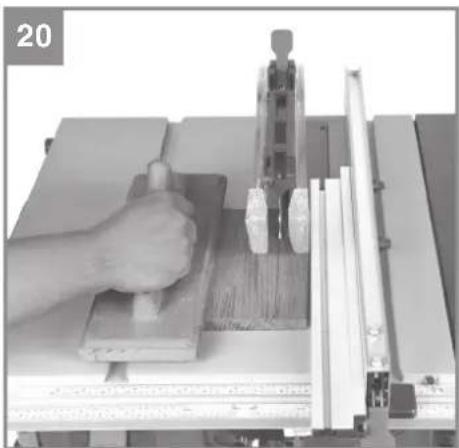
natural_image
Mechanical assembly with a hand pressing a block on a workbench, no visible text or symbols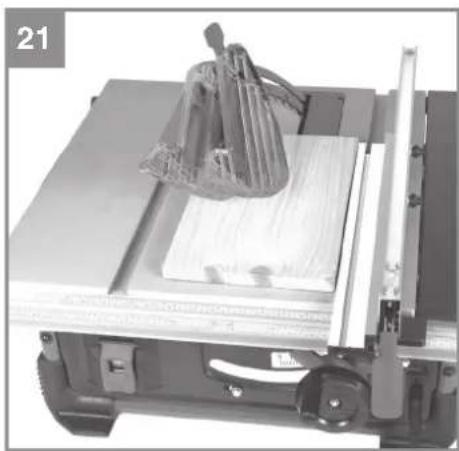
natural_image
Mechanical device with a bag resting on a wooden surface, no visible text or symbols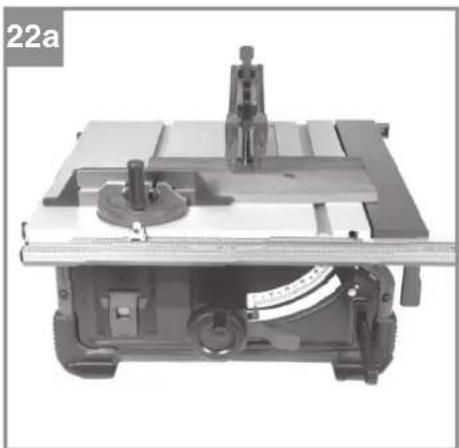
natural_image
Mechanical machine with workpiece and scale ruler, no visible text or symbols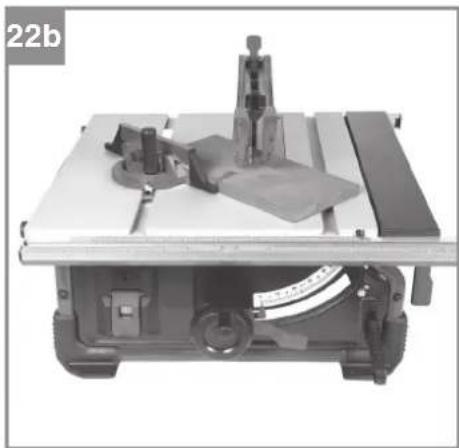
natural_image
Mechanical machine with cutting tool and workpiece (no visible text or symbols)23
6
1
2
D
Gefahr!
When using the equipment, a few safety precautions must be observed to avoid injuries and damage. Please read the complete operating instructions and safety regulations with due care. Keep this manual in a safe place, so that the information is available at all times. If you give the equipment to any other person, hand over these operating instructions and safety regulations as well. We cannot accept any liability for damage or accidents which arise due to a failure to follow these instructions and the safety instructions.
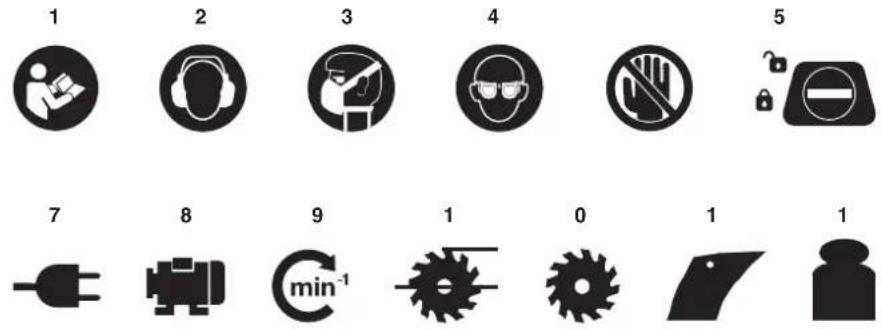
Explanation of the symbols used (see Fig. 23)
- Danger! - Read the operating instructions to reduce the risk of injury.
- Caution! Wear ear-muffs. The impact of noise can cause damage to hearing.
- Caution! Wear a breathing mask. Dust which is injurious to health can be generated when working on wood and other materials. Never use the device to work on any materials containing asbestos!
- Caution! Wear safety goggles. Sparks generated during working or splinters, chips and dust emitted by the device can cause loss of sight.
- Caution! Risk of injury! Do not reach into the running saw blade.
- Using the supplied ring wrench, turn the disk clockwise to release the table insert. Turn the disk counter-clockwise to secure the table insert against falling out.
- Conditions of the mains connection
- Power rating
- Speed
- Cutting height at 90° and 45° saw blade angle
- Saw blade dimensions
- Thickness of the splitter
- Weight
1. Safety regulations
The corresponding safety information can be found in the enclosed booklet.
WARNING!
Read all safety warnings, instructions, illustrations and specifications provided with this power tool. Failure to follow all instructions listed below may result in electric shock, fire and/or serious injury.
Save all warnings and instructions for future reference.
2. Layout and items supplied
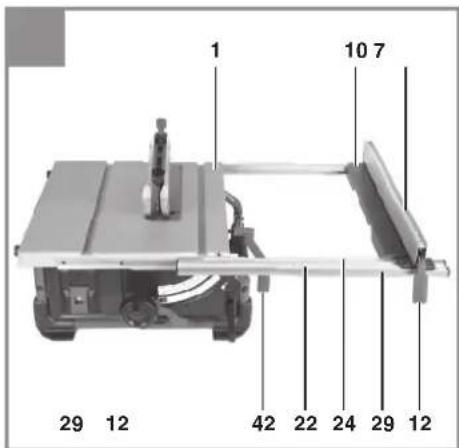
2.1 Layout (Fig. 1-22)
- Saw table
- Saw blade guard
- Push stick
- Blade
- Splitter
- Table insert
- Complete parallel stop
- Handwheel
- Locking lever for saw blade angle
- Pull-out table width extension
- On/Off switch
- Eccentric lever for parallel stop
- Rotary disk
- Cross stop
- Screw for saw blade
- Extractor adapter
- Recessed head screw
- Recess on the splitter
- Fastening lever
- Fastening plate
- Slot in saw table
- Main scale
- Stop rail
- Additional scale
- Slot in stop rail
- Knurled screw for parallel stop
- Washer for parallel stop
- Lock bolt for parallel stop
- Guide rail for parallel stop
- Wrench 10/13 mm
- Wrench 10/21 mm
- Adjustment screw 0°
- Adjustment screw 45°
- Stop rail for cross stop
- Knurled screw for cross stop
- Locking screw for cross stop
- Button cover for emergency stop switch
- Eccentric lever for the blade guard
- Overload switch
- Socket head screw 2.5 mm
- Nut on parallel stop
- Clamping lever for table width extension
- Threaded sleeve
- Nut
- Locking grip for saw blade angle
2.2 Items supplied
Please check that the article is complete as specified in the scope of delivery. If parts are missing, please contact our service center or the sales outlet where you made your purchase at
GB
the latest within 5 working days after purchasing the product and upon presentation of a valid bill of purchase. Also, refer to the warranty table in the service information at the end of the operating instructions.
- Open the packaging and take out the equipment with care.
- Remove the packaging material and any packaging and/or transportation braces (if available).
- Check to see if all items are supplied.
- Inspect the equipment and accessories for transport damage.
- If possible, please keep the packaging until the end of the guarantee period.
Danger!
The equipment and packaging material are not toys. Do not let children play with plastic bags, foils or small parts. There is a danger of swallowing or suff ocating!
• Bench-type circular saw
- Saw blade guard
- Pushstick
• Complete parallel stop
Crossstop
- Extractoradapter
• Wrench 10/13 mm
• Wrench 10/21 mm
• Original operating instructions
• Safetyinformation
3. Proper use
The bench-type circular saw is designed for the slitting and cross-cutting (only with the cross stop) of all types of timber commensurate with the machine's size. The equipment is not to be used for cutting any type of round wood.
The equipment is to be used only for its prescribed purpose. Any other use is deemed to be a case of misuse. The user / operator and not the manufacturer will be liable for any damage or injuries of any kind caused as a result of this.
Please note that our equipment has not been designed for use in commercial, trade or industrial applications. Our warranty will be voided if the machine is used in commercial, trade or industrial businesses or for equivalent purposes.
The equipment is to be operated only with suitable saw blades (saw blades made of HM or CV) It is prohibited to use any type of HSS saw blade and cutting-off wheel.
To use the equipment properly you must also observe the safety information, the assembly instructions and the operating instructions to be found in this manual.
All persons who use and service the equipment have to be acquainted with these operating instructions and must be informed about the equipment's potential hazards. It is also imperative to observe the accident prevention regulations in force in your area. The same applies for the general rules of health and safety at work.
The manufacturer will not be liable for any changes made to the equipment nor for any damage resulting from such changes. Even when the equipment is used as prescribed it is still impossible to eliminate certain residual risk factors.
The following hazards may arise in connection with the machine's construction and design:
- Contact with the saw blade in the uncovered saw zone.
- Reaching into the running saw blade (cut injuries).
- Kick-back of workpieces and parts of workpieces.
• Saw blade fracturing. - Catapulting of faulty carbide tips from the saw blade.
- Damage to hearing if essential ear-muffs are not used.
- Harmful emissions of wood dust when used in closed rooms.
4. Technical data
AC motor 220-240V \~ 50Hz
Power P ....S1 1800 W · S6 25% 2000 W
Idling speed n_0 4700 rpm
Carbide saw blade ..... ∅ 254 x ∅ 30 x 2.8 mm
Number of teeth 48
Cutting height max. 89 mm / 90°
63 mm / 45°
Height adjustment .... infinite 0 - 89 mm
Tilting saw blade ....infinite 0° - 45°
Cross stop angle ....infi nite -60° - 60°
Extractor connection 0 36 mm
Weight approx. 18 kg
Protection class: ...... 11回
Thickness of the splitter 2.3 mm
GB
Operating mode S6 25%: Continuous operation with idling (cycle time 10 minutes). To ensure that the motor does not become excessively hot, it may only be operated for 25% of the cycle at the specified rating and must then be allowed to idle for 75% of the cycle.
Danger!
Noise
The noise emission values were measured in accordance with EN 62841.
Operation
L_pA sound pressure level ..... 92.3 dB (A)
K_pA uncertainty 3 dB (A)
L_WA sound power level 105.3 dB (A)
K_WA uncertainty 3 dB (A)
Wear ear-muff s.
The impact of noise can cause damage to hearing.
The stated noise emission values were measured in accordance with a set of standardized criteria and can be used to compare one power tool with another.
The stated noise emission values can also be used to make an initial assessment of exposure.
Warning:
The noise emission levels may vary from the level specified during actual use, depending on the way in which the power tool is used, especially the type of workpiece it is used for.
Keep the noise emissions and vibrations to a minimum.
- Only use appliances which are in perfect working order.
• Service and clean the appliance regularly.
• Adapt your working style to suit the appliance.
• Do not overload the appliance. - Have the appliance serviced whenever necessary.
• Switch the appliance off when it is not in use.
Limit the operating time!
All stages of the operating cycle must be considered (for example, times in which the electric tools are switched off and times in which the tool is switched on but operates without load).
Caution!
Residual risks
Even if you use this electric power tool in accordance with instructions, certain residual risks cannot be rules out. The following hazards may arise in connection with the equipment's construction and layout:
- Lung damage if no suitable protective dust mask is used.
- Damage to hearing if no suitable ear protection is used.
5. Before starting the equipment
Before you connect the equipment to the mains supply make sure that the data on the rating plate are identical to the mains data.
Warning!
Always pull the power plug before making adjustments to the equipment.
- Unpack the bench-type circular saw and check it for damage which may have occurred in transit.
- The machine has to be set up where it can stand firmly, e.g. on a work bench, or it must be bolted to a strong base.
- All covers and safety devices have to be properly fitted before the machine is switched on.
- It must be possible for the saw blade to run freely.
- When working with wood that has been processed before, watch out for foreign bodies such as nails or screws etc.
Before you actuate the On/Off switch, make sure that the saw blade is correctly fitted and that the machine's moving parts run smoothly.
6. Assembly
Danger! Pull out the power plug before carrying out any maintenance, resetting or assembly work on the bench-type circular saw.
6.1 Setting up the bench-type circular saw (Fig. 3)
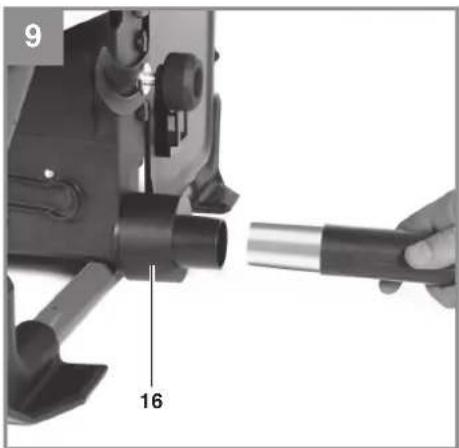
Fit the extractor adapter (16) at the back of the machine. To do so, remove the recessed head screw (17) and push on the extractor adapter (16). Secure the extractor adapter (16) with the recessed head screw (17).
GB
6.2 Fitting/changing the table insert (Fig. 4, 6)
- To prevent increased risk of injury, the table insert (6) must be replaced whenever it becomes worn or damaged.
• Take off the saw blade guard (2) (see 6.4). - Place the 10 mm end of one of the two wrenches (30, 31) on the rotary disk (13). Use the wrench to turn the disk (13) clockwise in order to release the table insert.
• Take out the worn table insert (6). - To fit the replacement table insert, proceed in reverse order.
- Warning! When the workpiece is moved in feeding direction, it must not be blocked by the table insert!
- The height of the table insert (6) relative to the saw table (1) is set at the factory. Check the setting on a regular basis with the help of an object with a straight edge (e.g. a ruler, an angle gauge, etc.).
- If necessary, the table insert (6) can be re-adjusted in height by means of socket head screws (40).
- Warning! The support surface of the table insert (6) must not project at the front side!
- Warning! The support surface of the table insert (6) must not lie below the saw table (1) at the rear side!
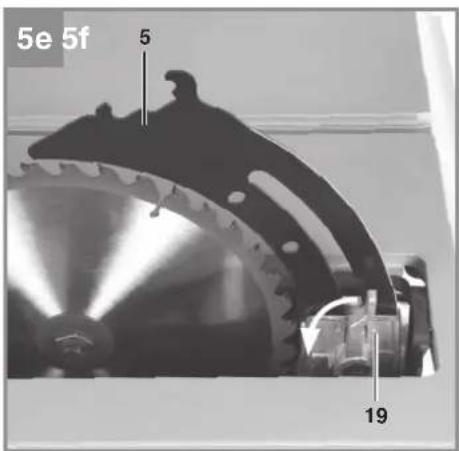
6.3 Moving the splitter into working position (Fig. 5)
Warning! In the as-delivered state the splitter (5) is in transport position. For operation always fasten the splitter (5) in top position (working position) as described below.
- Using the hand wheel (8), set the blade (4) to maximum cutting depth, move it to 0° position and lock it in place.
- Remove the blade guard (2) and the table insert (6) (see 6.6, 6.3).
- Turn the fastening lever (19) upwards in order to slacken the splitter (5).
- Press the splitter (5) sideways in order to release the locked transport position. (see Fig. 5b, arrow A)
- When the splitter (5) is pressed sideways, guide the splitter (5) upwards into working position. (see Fig. 5b, arrow B)
- Danger! The splitter (5) must latch in the top position! Once the splitter (5) has latched in the top position, the fastening plate (20) will press the splitter (5) inwards again.
-
Before you clamp the splitter, make sure that the gap between the blade (4) and the splitter (5) equals 3 to 8 mm. (see Fig. 5d)
-
Fasten the splitter (5) using the fastening lever (19).
- Warning! The splitter (5) must be fastened securely.
The position of the splitter (5) relative to the blade (4) is set at the factory. To ensure safe operation at all times, check the setting before beginning to work.
The splitter (5) must be positioned centrally on an imaginary extended plane behind the blade (4) so that it is impossible for the cut material to become jammed.
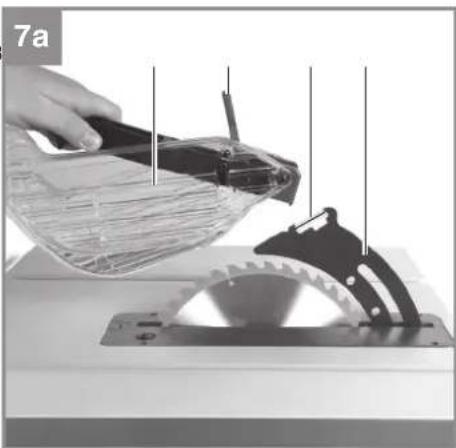
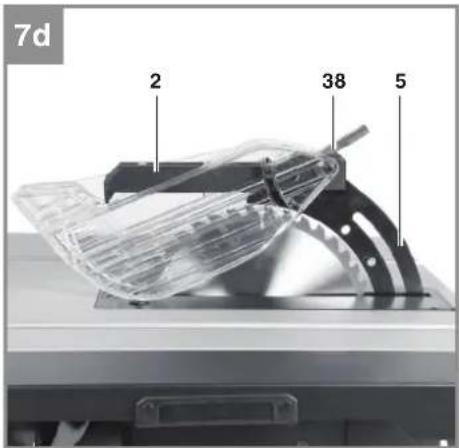
6.4 Fitting/changing the blade guard (Fig. 7)
- Danger! Before operation, always fasten the blade guard (2) to the splitter (5).
• Make sure that the eccentric lever (38) is open, i.e. is pointed in the direction of the front edge of the blade guard (2). - Guide the blade guard (2) centrally onto the splitter (5) and first hang the rear pin in the recess (18) on the splitter.
- Then tilt the blade guard (2) downwards until the front pin is also resting in the recess (18) on the splitter.
- Tension the blade guard (2) by pressing the eccentric lever (38) to the rear, i.e. towards the rear side of the machine.
- Warning! The saw blade guard (2) must always descend onto the workpiece automatically under its own weight.
- After mounting the saw blade guard (2), check that it works correctly by raising it and letting it go.
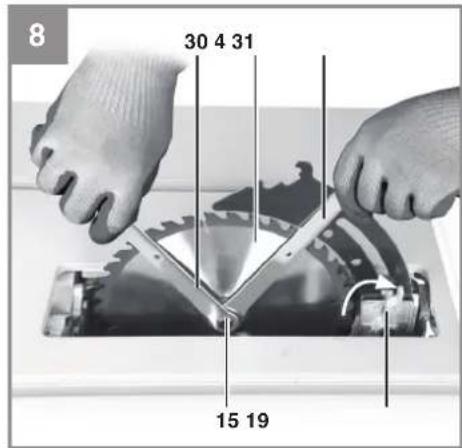
6.5 Fitting/changing the saw blade (Fig. 8)
• Before changing the saw blade: Pull out the power plug!
- Wear work gloves to prevent injury when changing the saw blade.
- Remove the saw blade guard and the table insert (see 6.4, 6.2).
- Release the fastening lever (19) in order to provide access to the work area.
- Undo the screw (15) with one wrench (30) on the screw (15) itself and a second wrench (31) on the motor shaft to apply counter-pressure.
- Caution! Turn the screw (15) in the direction of rotation of the saw blade.
- Remove the outer flange and the old saw blade (4) from the inner flange.
- Clean the blade flange thoroughly before fitting the new blade.
GB
- Fit and fasten the new saw blade (4) in reverse order.
- Important! Note the running direction. The cutting angle of the teeth must point in running direction, i.e. forwards (see the arrow on the blade guard).
- Secure the fastening lever (19) again, then mount and adjust the table insert and the saw blade guard (see 6.3, 6.2, 6.4).
- Check that all safety devices are in good working order before you begin working with the saw again.
- Warning! Every time you change the saw blade, check that the saw blade guard (2) opens and closes again in accordance with requirements. Also check that the saw blade (4) spins freely in the saw blade guard (2).
- Warning! Every time that you change the saw blade (4), check to see that it spins freely in the table insert (6) in both perpendicular and 45° angle settings.
- Warning! A worn or damaged table insert (6) must be replaced immediately (see 6.2).
- Warning! The work to change and align the saw blade (4) must be carried out correctly.
6.6 Putting away loose parts (Fig. 2)
When not in use, the cross stop (14), the push stick (3) and the two wrenches (30, 31) can be secured as shown in Fig. 2.
6.7 Connection for dust extractor (Fig. 9)
A connection option for dust extraction is provided at the extractor adapter (16) on the housing.
6.7.1 Dust extraction using a wet & dry vac (Fig. 9)
- A wet & dry vac is not supplied with the product but is available as an accessory.
- Connect the wet & dry vac to the extractor adapter (16) on the housing.
7. Operation
7.1 On/Off switch (Fig. 1, 10 / Item 11)
- To turn the saw on, press the green button „I“. Wait for the blade to reach its maximum speed of rotation before commencing with the cut.
- The red button "0" is covered by the switch cover (37). To switch off the saw, press the switch cover (37).
The motor of this equipment is protected against overload by an overload switch (39). If the rated current is exceeded, the overload switch (39) will shut down the equipment.
- Let the equipment cool down for several minutes.
• Press the overload switch (39). - Press the green button „I“ to switch on the equipment.
7.2 Cutting depth (Fig. 1, 11)
Turn the hand wheel (8) to set the blade (4) to the required cutting depth.
Warning! To reduce the risk of coming into contact with the blade (4), always adjust the cutting depth of the blade to the thickness of the workpiece.
Rule of thumb: The blade (4) should be moved in and out only as far as necessary for the tips of the blade teeth to project visibly beyond the workpiece.
Turn counter-clockwise:
Smaller cutting depth
Turn clockwise:
Larger cutting depth
7.3 Parallel stop
The parallel stop (7) must be used when making longitudinal cuts in wooden workpieces. When you mount or adjust the parallel stop (7), make sure that it is aligned parallel to the blade (4).
7.3.1 Stop height (Fig. 1c, 12)
- Warning! The stop height must always be set such that the workpiece can be guided as well as possible past the blade (4).
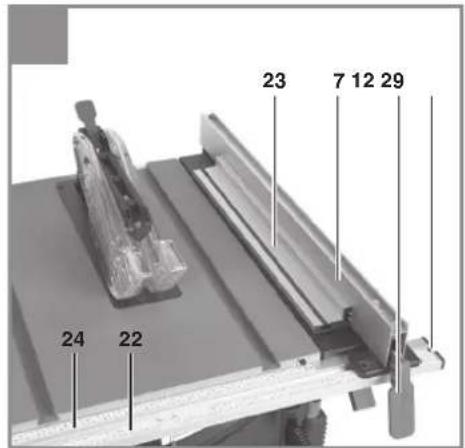
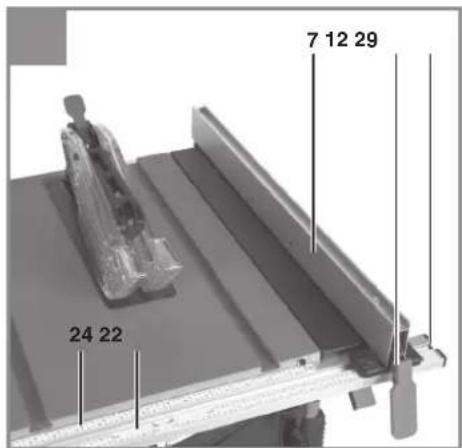
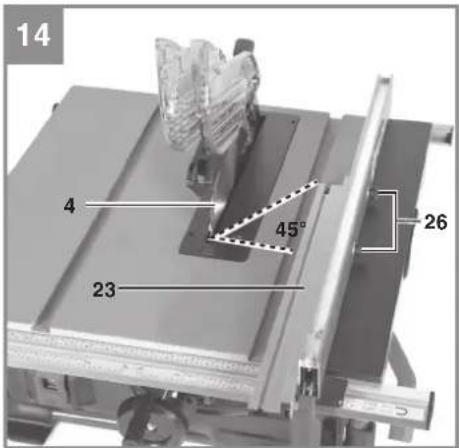
- The parallel stop (7) supplied with the product must be used together with the stop rail (23) when you perform longitudinal cuts on narrow wooden workpieces (see Fig. 12a).
- To fasten the stop rail (23) to the parallel stop (7) you must slacken the two knurled screws (26). Then thread the stop rail (23) with the slot (25) onto the lock bolts (28) and secure it with the washers (27) and the knurled screws (26).
- The parallel stop (7) can also be used without the stop rail (23) when making longitudinal cuts in wider wooden workpieces (see Fig. 12b). To do this you must remove the lock bolts (28), the washers (27) and the knurled screws (26).
GB
- Warning! When in use, the stop rail (23) must always be screwed to the side of the parallel stop (7) which faces the blade.
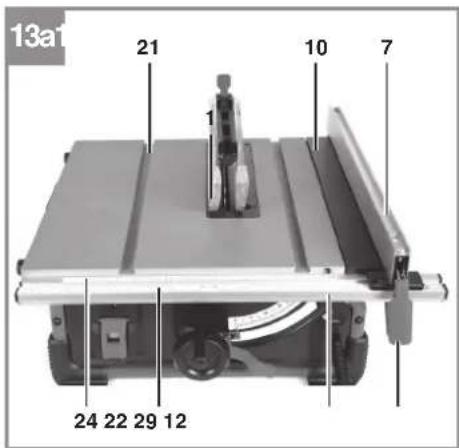
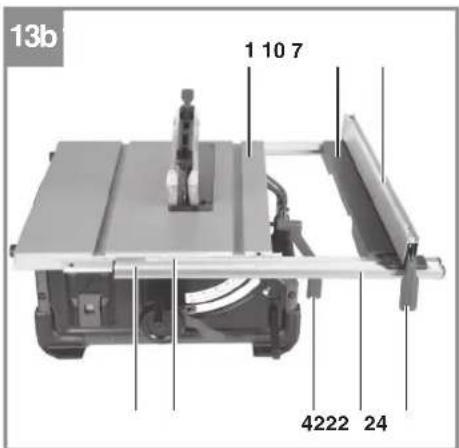
7.3.2 Cutting width (Fig. 13)
- The parallel stop (7) can be mounted on either side of the saw table (1).
- The parallel stop (7) must be mounted in the guide rail (29) of the saw table (1).
- You can clamp the parallel stop (7) in the required position by pressing the eccentric lever (12).
When the table width extension (10) is retracted and/or you want to cut widths of less than 25 cm:
- Use the main scale (22) on the guide rail (29) to adjust the parallel stop (7) to the required dimension.
When the table width extension (10) is extended and/or you want to cut widths of more than 25 cm:
- Use the main scale (22) to adjust the parallel stop (7) to the 25 cm angle and secure it with the eccentric lever (12).
- To then increase the cutting width, adjust the rest of the cutting width by pulling out the table width extension (10) (see 7.6).
- Read off the set total cutting width from the additional scale (24). Note! To ensure that the cutting dimension on the additional scale (24) is correct, the parallel stop (7) must be set to the defined dimension of 25 cm on the main scale (22).
7.3.3 Setting the stop length (Fig. 14)
- The stop rail (23) can be moved in longitudinal direction in order to prevent the workpiece from becoming jammed.
- Rule of thumb: The rear end of the stop comes up against an imaginary line that begins roughly at the front edge of the blade and runs at an angle of 45^ to the rear.
• Set the required cutting width - Slacken the knurled screws (26) and push the stop rail (23) forward until it touches the imaginary 45^ line.
- Retighten the knurled screws (26).
7.3.4 Readjusting the clamping force (Fig. 17) Danger! Always ensure that the parallel stop (7) is clamped securely on the guide rail (29) and cannot slip.
If required you can readjust the clamping force of the parallel stop (7) by means of the nut (41) on the rear side of the parallel stop.
Use the wrench (30/31) for this purpose.
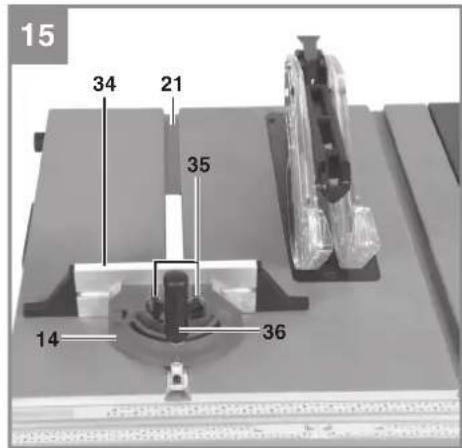
7.4 Cross stop (Fig. 15)
To make cross-cuts in wooden workpieces you must use the cross stop (14).
- Slide the cross stop (14) into the slot (21) of the saw table.
• Slacken the locking screw (36). - Turn the stop rail (34) until the arrow points to the angle required.
• Re-tighten the locking screw (36). - Check the gap between the stop rail (34) and the saw blade (4).
- Warning! Do not push the stop rail (34) too far toward the blade (4). The distance between the stop rail (34) and the blade (4) should be approx. 2 cm.
• If necessary, slacken the two knurled screws (35) and adjust the stop rail (34).
• Retighten the knurled screws (35).
7.5 Setting the angle (Fig. 10, 11)
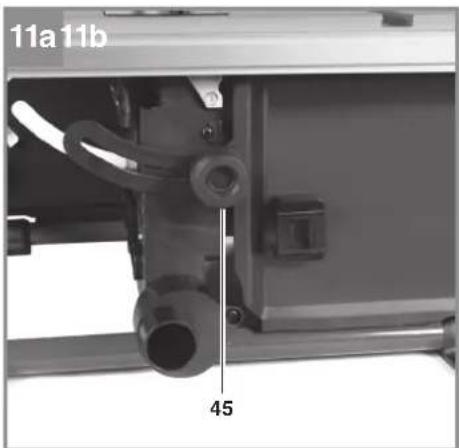
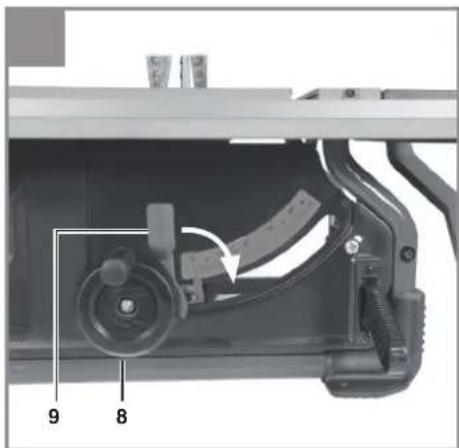
- Slacken the locking grip (45) and the locking lever (9).
- Adjust the angle of the saw blade by pushing the hand wheel (8) until the pointer is aligned with the desired angle setting on the angle scale.
- Secure the angle by tightening the locking lever (9).
- Secure the angle setting in addition with the locking grip (45) on the rear of the machine.
- If required, the end stop for the angle setting of the blade can be readjusted at 0^ and at 45^ . This is done by adjusting the two adjustment screws (32) and (33).
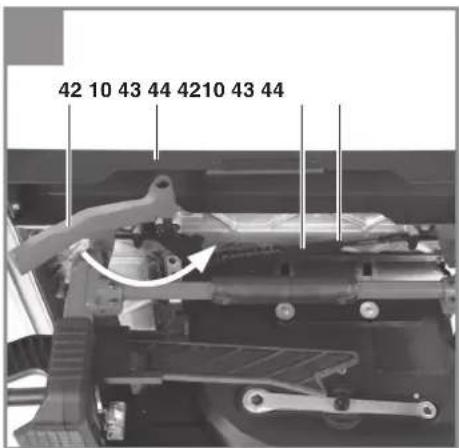
7.6 Adjusting the table width extension (Fig. 16)
- The table width extension (10) on the saw table (1) can be pulled out to the right.
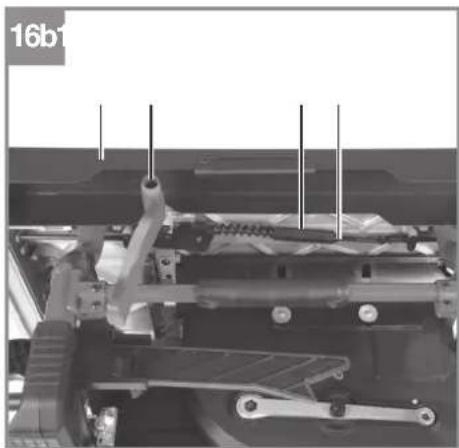
- The clamping lever (42) must point away from the bench-type circular saw to enable the table width extension (10) to be moved (see Fig. 16a).
- To lock the table width extension (10) in a certain position, the clamping lever (42) must point towards the machine (see Fig. 16b).
GB
- If the parallel stop is used when the table width extension (10) is extended, the parallel stop (7) must be set to the dimension of 25 cm on the main scale (22).
- Danger! If the parallel stop (7) is not secured properly, this may cause a kickback.
- Warning! Especially when the table width extension is extended, always make sure that the workpiece lies safely on the saw table and cannot become jammed.
- The clamping force of the clamping lever (42) can be readjusted if necessary. To do so, slacken the nut (44) and screw the threaded sleeve (43) out or in as far as required to reach the desired clamping force. Then secure the threaded sleeve (43) again with the nut (44).
8. Operation
Warning!
- After every new adjustment we recommend you to make a trial cut in order to check the new settings.
• After switching on the saw, wait for the blade to reach its maximum speed of rotation before commencing with the cut.
• Take extra care when starting the cut! - Never use the equipment without the suction function.
- Regularly check and clean the suction channels.
8.1 Making longitudinal cuts (Figure 18)
Longitudinal cutting (also known as slitting) is when you use the saw to cut along the grain of the wood. Press one edge of the workpiece against the parallel stop (7) while the fl at side lies on the saw table (1). The guard hood (2) must always be lowered over the workpiece.
When you make a longitudinal cut, never adopt a working position that is in line with the cutting direction.
- Set the parallel stop (7) in accordance with the workpiece height and the desired width. (See 7.3.)
- Switch on the saw.
- Place your hands (with fingers closed) flat on the workpiece and push the workpiece along the parallel stop (7) and into the blade (4).
- Guide at the side with your left or right hand (depending on the position of the parallel stop) only as far as the front edge of the gu-
ard hood.
• Always push the workpiece through to the end of the splitter (5).
- The offcut piece remains on the saw table (1) until the blade (4) is back in its position of rest.
- Secure long workpieces against falling off at the end of the cut (e.g. with a roller stand etc.).
8.1.1 Cutting narrow workpieces (Fig. 19)
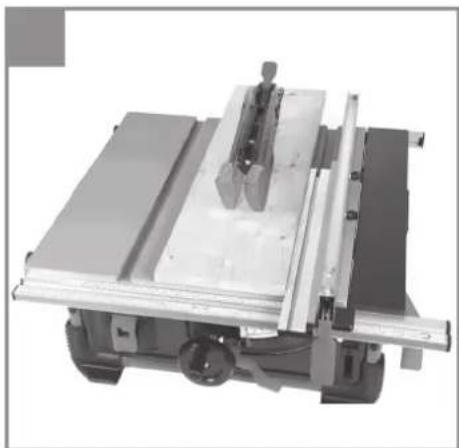
Be sure to use a push stick (3) when making longitudinal cuts in workpieces smaller than 150 mm in width. A push block is supplied with the saw! Replace a worn or damaged push stick immediately.
8.1.2 Cutting extremely narrow workpieces (Fig. 20)
- Be sure to use a push block when making longitudinal cuts in very narrow workpieces with a width of 50 mm and less.
• The low guide face of the parallel stop is best used in this case. - There is no push block supplied with the saw! (Available from your specialist dealer). Replace the push block without delay when it becomes worn.
8.2 Making bevel cuts (Fig. 11, 21)
Bevel cuts must always be used using the parallel stop (7).
If you tilt the saw blade (4) to the left when making angular cuts, position the parallel stop (7) on the right-hand side of the saw blade (4). Guide the workpiece between the saw blade (4) and the parallel stop (7).
- Set the blade (4) to the desired angle. (See 7.5.)
- Set the parallel stop (7) in accordance with the workpiece width and height (see 7.3)
- Carry out the cut in accordance with the workpiece width (see 8.1.1., 8.1.2.)
8.3 Making cross cuts (Fig. 22)
- Slide the cross stop (14) into the slot (21) in the saw table and adjust to the required angle. (See 7.4.)
- Press the workpiece firmly against the cross stop (14).
- Switch on the saw.
- Push the cross stop (14) and the workpiece toward the blade in order to make the cut.
- Warning! Always hold the guided part of the workpiece.
GB
Never hold the part which is to be cut off.
- Push the cross stop (14) forward until the workpiece is cut all the way through.
- Switch off the saw again. Do not remove the offcut until the blade has stopped rotating.
9. Replacing the power cable
Danger!
If the power cable for this equipment is damaged, it must be replaced by the manufacturer or its after-sales service or similarly trained personnel to avoid danger.
10. Cleaning, maintenance and ordering of spare parts
Danger!
Always pull out the mains power plug before starting any cleaning work.
10.1 Cleaning
- Keep all safety devices, air vents and the motor housing free of dirt and dust as far as possible. Wipe the equipment with a clean cloth or blow it with compressed air at low pressure.
• We recommend that you clean the device immediately each time you have finished using it. - Clean the equipment regularly with a moist cloth and some soft soap. Do not use cleaning agents or solvents; these could attack the plastic parts of the equipment. Ensure that no water can seep into the device. The ingress of water into an electric tool increases the risk of an electric shock.
10.2 Carbon brushes
In case of excessive sparking, have the carbon brushes checked only by a qualified electrician. Danger! The carbon brushes should not be replaced by anyone but a qualified electrician.
10.3 Maintenance
There are no parts inside the equipment which require additional maintenance.
10.4 Ordering spare parts and accessories
Please provide the following information when ordering spare parts:
- Type of unit
• Article number of the unit
• ID number of the unit - Spare part number of the required spare part For our latest prices and information please go to www.Einhell-Service.com

Tip! For good results we recommend high-quality accessories from !kwb www.kwb.eu welcome@kwb.eu
10.5 Transport
Only ever transport the machine by lifting it by the saw table. Never use the safety devices such as the saw blade guard and stop rails for handling or transporting purposes.
11. Disposal and recycling
The equipment is supplied in packaging to prevent it from being damaged in transit. The raw materials in this packaging can be reused or recycled. The equipment and its accessories are made of various types of material, such as metal and plastic. Never place defective equipment in your household refuse. The equipment should be taken to a suitable collection center for proper disposal. If you do not know the whereabouts of such a collection point, you should ask in your local council offices.
12. Storage
Store the equipment and accessories in a dark and dry place at above freezing temperature. The ideal storage temperature is between 5 and 30 °C. Store the electric tool in its original packaging.
GB
Disposal
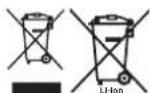
Power tools, rechargeable batteries, accessories and packaging should be sorted for environmental-friendly recycling.
Do not dispose of power tools and batteries/rechargeable batteries into household waste!
Only for EU countries:
According to the Directive 2012/19/EU on waste electrical and electronic equipment and its transposition into national law, power tools that are no longer usable, and, according to the Directive 2006/66/EC, defective or drained batteries must be collected separately and disposed of in an environmentally correct manner.
If disposed incorrectly, waste electrical and electronic equipment may have harmful effects on the environment and human health, due to the potential presence of hazardous substances.
Only for United Kingdom:
According to The Waste Electrical and Electronic Equipment Regulations 2013 (SI 2013/3113) (as amended) and the Waste Batteries and Accumulators Regulations 2009 (SI 2009/890) (as amended), products that are no longer usable must be collected separately and disposed of in an environmentally friendly manner.
The reprinting or reproduction by any other means, in whole or in part, of documentation and papers accompanying products is permitted only with the express consent of the Einhell Germany AG.
Subject to technical changes
GB
Service information
We have competent service partners in all countries named on the guarantee certificate whose contact details can also be found on the guarantee certificate. These partners will help you with all service requests such as repairs, spare and wearing part orders or the purchase of consumables.
Please note that the following parts of this product are subject to normal or natural wear and that the following parts are therefore also required for use as consumables.
| Category Example | |
| Wear parts* V-belt, carbon brushes, table insert, push stick | |
| Consumables* Saw blade | |
| Missing parts | |
* Not necessarily included in the scope of delivery!
In the effect of defects or faults, please register the problem on the internet at www.Einhell-Service.com. Please ensure that you provide a precise description of the problem and answer the following questions in all cases:
• Did the equipment work at all or was it defective from the beginning?
• Did you notice anything (symptom or defect) prior to the failure?
• What malfunction does the equipment have in your opinion (main symptom)?
Describe this malfunction.
F
Danger!
7.5 Nurga seadmine (joonised 10, 11)
• Keerake kinnituskruvi (45) ning lukustushoob (9) natukene lahti.
- Seadistage saeketta nurk, surudes käsiratast
Subject to change without notice
Archive-File/Record: NAPR027719
Documents registrar: Felix Hofner
Wiesenweg 22, D-94405 Landau/Isar
^1 SH Bench-type circular saw - SA Circle circule at tabu - Saga circuleen de banco - IXV Bundrandsaw - S Bankerskatzag - CZ Stolni kotouvára pla - SK Stolna kotouve pla - NL Tafereirskatzag - E Stora circular de masa - FIN Polysteknik - SLO Nantine krajna rzega - H Asstelklürtiszt - RO Fostadru circular cu masă - GP Armorulomă týdovus - P Stera cirduur do bancala - HR/HH Stalne krutna pla - PS Stola krutna testora - PL Pracemarica do drewna - TR Targinti Dire Latviae - RUS Drosionana mica co stroma - EE Lavaiklassaaag - LV Galisa sprajis - LT Stalins diskinis pjuklas - BG Kirrupurin nestornet - UKN Krutna disicosa nula - MK Kirrupurarna nula ca casa - NO BDKSIRKTEAG - IG BDH-hosog

Declaration of conformity
We, Einhell UK Ltd
Champions Business Park, First Floor Unit 10, Arrowe Brook Rd, Upton, Wirral CH49 0AB, United Kingdom
declare the conformity to UK standards and legislation was assessed for:
Bench-type circular saw TE-TS 10 T (Einhell)
UK legislation
□ Simple Pressure Vessels (Safety) Regulation
□ Electrical Equipment (Safety) Regulation
□ Radio Equipment Regulation
□ Personal Protective Equipment Regulation
☐ The Ecodesign for Energy-Related Products and Energy Information Regulation
X The Restriction of the Use of Certain Hazardous Substances in Electrical and Electronic Equipment Regulation
□ Noise Emission in the Environment by Equipment for use Outdoors Regulation
☒ Electromagnetic Compatibility Regulation
□ Measuring Instruments Regulation
□ Pressure Equipment (Safety) Regulation
[Non-Text]
Information Regulation
ces in Electrical and Electronic Equipment Regulation
e Outdoors Regulation
Annex V
Annex VI
Noise:measuredL WA = dB (A); guaranteed L WA = dB (A)
P = kW; L/∅ = cm
Approved Body:
-
[Non-Text]
X Supply of Machinery (Safety) Regulation
X Annex IV
Approved Body: TÜV Süd Product Service GmbH (0123), Ridlerstraße 65, D-80339 München, Germany
Certifi cate No.: M6A 010654 0646 Rev. 00
[Non-Text]
[Non-Text]
。
[Non-Text]
[Non-Text]
Tom Chambers, Managing Director Einhell UK Ltd.
Archive-File/Record: NAPR027719
Article Number: 43.404.31 I.-No.: 21013
Subject to change without notice Wiesenweg 22, 94405 Landau/Isar, Germany
Documents registrar: Felix Hofner
EH 03/2025 (01)