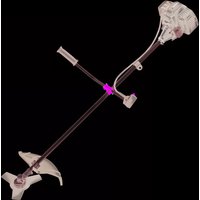
BBC 52/2 - Petrol brushcutter Bavaria - Free user manual and instructions
Find the device manual for free BBC 52/2 Bavaria in PDF.



| Product type | Gasoline brush cutter |
| Brand | Bavaria |
| Model | BBC 52/2 |
| Weight (empty tank) | 7.4 kg |
| Engine type | 2-stroke, air-cooled, chrome cylinder |
| Displacement | 51.7 cm³ |
| Max. engine power | 1.5 kW (2 PS) |
| Idle speed | 3000 ± 300 rpm |
| Max. engine speed | 10000 rpm |
| Fuel tank capacity | 1.1 L |
| Fuel mixture | 40:1 (unleaded petrol / 2-stroke oil) |
| Cutting diameter (line) | 45 cm |
| Cutting diameter (blade) | 25.5 cm |
| Line diameter | 2.4 mm |
| Line length | 2.5 m |
| Sound pressure level LpA | 92.1 dB(A) (uncertainty K=3 dB) |
| Sound power level LWA | 112.1 dB(A) (uncertainty K=3 dB) |
| Right handle vibration | 13.846 m/s² (uncertainty K=1.5 m/s²) |
| Left handle vibration | 10.602 m/s² (uncertainty K=1.5 m/s²) |
| Spark plug | Torch L8RTC |
| Safety device | Protective guard, line cutter, on/off switch |
| Air filter maintenance | Every 25 service hours |
| Spark plug maintenance | First check after 10 h, then every 50 h |
| Wear parts | Spark plugs, air filters, blade, spool with line |
Frequently Asked Questions - BBC 52/2 Bavaria
User questions about BBC 52/2 Bavaria
0 question about this device. Answer the ones you know or ask your own.
Ask a new question about this device
Download the instructions for your Petrol brushcutter in PDF format for free! Find your manual BBC 52/2 - Bavaria and take your electronic device back in hand. On this page are published all the documents necessary for the use of your device. BBC 52/2 by Bavaria.
USER MANUAL BBC 52/2 Bavaria
When using the equipment, a few safety precautions must be observed to avoid injuries and damage. Please read the complete operating instructions and safety regulations with due care. Keep this manual in a safe place, so that the information is available at all times. If you give the equipment to any other person, hand over these operating instructions and safety regulations as well. We cannot accept any liability for damage or accidents which arise due to a failure to follow these instructions and the safety instructions.
1. Safety regulations
The corresponding safety information can be found in the enclosed booklet.
Danger!
Read all safety regulations and instructions. Any errors made in following the safety regulations and instructions may result in an electric shock, fire and/or serious injury.
Keep all safety regulations and instructions in a safe place for future use.
Safety devices
When working with the equipment, the appropriate plastic guard hood for cutting blade mode or cutting line mode must be fitted to prevent objects being thrown out by the equipment. The integrated blade in the cutting line guard hood automatically cuts the line to the optimum length.
Assembly: During assembly, take care not to let any foreign bodies get inside the equipment or the operation of the coupling will be impaired by dirt.
After assembly: When the equipment is running in idling mode, the tool is not allowed to rotate. If this is not the case, an error was made during the assembly work.
Explanation of the warning signs on the equipment (Fig. 16):
- Warning!
- Read the directions for use before operating the equipment.
- Wear protective headgear, goggles and ear muff s.
- Wear sturdy, non-slip footwear.
- Wear safety gloves.
-
Protect the equipment from rain and damp.
-
Be careful of objects being thrown out!
- Always switch off the equipment and pull out the spark boot plug before carrying out any maintenance work.
-
All bystanders must be kept at least 15m from the machine.
-
The equipment continues to rotate!
- Caution: Hot equipment parts. Keep your distance.
- Add a little grease (gear grease) after every 20 hours in operation!
- Beware of recoil!
- Do not use any saw blades.
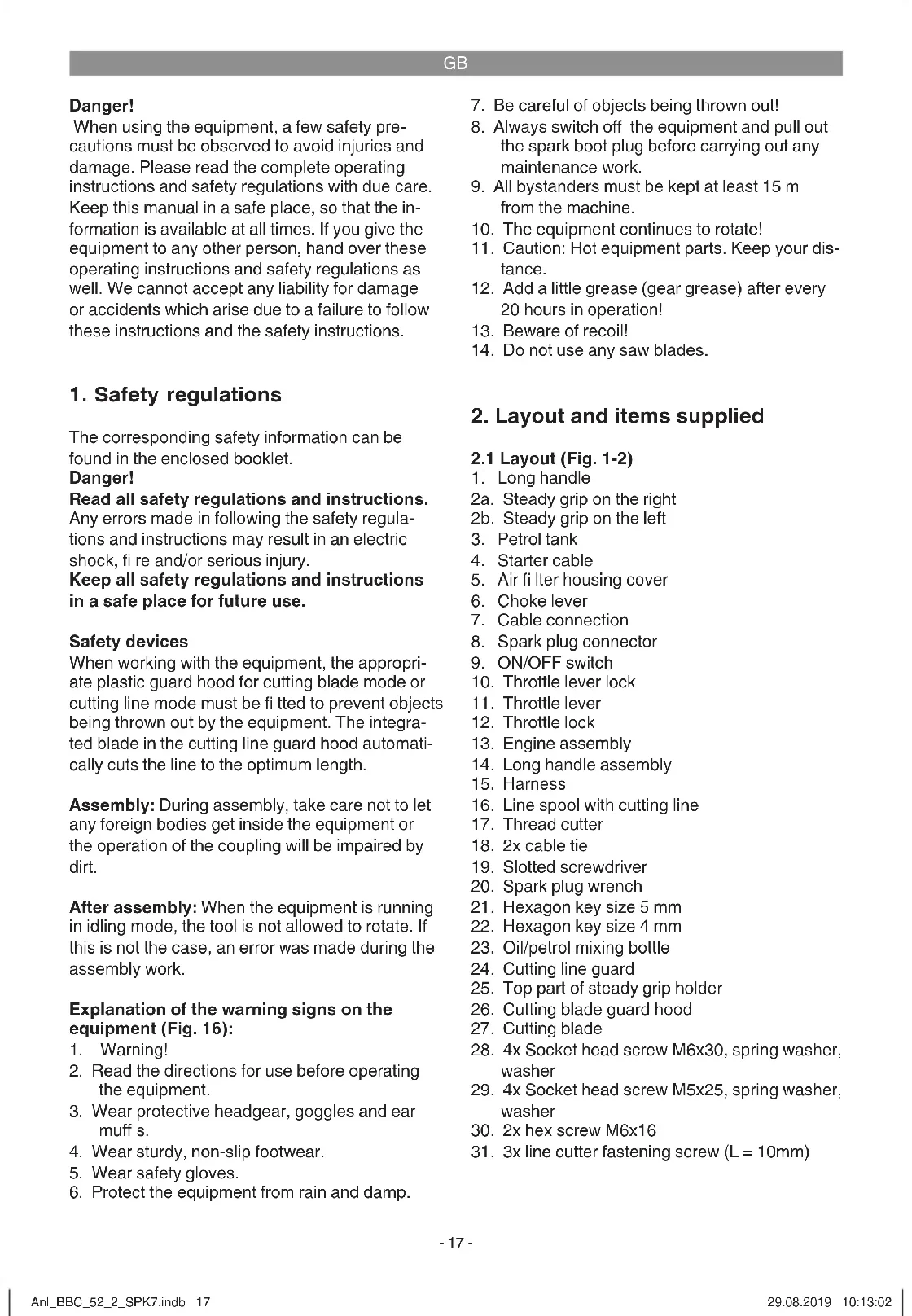
2. Layout and items supplied
2.1 Layout (Fig. 1-2)
- Long handle
2a. Steady grip on the right
2b. Steady grip on the left - Petrol tank
- Starter cable
- Air filter housing cover
- Choke lever
- Cable connection
- Spark plug connector
- ON/OFF switch
- Throttle lever lock
- Throttle lever
- Throttle lock
- Engine assembly
- Long handle assembly
- Harness
- Line spool with cutting line
- Thread cutter
- 2x cable tie
- Slotted screwdriver
- Spark plug wrench
- Hexagon key size 5 mm
- Hexagon key size 4 mm
- Oil/petrol mixing bottle
- Cutting line guard
- Top part of steady grip holder
- Cutting blade guard hood
- Cutting blade
- 4x Socket head screw M6x30, spring washer, washer
- 4x Socket head screw M5x25, spring washer, washer
- 2x hex screw M6x16
- 3x line cutter fastening screw (L = 10mm)
GB
2.2 Items supplied
Please check that the article is complete as specified in the scope of delivery. If parts are missing, please contact our service center or the store where you made your purchase at the latest within 5 work days after purchasing the article and upon presentation of a valid bill of purchase. Also, refer to the warranty table in the service information at the end of the operating instructions.
- Open the packaging and take out the equipment with care.
- Remove the packaging material and any packaging and/or transportation braces (if present).
- Check to see if all the items are supplied.
- Inspect the equipment and accessories for transport damage.
If possible, keep the packaging until the end of the guarantee period.
Danger!
The equipment and packaging material are not toys. Do not let children play with plastic bags, plastic sheets and small parts. There is a risk of choking and suffocating!
Engine assembly
Long handle assembly
Steady grip on the left
Harness
Line spool with cutting line
- Thread cutter
2x cable tie
- Slotted screwdriver
Spark plug wrench
- Hexagon key size 5 mm
- Hexagon key size 4 mm
Oil/petrol mixing bottle
Cutting line guard
Top part of steady grip holder
Cutting blade guard hood
Cutting blade
4x Socket head screw M6x30, spring washer, washer
4x Socket head screw M5x25, spring washer, washer
2x hex screw M6x16
3x line cutter fastening screw (L = 10mm)
Original Operating Instructions
Safety information
3. Proper use
The power scythe (using the cutting blade) is designed for cutting young trees, strong weeds and undergrowth. The power trimmer (using the line spool with cutting line) is designed for cutting lawns, grassed areas and small weeds. The operating instructions as supplied by the manufacturer must be obeyed to ensure that the equipment is used properly. Any use which is not expressly permitted in the manual may result in damage to the equipment and place the user in serious danger. Be sure to observe the restrictions in the safety instructions.
Please note that our equipment has not been designed for use in commercial, trade or industrial applications. Our warranty will be voided if the equipment is used in commercial, trade or industrial businesses or for equivalent purposes.
Important. Due to the high risk of bodily injury to the user, the petrol power scythe must not be used to carry out the following work: to clean dirt and debris off walkways, or to chop up tree or hedge clippings. Similarly, the petrol power scythe must not be used to level out high areas such as molehills. For safety reasons, the petrol power scythe must not be used as a drive unit for other work tools or toolkits of any kind.
The equipment is allowed to be used only for its prescribed purpose. Any other use is deemed to be a case of misuse. The user/operator and not the manufacturer will be liable for any damage or injuries of any kind resulting from such misuse.
4. Technical data
Engine type .2-stroke engine, air-cooled, chrome cylinder
Engine power (max.) 1.5 kW / (2 HP)
Displacement. 51.7cm
Engine idling speed 3000 ± 300 min
Max. engine speed. 10000 min
Max.scythe speed: .8400 min
Trimmer: 7400 min
Ignition Electronic
Drive . Centrifugal clutch
Weight (empty tank) 7.4 kg
Cutting circle of line 45 cm
Cutting circle of blade 25.5 cm
GB
Line length 2.5 m
Line 0 2.4 mm
Tank capacity 1.1 I
Spark plug .Torch L8RTC
Danger!
Sound and vibration
LpA sound pressure level 92.1 dB(A)
KoA uncertainty 3 dB
L_W sound power level 112.1 dB(A)
K_WA uncertainty 3 dB
Wear ear-muff s.
The impact of noise can cause damage to hearing.
Operation
Vibration emission value a_b = 13.846 m/s^2
Uncertainty K = 1.5m / s^2
Handle on the right
Vibration emission value a_h = 10.602 m/s^2
Uncertainty K = 1.5m / s^2
Keep the noise emissions and vibrations to a minimum.
Only use appliances which are in perfect working order.
Service and clean the appliance regularly.
Adapt your working style to suit the appliance.
Do not overload the appliance.
- Have the appliance serviced whenever necessary.
- Switch the appliance off when it is not in use.
- Wear protective gloves.
5. Assembly
5.1.1 Fitting the long handle (Fig. 3)
Using the 4 Socket head screws M6x30 (28), fasten the long handle assembly (14) to the engine assembly (13).
5.1.2 Fitting the steady grip
Fit the left steady grip (2b) or the right steady grip (2a) as shown in Figs. 4-4a. The holes in the steady grips are for receiving the screws. Tighten the screws (29) securely at the top part of the steady grip holder (25).
5.1.3 Fastening the harness and cable
Hook the harness (15) into the holder as shown in Fig. 5. Then use the supplied cable ties (18) to fasten the cable to the long handle and the steady grip.
5.1.4 Fitting the cutting blade guard hood is Important: The cutting blade guard hood must be fitted if you want to work with the cutting blade
Using the two screws M6x16 (30), secure the cutting blade guard hood (26) to the clip provided as shown in Fig. 6.
5.1.5 Fitting/Replacing the cutting blade
The procedure for ftting the cutting blade is shown in Figs. 7a-7f. To dismantle, proceed in reverse order.
Plug the carrier plate (32) onto the spline shaft (Fig. 7b)
- Lock the cutting blade (27) on the carrier plate (Fig. 7c)
Plug the pressure plate (33) over the thread of the spline shaft (Fig. 7d).
Plug on the cover of the pressure plate (34) (Fig. 7e).
- Look for the hole in the carrier plate, line up with the notch underneath and lock with the supplied hexagon key (22) in order to now tighten the nut (35) (Fig. 7f). Important: Left-hand thread
5.1.6 Fitting the line cutter
Using the three screws (31), secure the line cutter (17) to the cutting line guard (24) as shown in Fig.
8. Risk of injury - wear safety gloves.
5.1.7 Fitting the cutting line guard to the cutting blade guard hood
Important: The cutting line guard hood must be fitted in addition if you want to work with the cutting line.
The cutting line guard (24) is pressed into the mounts on the blade guard hood (26) as shown in
Fig. 9. Important: The cutting line cutter is on the cutting line guard - risk of injury!
5.1.8 Fitting/Replacing the line spool
The procedure for fitting the line spool is shown in Fig. 10. To dismantle, proceed in reverse order.
Look for the hole in the carrier plate, line up with the notch underneath and lock with the supplied Allen key (22) in order to now screw the line spool (16) onto the thread. Important: Left-hand thread
GB
5.2. Adjusting the cutting height
- Slip the shoulder strap (15) over your left shoulder.
To establish the optimum length of the harness, you should then make a few swinging movements without starting the engine (Fig. 11a).
Warning! Always use the strap when working with the equipment. Attach the strap as soon as you have started the engine and it is running in idle mode. Switch off the engine before you take off the carrying strap.
6. Before starting the equipment
Check the equipment for the following each time before use:
- That there are no leaks in the fuel system.
- That the equipment is in perfect condition and that the safety devices and cutting devices are complete.
- That all screws are securely fastened.
- That all moving parts move smoothly.
6.1 Fuel and oil
Recommended fuels
Use only a mixture of unleaded petrol and special 2-stroke engine oil. Mix the fuel mixture as indicated on the fuel mixing table.
Important: Do not use a fuel mixture which has been stored for longer than 90 days.
Important: Never use 2-stroke oil with a recommended mixing ratio of 100:1. The manufacturer's warranty will be voided in case of engine damage due to inadequate lubrication.
Important: Only use containers designed and approved for the purpose to transport and store fuel. Pour the correct quantities of petrol and 2-stroke oil into the mixing bottle (see scale printed on the bottle). Then shake the bottle well.
6.2 Fuel mixture table
Mixing procedure: 40 parts petrol to 1 part oil
| Petrol 2-stroke oil | |
| 1 liter 25 ml | |
| 5 liters 125 ml | |
7. Operation
Please note that the statutory regulations governing noise abatement may differ from town to town.
Before starting up the equipment remove the protective caps from the cutting blade (18).
7.1 Starting the engine when cold
Fill the tank with an adequate amount of petrol/oil mix. See ,Fuel and oil".
- Set the equipment down on a hard, level surface.
- Press the fuel pump (primer) (Fig. 14a/Item 39) ten times.
- Set the On/Off switch (Fig. 1/Item 9) to ^ .
- Secure the throttle lever. To do this, press the throttle lever lock (Fig. 1/Item 12) and then the throttle lever (Fig. 1/Item 11), and secure the throttle lever by pressing the lock (Fig. 1/Item 10) simultaneously.
- Set the choke lever (Fig. 1/Item 6) to ON.
- Hold the equipment securely and pull out the starter cable (Fig. 1/Item 4) until you feel it begin to resist. Then tug sharply on the starter cable 4 times. The equipment should start.
Note: Never allow the starter line to snap back. This may result in damage.
Warning: Since the throttle lever is secured, the cutting tool will start to operate when the engine is started. Once the engine has started, move the choke lever immediately to OFF and allow the equipment to warm up for approx. 3 seconds. Then release the throttle lever by simply actuating it (the engine then returns to running in idle mode).
- If the engine does not start up, repeat steps 4-6 above.
Please note: If the engine does not start up even after several attempts, read the Engine troubleshooting section.
Please note: Always pull out the starter cable in a straight line. If it is pulled out at an angle, friction will occur on the eyelet. As a result of this friction, the cable will become frayed and will wear faster.
Always hold the starter handle when the cable retracts.
Never allow the cable to snap back when it has been pulled out.
GB
7.2 Starting the engine when warm
(The equipment has been idle for less than 15-20 min.)
- Set the equipment down on a hard, level surface.
- Switch the On/Off switch to, I".
- Secure the throttle lever (in the same way as described in "Starting the engine when cold"). Hold the equipment firmly and pull out the starter cable until you feel it start to resist. Then tug sharply on the starter cable. The equipment should start after 1-2 tugs. If the equipment does not start after 6 pulls, repeat steps 1 to 7 of the procedure for starting the engine when cold.
7.3 Switching off the engine
Emergency Stop procedure:
If it becomes necessary to stop the equipment immediately, set the ON/OFF switch to "Stop" or "0".
Normal procedure:
Let go of the throttle lever and wait until the engine has changed to idling speed. Then set the ON/OFF switch to "Stop" or "0".
7.4 Practical tips
Practice all operating techniques with the engine switched off before you start to use the equipment.
8. Working with the petrol power scythe
Extending the cutting line
Caution! Do not use any kind of metal wire or metal wire encased in plastic in the line spool. This may cause serious injuries to the user.
To extend the cutting line, run the engine at full speed and tap the line spool on the ground. This will automatically extend the line. The blade on the safety shield will cut the line to the appropriate length (Fig. 11b).
Important: Remove all grass and weed remnants at regular intervals to prevent the shaft tube overheating. Lawn, grass and weed remnants become trapped under the safety shield (Fig. 11c) and prevent the shaft tube from receiving adequate ventilation. Remove the remnants carefully using a screwdriver or the like.
Diff erent cutting methods
When the equipment is correctly assembled it will cut weeds and long grass in places which are difficult to access, e.g. along fences, walls and foundations and also around trees. It can also be used for "mowing" down vegetation so that a garden can be better prepared or a certain area cleared down to the soil.
Please note: Even if it is used carefully, cutting around foundations, stone or concrete walls, etc. will result in the line suffering more than normal wear.
Trimming/mowing
Swing the trimmer from side to side in a scything motion. Always keep the line spool parallel to the ground. Check the site and decide which cutting height you require. Guide and hold the line spool at the required height to obtain an even cut (Fig. 11d).
Low trimming
Hold the trimmer right in front of you at a slight angle so that the underside of the line spool is above the ground and the line strikes the correct target. Always cut away from yourself. Never draw the trimmer towards yourself.
Cutting along fences/foundations
Approach wire mesh fences, lath fences, natural stone walls and foundations slowly so that you can cut close to them without striking the obstacle with the line. If, for example, the line strikes stones, stone walls or foundations, it will wear or fray.
If the line strikes wire fencing, it will break.
Trimming around trees
When trimming around tree trunks, approach slowly so that the line does not strike the bark. Walk around the tree, cutting from left to right. Approach grass or weeds with the tip of the line and tilt the line spool forwards slightly. Warning! Take extreme care during mowing work. When doing such work keep a distance of 30 meters between yourself and other people or animals.
Mowing
When mowing, you want to cut all the vegetation down to the ground. To do this, set the line spool at an angle of 30^ to the right. Place the handle in the required position. Remember the increased risk of injury to the user, watchers and animals, and the danger of damaging property due to ob
GB
jects (for example stones) being thrown up (Fig. 11e).
Warning! Do not use the equipment to remove objects from footpaths, etc. The equipment is a powerful tool and can throw small stones and other objects a distance of 15 meters or more, causing injuries and damage to cars, houses and windows.
Sawing
The equipment is not suitable for sawing.
Jamming
If the cutting blade jams as a result of attempting to cut vegetation that is too dense, switch off the engine immediately. Remove the grass and scrub from the equipment before you restart it.
Preventing recoil
When you work with the blade, there is a risk of recoil if it strikes solid objects such as tree trunks, branches, tree stumps, stones or the like. This will throw the equipment backwards in the direction opposite to the rotation of the tool. This can cause you to lose control of the equipment. Do not use the blade near fences, metal posts, boundary stones or foundations. For cutting dense stalks, position the blade as shown in Fig. 9f to prevent recoil.
9. Maintenance
Always switch off the equipment and pull out the spark boot plug before carrying out any maintenance work.
9.1 Replacing the line spool/cutting line
- Dismantle the line spool (16) as described in section 5.1.8. Press in the side lugs slightly while simultaneously pressing the spool down and turning it clockwise (Fig. 15a). Remove one half of the housing.
- Take the line spool out of the line spool housing (Fig. 15c).
- Remove any remaining cutting line.
- Place the new cutting line in the center and hang the loop which has formed into the recess in the spool splitter (Fig. 15d)
- Wind up the line counter-clockwise and under tension. The spool splitter will separate the two halves of the line (Fig. 15e)
- Hook the last 15cm of the two ends of the
line onto the opposite lying line holders of the spool plate (Fig. 15f)
- Thread the two ends of the line through the metal eyelets in the line spool housing (Fig. 15c).
- Press the line spool into the line spool housing.
- Pull the two line ends sharply to release them from the line holders.
- Cut the excess line to a length of around 13 cm. This will reduce the load on the engine when starting and warming up.
- Refi t the line spool (see section 5.1.8). If you are replacing the complete line spool, skip points 3-6.
9.2 Grinding the safety hood blade
The safety hood blade can become blunt over time. When you notice this, undo the screw holding the safety hood blade on the safety hood. Clamp the blade in a vise. Sharpen the blade with a flat file and make sure that the angle of the cutting edge is not altered in the process. File in one direction only.
9.3 Maintenance of the air fi lter
Soiledairfi liters reduce the engine output by supplying too little air to the carburetor. Regular checks are therefore essential. The air fi liter (37) should be checked after every 25 hours of use and cleaned if necessary. If the air contains a lot of dust, the air fi liter must be checked more frequently.
- Remove the air fi Iter cover (Fig. 12a/Item 36)
- Remove the air fi Iter (Fig. 12b/Item 37)
- Clean the air filter by tapping it or blowing it out.
- Assemble in reverse order.
Important: Never clean the air filter with petrol or inflammable solvents.
9.4 Maintenance of the spark plug
Spark plug sparking gap = 0.6mm Tighten the spark plug with a torque of 12 to 15 Nm. Check the spark plug for dirt and grime after 10 hours of operation and if necessary clean it with a copper wire brush. Thereafter service the spark plug after every 50 hours of operation.
- Pull out the spark plug connector (38).
- Remove the spark plug (Fig. 39) with the supplied spark plug wrench (20).
- Assemble in reverse order.
GB
9.5 Carburetor settings
Warning! Settings on the carburetor may only be made by authorized customer service personnel. The air fiiter cover must be removed before any work on the carburetor, as shown in Figures 12a and 12b.
Setting the throttle cable:
If the maximum speed of the equipment drops over time and you have ruled out all the other possible causes listed in section 12, Troubleshooting, it may be necessary to adjust the throttle cable. First of all check whether the carburetor opens fully when the throttle handle is pressed right through. This is the case if the carburetor slide (Fig. 13a) is completely opened when the throttle is fully activated. Figure 13a shows the correct setting. If the carburetor slide is not completely open, it must be adjusted. The following steps are required to adjust the throttle cable:
- Undo the lock nut (Fig. 13a/Item C) a few turns.
- Undo the adjusting screw (Fig. 13a/Item D) until the carburetor slide is completely open when the throttle is fully activated, as shown in Figure 13a.
Retighten the lock nut.
9.6 Setting the idling speed
Warning! Set the idling speed when the equipment is warm.
If the engine stalls when the throttle is not pressed and you have ruled out all the other possible causes listed in section 12, Troubleshooting, the idling speed must be adjusted. To do this turn the idling speed screw (Fig. 13a/Item E) clockwise until the equipment runs smoothly at idling speed. If the idling speed is so fast that the cutting tool turns as well, it has to be reduced by turning the idling speed screw for as long as is required for the cutting tool to stop turning as well.
The start-up speed of the cutting tool must be at least 1.25 times the idling speed.
10. Cleaning, storage, transport and ordering of spare parts
10.1 Cleaning
- Keep the handles free of oil so that you can maintain a firm grip.
Clean the equipment as required with a damp cloth and, if necessary, mild washing up liquid.
Important!
Always pull out the spark boot plug each time before carrying out any cleaning. Never immerse the equipment in water or other liquids in order to clean it.
Store the equipment in a safe and dry place out of the reach of children.
10.2 Storage
Important: Never put the equipment into storage for longer than 30 days without carrying out the following steps.
Storing the equipment
If you intend to store the equipment for longer than 30 days, the equipment must be prepared accordingly. Otherwise the fuel still remaining in the carburetor will evaporate and leave a rubbery sediment. This can cause problems when starting up the equipment and may require expensive repairs.
- Slowly remove the fuel tank cap to release any pressure that may have formed in the tank. Carefully empty the tank.
- To remove the fuel from the carburetor, start the engine and let it run until it stops.
- Leave the engine to cool (approx. 5 minutes).
- Remove the spark plug (see section 9.4).
- Add one teaspoon of 2-stroke engine oil into the combustion chamber. Slowly pull the starter cord several times to apply a layer of oil to all internal components. Fit the spark plug again.
Note: Store the equipment in a dry place and far away from possible ignition sources such as an oven, a gas-fired hot water boiler, a gas-fired dryer, etc.
Putting the equipment back into operation
- Remove the spark plug (see section 9.4).
- Quickly tug on the starter cord to remove excess oil from the combustion chamber.
- Clean the spark plug and check that the electrode gap is correct, or insert a new spark plug with the correct electrode gap.
- Prepare the equipment for operation.
- Fill the tank with the relevant mixture of fuel and oil. See the section "Fuel and oil".
GB
10.3 Transport
To transport the machine, empty the petrol tank as described in section 10. Clean coarse dirt off the equipment with a brush or hand brush.
10.4 Ordering spare parts
Please provide the following information on all orders for spare parts:
Model/type of the equipment
Article number of the equipment
ID number of the equipment
Part number of the required spare part
For our latest prices and information please go to www.isc-gmbh.info
11. Disposal and recycling
The equipment is supplied in packaging to prevent it from being damaged in transit. The raw materials in this packaging can be reused or recycled. The equipment and its accessories are made of various types of material, such as metal and plastic. Defective components must be disposed of as special waste. Ask your dealer or your local council.
12. Troubleshooting guide
The table below contains a list of fault symptoms and explains what you can do to remedy the problem if your equipment fails to work properly. If the problem still persists after working through the list, please contact your nearest service workshop.
| Fault Possible cause Remedy | ||
| The equipment does not start | - Correct starting procedure not followed - Sooted or damp spark plug - Incorrect carburetor setting | - Follow the instructions for starting - Clean the spark plug or replace it with a new one - Contact an authorized customer service outlet or send the equipment to ISC GmbH |
| The equipment starts but does not develop its full power | - Incorrect choke lever setting - Soiled air filter - Incorrect carburetor setting | - Set the choke lever to OFF - Clean the air filter - Contact an authorized customer service outlet or send the equipment to ISC GmbH |
| The engine does not run smoothly | - Incorrect electrode gap on the spark plug - Incorrect carburetor setting | - Clean the spark plug and adjust the electrode gap, or fit a new spark plug - Contact an authorized customer service outlet or send the equipment to ISC GmbH |
| Engine smokes excessively | - Incorrect fuel mix - Incorrect carburetor setting | - Use the correct fuel mix (see fuel mixing table) - Contact an authorized customer service outlet or send the equipment to ISC GmbH |
The reprinting or reproduction by any other means, in whole or in part, of documentation and papers accompanying products is permitted only with the express consent of the iSC GmbH.
Subject to technical changes
GB
Service information
We have competent service partners in all countries named on the guarantee certificate whose contact details can also be found on the guarantee certificate. These partners will help you with all service requests such as repairs, spare and wearing part orders or the purchase of consumables.
Please note that the following parts of this product are subject to normal or natural wear and that the following parts are therefore also required for use as consumables.
| Category Example | |
| Wear parts* Spark plug, air fi I ter | |
| Consumables* Cutting blade, line spool with cutting line | |
| Missing parts |
- Not necessarily included in the scope of delivery!
In the effect of defects or faults, please register the problem on the internet at www.isc-gmbh.info. Please ensure that you provide a precise description of the problem and answer the following questions in all cases:
Did the equipment work at all or was it defective from the beginning?
Did you notice anything (symptom or defect) prior to the failure?
What malfunction does the equipment have in your opinion (main symptom)?
Describe this malfunction.
GB
Warranty certificate
Dear Customer:
All of our products undergo strict quality checks to ensure that they reach you in perfect condition. In the unlikely event that your device develops a fault, please contact our service department at the address shown on this guarantee card or the sales outlet from where you bought the device. Please note the following terms under which guarantee claims can be made:
- These guarantee terms apply to consumers only, i.e. natural persons intending to use this product neither for their commercial activities nor for any other self-employed activities. These warranty terms regulate additional warranty services, which the manufacturer mentioned below promises to buyers of its new products in addition to their statutory rights of guarantee. Your statutory guarantee claims are not affected by this guarantee. Our guarantee is free of charge to you.
- The warranty services cover only defects due to material or manufacturing faults on a product which you have bought from the manufacturer mentioned below and are limited to either the rectification of said defects on the product or the replacement of the product, whichever we prefer. Please note that our devices are not designed for use in commercial, trade or professional applications. A guarantee contract will not be created if the device has been used by commercial, trade or industrial business or has been exposed to similar stresses during the guarantee period.
-
The following are not covered by our guarantee:
-
Damage to the device caused by a failure to follow the assembly instructions or due to incorrect installation, a failure to follow the operating instructions (for example connecting it to an incorrect mains voltage or current type) or a failure to follow the maintenance and safety instructions or by exposing the device to abnormal environmental conditions or by lack of care and maintenance.
- Damage to the device caused by abuse or incorrect use (for example overloading the device or the use or unapproved tools or accessories), ingress of foreign bodies into the device (such as sand, stones or dust, transport damage), the use of force or damage caused by external forces (for example by dropping it).
-
Damage to the device or parts of the device caused by normal or natural wear or tear or by normal use of the device.
-
The guarantee is valid for a period of 24 months starting from the purchase date of the device. Guarantee claims should be submitted before the end of the guarantee period within two weeks of the defect being noticed. No guarantee claims will be accepted after the end of the guarantee period. The original guarantee period remains applicable to the device even if repairs are carried out or parts are replaced. In such cases, the work performed or parts fitted will not result in an extension of the guarantee period, and no new guarantee will become active for the work performed or parts fitted. This also applies if an on-site service is used.
- To make a claim under the guarantee, please register the defective device at: www.isc-gmbh.info. Please keep your bill of purchase or other proof of purchase for the new device. Devices that are returned without proof of purchase or without a rating plate shall not be covered by the guarantee, because appropriate identification will not be possible. If the defect is covered by our guarantee, then the item in question will either be repaired immediately and returned to you or we will send you a new replacement.
Also refer to the restrictions of this warranty concerning wear parts, consumables and missing parts as set out in the service information in these operating instructions.
F
Danger!
Chere cliente, cher client,
6. Pre puštanja u pigeon
Proverite uredaj pre svakog pušanja u rad.
Zaptivanjeistema za gorivo.
Besprekorno stanje zašitihn naprava i seciva.
- Pričvršćenost svih spojeva sa zavrtnjima.
LakaPokretljivostsvihpomicih delova.
6.1 Gorivo i ulje
Preporucena goriva
Koristite mešavinu bezolovnog benzina i ulje za dvotaktne motore. Pomešajte směsu goriva prema tabeli.
Napomena: Ne koristite mešavinu goriva koja je stajala duže od 90 dana.
Napomena: Ne koristite ulje za 2-taktne motore koje se preporuca za mešavinski odnos od 100:1. U slucaju šteta na motoru uzrokovanih nedovoljinim podmazivanjem gubi se garancija proizvojdača za motor.
Upozorenje: Za transport i skladišenje goriva koristite samo za to predvidene i dozvoljene re-zervoare.
Sipajte tačnu količinu benzina i ulja za 2-taktne motore u prilozenu fl ašu za mešanje (vidi odstampanu skalu). Zatim dobro protresite posudu.
6.2 Tabela smese goriva
Postupak mešanja: 40 delova benzina na 1 deo ulja
| Benzin 2-takno | ulje |
| 1 litra 25 ml | |
| 5 litara 125 ml |
7. Rukovanje
Negotovost K = 1.5 m/s²
Desni rocaj
Emisija vrednost vibriranja a_h = 10,602 ~m / s^2
Negotovost K = 1,5m / s^2
Omejite hrupnost in vibracije na minimum!
Stimata clienta, stimate client,
He Tp8Ba Da Ce H3No13Ba KaTo 3aBnKBaU aRperaT 3a Dpyrna Pa6OTHn IHCTpyMeHTn I KOMPNEKTN IHCTpyMeHTn OT BCKaKBb BVd.
YpebT Tp6Ba da ce n3no13Ba cmo no npedHa3hauehne. BcKa dpya ynoTp6a e Heuelecb6pa3Ha. OTROBOPHCTTa 3a Bb3HNkHaJI B CJeDCTBn Ha TOBa UeTI Hn HapaHaaBHn OT BcKaKbB BnC ce noema OT NotP6BeNTeJI/No13BaTeJI, a He ot npon3BOJNTeJI.
4. TexHHueckn daHHN
BnHaDbIraTeJIaByTaHTOB DbIraTeJI C Bb3duuHO OxlaHdaHe, XpOMOB UINHdbP MoocT Ha DBratela (MaHC.) 1.5 kW / (2 PS)
Paboteh 06em .51,7 cm3
O6opOTn Ha DnIraTeIHa npa3eH xoI. 3000 ± 300 MInH.1
MaKc.6opOTH Ha DnIraTeJI 10000 MNH.
MaKc.6obopoTu Ha Kocata 8400 MnH.1
TpMep 7400MH.3anaBaHe eEeKtpoHNO
3aBnHbHe ....eHTpObeKeH cBeHNHTeT Terno (npaeh pe3epBoap) 7,4 Kr
HnameTbp Ha KocHe c Kopda 45cm
Диаметьр Ha KoceHe C HOK 25,5 CM
Дылжуна Ha Koprata 2,5 M
Kopda 2,4 MM BmecTHMOCT Ha peepBoapa. 1,1
3anaIteHa cBeu .Torch L8RTC
Onachoct!
UymnBn6paun
HnBOHa3BykoBoHaJraHe Lda 92,1dB(A)
KoIe6aHne K 3 dB
HnBOHa3BvKOBA MoUHOCLTWA 112,1dB(A)
Kollebene KWA 3 dB
N3noJ3BaIte cpeCTBa 3a 3auNTa Ha clyxa.
H3IarAHeto Ha yM MoHe Da npEi3BnKa yBpeKdAne Ha cnYxa.
Pa6oTeH peHHM
EMCNOHbCTOHOCHaBaBpaunTe
a=13,846 M/ceK.
OTKIOHHeHc=1,5M/ceK.2
Acha pboxbaTha
EMNCHHcCTOHHOCTHaBn6paunnte a=10,602M/ceK.2
OTKHOHeHHe K=1,5M/ceK.2
OrpaHcyte 6pa3yBaHeto Ha yum Hb6paunrTa do MNHMym!
- I3noI3BaIte cAmo 6e3ynpueHOn
- yHKnOHHpaAn ypeN.
IopdbpkaTe n nouchBaHTe ypea peDobHO.
- yHKnOHHpaAn ypeN.
- PnroTe HaHa cHa pa6To cnpmo ypea.
He npetobapbaTe ypea.
Hocete ypea npn Heo6xoImocst 3a npoBepka. - I3KIIIOUBAte ypeDa, aKO He ce nI3NoJ3Ba.
HocTe pKaBnU.
5.1.5 MoHTaHc/CMHa Ha HOHa
HaHHT Ha MOHTIpaHe Ha HOKa e NOKa3aH Ha
ΦIpyr 7a-7f. DEMOHTIpaHETo ce N3BbPwBa B
06pTaHa NoCNEIOBAteJIHOCT.
- PbxheTe HappaBnBaAaTa 32) B
BG
wnueBnBaI (fnrypa 7b).
IocTaBeTe HOna (27) Bbpxy HanpaBnBaUata Wa6a (fHpya 7c).
- TbXhHeTe CToOpHata WaI6a (33) B pe36aTa Ha WIIuCEBnBaI (Fmrypa 7d).
- NocTaBeTe KaNaKata Ha CTOnOpHata WaM6a (34) (ФИгура 7e).
HamepeTe OTbopaHa HappaBlaBaataa Wai6a, paoIOnIOHeTe ro Bpyx npope3a no Hero nHcnpaTe C doCTabeHnna WectorpamEn KInOy (22), 3a da 3aTeHete raKaTa (35) (fNpya 7f).BnMaHne:JaBa pe36a.
5.1.6 MoHTaH Ha HoHa 3a KopdaTa
3aTeHHeTe Hoka 3a KOpdaTa (17) KbM npEiNa3nTEnHa KOpData (24) c NOMoUta Ha Tpnte BnHTA (31), KaKTo e NOKa3aHo Ha FInrpya 8. OnaChOcT OTHapaHbBaHe. NAnol3BaIte npEiNa3Hn PbKaBnCi.
5.1.7 MoNTaH Ha npedna3nteHa HOpdaTa KbM npedna3nteHa HOHa
BnmaHne:Horato pa6oTne cpeKeaata Kpda, Tpa6Ba DoNbHInTeNo da MoHTnpaTe npEpaTaHa KpDa.
ΦncpaTe npEpa3eHa KaPdta (24) KbM npEpa3eHa HoKa (26),KaKTo e noka3Ho Ha cnpya 9.BnMaHne:HOkBT 3a KpDa Ta Ce HmPa Ha npEpa3eHa KaPda- onachOCT OT HapaHbaHe!
5.1.8 MoHTaH/cmHa Ha MaHaPaTa
HaHT Ha MoHTnpaHe Ha MaKapata e NOKa3aHa HcHypa 10. DeMoHTnpaHTo ce HbPwBa B o6paTHa nocJeOBaTeHnOCT.
HamepeTe OTbopaHa HnnpabIbRaUaTa 7aM6a (32),pa3noIOKeTe ro Bbpy npope3a noD Hero mKncpAte C DocTaBeHHu WeCTOrpamen KIOU (22),3a Da 3aBHeTe MaKaPaTa (16) B pe36aba. BHIMAHHe:JIba pe36a.
5.2 Perylnpae Ha BncoounHa Ta Ha Koche
- Ппемтэне Колан (15) пэр Зявото си рамо.
3a da onpeJeIte ONTHMaHaTa DbJHnHa Ha KOJaHa, HAnpaBeTe HrKOJIko BbPteJIuBn DBNKeHn, 6e3 Da BkIOUbaTe DBrGaTeTn (Furypa 11a).
BHHMaHHe! BnHaHn H3NoJ3BaIte KoJaHa, KOraTo pa6OHTe CypeA.CloKeTe KOJaHa, CLeK KaTo BKnIOUHTe DBrAteJIa, DoKaTo pa6OHT Ha npa3en XoJ. N3KnIOUHTe DBrAteJIa, npEi Da
CBAJIHTe KOLaHa.
6.ПпсдпснанeВ eнрлоациа
Ipeyn BcraKa ynoTpe6a npOBepaBae Te ypeDa 3a:
XepMeTnUHOCHT Ha rOpNBHaTa CnCTema;
H3npaBHO CbCToRHe HnHaIuHne Ha 3aunTHnTe npncnocObeHn npeKeuHTe yctpoiCTBa;
CTaBnHOCHT Ha BCnHK 60JTOBN CbeHNHeHHI;
CBO6OJHO DBNKHeHHe Ha BCNUKN DBNKHeU NCE YAcTH.
6.1 FopnBO maclo
IpenopbHTeHn rOpBa
H3no3BaTe cAmo Cmec OT 6e3oJIOBHe 6eH3nH
n cneHaNHO McaNo 3a DByTaKToBN DnRatEIn.
CmecTe rOpBnHaTc Cmec, KaTO e NocOHe B
Ta6nUcata 3a CmecBaHe Hr OpBnBaTa.
Yka3aHHe He 3nON3BaIte rOpNBcMec, KOrTo e 6bHa cBxaPraHbHa nObee ot 90 dH.
Yka3aHne: He n3noJIbBaIeMaCNo 3a DByTAHTOBn DBInatEJI, 3a KOETo Ce npenopbUBA cbOTHOseHne Ha CmecTa 100:1. Pn nobpeKaDaHe Ha DBInatEJI npaDi HEOCTaTbHQ CMA3BaHE IpnO3BODIeTJ HMa Da yBaJn rapaHnIraTa 3a DBInatEJI.
BnmaHne: TpnaHcnpOpTupaHe n cbxpaHene Ha TropNo 3nOJ3BaIte cAmo PpeHa3HaueHHTe 3a ceJI Ta CbIOBe, KOITc a N03BOJIeHN 3a ynoTpe6a.
HaJIeIe CbOTBeHToTO KOJIYeCTBO 6eH3nH mACIO 3a DByTaKTOBn DBIrTaTeIN B DOCTaBeHATA cMeCtEnHa 6yTInkA (BNHTe CkAnata).CneI TOBa pa3KnIaTe 6yTInkata Do6pe.
6.2 Ta6nua 3a cmecbane Ha ropuBaTa
CbtoHOseHHe Ha cmecBaHe: 40 qactn 6eH3HH KbM 1 qact Maclo
YdJIHaBaHe Ha peHcTa KOpda
BnmaHne! He noctabTBe B mKaapaTa MeTaHa KMuA Nm MeTaHa KMuA C nlaCTMaCBO NOKPHTe OT KaKbTO I Da E BVd ToBa MoHe Da DOBeE Do TeKn HapaRaBaHn Ha NoI3BaTeJ.
3a da ydbnnte pekeata KOpda, octabete Dnuratela da pa60Tu Ha nblnnn 6opotn
BG
n onpete MaKapata do 3emrTa. Kopdata ce yIbIhJaBa aBToMaTHuHO. HoHbT Ha npedna3nteIa Ckcbra KaopdaTdo donyctmata IbIhHa (fumypa 11b).
Yka3aHHe:OTcPaHbAtepeoBHO BCHNOCtTaBcNt OT TpeBa HnIeBEN,3a Da N36BerHeTe nperePBAHe Ha Tpb6aT. Octatbnte OT TpeBaHnIeBEN CE 3aIANTat NOp PepNa3HTeIN (fHiypa 11c).ToBa VB3npenrTc7BaOxAkDaHeto HA Tpb6ata.OTCTpaHbAteOCTaBcNTe BHIMaTeHCO TBepTKa NIN C DpyNOdo6eH INCTpyMeNT.
Pa3nHMeToaHaHOceHe
Ako ypeIbTe MOHTnpan npaBnHTo, ToM MoKe da Kocn nIeBEni BnCoka TpeBa Ha Tpydno DOCTbHN MeCTa, HApNIMep NOKpA rOpaN, CTeHn IyHdAmEtN, KaTOn OKOLO DbpBETA. YpeIbMoTe Da ce N3NoJ3Ba N 3a OKoCBAhe, 3a da Ce OTcpan pactHeIHOCTTa BB3MOKHO Han-6bn30 Do NoYbata C cen No-dobpa noTOBkHa gnPAdnHa tnn 3a noNCTBaHe Ha onpeDeEHa nlou.
BnMaHHe: DOpu n npBnMaTeHNO 13NoI3BaHe Ha ypeDa HocHeTo OKoIo FyHdAmeHTN, KameHHN, BeTOHHCTEH N dP. BOn Do pKeKOMepHO H3HOCBaHe Ha KopdaTa.
IopraBaHe/kocHe
BnHexTe TpHMePa CbCcbPNOBnHO ABnHexHe OT eHa Ta Bm ApyraTa CTpaHa. DpKte MaKaPata BnHaru ycnopeHNo Ha 3eMrta. PpoBepe TepeHa nOppeJeTe BnCOunHata Ha KocHe.BoTe N DpKte MaKaPata Ha KHeJAHaTBA BnCOUHa c Qel NoCTHRe Ha paBHomepHo KocHe (fNrga 11d).
Hncho noopra3BaHe
PpeoTbpatBaHcHa o6pateyap
Pn pa6ota c HOna CbIeCTByBa onaCHOCT O
obpaTeH yap, aKo HObT ce ydApn B TBbpN
npenrCTBn (CTB0n Ha DpBO, KIOH, DbHep, KaMbN n dp.). YpeBt 9e OTCKOH Na3aB D
obpaTHa NOCOKa Ha NOCOKaTa Ha BbTpHe Ha
HHCTpyMeHTa. ToBA MoKeJa DoOBede Do 3aRyBa
ha KcHToP BbPx yPeDA. He h3No13BaIte HoKa
6JIn3O do OrpAdn, MeTaN CHbNbOBe, rpaHnHn
KaMbHN nn FyHdAmENTn.
BG
Horato pexete de6eHn CTb6na, Tp6ba da rna3axbaaate taka, KaHTo e noka3aHo Ha fHrypa11f, 3a da n36berhe o6paTHn yapn.
9. Podpckka
BnHaHn 3KJIIOUBaIte ypeDa IpeDu paOToN no NOdRpBbKaTa N 3BaXJaTe ΣeKepa Ha 3anaJIteJIHaTa CBeu.
9.1 CmHa Ha MaKaPaTa/peKeMaTa HOpda
1.ДeMoHTnpaIteMaHApata(16),KaHTo eNocOHeHO BTOHa 5.1.8.HaTtCHete CTpaHnHTneФHKCaTOPu,eHNOBpeMeHHOC TOBaHaTHCHeTe MaKapataHaDOLny H3aBbPteTe NO NocOHa HaYacOBHnKOBaTa CTpeJIka(Φnrypa15a)。PaSriNoBeTe Kopnyca.
2. ɪəbaɪdæTe Maɪkapata O'T Kɔpnyca (fɪŋrpa 15c).
3. OtrpaheTe octaHaIata KOpda.
4. NocTabeTe HObTa KOpJa B CpeJaTa N 3aKaayete O6pa3yBaHnKKnYn B npope3a Ha MaKapata (fNrypa 15d).
5. HABHnTe KOpDAta 06TeHata B NocKa o6paTHa Ha YacOBHNKOBaTa CTeIka. Pa3dEnHteIaHT Ha MaKapata pa3dEla DBeTe NOLOBHN Ha KopData (fNpya 15e).
6. 3aKaYeTe NocIeHnITe 15cm Ha DbTaHa KpaHa KopdaTa Ha cpeUynIOHnHTe DbpKaHaHa MaKapata (fHiypa 15f).
7. Покарайда Двета Края НКордата ппзmetалнITEхлкиВКорпуcaНМakapata(Фигура 15c).
8. NocTaBeteMaKaPaTa B KOpnyca.
9.Дрнпсг ряки силно ДБаТа КраН haКордАТа,3aДЯг OCBOбОNTe OTДьрЖСИТеHaMaKapaTа.
10. CkbcTe nJIiHuaTa KOpda Ha OKOJIO 13cm.Toba HamaIaRa HAtOBaPaHETo HA DnIraTeJa PnI CTapTnPaHeTo N NOdrpaHaHTo.
11. MoHTpaIte MaKapata (BnHKe ToyKa 5.1.8). Pn cMaHa Ha cRNaTa MaKapa npOnycheTe TOHKN 3-6.
9.2 HatoBaHe Ha HoHa Ha npednaTeJIa
HoxbHa npedna3nteMa Moke da ce n3Tbn C TeueHe Ha BpeMeTo. Korato ToBa ce cIyu, pa3BnTe BnTOBete, c KOHTO HOKtE 3aKepehen KbM npedna3nte. CTeHete HOHa B MeHeme. HaToe HOKa cPiocKa Pnla N BHIMabaTe Da 3anaNTe bTbaHa peKeessra p6. PnneTe caMo B eHa nocoka.
9.3 PpBHKHa Bb3dyuHnA qntTp
3aMbpceHHeB3dyuHnΦnItpnHaMaIbRaT MoUHOCCTHa HdbiratEe, TbKATO B kAp6ypatopa ce noadaNo-maHO KOINcTeBO B3dYx.PeOBHATA npOBepKa e 3aDJIHKInTeHa. B3dyuHnATnITbP (37) TpRABa da ce npOBepBA Ha BcKn 25 paOToH yaca nPi np Heo6xoIMocT da ce noCnCTBa.Ipn Mhoro 3aPaawen B3dyx B3dyuHnFnITbTpra6Ba Da ca npOBepBA No-yeCTO.
1.CbaneKaanaHaBb3dyuHnIyHnITbp (fNtypa 12a/no3nua 36).
2. N3BaTe Bb3dUHnHnФnTbp (fNrypa 12b/ nO3n737).
3.ПочнстeteВьздушниФИТБЧЕЗ n3Tунbaнe Илпpoduybahe.
4. Crno6BaHeto Ce n3BbPwBA B o6paTHa nocJeDobATEJIHOCT.
BHHMaHHe: HnKora He nouchTaBnTe Bb3dUwHnH
fNtbp C 6eH3nH nIi CbD 3aIaIIMn
pa3TBOpHTeIi.
9.4 NpdpbKaHa 3anaHnHaTa CBeu (fnpya 13)
MeHdyeIeKTePdoHo pa3cToHHe =0,6 MM. 3aBnTe 3anaIteIeHaTa CBeu c 12 do 15 Nm. IpobepeTe 3anaIteIeHaTa CBeu 3a 3ambpcBaHncreJe IbPbNeTe 10 pa6oTH uca n npn Heo6xOmoCT r NoCHTEe C MeHa TeLeHa ueTka.CeJe TOBA HsBpWbAte NoDpBxKa Ha 3anaIteIeHaTa CBeu Ha BCEk 50 pa6oTH uaca.
- ⅢBaTe ΜeKepa Ha 3aNaHrHaTa CBeu (38).
2.ИЗБаTe 3anaJIteHаТа CBeU (ФИгура 39) CdoCTaBeHЯ KInOu (20). - Crno6BaHeto ce n3BbPwBa B o6paTHa NocJeDoBaTeJHOCT.
9.5 HactpoHn Ha Kap6ypaTopa
BHHMaHHe! HAcTpoHnTe Ha Kap6bpaTopa Tp8Ba Da ce N3bPwBt CaMO OT OTOPIuPAH cepBnEh cEHbTp. PIn BcNKn pa6Otn No KAp6bpaTopa NpBTo PTr6Ba Da ce DEMoHTnpa KaNaKbT Ha Bb3dyWnHn FmNTbp, KaHTo e nokaaHO Ha fHypa 12a n 12b.
PerynnpaHe Ha HnIto Ha ra3Ta:
AkoC TeueHHe Ha BpeMeTo MaKcMaJIHnTe
O6OpOTn Ha yPeHa He MoRat Da 6bDaT
DOCTHNaTI N BCNUOCTAHNI PnUHHN,
NOCoEHn B pa3dI 12.OTCTpaHBAHe
Ha NOBpeu"Ca n3KnIOUeH, BepoTHo e
Heo6XoDima NaCTpOHa Ka HJIoTO Ha Ra3Ta.
3a CeI TaNbPo npOBepete daN Klanata Ha
kap6ypatopae Ce OTBapr n3uIIO npHaTncat
BG
dokpa nocHa ra3a.ToBa ce noJyaba, KoraTo klanata Ha Kap6ypatopa (fHrypa 13a) e na3ra. Ho fHpya 13a e noKa3ana npabnHata NaCTPOKA.AHO Klanata Ha Kap6ypatopa He ce OTBAPn HbIHO, Tp6Ba Da ce N3Bpwn DonbHNTeHPO perynipaHe.3a da perynpate XHNOTo Ha ra3Ta, CneBaTe CneHNrte CTbNk:
OTnycheTe KOHTparaHkata (fNrypa 13a/ no3uC) C HAnKoJIKO 3aBbPtaHn.
Pa3Bbptete perynnpaun BINT (fynypa 13a/no3uD),doKATO klanata Ha Kap6bypatopa ce OTbOpn n3cINo npn HnatChat doKpam noCT ha ra3Ta, KaKTo e nok3aHa fynpya 13a.
3aterheTe OTHOBO KOHTparaiKaTAt.
9.6 HAcTpoBbAHe Ha NoCToHHa ra3:
BHHMaHHe! HAcTpoTe NoCToHHata ra3 npn 3aqrT dBrTaTeJ.
Ako ypebT cnpe npn He3aedeCTbaH noct Ha ra3Ta n BCNUKIOCTaHaII pnuHHN, NOOCHeH B pa3dI 12,OTcpanhaBe HA nobpeu", ca hKnIOUeHN, e Heo6XODMa DObLNHTeHa HAcTPOKa HA NOCTOHHATA ra3. 3a ceIta 3aBpTeTe 60JIa HA NOCTOHHATA ra3 (fNpya 13a/No3nuaE) NO NocOA HA YacOBHKoBaTa CTpeIka, DOKato ypebT 3anoYne Da pa60t Ndo6pe Ha npa3eH XoJ. Ako NOCTOHHATA ra3 e TOnkOBa CInHa, Ye peKeuHINCTPymENT 3anoYne Da Ce BpTN, TOBA Tp6Ba Da ce orpaHUnype3 3aBpTaHe HA 60JIa 3a NOCTOHHATA ra3 HAnlBO, DOKATO peKeuHINCTPymENT cnpe Da CE BpTN.
HaahnhatachopochthapekeuHnHCTpymeh Tpr6ba da 6bde Hau-Maiko 1,25 nTn chopocTt ha npaseh xoJ.
10. NocTBAHe, cxbpaHHe, TpaHcnpTnpe H npbYBaHe Ha pe3epBn Yactn
10.1ПОИСТВАнe
IOnCTBaTte DpBxKHTe OT MacNo, 3a da HMaTe BnHaH CTa6HnHa ONopa.
- PnHHeo6xOaMIOCT NOUcTbaTe ypeDa C BlaJHa KbpNa N EBeHTyaJIHO C MeK npenapat.
BHHMaHHe!
IpeynBCaNONoCTBaHe 3BaKaJaTe uekepaHa 3anaJIteHnata CbeU. He notanJte ypeDaBb Boda HnB DpyrN TeHocTH, 3a Da ro
nouctte.CbxaPnBaIte ypeHa Ha 6e3onacHo n cyxo MCTO, HeocTbHIO 3a Deca.
10.2 CbxpaneHne
BnmaHne: Hkora He np6paTyepea 3a noBeYeOT 30 dH, 6e3 da cTe n3pbHnInnnoCoyHeNTe NO-dony DeIcTBn.
CbxpaheneHa ypeda
AkoHMa Da n3nOJ3BaTe ypeDa nobYe ot 30 dHn, Tp86Ba Da ro noDOrBNTe 3a CbXpaHeHne. B npOTuBEH CnyaH ocTaNtO KOJIHeCTBO rOpNBO B KAp6ByaTopa Ce n3napBa H ce 6oPa3yBa KauyKOnoJodHa yTaHa. ToBa MoKe da 3aTpyDN BKNIOHBaHETo Ha ypeDa N da Do cKn pEmoHT.
- OtctpaHete 6abHO kanaHkata Ha pe3epBoapa, 3aJa hNpyCHete eBEHTyaIHOto HnlaRaHe BVtpe B pe3epBoapa. NpaaHete pe3epBoapa BHIMATEJIHO.
- Bhikoyete Dniratela nro octabeTe da pa60tn,doKaTo DniratelaT cnpe,3a Da Cbpyn ropBOTO B Kap6ypatopa.
- Octabete Dniratela da ce oxlaan (okono 5 MNHyTu).
4.ИЗваде Te заллгелнота CBEU (BUNTE TOYka 9.4). - HaneIte eHa YaeHa JbXnua YnCTO DByaTkoMaCNO B rOpNBata KaMepa. DpbHHe 6abHO CTapTePHTo BbKe HKOJIIO TbTH, 3a Da Ce CMAKAT BbTpewHInTe YaCTn. NocTaBeTe OTHOBO 3anaJInEnHa TcBeeU.
Yha3aHHe: CbxaPraBaIte ypeDa Ha cyxo Macto n H3BbN O6ceRa Ha eBEHTyaJIHN N3TOUHNi Ha B3pIaMeHraBe, HApnIMep NeKIn, Ra3OBN 60JIePN, Ra3OBN CuJINIHn I dp.
CneBaUo n3noJ3BaHe
- 3BaTe 3anaJIInTeJIHata CBeU (BnKTe TOka 9.4).
2.ДьнHTe CTAPTePHO BJHe 6bP30,3a DA MOKe H3JIHHTO KOJIHcE7BO MaCNo Da CE OTCTpaHn OT FOpNBHaTaNkMepe.
3.ПочнстeteЗалnteHLHATAcBEuN cnazBaIte npaBnHOTMeMxDyJeEKeTPOdHO pa3CTOraHne nIN NOCTaBeTe HOBA 3anaIITeHa CBeUc C npaBILHO MeJdyeJeKToPOdHO pa3CToRHe. - Nogrotbete ypea 3a ynoTpe6a
- HanbHHepe3epBoaapcnOxOJaCa Cmec OTropnBO mACNo.BnKTe pa3deJ,ToPnBO mACNo".
BG
10.3 TpaHcnopTpnpahe
Ako nchaTe da TpaHcnpTnapeYpeDa, 3n3pna3HeTe 6eH3nHOBn pe3epBoap, KaKTo e o6rCheHo B ToUka 10. NocHTe Te ypeDa ot rpybTe 3aMbpCraBaHn C YeTa Hn C MeTnUHa.
10.4 Nopbka Ha pe3epBHN actn:
PnnpbukataHape3epBnuaCTN Tpa6Ba da ce nocohat CneHNTe daHHH:
Tnype
ApTNKynen HOMep Ha ypei
- IeHTnHkaUHOHeH Homep Ha ypeI
Home Ha Heo6xOImaTa pe3epBHa yact
AkyanHn ceHH nHΦopMauny ue OTKpneHa www.isc-gmbh.info
11. OtrtpaHbAne n peunHInpaH
YpeBt e onaKOBan c ueI npdeoTbpaTaBaHe Ha nobpeHn npn TpaHcnpTnpaHeto. OAnakOBka e CypOBHa n MoKe da ce H3NoJ3Ba OTHOBO nn Da ce npepa6OtN. YpeBt n PnHnAeJeHXOCTHTe My Ce CbCToRr OT paJInuHN MaTePnaHn, Hapnimep MeTal n INaCTMaC. He NoctabTne deFeHTnTe yPeDn B KOHTeHepNTe 3a 6BtOnBn OTnAbTu. C zeN KomTeHTHO OTcpanBaHBe Tp6BaDa na ppeJaTe ypeDa B NOxOJaPnEmeH NHyHt. Ako He 3Haete KbDe Ima npHEMeH NyHKT, MOKeTe da noLyHTe INHΦopMaun B ObuHata.
BG
12. OtrpaHraBaHe Ha NobpeDn
B Ta6nlaTa no-dony ca npedctabehn np3haun Ha nobpeu n e nocoho kak mokeTe da rnoCTpaHnte, ako ypebT He e B n3npaBHO cbctOHHne. Ako He ycneete Da ycTaHOBnte n da oTcpanHte npoblema, Tp8Ba da ce obpheTe KbM Baunr cepBn3en ceHTbp.
Evnpewon yia to epbiC
E 6oec tic xwpec nou avapepovtai otnv eyyunon exoume apuodia ouvepyea nou ouvepyaovtai naic aac, n dieuvovn twv onotiw npokuntie ano tnv eyyunon. Ta ouvepyea auta piokovta ot ni diaeon oac yia eniokuec, avtalaktka n aeouap nyia tnv ayopa avalomegav.
IpooeTe oTt Ooakeun aut ta akoloutheta Eaaptmuata unokevtae kovn fhoa n otu xepiaovta t a akoloutheta avawouma.
Kenar kesme: .7400 dev/dak
GB explains the following conformity according to EU directives and norms for the following product
Subject to change without notice
EH 08/2019 (01)