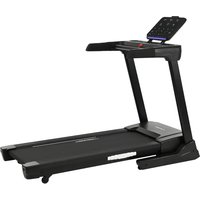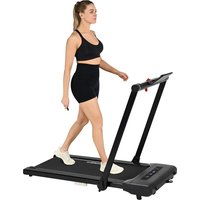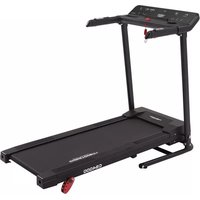
CS4000 - Treadmills Christopeit - Free user manual and instructions
Find the device manual for free CS4000 Christopeit in PDF.



| Product Type | Treadmill |
| Brand | Christopeit |
| Model | CS4000 |
| Dimensions (unfolded) | 149 x 70 x 114 cm |
| Dimensions (folded) | 72 x 70 x 140 cm |
| Product Weight | 37 kg |
| Maximum User Weight | 110 kg |
| Power Supply | 220-240 V~50-60 Hz, 550 W |
| Motor (continuous / peak) | 0.75 HP (550 W) / 1.1 HP (1100 W) |
| Speed Range | 1 to 12 km/h (in increments of 0.1 km/h) |
| Incline | 4 manual levels |
| Running Surface | 120 x 40 cm |
| Training Programs | 1 manual (time, distance, calories) + 12 automatic speed programs |
| Display | 5 LED screens: time, speed, distance, calories, heart rate |
| Connectivity | Bluetooth for Kinomap, built-in speakers, gesture control |
| Safety | Safety clip with emergency stop |
| Belt Adjustment | Centering and tension via Allen key (screws at the back of the frame) |
| Lubrication | Silicone oil every 50 hours of use |
| Cleaning | Slightly damp cloth; do not use harsh chemicals |
| Storage | Fold, unplug if unused for more than 4 weeks, dry place |
| Transport Wheels | Yes (2 wheels) |
| Folding | Yes, with soft drop system |
| Usage | Private domestic, class H/C |
| Spare Parts | Available from the manufacturer (ET numbers provided in the manual) |
Frequently Asked Questions - CS4000 Christopeit
User questions about CS4000 Christopeit
0 question about this device. Answer the ones you know or ask your own.
Ask a new question about this device
Download the instructions for your Treadmills in PDF format for free! Find your manual CS4000 - Christopeit and take your electronic device back in hand. On this page are published all the documents necessary for the use of your device. CS4000 by Christopeit.
USER MANUAL CS4000 Christopeit
Assembly and operating instructions
Order No.: 2330
Page: 13-22

ZUSAMMENKLAPPEN

natural_image
Four line drawings showing a person performing a treadmill exercise, with no text or symbols present.natural_image
Illustration showing a bottle and a hand holding a pen, with no visible text or symbols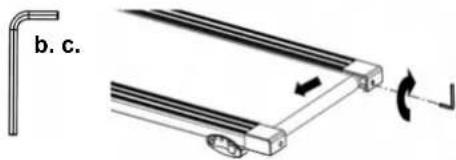
natural_image
Diagram of a mechanical assembly with labeled parts (b. c.) and directional arrows, no readable text or symbols present.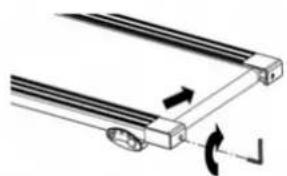
natural_image
Diagram of a mechanical linkage or lever mechanism with directional arrows indicating motion (no text or symbols)d.
natural_image
Diagram of a mechanical assembly with rotating components and directional arrows (no text or symbols)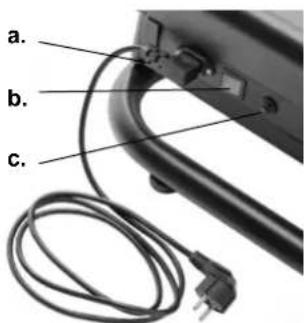
ANZEIGEN
natural_image
Line drawing of a portable electronic device with control panel and labeled component (no text or symbols beyond labels)AUDIOWIEDERGABE
natural_image
Sequence of four sequential illustrations showing a person performing a stretching or kneeling movement (no text or symbols)natural_image
Isometric line drawing of a mechanical device inside a transparent cube, with dimension labels (2090, 2100, 2200) indicating measurements on the right side.13 Important recommendations and safety instructions
14 Assembly instructions
15 Fold / Fold out
15 Transport
15 Incline adjustment
16 Maintenance and adjusting
17-18 Computer manual
18 Kinomap App
19 Gesture control
20 General training instructions
21-22 Parts List – Spare Parts List
75 Exploded drawing
DEAR CUSTOMER,
we congratulate you on your purchase of this home training sports unit and hope that we will have a great deal of pleasure with it. Please take heed of the enclosed notes and instructions and follow them closely concerning assembly and use. Please do not hesitate to contact us at any time if you should have any questions.
Attention! Before use read operating instructions!


IMPORTANT RECOMMENDATIONS AND SAFETY INSTRUCTIONS
Our products are all TÜV tested and therefore represent the highest current safety standards. However, this fact does not make it unnecessary to observe the following principles strictly.
- Assembly the machine exactly as described in the installation instructions and use only the enclosed, specific parts of the machine contained in the assembly. Before assembling, verify the completeness of the delivery against the delivery notice and the completeness of the carton against the installation and operating instructions.
- Check the firm seating off all screws, nuts and other connections before using the machine for the first time and at regular intervals (every 1-2 months) to ensure that the trainer is in a safe condition. Replace defective components immediately and/or keep the equipment put of the use until repair.
- Set up the machine in a dry, level place and protect it from moisture and water. Uneven parts of the floor must be compensated by suitable measures and by the provided adjustable parts of the machine if such are installed. Ensure that no contact occurs with moisture or water.
- Place a suitable base (e.g. rubber mat, wooden board etc.) beneath the machine if the area of the machine must be specially protected against indentations, dirt etc.
- Leave at least 1 meter of free space around the treadmill at the installation site and at least 2 meters to other objects such as furniture or walls.
- Do not use aggressive cleaning agents to clean the machine and employ only the supplied tools or suitable tools of your own to assemble the machine and for any necessary repairs. Remove drops of sweat from the machine immediately after finishing training.
- Attention! Systems of the heart frequency supervision can be inexact. Excessive training can lead to serious health damage or to the death. Consult a doctor before beginning a planned training programme. He can define the maximum exertion (pulse, Watts, duration of training etc.) to which you may expose yourself and can give you precise information on the correct posture during training, the targets of your training and your diet. Never train after eating large meals.
- Only train on the machine when it is in correct working order. Use original spare parts only for any necessary repairs. Attention! Replace the worm parts immediately and keep this equipment out of use until repaired.
- When setting the adjustable parts, observe the correct position and the marked, maximum setting positions and ensure that the newly adjusted position is correctly secured. Please remove the tools you need to adjust after adjusting a new position.
-
Unless otherwise described in the instructions, the machine must only be used for training by one person at a time. The exercise time should not overtake 60 min./daily.
-
Wear training clothes and shoes which are suitable for fitness training with the machine. Your clothes must be such that they cannot catch during training due to their shape (e.g. length). Your training shoes should be appropriate for the trainer, must support your feet firmly and must have non-slip soles.
- Attention! If you notice a feeling of dizziness, sickness, chest pain or other abnormal symptoms, stop training and consult a doctor.
- Never forget that sports machines are not toys. They must therefore only be used according to their purpose and by suitably informed and instructed persons.
- People such as children, invalids and handicapped persons should only use the machine in the presence of another person who can give aid and advice. Take suitable measures to ensure that children never use the machine without supervision.
- Ensure that the person conducting training and other people never move or hold any parts of their body into the vicinity of moving parts.
- At the end of its life span this product is not allowed to dispose over the normal household waste, but it must be given to an assembly point for the recycling of electric and electronic components. You may find the symbol on the product, on the instructions or on the packing. The materials are reusable in accordance with their marking. With the re-use, the material utilization or the protection of our environment. Please ask the local administration for the responsible disposal place.
- To protect the environment, do not dispose of the packaging materials, used batteries or parts of the machine as household waste. Put these in the appropriate collection bins or bring them to a suitable collection point.
- The maximum permissible load (=body weight) is specified as 110 kg. Evaluate your body weight before you starting the exercise.
- If the power cord of this item is damaged, this must be replaced by the manufacturer or the customer service or with an electrically certified person.
Manufacturer: Top-Sports Gilles GmbH, Friedrichstraße 55, D-42551 Velbert. This product complies with the following European directives and standards: 2014/53/EU (RED), 2014/35/EU (LVD), 2011/65/EG (RoHS) and EN ISO 20957-1:2013, EN 957-6: 2010 / A1:2014 (Home Sports). - The assembly and operating instructions are part of the product to look at. If the product is sold or passed on, this documentation must be included.
20. Declaration of Conformity
ASSEMBLY INSTRUCTIONS

Put everything clearly on the ground and control the completeness based on the assembly steps. Attention! The simplified assembly process requires 100% attention. Especially in the kink and folding positions. Assembly time is approx. 20min.
STEP 1
- Remove all small parts and loose packaging material from the box and then, with the help of a second person, remove the pre-assembled treadmill.
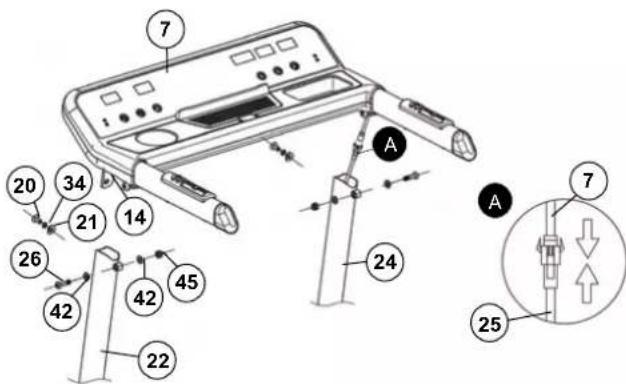
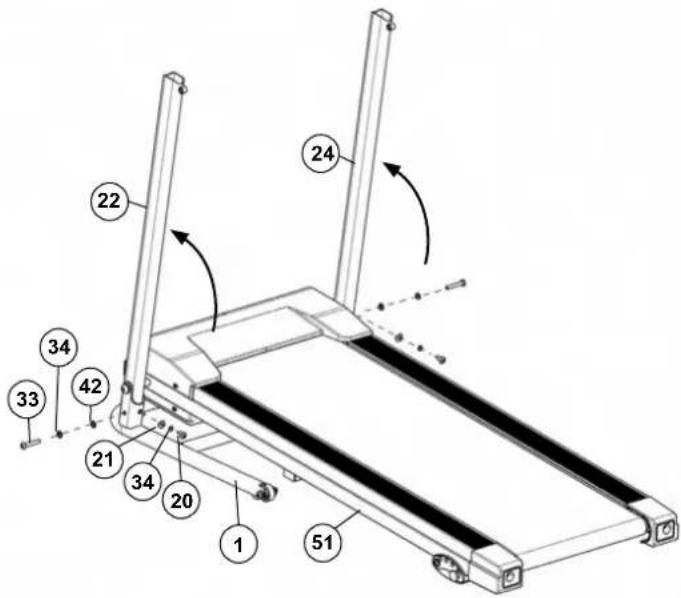
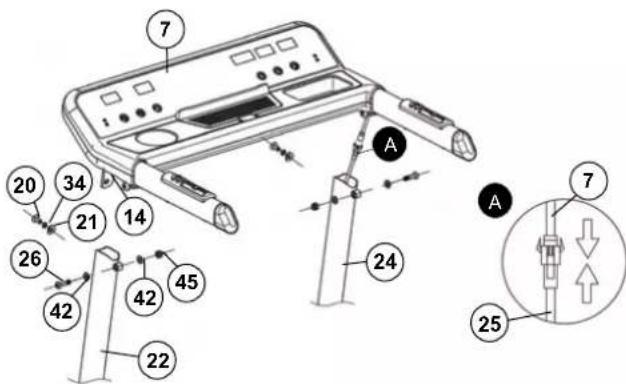
- Place the screws M8x16 (20) and M8x50 (33) together with washers (21+42) and spring washers (34) on the right and left next to the running frame (51) ready to hand.
- Carefully fold up the support tubes on the left and right (22+24) and screw them to the base frame (1) using the M8x50 screws (33), the spring washers (34) and the washers (42). Then tighten the other screws M8x16 (20) with spring washers (34) and curved washers (21).
STEP 2
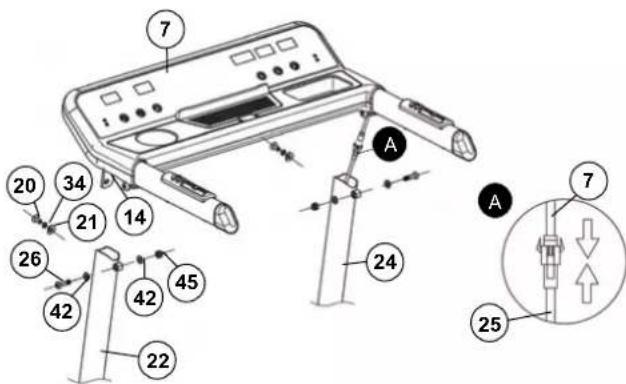
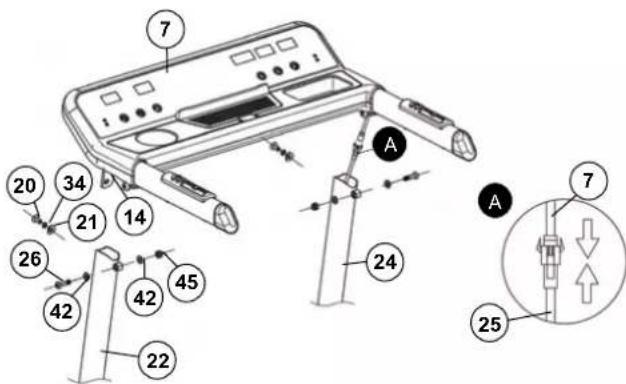
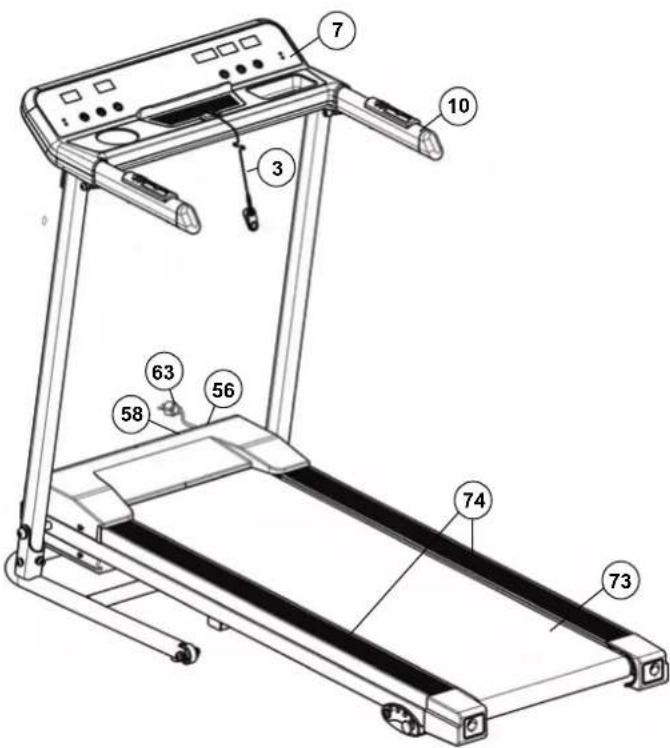
- Guide the computer frame (14) onto the support tubes (22+24) and connect the plugs from the connection cable (25) and computer (7) at the top of the right support tube (24).
- Then screw the computer frame (14) to the support tubes (22+24) using the screws M8x16 (20), spring washers (34) and curved washers (21) and ensure that the cable connection is not trapped. Then use the other screws M8x30 (26), washers (42) and self-locking nuts (45) to screw the computer frame (14) to the support tubes (22+24).
CHECKS AND HOW TO START
- Check the correct installation and function of all screwed and plug connections.
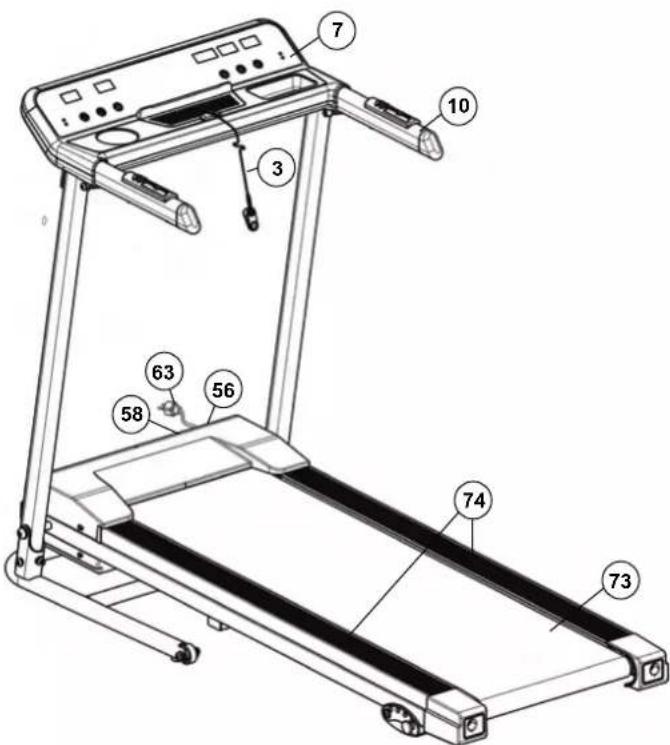
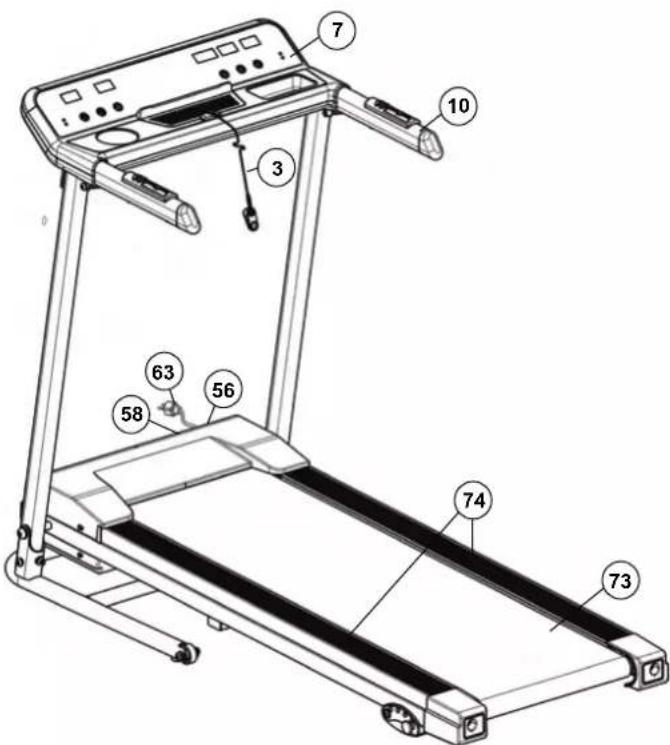
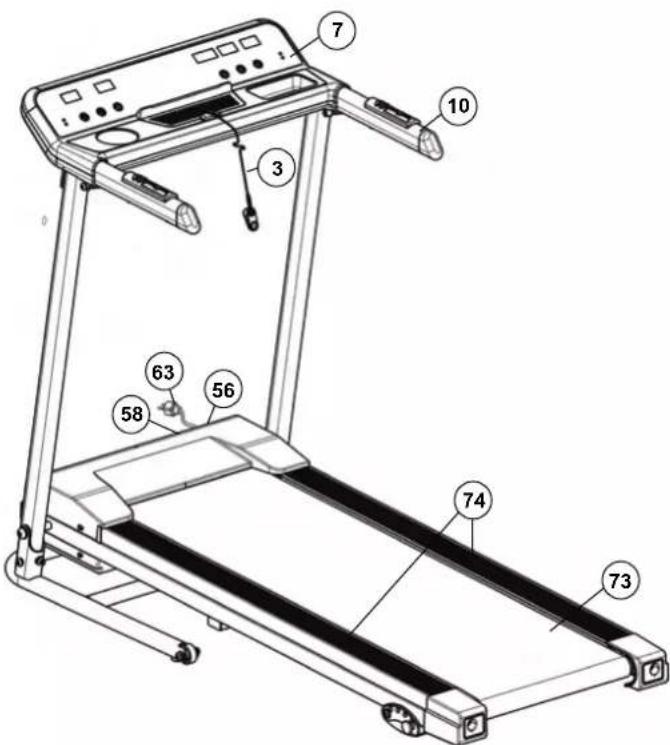
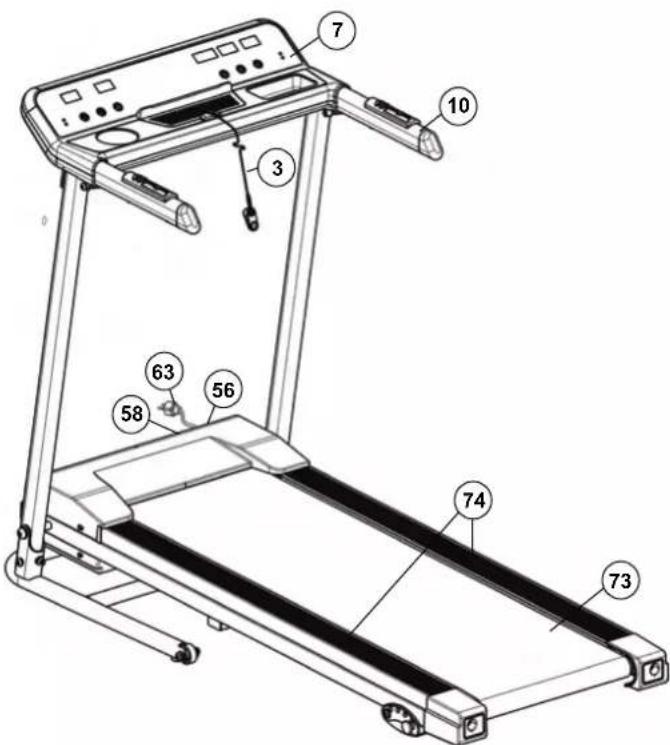
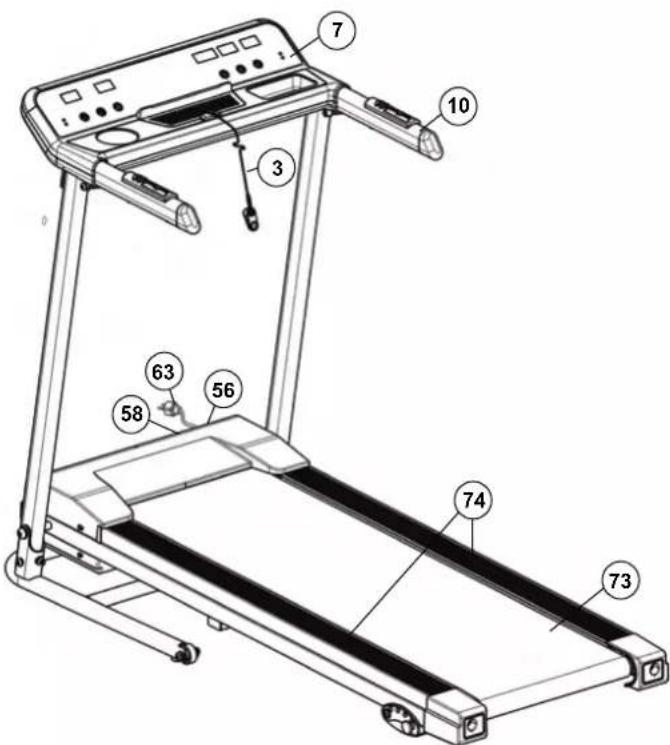
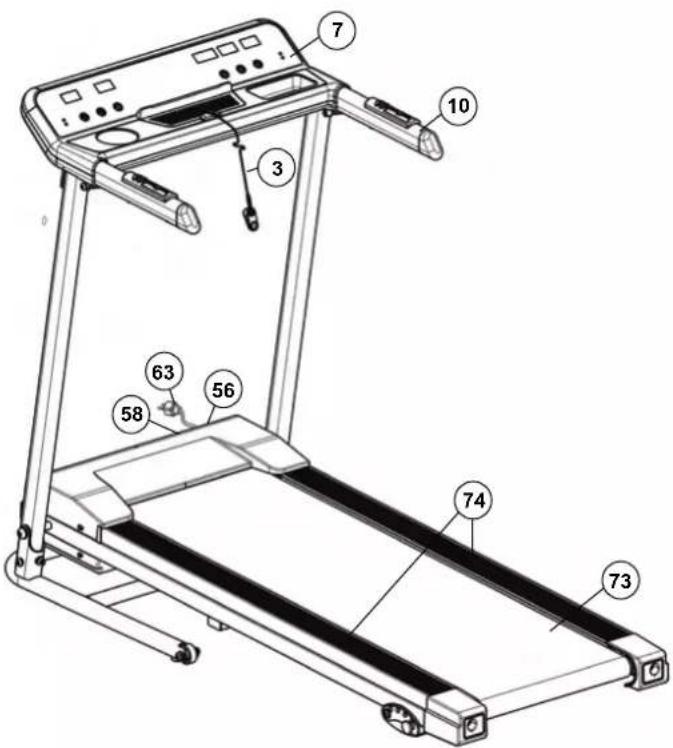
- When everything is in order, connect the power supply cable (63) with wall power (220-240V\~50-60Hz) and switch socket (56). Switch on the main switch (58) below the front frame.
- Put the safety key (3) onto the computer (7) and the computer will show normal manual mode. Put the safety clip (3) at your exercising cloth and stand on the side rails (74). Press [Start] Button and after a Count Down the treadmill start moving. Start walking onto the walk surface (73) when speed is slowly and follow the speed. Familiarize yourself with the machine at a low speed settings.
- Run in the middle of the running surface (73) and don't step on the side foot rails (74), Hold yourself tight at handrail (10) if you feel insecure only run with look at the computer (7) on the treadmill during the running. In emergency case, step of the treadmill lateral and hold on to the handle (10).
Note: Please keep the tool set and the instructions in a safe place as these may be required for repairs or spare parts orders becoming necessary later.
FOLD UP
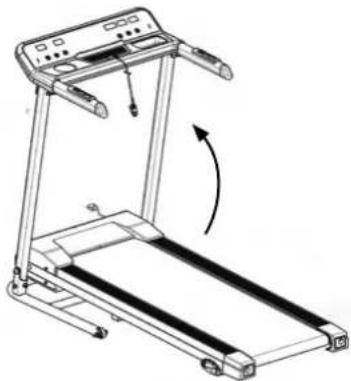
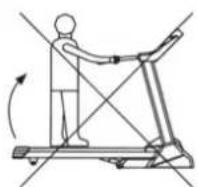
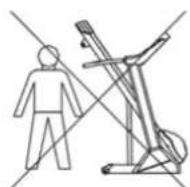
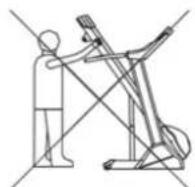
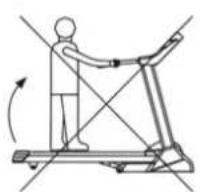
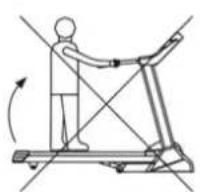
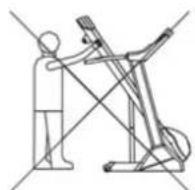
Put one hand at the end caps (49) of the running frame and lift up into vertically position that it automatically locks the upright position.
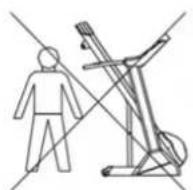
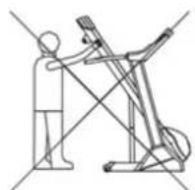
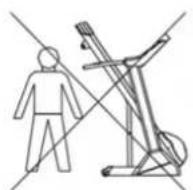
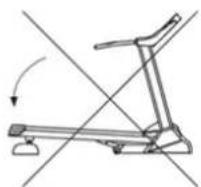
Attention! Before folding up the treadmill switch off and wait until the running surface totally stopped. Don't start the treadmill in fold up position!
FOLD OUT
Press a little against the end cap (49) on the treadmill and release the lock by pushing the small lever on the gas spring (27) with your foot. This releases the lock and the walking frame lowers down into the unfolded position.
TRANSPORT
-
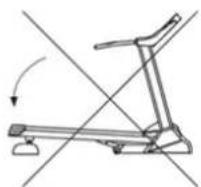
Fold up the treadmill.
-
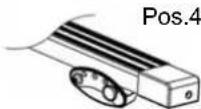
Place your hands on at the endcaps (49), than lean the machine toward your body until it is easy moveable on transportation rollers (38).
INCLINE ADJUSTMENT
- Fold up the treadmill.
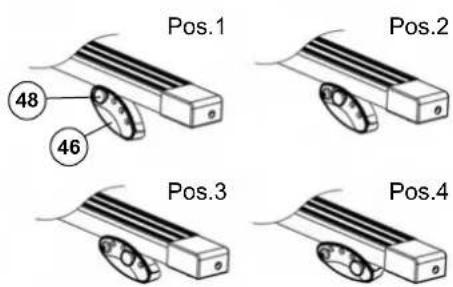
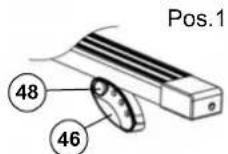
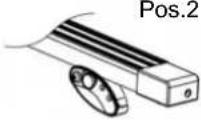
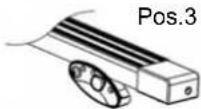
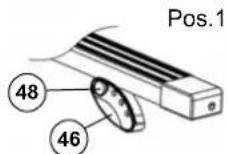
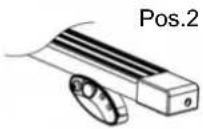
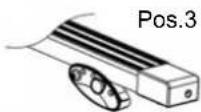
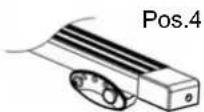
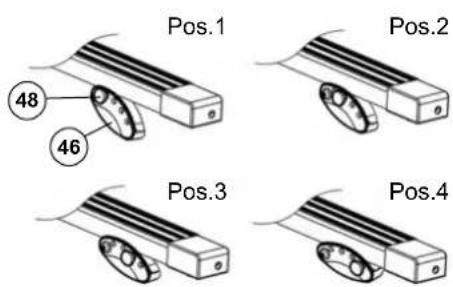
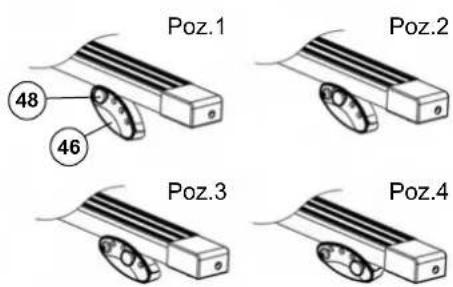
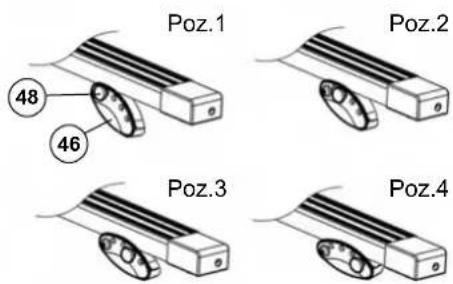
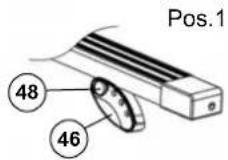
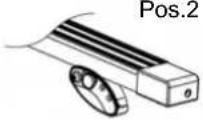
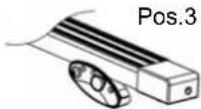
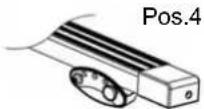
- Take out both security pins (48), shift the incline adjuster (46) in another position and put in the security pins (48).
- Fold out the treadmill. The incline adjustment is intended in addition to raise the load of the mountain accrual.
natural_image
Line drawing of a treadmill with an arrow indicating rotational motion (no text or symbols)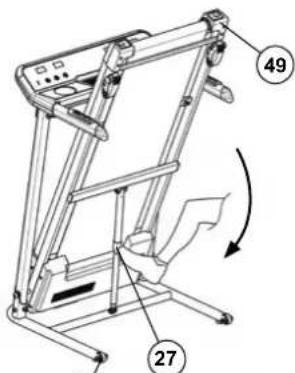
38
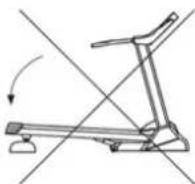
MAINTENANCE AND ADJUSTING
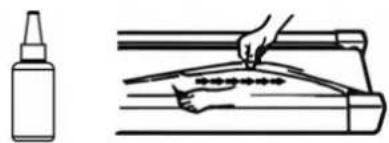
Lubrication for the running belt
In order to keep the machine in the best condition, please add some Silicone oil between the running belt and the running board after 50 hours of use. But the running belt may slip, if you lubricate too much. To lubricate the belt please pull the walking belt up and injection the silicon spray or silicone oil into the gap between belt and walking deck.
(Attention: Too much lubricant can cause the tread to slip.)
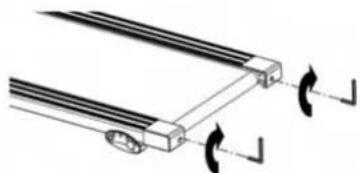
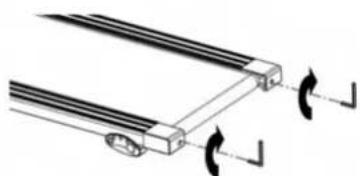
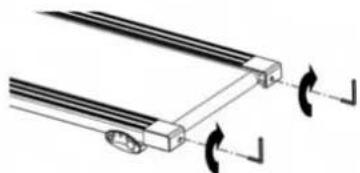
Adjusting running belt
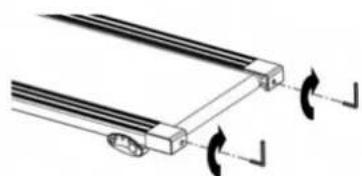
You need to adjust the walking belt to the normal position, per the following steps if it is off.
a. Set speed at 3-5km.
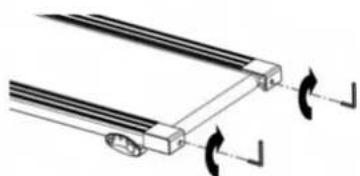
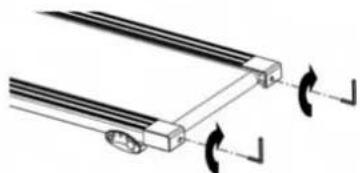
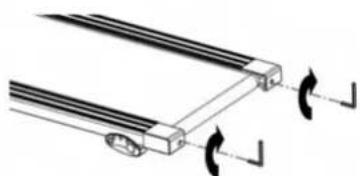
b. Using the Allen key to adjust the belt tension bolt on the end cap of the system frame.
c. If you want to move the belt towards left, turn the right tension bolt clockwise.
d. If you want to move the belt towards right, turn the left tension bolt clockwise.
e. If you have already done according to the steps above and it is still not at the good range, then the running belt should be damaged already, please contact your local dealer for replacement.
Note: Make sure that the running surface is as centered as possible. Once these moves too far from the center, (about 10 mm) it should be readjusted into the center.
Running belt slips
a. Make sure the walking belt is not too loose.
b. Make sure the motor belt is not too loose.
c. Remove excess lubricant with a cloth.
No light on the Display
a. Check whether the plug is in the socket and whether the outlet has power.
b. Check that the main switch on the base frame is switched on and that the safety clip is correctly attached to the computer.
Attention! Always pull out the mains plug when checking the computer plug connections.
c. Check whether the overload protection has tripped. If necessary, press the button.
Abnormal noise from the machine:
a. Check if any screw of machine is loose.
b. Check if the motor belt is off.
c. Check if the running belt is off.
Note: Please contact your local dealer if you have checked all the above listed things but the problem is still there.
Cleaning
Use only a less wet cloth for cleaning. Caution: Never use benzene, thinner or other aggressive cleaning agents for surface cleaning as this damage caused. The device is only for private home use and for use suitable indoors. Keep the unit clean and moisture from the device.
Storage
Fold up the treadmill. Unplug the power cord if you do not intend to use the device for more than 4 weeks. Choose a dry storage location in the house. Cover the device to protect it from discoloration caused by sunlight and dust.
natural_image
Illustration showing a bottle and a hand holding a tool over a surface, with no visible text or symbols.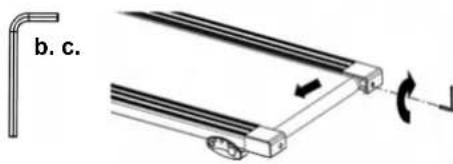
natural_image
Diagram of a mechanical assembly with labeled parts (b. c.) and directional arrows, no readable text or symbols present.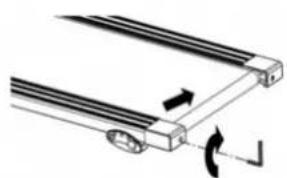
natural_image
Diagram of a mechanical linkage or lever mechanism with directional arrows indicating motion (no text or symbols)d.
natural_image
Pure mechanical assembly diagram showing two parallel plates with rotating arms and fasteners (no text or symbols)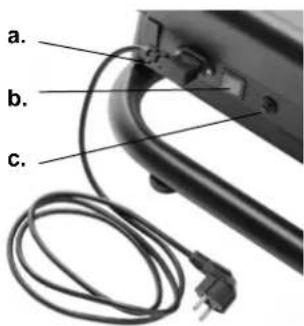
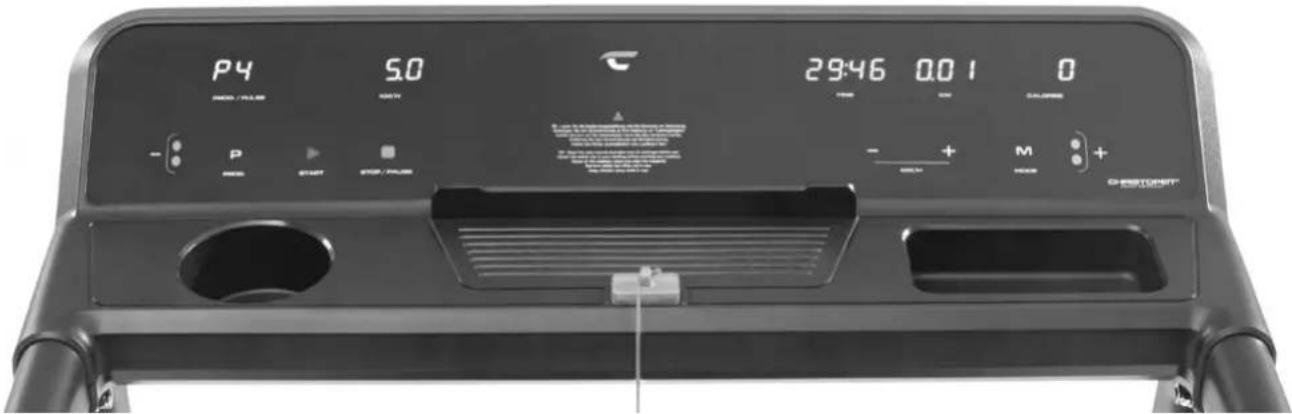
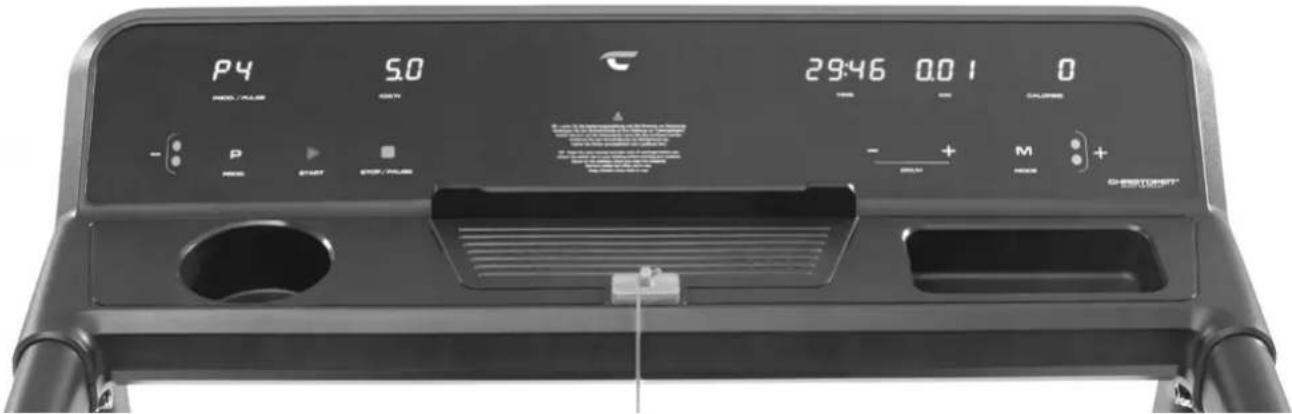
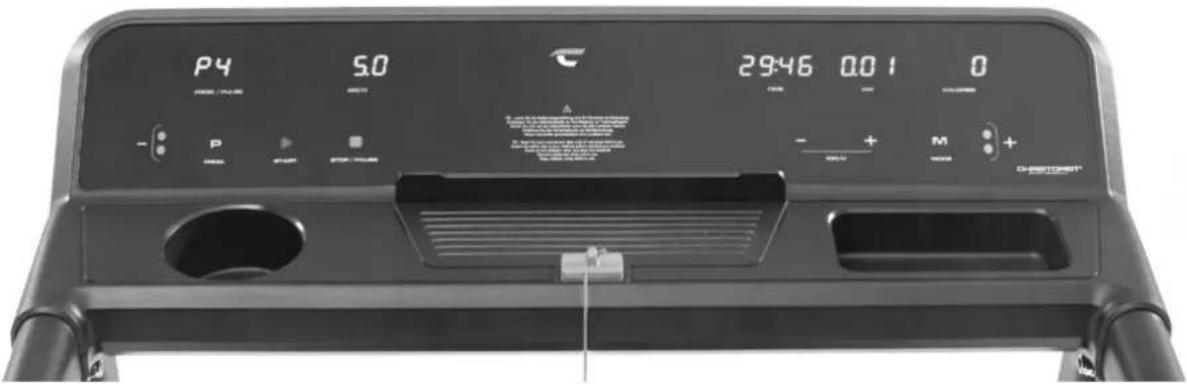
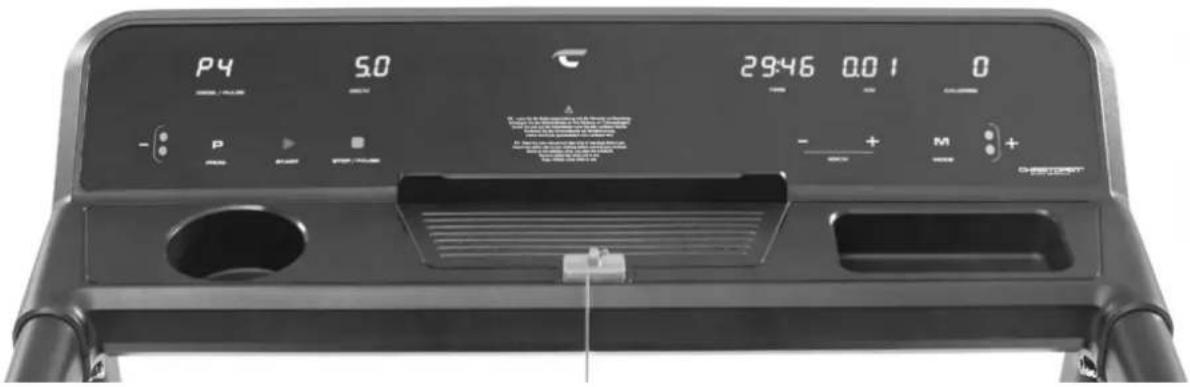
DISPLAYS
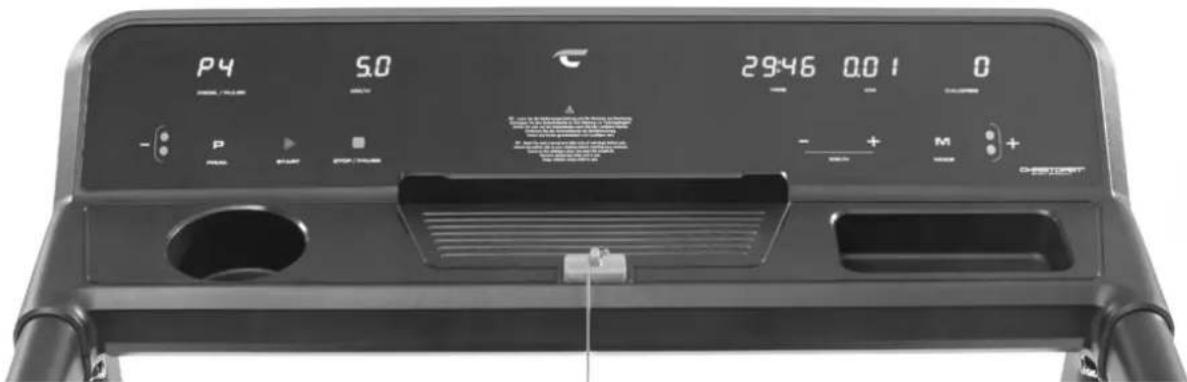
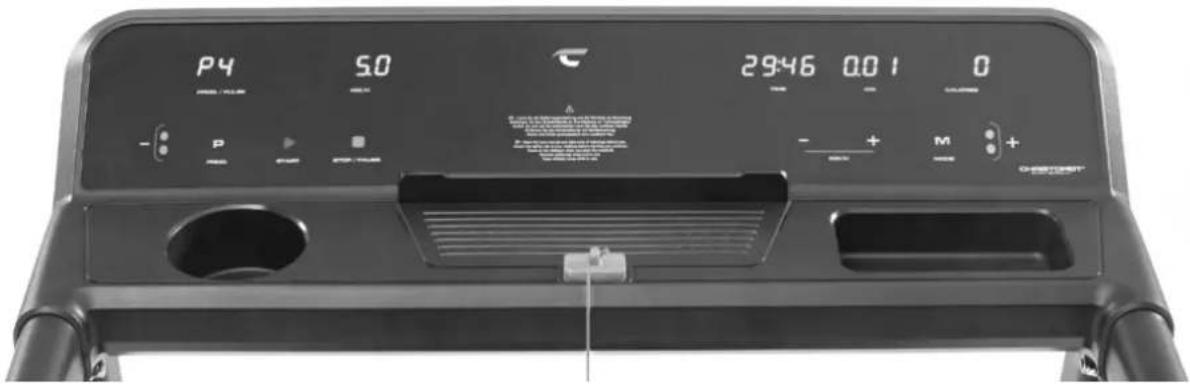
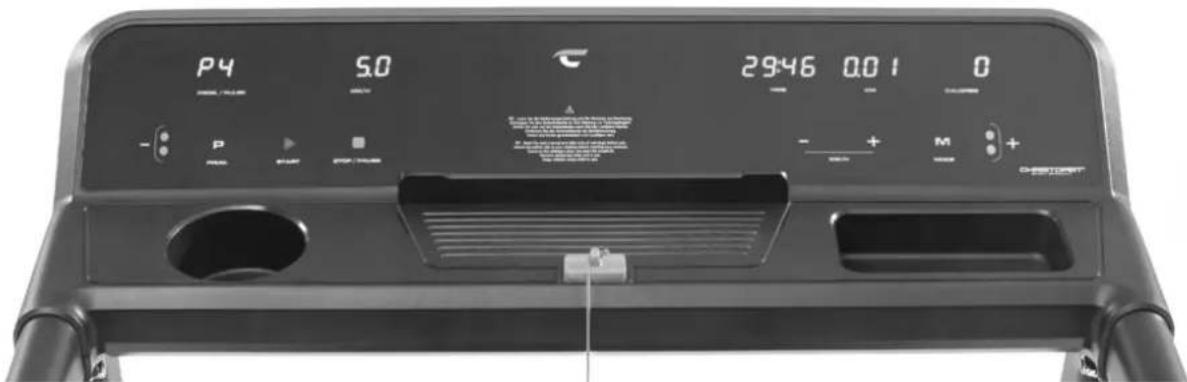
[PROG./PULSE] Display: Shows actually exercise programs P01-P12 or actually heart rate data if using hand pulse.
[KM/H] Display: Shows actually speed in Km/h.
[TIME] Display: Shows actually time of exercising in minutes and seconds.
[KM] Display: Shows actually distance in Km.
[CALORIES] Display: Shows actually calories in kcal.
KEYS:


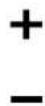

[P-Prog.] Key: press this key to select exercising speed programs P01-P12
[Start] Key: Press this key to start exercise program. The runing surface starts delayed by 3 seconds.
[Stop/Pause] Key: Press this key during exercise to interrupt the program (motor stops running). Within 5 min. you can press [Start] key to continue this exercise program or press [Stop/Pause] key again to finish this program. Prevalues can set to zero by pressing the [Stop/Pause] key.
[+] Key: Press this key to increase settings or motor speed.
[-] Key: Press this key to decrease settings or motor speed.
[M-Mode] Key: Press this key to select the time distance or calories in the manual program.
START UP
-
Plug the mains plug into a properly installed socket (230V\~50Hz) and switch on the main switch (58) at the bottom front of the treadmill.
-
Stand on the side rails.
-
Put the safety clip on your training clothes (e.g. waistband) and in the corresponding holder on the computer and the computer will show you the manual program and you are ready to start.
PROGRAMS
Manual-Program:
Press the [Start] key to start the treadmill. After a 3-second countdown, the running surface begins to move. Immediately after the belt starts up, step onto the treadmill and follow the set speed.
Time Program:
Use the [M-Mode] button to select the time program, then the [TIME] display flashes and a suggestion of 30:00 Min is shown. If desired, you can change this with the [+] and [-] buttons. (Default option 5:00-99.00 Min) Start the program after specifying the time with the [Start] button and the default value counts down to "0". If this value is reached, a signal sounds and that treadmill stops.
Distance-Program:
Use the [M-Mode] button to select the distance program, then the [KM] display flashes and a suggestion of 1,00 Km is shown. If desired, you can change this with the [+] and [-] buttons. (Default option 0,5-65,0 Km) Start the program after specifying the distance with the [Start] button and the default value counts down to "0". If this value is reached, a signal sounds and that treadmill stops.
Calorie program:
Use the [M-Mode] button to select the calorie program, then the [CALORIES] display flashes and a suggestion of 50kcal is shown. If desired, you can change this with the [+] and [-] buttons. (Default option 10-995 kcal.) Start the program after specifying the calories with the start button and the default value counts down to "0". If this value is reached, a signal sounds and that treadmill stops.
RANGE OF ALL FUNCTIONS
| Initial | Initial Value | Setting Range | Display Range | |
| TIME (Min:Sec) 0:00 | 30:00 5:00-99:00 0:00-99:59 | |||
| KM/H 0.0 N/A N/A | 1.0-8.0 | |||
| KM 0.00 1.00 0.5-6 | 5.0 0.00-99.99 | |||
| PULSE P | N/A N/A 50-200 | |||
| CALORIES (Kcal) | 0 | 50 | 10-995 | 0-999 |
EXERCISE PROGRAMS P01-P12
On the normal manual mode, press [P-Prog] key to chose one of the exercise speed programs P01-P12. Each program is divided into 20 intervals of time and the speed changes as following program list shows. Initial setting time is 30 min, set a time for training session and press [Start] key to start the program. Pressing [Stop/Pause] key to have a break or finish earlier the program. Press [+] key or [-] key to adjust speed during the program if it is to quick or slow. With next intervals of time the speed level will change back to program mode. If the program runs till end of time the motor will stop running after the display counts down time to zero.
Program speed table P01 - P12
| No. +P | programs in 20 time divisions | ||||||||||||||||||||||
| ↓ Program | 1 2 | 3 4 5 | 6 7 | 8 9 10 | 11 12 | 13 14 | 15 16 | 17 | 18 19 | 20 | |||||||||||||
| P01 Km/h | 2 | 3 3 4 | 5 3 | 4 5 5 | 3 4 | 5 4 4 | 4 2 | 3 3 5 | 3 | ||||||||||||||
| P02 Km/h | 2 | 4 4 5 | 6 4 | 6 6 6 | 4 5 | 6 4 4 | 4 2 | 2 5 4 | 2 | ||||||||||||||
| P03 Km/h | 2 | 4 4 6 | 6 4 | 7 7 7 | 4 7 | 7 4 4 | 4 2 | 4 5 3 | 2 | ||||||||||||||
| P04 Km/h | 3 | 5 5 6 | 7 7 | 5 7 7 | 8 8 | 5 9 5 | 5 6 | 6 4 4 | 3 | ||||||||||||||
| P05 Km/h | 2 | 4 4 5 | 6 7 | 7 5 6 | 7 8 | 8 5 4 | 4 6 | 5 5 4 | 2 | ||||||||||||||
| P06 Km/h | 2 | 4 | 3 4 | 5 4 8 | 7 5 | 7 8 3 | 6 4 4 | 2 5 | 4 3 2 | ||||||||||||||
| P07 Km/h | 2 | 3 3 3 | 4 5 | 3 4 5 | 3 4 | 5 3 3 | 3 6 | 6 5 3 | 3 | ||||||||||||||
| P08 Km/h | 2 | 3 3 6 | 7 7 | 4 6 7 | 4 4 | 4 6 7 | 4 4 | 4 2 3 | 2 | ||||||||||||||
| P09 Km/h | 2 | 4 4 7 | 7 4 | 7 8 4 | 8 9 | 9 4 4 | 4 5 | 6 3 3 | 2 | ||||||||||||||
| P10 Km/h | 2 | 4 5 6 | 7 5 | 4 6 8 | 8 6 | 6 5 4 | 4 2 | 4 4 3 | 3 | ||||||||||||||
| P11 | Km/h | 3 | 4 | 5 | 9 | 5 | 9 | 5 | 5 | 5 | 9 | 9 | 5 | 5 | 5 | 9 | 9 | 8 | 7 | 6 | 3 | ||
| P12 Km/h | 2 | 5 8 | 10 | 7 7 | 10 10 | 7 7 | 10 10 | 6 6 | 9 9 | 5 5 4 | 3 | ||||||||||||
HEART RATE MEASUREMENT FUNCTION
Optionally, you can use a compatible Bluetooth heart rate monitor to measure your heart rate (Christopeit-Sport heart rate monitor 2209). The measured pulse value is displayed in the heart rate display. Response time is up to 60 seconds.
Attention: The heart rate measurement is not for medical purposes suitable.
SAFETY KEY
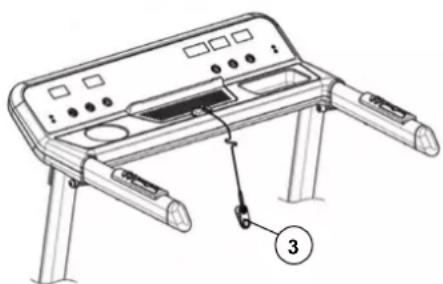
The safety clip (3) has an emergency function. In fear or danger or if you fall down or jumped from it, the safety clip will lose position at computer and stops the motor with break system. Put the safety key out from computer on any status, the display is „---“, the buzzer beep each second. Put the safety key on computer, then the display will enter normal manual mode. All parameter reset to zero.
natural_image
Line drawing of a mechanical device with labeled parts (no text or symbols present)AUDIO PLAYBACK
The computer has speakers that allow you to play audio data via Bluetooth from a Bluetooth device (smartphone, tablet, ...). To pair the devices, turn on the treadmill. Pair your end device with the "BTMP3". Successful pairing and unpairing is confirmed by a short announcement "Bluetooth is now connected" or "Bluetooth is now disconnected".
KINOMAP APP
The product can be used with the Kinomap app. This enables entertaining and interactive training with Android or IOS devices and saving training data.
Sport, coaching, gaming and eSport are the keywords of the Kinomap app. This contains many kilometers of real film material to exercise inside as if you were outside; Tracking routes and analysis of your performance; Coaching content; Multiplayer mode; new posts daily; Official indoor races and more
... The APP thus contains approx. 100,000 videos recorded by athletes and 200,000 km of accumulated tracks for cycling, running or rowing for currently approx. 270,000 members from all over the world.
Download the app and connect
Scan the adjacent QR code with your smartphone / tablet or use the search function at the Playstore (Android) or APP Store (IOS) to download the Kinomap APP. Register and follow the instructions in the APP.
Activate Bluetooth on the smartphone or tablet and select the device manager via the menu in the APP and then select the „Treadmill“ category. Then select your type designation via the manufacturer logo „Christopeit Sport“ in order to connect the sports equipment. Depending on the sports equipment, different functions are recorded by the APP via Bluetooth or data is exchanged.
Attention! The Kinomap APP offers a free trial version for 14 days. After that, fees will apply which are listed on the Kinomap homepage. Further information can be found at: https://www.kinomap.com/en/
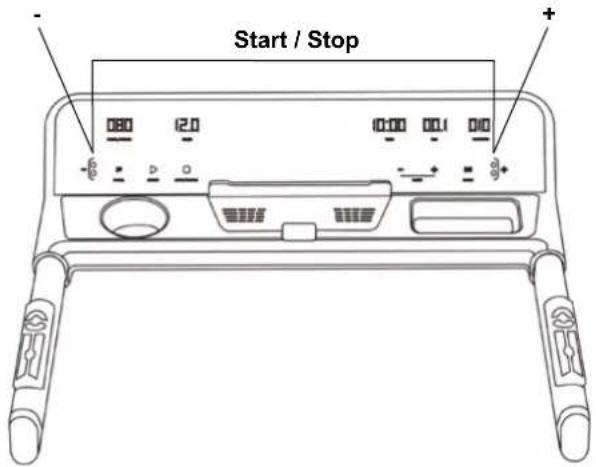
The treadmill also has the option of gesture control. The sensors are located on the left and right of the computer and are denoted by [-] and [+].
LEFT SENSOR [-]
Moving around the sensor coverage area decrease speed.
RIGHT SENSOR [+]
Moving around the sensor coverage area increase speed.
LEFT SENSOR [-] AND RIGHT SENSOR [+]
Simultaneous actuation of the sensors starts or stops the treadmill.
FUNCTIONAL TEST
Stand on the sidebars. The normal sensor coverage area is approx. 5-15 cm above the sensors. Run your hands over the two sensors. The treadmill should start after a 3 second countdown. Then move your right hand over the right [+] sensor. The speed increases as long as the hand is in the coverage area. When you remove your hand, the speed remains set. Then move your left hand over the left [-] sensor. The speed decreases as long as the hand is in the coverage area. When you remove your hand, the speed remains set. To stop the treadmill, place both hands over the sensors at the same time. The treadmill is stopped.
Stand on the tread. Follow the same steps to learn gesture controls while walking/ running.
Attention! Depending on the incidence of light, the coverage area of the sensor can vary slightly. Familiarize yourself with the sensors by moving your hand toward, away from, and around the sensor in the coverage area. You will notice where the sensor reacts and where not.

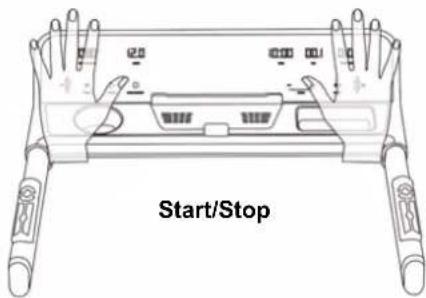
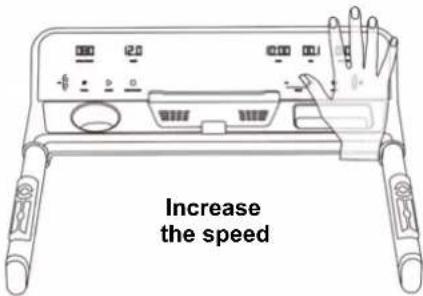
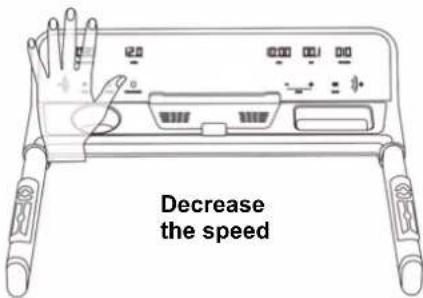
GENERAL TRAINING INSTRUCTIONS
You must consider the following factors in determining the amount of training effort required in order to attain tangible physical and health benefits.
INTENSITY
The level of physical exertion during training must exceed the point of normal exertion, without going beyond the point of breathlessness and/or exhaustion. A suitable reference value can be the pulse. With each training session, the condition increases and therefore the training requirements should be adjusted. This is possible by extending the duration of the training, increasing the level of difficulty or changing the typ training.
TRAINING HEART RATE
To determine the training heart rate, you can proceed as follows. Please note that these are guide values. If you have health problems or are unsure, consult a doctor or fitness trainer.
01 Maximum heart rate calculation
The maximum pulse value can be determined in many different ways, since the maximum pulse depends on many factors. You can use the main-formula for the calculation (maximum heart rate = 220 - age). This formula is very general. It is used in many home sport products to determine the maximum heart rate. We recommend the Sally-Edwards-formula. This formula calculates the maximum heart rate more precisely and takes gender, age and body weight into account.
Sally-Edwards-formula:
Men:
Maximum heart rate = 214 - (0.5 x age) - (0.11 x body weight)
Women:
Maximum heart rate = 210 - (0.5 x age) - (0.11 x body weight)
02 Training heart rate calculation
The optimal training heart rate is determined by the goal of the training. Training zones were defined for this.
Health - Zone: Regeneration and Compensation
Suitable for: Beginners
Type of training: very light cardio training
Goal: recovery and health promotion. Building the basic condition.
Training heart rate = 50 to 60% of the maximum heart rate
Fat-Metabolism - Zone: Basics endurance training 1
Suitable for: beginners and advanced users
Type of training: light cardio training
Goal: activation of fat metabolism (calorie burning). improvement in endurance performance.
Training heart rate = 60 to 70% of the maximum heart rate
Aerobic - Zone: Basics endurance training 1 to 2
Suitable for: beginners and advanced
Type of training: moderate cardio training.
Goal: Activation of the fat metabolism (calorie burning), improving aerobic performance, Increase in endurance performance.
Training heart rate = 70 to 80% of the maximum heart rate
Anaerobic - Zone: Basics endurance training 2
Suitable for: advanced and competitive athletes
Type of training: moderate endurance training or interval training
Goal: improvement of lactate tolerance, maximum increase in performance.
Training heart rate = 80 to 90% of the maximum heart rate
Competition - Zone: Performance / Competition Training
Suitable for: athletes and high-performance athletes
Type of training: intensive interval training and competition training /
Goal: improvement of maximum speed and power.
Attention! Training in this area can lead to overloading of the cardiovascular system and damage to health.
Training heart rate = 90 to 100% of the maximum heart rate
Sample calculation
Male, 30 years old and weighs 80 kg. I am a beginner and would like to lose some weight and increase my endurance.
01: Maximum pulse - calculation
Maximum heart rate = 214 - (0.5 x age) - (0.11 x body weight)
Maximum heart rate = 214 - (0.5 x 30) - (0.11 x 80)
Maximum pulse = approx. 190 beats/min
02: Training heart rate calculation
Due to my goals and training level, the fat metabolism zone suits me best.
Training heart rate = 60 to 70% of the maximum heart rate Training heart rate = 190 x 0.6 [60%]
Training heart rate = approx. 114 beats/min
After you have set your training heart rate for your training condition of? Once you have identified goals, you can start training. Most of our endurance training equipment have heart rate sensors or are heart rate belt compatible. So you can check your heart rate on the monitor during the workouts. If the pulse rate is not shown on the computer display or you want to be on the safe side and want to check your pulse rate, which could be incorrectly displayed due to possible application errors or similar, you can use the following tools:
a. Pulse measurement in the conventional way (sensing the pulse beat, e.g. on the wrist and counting the beats within a minute).
b. Heart rate measurement with suitable and calibrated heart rate measuring devices (available from medical supply stores).
c. Heart rate measurement with other products such as heart rate monitors, smartphones....
FREQUENCY
Most experts recommend the combination of a health-conscious diet, which must be adjusted according to the training goal, and physical exercise three to five times a week. A normal adult needs twice a week exercise to maintain its current condition. To improve his condition and change his body weight, he needs at least three training sessions per week. Ideal of course is a frequency of five training sessions per week.
TRAINING PLAN
Each training session should consist of three training phases: "warmup phase", "training phase" and "cool-down phase". In the "warm-up phase" the body temperature and the oxygen supply should be increased slowly. This is possible through gymnastic exercises over a period of five to ten minutes. After that you start with actual training "training phase". The training load should be adapted according to the training heart rate. In order to support the circulation after the training phase and to preventaching or strained muscles later, it is necessary to follow the training phase with a cool-down phase. This should be consist of stretching exercises and/or light gymnastic exercises for a period of five to ten minutes.
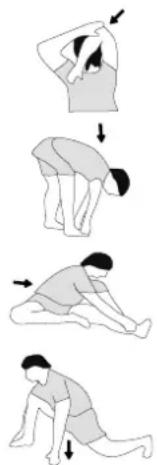
Example - stretching exercises for the warm-up and cool-down phases
Start your warm up by walking on the spot for at least 3 minutes and then perform the following gymnastic exercises to the body for the training phase to prepare accordingly. The exercises do not overdo it and only as far run until a slight drag felt. This position will hold a while.
natural_image
Sequence of four sequential illustrations showing a person performing a stretching or kneeling movement (no text or symbols)Reach with your left hand behind your head to the right shoulder and pull with the right hand slightly to the left elbow. After 20sec. switch arm.
Bend forward as far forward as possible and let your legs almost stretched. Show it with your fingers in the direction of toe. 2 x 20sec.
Sit down with one leg stretched out on the floor and bend forward and try to reach the foot with your hands. 2 x 20sec.
Kneel in a wide lunge forward and support yourself with your hands on the floor. Press the pelvis down. Change after 20 sec leg.
MOTIVATION
The key to a successful program is regular training. You should set a fixed time and place for each day of training and prepare yourself mentally for the training. Only train when you are in the mood for it and always have your goalin view. With continuous training you will be able to see how you are progressing day by day and are approaching your personal training goal bit by bit.
PARTS LIST – SPARE PARTS LIST
| Type: | CS4000 with gesture control |
| Order-Nr.: | 2330 |
| Date of technical data: | 08.05.2023 |
| Dimensions approx: [cm]: | L 149 x B 70 x H 114 |
| Dimensions folded approx. [cm]: | L 72 x B 70 x H 140 |
| Space requirements [ m^2 ]: | 4 |
| Weight approx. [kg]: | 37 |
| Load max. (User weight) [kg]: | 110 |
| Electrical data: | 220-240V/50-60Hz/550W |
FEATURES
- Motor continuous power 0,75PS (0,55 kW), maximum motor power 1,5 PS (1,1 kW)
- Speed: 1 km/h to 12 km/h (in 0,1 km/h steps adjustable)
• Vibration absorbing running surface (Cushion System)
• 4 adjustable manual incline - Safety belt stop
- Transport wheels for easy relocation
- Foldable for save space
- 1 manual program with possibility to enter time, distance and approx. calories
- 12 pre-determined training programs with programmed speed control
-
Computer with 5 LED displays: time, distance, speed, approx. calorie and pulse
-
Bluetooth-Connection for Kinomap (App for iOS and Android) and speakers for audio playback
- Gesture control
- Integrated holder for tablet + smartphone
- Optional heart rate measurement is possible with a compatible bluetooth pulse belt
- Hand pulse measurement with speed and start/stop adjustment at hand grips
- Fold-out Soft-Drop-System for a safety let down of the treadmill
• Measurement of run area (LxW):120 x 40 cm
NOTE
Please contact us if any components are defective or missing, or if you need any spare parts or replacements in future.
This product is created only for private Home sports activity and not allowed to us in a commercial or professional area. Home Sport use class H/C.
| Illustr. No. | Designation | Dimension mm | Quantity | Attached to Illustration No. | ET-Number | |
| 1 Overlay | 1 7 36-2330-02-BT | |||||
| 2 Remote buttons | Speed with pulse 2 14 36-2230-05-BT | |||||
| 3 Safety key | 1 7 36-2025-09-BT | |||||
| 4 Remote button Start/Stop with pulse | 2 14 36-2230-06-BT | |||||
| 5 Safety key sticker | 1 7 36-2230-23-BT | |||||
| 6 Choke | 1 51+54 36-2230-25-BT | |||||
| 7 Upper computer housing | 1 7 36-2230-31-BT | |||||
| 8 Computer display | 1 7 36-2330-03-BT | |||||
| 9 Pulse sensor washer | 4 16 36-2230-24-BT | |||||
| 10 | Handlebar foam grip | 2 14 36-2230-08-BT | ||||
| 11 | Handlebar end cap | 2 | 14 | 36-2230-09-BT | ||
| 12 | BT music board | 1 7 36-2230-10-BT | ||||
| 13 | Speaker | 2 7 36-2230-11-BT | ||||
| 14 | Handlebar frame | 1 22+24 33-2230-03-SW | ||||
| 15 | Safety key cable | 1 8 36-2230-12-BT | ||||
| 16 | Cross head screw | 4x50 | 4 | 2,4+14 | 39-9905 | |
| 17 | Cross head screw | 3x8 | 37 | 8 | 39-10127 | |
| 18 | Cross head screw | 4x14 | 18 | 12+13 | 36-9206104-BT | |
| 19 | Lower computer housing | 1 7 36-2230-13-BT | ||||
| 20 | Inner hex bolt | M8x16 | 4 | 14,22,24+29 | 39-9888 | |
| 21 | Curved washer | 8//19 | 6 | 20+33 | 39-9966-CR | |
| 22 | Support tube left | 1 14+29 33-2230-04-SW | ||||
| 23 | Cable save | 2 24+40 36-1820-27-BT | ||||
| 24 | Support tube right | 1 14+29 | 33-2230-05-SW | |||
| 25 | Connection cable | 1 | 7+54 | 36-2230-14-BT | ||
| 26 | Inner hex bolt | M8x30 | 3 | 14,22,24+29 | 39-10134 | |
| 27 | Gas spring | 1 29+51 36-2230-15-BT | ||||
| 28 | Tube bushing | 2 22+24 36-1830-13-BT | ||||
| 29 | Base frame | 1 22+24 33-2230-01-SW | ||||
| 30 | Spring washer | for M12 | 2 | 32 | 36-9519924-BT | |
| 31 | Washer | 12//24 | 2 32 39-10062-SW | |||
| 32 | Inner hex screw M12x65 | 2 29+51 39-9987-CR | ||||
| 33 | Inner hex screw | M8x50 | 4 | 22,24+38 | 39-9811 | |
| 34 | Spring washer | for M8 | 6 | 33+64 | 39-9864-VC | |
| 35 | Curved foot pad | 4 29 36-1830-11-BT | ||||
| 36 | Upper motor cover | 1 51 36-2230-01-BT | ||||
| Illustr. No. | Designation | Dimension mm | Quantity | Attached to Illustration No. | ET-Number | |
| 37 Cross head screw M6x12 4 35 39-9964 | ||||||
| 38 Transportation wheel 2 29 36-1830-12-BT | ||||||
| 39 Wire for fuse box 1 56+57 36-1830-29-BT | ||||||
| 40 Lower motor cover 1 51 36-2230-16-BT | ||||||
| 41 Inner hex screw M8x45 3 27+46 39-10124-VC | ||||||
| 42 Washer 8//16 11 26,33,50+67 39-9862-CR | ||||||
| 43 Washer 5//10 4 68 39-10111-SW | ||||||
| 44 Flange nut | M6 | 4 70 39-9891 | ||||
| 45 Nylon nut | M8 | 8 26,33+41 | 39-9818-CR | |||
| 46 Incline adjustor | 2 51 36-2230-17-BT | |||||
| 47 Left end cover | 1 51 36-2230-18-BT | |||||
| 48 Lock pin | 2 46 36-1820-12-BT | |||||
| 49 Right end cover | 1 51 36-2230-19-BT | |||||
| 50 Inner hex screw | M8x55 2 52 39-10056-CR | |||||
| 51 Main frame | 1 22,24+51 | 33-2230-02-SW | ||||
| 52 Rear roller | 1 51 33-1830-09-SI | |||||
| 53 Reinforced tube | 2 51 33-2230-06-SW | |||||
| 54 Controller board | 1 40 36-2230-20-BT | |||||
| 55 Rectangular tube cap | 20x40mm | 4 51 36-1830-27-BT | ||||
| 56 Switch socket | 1 51 36-2230-21-BT | |||||
| 57 Overload button | 1 51 36-1830-28-BT | |||||
| 58 Power switch | 1 51 36-1352-29-BT | |||||
| 59 Cross head screw M3x8 | 2 56 39-10128 | |||||
| 60 Motor | 1 51 33-1830-07-SI | |||||
| 61 Flange nut | M8 | 4 64 39-10031 | ||||
| 62 Foot pad for motor | 4 60 36-1820-23-BT | |||||
| 63 Power cord | 1 56 36-1352-31-BT | |||||
| 64 Hex screw | M8x25 4 51+60 39-10455 | |||||
| 65 Wire for controller board | 1 54,56+57 | 36-1830-30-BT | ||||
| 66 Driving belt | 1 60+69 36-2230-22-BT | |||||
| 67 Inner hex screw | M8x40 1 69 39-10125-VC | |||||
| 68 Cross head screw M5x10 12 | 6,36,47,49+54 | 39-9903 | ||||
| 69 Front roller | 1 51 33-1830-08-SI | |||||
| 70 Cross head countersunk screw | M6x45 4 52+71 39-9825 | |||||
| 71 Running board | 1 51 36-2230-26-BT | |||||
| 72 Cross head countersunk screw | M5x40 6 51+71 36-9911-15-BT | |||||
| 73 Running belt | 1 52+69 36-2230-27-BT | |||||
| 74 Side rail | 2 51 36-2230-02-BT | |||||
| 75 Antislip | 2 74 36-2230-28-BT | |||||
| 76 Tool Set | 1 36-2230-29-BT | |||||
| 77 Assembly and exercise instruction | 1 | 36-2330-04-BT | ||||

TRAINING SPACE REQUIREMENT
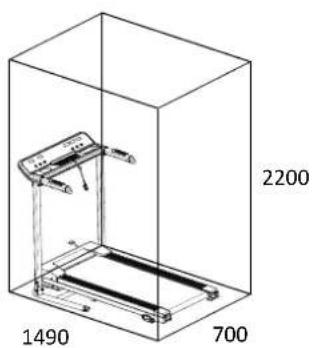
Training area in mm (for home trainer and user)
natural_image
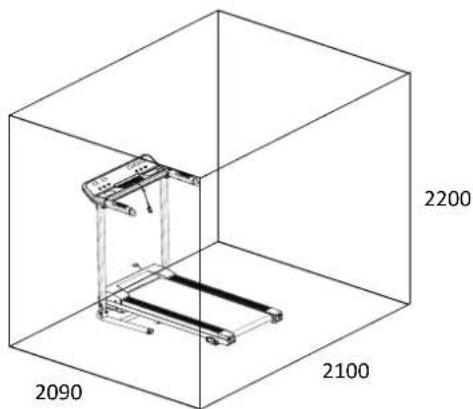
Isometric line drawing of a mechanical device inside a transparent cube, with dimension labels (2090, 2100, 2200) indicating measurements on the right side.Free area in mm (Training area and security area (circulating 600mm))
ContenuPage
PLIER ENSEMBLE
natural_image
Line drawing of a treadmill with an arrow indicating rotational motion (no text or symbols)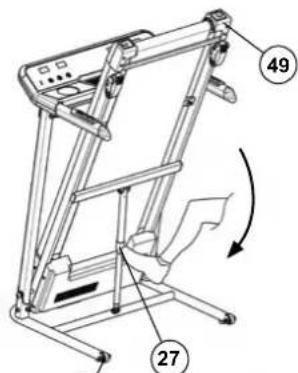
38
natural_image
Illustration showing a bottle and a hand holding a tool over a surface, with no visible text or symbols.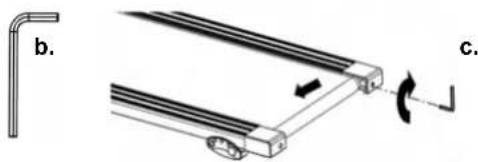
natural_image
Diagram showing a mechanical assembly with labeled parts b. and c, featuring directional arrows and a curved arrow (no text or symbols present)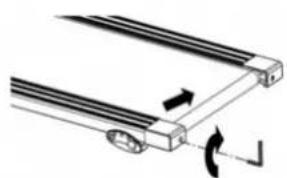
natural_image
Diagram of a mechanical linkage or lever mechanism with directional arrows indicating motion (no text or symbols)d.
natural_image
Diagram of a mechanical assembly with rotating components and directional arrows (no text or symbols)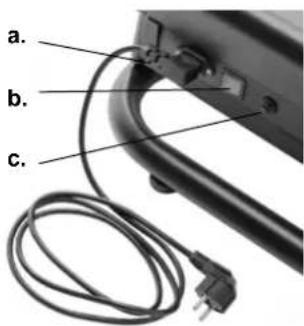
AFFICHAGES
DIFFÉRENTES DONNÉES POSSIBLES
| Affichage | Valeur d'affichage | Possibilité de contrainte | Possibilité d'affichage | |
| TEMPS(MIN:SEC) | 0:00 | 30:00 | 5:00-99:00 | 0:00-99:59 |
| KM/H | 0.0 | N/A | N/A | 1.0-8.0 |
| KM | 0.00 | 1.00 | 0.5-65.0 | 0.00-99.99 |
| PULSATION | P | N/A | N/A | 50-200 |
| CALORIES | 0 | 50 | 10-995 | 0-999 |
PROGRAMME VITESSE P01-P12
natural_image
Line drawing of a portable electronic device with control panel and labeled component (no text or symbols beyond label)LECTURE AUDIO

IOS / ANDROID APP
CONTRÔLE GESTUEL
natural_image
Isometric line drawing of a mechanical device inside a transparent cube, with dimension labels (2090, 2100, 2200) indicating measurements on the right side.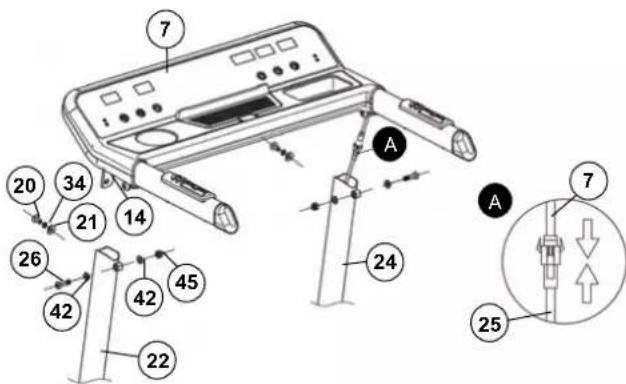
VOUW SAMEN
METHODE OM UW LOOPBAND

natural_image
Four line drawings showing a person performing a treadmill exercise, with no text or symbols present.ONDERHOUD EN AANPASSING
natural_image
Illustration showing a bottle and a hand holding a tool over a surface, with no visible text or symbols.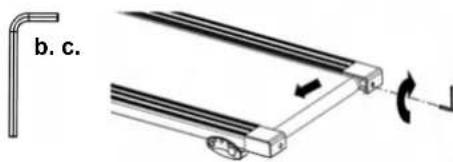
natural_image
Diagram of a mechanical assembly with labeled parts (b. c.) and directional arrows, no readable text or symbols present.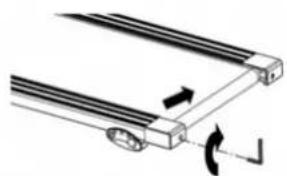
natural_image
Diagram of a mechanical linkage or lever mechanism with directional arrows indicating motion (no text or symbols)d.
natural_image
Diagram of a mechanical assembly with rotating components and directional arrows (no text or symbols)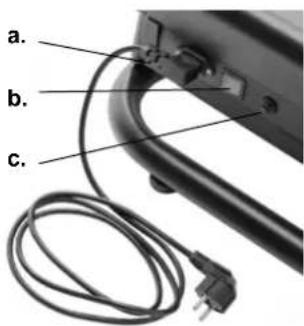
BEELDSCHERMEN
natural_image
Line drawing of a portable electronic device with labeled parts (no text or symbols)AUDIO AFSPELEN

IOS / ANDROID APP
GEBAREN CONTROLE
LINKER SENSOR [-] EN RECHTER SENSOR [+]
Competitie - Zone: Prestaties / Competitie Training
02: Training hartslagberekening
natural_image
Sequence of four sequential illustrations showing a person performing a stretching or kneeling movement (no text or symbols)natural_image
Isometric line drawing of a mechanical device inside a transparent cube, with dimension labels (2090, 2100, 2200) indicating measurements on the right side.Oefenterrein in mm
(Voor de apparaat-en gebruikers omringend 600mm)
OBSAH
ObsahStrana
SLOŽIT K SOBĚ

natural_image
Four line drawings showing a person performing a treadmill exercise, with no text or symbols present.POZNÁMKY OHLEDNĚ ÚDRŽBY A NASTAVENÍ
Péče o plošinku
natural_image
Illustration showing a bottle and a hand holding a tool over a surface, with no visible text or symbols.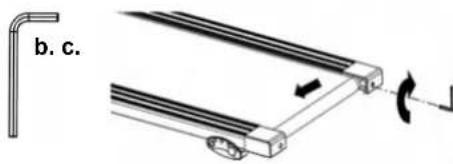
natural_image
Diagram of a mechanical assembly with labeled parts (b. c.) and directional arrows, no readable text or symbols present.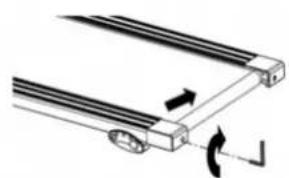
natural_image
Diagram of a mechanical linkage or lever mechanism with directional arrows indicating motion (no text or symbols)d.
natural_image
Pure mechanical assembly diagram showing two parallel plates with rotating arms and fasteners (no text or symbols)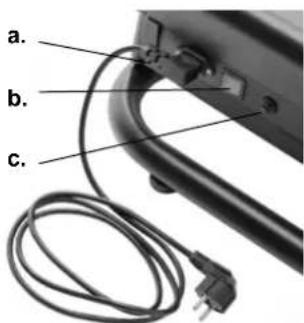
ZOBRAZOVANÉ ÚDAJE
natural_image
Line drawing of a portable electronic device with labeled parts (no text or symbols)PŘEHRÁVÁNÍ ZVUKU

IOS / ANDROID APP
OVLÁDÁNÍ GESTY

natural_image
Sequence of four sequential illustrations showing a person performing a stretching or kneeling movement (no text or symbols)natural_image
Isometric line drawing of a mechanical device inside a transparent cube, with dimension labels (2090, 2100, 2200) indicating measurements on the right side.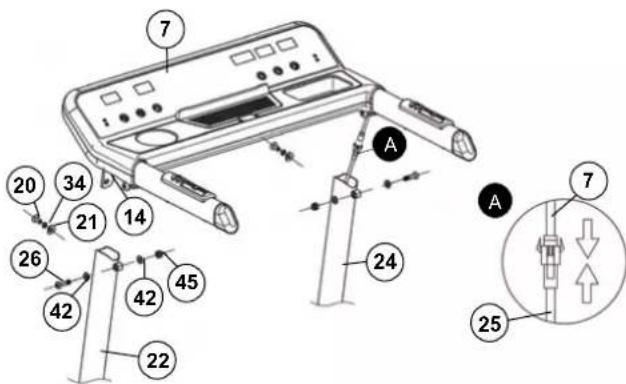
SPASOWAĆ RAZEM
natural_image
Line drawing of a treadmill with an arrow indicating rotational motion (no text or symbols)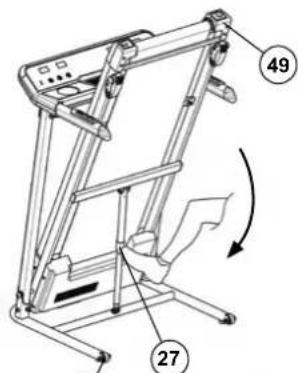
38

natural_image
Four line drawings showing different exercise poses on a treadmill, including standing, stretching, and rotation (no text or symbols)KONSERWACJA I REGULACJA
natural_image
Illustration showing a bottle and a hand holding a tool over a surface, with no visible text or symbols.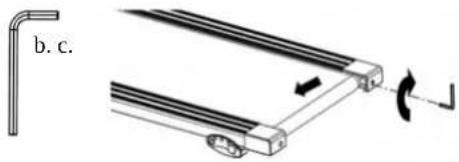
natural_image
Technical diagram showing a mechanical assembly with labeled components and directional arrows (no text or symbols)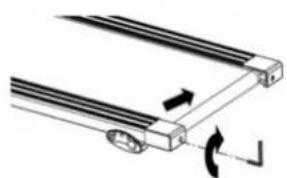
natural_image
Diagram of a mechanical linkage or lever mechanism with directional arrows indicating motion (no text or symbols)d.
natural_image
Diagram of a mechanical assembly with rotating components and directional arrows (no text or symbols)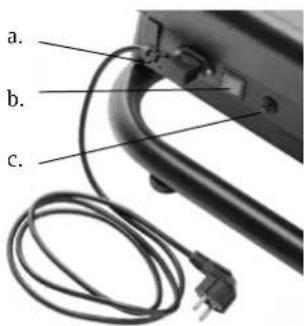
FUNKCJE WYŚWIETLACZY
natural_image
Line drawing of a portable electronic device with labeled parts (no text or symbols)ODTWARZANIE DŻWIĘKU

IOS / ANDROID APP
STEROWANIE GESTAMI
natural_image
Sequence of four sequential illustrations showing a person performing a stretching or kneeling movement (no text or symbols)natural_image
Isometric line drawing of a mechanical device inside a transparent cube, with dimension labels (2090, 2100, 2200) indicating measurements on the right side.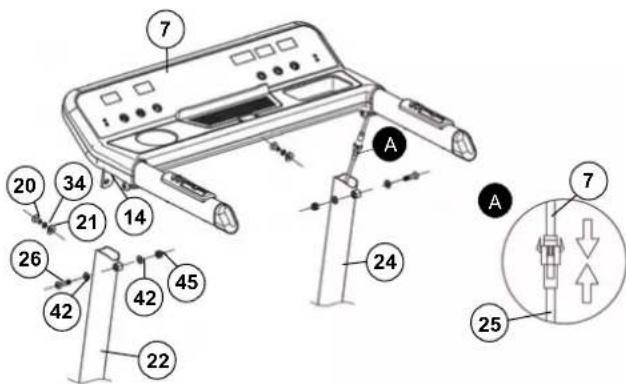
HAJTSD ÖSSZE
natural_image
Line drawing of a treadmill with an arrow indicating rotational motion (no text or symbols)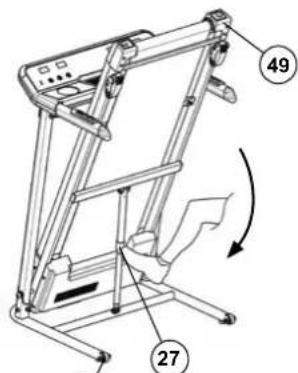
38
natural_image
Illustration showing a bottle and a hand holding a tool over a surface, with no visible text or symbols.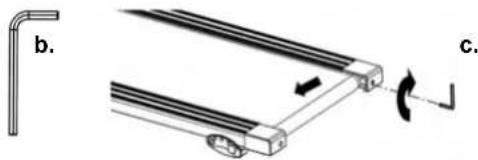
natural_image
Diagram showing a mechanical assembly with labeled parts b. and c, featuring parallel rods and a rotating arm (no text or symbols present)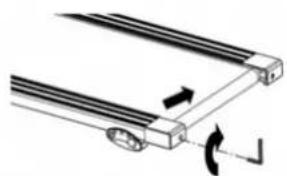
natural_image
Diagram of a mechanical linkage or lever mechanism with directional arrows indicating motion (no text or symbols)d.
natural_image
Diagram of a mechanical assembly with rotating components and directional arrows (no text or symbols)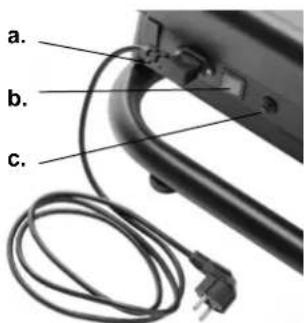
MEGJELENÍTI
natural_image
Line drawing of a small electronic device with labeled parts (no text or symbols present)HANGLEJÁTSZÁS

IOS / ANDROID APP
GESZTUSVEZÉRLÉS