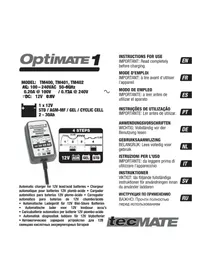
Optimate 1 - Battery charger Tecmate - Free user manual and instructions
Find the device manual for free Optimate 1 Tecmate in PDF.


| Brand | Tecmate |
| Model | Optimate 1 |
| Product type | Automatic battery charger with diagnostic function |
| Input voltage | 100-240 V AC, 50-60 Hz (global) |
| Nominal output voltage | 13.6 V (maintenance charge), up to 14.5 V (bulk charge) |
| Maximum charging current | 0.6 A |
| Compatible battery types | 12 V lead-acid batteries (2-30 Ah) - not suitable for NiCd, NiMH, Li-Ion |
| Main functions | Battery diagnosis, 3-step charging, recovery of deeply discharged batteries (from 2 V), hold test, automatic maintenance charging, energy-saving mode |
| LED indicators | LED 1 (mains power), LED 2 (charge and check), LED 3 (battery charged / maintenance) |
| Reverse polarity protection | Yes (automatic detection, no charge if reversed) |
| Overcharge protection | Absolute charge limit of 72 hours |
| Energy-saving mode | Consumption < 0.5 W in standby (no battery) |
| Typical charging time | Approximately capacity (Ah) x 1.5 hours (e.g., 48 h for 32 Ah) |
| Fuse | 15 A in the eyelet connector set |
| Included accessories | Alligator clips, eyelet terminal set with waterproof cap and fuse, power cord |
| Intended use | Indoor use only, do not expose to rain or snow |
| Safety standards | Class II appliance, protection against explosive gases |
| Safety precautions | Do not smoke near battery, avoid sparks, wear protective goggles |
| Warranty | 3 years (limited, against component and assembly defects) |
| Manufacturer | TecMate International SA, Belgium |
Frequently Asked Questions - Optimate 1 Tecmate
User questions about Optimate 1 Tecmate
0 question about this device. Answer the ones you know or ask your own.
Ask a new question about this device
Download the instructions for your Battery charger in PDF format for free! Find your manual Optimate 1 - Tecmate and take your electronic device back in hand. On this page are published all the documents necessary for the use of your device. Optimate 1 by Tecmate.
USER MANUAL Optimate 1 Tecmate
IMPORTANT: Read completely before charging
MODE D'EMPLOI
- CAUTION : CLASS II APPLIANCE. DO NOT CONNECT TO GROUND.
- For indoor use only. Do not expose charger to rain or snow.
- Use of an attachment not recommended or sold by the battery charger manufacturer may result in a risk of fire, electric shock, or injury to persons.
- To reduce risk of damage to electric plug and cord, pull by plug rather than cord when disconnecting charger.
- An extension cord should not be used unless absolutely necessary. Use of improper extension cord could result in a risk of fire and electric shock. If extension cord must be used make sure that:
a) pins on plug of extension cord are the same number, size and shape as those of plug on charger.
b) the extension cord is property wired and in good electrical condition, and
c) the conductor wire size is large enough for the AC ampere rating of the charger as specified in the table below.
| AC INPUT RATING IN AMPERES Equal to or greater than But less than | LENGTH OF CORD, FEET (m) | AWG SIZE OF CORD | |
| 2A 3A 25 (17.6) | 50 (15.2) 100 (30.5) | 18 18 14 | |
- Do not operate charger with damaged cord or plug - replace the cord or plug immediately.
- Do not operate charger if it has received a sharp blow, been dropped, or otherwise damaged in any way; take it to a qualified serviceman.
- Do not disassemble charger; take it to a qualified serviceman when service or repair is required. Incorrect reassembly may result in a risk of electric shock or fire.
- To reduce risk of electric shock, unplug the charger from outlet before attempting any maintenance or cleaning. Turning off controls will not reduce this risk.Clean only with slightly moist,not wet, cloth.Do not use solvents.
- WARNING - RISK OF EXPLOSIVE GASES.
a) WORKING IN VICINITY OF A LEAD-ACID BATTERY IS DANGEROUS. BATTERIES GENERATE EXPLOSIVE GASES DURING NORMAL BATTERY OPERATION. FOR THIS REASON, IT IS OF UTMOST IMPORTANCE THAT YOU FOLLOW THE INSTRUCTIONS EACH TIME YOU USE THE CHARGER. b) To reduce risk of battery explosion, follow these instructions and those published by the battery manufacturer and manufacturer of any equipment you intend to use in vicinity of the battery. Review cautionary marking on these products and on engine.
11. PERSONAL PRECAUTIONS.
a) Someone should be within range of your voice OR close enough to come to your aid when you work near a lead-acid battery. b) Have plenty of fresh water and soap nearby in case battery acid contacts skin, clothing or eyes.
c) Wear complete eye protection and clothing protection. Avoid touching eyes while working near battery.
d) If battery acid contacts or enters eye, flood eye with cold running water for at least 10 minutes and get medical attention immediately. If battery acid contacts skin or clothing, wash immediately with soap & water. If acid enters an eye, immediately flood eye with running cold water for at least 10 minutes & get medical attention immediately.
e) NEVER smoke or allow a spark or flame in vicinity of battery or engine.
f) Be extra cautious to reduce risk of dropping a metal tool onto battery. It might spark or short-circuit the battery or other electrical part that may cause explosion.
g) Remove personal metal items such as rings, bracelets, necklaces, and watches when working with a lead-acid battery. A lead-acid battery can produce a short-circuit current high enough to weld a ring or the like to metal, causing a severe burn.
i) NEVER charge a frozen battery.
12. PREPARED TO CHARGE
a) If necessary to remove battery from vehicle to charge, always remove grounded terminal from battery first. Make sure all accessories in the vehicle are off, so as not to cause an arc.
b) Be sure area around battery is well ventilated while battery is being charged. Gas can be forcefully blown away by using a piece of cardboard or other non-metallic material as a fan.
c) Clean battery terminals. Be careful to keep corrosion from coming in contact with eyes.
d) Add distilled water in each cell until battery acid reaches level specified by battery manufacturer. This helps purge excessive gas from cells. Do not overfill. For a battery without cell caps, such as valve regulated lead acid (VRLA) or absorbed glass mat (AGM) batteries, carefully follow manufacturer's recharging instructions.
e) Study all battery manufacturer's specific precautions such as removing or not removing cell caps while charging and recommended rates of charge.
f) Determine voltage of battery by referring to vehicle or other user's manual and BEFORE MAKING THE BATTERY CONNECTIONS, MAKE SURE THAT THE VOLTAGE OF THE BATTERY YOU ARE GOING TO CHARGE MATCHES THE OUTPUT VOLTAGE OF THE CHARGER.
- CHARGER LOCATION.
a) Locate charger as far away from battery as DC cables permit.
b) Never place charger directly above battery being charged; gases from battery will corrode and damage the charger. c) Never allow battery acid to drip on charger when reading gravity or filling battery. Do not operate charger in a closed-in area or restrict ventilation in any way.
d) Do not set a battery on top of charger. IMPORTANT : Place charger on a hard flat surface or mount onto a vertical surface. Do not place on plastic, leather or textile surface.
14. DC CONNECTION PRECAUTIONS
a) Connect and disconnect DC output clips only after setting any charger switches to off position and removing AC cord from electric outlet. Never allow clips to touch each other, however should this happen no damage will result to the charger circuit & the automatic charging programme will just reset to «start».
b) Attach clips to battery and chassis as indicated in 15(e), 15(f), and 16(b) through 16(d).
NOTE : This battery charger has an automatic safety feature that will prevent it from operating if the battery has been inversely connected. Set charger switches to off position and/or remove AC cord from electrical outlet, disconnect the battery clips, then reconnect correctly according to the instructions below.
15. FOLLOW THESE STEPS WHEN BATTERY IS INSTALLED IN VEHICLE. A SPARK NEAR A BATTERY MAY CAUSE BATTERY EXPLOSION. TO REDUCE RISK OF A SPARK NEAR BATTERY :
a) Position AC and DC cords so as to reduce risk of damage by hood, door or moving engine part.
b) Stay clear of fan -blades, belts, pulleys, and other parts that can cause injury to persons.
c) Check polarity of battery posts. POSITIVE (POS, P, +) battery post usually has larger diameter than NEGATIVE (NEG, N,-) post.
d) Determine which post of battery is grounded (connected) to the chassis. If negative post is grounded to chassis (as in most vehicles), see (e). If positive post is grounded to the chassis, see (f).
e) For negative-grounded vehicle, connect POSITIVE (RED) clip from battery charger to POSITIVE (POS, P, +) ungrounded post of battery.

Connect NEGATIVE (BLACK) clip to vehicle chassis or engine block away from battery. Do not connect clip to carburetor, fuel lines, or sheet-metal body parts. Connect to a heavy gage metal part of the frame or engine block.
f) For positive-grounded vehicle, connect NEGATIVE (BLACK) clip from battery charger to NEGATIVE (NEG. N, -) ungrounded post of battery.
Connect POSITIVE (RED) clip to vehicle chassis or engine block away from battery. Do not connect clip to carburetor, fuel lines, or sheet-metal body parts. Connect to a heavy gage metal part of the frame or engine block.
g) When disconnecting charger, turn switches to off, disconnect AC cord,remove clip from vehicle chassis,and then remove clip from battery terminal.
h) See operating instructions for length of charge information.
16. FOLLOW THESE STEPS WHEN BATTERY IS OUTSIDE VEHICLE. A SPARK NEAR THE BATTERY MAY CAUSE BATTERY EXPLOSION. TO REDUCE RISK OF A SPARK NEAR BATTERY :
a) Check polarity of battery posts. POSITIVE (POS, P, +) battery post usually has a larger diameter than NEGATIVE (NEG,N, -) post.
b) This battery charger has an automatic safety feature that will prevent it from operating if the battery has been inversely connected. The charger does not allow charge current unless a voltage of at least 4V is sensed.
c) Connect POSITIVE (RED) charger clip to POSITIVE (POS, P, +) post of battery.
d) Connect NEGATIVE (BLACK) charger clip to NEGATIVE (NEG, N, -) battery post of the battery.
e) Do not face battery when making final connection.
f) When disconnecting charger, always do so in reverse sequence of connecting procedure & break first connection while as far away from battery as practical.
g) A marine (boat) battery must be removed & charged on shore. To charge it on board requires equipment specially designed for marine use.
Optimate 1

AUTOMATIC MAINTENANCE CHARGER FOR 12V LEAD-ACID BATTERIES FROM 2Ah TO 30Ah, AS FOUND IN:
DO NOT USE FOR NiCd, NiMH, Li-Ion OR NON-RECHARGEABLE BATTERIES.
IMPORTANT: READ THE FOLLOWING INSTRUCTIONS BEFORE USING THE CHARGER
This appliance can be used by children aged from 8 years and above and persons with reduced physical, sensory or mental capabilities or lack of experience and knowledge if they have been given supervision or instruction concerning use of the appliance in a safe way and understand the hazards involved. Children shall not play with the appliance. Cleaning and user maintenance shall not be made by children without supervision.
SAFETY WARNING AND NOTES: Batteries emit EXPLOSIVE GASES - prevent flame or sparks near batteries. Charge the battery in a well ventilated area. Disconnect AC power supply before making or breaking DC/battery connections. Battery acid is highly corrosive. Wear protective clothing and eyewear and avoid contact. In case of accidental contact, wash immediately with soap and water. Check that the battery posts are not loose; if so, have the battery professionally assessed. If the battery posts are corroded, clean with a copper wire brush; if greasy or dirty clean with a rag damped in detergent. Use the charger only if the input and output leads and connectors are in good, undamaged condition. If the cable is damaged, it is essential to have it replaced without delay by the manufacturer, his authorised service agent or a qualified workshop, to avoid danger. Protect your charger from acid and acid fumes and from damp and humid conditions both during use and in storage. Damage resulting from corrosion, oxidation or internal electrical short-circuiting is not covered by warranty. Distance the charger from the battery during charging to avoid contamination by or exposure to acid or acidic vapours. If using it in the horizontal orientation, place the charger on a hard, flat surface, but NOT on plastic, textile or leather. Use the fixing holes provided in the enclosure base to attach the charger to any convenient, sound vertical surface.
EXPOSURE TO LIQUIDS: Failure of the charger due to oxidation resulting from the penetration of liquid into the electronic components, connectors or plugs, is not covered by warranty.
BATTERY CONNECTIONS: 2 interchangeable connection sets are available, supplied with the charger is a set of battery clips for charging the battery off-vehicle, the other connection set comes with metal eyelet lugs for permanent connection to the battery posts, and re-sealable weatherproof cap on the connector that connects to the charger output cable. This connection set allows easy and sure connection of the charger to maintain the battery on-vehicle. The resealable weatherproof cap is designed to protect the connector from dirt and damp whenever the charger is not attached. Consult a professional service agent for assistance in attaching the metal eyelets to the battery posts. Secure the connector with weatherproof cap so that it cannot foul any moving part of the vehicle or the cable can be pinched or damaged by sharp edges. The in-line fuse in the eyelets connection set protects the battery against such accidental shorting across positive and negative conductors. Replace any burnt fuse only with a similar new fuse of 15A rating.
CONNECTING THE CHARGER TO THE BATTERY
-
Disconnect AC power supply before making or breaking DC / battery connections.
-
If charging a battery in the vehicle with the battery clips, before making connections, first check that the battery clips can be safely and securely positioned clear from surrounding wiring, metal tubing or the chassis. Make connections in the following order:

First connect to the battery terminal not connected to the chassis (normally positive), then connect the other battery clip (normally negative) to the chassis well away from the battery and fuel line. Always disconnect in reverse sequence.
- When charging a battery out of the vehicle with the battery clips, place it in a well ventilated area. Connect the charger to the battery: RED clamp to POSITIVE (POS, P or +) terminal and BLACK clamp to NEGATIVE (NEG, N or -) terminal. Make sure the connections are firm and secure. Good contact is important.
- If the battery is deeply discharged (and possibly sulphated), remove from the vehicle and inspect the battery before connecting the charger for a recovery attempt. Visually check the battery for mechanical defects such as a bulging or cracked casing, or signs of electrolyte leakage. If the battery has filler caps and the plates within the cells can be seen from the outside, examine the battery carefully to try to determine if any cells seem different to the others (for example, with white matter between the plates, plates touching). If mechanical defects are apparent do not attempt to charge the battery, have the battery professionally assessed.
- If the battery is new, before connecting the charger read the battery manufacturer's safety and operational instructions carefully. If applicable, carefully and exactly follow acid filling instructions.
USING THE OPTIMATE 1: PROCEEDING TO CHARGE
AC SUPPLY: GLOBAL 100-240Vac 50-60Hz.
For safety reasons, the OptiMate output will only activate if a battery retaining at least 4V is connected.
VERY FLAT NEGLECTED BATTERIES: Pay particularly close attention to the following which is especially important for relatively small batteries such as those used on motorcycles, lawn tractors, jet-ski's, snowmobiles and similar: A battery left deep-discharged for an extended period may develop permanent damage in one or more cells. Such batteries may heat up excessively during high current charging.
Monitor the battery temperature during the first hour, then hourly there-after. Check for unusual signs, such as bubbling or leaking electrolyte, heightened activity in one cell compared to others, or hissing sounds. If at any time the battery is uncomfortably hot to touch or you notice any unusual signs, DISCONNECT THE CHARGER IMMEDIATELY.
ECO POWER SAVING MODE WHEN THE CHARGER IS CONNECTED TO AC SUPPLY: The power converter switches to ECO mode when the charger is not connected to a battery resulting in a very low power draw of less than 0.5W, equivalent to power consumption of 0.012 kWh per day. When a battery is connected to the charger power consumption depends on the current demand of the battery and its connected vehicle / electronic circuitry. After the battery has been charged and the charger is in long term maintenance charge mode (to keep the battery at 100% charge) the total power consumption is estimated to be 0.060 kWh or less per day.
The LED indicators referred to below, and the clauses dealing with them, are sequenced as they may come on through the course of the program.
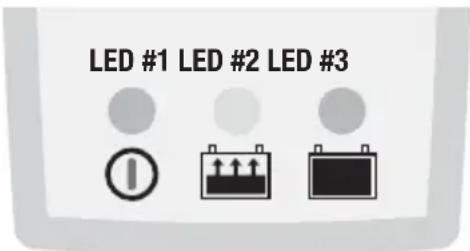
LED #1 - Power on. Confirms AC power supply to the charger.
For safety reasons, the OptiMate output will only activate if a battery retaining at least 4V is connected.
No charging following connection to a 12V battery -voltage below 4V or wrong output connections. Swap around to activate output.
LED #2 - Charge and charge verification
STEP1: PULSE LOW VOLT SAVE (from 4V): Current up to 0.6A is delivered in pulses to prepare the battery to accept normal charge. Charge time: Minimum 15 minutes, maximum 2 hours.
STEP2: CHARGE: The BULK CHARGE stage (LED #2) delivers a constant current of about 0.6 Amps maximum into the battery, up to a voltage of 14.2 -14.5V.
STEP3: VERIFICATION: For 30 minutes the program verifies the charge level. If the battery requires further charging the programme reverts to BULK CHARGE for brief periods, delivering a variable current pulse to the battery. These reversions may occur as many times as is necessary to reduce the battery's current demand below 200mA at 13.6V (which is consistent with a battery that has accepted as much charge as its basic condition allows). See expected Charging time below.
NOTE: For safety reasons there is an overall charge time limit of 72 hours.
LED# 3 - STEP4 : Voltage retention tests alternating half-hourly with battery maintenance
Voltage retention test - For a battery able to remain above 12.4V throughout the voltage retention test - NO CHARGE CURRENT - and 30 minute maintenance charge period, LED #3 remains on. If the battery voltage falls below 12.4V during the test the program reverts to step 2.
Maintenance - float charge at a safe voltage limit of 13.6V and up to 0.6A is available to counter self-discharge.
The battery can draw current as required to support small loads and counter self-discharge. Maintenance and voltage retention test periods continue alternating half-hourly until the battery is disconnected. If the battery voltage falls below 12.4V during the float charge the program reverts to step 2.
NOTE 1: If LED#2 and #3 alternates every 1-2 seconds the battery may be in a sulphated condition and unable to initially accept charge current. Monitor for 2 hours whilst the charger attempts to deliver charge to the battery. A lightly sulphated battery may recover and accept full charge current as confirmed by a steady LED#2. If the condition remains unchanged the battery may be in an advanced state of sulphation and that despite recovery attempts the battery was irrecoverable. This may be due to a defect in the battery itself, such as a short-circuited cell or total sulphation, or, in the case of a battery still connected to the vehicle's wiring system, it may be signalling a loss of current through deteriorated wiring or a degraded switch or contact, or in-circuit current-consuming accessories. A sudden load such as the headlights being switched on while the charger is connected can also cause the battery voltage to dip significantly. Always remove the battery from the vehicle, reconnect the OptiMate™ and allow it to proceed through its programme once more.
See www/optimate1.com for the appropriate OptiMate model able to recover batteries from advanced sulfation.
Maintaining a battery for extended periods: The OptiMate will maintain a battery whose basic condition is good, for months at a time. At least once every two weeks, check that the connections between the charger and battery are secure, and, in the case of batteries with filler caps on each cell, disconnect the battery from the charger, check the level of the electrolyte and if necessary, top up the cells (with distilled water, NOT acid), then reconnect. When handling batteries or in their vicinity, always take care to observe the SAFETY WARNINGS above.
Charging time: The time required for the OptiMate 1 to complete a charge on a flat but otherwise undamaged battery is roughly equal to 1.5x the battery's Ah rating, so a 32Ah battery should take no more than about 48 hours to progress to Step 3. Deep-discharged batteries may take significantly longer.

LIMITED WARRANTY
TecMate (International) SA, Sint-Truidensestenweg 252, B-3300 Tienen, Belgium, makes this limited warranty to the original purchaser at retail of this product. This limited warranty is not transferable. TecMate (International) warrants this battery charger for three years from date of purchase at retail against defective material or workmanship. If such should occur the unit will be repaired or replaced at the option of the manufacturer. It is the obligation of the purchaser to forward the unit together with proof of purchase (see NOTE), transportation or mailing costs prepaid, to the manufacturer or its authorized representative. This limited warranty is void if the product is misused, subjected to careless handling, or repaired by anyone other than the factory or its authorized representative. The manufacturer makes no warranty other than this limited warranty and expressly excludes any implied warranty including any warranty for consequential damages.
THIS IS THE ONLY EXPRESS LIMITED WARRANTY AND THE MANUFACTURER NEITHER ASSUMES NOR AUTHORIZES ANYONE TO ASSUME OR MAKE ANY OTHER OBLIGATION TOWARDS THE PRODUCT OTHER THAN THIS EXPRESS LIMITED WARRANTY. YOUR STATUTORY RIGHTS ARE NOT AFFECTED. NOTE: Details at www.tecmate.com/warranty.
WARRANTY in Canada, USA, Central America & South America:
TecMate North America, Oakville, ON, Canada, as a wholly owned subsidiary of TecMate International, assumes the responsibility for product warranty in these regions.
More information on TecMate products can be found at www.tecmate.com.
INSTRUCTIONS IMPORTANTES CONCERNANT LA SECURITE
CONSERVER CES INSTRUCTIONS. CE MANUEL CONTIENT DES INSTRUCTIONS IMPORTANTES CONCERNANT LA SECURITE ET LE FONCTIONNEMENT DU CHARGEUR OPTIMATE 1.
CHARGEUR AUTOMATIQUE POUR BATTERIES 12V PLOMB-ACIDE
NE CONVIENT PAS POUR LES BATTERIES NiCd, NiMH, Li-Ion OU NON RECHARGEABLES.
AVERTISSEMENT :
LED #1 LED #2 LED #3


FR
LED #1 LED #2 LED #3


LED #1 LED #2 LED #3


NOTITIE: Zie www.tecmate.com/warranty of contacteer warranty@tecmate.com.
LED #1 LED #2 LED #3


LED #1 LED #2 LED #3


ABTOMATUHECKOE NOIDEPXNUOUIEE 3APYHOE YCTPOICTBO IJI 12B CBNHUCOBO-KNCJIOTHbIX AKKYMUYIATOPHBIX BATAPEI OT 2AU DO 30AU, NCNOJIb3YEMbIX B:
HE NCIOJIb3yIe IJIa NiCd, NiMH, Li-Ion H HE NEPE3APJXAEMbIX BATAPEI.
BAXKHO: BHNMATEJIbHO INPOYTME CLEDAIIOUHNCPTPKMIO NEPED NCNOJb30BAHNEM 3APADHO YCTPOICTBA
JaHbI np6Op He npedHa3HaueH dna NCNoB30BaHnA liuam (BkIoUaJeTe) C OrpaHneHHbIMN
fN3WueCKHM, CEHCOPHbIMN HJN yMCTBeHHbIMN cNOcO6HOCTaMn HJN C HeoCTaTOOHbIM ONbITOM N 3HaHnA M,
ecn ToJbKO OHn HE HaxoJrTc NOd KOHTpOJIeM NJN INCtpyKTHpOBaHNEM NO BONpOCAM NCNoB30BaHnA
np6opa co cToPOhbl Iu, OTBeTCTBeHHbIX 3a ux 6e3OnaCHOCTb. DeTu DOJXHbI 6bITb NOD pncmOTpOM B uejx
KoHTpOJIa, YTObI OHn HE nPpAIc C 3apAnHbIM yCTPOINCTBOM.
YKA3AHN IN PEPDYNPEXKDEHNA NO TEXHMKE 6E3ONACHOCTN: Batape NblJeHOT B3pbBOOnachBra3bl I npedotbpaTne BOHNHOBENHNOIINN HcKpblOBnHbOaTepen. OTKIOHTe OT cETNIpeMeHHORo TOKA, npexde Yem NOkIOHTb NIN ONKIOHTb 3apdHoe yctpoictBO OT batape. AKKymIATOPHAR KNCLOTA CINbHO paoBaTe aiooua. HaeBaIte 3aunTHyO odexdy ouKn IN npedotbpaauite KOtAKT C KncIoTOB. B clyae cnyaHoro KOtAKTA, IpomOIte BOOc MblOM. IpobepbTe, YTObIb 6atapeHbIE BBIOBHe He bILIN WATAUIMC; eCN OHI TAKOBbl, 6tpaer Tpe6yET npofeccoHaJIbHO dnaHocTNK. Ecn BlBObl 6atapeN Koppo3npoBAHb NOuCTNE UeTKO C MeHNO pnoBOLOKO; eCN JxHPbIE NII rprHbIE ONUCTNE TKAHbIO C MOUUM CpeCTBOM. NcNoIb3yTE 3apdHoe yctpoCTBO TOhko, eCN BixOHDHE IN BXODHe Ka6eM, HenoBPExDeHHOM COCTOHIN. Ecn BxOHDHO Ka6eJIb NOpeXeH, KpaHe BaxHO er0 3ameHITb 6e3 3aMeJNeHRA h 3ABOE u3ROTOBITE, y ercePBCIHORo AREHTA NII B KBANmipoBAHOH MaTePCCKO, dI npedotbpaueHNA OnaCHOIn. ORpaNTe CBOE 3apdHoe yctpoICTBO OT KNCLOToB, IN napOB KNCLOToB, OT cbIOCTN IN BLAAHO CpeDl BO BPEM XpaHENr n 3cknpyatauIN. NobPexDeHNA, B13BaHbHle Koppo3neM, OKCNLEHEM MNN BHYPTEHMM KOPOTKIm 3AmkaHEm HE NOKpBlAOTcR rapaHTne. PaCNOJoxNTE 3apdHoe yctpoictBO DaNlONOT bATAPEN BO BPEM 3apdA da I npedotbpaueHNA Bo3eJCTBNA KNCLOTBI INN KNCLOTH NapOB. PnN cNoJIb3OBAHm IN Ropn3oHTaNBOM nNOXeHN, paCNOJoxNTE 3apdHoe yctpoICTBO HA TBepDo nPiocKoN IOBpXHOCTN, HO HE NaKb, IIaactNK INN KCOy. B npOTNBOM cNYae, nCNOJb3yIte oHKcypUoiue OTBepCTN B OCHOBAHm 3apdHOrO yctpoiCTBA dIg 3akpenJIeHry UdoBHOM BEptkALbHM ONIOXeHN.
B03DECTBNE KIOKCTE: OTKa3 3apraHoro yctpoiCTBa 3a cHT OKnCHeH N pe3yIbTaTe BO3MOxHOrO IPOHKnHOBeHn JIKKOCTN BHyTpb 3neKTPoHHbIX KOMNoHETOB IN pa3beMOB, He NOKpbBaIOc rapaHTne.
NOKIOYHEK BATAPEE: 2 CMEHbIX KOMNKeTA NOKIOUeHIN, NOCTABnEMbIX C 3apdHbIM yCTPOIcTBOM, npedctabJIOT CO6oHabop 3aKIMOB dIg 3apraBnBHe TpaHcnpTHORO cpeDCTBA u KOJIbeBO pa3bem NOCTOHNHO NOKIOUeHIN K batapee C3aKpbBaIOUcMCR KOIIauchOM, 3aIIuIauUIM OT aTMocOePbIX BO3deICTBNI, KOtOpB I NOKIOUaeTc K BbIXOHOMy Ka6JIIO 3aprHOrO yCTPOIcTBa. 3OTn Hbop nO3BOJAEIT JERKO u YbepeHNO NOKIOUaTb 3aprHOe yCTPOIcTBO dIg NODEpXAHIN 6bATApEN YCTAOHJIeHNBM BVTC. 3aKpbBaIOUcNcpa3bEM c KpblIKo NpeHa3HauEN dIg 3auNTbI pa3bema OT rpr3N u cbipocTN, KOrda 3aprHOe yCTPOIcTBO He NCNOBJyETcN. IpokOnCytbTIpyntecB c PnoPeCCNOHAhBIM cepBnCHbIM aREHTOM B CnOCObE KpenneHnMaTTNNueckNX KOJIbeBx pa3bEmOB K batapee. 3aKpeNTe pa3bEM c KOIIaChOM, tak UTO6 OH He MOR 3arp3HHTBCR OT IIO60 DBHXUYeCEcAuctn TpaHCNPTHORO cpeDCTBA, a Ka6JIb He MOr 6b1b 3axat Wn NOBpeKJEn OCTpbIM KpaAMN. PpeOxApaHInTeIN B Haboep NpeHa3HaueHBI DnI 3auNTbI batapeN OT clyauHOrO KOPOTKOrO
3aMbIKAHnHa nnoJXtEnbHbIX n OtpuataTeNbHbIX npoBODnKax. 3aMeHITe cropeBwI npedoxpaHHTeB ToIbKO aHaIOrnHbIM HOBBIM npedoxpaHHTenEM 15A.
IIOKJIIOUeyHHe 3APJADHOrO YCTPOINCTBA K BATAPEE
- OTKIIOHTb OT cETn NepemEHOro TOKa, npexJe Yem NODKJIIOHaT b mNt OKJIIOHaT 3aprAnHoe yCTpoNTBO OT 6aTaPeN.
- Ecnn 3apn npocxodnt Ha aTOMoNBc nmoOyIO 3aKMOB, nepe nnKJIOueHEm, npOBepTe, Yo 3aKmbl MOrTy 6bItb 6e3onacno H naEcknoho pacnooxneHb CBO60HO OT OKpykaooN X npBOOB, MeTANLNececknx Tpy6 NnIaaccn. BInONHnTe noKKnIOueHHe B cJeYIOUem nopAke: chayana noKNIouHTe K 6taPae noIOXnTEhBk Pachn 3axm, a 3aTeM OTPnauTeNbHb YepHb 3aKmHa paMy IIN DBIRATEb BdaII ONTOINBHOININ. BcerDa oTKIOuaTe B o6paTHo nocneobateHBoctn.
- Pn 3apJe 6bapee BHe ABTOMOBnC NOMOUB 3axmMOB, NOMECTIe ee B Xopo0Ip npOBETPBAEMOM NOMEUHIM. IOnKIOHTe 3apJHOy yctpoCTBO K 6bapee: KpaChbI 3axmK NOLOXHTeNBOMy (POS, P nII +), a cepHbI 3axmK OTpuaTeNBOMy (NEG, N nII -) BbIBOy. Y6eNTecb, YTO COeINHeHnRAJIOTcHnAedXhBMn 6e3ONaChbIMN. XopoWNI KOHTAKT BAXHE.
- Ecn 6aTapee cnIbHO pa3pXeHa (n, Bo3MOxHc, cyIbpaTHPOBaHa), CHrB c ATOMObII IN PNOBepntb 6aTapeo nepe nOdkNIOueHem 3apnHO yCTPOCTBA IINONbITKN BOCCTAHOBENHE.Bi3yALbHO npOBepTe COCTOHNHE AKKymJYTOPHO 6aTapeH HAnuHmexAHuecknx DeEeKToB, TAKHX KAK BbIyKnbl mnn TpeCHyBmK KopynC, mnn pni3Hak yTeekn 3neKTPOInTa. Ecn AKKymJYTop HMeET 3JIINBHbIe KpbIshK INPiactINbI BJeHkax, KOtOpBe MOXHO YBnDteB Co CTOPHO, OCTOPOXHO N3yUHTe6aTapeo, INonblTaeCB ONpeDeNTb, eCTb IINrHuK, OTNIuaHOuNEcR O TpyrNX (HApIMep, C 6enBIM BeLecTBOM MEXdy nlaCTNHAMnIN, KacaOHUMncn RnactNHAM). Ecn IMeOTcMexAHueckne DeEeKtB, He NItaTecb 3apnHbT 6aTapeo, Tpe6yETc npOeCCNOHaJIbHa oEhKa coCTOHN H6aTapeH.
- Ecnbatape HOBa, nepei noKIOHHeM 3apJHO yCTPOcTBA npOHTne INHCTpyKIO NO kCNyATAuIN N 6eONACOCTN npOn3BODITeJIbBaTapei. EcnI 3TO pImeHMO, TuaTeNbHO IN TOHNO CNEdyNE INHCTpyKIO NO IN 3aONHEHKO KNCLOToI.
ИСПОЛБ3OBAHNE OPTIMATE 1: HACHAJIO 3APЯДA
3JEKTPONITAHNE INPEMEHHO TOKA YHMBEPCAJIbHOE NOKNIQUEHNE K CETN, 100-240 B INPEMEHHORO TOKA, 50-60 T. N O CO6paXeHnM Be3oNaChocTH BixOg yCTpoIcTBA OptiMate aKTHBnpyetcToIbKO B TOM cIyae, eCIN K Hemy NOKNIQUeHa AKKymyTAOPHAR 6aTape C HanpIXeHem He Hxke 4 B.
CNbHO PA3PRAEHHBIE AKKMYJATOPBI, KOTOPBIE OBCJYXHBAJNCB HEADJIXAUMM 05PA3OM Heo6xOIMMO opaTnB oc6oe BHMAMHe Na cnyuouie oocenho (To oocenHo B aKHO B npByo oupeDb Ira He6oBbux AKKMyJATOpbix 6aTaepi, KOtOpbe HcNOb3yOTCB MTOUKNax, MNHTpAKTopax-ra30HOKCunkax, rnpoucknax, cherooxoad N B aHaONrHuonTexnke). B akymyTAOPbix 6atapeax, haoDauXcxB COCTOHm rny60koRa p3prda dntelhoe BPEM, MOrT Bo3NHKYb Heo6paTImbIe NobpeKdEHN Ondoro nn HeCKOBKnx 3neMeHOB. TaKe 6atapein npz 3apRke 6oBbIM TOKOM Moryr Ype3meHOr HarpeBaTcB. B TeueHHe nepBOrO yaca 3ap4nnk CNeTyet nocTOnHNO KOHTpOINPOBaT btempeAtpy aKKMyJATOpa, 3aTe m npOBepTB ee kaxdbI qac. Heo6xOIMTO takKe npOBepTa, Het n Heo6bHbIX npoBHeH, TaNX KaK BbIeNEHe ny3bpe ra3a nn yteKn 3neKTPOInTa, nobBuHHeA AKTNBOCTB OODHom 3neMeHTe No cpabHeHIO c DpyHMMn WnneHme. Ecn AkKMyJATOPHAB 6aTaepaer cnWkoM Tropaay Ha ouynb nn 6hApkyehb Dpyine Heo6bHbIe np3NaK, HEMEDIIEHHO OTKIOHTE 3APJHO UCTPOCTBO.
3KOHOMbI PEXMM ECO NPOIKJIOUeHHN 3APADHORO YCTPOINCTBA K 3NEKTPUECKON CETH INPEMEHHOROTOKA INBepTOp nepeKIOuetaerB pexmm ECO,ecn3apdnoe yctpoiCTBO He npkIOUeHO K AKKymyIaTOpHO Batapee,yTO obceueBaet Hm3kyo nTope6nemyMOuHcTB (Mehee0,5BT), 3KBINBAENTHYIO nTope6bneHHNO 3NEKTPo3HePrrn 0,012 KBt-4B cyTKn.Korda K 3apdHOMy UcToPOCTBY NOKIOUeHA AKKymyIaTOpHAR 6bTaPAER,notpe6bneHne 3NEKTPo3HePrrn 3ABUCNT OT Tekyuero 3NEPronOTpe6bneHHA AKKymyIaTOpHO 6bataen I NOKIOUeHHO K He6bOPTOBcETn TpaHCnOPIrTO cpcTeBAs /3NEKTPoHHbIX UcToPCTB. Tocne 3ABEPeHHra 3ApdKn AKKymyIaTOpHO 6bataen IMepexoDA 3apdHoro yCTPOINCTBA B pexmm OIOTOBpeMHORO coXpAHENHa 3apraa (Tu6bI AKKymyIaTOpHAR 6batae BCE Bpema 6bln nonHOCTbIO 3apxjena) oObee notpe6bneHne 3NEKTPo3HePrrn IO ouenKaM coCTabIeN PtupnImntelhO 0,060 KBt-4 (Inn Meee) BC TYKN.

Hnke npBHebeHb CnHnblcCBeTOpNoHbIX HnDnKaTOPOB Hx paCUnΦpOBKa B TOM nopAKe, B KOTOPOM OHN MOryT NOBnTbcB B xOe pa6oTbI nporpaMMbl.
LED #1 LED #2 LED #3


CBeToNDIO1:3NeKtponHTaHHe BKnOueHo.NoTbEpXdHHe NOctynIeHnHa npJxHnCeTn NepemEnHO ToKa Ha 3apJdHoe yCTpoiCTBO. IIO CoobpaXeHnM 6e30NaChOCTn BixOyCTPOcTBA OptiMate AKTNBpyETc TOnbKO B TOM Clyue,ecn K HEmy NoDknloyeHa AKKymyTATopHnA 6aTape n CnapJxHnEM He HmKe 4 B.B Cnyae NpDKNIOeHn yCTPOcTBA K AKKymyTAtopHO 6aTaape c HomHaJIbHbIM HnpJxHnEM 12 B,pa3PaxEHnO Do yPoBHnHex Do 4 B,HIn npHnPaBnBHom NODcoEHNHeHH NOLOCOB 6aTape He NaHET 3apJxKATbc.ДЯ AKTHBaunn BbxOda 3apJdHoro yCTPOcTBA Heo6XoIMNo pabINbHO NODKnIOuHTb NOLoca 6aTape.
CbeToDnO2:3apKa npOBepKa 3apKn
War 1 - nybcnpyooee Hn3koe BocctaHbnaooue HanpJxehne (OT 4B): Pynbcnpyouin TOK do 0.6A noIgrotabInBaet 6atapeK K HopMaIbHOMy npHHIO 3apJa. 3T0 pexmM oO6eHHo 3fkeKTbHEn DJI RBOcCTaHOBHeN A kTNBPoAHbH na 3aBoJe/ "BblcOKo pnON3BOUHTeHOCTH" YHCTORO CBNHua INIINuINHdpuecknx yueek AGM 6aTapei. Bpemz 3apJa: MmHMym 15 MmHyT, MaKcHMym 2 caca.
3a 14,2-14,5 B.
War 3 - PPOBEPKA CXeMa HauHnHaet npOBepky yOoBHe 3apJa 6aTape. Ecm 6aTape Tpe6yEt dIaNbHeuWe 3apJKn, IpOgPAMMa Ha KOpOTKne NepnoDbI BpeMeHN BO3BpaAaetcKa K peKmmy O5bEMHO 03APJa, NoDaBaHa 6aTapeIO MMNylbc NMehNoEco3 ToKa. TaKe NOBtOpHbE BKlHouEnM OMy TOCUeCTBnTBcra CToJIbKO pa3, CKoJIbKO Heo6xOIMMo Iyua YIOBJeTBopeHry TeKUeIe NOTpe6Hocn 6aTape B Toke MeHbue 200 MA pIn HanpJKeHm 13,6 B (TuO coOTBeCTByET 6aTapee, KOtopa IpnHna StolbKO 3apJa, cKoJIbKO No3BOJnEr ee OCHOBHe COCTOHNHe). CM. pa3dien «BpeMn 3apJKn» HnHexe.
PIMMEYAHNE. IIO coo6paXeHnM 6e3oNaCHocTH uCTaHOBHeN 06Ii PpeDeN BpeMeHn 3apAKn, paBHy 72 Yacam.
CbeTOnIO3:Iar4TeTnPoBaHnHa coXpaHHe 3apJa,YepeDyUeNecK KxkbIe IOnHaca* C nepHOaMn coXpaHHe 3apJa 6atapen
Iy 6aTape, cnoc6no yepkahtb HnpaKeHne Bblue 12,4B TeueHne TcnpoBaHna Ho cxpaHne 3apda (E33APJHO TOKA) 30-MnHyTOr npnoa coxpaHHe 3apda, CBeToIOo 3 ocTaTcBAKIOUeHHbIM. Ecn HnpaKeHne 6aTape nadaet Hnke 12,4B TeueHne TcnpoBaHna, nporpMaBo3BpaAaTeCk 8uary 2.
06cnykubahne -no3apn6e0anachbHm HapxgeHem OrpaHueHHbIM 13.6B nO do 0.6A doctynho nI npoTbpaueHnna Camopa3pda. baTaper moKet noTppeNt bTOK nHe60bnixn Harpy3OK n pepoTbpaatb camopa3pia. O6cnykubahme n Tect ydepkaHnna HapxgeHn CMeHnOT dpyr dpya KaJbte noUaca do MOMHTa otcoedHnna 6batae. Ecnn HapxgeHne 6batae nndaet Hnke 12.4B BO Bpema no3apra da nporpamMa BO3bpaaaetca K wary 2.
PIMMEAHNE. Ecn CBtoOnMoB 2 N 3 BkIOaHOTc N BbKIOaHOTc KaXdbie 1-2 cekynb, tO moKet CBNTeJIbCTBOBaT bO cyIb foTHPOBAHOM COCTOH M 6Taapeu H eecnoocHO CTn HAauJIbHO NOyUHTb 3apJHbIK To HO6xOIMo B TeueHne 2 aocB CleNTb 3a npoueCCOM nepeaun 3apJa 6Taapee ot 3apJHOYCTPBtBa. BaTape r CbeONbIsh CyIbFaTaueM MoKET BOCCTAHOBITcN I pINHb T OINHb 3apJHbIK TO yTO 6yET NoITBepKDaTbcr HeNpepbIBHbIM CBeueHMem CBtoOnMOda 2. Ecn CoToTHeNHE OctaeTcH Neu3MeHNbIM, tO MOKeT CBNTeJIbCTBOBaT bO TOM, tO 6Taape R 3auHTeJIbHO CyIb foTHPOBAHa, n, HecmOpTn Ha NpOItKN BOCCTAHOBHeHn, HeBOCCTAHOBUMA. tO MOKeT 6bTB BBy3BaHO DeEeKTOM B CaMO AKKymIaTOPHO Batape, HanPMEm KopoTKM 3AmkaHmem
3nemeta nno nnoho cyb foatau me, noo oocnohe Toe, yto 6aater Bce eue noKIOUeHa K 3neKTPOcTe TpaHCNpTHO CpeCTBa. 3TO MOxET CnHnHn3npOaBt o notepax Toka B NOBpeXeHNHO npOBoKe, O HeNCpABHOCTn nepeKIOUaTeI IIN KOHTAKTA IIN O HAnu nnno kIOJIIOUeHHbIX UCTPOiCTB, NOTpe6JHOxix ToK. BHe3aHNOe noKIOUeHne Harpy3Kn, HanpIMep BKIOUeHne nepeDHX fap, B MOMENT, KOrda 3apAHOe YCTPOICTBO noKIOUeHo, Moxet TaKKe Bb3BaTb CyueCTBeHoe ChIXeHne HApJXeHn AKKymIaTOHPO 6TaapeIO I3 TpaHCNpTHoro CpeCTBA, CHOba noKIOUoATbe ee K OptiMateTM 3anyckatb nporpammy eue pa3.
Co0TBeCTBvUOyMoDEnbOptiMate,CnOC6HyIO BocCTaHaBnBaTbakKymIaTOPbHe 6bAtpen C cepbe3HO cybpaTaueHm,MooJHo HauTn Ha Be6-caTe www.optimate1. com.
Iopndepkka ypOBHa 3apAepn B TeueHne dntteBnBx npHnoOB BpeMeHH UcpoCTBO OptiMate cncocbo HnpepbIBHO pOeJbTaBbYpOBHe 3apJa aKKyMnTOpHb6BaTapeu, haxoJeCBA X opoWe mcoToHH, B TeueHne HeckolbKnx MecaeB. HeoXoDmIO npOBepaTB HaekHoCTb CoeUHeHm MExdy 3apAdbim YcTpoCTBOM N BaTapee HepeKe, cHcKaDbIe DBe HeDen, a B Cnyae IpImeHHeA KkyMnTOpB C KpbIiKaMM 3aINBOOHOrO OTBepCTRA HA KaKdOM 3JeMeHTe CNeDyET OCoEHNHTb 6BaTapeoOT 3apArdHO yctPoCTBa, npOBeptBu ypOBHe 3JIeKTPOJNTa I npHEo6XoDMOCm TdoNtBu XnKOCTB B 3JeMeHtB (InCTNIIMPobAHHyIO BDO, HE KNCIoTy), 3aTe CMoBnOgCoEHNHTb K 3apArdHomy yctPoCTBy. Pnp paBoTe c AkKyMnTOpAMnn Bo3ne HxBCERda CneDyET yuHTbBAbTH HCHTPKYLIMI PO
TEXHWE 6301ACHOCTN, npBedeHHbIe BbIwe. Bpem 3apKn Bpem, tpe6yUeecE OptiMate 1 nla 3apKn pa3prKeHHo HcnpBaH oakymyTropHO 6aTapeu, np6bnntenbHO paBHO 1,5 x eMKoctb 6aTapeu B aMnep-uaCax. HanpImep, nla 6aTapeu EMKOCTBO 32 A- uotpe6yETc H e 6oNEe 48 cacob, uTO6bl nepeHTu K shary 3. Dna 3apKn Tpy6kO pa3prKeHHbIX 6aTapeu MoKet noHaIOb6bc HAHORO 60JIbwe BpemeHN.
ORPAHNUEHHA JAPAHTNIA
TecMate (International) SA, Ambachtenlaan 6, B-3300 Tienen, Bebnr, npedocabnet er opaehnhyo rapaHTIO nepBOHauhOMy po3HCHOMy noknyateIO 3TOI npdykTA. DaHHa ORpaHueHHa rapaTNI He noDleKNT nepeDAe DpyROMy IuCy. TecMate(International) rapaHTIpyET KaeeCTBO I3ROTOBHe IaHHoro 3apdHoro yctpoCTBa B TeeyHe TPEX JET C MOMENTA NOKyKN B PO3HNHO CETN B OTHOeHM DEEKTOB MATEPNA HIN I3ROTOBHe. B CNYae BO3NKHOBeHHa DeEeKTA yctpoCTBO 6yET OTPMOTPOBAHO INI 3aMeHEO NO yCMOTpeHIO npOHIOTeJI. NOKyATeJI DoJIXe HApabITb YcTPOCTBO BMECTe C DOKAteJIbCTBOM NOKYKN, NepeBO3KN, a TAxke ONIIATNB NOYTOBbie paXOdbI B aDEC pON3BOUInTeJI INI ERO yNOHMOeHHORo npedCTaBtTEJI.
Haetora rapaHTn HeeCTBntbHa, eCNI npOyKT HnPaBnIbHO 3KcNpyAtnPOBaIcn, noDBepraIcHneOToXHOMy o6paueHIO nIpeMOHTnpOBaIC B MeCTax, OTINHbIX O3ABODa INrTOBtEJI NII erO yNOIHOMOeHHORo pndTabTeJI. POn3BDmTeJI He daeT Hkaknx rapaHTn, Kpome 3ToI ORpaHnueHHo rapaHTmN I ONpeDeneHNO IcklOaET IIObIe NOpa3ymBaemble rapaHTmN, BKIOUaIIObIe rapaHTmN 3a KOCBeHHbIe y6bITKn.
3TA OPGAHUHHEHHAR TAPAHNTI IPOIN3BOIDNTEJI H IE PNIHMAET HA CEEB IN HE YNOLIHOMAUYBAET HNKOTO PPNHIMATb JIOBBIE DpyTNE O6R3ATEJbCTBA IIO OTHOHEHIO K TOBAPOBAM, KPOME 3TOI OPGAHUHENI TAPAHNTI.
ПРIMEЧАНЕ: Побрбности Ha www.tecmate.com / warranty ИИ CBЖКТECь no warranty@tecmate.com
IpeBoc anrnnckoro: OoceTBO cOpaHneHHo OTBeTCTBeHHocTBIO «E3Tepn CepBNC
Bce npaba 3aunuiehbl
www.batteryservice.ru
Optimate accessories

Discover our full range of accessories at optimize1.com
Battery Performance Guaranteed!
- PERSONAL PRECAUTIONS
- PREPARED TO CHARGE
- DC CONNECTION PRECAUTIONS
- FOLLOW THESE STEPS WHEN BATTERY IS INSTALLED IN VEHICLE. A SPARK NEAR A BATTERY MAY CAUSE BATTERY EXPLOSION. TO REDUCE RISK OF A SPARK NEAR BATTERY
- FOLLOW THESE STEPS WHEN BATTERY IS OUTSIDE VEHICLE. A SPARK NEAR THE BATTERY MAY CAUSE BATTERY EXPLOSION. TO REDUCE RISK OF A SPARK NEAR BATTERY
- OPTIMATE 1
- IMPORTANT: READ THE FOLLOWING INSTRUCTIONS BEFORE USING THE CHARGER
- CONNECTING THE CHARGER TO THE BATTERY
- FIRST CONNECT TO THE BATTERY TERMINAL NOT CONNECTED TO THE CHASSIS (NORMALLY POSITIVE), THEN CONNECT THE OTHER BATTERY CLIP (NORMALLY NEGATIVE) TO THE CHASSIS WELL AWAY FROM THE BATTERY AND FUEL LINE. ALWAYS DISCONNECT IN REVERSE SEQUENCE
- USING THE OPTIMATE 1: PROCEEDING TO CHARGE
- LED #2 - CHARGE AND CHARGE VERIFICATION
- LED# 3 - STEP4 : VOLTAGE RETENTION TESTS ALTERNATING HALF-HOURLY WITH BATTERY MAINTENANCE
- LIMITED WARRANTY
- INSTRUCTIONS IMPORTANTES CONCERNANT LA SECURITE
- CHARGEUR AUTOMATIQUE POUR BATTERIES 12V PLOMB-ACIDE
- AVERTISSEMENT
- LED #1 LED #2 LED #3
- ABTOMATUHECKOE NOIDEPXNUOUIEE 3APYHOE YCTPOICTBO IJI 12B CBNHUCOBO-KNCJIOTHBIX AKKYMUYIATOPHBIX BATAPEI OT 2AU DO 30AU, NCNOJIB3YEMBIX B
- BAXKHO: BHNMATEJIBHO INPOYTME CLEDAIIOUHNCPTPKMIO NEPED NCNOJB30BAHNEM 3APADHO YCTPOICTBA
- IIOKJIIOUEYHHE 3APJADHORO YCTPOINCTBA K BATAPEE
- ИСПОЛБ3OBAHNE OPTIMATE 1: HACHAJIO 3APЯДA
- ORPAHNUEHHA JAPAHTNIA
- OPTIMATE ACCESSORIES
Brand : Tecmate
Model : Optimate 1
Category : Battery charger