IAN 383842 - Weather Station AURIOL - Free user manual and instructions
Find the device manual for free IAN 383842 AURIOL in PDF.



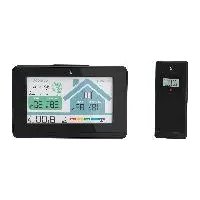
| Product type | Radio-controlled weather station with ventilation indicator |
| Brand | Auriol |
| Model | IAN 383842 |
| Main unit dimensions | Approximately 15.0 x 9.5 x 2.3 cm |
| Main unit weight (without batteries) | Approximately 160 g |
| Main unit power supply | 2 alkaline 1.5 V AAA R03/LR03 batteries |
| Outdoor sensor dimensions | Approximately 4.2 x 10.2 x 2.6 cm |
| Outdoor sensor weight (without batteries) | Approximately 42 g |
| Outdoor sensor power supply | 2 alkaline 1.5 V AAA R03/LR03 batteries |
| Indoor temperature range | -10 °C to 50 °C |
| Outdoor temperature range | -40 °C to 60 °C |
| Humidity range | 20% to 95% |
| Transmission frequency | 433 MHz |
| Maximum range | 50 m (without obstacles) |
| Outdoor sensor protection rating | IPX4 (splash-proof) |
| Main functions | Radio-controlled time display (DCF77), alarm, snooze, indoor/outdoor temperature/humidity, ventilation recommendation, climate assessment, mold alarm, min/max values, backlight |
| Maintenance and cleaning | Clean with a soft, dry, lint-free cloth; do not immerse |
| Safety | Keep out of reach of children; do not expose to excessive moisture; do not short-circuit batteries |
| Spare parts and repairability | Additional outdoor sensors available via after-sales service |
| General information | 3-year warranty, CE marking, recyclable via TRIMAN |
Frequently Asked Questions - IAN 383842 AURIOL
User questions about IAN 383842 AURIOL
0 question about this device. Answer the ones you know or ask your own.
Ask a new question about this device
Download the instructions for your Weather Station in PDF format for free! Find your manual IAN 383842 - AURIOL and take your electronic device back in hand. On this page are published all the documents necessary for the use of your device. IAN 383842 by AURIOL.
USER MANUAL IAN 383842 AURIOL
GB IE Usage and safety
instructions
Table of contents
Table of contents ...... - 1 -
Introduction - 4 -
Approved use - 4 -
Scope of delivery 5 -
Technical specifications ....- 6 -
Device - 6 -
Wireless outdoor sensor - 6 -
Explanation of symbols ......-7 -
Important safety instructions Important safety instructions. - 10 -
Safety instructions for users - 10 -
Safety information for the batteries - 11 -
Hanging or positioning the device securely - 15 -
Hanging or setting up the outdoor sensor securely ..... - 16 -
Display and controls - 18 -
Device - 18 .
Wireless outdoor sensor - 21 -
-1-
GB IE NI CY MT
Starting up the device - 22 -
Quick set-up - 24 -
Basic settings - 25 -
Adjusting the time zone - 25 -
Radio signal reception - 26 -
Radio reception interference - 26 -
Switching radio signal reception off and on - 27 -
Restarting radio reception - 28 -
Light - 29 -
12/24-hour time format - 29 -
Temperature - 29 -
Alarm - 30 -
Setting the alarm - 30 -
Activating or deactivating the alarm - 30 -
Snooze function (SNOOZE) - 31 -
Wireless outdoor sensor/channel setting - 31 -
Ventilation rating - 34 -
Indoor climate assessment - 34 -
Recommended ventilation - 35 -
Mould alert - 36 -
Setting the mould alert - 36 -
-2-
GB IE NI CY MT
Activating and deactivating the mould alert.... - 36 -
Maximum and minimum values ...... - 37 -
Battery level indicator - 38 -
Restart (RESET) - 38 -
Cleaning instructions....- 39 -
Storage - 39 -
Simplified EU Declaration of Conformity - 39 -
Disposal - 40 -
Disposing of the electrical device.... - 41 -
Disposal of batteries - 43 -
Recycling - 47 -
Waste management - 48 -
digi-tech gmbh warranty - 48 -
Warranty terms - 48 -
Warranty period and statutory claims for defects ..... - 49 -
Scope of Warranty - 49
Processing in the event of a warranty claim ...... - 50 -
Order service - 52 -
Service - 52 -
Supplier - 54 -

RADIO-CONTROLLED WEATHER STATION & VENTILATION MONITOR
Introduction

Congratulations on purchasing your new radio-controlled weather station & ventilation monitor (from now on referred to simply as the "device"). You have chosen a high-quality device. The operating instructions are part of this device. They contain important information pertaining to the safety, use and disposal of the device. Please familiarise yourself with all the operating and safety instructions before using this device. Use the device only as described and for the purposes indicated. All documents must be provided when giving the device to third parties. Please keep the packaging and operating instructions for future queries.
Approved use
This device is suitable for displaying the time and for using the additional functions described. Any other use or modification of the device is considered to be improper use. The manufacturer
-4-

is not liable for damage caused by improper use or incorrect operation. The device is not intended for commercial use.
Scope of delivery
Note: Please check the package after purchase. Make sure that all parts are included and that none are defective. Do not use the device if the delivery is incomplete and/or parts are damaged. Contact the service department (see "Procedure in the event of a warranty claim").
• 1 x wireless weather station
• 2 x alkaline batteries 1.5 V AAA LR03
• 1 x wireless outdoor sensor
• 2 x alkaline batteries 1.5 V AAA LR03
- 2 x rawlplugs
- 2 x screws
• 1 x operating instructions

Technical specifications
Device
• Measuring range/temperature: -10 °C – 50 °C
- Temperature display/tolerance:
+/- 1 °C (0 °C - 50 °C); +/- 1.5 °C (-10 °C - 0 °C)
• Measuring range/humidity: 20% – 95%
• Humidity indicator/tolerance: +/- 5 %
• Dimensions: approx. 15.0 x 9.5 x 2.3 cm
• Weight: approx. 160 g (excl. battery)
- Batteries: 2 x 1.5 V AAA R03/LR03 (UM-4)
Wireless outdoor sensor
• Measuring range/temperature: -40 °C - 60 °C
- Temperature display/tolerance:
+/- 1 °C (0 °C - 50 °C); +/- 2 °C (-40 °C - 0 °C, 50 °C - 60 °C)
• Measuring range/humidity: 20% – 95%
• Humidity indicator/tolerance: +/- 5 %
- Range: max. 50 m
• Transmission frequency: 433 MHz
-6-
GB IE NI CY MT
• Transmission power: 0.024 W
- Protection rating provided by the housing (outdoor sensor): IPX4 (splash water protection in accordance with IEC 60529 standard)
• Dimensions: approx. 4.2 x 10.2 x 2.6 cm
• Weight: approx. 42 g (excl. battery)
- Batteries: 2 × 1.5 V AAA R03/LR03 (UM-4)
- symbol for DC voltage
Explanation of symbols
 WARNING! WARNING! | This warning signal/word indicates a hazard with a medium level of risk which, if not avoided, could result in death or serious injury. |
| Note: | This signal word indicates additional information. |
 | Improper use of disposable/rechargeable batteries may cause an explosion and/or leakage of battery fluid. |
-7-

 | Alkaline batteries included |
 | |
 | Batteries: 4 x 1.5 V AAA R03/LR03 (UM-4) |
 | |
 | Symbol for DC voltage |
 | Operating instructions |
 | Please read the operating instructionsl |
 | By using the CE symbol, digi-tech gmbh declares conformity with the applicable EU directives. |

 | Indoor/outdoor temperature |
 | Time |
 | Humidity |
 | Sensor range: max. 50 mTransmission frequency: 433 MHzTransmission power: 0.024 W |
 | |
 | Protection rating provided by the housing(outdoor sensor): IPX4 (splash waterprotection in accordance with IEC 60529 standard) |
 | |
 | DCF77 radio time |
-9-
GB IE NI CY MT
 | Radio waves/radio symbol |
 | Alarm |
Important safety instructions
Safety instructions for users

WARNING!
RISK OF INJURY!
This device can be used by persons (including children aged 8 and over) with reduced physical, sensory and mental abilities, as well as by persons with a lack of experience and knowledge, if they have been given supervision
-10-

or instruction concerning use of the device with respect to safety and if they understand the hazards involved. Children must not play with the device. Cleaning and user maintenance must not be carried out by children unless they are supervised.
Keep the packaging film out of reach of children.
There is a risk of suffocation.
Safety information for the batteries

WARNING!
HEALTH HAZARD!
RISK OF EXPLOSION!
Keep new and old disposable/rechargeable batteries out of reach of small children. If a
- 11 -


disposable/rechargeable battery is swallowed, seek medical attention immediately.
If you think batteries may have been swallowed or have got into any part of the body, seek medical attention immediately.
The disposable/rechargeable batteries must always be inserted with the correct polarity.
Clean the battery and device contacts beforehand if necessary. Do not attempt to recharge, short-circuit, or open the batteries.
Never heat the disposable/rechargeable batteries to recharge them. Do not expose the disposable/rechargeable batteries to excessive heat such as sunshine, fire or the like. There is an increased risk of leakage! Never throw

disposable/rechargeable batteries onto a fire, as they may explode.
Improper use of disposable/
rechargeable batteries may cause an explosion and/or leakage of battery fluid.
If the disposable/rechargeable batteries do leak, avoid contact with skin, eyes and mucous membranes. Use protective gloves. In the event of contact with battery fluid, rinse the affected areas with plenty of clean water straight away and seek immediate medical attention. Remove exhausted disposable/rechargeable batteries from the device immediately as there is an increased risk of leakage.


Note:
- Non-rechargeable batteries must not be charged!
- Different battery types or new and used batteries must not be used together!
- The battery and device contacts must not be short-circuited!
- Empty disposable/rechargeable batteries must be removed from the device and safely disposed of (see "Disposal of batteries")!
- If the device is stored unused for a prolonged period of time, the disposable/rechargeable batteries should be removed.

Hanging or positioning the device securely
The device is not designed to be used in rooms with a high humidity level (e.g., bathrooms).
You can use the rawlplug and screw supplied for wall mounting. Before fixing it to the wall, make sure that there are no gas, water or electricity lines at the drilling location. Note the condition of the wall. The enclosed fittings are not suitable for all types of wall.
The manufacturer accepts no liability for damage caused by incorrect mounting.
- Fold out the stand (20) to set up the device securely.
- Protect easily-damaged surfaces before setting up to avoid scratches.
Make sure that: - adequate ventilation is always guaranteed (do not place the device on shelves or places where curtains or furniture cover the ventilation slots (28) and leave at least 10 cm of space on all sides);

- the device is not placed on a thick carpet or bed during operation, and that no direct sources of heat (e.g. radiators) can affect the device;
• the device is not exposed to direct sunlight; - contact with splashing or dripping water is avoided;
- the appliance does not hang or stand in the immediate vicinity of magnetic fields (e.g., loudspeakers);
- no foreign bodies or dust can enter the device;
- candles and other open flames are kept away from the device at all times to prevent the spread of fire.
Hanging or setting up the outdoor sensor securely
Place the outdoor sensor so that it is protected from the direct effects of the weather, e.g., under a porch or carport. The outdoor sensor has protection rating IPX4 and is therefore protected against splashing water. You can use the rawlplug and screw supplied for wall mounting. Before fixing it to the wall, make sure that there are no gas, water or electricity lines at the drilling location. Note the

condition of the wall. The enclosed fittings are not suitable for all types of wall.
The manufacturer accepts no liability for damage caused by incorrect mounting.
Protect easily-damaged surfaces before setting up to avoid scratches. Make sure that:
• the outdoor sensor is standing or hanging upright;
- adequate ventilation is always guaranteed (leave at least 10 cm space on all sides);
• the outdoor sensor is not exposed to direct sunlight;
- the outdoor sensor is not hanging or standing in the immediate vicinity of magnetic fields (e.g., loudspeakers);
- no foreign bodies or dust can enter the device;
- easily-damaged surfaces are protected before setting up.

Display and controls
Device
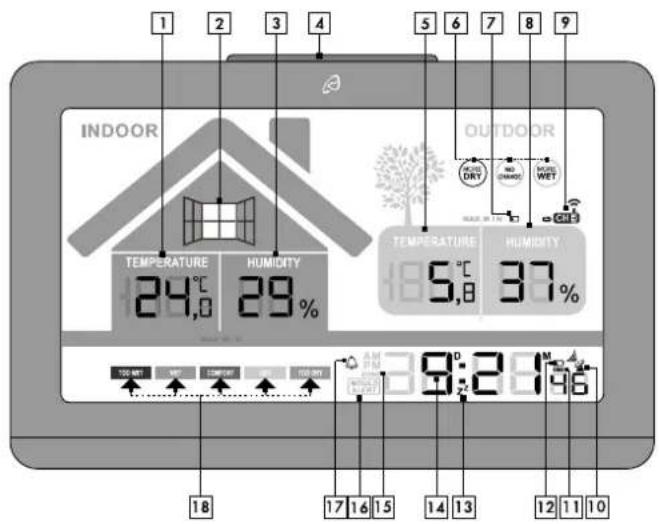
-18-
GB IE NI CY MT
| 1 | Indoor temperature | 2 | Recommended ventilation |
| 3 | Indoor humidity | 4 | SNOOZE/LIGHT button |
| 5 | Outdoor temperature | 6 | Ventilation rating |
| 7 | Battery level indicator Wireless outdoor sensor | 8 | Outdoor humidity |
| 9 | Channel for wireless outdoor sensor | 10 | Radio symbol, radio waves, radio tower |
| 11 | DST (daylight saving time) | 12 | Battery level indicator device |
| 13 | Snooze symbol | 14 | Time |
| 15 | Time zone | 16 | Mould alert symbol |
| 17 | Alarm symbol | 18 | Indoor climate assessment |

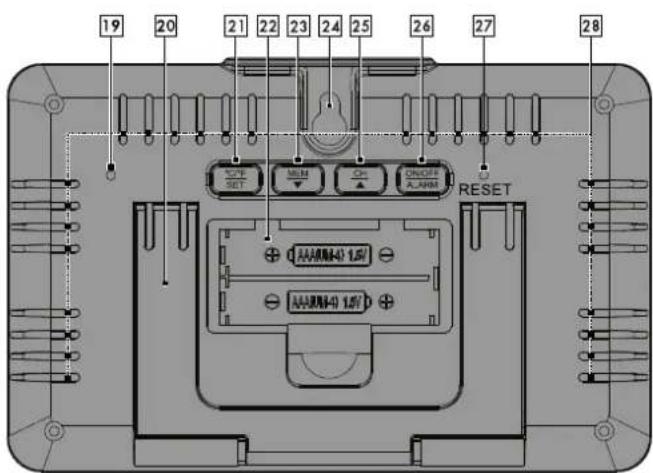
| 19 | Loudspeaker, buzzer | 20 | Fold-out stand |
| 21 | °C/°F/SET button | 22 | Battery compartment |
| 23 | MEM-/▼button, down | 24 | Hanging device |

| 25 | CH-/▲button, up | 26 | ON/OFF/ALARM button |
| 27 | RESET button | 28 | Ventilation slots |
Wireless outdoor sensor
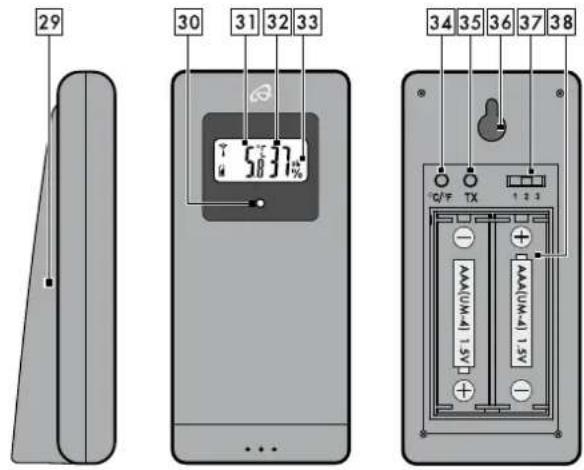

| 29 | Stand | 30 | Control LED |
| 31 | Temperature | 32 | Humidity |
| 33 | Set channel | 34 | °C/°F button |
| 35 | TX button | 36 | Hanging device |
| 37 | Channel selector | 38 | Battery compartment |
Starting up the device
Note:
First insert the batteries into the battery compartment of the outdoor sensor (38) and only then into the battery compartment of the device (22).
- Remove the protective film from the device's display.
- Open the battery compartment of the wireless outdoor sensor (38).
- Insert two 1.5 V AAA R03/LR03 (UM-4) batteries, ensuring the correct polarity.
The control LED (30) will light up temporarily, the temperature (31) and the humidity (32) will be displayed.
-22-

- Close the battery compartment (38).
- Open the battery compartment of the device (22).
- Insert two 1.5 V AAA R03/LR03 (UM-4) batteries, ensuring the correct polarity.
The display will light up for 5 seconds, a beep will sound, and the device will check the indoor temperature and humidity.
- Close the battery compartment (22).
The device then receives the temperature and humidity from the wireless outdoor sensor, and the radio waves of the wireless outdoor sensor channel (9) will flash in the display. This process takes up to 3 minutes. If reception of the radio signal from the wireless outdoor sensor is unsuccessful, the device will abort the process.
The device will then start receiving the DCF77 radio signal, and the radio symbol (10) will flash in the display. This process can take 3-10 minutes. During reception of the DCF77 radio signal, all buttons except the SNOOZE/LIGHT button (4) will not function. If, after 10

minutes, the reception of the DCF77 radio signal remains unsuccessful, the radio symbol (10) will disappear.
- Set the time manually (see "Basic settings"). The device will make a new attempt to receive the DCF77 radio signal at 4 a.m. and 5 a.m. and will correct the time automatically after it has successfully received the DCF77 radio signal.
Note: Please do not move the device or the wireless outdoor sensor while the DCF77 radio signal is being received.
Upon successful reception of the DCF77 radio signal, the radio symbol (10) will appear permanently and the correct time (14) is automatically set. DST (11) will appear in the display during daylight saving time.

Quick set-up
When setting numeric values, you can use the quick setting by pressing and holding the MEM-/▼ button (23) and the CH-/▲ button (25).

Basic settings
The following settings are possible: hours, minutes, time zone and 12/24-hour time format.
- In the normal time display, press and hold the °C/°F/SET button (21) for 3 seconds, and the hours will flash.
- Use the MEM-/▼ button (23) or the CH-/▲ button (25) to set the seconds.
- Press the °C/°F/SET button (21) to confirm your entry.
- Set the minutes, time zone 00- (-) and 12/24-hour time format in the same way.
Adjusting the time zone
If you are in a country where the current time differs in spite of the DCF77 radio signal, use the time zone adjustment to use your device in a time zone other than the standard setting (UTC
+ 1 = Central European Time). Set the difference in hours (e.g., -01) to the desired time zone.
- In the normal time display, press and hold the °C/°F/SET button (21) once and then press and release twice. The

time zone will flash and can be set with the MEM-/▼ button (23) or the CH-/▲button (25).
- Press the °C/°F/SET button (21) to confirm the input. The 12/24-hour time format will flash.
- Press the button again and you will be back to the normal setting. The device will display the changed time (14) (e.g., 1 hour less).
Radio signal reception
Radio reception interference
The DCF77 radio signal is sent from near Frankfurt am Main. It can be received within a radius of up to approx. 2000 km from Frankfurt am Main. However, there are a number of sources of interference that can significantly hinder reception of the DCF77 radio signal. If your device does not receive the DCF77 radio signal correctly, move it or hang it up in a different location. Note that there may be electromagnetic radiation in the vicinity of computers, telephones, radios and TVs which can interfere with the reception of the DCF77 radio signal. Problems with radio signal reception can also be caused by strong

building insulation (metal components), high mountains or atmospheric interference. Replace the batteries if necessary.
Switching radio signal reception off and on
You can temporarily turn off the reception of the DCF77 radio signal.

- In the normal time display, press and hold the MEM-/▼ button (23) twice for 3 seconds. The radio symbol (10) will disappear. The device will no longer receive a DCF77 radio signal but will start a new attempt to receive the DCF77 radio signal every hour between 1 a.m. and 5 a.m.
- Or press and hold the MEM-/▼ button (23) again for 3 seconds, which will start the reception of the DCF77 radio signal directly.
You can permanently turn off the reception of the DCF77 radio signal.
- In the normal time display, press and hold the MEM-/▼ button (23) and the CH-/▲ button (25) at the same time for 3 seconds.

The radio tower (10) will disappear. The device will no longer receive a DCF77 radio signal.
- In the normal time display, press and hold the MEM-/▼ button (23) and the CH-/▲ button (25) at the same time for 3 seconds. The radio waves (10) will also disappear. The device is able to receive the DCF77 radio signal again.
- The device will make a new attempt to receive the DCF77 radio signal every hour between 1 a.m. and 5 a.m. and will correct the time (14) automatically after it has successfully received the DCF77 radio signal. Upon successful reception of the DCF77 radio signal, the radio symbol (10) will appear permanently in the display.
Restarting radio reception
You can restart the reception of the DCF77 radio signal.
- In the normal time display, press and hold the MEM-/▼ button (23) twice for 3 seconds.
The radio symbol (10) will flash in the display. The device will then start receiving the DCF77 radio signal. This process can take 3-10 minutes.

Light
Press the SNOOZE/LIGHT button (4) to temporarily activate the display lighting.
12/24-hour time format
- In the normal time display, press and hold the °C/°F/SET button (21) once and then press and release three times. The 12 or 24-hour time format will flash and can be set with the MEM-/▼ button (23) or the CH-/▲ button (25). In the 12-hour time format, AM will appear in front of the time (14) in the morning and PM in the afternoon in the display.
Temperature
- In the normal time display, press the °C/°F/SET button (21) to display the temperature in degrees Celsius (°C) or degrees Fahrenheit (°F).

Alarm

Setting the alarm
- In the normal time display, press and release the ON/OFF/ALARM button (26) once to enter alarm mode. OFF and AL will appear in the display.
- Press and hold the ON/OFF/ALARM button (26). The hours will flash and can be set by pressing the MEM-/▼ button (23) or the CH-/▲button (25).
- Press the ON/OFF/ALARM button (26) to confirm your entry. The minutes will flash and can be set in the same way.
- Press the ON/OFF/ALARM button (26) to confirm your entry and return to the normal time display.
Activating or deactivating the alarm
- In the normal time display, press and release the ON/OFF/ALARM button (26) once to enter alarm mode. OFF and AL will appear in the display.

- Press the MEM-/▼ button (23) or the CH-/▲ button (25). The set alarm time (6 a.m.) and the alarm symbol (417) will appear in the display. The alarm is activated.
- Press the MEM-/▼ button (23) or the CH-/▲ button (25) again. OFF will appear in the display and the alarm symbol ⏱ (17) will disappear. The alarm is deactivated.
- Press and release the ON/OFF/ALARM button (26) twice and return to the normal time display.
Snooze function (SNOOZE)
- When the alarm sounds, press the SNOOZE/LIGHT button (4) to temporarily deactivate the alarm. The snooze symbol Z^2 (13) will flash in the display. The alarm will sound again after 5 minutes.
- Press any button except the SNOOZE/LIGHT button (4) to switch off the alarm.
Wireless outdoor sensor/channel setting
You can use up to three wireless outdoor sensors at the same time with your device.

Note: First insert the batteries into the battery compartment of the wireless outdoor sensor (38) and only then into the battery compartment of the device (22).
- Open the battery compartment of the wireless outdoor sensor (38) and set the desired channel (1-3) on the channel selector switch (37).
- Press and hold the CH-/▲ button (25) on the device for approx. 3 seconds until the radio waves of the wireless outdoor sensor channel (9) flash. The device will receive the signal from the wireless outdoor sensor.
- You can press the TX button (35) to manually transfer the measured temperature and humidity directly from the wireless outdoor sensor to the device.
- You can use the °C/°F button (32) to choose between °C Celsius and °F Fahrenheit.
- Close the battery compartment (38).

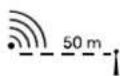
Note: The wireless outdoor sensor must be located within a maximum radius of 50 m to the device, without obstruction.
If more than one outdoor sensor is used:
- In the device's normal time display, press and release the CH-/▲button (25) several times to switch between the wireless outdoor sensors. The rotation symbol to the left of the wireless outdoor sensor channel (9) indicates in the display that the system is automatically switching between the various wireless outdoor sensors.
- Only wireless outdoor sensors that are accessed are displayed.
- Press and hold the CH-/▲ button (25), the device will receive the temperature and humidity from the wireless outdoor sensors and the radio waves of the wireless outdoor sensor channel (9) will flash.
- If you add another wireless outdoor sensor, the device will automatically detect it, or you can manually transmit the signal directly by pressing the TX button (35) on the wireless outdoor sensor.

Ventilation rating
Based on the indoor and outdoor temperature and humidity values, the device will provide an assessment of how the humidity values in the interior will change when there is ventilation.


Humidity increases by 5% or more

Humidity remains the same

Humidity decreases by 5% or more
Indoor climate assessment
The comfort indicator (18) depends on the humidity and temperature in the interior. However, the "Comfort" status is only displayed if both the humidity and the temperature in the interior are within the comfort range (45% – 65% and 20 °C – 25 °C).
-34-


| TOO WET | WET COMFORT DRY | TOO DRY | ||
| too wet wet comfort dry too dry | ||||
| 85% - 95% | 66% - 84% | 45% - 65% | 31% - 44% | 20% - 30% |
Recommended ventilation
The device calculates the expected change in the indoor climate from the measurement data recorded indoors and outdoors and recommends whether or not ventilation is necessary.
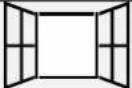 |  |  |
| Open the window | Window remains as it is | Close the window |
| Change indoor climate | Leave indoor climate | Change indoor climate |

Mould alert

Setting the mould alert
- In the normal time display, press and release the ON/OFF/ALARM button (26) twice to enter mould alert mode. OFF will appear.
- Press and hold the ON/OFF/ALARM button (26). The preset mould alert value will flash showing 65 % humidity.
- Press the MEM-/▼ button (23) or the CH-/▲ button (25), to change the value in 5 % increments.
- Press the ON/OFF/ALARM button (26) to confirm your entry and return to the normal time display.
Activating and deactivating the mould alert
- In the normal time display, press and release the ON/OFF/ALARM button (26) twice to enter mould alert mode. OFF will appear.
- Press the MEM-/▼ button (23) or the CH-/▲ button (25). The set humidity value and the mould alert symbol (16)

will appear in the display.
The mould alert is activated.
- Press the MEM-/▼ button (23) or the CH-/▲ button (25) again. OFF will appear in the display. The mould alert symbol (16) will disappear. The mould alert is deactivated.
- Press the ON/OFF/ALARM button (26) and return to the normal time display.
Maximum and minimum values
The maximum and minimum temperature and humidity values are saved from the moment the batteries are inserted.
- In the normal time display, press and release the MEM-/▼ button (23) once to display the maximum values MAX. of indoor temperature (1), outdoor temperature (5), indoor humidity (3) and outdoor humidity (8).
- Press and release the MEM-/▼ button (23) once more to display the minimum values MIN of indoor temperature (1), outdoor temperature (5), indoor humidity (3) and outdoor humidity (8).

You can delete the maximum and minimum temperature and humidity values.
- In the normal time display, press and release the MEM-/▼ button (23) and then hold it down to delete the maximum and minimum values. The maximum and minimum values are deleted and re-recorded from that moment on.
Battery level indicator
If the batteries are too low to keep the device, the wireless outdoor sensor and the data transmission in operation, the battery level indicator (7) or (12) will appear in the display.
- Replace the batteries in all devices as soon as possible.
- Restart the device.
Restart (RESET)
- Press the RESET button (27), using a narrow tool if necessary, to reset the device and restart reception of the DCF77 radio signal. All data and settings will be deleted.

Cleaning instructions
Incorrect cleaning can damage the device. Do not immerse the device in water or other liquids. Do not use aggressive cleaning agents, brushes with metal or nylon bristles or sharp or metallic cleaning objects such as knives, hard spatulas etc. These can damage the surface. Clean the device with a soft, dry, lint-free cloth, such as is used for cleaning eyeglass lenses.
Storage
If the device is not used for a fairly long period of time, remove the batteries and store the device, cleaned and protected from sunlight, in a cool, dry place, ideally in the original packaging.
Simplified EU Declaration of Conformity
The digi-tech gmbh hereby declares that the Radio-controlled weather station & ventilation monitor 4-LD6012 complies with the RED 2014/53/EU directive, Article 10 (8).
You can download your operating instructions and the declaration of conformity here:

www.digi-tech-gmbh.com/downloads
Then click on the magnifying glass and enter the article number 383842_2110.
Disposal
The product and packaging materials are recyclable; dispose of them separately for better waste treatment. For options for disposing of the used product, please contact your town council or city administration.
Pay attention to the labelling on the packaging materials when separating waste; these are marked with abbreviations (a) and numbers (b) that mean the following:
1-7: plastics
20-22: paper and cardboard
80-98: composites.


Disposing of the electrical device
The symbol with the crossed-out waste bin signifies that electrical and electronic equipment must not be disposed of with household waste. Consumers are legally obliged to collect electrical and electronic equipment separately from unsorted municipal waste at the end of their service life. In this way, an environmentally friendly and resource-saving usage is ensured.
Disposable and rechargeable batteries that are not firmly enclosed by the electrical or electronic device and that can be removed in a non-destructive way must be separated from the device before it is handed over to a collection point and disposed of as intended. The same applies to light sources that can be removed from the device in a non-destructive way.
Owners of electrical and electronic equipment from private households can hand them in at the collection points of the public waste disposal authorities or at the collection points set up by the manufacturers or distributors within the jurisdiction of the ElektroG (Electrical and Electronic
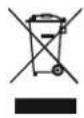

Equipment Act). The surrender of old devices is free of charge.
Please dispose of the device by returning it to your local branch of LIDL.
Dealers with a sales area of at least 400 m ^2 for electrical and electronic equipment are obliged to take them back. The same applies to food retailers with a total sales area of at least 800 m ^2 , provided that they offer electrical and electronic equipment continuously or at least several times a year. Distance sellers with a storage area of at least 400 m ^2 for electrical and electronic equipment or a total storage area of at least 800 m ^2 are also obligated. In general, distributors are obliged to ensure that old devices can be returned free of charge by means of suitable return options at a reasonable distance.
Consumers have the option of handing over an old device free of charge to a distributor who is obliged to take it back if the consumer purchases an equivalent new device with essentially the same function. This possibility also exists for deliveries to a private household. In distance selling, the option of free pick-up when purchasing a new device is

limited to heat exchangers, computer monitors and large devices that have at least one outer edge with a length of more than 50 cm. When concluding the purchase contract, the distributor must ask the consumer about how they intend to return the device. Apart from that, consumers can hand in up to three old devices of one type at a distributor's collection point free of charge, without this being tied to the purchase of a new device. However, the edge lengths of the respective devices must not exceed 25 cm.
Consumers are encouraged to take measures to avoid waste. With regard to electrical and electronic devices, this means extending their lifespan by repairing defective devices and selling used devices that are in good working order instead of disposing of them.
Remove the battery before disposal of the device in a non-destructive way and dispose of it separately (see "Disposal of batteries").
Disposal of batteries
The accompanying symbol indicates that batteries and rechargeable batteries must not be disposed of


with normal household waste. Defective or used batteries/rechargeable batteries must be recycled in accordance with Directive 2006/66/EC and its amendments. Consumers are legally obliged to dispose of all batteries and rechargeable batteries, regardless of whether they contain harmful substances such as:
Cd = cadmium, Hg = mercury, Pb = lead, Li = lithium or not, at a collection point in their municipality/district or at a retail outlet, for environmentally friendly disposal and for the recovery of valuable raw materials such as cobalt, nickel or copper.
The return of batteries and rechargeable batteries is free of charge.


WARNING!
Environmental damage due to incorrect disposal of batteries/rechargeable batteries!
Some of the possible materials such as mercury, cadmium and lead are poisonous and, if not disposed of properly, endanger the environment. Heavy metals, for example, can have harmful effects on the health of humans, animals and plants and accumulate in the environment and in the food chain, and then enter the body indirectly via food.


WARNING!
Risk of explosion!
With used batteries containing lithium (Li = lithium) there is a high risk of fire. Therefore, special attention must be paid to the proper disposal of used batteries and rechargeable batteries containing lithium. Incorrect disposal can also lead to internal and external short circuits due to thermal effects (heat) or mechanical damage. A short circuit can lead to a fire or an explosion and have serious consequences for humans and the environment.

For this reason, tape off the poles of lithium-based batteries and rechargeable batteries prior to disposal in order to avoid an external short circuit.
Batteries and rechargeable batteries that are not permanently installed in the device must be removed and disposed of separately before disposal of the device.
Please only return batteries and rechargeable batteries in a discharged state!
Use rechargeable batteries instead of disposable batteries whenever possible.
Recycling
Product packaging consists of recyclable materials. Dispose of them in an environmentally friendly way using the collection systems available.


Waste management
Dispose of packaging in an environmentally friendly way.
Note the labelling on the various packaging materials and dispose of them separately if necessary.

digi-tech gmbh warranty
This device has a 3 year warranty from the date of purchase. In the event of defects in this device, you have legal rights against the seller of the product. These statutory rights are not influenced by our guarantee as set out below.
Warranty terms
The warranty period begins on the date of purchase. Please keep the receipt. This document is required as proof of purchase. If a material or manufacturing defect occurs within three years of the date of purchase of this device, the device will be repaired or replaced – at our discretion – by us free of charge. This warranty requires that the defective device and the purchase receipt are presented within the three-year period along with a brief written description of

the nature of the defect and when it occurred. If the defect is covered by our warranty, we will send you either the repaired device or a new one. There is no new warranty period starting with the repair or replacement of the product.
Warranty period and statutory claims for defects
The warranty does not extend the warranty period. This also applies to replaced and repaired parts. Any damage or defects already present at the time of purchase must be reported immediately after unpacking. After the warranty has expired, any repairs are subject to a charge.
Scope of Warranty
The device was carefully manufactured according to strict quality guidelines and carefully checked before delivery. The warranty applies to material or manufacturing defects. This warranty does not cover parts of the product that are subject to normal wear and tear and can therefore be regarded as wear parts or damage to fragile parts, e.g. switches, batteries or parts made of glass. This warranty is void if the device is damaged, improperly used or

improperly maintained. For proper use of the device, all instructions given in the manual must be strictly observed. Uses and actions that are advised against or warned against in the operating instructions must be avoided at all costs.
The device is designed exclusively for private and not for commercial use. The warranty expires in the event of abusive or improper handling, the use of force or repairs that were not carried out by our authorised service branch.
Processing in the event of a warranty claim
To ensure that your request is processed quickly, please follow the instructions below:
- Please have the receipt and item number (383842_2110) ready as proof of purchase for all enquiries.
- The item number can be found on the nameplate, an engraving, the title page of your instructions (bottom left) or the sticker on the back or the underside.
- If functional errors or other defects occur, first contact the following service department by phone or email.


You can download these instructions and many other manuals, product videos and software from www.lidl-service.com.
This QR code takes you directly to the Lidl service page (www.lidl-service.com) and you can open your operating instructions by entering the item number (383842_2110).
GB IE NI CY MT
Order service
Additional radio outside sensors can be ordered by fax +49(0)6198-5770-99 or online at www.inter-quartz.de. The price for one sensor is 5,00 € excluding VAT and despatch.
Service
Inter-Quartz GmbH
Valterweg 27A
65817 Eppstein
GERMANY
Email: support@inter-quartz.de
Phone: +49 (0)6198 571825

AT BE DE ES FI FR GB IE IT NI
NL PT SE
00800 5515 6616
BG
00800 1114916

8800 33139
CH
0800 563862
8000
5884
-52-
GB IE
NI
CY
MT
CY 8009 4403 800 62851
CZ 800 142 315
PL 00800 44 11 493
DK 800 5515 6616
RO 0800 896640
EE 80000 49116
0800 191026
GR 00800 44140855
SI 0800 80847
HR 0800 222943
0800 004449
HU 0680 981220
IAN 383842_2110
Art.-Nr.: 4-LD6012

Year of manufacture: 2022
-53-
GB IE NI CY MT

Supplier
Please note that the following address is not a service address. Please first contact the service address (see above).
digi-tech gmbh
Valterweg 27A
65817 Eppstein
GERMANY

-54-

www.digi-tech-gmbh.com/downloads
| TOO WET | WET COMFORT | DRY TOO DRY | ||
| trop humide | humide comfort sec trop sec | |||
| 85% - 95% | 66% - 84% | 45% - 65% | 31% - 44% | 20% - 30% |
-147-

DRAADLOOS WEERSTATION MET VENTILATIEADVIES
Inleiding
www.digi-tech-gmbh.com/downloads
www.digi-tech-gmbh.com/downloads
www.digi-tech-gmbh.com/downloads
www.digi-tech-gmbh.com/downloads
Ventilationsvurdering
www.digi-tech-gmbh.com/downloads
-598-

| 19 | Zvočnik, brenčalo | 20 | Zložljivo stojalo |
| 21 | Tipka °C/°F | 22 | Predal za baterije |
| 23 | MEM /▼Tipka, dol | 24 | Priprava za obešanje |
-635-
SI
| 25 | CH-/▲ipka, gor | 26 | Tipka za VKLOP/IZKLOP/ALARM |
| 27 | Tipka RESET (ponastavi) | 28 | Prezračevalne reže |
www.digi-tech-gmbh.com/downloads


- GB IE Usage and safety
- instructions
- Table of contents
- RADIO-CONTROLLED WEATHER STATION & VENTILATION MONITOR
- Introduction
- Approved use
- Scope of delivery
- Technical specifications
- Device
- Wireless outdoor sensor
- Important safety instructions
- WARNING!
- RISK OF INJURY!
- HEALTH HAZARD!
- RISK OF EXPLOSION!
- Note:
- Hanging or positioning the device securely
- Hanging or setting up the outdoor sensor securely
- Starting up the device
- Quick set-up
- Basic settings
- Adjusting the time zone
- Radio signal reception
- Radio reception interference
- Switching radio signal reception off and on
- Restarting radio reception
- Light
- 12/24-hour time format
- Temperature
- Alarm
- Setting the alarm
- Activating or deactivating the alarm
- Snooze function (SNOOZE)
- Wireless outdoor sensor/channel setting
- Ventilation rating
- Indoor climate assessment
- Recommended ventilation
- Mould alert
- Setting the mould alert
- Activating and deactivating the mould alert
- Maximum and minimum values
- Battery level indicator
- Restart (RESET)
- Cleaning instructions
- Storage
- Simplified EU Declaration of Conformity
- Disposal
- Disposing of the electrical device
- Disposal of batteries
- Environmental damage due to incorrect disposal of batteries/rechargeable batteries!
- Recycling
- Waste management
- digi-tech gmbh warranty
- Warranty terms
- Warranty period and statutory claims for defects
- Scope of Warranty
- Processing in the event of a warranty claim
- Order service
- Service
- Supplier
- DRAADLOOS WEERSTATION MET VENTILATIEADVIES
- Inleiding
- Ventilationsvurdering
Brand : AURIOL
Model : IAN 383842
Category : Weather Station