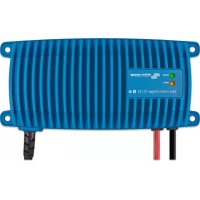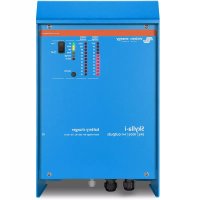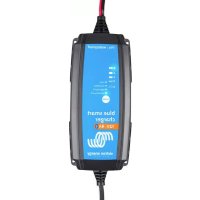
Blue Smart IP65 - Battery charger VICTRON ENERGY - Free user manual and instructions
Find the device manual for free Blue Smart IP65 VICTRON ENERGY in PDF.



| Product Type | Smart Battery Charger |
| Brand | Victron Energy |
| Model | Blue Smart IP65 |
| Supply Voltage | 230 VAC |
| Efficiency | Up to 95% |
| Standby Power Consumption | 0.5 W |
| Minimum Battery Voltage | 0 V (start from zero) |
| Available Charge Currents | 12V: 4/5/7/10/15/25 A; 24V: 5/8/13 A |
| Low Current Mode | Yes (automatic or manual reduction) |
| Built-in Protection | Reverse polarity, short circuit, overheating |
| Temperature Compensation | 16 mV/°C (12V) / 32 mV/°C (24V) |
| Power Supply Function | Yes (without battery) |
| Protection Rating | IP65 (dust-tight and water-protected) |
| Dimensions (example 12V 7A) | 47 x 95 x 190 mm |
| Weight | 0.9 kg (up to 15A) / 1.9 kg (25A/13A) |
| Safety Standards | EN 60335-1, EN 60335-2-29 |
| Warranty | 5-year limited |
| Bluetooth Connectivity | Yes (Blue Smart only) |
| Charge Algorithms | 8 steps (Test, Bulk, Absorption, Recondition, Float, Storage, Ready, Refresh) |
| Supported Battery Types | Lead (AGM, GEL, liquid) and Lithium-ion (LiFePO₄) |
| Maintenance | Clean with a dry cloth, avoid moisture |
| Safety of Use | Do not charge non-rechargeable/frozen batteries, ventilate, avoid sparks |
| Spare Parts Available | Power and battery cables (contact customer service) |
| General Information | Silent smart charger without fan |
Frequently Asked Questions - Blue Smart IP65 VICTRON ENERGY
User questions about Blue Smart IP65 VICTRON ENERGY
0 question about this device. Answer the ones you know or ask your own.
Ask a new question about this device
Download the instructions for your Battery charger in PDF format for free! Find your manual Blue Smart IP65 - VICTRON ENERGY and take your electronic device back in hand. On this page are published all the documents necessary for the use of your device. Blue Smart IP65 by VICTRON ENERGY.
USER MANUAL Blue Smart IP65 VICTRON ENERGY
natural_image
Abstract blue logo design with intertwined curved shapes (no text or symbols)victron energy
BLUE POWER
Manual
三
Handleiding
Z
Manuel
π
Anleitung
DE
Manual
m
Användarhandbok
S
Käyttöohjeet
T
Blue Smart IP65 Charger
12/4 24/5
12/5 24/8
12/7 24/13
12/10
12/15
12/25
Appendix
Safety instructions

• Always provide proper ventilation during charging.
- Avoid covering the charger.
• Never try to charge non-rechargeable - or frozen batteries.
- Never place the charger on top of the battery when charging.
- Prevent sparks close to the battery. A battery being charged could emit explosive gasses.
- Battery acid is corrosive. Rinse immediately with water if acid comes into contact with skin.
- This appliance is not designed for use by young children or people who cannot read or understand the manual unless they are under the supervision of a responsible person to ensure that they can use the battery charger safely. Children should be supervised to ensure that they do not play with the appliance
- Connection to the mains supply must be in accordance with the national regulations for electrical installations. In case of a damaged supply cord please contact the manufacturer or your service agent.
- The battery terminal not connected to the chassis has to be connected first. The other connection is to be made to the chassis, remote from the battery and fuel line. The battery charger is then to be connected to the supply mains.
- After charging, disconnect the battery charger from the supply mains. Then remove the chassis connection and then the battery connection.
1. Quick user guide
A. Connect the charger to the battery.
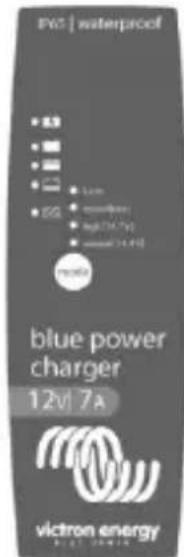
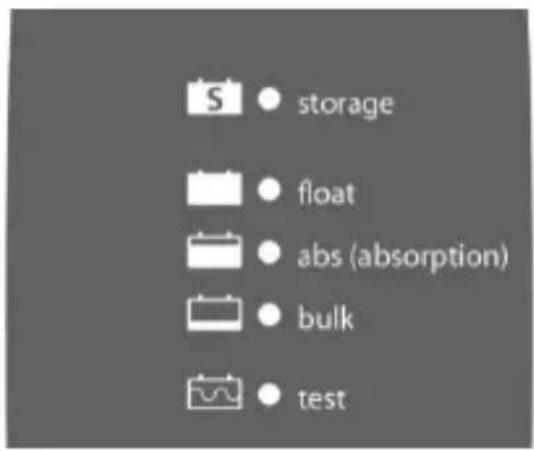
B. Connect the charger to the wall socket. The TEST LED will indicate that the mains cable is connected to the wall socket.
All charge status LEDs will flash in case of reverse polarity connection, short-circuit or if a 12V charger is connected to a 24V battery.
The TEST LED will flash as long as a charge pulse does not increase battery voltage to more than 12.5V resp. 25V.
When the TEST LED is on continuously, proceed to C.
C. If required, press the MODE-button or, in case of a Smart charger, use a Bluetooth Smart device to select another charge program.
When RECONDITION is selected in combination with NORMAL or HIGH; the RECONDITION LED will be on, and the RECONDITION LED will flash during reconditioning.
The charger can be switched to low current mode (see technical specifications) by pressing the MODE button during 3 seconds. The MODE LED will blink when in low current mode.
The low current mode remains activated until the MODE button is pressed again during 3 seconds.
D. The battery is about 80% charged and ready for use when the absorption LED switches on.
E. The battery is fully charged when the FLOAT or STORAGE LED is on.
F. Stop charging at any time by disconnecting the mains cable from the wall socket.
text_image
F63 | waterproof blue power charger 12V 7A victron energy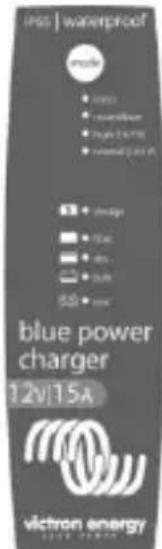
text_image
IPS | waterproof blue power charger 12V/15A victron energyExplanation icons
text_image
S • storage • float • abs (absorption) • bulk • test2. "Must know" features and facts
2.1 Blue Smart version only
Set-up, monitor and update the charger (add new features when they become available) using Apple and Android smartphones, tablets or other devices.
2.2 Ultra high efficiency "green" battery charger
With up to 95% efficiency, these chargers generate up to four times less heat when compared to the industry standard.
And once the battery is fully charged, power consumption reduces to 0.5 Watt, some five to ten times better than the industry standard.
2.3 Durable, safe and silent
- Low thermal stress on the electronic components.
- Protection against ingress of dust, water and chemicals.
- Protection against overheating: the output current will reduce as temperature increases up to 60^ C, but the charger will not fail.
- The chargers are totally silent: no cooling fan or any other moving parts.
2.4 Reverse polarity protected
Once the battery is connected, the charger immediately detects voltage and polarity. If the battery is connected incorrectly, all status-LEDs will start blinking. No sparks will occur.
2.5 Recovery function for fully discharged batteries
Most reverse polarity protected chargers will not recognize, and therefore not recharge a battery which has been discharged to zero or nearly zero Volts. The Blue Smart Charger however will attempt to recharge a fully discharged battery with low current and resume normal charging once sufficient voltage has developed across the battery terminals.
2.6 Temperature compensated charging
The optimal charge voltage of a lead-acid battery varies inversely with temperature. The Blue Smart IP65 Charger measures ambient temperature during the test phase and compensates for temperature during the charge process. The temperature is measured again when the charger is in low current mode during
float or storage. Special settings for a cold or hot environment are therefore not needed.
2.7 Adaptive Battery Management
Lead-acid batteries should be charged in three stages, which are [1] bulk or constant-current charge, [2] absorption or topping charge and [3] float charge.
Several hours of absorption charge are needed to fully charge the battery and prevent early failure to sulfation ^1 .
The relatively high voltage during absorption does however accelerate aging due to grid corrosion on the positive plates.
Adaptive Battery Management limits corrosion by reducing absorption time when possible, that is: when charging a battery that is already (nearly) fully charged.
2.8 Storage mode: less corrosion of the positive plates
Even the lower float charge voltage that follows the absorption period will cause grid corrosion. It is therefore essential to reduce the charge voltage even further when the battery remains connected to the charger during more than 48 hours.
2.9 Reconditioning
A lead-acid battery that has been insufficiently charged or has been left discharged during days or weeks will deteriorate due to sulfation ^1 . If caught in time, sulfation can sometimes be partially reversed by charging the battery with low current up to a higher voltage.
Remarks:
a) Reconditioning should be applied only occasionally to flat plate VRLA (gel and AGM) batteries because the resulting gassing will dry out the electrolyte.
b) Cylindrical cell VRLA batteries build more internal pressure before gassing and will therefore lose less water when subjected to reconditioning. Some manufacturers of cylindrical cell batteries therefore recommend the reconditioning setting in case of cyclic application.
c) Reconditioning can be applied to flooded batteries to “equalise” the cells and to prevent acid stratification.
d) Some battery charger manufactures recommend pulse charging to reverse sulfation. However, most battery experts agree that there is no conclusive proof that pulse charging works any better than constant voltage charging. This is confirmed by our own tests.
2.10 Lithium-ion (LiFePO _4 ) batteries
Li-ion batteries do not suffer from sulfation.
But Li-ion batteries are very sensitive to under voltage or over voltage ^2 .
Li-ion batteries therefore often have integrated cell balancing and under voltage protection (UVP) circuitry.
Some reverse polarity protected chargers will not recognize a battery when the UVP has tripped.
The Blue Smart Charger will however automatically reset the UVP and start charging.
Important note:
NEVER attempt to charge a Li-ion battery when its temperature is below 0^ C.
2.11 Low current mode
Some lead acid batteries can overheat if charged with a current exceeding 0,3C (C is the capacity in Ah. A 12Ah battery for example should not be charged with a current exceeding 0,3 x 12 = 4A). The low current mode (charge current limited to 4A or less, see technical specifications) should therefore be used to charge low capacity lead-acid batteries.
^1 For more information about batteries, please refer to our book ‘Energy Unlimited’ (downloadable from www.victronenergy.com), or http://batteryuniversity.com/learn/article/sulfation_and_how_to_prevent_it
^2 For more information about Li-ion batteries please see http://www.victronenergy.com/batteries/lithium-battery-12,8v/
3. Charge algorithms
3.1 Smart charge algorithm with optional reconditioning for lead-acid batteries
Charge voltages at room temperature:
| MODE | ABS V | FLOAT V | STORAGE V | RECONDITION Max V@% of Inom |
| NORMAL | 14,4 | 13,8 | 13,2 | 16,2@8%, max 1h |
| HIGH | 14,7 | 13,8 | 13,2 | 16,5@8%, max 1h |
| LI-ION | 14,2 | 13,5 | 13,5 | n. a. |
For 24V chargers: multiply all voltage values by 2.
NORMAL (14,4V): recommended for flooded flat plate lead antimony batteries (starter batteries), flat plate gel and AGM batteries.
HIGH (14,7V): recommended for flooded lead calcium batteries, Optima spiral cell batteries and Odyssey batteries.
Eight step charge sequence for lead-acid batteries:
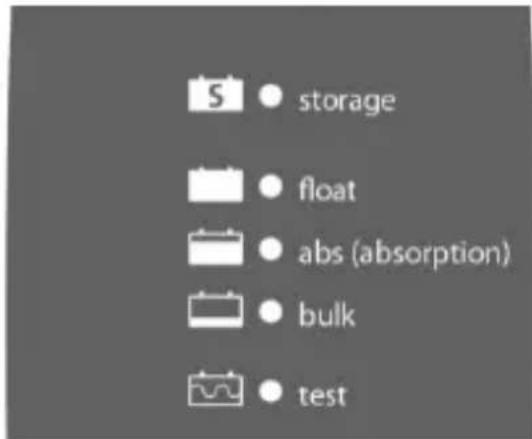
1. CHARGE/TEST
Tests if the battery can accept charge, even if the battery is fully discharged (zero or nearly zero Volt across the terminals).
All charge status LEDs will flash in case of reverse polarity connection, short-circuit or if a 12V charger is connected to a 24V battery.
The TEST LED will flash as long as a charge pulse does not increase battery voltage to more than 12,5V resp. 25V. If the flashing persists during several minutes the battery is probably damaged (internal short-circuit): disconnect the charger.
A false rejection may occur if a load is simultaneously draining a very weak or fully discharged battery during the test phase: disconnect the load and repeat the test.
The charger can be switched to low current mode (see technical specifications) by pressing the MODE button during 3 seconds. The MODE LED will blink when in low current mode.
The low current mode remains activated until the MODE button is pressed again during 3 seconds.
2. BULK
Charges the battery with maximum current until absorption voltage is reached. The battery will then be about 80% charged and is ready for use.
3. ABS - Absorption
Charges the battery at constant voltage and with decreasing current until it is fully charged.
See table above for absorption voltage at room temperature.
Adaptive battery management:
The absorption time is short (minimum 30 minutes) if the battery was (nearly) fully charged and increases to 8 hours in case of a deeply discharged battery.
4. RECONDITION
Optional reconditioning for deeply discharged lead-acid batteries.
Reconditioning is applicable to the charge algorithms NORMAL and HIGH and can be selected by pressing the MODE button one more time after selection of the required algorithm.
When in RECONDITION mode the battery will be charged with low current up to a higher voltage at the end of the absorption phase.
The RECONDITION LED will be on during charging, and will blink during the reconditioning period.
During reconditioning the maximum current is equal to 8% of the nominal current until the maximum voltage is reached. Reconditioning is terminated after one hour or when the maximum voltage is reached, whichever comes first. See table.
Example:
For a 12/15 charger: the recondition current is 15 × 0,08 = 1,2A .
5. FLOAT
Keeps the battery at constant voltage and fully charged.
6. STORAGE
Keeps the battery at reduced constant voltage to limit gassing and corrosion of the positive plates.
Slow self-discharge is prevented by an automatic weekly refresh of the battery with a short absorption charge.
7. READY
The battery is fully charged when the FLOAT or STORAGE LED is on.
8. REFRESH
Slow self-discharge is prevented by an automatic weekly refresh of the battery with a short absorption charge.
3.2 Lithium-ion (LiFePO _4 ) batteries
When charging a Lithium-ion battery, the Blue Smart Charger uses a specific charging algorithm for Lithium-ion batteries, to ensure optimum performance. Select LI-ION with the mode button.
3.3 When a load is connected to the battery
A load can be applied to the battery while charging, as long as the current draw is much lower than the rated output of the battery charger.
Reconditioning is not possible when a load is connected to the battery.
Remarks:
a) Disconnect all loads before attempting to recharge a very weak or fully discharged lead-acid battery. Loads may be reconnected once the bulk phase has started.
b) Disconnect all loads before attempting to recharge a Li-ion battery when the under voltage protection (UVP) of the Li-ion battery has tripped. Loads may be reconnected once the bulk phase has started.
3.4 Triggering a new charge cycle
A new charge cycle will start when:
a) The charger has reached float or storage, and, due to a load, current increases up to maximum current during more than four seconds.
b) The MODE button is pressed during charging.
c) The AC supply has been disconnected and reconnected.
3.5 Estimating charge time
A lead-acid battery is about 80% charged at the beginning of the absorption period.
The time T to 80% charged can be calculated as follows:
T = Ah / I
Where:
I is the charge current (= charger output minus load current).
Ah is the amount of Ah to be charged.
A full absorption period of up to 8 hours is needed to charge the battery to 100%.
Example:
Charge time to 80% of a fully discharged 100Ah battery when charged with a 10A Blue Smart Charger: T = 100 / 10 = 10 hours
Charge time to 100%: 10 + 8 = 18 hours.
A Li-ion battery is more than 95% charged at the beginning of the absorption period, and reaches 100% charge after approximately 30 minutes absorption charge.
3.6 High internal resistance
When a battery reaches the end of its cycle- or float life, or when it dies prematurely due to sulfation or corrosion, capacity will dramatically drop and internal resistance will increase. The charger will not recognise such a battery during the test phase (it could as well be a nearly fully charged battery).
A very short bulk phase when charging a supposedly discharged battery does however indicate that the battery has reached the end of its useful life.
Remark: sulfation can sometimes be partially reversed by repeated application of the RECONDITION MODE.
3.7 Can be used as a power supply
The charger will supply DC loads when no battery is connected.
4. Technical specifications
| Blue Smart IP65 Charger | 12V 4/5/7/10/15/25A | 24V 5/8/13A |
| Input voltage 230 VAC | ||
| Efficiency | 94% | 95% |
| Standby power consumption | 0,5W | |
| Minimum battery voltage Starts charging from down to 0V | ||
| Charge voltage 'absorption' | Normal: 14,4VHigh: 14,7VLi-ion: 14,2V | Normal: 28,8VHigh: 29,4VLi-ion: 28,4V |
| Charge voltage 'float' | Normal: 13,8VHigh: 13,8VLi-ion: 13,5V | Normal: 27,6VHigh: 27,6VLi-ion: 27,0V |
| Charge voltage 'storage' | Normal: 13,2VHigh: 13,2VLi-ion: 13,5V | Normal: 26,4VHigh: 26,4VLi-ion: 27,0V |
| Charge current | 4 / 5 / 7 / 10 / 15 / 25A | 5 / 8 / 13A |
| Charge current in low current mode | 2 / 2 / 2 / 3 / 4 / 10A | 2 / 3 / 4A |
| Temperature compensation (lead-acid batteries only) | 16 mV/°C | 32 mV/°C |
| Can be used as power supply | Yes | |
| Back current drain | 0,7Ah/month (1mA) | |
| Protection | Reverse polarity Output short circuitOver temperature | |
| Operating temp. range | -30 to +50°C (full rated output up to 30°C) | |
| Humidity (non condensing) | Max 95% | |
| ENCLOSURE | ||
| Battery-connection | Black and red cable of 1,5 meter | |
| 230 V AC-connection | Cable of 1,5 meter withCEE 7/7, BS 1363 plug (UK) or AS/NZS 3112 plug | |
| Protection category IP65 (splash and dust proof) | ||
| Weight | IP65 12V 25A 24V 13A: 1,9kgOther: 0,9kg | |
| Dimensions (h x w x d) | IP65s 12V 4/5A: 45x81x182mmIP65 12V 7A 24V 5A: 47x95x190mmIP65 12V 10/15A 24V 8A: 60x105x190mmIP65 12V 25A 24V 13A: 75x140x240mm | |
| STANDARDS | ||
| Safety | EN 60335-1, EN 60335-2-29 | |
| Emission | EN 55014-1, EN 61000-6-3, EN 61000-3-2 | |
| Immunity | EN 55014-2, EN 61000-6-1, EN 61000-6-2, EN 61000-3-3 | |
Five year limited warranty
This limited warranty covers defects in materials and workmanship in this product and lasts for five years from the date of original purchase of this product. The customer must return the product together with the receipt of purchase to the point of purchase.
This limited warranty does not cover damage, deterioration or malfunction resulting from alteration, modification, improper or unreasonable use or misuse, neglect, exposure to excess moisture, fire, improper packing, lightning, power surges, or other acts of nature.
This limited warranty does not cover damage, deterioration or malfunction resulting from repairs attempted by anyone unauthorized by Victron Energy to make such repairs.
Victron Energy is not liable for any consequential damages arising from the use of this product.
The maximum liability of Victron Energy under this limited warranty shall not exceed the actual purchase price of the product.
text_image
i26A | waterproof blue power charger 12v15A victron energyBetekenis iconen
text_image
S ● storage ● float ● abs (absorption) ● bulk ● test2.10 Lithium-ion (LiFePO _4 ) accu's
3.2 Lithium-ion (LiFePO _4 ) accu's
text_image
iPES | waterproof mode ● 1-4A ● powerBare ● RAGURE TIT ● wire/MSI A ● spring ● high ● low ● low ● high blue power charger 12V/15A victron energytext_image
S ● storage ● float ● abs (absorption) ● bulk ● testhttp://www.victronenergy.com/batteries/lithium-battery-12,8v/
3. Algorithme de charges
text_image
Ins | waterproof Inside ● Ins ● Installation ● High (3x3.9) ● Normal (3x3.4) ● Insage ● Seal ● Dye ● Dye 50 ● Ins blue power charger 12V/15A victron energyErklärende Symbole
text_image
S ● storage ● float ● abs (absorption) ● bulk ● testtext_image
s ● storage ● float ● abs (absorption) ● bulk ● testtext_image
FVG | waterproof blue power charger 12V/7A victron energy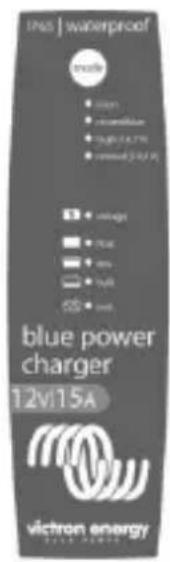
text_image
Victron | waterproof inline • Ison • ArcantBlue • High 2.4V • Medium 3.6V • energy • low • low • low • low blue power charger 12v/15A victron energyFörklaringsikoner
text_image
S • storage • float • abs (absorption) • bulk • testtext_image
S ● storage ● float ● abs (absorption) ● bulk ● test2. Ominaisuudet
2.1 Vain Blue Smart-versio
Date : September 4 ^th , 2019