WABHBL18 - Drill Westfalia - Free user manual and instructions
Find the device manual for free WABHBL18 Westfalia in PDF.



| Product type | Cordless hammer drill |
| Brand | Westfalia |
| Model | WABHBL18 |
| Power supply | 18V lithium-ion battery |
| Chuck type | SDS-Plus |
| Variable speed | Yes, trigger-controlled |
| Hammer function | Yes, for drilling in concrete and masonry |
| Safety clutch | Yes, to prevent jamming |
| Auxiliary handle | Included |
| Dust protection | Yes, installed on the tip |
| Sound level | Approx. 90 dB(A) |
| Maximum vibration | Approx. 15 m/s² |
| Weight | Approx. 2.5 kg |
| Dimensions (L × W × H) | Approx. 350 × 250 × 100 mm |
| Drilling capacity (concrete) | Up to 20 mm |
| Drilling capacity (wood) | Up to 30 mm |
| Drilling capacity (metal) | Up to 13 mm |
| Battery included | Lithium-ion 2.0 Ah (estimated) |
| Approximate charging time | 1 hour |
| Outdoor use | Yes, with residual current device (RCD) |
| Included accessories | Chisel, drill bits, charger |
| Recommended maintenance | Clean ventilation slots, check chuck |
| Safety | Safety stop, short-circuit protection |
Frequently Asked Questions - WABHBL18 Westfalia
User questions about WABHBL18 Westfalia
0 question about this device. Answer the ones you know or ask your own.
Ask a new question about this device
Download the instructions for your Drill in PDF format for free! Find your manual WABHBL18 - Westfalia and take your electronic device back in hand. On this page are published all the documents necessary for the use of your device. WABHBL18 by Westfalia.
USER MANUAL WABHBL18 Westfalia
GB Original Instructions - Rotary hammer
Instruction manuals provide valuable hints for using your new device. They enable you to use all functions, and they help you avoid misunderstandings and prevent damage. Please take the time to read this manual carefully and keep it for future reference.
EN Speed is controlled by the amount of switch trigger depression.
*2 ENGLISH The declared vibration total value and the declared noise emission values have been measured in accordance with a standard test method. The declared vibration total value may also be used in a preliminary assessment of exposure.
Warning!
The vibration and noise emission during actual use of the power tool can differ from the declared total value depending on the ways in which the tool is used, in particular, what kind of work piece is machined. It is necessary to identify safety measured to protect the operator that are based on an estimation of exposure in the actual conditions of use (taking account of all parts of the operating cycle such as the times when the tool is switched off and when it is running idle in addition to the trigger time). Try to minimize the impact of vibration and noise. Exemplary measures to reduce vibration exposure include wearing gloves while using the tool, limiting working time, and using accessories in good condition.
Batteries do not belong in the household garbage.
For battery disposal please check with your local council.
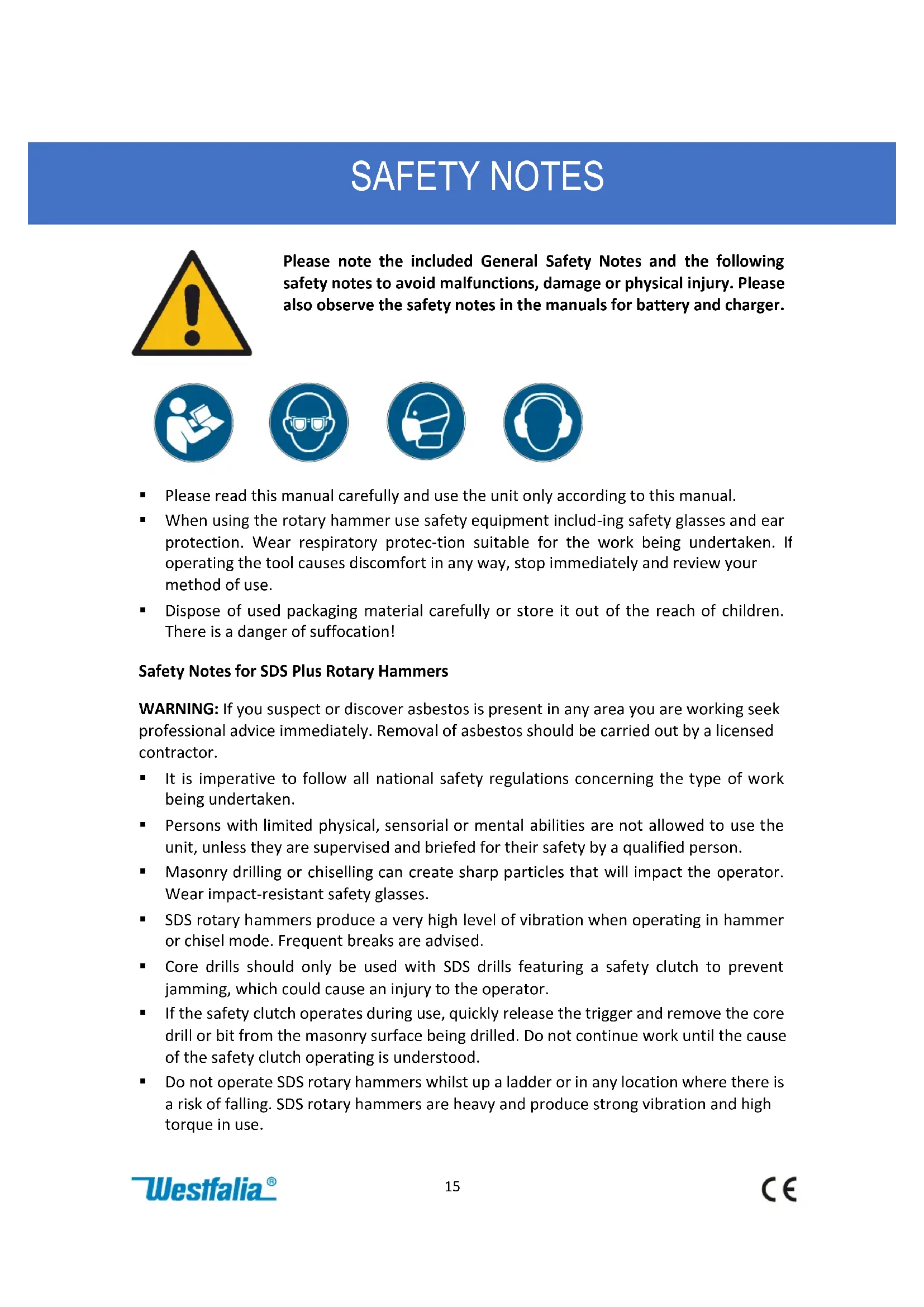
Please note the included General Safety Notes and the following safety notes to avoid malfunctions, damage or physical injury. Please also observe the safety notes in the manuals for battery and charger.




Please read this manual carefully and use the unit only according to this manual.
- When using the rotary hammer use safety equipment including safety glasses and ear protection. Wear respiratory protection suitable for the work being undertaken. If operating the tool causes discomfort in any way, stop immediately and review your method of use.
- Dispos of used packaging material carefully or store it out of the reach of children. There is a danger of suffocation!
Safety Notes for SDS Plus Rotary Hammers
WARNING: If you suspect or discover asbestos is present in any area you are working seek professional advice immediately. Removal of asbestos should be carried out by a licensed contractor.
It is imperative to follow all national safety regulations concerning the type of work being undertaken.
- Persons with limited physical, sensorial or mental abilities are not allowed to use the unit, unless they are supervised and briefed for their safety by a qualified person.
- Masonry drilling or chiselling can create sharp particles that will impact the operator. Wear impact-resistant safety glasses.
SDS rotary hammers produce a very high level of vibration when operating in hammer or chisel mode. Frequent breaks are advised.
- Core drills should only be used with SDS drills featuring a safety clutch to prevent jamming, which could cause an injury to the operator.
- If the safety clutch operates during use, quickly release the trigger and remove the core drill or bit from the masonry surface being drilled. Do not continue work until the cause of the safety clutch operating is understood.
- Do not operate SDS rotary hammers whilst up a ladder or in any location where there is a risk of falling. SDS rotary hammers are heavy and produce strong vibration and high torque in use.
- Drilling can produce large volumes of dust and debris that may be toxic. When necessary wear respiratory protection suitable for the work being undertaken.
- Only use SDS Chisels or Points with SDS rotary hammers that can disengage rotary drilling mode.
- Use metal and voltage detectors to locate concealed electric, water or gas lines. Avoid touching live components or conductors.
- Extension cable reels used with this tool must be completely unwound. Minimum conductor cross section: 1.25mm^2
- Extension reels used outside should be designed for outdoor use and should feature water-protected sockets and correct cable insulation.
- When using an SDS rotary hammer outdoors, an RCD device must be used either by connecting to a socket which incorporates an RCD, or through use of an inline RCD.
- Ensure that the chisel or drill bit is securely fixed in the chuck before operating the tool. Insecure drill bits can be ejected from the machine, causing a hazard.
- Ensure lighting is adequate.
- Use both hands when operating this tool.
Always use the auxiliary handle supplied with the tool. - Do not place pressure on the tool - to do so could shorten its service life.
- Drill bits become hot during operation. Allow to cool prior to handling.
If you are interrupted when operating the rotary hammer, complete the process and switch off before diverting your attention elsewhere. - Always disconnect the SDS rotary hammer from the electric supply before changing a chisel or drill bit.
- Examine the chuck regularly for signs of wear or damage. Have damaged parts repaired by a qualified service centre
Always wait until the drill has come to a complete stop before placing it down. - On completion of the work, disconnect the tool from the power source and remove the chisel/bit from the machine
Periodically check all nuts, bolts and other fixings and tighten where necessary. - Visibly check the tool after use, especially the power cable, which can be damaged by sharp masonry.
- Always fit the dust guard to the bit in use to prevent damage from debris entering the SDS chuck.
If operating the tool causes discomfort in any way, stop immediately and review your method of use.
Safety Notes for Battery-Operated Rotary Hammers
WARNING: Important: It is imperative to follow all national safety regulations concerning installation, operation and maintenance.
- Persons with limited physical, sensorial or mental abilities are not allowed to use the unit, unless they are supervised and briefed for their safety by a qualified person.
-
Wear ear protectors when impact drilling. Exposure to noise can cause hearing loss.
-
Use auxiliary handle(s), if supplied with the tool. Loss of control can cause personal injury.
- Hold power tool by insulated gripping surfaces, when performing an operation where the cutting accessory may contact hidden wiring or its own cord. Cutting accessory contacting a "live" wire may make exposed metal parts of the power tool "Live" and could give the operator an electric shock.
- Battery chargers are for indoors use only. Ensure that the power supply and charger are protected against moisture at all times.
- When using the rotary hammer use safety equipment including safety glasses and ear protection. Wear respiratory protection suitable for the work being undertaken. If operating the tool causes discomfort in any way, stop immediately and review your method of use.
- Use metal and voltage detectors to locate concealed electric, water or gas lines. Avoid touching live components or conductors.
- Ensure that the lighting is adequate.
- Ensure that the drill bit is securely fixed in the chuck. Insecure drill bits can be ejected from the machine causing a hazard
- Ensure that the drill bit is not in contact with the workpiece prior to starting up the tool.
- Before drilling, check that there is sufficient clearance for the drill bit under the workpiece.
- Do not exert pressure on to the tool. To do so would shorten its service life.
- Drill bits get hot during operation, allow to cool prior to handling them.
- Never use your hands to remove sawdust, chips or waste close by the bit.
If you are interrupted when operating the rotary hammer, complete the process and switch off before looking up. - Where possible, use clamps or a vice to hold your work.
- Examine the chuck regularly for signs of wear or damage. Have damaged parts repaired by a qualified service centre
Always wait until the drill has come to a complete stop before putting it down.
Periodically check all nuts, bolts and other fixings and tighten where necessary.
Additional Battery and Charger Safety Notes
- WARNING: Li-lon batteries, if incorrectly used, stored or charged are a fire, burn and explosion hazard.
Use the battery charger correctly
- Refer to the section of this manual relating to use of the battery charger before attempting to charge the battery.
- Do not attempt to use the charger with other batteries. Keep the battery charger clean; Foreign objects and dirt can cause a short circuit and block the ventilation holes. Failure to follow these instructions may result in overheating or fire.
-
Allow batteries to cool for 15 minutes after charging or heavy use. Failure to follow these instructions may cause overheating or fire.
-
Use only chargers recommended by the manufacturer to charge the batteries. If a charger is not suitable for a certain kind of battery there is a risk of fire.
- Use power tools only with specifically designated battery packs.
Use of any other battery packs may create a risk of injury and fire. - The device is designed for operation in altitudes of up to 2000m above sea level. Keep the battery out of reach of children. When not in use batteries should be stored at room temperature (approx. 20^ ).
- Do not open, disassemble, crush, heat above 60^ C or incinerate. Do not dispose of in fire or similar.
- Keep the battery away from other metal objects, like paper clips, coins, keys, nails, screws or other small metal objects that can make a connection from one terminal to another. Shorting the battery terminals together may cause burns or a fire.
- If used incorrectly, liquid may leak from the battery. Avoid contact with it. In case of accidental contact, rinse with water. If liquid contacts eyes, additionally seek medical help. Liquid ejected from the battery may cause irritation or burns.
Always switch off the heat gun after work. Please note that the device is still very hot. There is risk of injuries and fire! - Be careful when using the unit near flammable or easy fusible materials such as plastics or glass. Do not direct the unit for long time at the same place. Never point the running unit to people, animals, plants, flammable objects or liquids.
- Do not use the unit in explosive atmosphere.
- Be aware that heat may be conducted to combustible materials that are out of sight.
- Please note that poisonous gases may be emitted while removing paint. Use suitable inhalation protection and ensure adequate ventilation.
- Keep the air slots and the nozzle clean to avoid overheating the unit and to prevent from fire hazard.
- Use original accessory only.
- Should the unit become damaged do not use it any further and have it repaired by a professional or contact our customer service. Do not disassemble the unit or try repairing it yourself.
Residual risk
-
Even if you use the hammer drill as intended and observe all safety instructions, residual risks always remain. The following dangers can occur in connection with the construction and design of the rotary hammer:
-
Lung damage if a suitable dust protection mask is not worn.
- Hearing damage if suitable hearing protection is not worn.
-
Eye injuries from flying materials or pieces of material if suitable eye protection is not worn.
-
Damage to health resulting from hand-arm vibrations if the rotary hammer is used for a long period of time or the rotary hammer is not properly operated and maintained.
- Danger of injuries if long hair, loose clothing or jewelry are caught in rotating machine parts.
- Reduce the residual risk by using the rotary hammer carefully and carefully and by following all safety instructions and instructions.
CONSIGNES DE SECURITÉ

erklaren in alleiniger Verantwortung, dass das Produkt declare by our own responsibility that the product
18 V Bohrhammer WABHBL18
18 V Battery powered Rotary Hammer WABHBL18
Article No. 96 97 93
is according to the basic requirements, which are defined in the European Directives and their amendments.
2011/65/EU
Restriction of the Use of certain hazardous Substances in electrical and electronic Equipment (RoHS)
2014/30/EU
Please help avoid waste materials.
If you at some point intend to dispose of this article, then please keep in mind that many of its components consist of valuable materials, which can be recycled. Please do not discharge it in the rubbish bin, but check with your local council for recycling facilities in your area.