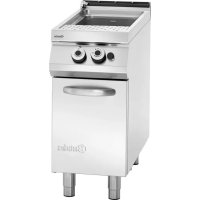
2953031 - Pasta machine BARTSCHER - Free user manual and instructions
Find the device manual for free 2953031 BARTSCHER in PDF.



| Product Type | Professional Pasta Cooker |
| Brand | Bartscher |
| Model | 2953031 |
| Power Supply | Gas (natural or propane, adjustable) |
| Main Material | Stainless Steel |
| Ignition | Piezoelectric |
| Power Regulator | Yes, for the main burner |
| Water Filling | Integrated water tap |
| Drainage | Drain valve |
| Water Level Indicator | Maximum and minimum level |
| Adjustable Feet | Yes, height adjustable |
| Safety Devices | Gas shut-off valve, safety thermocouple, anti-dry safety thermostat |
| Usage | Cooking pasta and other flour-based foods in water |
| Recommended Cleaning | Do not use water jet; clean with suitable products; apply food-grade petroleum jelly on stainless steel |
| Periodic Maintenance | Check burners, nozzles, and ducts by qualified technician |
| Installation | Gas and water connection; exhaust of combustion products via extractor |
| Compliance | CE marking, WEEE directive |
| Included Accessories | Baskets (depending on model) |
| Use | Professional, indoor |
Frequently Asked Questions - 2953031 BARTSCHER
User questions about 2953031 BARTSCHER
0 question about this device. Answer the ones you know or ask your own.
Ask a new question about this device
Download the instructions for your Pasta machine in PDF format for free! Find your manual 2953031 - BARTSCHER and take your electronic device back in hand. On this page are published all the documents necessary for the use of your device. 2953031 by BARTSCHER.
USER MANUAL 2953031 BARTSCHER
INSTALLATION, OPERATING
AND MAINTENANCE NST RUCTIONS
MANUEL D'INSTALLATION,
D'UTILI SATIO N ET D'ENTRETIEN
HANDLEI DING VOOR INSTALLATIE,
GE BRUIK EN ONDERHOUD
Rev.-Nr.: 01-2017
W SKAZOW KI DOT YCZA CE INST ALACJ I,
UZYTKOW ANIA I KONS ERW ACJI
DE TECHNISCHE ÄNDERUNGEN VORBEHALTEN!
GB TECHNICAL CHANGES RESERVED!
FR SOUS RÉSERVE DE MODIFICATIONS TECHNIQUES!
IT CI RISERVIAMO LA POSSIBILITA DI INTRODURRE MODIFICHE TECNICHE!
ES iSE RESERVVA EL DERECHO A INTRODUICIR MODIFICACIONES TECNICAS!
PT SUJEITO A ALTERACOES TECNICAS!
NL TECHNISCHE WIJZIGINGEN VOORBEHOUDEN!
PL WPROWADZANIE ZMIAN TECHNICZNYCH ZASTRZEZONE!
- TABLE OF CONTENTS 1
- INDEX 2
-
SAFETY 3
-
GENERAL INFORMATION AND WARNINGS 4
4.1. General guidelines 4
4.2. Description of the appliance 4
4.3. Protection appliances 5
4.4. Rating plate 6
4.5. Replacement of components (service technician) 6
- USE AND OPERATION 7
5.1.Description of the controls 7
5.2. Burner ignition 7
5.3. Filling the tank 8
5.4. Draining the container 8
5.5. Guidelines on how to use 8
- CLEANING AND MAINTENANCE 8
6.1. Guidelines on cleaning and maintenance 8
6.2. Proper maintenance 9
- TROUBLESHOOTING 10
- INSTALLATION 10
8.1. Packaging and unpacking 10
8.2. Installation (service technician) 11
8.3. Water connection (service technician) 11
8.4. Gas connection (service technician) 12
8.5. Extraction of fumes (service technician) 12
8.6. Installation of the appliance in a line 13
8.7. Gas supply (service technician) 13
8.8. Inspection (service technician) 13
- SETTINGS 14
9.1. Minimum setting of burner valve (service technician) 14
9.2. Replacement of burner nozzle (service technician) 14
9.3. Replacement of igniting flame burner nozzle (service technician) 15
10.APPLIANCE DISPOSAL 15
ATTACHMENTS I
2. INDEX
A
APPLIANCE DISPOSAL 15
B
Burner ignition 7
D
Description of the appliance 4
Description of the controls 7
Draining the container 8
E
Extraction of fumes 12
F
Filling the tank 8
G
Gas connection 12
Gas supply 13
General guidelines 4
Guidelines on cleaning and maintenance 8
Guidelines on how to use 8
1
Inspection 13
Installation 11
Installation of the appliance in a line 13
M
Minimum setting of the heating plate burner valve. 14
P
Packaging 10
Proper maintenance 9
Protection appliances 5
R
Rating plate 6
Replacement of burner nozzle 14
Replacement of components 6
Replacement of igniting flame burner nozzle 15
S
SAFETY 3
T
TROUBLESHOOTING 10
U
Unpacking 10
W
Water connection 11
3. SAFETY

Read carefully the guidelines and instructions in the instruction manual. If you use the appliance.
The instruction manual contains general information on how to safely use and maintain the appliance.
Retain the manual for future reference.
The manufacturer took extra care when designing and manufacturing to prevent any safety or health hazard to the personnel operating the appliance.
Please read carefully the guidelines in the instruction manual and instructions placed directly onto the appliance. Above all, observe all the safety instructions.
Do not intervene in or remove the protective appliances installed in the appliance. Noncompliance may lead to severe safety and health hazard against people. We recommend to perform a few tests to know the layout and main functions of the control panel, particularly those to switch the appliance on and off.
The appliance is intended only for the use it has been designed for and any other use is considered as the use not in compliance with the intended use.
The manufacturer is not liable for material damage or damage to person caused by misapplication or incorrect application of the appliance.
Any maintenance work that requires special technical licence or special skills may be performed by qualified personnel only.
To provide hygiene and protect foods from dirt, all the elements that have direct or indirect contact with the foods and all border areas must be thoroughly cleaned. Use only the cleaning agents intended for use in contact with food and avoid using flammable agents or harmful to health.

After each use make sure that the car is switched off, the operational vents are deactivated, and the gasy hoses are disconnected.
When the device will not be used for a longer time not only disconnect all gas supply hoses, but also thoroughly clean all internal and external elements of the device.

You must not clean the appliance.
with the direct stream of water.
4. GENERAL INFORMATION AND WARNINGS
4.1. General guidelines
The manual has been edited by the manufacturer to provide the authorized personnel with the information necessary to work with the appliance. We recommend the intended readers to read the manual carefully and comply with the information. By reading the information contained in the manual, hazards against people health and safety may be prevented.
Retain the manual in an easily available place throughout the time of use of the appliance to have access and refer to the required information at any time.
Special symbols, described below, have been used to stress important information or draw attention to essential data:
Caution - warning

Indicate important safety
instructions. You should acquire the proper conduct to prevent hazard against people health and safety or not to cause any damage.
Important

Indicate essentials technical data that
you cannot ignore.
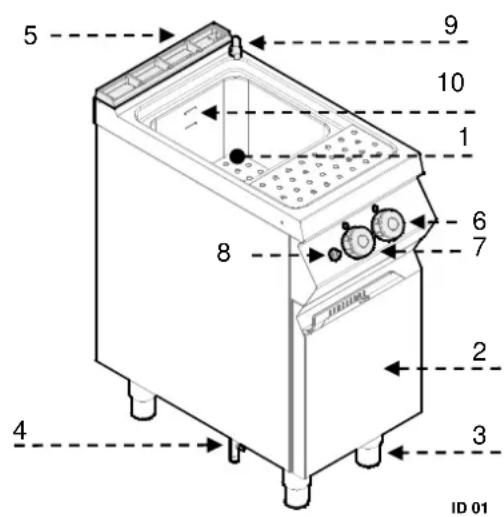
4.2. Description of the appliance
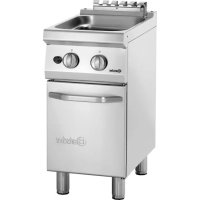
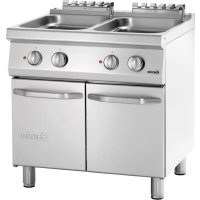
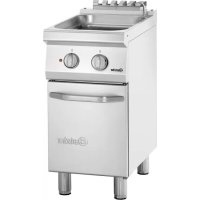
This appliance, called pasta cooker, has been designed and manufactured for professional gastronomy for cooking flour food products in water.
1) Container
2) Door
3) Feet of adjustable height
4) Gas connection
5) Extractor: Extraction of combustion gases
6) Water valve: Fills and adjusts water amount in the container.
7) Power control knob: adjusts burner power (min - max)
8) Burner ignition: piezoelectric burner ignition
9) Water inlet: fills container with water:
10) Minimum and maximum water level in the container.
4.3. Protection appliances
The appliance is equipped with the protection system. The arrangement of protection appliances is presented on the drawing.
A) Gas cut-off valve: to open and close the gas line.
B) Safety thermocouple: cuts off the gas supply if the flame goes out.
C) Safety thermostat: cuts off gas supply when there is no water.

Check every day that the protection
appliances are mounted correctly and operational.
After releasing of the safety thermostat restore the initial settings of the appliance.
- Wait for the unit to cool.
- Open the door (D).
- Press the safety thermostat button (B) to reactivate the gas supply.
- Close the door (D).

After releasing of the safety thermostat
press button (C).


4.4. Rating plate
The rating plate indicated in the drawing is mounted directly onto the appliance. There are all guidelines and information on the plate required for safe use.
1) EAN number
2) Code no./Model no./CE certificate no.
3) Category of appliance / type of design
4) Connected value / gas consumption / adjusted to gas type
5) Thermal load
6) Production date
7) Series no.
8) WEEE symbol
9) CE Declaration of Conformity

4.5. Replacement of components (service technician)

Before exchange of the components on all the existing protection.
ences.
First of all, switch off the gas valve and prevent access to the appliance, which in the case of activation may lead to unexpected situations endangering the safety and health of people.
If necessary, exchange the used components to the original spare parts.
We are not liable for personal injury or damage to the components that arise due to application of other spare parts than original or intervention into the appliance without the manufacturer's consent that may have altered the safety requirements.
5. USE AND OPERATION
5.1. Description of the controls.
The elements controlling the essential functions are located on the control panel of the appliance.
C) Piezoelectric ignition: for starting the igniting flame of the burner.
A) Burner control knob: for igniting, putting out, and adjusting the main burner.
B) Water valve: for filling the tank.

5.2. Burner ignition
IGNITION
A) Press the burner control knob and rotate it counter clockwise (position 1); at the same time press button B to start the igniting flame.
B) Hold the control knob B pressed for approx. 10 seconds in order to heat up
the thermal element; then release the controller.
C) To ignite the burner rotate the control knob clockwise (position 2).
D) Set the burner power (position 3).
SWITCHING OFF
A) To switch off the burner rotate the control knob clockwise (position 1); the igniting flame is still on.
B) To switch off the igniting flame rotate the control knob clockwise (position 0).

5.3. Filling the tank
Rotate the water valve to fill the tank to the required level. After reaching the maximum level the burner may be ignited.
After filling close the water valve to avoid dangerous overfilling.
When water level drops below minimum open the water valve again.
The appliance may be connected to hot water supply to reduce the heating time (max. 60^ ).
When the water level drops below the basket bottom, the safety thermostat may trip: Fill the tank at least to the minimum level and reignite the burner.
Avoid using the appliance with the tank filled below the marked minimum level.

5.4. Draining the container
Water may be drained with use of appropriate container resistant to temperature of min. 100^ To drain the tank rotate the drain valve A down.

Before filling up the container that the outlet valve A is closed.

5.5. Guidelines on how to use
When the appliance will not be used for a longer time, follow the instructions below:
- Close the gas cut-off valve.
- Thoroughly clean the appliance and adjacent surfaces.
- Apply the food grade vaseline on the stainless steel surfaces.
- Perform all maintenance works.
- Leave the appliance uncovered, with opened cooking chambers.

Always empty the containers
after use.
To ensure correct use of the appliance follow the guidelines below:
Use only accessories provided by the manufacturer;
Use baskets in the correct way;
Before filling the tank check if the drain valve is closed;
Make sure that the water level is above the minimum level marked in the tank.

Never use the appliance without it in the tank. It may cause total damage of the appliance.
6. CLEANING AND MAINTENANCE
6.1. Guidelines on cleaning and maintenance

Before you start maintenance
works, turn on all the mounted protective appliances.
First of all, close the gas valve and prevent access to the appliance, which in the case of activation may lead to unexpected situations endangering the safety and health of people.
6.2. Proper maintenance
Proper maintenance includes daily cleaning of all components which have contact with food products, and regular maintenance of the burner, nozzle and exhaust pipes.
Thorough maintenance allows for obtaining the best results, assures longer life of the appliance, and keeping constant level of the safety requirements.
Never direct the water stream or high pressure jet towards the appliance.
To clean the stainless steel, do not use iron wool or iron brush as they may leave iron particles on the surface that form rust in result of oxidation. Use the wooden or plastic spatula, or soft cleaning sponge to remove the dried remains.
When the appliance will not be used for a longer time, use cloth soaked in food grade vaseline to apply the protective layer on all stainless steel surfaces and ventilate the room periodically.

Do not use any clearing agents that can substances hazardous or harmful inth (solvents, petrol. etc.).
Regularly instruct the specialist personnel to perform the following maintenance works:
Installation pressure and tightness control;
Thermocouples functionality control;
Control of operation of the extractor and possible cleaning;
Inspection and possible lubrication of gas valves.
Control of correct operation of safety barostat.
7. TROUBLESHOOTING
The information below is provided to recognize and repair any failures that may occur when operating the appliance.
Some of the failures can be repaired by the user, others require thorough specialist knowledge.
Such problems may be solved exclusively by the qualified personnel.
| Problem Cause Solution | ||
| Gas smell. | The smell is sometimes released when extinguishing the flame. | Close the gas cut-off valve and ventilate the room. |
| The ignition flame does not start. | The spark ignition does not work. | Check operation of ignition appliances. Ignite the flame manually. × Contact the service company. |
| Air in the pipes in connection with the long downtime. | ||
| The igniting flame continuously goes out. | The thermal element is not sufficiently hot. | Extend the ignition process. |
| Yellow flame. | The burner is contaminated or moist. | Clean the burner and leave for drying. × When problem persists contact the service company. |
| It is difficult to rotate the burner control knob. | Damaged valve. | × Contact the service company. |
8. INSTALLATION
8.1. Packaging and unpacking
During unloading and when installing the appliance follow the information from the manufacturer placed directly on the packaging and in this manual.
To lift and transport the product plan to use a fork lift or stacker, and pay attention to even weight distribution to avoid a risk of tilting of the packaging (avoid excessive incline!).

While using the elevator pay. tion to the gas supply hoses and on of feet.
The packaging consists of the carton packaging and wooden pallet. There are symbols printed on the carton packaging that according to the international agreements inform about the regulations to follow when loading and unloading, transporting and storing the appliance.

When collecting the goods check if the packaging is complete and has not been damaged during transport.
Any damage should be immediately reported to the shipping company.
Unpack the appliance as soon as possible to check if the appliance is not damaged.
Do not use a sharp object to cut the carton box. It may damage the stainless steel inside the box.
Remove the carton packaging from bottom to top. When unpacked check if the appliance is according to the order.
In case of any difference inform the sales agent immediately.
Do not store the packaging materials (nylon bags, polystyrene foam, clips ...) in the reach of children!
Remove the protective PVC layer from the out and inner surfaces. If possible, do not use any metal tools.
8.2. Installation (service technician)
All the stages of the installation must be carefully planned.
The location should be equipped with all supply connections and production waste outlet. The location should also be properly lit and comply with all hygiene and sanitary requirements according to the binding regulations.
The appliance should be installed with the minimum 5 cm clearance from the wall, if the wall is not resistant to the minimum temperature of 150^ .
Locate the appliance in the horizontal position by adjusting the single feet.
To ensure the correct operation of the appliance, the appliance must be installed and operated in the thoroughly ventilated room only.

Internal installation of the gas supply and the rooms in which the appliance is housed, must comply with the local regulations applicable in the country in which the appliance is used (Regulation of 12 June 96 and UNI-CIG 87/23).
In order to ensure the proper gas burning in the burners the required volume of air, i.e. approx. 2 cubic meters per hour for every kW of installed power, must be supplied.
8.3. Water connection (service technician)
The installation is performed by connecting the connection pipe of the appliance to the water network pipe. Install the cut-off valve (A) on the connection to stop the water supply when required. Install appropriate filters after that valve.

Connect potable water to the appliance. Limit values for the potable water specified by the European Union are listed in the table.
| Description | Value |
| Pressure | 150-300 kPa |
| 1.5-3 bar | |
| pH | 6.5-8 |
| Hardness | 8-15°F (80-150 ppm CaCO3) |
| Minerals | <1500 mg/l |
| Iron | < 0.2 mg/l |
| Manganese | <0.05 mg/l |
| Chlorine | <0.25 mg/l |
| Sulphur | <0.25 mg/l |

8.4. Gas connection (service technician)
A gas connection must be performed in compliance with the applicable regulations.
Before connecting the appliance, check the technical data, type of gas, working pressure and flow rate which are provided on the rating plate.
The installation is performed by connecting the connection pipe of the appliance with a pipe of the gas distribution network. A shut-off valve must be installed on the connection to shut the gas supply off if necessary.
If there are significant pressure differences in the gas supply installation, it is recommended to install a pressure regulator.
After the installation, check the gas connection for tightness.

When looking for gas leaks do not use the open flame!
GB
8.5. Extraction of fumes (service technician)
Installation of the type "A" appliances does not envisage connection to the fume exhaust system, but to the appropriate extraction hood which discharges the fumes to outside.
Installation under the extraction hood (A)
Place the appliance under the extraction hood (1) and attach to the appliance connection a pipe of the size as shown on the figures.
The end of the fume extraction pipe should be located at least 1.8m above the floor.
The appliance's gas supply should subordinated to the exhaust system: Blocking of the fan must shut the gas supply off.
The fan must switch on automatically when the gas valve is open.
8.6. Installation of the appliance in a line
To fix the appliance in a line (neighbouring) follow the steps:
Dismantle the control panel, and remove the cast iron frame from the chimney if necessary.
Apply the sealing tape (A) onto the joining sides.
Place the appliances next to each other and in a horizontal position (by adjusting the feet).
Connect the appliances with the joining elements.
B

C

8.7. Gas supply (service technician)
The appliance has been checked by the manufacturer for the type of gas shown on the rating plate. If a different type of gas is used, follow these guidelines.
- Close the gas valve (A)
- Replace the burner nozzle (see relevant chapter)
- Replace the nozzle of the ignition flame (see relevant chapter)
- Set a minimum value on the burner gas valve (see relevant chapter)
- If necessary, check the air supply.
- Remove the sticker from the rating plate and apply a new sticker which includes the used gas type (item 4 of the rating plate).

8.8. Inspection (service technician)
Before starting the appliance the installation check-up should be run to evaluate the working conditions of every single component and recognize any errors.
It is recommended to run the following check-ups:
-
Open the gas valve and check the tightness of connections;
-
Check whether the igniter starts and burns properly.
- Check and adjust, if necessary, the gas pressure and flow rate in Max and Min positions (see chapter)
- Check whether the safety thermostat operates properly.
- Check gas connection for gas leaks.
9. SETTINGS

Before setting the appliance, first of
all switch on all the protection appliances.
In particular deactivate the gas valve and prevent access to the appliance, which in the case of activation may lead to unexpected situations endangering the safety and health of people.
9.1. Minimum setting of burner valve (service technician)
These settings are required only if the connected type of gas differs from the checked gas, after connecting to the gas supply. Before performing this setting, check whether the gas pressure is compliant with the value of nominal pressure (see table).
Follow the instructions below.
- Close the gas cut-off valve.
- Pull the control knob A.
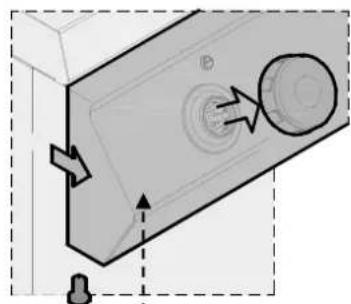
- Unscrew screws B and remove the control panel (C).
- Remove the injection nozzle D and replace it with the one suitable for used gas type (see appendices). After setting tighten the screw.
- Finally reinstall the control panel (C) and control knob (A).

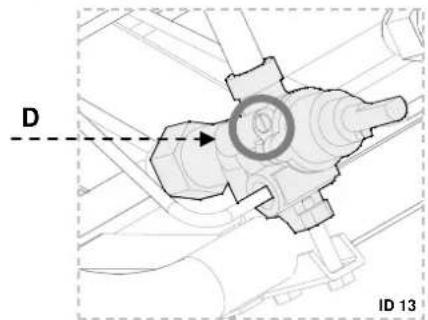
9.2. Replacement of burner nozzle (service technician)
Follow the instructions below.
Close the gas cut-off valve.
Open the cover (A)
Replace the nozzle (B) with a nozzle intended for the used gas (see appendix).
Loosen screw C and set the Venturi pipe (D).
Finally restore the initial state settings.
Close the cover.

9.3. Replacement of igniting flame burner nozzle (service technician)
Follow the instructions below.
Close the gas cut-off valve.
Open the cover (A)
The ignition flame is assigned to the burner.
Loosen the nut (B).Remove the nozzle C and replace it with a nozzle intended for the used gas (see attached tables).
Tighten the nut and restore the initial settings.
Close the cover.

10. APPLIANCE DISPOSAL
The appliance is marked in conformity with the European Directive 2002/96/EG WASTE ELECTRICAL AND ELECTRONIC EQUIPMENT (WEEE).

By disposing the appliance in
accordance with the regulations the user contributes towards prevention of adverse effects on environment and health.
The symbol on the product or attached manual indicates that the product cannot be considered as ordinary household waste and should be transferred to a special collection point for electrical and electronic appliances for recycling.
Local waste management regulations should be observed.
Further information on procedure, reusing and recycling of the product is available in local offices, waste management unit or with the product sales agent.
1. SOMMAIRE
- SOMMAIRE 1
- INDEX 2
- SECURITE 3
- RÉGLES ET AVERTISSEMENTS GÉNÉRAUX
- LIMPEZA E MANUTENCAO 9
6.1. Orientacoes de limpeza e manutenacao 9
6.2. Manutencao adequada 9
7.PROBLEMAS 10
8. INSTALLAÇAO 10
6. LIMPEZA E MANUTENÇA
Ao usability, preste
IN COMPLIANCE WITH THE LAW IN FORCE,IT IS PROHIBITED TO REPRODUCE AND/OR DISTRIBUTE THIS MANUAL IN ANY WAY WITHOUT THE AUTHORISATION OF THE PROPRIETOR!
FR
AUX TERMES DE LA LOI, LA PROPRIETE DE CETTE NOTICE EST RESERVEE. IL EST DONC INTERDIT DE LA REPRODUIRE ET/OU DE LA DISTRIBUTUER SOUS QUELQUE FORME QUE CE SOIT SANS NOTRE AUTORISATION!
IT
A TERMINI DI LEGGE E RISERVATA LA PROPRIETÀ DI QUESTO MANUALE CON DIVIETO DIRIPRODURLO E/O DISTRIBUTIONO IN QUALSIASI FORMA SENZA NOSTRA AUTORIZAZIONE!
ES
DE ACUERDO CON LOS TERMINOS DE LA LEY ESTA RESERVADA LA PROPIEDAD DE Este MANUAL CON EXPRESA PROHIBICION DE REPRODUCIRLO Y /O DISTRIBUTRIO EN CUALQUIER FORMA SIN NUESTRA AUTORIZACION!
PT
A PROPRIEDADE DESTE MANUAL É RESERVADA POR LEI, SENDO PROIBIDA A SUA REPRODUÇÃO E/OU DISTRIBUTIONE EM QUALQUER FORMA SEM A NOSSA AUTORIZACAO!
NL
DE FABRIKANT BEHOUDT ZICH HET RECHT VOOR OM DE KENMERKEN VAN DE TOESTELLEN DIE IN DEZE PUBLICATIE WORDEN VOORGESTELD TE WIJZIGEN ZONDER VOORAF TE VERWITTIGEN!
PL
ZGODNIE Z PRZEPISAMI PRAWNYMI NINIEJSZA INSTRUKCJA JEST NASZA WLASNOSCIA I Z TEGO POWODU NIE MOZE BYC BEZ NASZEJ ZGODY POWIELANA I / LUB PRZEKAZYWANA W JAKEJKOLWIEK FORMIE OSOBOM TRZECIM!
- INDEX
- A
- B
- D
- E
- F
- G
- 1
- M
- P
- R
- S
- T
- U
- W
- SAFETY
- Read carefully the guidelines and instructions in the instruction manual. If you use the appliance.
- After each use make sure that the car is switched off, the operational vents are deactivated, and the gasy hoses are disconnected.
- GENERAL INFORMATION AND WARNINGS
- General guidelines
- Caution - warning
- Important
- Description of the appliance
- Protection appliances
- Rating plate
- Replacement of components (service technician)
- USE AND OPERATION
- Description of the controls.
- Burner ignition
- IGNITION
- SWITCHING OFF
- Filling the tank
- Draining the container
- Guidelines on how to use
- CLEANING AND MAINTENANCE
- Guidelines on cleaning and maintenance
- Proper maintenance
- TROUBLESHOOTING
- INSTALLATION
- Packaging and unpacking
- Installation (service technician)
- Water connection (service technician)
- Gas connection (service technician)
- Extraction of fumes (service technician)
- Installation under the extraction hood (A)
- Installation of the appliance in a line
- Gas supply (service technician)
- Inspection (service technician)
- SETTINGS
- Minimum setting of burner valve (service technician)
- Replacement of burner nozzle (service technician)
- Replacement of igniting flame burner nozzle (service technician)
- APPLIANCE DISPOSAL
- SOMMAIRE
- LIMPEZA E MANUTENÇA
- FR
- IT
- ES
- PT
- NL
- PL
Brand : BARTSCHER
Model : 2953031
Category : Pasta machine