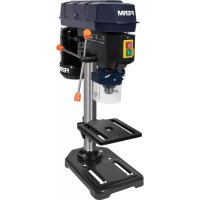
TDM1027 - Drill Ferm - Free user manual and instructions
Find the device manual for free TDM1027 Ferm in PDF.



| Product type | Pillar drill |
| Brand | Ferm |
| Model | TDM1027 |
| Supply voltage | 230 V~ / 50 Hz |
| Power consumption | 350 W |
| No-load speed | 600-2650 min⁻¹ (5 speeds) |
| Chuck capacity | 13 mm |
| Weight | 12.5 kg |
| Sound pressure level | 70.8 dB(A) (K=3) |
| Sound power level | 83.8 dB(A) (K=3) |
| Drilling depth adjustment | Depth stop with graduated scale |
| Speed adjustment | By moving the V-belt |
| Work table | Height-adjustable and tiltable |
| Chuck | Keyed drill chuck |
| Chuck guard | Yes, removable |
| Power supply | Mains, male plug |
| Maintenance | Regular cleaning, lubrication of racks |
| Safety | Zero voltage switch, restart protection |
| Warranty | According to the supplied warranty certificate |
| Recycling | Compliant with WEEE Directive 2012/19/EU |
Frequently Asked Questions - TDM1027 Ferm
User questions about TDM1027 Ferm
0 question about this device. Answer the ones you know or ask your own.
Ask a new question about this device
Download the instructions for your Drill in PDF format for free! Find your manual TDM1027 - Ferm and take your electronic device back in hand. On this page are published all the documents necessary for the use of your device. TDM1027 by Ferm.
USER MANUAL TDM1027 Ferm
natural_image
Industrial FERM drill press machine with control panel and base mount (no visible text or symbols)TDM1027
natural_image
Technical line drawing of a mechanical clamp or vise assembly (no text or symbols)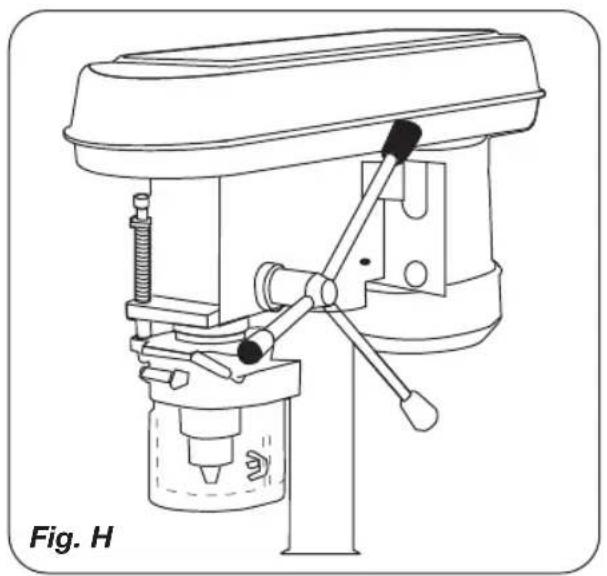
natural_image
Technical line drawing of a mechanical press or drill press with no visible text or symbols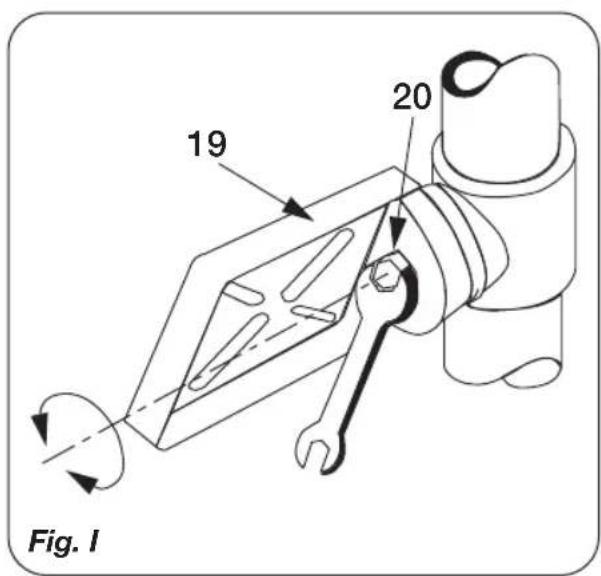
BENCH PILLAR DRILL TDM1027
Thank you for buying this Ferm product.
By doing so you now have an excellent product, delivered by one of Europe's leading suppliers. All products delivered to you by Ferm are manufactured according to the highest standards of performance and safety. As part of our philosophy we also provide an excellent customer service, backed by our comprehensive warranty. We hope you will enjoy using this product for many years to come.

Read the operating instructions carefully before using this device. Familiarise yourself with its functions and basic operation. Service the device as per the instructions to ensure that it always functions properly. The operating instructions and the accompanying documentation must be kept in the vicinity of the device.
1. MACHINE INFORMATION
Technical specifications
Voltage 230 V\~
Frequency 50 Hz
Power consumption 350 W
No load speed 600-2650/min
Number of speeds 5
Chuck capacity 13 mm
Weight 12.5 kg
Lpa (Sound pressure level) 70.8 dB(A) K=3
Lwa (Sound power level) 83.8 dB(A) K=3
The declared noise emission value(s) have been measured in accordance with a standard test method and may be used for comparing one tool with another.
The declared noise emission value(s) may also be used in a preliminary assessment of exposure.
The noise emissions during actual use of the power tool can differ from the declared values depending on the ways in which the tool is used especially what kind of workpiece is processed.
Need to identify safety measures to protect the
operator that are based on an estimation of exposure in the actual conditions of use.
Description
The numbers in the text refer to the diagrams on pages 2-4.
-
On/off switch
-
Depth limiter
-
Chuck guard
-
Motor
-
Drill depth handle
-
Table adjustment
-
Chuck key
-
Fixing screw
-
Chuck
-
Table holder
-
Column
-
Bolts
-
Footplate
-
Upper V-belt cover
-
Lower V-belt cover
-
Cover lock
-
Motor plate
-
Belt tension lock
-
Table
-
Hexagonal screw
-
Spindle
Check first whether or not the delivery has been damaged by transport and/or whether all the parts are present.
2. SAFETY INSTRUCTIONS
Explanation of symbols
The following pictograms are used in these instructions for use:

Denotes risk of personal injury, loss of life or damage to the tool in case of non-observance of the instructions in this manual.

Indicates the presence of an electrical voltage.

Immediately unplug the plug from the mains electricity in the case that the cord gets damaged and during maintenance.
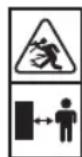
Keep bystanders away.

Wear eye and ear protection.
During use the following points must be considered:
- Do not remove any mechanical or electrical protective provisions.
- Check whether all the protective provisions are in place and have been attached correctly.
- Wear safety goggles during drilling.
- If you have long hair, be sure to wear hair protection (hair net or cap). Long hair can easily be caught in moving parts.
- Wear fitted clothing; tie buttons on sleeves.
- Do not hold any workpieces in your hands when drilling. Always use a machine clamp or another clamping tool.
- Protect workpieces and clamping tools on the bench to prevent them from getting caught. Fasten them yourself with screws or clamp them to a machine clamp fastened to the table.
- Check whether the drill holder is tightened properly.
- Check whether cable lead-throughs are okay.
- To remove drill chips only use hand brushes, brushes, rubber wipers, chip hooks or similar aids.
- Do not carry out any cleaning or greasing work while the machine is in operation.
- Always keep V-belts covered (so that your hands cannot become caught).
- Only tighten the toothed ring drill holder by means of the wrench.
- Never leave the wrench of the drill holder in the drill holder! Before switching on the machine, check whether the wrench really has been removed!
- Do not use any drills which are damaged on the shank.
- Drill is not suitable to use as press!
- If the mains cable is damaged, it may only be replaced by a mains cable of the same type.
Immediately switch off the machine when:
- Interruption in the mains plug, mains lead or mains lead damage.
- Defectswitch.
- Smoke or stench of scorched isolation.
Electrical safety
When using electric machines always observe the safety regulations applicable in your country to reduce the risk of fire, electric shock and personal injury. Read the following safety instructions and also the enclosed safety instructions.

Always check that the power supply corresponds to the voltage on the rating plate.

The machine is provided with a zero voltage switch. After the tension drops the machine will not start to run automatically for safety reasons. The machine must be switched on again.
Replacing cables or plugs
Immediately throw away old cables or plugs when they have been replaced by new ones. It is dangerous to insert the plug of a loose cable in the wall outlet.
If the supply cord of this power tool is damaged, it must be replaced by a specially prepared supply cord available through the service organization.
Using extension cables
Only use an approved extension cable suitable for the power input of the machine. The minimum conductor size is 1.5 mm2. When using a cable reel always unwind the reel completely.
Safety instructions for transportable drills Drill safety warnings
a) The drill must be secured. A drill that is not properly secured may move or tip over and may result in personal injury.
b) The workpiece must be clamped or secured to the workpiece support. Do not drill pieces that are too small to be clamped securely. Holding the workpiece by hand during operation may result in personal injury.
c) Do not wear gloves. Gloves may be entangled by the rotating parts or chips leading to personal injury.
d) Keep your hands out of the drilling area while the tool is running. Contact with rotating parts or chips may result in personal injury.
e) Make sure the accessory is rotating before feeding into the workpiece. Otherwise the accessory may become jammed in the workpiece causing unexpected movement of the workpiece and personal injury.
f) When the accessory is jammed, stop applying downward pressure and switch off the tool. Investigate and take corrective actions to eliminate the cause of the jam. Jamming can cause unexpected movement of the workpiece and personal injury.
g) Avoid generating long chips by regularly interrupting downward pressure. Sharp metal chips may cause entanglement and personal injuries.
h) Never remove chips from the drilling area while the tool is running. To remove chips, move the accessory away from the workpiece, switch off the tool and wait for the accessory to stop moving. Use tools such as a brush or hook to remove chips.
Contact with rotating parts or chips may result in personal injury.
i) Accessories with speed ratings must be rated at least equal to the maximum speed marked on the power tool. Accessories running faster than their rated speed can break and fly apart.
3. ASSEMBLY
Fig. B, F
- Place the footplate (13) in the correct position.
- Fasten the column (11) with the bolts supplied (12) to the footplate.
- Now slide the table holder (10) with the table over the column (11). With the fastening handle (6) the table is fastened into the desired position.
- Now you can assemble the machine casing and lock with the locking pins (8).
- Fit the chuck guard holder onto the spindle (21) and tighten the slotted screw.
-
Clean the conical hole in the chuck (9) and the spindle with a clean piece of fabric. Make sure there are no foreign particles sticking to the surfaces.
-
Powerfully push the chuck (9) up on the spindle (21), as far as it will go.
- Fit the clear chuck guard (3) to the chuck (9) guard holder and fasten the fixing screws.
- Since the drill spindle is greased in the factory, it is advisable to let the machine run for approximately 15 minutes at the lowest speed before use.

Before you push the chuck on the drill spindle, the inside of the chuck and the outside of the spindle must be completely grease-free!
Setting up the bench drill
Before use the drill must be mounted on a fixed base. The footplate (13) has therefore been provided with drilling holes. By means of screws the footplate can be fixed to the base in this place. If it is mounted on a wooden board, sufficiently large washers must be used on the opposite side, so that the bolts are not pushed into the wood and the machine cannot become loose.

The fastening screws may be fastened so far that the footplate is not under tension or deformed. When the tension is too high there is a risk of breakage.
Adjusting the number of revolutions of the drill spindle
Fig. C
The different revolutions of the drill spindle can be adjusted by shifting the V-belt into the belt drive. The machine is protected by a safety switch so that the machine is automatically switched off when opening the casing. The V-belt is shifted as follows:
- Open the V-belt cover (14) by loosen the screw (16) on the right side of the cover.
- Loosen the fastening button (18) and slide the motor in the direction of the machine head, upon which the V-belt is released.
- Shift the V-belt according to the table on the inside of the V-belt cover.
- Tension the V-belt again by pushing the motor plate (17) to the back. Then the tensioning device is fastened with the fastening button (18).
- Close the V-belt cover and the machine is ready again for use.

Keep the V-belt cover closed during use.
Fig. C & D
If you have shifted the V-belt, you must tighten it again by means of the motor plate (17) with the fastening button (18). The tension is correct when the V-belt can be pressed in by approximately 1 cm. The motor pulley must be aligned horizontally, so that early wear and loosening of the V-belt can be prevented. For this purpose the motor pulley (15) on the motor can be slid along the motor axle, after loosening the socket head screw.
Spindle speeds
Fig. E Position V-belt Revolutions/min
| 1 | 600 |
| 2 | 900 |
| 3 | 1300 |
| 4 | 1800 |
| 5 | 2650 |
The number of revolutions of the drill spindle of the V-belt combinations can be read from the illustration and the table.
Test the V-belt tension before you connect the machine to the electricity mains.
4. OPERATION, HINTS AND TIPS
Depth stop
Fig. A-1 The drill spindle is provided with a depth stop (2). It can be adjusted using the nut. The drill depth can be read on the scale division.
Clamping the drill
Fig. F
In the drill head of the bench drill, drills and other tools with a cylindrical shank can be clamped. The moment of rotation is transferred to the drill by means of the tension of the three clamping jaws. To prevent the drill from sliding away, it must be clamped using the toothed ring wrench. If the drill slides away in the drill holder, a slight burr occurs on the drill shank, which makes centric clamping impossible. A burr which occurs in this way must in any case be removed by grinding.
Clamping the workpiece
Fig. G
The drill bench and the footplate of the bench drill are provided with grooves for fastening clamping tools. Always clamp the workpiece in the machine clamp or other clamping tools. In this way you will prevent accidents and even increase the drilling accuracy because the workpiece is in a fixed position.
Adjusting the bench
The drill bench is fastened to the drill column and can be adjusted in height after loosening the fastening handle (6). Adjust the bench in such a way that there is still enough space between the top of the workpiece and the point of the drill. You can also swivel the bench sideways, if you wish to clamp a workpiece directly onto the footplate.
Fig. 1
For slanted drilling and with a slanted supporting surface of the workpiece the bench can be swivelled. For this purpose loosen the hexagonal screw (20) on the hinge point of the bench and remove the centring. Swivel the bench (19) to the desired position. Then screw down the hexagonal screw (20) properly using a wrench.
Number of revolutions, speed of rotation, supply
The supply - the feed motion of the drill - takes place by hand on the 3-armed drill lever. The speed of rotation is determined by the number of revolutions of the drill spindle and by the diameter of the drill. The correct choice of supply and the number of revolutions of the drill spindle are the deciding factors for the lifespan of the drill. The following applies as a basic rule: with a larger diameter of the drill the number of revolutions must be adjusted lower; the greater the firmness of the workpiece, the greater the cutting pressure must also be.
In order not to overheat the drill in this case, the supply and speed of rotation must be lowered at the same time. In addition, the drill must be cooled with drill oil. For thin plates, quite large drillings must be carried out carefully with little supply and little cutting pressure, so as to get a precise result and so that the drilling remains the correct size. For deep drilling (larger than 2 x the diameter of the drill) the discharge of chips is more difficult and the temperature of the drill is
higher. Therefore lower the supply and the number of revolutions and ensure a better discharge of chips by regularly pulling back the drill. For drilling with a greater diameter than 8 mm, pre-drilling must take place, so that early wear of the drill - main cutting edge can be avoided and so that the drilling point is not too heavily loaded.
5. MAINTENANCE

Make sure that the machine is not live when carrying out maintenance work on the motor.
This machine has been designed to operate over a long period of time with a minimum of maintenance. Continuous satisfactory operation depends upon proper machine care and regular cleaning.
Cleaning
Keep the ventilation slots of the machine clean to prevent overheating of the motor. Regularly clean the machine housing with a soft cloth, preferably after each use. Keep the ventilation slots free from dust and dirt. If the dirt does not come off use a soft cloth moistened with soapy water. Never use solvents such as petrol, alcohol, ammonia water, etc. These solvents may damage the plastic parts. Please clean the tool immediately after use.
Lubrication
Every bearing in the drill press has been pre-lubricated in the factory. Further lubrication is unnecessary. From time to time, you should grease the racks and pinions, the table lifting mechanism, the spindle and the splines of the hollow shaft. Open the drive belt guard and squirt a little oil onto the spindle shaft. Do not allow any oil to touch the drive belt!
Faults
Should a fault occur, e.g. after wear of a part, please contact the service address on the warranty card. In the back of this manual you find an exploded view showing the parts that can be ordered.
ENVIRONMENT
To prevent damage during transport, the appliance is delivered in a solid packaging which consists largely of reusable material. Therefore please make use of options for recycling the packaging.
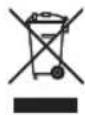
Damaged and/or disposed of electrical or electronic devices must be dropped off at recycling stations intended for that purpose.
Only for EC countries
Do not dispose of power tools into domestic waste. According to the European Guideline 2012/19/EU for Waste Electrical and Electronic Equipment and its implementation into national right, power tools that are no longer usable must be collected separately and disposed of in an environmentally friendly way.
WARRANTY
Read the warranty conditions on the separately supplied warranty card.
The product and the user manual are subject to change. Specifications can be changed without further notice.
TISCHBOHRMASCHINE TDM1027
4. KASUTAMINE, JUHISED
Sügavuspiiraja
Joonis A-1
Označava rizik od povreda, gubitak života ili oštećenje alata u slučaju nepoštovanja uputstva.
Ukazuje na prisustvo električnog napona.
CE
DECLARATION OF CONFORMITY TDM1027 - BENCH PILLAR DRILL
(EN) We declare under our sole responsibility that this product is in conformity with directive 2011/65/EU of the European parliament and of the council of 8 June on the restriction of the use of certain hazardous substances in electrical and electronic equipment is in conformity and accordance with the following standards and regulations:
(DE) Der Hersteller erklärt eigenverantwortlich, dass dieses Produkt der Direktive 2011/65/EU des Europäischen Parlaments und des Rats vom 8. Juni 2011 über die Einschränkung der Anwendung von bestimmten gefährlichen Stoffen in elektrischen und elektronischen Geräten entspricht. den folgenden Standards und Vorschriften entspricht:
(NL) Wij verklaren onder onze volledige verantwoordelijkheid dat dit product voldoet aan de conform Richtlijn 2011/65/EU van het Europees Parlement en de Raad van 8 juni 2011 betreffende beperking van het gebruik van bepaalde gevaarlijke stoffen in elektrische en elektronische apparatuur en in overeenstem ming is met de volgende standaarden en reguleringen:
(FR) Nous déclarons sous notre seule responsabilité que ce produit est conforme aux standards et directives suivants: est conforme à la Directive 2011/65/EU du Parlement Européen et du Conseil du 8 juin 2011 concernant la limitation d'usage de certaines substances dangereuses dans l'équipement électrique et électronique.
(ES) Declaramos bajo nuestra exclusiva responsabilidad que este producto cumple con las siguientes normas y estándares de funcionamiento: se encuentra conforme con la Directiva 2011/65/UE del Parlamento Europeo y del Consejo de 8 de junio de 2011 sobre la restricción del uso de determinadas sustancias peligrosas en los equipos eléctricos y electrónicos.
(PT) Declaramos por nossa total responsabilidade-de que este produto está em conformidade e cumpre as normas e regulamentações que se seguem: está em conformidade com a Directiva 2011/65/EU do Parlamento Europeu e com o Conselho de 8 de Junho de 2011 no que respeita à restrição de utilização de determinadas substâncias perigosas existentes em equipamento eléctrico e electrónico.
(IT) Dichiariamo, sotto la nostra responsabilità, che questo prodotto è conforme alle normative e ai regolamenti seguenti: è conforme alla Direttiva 2011/65/UE del Parlamento Europeo e del Consiglio dell'8 giugno 2011 sulla limitazione dell'uso di determinate sostanze pericolose nelle apparecchiature elettriche ed elettroniche.
(SV) Vi garanterar på eget ansvar att denna produkt uppfyller och följer följande standarder och bestämmelser: uppfyller direktiv 2011/65/EU från Europeiska parlamentet och EG-rådet från den 8 juni 2011 om begränsningen av användning av farliga substanser i elektrisk och elektronisk utrustning.
(FI) Vakuutamme yksinomaan omalla vastuillamme, että tämä tuote täyttää seuraavat standardit ja säädökset: täyttää Euroopan parlamentin ja neuvoston 8. kesäkuuta 2011 päivätyn direktiivin 2011/65/EU vaatimukset koskien vaarallisten aineiden käytön rajoitusta sähkö- ja elektronisissa laitteissa.
(NO) Vi erklærer under vårt eget ansvar at dette produkteter i samsvar med følgende standarder og regler: er i samsvar med EU-direktivet 2011/65/EU fra Europa-parlamentet og Europa-rådet, pr. 8 juni 2011, om begrensning i bruken av visse farlige stoffer i elektrisk og elektronisk utstyr.
(DA) Vi erklærer under eget ansvar, at dette produkt er i overensstemmelse med følgende standarder og bestemmelser: er i overensstemmelse med direktiv 2011/65/EU fra Europa-Parlamentet og Rådet af 8. juni 2011 om begrænsning af anvendelsen af visse farlige stoffer i elektrisk og elektronisk udstyr.
(HU) Felelősségünk teljes tudatában kijelentjük, hogy ez a termék teljes mértékben megfelel az alábbi szabványoknak és előírásoknak: je v souladu se směrnící 2011/65/EU Evropského parlamentu a Rady EU ze dne 8. června 2011, která se týká omezení použití určitých nebezpečných látek v elektrických a elektronických zařízeních.
(CS) Na našivlastní zodpovědnost prohlašujeme, že je tento výrobek v souladu s následujícími standardy a normami: Je v súlade s normou 2011/65/EÚ Európskeho parlamentu a Rady z 8. júna 2011 týkajúcej sa obmedzenia používania určitých nebezpečných látok v elektrickom a elektronickom vybavení.
(SK) Výhlasujeme na našu výhradnú zodpovednosť, že tento výrobok je v zhode a súlade s nasledujúcimi normami a predpismi: Je v súlade s normou 2011/65/EÚ Európskeho parlamentu a Rady z 8. júna 2011 týkajúcej sa obmedzenia používania určitých nebezpečných látok v elektrickom a elektronickom vybavení.
(SL) S polno odgovomostjo izjavljamo, da je ta izdelek v skladu in da odgovarja naslednjim standardom terpredpisom: je v skladu z direktivo 2011/65/EU Evropskega parlamenta in Sveta z dne 8. junij 2011 o omejevanju uporabe določenih nevarnih snovi v električni in elektronski opremi.
(PL) Deklarujemy na własną odpowiedzialność, że ten produkt spełnia wymogi zawarte w następujących normach i przepisach: jest zgodny z Dyrektywą 2011/65/UE Parlamentu Europejskiego i Rady z dnia 8 czerwca 2011 r. w sprawie ograniczenia stosowania niektórych niebezpiecznych substancji w sprzęcie elektrycznym i elektronicznym.
(LT) Prisimdami visą atsakomybę deklaruojame, kad śis gaminys atitinka żemiau paminėtus standartus arba nuostatus: atitinka 2011 m. birželio 8 d. Europos Parlamento ir Tarybos direktyvą 2011/65/EB dėl tam tikrų pavojingų medžiagų naudoiimo elektros ir elektroninėje irangoie apriboimo.
(LV) Ir atbilstoša Eiropas Parlamenta un Padomes 2011. gada 8. jūnija Direktīvai 2011/65/ES par dažu bīstamu vielu izmantošanas ierobežošanu elektriskās un elektroniskās iekārtās.
(ET) Apgalvojam ar visu atbildību, ka šis produkts ir saskaņa un atbilst sekojošiem standartiem un nolikumiem: ir atbilstoša Eiropas Parlamenta un Padomes 2011. gada 8. jūnija Direktīvai 2011/65/ES par dažu bīstamu vielu izmantošanas ierobežošanu elektriskās un elektroniskās iekārtās.
(RO) Declarăm prin aceasta cu răspunderea deplină că produsul acesta este în conformitate cu următoarele standarde sau directive: este în conformitate cu Directiva 2011/65/UE a Parlamentului European și a Consiliului din 8 iunie 2011 cu privire la interzicerea utilizării anumitor substanțe periculoase la echipamentele electrice și electronice.
(HR) Izjavljujemo pod vlastitom odgovornošu da je strojem ukladan sa slijedešim standardima ili standardiziranim dokumentima i u skladu sa odredbama: usklađeno s Direktivom 2011/65/EU europskog parlamenta i vijeća izdanom 8. lipnja 2011. o ograničenju korištenja određenih opasnih tvari u električnoj i elektroničkoj opremi.
(SRL) Pod punom odgovornošću izjavljujemo da je usaglašen sa sledećim standardima ili normama: usaglašen sa direktivom 2011/65/EU Evropskog parlamenta i Saveta od 8.juna. godine za restrikciju upotrebe određenih opasnih materija u električnoj i elektronskoj opremi.
(RU) Под свою ответственность заявляем, что данное изделие соответствует следующим стандартам и нормам: соответствует требованиям Директивы 2011/65/EU Европейского парламента и совета от 8 июня 2011 г. по ограничению использования определенных опасных веществ в электрическом и электронном оборудовании
(UK) На свою власну відповідальність заявляемо, що дане обладнання відповідає наступним стандартам і нормативам: задовольняє вимоги Директиви 2011/65/ЄС Європейського Парламенту та Ради від 8 червня 2011 року на обмеження використання деяких небезпечних речовин в електричному та електронному обладнанні.
(EL) Δηλώνουμε υπεύθυνα ότι το προϊόν αυτό συμφωνεί και τηρεί τους παρακάτυ κανονισμούς και τρότυπα: συμμοφώνεται με την Οδηγία 2011/65/ΕΕ του Ευρωπαϊκού Κοινοβουλίου και του Συμβουλίου της Βης Ιουνίου 2011 για τον περιορισμό της χρήσης ορισμένων επτικίνδυνων συπών σε ηλεκτρικό και ηλεκτρονικό εξοπλισμό.
EN 55014-1, EN 55014-2, EN 61000-3-2, EN 61000-3-3, EN 62841-1, EN 62841-3-13
2006/42/EC, 2014/30/EU, 2012/19/EU, 2011/65/EU
Zwolle, 01-04-2022
H.G.FRosberg
CEO FERM
FERM - Lingenstraat 6 - 8028 PM - Zwolle - The Netherlands

- TDM1027
- BENCH PILLAR DRILL TDM1027
- Thank you for buying this Ferm product.
- MACHINE INFORMATION
- Technical specifications
- Description
- SAFETY INSTRUCTIONS
- Explanation of symbols
- During use the following points must be considered:
- Immediately switch off the machine when:
- Electrical safety
- Replacing cables or plugs
- Using extension cables
- Safety instructions for transportable drills Drill safety warnings
- ASSEMBLY
- Fig. B, F
- Setting up the bench drill
- Adjusting the number of revolutions of the drill spindle
- Fig. C
- Fig. C & D
- Spindle speeds
- OPERATION, HINTS AND TIPS
- Depth stop
- Clamping the drill
- Fig. F
- Clamping the workpiece
- Fig. G
- Adjusting the bench
- Fig. 1
- Number of revolutions, speed of rotation, supply
- MAINTENANCE
- Cleaning
- Lubrication
- Faults
- ENVIRONMENT
- Only for EC countries
- WARRANTY
- TISCHBOHRMASCHINE TDM1027
- KASUTAMINE, JUHISED
- Sügavuspiiraja
- Joonis A-1
- CE
- DECLARATION OF CONFORMITY TDM1027 - BENCH PILLAR DRILL
- EN 55014-1, EN 55014-2, EN 61000-3-2, EN 61000-3-3, EN 62841-1, EN 62841-3-13
Brand : Ferm
Model : TDM1027
Category : Drill