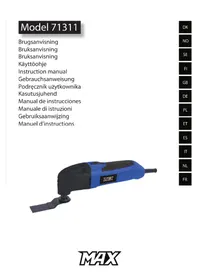
71311 - Multitools MAX - Free user manual and instructions
Find the device manual for free 71311 MAX in PDF.


| Product type | Multi-function tool |
| Brand | MAX |
| Model | 71311 |
| Voltage / Frequency | 230 V ~ 50 Hz |
| Rated power | 180 W |
| No-load speed | 22 000 / min |
| Protection class | II (double insulation) |
| Vibration level (sanding) | 2.5 m/s² |
| Main functions | Sanding, sawing, scraping, polishing, rasping, cutting |
| Included accessories | 3 sandpaper sheets (93×93×93 mm), 1 saw blade, 1 straight spatula, 1 Allen key, 1 sanding pad (91×91×91 mm) |
| Tool attachment | Clamping screw with washer (small or large diameter depending on tool) |
| Sanding | Hook and loop system, interchangeable sandpaper |
| Sawing | E-Cut saw blade, pendulum motion possible |
| Scraping | Removal of paint and adhesives |
| Recommended safety equipment | Safety goggles, hearing protection, gloves, dust mask, safety helmet |
| Maintenance | Clean ventilation openings and housing with compressed air at least once a year |
| Spare parts and service | www.schou.com for complaints, spare parts, returns, warranty |
| Manufacturer | Schou Company A/S, Nordagade 31, 6000 Kolding, Denmark |
| CE conformity | EN 62841-2-4:2014, EN 62841-1:2019, etc. |
| Recycling | Do not dispose of with household waste, drop off at a WEEE collection point |
Frequently Asked Questions - 71311 MAX
User questions about 71311 MAX
0 question about this device. Answer the ones you know or ask your own.
Ask a new question about this device
Download the instructions for your Multitools in PDF format for free! Find your manual 71311 - MAX and take your electronic device back in hand. On this page are published all the documents necessary for the use of your device. 71311 by MAX.
USER MANUAL 71311 MAX
GB: This product is double insulated and comes under protection class II
Product Safety Manager
19.02.2020 - Schou Company A/S, DK-6000 Kolding
Miljooplysninger
Montere/skfte slopepapir
Med borrelässystem
Product Safety Manager
19.02.2020 - Schou Company A/S, DK-6000 Kolding
Miljoinformasjon
Product Safety Manager
19.02.2020 - Schou Company A/S, DK-6000 Kolding
Miljöinformation
19.02.2020 - Schou Company A/S, DK-6000 Kolding
The accessories described or shown in this instruction manual are not necessarily supplied along with the machine.
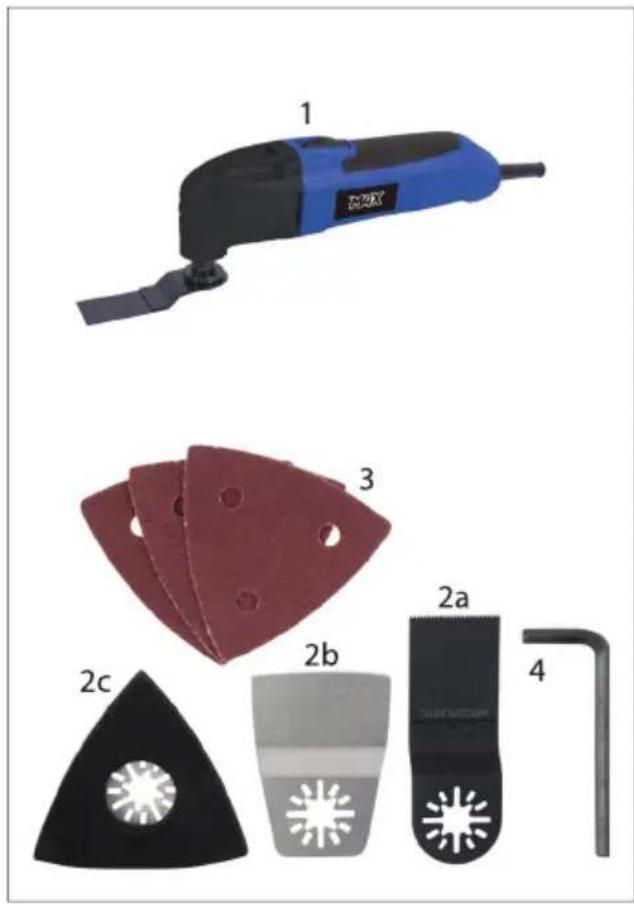
Technical data
Voltage/frequency: 230V 50Hz
Power rating: 180 W
Revolutions: 22,000 per min.
Sound pressure, L_pA: 84 ~dB(A), K_pF=3 ~dB(A)
Sound level, L_WA : 95 dB(A), K = 3 dB(A)
Vibrations, aH: 3.26 m/s ^2 , K=1.5 m/s²
The table below shows how long you may be exposed to vibration every day, if the vibration load of 2.5m / s^2 is not to be exceeded
| Vibration | Max. exposure |
| 2.5 m/s2 | 8 hours |
| 3.5 m/s2 | 4 hours |
| 5 m/s2 | 2 hours |
| 7 m/s2 | 1 hour |
| 10 m/s2 | 30 minutes |
Incl.
3 pc. sandpaper (93x93x93 mm)
1 saw blade
1 straight scrape
1 Allen key
1 sanding pad (91x91x91 mm
Special safety instructions
Read and follow these instructions before starting to use the machine:
The instruction manual.
- The instruction manual should be stored along with the machine and accompany the machine if it is sold or transferred to someone else.
Intended use
This machine is intended for dry sanding of small areas, sawing and scraping with various tool accessories, as well as for polishing, rasping, cutting and separating various substances
Safety instructions
Personal protective equipment. Make sure you use safety goggles, hearing protection and a dust mask when operating the machine
Operating the machine
On/off switchl
- Check that the cable and plug are intact.
Turning on: - Push the contact forward to position (1). Switching off
- Push the contact back to position (0).
Attaching tools
There is a risk of injury from the machine starting unintentionally.
Always disconnect from the mains before changing a tool
Be careful when using a sharp tool such as scrapers, saw blades or cutters, for example.
Clamping screw with small washer diameter:
For sanding pad, sanding blades, polishing disc, HM rasp (hard metal).
Clamping screw with large washer diameter. For saw blades, scrapers and disc cutters and cutting discs.
- Remove the clamping screw using an Allen key.
- Replace the tool and tighten it using the clamping screw. Check that the tool is secure in the machine.
Fitting/replacing sandpaper
Using velcro system
- Place the sandpaper in the middle of the sanding pad and press it firmly with your hand.
- Press the sandpaper firmly onto the plate with brief, firm pressure and then switch on the machine. This ensures that the disc is correctly secured and prevents excessive wear
- If the sandpaper is very worn in a particular spot, you can remove it, turn it 120^ and refit it or replace it
Helpful hints
Sanding
Typical use: wood, metal, small areas, including, in particular, corners, edges and awkward-to-reach areas.
Press the machine gently against the surface and keep it moving constantly
You cannot increase efficiency by pressin the machine hard against the workpiece. This will just wear the sandpaper more quickly.
Sawing with saw blades
Typical use: wood, plastic, sheet metal, ordinary metal.
The sandpaper will last longer if it is worn evenly. In order to ensure that the sandpaper worn evenly, you should loosen it, turn the sanding pad slightly and retighten it securely.
Sawing with E-Cut saw blades
Risk of personal injury
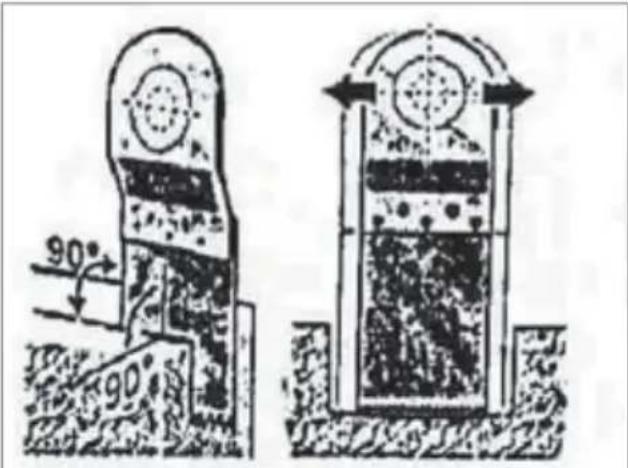
The teeth on the saw blade are very sharp. Avoid touching them during fitting and when using the saw blade.
Check that there are no live wires in the wall before you begin sawing.
Push the tool fully into the chuck and tighten securely before using the machine.
Typical use: wood, plaster and soft plastic materials. Not suitable for metal (e.g. nails) or stone.
All you need to do is to secure the E-cut saw blade and saw in a straight line. Always use a fastening screw and a washer with a large diameter.
Carefully remove the protective guard.
Always check that the E-Cut saw blade runs straight (90^) , and push it down into the saw groove in a straight line.
Always guide the E-Cut saw blade along the cutting line without using excess pressure.
When sawing or drilling with a slight pendulum movement, ensure that suffi cien material is removed.
Always keep the machine at a safe distance from stone and metal (approx. 3mm ), as there is a risk of the outside teeth breaking off.
Scraping
Typical use: Scraping off old paint anc adhesives, such as carpet glue on stairs or other mid-size surfaces.
Cleaning and care
There is a risk of personal injury from the machine starting unintentionally. Always disconnect from the mains before cleaning it.
Carry out the following at least once a week, especially if the machine is in frequent use:
Clean the ventilation holes.
- Blow the outside of the motor housing clean using compressed air
Service centre
Note: Please quote the product model number in connection with all inquiries.
The model number is shown on the front of this manual and on the product rating plate.
For:
- Complaints
- Replacements parts
- Returns
- Guarantee issues
www.schou.com
EC Declaration of Conformity
Manufacturer: Schou Company A/S, Nordager 31, 6000 Kolding, Denmark hereby declares that

JOINT CUTTER/MULTI-CUTTER
71311
230V-180W
has been manufactured in accordance with the following standards or normative documents
EN 62841-2-4:2014
FN 62841-1:2015
EN 55014-1:2008/A2:201
EN 55014-2:2015
EN 61000-3-2:2014
EN 61000-3-3:2013
in accordance with the provisions of the following directives
2006/42/EC The Machinery Directive
2014/30/EU The EMC Directive
1907/2006/EC The REACH Regulation
2011/65/EU The RoHS Directive

Kirsten Vibeke Jenser Product Safety Manager
19.02.2020 - Schou Company A/S, DK-6000 Kolding Denmark
Environmental information
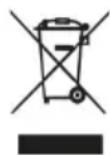
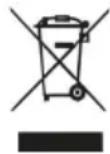
Electrical and electronic equipment (EEE) contains materials, components and substances that may be hazardous and harmful to human health and the environment
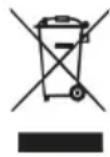
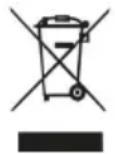
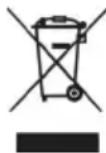
if waste electrical and electronic equipment (WEEE) is not disposed of correctly. Products marked with a crossed-out wheeled bin are electrical and electronic equipment. The crossed-out wheeled bin indicates that waste electrical and electronic equipment must not be disposed of with unsorted household waste, but must be collected separately.
Manufactured in P.R.C.
All rights reserved. The content of this manual may not be reproduced, either in full or in part, in any way by electronic or mechanical means, e.g. photocopying or publication, translated or saved in an information storage and retrieval system without written permission from Schou Company A/S
Product Safety Manager
19.02.2020 - Schou Company A/S, DK-6000 Kolding
Kirsten Vibeke Jenser Product Safety Managei
19.02.2020 - Schou Company A/S, DK-6000 Kolding Denmark
Product Safety Manager
19.02.2020 - Schou Company A/S, DK-6000 Kolding Taani
Product Safety Manager
19.02.2020 - Schou Company A/S, DK-6000 Kolding Dinamarca
Kirsten Vibeke Jenser Product Safety Managei
19.02.2020 - Schou Company A/S, DK-6000 Kolding Danimarca
Product Safety Manager
19.02.2020 - Schou Company A/S, DK-6000 Kolding Denemarker
Milieu-informatie
2006/42/CE Directive machines
2014/30/UE Directive CEM
1907/2006/CE Reglement REACH
2011/65/UE Directive RoHS

Kirsten Vibeke Jenser
Product Safety Manager
19.02.2020 - Schou Company A/S, DK-6000 Kolding Danemark