ManualGo.com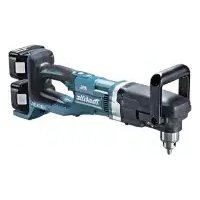
DDA460PT2 - Drill MAKITA - Free user manual and instructions
Find the device manual for free DDA460PT2 MAKITA in PDF.



Download the instructions for your Drill in PDF format for free! Find your manual DDA460PT2 - MAKITA and take your electronic device back in hand. On this page are published all the documents necessary for the use of your device. DDA460PT2 by MAKITA.
USER MANUAL DDA460PT2 MAKITA
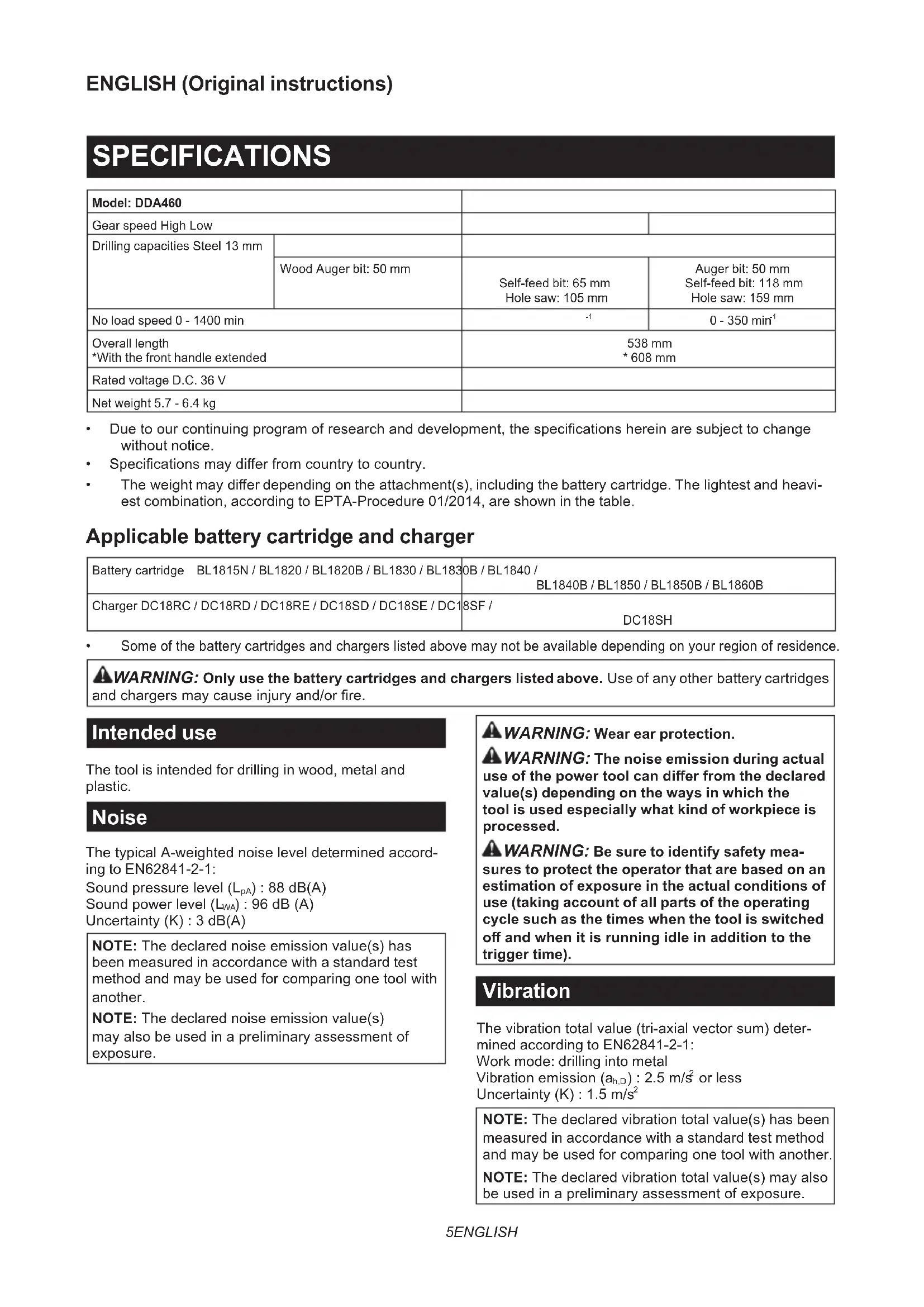
Overall length *With the front handle extended 538 mm
- Specicationsmaydierfromcountrytocountry.
- Theweightmaydierdependingontheattachment(s),includingthebatterycartridge.Thelightestandheavi- est combination, according to EPTA-Procedure 01/2014, are shown in the table. Applicable battery cartridge and charger Batterycartridge BL1815N / BL1820 / BL1820B / BL1830 / BL1830B / BL1840 / BL1840B / BL1850 / BL1850B / BL1860B Charger DC18RC / DC18RD / DC18RE / DC18SD / DC18SE / DC18SF / DC18SH
WARNING: Only use the battery cartridges and chargers listed above.Useofanyotherbatterycartridges
andchargersmaycauseinjuryand/orre. Intended use The tool is intended for drilling in wood, metal and plastic. Noise ThetypicalA-weightednoiseleveldeterminedaccord- ing to EN62841-2-1: Soundpressurelevel(L
WARNING: Wear ear protection.
WARNING: The noise emission during actual
use of the power tool can dier from the declared value(s) depending on the ways in which the tool is used especially what kind of workpiece is processed.
WARNING: Be sure to identify safety mea-
sures to protect the operator that are based on an estimation of exposure in the actual conditions of use (taking account of all parts of the operating cycle such as the times when the tool is switched o and when it is running idle in addition to the trigger time). Vibration Thevibrationtotalvalue(tri-axialvectorsum)deter- mined according to EN62841-2-1: Work mode: drilling into metal Vibrationemission(a h,D ):2.5m/s
NOTE:Thedeclaredvibrationtotalvalue(s)hasbeen measured in accordance with a standard test method andmaybeusedforcomparingonetoolwithanother. NOTE:Thedeclaredvibrationtotalvalue(s)mayalso beusedinapreliminaryassessmentofexposure.6 ENGLISH
The vibration emission during actual use of the power tool can dier from the declared val- ue(s) depending on the ways in which the tool is used especially what kind of workpiece is processed.
Be sure to identify safety measures to protect the operator that are based on an estima- tion of exposure in the actual conditions of use (tak- ing account of all parts of the operating cycle such as the times when the tool is switched o and when it is running idle in addition to the trigger time). Declarations of Conformity For European countries only TheDeclarationsofconformityareincludedinAnnexA to this instruction manual. SAFETY WARNINGS General power tool safety warnings
Read all safety warnings, instruc- tions, illustrations and specications provided with this power tool. Failure to follow all instructions listed below mayresultinelectricshock,reand/orseriousinjury. Save all warnings and instruc- tions for future reference. Theterm"powertool"inthewarningsreferstoyour mains-operated(corded)powertoolorbattery-operated (cordless)powertool. Cordless drill safety warnings Safety instructions for all operations
1. Use the auxiliary handle(s). Loss of control can
causepersonalinjury.
Hold the power tool by insulated gripping sur- faces, when performing an operation where the cutting accessory may contact hidden wiring. Cuttingaccessorycontactinga"live"wiremay make exposed metal parts of the power tool "live" and could give the operator an electric shock.
Always be sure you have a rm footing. Be sure no one is below when using the tool in high locations.
4. Hold the tool rmly.
5. Keep hands away from rotating parts.
6. Do not leave the tool running. Operate the tool
only when hand-held.
7. Do not touch the drill bit or the workpiece
immediately after operation; they may be extremely hot and could burn your skin.
Some material contains chemicals which may be toxic. Take caution to prevent dust inhalation and skin contact. Follow material supplier safety data.
9. If the drill bit cannot be loosened even you
open the jaws, use pliers to pull it out. In such a case,pullingoutthedrillbitbyhandmayresultin injurybyitssharpedge. Safety instructions when using long drill bits
1. Never operate at higher speed than the max-
imum speed rating of the drill bit. At higher speeds,thebitislikelytobendifallowedtorotate freelywithoutcontactingtheworkpiece,resulting inpersonalinjury.
2. Always start drilling at low speed and with the
bit tip in contact with the workpiece. At higher speeds,thebitislikelytobendifallowedtorotate freelywithoutcontactingtheworkpiece,resulting inpersonalinjury.
3. Apply pressure only in direct line with the bit
and do not apply excessive pressure. Bits can bend causing breakage or loss of control, resulting inpersonalinjury. SAVE THESE INSTRUCTIONS.
WARNING: DO NOT let comfort or familiarity
with product (gained from repeated use) replace strict adherence to safety rules for the subject product. MISUSE or failure to follow the safety rules stated in this instruction manual may cause serious personal injury. Important safety instructions for battery cartridge
Before using battery cartridge, read all instruc- tions and cautionary markings on (1) battery char- ger, (2) battery, and (3) product using battery.
2. Do not disassemble or tamper the battery
cartridge.Itmayresultinare,excessiveheat, or explosion.
3. If operating time has become excessively
shorter, stop operating immediately. It may result in a risk of overheating, possible burns and even an explosion.
4. If electrolyte gets into your eyes, rinse them
out with clear water and seek medical atten- tion right away. It may result in loss of your eyesight.
5. Do not short the battery cartridge:
(1) Do not touch the terminals with any con- ductive material. (2) Avoid storing battery cartridge in a con- tainer with other metal objects such as nails, coins, etc. (3) Do not expose battery cartridge to water or rain. A battery short can cause a large current ow, overheating, possible burns and even a breakdown.
6. Do not store and use the tool and battery car-
tridge in locations where the temperature may reach or exceed 50 °C (122 °F).
7. Do not incinerate the battery cartridge even if
it is severely damaged or is completely worn out. The battery cartridge can explode in a re.
8. Do not nail, cut, crush, throw, drop the battery
cartridge, or hit against a hard object to the battery cartridge.Suchconductmayresultina re,excessiveheat,orexplosion.
9. Do not use a damaged battery.7 ENGLISH
The contained lithium-ion batteries are subject to the Dangerous Goods Legislation requirements. Forcommercialtransportse.g.bythirdparties, forwarding agents, special requirement on pack- aging and labeling must be observed. For preparation of the item being shipped, consult- ing an expert for hazardous material is required. Pleasealsoobservepossiblymoredetailed national regulations. Tapeormaskoopencontactsandpackupthe batteryinsuchamannerthatitcannotmove around in the packaging.
11. When disposing the battery cartridge, remove
it from the tool and dispose of it in a safe place. Follow your local regulations relating to disposal of battery.
12. Use the batteries only with the products
specied by Makita. Installing the batteries to non-compliantproductsmayresultinare,exces- siveheat,explosion,orleakofelectrolyte.
13. If the tool is not used for a long period of time,
the battery must be removed from the tool.
14. During and after use, the battery cartridge may
take on heat which can cause burns or low temperature burns. Pay attention to the han- dling of hot battery cartridges.
15. Do not touch the terminal of the tool imme-
diately after use as it may get hot enough to cause burns.
16. Do not allow chips, dust, or soil stuck into the
terminals, holes, and grooves of the battery cartridge.Itmayresultinpoorperformanceor breakdownofthetoolorbatterycartridge.
17. Unless the tool supports the use near
high-voltage electrical power lines, do not use the battery cartridge near a high-voltage elec- trical power lines.Itmayresultinamalfunction orbreakdownofthetoolorbatterycartridge.
18. Keep the battery away from children.
SAVE THESE INSTRUCTIONS. CAUTION: Only use genuine Makita batteries. Use of non-genuine Makita batteries, or batteries that havebeenaltered,mayresultinthebatterybursting causingres,personalinjuryanddamage.Itwill alsovoidtheMakitawarrantyfortheMakitatooland charger. Tips for maintaining maximum battery life
1. Charge the battery cartridge before completely
discharged. Always stop tool operation and charge the battery cartridge when you notice less tool power.
2. Never recharge a fully charged battery car-
tridge. Overcharging shortens the battery service life.
Charge the battery cartridge with room tempera- ture at 10 °C - 40 °C (50 °F - 104 °F). Let a hot battery cartridge cool down before charging it.
4. When not using the battery cartridge, remove
it from the tool or the charger.
5. Charge the battery cartridge if you do not use
it for a long period (more than six months). FUNCTIONAL DESCRIPTION CAUTION: Always be sure that the tool is switched o and the battery cartridge is removed before adjusting or checking function on the tool. Installing or removing battery cartridge CAUTION: Always switch o the tool before installing or removing of the battery cartridge. CAUTION: Hold the tool and the battery car- tridge rmly when installing or removing battery cartridge.Failuretoholdthetoolandthebattery cartridgermlymaycausethemtoslipoyourhands andresultindamagetothetoolandbatterycartridge andapersonalinjury. ►Fig.1: 1. Red indicator 2. Button 3.Batterycartridge Toremovethebatterycartridge,slideitfromthetool while sliding the button on the front of the cartridge. Toinstallthebatterycartridge,alignthetongueonthe batterycartridgewiththegrooveinthehousingandslip itintoplace.Insertitallthewayuntilitlocksinplace withalittleclick.Ifyoucanseetheredindicatoronthe uppersideofthebutton,itisnotlockedcompletely. CAUTION: Always install the battery cartridge fully until the red indicator cannot be seen. If not, itmayaccidentallyfalloutofthetool,causinginjuryto youorsomeonearoundyou. CAUTION: Do not install the battery cartridge forcibly.Ifthecartridgedoesnotslideineasily,itis notbeinginsertedcorrectly. Indicating the remaining battery capacity Only for battery cartridges with the indicator ►Fig.2: 1. Indicator lamps 2. Check button Pressthecheckbuttononthebatterycartridgetoindi- catetheremainingbatterycapacity.Theindicatorlamps light up for a few seconds. Indicator lamps Remaining capacityLighted O Blinking75% to 100%50% to 75%25% to 50%0% to 25%Charge the battery.Thebatterymayhavemalfunctioned.8 ENGLISH NOTE: Depending on the conditions of use and the ambienttemperature,theindicationmaydierslightly fromtheactualcapacity. Tool / battery protection system Thetoolisequippedwithatool/batteryprotectionsys- tem.Thissystemautomaticallycutsopowertothe motortoextendtoolandbatterylife.Thetoolwillauto- maticallystopduringoperationifthetoolorbatteryis placed under one of the following conditions: Overload protection Whenthetool/batteryisoperatedinamannerthat causesittodrawanabnormallyhighcurrent,thetool stopsautomatically.Inthissituation,turnthetoolo and stop the application that caused the tool to become overloaded. Then turn the tool on to restart. Overheat protection Whenthetool/batteryisoverheated,thetoolstops automatically.Inthissituation,letthetool/batterycool before turning the tool on again. Overdischarge protection Whenthebatterycapacityisnotenough,thetoolstops automatically.Inthiscase,removethebatteryfromthe toolandchargethebattery. Main power switch
WARNING: Always turn o the main power
switch when not in use. Tostandbythetool,pressthemainpowerbuttonuntil themainpowerlamplightsup.Toturno,pressthe main power button again. ►Fig.3: 1. Main power button NOTE:Thistoolemploystheautopower-ofunction. To avoid unintentional start up, the main power switch willautomaticallyshutdownwhentheswitchtrigger is not pulled for a certain period after the main power switch is turned on. Switch action CAUTION: Before installing the battery car- tridge into the tool, always check to see that the switch trigger actuates properly and returns to the "OFF" position when released. ►Fig.4: 1. Switch trigger To start the tool, pull the switch trigger with the main powerswitchon.Toolspeedisincreasedbyincreas- ing pressure on the switch trigger. Release the switch trigger to stop. NOTE:Thetoolautomaticallystopsifyoukeeppull- ing the switch trigger for about 6 minutes. Lighting up the front lamp CAUTION: Do not look in the light or see the source of light directly. ►Fig.5: 1. Lamp Pull the switch trigger to light up the lamp. The lamp keeps on lighting while the switch trigger is being pulled. Thelampgoesoutapproximately10secondsafter releasing the switch trigger. NOTE: When the tool is overheated, the tool stops automaticallyandthelampstartsashing.Inthis case,releasetheswitchtrigger.Thelampturnsoin 5 minute. NOTE:Useadryclothtowipethedirtothelensof the lamp. Be careful not to scratch the lens of lamp, or itmaylowertheillumination. Reversing switch action ►Fig.6: 1. Reversing switch lever CAUTION: Always check the direction of rotation before operation. CAUTION: Use the reversing switch only after the tool comes to a complete stop. Changing the directionofrotationbeforethetoolstopsmaydam- age the tool. CAUTION: When not operating the tool, always set the reversing switch lever to the neu- tral position. This tool has a reversing switch to change the direction of rotation. Depress the reversing switch lever from the A side for clockwise rotation or from the B side for coun- terclockwise rotation. When the reversing switch lever is in the neutral posi- tion, the switch lever cannot be pulled. Automatic speed change function This tool has "high speed mode" and "high torque mode". Thetoolautomaticallychangestheoperationmode depending on the work load. When the work load is low, the tool will run in the "high speed mode" for quicker operation. When the work load is high, the tool will run in the "high torque mode" for powerful operation. ►Fig.7: 1. Mode indicator The mode indicator lights up in green when the tool is running in "high torque mode". If the tool is operated with excessive load, the mode indicator will blink in green. The mode indicator stops blinkingandthenlightsuporturnsoifyoureducethe load on the tool.9 ENGLISH Mode indicator status Operation mode On O Blinking High speed mode High torque mode Overload alert Speed change NOTICE: Use the speed change knob only after the tool comes to a complete stop. Changing the toolspeedbeforethetoolstopsmaydamagethetool. NOTICE: Always set the speed change knob carefully into the correct position.Ifyouoperate the tool with the speed change knob positioned half- waybetweentheposition1andtheposition2,the toolmaybedamaged. Two speed ranges can be preselected with the speed change knob. To change the speed, depress the lock button and turn the speed change knob so that the pointer points to the position 1 for low speed or the position 2 for high speed. ►Fig.8: 1. Lock button 2. Pointer 3. Speed change knob Torque limiter The torque limiter will actuate when a certain torque levelisreachedatthelowspeedsetting(position1). The motor will disengage from the output shaft. When this happens, the drill bit will stop turning. ASSEMBLY CAUTION: Always be sure that the tool is switched o and the battery cartridge is removed before carrying out any work on the tool. Installing side grip (auxiliary handle) CAUTION: Always be sure that the side grip is installed securely before operation. Screwthesidegriponthetoolsecurely.Thesidegrip can be installed on either side of the tool, whichever is convenient. ►Fig.9: 1. Side grip Front handle CAUTION: Do not x the front handle beyond the limits of the arrow as illustrated. Be cautious that your hand is not caught in the grip. Keep the hand away from the drill chuck.Theycanleadto serious accidents. CAUTION: Always be sure that the hex bolts (both sides) of the front handle are tightened securely. Thefronthandlecanbeinstalledinanypositionwithin 0° - 112.5° as illustrated. ►Fig.10: 1. Front handle Tochangetheposition,loosenthehexbolts(both sides)withahexwrenchandturnthefronthandletothe desiredposition.Thentightenthehexboltssecurely. ►Fig.11: 1. Front handle 2. Hex wrench Installing or removing drill bit To install the drill bit, place it in the chuck as far as it will go.Tightenthechuckbyhand.Placethechuckkeyin each of the three holes and tighten clockwise. Be sure totightenallthreechuckholesevenly. Toremovethedrillbit,turnthechuckkeycounterclock- wiseinjustonehole,thenloosenthechuckbyhand. ►Fig.12: 1.Chuckkey Afteruse,returnthechuckkeytothestoragecavityon the tool as illustrated. ►Fig.13 OPERATION CAUTION: Always insert the battery cartridge all the way until it locks in place.Ifyoucanseethe red indicator on the upper side of the button, it is not lockedcompletely.Insertitfullyuntiltheredindicator cannotbeseen.Ifnot,itmayaccidentallyfalloutof thetool,causinginjurytoyouorsomeonearound you. CAUTION: When the speed comes down extremely, reduce the load or stop the tool to avoid the tool damage. CAUTION: Hold the tool rmly when operat- ing the tool. Holding tool CAUTION: This is a powerful tool. High torque is developed and it is important that the tool should be securely held and properly braced. Grasp the handle with one hand and the front handle with the other hand. ►Fig.14: 1. Front handle 2. Handle When drilling a large hole with a self-feed bit, etc., the sidegrip(auxiliaryhandle)shouldbeusedasabraceto maintain safe control of the tool.10 ENGLISH Whendrillingactionisforward(clockwise),thetool should be braced to prevent a counterclockwise reac- tion if the bit should bind. ►Fig.15: 1. Reaction 2. Forward 3. Side grip When reversing, brace the tool to prevent a clockwise reaction.Ifthedrillbitmustberemovedfromapartially drilledhole,besurethetoolisproperlybracedbefore reversing. ►Fig.16: 1. Reaction 2. Reverse Drilling operation Drilling in wood When drilling in wood, the best results are obtained with wood drills equipped with a guide screw. The guide screwmakesdrillingeasierbypullingthedrillbitinto the workpiece. Drilling in metal To prevent the drill bit from slipping when starting a hole, make an indentation with a center-punch and hammer at the point to be drilled. Place the point of the drill bit in the indentation and start drilling. Use a cutting lubricant when drilling metals. The excep- tionsareironandbrasswhichshouldbedrilleddry. CAUTION: Pressing excessively on the tool will not speed up the drilling. In fact, this excessive pressurewillonlyservetodamagethetipofyourdrill bit, decrease the tool performance and shorten the service life of the tool. CAUTION: Hold the tool rmly and exert care when the drill bit begins to break through the workpiece. There is a tremendous force exerted on the tool/drill bit at the time of hole break through. CAUTION: A stuck drill bit can be removed simply by setting the reversing switch to reverse rotation in order to back out. However, the tool may back out abruptly if you do not hold it rmly. CAUTION: Always secure workpieces in a vise or similar hold-down device. CAUTION: Avoid drilling in material that you suspect contains hidden nails or other things that may cause the drill bit to bind or break. CAUTION: If the tool is operated continuously until the battery cartridge has discharged, allow the tool to rest for 15 minutes before proceeding with a fresh battery. Lanyard (tether strap) connection Safety warnings specic for use at height Read all safety warnings and instructions. Failure tofollowthewarningsandinstructionsmayresultin seriousinjury.
1. Always keep the tool tethered when working
"at height". Maximum lanyard length is 2 m (6.5 ft). The maximum permissible fall height for lan- yard (tether strap) must not exceed 2 m (6.5 ft).
2. Use only with lanyards appropriate for this tool
type and rated for at least 7.0 kg (15.4 lbs).
3. Do not anchor the tool lanyard to anything on
your body or on movable components. Anchor the tool lanyard to a rigid structure that can withstand the forces of a dropped tool.
4. Make sure the lanyard is properly secured at
each end prior to use.
5. Inspect the tool and lanyard before each use
for damage and proper function (including fabric and stitching). Do not use if damaged or not functioning properly.
6. Do not wrap lanyards around or allow them to
come in contact with sharp or rough edges.
7. Fasten the other end of the lanyard outside
the working area so that a falling tool is held securely.
8. Attach the lanyard so that the tool will move
away from the operator if it falls. Dropped tools willswingonthelanyard,whichcouldcauseinjury or loss of balance.
9. Do not use near moving parts or running
machinery.Failuretodosomayresultinacrush or entanglement hazard.
10. Do not carry the tool by the attachment device
11. Only transfer the tool between your hands
while you are properly balanced.
12. Do not attach lanyards to the tool in a way that
keeps guards, switches or lock-os from oper- ating properly.
13. Avoid getting tangled in the lanyard.
14. Keep lanyard away from the cutting area of the
15. Use multi-action and screw gate type cara-
bineers. Do not use single action spring clip carabineers.
16. In the event the tool is dropped, it must be
tagged and removed from service, and should be inspected by a Makita Factory or Authorized Service Center. ►Fig.17: 1.Holeforlanyard(tetherstrap) MAINTENANCE CAUTION: Always be sure that the tool is switched o and the battery cartridge is removed before attempting to perform inspection or maintenance. NOTICE: Never use gasoline, benzine, thinner, alcohol or the like. Discoloration, deformation or cracks may result. To maintain product SAFETY and RELIABILITY, repairs,anyothermaintenanceoradjustmentshould beperformedbyMakitaAuthorizedorFactoryService Centers,alwaysusingMakitareplacementparts.11 ENGLISH OPTIONAL ACCESSORIES CAUTION: These accessories or attachments are recommended for use with your Makita tool specied in this manual.Theuseofanyother accessories or attachments might present a risk of injurytopersons.Onlyuseaccessoryorattachment for its stated purpose. Ifyouneedanyassistanceformoredetailsregard- ingtheseaccessories,askyourlocalMakitaService Center.