 EasyManual
 43ACCU Vario - Lawn mower SABO - Free user manual and instructions
Find the device manual for free 43ACCU Vario SABO in PDF.



Download the instructions for your Lawn mower in PDF format for free! Find your manual 43ACCU Vario - SABO and take your electronic device back in hand. On this page are published all the documents necessary for the use of your device. 43ACCU Vario by SABO.
USER MANUAL 43ACCU Vario SABO
43-ACCU VARIO / 47-ACCU VARIO
English Original Instructions
1 INTRODUCTION Dear Garden Lover, Where pride in a trim lawn is coupled with a love of gardening, gardeners really appreciate good gardening equipment. You have made an excellent choice in purchasing your new lawn mower. It combines the power of a major traditional brand with the innovations of modern high-tech. You will feel this when you are working with it and be very pleased with the wonderful result. Yet before you start work on your lawn, here is some important information which you should always heed. Before you start your mower for the first time, read this operation manual through carefully to familiarise yourself with the correct operation and maintenance of the machine and to avoid injury or damage to your lawn mower. Read and note the separate operating instructions of the charger supplied as well, in particular the safety information. Use the lawn mower carefully. The pictograms on the equipment draw your attention to the most important precautionary measures. The safety instructions in this operating manual are marked with symbols. The meaning of the pictograms and symbols is explained in the following chapters. The terms "left" and "right" always refer to the left and right-hand side of the equipment seen in the direction of movement. Your mower will work reliably when the technical instructions are followed exactly. We would like to point out that any damage to the mower caused by operating faults is not covered by warranty / guarantee obligations. We hope you enjoy cultivating your lawn.
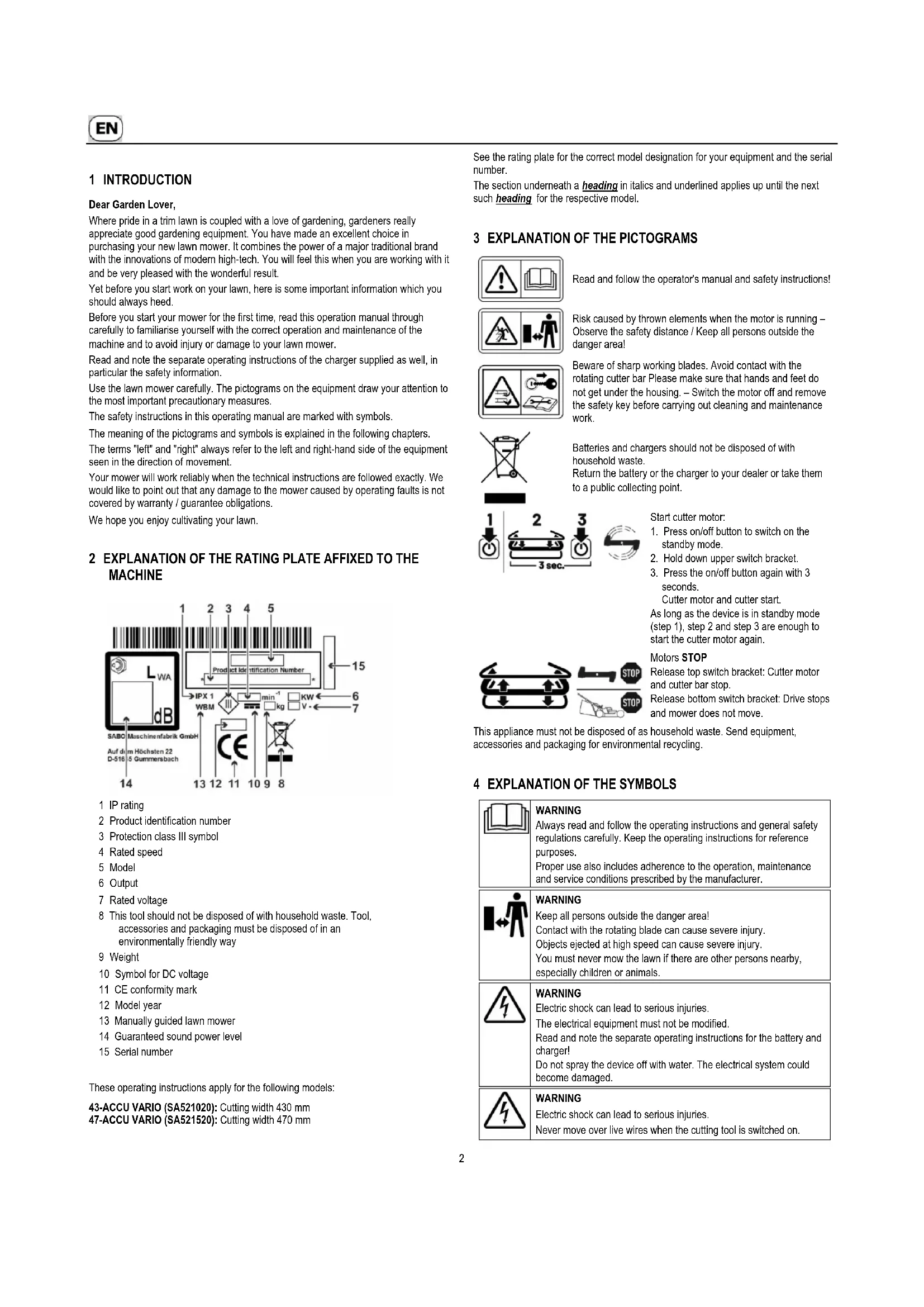
1 IP rating 2 Product identification number 3 Protection class III symbol 4 Rated speed 5 Model 6 Output 7 Rated voltage 8 This tool should not be disposed of with household waste. Tool, accessories and packaging must be disposed of in an environmentally friendly way 9 Weight 10 Symbol for DC voltage 11 CE conformity mark 12 Model year 13 Manually guided lawn mower 14 Guaranteed sound power level 15 Serial number
These operating instructions apply for the following models: 43-ACCU VARIO (SA521020): Cutting width 430 mm 47-ACCU VARIO (SA521520): Cutting width 470 mm See the rating plate for the correct model designation for your equipment and the serial number. The section underneath a heading in italics and underlined applies up until the next such heading for the respective model.
Read and follow the operator's manual and safety instructions!
Risk caused by thrown elements when the motor is running – Observe the safety distance / Keep all persons outside the danger area!
Beware of sharp working blades. Avoid contact with the rotating cutter bar Please make sure that hands and feet do not get under the housing. – Switch the motor off and remove the safety key before carrying out cleaning and maintenance work.
Batteries and chargers should not be disposed of with household waste. Return the battery or the charger to your dealer or take them to a public collecting point.
1. Press on/off button to switch on the
3. Press the on/off button again with 3
seconds. Cutter motor and cutter start. As long as the device is in standby mode (step 1), step 2 and step 3 are enough to start the cutter motor again.
Motors STOP Release top switch bracket: Cutter motor and cutter bar stop. Release bottom switch bracket: Drive stops and mower does not move.
This appliance must not be disposed of as household waste. Send equipment, accessories and packaging for environmental recycling.
WARNING Always read and follow the operating instructions and general safety regulations carefully. Keep the operating instructions for reference purposes. Proper use also includes adherence to the operation, maintenance and service conditions prescribed by the manufacturer.
WARNING Keep all persons outside the danger area! Contact with the rotating blade can cause severe injury. Objects ejected at high speed can cause severe injury. You must never mow the lawn if there are other persons nearby, especially children or animals.
WARNING Electric shock can lead to serious injuries. The electrical equipment must not be modified. Read and note the separate operating instructions for the battery and charger! Do not spray the device off with water. The electrical system could become damaged.
WARNING Electric shock can lead to serious injuries. Never move over live wires when the cutting tool is switched on.3 Before and during the mowing process, check the area for live wires and remove them if possible. If a live wire is damaged, switch off the equipment and disconnect the wire from the supply grid.
WARNING Watch out for sharp blades! Contact with the rotating blade can cause severe foot injuries. Only start the engine when standing behind the mower. Ensure that your feet do not get under the housing.
WARNING Watch out for sharp blades! Contact with the rotating blade can cause severe hand and foot injuries. When the engine is running, always observe the safety distance to the machine which is maintained by the handlebar. Ensure that your hands and feet do not get under the housing.
WARNING Objects thrown upwards can cause serious injuries. Before mowing areas covered in leaves in particular, remove all stones, sticks, wires, toys and other objects from the lawn. Never use the equipment with the protective devices damaged or missing. Missing or damaged safety and protective devices are a safety hazard for both you and other people. Before initial operation, check that the cutting blade screw is fastened, then examine the cutter bar for a tight fit, wear and damage every time you intend to use the mower. Have an authorised workshop replace a worn or damaged blade. Have an authorised workshop tighten the cutting blade screw.
WARNING If the safety key is not disconnected during work on the equipment, the motor may start up and this can result in serious injuries. Contact with the rotating cutting blade can lead to serious hand and foot injuries. Objects thrown upwards can cause serious injuries. Switch off the motor and wait until the cutting tool comes to a standstill; remove safety key: – before maintenance ad repair work; – if the mower needs lifting or tilting e.g. for transport purposes; – when driving outside the lawn on paths or streets; – if the machine is transported to and from the mowing surface again and again; – if the machine is left unsupervised; – before the battery is removed from or inserted into the battery compartment on the motor; – before the mulching plug is removed. Consult the operating instructions for respective cleaning or maintenance instructions. Insufficient equipment maintenance will lead to safety-related faults.
WARNING Contact with the rotating cutter bar can lead to serious hand and foot injuries. Objects thrown upwards can cause serious injuries. Switch the motor off and wait until the cutting tool comes to a standstill: – before setting the cutting height; – before removing the grass collecting bag.
CAUTION Contact with the sharp edges of the blade and other sharp edges of the machine can cause severe injury. Protective gloves must be worn at all times during maintenance and cleaning work.
- The equipment is exclusively designed for mowing grass and lawn areas within the context of gardening and landscape care ("Proper use"). Any use going beyond this is considered not proper; the manufacturer is not liable for any damage resulting from such use, the risk is borne by the user alone. Proper use also includes adherence to the operation, maintenance and service conditions prescribed by the manufacturer.
- Special care is required during use in public areas, parks, sports facilities, on roads and in agricultural and forestry operations.
- The mower must not be used in particular for trimming bushes, hedges and shrubs, for cutting twining plants or greenery on roofs and in flower baskets or boxes, for extraction or blowing on pavements.
- The use of any additional equipment and attachments not approved by the manufacturer is prohibited. If such additional equipment and attachments are used, the CE conformity and guarantee are considered null and void. Unauthorised modifications to this lawn mower exclude the manufacturer from liability for any damage resulting from these modifications.
ROTARY LAWNMOWER General safety instructions
Always read the operating instructions carefully for your own protection and to guarantee perfect function. Familiarise yourself with the operating elements and correct machine operation. Keep the operating instructions for reference purposes.
- Remember that the machine operator or user is responsible for accidents with other persons or their property.
- These operating instructions belong to the machine and must be handed over to the new owner in the event of the machine being sold.
- Never allow children and persons under 16 years of age or other persons not familiar with the operating instructions to use the machine. Local regulations can specify the minimum age of the user.
- Explain the potential hazards and how to avoid accidents to all those who are to use the equipment. This equipment may only be used, serviced and repaired by persons who are familiar with it and have been informed about the hazards.
- This equipment is not intended to be used by persons with limited physical, sensory or mental aptitude or lack of experience and/or knowledge unless they are supervised by a person responsible for their safety and have received instructions from this person as to how the equipment is used. This supervisor must decide in advance whether the person with limited physical, sensory or mental aptitude is suitable for this task.
Never use the mower while persons, particularly children, or animals are nearby.
- Keep your machine safe! Always keep unused equipment without the safety key and without battery in a clean state in a dry, locked room and inaccessible to children.
- Machine safety and protective devices must not be manipulated or disabled.
- The laying of cables must not be manipulated, e.g. by removing cable clamps or attaching additional cable ties! The cables must lie against the outside of the bar in such a way that they are neither crushed nor overstretched when the bar is folded. A damaged cable may result in a technical defect of the equipment. Preparatory measures
- When mowing, you must always wear a strong, closed, non-slip pair of shoes or safety shoes and long trousers. Avoid wearing loose clothing or clothing with cords or belts hanging down. Do not mow whilst you are barefooted or wearing sandals. Wear protective goggles to protect your eyes.
- Loud noises can lead to hearing impairments. We recommend wearing ear defenders.
Before and during mowing, check the whole area the equipment is being used on and remove all stones, sticks, wires, toys and other objects which can be caught and catapulted out.
Before and during the mowing process, check the area for live wires and remove them if possible. Never move over live wires when the cutting tool is switched on. Risk of electric shock! If a live wire is damaged, switch off the equipment and disconnect the wire from the supply grid.
- If you also use a mowing robot for lawn care, the following safety instructions must be heeded with regard to the working area of the mowing robot: – Before mowing on these areas, always check the range of the boundary wire. – If the wires are laid in the ground they must be checked, no wires may be visible, with particular attention necessary at the charging station.4 – If the boundary wires are laid above ground they should be routed tight directly on the ground and not lie loose in the grass. The wires must be sufficiently fixed using boundary staples, see the operating manual. – The boundary staples must not project, if this is the case push them firmly in place. – Remove any residual wires before starting to mow. In the cases described above, there is a risk of the wire being pulled in and wound up by the tool; this can lead to serious injury.
- Overhanging branches and similar obstacles can injure the user or impede mowing. Cables can get caught and damaged or pulled out. A damaged cable may result in a technical defect of the equipment. Before and during mowing, check for possible obstacles such as overhanging branches and cut these back or remove them.
The electrical equipment must not be modified. Read and note the separate operating instructions for the battery and charger!
- Before use, always carry out a visual inspection to see whether the cutting tool, attachment screws and the complete cutting unit are worn or damaged. To avoid unbalance, worn or damaged blades and attachment screws must be replaced by an authorised workshop.
- The condition of the pictograms must be checked every time the device is used. Worn or damaged pictograms must be replaced. Handling
- The supplied charger may only be used for the batteries belonging to the lawnmower. Equally, the batteries must not be charged using another charger. You can put yourself at risk or damage your device. Only use the lawnmower with the batteries approved for it. Incorrect use of batteries and charger may result in electric shock or fire. Approved chargers and batteries: see chapter "Original spare parts and accessories".
- The machine must not be operated in potentially explosive surroundings.
- Do not mow in bad weather when lightning could strike.
- Do not expose the tool to rain or humidity.
- Do not wear radio or music headphones. Safe service and operation requires your full attention.
- Only mow during daylight or if the lighting is good. Always push the machine at walking pace.
- Please adjust the driving speed depending on the person and the terrain. Increase speed gradually until you have reached a suitable driving speed, switch the motor drive off if necessary.
- Use care when approaching blind corners, shrubs, trees, or other obstacles that may obscure vision.
- Do not move too closely to holes, trenches and banks. The equipment can suddenly topple over when a wheel suddenly gives way over the edge of a trench or a bank or when an edge suddenly yields.
- Please be careful when mowing underneath playground equipment (e.g. swings). The equipment could get into an unsafe position. This may result in risk of injury.
- Do not operate the equipment when you are sick, tired or under the influence of alcohol, medicine or drugs.
- Avoid using the machine if possible on wet grass, in order to avoid the danger of slipping.
- Always make sure that you are standing securely whilst mowing slopes. Always mow at right angles to the slope, never mow straight up or down. Please be especially careful when you change direction when mowing on a slope.
- Do not mow excessively steep slopes. Mowing slopes always means additional risks. Always make sure you have a firm stance. Manually guided lawn mowers should never be used for gradients of more than 26% (15° slope). Stability may be lost.
- Please be especially careful when turning the machine or pulling it towards yourself.
- If you walk backwards whilst using the machine, you can easily stumble so this should be avoided. Avoid unnatural body positions. Ensure that you are standing securely and keep your balance at all times.
- Always observe the safety distance to the machine which is maintained by the handlebar.
- In order to avoid the machine slipping when being carried, always hold the machine by the grip devices provided (carrying handle, housing, handlebar ends or transverse bar of the lower handlebar section). Do not grasp the machine by the ejection flap!
- Note the weight of the machine before lifting or carrying it (see technical data). Lifting heavy weights can lead to health problems.
- Never lift or carry the machine when the engine is running.
- Never use the machine with safety and protective devices damaged or missing. Missing or damaged safety and protective devices are a safety hazard for both you and other people. Safety equipment includes (see chapter Component description):
– Cutter bar stop safety control bar (1) The lawn mower is equipped with a cutter bar stop device. During operation and in the event of a hazard, the cutter bar is stopped by releasing the cutter safety control bar. The cutter must come to a standstill within 3 seconds. After release, the safety control bar must always return to the position shown in the "component description" diagram. If this is not the case, it must be checked immediately by an authorised workshop. Risk of injury! If the blade run-on time is longer, stop using the equipment and take it to an authorised workshop. Measuring run-on time After the cutter motor has been started, the blade rotates and a wind- like noise can be heard. The run-on time corresponds to the duration of the wind-like noise after the motor has been switched off, it can be measured using a stopwatch. The function of the safety control bar must never be put out of operation. It is important to make sure that the safety control bar functions correctly. Have an incorrectly functioning safety control bar repaired by an authorised specialist workshop.
– Safety key (9) This safety device protects against injuries from inadvertent starting of the motor. In order to prevent unauthorised operation of the machine, the safety key must be removed for all work on the machine, before maintenance and repair work, if the machine is left unsupervised and during storage.
Protective equipment includes (see chapter Component description):
– Housing (13), grass collecting bag (16), ejection flap (6). The protective devices protect the user against objects being ejected at high speed. The machine must not be operated with a damaged housing or without a properly fitted collecting bag or ejection flap on the housing.
– Housing (13) This protection unit protects against injuries through contact with the rotating cutting blade bar. The equipment must not be operated with a damaged housing. Please make sure that hands and feet are not placed underneath the housing.
The safety devices must not be modified.
When you start the machine, make sure that your feet are at a sufficiently safe distance away from the cutting blades.
When the starting the motor, the machine must not be tilted on end, if necessary it must be tilted by pressing the guide bar down so that the cutting tool is pointing in the direction away from the user, but only as far as absolutely necessary. As long as the device does not have all 4 wheels on the ground, both your hands must be on the top part of the bar. Never start the motor while persons or animals are near the mower.
Never place hands or feet close to or under rotating parts. Please make sure that hands and feet do not get under the housing.
Switch off the cutter motor by releasing the cutter safety control bar and make sure that all moving parts have come to a complete stop and the safety key is removed: – if you leave the machine unsupervised; – before you inspect or clean the machine or carry out work on it;5 – if you have to lift or tilt the mower e.g. for transport purposes; – if you transport the machine to and from the mowing surface again and again; – before you remove the battery from or insert it into the battery compartment on the motor; – when driving outside the lawn; – before you loosen blockages or remove blockages in the ejector channel; – before you remove the mulching plug; – if a foreign body has been hit; – if a fault occurs; – if the machine starts to vibrate unusually.
- If a foreign object has been encountered or if the machine becomes blocked, e.g. by driving onto an obstacle, a specialist dealer must check whether parts of the machine have been damaged or deformed. Any necessary repairs must also be carried out by an authorized specialist workshop.
- If the machine starts to vibrate unusually heavily or to make unusual noises, please have it checked immediately by an authorised workshop. Heavy vibrations on your hands can damage your health. Please contact an authorised workshop immediately if heavy vibrations occur.
Switch off the cutter motor by releasing the cutter safety control bar. Ensure that all moving parts have come to a complete stop, – if you have to lift or tilt the machine, e.g. for transport purposes; – if you transport the machine to and from the mowing surface again and again; – when driving outside the lawn; – if you leave the machine for a short time; – when you wish to adjust the cutting height; – before you remove the grass collecting bag;
- WARNING The noise and vibration levels shown in these operating instructions are the maximum levels for use of the machine. The use of an unbalanced cutting element, the excessive speed of movement, or the absence of maintenance have a significant influence on noise emissions and vibrations. Consequently, it is necessary to take preventive steps to eliminate possible damage due to high levels of noise and stress from vibration. Maintain the machine well, wear ear protection devices, and take breaks while working. Adhere to the maintenance work listed in this operating manual and have the equipment checked and serviced regularly by an authorised workshop. Maintenance and storage
- Insufficient equipment maintenance will lead to safety-related faults.
- Ensure that all screws have been tightened securely and that the machine is in a safe working condition.
The ejection flap may only be opened and the grass collecting bag moved or the mulching plug removed with the motor off and the cutter bar stationary.
Before you start mowing, always check the grass collecting equipment for wear or loss of functionality.
Before you start mowing, always check the condition and firm attachment of the cutting blade. The blade attachment screw must always be tightened by an authorised workshop. If the blade screw is too tight or too loose, the blade fastening and cutter bar can become damaged or loose which can lead to serious injuries. A worn or damaged blade must always be replaced.
Replacement, sharpening and balancing of the cutting blade bar must always be carried out by an authorised workshop. If the cutter fastening is assembled incorrectly, the cutter bar can become loose, which can lead to serious injuries. An improperly ground and imbalanced cutting blade can cause strong vibrations and damage the lawn mower.
- For reasons of safety, always replace worn or damaged parts.
- Never clean the tool under running water or using high-pressure cleaners. The electrical system could become damaged.
Protective gloves must be worn at all times during maintenance and cleaning work.
Maintenance and cleaning work may only be carried out on level surfaces with the motor switched off and the safety key removed. Regular maintenance is essential for safety and top performance.
Always store the equipment in a clean state in a closed, dry room and inaccessible to children. Always remove the battery and the safety key before storing the machine in order to prevent unauthorised actuation of the machine.
For reasons of warranty and safety, only genuine spare parts may be used. Non-equivalent spare parts can damage the machine and are a safety hazard.
1 Safety control bar for blade stop 2 Display and control elements for the drive motor 3 Guide rail 4 Drive control bar 5 Quick release 6 Ejector flap 7 Battery cover 8 Battery (beneath the battery cover) 9 Safety key (beneath the battery cover) 10 Cutting height adjustment 11 Motor cover 12 Carrying handle, front 13 Housing 14 Rail height adjustment 15 Carrying handle, back 16 Grass collecting sack 17 Display and control elements for the standby mode, cutter motor and battery6 8 OVERVIEW OF THE DISPLAY AND CONTROL ELEMENTS
1 Display and control elements for the drive motor 2 Speed display 3 "Increase speed" button 4 "Reduce speed" button 5 Display and control elements for standby mode, cutter motor and battery 6 Display of the charge level of the battery currently being used, from top to bottom: battery charged 100%, 75%, 50%, 25% 7 Energy-saving button 8 Energy-saving display 9 On/off button for standby mode and cutter motor 10 Fault display
9 PREPARATION The following unit parts are included in the package for mower assembly:
- Mower with pre-assembled handlebar
- Grass catch, collecting bag frame
- Tool bag containing the following: – Operating manual with Declaration of Conformity – Guarantee conditions (depending on the model) Should a part be missing, please contact your professional dealership. Raise the handlebar (Illustration A1 + B1 + V4 ) IMPORTANT Make sure that the cables are not pinched, squeezed, twisted or overstretched when the handlebars are folded apart or collapsed! Always run the cables along the outside of the bar connection. A damaged cable may result in a technical defect of the equipment. CAUTION When you activate the bar height adjustment, when loosening the wing nuts B1 used to secure the bar bottom to the housing (only loosen sufficiently to ensure that the bar can be moved freely) and snapping the locking cams out of the drilled holes in the housing, it is possible that unintentional upsetting of the bar may occur. In addition, this may result in crushed areas between the bar bottom and the housing. This may result in a risk of injury! Pull the handlebar which is collapsed in a Z-shape upwards into place in the following sequence: – First lift the bottom part of the handlebar A1 , push the ends of this bottom part as far apart as necessary for the locking cams facing the inside to lock into the respective bore holes B1 . Three different handlebar heights can be set. – Tighten the wing nuts on both sides by hand B1 . – Lift the top part of the handlebar until the top part and the bottom part of the handlebar are on the same level. – The quick releases V4 for attachment of the top part and the bottom part of the handlebar are preset by the manufacturer.
1. Pull the quick releases upwards to the handlebar.
2. Tighten the screws hand-tight.
3. Open the quick releases.
4. Tighten the screws by a quarter to a half of a turn.
5. Pull the quick releases up again and check whether the bars are tightly
connected, correct again if necessary. – Keep this setting. If the tension slacks over time, the screws have to be tightened again. Attaching the grass collector to the mower (Illustration R1 + S1 ) – Insert the collection bag frame with the bar first into the grass catch. Align the upper seams of the grass catch on the bar. – Press the holding profile onto the frame of the collection bag frame R1 . – Open the ejection flap of the mower upwards. – Lift the grass collection bag on the carrier bar, insert the chute (1) R1 on the collection bag opening into the ejection flap and hang the grass collection bag with the two side hooks to the top of the mower housing S1 . – Fold the ejection flap onto the grass collection bag. Adjusting the cutting height (Illustration I )
The cutting height you desire is adjusted with the one-handed adjustment lever on the left hand side of the mower. – Pull the lever out of the catch and latch again after a lateral move into the desired position. – The marking on the left of the housing indicates the cutting height IMPORTANT Mowing at the lowest cutting height should only be carried out on level and plane lawns! Please note that the lower cutting height settings may only be used for optimum conditions. If you select cutting height that is too low, the turf may be damaged and under certain circumstances even destroyed. Besides the cutting height, the driving speed also influences the cutting pattern and collection result. Adapt the cutting height and driving speed to the grass height to be cut, the motor drive may not need to be switched on. Inserting the charged battery (figure K2 + V1 + G2 + H )
The handling of the charger and battery is described in the separate operating instructions for the charger. In particular, read and note the safety information! Fully charge the battery before initial use!
– Open and hold the battery cover. – Remove safety key K2 . – Push battery into the battery compartment until the lock catches V1 . Ensure that the lock on the battery can move freely and is cleanly locked in. 2 batteries or only 1 battery can be used. If only 1 battery is used, this can be inserted either into compartment I or compartment II. – Insert the safety key if the machine is to be used straight away G2 . – Close battery cover. Ensure that the cover closes automatically. Dirt and grass deposits can hinder this and therefore must be removed. – After switching on the standby mode, the display 6) H shows the charge level of the battery, from which the machine is currently drawing power. If 2 batteries are used, the power is drawn from battery I first and then from battery II. Therefore, the charge status for battery I or for battery II is on. Switching from battery I to battery II is performed automatically.
Remove the battery (Figure F + K2 + N2 ) – Switch off the motor F . – Open and hold the battery cover. – Remove safety key K2 . – Hold down the unlock button on the front of the battery and remove the battery from the compartment N2 . – Close battery cover. Ensure that the cover closes automatically. Dirt and grass deposits can hinder this and therefore must be removed.7 10 BEFORE USING THE LAWNMOWER FOR THE FIRST TIME
Check all screw connections for a tight fit. Tighten the screws if necessary. Attachment of the cutter bar must be checked in particular (see chapter "Cutter bar maintenance"). The blade attachment screw must always be tightened by an authorised workshop. If the blade screw is too tight or too loose, the blade fastening and cutter bar can become damaged or loose which can lead to serious injuries. The lawn mower is equipped with a blade stop device. Before using the equipment for the first time, make sure that the blade stop safety control bar is working perfectly. When the safety control bar is released, the cutter bar must come to a standstill within three seconds. After release, the safety control bar must always return to the position shown in the "component description" diagram. If this is not the case, it must be checked immediately by an authorised workshop. Risk of injury! If the blade run-on time is longer, stop using the equipment and take it to an authorised workshop. Measuring run-on time After the motor has been started, the blade rotates and a wind-like noise can be heard. The run-on time corresponds to the duration of the wind-like noise after the motor has been switched off, it can be measured using a stopwatch. Machine safety and protective devices must not be manipulated or disabled! Make sure that all protective devices have been attached properly and are not damaged. Charging the battery
The handling of the charger and battery is described in the separate operating instructions for the charger. In particular, read and note the safety information! Fully charge the battery before initial use!
All safety information regarding the handling, storage, safekeeping, transport, disposal of the lithium-ion battery and first-aid measures and measures for combating fires is contained in the "Product safety datasheet" at www.sabo-online.com under Instructions.
Switching signal tones on/off First ensure that – standby mode is switched on (see chapter "Switch standby mode on/off"). The display and control element signal tones can be switched on and off by simultaneously pressing "+" key (3) and "–" key (4) H .
11 SWITCHING STANDBY MODE ON/OFF (FIG. H (9) ) Standby mode has to be switched on in order to be able to work with the mower. First ensure that – there are one or two batteries in the battery compartment (see chapter "Insert the charged battery"), – the safety key is inserted G2 . Switch on standby mode (fig. H ) – Press the on/off button (9). A signal tone sounds and all display elements light up briefly. The display then shows the most recent settings (2, 8) and the charge level of the battery currently being used (6). If a battery is only 15% charged, the charge level display flashes (6) and the device automatically switches to the second battery. – Start the cutter motor to mow within approx. 30 seconds after switching to standby mode (see chapter "Start the cutter motor")." In order to save the battery, standby mode automatically switches off if the cutter motor or the drive motor is not started or a button is not pressed within approx. 30 seconds. Two signal tones sound and the display does out. If the fault display (10) shows a fault, immediately correct the fault (see chapter "Fault display") or contact an authorised workshop. Switch off standby mode (fig. H ) – Press the on/off button (9) again. Two signal tones sound and the display does out. Before not using the device for a longer period. – Remove safety key K2 . – Remove the batteries from the battery compartment N2 .
Only start the motor when you are standing behind the mower. Always place the mower on a level area which is not covered with high grass (if the grass is too high it will block the cutter bar start-up and make starting the mower more difficult). When the starting the motor, the machine must not be tilted on end, if necessary it must be tilted by pressing the guide bar down so that the cutting tool is pointing in the direction away from the user, but only as far as absolutely necessary. As long as the device does not have all 4 wheels on the ground, both your hands must be on the top part of the rail. First ensure that – there are one or two batteries in the battery compartment (see chapter "Insert the charged battery"), – the safety key is inserted G2 . Start cutter motor (fig. A2 ) – Press on/off button (1) to switch on the standby mode (see chapter "Switch standby mode on/off"). – With your left hand, hold down the safety control bar (2) against the top part of the rail and then press the on/off button (1) again with the right hand within 3 seconds. A signal tone sounds and the cutter motor and cutter start. – The cutter now runs while the safety control bar is held down. The cutter motor and cutter stop when the safety control bar is released. – After releasing the safety control bar, the device remains in standby mode for approx. 30 seconds, this is shown by the lights on the display element. The cutter motor can be started again during this period by holding down the safety control bar and pressing the on/off button again within 3 seconds. – If the cutter motor or drive motor are not started again or a button pressed within 30 seconds, standby mode switches off automatically in order to save the battery. Two signal tones sound and the display does out. To start the cutter motor, switch on standby mode again.
13 SWITCHING OFF THE CUTTER MOTOR (FIG. F + K2 ) – Release the safety control bar F . – Wait for the cutter bar to sop. – Remove safety key K2 .
14 EMERGENCY STOPPING Release the safety control bar and drive safety control bar. – The motor stops and the cutter comes to standstill. – The drive motor stops and the mower stops. NOTE Before every mowing job, make sure that the safety control bar for the cutter stop and the motor drive control bar are working perfectly: – When the safety control bar is released, the cutter must come to a standstill within 3 seconds. – When the drive control bar is released, the drive must stop immediately and the mower must come to a standstill. If this is not the case, please consult your nearest authorised workshop.8 15 MOVEMENT DRIVE NOTE If there is insufficient battery charge, the cutter motor and drive motor automatically switch off. Please charge the battery promptly. Operating the rear wheel drive (Illustration G + E2 ) First ensure that – there are one or two batteries in the battery compartment (see chapter "Insert the charged battery"), – the safety key is inserted G2 . – standby mode is switched on (see chapter "Switch standby mode on/off"). The rear wheel drive is switched on and off by means of the drive control bar on the top guide rail: – Pull and hold the drive control bar G = mower moves. – Release the drive control bar E2 = mower stops. IMPORTANT To move without mowing, always only activate the drive safety control bar! If the safety control bar is also pressed down at the same time, the drive motor switches off after approx. 3 seconds for safety reasons, the fault display shows a fault and the mower stops moving. IMPORTANT Only switch on the drive motor if the device is still or is being pushed forwards. Never switch on the drive motor while the device is moving backwards! This can destroy the gears. NOTE If you want to move the device backwards immediately after switching off the drive motor, it is possible that the centrifugal clutch is still engaged and the rear wheels are blocked. Release the clutch by pushing the device forwards with minimal force when the drive motor is off. Adjusting the speed (Illustration H (3, 4) ) First ensure that – standby mode is switched on (see chapter "Switch standby mode on/off"). The speed can be set independently of the running drive motor. – Press "+" button (3) = Increase speed by 0.5 km – Press "-" button (4) = Reduce speed by 0.5 km The display (2) shows the currently set speed. NOTE Mowing at high speed leads to poor cutting pattern and grass collection. Always adjust the speed to the conditions. For higher grass, select a lower speed.
Operation with grass collector WARNING When operating the equipment with a collecting bag, the bag must be completely assembled and in technically perfect condition. IMPORTANT Make sure that the chute (1) R1 is not bent when handling the collector. While mowing, ensure that the collector is emptied in good time. The turbo signal on the collector will indicate when the collector should be emptied. Turbo signal (shows when the grass collector is full) (Illustration J + K ) There is an indicator on the top of the collector that shows whether the collector is empty or full: – The collector indicator inflates if the collector is empty and during the mowing J . – If the collector is full, the indicator collapses; once this happens, stop mowing immediately and empty the collector K .
IMPORTANT If the fabric of the grass collector is very dirty the turbo indicator will not inflate – in this case, clean the fabric immediately. The grass collector will only collect grass perfectly if it is permeable to air. IMPORTANT Do not clean the grass collector with hot water! Emptying the grass collecting bag (Illustration F + L ) – Switch the motor off F , wait until the cutter bar comes to a standstill. – Lift the ejection flap. – Unhook the filled grass collecting bag by the handle – the ejector flap closes automatically. – Hold the collecting bag firmly by the handle on the bottom and shake thoroughly to empty it L .
Operation without grass collector WARNING When mowing without grass collector the ejection flap on the mower housing must always be closed (flap down).
NOTE If there is insufficient battery charge, the cutter motor and drive motor automatically switch off. Please charge the battery promptly. NOTE If you want to move the device backwards immediately after switching off the drive motor, it is possible that the centrifugal clutch is still engaged and the rear wheels are blocked. Release the clutch by pushing the device forwards with minimal force when the drive motor is off. Mowing on slopes ATTENTION Do not mow excessively steep slopes! Mowing slopes always means additional risks. Mow at right-angles to the slope, never up and down. Always make sure you have a firm stance. Manually guided lawnmowers should never be used for gradients of more than 26% (15° slope). Stability may be lost. Checking operating safety The lawn mower is equipped with a blade stop device. Before every mowing job, make sure that the blade stop safety control bar is working perfectly. When the safety control bar is released, the cutter bar must come to a standstill within 3 seconds. After release, the safety control bar must always return to the position shown in the "component description" diagram. If this is not the case, it must be checked immediately by an authorised workshop. Risk of injury! If the blade run-on time is longer, stop using the equipment and take it to an authorised workshop. Measuring run-on time After the cutter motor has been started, the blade rotates and a wind-like noise can be heard. The run-on time corresponds to the duration of the wind-like noise after the motor has been switched off, it can be measured using a stopwatch. Machine safety and protective devices must not be manipulated or disabled. The perfect function of the motor drive control bar must be checked before every mowing job too. When the drive control bar is released, the drive must stop immediately and the mower must come to a standstill. If this is not the case, it must be checked immediately by an authorised workshop. Make sure that all protective devices have been attached properly and are not damaged. To avoid risk, check the condition and firm attachment of the blade before every mowing job. The blade attachment screw must always be tightened by an authorised workshop. If the blade screw is too tight or too loose, the blade fastening and cutter bar can become damaged or loose which can lead to serious injuries. A worn or damaged cutter must be replaced (see chapter "Maintenance of the cutter bar"). In addition, check the fan, cutter fastening and fan housing every 10 operating hours for wear and a tight fit. Also check equipment screws and nuts for a firm fit and tighten if necessary.9 If the mower mechanism becomes blocked e.g. by colliding with an obstacle, have an authorised workshop check whether any parts of the mower are damaged or deformed. Always have any necessary repairs done by an authorised workshop too. If the machine starts to vibrate unusually heavily or to make unusual noises, please have it checked immediately by an authorised workshop. Time restrictions In Germany, the set hours for operating lawnmowers are regulated in the "32nd Ordinance implementing the Federal Emissions Protection Act (32nd BImSch-V)". In addition, there may be regional restrictions (e.g. to protect midday peace), which can be issued by the respective local authority. Automatic speed increase In difficult mowing conditions, such as high grass, the cutter motor automatically increases its speed from 2800 to 3000 rpm. As soon as the mowing conditions return to normal, the speed decreases again automatically to the standard setting of 2800 rpm. NOTE In energy-saving mode, the speed does not increase automatically if the mowing conditions become more difficult. Lower speed (energy-saving mode) (fig. H (7) ) The standard speed of the cutter motor is 2800 rpm. In order to protect the battery and save energy, the speed can be reduced to 2600 rpm. – Press the "ECO" button (7). The energy-saving display (8) lights up and the mower only mows at 2600 rpm. Restore standard speed; – Press the "ECO" button (7) again. The energy-saving display (8) goes out and the mower now mows at 2800 rpm again. IMPORTANT Only use energy-saving mode in good mowing conditions, e..g short, dry grass. Otherwise the cutting quality can deteriorate or the ejector channel can block. In energy-saving mode, the mower does not automatically increase the speed if the mowing conditions become more difficult. Tips on caring for your lawn (Illustration M ) WARNING Remove any objects (stones, wood, branches, etc.) from the lawn before each cut; but still watch out for objects lying around during the mowing process. Ask your dealer about lawn care instructions. Information and instructions about mowing can also be found on the manufacturer website. Mulching The lawn mower can also be fitted with a mulching kit. The corresponding conversion kit is available as an accessory from professional dealerships (order no. see chapter "Original spare parts and accessories"). The mulching kit also includes tips and information about mulching. You will also find information about mulching on the manufacturer's website. WARNING Always have an authorised workshop carry out the conversion of the mower to a mulching system. A wrongly assembled cutter fastening or a blade screw that is tightened too tightly or too loosely can allow the cutting blade bar to become loose and cause severe injuries. If the grass should happen to be too high for mulching, the mulching mower can be converted for mowing with a grass collecting bag in no time. Conversion to rear ejector mower (fig. U2 + S1 + K2 ) – Stop the motor. – Remove safety key K2 . – Lift the ejection flap. – Remove the mulching plug from the channel U2 . – Hook the grass collecting bag in the bracket provided on the mower housing S1. The mulching blade system does not have to be converted. The capacity of the collecting bag can be reduced under difficult mowing conditions (e.g. wet grass). For the equipment to be used as a mulching machine again, the mulching plug must be installed again. To do this, remove the grass collecting bag, insert the mulching plug into the ejector channel and close the ejector flap. Clean the ejector channel first.
18 SERVICE INTERVALS IMPORTANT Avoid damage! Under extreme or unusual conditions, shorter servicing intervals than the ones specified below may be necessary. If you establish any problems, please contact an authorised workshop. Carry out routine servicing on the machine in line with the following servicing intervals. Work must be carried out at the following servicing intervals in addition to the maintenance work listed in these operating instructions. Before initial use – Charge battery.
- Check all screw connections for a tight fit.
- Check the cutting blade screw and have an authorised workshop tighten it if necessary.
- Check whether the safety control bar is working properly.
- Check whether the drive safety control bar is working properly.
- Check that all protective devices have been attached properly and are not damaged. Before every operation
- Check the lawn area and remove any objects, in particular live cables.
- Check the area of the boundary wires (if an automatic mower is being used for lawn care).
- Check the battery is charged.
- Check the condition and firm fit of the blade, if necessary have an authorised workshop tighten the blade screw.
- Check whether the safety control bar is working properly.
- Check whether the drive safety control bar is working properly.
- Check that all protective devices have been attached properly and are not damaged.
- Check grass collecting equipment for wear or loss of functionality. Every 10 operating hours
- Check all screw connections for a tight fit.
- Check the fan, cutter fastening and fan housing regularly for wear and a tight fit. After every operation
- Check the blade for damage and wear. Every 15-20 operating hours or annually
- Lubricate the wheel bearings.
19 CARE AND SERVICING OF YOUR LAWNMOWER
Regular care is the best way to guarantee a long service life and problem-free operation. Insufficient equipment maintenance will lead to safety-related faults! Only use original spare parts because only those guarantee safety and quality!
Cleaning (Illustration O ) Remove dirt and grass residue immediately after finishing mowing. Place the mower on its side and use a brush or cloth to clean. ATTENTION Do not put your fingers into the openings of the fan housing and hold onto the fan. If the blade bar is rotated during cleaning, there is a risk that your fingers may become caught between the fan and the fan housing! IMPORTANT Never spray the mower with water. This may damage the electrical systems. Storage Always store the device with the safety key removed and without an inserted battery. Always store the equipment in a clean state in a closed, dry room and inaccessible to children. Collapsing the handle (Illustration B4 ) – For space-saving storage space or for transportation, open the quick releases, loosen the wing nuts such that the handlebar can be folded together without10 resistance in Z-shape above the engine B4 . The locking cams on the lower end of the bar have to snap out of the holes in the housing. IMPORTANT Make sure that the cables are not pinched, squeezed, twisted or overstretched when the handlebars are folded apart or collapsed! Always run the cables along the outside of the bar connection. A damaged cable may result in a technical defect of the equipment. CAUTION When the bar is moved for transport and storage purposes, the bar may fold over unintentionally during opening of the quick releases, loosening of the wing nuts and snapping of the locking cams out of the holes in the housing. In addition, crushing spots can occur between the base and top of the bar and the housing. This may result in risk of injury. Transporting and securing the equipment (Illustration N + N4 )
– If the equipment has to be carried, do not hold the ejection flap! Hold the carrying handle at the front and at the back (see Figure N ). Please take the weight of the machine into consideration before lifting it (see Technical Data). Lifting large weights can result in health problems. We recommend that this equipment should always be lifted or carried by at least two people if other means of help are not available. When this equipment is transported on a load area, a loading ramp should be used for loading and unloading. – Transport the unit upright on all 4 wheels to avoid fuel loss, damage to the equipment and personal injury. NOTE Avoid injuries! Be especially careful when loading or unloading the equipment. When a trailer is used, we recommend ensuring that it is equipped with stable sidewalls. Only the marked points on the transport vehicle may be used to secure the equipment. – Park the means of transport on level ground so that the equipment cannot roll away before it is secured. – Remove the collecting bag and secure it separately during transport. – Secure the equipment with approved load-securing devices (e.g. tie-down straps with clamping elements) on or inside the vehicle. Tie-down straps are belt bands made of synthetic fibres. Every tie-down strap is marked with a label. The label contains important details for application. The information on this label must be heeded when using the tie-down strap. – For loaded goods that can roll, we recommend using direct strapping with four lashing straps. For this purpose, the belts are fastened directly on the fastening points on the equipment (see Figure N4 ) and in the tie-down strapping points on the loading surface and slightly pre-tensioned. NOTE Do not tighten the belts too firmly. Fixing the equipment too firmly can cause damage. Maintenance of the blade A sharp blade guarantees optimum cutting performance. Before you start mowing, always check the condition and firm attachment of the cutting blade. The blade attachment screw must always be tightened by an authorised workshop. If the blade screw is too tight or too loose, the blade fastening and cutter bar can become damaged or loose which can lead to serious injuries. A worn or damaged blade must always be replaced. Sharpening and balancing the blade (Illustration Q ) WARNING The sharpening and balancing of the blade should be carried out only by an authorized specialist workshop. An improperly sharpened or unbalanced blade can cause severe vibrations, and damage the lawnmower. The cutting edges of the cutter bar may be ground only until the wear limit is reached. This is marked with a ring (1) in the cutter bar Q . The wear limit is 8 mm. Your professional workshop can check this value for you! Note! Observe the grinding angle of 30°. WARNING A blade by which the wear limit (marking) has been exceeded can break off and spin away; this can cause severe injuries. Replacing the blade WARNING The cutting blade bar must always be replaced by an authorised workshop. A wrongly assembled cutter fastening or a blade screw that is tightened too tightly or too loosely can allow the cutting blade bar to become loose and cause severe injuries.
– Only use genuine cutter bars for replacement. Non-equivalent spare parts can damage the machine and are a safety hazard. – Replacement cutting tool must be marked permanently with the name and/or company logo of the manufacturer or supplier and the part number.
Servicing the front wheels Lubricate the wheel bearings once a year or every 15-20 operating hours. – Remove the covers in the middle of the wheel caps. – Use a socket wrench to loosen the hexagon nut, remove the washer, pull the wheels off the wheel axle together with the wheel cap and collar washer. Remove the wheel cap from the wheel. – After the bearings have been lubricated using the roller bearing grease (e.g. "KAJO-Langzeitfett LZR 2"), push the wheels back on. First insert the collar washer into the wheel, set the wheel cap in place and press until you hear it click. Set the washer in place, fix using the hexagon nut and tighten to such an extent that the wheels can just about turn easily but without play. Replace the covers in the middle of the wheel caps. Servicing the rear wheel drive (Illustration R ) Lubricate the wheel bearings once a year or every 15-20 operating hours. – Remove the covers in the middle of the wheel caps. – Use a socket wrench to loosen the hexagon nut, remove the washer, pull the drive wheels off the wheel axle together with the wheel cap and collar washer. – Remove the wheel cover, pay attention to the thrust washer. – Remove any soiling from the wheel cover, the pinion on the gear shaft and the gear rim on the inside of the wheel. NOTE Do not remove the pinion from the gear shaft!
– Lubricate the bearings using the roller bearing grease (e.g. "KAJO-Langzeitfett LZR 2"). Do not lubricate the pinion and gear rim in the wheel. – Set the wheel cover in place and push the start-up disc onto the wheel axle. When putting the drive wheel in place make sure the pinion and gear rim interlock, turn the wheel on the axle slightly to achieve this if necessary. – If the wheel cap has loosened from the wheel, insert the collar washer into the wheel first as shown in Figure R , set the wheel cap in place and press until you hear it click. Set the washer in place, fix using the hexagon nut and tighten to such an extent that the wheels can just about turn easily but without play. Replace the covers in the middle of the wheel caps.
Motor does not start Safety key not inserted. Insert safety key G2 . Battery not charged. Charge battery W1 . Battery does not work or cannot be charged. Replace battery. Cutting height set too low (grass that is too high prevents the motor starting). Set higher cutting height I . Tilt the machine during start- up. Too much grass waste in the housing or ejector channel. Clean grass from cutting area/ejector channel, keep gap between fan and housing clean (remove safety key before hand K2 !). Standby mode not on. Before starting the engine, switch on standby mode (9) H .
Have it checked by an authorised workshop.
Motor switches off during mowing Cutting height too low. Set higher cutting height I . Battery is empty Charge battery W1 . Excessive grass waste in the housing or ejection channel. Clear the cutting chamber/ejection channel of grass, keep the gap between fan and housing clean (remove the safety key first K2 ).11 Motor power decreasing Cutting bar blunt. Have it sharpened and balanced by an authorised workshop Q . Low battery capacity Charge battery W1 . Excessive grass waste in the housing or ejection channel. Clear the cutting chamber/ejection channel of grass, keep the gap between fan and housing clean (remove the safety key first K2 ).
Mower does not work Pull drive control bar not pulled. Pull drive control bar G . Standby mode not on. Before moving the drive safety control bar, switch on standby mode (9) H .
Have it checked by an authorised workshop.
Mower cannot be moved backwards Centrifugal clutch of the drive still engaged. Push mower forwards minimally without the on to release the clutch.
Speed cannot be regulated Standby mode not on. Before activating the speed adjustment, switch on standby mode (9) H .
Have it checked by an authorised workshop.
Have it checked by an authorized dealer
Cut not clean, lawn turns yellow Cutting blade blunt. Have it sharpened and balanced by an authorised workshop Q . Cutting height too low. Set higher cutting height I . Mowing speed too high. Adjust mowing speed. Insufficient overlap between mowing lanes. If grass is long, the mowing lanes may need to overlap further. Lawn matted. A perceptible improvement can be achieved by using a scarifier. Mowing in energy-saving mode under difficult conditions. Switch off energy-saving mode.
Ejector blocked Turbo signal ignored J + K . Empty the collecting bag L . Cutting height too low with grass too high. Set higher cutting higher I . Mowing speed too high. Adjust mowing speed. Grass is damp. Allow the lawn to dry. Mowing in energy-saving mode under difficult conditions. Switch off energy-saving mode.
The mulched grass does not look good: clumps, excessive cut material, coarse cut Cutting blade blunt. Have it sharpened and balanced by an authorised workshop. Mulching rule ignored (cut max. 1/3 of grass height; the grass height to be cut must be less than 10 cm) Set higher cutting height I . Convert mower to rear ejection U2 + S1 and mow lawn with high cutting height first. Driving speed too high. Adapt driving speed, switch motor drive off if necessary. Grass accumulation under the mower blade. Set higher cutting height I . Insufficient overlap between mowing lanes. If grass is long, the mowing lanes may need to overlap further. Grass is damp. Set higher cutting height I . Allow the lawn to dry.
In case of faults and defects which have not been listed here, please contact the nearest authorized dealer. Repairs which require specialized knowledge should only be performed by a qualified expert. Your authorized dealer will naturally also be glad to help if you do not wish to perform the maintenance work described here yourself.
21 FAULT DISPLAY (FIG. H (10) ) Frequency of the flashing signal / signal tone Meaning Correcting the fault
1 x Motor does not reach the set speed. Restart motor. Check the battery is charged., charge if necessary. Have it checked by an authorised workshop.
2 x Fault with control circuit board when starting. Restart motor. Have it checked by an authorised workshop.
3 x Communication between battery and control circuit board interrupted. Check whether the battery is fitted correctly in the battery compartment, correct if necessary and restart motor. Have it checked by an authorised workshop.
4 x Overload on cutter motor or drive motor. Clean grass from cutting area/ejector channel, remove blockages (remove safety key before hand K2 !). When mowing on a slope: Reduce speed or switch off drive. Mow at right-angles to the slope, not up and down.
5 x Battery capacity low. Charge battery.
6 x Motor, control circuit board or battery overheated. Allow the mower to cool.
7 x Overload on cutter motor or drive motor. Clean grass from cutting area/ejector channel, remove blockages (remove safety key before hand K2 !). When mowing on a slope: Reduce speed or switch off drive. Mow at right-angles to the slope, not up and down.
8 x Control element for starting the cutter motor activated in the wrong order. Note the correct operating sequence for starting the cutter motor (see chapter "Start the cutter motor").
9 x Software error. Restart motor. Have it checked by an authorised workshop.
Standard setting 2800 rpm Energy-saving mode 2600 rpm Automatic speed increase under difficult mowing conditions
Charger See separate instructions for the charger.12 Battery See separate instructions for the charger. Mower 43-ACCU VARIO Housing Aluminium pressure die-casting Cutting width 430 mm Cutting heights Central cutting height setting 25, 30, 40, 45, 55, 60, 70, 80 mm Handlebar height adjustable 3 heights Sack volume 45 litres Driving speed
Weight (without batteries) 31 kg Length 1570 mm Width 500 mm Height 1030 mm Wheels front / rear Ø 180 mm / Ø 200 mm Mount front Cone ball bearings Mount rear Cone ball bearings
47-ACCU VARIO Housing Aluminium pressure die-casting Cutting width 470 mm Cutting heights Central cutting height setting 25, 30, 40, 45, 55, 60, 70, 80 mm Handlebar height adjustable 3 heights Sack volume 45 litres Driving speed
Weight (without batteries) 33 kg Length 1570 mm Width 500 mm Height 1030 mm Wheels front / rear Ø 180 mm / Ø 200 mm Mount front Cone ball bearings Mount rear Cone ball bearings
Sound pressure level 43-ACCU VARIO Emission sound pressure level at operator's workplace; measured according to EN60335-2-77 Measuring inaccuracy; according to ISO 4871
47-ACCU VARIO Emission sound pressure level at operator's workplace; measured according to EN60335-2-77 Measuring inaccuracy; according to ISO 4871
All models Sound power level Guaranteed sound power level; measured according to 2000/14/EC
Vibrations Vibrations on the lawnmower’s handlebar; measured according to EN 60335-2-77 Measuring inaccuracy; according to EN12096