NA 20 - Baby products BEURER - Free user manual and instructions
Find the device manual for free NA 20 BEURER in PDF.


| Product type | Nasal aspirator for infants and children (0-12 years) |
| Brand | Beurer |
| Model | NA 20 |
| Dimensions (L x W x H) | 169 x 43 x 75 mm |
| Weight (without batteries) | 138 g |
| Power supply | 2 AA 1.5 V batteries (LR6) |
| Battery life | More than 90 minutes of continuous operation |
| Maximum suction performance | 500 mmHg (66 kPa) |
| Noise level | Less than 75 dB at 30 cm |
| Housing materials | ABS (housing and head), PC (container), silicone (tips) |
| Package contents | 1 nasal aspirator, 1 wide tip, 1 thin tip, 2 AA batteries, instruction manual |
| Main functions | Removal of nasal secretions, patented anti-reflux protection, quiet operation, compact design |
| Ease of use | One-button operation, soft silicone tips, use angle 20°-60° |
| Maintenance and cleaning | Tips and container washable in warm soapy water and boilable for 3-5 min; head rinsed with water; housing wiped |
| Safety | Do not use in case of nasal injuries, coagulation disorders; do not insert deeply; stop in case of pain |
| Spare parts and consumables | Silicone tips (ref. 164.104), complete main unit (ref. 164.103) |
| Warranty | 3 years (excluding normal wear, batteries and consumable accessories) |
| Operating conditions | Temperature: 16 °C to 35 °C, humidity < 85% |
| Storage conditions | Temperature: -25 °C to +55 °C, humidity < 85% |
| Serial number | On the device or in the battery compartment |
Frequently Asked Questions - NA 20 BEURER
User questions about NA 20 BEURER
0 question about this device. Answer the ones you know or ask your own.
Ask a new question about this device
Download the instructions for your Baby products in PDF format for free! Find your manual NA 20 - BEURER and take your electronic device back in hand. On this page are published all the documents necessary for the use of your device. NA 20 by BEURER.
USER MANUAL NA 20 BEURER
natural_image
White beurer device with needle tip and digital display (no visible text or symbols on body)EN Nasal aspirator Instructions for use.....18
natural_image
Icon of a person using a computer (no text or symbols)natural_image
Line drawing of a hand holding a small object, possibly a tool or device, with no visible text or symbols.natural_image
Technical line drawing of a mechanical component with two circular components and mounting holes (no text or symbols)natural_image
Simple line drawing of a teardrop-shaped object with a curved top and base (no text or symbols)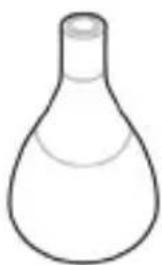
natural_image
Simple line drawing of a laboratory flask (no text or labels)natural_image
Simple line drawing of a medical or laboratory device with no text or symbolsnatural_image
Line drawing of a human face with a hand holding a medical device, showing anatomical alignment lines (no text or symbols)natural_image
Circular diagram with internal components and a labeled arrow pointing to a circular symbol (no text or labels)natural_image
Diagram of a device with a funnel and bottle, showing internal components and directional arrows (no text or symbols)natural_image
Simple line drawing of a water dispenser with directional arrows indicating flow or movement (no text or symbols)natural_image
Icon of a person using a laptop inside a circle (no text or symbols)Read these instructions for use carefully and keep them for later use, be sure to make them accessible to other users and observe the information they contain.
Table of contents
- Getting to know your device 19
- Signs and symbols....20
- Intended use ....21
- Warnings and safety notes....21
- Device description....24
- Initial use 24
- Use 25
- Cleaning and disinfection....27
- Disposal....28
- Technical data 29
- Replacement parts and wearing parts 30
- What if there are problems? 31
- Warranty/service.... 31
Dear customer,
Thank you for choosing a product from our range. Our name stands for high-quality, thoroughly tested products for applications in the areas of heat, gentle therapy, blood pressure/diagnosis, weight, massage and air.
With kind regards,
Your Beurer team
Included in delivery
Check that the exterior of the delivery cardboard packaging is intact and make sure that all components are present. See device and accessories description, page 24.
- 1 x nasal aspirator
- 1 x wide silicone attachment
- 1 x slim silicone attachment
- 2 x 1.5 V AA batteries
• These instructions for use
1. Getting to know your device
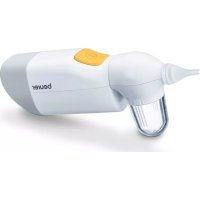
With the new NA 20 nasal aspirator you can gently and effectively remove nasal secretions from infants, toddlers and children (henceforth referred to as children).
The nasal aspirator can be used again once it has been prepared. Preparation involves disinfecting the included silicone attachments, including nasal secretion container, rubber seal and valve, as well as the device surface using a conventional disinfectant.
Please note that the entire head unit (including silicone attachments and nasal secretion container) should be replaced if the device is used by more than one person. We recommend that you replace the entire head unit after one year.
The nasal aspirator has the following features:
- Easy to use (single-button design).
- Soft and flexible silicone attachments for safe and comfortable application.
- Powerful motor with a maximum suction pressure of 500 mmHg (66 kPa).
- Compact design; ideal for use on the move.
- Quiet operation. Can also be used while the child is sleeping.
- Patented backflow prevention – no backflow from the nasal secretion container possible.
- Battery-operated.
- Hygienic: head unit, silicone attachments and nasal secretion container can be removed and cleaned separately. The nasal secretion container and the silicone attachments can be boiled.
2. Signs and symbols
The following symbols appear in these instructions for use and on the device:
 | WARNINGWarning notice indicating a risk of injury or damage to health. |
 | IMPORTANTSafety note indicating possible damage to the device/accessory. |
 | NoteNote on important information. |
 | Observe the instructions for use |
 | Application part, type BF |
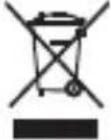 | Disposal in accordance with the Waste Electrical and Electronic Equipment EC Directive – WEEE |
| IP 22 | Protected against foreign objects ≥ 12,5 mm and against water dripping at an angle |
 | This product satisfies the requirements of the applicable European and national directives. |
 | Manufacturer |
Storage/Transport | Permissible storage and transport temperature and humidity |
Operating | Permissible operating temperature and humidity |
 | Dispose of packaging in an environmentally friendly manner |
3. Intendeduse
The beurer nasal aspirator is exclusively intended for the removal of nasal secretions from children (0 to 12 years). Do not use the nasal aspirator for other orifices or on animals.
The nasal aspirator may only be operated by adults who are able to operate the device according to the instructions outlined in these instructions for use. Keep the nasal aspirator away from children.
This nasal aspirator is suitable only for use in private homes, and not for medical or commercial purposes. The nasal aspirator may only be used for the purpose for which it was designed and in the manner specified in the instructions for use. Any form of improper use can be dangerous. The manufacturer is not liable for damage resulting from improper or incorrect use. Do not use the nasal aspirator if one or several of the following warnings applies. If you are unsure whether the nasal aspirator is suitable for your child, please consult your doctor.
4. Warnings and safety notes
WARNING
- Before use, ensure that the device and accessories show no visible damage. If you have any doubts, do not use the device and contact your retailer or the specified Customer Service address.
- The device is not a substitute for medical consultation and treatment. Always consult your doctor immediately in the event of pain or illness.
- If the child has a nasal condition, consult your GP before using the device.
- Do not use the device on people with nosebleeds.
- Do not use the device on people with acute head, facial or neck injuries.
- Do not use the device on people with coagulation or blood disorders.
-
Only use the device as described in the instructions for use. Failure to observe the warnings can lead to mechanical trauma such as nosebleeds, bleeding of the mucous membrane, discomfort or pain.
-
Do not use excessive force when inserting the silicone attachment into the nose.
- Please observe the general hygiene measures when using the device.
- Clean the silicone attachment before each use.
- If the device does not work properly, stop using it immediately.
- Should discomfort or pain arise while the device is in operation, stop using it immediately.
- During operation, ensure that the baby does not hold their breath, close their mouth or swallow their saliva. This could create a vacuum, which can damage the eardrum.
- This device is not intended for use by children or people with restricted physical, sensory (e.g. reduced sensitivity to pain) or mental skills or a lack of experience and/or lack of knowledge, unless they are supervised by a person who is responsible for their safety or are instructed by such a person in how to use the device.
- Keep packaging material away from children (risk of suffocation).
- Do not use any additional parts that are not recommended by the manufacturer.
- Never submerge the device in water and do not use it in the bathroom. Under no circumstances may liquid enter the device.
- Never open the device, modify it or repair it; otherwise proper operation can no longer be guaranteed. Failure to comply with this instruction can be dangerous, and will also invalidate the warranty.
- If the device has been dropped, exposed to high levels of moisture or suffered any other damage, it must no longer be used. If in doubt, contact Customer Services or the retailer.
IMPORTANT
- Protect the device from impacts, moisture, dirt, marked temperature fluctuations and direct sunlight. Do not drop the device.
- If the batteries are empty or you do not intend to use the device for longer periods, remove the batteries from the device. This prevents damage which could occur due to leakage.
WARNING
Notes on handling batteries
- If your skin or eyes come into contact with battery fluid, rinse the affected area with water and seek medical assistance.
- Choking hazard! Children could swallow and choke on batteries. Store batteries out of the reach of children.
- Observe the plus (+) and minus (−) polarity signs. If a battery has leaked, put on protective gloves and clean the battery compartment with a dry cloth.
- Protect batteries from excessive heat.
- Risk of explosion! Do not throw batteries into a fire.
- Do not charge or short-circuit batteries.
- If the device is not to be used for a relatively long period, take the batteries out of the battery compartment.
- Use identical or equivalent battery types only.
• Always replace all batteries at the same time. - Do not use rechargeable batteries.
- Do not disassemble, open or crush the batteries.
5. Device description
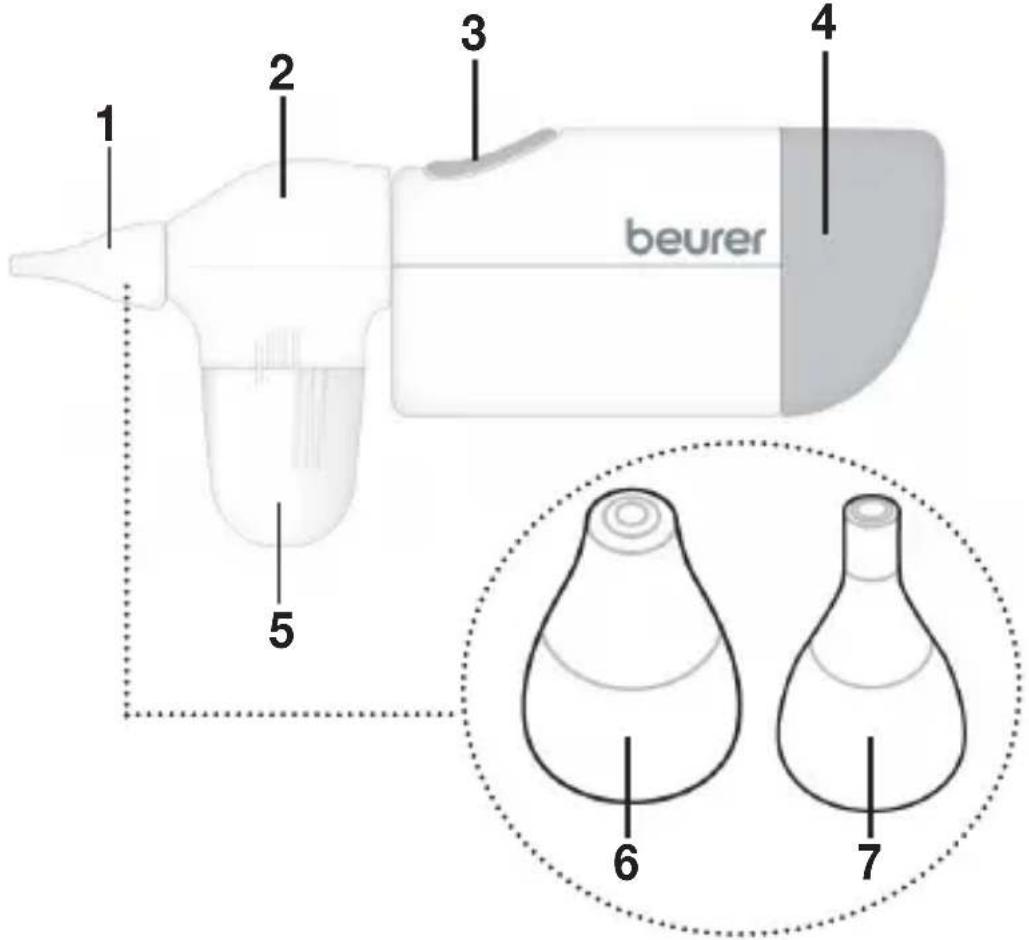
- Silicone attachment
- Head unit
- ON/OFF button ⏻
- Battery compartment
- Nasal secretion container
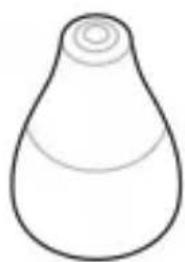
- Wide silicone attachment
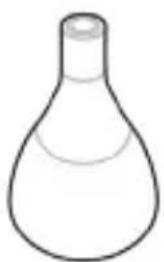
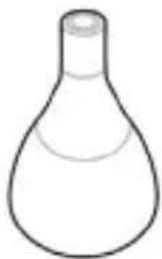
Suitable for removal of solid nasal secretions - Slim silicone attachment
Suitable for removal of more liquid nasal secretions
6. Initialuse
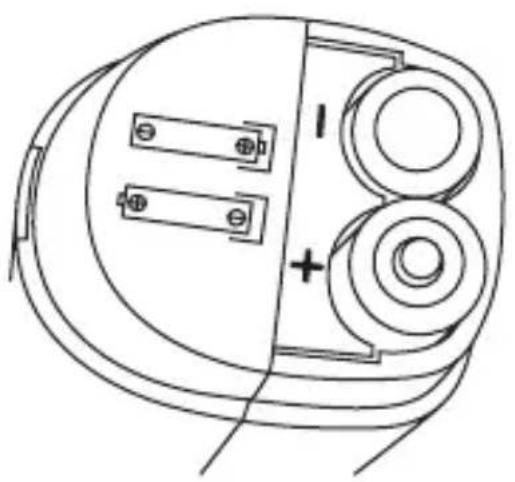
Inserting the batteries
In order to use the device, you first need to insert the supplied batteries (2 x 1.5 V AA batteries).
- Pull the cover off the battery compartment on the device. Use the notch on the underside of the device to do this. Hold the device vertically to prevent the batteries from falling out.
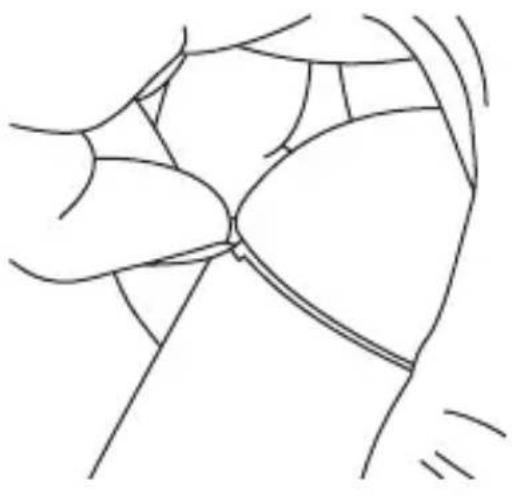
natural_image
Line drawing of a hand holding a small object, possibly a tool or device, with no visible text or symbols.- Insert both batteries into the battery compartment according to the specified polarity (+/-).
natural_image
Technical line drawing of a mechanical component with two circular ports and a central plus symbol (no text or labels)- Place the cover back onto the battery compartment until you feel it click into place.
7. Use
To start treatment, proceed as follows:
- Select your desired silicone attachment.
natural_image
Simple line drawing of a teardrop-shaped object with a circular top and curved base (no text or symbols)Wide silicone attachment
Suitable for removal of more solid nasal secretions.
natural_image
Simple line drawing of a laboratory flask (no text or labels)Slim silicone attachment
Suitable for removal of more fluid nasal secretions.
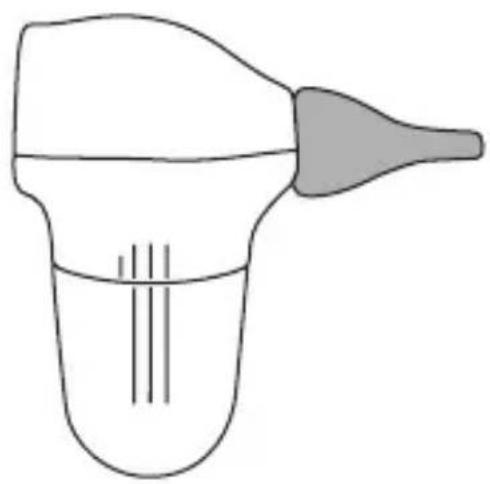
- Position the selected silicone attachment onto the tip of the device. Ensure that the silicone attachment is fully placed on the tip of the head unit.
natural_image
Simple line drawing of a medical or laboratory device with no text or symbols-
Check that the device is functioning correctly before inserting it into the nose. To do so, briefly press and hold the ON/OFF button
-
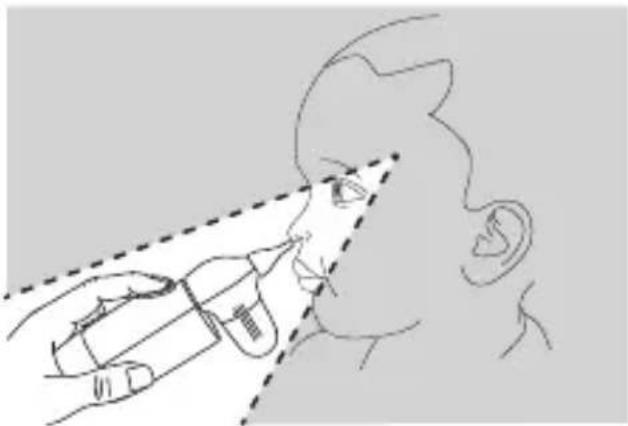
Hold or place the child to be treated in an upright position or in a position where they are leaning slightly back. Do not use the device when the child to be treated is lying down.
Carefully guide the tip of the silicone attachment into the nostril or against the nasal septum. The tip of the silicone attachment does not need to be fully inserted into the nose.
natural_image
Line drawing of a human face with a handheld device, showing alignment lines (no text or symbols)During the treatment, hold the device at an angle of 20^ to 60^ from the face.
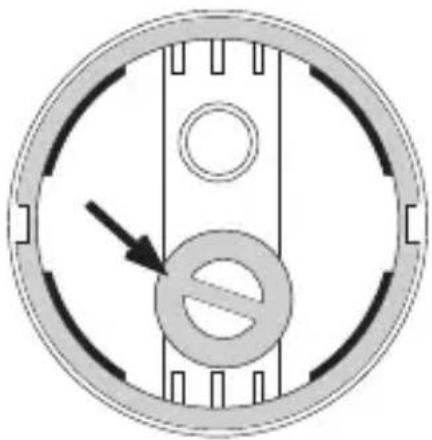
- Press and hold the ON/OFF button ⏻ to switch on the device. Now suck the nasal secretions out of the nose. Ensure that no nasal secretions get inside the valve.
natural_image
Circular diagram with two circular elements and an arrow pointing to the letter 'e' (no text or symbols present)- Repeat the process as necessary on the other nostril. Should the child experience discomfort or pain, stop using the device imme-
diately. Stop use once the nasal secretion container is filled up to the "MAX" line, at the latest.
-
To end use, release the ON/OFF button ⏻.
-
Clean the device after every use (see "8. Cleaning and disinfection" on page 27).
8. Cleaning and disinfection
IMPORTANT
Clean the device after every use, as otherwise it can become clogged and will no longer be able to guarantee smooth, hygienic operation.
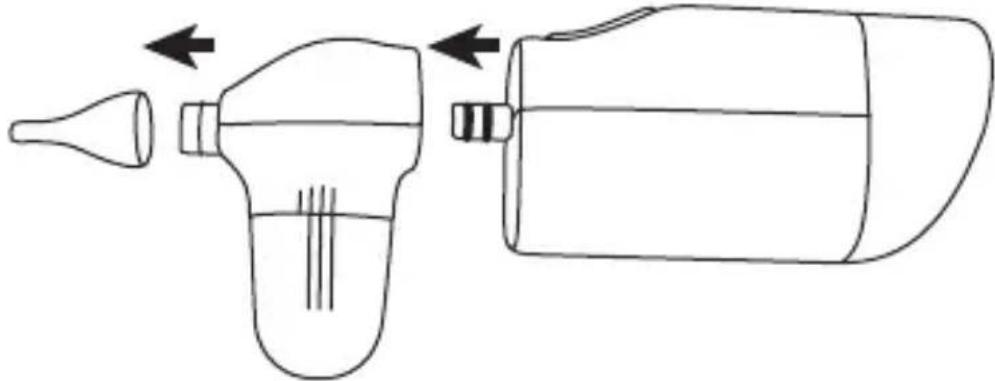
- Remove the silicone attachment used and the head unit from the device.
natural_image
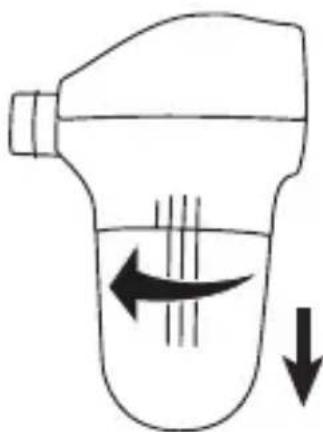
Diagram of a bottle being inserted into a container, showing fluid flow direction (no text or labels)- Twist the nasal secretion container anti-clockwise (a half rotation). Then pull it down and off.
natural_image
Simple line drawing of a water dispenser with directional arrows indicating flow or movement (no text or symbols)- We also recommend removing the rubber seal (1) as well as the valve (2) from the head unit, so that no bacteria can accumulate there.
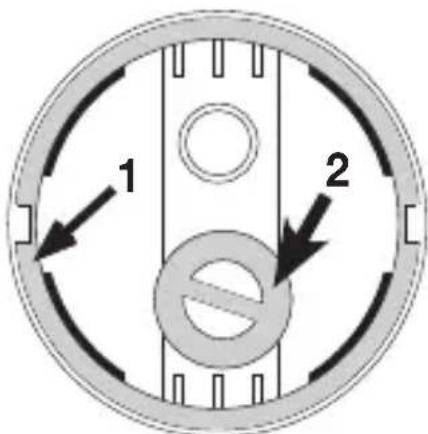
- Clean the silicone attachment, nasal secretion container, rubber seal and valve with hot water and some mild soap. Do not use any harsh cleaning products. To disinfect the silicone attachment and the nasal secretion container, place them in boiling water for 3 to 5 minutes. Contact between the parts and the hot base of the pan should be avoided. Place the individual components subsequent on a dry, clean and absorbent surface and allow to dry completely (for at least 4 hours).
- Clean the head unit exclusively with water. Do not use soap or chemical cleaners, as these can clog the tip of the head unit.
- Only clean the main device with a clean, dry cloth. Do not use any corrosive cleaning products, solutions or benzenes. The device must not be cleaned with water or submerged in water.
- Using a dirty or damaged valve can decrease the suction pressure of the nasal aspirator. The valve must be replaced as soon as you notice it is dirty or damaged. Additionally, the valve must be completely dry after cleaning in order for the device to function. The suction power is impaired/non-existent even if there is a small amount of residual moisture remaining.
- Dry all parts carefully using a soft cloth. Do not reassemble the parts until they are completely dry. Store the device away from sunlight, dust and moisture.
9. Disposal
Disposal of the device
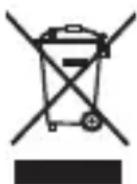
For environmental reasons, do not dispose of the device in the household waste at the end of its useful
life. Dispose of the device at a suitable local collection or recycling
point in your country. Dispose of the device in accordance with EC Directive – WEEE (Waste Electrical and Electronic Equipment). If you have any questions, please contact the local authorities responsible for waste disposal.
Disposal of the batteries
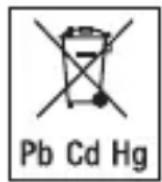
- The empty, completely flat batteries must be disposed of through specially designated collection boxes, recycling points or electronics retailers. You are legally required to dispose of the batteries.
- The codes below are printed on batteries containing harmful substances:
Pb = Battery contains lead
Cd = Battery contains cadmium
Hg = Battery contains mercury
- Technical data
| Type NA 20 | |
| Dimensions(L x W x H) | 169 x 43 x 75 mm |
| Weight 138 g (without batteries) | |
| Maximum suction pressure | 500 mmHg (66 kPa) |
| Sound pressure < 75 dB (measured at a distance of 30 cm) | |
| Material Housing and head unit: ABSNasal secretion container: PCSilicone attachment: Silicone | |
| Battery operation 2 x 1.5 V type AA, Mignon (LR6)Battery life in continuous operation > 90 minutes | |
| Expected service life 3 years | |
| Operating conditions Temperature: 16°C to 35°C(61°F to 95°F)Humidity: <85%Ambient pressure: 700 hPa to 1060 hPa | |
| Storage and transport conditions | Temperature: -25°C to +55°C(-13°F to 131°F) Humidity: < 85%Ambient pressure: 700 hPa to 1060 hPa |
Subject to technical changes.
The serial number is located on the device or in the battery compartment.
This device and its accessories comply with the EU Directive 2014/30/EU and the European standard EN 60601-1-2 (in accordance with CISPR 11, EN 61000-3-2, 61000-3-3, 61000-4-2, 61000-
4-3, 61000-4-4, 61000-4-5, 61000-4-6, 61000-4-8, 61000-4-11) and is subject to particular precautions with regard to electromagnetic compatibility.
The device is suitable for use in all environments listed in these instructions for use, including domestic environments. Please note that portable and mobile HF communication systems may interfere with this device.
Notes on electromagnetic compatibility
- The device is suitable for use in all environments listed in these instructions for use, including domestic environments.
- The use of the device may be limited in the presence of electromagnetic disturbances. This could result in issues such as error messages or the failure of the display/device.
- Avoid using this device directly next to other devices or stacked on top of other devices, as this could lead to faulty operation. If, however, it is necessary to use the device in the manner stated, this device as well as the other devices must be monitored to ensure they are working properly.
- The use of accessories other than those specified or provided by the manufacturer of this device can lead to an increase in electromagnetic emissions or a decrease in the device's electromagnetic immunity; this can result in faulty operation.
-
Failure to comply with the above can impair the performance of the device.
-
Replacement parts and wearing parts
| Designation Material REF | ||
| Silicone attachments | Silicone 164.104 | |
| Head unit (incl. valve, rubber seal, nasal secretion container and silicone attachments) | ABS, PTFE, PC, silicone | 164.103 |
- What if there are problems?
| Problem/questions | Possible causes Solution | |
| The suction power is impaired/non-existent. | Batteries are not inserted properly. | Check whether the batteries have been inserted the correct way round. |
| Batteries are flat. Replace the batteries and try again. | ||
| The grey rubber seal on the lower end of the head unit for sealing the nasal secretion container is missing. | Check whether the grey rubber seal has been fitted. | |
| The nasal secretion container is not correctly inserted. | Check whether the 3 raised lines on the head unit are in the same position as those on the nasal secretion container. | |
| The valve still has some residual moisture, even if just a small amount, after cleaning. | Ensure that the valve is completely dry after cleaning in order for the device to function. | |
13. Warranty/service
Beurer GmbH, Söflinger Straße 218, 89077 Ulm, Germany (hereinafter referred to as “Beurer”) provides a warranty for this product, subject to the requirements below and to the extent described as follows.
The warranty conditions below shall not affect the seller's statutory warranty obligations which ensue from the sales agreement with the buyer.
The warranty shall apply without prejudice to any mandatory statutory provisions on liability.
Beurer guarantees the perfect functionality and completeness of this product.
The worldwide warranty period is 3 years, commencing from the purchase of the new, unused product from the seller.
The warranty only applies to products purchased by the buyer as a consumer and used exclusively for personal purposes in the context of domestic use.
German law shall apply.
During the warranty period, should this product prove to be incomplete or defective in functionality in accordance with the following provisions, Beurer shall carry out a repair or a replacement delivery free of charge, in accordance with these warranty conditions.
If the buyer wishes to make a warranty claim, they should approach their local retailer in the first instance: see the attached “International Service” list of service addresses.
The buyer will then receive further information about the processing of the warranty claim, e.g. where they can send the product and what documentation is required.
A warranty claim shall only be considered if the buyer can provide Beurer, or an authorised Beurer partner, with
- a copy of the invoice/purchase receipt, and
- the original product.
The following are explicitly excluded from this warranty:
- deterioration due to normal use or consumption of the product;
- accessories supplied with this product which are worn out or used up through proper use (e.g. batteries, rechargeable batteries, cuffs, seals, electrodes, light sources, attachments and nebuliser accessories);
- products that are used, cleaned, stored or maintained improperly and/or contrary to the provisions of the instructions for use, as well as products that have been opened, repaired or modified by the buyer or by a service centre not authorised by Beurer;
- damage that arises during transport between manufacturer and customer, or between service centre and customer;
- products purchased as seconds or as used goods;
- consequential damage arising from a fault in this product (however, in this case, claims may exist arising from product liability or other compulsory statutory liability provisions).
Repairs or an exchange in full do not extend the warranty period under any circumstances.
FRANÇAIS

natural_image
Icon of a person using a computer (no text or symbols)natural_image
Line drawing of a hand holding a small object, possibly a tool or device, with no visible text or symbols.natural_image
Technical line drawing of a mechanical component with two circular components and a central plus button (no text or symbols)natural_image
Simple line drawing of a teardrop-shaped object with a circular top and curved base (no text or symbols)Embout silicone large
natural_image
Simple line drawing of a laboratory flask (no text or labels)Embout silicone mince
natural_image
Simple line drawing of a medical or laboratory device with no text or symbolsnatural_image
Line drawing of a person's face with a handheld device, showing eye alignment and measurement lines (no text or symbols)natural_image
Circular diagram with two circular components and an arrow pointing to a symbol, no readable text or labels present.natural_image
Diagram of a bottle being inserted into a container, showing fluid flow direction (no text or labels)natural_image
Simple line drawing of a water dispenser with directional arrows indicating flow or movement (no text or symbols)natural_image
Icon of a person using a computer (no text or symbols)natural_image
Line drawing of a hand holding a small object, possibly a tool or device, with no visible text or symbols.natural_image
Technical line drawing of a mechanical component with two circular components and a central plus symbol (no text or labels)natural_image
Simple line drawing of a teardrop-shaped object with a curved top and base (no text or symbols)natural_image
Simple line drawing of a laboratory flask (no text or labels)natural_image
Simple line drawing of a medical or laboratory device with no text or symbolsnatural_image
Line drawing of a human face with a handheld device, showing eye alignment and measurement lines (no text or symbols)natural_image
Circular diagram with two circular elements and an arrow pointing to the letter 'e' (no text or symbols beyond basic labels)natural_image
Diagram of a bottle being inserted into a cylindrical container, showing fluid flow direction (no text or labels)natural_image
Simple line drawing of a water bottle with arrows indicating flow direction (no text or symbols)natural_image
Icon of a person using a laptop inside a circle (no text or symbols)natural_image
Line drawing of a hand holding a small object, possibly a tool or device, with no visible text or symbols.natural_image
Technical line drawing of a mechanical component with two circular components and a central plus symbol (no text or labels)natural_image
Simple line drawing of a teardrop-shaped object with a circular top and curved base (no text or symbols)Accessorio in silicone a punta larga
natural_image
Simple line drawing of a laboratory flask (no text or labels)natural_image
Simple line drawing of a medical or laboratory device with no text or symbolsnatural_image
Line drawing of a person's face with a medical device, showing eye alignment and measurement lines (no text or symbols)natural_image
Circular diagram with two circular components and an arrow pointing to a symbol, no readable text or labels present.natural_image
Simple line drawing of a water dispenser with directional arrows indicating flow or movement (no text or symbols)natural_image
Icon of a person using a laptop inside a circle (no text or symbols)natural_image
Line drawing of a hand holding a small object, possibly a tool or device, with no visible text or symbols.natural_image
Technical line drawing of a mechanical component with two circular components and a central plus symbol (no text or labels)natural_image
Simple line drawing of a teardrop-shaped object with a circular top and curved base (no text or symbols)natural_image
Simple line drawing of a laboratory flask (no text or labels)Dar silikon başlık
natural_image
Simple line drawing of a medical or laboratory device with no text or symbolsnatural_image
Line drawing of a human face with a hand holding a medical device, showing measurement alignment lines (no text or symbols)natural_image
Circular diagram with two circular components and an arrow pointing to a symbol, no readable text or labels present.natural_image
Diagram of a bottle being inserted into a container, showing fluid flow direction (no text or labels)natural_image
Simple line drawing of a water dispenser with directional arrows indicating flow or movement (no text or symbols)natural_image
Icon of a person using a laptop inside a circle (no text or symbols)natural_image
Line drawing of a hand holding a small object, possibly a tool or device, with no visible text or symbols.natural_image
Technical line drawing of a mechanical component with two circular components and labeled terminals (no text or symbols)natural_image
Simple line drawing of a teardrop-shaped object with a circular top and curved base (no text or symbols)