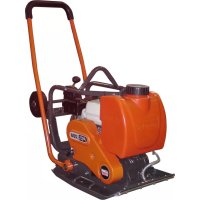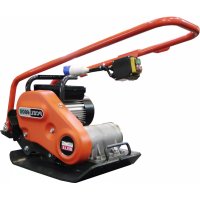
BELLE PCEL 400E - Vibratory plate Lescha - Free user manual and instructions
Find the device manual for free BELLE PCEL 400E Lescha in PDF.



| Product type | Unidirectional vibrating plate with electric motor |
| Brand | Lescha (Belle Group) |
| Model | BELLE PCEL 400E |
| Weight | 48.5 kg |
| Motor power (230 V) | 0.55 kW (0.75 hp) |
| Motor power (110 V) | 0.6 kW (0.8 hp) |
| Rated voltage | 230 V or 110 V |
| Rated current (230 V / 110 V) | 2.8 A / 6.4 A |
| Protection rating | IP44 |
| Vibrator force | 11 kN |
| Vibration frequency | 101 Hz |
| Engine speed | 2800 rpm |
| Maximum travel speed | 18 m/min |
| Maximum gradient | 20° |
| Compaction force (230 V / 110 V) | 354 kg/m² / 376 kg/m² |
| Sound power level | 99 dB(A) |
| Hand-arm vibration (3 axes) | 4.43 m/s² |
| Recommended usage duration | 611 minutes per day |
| Vibrator oil type | SAE 10W40 |
| Vibrator oil capacity | 0.22 liter |
| Belt maintenance | Check tension every 4 hours |
| Warranty | 12 months (parts and labor) |
Frequently Asked Questions - BELLE PCEL 400E Lescha
User questions about BELLE PCEL 400E Lescha
0 question about this device. Answer the ones you know or ask your own.
Ask a new question about this device
Download the instructions for your Vibratory plate in PDF format for free! Find your manual BELLE PCEL 400E - Lescha and take your electronic device back in hand. On this page are published all the documents necessary for the use of your device. BELLE PCEL 400E by Lescha.
USER MANUAL BELLE PCEL 400E Lescha
natural_image
Line drawing of a manual push-button press mechanism with lever and handle (no text or symbols)- Spare Parts Book
- Pièces Détachées
• Onderdelen Boekje - Reservedele Skrift
- Ersatzteilhandbuch
- Manuale dei Ricambi
- Bruksanvisning
- Varaosaluettelo
- Lista Części Zamiennych
• Запасные Части Книга - Varuosade Nimekiri
- Rezerves Dalu Saraksts
- Atsarginiu Daliu Sarašas
GB Operators Manual
F Manuel De L'Opérateur
NL Handleiding
DK Betjeningsvejledning
D Bedienungshandbuch
① Manuale Dell'Operatore
s Bruksanvisning
SF Käyttöohje
PL Instrukcja Obstugi
RUS Руководство для оператора
EST Kasutusjuhend
LV Lietotāja rokasgrāmata
LT Naudojimo Instrukcija
6
16
26
36
46
56
66
76
86
96
106
116
126
EC DECLARATION OF CONFORMITY / DECLARATION CE DE CONFORMITE / DECLARACIÓN DE CONFORMIDAD CE / DECLARAÇÃO CE DE CONFORMIDADE / EG-VERKLARING VAN OVEREENSTEMMING / EF OVERENSSTEMMELSESERKLAERING

We, Belle Group Sheen UK, Sheen, Nr. Buxton, Derbyshire, SK17 0EU, GB, hereby certify that if the product described within this certificate is bought from an authorised Belle Group dealer within the EEC, it conforms to the following EEC directives: 2006/42/CE (This directive replaces directive 98/37/EC), Electromagnetic Compatibility Directive 2004/108/CE (as amended by 89/336/EEC, 92/31/EEC & 93/68 EEC). The Waste Electrical and Electronic Equipment (WEEE) 2002/96/CE, the low voltage directive 2006/95/CE, BS EN ISO 12100-1:2003 Safety of machinery and associated harmonised standards, where applicable. Noise emissions conform to directives 2000/14/EC Annex VI & 2005/88/EC, for machines under article 12 the notified body is AVT Reliability, Unit 2 Easter Court, Europa Boulevard, Warrington, Cheshire, WA5 7ZB, GB. Noise Technical files are held by Ray Neilson at the Belle group Head Office address which is stated above.

PRODUCT TYPE ...... TYPE DE PRODUIT...... TIPO DE PRODUCTO......
MODEL...... MODELE...... MODELO......
SERIAL No..... N° DE SERIE..... N° DE SERIE.....
natural_image
Empty white rectangle with dashed border (no text or symbols)Signed by:
Signature:
Medido por:
Assinado por:
Getekend door:
Uunderskrevetaf:
text_image
O.NahRay Neilson
Managing Director - On behalf of BELLE GROUP (SHEEN) UK.
Place of Declaration - Sheen, Nr. Buxton, Derbyshire, SK17 0EU, UK
Lieu de déclaration - Sheen, Nr. Buxton, Derbyshire, SK17 0EU, UK
Sted i erklæring - Sheen, Nr. Buxton, Derbyshire, SK17 0EU, UK
Date of Declaration - 2013....
natural_image
Empty white rectangle with dashed border (no text or symbols)Unterzeichnet vo:
Firmato da:
Undertecknat:
Signatur:
Allekirjoitus:
Podpisat:

text_image
O. Nath Ray Neilsonnatural_image
Empty rectangular frame with dashed border (no text or symbols)natural_image
Empty white rectangle with dashed border (no text or symbols)Podepsal:
Semnat de:
Aláírás:
Potpisao:
Imzalayan:
Podpísal:
text_image
O.NahRay Neilson
Director General - in numele BELLE GROUP (SHEEN), UK
This manual has been written to help you operate and service the 'PCEL 400E' Plate compactor safely. This manual is intended for dealers and operators of the 'PCEL 400E' Plate compactor.
Foreword
The ‘Machine Description’ section helps you to familiarise yourself with the machine's layout and controls.
The ‘Environment’ section gives instructions on how to handle the recycling of discarded apparatus in an environmentally friendly way.
The ‘General Safety’ and ‘Health and Safety’ sections explain how to use the machine to ensure your safety and the safety of the general public.
The ‘Operating Instructions’ section helps you with the setting up and use of the machine.
The ‘Trouble Shooting Guide’ helps you if you have a problem with your machine.
The 'Service & Maintenance' section is to help you with the general maintenance and servicing of your machine.
The ‘Warranty’ Section details the nature of the warranty cover and the claims procedure.
Directives with regard to the notations.
Text in this manual to which special attention must be paid are shown in the following way:

CAUTION
The product can be at risk. The machine or yourself can be damaged or injured if procedures are not carried out in the correct way.

WARNING
The life of the operator can be at risk.

WARNING

WARNING
Before you operate or carry out any maintenance on this machine YOU MUST READ and STUDY this manual.
KNOW how to safely use the unit's controls and what you must do for safe maintenance. (NB Be sure that you know how to switch the machine off before you switch on, in case you get into difficulty.)
ALWAYS wear or use the proper safety items required for your personal protection. If you have ANY QUESTIONS about the safe use or maintenance of this unit, ASK YOUR SUPERVISOR OR CONTACT: Altrad Belle (UK): +44 (0) 1298 84606

Contents
How To Use This Manual....6
Warning 6
Machine Description....7
Environment 7
Technical Data....8
Decals....9
Safety Instructions....10
Health And Safety....11
Reasons For Compaction....11
Compaction Specification....11
Applications....11
Pre-Start Checks 11
Operating Instructions....12
Trouble Shooting Guide .... 13
Service & Maintenance ....14
Warranty 15
Declaration Of Conformity....2
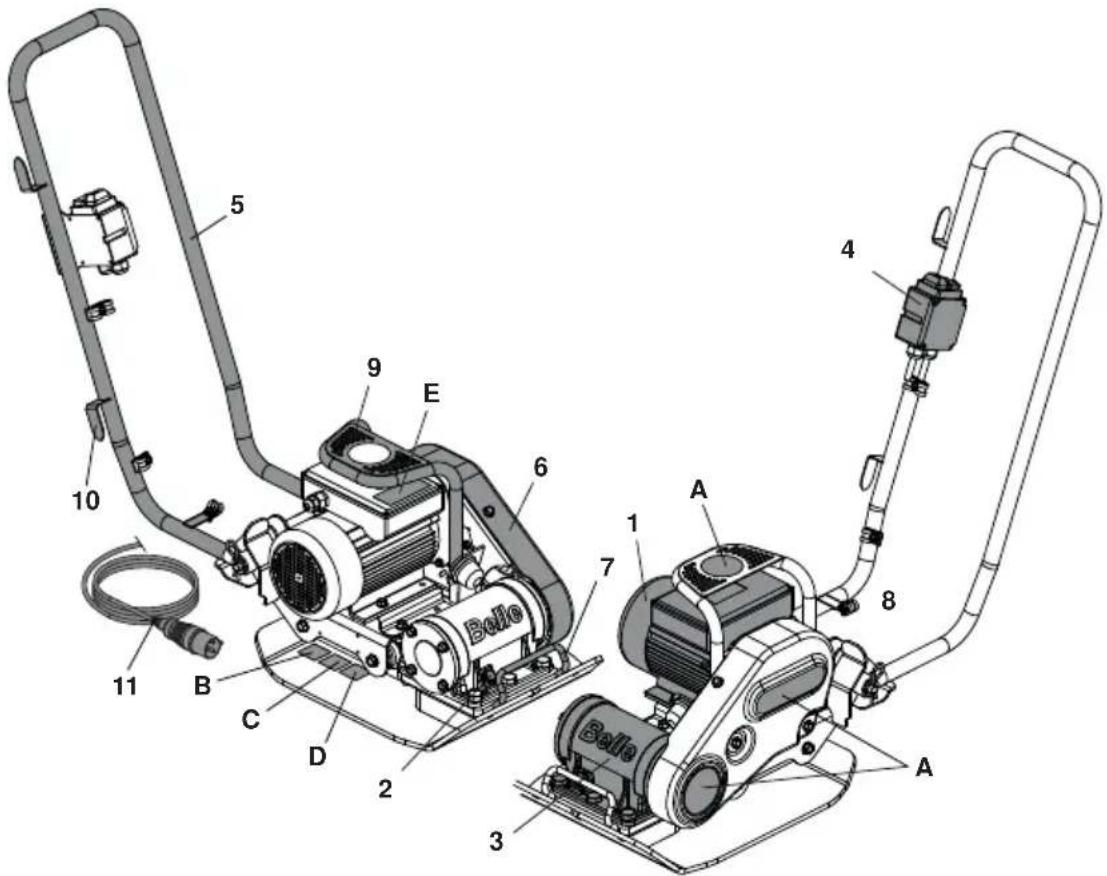
Machine type:
Single Direction Plate Compactor
- Electric Motor
- Vibrator Unit Oil Plug.
- Vibrator Unit
- On / Off Switch
- Operating Handle,
- Belt Guard,
- Hand Lifting Point
- Hand Lifting Point (Strut)
- Motor Guard
- Cable Storage Hook
- Power Cable
DO NOT use a Mechanical Hoist on the Hand Lifting Points (No's 7 & 8) and Motor Guard (No. 9)
text_image
Technical diagram of a Balle air purifier with labeled components and parts
Environment
Safe Disposal.

Instructions for the protection of the environment. The machine contains valuable materials. Take the discarded apparatus and accessories to the relevant recycling facilities.
| Component Material | |
| Operator Handle Steel | |
| Hand Grip Steel | |
| Base Plate Steel | |
| Eccentric Weights Steel | |
| Electric Motor Steel & Various Parts Steel | Aluminium & Copper& Aluminium |
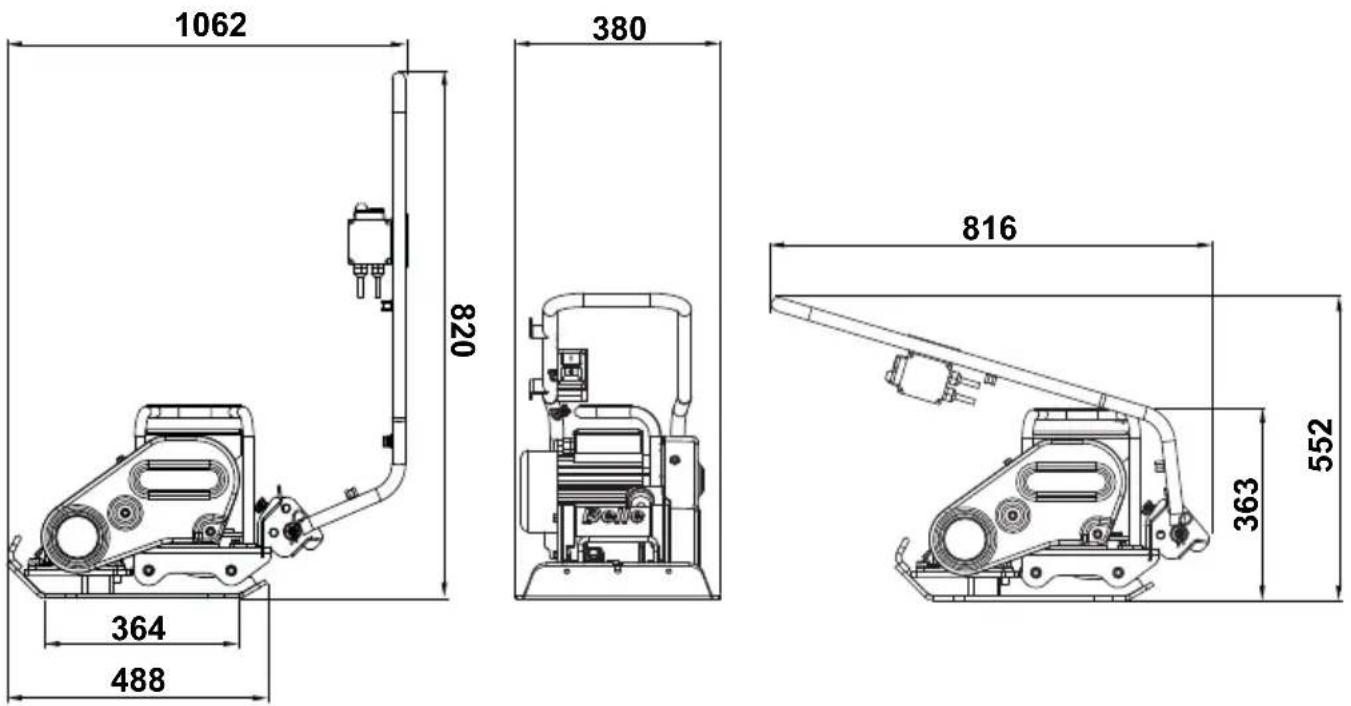
| Model 110v 50Hz 230v 50Hz | ||
| Weight (kg) 48.5 48.5 | ||
| Motor Power (Hp / kW) 0.8 / 0.6 0.75 / 0.55 | ||
| Motor RPM 2800 2800 | ||
| Nominal Voltage (v) 110230 | ||
| Full Load Current (A) 6.4 2.8 | ||
| Motor Protection Rating IP44 IP44 | ||
| Power Consumption (kW) | 0.62 0.62 | |
| Vibrator Force (kN) | 11 | 11 |
| Frequency (Hz) | 101 | 101 |
| Minimum Transformer Size (kVA) | 3.3 | N/A |
| Maximum Travel Speed (m/min) | 18 | 18 |
| Max. Gradient (°) | 20 | 20 |
| Compaction Force (kg/m2) | 376 | 354 |
| 3 Axis Vibration* (m/sec2) | 4.43 4.43 | |
| Usage Time (Mins) | 611 | 611 |
| Sound Power Level (dB(A)) | 99 | 99 |
* Minimum level to EN500 Part 4
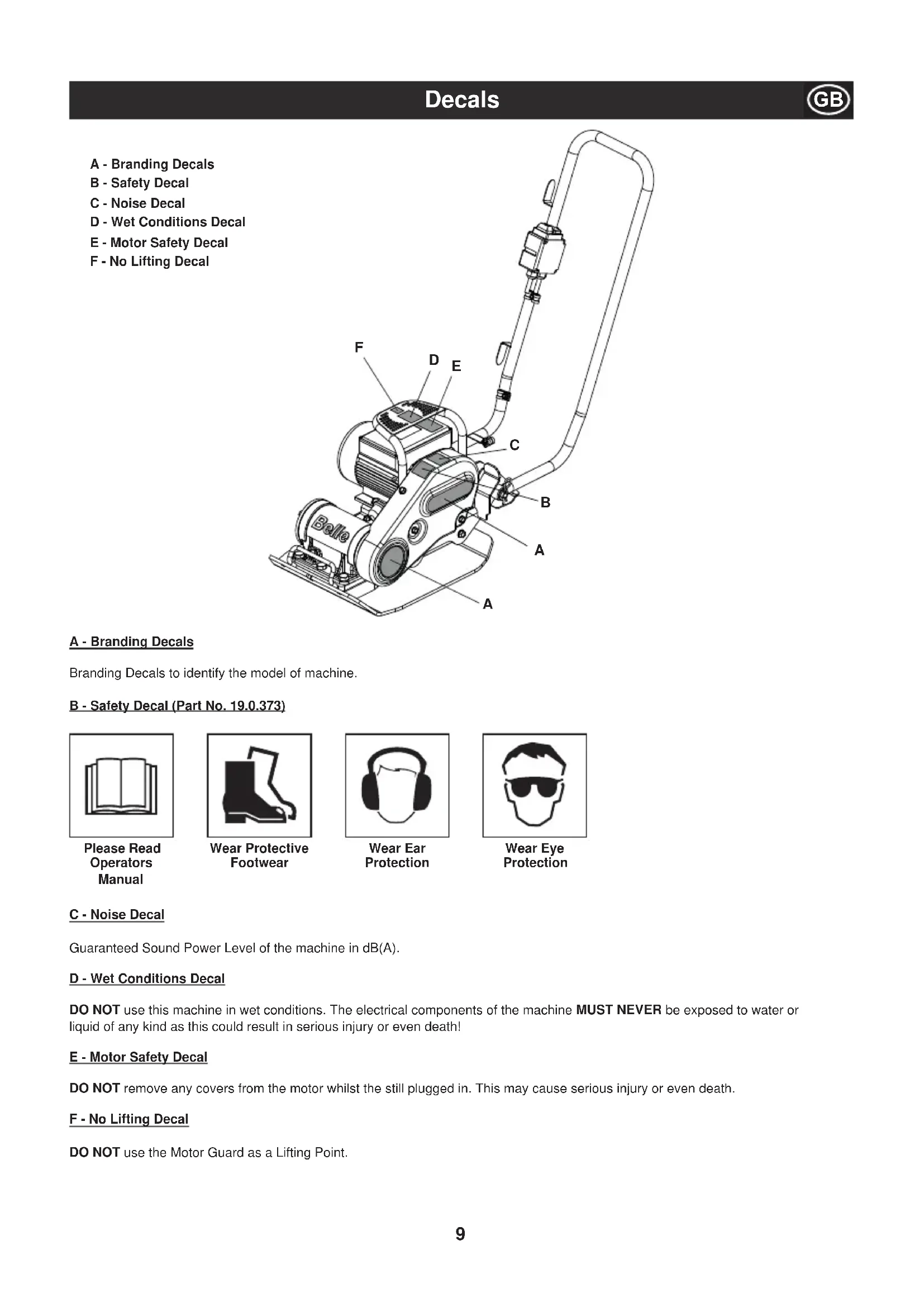
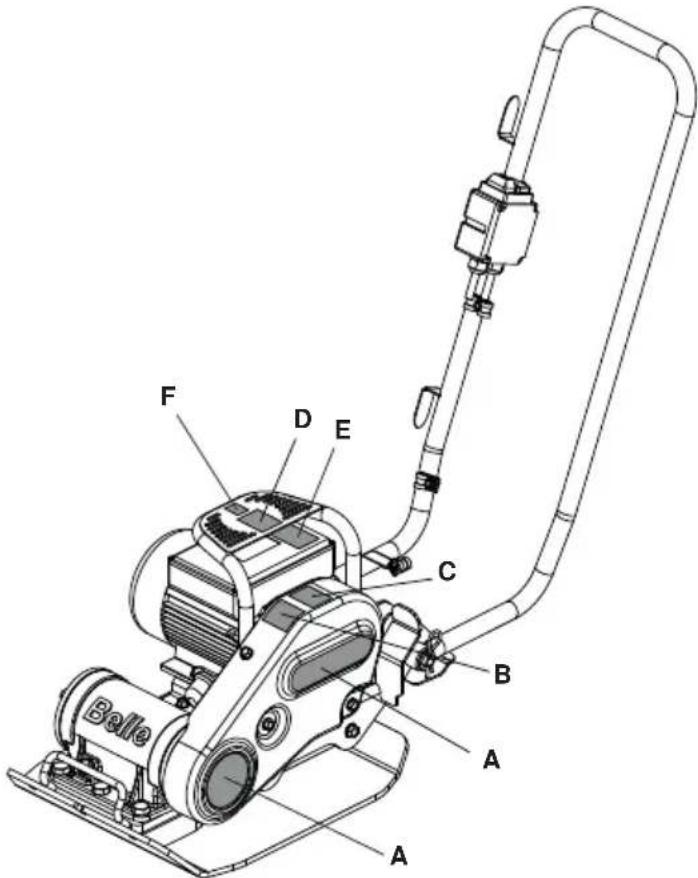
A - Branding Decals
B - Safety Decal
C - Noise Decal
D - Wet Conditions Decal
E - Motor Safety Decal
F - No Lifting Decal
text_image
Belle A B C D E FA - Branding Decals
Branding Decals to identify the model of machine.
B - Safety Decal (Part No. 19.0.373)

Please Read
Operators
Manual

Wear Protective Footwear

Wear Ear Protection

Wear Eye Protection
C - Noise Decal
Guaranteed Sound Power Level of the machine in dB(A).
D - Wet Conditions Decal
DO NOT use this machine in wet conditions. The electrical components of the machine MUST NEVER be exposed to water or liquid of any kind as this could result in serious injury or even death!
E - Motor Safety Decal
DO NOT remove any covers from the motor whilst the still plugged in. This may cause serious injury or even death.
F - No Lifting Decal
DO NOT use the Motor Guard as a Lifting Point.
For your own personal protection and for the safety of those around you, please read and ensure you fully understand the following safety information. It is the responsibility of the operator to ensure that he/she fully understands how to operate this equipment safely. If you are unsure about the safe and correct use of the 'PCEL 400E' Plate compactor, consult your supervisor or Altrad Belle.

CAUTION
Improper maintenance can be hazardous. Read and Understand this section before you perform any maintenance, service or repairs.
• This equipment is heavy and must not be lifted single-handedly, either GET HELP or use suitable lifting equipment.
• Cordon off the work area and keep members of the public and unauthorized personnel at a safe distance.
• Personal Protective Equipment (PPE) must be worn by the operator whenever this equipment is being used (see Health & Safety).
• Make sure you know how to safely switch this machine OFF before you switch it ON in case you get into difficulty.
• Always switch OFF and un-plug the motor before transporting, moving it around the site or servicing it.
- During use the motor becomes very hot, allow the motor to cool before touching it. Never leave the motor running and unattended.
- Never remove or tamper with any guards fitted, they are there for your protection. Always check guards for condition and security, if any are damaged or missing, DO NOT USE THE MACHINE until the guard has been replaced or repaired.
- Never pull or guide the machine using the cable and never pull on the cable to disconnect the plug.
• DO NOT operate the MACHINE when you are ill, feeling tired, or when under the influence of alcohol or drugs.
- Ensure that any trailing cable is protected against damage and not liable to be tripped over or trapped underneath the machine.
• DO NOT use the Motor Guard as a Lifting Point.
• DO NOT Jet Wash the machine as this could result in serious injury or even death!
- DO NOT use this machine in wet conditions. The electrical components of the machine MUST NEVER be exposed to water or liquid of any kind as this could result in serious injury or even death!
- Belle strongly recommends the use of a Residual Current Device on 220/240v electrics.
Fire Fighting
If your machine catches fire, turn off the electric supply. Using a dry powder or C02 fire extinguisher put out the fire. If the fire can not be put out, keep away and call the fire brigade. If you are in any doubt about the safety condition of your machine, please consult your nearest Altrad Belle dealer or Altrad Belle direct.
Electric Motors
All portable electric appliances are dangerous if abused. This machine will only operate on one voltage. Check the power supply to ensure it corresponds to the voltage as stamped on the motor. Make sure that the motor is switched off before you plug it into the power supply.
220/240v - Always use a Residual Current Device ("RCD"), (earth leakage trip), plugged directly into the 220/240v socket.
If using an extension cable, plug it directly into the RCD.
110v - When using a portable transformer it must have a minimum output of 3.3kw and be continuously rated.
The symbols on the ON/OFF switch are 0=OFF and I=ON in accordance with international standards.

WARNING
DO NOT use an extension cable between the transformer and the power supply. Always ensure that the cable between the 110v machine and transformer is a minimum length of 3 metres. Ensure cable is fitted with cable clip to the operating handle at all times.
Plugs
The PCEL 400E Plate Compactor is intended for DIY or site usage, the following plug types are supplied fitted to the product:-
110v Motor - 16 amp rated BS4343 plug type. or 3-pin CEE7/7 Euro plug type.
230v Motor - 13 amp rated 3-pin BS1363 plug type
Fitting a plug - WARNING THIS PRODUCT MUST BE EARTHED
IMPORTANT: The wires in the mains lead are coloured in accordance with the following code:
GREEN / YELLOW = EARTH, BLUE = NEUTRAL, BROWN = LIVE
The wire which is coloured Green and Yellow must be connected to the terminal in the plug marked E or coloured Green and Yellow. The wire which is coloured Brown must be connected to the terminal in the plug marked L or coloured Red. The wire which is coloured Blue must be connected to the terminal in the plug marked N or coloured Black. Always ensure before connecting to the supply that the supply voltage is the same as the rated voltage marked on the motor
Extension Cables
If you need to use an extension cable it must be no longer than 25 metres (82 feet) in length. The wire section must be 2.5mm^2 on 230v and 2.5mm^2 on 110v. Ensure that the extension cable is carefully laid out avoiding liquids, sharp edges and places where vehicles might run over it. Avoid allowing the extension cable to be trapped underneath the plate compactor. Unroll it fully or it will overheat and could catch fire. Make sure that any extension cable connections are dry and safe.
NVR - No Volt Release
The motors which are fitted to the machine are fitted with a NVR (No Volt Release) Switch. This mean that if the power fails, the motor will not automatically restart when the power is restored. The machine will need to be manually restarted.
Health & Safety
Vibration
Some vibration from the compacting operation is transmitted through the handle to the operator's hands. Refer to specifications & technical data for vibration levels and usage times (recommended maximum daily exposure time). DO NOT exceed the maximum usage times.
PPE (Personal Protective Equipment).
Suitable PPE must be worn when using this equipment i.e. Safety Goggles, Gloves, Ear Defenders, Dust Mask and Steel Toe capped footwear (with anti-slip soles for added protection). Wear clothing suitable for the work you are doing. Always protect skin from contact with concrete.
Dust.
The compaction process can produce dust, which may be hazardous to your health. Always wear a mask that is suited to the type of dust being produced.
Reasons For Compaction

Soil, which has been disturbed or new infill, subbase and blacktop, will have small voids or air pockets which, if not compacted, will lead to one or more problems occurring.
- As traffic crosses the surface of an uncompacted area, the material is compressed. This leads to subsidence of the top surface as the material fills the voids.
- A similar situation occurs with static loads on uncompacted ground. The load (e.g. a building) will sink.
- Materials with voids are more susceptible to water seepage, leading to erosion. Water ingress may also cause the soil to expand during freezing temperatures and contract during dry spells. Expansion and contraction is a major cause of damage to building foundations and normally leads to the structure requiring underpinning.
Compaction increases the density of the material and therefore increases its load bearing capacity. Reduces air voids and therefore reduces the risk of subsidence, expansion and contraction, due to ingress of water.
Compaction Specification

Various methods have been employed in the past to specify the compaction required for various applications. The factors to consider are, material properties, layer thickness, pressure applied, vibration and number of passess. Greater understanding of how compaction works has lead to new compaction specifications being introduced. The most up to date specification is part of the U.K.'s NRSWA (New Roads & Street Works Act). Civil Engineers are now adopting these specifications to ensure good compaction for all site work.
Applications

Applications/materials fall into three categories:
- Cohesive materials (less than 20% granular) e.g clay, silt & heavy soils.
- Granular materials (more than 20% granular) e.g hard core, sand & light soils.
- Bituminous materials e.g asphalt (tarmac), cold lay (bitumin emulsion products).
Pre-start Checks

Pre start-up inspection.
The following Pre-start-up inspection must be performed before the start of each work session or after every four hours of use, whichever is first. Please refer to the service section for detailed guidance. If any fault is discovered, the 'PCEL 400E' must not be used until the fault is rectified.
- Thoroughly inspect the 'PCEL 400E' and all cables for signs of damage. Make sure that the belt guard is secure before using the machine.
- Check hoses, filler openings, drain plugs and any other areas for signs of leakage. Fix any leaks before operating.

WARNING
Before you operate or carry out any maintenance on this machine YOU MUST READ and STUDY this manual.

WARNING
NEVER pass over the electric cable with the compactor during operation.
• Take the compactor to where it is required.
DO NOT use a Mechanical Hoist on the Hand Lifting Points (See Machine Description section).
Transporting the PCEL 400E is a 2 person operation. Use the provided Hand Lifting Points (See Machine Description section)
- NEVER leave the motor running whilst transporting or moving the PCEL 400E, even if it is only a short distance.
- Having carried out the checks listed in the 'Pre-Start' section, you may start the motor.
- Switch the machine on and use the control handle to steer or turn the PCEL 400E.
The vibrator will not only cause the baseplate to vibrate but will also cause it to travel forward. During normal operation you should not have to push the PCEL 400E but allow it to travel at its own pace. The speed of travel will be determined by the condition of the surface being compacted. If the surface to be compacted is on a slope, great care must be taken when controlling the PCEL 400E's direction of travel. If necessary, use a suitable rope attached to the PCEL 400E at a low point on the chassis, to allow a helper to take part of the PCEL 400E's weight. Work up and down a slope not across.
• Work the PCEL 400E over the surface in an organized pattern until the required compaction has been achieved.
Where there are a number of different layers to be compacted on top of each other, compact each layer individually.
Stopping the Motor
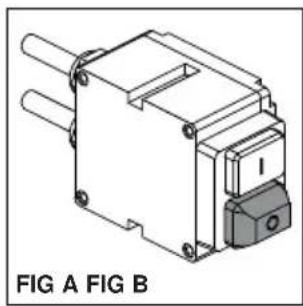
- Depress the RED Button (O) to stop the machine (Fig A).
Starting the Motor
- Plug into power supply.
- Depress the GREEN Button (I) to start the machine (Fig B).
natural_image
Technical line drawing of an electrical component (no text or symbols on the diagram itself)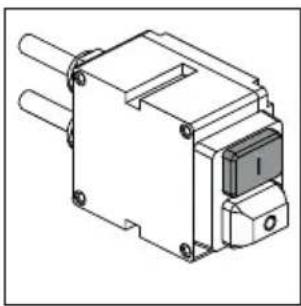
natural_image
Technical line drawing of a mechanical component with no visible text or symbolsGuide to using optional PCEL 400E Portable Appliance Test (PAT) Rig

WARNING
Make sure that the plate is unplugged from the power source prior to carrying out first steps or the visual inspection!
Prior to the PAT a Formal Visual Inspection must be carried out by a competent person to check the electrical safety of the equipment following correct procedure. For guidelines on PAT and definitions involved please visit government website:
http://www.hse.gov.uk/electricity/faq-portable-appliance-testing.htm.
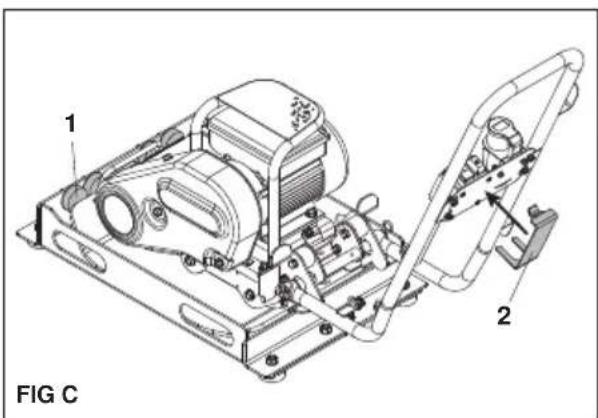
- Place the PCEL 400E plate compactor into the test rig / fixture (Part No. 968/01200) with the front of the plate facing the anti-vibration mounts (Item 1), resting on the matting and with the handle swung back (Fig C). The Test rig must be located on a level floor, in dry ambient conditions with only the rubber feet touching the ground for appropriate vibration damping (NOTE: rubber feet are NOT designed to isolate the product from the ground).
- Fit the Z-Bracket (Item 2) (Part No. 968/01205) to the switch by sliding it until it securely clicks into place and presses the green ON button of the switch.
- Connect an approved PAT tester, configuring it according to your PCEL 400E specifications (e.g. Voltage; Appliance Insulation Class; Correct type of test etc.).
- Make sure that PCEL-E plate compactor and PAT test fixture are not touched by a human, animal or any other object and are not at risk of doing so during the test. Conduct the test when and if you are happy that it is safe to do so.
text_image
1 2 FIG CTroubleshooting Guide
| Problem Cause Problem | ||
| Motor fails to start. | Fuse or Circuit Breaker tripped. Replace Fuse or reset the Breaker. | |
| Stator is shorted or went to ground. Motor will make a humming noise and the circuit breaker or fuse will trip. | Contact Agent or Altrad Belle. | |
| Motor overloaded or load jammed. | Inspect to see that the load is free. If free, Contact Agent or Altrad Belle. | |
| Capacitor (on single phase motor) may have failed. | Contact Agent or Altrad Belle. | |
| Starting switch has failed. Contact Agent or | Altrad Belle. | |
| Motor runs but dies down. | Voltage drop. | If voltage is less than 10% of the motor's rating contact power company or check if some other equipment is taking power away from the motor or Contact Agent or Altrad Belle. |
| Load increased. | Verify the load has not changed. Verify equipment hasn't got tighter. If fan application verify the air flow hasn't changed or Contact Agent or Altrad Belle. | |
| Motor takes too long to accelerate. | Defective capacitor Contact Agent or Altrad Belle. | |
| Faulty stationary switch. Contact Agent or Altrad Belle. | ||
| Bad bearings. Contact Agent or Altrad Belle. | ||
| Voltage too low. | Make sure that the voltage is within 10% of the motor's nameplate rating. If not, contact power company or check if some other equipment is taking power away from the motor or contact Belle. | |
| Motor overload protector continually trips. | Load too high. | Verify that the load is not jammed. If motor is a replacement, verify that the rating is the same as the old motor. If previous motor was a special design, a stock motor may not be able to duplicate the performance. Remove the load from the motor and check motor doesn't trip. |
| Ambient temperature too high. | Verify that the motor is getting enough air for proper cooling. Most motors are designed to run in an ambient temperature of less than 40°C. (Note: A properly operating motor may be hot to the touch.) | |
| Protector may be defective. Contact Agent or Altrad Belle. | ||
| Winding shorted or grounded. Contact Agent or Altrad Belle. | ||
| The motor makes a loud rubbing or grinding noise. | Damage to internal workings. Contact Agent or Altrad Belle. | |
| Unit will not vibrate. | Drive belt tension loose. Adjust belt tension. | |
| Drive failure. Contact Agent or Altrad Belle. | ||
| Vibrator failure. | Contact Agent or Altrad Belle. | |
| Asphalt adhering to plate. Bituminous surface flaking (laminating). | Lack of lubrication. | Use water. |
| Over compaction. | Remove and relay. | |
| Low travel speed (plate sinking). | Layer thickness too deep. | Remove some of the material. |
| Moisture content too high or too low. | Remove material and adjust. | |
Maintenance
The Altrad Belle 'PCEL 400E' is designed to give many years of trouble free operation. It is recommended that an approved Altrad Belle dealer carries out all major maintenance and repairs. Always use genuine Altrad Belle replacement parts, the use of spurious parts may void your warranty. Before any maintenance is carried out on the machine, switch off the motor and disconnect the power supply. Always set the 'PCEL 400E' on level ground to ensure any fluid levels will be correctly read. Only use recommended oils (see chart below).
Running In Period
The vibrator shaft case oil must be replaced after the first 100 hours use, then after every 500 working hours. For detail on vibrator shaft case oil replacement, see 'Vibrator unit'. The belt tension should be checked after 4 hours use.
Cleaning
This is an electrical appliance. During cleaning, the electrical components of this machine MUST NEVER be exposed to water or liquid of any kind as this could result in serious injury or even death!
| Routine Maintenance | Before Each Use | First 4 Hours | First Month / | 3 Months / 50 Hours | |
| Cables | Check | √ | |||
| Replace when necessary | |||||
| Drive Belt Tension | √ √ | √ | |||
Oil / Fuel Type & Quantity
| Oil Type | Quantity (Litre) | Fuel Type | Capacity (Litre) | Spark Plug Type | Electrode Gap (mm) | |
| Vibrator SAE 10w40 0.22 N/A | N/A N/A N/A |
text_image
Plug Seal Regular Level Lower part of screw threadVibrator Unit.
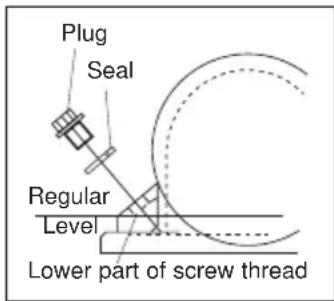
Remove the plug complete with seal, check that the oil level reaches the bottom thread on the oil plug hole. Top up as necessary with the correct oil (see chart).
Your new Altrad Belle 'PCEL 400E' single direction plate compactor is warranted to the original purchaser for a period of one-year (12 months) from the original date of purchase.
The Altrad Belle warranty is against defects in design, materials and workmanship.
The following are not covered under the Altrad Belle warranty:
- Damage caused by abuse, misuse, dropping or other similar damage caused by or as a result of failure to follow assembly, operation or user maintenance instructions.
- Alterations, additions or repairs carried out by persons other than Altrad Belle or their recognised agents.
- Transportation or shipment costs to and from Altrad Belle or their recognised agents, for repair or assessment against a warranty claim, on any machine.
- Materials and/or labour costs to renew, repair or replace components due to fair wear and tear.
The following components are not covered by warranty.
- Drivebelt/s
Altrad Belle and/or their recognised agents, directors, employees or insurers will not be held liable for consequential or other damages, losses or expenses in connection with or by reason of or the inability to use the machine for any purpose.
Warranty Claims
All warranty claims should firstly be directed to Altrad Belle, either by telephone, by Fax, by Email, or in writing.
For warranty claims:
Tel: +44 (0)1298 84606 Fax: +44 (0)1298 84722 Email : warranty@belle-group.co.uk
Write to:
Altrad Belle Warranty Department
Sheen, Nr. Buxton
Derbyshire
SK17 0EU
England
Compaction Specification

natural_image
Technical line drawing of an electrical component (no text or symbols on the diagram itself)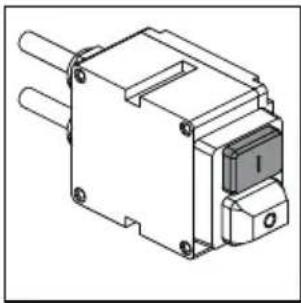
natural_image
Technical line drawing of a mechanical component with mounting holes and a central button (no text or symbols)http://www.hse.gov.uk/electricity/faq-portable-appliance-testing.htm.
text_image
Technical diagram of a mechanical device with labeled parts 1 and 2FIG C
Altrad Belle Warranty Department,
Sheen, Nr. Buxton,
Derbyshire
SK17 0EU
Angleterre
text_image
Sticker F D E C B A BelleA - Merkstickers
GEEL / GROEN = AARDE, BLAUW = NUL, BRUIN = FASE
natural_image
Technical line drawing of a mechanical component labeled FIG A, FIG B (no other text or symbols)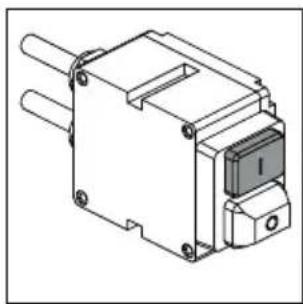
natural_image
Technical line drawing of a mechanical component with no visible text or symbolshttp://www.hse.gov.uk/electricity/faq-portable-appliance-testing.htm.
Altrad Belle Warranty Department,
Sheen, Nr. Buxton
Derbyshire,
SK17 0EU, England.
text_image
Technical diagram of a Bate air purifier with labeled components and wiring, including parts A through 11.Etikette

text_image
Belle A B C D E FA - Fabrikatsmærkat
GR∅N / GUL = JORD, BLÅ = NEUTRAL, BRUN = LEVENDE
natural_image
Technical line drawing of an electrical component labeled FIG A, FIG B (no other text or symbols)
natural_image
Technical line drawing of a mechanical component with no visible text or symbolsAltrad Belle Warranty Department,
Sheen, Nr. Buxton
Derbyshire
SK17 0EU
England
natural_image
Technical line drawing of an electrical component (no text or symbols on the diagram itself)
natural_image
Technical line drawing of a mechanical component with no visible text or symbolshttp://www.hse.gov.uk/electricity/faq-portable-appliance-testing.htm.
Altrad Belle Warranty Department,
Sheen, Nr. Buxton
Derbyshire
SK17 0EU, England
I
text_image
Technical diagram of a Balle electric pump assembly with numbered components and labeled partsAmbiente
I
Smaltimento sicuro.

natural_image
Technical line drawing of an electrical component labeled FIG A, FIG B (no other text or symbols)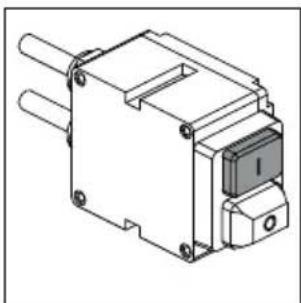
natural_image
Technical line drawing of a mechanical component with mounting holes and a central button (no text or symbols)Altrad Belle Warranty Department,
Sheen, Nr. Buxton
Derbyshire
text_image
Belle A B C D E FA - Varumärkesdekal
GRÖN/GUL = JORD, BLÅ = NEUTRAL, BRUN = SPÄNNING
natural_image
Technical line drawing of an electrical component (no text or symbols on the diagram itself)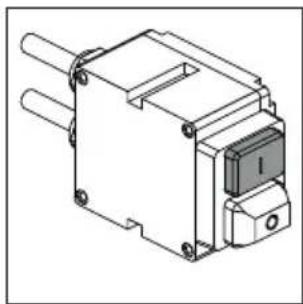
natural_image
Technical line drawing of a mechanical component with no visible text or symbolsAltrad Belle Warranty Department,
Sheen, Nr. Buxton
Derbyshire
SK17 0EU England
natural_image
Technical line drawing of a KUVA A KUVA B electrical contactor component (no text or symbols on the diagram itself)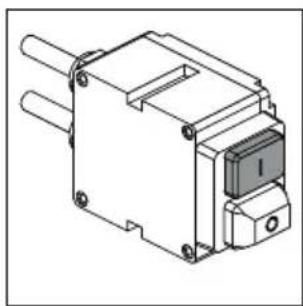
natural_image
Technical line drawing of a mechanical component with no visible text or symbolshttp://www.hse.gov.uk/electricity/faq-portable-appliance-testing.htm.
Altrad Belle Warranty Department,
Sheen, Nr. Buxton
Derbyshire
SK17 0EU,
England
text_image
Technical diagram of a Bate industrial machine with labeled components and wiring, showing parts A through 11.Środowisko

natural_image
Isometric line drawing of an electrical component with two leads and a button (no text or symbols)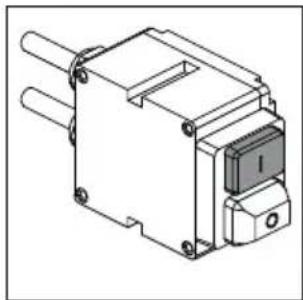
natural_image
Technical line drawing of a mechanical component with no visible text or symbolsAltrad Belle Warranty Department,
Sheen, Nr. Buxton
Derbyshire
SK17 0EU,
England
natural_image
Technical line drawing of an electrical component with no visible text or symbols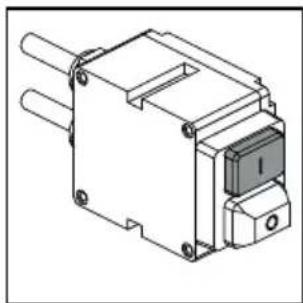
natural_image
Technical line drawing of a mechanical component with no visible text or symbolsAltrad Belle Warranty Department,
Sheen, Nr. Buxton
Derbyshire
SK17 0EU,
Англия
natural_image
Technical line drawing of a JOONIS A JOONIS B electrical contactor component (no text or symbols on the diagram itself)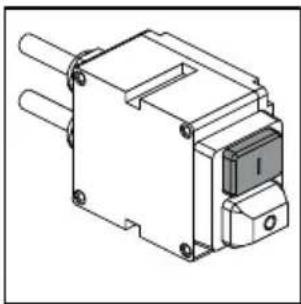
natural_image
Technical line drawing of a mechanical component with no visible text or symbolsAltrad Belle Warranty Department,
Sheen, Nr. Buxton
Derbyshire
SK17 0EU,
England
text_image
Technical diagram of a Balle air purifier with labeled components and partsVide

Droša iznīcināšana

text_image
Belle A B C D E FA - Zimola uzlime
natural_image
Technical line drawing of an electrical contactor component (no text or symbols on the diagram itself)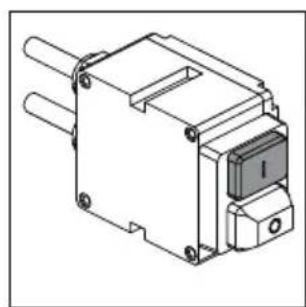
natural_image
Technical line drawing of a mechanical component with no visible text or symbolsAltrad Belle Warranty Department,
Sheen, Nr. Buxton
Derbyshire
SK17 0EU, England
text_image
lipdukas s lipdukas as ugos lipdukas F D E C B A Bellenatural_image
Technical line drawing of a mechanical component with mounting holes and a central block (no text or symbols)PCEL-E portatyvinio prietaiso bandymo (PAT) stendo vadovas

WARNING
Make sure that the plate is unplugged from the power source prior to carrying out first steps or the visual inspection!
http://www.hse.gov.uk/electricity/faq-portable-appliance-testing.htm.
Altrad Belle Warranty Department,
Sheen, Nr. Buxton
Derbyshire
SK17 0EU,
England
text_image
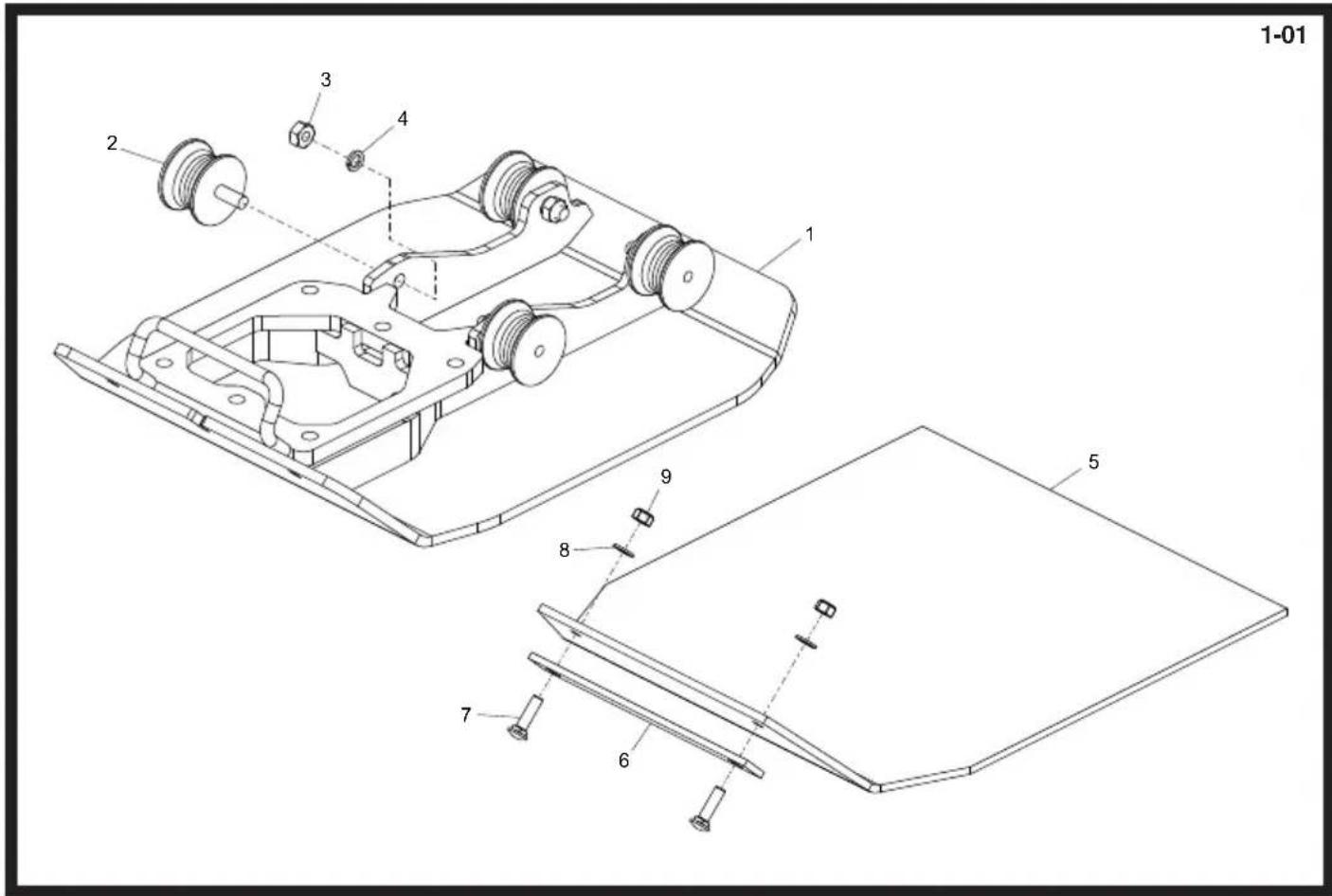
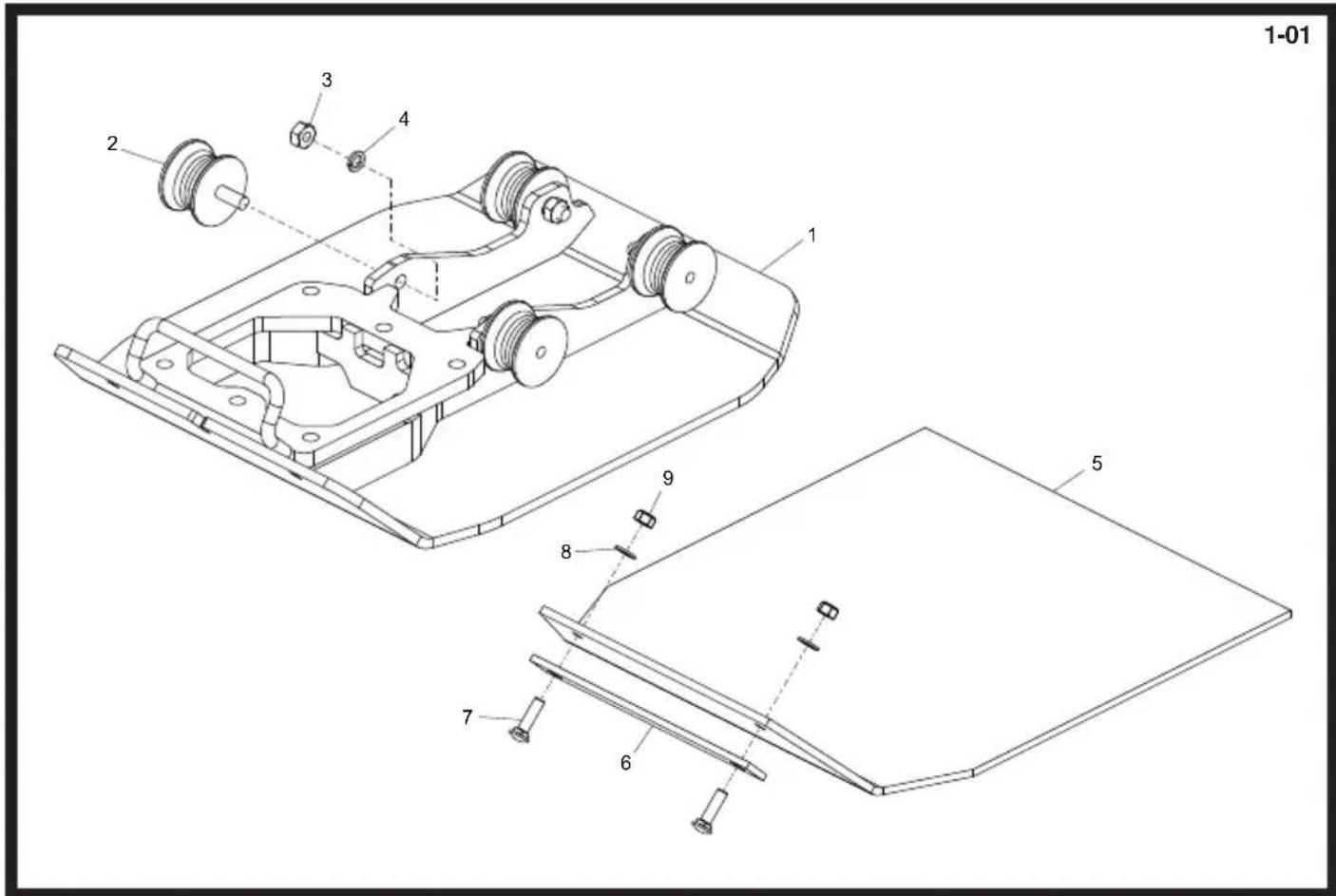
1-01 2 3 4 1 5 9 8 7 6Baseplate Assembly, Plaque d'embase, Cto. Placa de Base, Conj. Place de Base
| 1 | 968/01000 | Baseplate | Plaque d'embase | Placa de base | Placa de Base | 1 |
| 2 | 21.0.292 | Anti-Vibration Mount | Tampon antivibratoire | Montura antivibratoria | Bloco Anti-vibração | 4 |
| 3 | 8/10003 | Nut | Ecrou | Tuerca | Porca | M10 |
| 4 | 4/1003 | Washer | Rondelle | Arandela | Anilha | M10 |
| 5 | 968/99909 | Paving Pad | Tampon de Pavage | Tampón de Pavimentación | Bloco de Pavimentação | 1 |
| 6 | 943/99907 | Clamp Strip | Barrette de blocage | Barra de fijación | Tira de Grampeamento | 1 |
| 7 | 00.0.860 | Bolt | Boulon | Perno | Perno | M8 x 30 |
| 8 | 4/8006 | Washer | Rondelle | Arandela | Anilha | M8 |
| 9 | 8/8008 | Nut | Ecrou | Tuerca | Porca | M8 |
text_image
1-01 1 2 3 4 1 5 9 8 7 6Vloerplaat, Ruttelplatten -Zsb., Bundplade, Gruppo Piastra di Base
| 1 | 968/01000 | Vloerplaat | Rüttelplatten | Bundplade | Piastra di Base | 1 |
| 2 | 21.0.292 | Anti-trilbevestiging | Schwingungsdämpfer | Antivibrationsophæng | Supporto antivibrazioni | 4 |
| 3 | 8/10003 | Moer | Mutter | Møtrik | Dado | M10 |
| 4 | 4/1003 | Afdichtring | Scheibe | Spændeskive | Rondella | M10 |
| 5 | 968/99909 | Paving Pad | Tampon de Pavage | Tampón de Pavimentación | Bloco de Pavimentação | 1 |
| 6 | 943/99907 | Clamp Strip | Barrette de blocage | Barra de fijación | Tira de Grampeamento | 1 |
| 7 | 00.0.860 | Bouten | Bolzen | Skruebolt | Bullone | M8 x 30 |
| 8 | 4/8006 | Afdichtring | Scheibe | Spændeskive | Rondella | M8 |
| 9 | 8/8008 | Moer | Mutter | Møtrik | Dado | M8 |
text_image
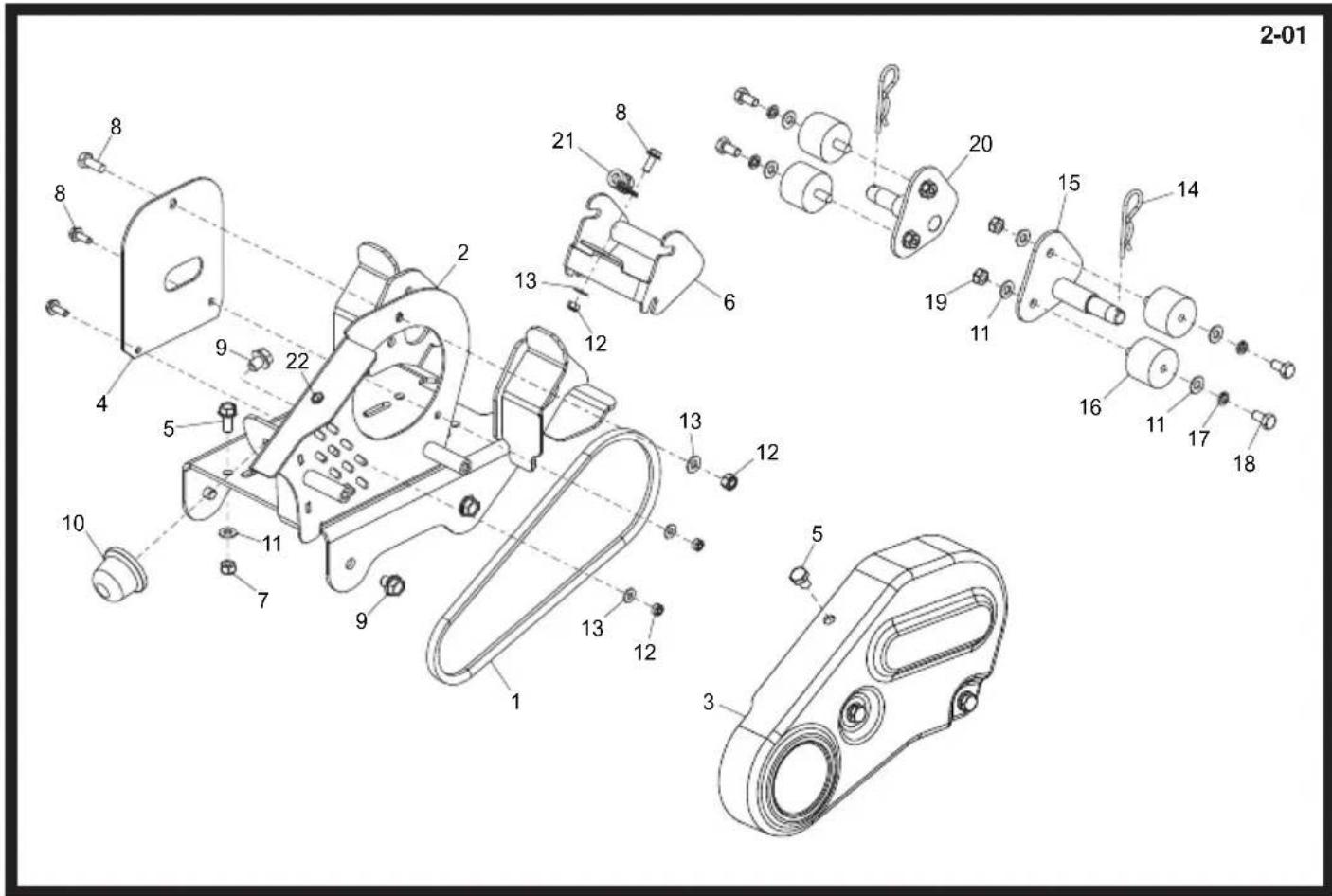
2-01 8 8 21 8 6 20 15 14 19 11 16 11 17 18 13 12 13 12 13 12 7 9 10 4 5 22 9 2Bedplate Assembly, Ensemble Socle, Conjunto de Bancada, Conjunto da Placa de Apoio
| 1 | 11.0.065 | Belt | Courroie | Correa | Cinta | 1 |
| 2 | 968/00100 | Bedplate | Plaque d'assise | Bancada | Placa de Apoio | 1 |
| 3 | 968/99901S | Belt Guard - Orange | Capot de courroie - Orange | Protector de la correa - Naranja | Guarda da Cinta - Laranja | 1 |
| 3 | 968/99901B | Belt Guard - Blue | Capot de courroie - Bleu | Protector de la correa - Azúl | Guarda da Cinta - Azul | 1 |
| 3 | 968/99901G | Belt Guard - Green | Capot de courroie - Vert | Protector de la correa - Verde | Guarda da Cinta - Verde | 1 |
| 3 | 968/99901R | Belt Guard - Red | Capot de courroie - Rouge | Protector de la correa - Roja | Guarda da Cinta - Vermelho | 1 |
| 3 | 968/99901Y | Belt Guard - Yellow | Capot de courroie - Jaune | Protector de la correa - Amarillo | Guarda da Cinta - Amarelo | 1 |
| 3 | 968/99901W | Belt Guard - White | Capot de courroie - Blanc | Protector de la correa - Blanco | Guarda da Cinta - Branco | 1 |
| 4 | 968/99908 | Plate | Plaque | Placa | Placa | 1 |
| 5 | 7/8037 | Screw | Vis | Tornillo | Parafuse | 4 |
| 6 | 968/00700 | Handle | Guidon | Manillar | Punho | 1 |
| 7 | 8/8002 | Nut | Ecrou | Tuerca | Porca | 1 |
| 8 | 7/6034 | Screw | Vis | Tornillo | Parafuse | 4 |
| 9 | 7/10025 | Screw | Vis | Tornillo | Parafuse | 5 |
| 10 | 21.0.333 | Rubber Stop | Butée en caoutchouc | Tope de caucho | Batente de Borracha | 1 |
| 11 | 4/8006 | Washer | Rondelle | Arandela | Anilha | M8 |
| 12 | 8/6007 | Nut | Ecrou | Tuerca | Porca | M6 |
| 13 | 4/6007 | Washer | Rondelle | Arandela | Anilha | M6 |
| 14 | 900/00100 | R-Clip | Collier en "R" | Abrazadera "R" | Gancho "R" | 2 |
| 15 | 968/00500 | Pivot | Pivot | Pivote | Pivô | 1 |
| 16 | 21/0157 | Anti-Vibration Mount | Tampon antivibratoire | Montura antivibratoria | Bloco Anti-vibração | 4 |
| 17 | 4/8003 | Washer | Rondelle | Arandela | Anilha | 4 |
| 18 | 7/8008 | Screw | Vis | Tornillo | Parafuse | M8 |
| 19 | 8/8002 | Nut | Ecrou | Tuerca | Porca | M8 |
| 20 | 968/00600 | Pivot | Pivot | Pivote | Pivô | 1 |
| 21 | 900/10200 | P-Clip | Collier en "P" | Abrazadera "P" | Gancho "P" | 5 |
| 22 | 8/8011 | Nut | Ecrou | Tuerca | Porca | M8 |
text_image
2-01 8 8 21 8 6 20 15 14 19 11 16 11 17 18 13 12 13 12 13 12 7 9 10 4 5 22 9 2Grondplaat, Sohlplatten-Zsb., Fundamentplademontage, Gruppo Piastra di Base
| 1 | 11.0.065 | Riem | Riemen | Remmen | Cinghia | 1 |
| 2 | 968/00100 | Grondplaat | Sohlplatte | Fundamentplade | Piastra di Base | 1 |
| 3 | 968/99901S | Riembeschermkap - Oranje | Riemenabdeckung - Orange | Remskærm - Orange | Protezione Cinghia - Arancione | 1 |
| 3 | 968/99901B | Riembeschermkap - Blauw | Riemenabdeckung - Blau | Remskærm - Blå | Protezione Cinghia - Blu | 1 |
| 3 | 968/99901G | Riembeschermkap - Groen | Riemenabdeckung - Grün | Remskærm - Gron | Protezione Cinghia - verde | 1 |
| 3 | 968/99901R | Riembeschermkap - Rood | Riemenabdeckung - Rot | Remskærm - Rød | Protezione Cinghia - Rosso | 1 |
| 3 | 968/99901Y | Riembeschermkap - Geel | Riemenabdeckung - Gelb | Remskærm - Gul | Protezione Cinghia - Giallo | 1 |
| 3 | 968/99901W | Riembeschermkap - Wit | Riemenabdeckung - Weiß | Remskærm - Hvid | Protezione Cinghia - Blanco | 1 |
| 4 | 968/99908 | Plaat | Platte | Plade | Piastra | 1 |
| 5 | 7/8037 | Schroef | Schraube | Skrue | Vite | 4 |
| 6 | 968/00700 | Hendel | Griff | Håndtag | Impugnatura | 1 |
| 7 | 8/8002 | Moer | Mutter | Møtrik | Dado | 1 |
| 8 | 7/6034 | Schroef | Schraube | Skrue | Vite | 4 |
| 9 | 7/10025 | Schroef | Schraube | Skrue | Vite | 5 |
| 10 | 21.0.333 | Aanslagrubber | Gummianschlag | Gummistop | Arresto in gomma | 1 |
| 11 | 4/8006 | Afdichtring | Scheibe | Spændeskive | Rondella | 9 |
| 12 | 8/6007 | Moer | Mutter | Møtrik | Dado | 4 |
| 13 | 4/6007 | Afdichtring | Scheibe | Spændeskive | Rondella | 4 |
| 14 | 900/00100 | R-klemmen | 'R'-Schellen | 'R'-klemmer | Fermagli a "R" | 2 |
| 15 | 968/00500 | Roteren | Achse | Dreje | Perno | 1 |
| 16 | 21/0157 | Anti-trilbevestiging | Schwingungsdämpfer | Antivibrationsophaeng | Supporto antivibrazioni | 4 |
| 17 | 4/8003 | Afdichtring | Scheibe | Spændeskive | Rondella | 4 |
| 18 | 7/8008 | Schroef | Schraube | Skrue | Vite | 4 |
| 19 | 8/8002 | Moer | Mutter | Møtrik | Dado | 4 |
| 20 | 968/00600 | Roteren | Achse | Dreje | Perno | 1 |
| 21 | 900/10200 | P-klemmen | 'P'-Schellen | 'P'-klemmer | Fermagli a "P" | 5 |
| 22 | 8/8011 | Moer | Mutter | Møtrik | Dado | 1 |
text_image
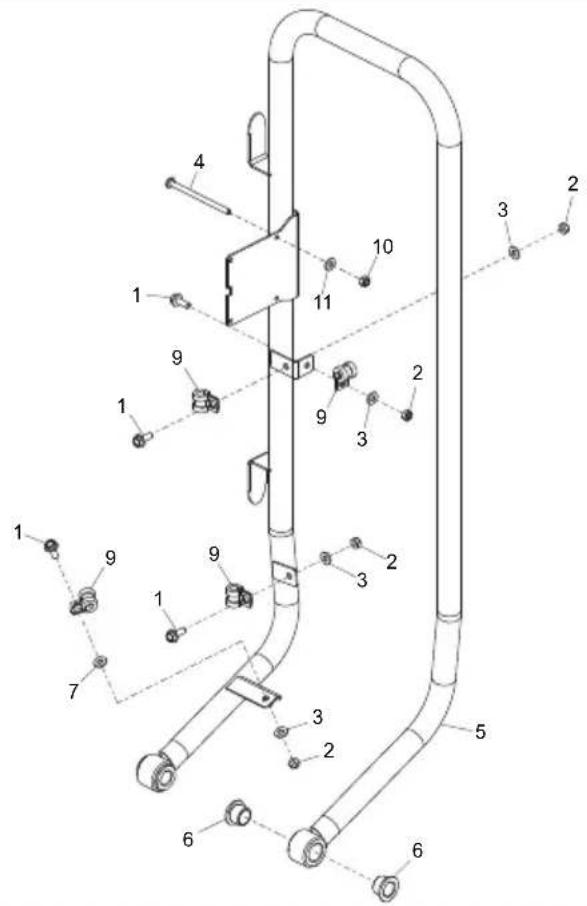
Technical diagram of a mechanical device with numbered components for identification3-01
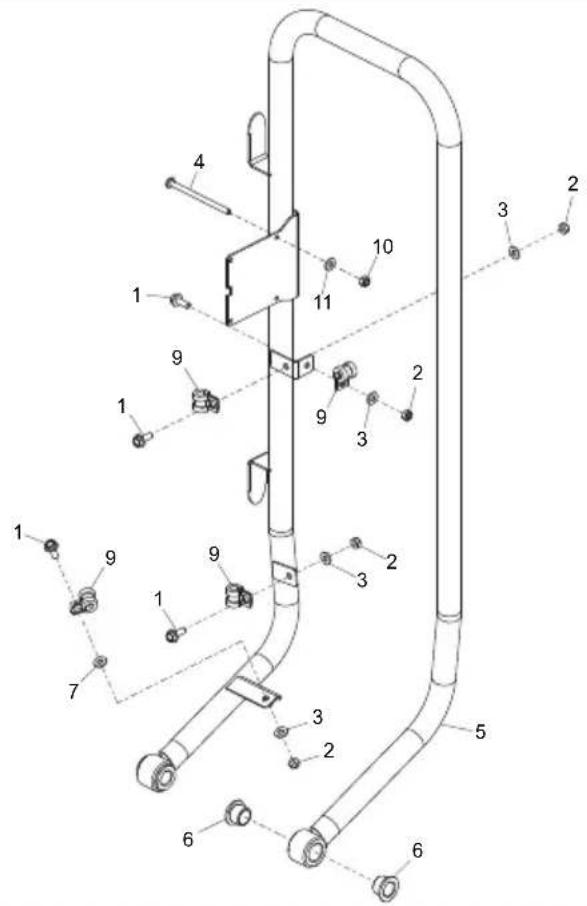
Handle Assembly, Ensemble Poignée, Conjunto de Manillar, Conjunto do Punho
| 1 | 7/6034 | Screw | Vis | Tornillo | Parafuse | M6 | 4 |
| 2 | 8/6007 | Nut | Ecrou | Tuerca | Porca | M6 | 4 |
| 3 | 4/6007 | Washer | Rondelle | Arandela | Anilha | M6 | 4 |
| 4 | 7/4022 | Screw | Vis | Tornillo | Parafuse | M4 x 60 | 4 |
| 5 | 968/00900 | Handle | Guidon | Manillar | Punho | 5 | |
| 6 | 50/000068 | Bush | Douille | Buje | Bucha | 4 | |
| 7 | 4/8002 | Washer | Rondelle | Arandela | Anilha | M8 | 1 |
| 9 | 900/10200 | P-Clip | Collier en "P" | Abrazadera "P" | Gancho "P" | 1 | |
| 10 | 8/4005 | Nut | Ecrou | Tuerca | Porca | M4 | 4 |
| 11 | 4/4001 | Washer | Rondelle | Arandela | Anilha | M4 | 4 |
text_image
Technical diagram of a mechanical device with numbered components for identification3-01
Complete Hendel, Griff-zsb., Håndtagsenhed, Gruppo Impugnatura
| 1 | 7/6034 | Schroef | Schraube | Skrue | Vite | 4 |
| 2 | 8/6007 | Moer | Mutter | Møtrik | Dado | M6 |
| 3 | 4/6007 | Afdichtring | Scheibe | Spændeskive | Rondella | M6 |
| 4 | 7/4022 | Schroef | Schraube | Skrue | Vite | M4 x 60 |
| 5 | 968/00900 | Hendel | Griff | Håndtag | Impugnatura | 5 |
| 6 | 50/000068 | Bus | Buchse | Bøsning | Boccola | 4 |
| 7 | 4/8002 | Afdichtring | Scheibe | Spændeskive | Rondella | M8 |
| 9 | 900/10200 | P-klemmen | ‘P’-Schellen | ‘P’-klemmer | Fermagli a “P” | 1 |
| 10 | 8/4005 | Moer | Mutter | Møtrik | Dado | M4 |
| 11 | 4/4001 | Afdichtring | Scheibe | Spændeskive | Rondella | M4 |
text_image
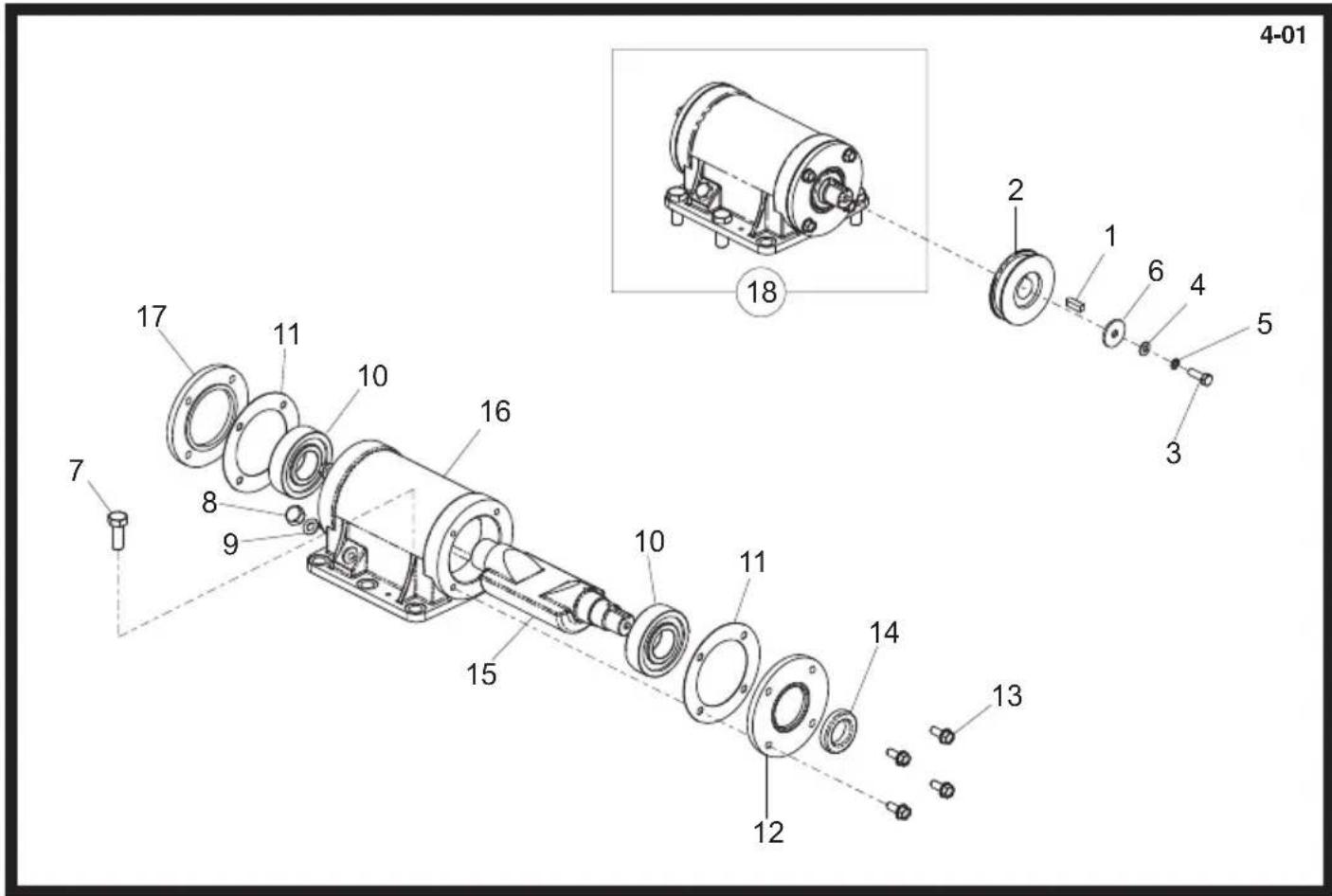
4-01 18 2 1 6 4 5 3 17 11 10 16 10 11 14 13 12 15 7 8 9 15Vibrator Unit, Unité de Vibration, Unidade Vibradora, Unidade do Vibrador
| 1 | 06.3.014 | Key | Clavette | Chaveta | Chaveta | 8 x 7 x 25 | 1 |
| 2 | 151.0.221 | Pulley | Poelie | Polea | Polia | 1 | |
| 3 | 7/8012 | Bolt | Boulon | Perno | Perno | M8 x 25 | 1 |
| 4 | 4/8006 | Washer | Rondelle | Arandela | Anilha | M8 | 1 |
| 5 | 4/8003 | Washer | Rondelle | Arandela | Anilha | M8 | 1 |
| 6 | 77.0.142 | Washer | Rondelle | Arandela | Anilha | 1 | |
| 7 | 07.9.062 | Screw | Vis | Tornillo | Parafuse | M7 x 35 | 6 |
| 8 | MS12 | Bung | Obturateur | Tapón | Tampão | 1/4" | 1 |
| 9 | 15.0.102 | Washer | Rondelle | Arandela | Anilha | 1 | |
| 10 | 12.1.057 | Bearing | Roulement | Cojinete | Rolamanto | 2 | |
| 11 | 943/99904 | Gasket | Joint | Junta | Gaxeta | 2 | |
| 12 | 77.0.015 | End Cover | Carter d'extrémité | Tapa de fondo | Tampa de extremidade | 1 | |
| 13 | 7/8037 | Screw | Vis | Tornillo | Parafuse | M8 x 20 | 4 |
| 14 | 15.0.196 | Oil Seal | Joint d'étanchéité à l'huile | Obturador aceite | Vedação de Óleo | 1 | |
| 15 | 943/99955UK | Vibrator Shaft | Axe | Eje | Veio | 1 | |
| 16 | 151/99999 | Housing | Carter de boîte de vitesses | Envoltura de la transmisión | Estojo da caixa de engrenagens | 1 | |
| 17 | 77.0.016 | End Cover | Carter d'extrémité | Tapa de fondo | Tampa de extremidade | 1 | |
| 18 | PCLX-VIB-02SP | Vibrator Assembly | Ensemble vibrateur | Conjunto de vibrador | Conjunto do Vibrador | 1 |

text_image
4-01 18 2 1 6 4 5 3 17 11 10 16 10 11 14 13 12 15 7 8 9 15Trilelement, Rüttlerteil, Vibratorenhed, Gruppo Vibratore
| 1 | 06.3.014.... | Spie.... | Keil.... | Feder.... | Chiave.... | 8 x 7 x 25.... | 1 |
| 2 | 151.0.221.... | Poelie.... | Riemenscheibe.... | Remskive.... | Puleggia.... | 1 | |
| 3 | 7/8012.... | Bouten.... | Bolzen.... | Skruebolt.... | Bullone.... | M8 x 25.... | 1 |
| 4 | 4/8006.... | Afdichtring.... | Scheibe.... | Spændeskive.... | Cuscinetto.... | M8.... | 1 |
| 5 | 4/8003.... | Afdichtring.... | Scheibe.... | Spændeskive.... | Cuscinetto.... | M8.... | 1 |
| 6 | 77.0.142.... | Afdichtring.... | Scheibe.... | Spændeskive.... | Cuscinetto.... | 1 | |
| 7 | 07.9.062.... | Schroef.... | Schraube.... | Skrue.... | Vite.... | M7 x 35.... | 6 |
| 8 | MS12.... | Plug.... | Verschlusschraube.... | Prop.... | Candela.... | 1/4".... | 1 |
| 9 | 15.0.102.... | Afdichtring.... | Scheibe.... | Spændeskive.... | Cuscinetto.... | 1 | |
| 10 | 12.1.057.... | Lager.... | Lager.... | Leje.... | Rolamanto.... | 2 | |
| 11 | 943/99904.... | Tætningsring.... | Flachdichtung.... | Pakking.... | Gaurnizione.... | 2 | |
| 12 | 77.0.015.... | Einddeksel.... | Endschild.... | Endedæksel.... | Coperchio Estremità.... | 1 | |
| 13 | 7/8037.... | Schroef.... | Schraube.... | Skrue.... | Vite.... | M8 x 20.... | 4 |
| 14 | 15.0.196.... | Olieafdichtring.... | Oldichtung.... | Oliepakning.... | Paraolio.... | 1 | |
| 15 | 943/99955UK.... | As.... | Welle.... | Aksel.... | Albero.... | 1 | |
| 16 | 151/99999.... | Versnellingsbakhuis.... | Getriebekasten.... | Gearkassehus.... | Involucro scatola ingranaggi.... | 1 | |
| 17 | 77.0.016.... | Einddeksel.... | Endschild.... | Endedæksel.... | Coperchio Estremità.... | 1 | |
| 18 | PCLX-VIB-02SP.... | Trilelement.... | Rüttelwerk.... | Vibratorenhed.... | Gruppo vibratore.... | 1 |
text_image
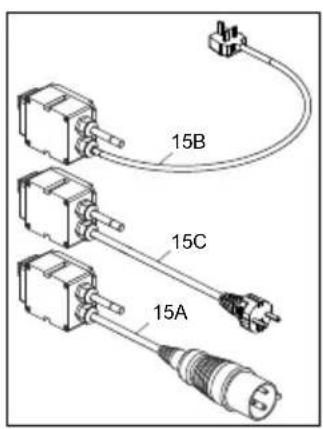
15B 15C 15A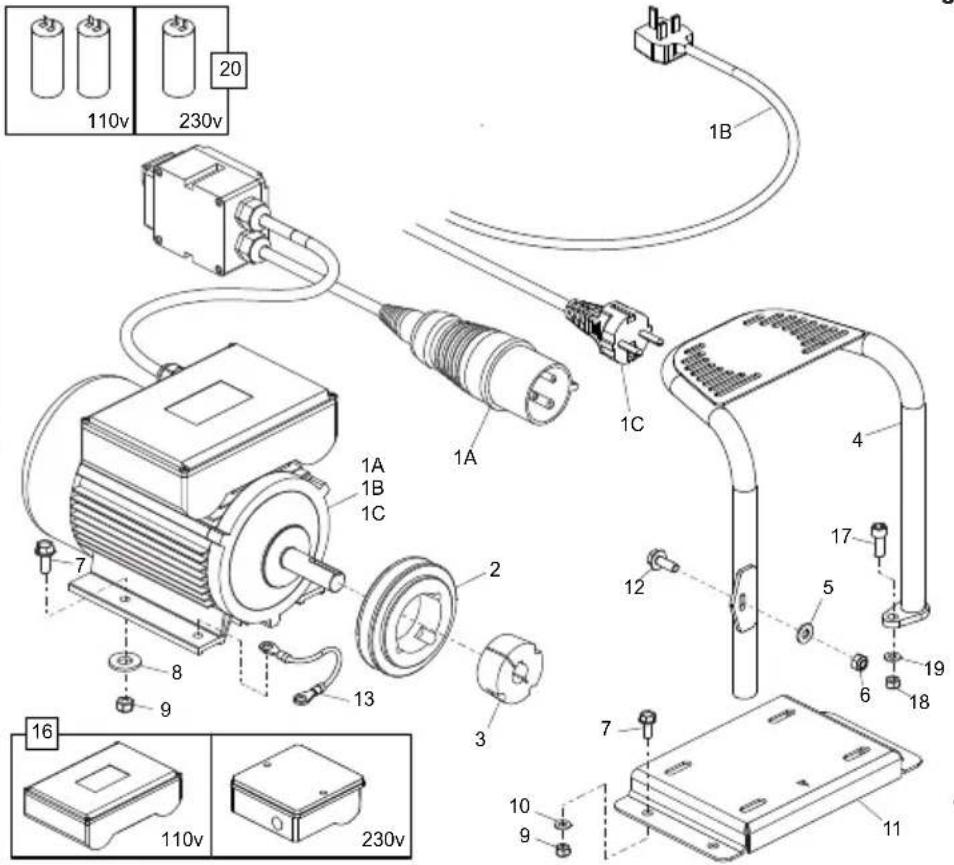
text_image
Technical diagram of an electrical device with labeled components and wiring, including batteries, motors, and connectors.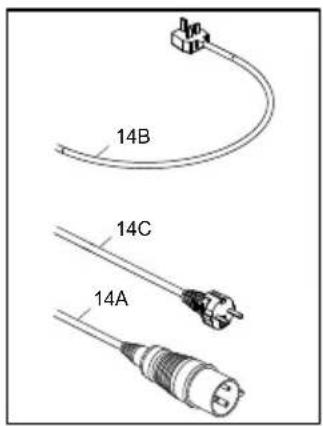
text_image
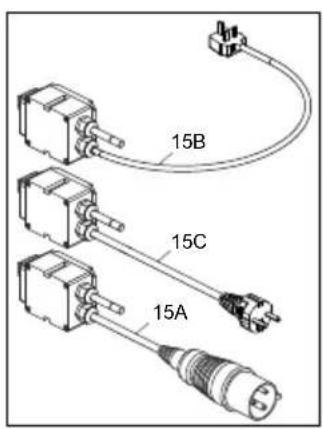
14B 14C 14AMotor and Drive Kit, Moteur et Kit d'Entraînement, Motor y Kit Transmision, Motor e Kit de Transmissão
| 1A | 20/0119 | Motor | Moteur | Motor | Motor | 110v UK | 1 |
| 1B | 20/0123 | Motor | Moteur | Motor | Motor | 230v UK | 1 |
| 1C | 20/0121 | Motor | Moteur | Motor | Motor | 230v EU | 1 |
| 2 | 21/0370 | Pulley | Poulie | Polea | Polia | 1 | 1 |
| 3 | 21/0371 | Bush | Douille | Buje | Bucha | 1 | 1 |
| 4 | 968/01100 | Guard | Carène | Defensa | Guarda | 1 | 1 |
| 5 | 4/6007 | Washer | Rondelle | Arandela | Anilha | M6 | 1 |
| 6 | 8/6007 | Nut | Ecrou | Tuerca | Porca | M8 | 1 |
| 7 | 7/8037 | Screw | Vis | Tornillo | Parafuso | 8 | 8 |
| 8 | 4/8014 | Washer | Rondelle | Arandela | Anilha | M12 | 4 |
| 9 | 8/8002 | Nut | Ecrou | Tuerca | Porca | M8 | 8 |
| 10 | 4/8006 | Washer | Rondelle | Arandela | Anilha | M8 | 4 |
| 11 | 968/99907 | Motor Deck | Plate-Forme De Moteur | Cubierta Motor | Plataforma motor | 1 | 1 |
| 12 | 7/6034 | Screw | Vis | Tornillo | Parafuso | 1 | 1 |
| 13 | 71/0289 | Earth Cable | Cable - de Terre | Cable - Positivo | Cable - Terra | 1 | 1 |
| 14A | 71/0288 | Harness | Faisceau | Ver Partido | Consulatar Arnês | 110v UK | 1 |
| 14B | 71/0284 | Harness | Faisceau | Ver Partido | Consulatar Arnês | 230v UK | 1 |
| 14C | 71/0283 | Harness | Faisceau | Ver Partido | Consulatar Arnês | 230v EU | 1 |
| 15A | 71/0291 | Harness & Switch | Faisceau & Commutateur | Ver Partido & Interruptor | Consulatar Arnês & Interruptor | 110v UK | 1 |
| 15B | 71/0290 | Harness & Switch | Faisceau & Commutateur | Ver Partido & Interruptor | Consulatar Arnês & Interruptor | 230v UK | 1 |
| 15C | 71/0292 | Harness & Switch | Faisceau & Commutateur | Ver Partido & Interruptor | Consulatar Arnês & Interruptor | 230v EU | 1 |
| 16A | 21/0398 | Housing Connector | Connecteur de Boîtier | Conector de la Vivienda | Conector de Habitação | 110v | 1 |
| 16B | 21/0399 | Housing Connector | Connecteur de Boîtier | Conector de la Vivienda | Conector de Habitação | 230v | 1 |
| 17 | 7/8039 | Screw | Vis | Tornillo | Parafuso | M8 x 20 | 1 |
| 18 | 8/8008 | Nut | Ecrou | Tuerca | Porca | M8 | 1 |
| 19 | 4/8006 | Washer | Rondelle | Arandela | Anilha | M8 | 1 |
| 20 | 902/14700 | Capacitors | Condensateurs | Condensadores | Condensadores | 110v | 1 |
| 20 | 70/0137 | Capacitor | Condensateur | Condensador | Condensador | 230v | 1 |
text_image
15B 15C 15A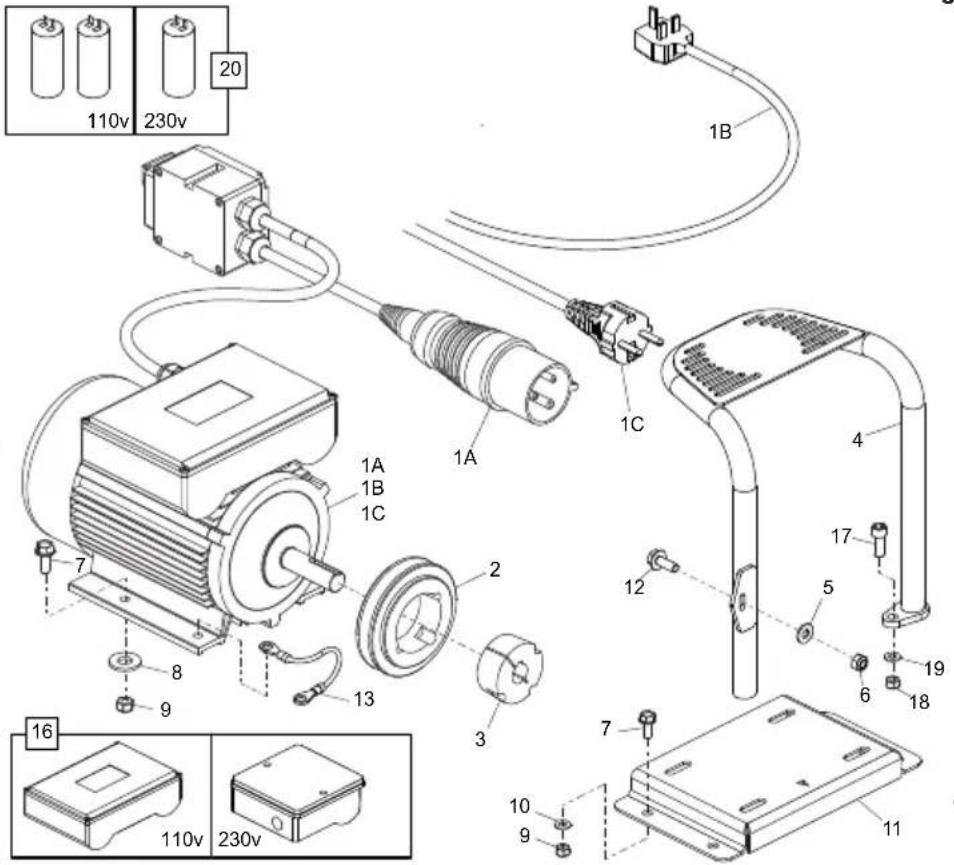
text_image
Technical diagram of an electrical device with labeled components and wiring, including batteries, motors, and connectors.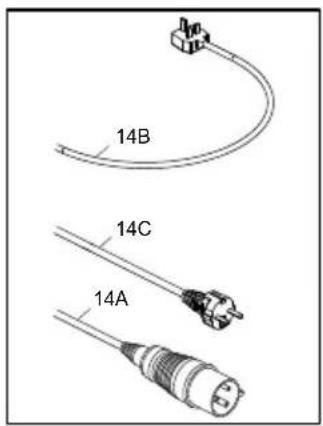
text_image
14B 14C 14AMotor en Aandrijfset, Motor und Antriebsbausatz, Motor og Gearkit, Motore e Kit Trasmissione
| 1 | 20/0119 | Motor | Motor | Motor | Motore | 110v UK | 1 |
| 1 | 20/0123 | Motor | Motor | Motor | Motore | 230v UK | 1 |
| 1 | 20/0121 | Motor | Motor | Motor | Motore | 230v EU | 1 |
| 2 | 21/0370 | Poelie | Riemenscheibe | Remskive | Puleggia | 1 | |
| 3 | 21/0371 | Bus | Buchse | Bøsning | Boccola | 1 | |
| 4 | 968/01100 | Beschermkap | Schutz | Skærm | Protezione | 1 | |
| 5 | 4/6007 | Afdichtring | Scheibe | Spændeskive | Cuscinetto | M6 | 1 |
| 6 | 8/6007 | Moer | Mutter | Møtrik | Dado | M8 | 1 |
| 7 | 7/8037 | Schroef | Schraube | Skrue | Vite | 8 | |
| 8 | 4/8014 | Afdichtring | Scheibe | Spændeskive | Cuscinetto | M12 | 4 |
| 9 | 8/8002 | Moer | Mutter | Møtrik | Dado | M8 | 8 |
| 10 | 4/8006 | Afdichtring | Scheibe | Spændeskive | Cuscinetto | M8 | 4 |
| 11 | 968/99907 | Motor Dek | Motordeck | Motor Dæk | Deck Motore | 1 | |
| 12 | 7/6034 | Schroef | Schraube | Skrue | Vite | 1 | |
| 13 | 71/0289 | Aardkabel | Erdungskabel | Jordkabel | Cavo di Terra | 1 | |
| 14A | 71/0288 | Bedrading | Kabelbaum | ledningsnet | Cablaggio | 110v UK | 1 |
| 14B | 71/0284 | Bedrading | Kabelbaum | ledningsnet | Cablaggio | 230v UK | 1 |
| 14C | 71/0283 | Bedrading | Kabelbaum | ledningsnet | Cablaggio | 230v EU | 1 |
| 15A | 71/0291 | Harness & Schakelaar | Faisceau & Schalter | Ver Partido & Omskifter | Consulatar Arnès & Interruttore | 110v UK | 1 |
| 15B | 71/0290 | Harness & Schakelaar | Faisceau & Schalter | Ver Partido & Omskifter | Consulatar Arnès & Interruttore | 230v UK | 1 |
| 15C | 71/0292 | Harness & Schakelaar | Faisceau & Schalter | Ver Partido & Omskifter | Consulatar Arnès & Interruttore | 230v EU | 1 |
| 16A | 21/0398 | Behuizing Connector | Gehäuseverbinder | Boliger Stik | Connettore Alloggiamento | 110v | 1 |
| 16B | 21/0399 | Behuizing Connector | Gehäuseverbinder | Boliger Stik | Connettore Alloggiamento | 230v | 1 |
| 17 | 7/8039 | Schroef | Schraube | Skrue | Vite | M8 x 20 | 1 |
| 18 | 8/8008 | Moer | Mutter | Møtrik | Dado | M8 | 1 |
| 19 | 4/8006 | Afdichtring | Scheibe | Spændeskive | Cuscinetto | M8 | 1 |
| 20 | 902/14700 | Condensatoren | Kondensatoren | Kondensatorer | Condensatori | 110v | 1 |
| 20 | 70/0137 | Condensator | Kondensator | Kondensator | Condensatore | 230v | 1 |
6-01
text_image
Technical diagram of a rectangular electronic device with numbered components labeled 2 through 7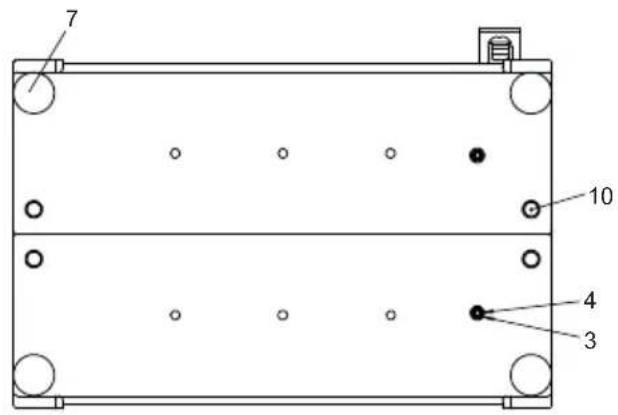
text_image
7 10 4 3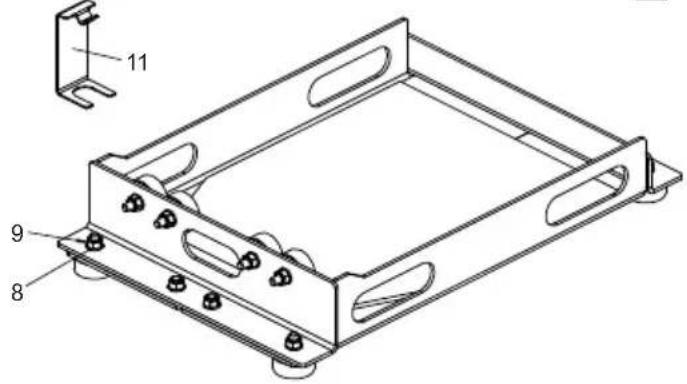
text_image
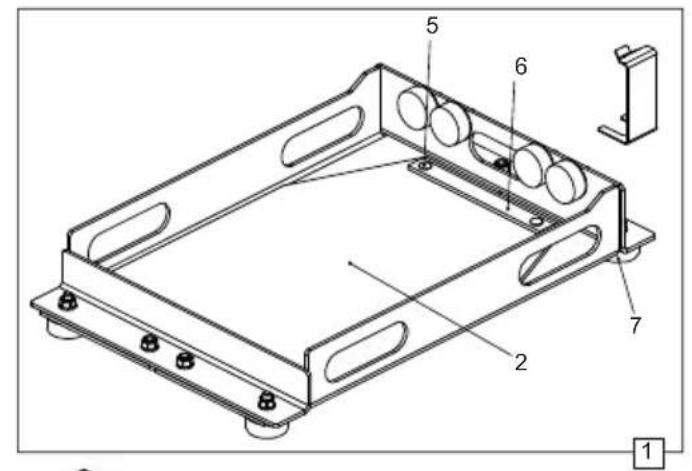
11 9 8PAT Test Rig, Appareil Portable Dispositif d'Essai, Aparato Portátil de Prueba de Plataforma, Kit de Teste de Aparelho Portátil
| 1 | 968/01200....PAT Test Rig.... | Appareil portable dispositif.... | Aparato portátil de prueba.... | Kit de teste de aparelho portátil.... | 1 |
| d'essai.... | de plataforma.... | ||||
| 2 | 968/99909....Paving Pad.... | Tampon de pavage.... | Tampón de pavimentación.... | Bloco de Pavimentação.... | 1 |
| 3 | 4/8006....Washer.... | Rondelle.... | Arandela.... | Anilha.... | M8....2 |
| 4 | 8/8008....Nut.... | Ecrou.... | Tuerca.... | Porca.... | M8....2 |
| 5 | 00.0.860....Bolt.... | Boulon.... | Perno.... | Perno.... | M8 x 30....2 |
| 6 | 943/99907....Clamp Plate.... | Plaque de serrage.... | Placa de fijación.... | Placa de Fixação.... | 1 |
| 7 | 00525-B....Anti-Vibration Mounting.. | Tampon antivibratoire.... | Montura antivibratoria.... | Montagem Anti-Vibração.... | 8 |
| 8 | 4/1005....Washer.... | Rondelle.... | Arandela.... | Anilha.... | M10....16 |
| 9 | 8/10006....Nut.... | Ecrou.... | Tuerca.... | Porca.... | M10....12 |
| 10 | 7/10005....Screw.... | Vis.... | Tornillo.... | Parafuso.... | M10 x 25....4 |
| 11 | 968/01205....Bracket.... | Patte de montage.... | Escuadra.... | Suporte.... | 1 |
6-01
text_image
Technical diagram of a rectangular electronic device with numbered components labeled 2 through 7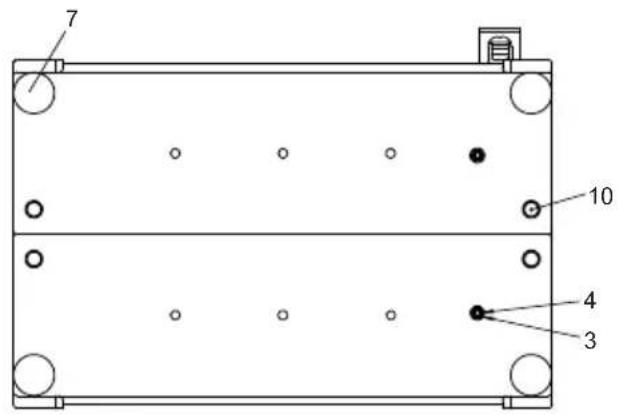
text_image
7 10 4 3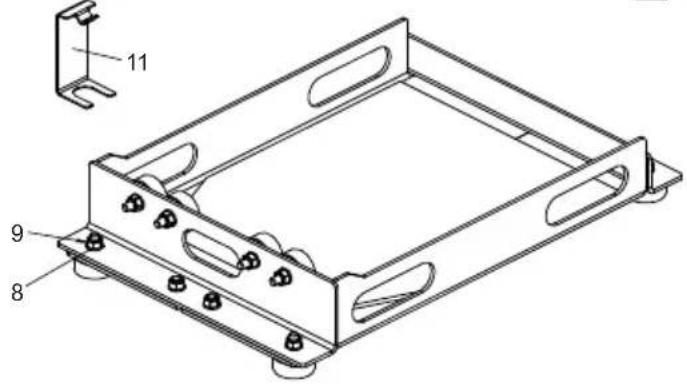
text_image
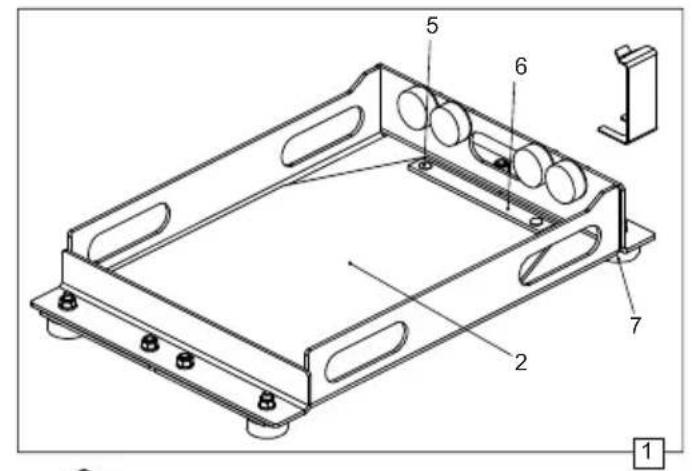
11 9 8Testen van Draagbare Apparaten Kit, Tragbares Gerät Prüfstand, Bærbar Apparat Testkit, Kit di Test Apparecchio Portatile
| 1 | 968/01200......Testen van draagbare ....Tragbares Gerät Prüfstand....Bærbar apparat testkit......Kit di test apparecchio portatile......1 | ||||
| apparaten kit...... | |||||
| 2 | 968/99909......Kunststof Onderplaat......Blockpflasterrüttler......Belægningsklodsudstyr......Pavimentazione a blocchi......1 | ||||
| 3 | 4/8006......Afdichtring......Scheibe......Spændeskive......Cuscinetto......M8......2 | ||||
| 4 | 8/8008......Moer......Mutter......Møtrik......Dado......M8......2 | ||||
| 5 | 00.0.860......Bouten......Bolzen......Skruebolt......Bullone......M8 x 30......2 | ||||
| 6 | 943/99907......Klemplaat......Klemmplatte......Holdeplade......Piastra di serraggio......1 | ||||
| 7 | 00525-B......Anti-trilbevestiging......Schwingungsdämpfer......Antivibrationsophæng......Supporto antivibrazioni......8 | ||||
| 8 | 4/1005......Afdichtring......Scheibe......Spændeskive......Cuscinetto......M10......16 | ||||
| 9 | 8/10006......Moer......Mutter......Møtrik......Dado......M10......12 | ||||
| 10 | 7/10005......Schroef......Schraube......Skrue......Vite......M10 x 25......4 | ||||
| 11 | 968/01205......Steun......Halterung......Beslag......Staffa......1 | ||||
text_image
Belle 1 2 3 4 5 6 77-01
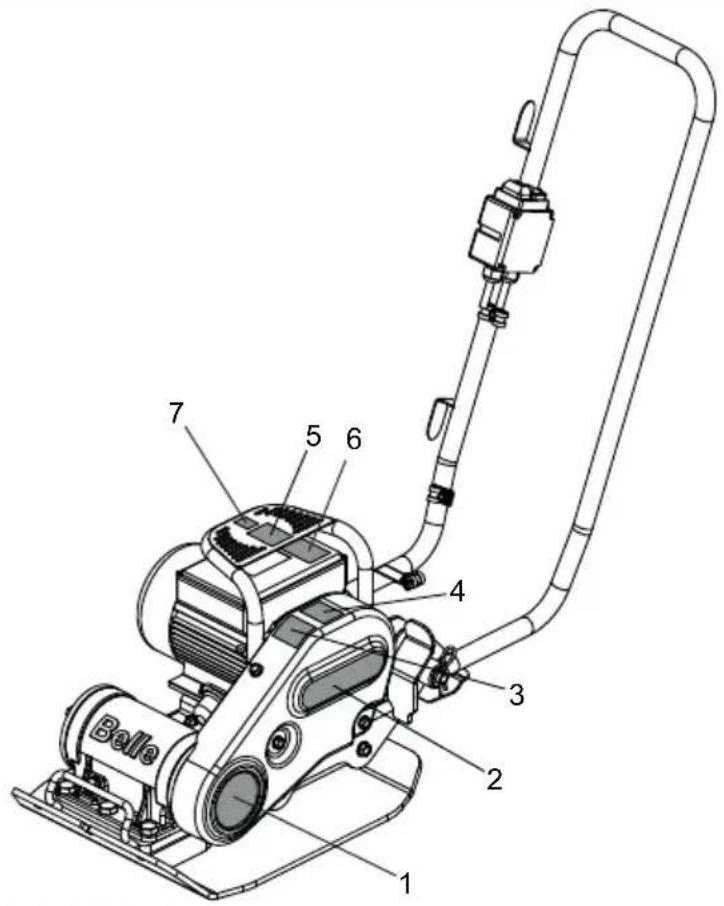
Decals, Autocollant, Rótulo, Decalque
| 1 | 800/00300 | Decal | Autocollant | Rótulo | Decalque | Belle | 2 |
| 2 | 800/99510 | Decal | Autocollant | Rótulo | Decalque | PCEL 400E | 1 |
| 3 | 19.0.373 | Decal | Autocollant | Rótulo | Decalque | Safety | 1 |
| 4 | 800/99916 | Decal | Autocollant | Rótulo | Decalque | 99 dB(A) | 1 |
| 5 | 800/99532 | Decal | Autocollant | Rótulo | Decalque | Wet Conditions | 1 |
| 6 | 800/99531 | Decal | Autocollant | Rótulo | Decalque | Motor Safety | 1 |
| 7 | 800/99533 | Decal | Autocollant | Rótulo | Decalque | No Lifting | 1 |
text_image
Bella 1 2 3 4 5 6 77-01
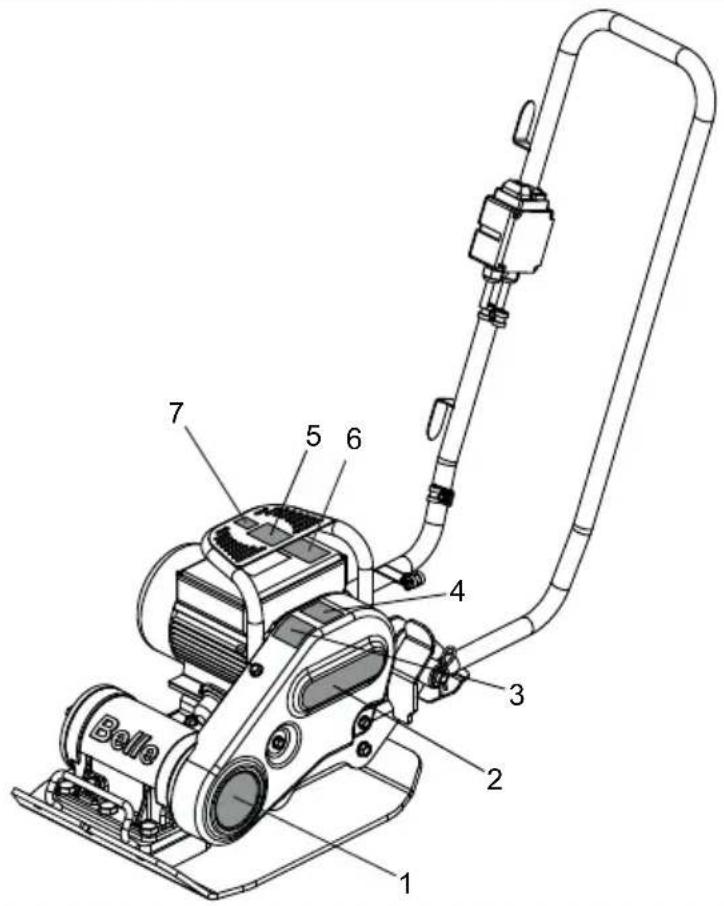
Label, Abziehbild, Skilt, Decalcomania
| 1 | 800/00300 | Label | Abziehbild | Skilt | Decalcomania | Belle | 2 |
| 2 | 800/99510 | Label | Abziehbild | Skilt | Decalcomania | PCEL 400E | 1 |
| 3 | 19.0.373 | Label | Abziehbild | Skilt | Decalcomania | Safety | 1 |
| 4 | 800/99916 | Label | Abziehbild | Skilt | Decalcomania | 99 dB(A) | 1 |
| 5 | 800/99532 | Label | Abziehbild | Skilt | Decalcomania | Wet Conditions | 1 |
| 6 | 800/99531 | Label | Abziehbild | Skilt | Decalcomania | Motor Safety | 1 |
| 7 | 800/99533 | Label | Abziehbild | Skilt | Decalcomania | No Lifting | 1 |