BTCCS003 - Saw Batavia - Free user manual and instructions
Find the device manual for free BTCCS003 Batavia in PDF.



User questions about BTCCS003 Batavia
0 question about this device. Answer the ones you know or ask your own.
Ask a new question about this device
Download the instructions for your Saw in PDF format for free! Find your manual BTCCS003 - Batavia and take your electronic device back in hand. On this page are published all the documents necessary for the use of your device. BTCCS003 by Batavia.
USER MANUAL BTCCS003 Batavia
Operating instructions
Mode d'emploi
Gebruiksaanwijzing
Modelnr. BT-CCS003
Art.Nr.7062508
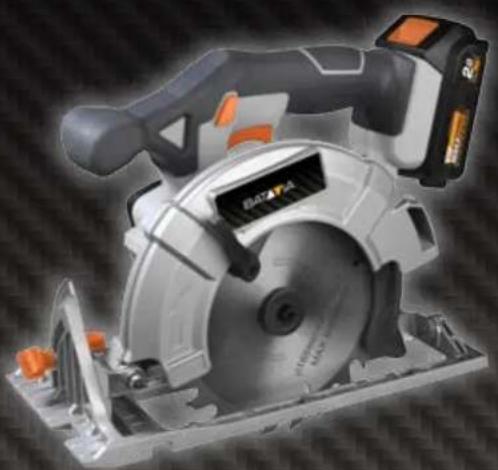
Cordless Circular Saw
Akku Handkreissäge
Scie circulaire sans fil
AccuCirkelzaag

YEAR V
A
24
JAA
APPANY
DANINE
- 2018年3月
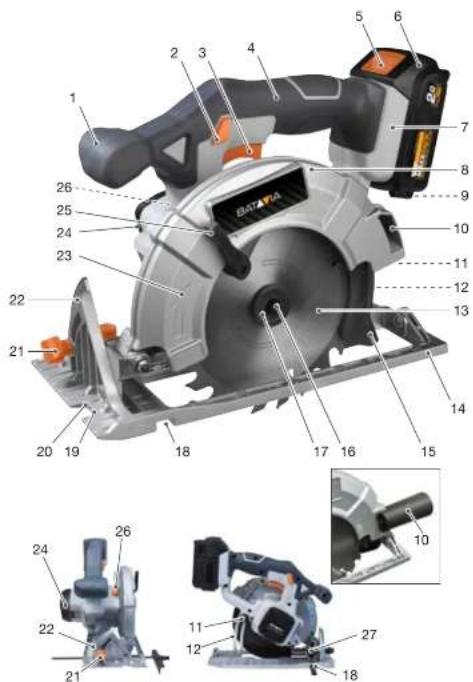
UBERSICHT
+
2.50
-
En/Au#
-
Hua zhi
5.AjduL
0.
T.
H.
1.000000000000000
10.
11.
- Togokak
13.5%的利润
15.2019年4月1日
15.(2016·南京)
10.2017年4月28日
17.500000000000
14.2023年1月1日
1.1.1
图1.1.2
21 Board Angle Locking Knob
- Prove Theorem 1.
23 Unclcn holo
- 1000
2b. Looer-GardLover
- Spalck Rkton
2/.GudloocngKn
APERCU
-
P2
-
DooRr 1
3.Cachettnemnnt
P
-
Postdoc is a signaart de a bae
-
Valable (non comrants)
-
Deli
8.0000000000000000000000000000
2.公司基本情况
10 Tn
11.500000000000000
1.
13.47%
14.2
15.012600000000000000000000000000
10.
17.2006年3月
10.6.2.3
- Postscript
2017年4月1日
31.2006年度利润分配方案
24.01000000000000000000000000000
2017年1月16日星期一
2.股东姓名:李晓 3.身份证号码:40010000007811
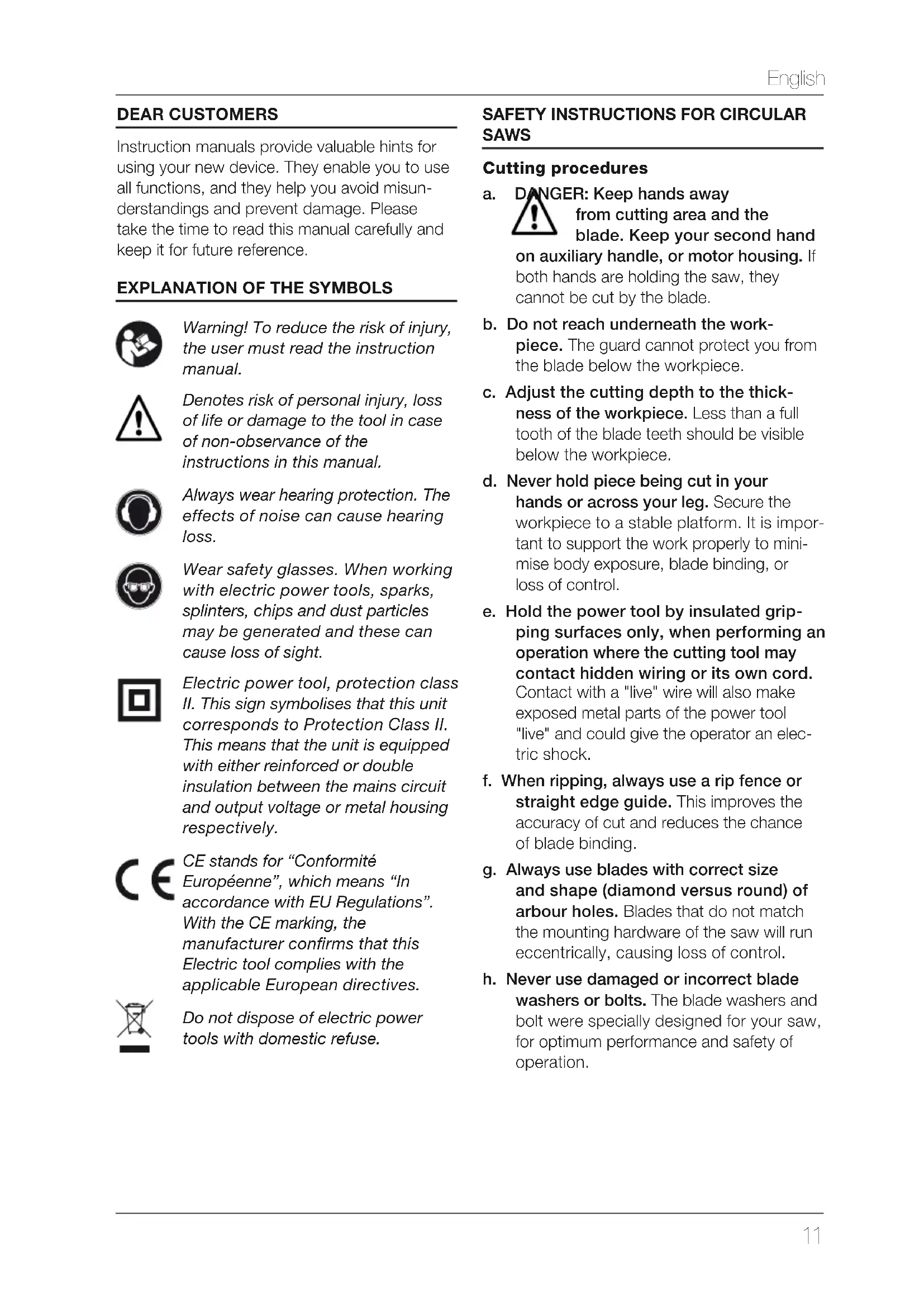
Instruction manuals provide valuable hints for using your new device. They enable you to use all functions, and they help you avoid misunderstandings and prevent damage. Please take the time to read this manual carefully and keep it for future reference.
EXPLANATION OF THE SYMBOLS

Warning! To reduce the risk of injury, the user must read the instruction manual.

Denotes risk of personal injury, loss of life or damage to the tool in case of non-observation of the instructions in this manual.

Always wear hearing protection. The effects of noise can cause hearing loss.

Wear safety glasses. When working with electric power tools, sparks, splinters, chips and dust particles may be generated and these can cause loss of sight.

Electric power tool, protection class II. This sign symbolises that this unit corresponds to Protection Class II. This means that the unit is equipped with either reinforced or double insulation between the mains circuit and output voltage or metal housing respectively.

CE stands for "Conformité Européenne", which means "In accordance with EU Regulations". With the CE marking, the manufacturer confirms that this Electric tool complies with the applicable European directives.
Do not dispose of electric power tools with domestic refuse.
SAFETY INSTRUCTIONS FOR CIRCULAR SAWS
Cutting procedures
a. DANGER: Keep hands away
from cutting area and the blade. Keep your second hand on auxiliary handle, or motor housing. If both hands are holding the saw, they cannot be cut by the blade.
b. Do not reach underneath the workpiece. The guard cannot protect you from the blade below the workpiece.
c. Adjust the cutting depth to the thickness of the workpiece. Less than a full tooth of the blade teeth should be visible below the workpiece.
d. Never hold piece being cut in your hands or across your leg. Secure the workpiece to a stable platform. It is important to support the work properly to minimise body exposure, blade binding, or loss of control.
e. Hold the power tool by insulated gripping surfaces only, when performing an operation where the cutting tool may contact hidden wiring or its own cord. Contact with a "live" wire will also make exposed metal parts of the power tool "live" and could give the operator an electric shock.
f. When ripping, always use a rip fence or straight edge guide. This improves the accuracy of cut and reduces the chance of blade binding.
g. Always use blades with correct size and shape (diamond versus round) of arbour holes. Blades that do not match the mounting hardware of the saw will run eccentrically, causing loss of control.
h. Never use damaged or incorrect blade washers or bolts. The blade washers and bolt were specially designed for your saw, for optimum performance and safety of operation.
under the panel on both sides, near the line of cut and near the edge of the panel.
e. Do not use dull or damaged blades. Unsharpened or improperly set blades produce narrow ker causing excessive friction, blade binding and kickback.
1. Blade depth and bevel adjusting locking levers must be tight and secure before making cut, if blade adjustment shifts while cutting, it may cause binding and kickback.
g. Use extra caution when sawing into existing walls or other blind areas. The protruding blade may cut objects that can cause kickback.
Lower guard function
a. Check lower guard for proper closing before each use. Do not operate the saw if lower guard does not move freely and close instantly. Never clamp or tie the lower guard into the open position. If saw is accidentally dropped, lower guard may be bent. Raise the lower guard with the retracting handle and make sure it moves freely and does not touch the blade or any other part, in all angles and depths of cut.
b. Check the operation of the lower guard spring. If the guard and the spring are not operating properly, they must be serviced before use. Lower guard may operate sluggishly due to damaged parts, gummy deposits, or a build-up of debris.
c. Lower guard may be retracted manually only for special cuts such as "plunge cuts" and "compound cuts". Raise lower guard by retracting handle and as soon as blade enters the material, the lower guard must be released. For all other sawing, the lower guard should operate automatically.
d. Always observe that the lower guard is covering the blade before placing saw down on bench or floor. An unprotected, coasting blade will cause the saw to walk backwards, cutting whatever is in its path. Be aware of the time it takes for the blade to stop after switch is released.
ADDITIONAL CIRCULAR SAW SAFETY
a. Do not allow anyone under the age of 18 years to operate this saw.
b. When operating the saw, use safety equipment including safety goggles or shield, ear protection, dust mask and protective clothing including safety gloves.
c. Hand-held power tools may produce vibration.Vibration can cause disease. Gloves may help to maintain blood circulation in the fingers. Hand-held tools should not be used for long periods without a break.
d. Whenever possible, use a vacuum dust extraction system to control dust/waste.
e. Do not attempt to cut material thicker than detailed in the Specifications section of this manual.
f. Adjust the cutting depth to the thickness of the workpiece i.e. less than a full tooth of the blade should be visible below the workpiece.
g. Ensure work is correctly supported. Large panels may sag under their own weight and bind the saw blade. Supports must be placed under the panel on both sides, close to the line of cut and near the edge of the panel.
h. Ensure all supports and power cables are completely clear of the cutting path.
i. Always secure the workpiece to a stable platform, ensuring body exposure is minimised, avoiding blade binding, or loss of control.
j. Always stand at an angle to the tool when operating.
k. Be aware that the blade will project from the underside of the workpiece.
1. Do not reach beneath the workpiece where the guard cannot protect you from the blade.
m. Note the direction of rotation of the motor and the blade.
n. Inspect the workpiece and remove all nails and other embedded objects prior to starting work.
o. Do not apply any sideways or twisting force to the blade whilst cutting.
p. If a cut does not extend to the edge of the workpiece, or if the blade binds in the cut, allow the blade to come to a complete stop and lift the saw out of the workpiece.
q. Do not attempt to free a jammed blade before first disconnecting the machine from power.
r. Do not move the saw backwards at any time whilst cutting.
s. Beware of projected waste. In some situations, waste material may be projected at speed from the cutting tool. It is the user's responsibility to ensure other people in the work area are protected from the possibility of projected waste.
t. If you are interrupted when operating the saw, complete the process and switch off before diverting your attention.
u. Check the lower guard for proper closure before each use. Do not operate the saw if the lower guard does not move freely and close instantly. Never clamp or tie the lower guard into the open position. If the saw is accidentally dropped, the lower guard may be bent. Raise the lower guard with the retracting handle and make sure it moves freely and does not touch the blade or any other part, in all angles and depths of cut.
v. Always observe that the lower guard is covering the blade before resting the saw on a surface after use. An unprotected, coasting blade will cause the saw to move backwards, cutting whatever is in its path. Be aware of the time it takes for the blade to stop after the trigger switch is released.
w. Periodically check that all nuts, bolts and other fixings have not become loose, and tighten where necessary.
The tool must be used only for its prescribed purpose. Any uses other than those mentioned in this manual will be considered a case of misuse. The user, and not the manufacturer, shall be liable for any damage or injury resulting from such cases of misuse.
The manufacturer shall not be liable for any modifications made to the tool nor for any damage resulting from such modifications. Even when the tool is used as prescribed it is not possible to eliminate all residual risk factors.
English
BEFORE USE
- Avoid damage that can be caused by screws, nails and other elements in your workpiece; remove them before you start working.
Use suitable detectors to find hidden utility lines or call the local utility company for assistance (contact with electric lines can lead to fire or electrical shock; damaging a gas line can result in an explosion; penetrating a water pipe will cause property damage or an electrical shock) - Secure the workpiece (a) workplace clamped with clamping devices or in a vice is held more securely than by handi
BEFORE FIRST USE
Remove the machine and the accessories from the packaging. Check the machine for transport damage and do not use the machine in case of damages. Keep the packing materials away from children, risk of suffocation!
INTENDED USE
Hand held battery-powered electric circular saw for cross, rip and bevel cutting of hard and softwood timber and sheet material.
OPERATION
Before using the saw, practise on scrap material. The settings of the machine are crucial to achieving a good quality finish, and your work could easily be damaged by using an incorrect setting.
Handling your circular saw
Always hold the saw securely, with both hands, by the handles provided.
Always allow the blade to come to a complete stop before placing the machine down.
Always make sure that work will not move whilst being cut. Use clamps where appropriate.
Making a cut
Hold the saw securely and rest the front edge of the Base Plate (14) on the edge of the workpiece.
- Check the blade is not in contact with the workplace or any other object.
- Start the machine by pressing in the Lock Off Button (2) and squeezing the On/Off Tigger (3).
Note: The saw is fitted with two Lock Off Buttons - one on each side of the saw - to allow left or right-handed operation.
Allow the motor to reach full speed and push the saw forwards smoothly across the workpiece.
- Maintain a steady movement and ensure the Base Plate is kept pressed against the workplace.
Note: The front edge of the Base Plate features an indentation. For normal 0^ cutting, align the left side, 0^ Line (19) with the line to be cut, for 45^ bevel cutting align the right side, 45^ Line (20) with the line to be cut.
Allow the blade to pass through the material and release the On/Off Trigger. Alternatively, if the cut does not reach the edge of the workpiece, release the On/Off Trigger and allow the blade to stop moving before lifting out of the cut.
- Do not place the machine down until the blade has stopped completely.
FITTING AND REMOVING BLADES
WARNING: Remove battery pack if fitted.
WARNING: Wear cut-proof gloves when handling sharp blades.
Always check the blade being fitted is suitable for the material being cut.
Only fit blades that are in perfect condition. Blunt, bent, and cracked blades should be discarded.
Press in the Spindle Lock Button (26) and carefully rotate the blade by pushing on the side face of the saw blade until the spindle lock engages. Unscrew the Blade Securing Bolt (16) anti-clockwise using the supplied hex key.
- Remove the Blade Securing Bolt, washer (if fitted) and Blade Flange (17).
- Use the Lower Guard Lever (25) to rotate the Lower Guard out of the way.
- Fit the required blade, making sure the direction indicator on the face of the blade is in the same direction as the Direction Indicator (23).
- Re-fit the Blade Flange, washer and Blade Securing Bolt. Press in the Spindle Lock Button and tighten using the hex key.
- Ensure the blade is secure before use.
SETTING BEVEL ANGLE
This saw is equipped with a tilting Base Plate (14). This allows bevel cuts to be made.
- After the angle of the Base Plate by loosening the Bevel Angle Locking Knob (21). The Base Plate will now be free to pivot.
- Select the angle required (0 - 45°) using the Bevel Angle Gauge (22) and restraints the Bevel Angle Locking Knob.
- Ensure accuracy by checking the angle between the Blade (13) and the Base Plate using a suitable protractor.
SETTING DEPTH ADJUSTMENT
This saw is equipped with a depth adjustment mechanism.
- Alter the depth of the cut by loosening the Depth Locking Knob (11). The Base Plate (14) is now free to adjust to the required depth.
- Adjust the Base Plate to the required depth using the Depth Scale (12) or a ruler and straighten the Depth Locking Knob.
- When set correctly, the blade teeth should project approximately 3mm from the underside of the material being cut.
English
MAINTENANCE AND CLEANING
WARNING: Always disconnect from the mains power supply, before carrying out any maintenance/cleaning of the charger. Remove the battery before carrying out any maintenance/cleaning of the tool.
Cleaning
- Keep safety devices, ventilation openings and the motor housing as free as possible from dirt and dust. Ruo the electric power tool with a clean cloth or blow over it with low pressure compressed air.
We recommend that you clean your electric power tool immediately after each use. - Clean the electric power tool regularly with a damp cloth and somewhat soft soap.
Do not use any cleaning or solvent materials; these can attack the device's plastic components. Make sure that no water can get inside the electric power tool.
Maintenance
There are no inner parts of the tool which need maintenance.
TECHNICAL DATA
No load speed 3650 mm² Blade size 0.165 mm Blade bore 0.16 mm Max depth of cut 0° 50mm / 45° 36mm Dimensions 32 x 18 x 25 cm
Weight 2.77 kg Sound Pressure Level L .81.47 dB(A) Uncertainty K .3 dB
Sound Power Level 93.47 dB(A)
Uncertainty K_US 3 dB Hand Arm Vibration
[No Load] 1.264 m/s
Uncertainty K. 1.5m/s
DISPOSAL
Do not dispose of electric power tools with domestic refuse.
The electric power tool is shipped in packaging to reduce transport damage. This packaging is a raw material and as such can either be reused or can be fed back into the raw material cycle. The electric power tool and its accessories are made from various materials such as metals and plastics. Take defective components to a special refuse collection point. Ask about these at your specialist shop or local council. The product and the user manual may be subject to changes. Technical data may be changed without prior notice.
Batteries
Think of the environment when disposing of batteries. Contact your local authorities to find out where your nearest disposal area is.
Do not dispose of batteries with domestic refuse.
Do not dispose of by burning, risk of explosion.
EC-DECLARATION OF CONFORMITY
We, the Batavia GmbH, Weth. Buitenhuisstraße 2a, NL-7951 SM Staphorst, declare by our own responsibility that the product Cordless Circular Saw, Model BT-CCS003, Item-No 7062508 is according to the basic requirements, which are defined in the European Directives Electromagnetic Compatibility 2014/30/EU (EMC), 2006/42/EC (Machinery), 2011/65/EU (RoHS) and their amendments. For the evaluation of conformity, the following harmonized standards were consulted: EN 55014-1:2006+A1+A2, EN 55014-2:2015, EN 60745-1:2009+A11, EN 60745-2-5:2010
Staphorst, 24 March 2017
Meino Seinen, QA Representative
Batavia GmbH, Weth. Buitenhuisstraat 2a, 7951 SM Staphorst, Netherlands
CHER CLIENT
CE-DECLARATION DE CONFORMITE
Cordless Circular Saw
Akku Handkreissäge
Scie circulaire sans fil
AccuCirkelzaag
This product has got a 2 year warranty.
Dear Client, if for any reason this product is not working, please ensure you contact our Client Service Centre. Ensure you have your original receipt of purchase. This warranty covers all defects in workmanship or materials in this Batavia product for a two year period from the date of purchase. The warranty does not cover any malfunction, or defect resulting from misuse, neglect, alteration, or repair.
Other European countries | Customer ServicesMonday till Friday from 8 am until 4 pm
Overige landen Europa | Klantenservice