BTPS004 - Saw Batavia - Free user manual and instructions
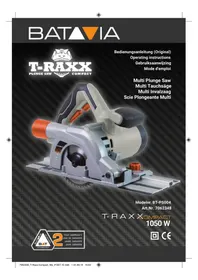
Find the device manual for free BTPS004 Batavia in PDF.

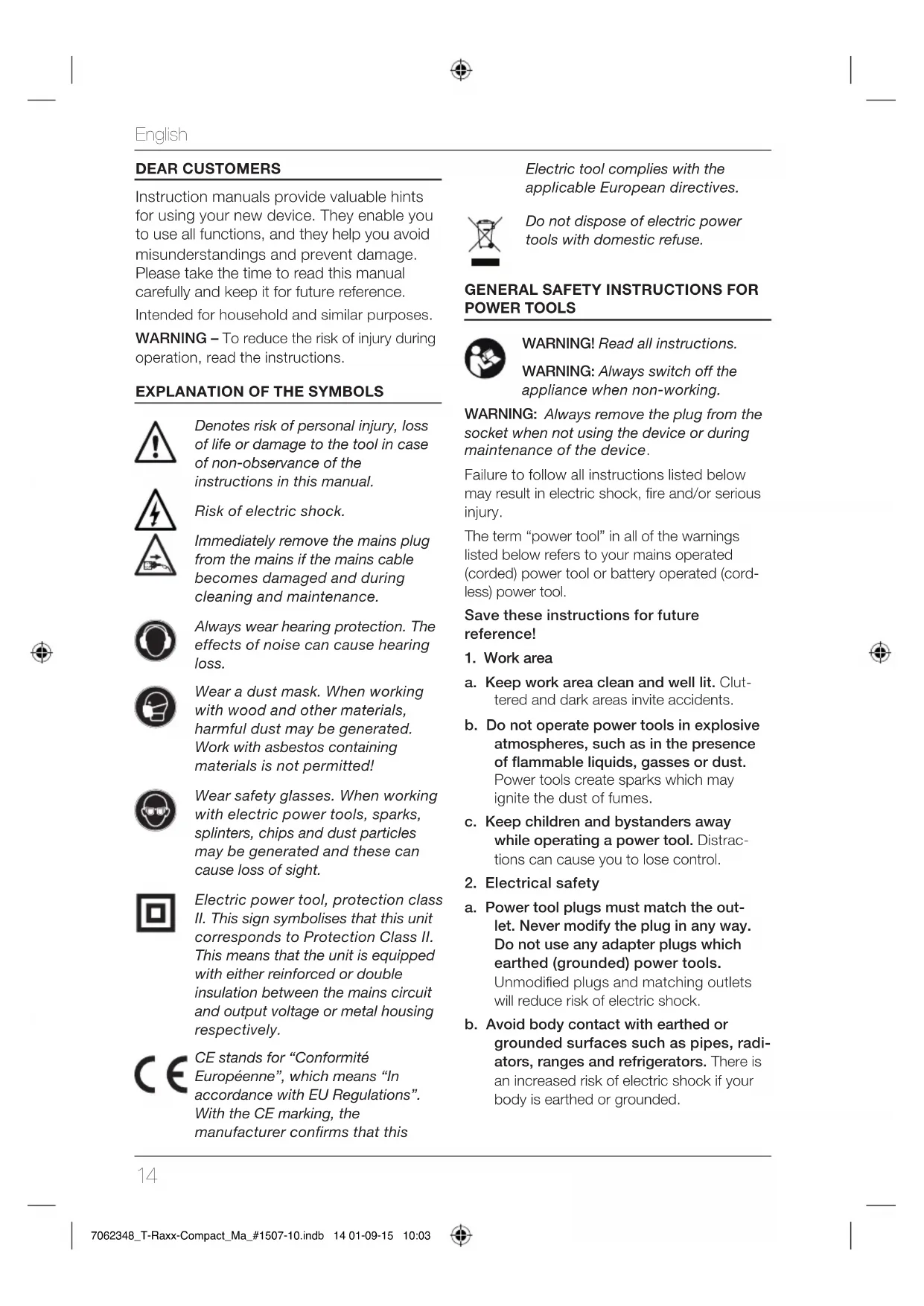


| Product type | Plunge circular saw |
| Brand | Batavia |
| Model | BTPS004 |
| Supply voltage | 230 – 240 V~, 50 Hz |
| Protection class | II (double insulation) |
| Max cutting depth | 28 mm |
| Blade diameter | 110 mm |
| Blade bore | 22.2 mm |
| Blade thickness | 2 mm |
| TCT blade included | 40 teeth |
| Diamond blade included | 9 segments |
| Max rotation speed | 13,000 min⁻¹ |
| Sound pressure level (LpA) | 99.92 dB(A) |
| Sound power level (LWA) | 110.92 dB(A) |
| Hand/arm vibration (wood) | 1.646 m/s² (handle) / 1.744 m/s² (auxiliary handle) |
| Hand/arm vibration (metal) | 1.505 m/s² (handle) / 2.507 m/s² (auxiliary handle) |
| Hand/arm vibration (tiles) | 3.253 m/s² (handle) / 4.415 m/s² (auxiliary handle) |
| Protection rating | IP20 |
| Delivery contents | 1× T-Raxx Compact, 3× guide rails 33 cm, 2× connection rods, 2× clamps, 1× TCT blade 40 teeth, 1× diamond blade, 1× hex key, 1× user manual |
| Warranty | 2 years |
| Highlights | Dust extraction nozzle, anti-splinter guard, guide rail, double insulation, safety switch |
| Maintenance | Clean with dry cloth or compressed air; do not immerse |
| Repairability | Use original spare parts; have repairs done by an authorized center |
Frequently Asked Questions - BTPS004 Batavia
User questions about BTPS004 Batavia
0 question about this device. Answer the ones you know or ask your own.
Ask a new question about this device
Download the instructions for your Saw in PDF format for free! Find your manual BTPS004 - Batavia and take your electronic device back in hand. On this page are published all the documents necessary for the use of your device. BTPS004 by Batavia.
USER MANUAL BTPS004 Batavia
Operating instructions
Gebruiksaanwijzing
Mode d'emploi
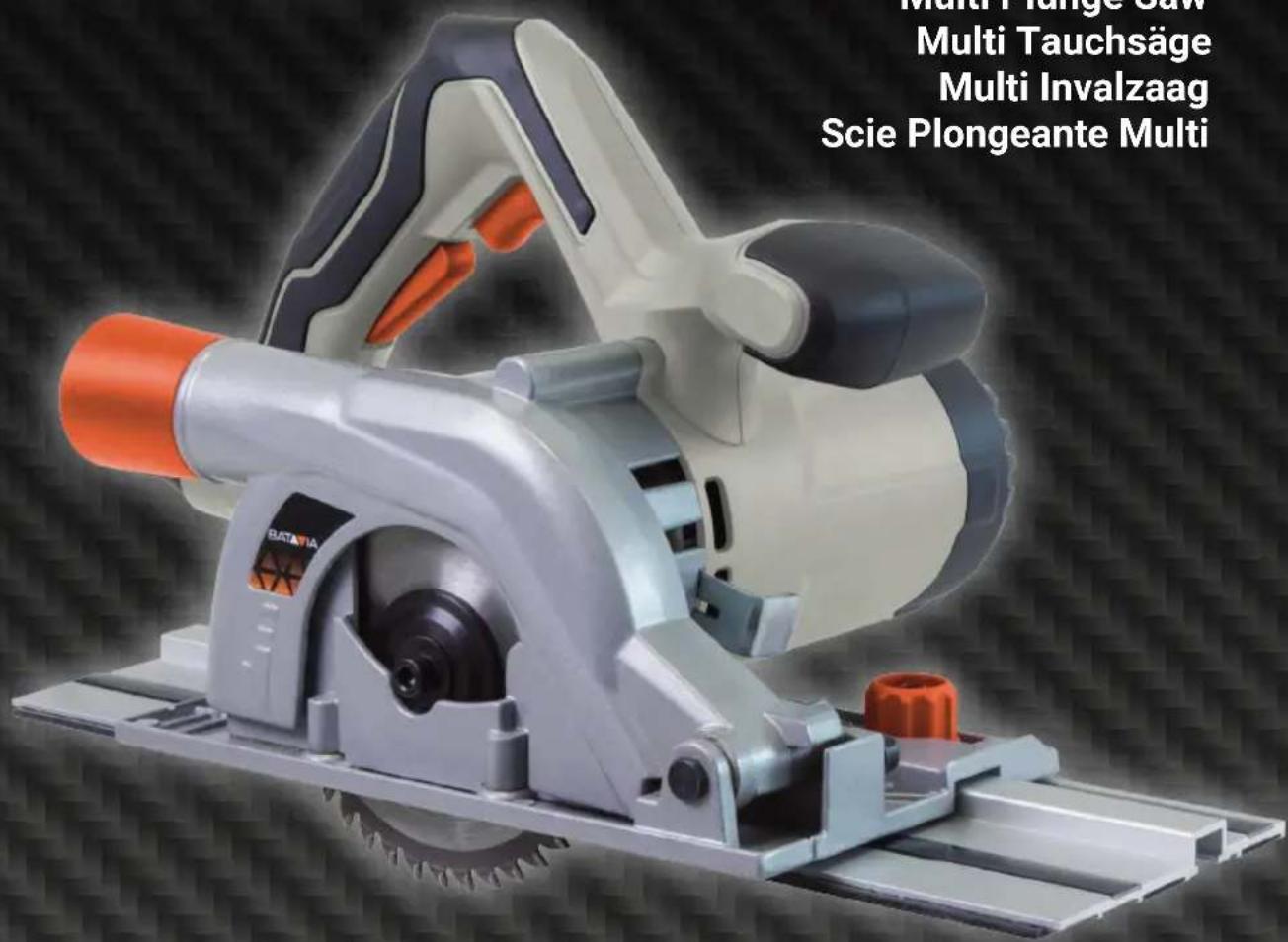
Multi Plunge Saw
Multi Tauchsäge
Multi Invalzaag
Scie Plongeante Multi
text_image
Multi Tauchsäge Multi Invalzaag Scie Plongeante MultiModelnr. BT-PS004
Art.Nr. 7062348
T-RAXXCOMPACT
1050 W
回CE

text_image
BATXIA ADVANCED BATS TECHNOLOGY 2 YEAR WARRANTY ANS DE GARANTIE JAHRE GARANTIE JAAR GARANTIEBATAVIA
text_image
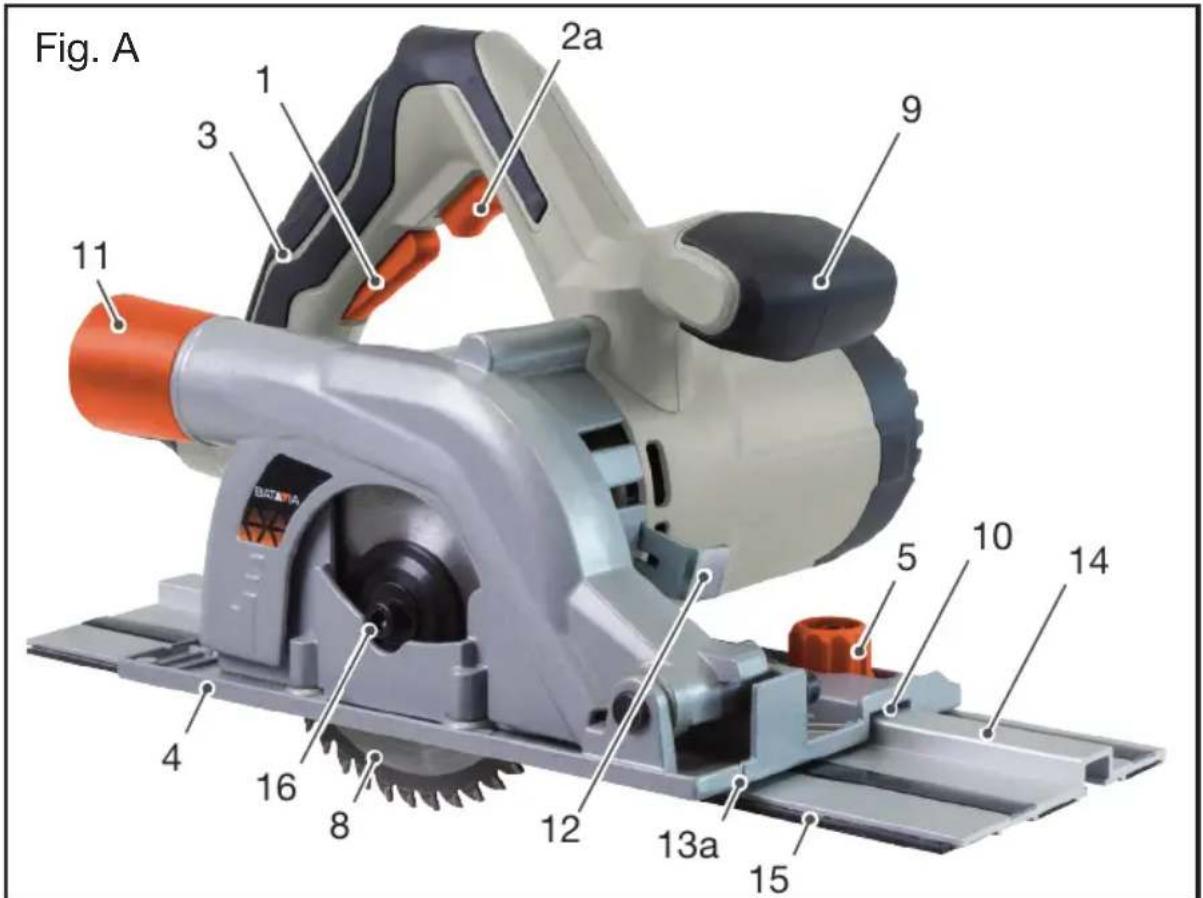
Fig. A 1 2a 3 9 11 5 10 14 4 16 8 12 13a 15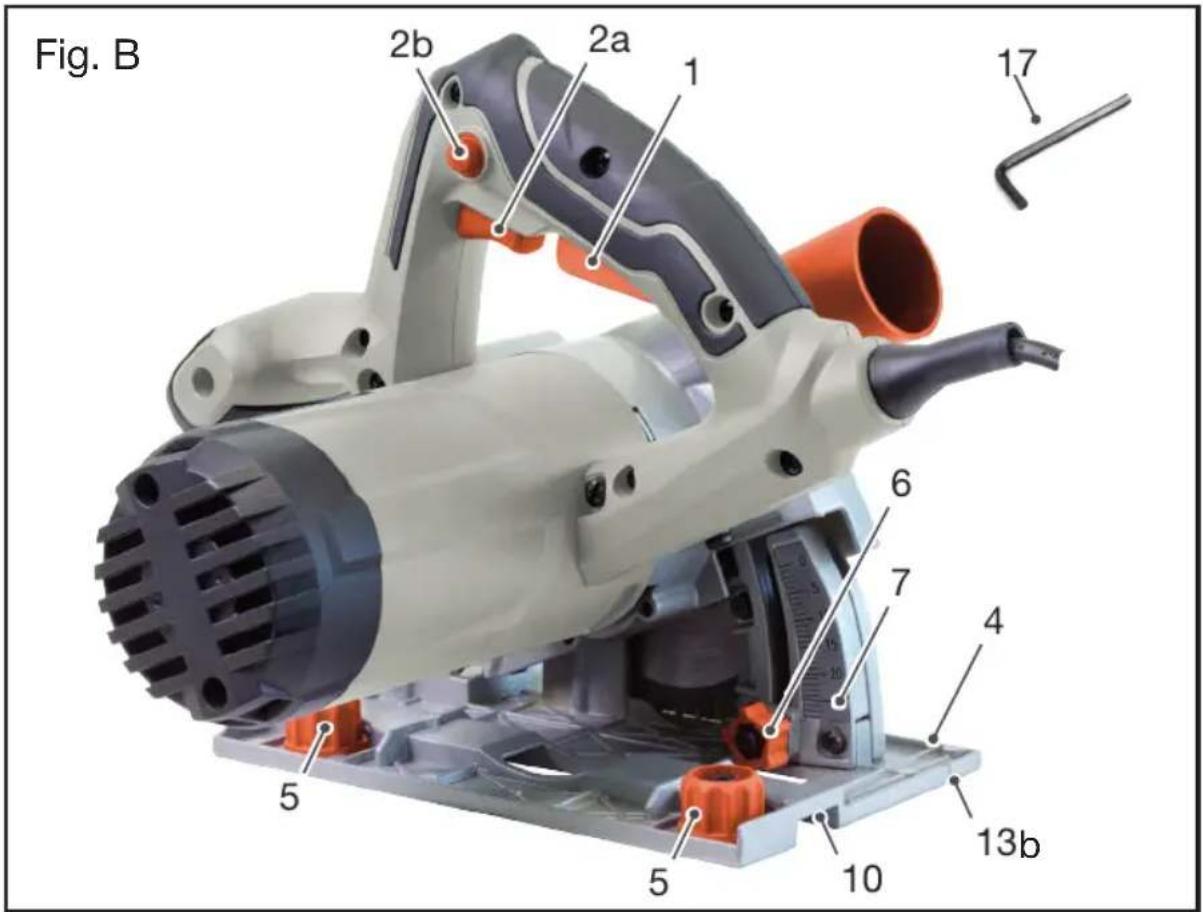
text_image
Fig. B 2b 2a 1 17 6 7 4 5 5 10 13bÜBERSICHT
- Locking Switch
- a) ON/OFF Switch b) Safety switch
- Main Handle
- Base plate
- Fine Adjustment Knob (2x)
- Depth Adjustment Knob
- Depth Scale
- Blade
- Auxiliary Handle
- Slot for Track
- Dust Extraction Outlet
- Shaft Lock
- a + b) Cutting line
- Guide ridge
- Splinter guard
- Screw
- Allen key
APERÇU
Switch plunge saw on/off . . . . . . 18
Set cutting depth ..... 18
Determine cutting line . . . . . . . 18
Preparation . . . . . . . . . . . 18
Correct working with the plunge saw . . 18
Straight cuts . . . . . . . . . . . 19
Plunge cuts . . . . . . . . . . . 19
Change saw blade / Diamond blade. . . 19
Guide rail(s) and clamps ..... 19
Fine adjustment of plunge saw play on guide rail . . . . . . . . . . . 19
Determine cutting line . . . . . . . 20
Guide rail splinter guards . . . . . . 20
Plunge cut with guide rail . . . . . . 20
Saw blades 20
Cleaning and maintenance ..... 20
Technical data 21
TABLE DES MATIÈRES
natural_image
Line drawing of a mechanical device mounted on a flat base (no text or symbols)Deutsch
natural_image
Close-up of a metal clamp securing a wooden panel with layered materials (no text or symbols visible)natural_image
Two striped metal strips on a wooden surface, one with a metal ruler for scale (no text or symbols visible)Handgriff:....1,505 m/s ^2
Zusatzhandgriff: 2,507 m/s^2
Handgriff: 3,253 m/s ^4
Zusatzhandgriff: 4,415 m/s ^2
text_image
Handwritten signature or scribble on a white background, possibly a signature or artistic markInstruction manuals provide valuable hints for using your new device. They enable you to use all functions, and they help you avoid misunderstandings and prevent damage. Please take the time to read this manual carefully and keep it for future reference. Intended for household and similar purposes.
WARNING – To reduce the risk of injury during operation, read the instructions.
EXPLANATION OF THE SYMBOLS

Denotes risk of personal injury, loss of life or damage to the tool in case of non-observance of the instructions in this manual.

Risk of electric shock.

Immediately remove the mains plug from the mains if the mains cable becomes damaged and during cleaning and maintenance.

Always wear hearing protection. The effects of noise can cause hearing loss.

Wear a dust mask. When working with wood and other materials, harmful dust may be generated. Work with asbestos containing materials is not permitted!

Wear safety glasses. When working with electric power tools, sparks, splinters, chips and dust particles may be generated and these can cause loss of sight.

Electric power tool, protection class II. This sign symbolises that this unit corresponds to Protection Class II. This means that the unit is equipped with either reinforced or double insulation between the mains circuit and output voltage or metal housing respectively.


CE stands for “Conformité Européenne”, which means “In accordance with EU Regulations”. With the CE marking, the manufacturer confirms that this
Electric tool complies with the applicable European directives.

Do not dispose of electric power tools with domestic refuse.
GENERAL SAFETY INSTRUCTIONS FOR POWER TOOLS

WARNING! Read all instructions.
WARNING: Always switch off the appliance when non-working.
WARNING: Always remove the plug from the socket when not using the device or during maintenance of the device.
Failure to follow all instructions listed below may result in electric shock, fire and/or serious injury.
The term “power tool” in all of the warnings listed below refers to your mains operated (corded) power tool or battery operated (cordless) power tool.
Save these instructions for future reference!
- Work area
a. Keep work area clean and well lit. Cluttered and dark areas invite accidents.
b. Do not operate power tools in explosive atmospheres, such as in the presence of flammable liquids, gasses or dust. Power tools create sparks which may ignite the dust of fumes.
c. Keep children and bystanders away while operating a power tool. Distractions can cause you to lose control.
- Electrical safety
a. Power tool plugs must match the outlet. Never modify the plug in any way. Do not use any adapter plugs which earthed (grounded) power tools. Unmodified plugs and matching outlets will reduce risk of electric shock.
b. Avoid body contact with earthed or grounded surfaces such as pipes, radiators, ranges and refrigerators. There is an increased risk of electric shock if your body is earthed or grounded.
c. Do not expose power tools to rain or wet conditions. Water entering a power tool will increase the risk of electric shock.
d. Do not abuse the cord. Never use the cord for carrying, pulling or unplugging the power tool. Keep cord away from heat, oil, sharp edges or moving parts. Damaged or entangled cords increase the risk of electric shock.
e. When operating a power tool outdoors, use an extension cord suitable for outdoor use. Use of a cord suitable for outdoor use reduces the risk of electric shock.
f. Always use tool in conjunction with a residual circuit breaker device. The use of a residual circuit breaker device reduces the risk of electric shock.
- Personal safety
a. Stay alert, watch what you are doing and use common sense when operating a power tool. Do not use a power tool while you are tired or under the influence of drugs, alcohol or medication. A moment of inattention while operating power tools may result in serious personal injury.
b. Use safety equipment. Always wear eye protection. Safety equipment such as dust mask, non-skid safety shoes, hard hat, or hearing protection used for appropriate conditions will reduce personal injuries.
c. Avoid accidental starting. Ensure the switch is in the off position before plugging in. Carrying power tools with your finger on the switch or plugging in power tools that have the switch on invites accidents.
d. Remove any adjusting key or wrench before turning the power tool on. A wrench or a key left attached to a rotating part of the power tool may result in personal injury.
e. Do not overreach. Keep proper footing and balance at all times. This enables better control of the power tool in unexpected situations.
f. Dress properly. Do not wear loose clothing or jewellery. Keep your hair,
clothing and gloves away from moving parts. Loose clothes, jewellery or long hair can be caught in moving parts.
g. If devices are provided for the connection of dust extraction and collection facilities, ensure these are connected and properly used. The use of these pieces of equipment reduce hazards caused by dust.
- Power tool use and care
a. Do not force the power tool. Use the correct power tool for your application. The correct power tool will do the job better and safer at the rate for which it was designed.
b. Do not use the power tool if the switch does not turn it on and off. Any power tool that cannot be controlled with the switch is dangerous and must be repaired.
c. Disconnect the plug from the power source before making any adjustments, changing accessories, or storing power tools. Such preventive safety measures reduce the risk of starting the power tool accidentally.
d. Store idle power tools out of the reach of children and do not allow persons unfamiliar with the power tool or these instructions to operate the power tool. Power tools are dangerous in the hands of untrained users.
e. Maintain power tools. Check for misalignment or binding of moving parts, breakage of parts and any other condition that may affect the power tools operation. If damaged, have the power tool repaired before use. Many accidents are caused by poorly maintained power tools.
f. Keep cutting tools sharp and clean. Properly maintained cutting tools with sharp cutting edges are less likely to bind and are easier to control.
g. Use the power tool, accessories and tool bits etc., in accordance with these instructions and in the manner intended for the particular type of power tool, taking into account the working conditions and the work to be performed. Use of the power tool for
English
operations different from intended could result in a hazardous situation.
5. Service
a. Please use a qualified expert who uses original replacement parts to repair your power tool. This will ensure proper functioning of the power tool.
SAFETY INSTRUCTIONS FOR PLUNGE SAWS

When using electric tools, basic safety precautions should always be followed to reduce the risk of fire, electric shock and personal injury.
Read all these instructions before attempting to operate this product and save these instructions.
- Make sure that the mains voltage matches the specifications on the type plate.
- Persons with restricted physical, sensory or mental capabilities are not allowed to use the circular saw unless they are supervised and instructed by a guardian.
- Never leave the powered-on saw unattended and keep them out of reach of children and persons in need of supervision.
- Use only approved extension cords with a suitable cable quality.
- Do not bring your hands in the cutting area and the saw blade.
- Wear appropriate work clothing as well as eye protection, hand protection and hearing protection. Always handle the saw blade with gloves.


- Keep in mind that even a worn saw blade is still very sharp. Always grasp the saw blade on the sides. Do not fling the saw blade and do not drop it.
- Never use the circular saw with grinding wheels.
- Do not grip underneath the workpiece. The protective cover cannot protect you from the saw blade under the workpiece.
- Adjust the cutting depth to the thickness of the workpiece. It should be visible less
than a full tooth height under the workpiece.
- Do not cut very small workpieces. When cutting round wood, use a device which secures the workpiece from twisting. Never hold the workpiece to be cut in your hand or across your leg. It is important to secure the workpiece properly to minimise the risk of physical contact, jamming of the saw blade or loss of control.
- Hold the saw only by the insulated gripping surfaces when performing an operation where the cutting tool may come into contact with hidden power lines or its own device cable. Contact with a live wire also exposes the metal parts to tension and leads to an electric shock.
- When cutting longitudinally, always use the parallel stop or a straight edge guide. This improves the cutting accuracy and reduces the possibility that the saw blade gets jammed.
- Use always saw blades in the correct size and with suitable locating bore. Saw blades that do not match the mounting parts of the saw will run unevenly and lead to loss of control.
- Never use a damaged or incorrect outer flange or a damaged clamping screw. The outer flange and the clamping screw have been specially designed for your saw for optimum performance and reliability.
- Start the circular saw and begin cutting when it reaches the full idling speed.
- Never brake the saw blade using lateral pressure after switching it off.
- Set the saw aside only when the saw blade comes to a standstill.
- Do not expose the saw to high temperatures, humidity and strong shocks. The saw can be damaged as a result.
CAUSES AND PREVENTION OF KICKBACK
- A kickback is the sudden reaction as a result of a stuck, jammed or misaligned saw blade which leads to an uncontrolled saw to be lifted and moved from the workpiece out in the direction of the operator.
- A kickback can occur when the saw blade gets stuck or jammed in the saw gap. The saw blade is blocked and the motor force repels the circular saw in the direction of the operator.
- A kickback can occur when the saw blade becomes twisted or misaligned in the saw groove. As a result, the teeth of the back edge of the saw blade can get stuck in the surface of the workpiece, whereby the saw blade is moved out of the saw gap and the saw jumps back in the direction of the operator.
A kickback is the result of incorrect or faulty use of the saw. It can be prevented by appropriate precautions as described below.
- Hold the saw firmly with both hands and bring your arms into a position in which you can resist the kickback forces. Always hold the saw on the sides, never bring the blade in line with your body. In a kickback, the saw can jump backwards, but the operator can control the kickback forces if appropriate measures were taken.
- If the saw blade jams or sawing is interrupted for any reason, release the ON / OFF switch and calmly hold the saw in the material until the saw blade stands completely still. Never attempt to remove the saw from the workpiece or pull it backwards as long as the saw blade is moving or a kickback might occur. Find the cause of the saw blade jam and eliminate them through appropriate measures.
- When you want to restart a saw that is stuck in a workpiece, center the saw blade in the saw gap and check that the saw teeth are not stuck in the workpiece. If the saw blade jams, it can move out from the workpiece or a kickback can happen if the saw is restarted.
- Prop up large panels in order to minimise the risk of a kickback by a jammed saw blade. Large panels tend to sag under their own weight. Panels must be supported on both sides, both in the vicinity of the saw gap as well as on the edge.
- Do not use dull or damaged saw blades. Saw blades with blunt or misaligned teeth cause increased friction, jamming of the
saw blade and kickback by an excessively narrow saw gap.
- Tighten the cutting depth position prior to cutting. If the settings change while cutting, the saw blade can jam and a kick-back can occur.
- Be especially careful if you perform a "circular cut" in a hidden area, such as an existing wall. The protruding saw blade can get blocked in hidden objects while cutting and cause a kickback.
- Do not place the saw on the workbench or the floor unless the saw blade is at a standstill. An unprotected, running saw blade moves the saw against the cutting direction and cuts whatever is in its way. Thus note the delay time of the saw.
- For this reason, the saw is not suitable for use in reverse position as fixed equipment.
- Do not operate the saw if it is not working properly or has been damaged. In case of technical problems, do not attempt to repair it on your own. Contact the service or have the saw repaired by a professional.
ELECTRICAL SAFETY
When using electric machines always observe the safety regulations applicable in your country to reduce the risk of fire, electric shock and personal injury. Read the following safety instructions and also the enclosed safety instructions.

Always check that the power supply corresponds to the voltage on the rating plate.

Class II machine – Double insulation – You don't need any earthed plug.
Replacing cables or plugs
If the power cord is damaged, it must be replaced by the manufacturer or its service agent or a similarly qualified person, in order to avoid a hazard.
Immediately throw away old cables or plugs when they have been replaced by new ones. It is dangerous to insert the plug of a loose cable in the wall outlet.
Using extension cables
Only use an approved extension cable suitable for the power input of the machine. The minimum conductor size is 1.5 mm ^2 . When using a cable reel always unwind the reel completely
Inadequate extension cords can be dangerous. If an extension cord is used, it shall be suitable for outdoor use, and the connection has to be kept dry and off the ground. It is recommended that this is accomplished by means of a cord reel which keeps the socket at least 60 mm above the ground.
BEFORE FIRST USE
Remove the plunge saw and the accessories from the packaging. Check the saw for transport damage and do not use the saw in case of damages. Keep the packing materials away from children, risk of suffocation!
CONTENTS
1× T-Raxx Compact
3× Guide Rail 33 cm
2× Connecting Rods for Guide Rail
2× Clamps for Guide Rail
1× TCT Blade 40 teeth
1× Diamond Blade
1× Allen Key
1× User Manual
INTENDED USE
The plunge saw is intended to cut wood and similar materials, gypsum and cement-bonded fibre materials and plastics (TCT saw blade), tile, granite or concrete (diamond blade).
The plunge saw is only to be used with a specifically designed guide rail. Installation in a different or homemade guide rail or workbench can cause serious accidents.
SWITCH PLUNGE SAW ON/OFF
- Press the safety switch (2b) and then the ON/OFF switch (2a) to switch the plunge saw on.
- Release the ON/OFF switch (2a+b) to switch the plunge saw off.
- Pressing the locking switch (1) unlocks the plunge cut mechanism, so that the motor can be moved downwards. The saw blade emerges from the protective cover. When
lifting the saw the motor slides back into the initial position.
SET CUTTING DEPTH
The cutting depth can be set between 0 — 28 mm:
- Loosen the cutting depth limit stop knob (6) and slide it to the desired cutting depth according to the graduated scale (7) to set the cutting depth.
- Tighten the cutting depth limit stop knob (6). The motor or respectively the saw blade can now be pushed down to the set cutting depth.
For a clean, safe cut set the cutting depth in such way that only max. one saw blade tooth protrudes under the work piece.
DETERMINE CUTTING LINE
The cutting line (13a + b) is marked on the base plate (4) of the plunge saw.
Align cutting line (13a + b) at the front and back of the base plate with your marked cutting line when using the plunge saw without guide rail for straight cuts.
PREPARATION
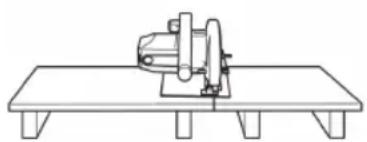
- Before each use check the proper function of all installation fixtures of the plunge saw and only use the plunge saw if everything works properly.
- Attach the work piece in such way that it cannot move or bend during work. Line the work piece respectively.
natural_image
Line drawing of a mechanical device mounted on a flat base (no text or symbols)CORRECT WORKING WITH THE PLUNGE SAW
• Always hold the plunge saw with both hands at the hand grips (3) and (9).
• Always guide the plunge saw forward. Never draw the plunge saw back!
- Place the plunge saw with the front part of the base plate (4) on the work piece. Guide
the plunge saw only against the work piece during operation.
- With the correct forward speed you prevent overheating of the saw blade, and melting when cutting plastics.
STRAIGHT CUTS
- Set the desired plunge depth.
- To switch on the saw press the ON/OFF switch (2a+b). Press the locking switch (1) and push the motor down. Guide the saw forward to cut.
PLUNGE CUTS
- Set the desired plunge depth.
- To switch on the saw press the ON/OFF switch (2a+b). Press the locking switch (1) and push the motor down. Guide the saw forward to cut.
Note: To prevent the saw from kicking back during plunge cuts follow these steps: - Always place the plunge saw with the rear edge of the base plate (4) against a fixed limit stop.
- Hold the plunge saw in both hands and slowly lower the saw blade.
Before any maintenance work always switch off the plunge saw and disconnect from mains power.
- Press the locking switch (1) down and push the motor down.
- Press and hold the spindle arrester (12) down.
- Use a 5 mm Allen key (17) to turn the screw (16) at the saw blade slightly clockwise or counter-clockwise until the spindle clicks into place.
- Use the Allen key to loosen the screw counter-clockwise. Remove the flange and the saw blade.
- Clean the flange and replace the saw blade.
Note: The rotation direction arrows of saw blade and saw must be aligned!
- Press and hold the spindle arrester (12) and tighten the screw.
GUIDE RAIL(S) AND CLAMPS
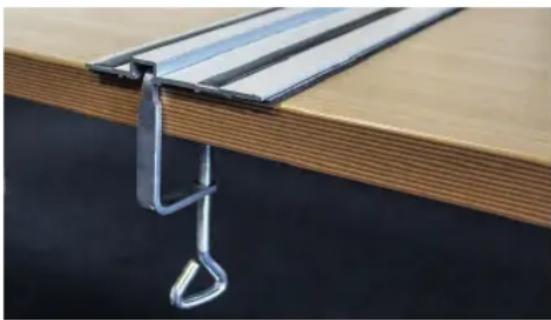
The guide rails allow precise and clean straight cuts, mitre cuts and fitting. The rails also protect the work piece surface from damages.
Fixing with the clamps ensures solid grip and safe work.
natural_image
Close-up of a metal clamp securing a wooden panel with layered insulation (no text or symbols visible)- Place the guide rail on the work piece and fix the guide rail with the clamps. Slide the bar into the groove of the guide rail and tighten the clamp with the lever.
Note: Place the guide rail with the black foam strips on the work piece.
- Place the plunge saw on the guide rail. The base plate has a groove (10), which exactly fits into the guide ridge (14) of the rail.
FINE ADJUSTMENT OF PLUNGE SAW PLAY ON GUIDE RAIL
The play of the base plate on the guide rail can be reduced to minimum with the fine adjustment screws (5).
- Loosen the fine adjustment screws counter-clockwise.
- Turn both fine adjustment screws (5) clockwise to minimize the play between base plate and guide rail, if necessary.
- Fasten the fine adjustment screws clockwise.
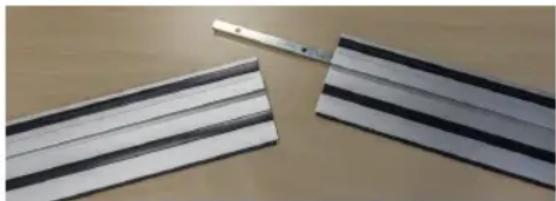
CONNECTING RODS FOR GUIDE RAILS
- To connect both guide rails slide the first connecting rod from the bottom into the groove of the guide rail.
- Slide the other connecting rod into the second groove.
English
- Use the 3 mm Allen key to tighten the stud screws to the limit stop to connect the rails.
natural_image
Two metallic strips with black bands placed on a flat surface, one being cut and the other lying on (no text or symbols visible)DETERMINE CUTTING LINE
When using the saw with guide rail always align cutting line (13a + b) at the front and back of the base plate with your marked cutting line for straight cuts.
GUIDE RAIL SPLINTER GUARDS
The guide rails come with a splinter guard (black protruding rubber lip). The splinter guard should be cut to size before first use. The splinter guard ensures a tear-free cut, since the wood fibres at the top of the work piece are torn without splinter guard. This is due to the saw blade teeth being directed upward.
After cutting the splinter guard to size it also shows the precise cutting path of the saw blade.
- Place the plunge saw at the rear end of the guide rail.
- Switch the plunge saw on and push the saw down. Cut the splinter guard continuously over the entire length. The edge of the splinter guard now exactly matches the cutting edge.
PLUNGE CUT WITH GUIDE RAIL
- Hold the plunge saw with both hands at hand grips (3) and (9).
- Switch the plunge saw on and wait until it runs on full speed.
- Push the saw slowly down and guide the saw towards the plunge position.
SAW BLADES

External diameter: ∅ 110 mm
Bore diameter: ∅ 22.2 mm
Strength: 2 mm
Number of teeth/segment: 40
Max. permissible rotation speed: 13000 min ^1
Application: Saw work
Material: Wood

External diameter: ∅ 110 mm
Bore diameter: ∅ 22.2 mm
Strength: 2 mm
Number of segments: 9
Working speed max: 80 m/s
Max. permissible rotation speed: 13000 min ^1
Application: Cutting
Material: tiles, granite, concrete
CLEANING AND MAINTENANCE
Disconnect from mains power before carrying out any maintenance work on the plunge saw!
All maintenance and repair work involving opening the motor casing must be carried out by an authorized service centre.
Always keep the plunge saw clean. Clean the plunge saw after every use with a dry cloth or compressed air. Do not use any aggressive chemicals for cleaning.
- To reduce the risk of injury, always disconnect the main power plug before cleaning the device.
- Clean your device with a damp cloth.
- For stubborn dirt, you can moisten the cloth with a mild detergent or soft soap. Other cleaning products often contain chemicals that can damage the plastic parts of the device.
- Make sure that air vents always remain clean and open.
- Make sure that no liquids get into the machine and never immerse the device in liquid.
- Repairs, inspections of the machine interior, adjustments, and the replacement of carbon brushes should only be performed by a qualified electrician. Only identical replacement parts should be used! For more information, please contact customer service.
- If an increased brush sparking occurs, it is a sign that the carbon brushes must be replaced. Have the carbon brushes replaced by a professional.
TECHNICAL DATA
Mains power: . . . . . . 230 - 240 V\~, 50 Hz
Power: 1050 W
No load speed: 12000 min^-1
Saw blade dimensions: . . 110 × 22.2 × 2 mm
Diamond blade dimensions: 110 × 22.2 × 2 mm
Weight: 3 kg
Protecting class: ..... II
Max. cutting depth with guide rail: . . . 22 mm
Max. cutting depth without guide rail: . 28 mm
Noise pressure level ( L_0A ): ..... 99.92 dB(A)
Uncertainty: . . . . . . . . . . . . . . . K = 3 dB(A)
Sound power level (L _WA ): . . . . . 110.92 dB(A)
Uncertainty: . . . . . . . . . . . . . . . K = 3 dB(A)
Hand-Arm-Vibration
Cutting wood ( a_h,w ):
Main handle: 1.646 m/s^2
Auxiliary handle: 1.744 m/s^2
Cutting aluminium metal sheets ( a_h,M ):
Main handle: 1.505 m/s^2
Auxiliary handle: 2.507 m/s^2
Cutting ceramics ( a_h ):
Main handle: 3.253 m/s ^4
Auxiliary handle: 4.415 m/s ^2
Uncertainty: K = 1.5 m/s^2
Protecting rating: IP20
DISPOSAL AND RECYCLING

Do not dispose of electric power tools with domestic refuse.
The electric power tool is shipped in packaging to reduce transport damage. This packaging is a raw material and as such can either be reused or can be fed back into the raw material cycle. The electric power tool and its accessories are made from various materials such as metals and plastics. Take defective components to a special refuse collection point. Ask about these at your specialist shop or local council.
EC-DECLARATION OF CONFORMITY
We, the Batavia GmbH, Weth. Buitenhuisstraat 2a, NL-7951 SM Staphorst, declare by our own responsibility that the product T-Raxx Compact, Model BT-PS005, Item-No 7062348, is according to the basic requirements, which are defined in the European Directives Electromagnetic Compatibility 2004/108/EC (EMC), 2006/42/EC (Machinery) and their amendments. For the evaluation of conformity, the following harmonized standards were consulted:
EN 60745-1:2009+A11
EN 60745-2-5:2010
EN 60745-2-22:2011
ZEK 01.4-08/11.11
EN 55014-1:2006+A1+A2
EN 55014-2:1997+A1+A2
EN 61000-3-3:2013
EN 61000-3-2:2006+A1+A2
Staphorst, 22 June 2015
text_image
JennyMeino Seinen, QA Representative Batavia GmbH, Weth. Buitenhuisstraat 2a, 7951 SM Staphorst, Netherlands
The product and the user manual may be subject to changes. Technical data may be changed without prior notice.
CHER CLIENT
natural_image
Line drawing of a mechanical device mounted on a flat base (no text or symbols)Français
UTILISATION CORRECTE DE LA SCIE PLONGEANTE
natural_image
Close-up of a metal clamp securing a wooden panel with layered panels (no text or symbols visible)natural_image
Two metallic strips with black bands placed on a wooden surface, no text or symbols visibleDÉTERMINATION DE LA LIGNE DE COUPE
CE-DÉCLARATION DE CONFORMITÉ
text_image
Handwritten signature or scribble on a white background, possibly a signature or autograph.natural_image
Line drawing of a mechanical device mounted on a flat base (no text or symbols)CORRECT WERKEN MET DE INVALIDZAAG
natural_image
Close-up of a metal clamp bracket attached to a wooden panel, showing structural details (no text or symbols visible)natural_image
Two striped metal strips on a wooden surface, one with a metallic clip and the other with a black strip (no text or symbols visible)BEPALEN VAN DE ZAAGLIJN
text_image
Handwritten signature or scribble on a stylized oval shape, possibly from a document or form.This product has got a 2 year warranty
Dear Client, if for any reason this product is not working, please ensure you contact our Client Service Centre. Ensure you have your original receipt of purchase. This warranty covers all defects in workmanship or materials in this Batavia product for a two year period from the date of purchase. The warranty does not cover any malfunction, or defect resulting from misuse, neglect, alteration, or repair.
Other European countries | Customer Services
Monday till Friday from 8 am until 4 pm

00800 66477400
Overige landen Europa | Klantenservice