EPO 2003 R NT - Electric sander Eibenstock - Free user manual and instructions
Find the device manual for free EPO 2003 R NT Eibenstock in PDF.


User questions about EPO 2003 R NT Eibenstock
0 question about this device. Answer the ones you know or ask your own.
Ask a new question about this device
Download the instructions for your Electric sander in PDF format for free! Find your manual EPO 2003 R NT - Eibenstock and take your electronic device back in hand. On this page are published all the documents necessary for the use of your device. EPO 2003 R NT by Eibenstock.
USER MANUAL EPO 2003 R NT Eibenstock
natural_image
Green hexagonal logo with stylized letter 'E' (no text or symbols)natural_image
EIBENSTOCK electric shaver with black and green body, no visible text or symbols on the device itself.EPO 200-3 R NT

text_image
QR code image containing encoded data, no visible human-readable text
DEUTSCH
Wichtige Hinweise
natural_image
Circular object with concentric rings and a central hole, intersected by two diagonal lines labeled 'falsch' (no other text or symbols)natural_image
Close-up of a mechanical component with threaded shaft and circular end, marked with an arrow (no text or symbols visible)natural_image
Symbol of a trash bin crossed with no text or numbers, representing waste sorting or disposal (no text present)text_image
Handwritten signature or scribble on white background, possibly a signature or artistic markLothar Lässig
General Manager
14.04.2025
text_image
Handwritten signature or scribble on white backgroundFrank Markert
Head of Engineering
Important Safety Instructions
Important instructions and warning notices are allegorized on the machine by means of symbols:

Before you start working, read the operating instructions of the machine.

Work concentrated and carefully. Keep your work-place clean and avoid dangerous situations.

In order to protect the user, take precautions.
During work you should wear ear protectors, goggles, dust mask, protective gloves and sturdy work clothes!

Use ear protection

Wear safety goggles

Wear a dust mask

Wear protective gloves
Warning notices

Warning of general danger

Warning of dangerous voltage

Warning of hot surface

Danger of being ripped or cut
Technical Data
Wet- / Dry Polisher EPO 200-3 R NT
| Rated voltage: 230 V ~ | |
| Power input: 1500 W | |
| Rated current: 6.8 A | |
| Frequency: 50 / 60 Hz | |
| No-load speed: 2000 - 3000 rpm | |
| Max. disc diameter: 3 x 100 mm | |
| Working diameter 200 mm | |
| Spindle connection: 3 x M 14 male | |
| Protection class: II | |
| Degree of protection: IP 20 | |
| Net weight: approx. 5,2 kg | |
| Order number: 05723000 |
Interference suppression: EN 55014 and EN 61000
Available special accessories:
| Item | Order no. |
| Velcro disc ∅ 100 mm | 37300000 |
| Water pressure tank 10l | 35812000 |
| Industrial Vacuum Cleaner DSS 35 M iP | 09919000 |
| Industrial Vacuum Cleaner ESS 35 MP | 09931000 |
For further information about our products and our wide range of accessories please see: www.eibenstock.com
Supply
Wet / dry polisher EPO 200-3 R NT incl. 3 Velcro discs, water supply and operating instructions operating instructions in a case.
Application for Indented Purpose
The EPO 200-3 R NT wet/dry polisher is designed for professional use. professional use.
With the appropriate tool for the corresponding application, it is used. It is used for grinding, polishing and smoothing natural stone using wet or dry methods.
Do not load the machine to such an extent that it comes to a standstill.

Safe work with the machine is only possible if you read this operating instruction completely and follow the instructions contained strictly. Additionally, the general safety instructions of the leaflet supplied with the tool must be observed. Prior to the first use, the user should absolve a practical training. Save all warnings and instructions for future reference.
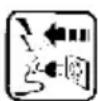
If the mains cable gets damaged or cut during the use, do not touch it, but instantly pull the plug out of the socket. Never use the tool with damaged mains cable.

The tool must neither be wet nor used in humid environment.
- Do not use the tool near explosive materials (petrol, dilution).
- Do not work with materials containing asbestos.
- Prior to every use, check the tool and its cable and plug. Have damages only repaired by specialists. Insert the plug into the socket only when the tool switch is off.
- Plug off if it is not under supervision, in case of putting up and stripping down the machine, in case of voltage drop or when fixing or mounting an accessory.
- When you work outside, the machine has to be used with a fault-current circuit breaker with max. 30 mA.
- Switch the machine off if it stops for whatever reason. You avoid that it starts suddenly and not under supervision.
- Pay attention that the speed indicated on the wheels meets or is higher than the max. speed indicated on the machine.
- Grinding wheels have to be stored and used carefully according to the instructions of the producer.
- Check the accessories before use. Do not use any products which are broken, cracked or damaged in another way.
■ Make sure that the tool was mounted properly, and let it run idly in a safe position for 30 seconds. Stop the tool immediately if you found considerable vibrations or other defects. - Always lead the mains and extension cable as well as the extraction hose to the back away from the machine.
- Don't use the machine if a part of the housing is damaged or in case of damages on the switch, the cable or plug.
- Electrical tools have to be inspected visually by a specialist in regular intervals.
- Do not touch rotating parts.
- Persons under 16 years are not supposed to use the tool.
- Keep the handles dry, clean and free of oil and grease.




- During use, the operator and other persons standing nearby have to wear suitable ear protectors, a dust mask and protection goggles.
- Make sure that persons in the work space are not endangered by Particles flying around.
■ Always hold the machine with both hands.
- Attention! The tool still runs for a little while after the machine was switched off.
For further safety instructions please refer to the enclosure!

Electrical Connection
Before starting the machine check the correspondence between voltage and frequency according to the data mentioned on the identification plate. Voltage differences from +6% and -10% are allowed.
For protection purposes the EPO 200-3 R NT can only be run with a GFCI. The machine is standard equipped with a PRCD protective switch integrated in the cord.
Attention!

- The PRCD protective switch must not lay in water.
- PRCD protective switches must not be used to switch the tool on and off.
■ Before starting your work, check the proper function by pressing the TEST button.
Only use extension cables with a sufficient cross-section. A cross-section which is too small could cause a considerable drop in performance and an overheating of machine and cable.
Recommended minimum cross sections and maximum cable lengths
| Mains voltage | Cross section in sq. mm | |
| 1.5 | 2.5 | |
| 110V | 20 m | 40 m |
| 230V | 50 m | 80 m |
The tool is equipped with a start-up speed limiter to prevent that swift automatic circuit breakers are unintentionally triggered.
Switching on and off
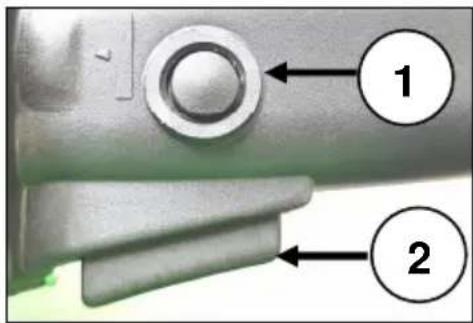
text_image
1 2To start the power tool, first press the lock-off button(1), then press the on/off switch (2) and keep it pressed.
Note:
For safety reasons, the on/off switch cannot be locked; it must remain pressed during the entire operation. To switch off the power tool, release the on/off switch. The EPO 200-3 R NT has an adjusting wheel with which the speed can be can be continuously adjusted between 2000 and 3000 rpm. This is located on the switch handle.
Tool assembly and replacement




Attention!
Before any work on the tool, disconnect the plug from the mains!
Activate the spindle lock and keep it pressed.
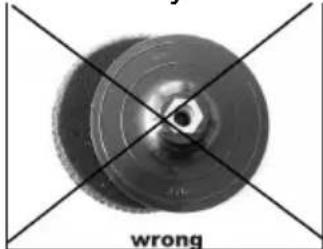
First fit the Velcro discs to the work spindle. Screw them on and tighten them firmly. Use the spindle lock to hold them in place.
text_image
wrongPress the grinding or polishing discs required for your application onto the hook and loop backing pads. Ensure that the disc is positioned as precisely as possible on the backing pad. This enables the device to run smoothly.
Let the machine run for a short period of time and in a safe position. If the machine does not run easily, stop working immediately.
Working instructions
Dry polishing:
Dust generated during work is harmful to health. When Therefore, a hoover must be used when sanding / polishing and wear a dust mask.
The appropriate wet/dry vacuum cleaner (dust class M) is available as an accessory. This is connected directly to the socket provided on the extraction hood. suction bonnet.
Wet polishing:
The water connection is attached to the spigot of the protective cover.
Connect the machine to the water supply or a pressurised water container via the GARDENA
Only operate the machine with clean water and a sufficient water supply.
The maximum water pressure should not exceed 3 bar!
The water supply must be regulated according to the material.
The dust/splash guard attached to the protective bonnet must be adjusted to the height of the insert tools (discs) before
commissioning. To do this, place the appliance with the fitted insert tools on a smooth surface and attach the protective strips to the protective cover and removable segment using Velcro with a gap of approx. 1-3 mm to the surface.
Switch on the appliance and carefully place it on the surface to be processed. Hold the appliance firmly in both hands - one hand on the switch handle and the second hand on the motor cap. Work in a linear or circular motion. Work with light pressure. Excessive pressure increases abrasive wear and worsens the sanding result.
A segment of the protective bonnet can be removed for work directly on wall edges. This makes it possible to work on otherwise inaccessible areas.
To do this, pull the segment upwards from the protective cover.
Caution!
For all other sanding work, only work with the protective bonnet completely closed.
Dust Extraction
Dust which occurs during your work is hazardous to health. That is why the concrete grinder must be used with a vacuum cleaner, and a dust mask has to be worn. The suitable Wet/Dry Vacuum Cleaner ESS 35 MP is available as accessory. It can directly be attached to the connection on the dust hood.
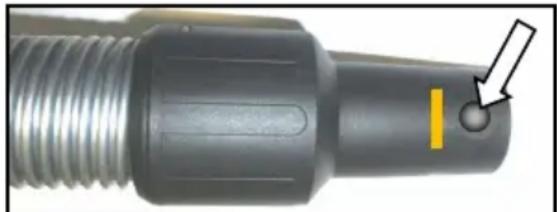
The suction hose can be locked against slipping out by means of the hose fixing. Make the necessary drill hole as follows:
Put the suction hose in the connector of the hood.
Mark the plug-in depth with a crayon.
natural_image
Close-up of a threaded mechanical component with a small circular mark and an arrow pointing to it (no text or symbols visible)Drill 9 mm from this marking (line) a hole with diameter 6 mm in the nozzle.
When insert the suction hose pull the ring of the hose fixing and turn the nozzle till the fixation engages.
Overload Protection
In order to protect the user, the motor and the tool, the EPO 200-3 R NT is equipped with an electronic and thermal overload protection.
Electronic: In case of overload caused by a grinding pressure which is too high, the electronics react by decreasing the speed of the machine. You can continue working when the grinding pressure has been reduced. If you don't relief the
pressure on the machine or put furthermore too much pressure on the tool it reacts by witching OFF the machine. After automatic switch-OFF of the machine you can continue working after switching OFF and ON the power tool again.
Thermal: In case of permanent overload, a thermal sensor protects the motor against destruction. In this case, the tool switches off automatically and can only be restarted after a certain cooling period (approx. 2 minutes). Actuate the ON/OFF switch! The cooling period depends on the heating of the motor winding and the ambient temperature.
Care and Maintenance

Before the beginning of the maintenance- or repair works you have to disconnect the plug from the mains.
Repairs may be executed only by appropriately qualified and experienced personnel. After every repair the machine has to be inspected by an electric specialist. Due to its design, the power tool needs a minimum of care and maintenance. The following works have to be carried out or rather the component parts have to be inspected:
■ The power tool as well as the ventilation slots always have to be clean.
■ During work, please pay attention that no foreign elements get into the interior of the machine.
In case of failure, a repair has to be carried out by an authorized service workshop.
Our after-sales service responds to your questions concerning maintenance and repair of your product as well as spare parts.
EIBENSTOCK's application service team will gladly answer questions concerning our products and their accessories.
Environmental Protection

Raw Material Recycling Instead of Waste Disposal
In order to avoid damages during transportation, the tool has to be delivered in solid packaging. Packaging as well as unit and accessories are made of recyclable materials and can be disposed accordingly.
The tool's plastic components are marked according to their material, which makes it possible to remove environmental friendly and differentiated because of available collection facilities.
Only for EU countries

natural_image
Symbol of a trash bin crossed with a circular weight, representing waste sorting or disposal (no text or labels)Do not dispose of electric tools together with household waste material! In observance of European Directive 2012/19/EU on waste electrical and electronic equipment and its implementation in accordance with national law, electric tools that have reached the end of their life must be collected separately and returned to an environmentally compatible recycling facility.
Noise Emission
The indication of noise emission is measured according to EN 62841-2-3. The level of acoustic pressure on the work site could exceed 85 dB (A); in this case protection means must be used.

Wear ear protectors!
The typical hand-arm vibration is below 2.5 m/s ^4 .
Measured values determined according to EN 62841-2-3.
The declared vibration emission level represents the main applications of the tool. However if the tool is used for different applications, with different accessories or poorly maintained, the vibration emission may differ. This may significantly increase the exposure level over the total working period. An estimation of the level of exposure to vibration should also take into account the times when the tool is switched off or when it is running but not actually doing the job. This may significantly reduce the exposure level over the total working period. Identify additional safety measures to protect the operator from the effects of vibration such as: maintain the tool and the accessories, keep the hands warm, organisation of work patterns.
Dust protection
Dust from material such as paint containing lead, some wood species, minerals and metal may be harmful. Contact with or inhalation of the dust may cause allergic reactions and/or respiratory diseases to the operator or bystanders. Certain kinds of dust are classified as carcinogenic such as oak and beech dust especially in conjunction with additives for wood conditioning (chromate, wood preservative). Material containing asbestos must not be processed.
- Where the use of a dust extraction device is possible it shall be used.
- To achieve a high level of dust collection, use industrial vacuum cleaner (category M) for wood and/or minerals together with this tool.
■ The work place must be well ventilated. - The use of a dust mask of filter class P2 is recommended.
Warranty
According to the general supply conditions for business dealings, suppliers have to provide to companies a warranty period of 12 months for redhibitory defects. (To be documented by invoice or delivery note.) Damages due to natural wear, overstressing or improper handling are excluded from this warranty. Damages due to material defects or production faults shall be eliminated free of charge by either repair or replacement.
Complaints will be accepted only if the tool is returned in non-dismantled condition to the manufacturer.
EU Declaration of Conformity
We declare under our sole responsibility that the product described under "Technical Data" is in conformity with all relevant provisions of the directives 2011/65/EU, 2014/30/EU, 2006/42/EC
including their amendments and complies with the following standards:
EN 62841-1:2023-03
EN 62841-2-3:2022-08
EN IEC 55014-1:2022-12
EN IEC 55014-2:2022-10
EN 61000-3-2:2023-10
EN 61000-3-3:2023-02
text_image
Handwritten signature or scribble in cursive scriptFrank Markert
Head of Engineering
GB - Declaration of Conformity
We declare as the manufacturer under our sole responsibility that the product described under “Technical Data” fulfi lls all the relevant provisions of the following Regulations S.I. 2008/1597 (as amended), S.I. 2017/1206 (as amended), S.I. 2012/3032 (as amended) and that the following designated standards have been used:
BS EN 62841-1:2023-03
BS EN 62841-2-3:2022-08
BS EN IEC 55014-1:2022-12
BS EN IEC 55014-2:2022-10
BS EN 61000-3-2:2023-10
BS EN 61000-3-3:2023-02
Technical file (S.I. 2008/1597) at:
text_image
Handwritten signature or scribble on white background, possibly a signature or artistic markFrank Markert
Head of Engineering
Subject to change without notice.
natural_image
Circular mechanical component with central hub and two diagonal cross lines, labeled 'faux' at bottom (no other text or symbols)natural_image
Close-up of a mechanical component with threaded shaft and circular end, marked with an arrow pointing to a small circular feature (no text or symbols visible)natural_image
Symbol of a trash bin with no text or numbers presenttext_image
Handwritten signature or scribble on white background, possibly a signature or artistic markLothar Lässig
General Manager
14.04.2025
text_image
Handwritten signature or scribble on a wavy line, possibly from a document or formFrank Markert
Head of Engineering
Note importanti
natural_image
Circular mechanical component with cross-sectional lines, labeled 'errato' at bottom (no other text or symbols)natural_image
Close-up of a threaded mechanical component with a yellow indicator and a white arrow pointing to a small circular feature (no text or symbols visible)natural_image
Symbol of a trash bin with no text or labelstext_image
Handwritten signature or scribble with three curved lines and a dot, possibly a signature or annotationLothar Lässig
General Manager
14.04.2025
text_image
Handwritten signature or scribble on white backgroundFrank Markert
Head of Engineering
NEDERLANDS
natural_image
Close-up of a mechanical component with threaded shaft and circular end, marked with an arrow pointing to a small circular feature (no text or symbols visible)natural_image
Symbol of a trash bin crossed with diagonal lines, no text or numbers presenttext_image
Handwritten signature or scribble on a plain backgroundLothar Lässig
General Manager
14.04.2025
text_image
Handwritten signature or scribble in cursive scriptFrank Markert
Head of Engineering
natural_image
Close-up of a mechanical component with threaded shaft and highlighted section (no text or symbols)natural_image
Symbol of a trash bin crossed with diagonal lines, representing waste sorting or disposal (no text or labels)Kun for EU lande
text_image
Handwritten signature or scribble on white background, possibly a signature or artistic markLothar Lässig
General Manager
14.04.2025
text_image
Handwritten signature or scribble on white backgroundFrank Markert
Head of Engineering
Ihr Fachhändler
Your distributor