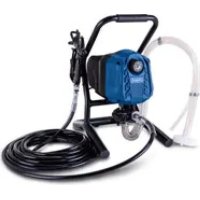
ACS4000 - Paint spray SCHEPPACH - Free user manual and instructions
Find the device manual for free ACS4000 SCHEPPACH in PDF.



| Product Type | Airless Paint Sprayer |
| Brand | Scheppach |
| Model | ACS4000 |
| Power Supply | 230 V ~ 50 Hz |
| Power | 550 W |
| Max. Operating Pressure | 110 bar (11 MPa) |
| Max. Paint Flow Rate | 1250 ml/min |
| Max. Product Temperature | 40 °C |
| Weight | Approx. 7.8 kg |
| Protection Class | I |
| Protection Rating | IPX3 |
| Sound Power Level | 91.2 dB |
| Sound Pressure Level | 78.4 dB |
| Vibrations | > 2.5 m/s² |
| Compatible Materials | Acrylic paints, water-based, oil-based, varnishes, primers, etc. |
| High Pressure Hose Length | Approx. 15 m (estimated) |
| Number of Nozzles Included | 2 (ref. 311 and 517) |
| HEA Filter | Yes, pre-installed and replaceable |
| Use | Domestic, indoor and outdoor |
| Maintenance | Clean after each use, decompress before maintenance |
| Warranty | 2 years (according to legislation) |
Frequently Asked Questions - ACS4000 SCHEPPACH
User questions about ACS4000 SCHEPPACH
0 question about this device. Answer the ones you know or ask your own.
Ask a new question about this device
Download the instructions for your Paint spray in PDF format for free! Find your manual ACS4000 - SCHEPPACH and take your electronic device back in hand. On this page are published all the documents necessary for the use of your device. ACS4000 by SCHEPPACH.
USER MANUAL ACS4000 SCHEPPACH
natural_image
Black industrial spray sprayer machine with coiled hose and transparent tubing (no visible text or symbols)
ACS4000
| DE | Airless FarbsprühsystemOriginalbetriebsanleitung | 5 |
| GB | Airless paint spray systemTranslation of original instruction manual | 23 |
| FR | Pistolet à peinture AirlessTraduction des instructions d'origine | 37 |
| IT | Sistema airless di spruzzatura di verniceLa traduzione dal manuale di istruzioni originale | 53 |
| NL | Airless verfsproeisysteemVertaling van de originele gebruikshandleiding | 69 |
| ES | Sistema de pulverización de pintura AirlessTraducción del manual de instrucciones original | 85 |
| PT | Sistema de pintura por pulverização airlessTradução do manual de operação original | 101 |

natural_image
Mechanical assembly diagram showing pipe connection with wrench and screwdriver (no text or symbols)
natural_image
Technical line drawing of a spray gun with labeled parts (no text or symbols present)




natural_image
Technical line drawing of a mechanical device with hoses and a lever (no text or symbols)
Günzburger Straße 69
D-89335 Ichenhausen
Verehrter Kunde,
Homepage: https://www.scheppach.com/de/service
Explanation of the symbols on the product
Symbols are used in this manual to draw your attention to potential hazards. The safety symbols and the accompanying explanations must be fully understood. The warnings themselves will not rectify a hazard and cannot replace proper accident prevention measures.
 | Warning - Read the operating manual to reduce the risk of injury. |
 | Wear hearing protection. Excessive noise can result in a loss of hearing. |
 | Wear a dust protection mask. When machining wood and other materials, harmful dust may be generated. Do not machine material containing asbestos! |
 | Wear safety goggles. Sparks created during work or fragments, chippings and dust ejected by the product can case sight loss. |
 | Always wear dissipative protective gloves. |
 | Wear non-slip, dissipative safety shoes. |
 | Wear protective clothing. |
 | Warning! Switch off and unplug the device from the mains plug before installing, cleaning, servicing, converting, storing or transporting the device. |
 | The product complies with the applicable European directives. |
| ⚠ Attention! | We have marked points in these operating instructions that impact your safety with this symbol. |
Table of contents: Page:
- Introduction....25
- Product description (fig. 1)....25
- Scope of delivery 25
- Proper use 26
- General safety instructions.... 26
- Residual risks 29
- Technical data....30
- Unpacking 30
- Working instructions 31
- Before commissioning 31
- Commissioning 32
- Electrical connection 33
- Cleaning and maintenance.... 33
- Storage and transport.... 35
- Repair & ordering spare parts 35
- Disposal and recycling....35
- Troubleshooting 36
- Declaration of conformity 119
1. Introduction
Manufacturer:
Scheppach GmbH
Günzburger Straße 69
D-89335 Ichenhausen
Dear Customer,
We hope your new product brings you much enjoyment and success.
Note:
In accordance with the applicable product liability laws, the manufacturer of this product assumes no liability for damage to the product or caused by the product arising from:
- Improper handling
• Non-compliance with the operating manual
• Repairs carried out by third parties, unauthorised specialists
• Installing and replacing non-original spare parts
• Application other than specified - Failure of the electrical system in the event of the electrical regulations and VDE provisions 0100, DIN 57113 / VDE0113 not being observed
Note:
Read through the complete text in the operating manual before installing and commissioning the device.
This operating manual should help you to familiarise yourself with your product and to use it for its intended purpose.
The operating manual includes important instructions for the safe, proper and economic operation of the product, for avoiding danger, for minimising repair costs and downtimes and for increasing the reliability and extending the service life of the product.
In addition to the safety instructions in this operating manual, you must also observe the regulations applicable to the operation of the product in your country.
Keep the operating manual package with the power tool at all times and store it in a plastic cover to protect it from dirt and moisture. They must be read and carefully observed by all operating personnel before starting the work.
The product may only be used by personnel who have been trained to use it and who have been instructed with respect to the associated hazards.
The required minimum age must be observed.
In addition to the safety instructions in this operating manual and the separate regulations of your country, the generally recognised technical rules relating to the operation of such products must also be observed.
We accept no liability for accidents or damage that occur due to a failure to observe this manual and the safety instructions.
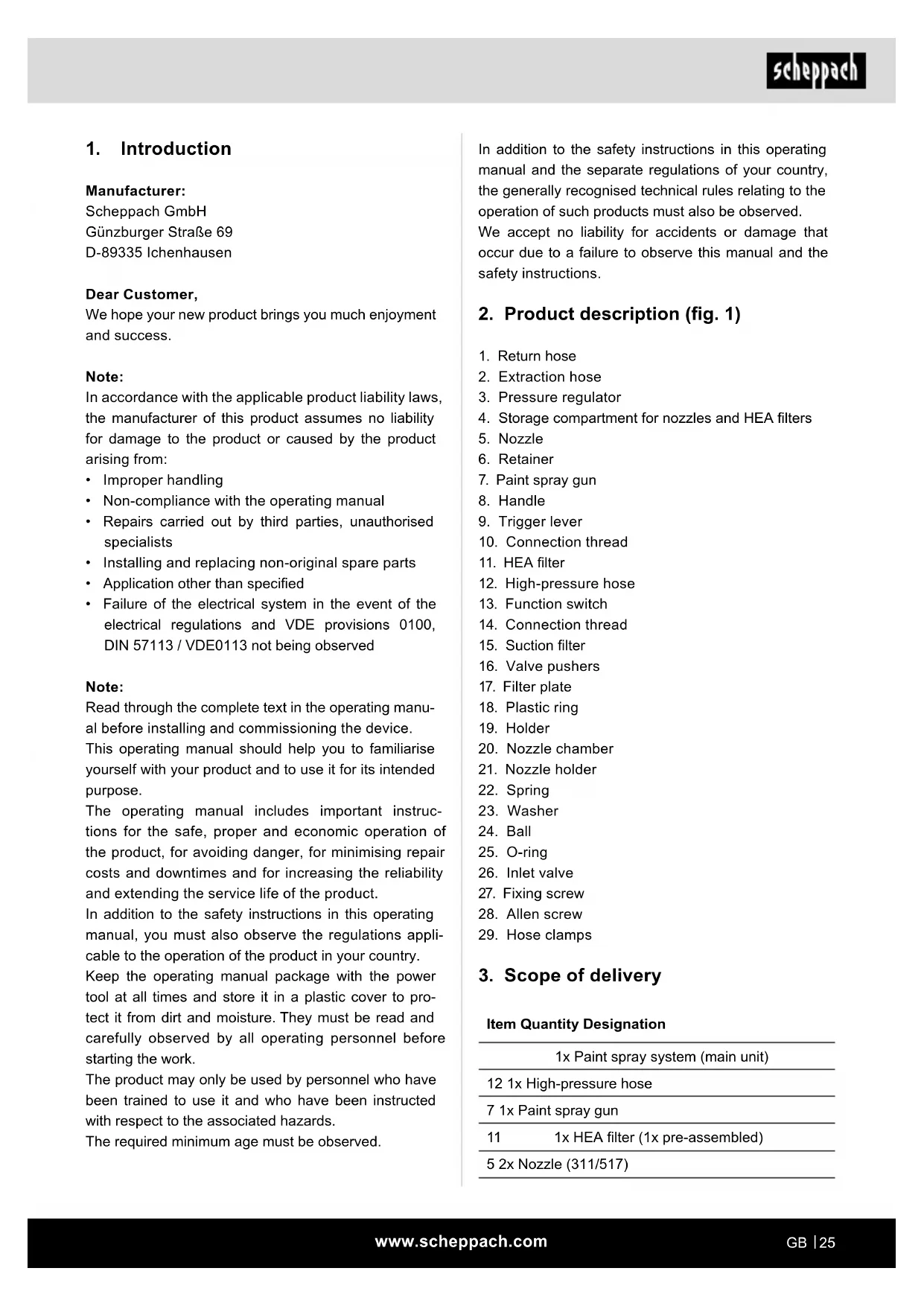
2. Product description (fig. 1)
- Return hose
- Extraction hose
- Pressure regulator
- Storage compartment for nozzles and HEA filters
- Nozzle
- Retainer
- Paint spray gun
- Handle
- Trigger lever
- Connection thread
- HEA filter
- High-pressure hose
- Function switch
- Connection thread
- Suction filter
- Valve pushers
- Filter plate
- Plastic ring
- Holder
- Nozzle chamber
- Nozzle holder
- Spring
- Washer
- Ball
- O-ring
- Inlet valve
- Fixing screw
- Allen screw
- Hose clamps
3. Scope of delivery
Item Quantity Designation
| 1x Paint spray system (main unit) | |
| 12 1x High-pressure hose | |
| 7 1x Paint spray gun | |
| 11 | 1x HEA filter (1x pre-assembled) |
| 5 2x Nozzle (311/517) | |
2x Screw (3.5/9.5 mm)
1x Operating manual
4. Proper use
The product may only be used in the intended manner. Any use beyond this is improper. The user/operator, not the manufacturer, is responsible for damages or injuries of any type resulting from this.
An element of the intended use is also the observance of the safety instructions, as well as the assembly instructions and operating information in the operating manual.
Persons who operate and maintain the product must be familiar with the manual and must be informed about potential dangers.
The liability of the manufacturer and resulting damages are excluded in the event of modifications of the product.
The product may only be operated with original parts and original accessories from the manufacturer.
The safety, operating and maintenance specifications of the manufacturer, as well as the dimensions specified in the technical data, must be observed.
This device is suitable for coating walls indoors as well as objects outdoors. Approved for use are:
• Water-based paints and varnishes
Not approved for use are:
- Flammable coating materials, materials containing acetone or nitro thinner
- Materials that contain highly abrasive components
- Façade paint, alkalis and acidic coating materials Do not use the device in areas at potential risk of explosion. Any other use or modification shall be deemed to be improper use and could give rise to considerable risk of accident. We will not accept liability for loss or damage arising from improper use. The device is intended for private, domestic use only.
Please note that our products were not designed with the intention of use for commercial or industrial purposes. We assume no guarantee if the product is used in commercial or industrial applications, or for equivalent work.
The manufacturer is not liable for damage caused by an improper use or incorrect operation of this device.
5. General safety instructions
⚠ WARNING - Read all safety information, instructions, illustrations and technical data for this product.
Failure to follow all instructions listed below may result in electric shock, fire and/or serious injury.
Save all warnings and instructions for future reference.
The term electric tool used in the safety instructions refers to mains-powered electrical tools (with a mains cable) and battery-powered electrical tools (without a mains cable).
- Work area safety
a) Keep your work area clean and well-lit. Disorganised and unlit work areas can result in accidents.
b) Do not operate power tools in explosive atmospheres, such as in the presence of flammable liquids, gases or dust. Power tools create sparks which may ignite the dust or fumes.
c) Keep children and bystanders away while operating a power tool. Distractions can cause you to lose control.
- Electrical safety
a) Power tool plugs must match the outlet. Never modify the plug in any way. Do not use any adapter plugs with earthed (grounded) power tools. Unmodified plugs and matching outlets will reduce risk of electric shock.
b) Avoid body contact with earthed or grounded surfaces, such as pipes, radiators, ranges and refrigerators. There is an increased risk of electric shock if your body is earthed or grounded.
c) Do not expose power tools to rain or wet conditions. Water entering a power tool will increase the risk of electric shock.
d) Do not abuse the cord. Never use the cord for carrying, pulling or unplugging the power tool. Keep cord away from heat, oil, sharp edges or moving parts. Damaged or entangled cords increase the risk of electric shock.
e) When operating a power tool outdoors, use an extension cord suitable for outdoor use. Use of a cord suitable for outdoor use reduces the risk of electric shock.
f) If operating a power tool in a damp location is unavoidable, use a residual current device (RCD) protected supply. Use of an RCD reduces the risk of electric shock.
3. Personal safety
a) Stay alert, watch what you are doing and use common sense when operating a power tool. Do not use a power tool while you are tired or under the influence of drugs, alcohol or medication. A moment of inattention while operating power tools may result in serious personal injury.
b) Wear personal protective equipment and always safety goggles. Protective equipment such as a dust mask, non-skid safety shoes, hard hat or hearing protection used for appropriate conditions will reduce personal injuries.
c) Prevent unintentional starting. Ensure the switch is in the off-position before connecting to power source and/or rechargeable battery, picking up or carrying the tool. Carrying power tools with your finger on the switch or energising power tools that have the switch on invites accidents.
d) Remove any adjusting key or screwdriver before turning the power tool on. A wrench or a key left attached to a rotating part of the power tool may result in personal injury.
e) Do not overreach. Keep proper footing and balance at all times. This enables better control of the power tool in unexpected situations.
f) Dress properly. Do not wear loose clothing or jewellery. Keep your hair and clothing away from moving parts. Loose clothes, jewellery or long hair can be caught in moving parts.
g) If devices are provided for the connection of dust extraction and collection facilities, ensure these are connected and properly used. Use of dust collection can reduce dust-related hazards.
h) Do not let familiarity gained from frequent use of tools allow you to become complacent and ignore tool safety principles. A careless action can cause severe injury within a fraction of a second.
4. Power tool use and care
a) Do not force the power tool. Use the correct power tool for your application. The correct power tool will do the job better and safer at the rate for which it was designed.
b) Do not use the power tool if the switch does not turn it on and off. Any power tool that cannot be controlled with the switch is dangerous and must be repaired.
c) Disconnect the plug from the power socket and/or remove the rechargeable battery (if removable) from the power tool before making any adjustments, changing accessories, or storing power tools. Such precautionary measures reduce the risk of starting the power tool accidentally.
d) Store idle power tools out of the reach of children and do not allow persons unfamiliar with the power tool or these instructions to operate the power tool. Power tools are dangerous in the hands of untrained users.
e) Maintain power tools and accessories. Check for misalignment or binding of moving parts, breakage of parts and any other condition that may affect the power tool's operation. If damaged, have the power tool repaired before use. Many accidents are caused by poorly maintained power tools.
f) Keep cutting tools sharp and clean. Properly maintained cutting tools with sharp cutting edges are less likely to bind and are easier to control.
g) Use electric tools, insertion tools, etc. according to these instructions. taking into account the working conditions and the work to be performed. Use of the power tool for operations different from those intended could result in a hazardous situation.
h) Keep handles and grasping surfaces dry, clean and free from oil and grease. Slippery handles and grasping surfaces do not allow for safe handling and control of the tool in unexpected situations.
5. Service
a) Have your power tool serviced by a qualified repair person using only identical replacement parts. This will ensure that the safety of the power tool is maintained.
Additional safety instructions
- RISK OF EXPLOSION AND FIRE! There must be no ignition sources in the vicinity. Explosion hazard caused by the possible formation of an explosive atmosphere in combination with ignition sources (e.g. by electrostatic discharge, electric sparks, hot surfaces)!
- RISK OF INJURY! MISUSE! Never point the device at people and / or animals.
- RISK OF EXPLOSION/FIRE! NO SMOKING! Do not ignite sparks or open fire. There must be no sources of ignition in the vicinity, such as open fires, lit cigarettes, cigars and tobacco pipes, sparks, glowing wires, hot surfaces, etc.
- WARNING! Keep your distance from the nozzle tip!
- Do not spray on yourself, other people or animals. Keep your hands and other body parts away from the spray. If it penetrates the skin, seek medical attention immediately. The spray can penetrate the skin even through a glove and be injected into your body.
- Do not treat an injection as a simple cut. A high-pressure jet can inject toxins into the body and cause serious injury (e.g. necrosis, loss of limbs). In case of skin injection, seek medical attention immediately.
- Prior to every start-up, observe the following points in accordance with the operating instructions:
1) Do not use defective devices.
2) Secure the spray gun with the safety catch on the trigger.
3) Ensure earthing. The connection must be established via a correctly earthed protective contact socket.
4) Check the permissible operating pressure of the high-pressure hose and the spray gun.
5) Check all connecting parts for tightness.
- Strictly follow the instructions for regular cleaning and maintenance of the device. Observe the following rules before carrying out any work on the device and after every interruption to work:
1) Depressurise the spray gun and the high-pressure hose.
2) Secure the spray gun with the safety catch on the trigger.
3) Switch the device off.
- Do not use the device in operating locations that fall under the explosion protection ordinance.
- Keep your work area clean, well lit and free from paint or solvent containers, rags and other flammable materials. Possible danger of spontaneous combustion. Keep functional fire extinguishers / extinguishing equipment available at all times.
-
Do not spray or clean with materials whose flash point is below 21°C. Use materials based on water, low-volatility hydrocarbons or similar materials. Volatile evaporating solvents create an explosive environment.
-
Do not spray in the vicinity of ignition sources such as static electricity sparks, naked flames, pilot lights, hot objects, motors, cigarettes and sparks from plugging in and unplugging power cables or operating switches. Such spark sources can cause ignition of the surrounding area.
- Do not spray materials that are not known to be hazardous. Unknown materials can create hazardous conditions.
- If the mains connection cable of this device is damaged, it must be replaced by the manufacturer, their service department or a similarly qualified person to avoid dangers.
- Wear additional personal protective equipment such as appropriate protective gloves and protective or respiratory mask when spraying or handling chemicals. Wearing protective equipment for appropriate conditions reduces exposure to hazardous substances.
- Be aware of any hazards arising from the material being sprayed. Observe the markings on the container or the manufacturer's information for the spray, including instructions to use personal protective equipment. Follow the manufacturer's instructions to reduce the risk of fire and injuries caused by toxins, carcinogens, etc.
- The spray gun must not be used for spraying flammable substances. Spray guns must not be cleaned with flammable solvents.
- Secure the device and the spray gun.
- Secure all hoses, connections and filter parts before starting up the spray pump. Unsecured parts can come loose with great force or fluid can leak out at high pressure, causing serious injury. Always secure the spray gun when assembling or disassembling the nozzle and when interrupting work.
- Expect recoil from the spray gun during operation. At high operating pressure, pulling the trigger causes a recoil force of up to 15 N. If you are not prepared for this, your hand may be pushed back or you may lose your balance. This can result in injuries. Permanent exposure to this recoil can lead to permanent damage to health.
- Max. operating pressure: The permissible operating pressure for the spray gun, high-pressure hose and spray gun accessories must not be less than the maximum operating pressure of 110 bar (11 MPa) indicated on the device.
- The device must be connected to a correctly earthed socket outlet. The connection must be equipped with a residual current device INF ≤ 30 mA.
- Ensure that the mains supply to be connected corresponds to the values indicated on the type plate.
- Relieve the pressure and disconnect the mains plug from the socket before carrying out any work on the device.
- It is essential to earth the object to be sprayed!
- Observe the user manual for the installation, maintenance and repair of the device.
- The device must be connected to the earthing system during installation.
- Ensure good ventilation in the spraying area and sufficient fresh air in the entire room. Wear respiratory protection.
• Always wear suitable safety goggles to keep hazardous vapours and liquid away from the eyes.
- Wear protective clothing to keep paint away from skin and hair.
- WARNING! Due to the flow speed of the coating material during spraying, electrostatic charges may occur on the device under certain circumstances. These can cause sparks or flames when discharged. It is therefore essential that the device is always earthed via the electrical installation. The connection must be established via a correctly earthed protective contact socket.
- Pay attention to hazards that may be caused by the substance being sprayed and also observe the labels on the containers or the instructions given by the manufacturer of the substance.
- When working indoors: Prevent any vapours containing solvents forming in the area of the device. Set up the device on the side facing away from the spray object. A minimum distance of 5 m must be maintained between the motor unit and the spray gun.
- WARNING! When working outdoors: Prevent any vapours containing solvents being propelled towards the device. Note the wind direction! Position the device so that no vapours containing solvents can reach the device and build up. A minimum distance of 5 m must be maintained between the device and the spray gun.
- Danger of short circuit due to water penetration! Never clean the device with a high-pressure or steam cleaner.
- Do not use a solvent container with a small opening for cleaning the device. An explosive atmosphere could form. Ground the container beforehand.
Safety instructions for high-pressure hose
- DANGER! Attention: Danger of injury from injection! Leaks can form in the high-pressure hose due to wear, kinking and improper use. Fluid can be injected into the skin through a leak.
- The electrostatic charge from the spray gun and high-pressure hose is discharged via the high-pressure hose.
- Check the high-pressure hose every time before use.
- Never pull on the high-pressure hose to move the device.
- Never repair a defective high-pressure hose yourself!
- Replace a damaged high-pressure hose immediately.
- Avoid sharp bending or kinking, the smallest bending radius is about 20 cm.
- Protect the high-pressure hose from sharp objects and edges.
- Do not twist the high-pressure hose.
- Do not immerse the high-pressure hose in solvent. Only wipe the outside of the device with a damp cloth.
- Lay the high-pressure hose so that there is no risk of tripping.
- Do not drive over the high-pressure hose.
- NOTE: Old high-pressure hoses increase the risk of damage. We recommend replacing the high-pressure hose every 6 years.
Warning! This power tool generates an electromagnetic field during operation. This field can impair active or passive medical implants under certain circumstances. In order to prevent the risk of serious or deadly injuries, we recommend that persons with medical implants consult with their physician and the manufacturer of the medical implant prior to operating the power tool.
6. Residual risks
The product has been built according to state-of-the-art and the recognised technical safety rules. However, individual residual risks can arise during operation.
• Health hazard due to electrical power, with the use of improper electrical connection cables.
• Furthermore, despite all precautions having been met, some non-obvious residual risks may still remain.
- Residual risks can be minimised if the "Safety Instructions" and the "Intended Use" together with the operating manual as a whole are observed.
- Avoid accidental starting of the product: the operating button may not be pressed when inserting the plug in a socket. Use the tool attachment that is recommended in this operating manual. This is how to ensure that your product provides optimum performance.
- Keep your hands away from the working area when the product is in operation.
Even when applying the relevant safety regulations and using safety equipment, certain residual risks cannot be avoided. These include:
- Lung damage if suitable respiratory protection is not worn;
• Hearing damage if hearing protection is not worn; - Eye damage if suitable eye protection is not worn;
- Damage to health due to oscillation of the hands and arms during prolonged operation of the device or if the device is not properly held or maintained. If you use a device for a long period of time, take regular breaks.
WARNING! DANGER FROM MATERIAL AND SUBSTANCES!
- There is a risk of coming into contact with or absorbing coating materials and/or cleaning fluids. There is also a risk of inhaling vapours from liquids. As a result, permanent damage due to exposure can occur under certain conditions.
- Wear personal protective equipment during all work on the device!
- Ensure sufficient technical or natural ventilation.
- Observe the safety instructions of the manufacturers of the respective coating materials and cleaning liquids.
• If symptoms occur, seek medical advice!
7. Technical data
Rated voltage 230 V\~50 Hz
| Rated power consumption 550 W | |
| Max. paint throughput 1250 ml/min | |
| Max. working pressure approx. 110 bar | |
| Max. temperature of coating material | 40°C |
| Protection class I | |
| Protection category IPX3 | |
| Weight approx. 7.8 kg | |
Subject to technical changes!
Noise and vibration
⚠ Warning: Noise can have serious effects on your health. If the machine noise exceeds 85 dB, please wear suitable hearing protection.
Information about noise level measured in accordance with ISO 14462
Noise data
| Sound power level L_WA | 91.2 dB |
| Sound pressure level L_pA | 78.4 dB |
| Uncertainty K_wa/pA | 2.5 dB |
Vibration parameters
| Vibration a_h | >2.5 m/s ^2 |
| Uncertainty K_h | 1.5 m/s ^2 |
8. Unpacking
- Open the packaging and carefully remove the product.
- Remove the packaging material, as well as the packaging and transport safety devices (if present).
- Check whether the scope of delivery is complete.
- Check the product and accessory parts for transport damage. In the event of complaints the carrier must be informed immediately. Later claims will not be recognised.
- If possible, keep the packaging until the expiry of the warranty period.
- Familiarise yourself with the product by means of the operating manual before using for the first time.
- With accessories as well as wearing parts and replacement parts use only original parts. Spare parts can be obtained from your specialist dealer.
- When ordering please provide our article number as well as type and year of manufacture for the product.
⚠ WARNING!
The product and the packaging material are not children's toys! Do not let children play with plastic bags, films or small parts! There is a danger of choking or suffocating!
9. Working instructions
Material and paint selection
△ Attention! Do not use textured wall paints or coatings as this may clog the spray gun nozzle and damage components of the airless paint spray station.
9.1 Suitable materials and paints
Many materials and paints are suitable for spraying, but some are not. See the manufacturer's recommendations for this.
The following materials and paints are approved:
• Water-based paints
- Wood preservative
- Oil based paints
- Primers
- Enamel paints
- Adhesive primers
- Clear lacquers
- Oils
- Pickling substances
9.2 Unsuitable materials and paints
When using the following materials and paints, premature wear and clogging of the variable nozzle will occur. This will invalidate the warranty.
a. Paints and varnishes that contain abrasive components, e.g:
• emulsion/dispersion paints for exterior coatings
b. Silicate paints
c. Combustible materials
For excellent results, read the instruction manual carefully before using your airless paint spray system.
Preparing the spray surface
WARNING! Danger of electric shock due to penetrating spray material! Be sure to tape down sockets and switches.
- Thoroughly cover a generous area around the area to be sprayed. Any uncovered areas or surfaces may otherwise become contaminated.
- Make sure that the spray surface is clean, dry and free of grease.
- Roughen smooth surfaces and then remove the sanding dust.
Spray technique
- Always keep the paint spray gun at the same distance from the object and hold at a right angle. The ideal spraying distance is approx. 20 to 25cm . Move the paint spray gun evenly with the whole arm (see Fig. 11).
- Determine the appropriate settings in each case by trial and error, e.g. on a piece of cardboard.
- Do not switch the device on/off over the spray area, but start and end the spraying process approx. 10 cm outside the spray area.
10. Before commissioning
⚠ Attention!
Always make sure the product is fully assembled before commissioning!
Assembly
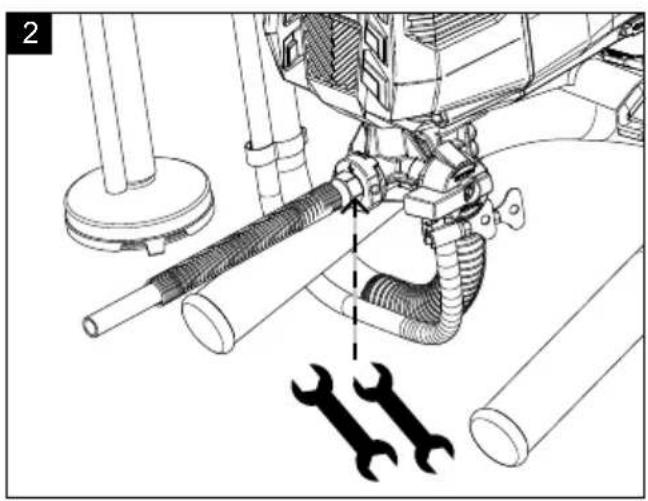
You can assemble the device using two open-ended spanners (not supplied). Alternatively, you can use a 16 mm and 19 mm spanner (not supplied).
Connecting a high-pressure hose (Fig. 1, 2)
- Fit the high-pressure hose 12 to the connection thread (14) of the device. Tighten the nuts using an open-ended spanner.
Counter the nut of the connection thread (14) with a second open-ended spanner (see Fig. 2). - Fit the other end of the high-pressure hose (12) to the connection thread of the paint spray gun (10). Tighten the nuts using an open-ended spanner. Counter the nut of the connection thread of the paint spray gun with a second open-ended spanner.
Attaching the suction hose and return hose
The suction hose (2) and return hose (1) are pre-assembled on the device.
-
To replace the suction hose (2) or the return hose (1), use a flat-blade screwdriver (not included in the scope of delivery) to loosen the screws on the hose clamps and remove the hose.
-
Replace it with a new hose (suction hose/return hose) and mount it in the opposite direction.
Select/change the nozzle (Fig. 7)
Nozzle 311: low viscosity spray material
Nozzle 517: viscous spray material
Insert the corresponding nozzle (5) into the nozzle chamber (20) with the arrow tip pointing in the spraying direction.
Change HEA filter (Fig. 3)
WARNING! The system must be depressurised in order to carry out the following work. To do this, follow the instructions in the chapter "Performing pressure relief".
- Remove the high-pressure hose (12) from the paint spray gun (7).
- Turn the handle (8) clockwise until the upper end can be detached from the paint spray gun (7). You can attach an open-ended spanner to the lower end of the handle to assist with this.
- Insert the matching HEA filter (11) to the installed nozzle 5.
- Turn the handle (8) anticlockwise back into the thread of the paint spray gun (7).
Note Clean the HEA filters (11) regularly and replace them if necessary.
11. Commissioning
- Place the suction hose (2) and return hose 1 in the paint bucket.
- Operate the valve pusher (16) to ensure that the valve is free.
- Plug the mains plug into the mains socket.
- Turn the function switch (13) to the vertical position (PRIME).
- Turn the pressure control dial (3) to position 2 to ensure that the paint is pumped through the system.
- Wait until the paint runs back into the paint bucket through the return hose (1). Now turn the pressure control dial (3) to position 0 (off).
- NOTE: If no paint comes out, follow the measures mentioned in the chapter "Rectifying intake problems".
- Turn the function switch (13) to the horizontal position (SPRAY).
- Turn the pressure control dial (3) to a level corresponding to the viscosity of the sprayed material.
- Hold the paint spray gun (7) over an empty container.
- Unlock the paint spray gun (7) by turning the safety catch 6 with the tip down.
- Operate the trigger lever (9) until the paint comes out in a straight stream.
- Secure the paint spray gun (7) by turning the safety catch (6) with the tip as far back and up as possible.
Settings
- You can switch on the device with the pressure control dial (3) by setting a level greater than 0. The level you choose depends on the spray material used. Determine the best settings by performing a spray test.
• The function switch (13) has two settings:
-
PRIME (vertical position): This setting allows you to pre-fill the system with paint or perform a pressure relief.
-
SPRAY (horizontal position): With this setting, you can work with the device.
Spray
- Unlock the paint spray gun (7) by turning the safety catch (6) with the tip down.
• To spray, press and hold the trigger lever (9). - Release the trigger lever (9) again to stop spraying. WARNING! Always secure the paint spray gun (7) when you do not want to spray immediately.
- Secure the paint spray gun (7) by turning the safety catch (6) with the tip as far back and up as possible.
Overheating protection
The device has overheating protection. This switches the device off if overheating is imminent. Then perform the following steps:
- Turn the pressure control dial (3) to position 0 (off).
- Turn the function switch (13) to the vertical position (PRIME).
-
Allow the device to cool down for at least 30 minutes and remove the cause of overheating, if necessary. This can be caused, for example, by the ventilation slots being covered or the device being too close to a wall.
-
Put the device back into operation.
Performing pressure relief
Always perform pressure relief when you want to take the device out of operation. This is how you relieve system pressure:
- Turn the pressure control dial (3) to position 0 (off).
- Turn the function switch (13) to the vertical position (PRIME).
- Unlock the paint spray gun (7) by turning the safety catch (6) with the tip down.
- Release the pressure by pulling the trigger lever (9). Hold the paint spray gun (7) over an empty container.
-
Wait until all pressure has been relieved or all paint has been discharged from the system. Release the trigger lever (9) again to stop spraying.
-
Secure the paint spray gun (7) by turning the safety catch (6) with the tip as far back and up as possible.
Rectifying intake problems
Operate the valve pusher (16) 3 to 4 times to remove any blockages or deposits from the valve.
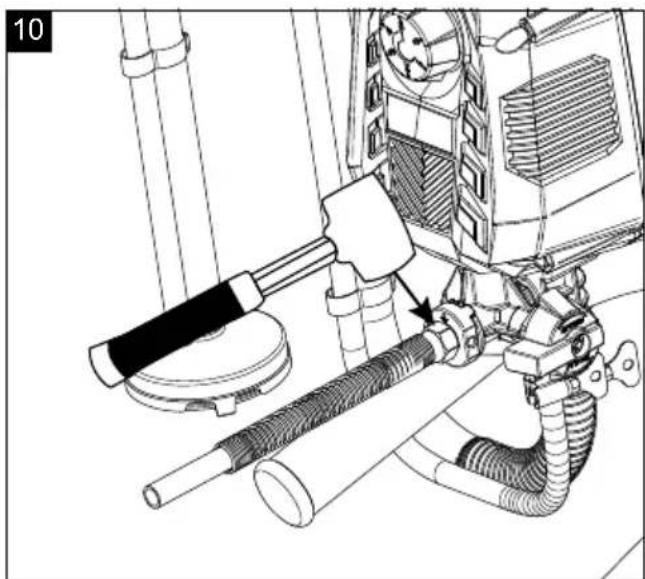
If the problem persists: Tap the connection thread (14) (see Fig. 10) extremely carefully several times with a rubber mallet to loosen harder deposits.
Blow the nozzle clear (Fig. 5 + 5a)
⚠ WARNING! Always secure the paint spray gun (7) when not in use.
- Loosen the nozzle holder (21) (including the nut) a little bit.
- Actuate the trigger lever (9) to blow the nozzle (5) clear. Hold the paint spray gun (7) over an empty container. As soon as a straight spray jet comes out, the nozzle (5) is blown clear.
- Turn the inserted nozzle (5) forwards 180 degrees again.
NOTE: Use an appropriate HEA filter (11) to minimise clogging.
Work interruption
- Perform pressure relief.
- Turn the pressure control dial (3) to position 0 (off).
- Unplug the mains plug from the socket.
- Place the paint spray gun (7) in a plastic bag and then seal it airtight.
- Wet the paint in the paint bucket with water so that no skin forms on it.
12. Electrical connection
The electrical motor installed is connected and ready for operation. The connection complies with the applicable VDE and DIN provisions.
The customer's mains connection as well as the extension cable used must also comply with these regulations.
When working with spraying equipment and attachments, and during temporary outdoor use, it is essential to connect the device via a residual current circuit breaker with a tripping current of 30 mA or less.
Damaged electrical connection cable
The insulation on electrical connection cables is often damaged.
This may have the following causes:
- Pressure points, where connection cables are passed through windows or doors.
- Kinks where the connection cable has been improperly fastened or routed.
- Places where the connection cables have been cut due to being driven over.
• Insulation damage due to being ripped out of the wall outlet.
• Cracks due to the insulation ageing.
Such damaged electrical connection cables must not be used and are life-threatening due to the insulation damage.
Check the electrical connection cables for damage regularly. Ensure that the connection cables are disconnected from electrical power when checking for damage.
Electrical connection cables must comply with the applicable VDE and DIN provisions. Only use connection cables of the same designation.
The printing of the type designation on the connection cable is mandatory.
For single-phase AC motors, we recommend a fuse rating of C 16A or K 16A for products with a high starting current (from 3000 watts)!
Connection type Y
If it is necessary to replace the mains connection cable, this must be done by the manufacturer or their representative to avoid safety hazards.
AC motor
• The mains voltage must be 220-240 V\~.
- Extension cables up to 25 m long must have a cross-section of 1.5 ~mm^2 .
13. Cleaning and maintenance
⚠ WARNING! RISK OF INJURY! Before carrying out any work on the device, switch off the device, disconnect the mains plug and perform pressure relief!
ATTENTION!
- Do not use flammable materials such as nitro thinner for cleaning.
- Please refer to the manufacturer's information of the respective spray material to find out which cleaning agents are suitable.
NOTE
- Thorough cleaning promptly after each use is very important for safety and operation. Otherwise it is no longer possible to guarantee that the device will work correctly.
- Wear suitable protective gloves when cleaning.
-
Remove residual coating materials at appropriate intervals. Remove any sprayed material that has landed on unwanted surfaces before it dries.
-
Perform pressure relief.
- Secure the paint spray gun (7) by turning the safety catch (6) with the sprayer as far back and up as possible.
- Turn the nozzle holder (21) on the paint spray gun (7).
- Place the suction hose (2) with return hose 1 in a container with water or a suitable cleaning agent.
- Turn the function switch to the horizontal position (SPRAY).
-
Turn the pressure control dial (3) to position 5.
-
Unlock the paint spray gun (7) by turning the safety catch (6) with the tip down.
-
Discharge the remaining paint by pulling the trigger lever (9). Hold the paint spray gun (7) over the paint bucket while doing this. ATTENTION! If you are using a metal container, ground the paint spray gun (7) beforehand.
-
Release the trigger lever (9) as soon as cleaning fluid flows out.
-
Secure the paint spray gun (7) by turning the safety catch (6) with the tip as far back and up as possible.
-
Turn the function switch (13) to the vertical position (PRIME).
-
Unlock the paint spray gun (7) by turning the safety catch (6) with the tip down.
-
Discharge the remaining paint by pulling the trigger lever (9). Hold the paint spray gun (7) over the cleaning agent container while doing this.
-
Release the trigger lever (9) as soon as clear cleaning agent flows out.
-
Secure the paint spray gun (7) by turning the safety catch (6) with the tip as far back and up as possible.
-
Turn the pressure control dial (3) to position 0 (off). Unplug the mains plug from the socket.
- Perform pressure relief.
- Remove the high-pressure hose (12) from the paint spray gun (7) using an open-ended spanner.
- Disassemble the nozzle holder (21) with the nozzle (5), holder (19) and plastic ring (18) (see Fig. 6). Clean all parts thoroughly using suitable cleaning agents.
-
Secure the paint spray gun (7) by turning the safety catch (6) with the tip upwards as far as possible. NOTE: Clean the HEA filter (11) regularly. Replace it if cleaning is no longer sufficient.
-
Disconnect the suction hose (2) and return hose (1) from the device using the hose clamps (29). Clean the hoses externally.
-
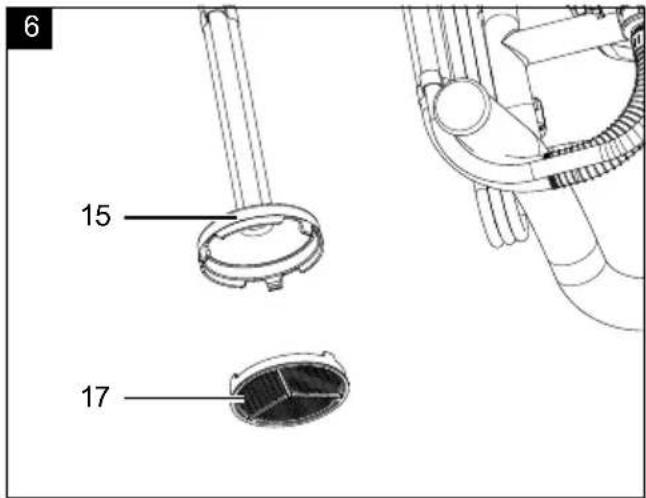
Remove the filter plate (17) of the intake filter (15) (see Fig. 5).
-
Clean the filter plate (17) thoroughly under running water.
-
Remove the high-pressure hose (12) from the connection thread (14) using an open-ended spanner. Counter the connection thread with a second open-ended spanner.
-
Let the inlet valve (26) be immersed in a container filled with preservative (e.g. fine machine oil) so that it can be sucked in.
-
Plug the mains plug into the mains socket.
-
Hold a cloth in front of the connection thread (14). Turn the pressure control (3) to position 1 for 5 seconds. This preserves the device. Turn the pressure control (3) to position 0 (off).
-
Unplug the mains plug from the socket.
Cleaning the inlet valve (Fig. 8)
NOTE: If problems with the paint suction cannot be eliminated, clean the inlet valve 26 or replace it if necessary.
- Disconnect the suction hose (2) the device.
- Remove the inlet valve (26) using an open-ended spanner.
- Remove the O-ring (25), ball (24), washer (23) and spring (22) (see Fig. 7).
- Clean the parts thoroughly using suitable cleaning agents. Replace them if necessary.
- Grease the O-ring (25).
- Insert the parts of the intake filter (26) (see Fig. 7).
- Turn the inlet valve (26) back into the device. Tighten using an open-ended spanner.
Cleaning the connection thread
If a poor spray pattern persists after cleaning the nozzle, clean the connection thread (14).
-
Remove the high-pressure hose (12) from the connection thread (14) using an open-ended spanner. Counter the nut of the connection thread (14) with a second open-ended spanner.
-
Loosen the fastening screw (27) with a Phillips screwdriver (not supplied).
-
Loosen the Allen screw (28) with a 2 mm Allen key (not supplied).
-
Remove the connection thread (14) using an open-ended spanner.
-
Clean the connection thread (14) using suitable cleaning agents. Replace it if necessary.
-
Screw the connection thread (14) back into the device and tighten it using an open-ended spanner.
-
Turn the fastening screw (27) with a Phillips screwdriver to tighten again.
-
Turn the Allen screw (28) with a 2 mm Allen key to tighten again.
14. Storage and transport
Store the product and its accessories in a dark, dry and frost-free place that is inaccessible to children.
The optimum storage temperature lies between 5 and 30 °C.
Store the product in its original packaging. Cover the product to protect it from dust or moisture. Store the operating manual with the product.
15. Repair & ordering spare parts
After repairs or maintenance, make sure that all safety-related parts are installed and are in perfect condition. All parts which may cause injury must be kept where they are inaccessible to children or others.
Attention: According to the German Product Liability Act, no liability is accepted for damage caused by improper repairs or by not using original spare parts.
Such work should be performed by a customer service centre or an authorised specialist. The same applies to accessory parts.
Spare parts and accessories can be obtained from our Service Centre. To do this, scan the QR code on the front page.
Connections and repairs
Connections and repair work on the electrical equipment may only be carried out by electricians.
Please provide the following information in the event of any queries:
• Type of current for the motor
• Machine data - type plate
• Engine data - type plate
Important note in the case of repairs:
When returning the product for repair, for safety reasons, ensure that it is free of paint when it is sent to the service centre.
15.1 Ordering spare parts
Please provide the following information when ordering spare parts:
- Model designation
- Item number
- Type plate data
15.2 Service information
With this product, it is necessary to note that the following parts are subject to natural or usage-related wear, or that the following parts are required as consumables.
Wearing parts*: High-pressure hose, HEA filter, nozzle, paint spray gun
* may not be included in the scope of delivery!
16. Disposal and recycling
Notes for packaging


The packaging materials are recyclable. Please dispose of packaging in an environmentally friendly manner.
Notes on the electrical and electronic equipment act [ElektroG]
![SCHEPPACH ACS4000 - Notes on the electrical and electronic equipment act [ElektroG] - 1](/content/2026/03/563897/images/ca960610540fadf7a2704518fffd1c49f07a37e06251751f9a26dbd4c49fc949.jpg)
Electrical and electronic appliances do not belong in household waste, but should be collected and disposed of separately.
- Used batteries or rechargeable batteries that are not installed permanently in the old appliance must be removed non-destructively before disposal. Their disposal is regulated by the battery act.
- Owners or users of electrical and electronic devices are legally obliged to return them after use.
- The end user is responsible for deleting their personal data from the old device being disposed of!
- The symbol of the crossed-out dustbin means that waste electrical and electronic equipment must not be disposed of with household waste.
- Waste electrical and electronic equipment can be handed in free of charge at the following places:
- Public disposal or collection points (e.g. municipal works yards).
- Points of sale of electrical appliances (stationary and online), provided that dealers are obliged to take them back or offer to do so voluntarily.
-
Up to three waste electrical devices per type of device, with an edge length of no more than 25 centimetres, can be returned free of charge to the manufacturer without prior purchase of a new device from the manufacturer or taken to another authorised collection point in your vicinity.
-
For additional take-back conditions of the manufacturers and distributors, please contact the respective customer service.
- In the case of delivery of a new electrical device by the manufacturer to a private household, the latter may arrange for the free collection of the old electrical device upon request from the end-user. Get in contact with the manufacturer's customer service.
• These statements only apply to devices installed and sold in the countries of the European Union and which are subject to the European Directive 2012/19/EU. Different provisions may apply to the disposal of electrical and electronic appliances in countries outside the European Union.
17. Troubleshooting
The following table shows fault symptoms and describes remedial measures in the event of your product failing to work properly. If you cannot localise and rectify the problem with this, please contact your service workshop.
| Fault Possible cause Remedy | ||
| The sprayer does not start. | The sprayer is not plugged in. Plug | in the sprayer. |
| The socket is not outputting power. | Check the precise mains voltage. | |
| The extension cable is damaged or its capacity is too low. | Exchange the extension cable or replace it with a cable of a suitable voltage. | |
| The sprayer has switched off under pressure. | The motor switches on and off during spraying to regulate the pressure. This is a normal process. | |
| No (or very little) spraying material is sprayed. | The variable nozzle is clogged. | Clean the variable nozzle with the help of a cleaning needle. |
| The suction hose is clogged. Clean the suction hose. | ||
| The pressure control is set too low. | Set the pressure control higher by turning the dial clockwise. | |
| The suction hose is not tight enough. | Readjust the suction hose on the suction hose inlet connection and fix the screw on the metal hose clamp for the suction hose inlet connection with a flat-blade screwdriver. | |
| The suction hose mesh filter is clogged. | Clean or replace it. Only use cleaning solution suitable for the material. | |
Günzburger Straße 69
D-89335 Ichenhausen
Cher client,
Günzburger Straße 69
D-89335 Ichenhausen, Germania
Egregio cliente,
Günzburger Straße 69
D-89335 Ichenhausen
Geachte klant,
WAARSCHUWING! GEVAAR DOOR MATERIAAL EN SUBSTANTIES!
Günzburger Straße 69
Günzburger Straße 69
EU Declaration of Conformity
| X 2006/42/EG | |
| Annex IV Notified Body: Notified Body No.: Certificate No.: | |
Standard references:
EN 60204-1:2018; EN ISO 1200:2010; EN 1953:2013; EN IEC 55014-1:2021; EN IEC 55014-2:2021;
EN IEC 6100-3-2:2019/A1:2021; EN 6100-3-3:2013/A2:2021
This declaration of conformity is issued under the sole responsibility of the manufacturer.
The object of the declaration described above fulfils the regulations of the directive 2011/65/EU of the European Parliament and Council from 8th June 2011, on the restriction of the use of certain hazardous substances in electrical and electronic equipment.
Subject to change without notice
Documents registrar: David Rümpelein Günzburger Str. 69, D-89335 Ichenhausen
Garantie DE
Apparent defects must be notified within 8 days from the receipt of the goods. Otherwise, the buyer's rights of claim due to such defects are invalidated. We guarantee for our machines in case of proper treatment for the time of the statutory warranty period from delivery in such a way that we replace any machine part free of charge which provably becomes unusable due to faulty material or defects of fabrication within such period of time. With respect to parts not manufactured by us we only warrant insofar as we are entitled to warranty claims against the upstream suppliers. The costs for the installation of the new parts shall be borne by the buyer. The cancellation of sale or the reduction of purchase price as well as any other claims for damages shall be excluded.
Garantie FR
- ACS4000
- Verehrter Kunde,
- Explanation of the symbols on the product
- Table of contents: Page:
- Introduction
- Manufacturer:
- Dear Customer,
- Note:
- Product description (fig. 1)
- Scope of delivery
- Proper use
- General safety instructions
- Personal safety
- Power tool use and care
- Service
- Additional safety instructions
- Safety instructions for high-pressure hose
- Residual risks
- WARNING! DANGER FROM MATERIAL AND SUBSTANCES!
- Technical data
- Noise and vibration
- Information about noise level measured in accordance with ISO 14462
- Unpacking
- ⚠ WARNING!
- Working instructions
- Material and paint selection
- Suitable materials and paints
- Unsuitable materials and paints
- Preparing the spray surface
- Spray technique
- Before commissioning
- ⚠ Attention!
- Assembly
- Connecting a high-pressure hose (Fig. 1, 2)
- Attaching the suction hose and return hose
- Select/change the nozzle (Fig. 7)
- Change HEA filter (Fig. 3)
- Commissioning
- Settings
- Spray
- Overheating protection
- Performing pressure relief
- Rectifying intake problems
- Blow the nozzle clear (Fig. 5 + 5a)
- Work interruption
- Electrical connection
- Damaged electrical connection cable
- Connection type Y
- AC motor
- Cleaning and maintenance
- ATTENTION!
- NOTE
- Cleaning the inlet valve (Fig. 8)
- Cleaning the connection thread
- Storage and transport
- Repair & ordering spare parts
- Connections and repairs
- Important note in the case of repairs:
- Ordering spare parts
- Service information
- Disposal and recycling
- Notes for packaging
- Notes on the electrical and electronic equipment act [ElektroG]
- Electrical and electronic appliances do not belong in household waste, but should be collected and disposed of separately.
- Troubleshooting
- Cher client,
- Egregio cliente,
- Geachte klant,
- WAARSCHUWING! GEVAAR DOOR MATERIAAL EN SUBSTANTIES!
- EU Declaration of Conformity
- Standard references:
- Garantie DE
- Garantie FR
Brand : SCHEPPACH
Model : ACS4000
Category : Paint spray