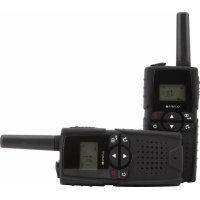
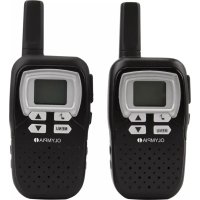
PMR 1410 - Walkie-talkie OLYMPIA - Free user manual and instructions
Find the device manual for free PMR 1410 OLYMPIA in PDF.



| Product type | PMR 446 walkie-talkie |
| Brand | Olympia |
| Model | PMR 1410 |
| Dimensions (L x W x H) | 125 x 55 x 30 mm |
| Weight | 64 g |
| Power supply | 3 rechargeable AAA batteries (1.2 V, 500 mAh) per device |
| Frequency | 446.00625 – 446.09375 MHz |
| Number of channels | 8 |
| Call codes | 38 CTCSS codes, 83 DCS codes |
| Range | Up to 10 km (in open space) |
| Transmission power | < 500 mW PMR |
| Channel spacing | 12.5 kHz |
| Battery life | Up to 8 hours |
| Interfaces | 2.5 mm headphone jack |
| Functions | VOX, Dual Watch, Scan, Roger Beep, Key lock, Auto power off |
| Safety | Use only specified batteries, do not expose to moisture, keep out of reach of children |
| Cleaning | Dry, soft cloth, no solvents |
| Warranty | Return to the store with the purchase receipt |
| Disposal | Device and batteries separately at collection points |
| Box contents | 2 walkie-talkies, 2 belt clips, 2 headsets, charging base, power adapter, 6 AAA batteries, instruction manual |
Frequently Asked Questions - PMR 1410 OLYMPIA
User questions about PMR 1410 OLYMPIA
0 question about this device. Answer the ones you know or ask your own.
Ask a new question about this device
Download the instructions for your Walkie-talkie in PDF format for free! Find your manual PMR 1410 - OLYMPIA and take your electronic device back in hand. On this page are published all the documents necessary for the use of your device. PMR 1410 by OLYMPIA.
USER MANUAL PMR 1410 OLYMPIA
natural_image
Illustration of two walkiehens with visible buttons and display screen (no text or symbols)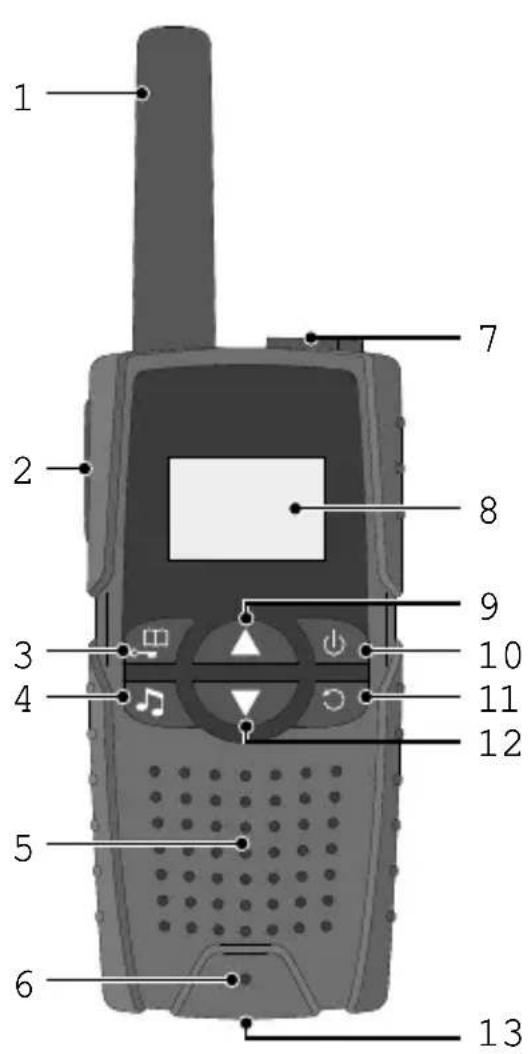
Inhalt
Inserting the Rechargeable Batteries .....14
Charging the Rechargeable Batteries ..... 14
Switching the Walkie-Talkies On ..... 14
Switching the Walkie-Talkies Off ..... 14
Operating the Walkie-Talkies ..... 14
Disposal 17
Technical Data 17
Declaration of Conformity 17
Cleaning 17
Guarantee....17
2 Taste Push-to-Talk
3 Taste Menü
4 Taste Rufton
natural_image
Diagram of a mobile phone with two batteries and a antenna (no text or symbols)natural_image
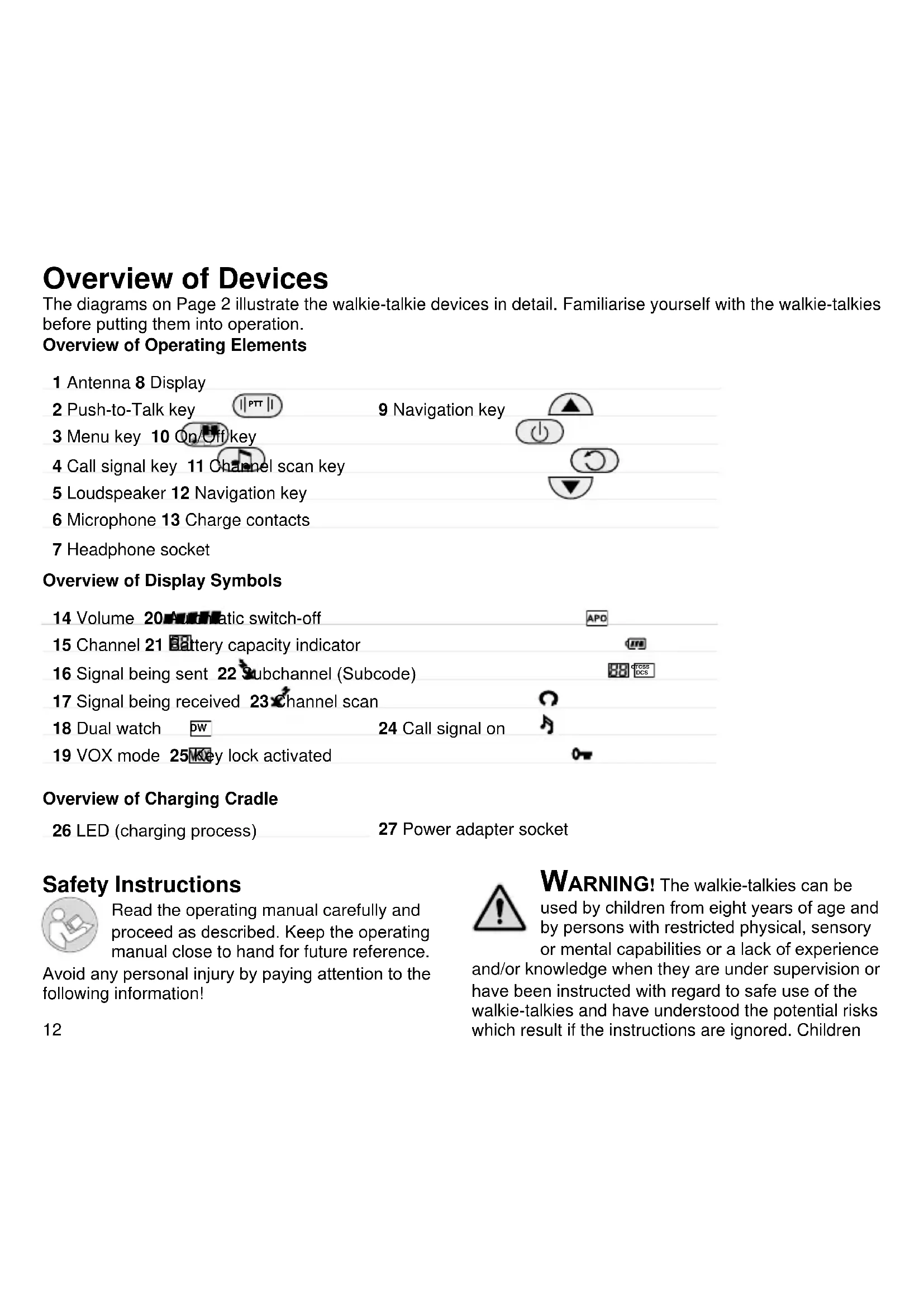
Two identical wireless walkiehios with two speakers and control buttons, each with a downward arrow indicator (no text or symbols on devices)The diagrams on Page 2 illustrate the walkie-talkie devices in detail. Familiarise yourself with the walkie-talkies before putting them into operation.
Overview of Operating Elements
1 Antenna 8 Display
2 Push-to-Talk key
3 Menu key 10 On/Off key
4 Call signal key 11 Channel scan key
5 Loudspeaker 12 Navigation key
6 Microphone 13 Charge contacts
7 Headphone socket
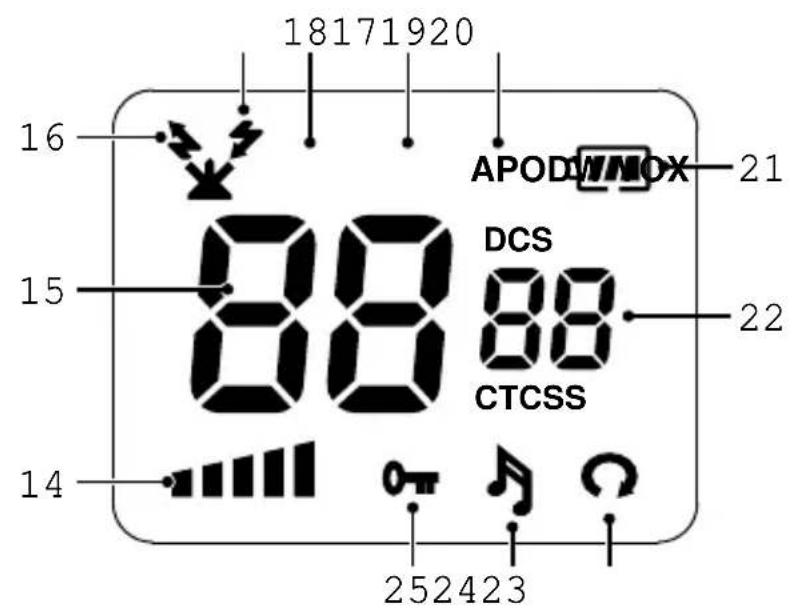
Overview of Display Symbols
14 Volume 20 Automatic switch-off
15 Channel 21 Battery capacity indicator
16 Signal being sent 22 Subchannel (Subcode)
17 Signal being received 23 Channel scan
18 Dual watch DW
19 VOX mode 25Key lock activated
9 Navigation key
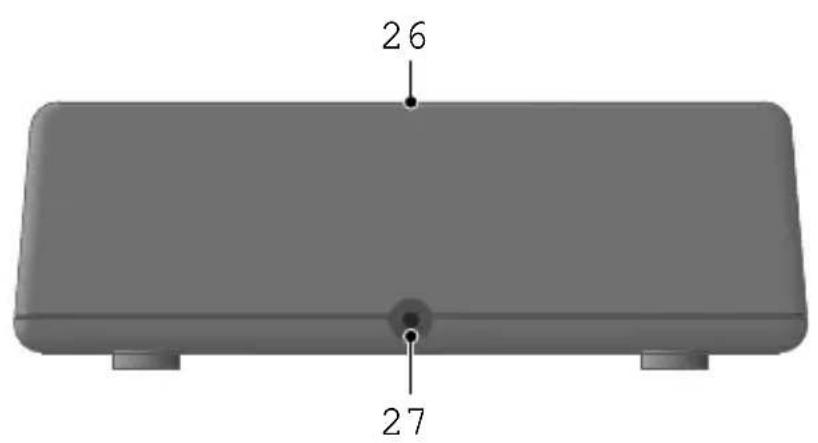
Overview of Charging Cradle
26 LED (charging process)
27 Power adapter socket
Safety Instructions

Read the operating manual carefully and proceed as described. Keep the operating manual close to hand for future reference.
Avoid any personal injury by paying attention to the following information!
WARNING! The walkie-talkies can be used by children from eight years of age and by persons with restricted physical, sensory or mental capabilities or a lack of experience and/or knowledge when they are under supervision or have been instructed with regard to safe use of the walkie-talkies and have understood the potential risks which result if the instructions are ignored. Children
may not be allowed to play with the walkie-talkies. Cleaning and user maintenance may not be completed by children without any supervision.

WARNING! Risk of suffocation! Keep away from children! Keep packaging and protective foils as well as batteries out of reach of children. Keep the walkie-talkies out of reach of children. Small children can swallow small parts. If a battery has been swallowed, seek medical assistance immediately.

CAUTION!
Risk of explosion due to use of the wrong types of battery! Only use rechargeable batteries which comply with the specifications in Section “Technical Data”. NEVER charge standard batteries. Never mix the types of batteries used.

CAUTION! Risk of explosion through improper replacement or removal of the rechargeable batteries! Only replace the batteries with a type approved by the manufacturer and dispose of used batteries according to the applicable laws.

CAUTION! Risk of explosion through improper replacement or removal of the rechargeable batteries! Do not remove the batteries while they are being charged. Disconnect the charging cable from the device or from the charging cradle before changing or removing the batteries.

CAUTION! Voice transmission is played through the loudspeaker. Hold the walkie-talkies about 30 cm away when receiving voice transmissions.

IMPORTANT! Do not use the walkie-talkies in prohibited or potentially explosive areas! Observe local regulations!

IMPORTANT! Protect the walkie-talkies from damp, dust, liquids, chemicals, vapours, heat and direct sunlight. The walkie-talkies are not waterproof; therefore, keep them dry.

IMPORTANT! Do not use the devices in areas where private radio communication is prohibited. Emergency and rescue services cannot be called using these devices.

IMPORTANT! Observe local regulations regarding the use of radio communication equipment before putting the walkie-talkies into operation.
Package Contents
Check the package contents before putting the walkie-talkies into operation. If anything is missing or damaged, please contact our Service department.
2 x walkie-talkies, PMR 1410
2 x belt clips
2 x headsets (2.5 mm port)
Charging cradle
Power adapter
6 x rechargeable batteries (AAA, 1.2 V, 500 mAh)
Operating manual
Intended Use
The walkie-talkies are designed for communication with other walkie-talkies of the same standard (446 MHz PMR). Any other use is considered unintended
use. Unauthorised modification or reconstruction is not permitted. Under no circumstances open the device or complete any repair work yourself.
Inserting the Rechargeable Batteries
Before the walkie-talkies can be used, insert the batteries contained in the walkie-talkie package.
1 Remove the battery compartment cover. Slide the battery compartment cover forward using a little force.

CAUTION!
Risk of explosion due to use of the wrong types of battery! Only use rechargeable batteries which comply with the specifica-
tions in Section "Technical Data". NEVER charge standard batteries. Never mix the types of batteries used.
2 Insert three appropriate batteries in the battery compartment, paying attention to correct polarity.
3 Replace the battery compartment cover. The battery compartment cover latches audibly in place.
Charging the Rechargeable Batteries
You must charge the rechargeable batteries before they lose all their power.
1 Connect the power adapter to an easily accessible power socket in the vicinity.
2 Connect the power adapter to the power connection port in the charging cradle.
natural_image
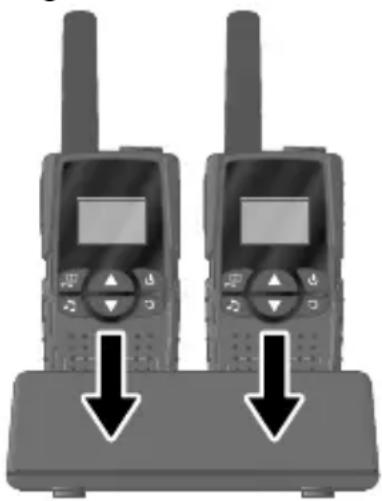
Two identical wireless walkiehios on a base, each with two side antennas and one displaying the screen (no text or symbols visible)3 Place the walkie-talkies in the charging cradle unit. While the batteries are being charged, the control lamps on the front of the charging cradle light up red continually.
4 Remove the walkie-talkies from the charging cradle after 8 hours.
5 Disconnect the power adapter from the power socket.
Switching the Walkie-Talkies On
Press and hold the key for about 3 seconds.
The walkie-talkie is switched on, the display indicates the selected channel 38- volume and current battery capacity
If only one bar is displayed, the batteries are almost empty. Charge the batteries in good time.
Switching the Walkie-Talkies Off
Press and hold the key for about 3 seconds.
The walkie-talkie is switched off and the display goes out.
Operating the Walkie-Talkies
When you want to communicate through the walkie-talkies, you must switch the walkie-talkies on and set them to the same channel.
To ensure a connection is established successfully, the walkie-talkies must be within the reception range. The elements selected in the menu flash when you are defining the respective setting.
Sending and Receiving Signals
1 Press and hold the ||PTT|| key. appears in the display. The walkie-talkie is in Transmit mode.
2 Hold the walkie-talkie close to your mouth and speak into the microphone.
All the walkie-talkies which are within range and are switched to the same channel receive your message.
✗ appears in the display.
3 If you want to answer a signal received, press the ||PTT|| key and speak into the microphone.
Scanning the Channels
Before scanning all the channels to receive possible radio signals within range of your walkie-talkie, ensure that the setting in the Subchannel menu is OF.
1 Press the key The walkie-talkie scans all the channels in succession.
2 If you want to retain a channel, press the key again.

If you want the communicate with others, ensure that all the relevant walkie-talkies communicating with each other are using the same subchannel.
Setting the Channel
The walkie-talkies use free channels. The walkie-talkies within range which are set to the same channel can receive signals. If you do not want to, please observe the information regarding subchannels, inferring that third parties can participate in your communication.
1 Press the key appears in the display.
2 Use the and keys to set the required channel.
3 Confirm your input by pressing the ||PTT|| key.
Setting the Subchannel (Subcode) CTCSS Code
In order to enable communication via a subchannel (CTCSS code), the walkie-talkies communicating with each other must be set to the same channel and same subchannel.
1 Press the key twice. appears in the display.
2 Use the and keys to select the required subchannel.
Select the setting OF if you do not wish to use a subchannel.
DCS Code
In order to enable communication via a subchannel (DCS code), the walkie-talkies communicating with each other must be set to the same channel and same subchannel.
1 Press the key three times. appears for the display.
2 Use the and keys to select the required subchannel.
Select the setting OF if you do not wish to use a subchannel.
Dual Watch
You can use the Dual Watch function when you want to monitor two channels simultaneously.
1 Press the key four times. dw appears in the display.
2 Select the second channel required (in addition to the current one) using the ▲ and ▼ keys.
3 Confirm your input by pressing the ||PTT|| key.
4 If the function is switched on, dw appears in the display continuously. The display shows the selected channels alternately.
VOX Function
You can use the VOX function when the microphone
should be activated automatically on detecting a sound.
You can set one of three different sensitivity levels.
1 Press the key five times. appears in the display.
2 Use the and keys to select the required sensitivity for the microphone.
3 Confirm your input by pressing the ||PTT|| key.
Selecting and Transmitting a Call Signal
Select a call signal and transmit it to get the attention of other walkie-talkie users.
1 Press the key six times.
2 Select one of the 10 call signal tones available using the ▲ and keys.
3 Confirm your input by pressing the ||PTT|| key.
4 If you want to transmit a call signal, press the key. Your call signal is transmitted to the other walkie-talkies.
Setting the Key Tones
You can define whether a tone is issued each time a key is pressed.
1 Press the key seven times.
2 Use the and keys to switch the key tone on or off.
3 Confirm your input by pressing the ||PTT|| key.
Confirmation Signal (Roger Beep)
You can define whether a short confirmation signal (Roger Beep) should be issued at the end of your voice transmission.
1 Press the eight times. ro appears in the display.
2 Use the and keys to switch the roger beep on or off.
3 Confirm your input by pressing the ||PTT|| key.
Automatic Switch-Off
You can define whether the walkie-talkie should be switched off automatically after a certain period of time (1 to 6 hours).
1 Press the key 9 times. appears in the display.
2 Use the and keys to select the required period of time.
3 Confirm your input by pressing the ||PTT|| key. Setting the Volume
You can set the volume of incoming signals when the walkie-talkie is in Standby mode.
Use the ▲ and keys to set the required volume. The volume set appears at the bottom edge of the display. The more bars displayed, the higher the volume.
Time-Out Function
The Time-out function helps to reduce power consumption. This function is automatically activated. If you press the ||PTT|| key for longer than 3 minutes, you will hear an acoustic signal. In this case, release the ||PTT|| key and start communication again.
After using the VOX function and hearing 3 minutes of uninterrupted detection of noise, you will hear an acoustic signal and the VOX function is switched off. Key Lock
You should activate the key lock if you want to prevent activating functions accidentally.
1 Press and hold the 📄 key for 3 seconds. The keys are locked and 🔍 appears in the display.
2 Press and hold the key for 3 seconds again to unlock the keys.
Disposal
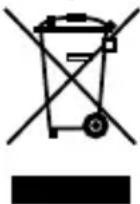
In order to dispose of your device, take it to a collection point provided by your local public waste authorities (e.g. recycling centre). According to laws on the disposal of electronic and electrical devices, owners are obliged to dispose of old electronic and electrical devices in a separate waste container. The symbol indicates that the device must not be disposed of in normal domestic waste!
Risks to health and the environment from
batteries! Remove the batteries from the device before disposing of the device. Never open, damage or swallow batteries or allow them to pollute the environment. They may contain toxic, ecologically hazardous heavy metals. You are legally obliged to dispose of batteries at a battery retailer or in the corresponding containers provided at collection points by local public waste authorities. Disposal is free of charge. The symbol indicates that the batteries must not be disposed of in normal domestic waste and that they must be brought to collection points provided by local public waste authorities.

Packaging materials must be disposed of according to local regulations. Information on Handling Batteries
Properly
Always use batteries of the type stipulated in Section "Technical Data". Never mix the types of batteries used. Remove the batteries in the device will not be used for longer periods.
When the batteries are almost empty, the walkie-talkie issues a warning signal at regular intervals.
Technical Data
See Page 52.
Declaration of Conformity
Olympia Business Systems Vertriebs GmbH, Zum Kraftwerk 1, 45527 Hattingen hereby declares that this device fulfils the requirements and complies with the regulations stipulated in the Directive 2014/53/EU. The CE marks on these devices confirms their conformity.
CE The Declaration of Conformity for product is available at: http://productip.com/?f=59f4f
Cleaning
Clean the surfaces of the housing with a dry, soft, lint-free cloth. Do not use any solvents or cleaning agents.
Guarantee
Dear Customer, we are pleased that you have chosen this equipment. In the case of a defect, please return the device together with the receipt and original packing material to the point-of-sale.
2 Touche Push-to-Talk

9 Touche navigation

natural_image
Diagram of a handheld electronic device with two internal battery cells and a top port (no text or symbols)Charger les piles rechargeables
natural_image
Two identical walkie-talkie devices with black arrows pointing to a base (no text or symbols visible)natural_image
Diagram of a mobile phone with two batteries and a antenna (no text or symbols)natural_image
Two identical mobile phone holders standing on a base, each with a screen and directional arrows indicating status (no text or symbols visible)natural_image
Diagram of a mobile phone casing showing internal battery pack and antenna (no text or symbols)natural_image
Two identical walkie-talkie devices on a base with downward arrows pointing to them (no text or symbols visible)natural_image
Diagram of a mobile phone casing showing internal battery pack and antenna (no text or labels)Oplaadbare batterijen laden
natural_image
Two identical walkie-talkie devices on a base, each with a black arrow pointing to its side (no text or symbols visible)Walkietalkie bedienen
natural_image
Diagram of a mobile phone with two batteries and a antenna (no text or symbols)
natural_image
Two identical walkie-talkie devices on a base, each with a black arrow pointing downward (no text or symbols visible)| Frequencies 446.00625 MHz - 446.09375 Mhz | |
| Channels 8 | |
| Call coding 38 CTCSS codes 83 DCS codes | |
| Range Up to 10 km (in open terrain) | |
| Power supply 3x batteries Type AAA (1.2 V) per device, 7.5 VDC, 400 mA | |
| Transmission power < 500 mW PMR | |
| Channel bandwidth 12.5 kHz | |
| Talk time Up to 8 hours | |
| Dimensions 125 x 55 x 30 mm | |
| Weight 64 g | |
| Ports 2.5 mm headset port |
1 446.00625 5 446.05625
2 446.01875 6 446.06875
3 446.03125 7 446.08125
4 446.04375 8 446.09375
We reserve the rights to make technical modifications and change the contents without notification.
Art. No. 5395 (black) / Version 2017.03
OLYMPIA


- Inhalt
- Overview of Operating Elements
- Overview of Display Symbols
- Overview of Charging Cradle
- Safety Instructions
- CAUTION!
- Package Contents
- Intended Use
- Inserting the Rechargeable Batteries
- Charging the Rechargeable Batteries
- Switching the Walkie-Talkies On
- Switching the Walkie-Talkies Off
- Operating the Walkie-Talkies
- Sending and Receiving Signals
- Scanning the Channels
- Setting the Channel
- Setting the Subchannel (Subcode) CTCSS Code
- DCS Code
- Dual Watch
- VOX Function
- Confirmation Signal (Roger Beep)
- Disposal
- Risks to health and the environment from
- Properly
- Technical Data
- Declaration of Conformity
- Cleaning
- Guarantee
- Charger les piles rechargeables
- Oplaadbare batterijen laden
- Walkietalkie bedienen
Brand : OLYMPIA
Model : PMR 1410
Category : Walkie-talkie