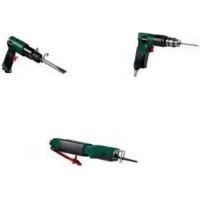
PDMH 4500 A4 - Pneumatic hammer PARKSIDE - Free user manual and instructions
Find the device manual for free PDMH 4500 A4 PARKSIDE in PDF.


| Product type | Pneumatic hammer (chisel hammer) |
| Brand | Parkside |
| Model | PDMH 4500 A4 |
| Maximum working pressure | 6,3 bar |
| Striking rate | 3500 min⁻¹ |
| Chisel holder | 10,2 mm (hexagon) |
| Weight (hammer only) | 1390 g |
| Sound pressure level (L_PA) | 84,2 dB(A) |
| Sound power level (L_WA) | 95,2 dB(A) |
| Vibration emission value (a_h) | 6,14 m/s² |
| Power supply | Compressed air (via compressor) |
| Intended use | Chiseling, tenoning, tile removal, sheet metal cutting, removal of bolts and rivets |
| Included equipment | Point chisel, flat chisel, rivet chisel, cut-off chisel, angle chisel, pneumatic lubricant, tension spring |
| Maintenance | Regular lubrication with pneumatic lubricant; cleaning with a damp cloth |
| Warranty | 3 years (according to conditions) |
| Recommended accessories | Suitable compressor, compressed air hose (inner Ø 10 mm) |
| Safety instructions | Wear hearing protection, goggles, gloves, mask; do not use flammable gases; disconnect before maintenance |
| Chisel type | Hexagon (10,2 mm) |
| Operating conditions | Only in enclosed rooms, private use |
| Lubrication | Daily via pneumatic lubricant (oil mist or 3-5 drops before use) |
Frequently Asked Questions - PDMH 4500 A4 PARKSIDE
User questions about PDMH 4500 A4 PARKSIDE
0 question about this device. Answer the ones you know or ask your own.
Ask a new question about this device
Download the instructions for your Pneumatic hammer in PDF format for free! Find your manual PDMH 4500 A4 - PARKSIDE and take your electronic device back in hand. On this page are published all the documents necessary for the use of your device. PDMH 4500 A4 by PARKSIDE.
USER MANUAL PDMH 4500 A4 PARKSIDE
Operation and Safety Notes Translation of the original instructions
NL BE
Before reading, unfold the page containing the illustrations and familiarise yourself with all functions of the device.
FR DE
GB/IE Operation and Safety Notes Page 19
service.at@cmc-creative.de
service.ch@cmc-creative.de
Telefon: +49 (0) 6894 9989751
Intended use Page 20
Features
Technical Data Page 21
General safety instructions for air tools
General safety rules.. Page 23
Risks due to projected parts. Page 23
Operating hazards.. Page 24
Hazards due to repetitive motions.. Page 24
Risks associated with accessories.. Page 25
Hazards in the work environment.. Page 25
Hazards due to dust and vapours.. Page 25
Noise hazards.. Page 26
Hazard due to vibration.. Page 26
Additional safety instructions for pneumatic power tools.. Page 27
Before using
Start-up Page 27
Chiselling
Changing chisels.
After initial use
Maintenance.. Page 28
Cleaning and Care
Information about warranty and service processing.. Page 28
Warranty terms.. Page 29
Extent of warranty.. Page 29
Processing of warranty claims.. Page 29
Environmental instructions and disposal information
Declaration of Conformity
| The following pictograms are used in these instructions for use / on the equipment: | |||
| ▲WARNING! | Please read the instructions for use! | Never use hydrogen, oxygen, carbon dioxide or other bottled gasses as a power source. | |
| Note Oil daily | |||
| Wear hearing protection! | Wear hearing protection, dust mask, safety glasses and protective gloves. | ||
| Observe the warning and safety instructions! | Compressed air hose | ||
| Caution! Explosion hazard! | Dispose of packaging and device in an environmentally-friendly way! | ||
Pneumatic chipping hammer PDMH 4500 A4
Introduction

Congratulations!
You have chosen high-quality device by our company. Familiarise yourself
with the product before using it for the first time. In addition, please carefully refer to the instructions for use and the safety advice below. Initial operation of this tool must be performed by trained personnel.
KEEP OUT OF THE REACH OF CHILDREN!
Intended use
The chipper is a compressed air operated tool for versatile use. It is suitable e.g. for working in grooves, chipping off tiles or plastering, wall breakthroughs, cutting sheet steel, and chipping off bolts and rivets. This tool is only suitable for indoor use. Keep these instructions in a safe place. When passing this product on to others, please also include all the documents. Any use other than the intended is prohibited and potentially dangerous. Damages resulting from
noncompliance or misuse are not covered by the warranty and are not included in the manufacturer's liability. This device has been designed for household use and may not be used for commercial or industrial purposes.
- Features

Check that all the items are present and that the product is in perfect condition immediately after unpacking. Never use
the product if it is defective.
Air adjusting screw
Plug nipple
3 Trigger
4 Tension spring
5 Moil chisel
6 Flat chisel (universal chisel)
7 Rivet chisel
Slitting chisel (sheet metal chisel)
9 Corner chisel
10 Speciality oil for compressed air
Technical Data
Max. working pressure: 6,3 bar
Percussion rate: 3500 rpm
Chisel holder: 10,2mm
Weight:
Hammer: 1390g
Noise and vibration
Noise and vibration ratings were determined according to EN 15744 and EN 28927-9.
Noise level L_pA : 84.2 dB(A)
Uncertainty K_pA : 3 dB
Sound power level L_WA : 95,2 dB(A)
Uncertainty KWA: 3 dB

Wear hearing protection!
Exposure to noise can cause hearing loss.
Vibration
Vibration emission value a_h = 6,14m / s^2
Uncertainty K = 1,5m / s^2
Additional information
WARNING!
The vibration emission value specified was measured according to a standardised testing method and may vary depending on the method the tool is being used, and in exceptions be higher than the specified value.
The vibration emission value specified can be used to compare tools.
The vibration emission value specified can also serve as a preliminary assessment of the impact.

Generalsafety instructions for air tools
Note: When used in the following text, the terms "compressed air unit" or "device" refer to the compressed air unit specified in these instructions for use.
AWARNING! Basic safety measures must be followed when using compressed air devices to eliminate the risk of fire, electric shock and personal injury. Be sure to read and follow the notices within these instructions for use prior to using the equipment and store them in a safe location. The manufacturer assumes no liability for damages or personal injury resulting from failure to follow these instructions for use.
Persons (including children) who lack the knowledge or experience to use the tool or whose physical, sensory or intellectual capacities are limited must never be allowed to use the tool without supervision or instruction by a person responsible for their safety.
Ensure children do not play with the device.
WARNING! RISK OF INJURY! Before performing maintenance tasks, disconnect the compressed air supply.

EXPLOSION HAZARD! Never use petrol or other flammable liquids to clean the air tool! Sparks could ignite
residual vapours inside the compressed air unit resulting in the compressed air unit exploding. Do not use the device in explosive environments with flammable liquids, gasses or dust. Never work on materials which are or could potentially be highly flammable or explosive.
Only use the equipment in areas of application for which it was designed!
Do not overburden the device.
Never use hydrogen, oxygen, carbon dioxide or other bottled gasses to power this tool as doing so may result in an explosion and thus may cause severe injuries.
Regularly maintain and clean the device as specified (see chapters "Maintenance" and "Cleaning and care").
Inspect the device for any damage before use. Always make sure that the device is in perfect condition each time before use.
Always be attentive! Unexpected movement of the device may cause hazards.
Avoid placing your body in an unnatural position. Keep proper footing and balance at all times. By doing this you will be in a better position to
General safety instructions for air tools
control the compressed air unit in unforeseen circumstances.
Do not use any device if its switch is defective. A device that can no longer be switched on and off is dangerous and must be repaired.
Store the device out of the reach of children when it is not in use. Do not let anyone use the device if he or she is not familiar with it or has not read the instructions and advice. Compressed air units are dangerous when they are used by inexperienced people.
Maintain the device carefully. Check that moving device parts are working properly and move freely. Check for any parts that are broken or damaged enough to detrimentally affect the functioning of the device. Have damaged parts repaired before using the device. Many accidents have their origins in poorly maintained devices.
Switch the device off if you do not use it anymore.
Always wear personal protective equipment and safety glasses. Wearing personal protective equipment such as dust mask, non-slip safety shoes, safety helmet or ear protectors, depending on the type of air tool and its application, reduces the risk of injuries.
Check the connections and supply lines. All maintenance devices, couplings and hoses must be equipped to meet the pressure and air amounts specified in the device specific values. Pressure that is too low influences the functioning of the device; pressure that is too high can cause damage to property and personal injury.
Protect hoses from kinks, constrictions, solvents and sharp edges. Keep hoses away from heat, oil and rotating parts.
Make sure that the hose clamps are always tightly fastened. If the hose clamps are not tightly fastened or are damaged, the air could escape uncontrollably.
Replace damaged hoses immediately. A damaged supply line may result in the air hose flapping about and may result in injuries.
If the power cable of the appliance is damaged, it has to be replaced by the manufacturer or its service department or a similarly qualified person in order to avoid hazards.
Do not use the device when tired or under the influence of drugs, alcohol or medications. One moment of carelessness when using the device may result in serious injuries.
Do not directly inhale the exhaust air. Keep exhaust air away from the eyes. Exhaust air from the air tool may contain water, oil, metal particles or contaminants from inside the compressor. This may damage your health.
A WOAKSHUT WHEN PUT
AWDANEROFSTAB
TING THE TOOL DOWN! Always put down the device so it does not come into contact with the trigger. This could potentially result in accidental activation of the device, which again could result in hazards.
Only use suitable accessories. These may be purchased from the manufacturer. Using non-OEM accessories may result in hazards.
Only use filtered and regulated compressed air. Dust, caustic vapours and / or moisture may damage the motor of the compressed air tool.
The hose must be designed for pressures of at least 8,6 bar or 125 PSI, but at least 150% of the maximum pressure generated in the system.
The tool and supply line must be equipped with a hose coupling to completely release pressure when disconnecting the coupling hose.
DANGER! Avoid contact with live lines. This device is not insulated against electric shock.
WARNING! RISK OF INJURY! High working pressures can give rise to recoil forces that under certain conditions can result in danger from continuous loading.
If you are inexperienced in the use of this type of device, you should seek training on how to handle it safely.
WOUNDS! Do not treat an injection as a simple cut. A high pressure jet may inject toxins into the body and cause serious injuries. If the spray is injected into the skin, seek medical help immediately.
Do not modify this device in any way without the manufacturer's approval.
Only use the compressed air unit with the specified pressure (6,3 bar).
General safety instructions for air tools / General safety rules
Disconnect the compressed air unit from the air supply after each use and when not in use.
Do not use the compressed air unit if it is not air tight or in need of repair.
Never connect the compressed air unit to an air hose with pressure exceeding 6,3 bar.
- Keep your working area clean and well lit. Untidy or poorly lit working areas can result in accidents. Doing so will allow you better control of the device, particularly under unforeseen circumstances.
AWARNING!he equipment
repaired by qualified specialist personnel using OEM spare parts. This will maintain the safety of the device.
- Keep children and other persons away from the device during use. Distractions can cause you to lose control of the device.
Wear suitable clothing. Do not wear loose clothing or jewellery. Keep your hair, clothing and gloves clear of moving parts. Loose clothing, jewellery or long hair can become trapped in moving parts.
Put down trigger and device in the event of unexpected compressor failure.
If possible, use a condensate trap or regularly drain the hoses and pipes of condensate (water) before and whilst using compressed air units.

TENTION! An undersized compressed air system may minimise the efficiency of your device.

General safety rules
For multiple hazards, read and understand the safety instructions before installing, operating, repairing, maintaining, changing accessories on, or working near the non-rotary percussive power tool. Failure to do so can result in serious bodily injury.
Only qualified and trained operators should install, adjust or use the non-rotary percussive power tool.
Do not modify this non-rotary percussive power tool. Modifications can reduce the
effectiveness of safety measures and increase the risks to the operator.
Do not discard the safety instructions; give them to the operator.
Do not use the non-rotary percussive power tool if it has been damaged.
Tools shall be inspected periodically to verify the ratings and markings required by this part of ISO 11148 are legibly marked on the tool. The employer / user shall contact the manufacturer to obtain replacement marking labels when necessary.
Never modify the product. Modifications reduce the effectiveness of safety measures and increase the risk of injuries.
Never use a damaged device.
Use and maintain the device as recommended in the instructions for use to minimise dust or gasses, noise and vibration.
Do not use the device in idle to prevent the chisel from ejecting uncontrolled.
Use the consumables and the inserted tool as specified in the instructions for use to minimise dust or gasses, noise and vibration.
Regularly maintain the device to verify all required rated values and markings such as rated speed or rated air pressure, required by ISO 11148, are legible on the device. If necessary, the user must contact the manufacturer for replacement labels for markings.
Risks due to projected parts
Disconnect the non-rotary percussive power tool from the energy source when changing inserted tool or accessories.
Be aware that failure of the workpiece, or accessories, or even of the inserted tool itself can generate highvelocity projectiles.
Always wear impact-resistant eye protection during the operation of the non-rotary percussive power tool. The grade of protection required should be assessed for each use.
For overhead work, wear a safety helmet.
The risks to others should also be assessed at this time.
General safety rules
Ensure that the workpiece is securely fixed.
Never operate a tool unless the inserted tool is retained in the tool with a proper retainer.
To avoid injury, retainer parts shall be replaced when they become worn, cracked or distorted.
Hold the inserted tool firmly against the work surface before starting the tool.
- Disconnect the compressed air supply and depressurise the device before maintaining, repairing or transporting the device, or changing the chisel.
Please remember, pieces of the tool, accessories, or the chisel being used can shoot off very quickly whilst chiselling.
Always wear impact-resistant goggles. The level of required protection required should be assessed individually for each application.
When working overhead, a safety helmet must be worn. Also remember the risk to others due to parts of the workpiece falling.
Make sure the workpiece is well secured.
Verify the chisel being used is attached securely.
Only use a fitting tension spring (included). Replace the tension spring when worn, broken or bent, to prevent injuries.
Hold the chisel being used up to the workpiece before starting the device.
Only use the recommended lubricant (see "Cleaning and care").
- Operating hazards
Use of the tool can expose the operator's hands to hazards, including impacts, cuts and abrasions and heat. Wear suitable gloves to protect the hands.
Operators and maintenance personnel shall be physically able to handle the bulk, weight and power of the tool.
Hold the tool correctly; be ready to counteract normal or sudden movements and have both hands available.
- Maintain a balanced body position and secure footing.
Release the start-and-stop device in the case of an interruption of the energy supply.
Use only lubricants recommended by the manufacturer.
Avoid direct contact with the inserted tool during and after use as it can become hot.
Personal protective safety glasses shall be used; suitable gloves and protective clothing are recommended.
Using the device can result in bruises, abrasion, cuts and burns. Wear suitable gloves to protect hands.
The operator must be physically capable to handle the size, weight and power of the device.
Unexpected device movement or the chisel breaking can result in serious accidents. Therefore always mind a secure and strong position to ensure you are able to control the device and maintain your working stance in the event of unexpected movement.
Release the trigg if the air supply is interrupted.
Wear the respective protective clothing when working with the chipper, especially impact-proof goggles, hearing protection and safety gloves.
bizards due to repetitive motions
When using a non-rotary percussive power tool to perform work-related activities, the operator can experience discomfort in the hands, arms, shoulders, neck or other parts of the body.
While using a non-rotary percussive power tool, the operator should adopt a comfortable posture while maintaining a secure footing and avoiding awkward off-balanced postures. The operator should change posture during extended tasks, which can help avoid discomfort and fatigue.
If the operator experiences symptoms, such as persistent or recurring discomfort, pain, throbbing, aching, tingling, numbness, burning sensations or stiffness, these warning signs should not be ignored. The operator should tell the employer and consult a qualified health professional.
Using the chipper can result in discomfort in the hands, arms, shoulders, neck or other body parts.
Ensure a comfortable posture whilst using the device and change it to prevent discomfort.
Risks associated with accessories
Stop using the device if you experience numbness, tingling, pain or lightening of the skin of the fingers or hands, and consult a physician.
Disconnect the non-rotary percussive power tool from the energy supply before changing the inserted tool or accessory.
Use only sizes and types of accessories and consumables that are recommended by the non-rotary percussive power tool manufacturer; do not use other types or sizes of accessories and consumables.
For hammers, where appropriate, never use any chisel as a hand-struck tool. They are specifically designed and heat-treated for use only in non-rotary percussive power tools.
For hammers and breakers, where appropriate, never use blunt chisels, as they require excessive pressure and can break from fatigue. Blunt tool-pieces can increase vibration and, therefore, sharp tools should always be used.
For hammers, where appropriate, never cool a hot accessory in water. Brittleness and early failure can result.
For hammers, where appropriate, chisel breakage or tool damage can result from misuse of using the tool as a lever, e.g. prising. Take smaller "bites" to avoid getting stuck.
Avoid direct contact with the inserted tool during and after use, as it can be hot or sharp.
ATTENTION! Disconnect the device from the air supply before performing maintenance or cleaning.
Only use the manufacturer recommended sizes and types of accessories and consumables.
Do not use the chisel as a hand-held tool. They were developed specifically for use with the a chipper.
Only use sharp chisels, as dull chisels require more pressure and could break as well as increase vibration.
Do not cool hot tools in water. Doing so may result in damage.
Do not use the chisels as hand-held tools.
Never use the chisel whilst or after operating the device. The fingers or hands could be injured. The chisel can get very hot.
Do not use defective devices. Replace defective parts to prevent injuries.
Hazards in the work environment
Slips, trips and falls are major causes of workplace injury. Be aware of slippery surfaces caused by use of the tool and also of trip hazards caused by the air line or hydraulic hose.
Proceed with care in unfamiliar surroundings. Hidden hazards, such as electricity or other utility lines, can exist.
The non-rotary percussive power tool is not intended for use in potentially explosive atmospheres and is not insulated against coming into contact with electric power.
Make sure there are no electrical cables, gas pipes, etc., that can cause a hazard if damaged by use of the tool.
Slipping, tripping and falling are the main causes of injuries at the workplace. Be aware of slippery areas caused by use of the device, as well as tripping hazards caused by the air hose.
Beware of hidden hazards such as electric cables, or gas- and water lines.
This device is not insulated against electric shock. Avoid any contact with electric cables. This device is not suitable for use in explosive environments.
This device is not suitable for use in explosive areas: using this device can produce sparks. Therefore never use this device near combustible materials, fluids or gasses.
Hazards due to dust and vapours
Dust and fumes generated when using non-ro-tary percussive power tools can cause ill health (for example cancer, birth defects, asthma and / or dermatitis); risk assessment and implementation of appropriate controls for these hazards are essential.
General safety rules
Risk assessment should include dust created by the use of the tool and the potential for disturbing existing dust.
Operate and maintain the non-rotary percussive power tool as recommended in the instructions handbook, to minimize dust or fume emissions.
Direct the exhaust so as to minimize the disturbance of dust in a dust-filled environment.
Where dust or fumes are created, the priority shall be to control them at the point of emission.
All integral features or accessories for the collection, extraction or suppression of airborne dust or fumes should be correctly used and maintained in accordance with the manufacturer's instructions.
Select, maintain and replace the consumable, inserted tool as recommended in the instructions, to prevent an unnecessary increase in dust or fumes.
Use respiratory protection in accordance with employer's instructions and as required by occupational health and safety regulations.
Depending on the material you are working on, dust and gasses produced can be hazardous to the health of the operator (e.g. cancer, birth defects, asthma and / or dermatitis).
Be aware, air emitted must raise as little dust as possible.
Wear a dust mask meant for the application and the generally applicable safety rules!
- Noise hazards
Exposure to high noise levels can cause permanent, disabling hearing loss and other problems, such as tinnitus (ringing, buzzing, whistling or humming in the ears). Therefore, a risk assessment and implementation of appropriate controls for these hazards are essential.
Appropriate controls to reduce the risk may include actions, such as damping materials to prevent workpieces from "ringing".
Use hearing protection in accordance with employer's instructions and as required by occupational health and safety regulations.
Operate and maintain the non-rotary percussive power tool as recommended in the instructions
handbook, to prevent an unnecessary increase in noise levels.
Select, maintain and replace the consumable / inserted tool as recommended in the instructions handbook, to prevent an unnecessary increase in noise.
If the non-rotary percussive power tool has a silencer, always ensure it is in place and in good working order when the non-rotary percussive power tool is operating.
Noise can cause permanent hearing damage. Unprotected exposure to high noise levels can result in permanent hearing loss and other problems such as tinnitus, (ringing, buzzing, whistling or humming in the ears). Wear hearing protection.
Observe the maintenance and operating instructions in the instructions for use to keep the noise and vibration generated as low as possible. Vibration reducing material as a pad, e.g. when processing sheet steel, can also reduce noise.
Hazard due to vibration
Exposure to vibration can cause disabling damage to the nerves and blood supply of the hands and arms.
Wear warm clothing when working in cold conditions and keep your hands warm and dry.
If you experience numbness, tingling, pain or whitening of the skin in your fingers or hands, stop using the non-rotary percussive power tool, tell your employer and consult a physician.
Operate and maintain the non-rotary percussive power tool as recommended in the instructions handbook, to prevent an unnecessary increase in vibration.
Do not hold the inserted tool with the free hand, as this increases vibration exposure.
Hold the tool with a light but safe grip, taking account of the required hand reaction forces, because the risk from vibration is generally greater when the grip force is higher.
Keep suspended handles in the central position and avoid pushing the handles into the end stops.
For breakers, cut small "bites" of concrete to prevent the tool from jamming.
For breakers, move the cutting tool every few seconds. Stop the breaker when lifting the tool to change position, because vibration is high when pulling up on the handles.
Exposure to vibration may cause damage to the nerves and disturb blood circulation in hands and arms.
warm clothing and keep your hands warm and dry when working in cold environments.
Stop using the device if you experience numbness, tingling, pain or lightening of the skin of the fingers or hands, and consult a physician.
Do not hold the tool being used with the free hand, as this will increase vibration.
Before using
Additional safety instructions for pneumatic power tools
Air under pressure can cause severe injury:
- always shut off air supply, drain hose of air pressure and disconnect tool from air supply when not in use, before changing accessories or when making repairs;
- never direct air at yourself or anyone else.
Whipping hoses can cause severe injury. Always check for damaged or loose hoses and fittings.
Cold air shall be directed away from hands.
Do not use quick-disconnect couplings at tool inlet. Use hardened steel (or material with comparable shock resistance) threaded hose fittings.
Whenever universal twist couplings (claw couplings) are used, lock pins shall be installed and whipcheck safety cables shall be used to safeguard against possible hose-to-tool and hose-to-hose connection failure.
Do not exceed the maximum air pressure stated on the tool.
Never carry an air tool by the hose.
Check the device and tools before every use, including checking the speed and the vibration level.
Screw the included plug nipple into the air connection after first wrapping the thread with 2-3 layers of sealing tape.
Insert the respective chisel into the hex collet of the chipper. First guide insert the square chisel into the tension spring. Then slide the tension spring over the chisel.
Tighten the tension spring all the way onto the thread of the cylinder. When doing so, hold the tension spring on the front retainer.
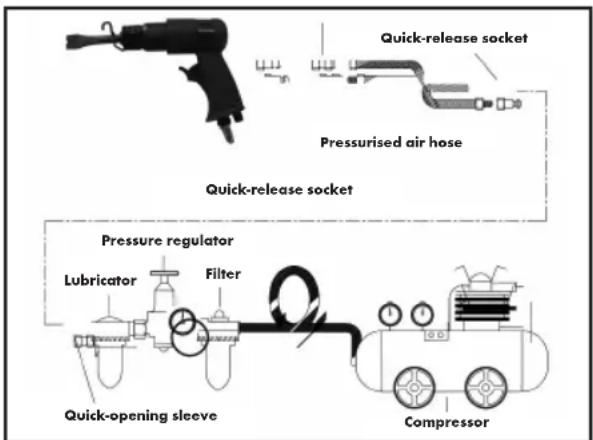
Connect the chipper to a compressor or compressed air supply with suitable output. When doing so, use a flexible air hose (inside 10mm with quick coupler (see picture shown above).
Be sure the air adjusting screw 1 is set to allow air to pass through.
- Start-up
Chiselling (see Fig. B / C)
Bring the chipper to the object you wish to work on.
Activate the trigg to start the chipper.
Release the trigg to switch the chipper off.
.../ After initial use / Maintenance / Cleaning .../ Information about warranty...
- Changing chisels
Disconnect the device from the compressed air source to change the chisel.
Turn the tension spring off the chipper cylinder, holding it by the rear bracket.
Now replace the chisel.
After initial use
Once the task has been finished the equipment must be disconnect from the compressed air supply.
- Maintenance
ATTENTION! Disconnect the device from compressed air before performing maintenance.
Observe the specified maintenance instructions to ensure a long life and proper operation of this quality product.
Check the speed and the oscillation level of the device after each use. When performing maintenance work, please ensure the appropriate protective clothing and accessories are used (ear protection, dust mask, safety goggles and protective gloves).
Your chipper working properly for a long time requires regular lubrication.
Only use speciality oil for compressed air, which is included. Speciality oil for compressed air is also available from speciality retailers.
Note: Use environmentally safe oil for compressed air if the device is used outside of workshops.
You may ensure this in any of the following ways:
With an oil-fog lubricator
Install a complete maintenance unit with oil-fog lubricator between the compressed air source and the chipper. A maintenance unit is available from speciality retailers and is not included.
Manually
Add 3-5 drops of speciality oil for compressed air to the compressed air connection before every use of the compressed air tool.
If the air tool has not been used for several days you must add 5-10 drops of oil to the compressed air connection before powering on the equipment.

Note: Regular lubrication is essential to ensure the longest possible life for your compressed air equipment.
The inside of the tool does not have any other tools which require maintenance.
Only store the product in dry rooms.
- Cleaning and Care
ATTENTION! Disconnect the device from compressed air before cleaning or caring for the device.
Do not use cleaners or solvents; these could affect the plastic parts of the device. Ensure that no water can penetrate the housing.
Clean the tool after finishing work.
- Keep safety devices, venting slots and the motor housing as dust and dirt free as possible.
- Rub the device down with a clean cloth or blow out with compressed air at a low pressure setting.
Regularly clean the device with a damp cloth and a little soft soap.
Occasionally lightly grease the chisel shaft with regular grease.
Information about warranty and service processing
Creative Marketing Consulting GmbH warranty
Dear customer, the warranty for this device is 3 years from the date of purchase. In the event of product defects, you have legal rights against the retailer of this product.
Your statutory rights are not limited in any way by our warranty detailed below.
Warranty terms
The warranty period begins on the date of purchase. Please retain the original receipt safely. This document is required as your proof of purchase.
Should this device show any fault in materials or manufacture within three years from date of purchase, it will be repaired or replaced - at our choice - by us free of charge. This warranty is conditional on the defective device and the proof of purchase (receipt) being presented within the three year warranty period, and that there is a brief written description of the nature of the defect and of the date it arose.
If the defect is covered by our warranty, we will return the repaired device or replacement thereof. A repair or exchange of the device does not extend a new warranty period.
- Extent of warranty
The appliance has been manufactured to strict quality guidelines and meticulously examined before delivery. The warranty applies to faults in material or manufacture. This warranty does not apply to product parts subject to normal wear and tear and which can therefore be considered as wear items, or to damage to fragile parts, e.g. switches, storage batteries or glass parts.
This warranty becomes void if the device has been damaged or improperly used or maintained. All instructions provided in the instructions for use must be followed strictly to constitute proper use of the product. Purposes and practices which the instructions for use warn of or advise against must be avoided without fail.
This product is intended for private, non-commercial use only. Any incorrect or improper use of the device, use of force and changes not performed by our authorized service branch will void the warranty.
- Processing of warranty claims
Please follow the instructions below to ensure quick processing of your claim:
When inquiring about your product please have your receipt and product number (e.g. IAN) ready as your proof of purchase.
The product number can be found on the type plate, an engraving, the cover page of your instructions (bottom left) or the decal at the back or bottom.
In the event of malfunctions or other defects, please first contact the service department below by phone or e-mail.
A product recorded as defective, along with the proof of purchase (sales receipt) and a description of the defect and when it occurred, can then be returned free of charge to you to the service address provided.

Note:
Visit www.lidl-service.com to download this and many other manuals, product videos and software.
How to contact us:
GB,IE
Name: C. M. C. GmbH
Website: www.cmc-creative.de
E-mail:service.gb@cmc-creative.de
Phone:0-808-189-0652
(standard German landline rates apply)
Fax: 0-808-189-0652
Registeredoffice:Germany
IAN 285212
Please note that the following address is not a service address.
Please first contact the service point named above.
Address:
C. M. C. GmbH
Katharina-Loth-Str. 15
66386 St. Ingbert
GERMANY
Environmentalinstructions and disposal information
Don't waste, recycle!

Device, accessories and packaging should be recycled in an environmentally friendly manner.
Do not dispose of the air tool with your household waste, or throw into fire or water. If possible, non-operational equipment should be recycled. Contact your local retailer for information.
- Quality Control Manager -
Declaration of Conformity (C)
We,
C. M. C. GmbH
Responsible for documentation: Marc Uhle
declare in our sole responsibility that the product
Pneumatic chipping hammer
Item number: 2055
Year of manufacture: 2017 / 34
IAN:285212
Model: PARKSIDE PNEUMATIC CHIPPING HAMMER PDMH 4500 A4
meets the basic safety requirements of European Directives
Machinery Directive
EC Directive 2006/42/EC
and its amendments.
The conformity assessment is based on the following harmonised standards:
EN ISO 11148-4:2012
Introduction
Directive relative aux machines
Directive CE 2006/42/CE