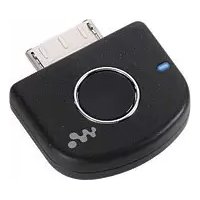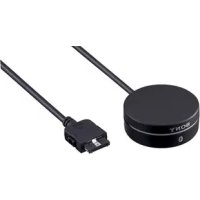
TDMBT10 - Bluetooth Receiver SONY - Free user manual and instructions
Find the device manual for free TDMBT10 SONY in PDF.


| Product type | Wireless Bluetooth receiver |
| Brand | Sony |
| Model | TDM-BT10 |
| Dimensions | 44 mm diameter × 16 mm height |
| Weight | 55 g (cable included) |
| Power supply | 5 V DC, 0.1 A via DIGITAL MEDIA PORT |
| Bluetooth version | 2.0 + EDR |
| Compatible Bluetooth profiles | A2DP, AVRCP |
| Maximum range | Approx. 10 m (depending on obstacles) |
| Frequency band | 2.4 GHz (2.4000 - 2.4835 GHz) |
| Modulation method | FHSS |
| Supported audio codec | SBC |
| Content protection | SCMS-T |
| DMPORT cable length | Approx. 1 m |
| Main functions | Pairing with up to 8 devices, wireless music listening, play/pause/skip control via the AV system |
| Care and cleaning | Clean with a soft, dry cloth. Do not use solvents. |
| Safety | Do not expose to rain or moisture. Do not place liquid containers. Keep away from heat sources. |
| Spare parts and repairability | Contact the nearest Sony dealer for any repairs. |
| General information | Complies with directive 1999/5/EC. Do not use within 20 km of Ny-Ålesund, Svalbard. |
Frequently Asked Questions - TDMBT10 SONY
User questions about TDMBT10 SONY
0 question about this device. Answer the ones you know or ask your own.
Ask a new question about this device
Download the instructions for your Bluetooth Receiver in PDF format for free! Find your manual TDMBT10 - SONY and take your electronic device back in hand. On this page are published all the documents necessary for the use of your device. TDMBT10 by SONY.
USER MANUAL TDMBT10 SONY
GB Operating Instructions
FR Mode d'emploi
©2008 Sony Corporation
WARNING
To reduce the risk of fire or electric shock, do not expose this apparatus to rain or moisture.
The unit is not disconnected from the AC power source (mains) as long as the connected AV system is connected to the wall outlet.
The nameplate is located on the bottom exterior.
Do not install the appliance in a confined space, such as a bookcase or built-in cabinet.
To prevent fire or shock hazard, do not place objects filled with liquids, such as vases, on the apparatus.
Install this system so that the power cord can be unplugged from the wall socket immediately in the event of trouble.
Notice for customers: the following information is only applicable to equipment sold in countries applying EU directives
The manufacturer of this product is Sony Corporation, 1-7-1 Konan Minato-ku Tokyo, 108-0075 Japan. The Authorized Representative for EMC and product safety is Sony Deutschland GmbH, Hedelfinger Strasse 61, 70327 Stuttgart, Germany. For any service or guarantee matters please refer to the addresses given in separate service or guarantee documents.
For the customers in Europe
C
Hereby, Sony Corporation declares that this TDM-BT10 Bluetooth Wireless Audio Adapter is in compliance with the essential requirements and other relevant provisions of Directive 1999/5/ EC. For details, please access the following URL: http://www.compliance.sony.de/
Use of this radio equipment is not allowed in the geographical area within a radius of 20km from the centre of Ny-Alesund, Svalbard in Norway.
The Bluetooth word mark and logos are owned by the Bluetooth SIG, Inc. and any use of such marks by Sony Corporation is under license. Other trademarks and trade names are those of their respective owners.
Electrical & Electronic Equipment (Applicable in the European Union and other European countries with
separate collection systems)
This symbol on the product or on its packaging indicates that this product shall not be treated as household waste. Instead it shall be handed over to the applicable collection point for the recycling of electrical and electronic equipment. By ensuring this product is disposed of correctly, you will help prevent potential negative consequences for the environment and human health, which could otherwise be caused by inappropriate waste handling of this product. The recycling of materials will help to conserve natural resources. For more detailed information about recycling of this product, please contact your local Civic Office, your household waste disposal service or the shop where you purchased the product.
Table of Contents
Features 4
How to use the unit 5
Getting Started
Unpacking 6
Location of parts 6
Connecting to an AV system .7
Pairing 8
What is pairing? 8
Using the Unit
Listening to music 11
Controlling the Bluetooth audio source device -AVRCP 13
Additional Information
Precautions 14
Troubleshooting 16
What is Bluetooth technology? 18
Initializing 19
Specifications 20
Features
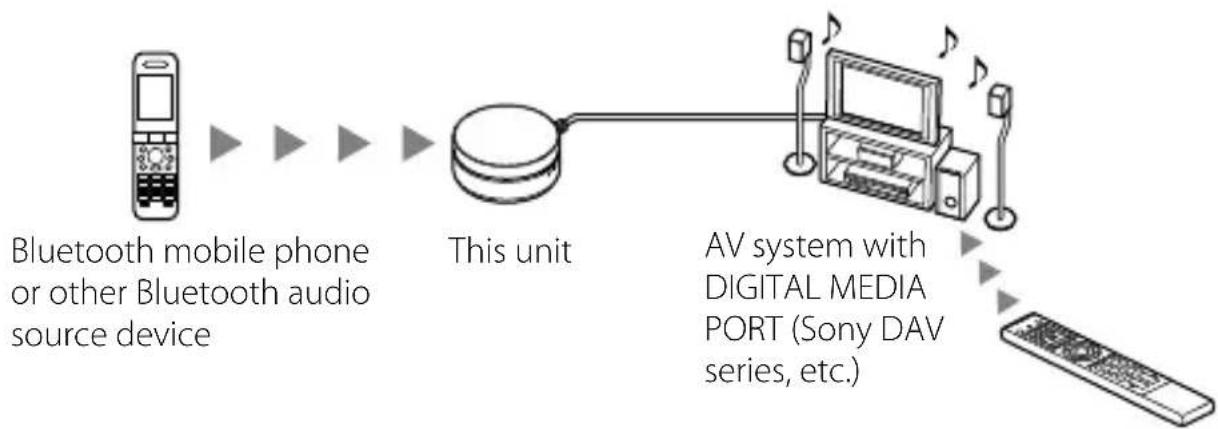
You can enjoy music, using Bluetooth wireless technology, played on a Bluetooth audio source device (mobile phone, digital music player, etc.) ^*1 , by connecting this unit to an AV system with a DIGITAL MEDIA PORT (DMPORT) jack.
- You can operate your Bluetooth audio source device via Bluetooth connection with the control buttons on the AV system and those of the remote supplied with the AV system for basic operation (play, stop, etc.).*2
- This unit supports Bluetooth version 2.0 + EDR (Enhanced Data Rate) for higher quality audio with less interference and lower power consumption.
Example
1 Bluetooth audio source devices to be connected with this unit are required to support A2DP (Advanced Audio Distribution Profile).
2 Bluetooth audio source devices to be connected with this unit are required to support AVRCP (Audio/Video Remote Control Profile).
Notes
- DIGITAL MEDIA PORT is occasionally abbreviated as DMPORT.
- For details on how to operate the devices to be connected, refer to the operating instructions supplied with each device.
- For details regarding compatible Bluetooth devices, visit the following URL.
Customers in Europe http://support.sony-europe.com
How to use the unit
1. Pairing
Register a Bluetooth mobile phone and this unit with each other.
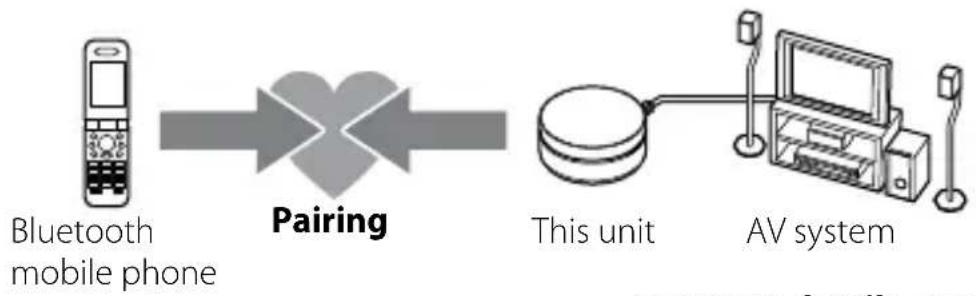
For more details, see page 8.

2. Bluetooth connection
Operate the Bluetooth mobile phone to make the Bluetooth connection.
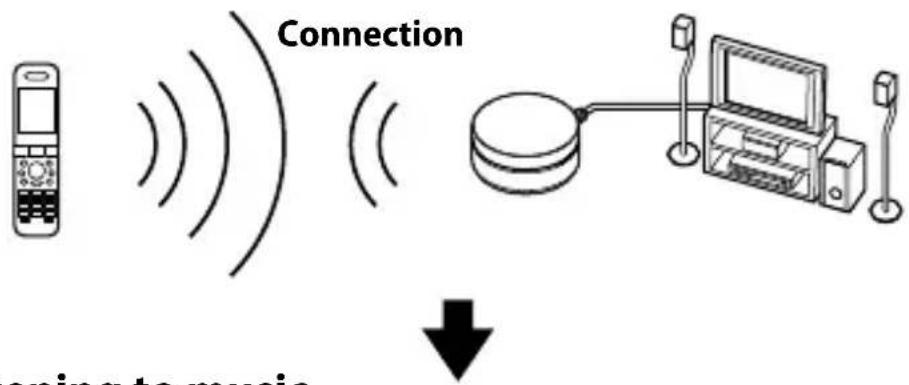
3. Listening to music
Enjoy listening to music played on a Bluetooth mobile phone through an AV system connected to this unit. Playback, stop, or pause operation is possible with the control buttons on the connected AV system and those of the remote supplied with the AV system.
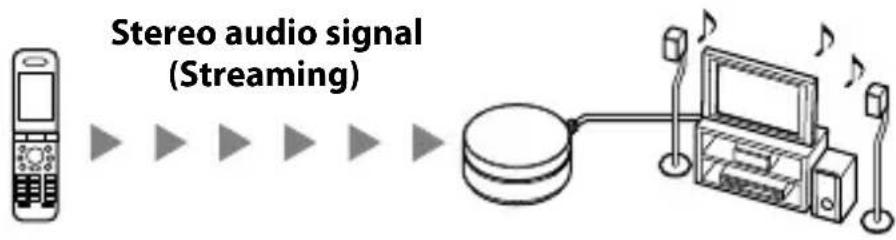
For more details, see page 11.
Unpacking
- Bluetooth Wireless Audio Adapter (1)
- Operating Instructions (1)
Location of parts
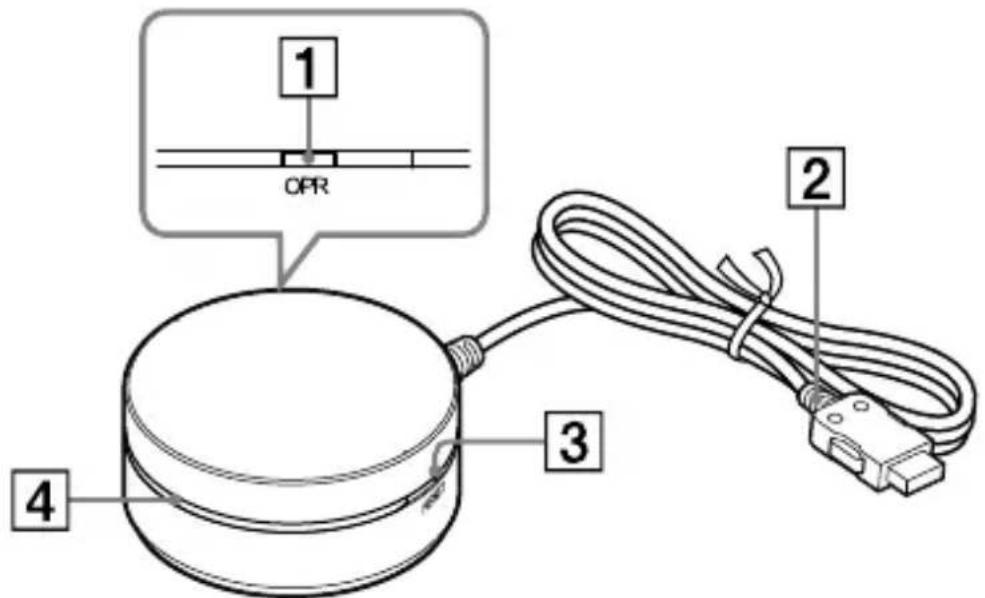
1 OPR button (page 8, 12)
2 DIGITAL MEDIA PORT cable (page 7)
3 RESET button (page 19)
4 Status indicator
Status Status indicator
Ready Lights up for 2 seconds, and then turns off
Pairing mode Flashes very quickly*
Connection possible Flashes slowly*
Connecting Constantly on
Disconnecting Flashes quickly*
Connecting to an AV system
1 Connect the DIGITAL MEDIA PORT cable of this unit to the DIGITAL MEDIA PORT (DMPORT) jack of an AV system. Make sure the AV system is turned off before connecting.
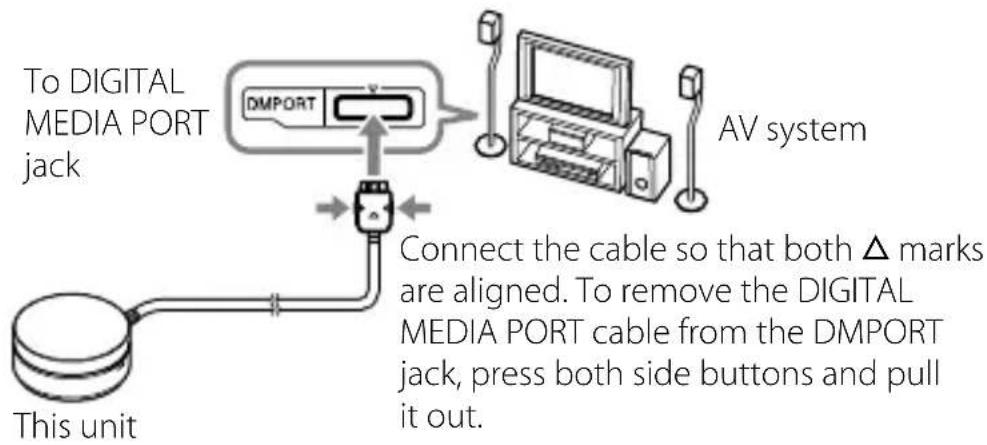
2 Turn on the AV system connected to this unit, and select the DIGITAL MEDIA PORT function.
The indicator lights up for 2 seconds to indicate "Ready."
For details on how to select the DIGITAL MEDIA PORT function, refer to the operating instructions supplied with the AV system.
Pairing
What is pairing?
Bluetooth devices need to be "paired" with each other beforehand. Once Bluetooth devices are paired, there is no need for pairing again, except in the following cases:
- Pairing information is deleted after repair, etc.
- This unit can be paired with up to 8 Bluetooth audio source devices. If a new device is paired thereafter, the device with the oldest registration among the 8 paired devices is replaced by the new one.
- This unit is initialized (page 19). All pairing information is deleted.
Check that the DMPORT function is selected at the connected AV system before operating the unit.
1 Press and hold the OPR button for 3 seconds or more.
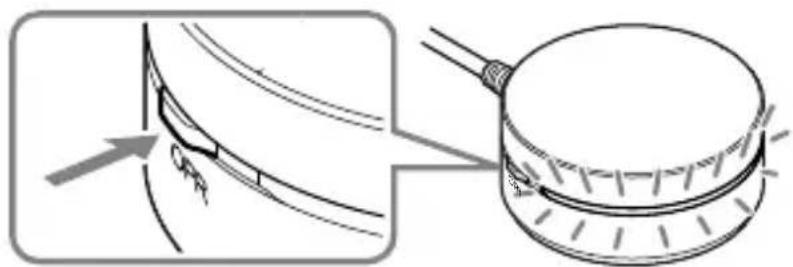
The indicator starts flashing very quickly and this unit enters pairing mode.
Note
Pairing mode is canceled automatically if pairing is not achieved within 5 minutes, or manually by pressing the OPR button. If pairing mode is canceled midway, start over from step 1.
2 Perform pairing procedure on the Bluetooth audio source device to detect this unit.
The list of detected devices appears on the display of the Bluetooth audio source device.
This unit is displayed as "TDM-BT10."
If "TDM-BT10" is not displayed, repeat from step 1.
Notes
- When pairing, be sure to place both the Bluetooth devices within 1m of each other.
- Some devices cannot display the list of detected devices.
- To operate the Bluetooth audio source device, refer to the operating instructions of the device.
3 Select "TDM-BT10" on the display of the Bluetooth audio source device.
4 If Passkey* input is required on the Bluetooth audio source device, input "0000".
When Bluetooth pairing is complete, the indicator flashes slowly and pairing information is memorized on this unit.
- Passkey may be called "Passcode," "PIN code," "PIN number," or "Password."
5 Start the Bluetooth connection from the Bluetooth audio source device.
Some Bluetooth audio source devices may connect with the unit automatically when pairing is completed.
Note
If you disconnect this unit or the Bluetooth audio source device, before a connection is complete, pairing information is not memorized, and pairing will not be completed.
When pairing with a Bluetooth audio source device that cannot display a list of detected devices or that has no display
You may pair the device by setting both this unit and the Bluetooth audio source device to pairing mode. For details, refer to the operating instructions supplied with the device.
If pairing is not complete
Start over from step 1.
Note
Passkey of this unit is fixed to "0000". This unit cannot be paired with a Bluetooth audio source device whose Passkey is not "0000".
Tip
To pair with other Bluetooth audio source devices, repeat steps 1 to 5 for each device.
Listening to music
This unit supports the SCMS-T content protection method. You can listen to music or audio content protected by this method when the connected Bluetooth audio source device supports the SCMS-T content protection.
Check the following before operating the unit.
- The Bluetooth audio source device is turned on.
- Pairing of this unit and the Bluetooth audio source device is complete.
-
The Bluetooth audio source device supports the transmitting music function (profile: A2DP*).
-
For detail on profiles, see page 18.
-
The DMPORT function is selected at the connected AV system.
1 Check to see if the indicator flashes slowly, indicating connection is possible.
Note
If the indicator turns off, press the OPR button momentarily, or perform the pairing procedure again.
2 Start the Bluetooth connection from the Bluetooth audio source device.
To operate the Bluetooth audio source device, refer to the operating instructions of the device.
3 Start music playback on the Bluetooth audio source device.
Note
After connection is complete, the indicator becomes constantly on.
To finish connecting
Terminate the Bluetooth connection by any of the operations below.
- Operate the Bluetooth audio source device to terminate the connection. For details, refer to the operating instructions supplied with the device.
- Turn off the Bluetooth audio source device or the AV system.
- Press the OPR button momentarily. When the disconnection is complete, the indicator flashes slowly.
Note
In the following cases, you need to make the Bluetooth connection again.
- The Bluetooth connection is disconnected once.
- The power of the Bluetooth audio source device does not turn on, or the Bluetooth signal is off.
- The Bluetooth audio source device is in sleep mode.
- The Bluetooth connection has not been established.
To turn off the Bluetooth signal
Even if you stop Bluetooth communication with the Bluetooth audio source device, this unit continues to send out signals. You can stop the signal completely by the operations below.
- When the indicator is on (When the Bluetooth connection is established): Press momentarily the OPR button to stop Bluetooth communication with the Bluetooth audio source device. (The indicator flashes.) Then press momentarily the OPR button again to turn off the signal from the unit. (The indicator turns off.)
- When the indicator is flashing (When the Bluetooth connection is possible): Press momentarily the OPR button to turn off the signal from the unit. (The indicator turns off.)
Controlling the Bluetooth audio source device - AVRCP
If the Bluetooth audio source device connected with this unit supports AVRCP (Audio/Video Remote Control Profile), you can operate the Bluetooth audio source device with the control buttons on the AV system and those of the remote supplied with the AV system.
Refer to the operating instructions supplied with the Bluetooth audio source device on how to operate it.
Note
Operation of the Bluetooth audio source device by this unit will vary depending on its specification.
Button Function
| Start playback | |
| Pause/Stop | |
| Short Press of | Skip to previous/next |
| Long Press of | Fast-rewind/Fast-forward |
| Fast-rewind/Fast-forward | |
Depending on the Bluetooth audio source devices, the operation may differ.
Precautions
- Bluetooth wireless technology operates within a range of about 10m . Maximum communication range may vary depending on obstacles (person, metal, wall, etc.) or electromagnetic environment.
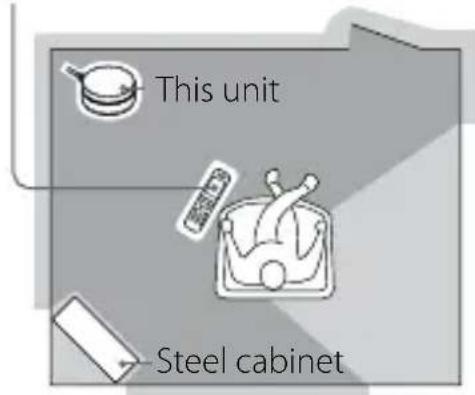
Bluetooth audio source device
Optimal performance
Limited performance
The following conditions may affect the sensitivity of Bluetooth communication.
There is an obstacle such as a person, metal, or wall between this unit and Bluetooth audio source device.
- A device using 2.4 GHz frequency, such as a wireless LAN device, cordless telephone, or microwave oven, is in use near this unit.
- This unit is installed horizontally on a desk made of steel.
-
Because Bluetooth devices and wireless LAN (IEEE802.11b/g) use the same frequency, microwave interference may occur and resulting in communication speed deterioration, noise, or invalid connection if this unit is used near a wireless LAN device. In such a case, perform the following.
-
Use this unit at least 10m away from the wireless LAN device.
- If this unit is used within 10m of a wireless LAN device, turn off the wireless LAN device.
-
Install this unit and Bluetooth audio source device as near to each other as possible.
-
Microwaves emitting from a Bluetooth device may affect the operation of electronic medical devices. Turn off the AV system connected to this unit and other Bluetooth devices in the following locations, as it may cause an accident.
where inflammable gas is present, in a hospital, train, airplane, or a gas (petrol) station
- near automatic doors or a fire alarm
Refer to "To turn off the Bluetooth signal" (page 12) for further details regarding how to quit Bluetooth connection of this unit.
- This unit supports security capabilities that comply with the Bluetooth standard to provide a secure connection when the Bluetooth wireless technology is used, but security may not be enough depending on the setting. Be careful when communicating using Bluetooth wireless technology.
- We do not take any responsibility for the leakage of information during Bluetooth communication.
-
Connection with all Bluetooth devices cannot be guaranteed.
-
A device featuring Bluetooth function is required to conform to the Bluetooth standard specified by Bluetooth SIG, and be authenticated.
Even if the connected device conforms to the above mentioned Bluetooth standard, some devices may not be connected or work correctly, depending on the features or specifications of the device. -
Depending on the device to be connected, it may require some time to start communication.
On safety
- Do not drop, hit, or otherwise expose the unit to strong shock of any kind. This could damage the product.
- Do not disassemble or attempt to open any parts of the unit.
On placement
-
Do not place the unit in any of the following locations.
-
Direct sunlight, near a heater, or other extremely high-temperature location
Dusty location - An unsteady or inclined surface
- Location exposed to large amounts of vibration
- Bathroom or other high-humidity location
In a car subject to the direct rays of the sun
Notes when using with a mobile phone
- You cannot use this unit to talk over the telephone, even if the Bluetooth connection between this unit and a mobile phone is established.
- For details on operation of your mobile phone when receiving a telephone call while transmitting music using the Bluetooth connection, refer to the operating instructions supplied with the mobile phone.
Others
- If you have any questions or problems concerning this unit that are not covered in this manual, please consult your nearest Sony dealer.
- Should any problem persist, consult your nearest Sony dealer.
Troubleshooting
If you run into any problems using this unit, use the following checklist. Should any problem persist, consult your nearest Sony dealer.
No sound
Check the connection between this unit and the AV system.
Check that both this unit and the Bluetooth audio source device are turned on.
Ensure that this unit is not too far from the Bluetooth audio source device, or this unit is not receiving interference from a wireless LAN, other 2.4 GHz wireless device, or microwave oven.
Check that the Bluetooth connection is established properly between this unit and the Bluetooth audio source device.
Turn up the volume of the AV system.
Turn up the volume of the Bluetooth audio source device as high as possible to the extent that sound is not distorted. For details on volume adjustment, refer to the operating instructions supplied with the Bluetooth audio source device.
Pair this unit and the Bluetooth audio source device again.
Check that music is being played on the Bluetooth audio source device.
Low sound level
Turn up the volume of the Bluetooth audio source device as high as possible to the extent that sound is not distorted. For details on volume adjustment, refer to the operating instructions supplied with the Bluetooth audio source device.
Turn up the volume of the AV system.
Distorted sound
Turn off the bass boost function or equalizer function of the Bluetooth audio source device.
Turn down the volume of the Bluetooth audio source device to the point where the sound is no longer distorted. For details, refer to the operating instructions supplied with the Bluetooth audio source device.
Sound skips or the correspondence distance is short.
If a device that generates electromagnetic radiation, such as a wireless LAN, other Bluetooth device(s), or a microwave oven is nearby, move away from such sources.
Remove any obstacle between this unit and the Bluetooth audio source device or move away from the obstacle.
Locate this unit and the Bluetooth audio source device(s) as near as possible.
Re-position this unit.
Re-position the Bluetooth audio source device.
Pairing cannot be done.
Bring this unit and the Bluetooth audio source device closer together.
Verify Bluetooth audio source device has passkey of "0000".
Turn off the Bluetooth function of all other unused Bluetooth device(s).
The Bluetooth audio source device cannot connect to this unit.
Turn off the Bluetooth function of all other unused Bluetooth device(s).
Sound is delayed.
If you watch a TV or a DVD through Bluetooth connection via this unit, sound may lag behind the picture.
What is Bluetooth technology?
Bluetooth wireless technology is a short-range wireless technology that enables wireless data communication between digital devices, such as a mobile phone or digital music player. Bluetooth wireless technology operates within a range of about 10m
Connecting two devices as necessary is common, but some devices can be connected to multiple devices at the same time.*
You do not need to use a cable for connection since Bluetooth technology is a wireless technology, nor is it necessary for the devices to face one another, such as the case with infrared technology. For example, you can use such a device in a bag or pocket. Bluetooth wireless technology is a global standard supported by thousands of companies. These companies produce products that meet the global standard.
- This unit cannot be connected to multiple devices at the same time.
Communication system and compatible Bluetooth profile of this unit
Profile is standardization of the function for each Bluetooth device specification. This unit and the Bluetooth audio source device need to support the following Bluetooth version and profiles to work together:
Communication system: Bluetooth Specification version 2.0 + EDR
Compatible Bluetooth profiles:
- A2DP (Advanced Audio Distribution Profile)
AVRCP (Audio/Video Remote Control Profile)
Initializing
You can reset this unit to its default setting and delete all pairing information.
1 If the Bluetooth connection has been established between this unit and the Bluetooth audio source device, press the OPR button to stop Bluetooth communication with the Bluetooth audio source device.
2 Use a thin pointed object (such as a paper clip) to press the RESET button to initialize this unit.
The indicator flashes twice, and this unit is reset to the default. All pairing information is deleted.
Specifications
General
Communication system
Bluetooth Specification version 2.0+ EDR (Enhanced Data Rate)
Output
Bluetooth Specification Power Class 2
Maximum communication range
Line of sight approx. 10m^*1
Frequency band
2.4 GHz band (2.4000 GHz - 2.4835 GHz)
Modulation method
FHSS
Compatible Bluetooth profiles*2
A2DP (Advanced Audio Distribution Profile)
AVRCP (Audio/Video Remote Control Profile)
Supported CODECs\*3
SBC^*4 , MP3
Supported content protection method
SCMS-T
Transmission range (A2DP)
20 - 20,000Hz (Sampling frequency 44.1kHz )
DIGITAL MEDIA PORT connector
18 pin
DIGITAL MEDIA PORT cable length
Approx. 1m
Power requirements
DC 5 V, 0.1 A (via DIGITAL MEDIA PORT)
Dimensions
Approx. dia. 44 × 16 ~mm high
Mass
Approx. 55g (including cable)
1 The actual range will vary depending on factors such as obstacles between devices, magnetic fields around a microwave oven, static electricity reception sensitivity, antenna's (aerial) performance, operating system, software application, etc.
^2 Bluetooth standard profiles indicate the purpose of Bluetooth communication between devices.
^3 Codec: Audio signal compression and conversion format
4 Subband Codec
MPEG Layer-3 audio coding technology and patents licensed from Fraunhofer IIS and Thomson.
"DIGITAL MEDIA PORT" and "DMPORT" are names for the standard specification used to connect various portable audio devices to AV products from Sony Corporation.
Design and specifications are subject to change without notice.
AVENTISSEMENT
- A2DP (Advanced Audio Distribution Profile)
AVRCP (Audio/Video Remote Control Profile)
Initialisation
Specifications Bluetooth version 2.0+ EDR (Enhanced Data Rate)
Sortie
Specifications Bluetooth Power Class 2
Distance de communication maximum
A2DP (Advanced Audio Distribution Profile)
AVRCP (Audio/Video Remote Control Profile)
Codes pris en charge*3
SBC^*4 , MP3
- A2DP (Advanced Audio Distribution Profile)
AVRCP (Audio/Video Remote Control Profile)
Inicializacion
- EDR (Enhanced Data Rate)
Salida
A2DP (Advanced Audio Distribution Profile)
AVRCP (Audio/Video Remote Control Profile)
Códecscompatables\*3
SBC^*4 , MP3
Conector DIGITAL MEDIA PORT
18 pines
- A2DP (Advanced Audio Distribution Profile)
AVRCP (Audio/Video Remote Control Profile)
Initialisieren
A2DP (Advanced Audio Distribution Profile)
AVRCP (Audio/Video Remote Control Profile)
- A2DP (Advanced Audio Distribution Profile)
AVRCP (Audio/Video Remote Control Profile)
Initialisatie
U kunt dit apparaat terugzetten op de standardinstelling en alle koppelingsgegevens wissen.
EDR (Enhanced Data Rate)
Uitvoer
Bluetooth-specificatie Power Class 2
Maximaalcommunicatiebereik
Ca. 10m zonder obstakels*
Frequentieband
2,4 GHz band (2,4000 GHz -
2,4835 GHz)
Modulatiemethode
FHSS
Compatible Bluetooth-profielen*2
A2DP (Advanced Audio Distribution Profile)
AVRCP (Audio/Video Remote
Control Profile)
Ondersteunde CODECs\*3
SBC^*4 , MP3
Ondersteunde
gegevensbeveiligingsmethode
SCMS-T
Transmissiebereik (A2DP)
20 - 20.000Hz (samplefrequentie
44,1 kHz)
- A2DP (Advanced Audio Distribution Profile)
AVRCP (Audio/Video Remote Control Profile)
Inizializzazione
Specifica Bluetooth Power Class 2
A2DP (Advanced Audio Distribution Profile)
AVRCP (Audio/Video Remote Control Profile)
Codec supportat*3
SBC^*4 , MP3
- A2DP (Advanced Audio Distribution Profile)
AVRCP (Audio/Video Remote Control Profile)
Återställning
Bluetooth-specification version 2.0+ EDR (Enhanced Data Rate)
Utmating
Bluetooth-specification effektklass 2
Maximal
A2DP (Advanced Audio Distribution Profile)
AVRCP (Audio/Video Remote Control Profile)
Stödda codes\*3
SBC^*4 , MP3
- A2DP (Advanced Audio Distribution Profile)
AVRCP (Audio/Video Remote Control Profile)
Inicjalizacja
A2DP (Advanced Audio Distribution Profile)
AVRCP (Audio/Video Remote Control Profile)
Obstugiwane kodeki*3
SBC^*4 , MP3
Obslugiwana metoda ochrypraw autorskich
SCMS-T
Zlácze DIGITAL MEDIA PORT
18-stykowe
Dlugosc kabla DIGITAL MEDIA PORT
W przybliz. 1 m
Zasilanie
Parring kan/DDfores.
- A2DP (Advanced Audio Distribution Profile)
AVRCP (Audio/Video Remote Control Profile)
Initialising
Bluetooth-specification version 2.0+ EDR (Enhanced Data Rate)
Udgang
Bluetooth-specification effektklasse 2
Maksimal
A2DP (Advanced Audio Distribution Profile)
AVRCP (Audio/Video Remote Control Profile)
Understegtede codecs\*3
SBC^*4 , MP3
- A2DP (Advanced Audio Distribution Profile)
AVRCP (Audio/Video Remote Control Profile)
Alustaminen
A2DP (Advanced Audio Distribution Profile)
AVRCP (Audio/Video Remote Control Profile)
Tuetut koodekit\*3
SBC^*4 MP3
- A2DP (Advanced Audio Distribution Profile)
AVRCP (Audio/Video Remote Control Profile)
Initializar
A2DP (Advanced Audio Distribution Profile)
AVRCP (Audio/Video Remote Control Profile)
Codes suportados\*3
SBC^*4 , MP3
Conector DIGITAL MEDIA PORT
18 pinos